Introduction
Many businesses choose an eCommerce platform based on pricing, popularity, or ease of setup, and later realize the platform cannot support their growth. Slow performance, limited customization, poor third-party integrations, checkout restrictions, and migration costs often become major operational problems as the business scales.
This is why choosing an eCommerce platform should be treated as a long-term business decision, not just a website decision. The right platform affects everything from customer experience and SEO performance to inventory management, omnichannel selling, operational efficiency, and future scalability.
For example, a startup may prioritize speed and simplicity, while an enterprise business may need advanced integrations, multi-store management, custom workflows, or B2B functionality. Similarly, brands planning international expansion often require stronger scalability, localization support, and flexible architecture from the beginning.
The challenge is that every platform comes with tradeoffs. Shopify offers ease of management, Magento provides deep customization, WooCommerce delivers flexibility for WordPress users, and BigCommerce supports growing businesses with built-in features. Without a proper eCommerce platform comparison strategy, businesses often choose platforms that fit their current needs but fail to support long-term growth.
A successful eCommerce platform selection process should evaluate scalability, customization flexibility, SEO capabilities, integrations, security, mobile performance, operational complexity, and future business goals together, not individually.
In this eCommerce platform selection guide, we will explain how to choose the right eCommerce platform for your business, compare leading eCommerce solutions, explore essential eCommerce platform features, and help decision-makers identify which platform aligns best with their growth strategy.
Why Choosing the Wrong eCommerce Platform Becomes Expensive Later
Many businesses choose an eCommerce platform based on current needs. The real problems usually appear later when the business starts scaling.
Scalability Problems
A platform that works for 500 monthly orders may struggle with 50,000. Common issues include:
- Slow website speed
- Checkout failures
- Poor mobile performance
- Inventory sync delays
- Server limitations during high traffic
These problems directly affect conversions and customer experience.
Limited Customization Flexibility
As businesses grow, they often require:
- Custom checkout experiences
- Subscription models
- B2B pricing structures
- Multi-vendor functionality
- Advanced customer journeys
Not every eCommerce platform supports deep customization. Businesses then depend heavily on plugins or expensive workarounds.
Expensive Third-Party Dependencies
Some eCommerce platforms require multiple paid apps for basic operational needs. This increases:
- Monthly operational costs
- Maintenance complexity
- Compatibility risks
- Performance issues
Over time, managing plugins becomes difficult and expensive.
Integration Challenges
Modern eCommerce operations rely on:
- ERP systems
- CRMs
- Inventory tools
- Payment gateways
- Shipping platforms
- Marketing automation software
Choosing an eCommerce platform with weak integration capabilities creates manual workflows and operational inefficiencies.
SEO & Performance Limitations
Many businesses ignore technical SEO during eCommerce platform selection. Poor platform architecture can limit:
- Page speed optimization
- Schema control
- URL flexibility
- Content management
- Mobile experience
This affects organic traffic growth and search visibility later.
Costly Platform Migration
Migration from the wrong eCommerce platform is rarely simple. Businesses often lose:
- SEO rankings
- Customer data accuracy
- Operational continuity
- Development budgets
- Time
Large migrations can become significantly more expensive than choosing the right platform initially.
The Bigger Business Risk
The wrong eCommerce platform not only creates technical issues. It can slow down:
- Business scalability
- Operational efficiency
- Customer experience improvements
- International expansion
- Revenue growth
This is why choosing the right eCommerce platform should always be treated as a long-term business decision, not just a website setup task.
Key Business Questions to Answer Before Choosing an eCommerce Platform
Before comparing platforms, businesses should first evaluate their own operational and growth requirements. A platform that works for one business model may become a limitation for another.
The goal of choosing an eCommerce platform is not finding the most popular option. It is finding the platform that aligns with your business strategy.
What Type of eCommerce Business Are You Running?
Different business models require different eCommerce capabilities.
For example:
- DTC brands focus heavily on customer experience and conversions
- B2B businesses require custom pricing and account-based workflows
- Marketplaces need vendor management features
- Enterprise brands require scalability and advanced integrations
Your business model should influence the entire eCommerce platform selection process.
How Fast Do You Plan to Scale?
Some platforms are designed for quick launches, while others support large-scale operations more effectively.
Ask questions like:
- How many products will you manage?
- How much traffic do you expect?
- Will order volumes increase rapidly?
- Are you planning international expansion?
Scalability should always be part of your eCommerce platform comparison strategy.
Do You Need Advanced Customization?
Many growing businesses eventually require:
- Custom checkout flows
- Personalized user experiences
- Subscription systems
- Advanced inventory logic
- Unique backend workflows
Not all eCommerce platforms offer the same development flexibility. This is especially important for businesses planning long-term digital growth.
What Integrations Will Your Business Need?
Modern eCommerce stores rarely operate independently. Most businesses rely on:
- ERP systems
- CRM platforms
- Payment gateways
- Shipping providers
- Marketing tools
- Analytics platforms
Choosing an eCommerce platform with strong integration capabilities helps avoid operational bottlenecks later.
Who Will Manage the eCommerce Platform?
Technical complexity varies significantly across platforms.
Some platforms are easier for internal teams to manage, while others need businesses to hire eCommerce developers for continuous support. Consider:
- Technical expertise available internally
- Content management needs
- Operational workflows
- Maintenance requirements
This helps businesses choose the right eCommerce platform based on team capabilities.
What Customer Experience Do You Want to Deliver?
Customer expectations continue to evolve rapidly. Businesses should evaluate whether the platform supports:
- Mobile-first shopping experiences
- Fast checkout processes
- Omnichannel selling
- Personalized experiences
- Multilingual support
- Multi-currency functionality
Customer experience directly affects conversions and long-term retention.
Are You Evaluating Long-Term Costs Properly?
Many businesses only compare upfront pricing. However, total eCommerce platform costs may include:
- Subscription fees
- Transaction charges
- Plugin costs
- Hosting expenses
- Development costs
- Maintenance expenses
- Scaling infrastructure
A proper eCommerce platform selection guide should always evaluate long-term ownership costs instead of only initial setup budgets.
Why These Questions Matter
Businesses often choose eCommerce platforms before fully understanding their future operational needs.
Answering these questions early helps decision-makers:
- Avoid expensive migrations
- Improve scalability planning
- Reduce operational inefficiencies
- Choose platforms aligned with business growth
This creates a more strategic and future-ready eCommerce platform selection process.
Must-Have eCommerce Platform Features Businesses Should Compare
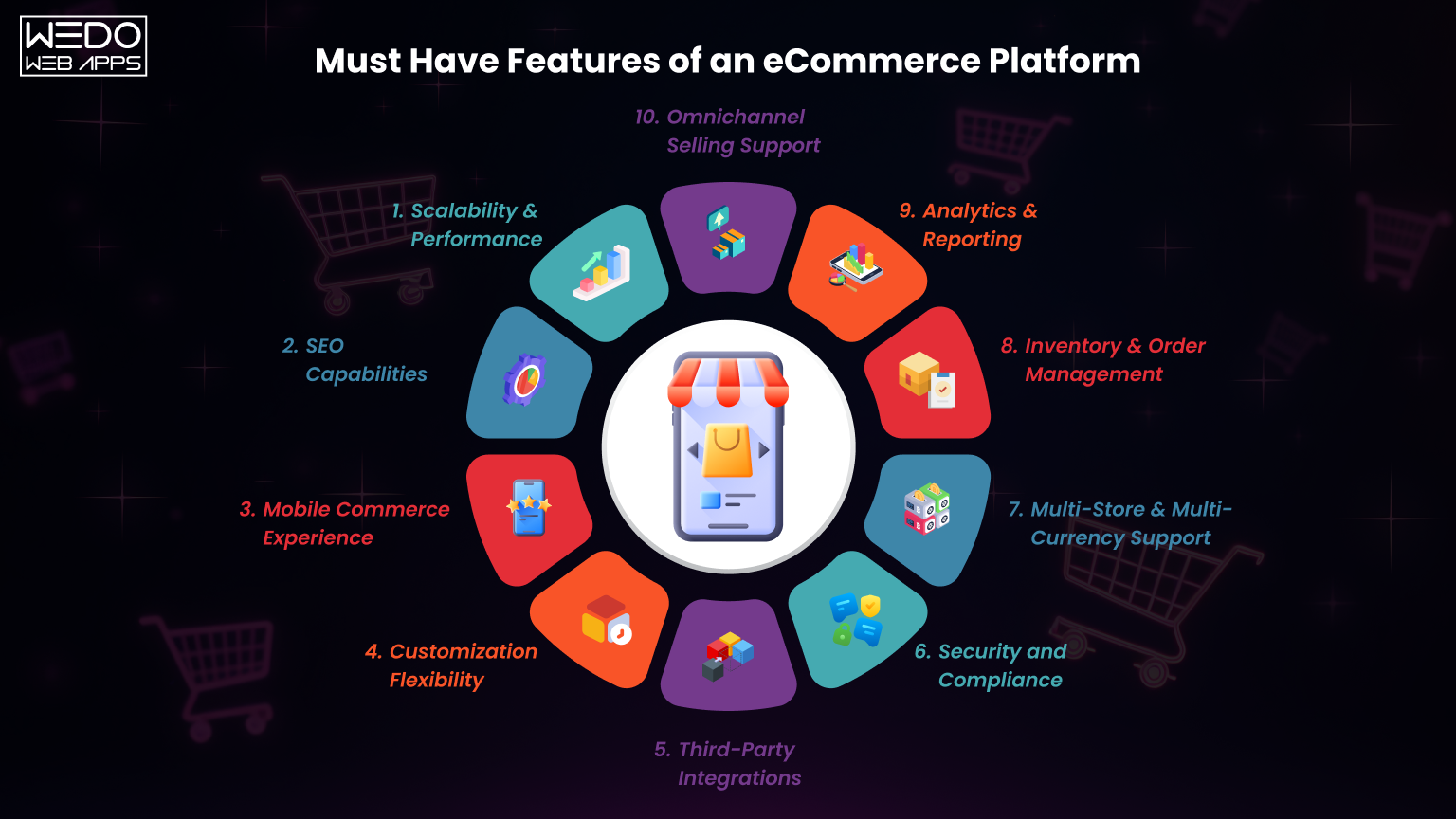
Choosing an eCommerce platform without comparing core features can create major operational limitations later. Businesses should evaluate platforms based on scalability, flexibility, performance, and long-term growth support, not just design templates or pricing.
Below are the most important eCommerce platform features businesses should compare before making a decision.
Scalability & Performance
A growing business needs a platform that can handle:
- Increasing traffic
- Large product catalogs
- High order volumes
- Seasonal sales spikes
Poor scalability often leads to slow performance and checkout issues during growth periods.
SEO Capabilities
SEO plays a major role in long-term eCommerce growth. An eCommerce platform should support:
- Customizable URLs
- Schema markup
- Meta tag control
- Page speed optimization
- Mobile responsiveness
- Clean site architecture
Weak SEO functionality can limit organic traffic growth.
Mobile Commerce Experience
Most eCommerce traffic now comes from mobile devices. Businesses should compare:
- Mobile page speed
- Responsive design support
- Mobile checkout experience
- App-like shopping experiences
Mobile performance directly impacts conversions and customer retention.
Customization Flexibility
Every business eventually develops unique operational requirements. Strong eCommerce platforms should support:
- Custom workflows
- Advanced checkout experiences
- Personalized user journeys
- Custom product configurations
- API-based development
Customization flexibility becomes increasingly important as businesses scale.
Third-Party Integrations
Modern eCommerce businesses rely on multiple software systems. An eCommerce platform should integrate smoothly with:
- CRM systems
- ERP software
- Inventory management tools
- Shipping providers
- Payment gateways
- Marketing automation platforms
Poor integrations often create manual operational work.
Security and Compliance
Security is critical for customer trust and business continuity. Businesses should evaluate:
- PCI compliance
- Secure payment processing
- Data protection features
- User access controls
- Fraud prevention capabilities
Security limitations can create long-term business risks.
Multi-Store & Multi-Currency Support
Businesses planning international growth need flexible expansion capabilities. Important features include:
- Multilingual support
- Multi-currency checkout
- Regional pricing management
- Country-specific storefronts
- Centralized store management
Not every eCommerce platform handles global scaling efficiently.
Inventory & Order Management
Operational efficiency depends heavily on backend functionality. Businesses should compare:
- Inventory synchronization
- Warehouse management
- Order processing automation
- Return management
- Product catalog management
These features become critical for scaling eCommerce operations.
Analytics & Reporting
Data-driven decision-making is essential for eCommerce growth. A strong eCommerce platform should provide insights into:
- Sales performance
- Customer behavior
- Conversion rates
- Inventory trends
- Marketing performance
Advanced reporting helps businesses optimize operations and revenue growth.
Omnichannel Selling Support
Modern eCommerce businesses sell across multiple channels. Platforms should support:
- Marketplaces
- Social commerce
- Mobile apps
- Physical retail integration
- Third-party sales channels
Omnichannel functionality improves customer reach and operational consistency.
Why Feature Comparison Matters
Many businesses choose eCommerce platforms based on short-term convenience instead of long-term operational requirements.
A proper eCommerce platform features comparison helps businesses:
- Avoid scalability limitations
- Improve operational efficiency
- Reduce future development costs
- Support long-term growth strategies
The right platform should not only support your current business needs, it should also support where your business plans to go next.
eCommerce Platform Comparison: Shopify vs Magento vs WooCommerce vs BigCommerce
Every eCommerce platform offers different strengths, limitations, and scalability capabilities. The right choice depends on your business model, operational complexity, technical requirements, and long-term growth plans.
This eCommerce platform comparison breaks down how Shopify, Magento, WooCommerce, and BigCommerce perform across key business areas.
1. Shopify
Best For: Startups, DTC brands, fast-growing eCommerce businesses, and businesses prioritizing quick launch and ease of management.
Strengths:
- User-friendly interface
- Fast setup process
- Strong app ecosystem
- Reliable hosting and security
- Excellent mobile commerce support
Limitations:
- Limited backend customization
- Dependency on third-party apps
- Transaction fees in some cases
- Less flexibility for highly complex workflows
Ideal Business Scenario:Shopify works well for businesses that want speed, simplicity, and faster go-to-market execution without managing technical infrastructure.
2. Magento (Adobe Commerce)
Best For: Enterprise businesses, large eCommerce operations, businesses requiring advanced customization, and B2B eCommerce platforms.
Strengths:
- Deep customization flexibility
- Enterprise-level scalability
- Strong multi-store capabilities
- Advanced product and inventory management
- Extensive API support
Limitations:
- High development costs
- Ongoing maintenance complexity
- Requires experienced development teams
- Longer implementation timelines
Ideal Business Scenario:Magento is suitable for businesses with complex operational requirements and long-term scalability needs.
3. WooCommerce
Best For: WordPress-based businesses, content-heavy eCommerce websites, small to mid-sized businesses, and businesses wanting full ownership control.
Strengths:
- Flexible customization
- Strong WordPress integration
- SEO-friendly structure
- Large plugin ecosystem
- Lower initial costs
Limitations:
- Plugin dependency
- Security and maintenance responsibility
- Performance challenges at scale
- Hosting quality affects stability
Ideal Business Scenario:WooCommerce works well for businesses already operating within the WordPress ecosystem and requiring content-driven eCommerce flexibility.
4. BigCommerce
Best For: Growing mid-sized businesses, omnichannel eCommerce brands, and businesses needing built-in enterprise features.
Strengths:
- Strong built-in functionality
- Multi-channel selling support
- Lower dependency on apps
- Good scalability
- Flexible API architecture
Limitations:
- Fewer themes and apps compared to Shopify
- Some customization limitations
- Learning curve for advanced configurations
Ideal Business Scenario:BigCommerce is often suitable for businesses looking for scalability without the operational complexity of enterprise-heavy platforms.
eCommerce Platform Features Comparison
| Feature | Shopify | Magento | WooCommerce | BigCommerce |
|---|---|---|---|---|
| Ease of Use | High | Moderate | Moderate | Moderate |
| Scalability | High | Very High | Moderate | High |
| Customization Flexibility | Moderate | Very High | High | Moderate |
| SEO Capabilities | Good | Excellent | Excellent | Good |
| Maintenance Complexity | Low | High | Moderate | Low |
| Third-Party Integrations | Strong | Strong | Strong | Strong |
| Enterprise Readiness | Moderate | Excellent | Moderate | High |
| Hosting Management | Managed | Self/Cloud Managed | Self-Managed | Managed |
| B2B Functionality | Moderate | Excellent | Moderate | Good |
| Development Dependency | Low | High | Moderate | Moderate |
Which eCommerce Platform is Best for Your Business?
There is no universal best eCommerce platform for business growth. The right choice depends on:
- Scalability goals
- Operational complexity
- Customization requirements
- Internal technical capabilities
- Budget
- Long-term digital strategy
Businesses focused on rapid launches may prioritize Shopify, while enterprises needing deep customization often choose Magento. Content-driven businesses frequently prefer WooCommerce, and growing omnichannel brands may find BigCommerce more suitable.
This is why eCommerce platform selection should always align with long-term business objectives instead of short-term convenience alone.
Which eCommerce Platform Fits Different Business Types?
Different businesses require different eCommerce capabilities. A platform that works well for a startup may become restrictive for an enterprise brand managing complex operations and large-scale growth.
This is why businesses should evaluate eCommerce platforms based on operational requirements, scalability goals, and customer experience expectations.
Best eCommerce Platform for Startups
Startups usually prioritize:
- Faster launch timelines
- Lower operational complexity
- Ease of management
- Affordable setup costs
Recommended Platforms:
- Shopify
- WooCommerce
Why These Platforms Work:
These platforms help startups launch quickly without requiring large development teams or complex infrastructure management.
However, scalability planning is still important if rapid growth is expected.
Best eCommerce Platform for Fast-Growing DTC Brands
Direct-to-consumer brands often focus heavily on:
- Customer experience
- Mobile commerce
- Conversion optimization
- Omnichannel selling
- Performance marketing
Recommended Platforms:
- Shopify
- BigCommerce
Why These Platforms Work:
These platforms provide strong mobile experiences, marketing integrations, and scalable storefront management for growing commerce operations.
Best eCommerce Platform for Enterprise Businesses
Enterprise eCommerce businesses usually require:
- Advanced scalability
- Custom workflows
- ERP integrations
- Multi-store management
- International commerce support
Recommended Platforms:
- Magento (Adobe Commerce)
- BigCommerce Enterprise
Why These Platforms Work:
Enterprise businesses need flexibility and operational control that simpler eCommerce platforms may not support effectively.
Best eCommerce Platform for B2B eCommerce
B2B eCommerce operations often involve:
- Custom pricing structures
- Account-based purchasing
- Bulk ordering
- Quote management
- Complex approval workflows
Recommended Platforms:
- Magento
- BigCommerce
- Custom eCommerce solutions
Why These Platforms Work:
B2B eCommerce typically requires deeper backend customization and workflow flexibility than standard DTC stores.
Best eCommerce Platform for Content-Driven Businesses
Some eCommerce businesses rely heavily on:
- SEO
- Blogging
- Educational content
- Organic traffic acquisition
Recommended Platforms:
- WooCommerce
- Shopify with content-focused architecture
Why These Platforms Work:
WooCommerce integrates directly with WordPress, making it highly effective for businesses prioritizing content marketing and SEO growth.
Best eCommerce Platform for Multi-Vendor Marketplaces
Marketplace businesses require:
- Vendor management
- Commission systems
- Advanced order management
- Scalable architecture
- Custom operational workflows
Recommended Platforms:
- Magento
- Custom multi-vendor marketplace development
Why These Platforms Work:
Marketplace models often require deeper customization than standard eCommerce platforms can provide out of the box.
Best eCommerce Platform for International eCommerce Brands
Global eCommerce businesses need:
- Multi-currency support
- Multilingual storefronts
- Regional pricing
- International payment gateways
- Localization flexibility
Recommended Platforms:
- Magento
- Shopify Plus
- BigCommerce
Why These Platforms Work:
International expansion requires strong scalability and centralized operational management across multiple regions.
Why Business Type Matters During eCommerce Platform Selection
Many businesses make the mistake of choosing eCommerce platforms based only on popularity.
A better approach is evaluating:
- Business model
- Operational complexity
- Scalability plans
- Customer experience goals
- Technical requirements
The best eCommerce platform is the one that supports both your current operational needs and your future growth strategy without creating limitations later.
Hidden Costs Businesses Often Ignore During eCommerce Platform Selection
Many businesses compare eCommerce platforms based only on monthly pricing or initial development costs. However, the real long-term expenses often appear after the business starts scaling.
Ignoring these hidden costs can turn an affordable platform into an expensive operational burden later.
Third-Party App & Plugin Costs
Many eCommerce platforms rely heavily on apps or plugins for advanced functionality. Businesses often need additional tools for:
- SEO optimization
- Subscriptions
- Advanced analytics
- Inventory management
- Upselling
- Automation
- B2B features
While individual apps may seem inexpensive, combined monthly costs can increase significantly over time.
Custom Development Expenses
As businesses grow, standard platform functionality often becomes insufficient. Custom development may be required for:
- Checkout customization
- ERP integrations
- Custom workflows
- Advanced product logic
- Marketplace functionality
- API-based automation
Platforms with limited flexibility usually require more workaround development later.
Hosting & Infrastructure Costs
Not all eCommerce platforms include hosting.
For self-hosted platforms like WooCommerce and Magento, businesses may need to invest in:
- Cloud hosting
- Server optimization
- CDN services
- Security infrastructure
- Performance monitoring
Infrastructure costs usually increase alongside traffic and operational complexity.
Maintenance & Technical Support
Ongoing eCommerce maintenance is often underestimated. Businesses may require:
- Plugin updates
- Security patches
- Bug fixes
- Performance optimization
- Developer support
- Uptime monitoring
Complex eCommerce environments typically demand continuous technical management.
Transaction & Payment Processing Fees
Some eCommerce platforms charge additional transaction fees depending on payment gateway usage. Over time, these costs can significantly impact:
- Profit margins
- Operational budgets
- Scaling expenses
This becomes especially important for high-volume eCommerce businesses.
SEO & Migration Costs
Migrating from the wrong eCommerce platform can become extremely expensive. Businesses often face:
- SEO ranking losses
- URL restructuring challenges
- Data migration complexity
- Broken integrations
- Temporary revenue disruption
Choosing the right eCommerce platform initially helps reduce future migration risks.
Scalability Costs
Some platforms become more expensive as operational demands increase. Scaling may require:
- Higher hosting plans
- Enterprise subscriptions
- Additional integrations
- Advanced security features
- Dedicated development resources
Businesses should evaluate scalability costs before platform adoption, not after growth begins.
Team Training & Operational Complexity
Complex eCommerce platforms often require:
- Employee training
- Onboarding processes
- Operational restructuring
- Ongoing technical support
This affects both productivity and long-term operational efficiency.
Why Total Ownership Cost Matters
A platform with lower upfront pricing is not always the most cost-effective long-term solution.
A proper eCommerce platform comparison should evaluate:
- Operational efficiency
- Scalability expenses
- Maintenance costs
- Technical flexibility
- Future development requirements
The goal is not simply to choose the cheapest eCommerce platform, but the platform that delivers sustainable long-term business value.
When Businesses Need Custom eCommerce Development Instead of Standard Platforms
Standard eCommerce platforms work well for many businesses. However, some companies eventually outgrow pre-built functionality and require more flexibility, scalability, and operational control.
This usually happens when businesses have unique workflows, complex integrations, or advanced customer experience requirements that standard platforms cannot fully support.
Complex Business Workflows
Some eCommerce operations involve processes that go beyond standard storefront functionality.
Examples include:
- Custom pricing structures
- Role-based purchasing
- Multi-step approvals
- Subscription ecosystems
- Marketplace operations
- Advanced inventory logic
These workflows often require custom eCommerce development instead of relying only on plugins or apps.
Advanced ERP & CRM Integrations
Growing eCommerce businesses frequently depend on multiple business systems.
This may include:
- ERP platforms
- Warehouse management systems
- CRM software
- Accounting tools
- Procurement systems
- Automation platforms
Custom integrations help businesses create smoother operational workflows and reduce manual processes.
Unique Customer Experience Requirements
Modern eCommerce brands increasingly compete on customer experience.
Businesses may require:
- Personalized product journeys
- AI-driven recommendations
- Custom checkout experiences
- Advanced loyalty systems
- Headless commerce experiences
- Omnichannel customer interactions
Standard eCommerce templates may not provide the flexibility needed for these experiences.
High-Scale eCommerce Operations
Large eCommerce businesses often manage:
- Massive product catalogs
- High transaction volumes
- Multiple storefronts
- Global customer bases
- Complex backend operations
At this scale, businesses may require custom architecture optimization for performance, security, and operational efficiency.
Marketplace & Multi-Vendor Platforms
Marketplace businesses usually require:
- Vendor onboarding systems
- Commission management
- Custom dashboards
- Complex order splitting
- Role-based permissions
These requirements often exceed the capabilities of traditional eCommerce platforms without significant customization.
B2B eCommerce Complexity
B2B eCommerce platforms frequently require:
- Custom catalogs
- Account-based pricing
- Quote management
- Bulk ordering workflows
- Approval systems
- Purchase hierarchies
This level of operational complexity often requires tailored eCommerce solutions.
Headless Commerce Requirements
Some businesses prioritize flexibility across:
- Websites
- Mobile apps
- Marketplaces
- In-store experiences
- IoT devices
- Digital commerce channels
Headless commerce architecture allows businesses to separate frontend experiences from backend eCommerce systems for greater flexibility and scalability.
When Standard Platforms Become Limiting
Businesses often realize platform limitations when they:
- Scale rapidly
- Expand internationally
- Launch multiple sales channels
- Require operational automation
- Need advanced customization
At this stage, relying heavily on plugins and workarounds can create performance, security, and maintenance challenges.
Why Strategic Development Planning Matters
Custom eCommerce development is not always about replacing standard platforms completely.
In many cases, businesses benefit from:
- Custom integrations
- Platform extensions
- API-based development
- Headless implementations
- Workflow automation
- Scalable architecture planning
This helps businesses build eCommerce ecosystems that align more closely with long-term operational and growth goals.
Common Ecommerce Platform Selection Mistakes Businesses Make
Many eCommerce platform decisions fail because businesses focus only on short-term convenience instead of long-term operational requirements. These mistakes often lead to scalability issues, rising costs, and expensive migrations later.
Understanding these common eCommerce platform selection mistakes can help businesses make more strategic decisions.
Choosing Based Only on Pricing
Lower pricing often looks attractive during the initial selection process.
However, businesses frequently ignore:
- Plugin costs
- Transaction fees
- Development expenses
- Maintenance costs
- Scalability pricing
A cheaper platform initially may become more expensive as the business grows.
Ignoring Long-Term Scalability
Some businesses choose eCommerce platforms that work for current operations but cannot support future growth.
This creates problems when:
- Traffic increases
- Product catalogs expand
- Order volumes grow
- Operational complexity rises
Scalability should always be part of the eCommerce platform comparison process.
Overlooking Integration Requirements
Modern eCommerce businesses rely on multiple software systems.
Choosing a platform without evaluating integration flexibility can create:
- Manual workflows
- Operational inefficiencies
- Data synchronization issues
- Reporting inaccuracies
Strong integrations are critical for long-term operational efficiency.
Depending Too Much on Third-Party Apps
Many businesses rely heavily on plugins to extend platform functionality.
Over time, this can create:
- Performance problems
- Compatibility conflicts
- Security risks
- Higher maintenance costs
Businesses should evaluate native platform capabilities before depending extensively on third-party apps.
Prioritizing Design Over Operations
A visually attractive storefront alone does not guarantee long-term eCommerce success.
Businesses often overlook:
- Backend flexibility
- Inventory management
- Order workflows
- Operational scalability
- Performance optimization
Operational efficiency matters just as much as frontend design.
Not Evaluating SEO Capabilities
SEO limitations can affect eCommerce growth significantly.
Some platforms restrict:
- URL customization
- Schema implementation
- Technical SEO control
- Page speed optimization
- Content flexibility
This can reduce long-term organic traffic potential.
Underestimating Migration Complexity
Businesses often assume they can switch platforms easily later.
In reality, eCommerce migration can involve:
- SEO risks
- Data loss issues
- Operational downtime
- Integration rebuilding
- Customer experience disruption
Choosing the right eCommerce platform initially helps reduce future migration challenges.
Ignoring Internal Team Capabilities
Some eCommerce platforms require ongoing technical management.
Businesses should evaluate:
- Developer availability
- Internal technical expertise
- Content management needs
- Operational workflows
The platform should align with both business goals and team capabilities.
Following Trends Instead of Business Needs
Popular eCommerce platforms are not automatically the best fit for every business.
The right eCommerce platform depends on:
- Business model
- Scalability goals
- Operational complexity
- Customization requirements
- Long-term growth strategy
Businesses should prioritize operational alignment over market trends.
Why Avoiding These Mistakes Matters
A poor eCommerce platform decision affects more than technology.
It can impact:
- Operational efficiency
- Customer experience
- Scalability
- Marketing performance
- Long-term profitability
A strategic eCommerce platform selection process helps businesses avoid costly limitations and build a stronger foundation for future growth.
A Simple eCommerce Platform Selection Framework for Decision-Makers
Choosing an eCommerce platform becomes easier when businesses evaluate platforms through a structured decision-making process instead of comparing features randomly.
This eCommerce platform selection framework helps businesses identify which platform aligns best with their operational needs, scalability goals, and long-term growth strategy.
Step 1: Define Your Business Model
Start by identifying the type of eCommerce business you operate.
Ask questions like:
- Are you B2B or B2C?
- Do you sell physical, digital, or subscription-based products?
- Are you building a marketplace?
- Will you manage multiple storefronts?
Your business model directly affects platform requirements.
Step 2: Identify Growth & Scalability Goals
Think beyond your current business size.
Evaluate:
- Expected traffic growth
- Future product expansion
- International selling plans
- Omnichannel growth
- Operational complexity over time
The right eCommerce platform should support future scalability without major operational limitations.
Step 3: List Required eCommerce Features
Every business has different operational priorities.
Your eCommerce platform features comparison should include:
- SEO capabilities
- Mobile commerce support
- Integrations
- Inventory management
- Checkout flexibility
- Analytics
- Multi-currency support
- Automation capabilities
This helps businesses avoid choosing platforms with missing critical functionality.
Step 4: Evaluate Customization Requirements
Some businesses can operate successfully with standard platform functionality, while others require deeper customization.
Consider whether you need:
- Custom workflows
- Unique customer journeys
- ERP integrations
- API flexibility
- Headless commerce support
- Advanced backend control
Customization needs often increase as businesses grow.
Step 5: Compare Operational Complexity
Not every eCommerce platform requires the same level of technical management.
Evaluate:
- Ease of administration
- Maintenance requirements
- Developer dependency
- Internal team capabilities
- Operational workflows
The platform should match your team's technical and operational capacity.
Step 6: Calculate Total Ownership Cost
Avoid comparing platforms based only on monthly pricing.
Your eCommerce platform comparison should include:
- Subscription costs
- Hosting expenses
- Plugin costs
- Transaction fees
- Maintenance
- Development expenses
- Future scalability costs
This creates a more realistic long-term investment evaluation.
Step 7: Analyze Integration Ecosystem
Modern eCommerce businesses rely heavily on connected systems.
Ensure the platform supports:
- ERP integrations
- CRM platforms
- Shipping providers
- Payment gateways
- Marketing tools
- Inventory systems
Strong integrations improve automation and operational efficiency.
Step 8: Prioritize Customer Experience
Customer expectations continue evolving rapidly.
Your eCommerce platform should support:
- Fast mobile experiences
- Smooth checkout flows
- Personalized shopping
- Omnichannel engagement
- Localization capabilities
Customer experience directly impacts conversions and retention.
Step 9: Evaluate Long-Term Flexibility
Businesses rarely remain operationally static.
Choose a platform that can support:
- Future feature expansion
- Business model evolution
- International growth
- Changing customer expectations
- Emerging technologies
Long-term flexibility reduces the need for expensive platform migrations later.
Final Thought on eCommerce Platform Selection
The best eCommerce platform for business growth is not necessarily the platform with the most features or the lowest pricing.
It is the platform that aligns with:
- Your operational requirements
- Scalability goals
- Customer experience strategy
- Technical flexibility needs
- Long-term business vision
A strategic eCommerce platform selection process helps businesses build a stronger digital commerce foundation while avoiding costly limitations in the future.
Conclusion
Choosing the right eCommerce platform is not simply about launching an online store quickly. It is a long-term business decision that affects scalability, operational efficiency, customer experience, SEO performance, integrations, and future growth opportunities.
Every platform comes with different strengths, limitations, and scalability capabilities. Shopify may work well for fast-growing DTC brands, Magento can support enterprise-level customization, WooCommerce offers flexibility for content-driven businesses, and BigCommerce helps growing brands manage omnichannel commerce more efficiently. The right choice depends on your business model, operational complexity, growth strategy, and technical requirements.
A successful eCommerce platform selection process should evaluate:
- Scalability requirements
- Customization flexibility
- Operational workflows
- Integration capabilities
- Long-term ownership costs
- Customer experience goals
Businesses that approach eCommerce platform selection strategically are better positioned to avoid costly migrations, operational bottlenecks, and scalability limitations later.
As eCommerce continues evolving, businesses also need platforms that can adapt to changing customer expectations, new technologies, and expanding digital commerce ecosystems. Choosing a scalable and future-ready eCommerce platform today can create a stronger foundation for sustainable business growth tomorrow.