Introduction, Why Customer Experience is the Real Growth Engine for eCommerce
A customer lands on your eCommerce website after clicking an ad. The page loads slowly. Navigation feels confusing. Product details are unclear. Checkout feels longer than it should.
Within seconds, they leave and complete their purchase somewhere else.
This scenario plays out every day across thousands of online stores.
In today's competitive digital landscape, customer experience in eCommerce has become the primary differentiator between brands that grow and brands that struggle. Price and product features still matter, but the way customers experience your website, your checkout flow, and your support often matters more.
For startups, SMBs, and enterprises, the challenge is no longer just attracting visitors. The real challenge is optimizing the entire eCommerce customer journey so visitors become customers, and customers become repeat buyers.
When you focus on improving eCommerce customer experience strategically, you can:
- Increase conversion rates
- Reduce cart abandonment
- Improve customer satisfaction
- Build long-term brand loyalty
This blog explains how to improve eCommerce customer experience using proven, conversion-focused strategies that directly impact revenue. You will learn what the eCommerce customer experience really means, how the modern customer journey works, and what actions you can take to optimize customer experience across every touchpoint of your online store.

What is Customer Experience in eCommerce?
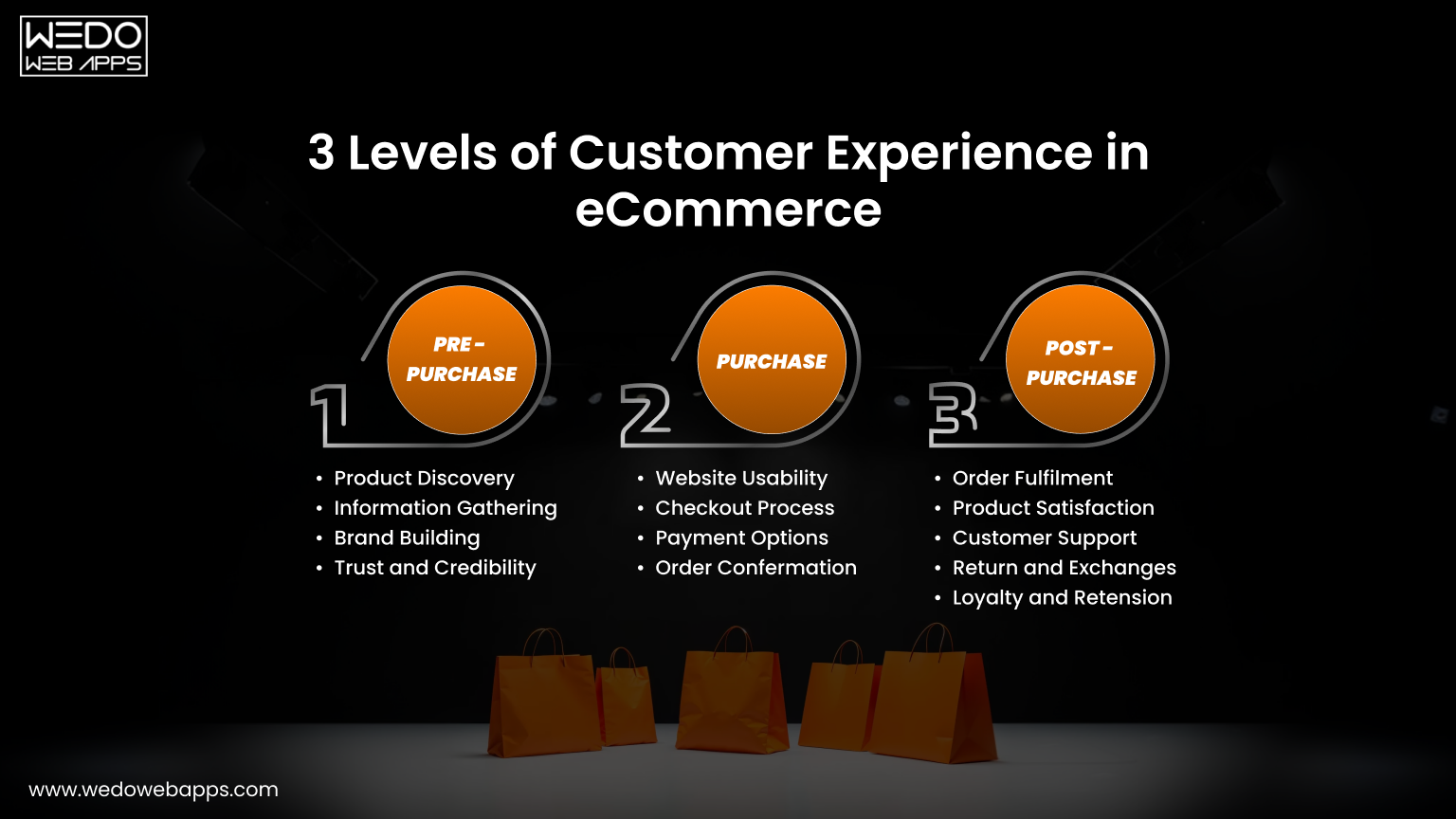
Customer Experience in eCommerce refers to the complete perception a customer forms based on every interaction they have with your online store, from the first visit to post-purchase support.
It is not limited to website design or usability.
eCommerce customer experience includes:
- How easily users find products
- How clearly the information is presented
- How smooth the checkout process feels
- How quickly issues are resolved
- How personalized the shopping journey is
In simple terms, eCommerce customer experience is how your customers feel while buying from you.
Customer Experience vs. User Experience (UX)
These two terms are often used interchangeably, but they are not the same.
User Experience (UX) focuses mainly on:
- Interface design
- Navigation
- Page layouts
- Visual hierarchy
Customer Experience (CX) is broader and includes:
- UX
- Content clarity
- Product discovery
- Checkout flow
- Customer service
- Post-purchase communication
UX is a component of CX. CX is the entire journey.
What Makes a Strong eCommerce Customer Experience?
A strong eCommerce customer experience is:
- Fast
- Intuitive
- Personalized
- Consistent
- Trust-building
When these elements work together, customers:
- Stay longer on your site
- Add more products to the cart
- Complete purchases
- Return for future orders
This is why brands that invest in CX consistently outperform competitors on conversion rate and retention.
Why This Matters for Decision-Makers
For business owners and leaders, eCommerce customer experience is not a "design concern". It is a growth strategy.
Optimizing customer experience helps you:
- Improve customer experience on your eCommerce website
- Increase conversion rates
- Lower acquisition costs
- Increase lifetime customer value
In short, a better experience equals better business outcomes.
Why eCommerce Customer Experience Directly Impacts Revenue
Every improvement you make to the eCommerce customer experience has a measurable impact on revenue. This is because experience influences how easily customers move from browsing to buying.
When your website feels intuitive, fast, and trustworthy, customers are far more likely to complete purchases.
When it feels slow, confusing, or unreliable, they leave.
Here is how customer experience in eCommerce directly affects your bottom line:
1. Better Experience Increases Conversion Rates
A smooth shopping experience removes friction from the buying process.
Examples of friction include:
- Slow-loading pages
- Confusing navigation
- Unclear product information
- Complicated checkout
Eliminating these obstacles makes it easier for customers to say "yes", which naturally increases conversions.
If your goal is to improve customer experience on your ecommerce website, conversion optimization must be a top priority.
2. Positive Experiences Reduce Cart Abandonment
Cart abandonment often happens because something feels difficult or uncertain.
Common causes:
- Unexpected costs
- Forced account creation
- Too many checkout steps
- Limited payment options
Improving these areas creates a smoother path to purchase and recovers revenue that would otherwise be lost.
3. Strong CX Increases Repeat Purchases
Acquiring a new customer is expensive.
Delivering a positive experience encourages customers to return, which increases lifetime value and reduces dependency on paid acquisition.
Repeat customers also tend to:
- Spend more per order
- Purchase more frequently
- Recommend your brand
4. Customer Experience Builds Brand Trust
Trust is essential in eCommerce.
When customers consistently have good experiences, they associate your brand with reliability. That trust lowers hesitation and shortens future buying cycles.
This trust factor plays a major role in optimising customer experience for long-term growth.
5. Poor CX Silently Destroys Revenue
The most dangerous part of a poor experience is that customers usually don't complain.
They simply leave.
If your store isn't converting well, the issue is often not your product. It's the experience around it.
Key Takeaway: Improving ecommerce customer experience is not a cosmetic upgrade. It is a revenue strategy that directly influences conversions, retention, and profitability.
Understanding the Modern eCommerce Customer Journey
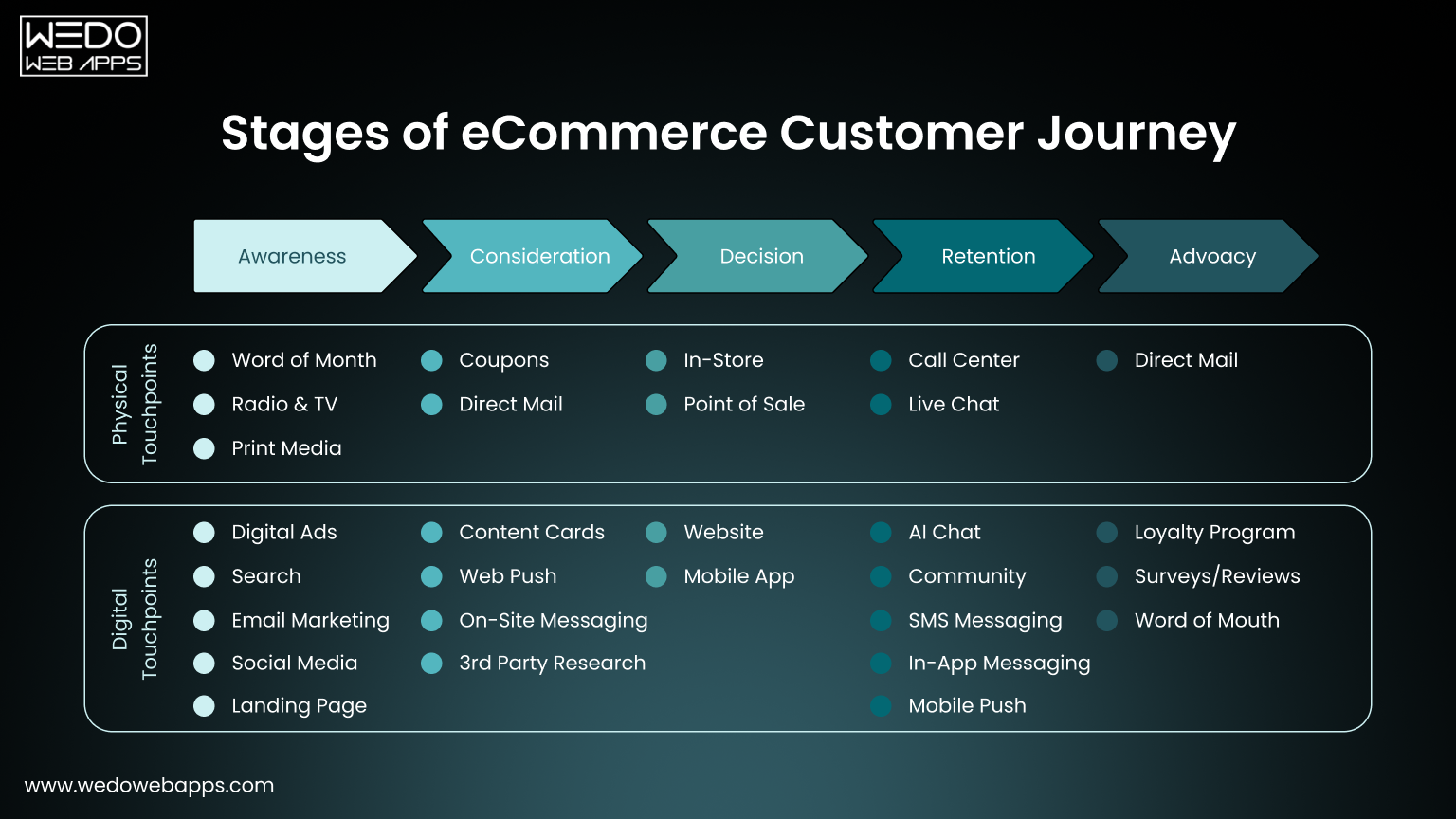
The eCommerce customer journey is the series of steps a customer goes through before, during, and after purchasing from your online store.
Understanding this journey is essential if you want to improve customer experience on your ecommerce website, because experience gaps usually appear at specific stages.
A modern eCommerce customer journey is no longer linear.
Customers may:
- Discover your brand on social media
- Visit your site from an ad
- Leave without buying
- Return through search
- Compare competitors
- Purchase later
Your goal is to deliver a consistent, friction-free experience at every touchpoint.
Stage 1: Awareness
This is when a potential customer first discovers your brand.
Common touchpoints:
- Social media posts
- Paid ads
- Search engines
- Influencer content
CX focus at this stage:
- Fast-loading pages
- Clear brand messaging
- Strong first impression
If the first interaction feels slow or confusing, the journey ends immediately.
Stage 2: Consideration
Customers begin exploring products and evaluating options.
They look for:
- Detailed product information
- Images and videos
- Reviews and ratings
- Pricing clarity
CX focus:
- Easy navigation
- Search and filters
- Well-structured product pages
This stage heavily influences whether customers trust your brand.
Stage 3: Purchase
This is the most critical stage of the journey.
Customers expect:
- Simple checkout
- Multiple payment options
- Transparent pricing
- Secure transactions
Even small obstacles here can destroy conversion rates.
Stage 4: Post-Purchase
The experience does not end after payment.
Post-purchase experience includes:
- Order confirmation
- Shipping updates
- Easy returns
- Customer support
Positive post-purchase experiences increase satisfaction and reduce refunds.
Stage 5: Loyalty and Advocacy
Happy customers become repeat buyers and promoters.
They:
- Reorder
- Leave reviews
- Recommend your brand
This stage fuels sustainable growth.
Why This Matters
When you view ecommerce customer experience through the lens of the entire customer journey, it becomes clear where improvements are needed.
Optimizing only one stage is not enough.
To truly optimize customer experience, you must improve every stage of the journey.
3 Brands Crushing Customer Experience
Some eCommerce brands consistently outperform competitors, not because they sell radically different products, but because they deliver exceptional customer experiences at every stage of the journey.
Here are three well-known examples and what businesses can learn from them.
1. Amazon, Obsessive Focus on Convenience
Amazon's success is built on removing friction from shopping.
What Amazon does exceptionally well:
- Ultra-fast site performance
- Powerful search and filtering
- One-click purchasing
- Transparent delivery timelines
- Easy returns and refunds
Why it works: Customers never have to think about how to buy. They simply buy.
Key takeaway: If you want to improve customer experience on your ecommerce website, reduce friction everywhere, especially in search, product discovery, and checkout.
2. Apple, Experience-Led Product Presentation
Apple doesn't just sell products. It sells clarity, simplicity, and confidence.
What Apple does well:
- Clean, distraction-free design
- Simple product comparisons
- Strong visuals and videos
- Clear benefits instead of technical jargon
Why it works: Customers understand exactly what they're buying and why it's right for them.
Key takeaway: High-quality product pages with clear messaging and visuals dramatically improve ecommerce customer experience and conversion rates.
3. Warby Parker, Seamless Omnichannel Experience
Warby Parker blends online and offline experiences effortlessly.
What they do well:
- Virtual try-on tools
- Home try-on programs
- Consistent experience across website, mobile, and stores
- Simple returns and exchanges
Why it works: Customers feel supported regardless of how they interact with the brand.
Key takeaway: Enabling omnichannel experiences helps optimise customer experience and builds trust.
What These Brands Have in Common
- They remove friction
- They prioritize clarity
- They personalize experiences
- They design for the customer, not the company
These principles apply to businesses of all sizes.
You don't need Amazon-level budgets. You need customer-first design and strategic execution.
Proven Strategies to Improve eCommerce Customer Experience
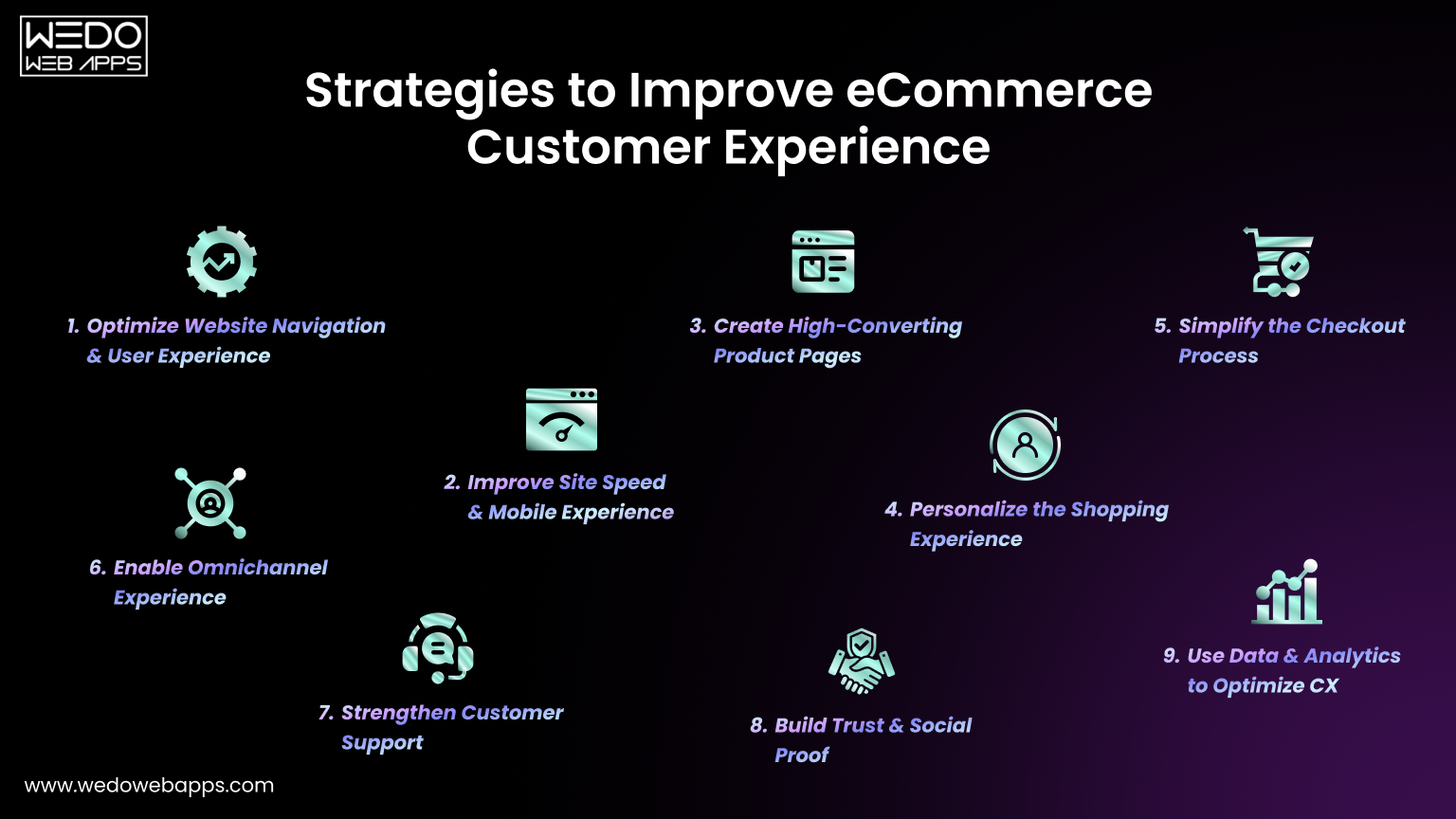
Improving ecommerce customer experience requires a combination of technology, design, data, and strategy. There is no single tactic that fixes everything. Successful brands continuously optimize multiple areas of their online store.
Below are proven strategies to help you improve customer experience on your ecommerce website and drive better business results.
1. Optimize Website Navigation and User Experience
Customers should find what they want within seconds.
Best practices:
- Simple, logical menu structure
- Clear product categories
- Prominent search bar
- Breadcrumb navigation
When navigation is intuitive, users explore more and bounce less.
2. Improve Site Speed and Mobile Experience
Most eCommerce traffic comes from mobile devices.
Focus on:
- Fast page loading
- Mobile-friendly layouts
- Compressed images
- Lightweight scripts
A slow site equals lost revenue.
3. Create High-Converting Product Pages
Product pages are conversion engines.
Essential elements:
- High-quality images and videos
- Clear product descriptions
- Benefits-focused copy
- Pricing transparency
- Reviews and ratings
Strong product pages directly improve ecommerce customer experience and conversions.
4. Personalize the Shopping Experience
Personalization makes customers feel understood.
Examples:
- Product recommendations
- Recently viewed items
- Personalized emails
- Location-based offers
Personalization increases engagement and average order value.
5. Simplify the Checkout Process
Every extra step reduces conversions.
Best practices:
- Guest checkout
- Minimal form fields
- Multiple payment options
- Clear error messages
Simple checkout flows optimise customer experience and reduce abandonment.
6. Enable Omnichannel Experience
Customers interact across devices and platforms.
Ensure consistency across:
- Website
- Mobile
- Social media
Omnichannel experiences build trust and continuity.
7. Strengthen Customer Support
Fast, helpful support improves confidence.
Options include:
- Live chat
- Chatbots
- Email support
- Knowledge base
Good support is part of the ecommerce customer experience, not an afterthought.
8. Build Trust and Social Proof
Trust drives conversions.
Use:
- Customer reviews
- Testimonials
- Security badges
- Clear policies
Social proof reassures hesitant buyers.
9. Use Data and Analytics to Optimize CX
You can't improve what you don't measure.
Track:
- Conversion rates
- Bounce rates
- Heatmaps
- Funnel drop-offs
Use insights to continuously optimise customer experience.
Key Takeaway: Improving ecommerce customer experience is an ongoing process, not a one-time project.

Metrics to Measure eCommerce Customer Experience Success
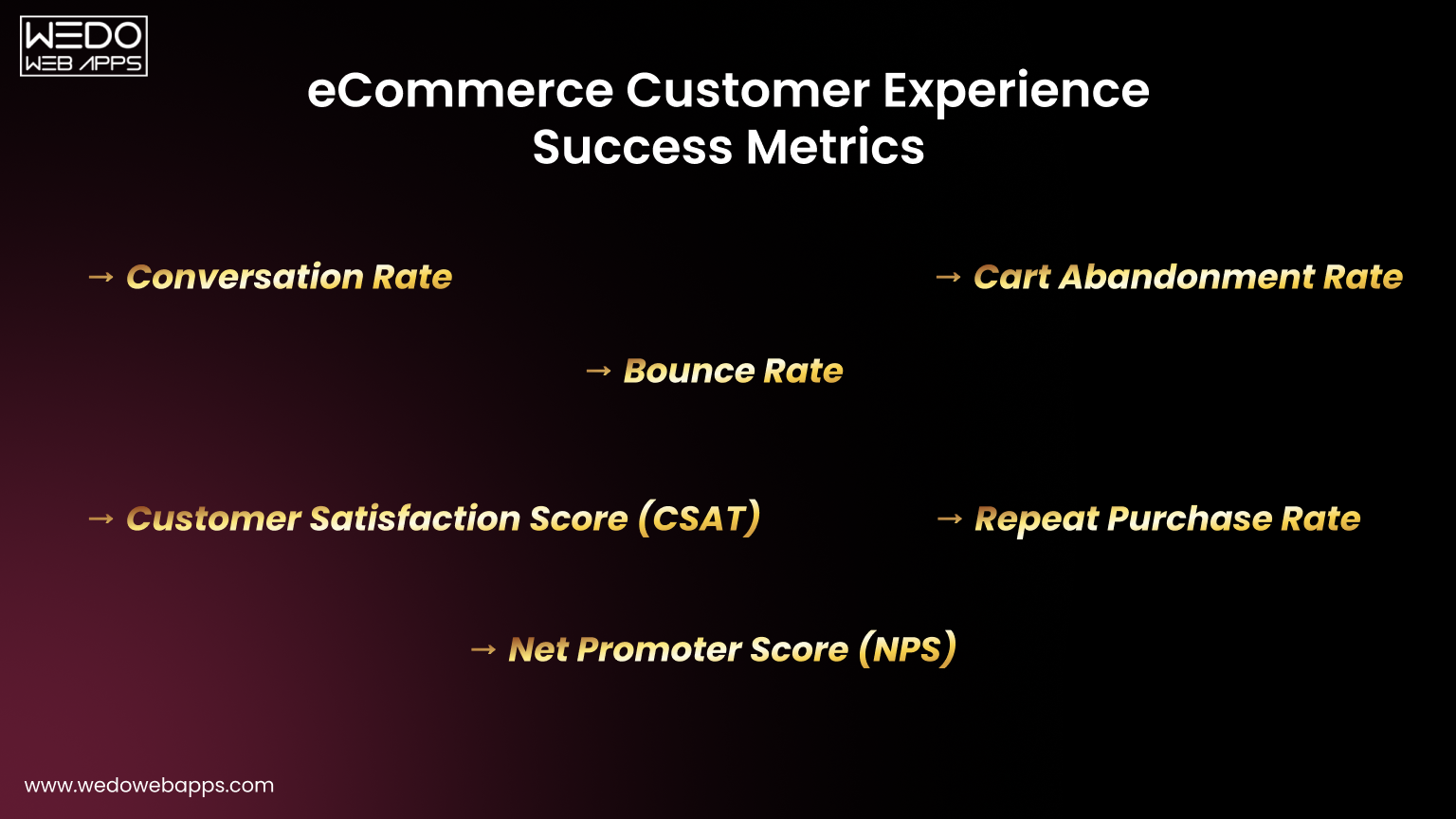
If you want to improve ecommerce customer experience, you must be able to measure it accurately. Without clear metrics, it's impossible to know what's working and what needs improvement.
Below are the most important metrics decision-makers should track.
Conversion Rate
Shows the percentage of visitors who complete a purchase.
Why it matters: A rising conversion rate indicates that your customer experience is becoming smoother and more persuasive.
Bounce Rate
Shows how many visitors leave after viewing only one page.
Why it matters: High bounce rates often signal slow loading, poor relevance, or confusing design.
Cart Abandonment Rate
Shows how many users add products to the cart but don't purchase.
Why it matters: Helps identify checkout or trust issues.
Customer Satisfaction Score (CSAT)
Measures how satisfied customers are with their experience.
Why it matters: A direct indicator of customer happiness.
Net Promoter Score (NPS)
Measures how likely customers are to recommend your brand.
Why it matters: Strong signal of loyalty and advocacy.
Repeat Purchase Rate
Shows how many customers buy again.
Why it matters: Reflects long-term experience quality.
Pro Tip: Track these metrics monthly and correlate changes with UX, content, and checkout improvements.
Common Mistakes That Hurt eCommerce Customer Experience
Many eCommerce businesses focus heavily on driving traffic but fail to invest enough in experience optimization. As a result, they attract visitors but struggle to convert and retain them.
If you want to optimise customer experience and drive sustainable growth, avoid these common mistakes.
1. Designing for Aesthetics Instead of Usability
Visually impressive websites do not guarantee good experiences.
When design prioritizes style over function, users struggle to navigate, find products, or complete purchases.
What to focus on instead:
- Clear layouts
- Logical hierarchy
- Easy navigation
Usability always beats visual complexity.
2. Overcomplicating Navigation and Site Structure
Complex menus and deep category structures confuse users.
Common symptoms:
- Too many categories
- Unclear labels
- Hidden products
Simpler navigation improves discovery and reduces bounce rates.
3. Ignoring Mobile Optimization
Most shoppers browse and buy on mobile devices.
If your mobile site is slow, hard to tap, or visually broken, customers leave.
Mobile experience must be treated as primary, not secondary.
4. Hiding Important Purchase Information
Customers need clarity before buying.
Hiding or delaying information such as:
- Shipping costs
- Delivery timelines
- Return policies
- Warranty details
creates friction and abandonment.
5. Using Generic or Thin Product Descriptions
Short, vague descriptions fail to answer buyer questions.
Strong product pages explain:
- What the product does
- Who it's for
- Why it's better
- How it solves problems
Detailed content improves ecommerce customer experience and SEO.
6. Offering Too Many Checkout Steps
Long checkout flows frustrate users.
Each additional step reduces completion rates.
Simple, streamlined checkout improves conversions.
7. Not Showing Social Proof
Customers look for reassurance.
Without reviews, ratings, or testimonials, trust is weak.
Social proof strengthens confidence.
8. Treating Customer Support as an Afterthought
Slow or unavailable support damages trust.
Customers expect quick help when issues arise.
Support quality directly affects experience.
9. Failing to Use Data for CX Decisions
Many businesses rely on assumptions.
Without analytics, heatmaps, and feedback, improvements become guesswork.
Data-driven optimization leads to better outcomes.
Key Takeaway: Most ecommerce customer experience problems are preventable. They stem from overlooked fundamentals, not advanced technology.
Why Partnering with Experts Improves Customer Experience Faster
Improving ecommerce customer experience is not just about making design tweaks or adding plugins. It requires strategy, technical expertise, data analysis, and continuous optimization.
For many startups, SMBs, and enterprises, building and maintaining this capability in-house is challenging.
This is where partnering with experienced eCommerce and CX specialists creates a competitive advantage.
1. CX Strategy Aligned With Business Goals
Experts start with your business objectives.
They map:
- Target customers
- Customer journeys
- Conversion funnels
- Growth goals
This ensures every experience improvement supports revenue, not just aesthetics.
2. Access to Cross-Functional Expertise
Effective CX improvement requires:
- UX and UI designers
- Front-end developers
- CRO specialists
- Analytics experts
Hiring and managing all these roles internally is costly and time-consuming.
Partners provide immediate access to specialized skills.
3. Faster Implementation and Testing
Experienced teams already know:
- What patterns work
- What mistakes to avoid
- How to test efficiently
This reduces trial-and-error and accelerates results.
4. Scalable Optimization Process
Experts build repeatable frameworks for:
- Auditing experience
- Prioritizing improvements
- Testing changes
- Measuring impact
This creates sustainable growth.
5. Technology and Tool Expertise
Specialists are familiar with:
- eCommerce platforms
- Analytics tools
- Personalization engines
- Automation solutions
This ensures correct implementation from day one.
Bottom Line: If ecommerce customer experience is a growth priority, treating it as a specialized discipline, not a side project, delivers faster and more predictable results.

Conclusion, Customer Experience Is the Foundation of eCommerce Growth
In today's competitive market, customer experience in eCommerce is no longer optional. It is a critical growth driver.
Brands that win are not always the ones with the lowest prices or the largest catalogs. They are the ones that deliver fast, intuitive, personalized, and trustworthy experiences across the entire eCommerce customer journey.
By understanding how customers move through your store, identifying friction points, and applying proven strategies to optimise customer experience, you can:
- Increase conversions
- Reduce cart abandonment
- Build customer loyalty
- Drive sustainable revenue growth
Improving ecommerce customer experience is not a one-time project. It is an ongoing process that requires strategy, testing, and continuous optimization.
If your goal is to build an eCommerce business that scales, investing in customer experience is one of the highest-ROI decisions you can make.