Introduction
What is pushing traditional B2B businesses towards eCommerce platforms? One of the major factors is the shift in how business buyers prefer to purchase. Companies expect a faster and more organized system for purchasing, which is why they are moving the processes online by making use of dedicated eCommerce platforms.
B2B eCommerce platform development involves building an advanced digital system that allows companies to sell products or services directly to other businesses through a structured website. These platforms give support to bulk ordering, account-specific pricing, customer portals, and integration with internal systems such as ERP or CRM software.
Market growth reflects this shift. Industry reports estimate the global B2B eCommerce market could reach nearly $36 trillion by 2026, showing how quickly companies are adopting online procurement.
This guide explains to you the fundamentals of B2B eCommerce website development, including how these platforms work, the features businesses require, and the key steps involved in building a reliable business-to-business eCommerce website.
What Is B2B eCommerce Platform Development?
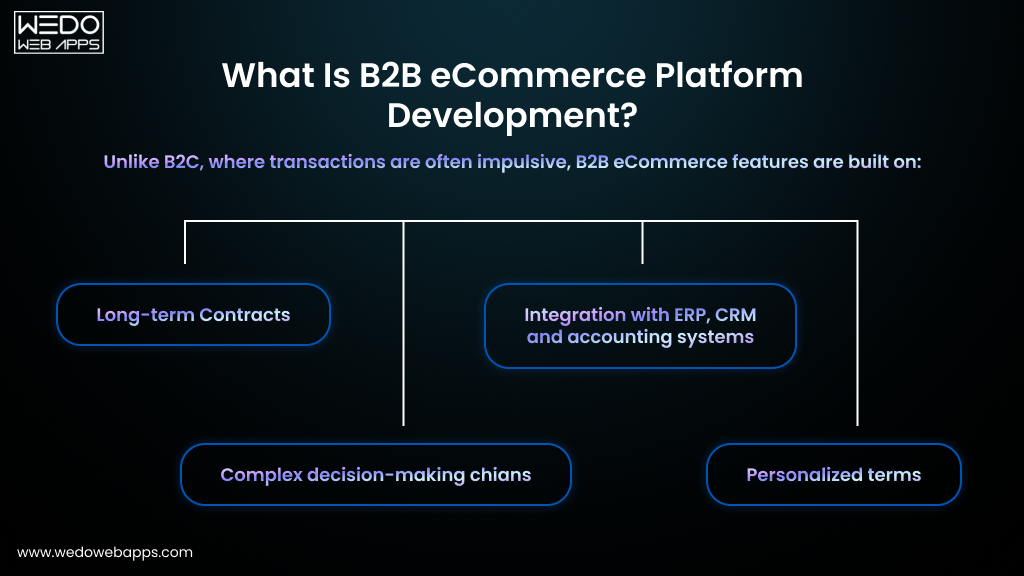
B2B eCommerce platform development refers to building an online system that allows businesses to sell products or services online and directly to other businesses. These platforms support bulk ordering, custom pricing for different customers, and secure buyer accounts.
A typical B2B eCommerce website includes product catalog management, pricing rules for different buyers, and customer portals where businesses can manage and place orders. Many of these platforms also connect with the internal systems, such as ERP or CRM software, to keep the product, order, and customer data synchronized.
Manufacturers, wholesalers, distributors, and software providers commonly use these platforms to manage large orders and transitions to maintain long-term business relationships.
B2B vs B2C eCommerce: Key Differences
As both models involve online transactions, B2B eCommerce operates differently in comparison with the consumer eCommerce website. Business buyers usually place large orders, follow structured approval processes, and often purchase products based on long-term supplier relationships.
| Factor | B2B eCommerce | B2C eCommerce |
|---|---|---|
| Order Size | Large bulk orders | Individual or small purchases |
| Pricing Model | Custom or negotiated contracts | Fixed product pricing |
| Buying Process | Multiple stakeholders and approval | Individual buyer decision |
| Payment Terms | Invoice-based or credit terms | Instant payment |
| Customer Relationship | Long-term business relationships | Short-term or transactional |
| Checkout Complexity | May include purchase orders and approval workflows | Simple and fast checkout process |
These differences mean that B2B eCommerce web development requires more advanced functionality in comparison with a typical online retail store.
Types of B2B eCommerce Models
Businesses use different eCommerce platform development models depending on how products move through their supply chain.
- Manufacturer to Distributor: Manufacturers sell products directly to distributors or dealers through an online ordering portal.
- Wholesaler to Retailer: Wholesale suppliers allow retailers to browse catalogs and place bulk orders.
- Business to Government (B2G): Companies supply products or services to government organizations through digital procurement platforms.
- Hybrid B2B and Direct to Consumer (DTC): Some businesses operate a single platform server for both business buyers and individual customers.
Why Are Businesses Investing in B2B eCommerce Website Development?
A B2B website is no longer optional. Companies of all sizes are shifting their sales and procurement processes online to meet buyer expectations and scale efficiently. The growth in digital commerce has made the investment in B2B platforms a critical part of business strategy.
Let's have a look at the growth statistics.
Market Size and Growth Statistics
The B2B eCommerce market is expanding rapidly.
- The global market is expected to grow from $19.34 trillion in 2024 to nearly $47.54 trillion by 2030, at a CAGR of 16.17%
- In the USA, B2B eCommerce sales have reached $2.3 trillion in 2024, growing over 10% year on year.
- According to Gartner, around 80% of B2B interactions are expected to occur by 2026.
This shift shows how online purchasing has become the core business strategy.
Changing Buyer Expectations
Modern B2B buyers are influenced by B2C experience. Research from Forrester Research shows that 71% of B2B buyers are millennials or Gen Z, who expect fast, transparent, and seamless online ordering.
Key trends in buyer behavior include:
- Comparing multiple products across tabs.
- Expecting real-time inventory and instant search results.
- Comfort with placing high-value orders through self-service portals.
- Using 10+ channels before completing a purchase.
These expectations are driving businesses to offer faster and more convenient online platforms.
Key Businesses Benefits
Investing in B2B eCommerce website development delivers various advantages:
- 24/7 ordering without needing sales support.
- 25-30% reduction in order processing costs.
- Reduced manual pricing and order errors.
- A scalable system that handles thousands of SKUs and customer tiers.
- Ownership of customer data that maintains loyalty and increases retention.
A well-developed B2B platform streamlines operations, reduces costs, and aligns with modern buyer needs.
Blended vs Dedicated B2B eCommerce Store: Which Should You Build?
Choosing the right store structure is important. Businesses must decide whether a single platform serving both B2B and DTC customers or a separate B2B-only site will best meet the operational and customer needs. The decision of the store gives the impact on backend management, buyer experience, and growth potential.
What Is a Blended Storefront?
A blended storefront services both B2B and DTC customers from a single website and admin panel.
Benefits:
- Unified backend and inventory management
- Lower maintenance costs
- Simplified team workflows
Drawbacks:
- Limited flexibility in design and themes.
- Potential confusion for buyers if pricing and catalog overlap.
Blended stores work well when product offerings largely overlap between B2B and DTC customers.
What is a Dedicated B2B Store?
A dedicated B2B store is a separate website designed exclusively for business buyers.
Benefits:
- Full control over UX and branding for B2B buyers.
- Clean workflow tailored to corporate orders.
- Separate team ownership for content and operations.
Drawbacks:
- Higher maintenance for separate admin, SEO strategy, and content calendars.
- Requires duplicated effort for updates and integrations.
Dedicated stores are ideal for companies with complex B2B workflows or large, enterprise-level clients.
Decision Checklist: When to Use Each
Choose a blended store if:
- Inventory largely overlaps between B2B and DTC.
- A single team manages both sales channels.
- Budget or resources are limited.
Choose a dedicated store if:
- Branding and UX must be separate for B2B.
- Inventory allocation differs significantly between channels.
- Large enterprise clients require complex workflows.
A clear decision here ensures that your platform supports business growth and buyer satisfaction without causing operational bottlenecks.

Must-Have Features of a B2B eCommerce Website
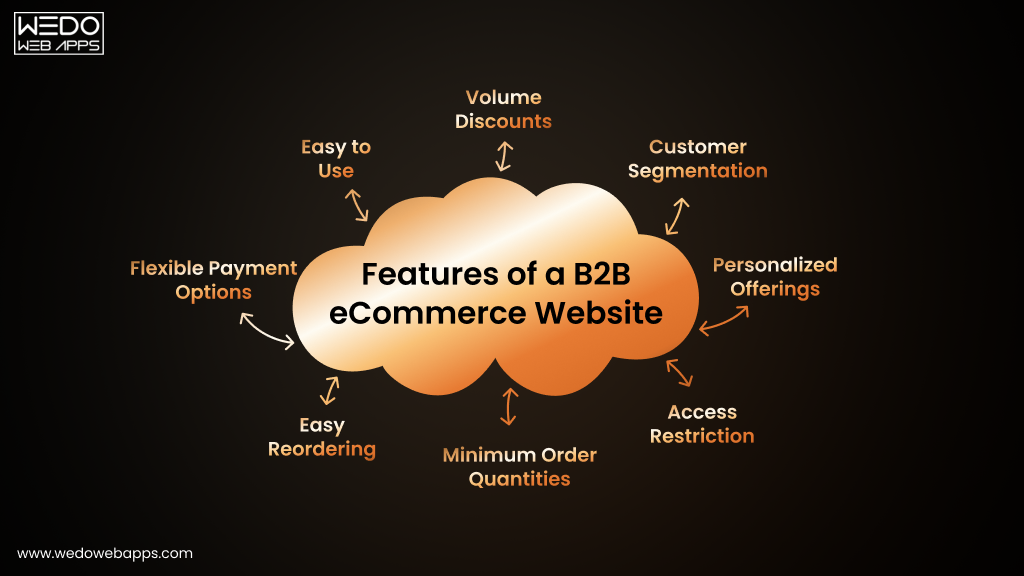
A successful B2B eCommerce platform development strategy depends on choosing the right features. Unlike standard online stores, a business-to-business eCommerce website must support complex pricing, bulk orders, and multi-user workflows.
These features ensure that your B2B eCommerce website development delivers both efficiency and a better buying experience.
Account-Based Pricing and Dynamic Pricing
Flexibility in pricing is a core requirement in B2B eCommerce web development. Businesses often offer different pricing structures based on customer relationships and order volume.
Key capabilities:
- Account-specific price lists and negotiated pricing.
- Tiered discounts based on the quantity.
- Program-based pricing for long-term clients.
Without this, your B2B eCommerce platform development will rely heavily on manual sales processes, which further reduces efficiency.
Bulk Ordering, Quick Order, and CSV Upload
Bulk purchasing is a standard behavior in any business-to-business eCommerce website. The platform must simplify large and repetitive orders.
Key capabilities:
- Quantity selectors with minimum order limits.
- SKU or part-number-based quick search.
- CSV upload for bulk orders.
- One-click reorder and saved order lists.
These features are essential for scalable B2B eCommerce development.
Self-Service Account Portal
A well-built B2B eCommerce website development solution should give buyers full control over their accounts.
Key capabilities:
- Order history, invoices, and shipment tracking.
- Multiple users with defined roles.
- Customer-specific catalogs and shared lists.
- Easy return management.
This reduces the dependency on sales teams and improves the overall efficiency.
Advanced Product Search and Filtering
Search plays an important role in B2B eCommerce web development, especially for large and technical catalogs.
Key capabilities:
- Faceted search with multiple filters.
- Category-based navigation.
- Smart search with suggestions.
Poor search experience can directly impact conversions on a business-to-business eCommerce website.
B2B Checkout: POs, Net Terms, and Approval Workflows
Checkout in B2B platform development must align with real business purchasing processes.
Key capabilities:
- Purchase order support at checkout.
- Net 30, 60, or 90 payment terms.
- Multi-location shipping.
- Approval workflow for internal teams.
These features ensure smooth transactions and compliance with company policies.
Company Hierarchy and Role-Based Access
A scalable B2B eCommerce platform development approach must reflect how the organization actually operates.
Key capabilities:
- Company-level accounts.
- Multiple locations under one organization.
- Role-based access control.
- Structured approval chains.
This is critical for handling enterprise-level buyers.
ERP, CRM, OMS, and PIM Integrations
Strong integrations are the backbone of efficient B2B eCommerce development services. They connect your platform with existing business systems.
Key capabilities:
- ERP systems like NetSuite, SAP, or Microsoft Dynamics.
- CRM platforms such as Salesforce and HubSpot.
- OMS for order lifecycle management.
- PIM for consistent product data.
These integrations ensure your B2B eCommerce website development is accurate and more efficient.
B2B eCommerce Development: Build vs Buy vs Customize
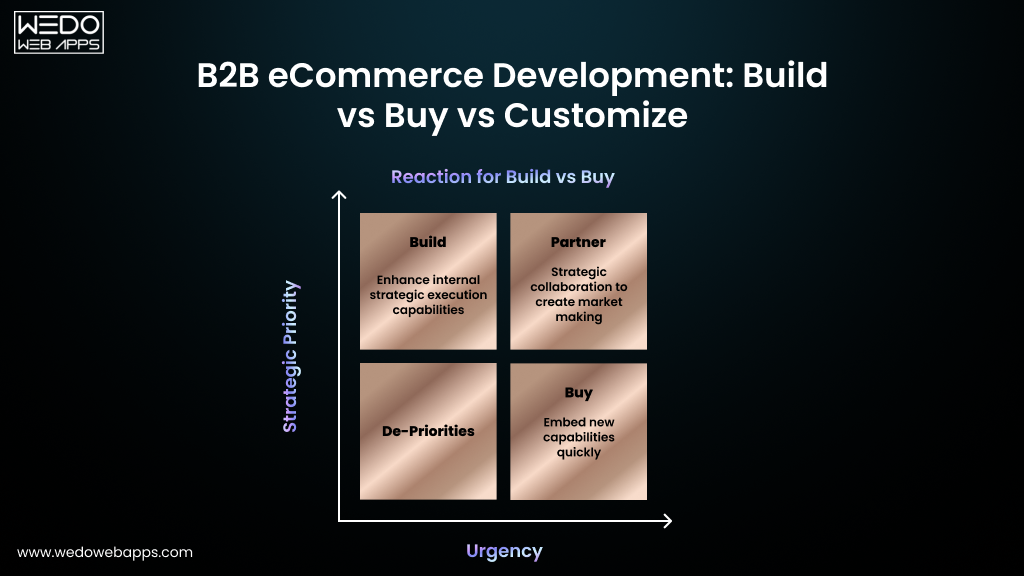
Choosing the right approach for B2B eCommerce development directly impacts cost, timeline, and long-term flexibility. You can choose between ready-made platforms, open-source solutions, or fully custom builds. The right option depends on your complexity, budget, and growth plans.
Here are some of the platform suggestions for your B2B eCommerce website development:
SaaS Platform (Shopify B2B, BigCommerce)
SaaS platforms are the fastest way to start a business-to-business eCommerce website. They offer pre-built features and require minimal setup.
Key points:
- Deployment time: 2-8 weeks.
- Built-in hosting, security, and updates.
- Growing B2B features, but limited deep customization.
Platforms like Shopify and BigCommerce are suitable for SMBs and mid-sized businesses entering B2B platform development without heavy technical investments.
Open-Source/Self-Hosted (Magento/Adobe Commerce)
Open-source platforms offer more flexibility for businesses with complex requirements. They are widely used in advanced B2B eCommerce website development projects.
Key points:
- High-level of customization and control.
- Strong developer community and extensions.
- Ideal for large catalogs and complex workflows.
Platforms like Adobe Commerce are best suited for enterprise. However, they require a skilled Magento developer and ongoing maintenance.
Estimated cost: $20k to $100k+
Purpose-Built B2B Platforms
Some platforms are designed specifically for B2B eCommerce web development, which focus only on business buyers.
Key points:
- Built-in account management and pricing tools.
- Native support for RFQ, contract pricing, and multi-channel selling.
- Better alignment with complex B2B workflows.
OroCommerce is also a strong option for companies that need advanced B2B functionality without building everything from scratch.
Custom B2B Platform Development
Custom development offers complete control over your B2B eCommerce platform development. It is ideal when existing platforms cannot meet specific business needs.
Key points:
- Fully customized UX, workflows, and integrations.
- Flexible data models and scalability.
- Tailored to unique business processes.
Estimated cost: $80k to $500k+
Timeline: 6-18 months
This approach works best for enterprises with complex operations and long-term scalability goals.
How to Build It: In-House, Agency, or Hybrid
Choosing the right execution model is also an important part of having a successful B2B eCommerce development. Each approach offers a different level of control, speed, and expertise depending on your business needs.
| Approach | Best For | Key Advantages | Limitations |
|---|---|---|---|
| In-house Team | Companies with strong internal tech teams | ||
|
| ||
| AgencySMBs and growing businesses |
|
| |
| Hybrid ModelScaling businesses |
|
|
Quick insight:
For most businesses starting B2B eCommerce website development, an agency or hybrid approach offers the best balance between speed, cost, and quality.
Step-by-Step Process for B2B eCommerce Website Development
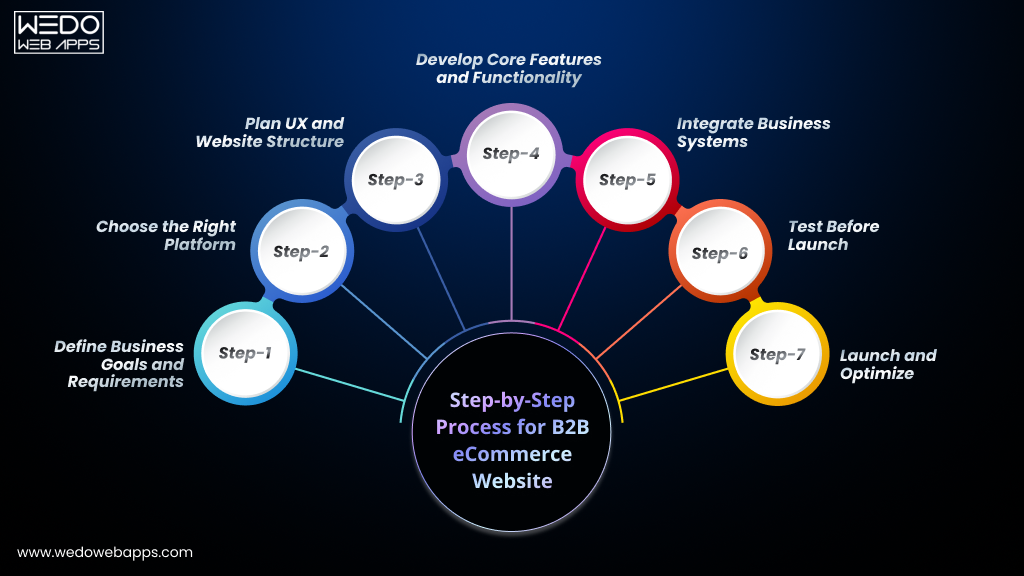
A structured approach is essential for successful eCommerce website development. Each stage of the development makes sure that your platform aligns with business goals, buyer needs, and technical requirements. Skipping any of these steps of development can often lead to delays, higher costs, and performance issues.
Step 1. Define Business Goals and Requirements
Start by identifying what you want to achieve with your business-to-business eCommerce website.
Key focus areas:
- Target audience and industries.
- Product catalog size and complexity.
- Pricing models and sales workflows.
Clear goals help and guide the entire team in handling the B2B eCommerce development process.
Step 2. Choose the Right Platform
Selecting the right technology is critical for long-term success in B2B eCommerce development.
Options include:
- SaaS platforms for faster deployment.
- Open-source platforms for flexibility.
- Custom-built solutions for complex needs.
Your choice should match your budget, scalability needs, and technical capabilities.
Step 3. Plan UX and Website Structure
User experience plays a major role in conversion and usability. A well-structured B2B eCommerce web development plan ensures buyers can navigate easily.
Key considerations:
- Clear navigation and product categories.
- Optimized search functionality.
- Mobile-friendly design.
A simple and effective layout helps to improve buyer satisfaction.
Step 4. Develop Core Features and Functionality
At this stage of development, your B2B eCommerce platform development begins to take shape.
Focus on:
- Pricing logic and account management.
- Bulk ordering and checkout workflows.
- Integration with internal systems.
Building the right feature ensures that your platform meets the real business needs.
Step 5. Integrate Business Systems
Integrations are essential to have efficient B2B eCommerce development. They connect your platform with existing tools.
Common integrations:
- ERP for inventory and financial data.
- CRM for customer management.
- Payment gateways and shipping systems.
This reduces the manual work and improves accuracy.
Step 6. Test Before Launch
Testing ensures your business-to-business eCommerce website performs reliably under real conditions.
Testing areas:
- Functionality and user flows.
- Payment and checkout processes.
- Performance and load speed.
Thorough testing helps to avoid costly issues after launch.
Step 7. Launch and Optimize
Once the website is live, continuous improvement is key to long-term success in B2B eCommerce website development.
Post-launch focus:
- Monitor performance and user behavior.
- Fix bugs and improve UX.
- Scale features as the business grows.
Ongoing optimization ensures that your platform stays competitive and efficient.
B2B eCommerce Website Design and UX Best Practices
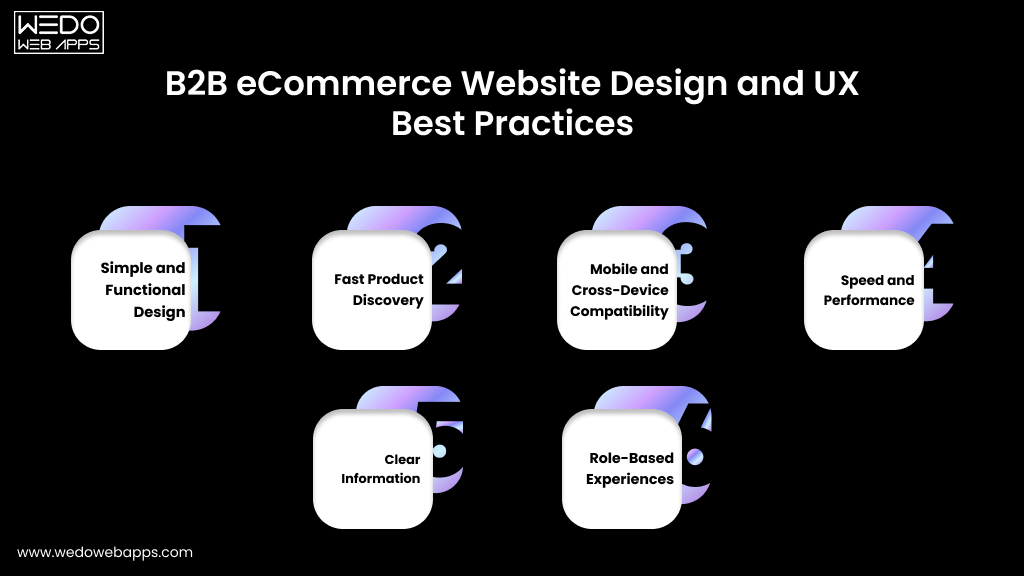
Let's first know about website designing.
Design plays an important role in the success of any B2B eCommerce website development project. A well-designed business-to-business eCommerce website should focus on clarity, speed, and ease of use.
Things you need to consider while designing your website:
Focus on Simple and Functional Design
B2B buyers want to complete tasks quickly. A clean and structured layout helps users find the products easily and place an order without confusion.
Best practices:
- Use clear navigation and logical categories.
- Avoid cluttered layouts.
- Highlights key actions like "Add to Cart" and "Reorder."
A simple design improves usability and reduces the drop-offs.
Optimize for Fast Product Discovery
Quick product discovery is important in B2B eCommerce web development, especially for managing large catalogs.
Best practices:
- Add advanced search with filters.
- Enable SKU-based search.
- Show relevant product suggestions.
Faster search leads to quicker purchasing decisions.
Ensure Mobile and Cross-Device Compatibility
Many B2B buyers now use multiple devices during the buying process. Your B2B platform development should support seamless access across all screens.
Best practices:
- Responsive design for mobile and tablets.
- Consistent experience across devices.
- Easy navigation on smaller screens.
Mobile-friendly platforms improve accessibility and engagement.
Prioritize Speed and Performance
Website performance has a direct impact on conversions in B2B eCommerce development. Slow-loading pages can lead to abandoned sessions.
Best practices:
- Optimize images and code.
- Use a reliable hosting infrastructure.
- Monitor performance regularly.
A fast website ensures a smooth buying experience.
Build Trust with Clear Information
B2B buyers rely on accurate and detailed information before making any decisions. Transparency builds confidence.
Best practices:
- Provide detailed product specifications.
- Show pricing clearly for logged-in users.
- Include shipping and return policies.
Clear information reduces hesitation and improves conversion.
Design for Role-Based Experiences
A strong B2B eCommerce website development strategy considers multiple users within one organization.
Best practices:
- AI eCommerce personalization of the dashboard for different roles.
- Show relevant data-based on user access.
- Simplify approval workflows through UI.
This ensures that the platform supports real-business processes.
12 B2B eCommerce Development Best Practices
Following these proven UX best practices ensures that your B2B eCommerce platform development delivers long-term value and usability.
Key best practices:
- Prioritize self-services to reduce dependency on sales teams.
- Design for quick reordering rather than only for product discovery.
- Make pricing visible and clear at the account level.
- Build approval workflows directly into checkout.
- Test performance under peak traffic before launch.
- Integrate ERP systems early in the development process.
- Use progressive disclosure for complex catalogs.
- Provide detailed product specifications and downloadable sheets.
- Support multiple payment methods such as PO, card, and invoice.
- Design mobile-first from the beginning.
- Set up analytics tracking before going live.
- Plan for scalability as the business grows.
These practices help in creating the B2B eCommerce development process that is efficient, better, and aligned with buyer expectations.

B2B eCommerce Website Development Cost
The cost of eCommerce website development varies based on the platform choice, feature complexity, integrations, and scale. A simple business-to-business eCommerce website can be built at a relatively low-cost, while the enterprise-level platform with custom workflows and integrations requires significantly higher investments.
Average Cost Based on Platform Type
Different development approaches directly impact the total cost of B2B eCommerce development.
| Platform Type | Estimated Cost Range | Best For |
|---|---|---|
| SaaS (Shopify, BigCommerce) | $1,500 - $30,000+ | Small to mid-sized businesses launching B2B eCommerce platforms quickly |
| Open-Source (Magento / Adobe Commerce) | $8,000 - $150,000+ | Businesses that require flexibility, custom workflows, and scalability |
| Custom Development | $30,000 - $500,000+ | Enterprises with complex logic, integrations, and unique operational needs |
In India, a mid-level B2B eCommerce website typically ranges between INR 6 lakh to 15 lakh+, depending on the integrations and features.
Key Factors That Affect Cost
The final cost of B2B eCommerce web development depends on several factors, such as:
- Feature complexity: Features like dynamic pricing, approval workflows, and bulk ordering increase cost.
- Integrations: ERP, CRM, and PIM integrations require additional development effort.
- Design and UX: Custom UI and optimized user experience increase both time and budget.
- Catalog size: Large product catalogs with complex attributes need more development work.
- Development team location: Developer rates vary significantly by region. For example, Magento developers may charge $20 to $150 per hour, depending on the location.
Hidden and Ongoing Costs
Beyond initial development, businesses must plan for ongoing expenses in B2B platform development.
Common ongoing costs include:
- Hosting and infrastructure.
- Platform licensing for enterprise solutions.
- Maintenance and updates.
- Third-party apps and extensions.
- SEO and marketing investments.
For enterprise platforms, annual costs can range from $20,000 to $200,000 and more, depending on the scale and technology stack.
Quick Insights: For most businesses, starting with a scalable platform and upgrading over time is more cost-effective than building everything from scratch. A well-planned B2B eCommerce website development strategy ensures better ROI and long-term growth.
Marketing, SEO, and Conversion Optimization for B2B eCommerce
Building a strong platform is only the starting part of having a successful B2B eCommerce development. To generate more traffic and revenue, businesses must focus on SEO, performance tracking, and conversion strategies. A well-optimized business-to-business eCommerce website attracts the right audience and turns visits into repeat orders.
Steps you can follow for having better conversions:
SEO Strategy for B2B eCommerce Websites
Search visibility is important to have long-term growth in B2B eCommerce website development. A structured SEO best practice helps your platform rank for high-intent keywords.
Key practices:
- Optimize site structure, URLs, and metadata.
- Use schema markup to improve search visibility.
- Create content based on buyer intent, such as feature pages, comparison guides, and cost breakdowns.
- Add FAQ schema to capture rich results and improve click-through rates.
A strong SEO foundation ensures consistent organic traffic.
Analyzing Conversion Rates and Revenue Metrics
Tracking performance is essential to improve results in B2B eCommerce web development. Data helps to identify where users drop off and what drives conversions.
Key metrics to track:
- Conversion rate and bounce rate.
- Average order value (AOV).
- Reorder rate and customer retention.
- Cart abandonment rate.
Use tools like Google Analytics and heatmapping software to understand user behavior. A/B testing checkout flows and CTA placements can further improve conversions.
Upsells, Cross-Sells, and Revenue Maximisation
Increasing the revenue from existing customers is a key goal in B2B platform development. Smart product recommendations and pricing strategies can boost the order values.
Key strategies:
- Suggest related products and accessories during the cart and checkout.
- Offer volume-based discounts to increase AOV.
- Use order history data to trigger reorder reminders.
These techniques help to maximise revenue while improving the overall buying experience.
How to Choose the Right B2B eCommerce Development Company
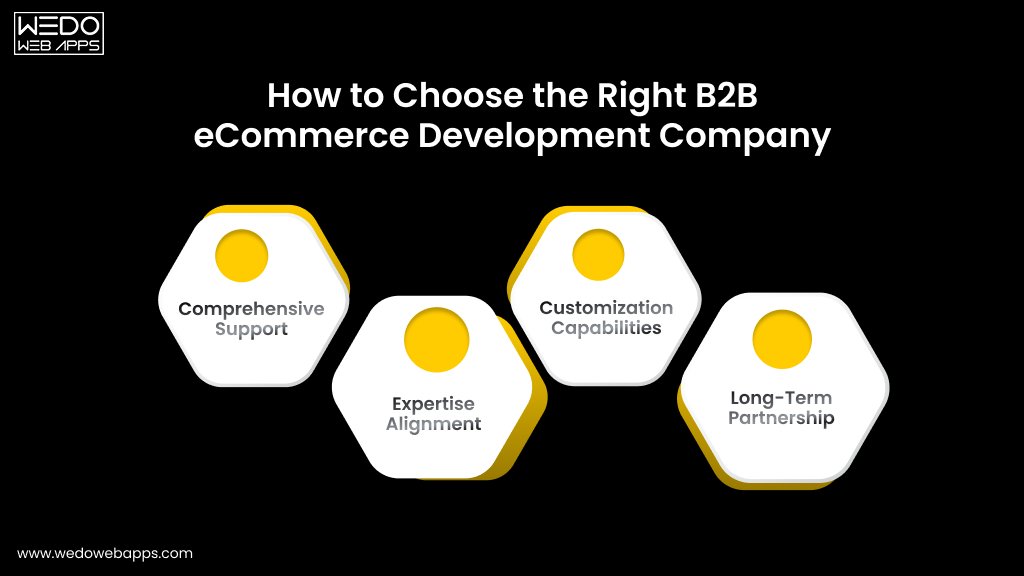
Choosing the right partner is a critical step in B2B eCommerce website development. A capable agency makes sure that your platform is built with the right eCommerce features, integrations, and scalability in mind. The focus should be on proven experience, technical depth, and long-term support.
What to Look for in a B2B Development Agency
Not every agency understands the complexity of B2B eCommerce development. You need a team that has hands-on experience with real-business workflows.
Key factors to evaluate:
- Proven B2B portfolio with features like RFQ, tiered pricing, and ERP integrations.
- Full-stack expertise covering UX, backend, APIs, QA, and security.
- Client references from manufacturers, wholesalers, or distributors.
- Clear post-launch support terms and maintenance agreements.
A strong agency will align your B2B platform development with both technical and business needs.
Questions to Ask Before Hiring
Asking the right questions helps you assess whether the agency can handle your B2B eCommerce web development requirements.
Important questions:
- What B2B eCommerce platform have you built end-to-end?
- How to handle ERP data migration and integration?
- What is your QA and security testing process?
- Do you support headless or composable architecture?
- What does your post-launch support include?
A clear answer to these questions will help you choose a partner that can deliver a reliable and scalable business-to-business eCommerce website.
Conclusion
A successful B2B eCommerce website development strategy depends on choosing the right platform, building essential features, and following structured development processes with a qualified web development company. From pricing and integrations to UX and performance, each element directly gives the impact on how efficiently your business operates online.
As buyer expectations continue to evolve, investing in a scalable and well-optimized business-to-business eCommerce website ensures long-term growth, better customer experience, and improved operational efficiency.