Introduction
An IoT application is never "just an app."
Behind every smart device application is a network of connected systems handling everything from communication, cloud processing, firmware updates, security, and real-time data continuously. Like a city traffic system, if the roads, signals, and control systems are not planned properly from the beginning, everything becomes slower, more expensive, and harder to manage as traffic grows.
The same happens with IoT products.
Many businesses start building IoT applications focused mainly on features, only to realize later that scalability, device communication, and backend infrastructure have a much bigger impact on long-term success. That is why the final IoT app development cost can vary significantly from one project to another.
A poorly planned IoT application architecture can create connectivity issues, rising cloud expenses, unstable performance, and maintenance challenges as more devices are added to the ecosystem. Businesses also often underestimate ongoing IoT app maintenance costs, including firmware updates, cloud monitoring, security patching, and device compatibility management after deployment.
This guide explains the actual cost structure, architecture planning, communication protocols, maintenance requirements, and technical decisions businesses should understand before developing a scalable IoT application.
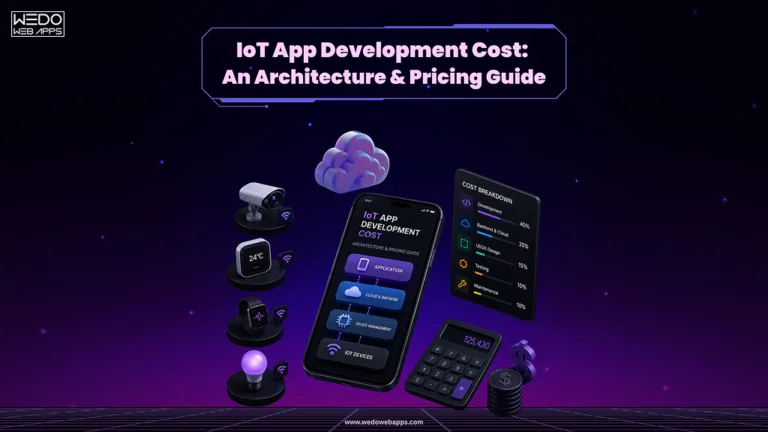
Why IoT App Development Costs Vary So Much in 2026?
One of the biggest misconceptions businesses have is assuming all IoT applications follow the same development process and pricing structure.
In reality, the cost differences between two IoT projects can be massive.
A simple smart home application with limited device connectivity may cost far less than an industrial IoT platform processing real-time sensor data from thousands of machines every second.
That is why understanding what affects IoT app development cost is important before starting development.
Several technical and business factors directly influence the final project budget.
Major Factor That Affects IoT Development Cost
| Factor | Impact on Cost |
|---|---|
| Number of connected devices | More devices require a stronger backend infrastructure. |
| Communication protocol | BLE, Zigbee, WiFi, and cellular have different implementation complexities. |
| Cloud infrastructure | Real-time processing and storage increase cloud expenses. |
| Firmware development | Custom firmware adds development and testing effort. |
| Security development | Encryption and compliance systems increase development scope. |
| Scalability planning | Systems designed for future growth require stronger architecture. |
| Third-party integrations | APIs and external systems increase backend complexity. |
Simple IoT Apps vs Enterprise IoT Platforms
Not every IoT application requires enterprise-level infrastructure from day one.
For example:
Basic IoT Application Usually Includes:
- Limited device connectivity
- Basic mobile app functionality
- Simple cloud storage
- Standard user authentication
- Small-scale deployments
Estimated Cost Range: $40,000 to $60,000
Enterprise IoT Platforms Usually Include:
- Real-time monitoring dashboards
- Thousands of connected devices
- Advanced analytics and automation
- Predictive maintenance systems
- Multi-user access management
- Edge computing and cloud scaling
Estimated Cost Range: $120,000 to $300,000+
The difference in cost mainly comes from infrastructure complexity and scalability.
Why Architecture Decisions Affect Development Costs
A poorly planned IoT application architecture often creates hidden expenses later.
For example, choosing the wrong communication protocol may increase battery consumption, cloud traffic, or device latency. Similarly, weak backend planning can lead to performance issues once more devices are added.
Businesses planning on building IoT applications should focus on long-term scalability instead of only reducing initial development costs.
A scalable architecture helps:
- Support future device growth.
- Reduce infrastructure bottlenecks.
- Improve real-time communication.
- Simplify maintenance and updates.
- Lower operational risks over time.
The Hidden Side of IoT Budgets
Development is only one part of the total investment.
Many businesses underestimate long-term IoT app maintenance costs, which continue after launch through:
- Firmware updates
- Cloud hosting
- Device monitoring
- Security patching
- API maintenance
- Infrastructure scaling
- Device compatibility testing
In many cases, maintenance costs become a long-term operational expense that businesses need to plan for early.
That is why successful IoT projects are usually built with scalability, maintenance, and infrastructure planning in mind from the beginning instead of treating them as future problems.
Core Components Required for Building IoT Applications
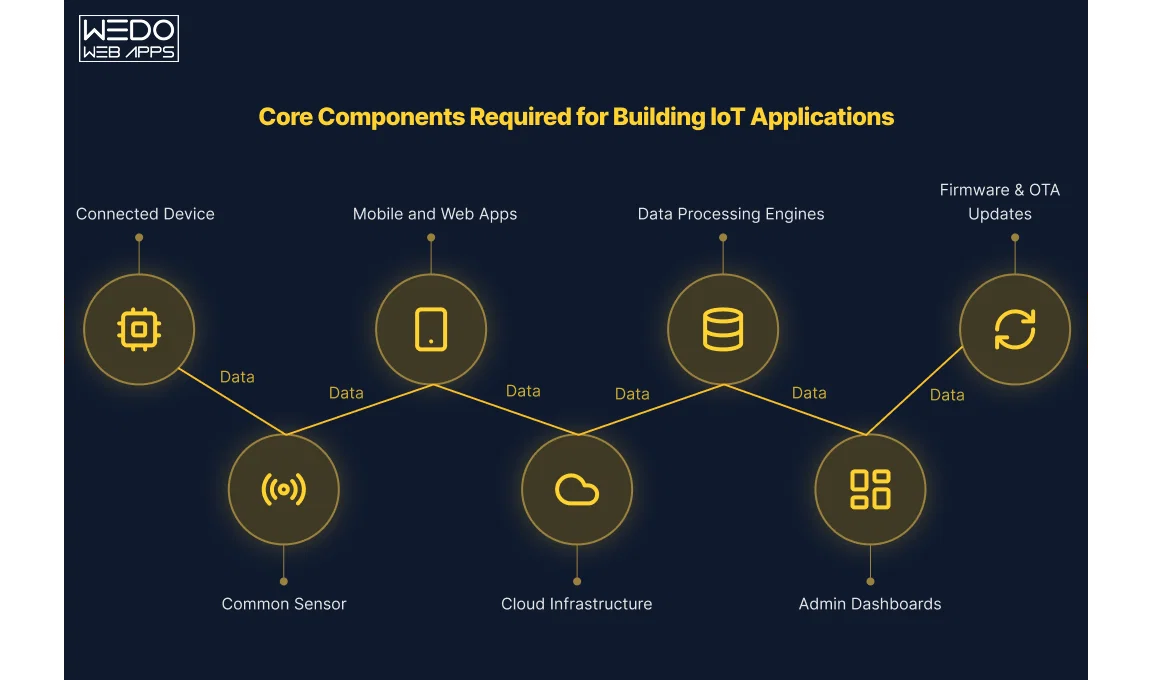
Every IoT product may look different from the outside, but most successful systems are built using the same core foundation.
Whether it is a smart home application, an industrial monitoring platform, a wearable device app, or a healthcare tracking system, the process of building IoT applications involves multiple layers working together continuously.
Think of an IoT ecosystem like a smart transportation network.
Devices collect information. Communication channels transfer the data. Cloud systems process it. Application displays insights to users in real-time.
If one layer is weak, the entire system can become unstable.
Here are the major components businesses need to understand before starting IoT development.
Connected Device and Sensors
Connected devices are the starting point of every IoT ecosystem.
These devices collect real-world data and send it to the backend system for processing.
Examples include:
- Smart thermostats
- GPS trackers
- Wearable fitness devices
- Industrial sensors
- Smart cameras
- Medical monitoring devices
The type of hardware directly affects the overall IoT app development cost because different devices require different firmware logic, communication protocols, and testing requirements.
Common Sensor Types Used in IoT Applications
| Sensor Type | Common Use Cases |
|---|---|
| Temperature sensors | Smart homes, healthcare |
| Motion sensors | Security systems |
| GPS sensors | Fleet tracking |
| Humidity sensors | Agriculture and manufacturing |
| Heart rate sensors | Wearable healthcare apps |
Mobile and Web Applications
The mobile or web application acts as the control center for users.
This is where users:
- Monitor devices
- Receive alerts
- Analyze reports
- Configure settings
- Manage connected systems
Most businesses today build:
- iOS applications
- Android applications
- Web dashboards
- Admin panels
The complexity of these interfaces plays a major role in IoT app development cost.
For example:
- Real-time dashboards require stronger backend communication.
- Multi-device synchronization increases infrastructure load.
- Advanced analytics dashboards require additional processing systems.
Cloud Infrastructure and APIs
Cloud infrastructure is the backbone of modern IoT systems.
It handles:
- Device communication
- Data storage
- Authentication
- Real-time processing
- Notifications
- Analytics
Popular cloud platforms include:
- AWS IoT Core
- Azure IoT Hub
- Google Cloud IoT services
A scalable cloud setup is a critical part of a successful IoT application architecture because every connected device continuously generates data that needs processing and storage.
Without proper cloud planning, systems can quickly become slow and expensive to maintain.
Real-Time Data Processing Engines
Many IoT systems depend on real-time communication.
For example:
- A smart lock should respond instantly
- Industrial sensors must detect failures immediately
- A fleet tracking system needs live location updates
This requires real-time data processing systems capable of handling continuous device communication with low latency.
Common technologies include:
- MQTT brokers
- WebSockets
- Event streaming systems
- Edge computing frameworks
Real-time processing infrastructure can significantly increase the complexity of building IoT applications, especially at enterprise scale.
Admin Dashboards and Device Management Panels
As the number of connected devices grows, businesses need centralized control systems to manage them efficiently.
Admin dashboard helps businesses:
- Monitor device health
- Track usage data
- Manage users and permissions
- Push firmware updates
- Detect system failures
- Analyze operational performance
For enterprise IoT platforms, dashboard development often becomes one of the largest contributors to backend complexity.
Firmware and OTA Update Systems
Firmware is the software running directly on IoT devices.
It controls:
- Sensor communication
- Device behavior
- Data transmission
- Power management
- Connectivity logic
One of the biggest challenges in IoT systems is updating devices remotely after deployment.
That is why many companies implement OTA (Over the Air) update systems.
OTA systems allow businesses to:
- Fix bugs remotely
- Improve device performance
- Release security updates
- Add new features without replacing hardware
However, firmware management also increases long-term IoT app maintenance costs because devices require continuous monitoring, testing, and compatibility updates throughout their lifecycle.
A strong IoT application architecture ensures all these components work together efficiently as device count, users, and data volume continue growing over time.
IoT Application Architecture Explained
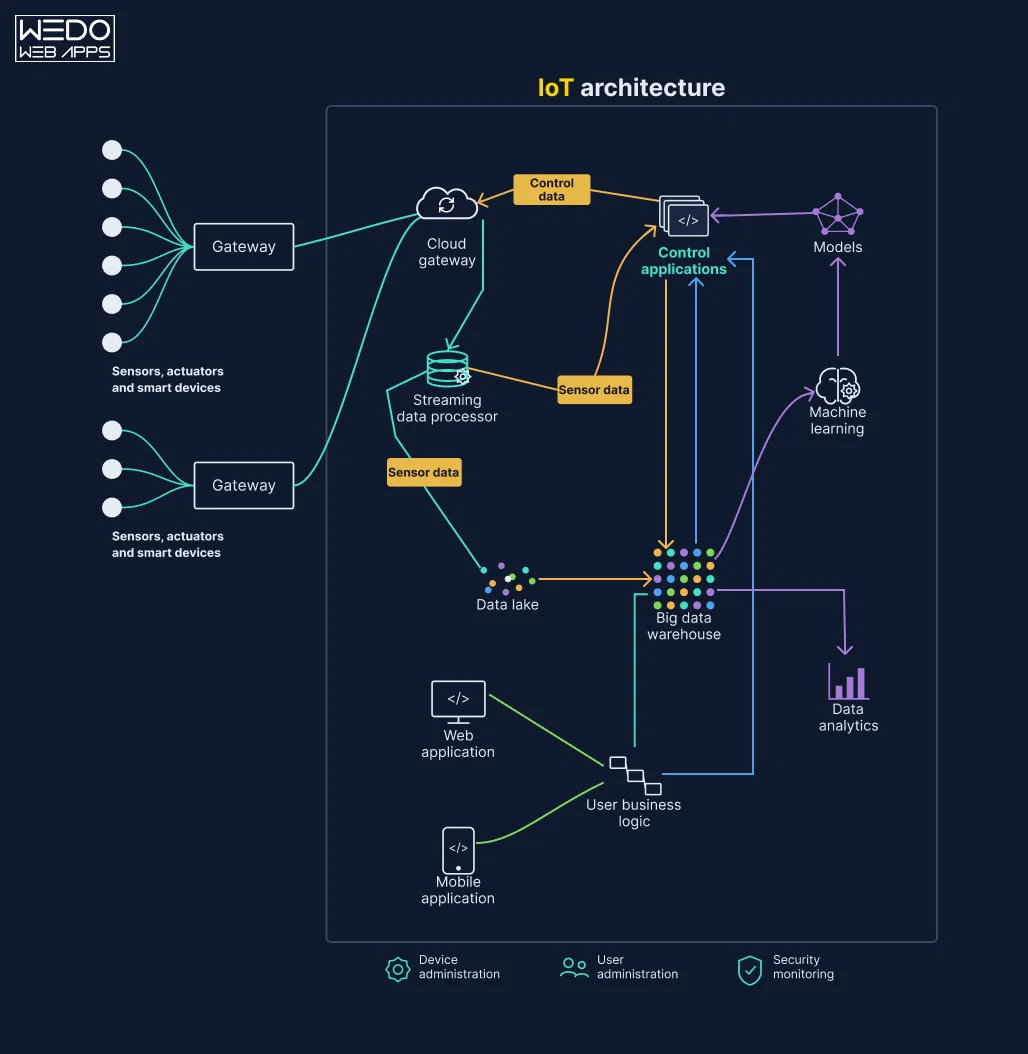
A successful IoT product depends on much more than connected devices and mobile apps.
Behind every scalable IoT system is an architecture that manages device communication, cloud processing, real-time data, and user interactions efficiently. That is why choosing the right IoT application architecture is one of the most important decisions businesses make while building IoT applications.
A weak architecture can create connectivity issues, higher cloud expenses, slow performance, and scaling problems as more devices are added to the ecosystem.
To understand how IoT systems work, let's break down the major architecture layers involved in modern IoT applications.
Device Layer
The device layer includes all physical hardware connected to the IoT ecosystem.
These devices collect, transmit, or receive information.
Examples include:
- Smart sensors
- Wearable devices
- GPS trackers
- Smart appliances
- Industrial monitoring equipment
- Medical IoT devices
At this stage, firmware controls how devices:
- Capture data
- Communicate with servers
- Manage battery usage
- Handle connectivity
The complexity of device communication directly impacts the overall IoT app development cost.
Connectivity Layer
The connectivity layer transfers data between devices and backend systems.
This layer is one of the most important parts of any IoT architecture because communication reliability affects system performance, battery life, scalability, and cloud expenses.
Common IoT communication protocols include:
| Protocol | Best Used For |
|---|---|
| BLE | Wearables and short-range devices |
| WiFi | Smart home systems |
| Zigbee | Low-power smart ecosystems |
| Cellular | Fleet tracking and remote monitoring |
| LoRaWAN | Long-range industrial deployments |
Choosing the wrong communication method early can create major operational and maintenance issues later.
Edge Computing Layer
Not all IoT data should travel directly to the cloud.
In many systems, edge computing processes data closer to the device before sending it to cloud servers.
For example:
- Industrial machines detect failures instantly.
- Smart cameras analyze movement locally.
- Autonomous systems process data in real-time.
Edge computing helps:
- Reduce latency
- Lower cloud processing costs
- Improve response times
- Reduce bandwidth usage
This layer is becoming increasingly important in modern IoT application architecture, especially for enterprise systems handling massive amounts of real-time data.
Cloud Backend Layer
The cloud backend acts as the central processing system for IoT applications.
It manages:
- Device communication
- Data storage
- Authentication
- Notifications
- Analytics
- User engagement
- API handling
Popular cloud platforms include:
- AWS IoT Core
- Azure IoT Hub
- Google Cloud IoT solutions
The scalability of cloud infrastructure directly affects both performance and long-term IoT app maintenance costs.
Poor backend planning often leads to:
- Higher cloud expenses
- Slow response times
- Data bottlenecks
- Device synchronization issues
Analytics and Visualization Layer
Raw IoT data becomes useful only when businesses can analyze and understand it clearly.
This layer transforms large volumes of device data into:
- Dashboards
- Reports
- Alerts
- Predictive insights
- Operational analytics
For example:
- A logistics company tracks fleet movement in real-time.
- A factory predicts machine failure before downtime occurs.
- A smart home app monitors energy consumption patterns.
Advanced analytics systems can significantly increase IoT app development cost, but they also create higher business value through automation and operational insights.
User Application Layer
This is the layer users interact with directly.
It includes:
- Mobile applications
- Web dashboards
- Admin control panels
- Smartwatch interfaces
The frontend application allows users to:
- View device status
- Receive notifications
- Control connected devices
- Analyze reports
- Configure settings
A smooth user experience is critical because when highly advanced IoT systems fail, users struggle to interact with them easily.
Typical IoT Application Architecture Workflow
A standard IoT workflow usually follows this sequence:
Device -> Communication Protocol -> Gateway/Edge Layer -> Cloud Backend -> Database -> Mobile App or Dashboard
For example:
A temperature sensor collects room data -> sends it through WiFi or BLE -> cloud infrastructure processes the information -> the mobile app displays real-time temperature updates to the user.
This continuous flow happens within seconds across thousands of devices simultaneously in large-scale systems.
That is why businesses planning on building IoT applications need a scalable architecture from the beginning instead of trying to redesign systems later, after traffic and device usage increase.
BLE vs WiFi vs Zigbee vs Cellular for IoT Applications
One of the most important decisions in any IoT project is choosing the right communication protocol.
This decision affects device performance, battery life, scalability, response time, infrastructure costs, and overall IoT application architecture.
Many businesses focus heavily on app features during planning, but overlook how devices will actually communicate with each other and cloud systems. Choosing the wrong protocol can create unstable connectivity, higher maintenance expenses, and poor user experience later.
There is no single communication protocol that works best for every IoT product.
The right choice depends on:
- Device type
- Range requirements
- Battery consumption
- Data transfer needs
- Real-time communication requirements
- Deployment environment
Let's understand where each protocol works best while building IoT applications.
When BLE Is the Right Choice
BLE (Bluetooth Low Energy) is designed for short-range communication with very low power consumption. It is commonly used in wearable devices, smart locks, healthcare systems, and fitness trackers.
| BLE Advantage | BLE Limitations |
|---|---|
| Low battery consumption | Short communication range |
| Fast device pairing | Limited large-scale connectivity |
| Lower hardware cost | Depends on nearby devices or gateways |
| Ideal for wearable devices | Lower bandwidth compared to WiFi |
When WiFi Works Better
WiFi supports high-speed communication and direct internet connectivity, making it suitable for smart home devices, smart appliances, and connected cameras.
| WiFi Advantages | WiFi Limitations |
|---|---|
| High-speed data transfer | Higher battery consumption |
| Direct cloud connectivity | Network congestion in large deployments |
| Suitable for real-time streaming | Less efficient for low-power devices |
| No separate gateway required | Higher infrastructure load |
Zigbee for Smart Home Ecosystems
Zigbee uses mesh networking to connect multiple devices efficiently while maintaining low power usage. It is widely used in smart home automation systems.
| Zigbee Advantages | Zigbee Limitations |
|---|---|
| Very low power usage | Requires compatible gateways |
| Reliable mesh networking | Lower data transfer speed |
| Supports large device ecosystems | More complex setup process |
| Good scalability for smart homes | Limited direct internet connectivity |
Protocol Comparison Table
| Protocol | Best For | Power Usage | Range | Internet Dependency |
|---|---|---|---|---|
| BLE | Wearables, healthcare | Very Low | Short | Usually through a mobile device |
| WiFi | Smart homes, cameras | High | Medium | Direct internet connection |
| Zigbee | Smart home ecosystems | Low | Medium | Requires gateway |
| LTE-M/NB-IoT | Industrial and remote systems | Medium | Long | Cellular network |
Why Protocol Selection Matters for IoT Costs
Communication protocol directly affects:
- Infrastructure requirements
- Device hardware selection
- Cloud traffic volume
- Battery performance
- Scalability planning
- Long-term IoT app maintenance cost
For example:
- WiFi may increase battery replacement frequency.
- The cellular system increases operational connectivity expenses.
- BLE may require additional gateway infrastructure.
That is why protocol selection should always align with the overall IoT application architecture instead of being a technical decision during development.
MQTT vs HTTP for IoT Mobile App Communication
Once devices are connected, the next challenge is deciding how they will exchange data with servers, cloud platforms, and mobile applications.
This is where communication protocols like MQTT and HTTP become important.
Both protocols are widely used in IoT systems, but they are built for different purposes. Choosing the wrong option can affect response speed, cloud costs, scalability, and overall IoT application architecture.
For businesses building IoT applications, understanding the difference between MQTT and HTTP helps create faster and more reliable communication between devices and backend systems.
How MQTT Works in IoT Systems
MQTT (Message Queuing Telemetry Transport) is a lightweight messaging protocol designed specifically for IoT environments.
Instead of devices continuously requesting information, MQTT uses a publish and subscribe model.
Here's how it works:
- Devices publish data to a broker.
- Applications subscribe to required topics.
- The broker delivers messages instantly.
For example:
A temperature sensor sends live updates to an MQTT broker, and the mobile app receives the data immediately without repeatedly requesting information.
MQTT is widely used in:
- Smart home applications
- Industrial IoT systems
- Real-time monitoring platforms
- Wearable devices
- Connected healthcare systems
Why Businesses Choose MQTT
| MQTT Advantages | MQTT Limitations |
|---|---|
| Lightweight communication | Requires MQTT broker setup |
| Very low bandwidth usage | Slightly higher backend complexity |
| Faster real-time messaging | Less suitable for traditional web requests |
| Better for unstable networks | Requires additional security configuration |
| Lower battery consumption | Not ideal for large file transfers |
MQTT is often preferred for applications that require continuous real-time communication between devices and cloud systems.
When HTTP APIs Are Still Necessary
HTTP remains one of the most commonly used communication protocols across web and mobile applications.
Unlike MQTT, HTTP follows a request and response model.
This means:
- The client sends a request
- The server processes it
- A response is returned
HTTP is still useful for:
- User authentication
- REST APIs
- Configuration requests
- Data uploads
- Dashboard systems
- Web applications
Many IoT platforms use HTTP together with MQTT instead of replacing one completely.
Why Businesses Still Use HTTP
| HTTP Advantages | HTTP Limitations |
|---|---|
| Easy API integration | Higher bandwidth usage |
| Simple implementation | Slower real-time communication |
| Strong web compatibility | More battery consumption |
| Widely supported infrastructure | Less efficient for continuous messaging |
| Better for standard web services | Higher latency for live updates |
HTTP works well for traditional client-server communication where real-time streaming is not the primary requirement.
MQTT vs HTTP Comparison Table
| Feature | MQTT | HTTP |
|---|---|---|
| Communication Type | Publish/Subscribe | Request/Response |
| Best For | Real-time IoT messaging | Web and API communication |
| Bandwidth Usage | Very low | Higher |
| Battery Consumption | Low | Higher |
| Real-Time Performance | Excellent | Moderate |
| Network Reliability | Better for unstable networks | Depends on stable connectivity |
| Infrastructure Complexity | Moderate | Simple |
| Scalability | High for IoT systems | Good for standard applications |
Which Protocol Is Better for IoT Applications?
There is no universal answer because both protocols solve different problems.
In many modern IoT ecosystems:
- MQTT handles real-time device communication.
- HTTP manages APIs and backend services.
For example:
- A smart sensor may use MQTT to stream live data.
- The mobile app may use HTTP APIs for login and account management.
The right approach depends on:
- Real-time communication needs.
- Device battery limitations.
- Network stability.
- Infrastructure scalability.
- Overall IoT app development cost.
That is why communication protocols should always be selected based on long-term scalability and system requirements instead of short-term implementation convenience.
IoT Mobile App Features That Increase Development Cost
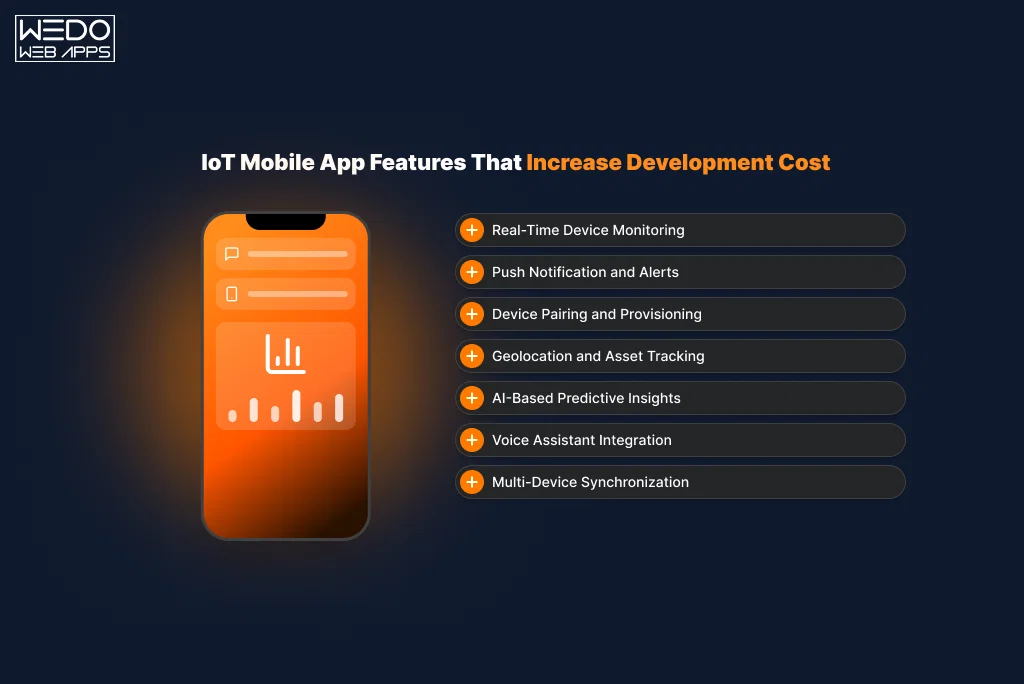
The feature set of an IoT application has a direct impact on development complexity, backend infrastructure, scalability, and overall IoT app development cost.
A basic IoT app that only displays sensor data will cost significantly less than a platform handling real-time monitoring, predictive analytics, multi-device synchronization, and automation workflows.
That is why businesses should prioritize features carefully before building IoT applications.
Adding every advanced feature in the first version may increase development time, cloud expenses, and long-term maintenance requirements unnecessarily.
Below are some of the most common IoT app features that influence project cost.
Real-Time Device Monitoring
Real-time monitoring allows users to track device activity instantly through mobile apps or dashboards.
This feature is commonly used in:
- Fleet tracking systems
- Smart home apps
- Industrial monitoring platforms
- Healthcare IoT systems
Real-time monitoring usually requires:
- Continuous device communication
- Event streaming systems
- WebSocket or MQTT integration
- Scalable backend infrastructure
The more devices connected simultaneously, the more complex the infrastructure becomes.
| Real-Time Monitoring Benefits | Cost Impact |
|---|---|
| Instant device updates | Higher backend complexity |
| Better operational visibility | Increased cloud processing |
| Faster issue detection | More infrastructure scaling |
| Improved automation | Additional data streaming setup |
Push Notification and Alerts
Push notifications help users receive instant alerts when specific device events occur.
Examples include:
- Security alerts from smart cameras.
- Machine failure warnings.
- Temperature threshold notifications.
- Battery level alerts.
Although notifications may appear simple, they often require:
- Event-driven architecture
- Real-time processing systems
- Notification delivery services
- Device synchronization logic
| Push Notification Benefits | Cost Impact |
|---|---|
| Faster user response | Notification infrastructure setup |
| Better user engagement | Additional backend workflows |
| Improved monitoring experiences | Real-time event processing |
Device Pairing and Provisioning
Device pairing allows users to connect IoT devices with mobile apps securely.
This is one of the most important user experience areas in IoT systems because poor onboarding often leads to product frustration.
Common pairing methods include:
- BLE pairing
- QR code scanning
- WiFi provisioning
- NFC-based setup
Secure provisioning systems often require:
- Authentication layers
- Encryption systems
- Device registration workflows
- Connectivity validation
| Device Pairing Benefits | Cost Impact |
|---|---|
| Better onboarding experience | Higher firmware complexity |
| Improved device security | Additional authentication systems |
| Easier device management | More testing requirements |
Geolocation and Asset Tracking
Location tracking features are commonly used in:
- Logistics applications
- Fleet management systems
- Asset monitoring platforms
- Delivery tracking systems
These systems require:
- GPS integration
- Real-time location updates
- Mapping APIs
- Route optimization systems
| Asset Tracking Benefits | Cost Impact |
|---|---|
| Real-time visibility | Continuous location processing |
| Improved logistics management | Higher cloud data usage |
| Better operational control | Third-party API integration costs |
AI-Based Predictive Insights
Modern IoT systems increasingly use AI models to predict future events based on device data.
Examples include:
- Predictive maintenance systems
- Smart energy optimization
- Equipment failure detection
- Usage pattern analysis
AI-based features often require:
- Large-scale data collection
- Machine learning infrastructure
- Advanced analytics systems
- Cloud computing resources
| AI Feature Benefits | Cost Impact |
|---|---|
| Predictive automation | Higher cloud infrastructure cost |
| Improved operational efficiency | Advanced analytics development |
| Better decision-making | Machine learning integration complexity |
Voice Assistant Integration
Many smart home and consumer IoT applications support voice control through:
- Amazon Alexa
- Google Assistant
- Apple HomeKit
Voice integration improves accessibility and automation but also increases development scope.
| Voice Integration Benefits | Cost Impact |
|---|---|
| Better user convenience | Third-party platform integration |
| Improved smart automation | Certification and testing requirements |
| Hands-free device control | Additional API management |
Multi-Device Synchronization
Many IoT ecosystems require multiple devices to communicate and stay synchronized simultaneously.
- Smart lighting systems
- Industrial monitoring networks
- Connected healthcare devices
- Multi-room automation systems
Synchronized systems often require:
- Distributed communication logic
- Real-time state management
- Strong backend coordination
| Synchronization Benefits | Cost Impact |
|---|---|
| Unified device ecosystem | Higher backend complexity |
| Better automation workflows | Increased infrastructure scaling |
| Improved user experience | Real-time synchronization management |
A scalable IoT application architecture makes it easier to add advanced functionality later without rebuilding the entire system.
Industrial IoT Dashboard Development Cost
Industrial IoT applications are built for environments where speed, reliability, and real-time visibility are critical.
Factories, warehouses, logistics companies, manufacturing plants, and energy providers use industrial IoT systems to monitor operations, track equipment performance, and reduce downtime issues through connected infrastructure.
Unlike consumer IoT products, industrial platforms process large volumes of live sensor data continuously. This makes backend architecture, data streaming, and infrastructure scalability far more complex.
As a result, the IoT app development cost for an industrial platform is usually higher than standard smart home or wearable applications.
What Industrial IoT Dashboards Usually Include
Industrial IoT dashboards act as centralized monitoring systems where businesses can track connected equipment and operational data in real-time.
These dashboards often include:
- Live sensor monitoring
- Equipment status tracking
- Predictive maintenance alerts
- Machine performance analytics
- Product monitoring
- User access controls
- Data visualization reports
The complexity increases further when the businesses need to monitor thousands of connected devices simultaneously.
| Industrial IoT Feature | Complexity Level |
|---|---|
| Real-time machine monitoring | High |
| Predictive maintenance systems | High |
| Multi-facility monitoring | Very High |
| Custom analytics dashboards | High |
| Sensor data visualization | Medium to High |
| Equipment automation workflows | High |
Why Industrial IoT Systems Cost More
Industrial systems do require a strong infrastructure to manage failures directly without affecting the operations and revenue.
For example:
- A delayed alert may stop production lines.
- A disconnected sensor may create safety risks.
- Poor real-time communication may affect machine automation.
That is why industrial platforms usually require:
- High availability architecture
- Low-latency communication
- Advanced security systems
- Real-time event processing
- Scalable cloud infrastructure
- Backup and failover systems
All of these increase both the development and long-term IoT app maintenance costs.
Real-Time Data Streaming Requirements
Industrial IoT systems constantly process live operational data from:
- Sensors
- Machines
- Camera
- GPS devices
- Robotics systems
This requires having a strong infrastructure capability to handle:
- Continuous event streams
- Massive device communication
- Low-latency processing
- High-speed dashboards
Technologies commonly used are:
- MQTT brokers
- Apache Kafka
- WebSockets
- Edge computing systems
| Real-Time Infrastructure Need | Cost Impact |
|---|---|
| Continuous device communication | Higher cloud usage |
| Live dashboards | More backend processing |
| Event streaming systems | Increased infrastructure complexity |
| Edge processing systems | Additional deployment setup |
Predictive Maintenance and AI Analytics
One of the biggest advantages of industrial IoT systems is predictive maintenance.
Instead of waiting for machines to fail, businesses can use sensor data and AI models to identify issues early.
Examples include:
- Detecting abnormal machine vibration.
- Predicting equipment overheating.
- Monitoring energy inefficiencies.
- Identifying maintenance patterns.
These systems reduce operational downtime but require:
- Large-scale data collections.
- Machine learning integration.
- Historical analytics systems.
- Advanced reporting infrastructure.
AI-powered analytics can significantly increase the overall IoT app development cost, but they often generate strong long-term ROI for enterprises.
Estimated Industrial IoT Development Cost
Industrial IoT systems vary widely based on deployment scale, infrastructure requirements, and analytics complexity.
Below is the general cost estimate range:
| Industrial IoT Platform Type | Estimated Cost |
|---|---|
| Basic monitoring dashboard | $60,000 to $100,000 |
| Mid-scale industrial IoT platform | $100,000 to $250,000 |
| Enterprise industrial IoT ecosystem | $250,000 to $500,000+ |
These estimates usually include:
- Dashboard development
- Cloud infrastructure
- Device communication setup
- API integrations
- Security systems
- Basic analytics
Custom AI automation, edge computing, and large-scale deployments can increase pricing further.
Why Scalability Matters in Industrial IoT
Industrial ecosystems rarely stay small.
A company may begin with:
- One facility
- Limited sensors
- Basic monitoring dashboards
But eventually expand into:
- Multiple facilities
- Thousands of devices
- Predictive analytics systems
- Automated operational workflows
Without a scalable IoT applications architecture, infrastructure costs and performance bottlenecks grow quickly.
That is why businesses building IoT applications for industrial environments should focus heavily on long-term scalability, infrastructure planning, and operational reliability from the beginning.
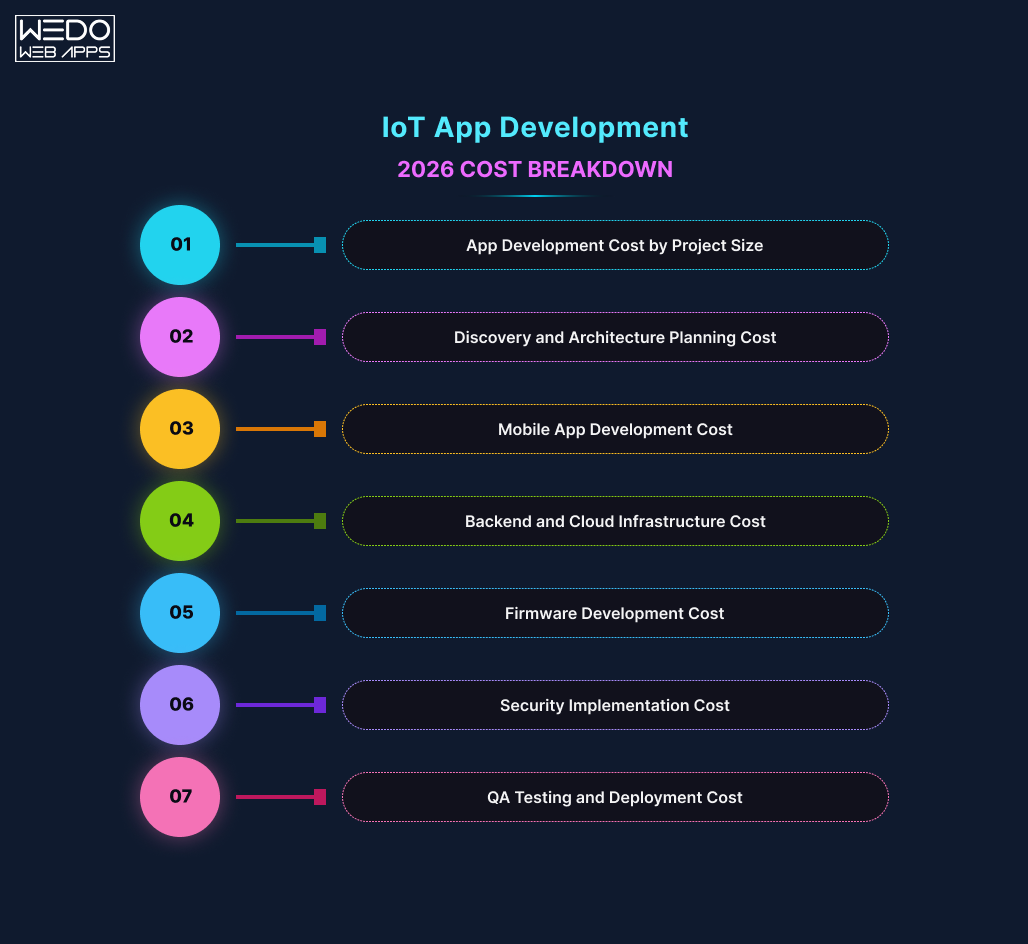
IoT App Development Cost Breakdown in 2026
One of the first questions businesses ask before starting an IoT project is simple.
"How much will it cost to build the application?"
The answer depends on multiple technical and business factors, including device complexity, cloud infrastructure, communication protocols, security requirements, and scalability planning.
Unlike traditional apps, building IoT applications requires several interconnected systems working together continuously. That is why the final IoT app development cost can vary widely between projects.
A basic connected device application may cost under $50,000, while large-scale industrial IoT ecosystems can exceed several hundred thousand dollars.
Understanding where the budget goes helps businesses plan development more realistically.
Average IoT App Development Cost by Project Size
Below is a general cost estimate based on project complexity.
| IoT Project Type | Estimated Development Cost |
|---|---|
| Basic IoT MVP | $40,000 to $60,000 |
| Mid-Scale IoT Application | $60,000 to $120,000 |
| Enterprise IoT Platform | $120,000 to $300,000+ |
| Large Industrial IoT Ecosystem | $300,000 to $500,000+ |
The more devices, automation workflows, analytics systems, and integrations involved, the higher the infrastructure and development complexity becomes.
Discovery and Architecture Planning Cost
The discovery phase is where businesses define:
- Product requirements
- Device communication flow
- Cloud infrastructure
- User workflows
- Scalability planning
- Security requirements
This stage helps to avoid architecture problems later in development.
| Discovery Phase Activities | Estimated Cost |
|---|---|
| Technical consultation | $3,000 to $8,000 |
| Architecture planning | $5,000 to $15,000 |
| UI/UX wireframing | $3,000 to $10,000 |
| Technical feasibility analysis | $2,000 to $7,000 |
Strong IoT application architecture planning reduces long-term infrastructure costs and maintenance issues significantly.
Mobile App Development Cost
The mobile application acts as the primary interface between users and connected devices.
Development cost depends on:
- Number of screens
- Real-time functionality
- Device synchronization
- User roles
- Dashboards complexity
- Platform support
| Mobile App Scope | Estimated Cost |
|---|---|
| Basic IoT mobile app | $15,000 to $30,000 |
| Real-time monitoring app | $30,000 to $60,000 |
| Enterprise dashboard app | $60,000 to $120,000+ |
Cross-platform development may reduce initial costs, but complex IoT ecosystems sometimes require native optimization for better device communication performance.
Backend and Cloud Infrastructure Cost
Cloud infrastructure is often one of the largest contributors to overall IoT app development cost.
Backend systems manage:
- Device communication
- Authentication
- APIs
- Notifications
- Real-time data processing
- Analytics
- Data storage
| Backend Infrastructure Area | Estimated Cost |
|---|---|
| API development | $10,000 to $25,000 |
| Cloud setup and configuration | $8,000 to $20,000 |
| Real-time messaging systems | $10,000 to $30,000 |
| Analytics infrastructure | $15,000 to $40,000 |
Platforms like AWS IoT Core and Azure IoT Hub also create ongoing operational expenses after deployment.
Firmware Development Cost
Firmware controls how devices behave and communicate inside the IoT ecosystem.
Firmware development usually includes:
- Sensor integration
- Connectivity setup
- Power optimization
- Data transmission logic
- OTA update support
| Firmware Complexity | Estimated Cost |
|---|---|
| Basic device firmware | $5,000 to $15,000 |
| Advanced firmware systems | $15,000 to $40,000 |
| Enterprise-grade firmware architecture | $40,000+ |
Firmware complexity increases when devices require:
- Low power optimization
- Real-time communication
- Security encryption
- Multi-device synchronization
Security Implementation Cost
Security is one of the most important parts of any IoT ecosystem.
Weak IoT security can expose:
- User data
- Device communication
- Operational systems
- Cloud infrastructure
Security implementation often includes:
- Device authentication
- Data encryption
- Secure APIs
- Access control systems
- Compliance support
| Security Area | Estimated Cost |
|---|---|
| Basic security setup | $5,000 to $15,000 |
| Enterprise security implementation | $20,000 to $50,000+ |
| Compliance and audit systems | Additional custom cost |
In many enterprise projects, security alone can account for 15% to 25% of total development budgets.
QA Testing and Deployment Cost
Testing IoT systems is more complex than testing traditional applications because businesses must validate:
- Device communication
- Network reliability
- Firmware stability
- Cross-device compatibility
- Cloud performance
- Real-time synchronization
| Testing Area | Estimated Cost |
|---|---|
| Functional testing | $5,000 to $12,000 |
| Device compatibility testing | $8,000 to $20,000 |
| Load and performance testing | $10,000 to $25,000 |
| Security testing | $5,000 to $15,000 |
Large-scale IoT ecosystems require extensive testing before deployment because failures can affect real-world operations directly.
Why IoT Development Costs Vary So Much
No two IoT systems are exactly alike.
The final IoT app development cost depends heavily on:
- Number of connected devices
- Communication protocols
- Real-time processing needs
- Cloud infrastructure scale
- Analytics requirements
- Security complexity
- Long-term scalability planning
That is why businesses should focus on scalable architecture and phased development instead of trying to estimate costs based only on mobile app functionality.
IoT App Maintenance Cost After Launch
Launching the application is only the beginning of an IoT product's lifecycle.
Many businesses focus heavily on initial development budget but underestimate the long-term IoT app maintenance cost required to keep connected systems stable, secure, and scalable after deployment.
Unlike traditional mobile applications, the IoT ecosystem involves:
- Connected devices
- Firmware systems
- Cloud infrastructure
- APIs
- Communication protocols
- Real-time data processing
All of these require continuous monitoring and updates.
As the number of devices and users grows, maintenance becomes a major operational responsibility rather than a small technical task.
Why IoT Maintenance Costs Are Higher Than Standard Apps
A normal mobile app mainly requires:
- Bug fixes
- OS compatibility updates
- UI improvements
But IoT systems need ongoing management across both software and hardware environments.
For example:
- Devices may lose connectivity.
- Firmware bugs may affect device behavior.
- Cloud traffic may increase unexpectedly.
- Communication protocols may require updates.
- Security vulnerabilities may appear over time.
This is why businesses building IoT applications must plan for long-term operational expenses from the beginning.
Major IoT Maintenance Cost Areas
Several technical areas contribute to ongoing maintenance expenses.
| Maintenance Area | Purpose |
|---|---|
| Cloud infrastructure monitoring | Keeps backend systems stable |
| Firmware updates | Improves device functionality and security |
| Security patching | Protects connected systems from threats |
| API maintenance | Ensures stable communication between systems |
| Device compatibility testing | Supports new devices and OS versions |
| Performance optimization | Maintains fast response times |
| Database management | Handles growing data volumes |
Cloud Hosting and Infrastructure Costs
Cloud infrastructure creates one of the largest ongoing operational expenses in IoT ecosystems.
As more devices connect to the platform, cloud usage increases through:
- Real-time messaging
- Data storage
- Analytics processing
- API traffic
- Device synchronization
Common cloud expenses include:
- AWS IoT Core usage
- Azure IoT Hub costs
- Server scaling
- Data transfer charges
- Database storage
| Infrastructure Scale | Estimated Monthly Cost |
|---|---|
| Small IoT deployment | $500 to $2,000 |
| Mid-scale IoT platform | $2,000 to $10,000 |
| Enterprise IoT ecosystem | $10,000 to $50,000+ |
Infrastructure costs grow continuously as the ecosystem expands.
Firmware Update Management
Firmware maintenance is one of the most important parts of long-term IoT operations.
Businesses often release firmware updates to:
- Fix bugs
- Improve battery performance
- Add new features
- Patch security vulnerabilities
- Improve communication stability
Most modern IoT ecosystems use OTA (Over the Air) update systems for remote firmware deployment.
However, firmware updates also require:
- Compatibility testing
- Rollback systems
- Device monitoring
- Deployment validation
Poor firmware management can create major operational failures across connected devices.
Security Maintenance and Monitoring
IoT security is not a one-time implementation.
Connected devices continuously exchange sensitive operational and user data, making them ongoing targets for security risks.
Security maintenance often includes:
- Vulnerability monitoring
- Encryption updates
- Access control management
- Authentication improvements
- Threat detection systems
For enterprise systems, security monitoring usually operates continuously.
| Security Maintenance Area | Estimated Annual Cost |
|---|---|
| Basic security monitoring | $5,000 to $15,000 |
| Enterprise security operations | $20,000 to $100,000+ |
Security expenses often increase as regulatory and compliance requirements evolve.
Device Compatibility and Ecosystem Expansion
IoT ecosystems rarely stay fixed after launch.
Businesses often expand support for:
- New devices
- Additional sensors
- Third-party integrations
- New operating systems
- New communication protocols
Each addition increases:
- Testing requirements
- Backend updates
- Infrastructure complexity
- Support requirements
A scalable IoT application architecture helps to reduce these operational challenges over time.
Average Annual IoT Maintenance Cost
Most businesses spend between 15% and 25% of the original development budget annually on maintenance and infrastructure operations.
| IoT Platform Type | Estimated Annual Maintenance Cost |
|---|---|
| Basic IoT application | $8,000 to $20,000 |
| Mid-scale IoT platform | $20,000 to $60,000 |
| Enterprise IoT ecosystem | $60,000 to $250,000+ |
These costs typically include:
- Cloud infrastructure
- Monitoring systems
- Firmware maintenance
- Security management
- API maintenance
- Performance optimization
Why Maintenance Planning Matters Early
Many businesses try to reduce initial development expenses without considering long-term operational impact.
But in reality, poorly planned systems often create:
- Higher infrastructure costs
- Device reliability issues
- Security vulnerabilities
- Performance bottlenecks
- Expensive architecture redesigns later
That is why scalable infrastructure and strong IoT application architecture are critical while building IoT applications.
A well-planned architecture reduces operational complexity and makes future maintenance easier and more manageable as the IoT ecosystem continues growing.
Hidden Costs Businesses Often Miss in IoT Development
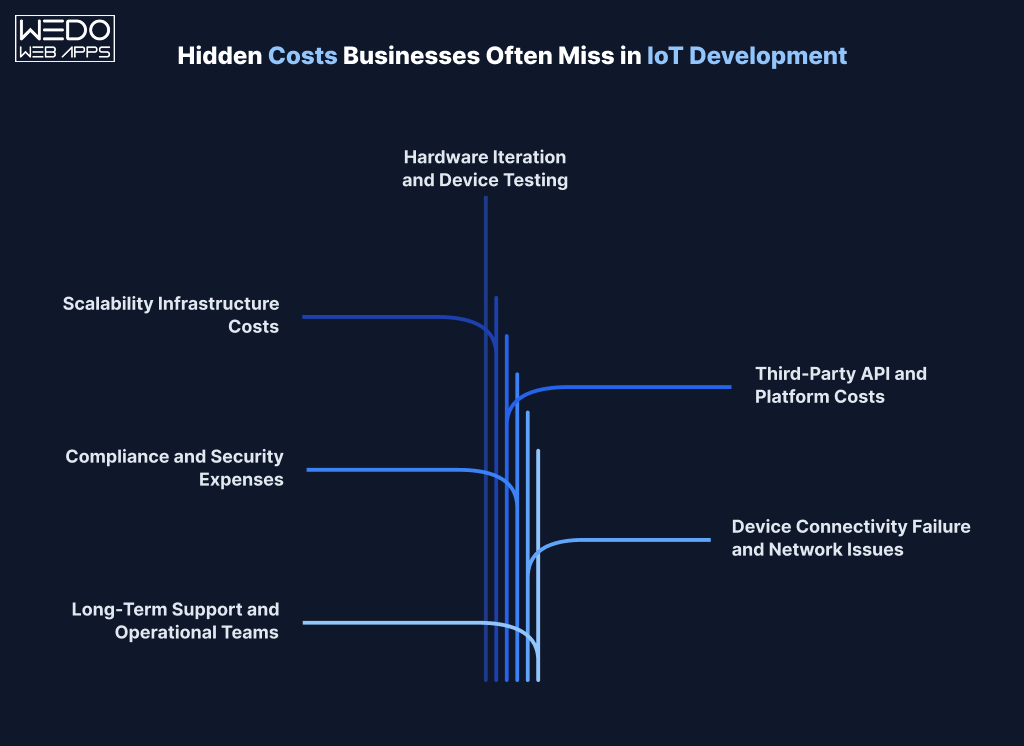
Many IoT projects exceed their original budgets not because the idea changes, but because businesses underestimate the hidden technical and operational costs involved.
At the beginning, the focus usually stays on:
- Device connectivity
- Dashboard features
But once development starts, additional infrastructure, testing, scalability, and maintenance requirements begin increasing the total IoT app development cost significantly.
That is why businesses planning on building IoT applications should understand the hidden expenses that commonly appear during development and after deployment.
Hardware Iteration and Device Testing
IoT hardware rarely works perfectly in the first prototype stage.
Businesses often go through multiple testing and refinement cycles to improve:
- Connectivity stability
- Sensor accuracy
- Battery performance
- Device durability
- Firmware reliability
Each hardware revision adds:
- Engineering effort
- Firmware updates
- QA testing
- Manufacturing adjustments
| Hardware Activity | Hidden Cost Impact |
|---|---|
| Prototype revisions | Increased development timeline |
| Sensor calibration | Additional testing expenses |
| Battery optimization | Firmware refinement costs |
| Connectivity troubleshooting | Infrastructure adjustments |
Hardware-related delays are one of the most common reasons IoT projects exceed estimated timelines.
Scalability Infrastructure Costs
Many businesses initially build systems for small deployments, but later realize the architecture cannot support larger device ecosystems efficiently.
As device count grows, infrastructure requirements increase rapidly.
This includes:
- Cloud server scaling
- Database optimization
- Load balancing systems
- Real-time event processing
- API traffic management
Without scaling IoT application architecture, operational costs rise quickly as more devices connect to the platform.
| Scalability Requirement | Cost Impact |
|---|---|
| Increased cloud traffic | Higher hosting expenses |
| Database scaling | Infrastructure optimization cost |
| Device synchronization | More backend processing |
| Real-time messaging systems | Additional event streaming setup |
Third-Party API and Platform Costs
Many IoT applications rely on external services for:
- Maps and geolocation
- Voice assistants
- Payment systems
- Messaging services
- Analytics platforms
These integrations often include recurring usage-based pricing.
For example:
- Google Maps API usage fees
- SMS notification charges
- Alexa certification requirements
- Third-party cloud service subscriptions
| Third-Party Services | Potential Hidden Expense |
|---|---|
| Mapping APIs | Usage-based billing |
| Push notification services | Increased messaging costs |
| Voice assistant platforms | Certification and testing |
| Analytics tools | Subscription fees |
These recurring costs are often overlooked during initial project estimation.
Compliance and Security Expenses
Many industries require strict compliance and security implementation for IoT systems.
This is especially important in:
- Healthcare
- Manufacturing
- Smart infrastructure
- Logistics
- Financial systems
Compliance requirements may include:
- Data encryption
- Security audits
- Device authentication
- Privacy management
- Regulatory certifications
| Security and Compliance Area | Cost Impact |
|---|---|
| Penetration testing | Additional security expenses |
| Compliance certifications | Extended deployment costs |
| Access control systems | Higher backend complexity |
| Security monitoring | Ongoing operational cost |
Security-related expenses often continue long after deployment through monitoring and patch management.
Device Connectivity Failure and Network Issues
Real-world device environments are unpredictable.
Device may face:
- Weak internet connectivity
- Signal interruptions
- Gateway failures
- Device pairing problems
- Communication latency
Handling these scenarios requires:
- Retry mechanisms
- Offline synchronization systems
- Local caching
- Failover infrastructure
| Connectivity Challenges | Development Impact |
|---|---|
| Offline device handling | Additional backend logic |
| Network instability | More testing requirements |
| Device recovery workflows | Increased firmware complexity |
| Data synchronization conflicts | Higher infrastructure management |
These technical edge cases often increase development effort substantially.
Long-Term Support and Operational Teams
As IoT ecosystems grow, businesses often need dedicated operational support teams.
This may include:
- Infrastructure engineers
- Firmware specialists
- Cloud architects
- Security analysts
- DevOps engineers
- Support teams
Operational staffing becomes an ongoing business expense beyond initial development.
How to Reduce IoT App Development Cost Without Affecting Scalability
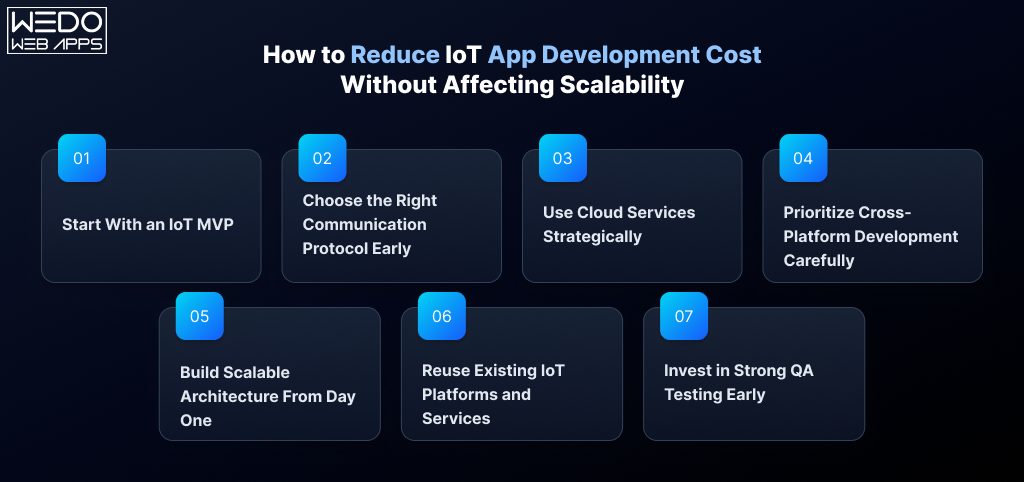
Reducing development costs does not mean cutting important features or compromising system quality.
The smarter approach is building the right foundation first and expanding strategically over time.
Many successful IoT products start with a focused MVP instead of launching with every advanced feature at once. This helps businesses validate the product, reduce technical risks, and control the overall IoT app development cost more effectively.
The key is reducing unnecessary complexity without weakening scalability or long-term performance.
Start With an IoT MVP
An MVP focuses only on the core functionality required for launch.
Instead of building:
- Advanced AI automation
- Complex analytics systems
- Large-scale integrations
- Enterprise dashboards
Businesses can first validate:
- Device connectivity
- Core workflows
- User engagement
- Communication stability
- Market demand
| MVP Development Benefits | Business Impact |
|---|---|
| Faster launch timeline | Reduced initial investment |
| Lower infrastructure cost | Easier product validation |
| Smaller development scope | Faster feedback collection |
| Reduced technical risk | Better scalability planning |
Starting with an MVP is one of the most effective ways to control IoT app development cost early.
Choose the Right Communication Protocol Early
Communication protocols directly affect:
- Infrastructure complexity
- Battery performance
- Device scalability
- Cloud traffic volume
- Long-term maintenance
For example:
- BLE reduces battery consumption for wearables.
- WiFi increases bandwidth for smart devices.
- Cellular communication increases operational expenses.
Selecting the wrong protocol early often creates expensive architecture changes later.
That is why communication planning should align with the overall IoT application architecture from the beginning.
Use Cloud Services Strategically
Many businesses overspend on cloud infrastructure during the early development stages.
Instead of deploying enterprise-level infrastructure immediately, businesses can start with scalable cloud services that grow gradually with usage.
Common cost optimization strategies include:
- Auto scaling cloud systems.
- Event-based serverless architecture.
- Edge computing for local processing.
- Optimized data storage policies.
| Cloud Optimization Strategy | Cost Benefit |
|---|---|
| Serverless processing | Lower idle infrastructure cost |
| Edge computing | Reduced cloud traffic |
| Data compression | Lower storage expenses |
| Auto scaling systems | Better resource efficiency |
Cloud optimization also helps to reduce long-term IoT app maintenance costs after launch.
Prioritize Cross-Platform Development Carefully
Cross-platform frameworks can reduce frontend development time for:
- iOS applications
- Android applications
- Web dashboards
However, not every IoT system performs well with cross-platform development.
Applications requiring:
- Heavy BLE communication
- Complex hardware integration
- Advanced real-time processing may still need native optimization
Businesses should choose development approaches based on technical requirements instead of only short-term cost savings.
Build Scalable Architecture From Day One
Trying to reduce costs by ignoring scalability usually creates larger expenses later.
Poor architecture planning often leads to:
- Infrastructure bottlenecks
- Backend redesigns
- Device synchronization issues
- Expensive migration projects
A scalable IoT application architecture allows businesses to:
- Add devices gradually
- Expand features later
- Improve infrastructure efficiency
- Reduce operational complexity
Even a basic MVP should be built on infrastructure capable of future expansion.
Reuse Existing IoT Platforms and Services
Businesses do not always need to build every system from scratch.
Many platforms already provide:
- Device management systems
- Messaging brokers
- Authentication services
- Cloud infrastructure
- Analytics tools
Examples include:
- AWS IoT Core
- Azure IoT Hub
- Firebase
- MQTT brokers
Using existing services can reduce:
- Backend development effort
- Infrastructure management complexity
- Deployment timelines
However, businesses should also evaluate long-term vendor dependency and operational costs before choosing managed platforms.
Invest in Strong QA Testing Early
Skipping testing may reduce short-term expenses, but often increases long-term costs significantly.
IoT testing helps prevent:
- Device failures
- Connectivity issues
- Firmware instability
- Data synchronization errors
- Security vulnerabilities
Early testing reduces expensive production-level failures later.
| Early QA Benefits | Long-Term Impact |
|---|---|
| Better device reliability | Lower support costs |
| Faster bug detection | Reduced maintenance effort |
| Improved scalability | Fewer operational failures |
| Stronger security | Lower security risk |
How to Choose the Right IoT App Development Company
Choosing the right development team may not always have the experience required for a connected ecosystem involving:
- Device communication
- Firmware systems
- Cloud infrastructure
- Real-time data processing
- Security implementation
- Scalability planning
That is why businesses planning on building IoT applications should evaluate technical expertise carefully before selecting an IoT development company.
The wrong development approach can increase:
- Project delays
- Infrastructure costs
- Maintenance complexity
- Security risks
- Scalability problems
A strong technology partner helps businesses reduce technical risks while creating scalable and reliable IoT systems.
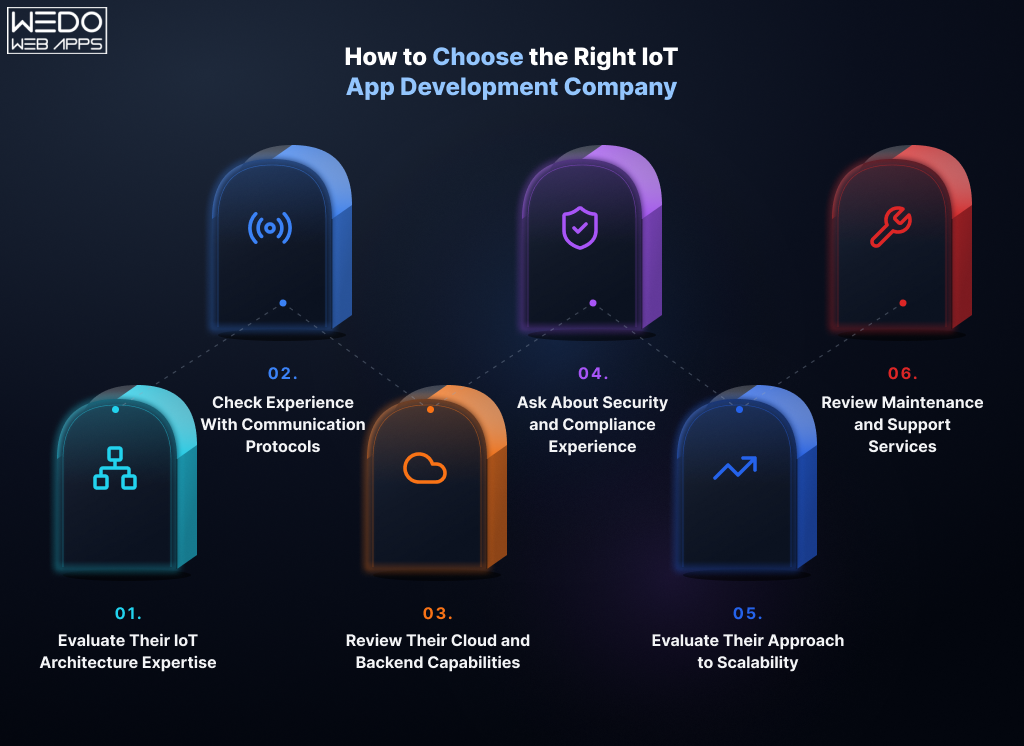
Evaluate Their IoT Architecture Expertise
One of the first things businesses should evaluate is whether the company understands scalable IoT application architecture.
A strong IoT architecture should support:
- Real-time device communication
- Cloud stability
- Firmware management
- Secure APIs
- Multi-device synchronization
- Future ecosystem expansion
Ask questions like:
- How do they handle real-time data processing?
- What cloud platforms do they recommend?
- How do they manage device scaling?
- How do they approach security and OTA updates?
Architecture decisions made early often affect long-term IoT app maintenance costs significantly.
Check Experience With Communication Protocols
Different IoT applications require different communication methods.
An experienced IoT development company should understand:
- BLE communication
- MQTT implementation
- WiFi connectivity
- Zigbee ecosystems
- Cellular IoT infrastructure
For example:
- Wearable apps may rely heavily on BLE.
- Industrial systems often use MQTT and edge computing.
- Smart homes may require Zigbee and WiFi integration.
The development team should recommend protocols based on scalability and product requirements instead of generic implementation approaches.
Review Their Cloud and Backend Capabilities
Cloud infrastructure is the backbone of most IoT ecosystems.
Businesses should evaluate whether the company has experience with:
- AWS IoT Core
- Azure IoT Hub
- Google Cloud IoT Services
- Real-time event processing
- Edge computing systems
- High availability infrastructure
Strong backend expertise is critical because cloud architecture directly affects:
- Performance
- Scalability
- Infrastructure costs
- System reliability
Weak backend planning often becomes one of the largest reasons IoT projects struggle later.
Ask About Security and Compliance Experience
IoT systems continuously exchange sensitive operational and user data.
Security should never be treated as an optional feature.
An experienced company should understand:
- Device authentication
- Data encryption
- Secure communication protocols
- Access control systems
- Compliance requirements
Industries like healthcare, manufacturing, logistics, and finance often require additional security and compliance standards.
| Security Evaluation Area | Why It Matters |
|---|---|
| Device authentication | Prevents unauthorized access |
| Encryption systems | Protects sensitive data |
| Secure firmware updates | Reduces operational risks |
| Compliance implementation | Supports industry regulations |
Security planning also affects long-term IoT app maintenance costs through monitoring and ongoing updates.
Evaluate Their Approach to Scalability
Many IoT systems start small but expand rapidly over time.
Businesses should ask:
- Can the architecture support future growth?
- How will the platform handle thousands of devices?
- What happens when cloud traffic increases?
- How do they optimize infrastructure costs?
A scalable approach reduces expensive backend redesigns later.
| Scalability Consideration | Business Impact |
|---|---|
| Device scaling strategy | Supports future growth |
| Cloud optimization | Controls operational cost |
| Modular architecture | Easier feature expansion |
| Edge computing support | Improves real-time performance |
Review Maintenance and Support Services
IoT systems require ongoing operational support after deployment.
Businesses should understand:
- What maintenance services are included?
- How are firmware updates managed?
- How does infrastructure monitoring work?
- What response times are provided for issues?
Long-term support becomes especially important for enterprise and industrial IoT ecosystems.
Conclusion
The final IoT app development cost depends on far more than app design and device connectivity. Cloud infrastructure, communication protocols, firmware systems, security, and scalability all play a major role in the success of an IoT product.
Businesses planning on building IoT applications should focus on scalable IoT application architecture from the beginning to avoid performance issues, rising infrastructure expenses, and costly redesigns later.
It is also important to plan for long-term IoT app maintenance costs, including cloud hosting, firmware updates, monitoring, and security management after deployment.
A well-planned IoT ecosystem helps businesses build reliable, scalable, and future-ready connected products.