Introduction
Manufacturers today are under constant pressure to deliver higher product quality while maintaining production speed and controlling operational costs. Whether it is automotive parts, electronics, pharmaceuticals, packaging, or consumer goods, even a small defect can lead to customer complaints, product recalls, compliance issues, and financial losses. As production lines become faster and more complex, traditional inspection methods are struggling to keep up.
Manual quality inspection often creates challenges, including inconsistent accuracy, inspection fatigue, slower throughput, and rising labor dependency. Human inspectors can miss micro-level defects, especially during repetitive high-volume production cycles. For startups, SMEs, and enterprises scaling manufacturing operations, these limitations directly affect productivity, customer trust, and long-term profitability.
This is where computer vision quality inspection is transforming modern manufacturing environments. By combining industrial cameras, artificial intelligence, machine learning, and real-time analytics, manufacturers can automate defect detection and improve inspection consistency across production lines. From identifying surface defects to verifying assemblies and measuring product dimensions, computer vision for quality control enables faster and more accurate decision-making at scale.
The growing adoption of computer vision in manufacturing industry workflows is not only reducing inspection costs but also helping manufacturers build more scalable and data-driven quality control systems. Companies investing in AI-powered inspection are increasingly focusing on long-term operational efficiency, predictive quality management, and real-time production visibility.
As businesses continue to modernize factory operations, partnering with experienced teams offering computer vision development, manufacturing software development, and AI-driven quality solutions becomes critical for building reliable and scalable inspection systems.
What Is Computer Vision Quality Inspection?
Computer Vision Quality Inspection is an AI-powered approach that uses cameras, image processing, and machine learning models to automatically inspect products and identify defects during manufacturing. Instead of relying entirely on human inspectors, the system analyzes visual data in real time and determines whether a product meets predefined quality standards.
In simple terms, computer vision acts as a digital inspection layer that can "see," analyze, and make decisions across a production line. Cameras capture product images or video streams, AI models process the visual information, and the system identifies issues such as scratches, cracks, missing components, dimensional variations, packaging defects, or assembly errors. The result is faster, more consistent, and highly scalable quality inspection.
Traditional machine vision systems have been used in manufacturing for years, but they often depend on rigid rule-based programming. These systems work well for predictable scenarios but struggle when product conditions vary. Changes in lighting, product orientation, surface texture, or defect patterns frequently require manual reconfiguration.
AI-powered computer vision for quality control addresses these limitations by learning from large image datasets and continuously improving detection accuracy. Rather than following fixed rules alone, modern systems can recognize complex defect patterns and adapt to changing production environments.
A typical computer vision quality control workflow often includes:
- Industrial cameras capturing product images
- Lighting systems improving image consistency
- AI models analyzing visual data
- Defect classification engines identifying anomalies
- Dashboards and reporting tools displaying results
- Production system integrations triggering actions automatically
This ability to combine visual intelligence with automation is one reason adoption of computer vision in manufacturing industry initiatives continues to grow. Manufacturers are increasingly using these systems not only for defect detection but also for process optimization, production monitoring, and operational insights.
For businesses exploring AI-driven transformation, implementation usually goes beyond model development alone. Scalable systems often require integration across factory software, analytics platforms, mobile interfaces, and operational workflows, areas where strategic AI consulting and technology implementation expertise becomes equally important.
Why Manufacturers Are Replacing Manual Quality Inspection
Manual quality inspection has supported manufacturing operations for years, but production environments have changed significantly. Faster production lines, increasing product complexity, and stricter quality expectations are making traditional inspection processes harder to scale.
As manufacturing volume grows, businesses often discover that manual inspection introduces limitations that directly affect speed, consistency, and operational costs.
Inspection Fatigue Reduces Accuracy
Human inspectors frequently perform repetitive visual checks throughout long production cycles. Over time, concentration naturally drops, increasing the chances of missed defects.
Small issues can easily go unnoticed, including:
- Surface scratches
- Cracks or dents
- Assembly misalignment
- Missing components
- Packaging inconsistencies
In high-speed production environments, even minor inspection errors can create larger quality problems later.
Inconsistent Quality Decisions
Manual inspections often vary from one person to another. Two inspectors may evaluate the same product differently based on experience, judgment, or shift conditions.
This creates challenges such as:
- Inconsistent defect reporting
- Variable quality standards
- Difficulties across multiple facilities
- Reduced process reliability
For manufacturers operating at scale, maintaining consistent inspection outcomes becomes increasingly difficult.
Higher Labor Dependency Increases Costs
Scaling manual inspection usually means hiring more inspectors. While this may temporarily solve production bottlenecks, it often increases:
- Labor costs
- Training requirements
- Operational complexity
- Workforce dependency
Over time, inspection costs can rise without delivering proportional efficiency improvements.
Missed Defects Create Hidden Business Costs
Inspection failures affect more than product quality. A defect that reaches customers can trigger expensive downstream consequences.
Common impacts include:
- Product recalls
- Scrap and rework costs
- Warranty claims
- Compliance issues
- Production delays
- Customer dissatisfaction
Why Manufacturers Are Turning to Computer Vision
This is one reason computer vision inspection systems are gaining traction. AI-powered inspection platforms can analyze products continuously, maintain consistent quality standards, and identify defects in real time.
Unlike manual workflows, computer vision for quality control allows manufacturers to improve accuracy without increasing inspection teams. As the adoption of computer vision manufacturing industry operations grows, businesses are increasingly viewing AI inspection as a long-term strategy for scalability and operational efficiency.
Computer Vision Quality Inspection Use Cases in Manufacturing
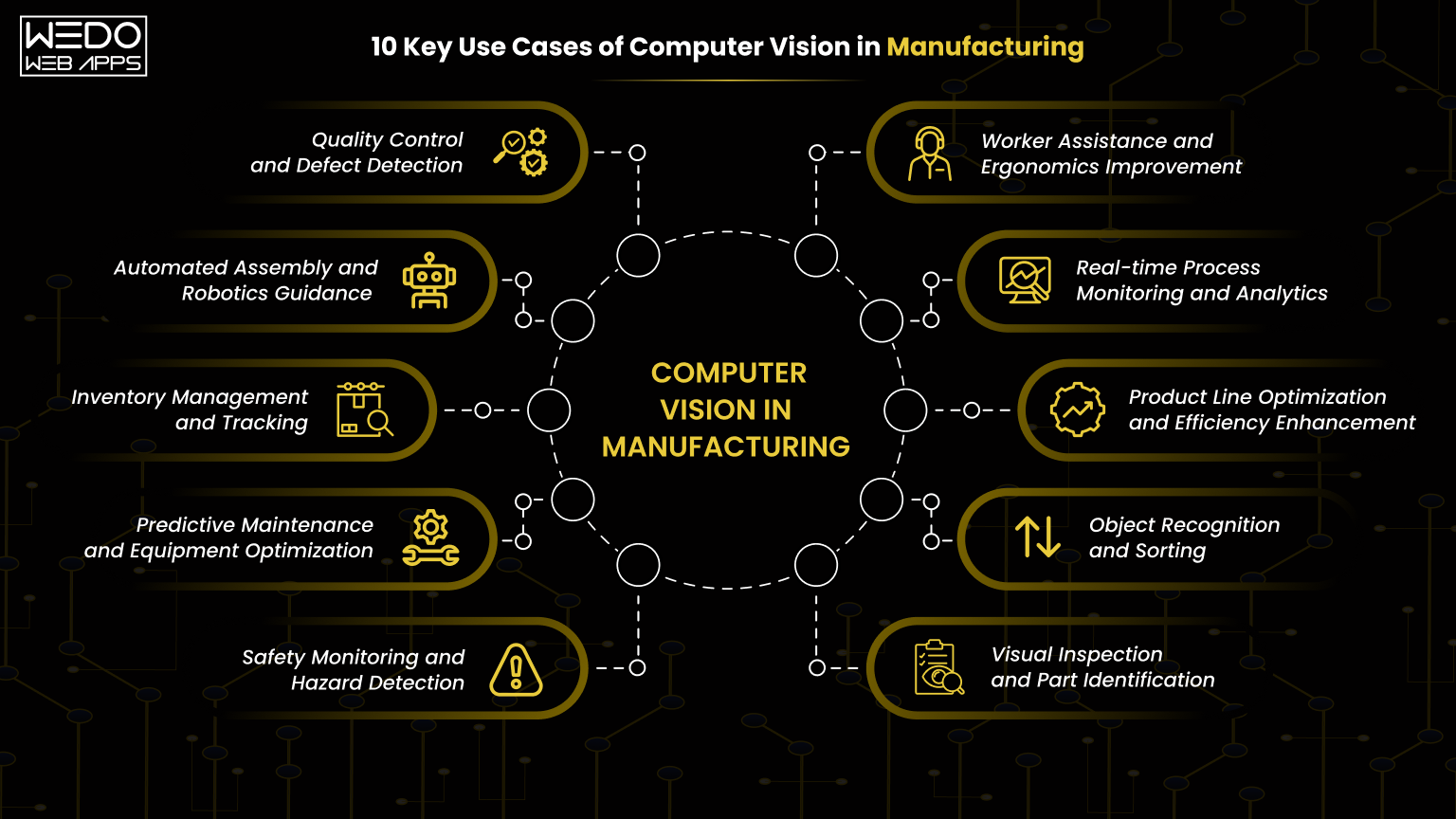
The value of computer vision quality inspection goes far beyond identifying defective products. Modern AI-powered inspection systems help manufacturers monitor production quality in real time, reduce human dependency, and create more reliable quality control processes across the factory floor.
Different industries use computer vision for quality control in different ways, depending on product complexity, production speed, and defect sensitivity. Below are some of the most common use cases.
Surface Defect Detection
Surface inspection is one of the most widely adopted applications of computer vision in manufacturing industry environments. AI models can detect defects that may be difficult to identify consistently through manual inspection.
Common examples include:
- Scratches
- Cracks
- Dents
- Paint inconsistencies
- Surface contamination
- Material damage
Industries such as automotive, electronics, metals, and consumer goods frequently use AI-driven inspection to identify visual defects before products move further in production.
Assembly Verification
Incorrect assembly can create costly quality failures and product returns. Computer vision systems can automatically verify whether components are assembled correctly and positioned according to predefined standards.
Assembly verification may include:
- Missing component detection
- Incorrect part placement
- Alignment verification
- Screw and fastener checks
- Wiring validation
Instead of relying on manual checks at multiple stages, manufacturers can automate verification and reduce production errors.
Dimensional Measurement and Tolerance Validation
Certain products require extremely precise measurements. Small dimensional variations can affect functionality, safety, or compliance requirements.
Computer vision systems help manufacturers inspect:
- Product dimensions
- Shape consistency
- Gap measurements
- Edge alignment
- Tolerance deviations
AI-powered inspection enables faster measurements without slowing production lines.
Packaging and Label Inspection
Packaging defects can create inventory issues, customer complaints, and regulatory risks. Computer vision systems can inspect packaging elements automatically before products leave the facility.
Common inspection scenarios include:
- Barcode verification
- Label placement checks
- Packaging damage detection
- Expiration date validation
- Missing packaging components
This helps manufacturers maintain consistency across large production volumes.
Production Line Monitoring
Beyond defect detection, computer vision quality control systems can continuously monitor manufacturing operations and generate real-time production insights.
Examples include:
- Product counting
- Conveyor monitoring
- Object tracking
- Process anomaly detection
- Production flow monitoring
These insights allow manufacturers to identify operational issues earlier and improve production efficiency.
As manufacturers expand AI adoption, inspection systems increasingly become part of larger digital ecosystems. Integrating inspection workflows with analytics platforms, dashboards, and custom factory solutions often requires broader manufacturing software development capabilities to support scalability and operational visibility.
How Computer Vision for Quality Control Works
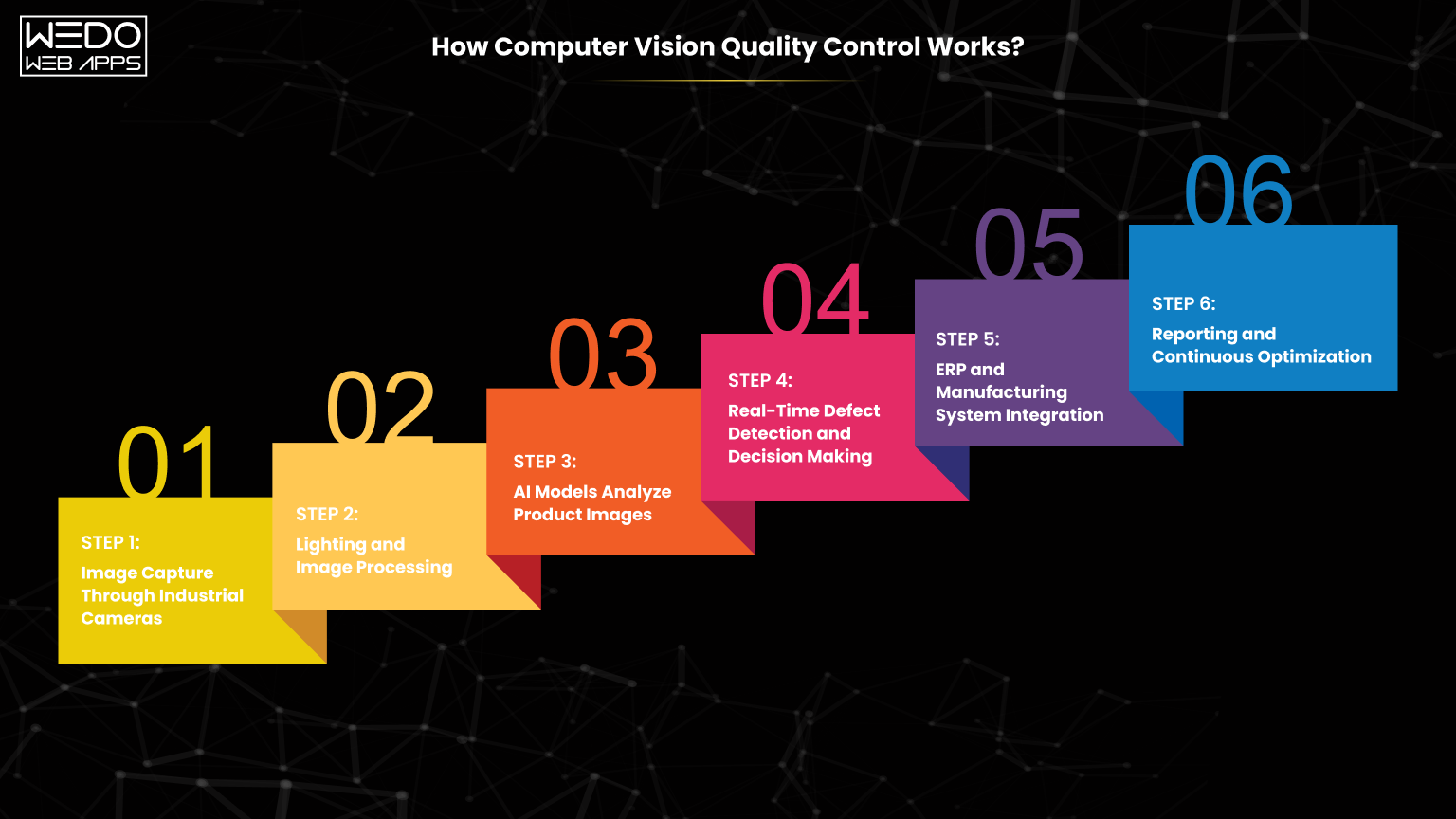
Understanding how computer vision for quality control works helps manufacturers evaluate implementation complexity, infrastructure requirements, and long-term scalability. While systems vary across industries and production environments, most computer vision quality inspection workflows follow a similar process.
The goal is simple: capture visual data, analyze it using AI models, identify defects, and trigger actions in real time.
Step 1: Image Capture Through Industrial Cameras
The process starts with industrial cameras positioned across the production line. These cameras continuously capture images or video streams of products as they move through inspection points.
Depending on manufacturing requirements, camera setups may vary based on:
- Product size
- Conveyor speed
- Inspection distance
- Resolution requirements
- Lighting conditions
High-quality image capture is critical because AI models rely heavily on clear visual data.
Step 2: Lighting and Image Processing
Image quality does not depend only on cameras. Lighting setup often has a major impact on inspection accuracy.
Manufacturers commonly use:
- Backlighting
- Diffused lighting
- Structured lighting
- Ring lighting systems
Before analysis, systems may also preprocess images to improve consistency by:
- Reducing noise
- Adjusting contrast
- Normalizing brightness
- Enhancing edges
This creates cleaner data for defect detection models.
Step 3: AI Models Analyze Product Images
Once images are captured and processed, AI models begin analyzing visual information.
Depending on use cases, systems may use technologies such as:
- OpenCV
- TensorFlow
- YOLO object detection
- Deep learning models
- Image segmentation algorithms
These models identify defects, classify objects, and compare products against predefined quality standards.
Step 4: Real-Time Defect Detection and Decision Making
The AI system then determines whether products meet quality requirements. Common outputs include:
- Pass/fail decisions
- Defect classification
- Severity scoring
- Anomaly detection
- Missing components alerts
This entire process often happens within milliseconds, allowing manufacturers to inspect products without slowing production.
Step 5: ERP and Manufacturing System Integration
Modern computer vision quality control systems rarely operate in isolation. Inspection platforms increasingly integrate with broader manufacturing systems.
Common integrations include:
- ERP systems
- MES platforms
- Inventory systems
- Quality management software
- Production dashboards
This allows inspection data to become part of larger operational workflows.
For many manufacturers, implementation also extends to mobile visibility and workflow management. Teams often require dashboards, reporting tools, and operational apps that provide real-time inspection insights across devices. This is where organizations with expertise in mobile app development, factory systems integration, and AI-driven workflows can help build scalable production ecosystems.
Step 6: Reporting and Continuous Optimization
After deployment, inspection systems continue collecting operational data. Manufacturers can track:
- Defect trends
- Production quality patterns
- Model accuracy
- Equipment performance
- Process improvements
Over time, this creates a feedback loop that continuously improves inspection accuracy and operational efficiency.
Instead of acting as a standalone inspection tool, computer vision in manufacturing industry environments increasingly functions as an integrated intelligence layer across production operations.
AI Models and Tech Stack Used in Computer Vision Quality Control
The performance of a computer vision quality inspection system depends heavily on the technology stack behind it. Cameras capture images, but AI models and processing frameworks are responsible for detecting defects, recognizing patterns, and making real-time inspection decisions.
The right technology choice depends on factors such as production speed, defect complexity, deployment requirements, and scalability goals.
Below are some of the most commonly used technologies in computer vision for quality control projects.
1. OpenCV for Image Processing
OpenCV is one of the most widely used computer vision libraries for image processing and visual analysis tasks. In manufacturing inspection systems, OpenCV often helps with:
- Image preprocessing
- Edge detection
- Noise reduction
- Shape identification
- Object tracking
- Image enhancement
Before AI models analyze products, OpenCV can improve image quality and prepare visual data for more accurate detection.
2. TensorFlow for AI Model Development
TensorFlow is commonly used for building and training machine learning models for inspection workflows.
Manufacturers use TensorFlow for tasks such as:
- Defect classification
- Image recognition
- Pattern analysis
- Deep learning model training
- Model optimization
Its flexibility makes it suitable for custom inspection scenarios where products, defects, and manufacturing conditions vary.
3. YOLO for Real-Time Object Detection
YOLO (You Only Look Once) has become one of the most popular object detection frameworks for industrial inspection. Production environments often require:
- Real-time processing
- Low latency
- Fast decision-making
- Continuous object tracking
YOLO can process images quickly while identifying multiple objects and defects simultaneously, making it suitable for high-speed production lines.
For manufacturers dealing with moving conveyor systems and rapid inspection cycles, speed becomes just as important as detection accuracy.
Edge AI Frameworks for Factory Deployment
Many manufacturers prefer running AI systems directly on factory-floor hardware rather than relying entirely on cloud infrastructure.
Common technologies include:
- NVIDIA Jetson
- TensorRT
- Intel OpenVINO
- Edge inference engines
These frameworks support local processing and enable:
- Faster response times
- Reduced internet dependency
- Lower latency
- Improved operational reliability
This becomes particularly valuable in production environments where real-time decisions are critical.
Technology Selection Depends on Business Goals
There is no universal technology stack for every manufacturer. A system designed for pharmaceutical packaging inspection may require a different architecture than one built for automotive defect detection.
Choosing the right tools often depends on:
- Production volume
- Defect complexity
- Hardware environment
- Accuracy requirements
- Integration needs
- Future scalability goals
This is why many businesses approach computer vision development projects with a broader implementation strategy rather than focusing only on model selection. Beyond AI models alone, successful deployments frequently require manufacturing workflows, testing processes, and scalable system architecture working together.
Camera and Hardware Requirements for Computer Vision Inspection
Even the most advanced AI model cannot deliver reliable results if the image quality is poor. In computer vision quality inspection, hardware decisions directly affect detection accuracy, processing speed, and long-term system reliability.
Many manufacturers initially focus on AI models, but camera selection, lighting conditions, and processing hardware often determine whether an inspection system performs consistently in real production environments.
Industrial Cameras: Capturing Reliable Visual Data
Industrial inspection systems rely on cameras designed for high-speed and continuous manufacturing operations.
Key factors to evaluate include:
- Resolution: Higher resolution allows systems to detect smaller defects and fine details. However, increasing resolution also increases processing requirements.
- Frame Rate: Fast-moving production lines require higher frame rates to capture products without motion blur.
- Field of View: Camera positioning and coverage area affect inspection quality and object visibility.
- Sensor Type: Different sensors perform better under varying lighting and environmental conditions.
Manufacturers often choose between:
- Area scan cameras for general product inspection
- Line scan cameras for continuous surface inspection
- Monochrome cameras for contrast-focused inspections
- Color cameras for label or packaging analysis
The ideal setup depends on production requirements rather than camera specifications alone.
Lighting Setup Often Determines Inspection Accuracy
Lighting is frequently underestimated during implementation planning. Poor lighting can introduce shadows, reflections, inconsistent contrast, and image noise that reduce detection reliability.
Common lighting methods include:
- Backlighting
- Diffused lighting
- Ring lighting
- Structured lighting
- Dark-field illumination
The goal is to create consistent image conditions, so AI models receive stable visual input.
In many implementations, improving lighting delivers larger accuracy gains than changing AI models.
Edge Devices and GPUs Power Real-Time Processing
Once images are captured, systems need hardware capable of processing large amounts of visual data quickly.
Common processing options include:
- GPUs for AI inference
- Industrial PCs
- Edge computing devices
- Embedded AI hardware
These devices help manage:
- Real-time image analysis
- Defect detection workloads
- AI model execution
- Production-speed requirements
Processing hardware selection becomes especially important when inspections occur at high speeds.
Factory Environment Conditions Also Matter
Real production environments create challenges that laboratory testing environments often do not.
Hardware planning should account for:
- Dust exposure
- Heat conditions
- Machine vibration
- Moisture levels
- Conveyor speed variations
- Continuous operation requirements
Ignoring environmental conditions can reduce system stability and increase maintenance costs over time.
Hardware Choices Directly Affect ROI
In computer vision for quality control, hardware should not be treated as a standalone purchase decision. Camera resolution, lighting quality, and processing infrastructure all influence defect detection accuracy and operational outcomes.
For manufacturers implementing computer vision in manufacturing industry environments, long-term success often comes from designing hardware and software together rather than treating them as separate investments.
Edge AI vs Cloud Vision for Factory Inspection
One of the biggest decisions in a computer vision quality inspection project is determining where image processing and AI inference should happen. Manufacturers typically choose between Edge AI and Cloud Vision deployment models based on operational needs, infrastructure, and production requirements.
There is no universal answer. The right approach depends on factors such as production speed, latency tolerance, data sensitivity, and scalability goals.
What is Edge AI?
Edge AI processes images and runs AI models directly on local devices located within the factory environment.
Instead of sending image data to remote servers, processing happens on:
- Industrial PCs
- Edge devices
- Embedded systems
- Local GPUs
- Factory-floor hardware
This approach allows inspection systems to make decisions close to the production source.
Benefits of Edge AI
- Real-time defect detection
- Lower latency
- Reduced internet dependency
- Faster production decisions
- Better performance in offline environments
- Improved data privacy
Limitations of Edge AI
- Higher upfront hardware investment
- Local infrastructure maintenance
- Hardware scaling requirements
Edge AI is commonly used in high-speed manufacturing environments where milliseconds matter.
What is Cloud Vision?
Cloud vision sends captured image data to a remote cloud infrastructure where AI models process and analyze the information.
This approach enables centralized system management and flexible resource allocation.
Benefits of Cloud Vision:
- Easier scalability
- Centralized model management
- Lower on-site infrastructure needs
- Simplified updates and deployment
- Flexible compute resources
Limitations of Cloud Vision:
- Internet dependency
- Possible network latency
- Data transmission considerations
- Security and compliance concerns
Cloud-based systems may work well when inspection workloads are distributed across multiple facilities.
Edge AI vs Cloud Vision Comparison
| Factor | Edge AI | Cloud Vision |
|---|---|---|
| Processing Location | Factory floor | Remote servers |
| Latency | Very low | Higher |
| Internet Dependency | Minimal | Required |
| Real-Time Performance | Strong | Moderate |
| Scalability | Hardware dependent | Highly scalable |
| Data Privacy | Higher control | Depends on cloud policies |
| Upfront Cost | Higher | Lower initially |
| Maintenance | Local | Centralized |
Which Option is Better for Manufacturers?
For many manufacturers using computer vision for quality control, deployment decisions are based on operational realities rather than technology preferences.
Edge AI often makes sense when businesses need:
- Real-time inspection decisions
- Low-latency environments
- Offline reliability
- Sensitive production data handling
Cloud deployment may fit organizations that prioritize:
- Multi-site management
- Centralized AI operations
- Flexible infrastructure scaling
In practice, many companies adopt hybrid models that combine local processing with cloud-based analytics and reporting.
As computer vision in manufacturing industry environments becomes more advanced, deployment strategies increasingly focus on balancing speed, cost, and long-term scalability rather than choosing one architecture exclusively.
ROI of Computer Vision Quality Inspection Systems
For most manufacturers, adopting AI-powered inspection is not simply a technology decision. It is a business decision. Before investing in automation, startups, SMEs, and enterprises typically ask one question:
Will computer vision generate measurable returns?
The answer often depends on how inspection inefficiencies affect current operations. Manual inspection costs extend beyond salaries alone. Missed defects, rework, downtime, and quality failures create hidden expenses that gradually impact profitability.
This is where computer vision quality inspection systems create long-term value.
Labor Cost Reduction
Manual quality inspection often requires dedicated teams across multiple production stages. As production volume increases, businesses typically add more inspectors to maintain output.
AI-powered inspection systems help reduce dependency on repetitive manual processes by:
- Automating visual checks
- Supporting continuous inspection cycles
- Reducing repetitive inspection workload
- Improving workforce utilization
Instead of scaling inspection teams linearly, manufacturers can scale inspection capacity more efficiently.
Reduced Scrap and Rework Costs
Late-stage defect detection can become expensive. A defect found after assembly, packaging, or shipment often creates higher downstream costs.
Computer vision systems help identify issues earlier through:
- Real-time defect detection
- Consistent inspection accuracy
- Early production-stage validation
- Automated quality monitoring
Earlier detection usually means lower material waste and fewer rework cycles.
Faster Production Cycles
Manual inspection can create bottlenecks, especially during high-volume production periods.
Automated inspection systems can:
- Analyze products in milliseconds
- Support continuous production flow
- Reduce inspection delays
- Improve production throughput
Higher production speed often translates directly into operational gains.
Lower Recall and Warranty Risks
A single undetected defect reaching customers can create expensive consequences. Potential impacts include:
- Product recalls
- Warranty claims
- Brand reputation damage
- Compliance penalties
- Customer dissatisfaction
Improving inspection consistency reduces these risks significantly.
A Simple ROI Formula
Manufacturers frequently calculate returns using a straightforward model:
ROI = [(Annual Savings - System Cost) / System Cost] * 100
For example:
- Annual quality-related savings: $250,000
- Computer vision implementation cost: $100,000
Estimated ROI: 150%
While actual results vary, many organizations evaluate both direct and indirect operational gains.
ROI Extends Beyond Cost Savings
The long-term impact of computer vision for quality control goes beyond labor reduction. Manufacturers also gain:
- Better production consistency
- Faster quality decisions
- Real-time operational visibility
- Improved scalability
- Data-driven quality insights
As the adoption of computer vision in manufacturing industry workflows grows, businesses increasingly view AI inspection systems as operational infrastructure rather than standalone automation tools. The strongest returns often come from combining technology investments with broader process optimization and implementation planning.

Typical Implementation Timeline for Computer Vision in Manufacturing Industry
One of the most common concerns manufacturers have before adopting AI inspection systems is implementation complexity. Many assume computer vision quality inspection projects require years of development, large infrastructure changes, or complete production redesigns.
In reality, implementation timelines are usually more structured and manageable. While project scope varies by use case, many computer vision for quality control initiatives can move from planning to deployment within 3-6 months.
The timeline largely depends on production complexity, data availability, hardware requirements, and integration needs.
Phase 1: Discovery and Requirement Analysis
The first stage focuses on understanding production goals and defining inspection requirements.
This typically includes:
- Identifying defect categories
- Evaluating current inspection workflows
- Defining accuracy expectations
- Reviewing production environments
- Assessing hardware requirements
Clear requirement analysis helps avoid costly changes later.
Phase 2: Data Collection and Annotation
AI inspection systems rely heavily on image data. Before training models, manufacturers need sufficient visual datasets representing both acceptable and defective products.
Activities often include:
- Capturing production images
- Gathering defect samples
- Image labeling and annotation
- Organizing datasets
- Reviewing data quality
High-quality data directly influences model performance.
Phase 3: AI Model Training and Validation
Once datasets are prepared, development teams begin training AI models for defect detection and classification.
This phase often includes:
- Model selection
- Training workflows
- Accuracy testing
- Hyperparameter tuning
- Validation against production requirements
The goal is not simply achieving high accuracy but ensuring reliable performance under real manufacturing conditions.
Phase 4: Pilot Deployment
Before full rollout, manufacturers often test systems in a controlled production environment.
Pilot deployments help validate:
- Detection accuracy
- Production performance
- Hardware behavior
- Real-world conditions
- Workflow integration
This stage identifies adjustments before scaling further.
Phase 5: Full Production Integration
After successful testing, the inspection system becomes part of broader manufacturing operations.
Common integration areas include:
- ERP systems
- MES platforms
- Quality management software
- Dashboards
- Reporting workflows
For many businesses, implementation extends beyond AI models alone. Production systems often require workflow design, analytics, and operational planning, making strategic AI consulting equally important during deployment.
Phase 6: Continuous Optimization
Deployment is rarely the first step. Over time, manufacturers frequently:
- Retrain AI models
- Add new defect categories
- Improve datasets
- Monitor inspection performance
- Expand systems across production lines
As computer vision in manufacturing industry adoption grows, successful projects increasingly focus on continuous improvement rather than one-time implementation.
A structured rollout strategy often helps manufacturers reduce implementation risks while accelerating time-to-value.
Common Challenges in Computer Vision Quality Control Projects
While computer vision quality inspection systems can significantly improve inspection speed and accuracy, successful implementation requires more than selecting an AI model and installing cameras. Real-world manufacturing environments introduce variables that can affect performance if they are not planned properly.
Understanding these challenges early helps businesses set realistic expectations and build more reliable systems.
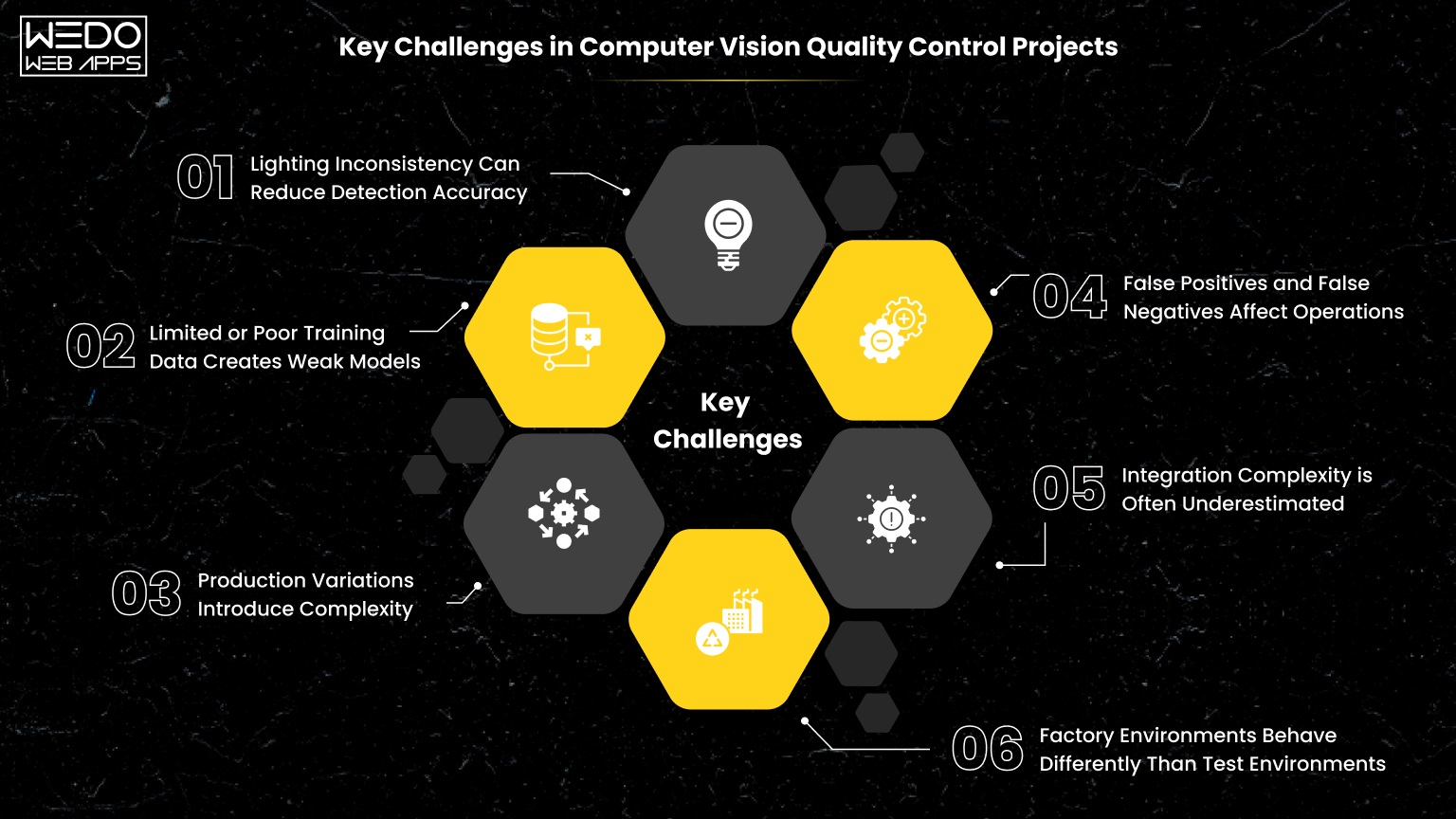
Lighting Inconsistency Can Reduce Detection Accuracy
Lighting is one of the most common reasons inspection performance varies. Changes in:
- Shadows
- Reflections
- Ambient light
- Product positioning
- Surface glare
can affect image quality and create inconsistent visual data.
Even highly accurate AI models can struggle if image conditions change across shifts or production environments.
Limited or Poor Training Data Creates Weak Models
AI models learn from examples. If training datasets are too small or fail to represent real production scenarios, detection performance often suffers.
Common dataset issues include:
- Insufficient defect samples
- Poor image quality
- Limited product variation
- Imbalanced datasets
- Missing edge-case scenarios
Better data usually leads to more reliable inspection outcomes.
Production Variations Introduce Complexity
Manufacturing environments rarely remain static. Product updates, design changes, packaging modifications, and material differences can influence inspection behavior.
Examples include:
- New product variants
- Surface texture changes
- Color variations
- Packaging redesigns
- Production process adjustments
Systems need flexibility to adapt as products evolve.
False Positives and False Negatives Affect Operations
No inspection system achieves perfect performance. Two common challenges include:
- False Positives: The system flags acceptable products as defective.
- False Negatives: Actual defects pass inspection unnoticed.
Both situations can create operational costs and affect production efficiency.
The goal is not simply maximizing accuracy percentages but balancing inspection performance against real business requirements.
Integration Complexity is Often Underestimated
Many manufacturers discover that implementation involves more than AI detection alone.
Inspection systems frequently need connections with:
- ERP platforms
- Manufacturing execution systems
- Production dashboards
- Reporting tools
- Factory workflows
Without proper integration planning, isolated systems can create operational silos.
Factory Environments Behave Differently Than Test Environments
AI models often perform well during testing but encounter additional variables in production environments.
Common environmental challenges include:
- Dust exposure
- Heat fluctuations
- Machine vibration
- High-speed production lines
- Continuous operation demands
These conditions can influence hardware stability and inspection consistency over time.
As computer vision for quality control adoption expands, successful implementations increasingly depend on planning for operational realities rather than focusing solely on model accuracy. The strongest computer vision in manufacturing industry deployments usually combines AI capability with process design, testing, and ongoing optimization.
Best Practices for Successful Computer Vision Quality Inspection Deployment
Implementing a successful computer vision quality inspection system requires more than selecting the right AI model. Long-term performance depends on planning, testing, operational alignment, and continuous optimization.
Manufacturers that approach implementation strategically often achieve faster adoption, better inspection accuracy, and stronger ROI outcomes.
Start With High-Impact Use Cases
Many organizations try to automate multiple inspection processes at once. This can increase complexity during early implementation stages.
A more effective approach is starting with inspection areas that create the highest operational impact, such as:
- Frequently occurring defects
- High-cost quality failures
- Manual inspection bottlenecks
- Rework-heavy processes
- High-volume production lines
Early success creates measurable business value and simplifies future expansion.
Use Pilot Deployments Before Full Rollout
Pilot deployments allow manufacturers to validate system performance in controlled production environments before scaling across facilities.
A pilot phase helps evaluate:
- Detection accuracy
- Production compatibility
- Hardware stability
- Workflow integration
- Real-time performance
This reduces implementation risks and helps teams identify optimization opportunities earlier.
Invest in High-Quality Image Data
AI inspection systems depend heavily on data quality.
Manufacturers should prioritize:
- Consistent image capture
- Diverse defect samples
- Proper annotation
- Real production scenarios
- Ongoing dataset updates
In many cases, improving training data delivers larger gains than changing AI algorithms.
Prioritize Lighting and Camera Setup
Even advanced AI models can underperform if image capture conditions are inconsistent.
Best practices include:
- Maintaining stable lighting conditions
- Reducing reflections and shadows
- Optimizing camera positioning
- Using production-specific lighting setups
Reliable visual input improves overall inspection consistency.
Combine AI With Human Validation Initially
Many manufacturers benefit from using AI-assisted inspection during early deployment stages rather than immediately removing human oversight.
This hybrid approach helps:
- Build operational confidence
- Validate inspection accuracy
- Reduce false-positive concerns
- Improve dataset quality
Over time, organizations can gradually increase automation levels.
Continuously Monitor and Retrain Models
Production environments change continuously. New product designs, packaging updates, and process adjustments can influence model performance.
Successful teams regularly:
- Monitor inspection accuracy
- Review defect trends
- Retrain models with new data
- Add new inspection scenarios
- Optimize detection thresholds
Continuous improvement helps maintain long-term system reliability.
Build Inspection Systems as Part of Larger Manufacturing Workflows
Modern computer vision for quality control systems work best when integrated into broader operational ecosystems.
This often includes:
- Quality management workflows
- Production analytics
- Mobile monitoring tools
- Reporting dashboards
- Manufacturing automation systems
For many businesses, scalable implementation requires expertise beyond AI alone. Combining inspection automation with strong testing processes, workflow planning, and broader quality assurance strategies often creates more sustainable outcomes for growing manufacturing operations.
How to Choose the Right Computer Vision Development Partner
Selecting the right technology partner can significantly influence the success of a computer vision quality inspection project. While many vendors can build AI models, manufacturing environments require far more than basic defect detection capabilities.
Successful implementations often depend on a combination of:
- AI expertise
- Manufacturing workflow understanding
- System integration capabilities
- Scalability planning
- Long-term operational support
For startups, SMEs, and enterprises, choosing the right partner is not only a technical decision but also a strategic business decision.
Look for Manufacturing Domain Experience
Manufacturing environments introduce challenges that generic AI projects may not address effectively.
A strong implementation partner should understand:
- Production workflows
- Factory-floor constraints
- Inspection bottlenecks
- Industrial hardware requirements
- Quality assurance processes
Experience in real manufacturing environments helps reduce implementation risks and improve deployment efficiency.
Evaluate End-to-End Development Capabilities
Many projects fail because AI systems are developed in isolation without considering operational workflows.
A capable partner should support:
- AI model development
- Camera and hardware integration
- Production system integration
- Dashboard development
- Workflow automation
- Reporting and analytics
This creates a more scalable and connected inspection ecosystem.
Assess Scalability and Integration Expertise
As production expands, inspection systems often need to scale across multiple lines, facilities, or product categories.
Manufacturers should evaluate whether the partner can support:
- ERP integration
- MES integration
- Cloud and edge deployment
- Multi-site scalability
- Continuous optimization
Long-term flexibility becomes important as manufacturing operations evolve.
Prioritize Testing and Quality Assurance
Inspection systems directly affect product quality decisions. Weak testing practices can create operational risks during deployment.
Strong implementation teams usually focus heavily on:
- Accuracy validation
- Real-world testing
- False-positive reduction
- Production performance monitoring
- Continuous QA processes
This is especially important in high-volume production environments where inspection reliability directly impacts operational efficiency.
Consider Mobile and Operational Visibility
Modern manufacturers increasingly require real-time visibility into production and quality workflows.
Beyond inspection itself, many businesses benefit from:
- Mobile monitoring applications
- Live production dashboards
- Automated alerts
- Quality analytics platforms
- Reporting systems
Organizations offering broader manufacturing software development and operational workflow expertise can often build more connected production ecosystems.
Look Beyond Initial Deployment
Computer vision systems continue evolving after implementation.
Manufacturers should evaluate whether the partner can support:
- Model retraining
- New defect scenarios
- System optimization
- Production scaling
- Ongoing maintenance
Long-term collaboration often matters more than short-term deployment speed.
As adoption of computer vision in manufacturing industry operations continues growing, businesses increasingly look for partners that combine AI implementation, operational understanding, and scalable software expertise. Teams with capabilities in computer vision development, AI consulting, and quality-focused software engineering can help manufacturers build inspection systems that support both immediate operational goals and future scalability.
Conclusion
As manufacturing environments become faster, more complex, and increasingly quality-driven, traditional inspection methods are struggling to deliver the speed and consistency modern production demands. Manual inspection processes often create limitations around scalability, accuracy, operational efficiency, and long-term cost management.
This is why computer vision quality inspection is rapidly becoming a critical part of modern manufacturing operations. By combining AI models, industrial cameras, real-time analytics, and automated workflows, manufacturers can detect defects faster, improve inspection consistency, and reduce dependency on repetitive manual processes.
From surface defect detection and assembly verification to dimensional measurement and production monitoring, computer vision for quality control enables manufacturers to build more reliable and data-driven quality systems. Beyond defect detection alone, these systems also improve operational visibility, production efficiency, and long-term scalability.
However, successful implementation depends on more than AI models alone. Factors such as hardware selection, workflow integration, deployment strategy, testing processes, and continuous optimization all play an important role in long-term performance.
As adoption of computer vision in manufacturing industry workflows continues growing, manufacturers increasingly need scalable technology ecosystems that combine AI, automation, quality assurance, and operational software integration. Businesses investing early in intelligent inspection systems are positioning themselves for stronger production reliability, lower quality-related costs, and greater operational agility in the years ahead.