Introduction
A website looks simple on the screen. A user clicks a button, submits a form, checks an order, or signs in. Yet each action can trigger several processes that users never see.
If you are planning a website or application, this distinction matters. You need to know which features belong to the interface and which ones require server-side logic, databases, APIs, or external services.
That is where front-end vs back-end comes in. Understanding frontend vs backend helps you make sense of how applications are built, what different dedicated developers handle, and what your project may need.
So, what is frontend and backend, and how do these two sides work together? Let's break down the difference, technologies, responsibilities, and practical examples you need to understand.
Quick Answer: What Is Frontend and Backend?
The frontend is the part of a website or application that your users see and interact with. It includes the interface, buttons, forms, menus, images, animations, and other elements displayed in the browser or app.
The backend works behind the interface. It processes requests, applies business logic, manages data, connects with databases, handles authentication, and communicates with external services.
A simple way to understand frontend vs backend is:
| Frontend | Backend |
|---|---|
| What users see and interact with | What processes those interactions |
| Runs mainly on the user's device or browser | Runs on servers or cloud infrastructure |
| Handles interface and user experience | Handles logic, data, APIs, and processing |
| Uses technology such as HTML, CSS, JavaScript, React, and Vue | Uses technologies such as Node.js, Python, Java, PHP, and .NET |
For example, when you log in to an eCommerce website, the frontend displays the login form. The backend receives your credentials, verifies them, manages the authentication process, and returns the appropriate response.
Both sides need to work together for an application to function correctly.
What Is Frontend Development?
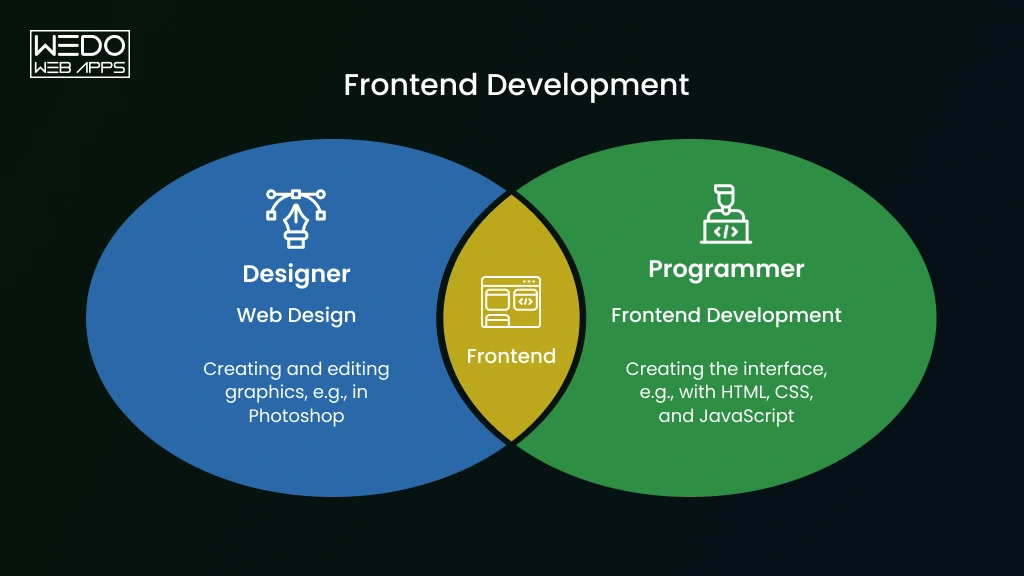
When you open a website or mobile web application, everything you can see and interact with belongs largely to the frontend. It is the client-side of the application that turns design concepts into working screens and interactions.
Frontend development focuses on how an application looks, responds, and behaves from the user's side. It connects interface elements with the data and services provided by the backend.
What Does a Frontend Developer Do?
A frontend developer turns designs and product requirements into functional interfaces. Their work can include:
- Building pages, navigation, forms, buttons, and interactive components.
- Making interfaces responsive across desktops, tablets, and mobile devices.
- Connecting screens to backend APIs.
- Handling client-side validation and user interactions.
- Improving page loading and browser performance.
- Supporting accessibility across different users and devices.
For example, on an online store, the frontend controls the product grid, filters, shopping cart interface, checkout screens, and the messages users see when an action succeeds or fails.
What Technologies Are Used for Frontend Development?
Frontend development typically combines core web technologies with frameworks and libraries.
| Technology | Common use |
|---|---|
| HTML | Structures webpage content |
| CSS | Controls layout, styling, and responsive design |
| JavaScript | Adds interaction and dynamic behavior |
| React | Builds reusable interface components |
| Angular | Supports structured web application development |
| Vue | Builds interactive user interfaces |
| Next.js | Supports ReactJS applications with features such as server rendering and routing |
The right choice depends on your application's requirements, existing technology stack, performance needs, and development team.
What Does Frontend Development Handle?
A frontend can be responsible for much more than visual presentation. It manages the part of the application your users directly experience.
For instance, when a customer filters products by price, the frontend can capture that interaction and request the relevant results from the backend. When the response arrives, it updates the product list without requiring the user to manually reload the page.
This makes the frontend the primary interaction layer between your users and the application.
What Is Backend Development?
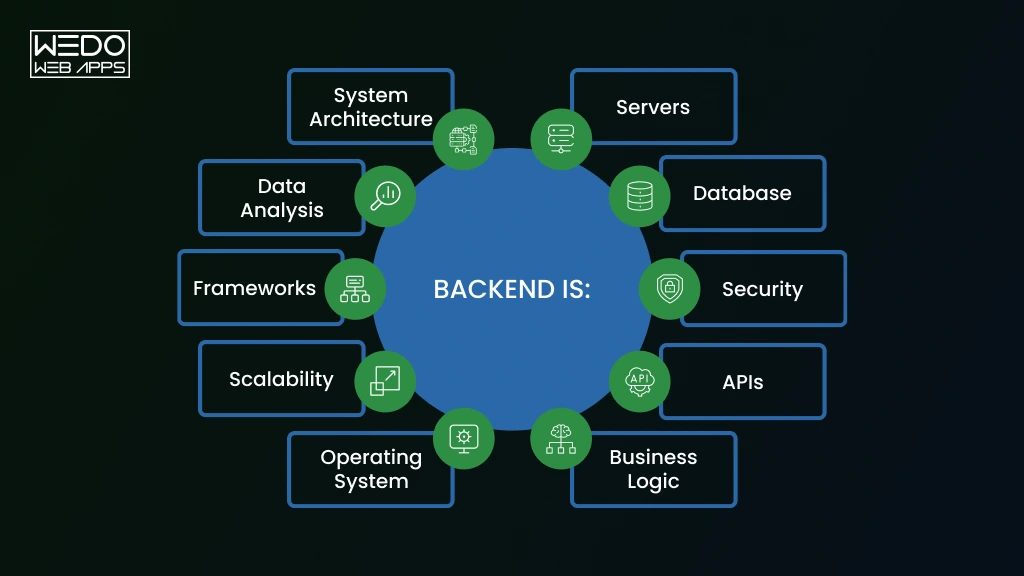
A user may only see a login form, product page, or payment screen, but those interactions need server-side processing to work. Backend development handles the operations that users do not directly see.
The backend receives requests from the frontend, processes them according to the application's rules, works with databases and external services, and sends the required response back to the frontend.
What Does a Backend Developer Do?
A backend developer builds and maintains the server-side components that support an application. Their responsibilities can include:
- Creating and managing APIs.
- Building application and business logic.
- Connecting applications with databases.
- Implementing authentication and authorization.
- Processing and validating data.
- Integrating payment gateways and third-party services.
- Managing server-side errors and application performance.
For example, when a customer places an order, the frontend captures the action. The backend can verify the customer, check product availability, calculate the order total, process the request, store the order, and return the result.
What Technologies Are Used for Backend Development?
Backend teams choose technologies based on the application's requirements, existing systems, performance needs, and developer expertise.
| Technology | Common use |
|---|---|
| Node.js | Building server-side applications and APIs with JavaScript |
| Python | Web applications, APIs, data processing, and AI integrations |
| Java | Large-scale applications and enterprise systems |
| PHP | Server-side web development and content-driven applications |
| C# | Applications built with the .NET ecosystem |
| Go | High-performance services and backend systems |
Popular backend frameworks include Express, Django, Laravel, Spring Boot, and ASP.NET Core. Framework selection depends on the project's architecture and technical requirements.
What Does Backend Development Handle?
Backend development typically manages the parts of an application that require controlled server-side processing.
Consider an online booking application. The backend can check availability, store customer details, calculate pricing, create bookings, process payments, and send confirmation data to the frontend.
It also provides the APIs that allow the frontend to request or submit information. This connection is what allows the interface to display current data and respond to user actions.
Frontend vs Backend: Key Differences
The easiest way to understand frontend vs backend is to look at where each one operates and what it is responsible for. The frontend deals directly with the user's interaction. The backend manages the processing and data needed to support that interaction.
| Factor | Frontend | Backend |
|---|---|---|
| Primary Purpose | Builds the user interface and interactions | Handles application logic and processing |
| Where it runs | Mainly in the browser or client device | On servers or cloud infrastructure |
| Main focus | User experience and interface behavior | Data, business rules, APIs, and services |
| Common languages | HTML, CSS, JavaScript, TypeScript | JavaScript, Python, Java, PHP, C#, Go |
| Common frameworks | React, Angular, Vue, Next.js | Node.js, Django, Laravel, Spring Boot, ASP.NET Core |
| Data handling | Requests and displays data through APIs | Processes, stores, retrieves, and manages data |
| Security | Client-side validation and secure interaction flows | Authentication, authorization, API and data protection |
| Testing | Interface, browser, accessibility, and interaction testing | API, database, integration, security, and load testing |
| Performance concerns | Rendering, JavaScript execution, assets, and browser performance | API response time, database queries, processing, and server resources |
Frontend focuses on the user experience
The frontend determines how your application responds to user actions. It controls elements such as navigation, forms, product displays, filters, and interactive components.
For example, when you select a product category, the frontend captures that action and can send a request to the backend for the relevant products.
Backend handles the processing behind those actions
The backend takes the request, applies the required business rules, retrieves or updates data, and returns a response.
In the same example, the backend may query the product database, apply inventory or pricing rules, and send the matching products back to the frontend.
Node.js development services can be used to build the server-side APIs and application services that support these interactions.
The two sides have different responsibilities
A frontend can provide a polished interface, but it cannot independently manage all the application logic and data an interactive product requires. Similarly, a backend can process data and business rules, but users need a frontend through which they can interact with those capabilities.
That is why the frontend vs backend distinction is mainly about where application responsibilities are handled and how those layers communicate.
How Frontend vs Backend Work Together
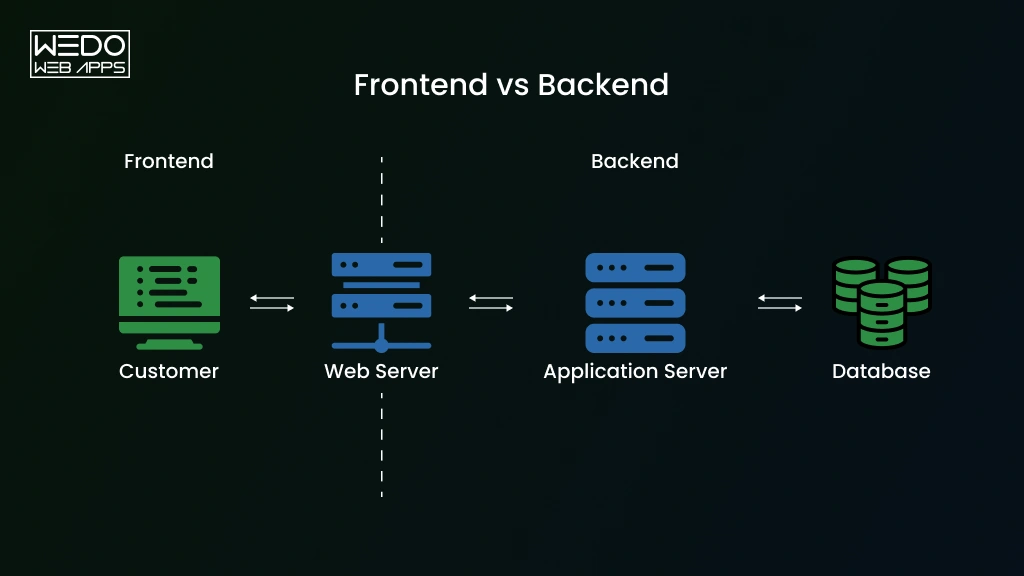
A website or application becomes functional when the frontend and backend communicate with each other. A user's action can trigger a request, backend processing, and a response that updates the interface.
How a Frontend Request Reaches the Backend
A typical interaction follows this sequence:
User action -> frontend -> API request -> backend -> database or service -> backend response -> frontend
Suppose you search for a product. The frontend captures your search and sends it to the backend through an API. The backend processes the request, retrieves matching information from the database, and sends the results back. The frontend then displays those products.
What Is the Role of an API Between Frontend and Backend?
An API acts as the communication layer between the frontend and backend. It allows the frontend to request information or ask the backend to perform an action without directly accessing the database.
- REST APIs are commonly used to exchange data through defined endpoints.
- GraphQL provides another approach, allowing clients to request the specific data they need.
This separation gives each side a clear responsibility. The frontend manages the interaction, while the backend controls access to data and application logic.
Example: How an eCommerce Application Uses Both
Consider what happens when you purchase a product.
When you open a product page: The frontend displays the page and requests product information. The backend retrieves the relevant details from the database and returns them for the frontend to display.
When you place an order: the frontend sends the order details to the backend. The backend verifies product availability, applies business rules, processes the payment request, creates the order, and updates the relevant records. The frontend then displays the order confirmation.
This same communication pattern supports features such as account login, appointment booking, online payments, and AI-powered applications.

Frontend vs Backend: How They Handle Security, Performance and Testing
The front-end vs back-end difference becomes clearer when you look at how an application handles security, performance, and testing. Both sides need to work correctly, but they face different technical requirements.
Frontend vs Backend Security
Frontend security starts with the user's interaction. The interface can validate inputs and guide users through secure actions.
The backend handles checks that cannot be trusted to the client. It verifies user identity and permissions before allowing access to protected resources. Sensitive data and business rules also need server-side protection.
For example, an eCommerce frontend may hide an admin dashboard from regular customers. The backend must still verify the user's permissions before returning any admin data.
Frontend vs Backend Performance
In frontend development, performance depends on how efficiently the browser loads and renders the application. Developers may optimize JavaScript, images, page resources, and client-side rendering. Frameworks such as React can also be optimized to improve rendering efficiency and application responsiveness. React.js application development can help businesses build interactive web applications with performance requirements in mind.
Backend performance depends on what happens after a request reaches the server. Database queries, API processing, caching, server resources, and external services can affect response times.
This is an important distinction when comparing frontend vs backend performance. A fast interface cannot compensate for a backend that takes several seconds to return the requested data.
Frontend vs Backend Testing
Testing also differs according to what each layer handles.
| Area | Frontend | Backend |
|---|---|---|
| Main focus | Interface and user interactions | Logic, data, and APIs |
| Common tests | UI, responsiveness, accessibility, browser testing | API, database, integration, security testing |
| Performance | Page loading and rendering | API response time and server load |
| Example | Checking whether checkout works across devices | Checking whether an order is correctly created and stored |
Testing should not stop at individual layers. A frontend can send the correct request while the backend returns unexpected data. End-to-end testing checks whether the complete user journey works correctly from the user's action to the final response.
Where Does AI Fit Into Frontend vs Backend Development?
AI integration services are becoming part of websites and applications across search, customer support, recommendations, content creation, and workflow automation. Building these features requires more than connecting an AI model to an application. The frontend and backend each handle different parts of the AI experience.
AI in Frontend Development
The frontend is where users interact with an AI feature. Its job is to make that interaction clear, responsive, and easy to use.
Common examples include:
- AI-powered search that understands natural language queries.
- Conversational interfaces for customer support.
- Personalized product or content recommendations.
- AI-assisted content creation and editing.
- Voice-enabled interfaces.
- Intelligent form assistance that can guide users as they enter information.
For example, AI shopping can let a customer describe what they need in natural language. The frontend provides the chat interface, displays recommendations, and presents the response in a way the customer can act on.
AI in Backend Development
The backend provides the services that connect AI capabilities with an application's data and business logic.
It can manage LLM API integration, AI model orchestration, data processing, and retrieval-augmented generation (RAG). Backend services can also support AI agent development that needs controlled access to business systems or specific actions.
Other responsibilities include prompt and context management, response validation, authentication, logging, usage monitoring, and API cost controls.
For example, an AI support system may retrieve information from a company's knowledge base before sending relevant context to an LLM. The backend can control what information the AI receives and verify how the resulting response is handled.
How Frontend vs Backend Work Together in an AI Application
Consider an AI customer support application.
| Layer | Responsibility |
|---|---|
| Frontend | Provides the chat interface and captures user questions |
| Backend | Handles authentication, conversation history, business rules, database access, AI API calls, logging, and security |
| AI Layer | Processes the request and generates the response |
A customer submits a question through the frontend. The backend receives it and checks the user's access. It can retrieve relevant information, prepare the required context, and send the request to the AI service.
After the AI generates a response, the backend can validate and process it before returning the result. The frontend then displays the response to the customer.
This shows how frontend vs backend responsibilities extend to AI applications. The interface provides the interaction, while backend services connect AI capabilities with the application's data rules, and security requirements.

Do Businesses Need Both Frontend vs Backend Development?
Whether you need frontend, backend, or both depends on what your application needs to do. A simple website may require limited backend functionality, while an eCommerce platform, SaaS product, or custom application development usually needs both.
When You Need Frontend Development
You need frontend development when users need to interact with your website or application through a custom interface.
Typical examples include:
- Business website with interactive forms and calculators.
- Customer portals and dashboards.
- eCommerce product pages and shopping carts.
- Booking and appointment interfaces.
- Mobile and web application screens.
- Interactive reporting and data visualization.
If the main requirement is presenting information and collecting basic user input, frontend development may handle much of the work.
When You Need Backend Development
Backend development becomes necessary when your application needs to process, store, protect, or exchange data.
You may need a backend for:
- User accounts and authentication
- Database management
- Payment processing
- Order and booking management
- Third-party API integrations
- Business rules and automated workflows
- AI services and data processing
- Admin systems and internal tools
For example, a booking platform needs backend services to check availability, store reservations, process payments, and prevent conflicting bookings.
When You Need Both Frontend vs Backend Development
Most feature-rich applications need both sides working together. This is common when your users interact with data that must be processed or stored securely.
| Business need | Frontend role | Backend role |
|---|---|---|
| eCommerce | Products, cart, checkout | Inventory, orders, payments |
| SaaS platform | Dashboard and workflows | Accounts, data, subscriptions |
| Booking platform | Search and booking screens | Availability, reservations, payments |
| Customer portal | Account interface and reports | User data, permissions, APIs |
| AI application | Chat or AI interface | AI APIs, context, data, security |
Understanding what is frontend and backend are helps you define the scope of your project before development begins. If your application needs user accounts, dynamic data, transactions, integrations, or AI capabilities, you will usually need a backend alongside the frontend.
Front-end vs Back-end: Choosing the Right Approach
The front-end vs back-end distinction becomes much easier to understand when you look at your project's actual requirements.
A customer-facing website may mainly need frontend development for its pages, forms, navigation, and interactive elements. An application that manages users, payments, databases, business workflows, or third-party integrations will also need backend development.
For products such as eCommerce platforms, SaaS applications, marketplaces, booking systems, and AI applications, both layers usually work together. The frontend gives users a way to interact with the product, while the backend manages the data, logic, services, and processes behind those interactions.
Understanding what is frontend and backend helps you define the right development scope, technology requirements, integrations, and long-term maintenance needs before development begins.