Introduction
"Is BigCommerce good for building a scalable dropshipping business?"
This is one of the most common questions eCommerce founders, startups, and growing online brands ask while evaluating dropshipping platforms today. Launching a dropshipping store is relatively easy, but scaling it successfully is where most businesses struggle. Supplier delays, inventory mismatches, disconnected apps, manual order management, and poor checkout experiences often become major operational bottlenecks as order volumes grow.
This is one of the key reasons many businesses are exploring BigCommerce dropshipping solutions. BigCommerce combines SaaS reliability with flexible customization capabilities, allowing eCommerce brands to build more scalable operations through automation, multi-supplier management, real-time inventory synchronization, and customizable workflows.
Modern dropshipping with BigCommerce is no longer just about launching a storefront. Businesses also need to think about operational efficiency, customer experience, SEO performance, multi-channel selling, and long-term scalability before choosing the right eCommerce infrastructure.
In this guide, we will explain how BigCommerce supports dropshipping businesses, how the BigCommerce dropshipping setup process works, which apps and integrations businesses commonly use, and what growing eCommerce brands should consider before scaling their operations.
What is BigCommerce Dropshipping?
BigCommerce dropshipping is an eCommerce business model where businesses sell products online without managing inventory or fulfillment themselves. Instead, third-party suppliers store, pack, and ship products directly to customers after an order is placed.
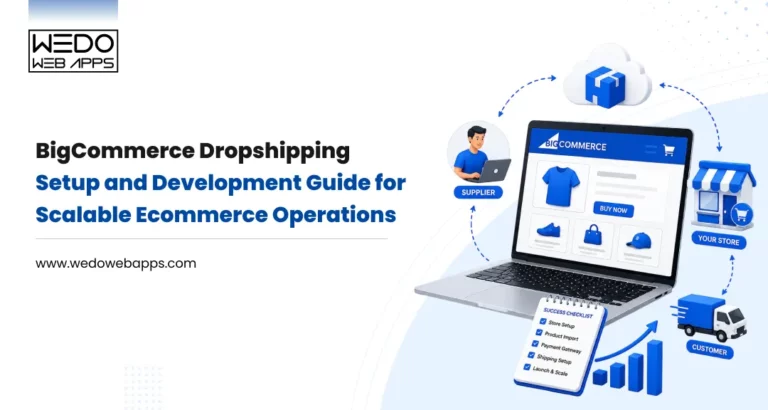
A standard BigCommerce dropshipping setup works like this:
- Customer places an order on your BigCommerce store
- Order is automatically forwarded to the supplier
- Supplier ships the product directly to the customer
- Store owner manages branding, pricing, and customer experience
This model allows businesses to launch eCommerce operations with lower upfront investment and reduced inventory risks.
Why Businesses Choose BigCommerce for Dropshipping
Many startups and eCommerce brands prefer dropshipping with BigCommerce because the platform supports:
- Multi-supplier management
- Automated inventory synchronization
- Multi-channel selling
- Flexible API integrations
- SEO-friendly storefronts
- Scalable eCommerce operations
Unlike basic eCommerce setups, the BigCommerce dropshipping model gives growing businesses more flexibility to automate workflows and scale operations as order volumes increase.
However, scaling a BigCommerce dropshipping business usually requires more than installing supplier apps. Businesses often need better automation, operational workflows, and custom integrations to manage fulfillment, inventory, and customer experience efficiently.
Is BigCommerce Good for Building a Scalable Dropshipping Business?
Yes, BigCommerce is considered one of the stronger eCommerce platforms for businesses planning to scale their dropshipping operations beyond the beginner stage.
While many platforms work well for launching small stores, growing eCommerce businesses often face challenges like:
- App dependency
- Slow storefront performance
- Limited customization
- Inventory management issues
- Multi-supplier complexity
This is where BigCommerce stands out.
Why Businesses Choose BigCommerce Dropshipping?
BigCommerce supports scalable eCommerce operations through:
- Flexible APIs and integrations
- Multi-channel selling capabilities
- Large product catalog management
- Built-in SEO features
- Checkout customization
- Multi-store support
- B2B and international commerce capabilities
These features make dropshipping with BigCommerce more suitable for startups, DTC brands, and scaling eCommerce businesses that expect operational complexity as they grow.
BigCommerce vs Basic Dropshipping Platforms
| Feature | BigCommerce | Basic eCommerce Platforms |
|---|---|---|
| Multi-supplier store | Strong | Limited |
| Custom integrations | Advanced | Restricted |
| SEO flexibility | High | Moderate |
| Checkout Customization | Flexible | Limited |
| Scalability | Enterprise-Ready | Often app-development |
| Multi-channel selling | Built-in | Partial support |
When BigCommerce Becomes More Valuable
The advantage of the BigCommerce dropshipping model becomes more noticeable when businesses:
- Manage larger inventories
- Sell across multiple marketplaces
- Expand internationally
- Automate fulfillment workflows
- Require custom supplier integrations
- Optimize eCommerce performance for higher conversions
For growing eCommerce brands, BigCommerce often works better as a long-term operational platform rather than just a basic storefront builder.
How BigCommerce Supports Modern Dropshipping Operations
One of the biggest reasons businesses choose BigCommerce dropshipping is its ability to support automation and operational scalability as eCommerce operations grow.
Instead of relying entirely on manual workflows, businesses can automate large parts of their dropshipping operations through integrations, apps, and custom workflows.
How BigCommerce Supports Dropshipping Businesses
BigCommerce supports modern dropshipping operations through:
- Automated inventory synchronization
- Supplier integration capabilities
- Real-time product updates
- Multi-channel selling
- Automated order routing
- Flexible shipping configurations
- Marketplace integrations
- API-based workflow automation
These capabilities help businesses reduce operational bottlenecks while improving fulfillment accuracy and customer experience.
Multi-Supplier Management
Many growing eCommerce brands work with multiple suppliers to:
- Expand product catalogs
- Reduce supplier dependency
- Improve shipping flexibility
- Support international fulfillment
The BigCommerce dropshipping model allows businesses to manage multi-supplier operations more efficiently through centralized product and order management workflows.
Automation Reduces Operational Complexity
As order volumes grow, manual operations become difficult to manage. Businesses often struggle with:
- Delayed inventory updates
- Overselling products
- Manual order forwarding
- Inconsistent fulfillment tracking
BigCommerce helps reduce these issues through automation and integration flexibility, especially when connected with dropshipping apps, ERP systems, shipping tools, or custom supplier workflows.
Where Businesses Often Need Custom Development
Many eCommerce businesses eventually outgrow disconnected third-party apps. Common scaling requirements include:
- Custom supplier integrations
- Advanced inventory synchronization
- Automated fulfillment workflows
- Custom checkout experiences
- ERP and CRM connectivity
This is where scalable BigCommerce development becomes important for supporting long-term eCommerce growth.
BigCommerce Dropshipping Setup: Step-By-Step for Businesses
A successful BigCommerce dropshipping setup involves much more than importing products and connecting supplier apps. Businesses that plan to scale their eCommerce operations need the right store structure, automation workflows, supplier strategy, and operational systems from the beginning. Without proper planning, many dropshipping businesses eventually struggle with inventory mismatches, fulfillment delays, app conflicts, and poor customer experience as order volume increases.
Below is a step-by-step breakdown of how businesses typically build and scale a BigCommerce dropshipping business successfully.
Step 1: Choose a Profitable and Scalable Niche
The foundation of any successful dropshipping business starts with selecting the right product niche. Instead of targeting oversaturated "general store" categories, many growing eCommerce brands focus on niche-specific markets with:
- Long-term demand
- Repeat purchase potential
- Manageable competition
- Stronger branding opportunities
Businesses should also evaluate supplier availability, shipping feasibility, and profit margins before finalizing a niche. Products with poor fulfillment consistency or extremely low margins often create operational challenges later.
Step 2: Select Reliable Dropshipping Suppliers
Supplier quality directly impacts:
- Shipping speed
- Customer satisfaction
- Return management
- Inventory accuracy
- Product consistency
Before integrating suppliers into a BigCommerce dropshipping setup, businesses should carefully evaluate:
- Fulfillment timelines
- Communication reliability
- Inventory update frequency
- Product quality
- International shipping capabilities
- Integration support
Many scaling eCommerce brands also work with multiple suppliers to reduce dependency on a single fulfillment source and improve operational flexibility.
Step 3: Create and Configure Your BigCommerce Store
Once suppliers are finalized, businesses can start building their BigCommerce storefront. This stage involves more than choosing a design template. A properly configured eCommerce store should support:
- SEO optimization
- Mobile responsiveness
- Conversion-focused navigation
- Scalable product categorization
- Fast checkout experiences
Businesses should also configure:
- Payment gateways
- Tax settings
- Shipping rules
- Customer notifications
- Storefront performance optimization
A well-structured storefront improves both customer experience and search engine visibility.
Step 4: Install BigCommerce Dropshipping Apps
Most businesses use BigCommerce dropshipping apps to automate essential operations such as:
- Product importing
- Inventory synchronization
- Automated order forwarding
- Shipping updates
- Supplier management
However, choosing too many disconnected apps can create operational inefficiencies later. Businesses should focus on building a streamlined app ecosystem that supports scalability rather than relying on excessive third-party tools for every workflow.
Step 5: Automate Inventory and Order Management
Automation becomes critical as order volume increases. Manual inventory tracking and order forwarding quickly become difficult to manage for scaling eCommerce businesses.
Modern dropshipping with BigCommerce allows businesses to automate:
- Inventory synchronization
- Order routing
- Shipping updates
- Customer notifications
- Fulfillment workflows
This helps reduce:
- Overselling
- Fulfillment delays
- Manual operational errors
- Supplier communication gaps
Businesses planning long-term growth often integrate ERP systems, shipping platforms, or custom workflows to improve operational efficiency even further.
Step 6: Optimize Product Pages and Store Performance
Many dropshipping stores fail because they focus only on importing products instead of building a strong customer experience.
Businesses should optimize:
- Product descriptions
- Product images
- Category structures
- Page speed
- Mobile usability
- Checkout experience
SEO optimization is also essential for improving organic visibility in SERPs and AI-driven search platforms.
Common BigCommerce Dropshipping Setup Mistakes
Many ecommerce businesses face operational challenges because of:
- overdependence on multiple disconnected apps
- poor supplier management
- weak inventory synchronization
- slow storefront performance
- manual fulfillment workflows
- poor checkout optimization
Planning scalable workflows early helps businesses avoid operational bottlenecks and improve long-term ecommerce growth.
Best BigCommerce Dropshipping Apps for Scaling eCommerce Operations
BigCommerce dropshipping apps play a major role in automating eCommerce operations, managing suppliers, synchronizing inventory, and improving fulfillment efficiency. However, not every app is suitable for every business model. The ideal app ecosystem depends on factors like supplier network, catalog size, operational complexity, and long-term growth plans.
For growing eCommerce brands, the goal should not be installing the maximum number of apps, it should be building efficient and scalable workflows with minimal operational friction.
Supplier & Product Sourcing Apps
Supplier sourcing apps help businesses:
- Import products into BigCommerce stores
- Connect with global suppliers
- Manage product catalogs
- Automate pricing and inventory updates
These apps are commonly used for:
- AliExpress dropshipping
- Wholesale sourcing
- Multi-supplier eCommerce operations
- Rapid product testing
Supplier sourcing apps are especially useful for startups and businesses looking to validate product demand quickly before investing heavily into inventory infrastructure.
However, businesses should carefully evaluate supplier reliability and fulfillment consistency instead of focusing only on product availability.
Inventory Management Apps
Inventory synchronization is one of the most important operational requirements in dropshipping with BigCommerce. As stores scale across multiple suppliers and sales channels, inventory mismatches can lead to:
- Overselling
- Canceled orders
- Delayed fulfillment
- Poor customer experience
Inventory management apps help businesses:
- Sync stock levels automatically
- Update inventory in real time
- Manage multi-channel inventory
- Reduce manual operational tasks
These apps become increasingly important for businesses handling larger product catalogs or high order volumes.
Print-On-Demand Apps
Print-on-demand apps allow businesses to sell customized products without managing production or inventory internally.
Common use cases include:
- Custom apparel
- Accessories
- Home decor
- Branded merchandise
These apps are popular among:
- DTC brands
- Creator-led eCommerce businesses
- Niche-focused product stores
Print-on-demand also allows businesses to test branding opportunities without maintaining large inventory investments upfront.
Shipping & Fulfillment Apps
Shipping and fulfillment apps help automate operational workflows such as:
- Shipping label generation
- Order tracking
- Fulfillment notifications
- Delivery updates
Efficient fulfillment operations directly impact customer retention and brand experience, especially for scaling eCommerce businesses managing high order volumes.
Businesses selling internationally may also require shipping apps that support:
- Multiple carriers
- International fulfillment
- Regional shipping rules
- Real-time shipping calculations
Automation & Workflow Apps
Automation tools help businesses reduce repetitive manual work by streamlining:
- Order routing
- Customer notifications
- Supplier communication
- Operational triggers
- Data synchronization
As BigCommerce dropshipping businesses grow, automation becomes critical for maintaining operational efficiency without significantly increasing internal management overhead.
When Businesses Outgrow Third-Party Apps
While apps simplify the initial BigCommerce dropshipping steup process, many scaling eCommerce businesses eventually face:
- App conflicts
- Workflow limitations
- Disconnected operational systems
- Slower storefront performance
- Integration inefficiencies
At this stage, businesses often require:
- Custom supplier integrations
- Advanced inventory synchronization
- ERP and CRM connectivity
- Custom fulfillment workflows
- Scalable eCommerce automation systems
This is where custom BigCommerce development becomes valuable for supporting long-term operational growth more efficiently than relying entirely on third-party apps.
Common Challenges in the BigCommerce Dropshipping Model
While the BigCommerce dropshipping model offers flexibility and lower upfront inventory costs, scaling a profitable eCommerce operations still comes with several operational challenges. Many businesses can launch a dropshipping store successfully, but maintaining fulfillment efficiency, customer experience, and profitability becomes increasingly difficult as operations grow.
Understanding these challenges early helps businesses build more scalable workflows and avoid long-term operational bottlenecks.
Supplier Dependency Can Impact Customer Experience
One of the biggest limitations of dropshipping with BigCommerce is supplier dependency. Since suppliers manage inventory storage, packaging, and shipping businesses have limited control over fulfillment operations.
Common supplier-related issues include:
- Delayed shipping
- Inventory inconsistencies
- Product quality variations
- Communication delays
- Unexpected stock shortages
These issues directly affect customer satisfaction and brand reputation, especially for eCommerce businesses scaling aggressively.
To reduce operational risks, many growing brands work with multiple suppliers or implement supplier backup strategies.
Inventory Synchronization Issues
Inventory management becomes significantly more complex when businesses manage:
- Multiple suppliers
- Multiple marketplaces
- Large product catalogs
- International fulfillment operations
Without proper synchronization, stores may accidentally sell out-of-stock products, leading to canceled orders and customer dissatisfaction.
This is why inventory automation is critical for scalable BigCommerce dropshipping businesses. Many businesses eventually integrate:
- Inventory management systems
- ERP platforms
- Automated supplier feeds
- Custom synchronization workflows
to improve inventory accuracy across operations.
Thin Profit Margins
Many businesses enter dropshipping expecting low operational costs and fast scalability. However, competition is saturated product categories often creates thin profit margins.
Common cost factors include:
- Supplier pricing
- Advertising costs
- Shipping fees
- Transaction fees
- App subscription costs
- Custom acquisition expenses
Businesses relying entirely on generic supplier products may also struggle to differentiate themselves from competitors selling similar products.
This is why successful eCommerce brands focus heavily on:
- Niche positioning
- Branding
- Customer experience
- Operational efficiency
- Conversion optimization
Instead of competing only on price.
Operational Complexity Increases as Businesses Scale
Many BigCommerce dropshipping businesses rely heavily on third-party apps during the initial steup phase. While apps simplify early operations, excessive app dependency can eventually create:
- Performance issues
- Workflow inefficiencies
- Integration limitation
- Operational inconsistencies
Growing eCommerce businesses often outgrow disconnected app ecosystems and require more customized operational workflows for long-term scalability.
This is one of the reasons businesses invest in scalable BigCommerce development solutions as their eCommerce operations mature.
How eCommerce Brands Scale BigCommerce Dropshipping Businesses
Launching a dropshipping store is relatively simple. Scaling it into a profitable and operationally efficient eCommerce business is where the real challenge begins.
As order volumes increase, many businesses start facing issues with:
- Inventory synchronization
- Supplier coordination
- Manual workflows
- Fulfillment speed
- Customer experience consistency
This is why scaling a BigCommerce dropshipping business usually requires a stronger operational strategy instead of simply adding more products or supplier apps.
Multi-Supplier Operations Become Essential
Many growing eCommerce brands eventually move beyond single-supplier dependency to improve:
- Product availability
- Shipping flexibility
- Fulfillment speed
- Pricing stability
However, managing multiple suppliers also increases operational complexity. Businesses often need centralized systems for:
- Inventory management
- Order routing
- Supplier communication
- Fulfillment tracking
This is one of the reasons why scalable BigCommerce dropshipping operations rely heavily on automation and integration workflows.
Automation Improves Operational Efficiency
Manual operations may work during the early stages of a dropshipping business, but they quickly become difficult to manage at scale.
Growing eCommerce businesses often automate:
- Inventory synchronization
- Order processing
- Shipping updates
- Customer notifications
- Supplier workflows
- Return management
Automation helps businesses:
- Reduce operational errors
- Improve fulfillment speed
- Prevent overselling
- Streamline customer experience
For scaling brands, operational automation becomes a competitive advantage rather than just a convenience feature.
ERP and CRM Integrations Support Growth
As eCommerce operations mature, businesses often need better visibility across:
- Inventory
- Customer data
- Fulfillment operations
- Financial reporting
- Supplier management
This is where ERP and CRM integrations become important.
BigCommerce supports integration flexibility through APIs and custom workflows, allowing businesses to build centralized operational systems instead of managing disconnected processes manually.
These integrations are especially valuable for:
- High-volume eCommerce stores
- International operations
- Multi-channel sellers
- Enterprise eCommerce businesses
Conversion Optimization Matters at Scale
Many dropshipping businesses focus heavily on traffic generation while overlooking conversion optimization.
As customer acquisition costs increase, improving conversion rates becomes critical for profitability. Scaling eCommerce brands often optimize:
- Product pages
- Mobile shopping experience
- Checkout flow
- Site speed
- Product recommendations
- Customer retention workflows
The flexibility of the BigCommerce dropshipping model allows businesses to customize storefront experiences more efficiently as operational requirements grow.
Headless Commerce and Advanced Customization
Some eCommerce businesses eventually outgrow traditional storefront limitations entirely.
Brands with advanced operational requirements may adopt:
- BigCommerce Headless commerce architectures
- Custom checkout experiences
- AI-powered personalization
- Marketplace integrations
- Advanced automation systems
BigCommerce supports these advanced eCommerce workflows through flexible APIs and scalable customization capabilities, making it suitable for businesses planning long-term operational growth.
Why Scalable Infrastructure Matters
Many dropshipping businesses fail to scale because their operational systems cannot handle growth efficiently.
As eCommerce competition becomes more operationally demanding, businesses increasingly require:
- Automation-ready workflows
- Scalable integrations
- Flexible eCommerce infrastructure
- Performance optimization
- Centralized operational management
This is why growing brands view BigCommerce not just as a storefront platform, but as a scalable eCommerce infrastructure for long-term business growth.
How Much Does BigCommerce Dropshipping Cost?
One of the biggest reasons businesses choose the BigCommerce dropshipping model is the lower upfront inventory investment compared to traditional eCommerce. However, running a scalable dropshipping business still involves multiple operational, software, and marketing costs that businesses should evaluate before launching.
The total cost of a BigCommerce dropshipping business depends on factors like:
- Store complexity
- Supplier network
- Automation requirements
- Product catalog size
- Customization needs
- Marketing strategy
BigCommerec Subscription Costs
Every business using BigCommerce requires a platform subscription plan. Pricing typically varies based on:
- Annual revenue
- eCommerce features
- API access
- B2B functionality
- Checkout customization requirements
For startups, standard plans may be enough initially. However, scaling eCommerce businesses often require more advanced functionality as operations grow.
Dropshipping App Costs
Most businesses use BigCommerce dropshipping apps for:
- Supplier integration
- Inventory synchronization
- Order automation
- Shipping management
- Workflow automation
While some apps offer entry-level plans, costs increase as:
- Order volume grows
- Supplier count increases
- Automation complexity expands
Many eCommerce brands eventually discover that relying on too many disconnected apps can become both operationally inefficient and expensive over time.
Marketing and Customer Acquisition Costs
Marketing is often one of the largest ongoing expenses is dropshipping with BigCommerce.
Businesses typically invest in:
- SEO
- Paid advertising
- Influencer partnerships
- Email marketing
- Social media campaigns
- Conversion optimization
As competition increases, customer acquisition costs can significantly impact profitability, especially in saturated product categories.
This is why many successful eCommerce businesses focus heavily on:
- Niche positioning
- Branding
- Customer retention
- Operational efficiency
instead of depending entirely on paid advertising.
Operational and Fulfillment Costs
Even without inventory management, businesses still incur operational expenses related to :
- Shipping
- Returns management
- Customer support
- Transaction fees
- International fulfillment
- Automation tools
As order volumes scale, businesses may also need:
- Inventory management systems
- ERP integrations
- Custom workflows
- Advanced reporting systems
to manage operations more efficiently.
Custom Development Costs
Many businesses initially rely on standard apps and templates during their BigCommerce dropshipping setup. However, growing eCommerce brands often require:
- Custom supplier integrations
- Checkout customization
- Advanced automation
- API integrations
- Performance optimization
- Scalable operational workflows
While custom BigCommerce development involves additional investment, it can reduce long-term operational inefficiencies caused by disconnected third-party systems.
For scaling eCommerce businesses, custom development often becomes more cost-efficient than continuously adding multiple apps and manual operational processes.
Startup vs Scaling-Stage Cost Expectations
| Business Stage | Typical Focus | Cost Structure |
|---|---|---|
| Startup Stage | Basic setup, supplier apps, initial marketing | Lower operational complexity |
| Growth Stage | Automation, scaling operations, customer optimization | Higher app and marketing costs |
| Scaling Stage | Custom integrations, workflow automation, infrastructure optimization | Higher investment but improved operational efficiency |
Understanding these cost layers early helps businesses build more realistic growth strategies and avoid operational limitations as their ecommerce operations scale.
When Businesses Need Custom BigCommerce Dropshipping Development
Many businesses can launch a basic dropshipping store using standard themes and third-party apps. However, as operations scale, eCommerce brands often reach a point where disconnected tools and manual workflows start creating operational inefficiencies.
This is usually when businesses begin investing in custom BigCommerce dropshipping development to support automation, scalability, and long-term operational growth.
Multi-Supplier Operations Become Difficult to Manage
Managing one supplier is relatively simple. Managing multiple suppliers across different product categories, warehouses, or regions is significantly more complex.
Growing eCommerce businesses often need custom workflows for:
- Supplier-specific order routing
- Inventory synchronization
- Shipping logic
- Product feed management
- Fulfillment automation
Without centralized systems, businesses may struggle with:
- Delayed order processing
- Inventory mismatches
- Inconsistent fulfillment workflows
- Poor customer experience
Custom BigCommerce development services help businesses create more efficient operational systems instead of relying entirely on disconnected apps.
Advanced Inventory Synchronization Requirements
Standard dropshipping apps may work during the early stages of a business, but scaling eCommerce operations usually require more advanced inventory management capabilities.
Businesses often need:
- Real-time stock updates
- Multi-warehouse inventory management
- Marketplace inventory synchronization
- Supplier-specific inventory rules
- Autaomated stock alerts
Custom integrations help reduce overselling risks and improve operational accuracy across larger eCommerce ecosystems.
ERP and CRM Integrations
As eCommerce operations grow, businesses typically require centralized visibility across:
- Orders
- Customer data
- Fulfillment workflows
- Supplier operations
- Financial reporting
This is where ERP and CRM integrations become critical.
BigCommerce supports API-based integrations that allow businesses to connect eCommerce operations with:
- ERP systems
- CRM platforms
- Shipping providers
- Accounting software
- Warehouse management systems
These integrations improve operational efficiency while reducing manual administrative work.
Checkout and Customer Experience Customization
Many scaling eCommerce brands eventually require more control over:
- Checkout workflows
- Shipping experiences
- Payment logic
- Customer journeys
- Subscription functionality
Custom BigCommerce development allows businesses to optimize the customer experience based on their operational and conversional requirements rather than being limited by default platform functionality.
This becomes especially important for:
- International eCommerce businesses
- B2B commerce
- Subscription-based models
- High-volume stores
Performance Optimization for Scaling Stores
As product catalogs, traffic, and integrations increase, storefront performance becomes more important.
Slow eCommerce stores can negatively impact:
- Conversions
- SEO visibility
- Customer retention
- Mobile shopping experience
Growing BigCommerce dropshipping businesses often invest in:
- Storefront optimization
- Code optimization
- API performance improvements
- Headless commerce architectures
- Advanced caching strategies
to maintain scalability and user experience as operations expand.
Why Businesses Move Beyond App-Only Ecosystem
Many businesses initially rely heavily on third-party apps because they simplify the BigCommerce dropshipping setup process. However, over time, app-heavy ecosystems can create:
- Higher operational costs
- Workflow limitations
- Performance issues
- Integration conflicts
- Fragmented operational systems
Custom BigCommerce development helps businesses build centralized, scalable workflows that support long-term eCommerce growth more efficiently.
For many scaling brands, the goal eventually shifts from "launching a dropshipping store" to building a scalable eCommerce infrastructure that supports automation, operational efficiency, and customer experience at scale.
Conclusion
BigCommerce dropshipping has evolved far beyond the traditional "launch a store quickly" approach. Modern ecommerce businesses now require scalable operations, automation, supplier coordination, inventory synchronization, and flexible ecommerce infrastructure to compete effectively in growing digital markets.
This is where the BigCommerce dropshipping model offers a major advantage. From multi-channel selling and API flexibility to automation capabilities and customizable workflows, BigCommerce gives businesses the operational foundation needed to scale more efficiently as order volumes and complexity increase.
However, building a successful dropshipping with BigCommerce strategy is not only about choosing the right apps or suppliers. Long-term growth often depends on operational efficiency, customer experience optimization, workflow automation, and scalable ecommerce development strategies backed by strong BigCommerce development expertise.
For startups, DTC brands, and growing ecommerce businesses planning long-term scalability, BigCommerce can serve as more than just a storefront platform, it can become a flexible ecommerce infrastructure that supports sustainable business growth.