Introduction
Enterprise AI adoption is moving fast, but one question continues to shape major technical decisions:
Should businesses use the OpenAI ChatGPT API or build a custom fine-tuned LLM?
For many companies, the fastest option is integrating an API for ChatGPT into existing products and workflows. Teams can launch AI assistants, copilots, search systems, and automation tools without managing infrastructure or training models from scratch.
At the same time, enterprises with strict compliance, high usage volume, or specialized data are exploring fine-tuned open source models like Llama 3 and Mistral.
The challenge is that both approaches come with very different costs, infrastructure needs, scalability limits, and long-term risks.
This guide explains how the open AI API works, what enterprise teams actually pay in 2026, when fine-tuning makes sense, and how to choose between hosted AI models and self-hosted LLM development.
Inside this article, you will learn:
- How to use ChatGPT API services in enterprise applications.
- The difference between open API vs public API.
- OpenAI API pricing and hidden infrastructure costs.
- When RAG is better than fine-tuning.
- Where custom LLMs outperform hosted APIs.
- How to reduce vendor lock-in risks.
Whether you are building an AI SaaS platform, enterprise assistant, or internal automation system, this comparison will help you make a smarter long-term AI decision.
What Is the ChatGPT OpenAI API and How Does It Work?
The OpenAI ChatGPT API allows businesses to integrate advanced AI capabilities into websites, SaaS products, mobile apps, enterprise software, and internal tools without building a large language model from scratch.
Instead of managing GPUs, training datasets, and inference infrastructure, AI developers can connect directly to the OpenAI API and access powerful AI models via simple API requests.
This makes the API for ChatGPT one of the fastest ways to launch AI-powered products in 2026.
What Does the OpenAI API Actually Do?
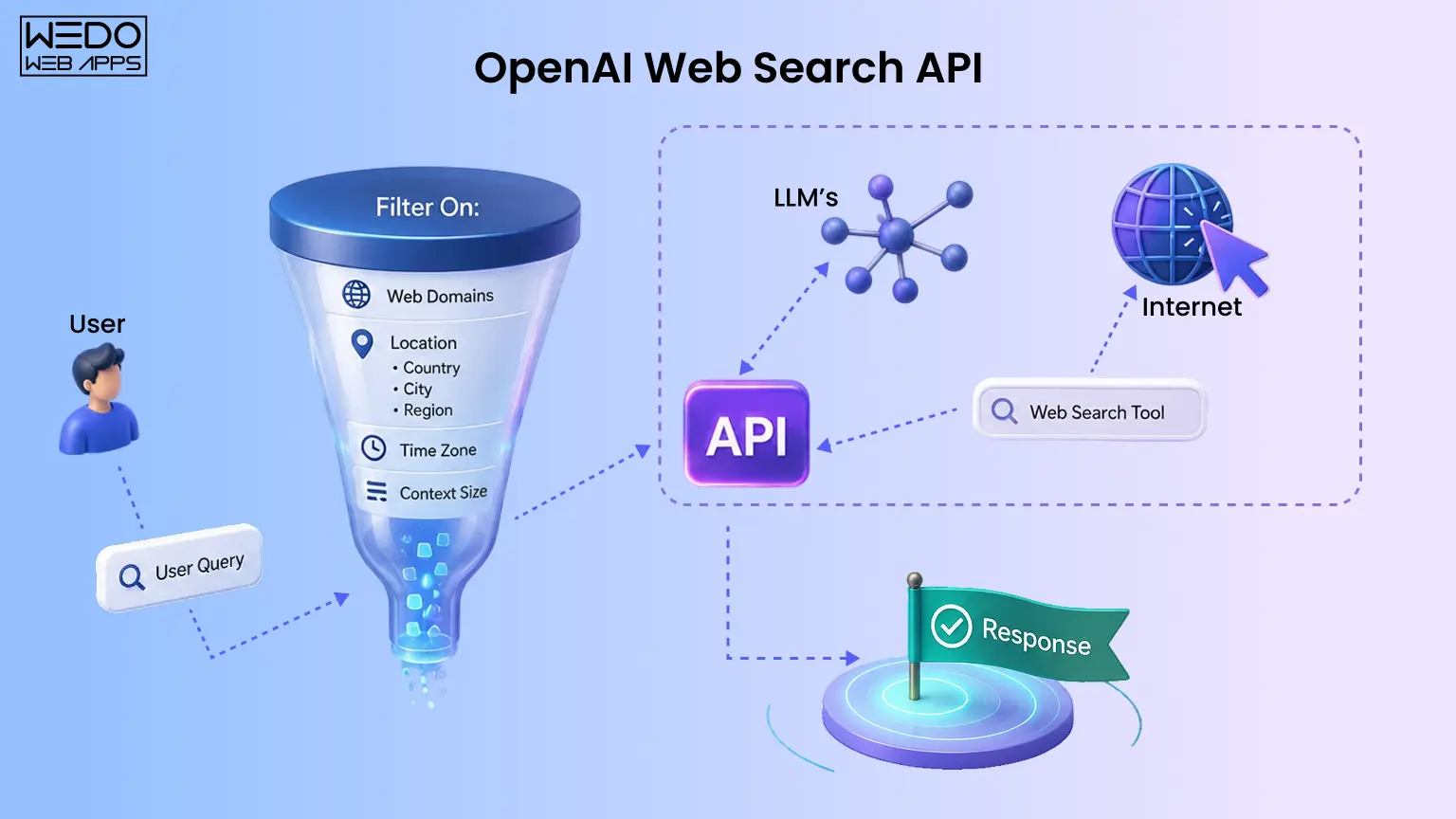
The OpenAI ChatGPT API acts as a bridge between your application and OpenAI's language models.
Your software sends a request to the API. The model processes the input and returns a generated response in real time.
Here is what enterprises commonly use the API for:
| Use Case | How Businesses Use It |
|---|---|
| AI Customer Support | Automated ticket handling and chatbot responses |
| Internal AI Assistant | Company knowledge retrieval and workflow automation |
| Content Generation | Blog drafts, product descriptions, and summaries |
| AI Search | Semantic search across enterprise documents |
| Developer Tools | Code generation and debugging assistance |
| Sales Automation | Personalized outreach and CRM support |
| Data Processing | Extracting insights from contracts, PDFs, and reports |
Many businesses prefer to use ChatGPT API services because they can deploy AI features quickly without hiring a dedicated ML infrastructure team.
What Happens During an API Call?
A typical workflow looks like this:
- A user submits a prompt inside your app.
- The app sends the request to the open ChatGPT API.
- The AI model processes the request.
- The API returns a generated response.
- Your application displays the output to the user.
This process usually takes seconds, depending on model size and request complexity.
How to Use the ChatGPT API: A Plain-English Walkthrough
Using the OpenAI API is simpler than most businesses expect.
You do not need to train an AI model yourself. Instead, you connect your application to OpenAI's hosted infrastructure.
Basic Setup Process
| Step | What You Do |
|---|---|
| Step 1 | Create an OpenAI developer account |
| Step 2 | Generate an API key |
| Step 3 | Choose a model like GPT-4o or GPT-4o Mini |
| Step 4 | Send prompts through API requests |
| Step 5 | Receive and display AI-generated responses |
| Step 6 | Monitor token usage and costs |
Example Enterprise Workflow
Imagine a legal SaaS platform using the API for ChatGPT.
A lawyer uploads a 40-page contract.
The application sends the document to the API and asks:
"Summarize the major liability clauses and identify potential risks."
The model returns a structured summary within seconds.
The company adds AI functionality without building its own LLM infrastructure.
Why Enterprises Prefer API Based AI
Many organizations choose the OpenAI ChatGPT API because it helps them:
- Reduce development time
- Avoid GPU infrastructure costs
- Launch AI features faster
- Scale globally through managed infrastructure
- Access newer models automatically
For startups and mid-sized SaaS companies, this approach is often more practical than self-hosting a custom LLM.
Open API vs Public API: What is the Difference?
The phrase open API vs public API often creates confusion because the terms sound similar but mean different things.
Here is the simplest way to understand it.
| Term | Meaning |
|---|---|
| Open API | An API built using publicly available standards and documentation. |
| Public API | An API that external developers can access openly. |
An API can be public without being an open standard.
Similarly, an API can follow an open specification but still require authentication and restricted access.
Example Using the OpenAI API
The OpenAI ChatGPT API is considered a public API because developers can access it after registering and obtaining credentials.
At the same time, OpenAI also provides structured API documentation and standardized developer workflows that align with modern open API practices.
Why This Difference Matters for Enterprises
Understanding open API vs public API becomes important when evaluating:
- Vendor interoperability
- Enterprise integrations
- Security policies
- Compliance requirements
- Long-term architecture flexibility
This is especially relevant for enterprises building AI systems that may later connect with multiple LLM providers.
Who Should Use the ChatGPT API vs Build Their Own Model?
Not every company needs to fine-tune or self-host an LLM.
For many businesses, the open AI API provides better speed, lower operational complexity, and faster deployment.
However, some organizations benefit from custom models due to compliance, scale, or domain-specific requirements.
Businesses That Should Use the ChatGPT API
The open ChatGPT API is usually the better choice for:
- Startups building MVPs quickly.
- SaaS products adding AI features.
- Teams without ML infrastructure expertise.
- Businesses with moderate AI usage volume.
- Companies prioritizing rapid deployment.
Businesses That May Need Custom LLMs
Fine-tuned or self-hosted models become more attractive for:
- Enterprises with strict data residency rules.
- Healthcare and financial organizations.
- High-volume AI platforms with large inference costs.
- Companies require domain-specific responses.
- Organizations avoiding vendor dependency.
Quick Comparison: API vs Custom LLM
| Factor | OpenAI API | Custom Fine-Tuned LLM |
|---|---|---|
| Setup Speed | Very fast | Slower |
| Infrastructure Management | Minimal | High |
| Upfront Cost | Low | High |
| Maintenance Complexity | Low | High |
| Customization Depth | Moderate | Extensive |
| Compliance Flexibility | Limited by the provider | Full control |
| Scalability Management | Managed by the provider | Self managed |
| Long-Term Cost at Scale | Can increase significantly | Often lower on a massive scale |
For most companies entering AI adoption today, starting with the open AI ChatGPT API is the practical first step.
Custom LLM infrastructure usually becomes relevant later when usage scale, compliance pressure, or model specialization justifies the added complexity.
OpenAI API Pricing for Enterprise Apps in 2026: What You Actually Pay
The pricing structure of the OpenAI ChatGPT API looks simple at first glance.
You pay per token.
But once enterprises start running AI workloads at scale, the real costs become far more complex than the pricing page suggests.
A small AI assistant handling a few thousand requests daily may cost only hundreds of dollars per month. An enterprise SaaS platform processing millions of prompts, documents, and agent workflows can quickly move into five or six-figure monthly infrastructure spending.
That is why understanding how the OpenAI API pricing model works is critical before deploying AI features into production.
What Enterprises Actually Pay For
When businesses use ChatGPT API services, they are usually paying for four major components:
| Cost Area | What Impacts Pricing |
|---|---|
| Input Tokens | User prompts, uploaded documents, context windows |
| Output Tokens | AI-generated responses |
| Tool Usage | Web search, containers, retrieval, agent workflows |
| Infrastructure Overhead | Retries, logging, monitoring, orchestration |
For many enterprise applications, token costs are only one part of the overall AI spending model.
Engineering teams also need to account for:
- Prompt optimization
- Vector database costs
- RAG infrastructure
- Response caching
- Monitoring pipelines
- Multi-model routing systems
This is where enterprise AI budgets often increase faster than expected.
Why Pricing Becomes Difficult at Scale
The API for ChatGPT uses token-based billing instead of fixed monthly subscriptions.
A token is roughly equivalent to parts of words and sentences processed by the model.
For example:
| Example Content | Approximate Tokens |
|---|---|
| Short email | 100 to 300 tokens |
| Blog article | 1,500 to 3,000 tokens |
| Long PDF upload | 20,000+ tokens |
| Enterprise knowledge base query | Varies heavily |
This means costs scale directly with:
- User activity
- Prompt size
- Output length
- Context window usage
- Agent complexity
A chatbot answering simple customer support questions may stay relatively affordable.
An AI agent analyzing contracts, generating reports, and calling external tools repeatedly can become significantly more expensive.
Current Model Tiers: GPT-4o, GPT-4o Mini, and What Each Costs
OpenAI offers multiple model tiers designed for different workloads, response quality requirements, and cost targets.
Some models prioritize advanced reasoning and multimodal capabilities, while others are optimized for lower latency and high volume usage.
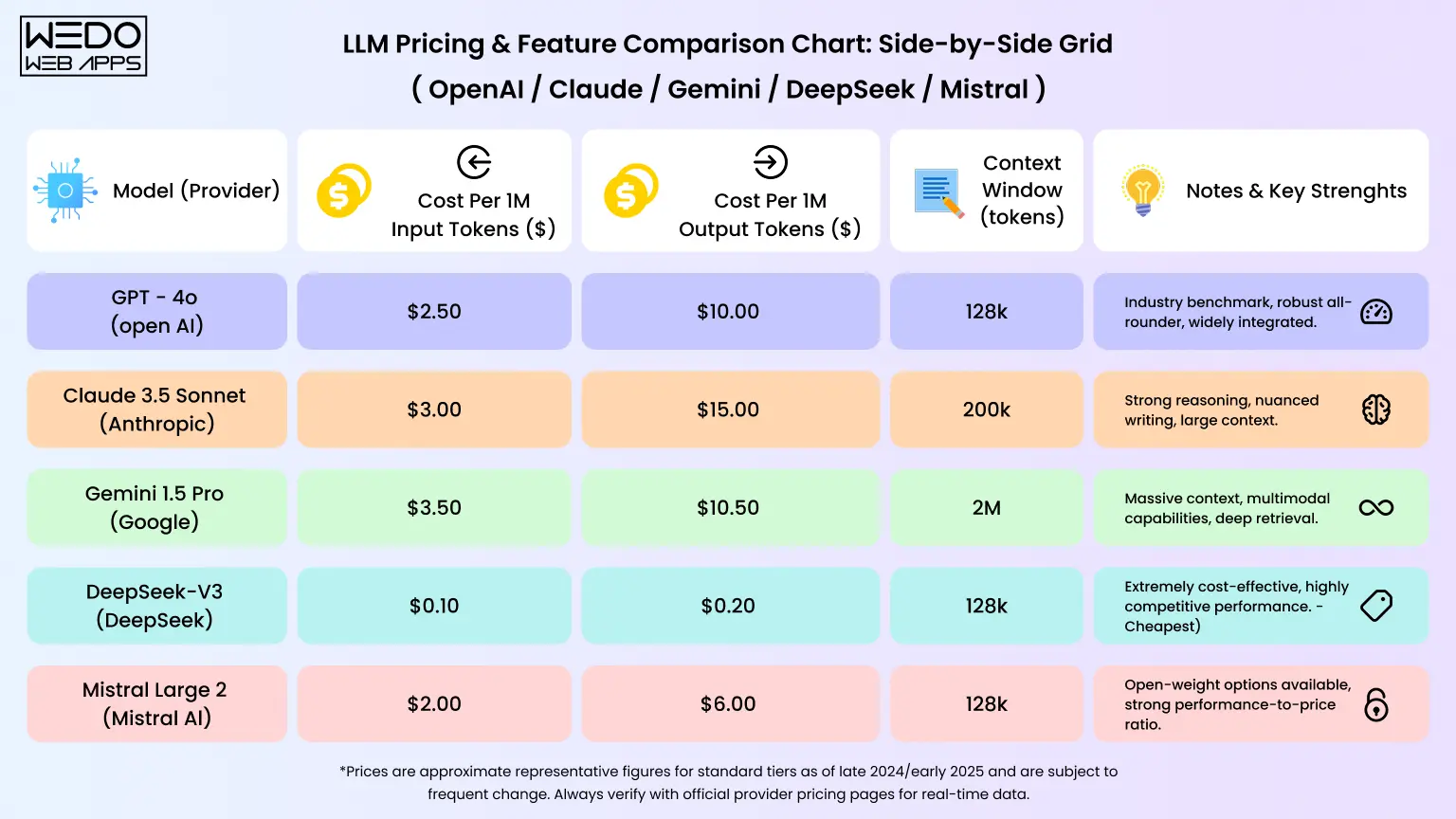
| Model | Input Cost (Per 1M Tokens) | Output Cost (Per 1M Tokens) | Best For |
|---|---|---|---|
| GPT 4o | $2.50 | $10.00 | Enterprise copilots and complex workflows |
| GPT 4o Mini | $0.15 | $0.60 | Large-scale automation and chat systems |
| GPT 5.4 | $2.50 | $15.00 | Advanced enterprise reasoning tasks |
| GPT 5.4 Mini | $0.75 | $4.50 | Faster production workloads |
Pricing may also vary depending on:
- Batch processing discounts
- Cached token usage
- Realtime API usage
- Priority processing
- Enterprise support tiers
Many businesses start with smaller models for cost control and later route more complex requests to premium models.
This hybrid model strategy is becoming common among enterprises using the API for ChatGPT at scale.
How Token-Based Pricing Works in Practice
The open ai chatgpt api uses token-based billing instead of flat monthly pricing.
A token represents pieces of text processed by the model.
Both input and output tokens are billed separately.
The final cost depends on:
| Cost Driver | Impact on Pricing |
|---|---|
| Prompt size | Larger prompts increase input costs |
| Output length | Longer responses increase output costs |
| Context windows | More retrieved data increases usage |
| User volume | More requests increase total spending |
| AI agents | Multi-step workflows increase token consumption |
For example, a simple customer support AI chatbot may stay relatively affordable.
An enterprise AI assistant analyzing contracts, generating summaries, searching databases, and calling tools repeatedly can consume dramatically more tokens.
This is why production AI costs often rise faster than expected after launch.
OpenAI API Cost Calculator: Estimating Your Monthly Spend at Enterprise Scale
Many teams underestimate AI spending because they only calculate per-request pricing.
In reality, the enterprise usage scales quickly once the AI features become part of their daily workflows.
Example Enterprise SaaS Scenario
Imagine a SaaS company using the open ChatGPT API for customer support automation.
Daily Usage Assumptions
| Metric | Estimate Usage |
|---|---|
| Daily active users | 50,000 |
| Average prompts per user | 8 |
| Average input size | 1,200 tokens |
| Average output size | 500 tokens |
Estimated Monthly Token Volume
| Token Type | Monthly Usage |
|---|---|
| Input Tokens | ~1.44 billion |
| Output Tokens | ~600 million |
At GPT 4o pricing, monthly API costs alone could easily reach tens of thousands of dollars.
And that does not include supporting infrastructure.
Additional Enterprise AI Costs
Most production systems also require:
- Vector databases for RAG
- Monitoring and observability tools
- Prompt management systems
- Rate-limiting infrastructure
- Response caching layers
- Human review workflows
- Security and moderation systems
This is why many enterprises later compare:
- API costs vs self-hosted GPUs.
- Managed inference vs custom deployment.
- Vendor convenience vs infrastructure ownership.
Hidden Costs Most Enterprise Teams Overlook
The pricing page usually reflects only direct API usage.
But enterprise AI deployments involve far more than token billing.
Common Hidden AI Infrastructure Costs
| Hidden Cost | Why It Matters |
|---|---|
| Prompt Iteration | Poor prompts increase token waste |
| Retrieval Systems | Vector search infrastructure adds costs |
| Failed Requests | Retries increase token consumption |
| Logging and Monitoring | Production AI systems require observability |
| AI Guardrails | Validation and moderation layers add overhead |
| Latency Optimization | Faster systems often cost more |
| Human Review Pipelines | Critical outputs still require oversight |
Another overlooked issue is context inflation.
As enterprises connect more documents, databases, and workflows into AI systems, prompt sizes increase significantly. Larger prompts directly increase token consumption.
This becomes especially important for:
- RAG-based systems
- Multi-agent workflows
- Long context enterprise assistants
- AI document processing pipelines
For startups and mid-sized SaaS platforms, the open ai api is often still the fastest and most practical option.
But at enterprise scale, businesses eventually begin evaluating whether fine-tuned open source models or hybrid architectures can reduce long-term operational costs.
What Is a Custom LLM and When Does It Make Sense for Enterprise?
A custom LLM is a large language model that has been modified, fine-tuned, or deployed specifically for a company's use case instead of relying entirely on a hosted provider like the OpenAI ChatGPT API.
In enterprise environments, custom LLMs are usually built using open-source foundation models such as Llama 3, Mistral, or Gemma.
Companies then adapt these models using:
- Fine tuning
- Retrieval systems
- Domain-specific knowledge
- Internal company knowledge
- Custom inference infrastructure
The goal is not always to build a smarter model than the open ai api.
In most cases, enterprises want:
- Better control over data
- Lower serving costs at scale
- Industry-specific responses
- Reduced vendor dependency
- Private deployment flexibility
For many organizations, custom LLMs become relevant only after AI usage grows significantly.
Open-Source LLM Comparison: Llama 3 vs Mistral vs Gemma for Enterprise Applications
Open-source models have improved rapidly in both quality and deployment flexibility.
Today, many enterprises compare these models against the API for ChatGPT for internal AI systems and domain-specific workloads.
Popular Enterprise Open Source Models in 2026
| Model | Best For | Key Strength |
|---|---|---|
| Llama 3 | Enterprise copilots and assistants | Strong reasoning and ecosystem support |
| Mistral | Efficient production workloads | Lower inference costs and speed |
| Gemma | Lightweight deployments | Smaller infrastructure requirements |
Each model comes with different tradeoffs around:
- GPU memory usage
- Inference speed
- Fine-tuning complexity
- Context window size
- Commercial licensing
Why Enterprises Choose Open-Source LLMs
Businesses usually move toward custom models when they need:
| Enterprise Need | Why Open-Source Helps |
|---|---|
| Data privacy | Full infrastructure control |
| Compliance | Easier internal governance |
| Lower long-term serving costs | No per-token API billing |
| Domain specialization | Better task-specific tuning |
| Multi-model flexibility | Reduced vendor lock-in |
However, open-source deployments also introduce significant operational complexity.
Fine-Tuning vs Training From Scratch: What Enterprises Actually Do in 2026
Most enterprises are not training LLMs entirely from scratch.
Training a frontier model requires:
- Massive datasets
- Distributed GPU clusters
- Advanced ML engineering teams
- Multi-million dollar infrastructure budgets
Instead, companies usually fine-tune existing open-source models.
What Fine-Tuning Actually Means
Fine-tuning updates an existing model using company-specific data so the model performs better on targeted tasks.
Examples include:
- Legal contract analysis
- Medical documentation workflows
- Financial compliance systems
- Technical support automation
- Internal enterprise knowledge assistants
Enterprise AI Reality in 2026
| Approach | Enterprise Adoption |
|---|---|
| Training from scratch | Rare outside major AI labs |
| Fine-tuning open models | Very common |
| RAG without fine-tuning | Extremely common |
| Hybrid RAG + fine-tuning | Growing rapidly |
For many businesses, retrieval-based systems deliver better ROI than expensive model retraining.
That is one reason why RAG architecture is becoming a preferred alternative to full custom model development.
What Infrastructure Do You Need to Self-Host an LLM?
Self-hosting an LLM means the enterprise manages its own inference infrastructure instead of depending entirely on the open AI ChatGPT API.
This gives companies more control, but it also increases operational responsibility.
Typical Self-Hosted LLM Infrastructure
| Infrastructure Component | Purpose |
|---|---|
| GPUs | Model inference and training |
| Vector Databases | Retrieval for RAG systems |
| Storage Systems | Model weights and datasets |
| Orchestration Layer | Request routing and scaling |
| Monitoring Stack | Performance and observability |
| Security Controls | Access management and auditing |
Common Enterprise GPU Options
| GPU Type | Typical Enterprise Usage |
|---|---|
| NVIDIA A100 | Large-scale inference and training |
| NVIDIA H100 | High-performance enterprise AI workloads |
| L40S | Cost-optimized inference |
| Consumer GPUs | Small internal testing environments |
Infrastructure costs vary dramatically depending on:
- Model size
- Concurrent users
- Latency requirements
- Context window size
- Fine-tuning frequency
For example, hosting a lightweight 7B parameter model may be relatively affordable.
Running multiple large models with low-latency enterprise inferences can quickly become extremely expensive.
When Does a Custom LLM Actually Make Sense?
A custom model becomes more practical when several conditions align.
Custom LLMs Usually Make Sense When:
- AI request volume is extremely high.
- Compliance requirements restrict external APIs.
- The company needs domain-specific responses.
- Long-term API costs become difficult to justify.
- Vendor lock-in becomes a strategic concern.
The OpenAI API Usually Makes More Sense When:
- Teams need faster deployment.
- Infrastructure resources are limited.
- AI workloads are still growing.
- Internal ML expertise is limited.
- Product teams prioritize speed to market.
For many enterprises, the best approach is not choosing one side exclusively.
Instead, companies increasingly combine:
- The OpenAI API for general reasoning.
- RAG systems for company knowledge.
- Fine-tuned open models for specialized workflows.
That hybrid strategy is becoming one of the most common enterprise AI architectures in 2026.
OpenAI API vs Custom LLM: Head-to-Head Cost Comparison
Choosing between the OpenAI ChatGPT API and a custom LLM is not only a technical decision.
It is also a long-term financial decision.
On a smaller scale, the OpenAI API is usually more affordable because businesses avoid upfront infrastructure investments. But as request volume increases, many enterprises begin comparing API billing against GPU hosting, model serving, and operational ownership costs.
The challenge is that most cost comparisons only look at token pricing.
In reality, enterprises must evaluate the total cost of ownership across infrastructure, engineering, maintenance, monitoring, and scaling.
API Call Costs vs Training Compute Costs
Using the API for ChatGPT removes the need to manage AI infrastructure internally.
Businesses pay for usage while OpenAI handles:
- Model hosting
- GPU scaling
- Inference optimization
- Availability management
- Model updates
This significantly reduces operational complexity.
Custom LLM deployment works differently.
Enterprises become responsible for:
- GPU provisioning
- Fine-tuning pipelines
- Scaling infrastructure
- Monitoring systems
- Security and compliance controls
Cost Structure Comparison
| Cost Area | OpenAI API | Custom LLM |
|---|---|---|
| Upfront Investment | Low | High |
| Monthly Usage Costs | Variable | Infrastructure-based |
| GPU Management | Not required | Required |
| Engineering Overhead | Lower | Higher |
| Scaling Complexity | Managed by provider | Self-managed |
| Infrastructure Ownership | None | Full ownership |
For most startups and SaaS products, the open AI ChatGPT API is financially practical during early growth stages.
The economics only start changing when AI usage becomes extremely large.
LLM Fine-Tuning Compute Requirements: GPU Hours, Memory, and Infrastructure Costs (2026)
Fine-tuning a model requires far more than downloading an open-source checkpoint.
Enterprise must plan for GPU memory, storage, orchestration, and training infrastructure.
Typical Fine-Tuning Infrastructure
| Model Size | Recommended Hardware | Estimated Complexity |
|---|---|---|
| 7B Models | Single high-memory GPU | Moderate |
| 13B Models | Multi-GPU setup | High |
| 70B+ Models | Enterprise GPU clusters | Very high |
Major Infrastructure Cost Drivers
| Infrastructure Factor | Impact |
|---|---|
| GPU rental rates | Largest operational expenses |
| Training duration | Longer runs increase costs |
| Dataset quality | Cleaning and labeling require engineering effort |
| Storage systems | Large datasets increase storage requirements |
| Experimentation cycles | Multiple iterations increase compute usage |
Even with modern approaches like LoRA and QLoRA, enterprise fine-tuning still requires experienced ML engineering support.
This is one of the reasons many businesses initially prefer to use ChatGPT API services before investing in dedicated infrastructure.
Serving Costs for Self-Hosted Models at Scale
Training costs are only one part of the equation.
Once a model moves into production, enterprises must continuously pay for inference infrastructure.
Ongoing Self-Hosted AI Costs
| Infrastructure Area | Why It Matters |
|---|---|
| GPU inference servers | Required for live responses |
| Autoscaling systems | Handle traffic spikes |
| Load balancing | Maintain uptime and performance |
| Monitoring pipelines | Detect failures and latency issues |
| Backup systems | Support reliability and disaster recovery |
Inference costs depend heavily on:
- Concurrent users
- Tokens generated per request
- Response latency targets
- Model size
- Context window usage
A lightweight internal assistant may run efficiently on a smaller deployment.
A production AI platform serving thousands of users simultaneously often requires enterprise-grade GPU infrastructure running continuously.
24-Month Total Cost of Ownership (TCO) Comparison Table
The real enterprise decision should focus on long-term operational economics instead of only monthly API billing.
Example 24 Month Enterprise AI Comparison
| Cost Category | OpenAI API | Custom LLM |
|---|---|---|
| Initial Setup | Low | High |
| Infrastructure Management | Minimal | Significant |
| Monthly Operating Costs | Usage based | Fixed + scaling costs |
| AI Engineering Requirements | Moderate | High |
| Maintenance Responsibility | Provider managed | Internal team |
| Compliance Flexibility | Limited | High |
| Vendor Dependency | Higher | Lower |
| Cost Predictability | Variable | More controllable at scale |
Typical Enterprise Pattern
| Business Stage | Most Common Choice |
|---|---|
| MVP and early AI rollout | OpenAI API |
| Growth stage optimization | Hybrid architecture |
| Massive enterprise scale | Partial or full self-hosting |
This explains why many companies start with hosted APIs and later transition toward hybrid AI infrastructure.
At What Usage Volume Does Self-Hosting Become Cheaper?
There is no universal number because costs depend on:
- Model size
- Request volume
- GPU pricing
- Latency requirements
- Engineering salaries
- Infrastructure efficiency
However, enterprises usually begin evaluating self-hosting when:
| Signal | Why It Matters |
|---|---|
| Monthly API bills grow rapidly | Token costs become difficult to predict |
| AI usage becomes core to the product | Infrastructure ownership becomes strategic |
| Data residency becomes critical | Internal hosting offers more control |
| Domain-specific tasks dominate | Smaller tuned models may outperform APIs |
| Multi-region scaling increases | API costs compound quickly |
For many businesses, the tipping points appear when AI workloads become continuous rather than occasional.
A small SaaS chatbot may remain cheaper on the open AI API indefinitely.
A high-traffic AI platform processing billions of monthly tokens may eventually reduce costs through custom inference infrastructure.
Enterprise Reality Check
The cheapest option is not always the best business decision.
Self-hosting may reduce long-term serving costs, but it also introduces:
- Infrastructure risk
- Operational overhead
- ML hiring requirements
- Scaling complexity
- Reliability challenges
For many enterprises, the practical path looks like this:
- Launch quickly using the OpenAI API.
- Validate AI usage and customer demand.
- Optimize costs using RAG and smaller models.
- Fine-tune or self-host only when scale justifies it.
That phased approach reduces unnecessary infrastructure spending while keeping long-term flexibility open.
RAG vs Fine-Tuning vs Hybrid: Which Approach Fits Your Enterprise Use Case?
One of the biggest misconceptions in enterprise AI is assuming every business needs to fine-tune a model.
In reality, many companies can achieve strong results using Retrieval Augmented Generation (RAG) without modifying the underlying LLM at all.
Other benefits of lightweight fine-tuning for domain-specific tasks.
And increasingly, production AI systems combine both approaches in a hybrid architecture.
Choosing the right method depends on:
- Data sensitivity
- Response accuracy requirements
- Infrastructure budget
- AI request volume
- Domain specialization
- Maintenance capacity
The goal is not to choose the most advanced architecture.
The goal is to choose the architecture that solves the business problem efficiently.
What is RAG & When Should You Use It?
RAG stands for Retrieval Augmented Generation.
Instead of retraining the model, a RAG system retrieves relevant company information during runtime and sends it to the LLM as context.
This allows businesses to keep responses updated without constantly retraining models.
How RAG Works
| Step | What Happens |
|---|---|
| Step 1 | Documents are stored inside a vector database |
| Step 2 | A user submits a query |
| Step 3 | Relevant information is retrieved |
| Step 4 | Retrieved content is added to the prompt |
| Step 5 | The LLM generates a contextual response |
Common Enterprise RAG Use Cases
- Internal knowledge assistants
- AI search systems
- Document retrieval platforms
- Customer support copilots
- Legal and policy search tools
Many enterprises using the OpenAI ChatGPT API rely on RAG because it is faster and cheaper than retraining models repeatedly.
When RAG Makes the Most Sense
| Scenario | Why RAG Works Well |
|---|---|
| Frequently changing information | No retraining required |
| Large internal knowledge bases | Easier document retrieval |
| Faster deployment timelines | Lower infrastructure complexity |
| Limited ML engineering resources | Easier implementation |
For many businesses, RAG becomes the first production AI architecture before exploring custom fine-tuning.
What is Fine-Tuning and What Does It Actually Cost?
Fine-tuning modified an existing model using task-specific or domain-specific training data.
Instead of only retrieving information, the model itself learns specialized response behavior.
Common Fine-Tuning Goals
| Goal | Example |
|---|---|
| Tone adaptation | Brand-consistent responses |
| Domain specialization | Legal or medical terminology |
| Workflow optimization | Structured enterprise outputs |
| Classification accuracy | Better tagging and routing |
Fine-tuning can improve consistency for repetitive enterprise tasks.
However, it also introduces additional infrastructure and maintenance costs.
Enterprise Fine-Tuning Cost Areas
| Cost Area | Why It Matters |
|---|---|
| GPU compute | Training requires expensive hardware |
| Dataset preparation | Data cleaning takes time |
| Experimentation cycles | Multiple training runs increase costs |
| Model hosting | Fine-tuned models still require inference infrastructure |
| Evaluation pipelines | Quality testing becomes essential |
This is why many companies do not immediately replace the open ai api with fully custom models.
LoRA and QLoRA: Fine-Tuning Without Enterprise-Level Hardware
Traditional fine-tuning can become expensive quickly.
LoRA and QLoRA reduce those costs by training only smaller portions of the model instead of updating every parameter.
What LoRA and QLoRA Improve
| Method | Main Benefits |
|---|---|
| LoRA | Lower GPU memory requirements |
| QLoRA | Reduced memory usage through optimization |
These methods allow enterprises to fine-tune open-source models using more affordable infrastructure.
Why Enterprises Use LoRA-Based Fine-Tuning
- Lower computer costs
- Faster experimentation
- Reduce GPU requirements
- Easier deployment for smaller teams
This approach has become increasingly common among organizations experimenting with custom LLMs before committing to large infrastructure investments.
The Hybrid Approach: Why Most Production Teams Combine RAG and Fine-Tuning
Many enterprise AI systems now combine:
- RAG for knowledge retrieval
- Fine-tuning for behavior optimization
- Hosted APIs for general reasoning
This hybrid approach balances flexibility, accuracy, and operational cost.
Example Hybrid Enterprise Architecture
| Components | Purpose |
|---|---|
| RAG system | Retrieves company knowledge |
| Fine-tuned model | Improves domain-specific outputs |
| Hosted LLM API | Handles advanced reasoning tasks |
| Routing layer | Sends requests to appropriate models |
Why Hybrid Systems Are Growing
| Benefit | Business Impact |
|---|---|
| Better response quality | Improved user experience |
| Lower serving costs | Reduced API dependency |
| Faster updates | Knowledge changes do not require retraining |
| Greater flexibility | Multiple models can co-exist |
For large enterprises, hybrid architecture often provides a better balance than relying entirely on either RAG or fine-tuning alone.
Use Case Fit Matrix: Match Your Problem to the Right Method
Choosing between RAG, fine-tuning, or hybrid deployment depends heavily on the business use case.
Enterprise AI Decision Matrix
| Use Case | Best Approach |
|---|---|
| Internal company search | RAG |
| AI knowledge assistant | RAG |
| Brand-specific content generation | Fine-tuning |
| Legal document analysis | Hybrid |
| Medical workflow automation | Hybrid |
| AI customer support chatbot | RAG + API |
| Highly specialized classification | Fine-tuning |
| Rapid MVP deployment | OpenAI + RAG |
Simplified Decision Framework
| If Your Priority Is... | Best Choice |
|---|---|
| Faster deployment | OpenAI API |
| Lower upfront cost | RAG |
| Domain specialization | Fine-tuning |
| Compliance control | Self-hosted hybrid |
| Long-term cost optimization | Hybrid architecture |
For most companies entering enterprise AI adoption today, RAG provides the best balance between speed, flexibility, and cost-efficiency.
Fine-tuning usually becomes valuable later when response behavior, domain accuracy, or operational economics require deeper model customization.
When to Use the OpenAI API vs Llama 3 / Mistral Fine-Tuning: A Direct Comparison
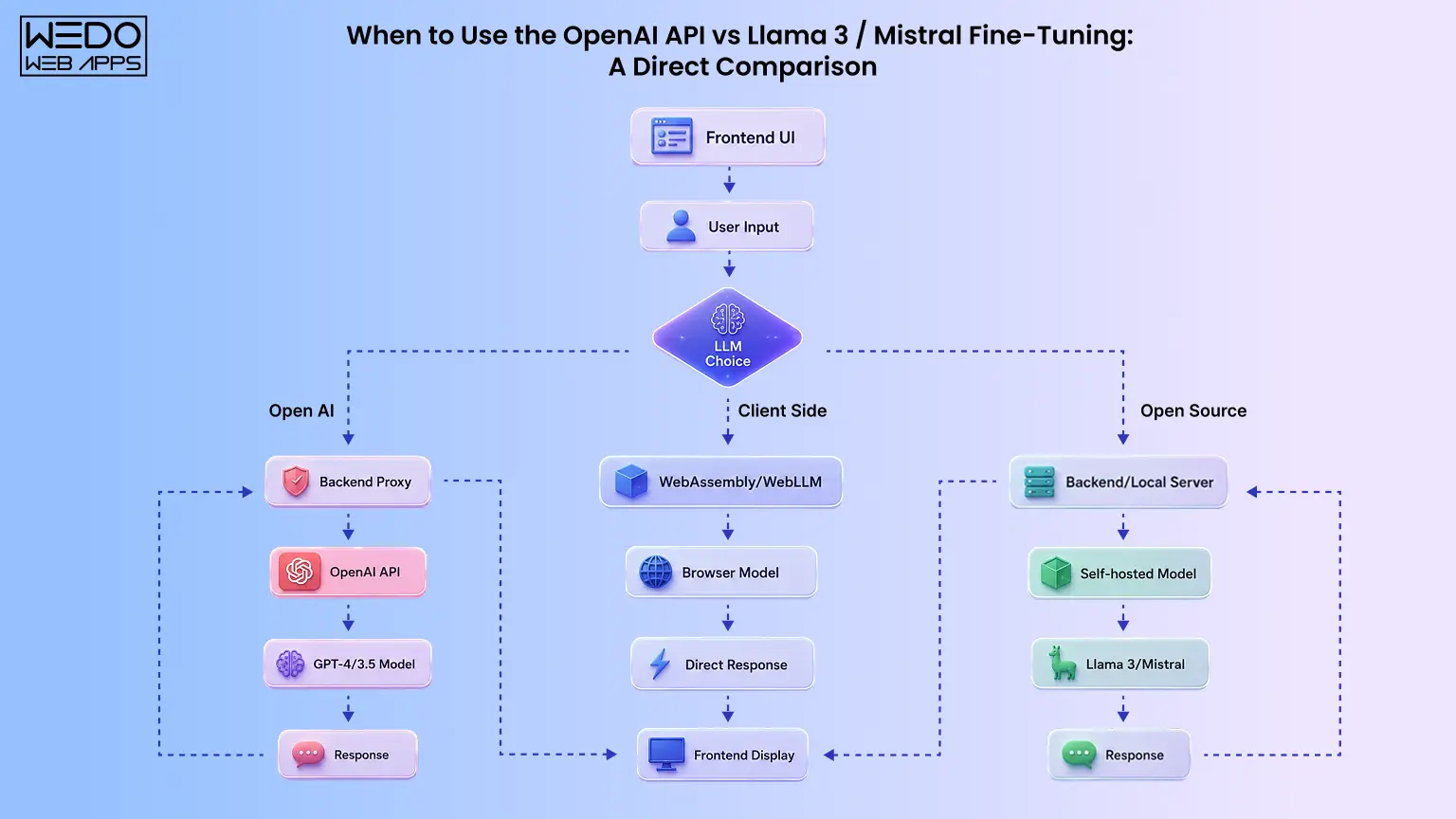
The debate between the OpenAI ChatGPT API and fine-tuned open-source models is no longer about which option is "better."
The real question is which approach fits the business problem, infrastructure capacity, and long-term AI strategy.
For many enterprises, the open ai api offers faster deployment and stronger general reasoning.
At the same time, fine-tuned models like Llama 3 and Mistral can outperform hosted APIs in highly specialized workflows where domain accuracy, cost control, or deployment flexibility matter more.
This is why production AI systems increasingly rely on multiple models instead of a single provider.
Tasks and Scenarios Where the OpenAI API Wins
The API for ChatGPT is usually the strongest choice when businesses prioritize speed, simplicity, and broad reasoning capability.
Areas Where Hosted APIs Perform Best
| Scenario | Why the OpenAI API Performs Well |
|---|---|
| Rapid MVP development | Minimal infrastructure setup |
| General-purpose AI assistants | Strong reasoning across many tasks |
| Multi-language support | Broad multilingual capabilities |
| Complex conversational workflows | Better contextual understanding |
| AI coding assistants | High-quality code generation |
| Low infrastructure teams | No GPU management required |
Why Enterprises Start With Hosted APIs
Most businesses initially choose the OpenAI ChatGPT API because it helps them:
- Launch faster
- Reduce engineering overhead
- Avoid infrastructure complexity
- Access continuously updated models
- Scale globally with managed systems
This approach is especially practical for startups and SaaS products validating AI demand.
Tasks and Scenarios Where Fine-Tuned Llama 3 or Mistral Wins
Fine-tuned open-source models become more attractive when enterprises need tighter control over behavior, deployment, or operational cost.
Areas Where Custom Models Often Perform Better
| Scenario | Why Fine-Tuned Models Help |
|---|---|
| Domain-specific terminology | Better specialized responses |
| Internal enterprise workflows | More consistent outputs |
| Data residency requirements | Easier private deployment |
| Massive inference scale | Lower long-term serving costs |
| Predictable response formatting | Better structured outputs |
| Offline or edge deployments | No dependency on external APIs |
Example Enterprise Scenarios
| Industry | Why Fine-Tuning Helps |
|---|---|
| Healthcare | Medical terminology consistency |
| Legal Tech | Contract-specific reasoning |
| Finance | Regulatory workflow specialization |
| Manufacturing | Internal process automation |
| Insurance | Structured claim processing |
In these cases, smaller tuned models may outperform general-purpose APIs for targeted tasks.
How to Evaluate LLM Output Quality for Production Apps
Choosing a model should never rely only on demos or benchmark marketing.
Production AI systems require structured evaluation.
Key Enterprise Evaluation Areas
| Evaluation Metric | Why It Matters |
|---|---|
| Accuracy | Correctness of responses |
| Hallucination Rate | Frequency of incorrect information |
| Latency | Response speed under load |
| Cost Efficiency | Cost per successful outcome |
| Consistency | Stability across repeated prompts |
| Security | Resistance to prompt injection |
Common Enterprise Testing Methods
- Human review pipelines
- Automated benchmark datasets
- Side-by-side model comparisons
- Task-specific scoring systems
- Production shadow testing
Many enterprises discover that the "best" model depends entirely on the workflow being evaluated.
A hosted API may outperform a custom model in reasoning tasks.
A fine-tuned model may perform better for structured classification or repetitive tasks.
Building an Evaluation Pipeline: Benchmarks, LLM-as-Judge, and Human Review
Modern enterprise AI systems require continuous evaluation instead of one-time testing.
This is especially important when teams combine:
- Multiple LLM providers
- RAG systems
- Fine-tuned models
- AI agents and workflows
Typical Enterprise Evaluation Pipeline
| Layer | Purpose |
|---|---|
| Benchmark Testing | Measure performance on fixed datasets |
| LLM-as-Judge | Use another model for automated scoring |
| Human Review | Validate business-critical outputs |
| Production Monitoring | Detect quality degradation over time |
What Enterprises Usually Measure
| Metric | Example |
|---|---|
| Response accuracy | Correctness of generated outputs |
| Retrieval relevance | Quality of retrieved RAG context |
| Hallucination frequency | Incorrect or fabricated responses |
| Formatting consistency | Structured response reliability |
| User satisfaction | Real user feedback |
Why Human Review Still Matters
Even advanced models can produce:
- Incorrect answers
- Confident hallucinations
- Unsafe outputs
- Policy violations
That is why regulated industries often combine AI automation with human approval layers.
Quick Comparison: OpenAI API vs Fine-Tuned Open Source Models
| Factor | OpenAI API | Fine-Tuned Llama 3 / Mistral |
|---|---|---|
| Deployment Speed | Very Fast | Slower |
| Infrastructure Management | Minimal | High |
| General Reasoning | Excellent | Moderate to strong |
| Domain Specialization | Moderate | Excellent |
| Compliance Flexibility | Limited | High |
| Long-Term Serving Costs | Higher at scale | Lower at a massive scale |
| Maintenance Complexity | Low | High |
| Vendor Dependency | Higher | Lower |
For many enterprises, the most effective strategy is not replacing hosted APIs entirely.
Instead, companies increasingly use:
- The open ai api for advanced reasoning.
- Fine-tuned models for specialized workflows.
- RAG systems for internal knowledge retrieval.
That layered approach improves flexibility while reducing unnecessary infrastructure complexity.
Latency and Performance Benchmarks: API vs Self-Hosted
Performance is one of the biggest factors influencing enterprise AI architecture decisions.
A model may produce excellent responses, but if latency is too high or throughput drops under production load, the user experience quickly suffers.
This is where the comparison between the OpenAI ChatGPT API and self-hosted models becomes important.
Hosted APIs benefit from highly optimized infrastructure and global scaling systems.
Self-hosted models offer more deployment control, but performance depends entirely on the company's infrastructure quality, GPU allocation, inference optimization, and traffic management.
The right choice depends on balancing:
- Response speed
- Infrastructure cost
- Concurrent user load
- Model quality
- Deployment flexibility
Time to First Token: OpenAI API vs Self-Hosted Fine-Tuned Models
Time to First Token (TTFT) measures how quickly a model begins generating a response after receiving a request.
This metric directly affects perceived responsiveness in AI applications.
Typical TTFT Comparison
| Deployment Type | Typical Performance |
|---|---|
| OpenAI hosted API | Usually optimized globally |
| Self-hosted small model | Can be extremely fast |
| Self-hosted large model | Depends heavily on GPU infrastructure |
Hosted APIs often perform well because providers optimize:
- Model serving stacks
- GPU allocation
- Global routing
- Inference caching
- Request batching
However, smaller fine-tuned models can sometimes outperform hosted APIs in low-latency enterprise environments when deployed close to internal systems.
Where Low Latency Matters Most
- AI customer support chat
- Voice assistants
- Realtime copilots
- Coding assistants
- Trading and analytics systems
Even a small increase in latency can reduce user satisfaction in conversational applications.
Tokens Per Second at Production Load
Latency alone is not enough.
Enterprises must also evaluate throughput, which measures how many tokens a system can generate per second under real production traffic.
What Affects Throughput?
| Performance Factor | Impact |
|---|---|
| GPU type | Faster GPUs increase inference speed |
| Model size | Larger models reduce throughput |
| Context window size | Longer prompts slow generation |
| Concurrent users | Heavy traffic affects performance |
| Quantization | Smaller model precision can improve speed |
Hosted API vs Self-Hosted Throughput
| Factor | OpenAI API | Self-Hosted Models |
|---|---|---|
| Traffic scaling | Managed automatically | Requires internal scaling |
| Performance optimization | Provider managed | Internal responsibility |
| Burst traffic handling | Usually strong | Depends on infrastructure |
| Cost predictability | Variable | More infrastructure-driven |
This is one reason many enterprises initially prefer the open ai api.
Scaling the inference infrastructure internally can become operationally demanding very quickly.
Domain-Specific Quality - Where Fine-Tuned Models Outperform the API
General-purpose APIs are trained for broad reasoning across many topics.
But enterprise workflows are often highly specialized.
Fine-tuned models can outperform hosted APIs when tasks require:
- Industry terminology
- Structured outputs
- Repetitive domain workflows
- Internal business logic
- Predictable formatting
Common Areas Where Fine-Tuning Helps
| Industry | Example Advantage |
|---|---|
| Healthcare | Medical terminology accuracy |
| Legal | Contract clause interpretation |
| Finance | Regulatory workflow consistency |
| Manufacturing | Process documentation automation |
| Insurance | Structured claim analysis |
Why Smaller Models Sometimes Win
A well-tuned smaller model can outperform a larger general model for narrow workflows.
This is similar to hiring a specialist instead of a general consultant.
The specialist may know less overall, but performs better within a specific domain.
That is why many enterprises combine:
- Hosted APIs for broad reasoning.
- Fine-tuned models for domain workflows.
- RAG systems for knowledge retrieval.
When Fine-Tuning Actually Hurts Performance
Fine-tuning is not always beneficial.
In some cases, excessive or poor-quality fine-tuning can reduce model performance.
Common Fine-Tuning Problems
| Problem | Result |
|---|---|
| Overfitting | Responses become too narrow |
| Poor datasets | Model quality declines |
| Small training datasets | Inconsistent behavior |
| Excessive specialization | Loss of general reasoning |
| Weak evaluation pipelines | Errors go unnoticed |
Some enterprises also underestimate operational complexity after deploying fine-tuned models.
Performance issues may appear through:
- Slower inference
- GPU memory bottlenecks
- Scaling instability
- Higher maintenance overhead
- Increased monitoring requirements
Sign Fine-Tuning May Not Be Necessary
- Knowledge changes frequently
- RAG alone solves the problem
- AI usage volume is still small
- Teams lack ML infrastructure expertise
- Hosted APIs already meet quality targets
In many cases, businesses achieve better ROI by improving prompts, retrieval pipelines, and evaluation systems before investing heavily in model retraining.
Enterprise Performance Reality
The fastest or smartest model is not always the best production choice.
Enterprise AI systems must balance:
- Speed
- Cost
- Accuracy
- Scalability
- Operational complexity
For many organizations, the practical approach looks like this:
| Business Need | Recommended Approach |
|---|---|
| Rapid deployment | OpenAI API |
| Low-latency internal workflows | Small fine-tuned models |
| Specialized enterprise tasks | Hybrid deployment |
| Massive scale inference | Self-hosted optimization |
| Frequently changing knowledge | RAG systems |
That is why hybrid AI architectures continue growing across enterprise deployments in 2026.
Data Privacy, Compliance, and Vendor Lock-In for Enterprise AI
Performance and cost are only part of the enterprise AI decision.
For many organizations, the bigger concern is control.
Companies handling customer records, financial transactions, legal documents, healthcare data, or internal intellectual property must evaluate how AI systems manage privacy, compliance, and infrastructure ownership.
This is where the differences between the OpenAI ChatGPT API and self-hosted LLMs become especially important.
The right architecture depends heavily on:
- Regulatory requirements
- Data residency policies
- Security standards
- Internal governance rules
- Vendor dependency tolerance
For some businesses, hosted APIs are completely acceptable.
For others, private infrastructure becomes mandatory.
What Happens to Your Data When You Call the OpenAI API?
When a business sends requests through the open ai api, the data is processed on OpenAI-managed infrastructure.
This often raises questions around:
- Data retention
- Training usage
- Security access
- Compliance obligations
- Sensitive information handling
Enterprise Concerns Around Hosted APIs
| Concern | Why It Matters |
|---|---|
| Sensitive customer data | May require stricter controls |
| Internal company documents | Intellectual property protection |
| Regulatory restrictions | Certain industries limit external processing |
| Data residency | Geographic storage requirements |
| Third-party infrastructure | Reduced infrastructure ownership |
OpenAI provides enterprise-focused controls and policies, but companies still need to verify whether those controls align with internal governance requirements.
This is especially important for businesses operating in highly regulated sectors.
On-Premise LLM Deployment for Regulated Industries
Some enterprises' control relies entirely on external APIs due to compliance obligations or internal security policies.
In these cases, organizations may deploy self-hosted models inside:
- Private cloud environments
- On-premise data centers
- Dedicated enterprise infrastructure
Industries That Commonly Require Private AI Infrastructure
| Industry | Common Requirement |
|---|---|
| Healthcare | Patient data protection |
| Finance | Transaction and compliance controls |
| Government | National security policies |
| Legal | Confidential document handling |
| Insurance | Sensitive claims processing |
Why Enterprises Choose Self-Hosted API
| Benefit | Business Impact |
|---|---|
| Full infrastructure control | Stronger governance |
| Internal data processing | Reduced external exposure |
| Custom security policies | Better enterprise alignment |
| Flexible deployment models | Multi-region support |
However, private deployment also increases operational responsibility significantly.
HIPAA, GDPR, and Data Residency Considerations
Compliance is often one of the biggest reasons enterprises evaluate alternatives to the API for ChatGPT.
Different regulations impose different requirements around how data is processed, stored, and transferred.
Common Enterprise AI Compliance Areas
| Regulation | Primary Concern |
|---|---|
| HIPAA | Healthcare data protection |
| GDPR | EU user privacy and consent |
| SOC 2 | Security and operational controls |
| PCI DSS | Payment-related data handling |
Important Enterprise Questions
Before deploying AI systems, organizations usually evaluate:
- Where is the data processed?
- Is customer data retained?
- Can data stay within specific regions?
- Are audit trails available?
- How are access permissions managed?
For many enterprises, compliance decisions directly influence whether they continue using the open ai chatgpt api or transition toward hybrid and self-hosted architectures.
LLM Vendor Lock-In Risks When Building With OpenAI
Hosted APIs provide convenience and rapid deployment.
But they can also create long-term dependency risks.
Common Vendor Lock-In Concerns
| Risk | Why It Matters |
|---|---|
| Pricing changes | Operational costs may increase |
| API dependency | Critical systems rely on external providers |
| Model behavior changes | Outputs may shift after updates |
| Feature limitations | Limited infrastructure control |
| Migration complexity | Switching providers can become difficult |
This becomes especially important when AI becomes deeply integrated into:
- Customer workflows
- Internal automation systems
- SaaS platforms
- Enterprise products
The deeper the integration, the harder migration becomes later.
Migration Strategies: How to Avoid Being Locked Into One LLM Provider
Most enterprises do not eliminate vendor dependency.
Instead, they reduce risk through architectural decisions.
Common Enterprise Mitigation Strategies
| Strategy | Why It Helps |
|---|---|
| Multi-model routing | Reduces dependence on one provider |
| Abstraction layers | Easier API switching |
| Hybrid infrastructure | Balances hosted and private systems |
| Open-source fallback models | Improves deployment flexibility |
| RAG-based architectures | Keeps company knowledge separate from models |
Example Hybrid Enterprise Architecture
| Component | Deployment Type |
|---|---|
| General reasoning | Hosted API |
| Sensitive workflows | Self-hosted models |
| Company knowledge retrieval | Internal RAG system |
| Model routing | Provider-agnostic orchestration |
This layered strategy gives enterprises more flexibility while still allowing them to benefit from hosted AI services.
Enterprise Reality Check
For many companies, the open ai api remains the fastest and most practical way to deploy AI features.
But as AI systems become more deeply integrated into core business operations, organizations often begin prioritizing:
- Infrastructure ownership
- Compliance flexibility
- Deployment control
- Vendor diversification
- Long-term operational predictability
That is why enterprise AI strategies increasingly move towards hybrid architectures instead of relying entirely on a single provider or deployment model.
Decision Flowchart: OpenAI API vs Fine-Tuned LLM vs Hybrid
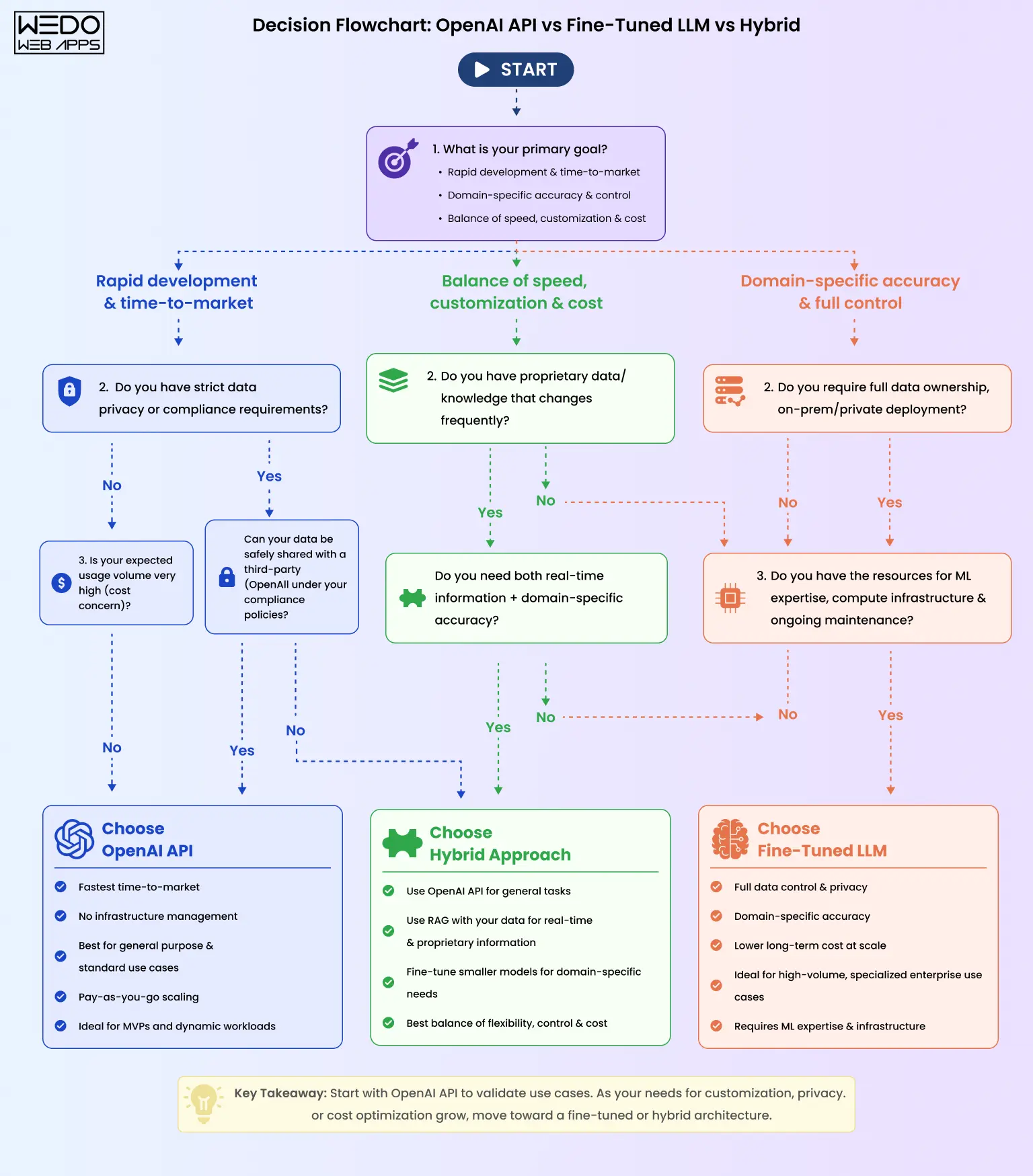
Choosing between the OpenAI ChatGPT API, a fine-tuned custom model, or a hybrid architecture should not depend on trends alone.
The right decision depends on:
- AI usage volume
- Infrastructure budget
- Compliance requirements
- Internal ML expertise
- Latency expectations
- Domain specialization needs
Many enterprises make the mistake of overengineering too early.
They invest in GPU infrastructure, model fine-tuning, and custom deployment pipelines before validating whether their AI workflows actually require that level of complexity.
In most cases, the smartest approach is phased adoption.
Start simple.
Scale only when the business case justifies it.
Key Signals That You Should Stick With the OpenAI API
For many organizations, the OpenAI API remains the most practical option.
It reduces infrastructure complexity and allows teams to focus on product execution instead of model operations.
Signs Hosted APIs Are Still the Best Choice
| Signal | Why It Matters |
|---|---|
| AI features are still experimental | Avoid premature infrastructure investment |
| Product launch speed matters | Faster implementation |
| Internal ML expertise is limited | Lower operational complexity |
| AI request volume is moderate | API costs remain manageable |
| General reasoning quality is sufficient | Fine-tuning may not improve results significantly |
Best Fit Scenarios for the API
- SaaS AI assistants
- AI customer support tools
- Content generation platforms
- Internal productivity copilots
- Early-stage AI products
Custom infrastructure becomes more attractive when AI evolves from a feature into a core operational system.
Signs Fine-Tuning or Self-Hosting Makes Sense
| Signal | Why It Matters |
|---|---|
| Monthly API costs are increasing rapidly | Long-term serving costs become harder to justify |
| Compliance requirements are strict | Greater infrastructure control is needed |
| AI tasks are highly specialized | Domain-tuned models may perform better |
| Vendor dependency becomes risky | Business continuity concerns increase |
| Massive inference scale exists | Self-hosting may improve economics |
Common Enterprise Triggers
| Triggers | Example |
|---|---|
| Healthcare compliance | Sensitive patient workflows |
| Financial governance | Regulatory document processing |
| Large-scale AI products | Millions of daily requests |
| Private enterprise deployments | Internal corporate assistants |
At this stage, many enterprises start evaluating:
- Fine-tuned Llama 3 deployments
- Mistral-based inference stacks
- Private RAG infrastructure
- Hybrid AI orchestration systems
The Step-by-Step Decision Framework
The best enterprise AI strategies usually evolve gradually instead of replacing systems all at once.
Enterprise AI Decision Path
| Step | Recommended Action |
|---|---|
| Step 1 | Start with the OpenAI ChatGPT API |
| Step 2 | Validate business demand and usage patterns |
| Step 3 | Add RAG for company knowledge and evaluation systems |
| Step 4 | Optimize prompts and evaluation systems |
| Step 5 | Monitor API spending and latency |
| Step 6 | Fine-tune models only for specialized workflows |
| Step 7 | Self-host only when scale or compliance requires it |
Simplified Decision Matrix
| Business Priority | Recommended Approach |
|---|---|
| Fast deployment | OpenAI API |
| Lower upfront cost | OpenAI API + RAG |
| Domain specialization | Fine-Tuning |
| Compliance flexibility | Hybrid or self-hosted |
| Massive AI scale | Hybrid infrastructure |
Enterprise Architecture Comparison Snapshot
| Factor | OpenAI API | Fine-Tuned LLM | Hybrid Architecture |
|---|---|---|---|
| Setup Speed | Fast | Slow | Moderate |
| Infrastructure Complexity | Low | High | Moderate to high |
| Compliance Control | Moderate | High | High |
| Long-Term Flexibility | Moderate | High | Very High |
| Upfront Investment | Low | High | Moderate |
| Operational Ownership | Minimal | Significant | Shared |
For most enterprises in 2026, hybrid architecture is becoming the long-term direction.
Companies increasingly combine:
- Hosted APIs for advanced reasoning.
- RAG systems for enterprise knowledge.
- Fine-tuned models for specialized workflows.
- Internal orchestration layers for routing and governance.
This approach balances speed, flexibility, performance, and operational control more effectively than relying entirely on an AI development service.
Build a Private LLM With Your Own Company Data
The choice between the OpenAI ChatGPT API and a custom LLM depends on your business priorities, infrastructure capacity, and long-term AI goals.
For most companies, the open ai api offers the fastest way to launch AI features with lower upfront complexity. But as usage grows, enterprises often explore fine-tuned models, private deployments, and hybrid RAG architectures for better control, compliance, and cost optimization.
In 2026, the most effective enterprise AI systems are rarely built around a single model strategy.
Businesses increasingly combine hosted APIs, retrieval systems, and fine-tuned models to balance performance, scalability, flexibility, and operational cost.