Introduction
You have a project in mind. Then comes the harder question: which programming language should power it?
You may be building a web application, developing an AI-powered product, or planning a backend that needs to handle growing traffic. Python and JavaScript can both fit the brief. Choosing between them requires a close look at what your application actually needs.
That is why the Python vs JavaScript debate continues to matter for developers and businesses. Python has a strong position in AI, machine learning, data processing, automation, and backend development. JavaScript dominates browser-based development and also supports server-side applications through Node.js.
Then there is performance. Is Python or JavaScript faster for your workload? Which one handles concurrent requests better? Which ecosystem gives your team the tools needed for long-term development?
There is no useful answer without context. Your project type, performance requirements, development environment, AI needs, and scalability plans all affect the choice.
This guide compares Python vs JavaScript across these factors, so you can evaluate both languages against what your project actually demands for Python development or JavaScript.
Python vs JavaScript at a Glance
Python and JavaScript both support application development, but their strengths differ across development environments and workloads.
Here is a quick Python vs JavaScript comparison before we look at each difference in detail.
| Factor | Python | JavaScript |
|---|---|---|
| Primary focus | General-purpose development, data, AI, automation, backend | Web interfaces, full-stack, real-time applications |
| Frontend development | Limited | Strong |
| Backend development | Strong | Strong |
| AI and machine learning | Strong ecosystem | Growing ecosystem |
| Data science | Strong | More limited |
| Real-time applications | Possible | Strong fit |
| Learning curve | Generally beginner-friendly | Beginner-friendly with more web concepts |
| Runtime | Python implementations | Browser engines and Node.js |
| Mobile development | Available through frameworks | Strong ecosystem |
| Desktop development | Available | Available through frameworks |
| Package ecosystem | PyPI | npm |
| Common frameworks | Django, Flask, FastAPI | React, Angular, Vue, Node.js, Next.js |
The choice becomes clearer once you connect these differences to your project. Python commonly fits AI, data-intensive applications, automation, and backend services. JavaScript is widely used for browser-based interfaces, real-time applications, and full-stack web development.
You can also combine both when an application needs a JavaScript-based interface with a Python-powered backend, data, or AI services.
What Is Python?
Python is a general-purpose programming language known for its readable syntax and a broad library ecosystem. It is used across backend development, automation, data analysis, artificial intelligence, and scientific computing.
Its straightforward syntax can reduce the amount of code needed for many development tasks. Python also has mature libraries and frameworks that support everything from web APIs to machine learning models.
Key Characteristics of Python
Python's main characteristics include:
- Readable syntax: Python uses a relatively clean syntax that makes code easier to read and maintain.
- Large ecosystem: Developers can access thousands of packages through the Python Package Index (PyPI).
- Backend capabilities: Frameworks such as Django, Flask, and FastAPI support websites, APIs, and backend services.
- AI and data support: Libraries such as PyTorch, NumPy, pandas, and scikit-learn support machine learning and data-focused applications.
- Automation: Python is commonly used for scripting, testing, data processing, and repetitive development tasks.
Where Is Python Commonly Used?
Python is a practical choice when your application depends heavily on data, backend processing, or automation.
For example, an AI application could use Python to process data, run a machine learning model, and expose its predictions through an API. A JavaScript-based frontend could then consume that API and present the results to users.
What Is JavaScript?
JavaScript is a programming language best known for adding interaction and dynamic behavior to websites. It runs directly in a web browser and can also power server-side applications through runtimes such as Node.js.
Its ecosystem has expanded far beyond browser scripting. Developers now use JavaScript for web applications, APIs, real-time systems, mobile applications, and desktop software.
Key Characteristics of JavaScript
JavaScript stands out for a few practical reasons:
- Browser support: JavaScript is supported by modern web browsers, making it central to interactive frontend development.
- Asynchronous programming: Its event-driven model works well for applications handling multiple I/O operations.
- Full-stack development: Node.js development allows developers to use JavaScript on the server alongside frontend frameworks.
- Large package ecosystem: npm provides access to a broad range of reusable packages and development tools.
- Application flexibility: Frameworks and runtimes support web, mobile, desktop, and server-side applications.
Where Is JavaScript Commonly Used?
JavaScript is widely used for interactive websites, single-page applications, real-time communication, and full-stack products.
For example, a live collaboration platform may use JavaScript to update messages, notifications, and user activity without repeatedly refreshing the page. Node.js can also handle the server-side communication required to support those interactions.
Python vs JavaScript: Key Differences
The difference between Python and JavaScript goes beyond syntax. Their type systems, programming styles, runtimes, and ecosystems influence how developers build and maintain applications.
Syntax and Readability
Python uses indentation to define code blocks, which gives its syntax a relatively clean structure. JavaScript uses braces, and semicolons are commonly used, although they are not always required.
For example, a simple conditional statement looks different in each language:
if user_logged_in:
    print("Welcome")
if (userLoggedIn) {
console.log("Welcome");
}Python can feel more concise for beginners. JavaScript gives developers syntax and features designed around browser and application development.
Typical and Type System
Both languages use dynamic typing, meaning variable types are determined during program execution rather than requiring every variable to declare a fixed type.
They handle type conversion and coercion differently, though. JavaScript can perform implicit type conversions in certain operations, while Python generally raises an error when incompatible types are used together.
For larger applications, both ecosystems also provide ways to catch type-related issues earlier. TypeScript is commonly used with JavaScript, while Python supports type hints and static type-checking tools.
Programming Paradigms
Python supports object-oriented, procedural, and functional programming styles. Its syntax lets developers choose the approach that best fits the application.
JavaScript also supports multiple programming styles. Its event-driven and asynchronous capabilities are particularly useful for applications that handle frequent user interactions or network operations.
The practical difference depends on the application's architecture rather than which programming paradigm a language supports.
Libraries and Ecosystems
Python has a mature ecosystem for backend development, data processing, scientific computing, and AI. Developers can access packages through the Python Package Index, commonly called PyPI.
JavaScript has a broad package ecosystem through npm. Its libraries cover frontend interfaces, backend services, testing, build tools, mobile development, and more.
The ecosystem you need should therefore be part of your Python vs JavaScript evaluation. A project requiring machine learning libraries has different requirements from one centered on a highly interactive browser interface.
Runtime and Execution Model
Python applications run through Python implementations such as CPython. JavaScript can run inside browsers through JavaScript engines and on servers through runtimes such as Node.js.
This distinction matters because the execution environment affects how applications handle tasks. Browser-based JavaScript has direct access to web APIs, while Node.js provides server-side capabilities. Python is commonly used as a server-side language for APIs, backend services, automation, and data processing.
These runtime differences become particularly important when comparing Python vs JavaScript performance, which depends on the workload and application architecture.
Python vs JavaScript Performance
Performance is often one of the first concerns when comparing Python vs JavaScript. However, a language does not determine application speed on its own.
The runtime, framework, workload, database, algorithms, and application architecture can all affect the final result. The more useful question is how each language handles the type of work your application performs.
Python vs JavaScript Execution Speed
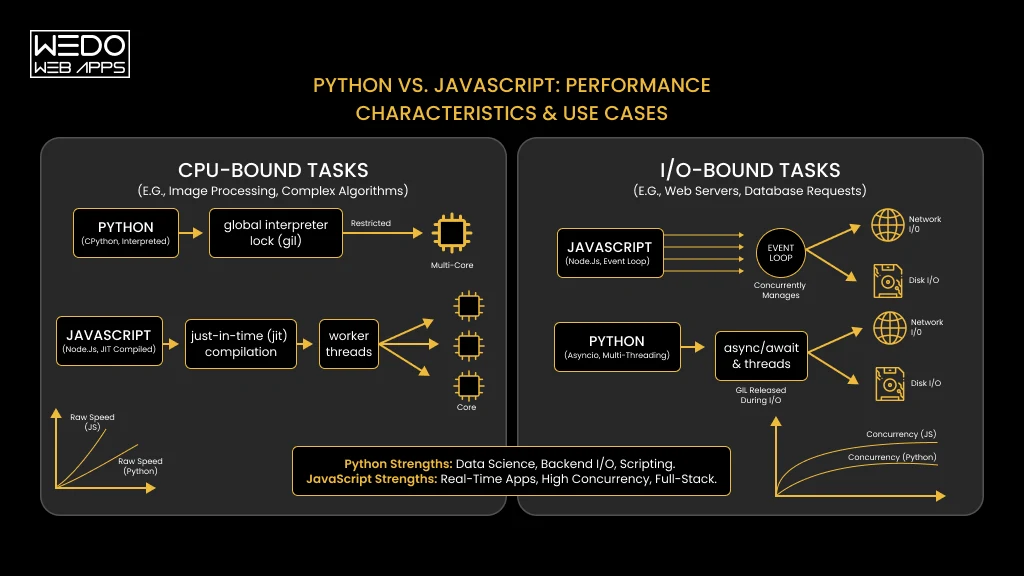
JavaScript engines such as Google's V8 use just-in-time compilation to optimize frequently executed code during runtime. Python implementations such as CPython follow a different model and can be slower for many CPU-intensive tasks.
That does not make JavaScript automatically faster in every application. Libraries, infrastructure, and application design can have a significant effect on actual performance.
CPU-Intensive Workloads
Tasks that require substantial computation can expose differences between the two languages.
Examples include:
- Large numerical calculations
- Complex algorithms
- Image processing
- Data transformations
Python applications can rely on optimized libraries that execute computational work through native code. This means the performance of a Python-based application cannot be judged from Python code execution alone.
I/O and Concurrent Workloads
Applications that spend much of their time waiting for network requests, database operations, or other I/O tasks have different performance considerations.
Node.js uses an event-driven architecture with non-blocking I/O. This makes JavaScript a common choice for applications handling many concurrent connections, such as chat platforms and real-time dashboards.
Python also supports asynchronous programming through frameworks and libraries. Frameworks such as FastAPI can handle asynchronous workloads when the application is designed accordingly.
Python vs JavaScript for Backend Performance
Both languages can support high-traffic backend applications. The better fit depends on what the backend spends most of its time doing.
| Workload | Common Consideration |
|---|---|
| CPU-intensive processing | Benchmark the specific implementation |
| API and database operations | Both can perform well with a suitable architecture |
| Real-time communication | JavaScript with Node.js is commonly used |
| Data processing | Python has a mature ecosystem |
| Asynchronous services | Both support asynchronous programming |
What Actually Determines Application Performance?
Before choosing between Python and JavaScript, assess the complete application stack.
Consider the runtime, framework, database design, caching strategy, algorithms, infrastructure, and expected traffic. A well-designed application in either language can perform better than a poorly optimized application built with the other.
For a production project, benchmark the workloads that matter to your users instead of relying only on language-level speed comparisons.
Python vs JavaScript for Web Development
The choice becomes easier when you look at what your web application actually needs.
| Your requirements | More suitable option | Why |
|---|---|---|
| Interactive fronted | JavaScript | It runs directly in browsers and supports dynamic interfaces |
| Backend APIs | Python or JavaScript | Both offer mature frameworks for API development |
| AI-powered web application | Python + JavaScript | Python supports AI services while JavaScript handles the interface |
| Real-time applications | JavaScript | Node.js supports event-driven, asynchronous workloads |
| Data-intensive backend | Python | Its ecosystem includes mature tools for data processing |
| Full-stack JavaScript project | JavaScript | The same language can be used across the frontend and backend |
When Python Fits Your Web Project
Python for web development is often a strong fit when the backend does more than serve web pages. You may need data processing, automation, analytics, or AI services alongside your APIs.
Example: A healthcare analytics platform could use Python for processing and analyzing data while exposing the results through APIs.
When JavaScript Fits Your Web Project
JavaScript becomes particularly relevant when the user interface is a major part of the product. It supports browser-based interactions and can also handle backend development through Node.js.
Example: A collaborative project management application can use JavaScript for live updates, notifications, dashboards, and server-side communication.
When Using Both Makes Sense
You do not always have to choose between Python and JavaScript.
A product can use JavaScript for the frontend and Python for backend services that handle AI, data processing, or specialized business logic.
Example: An AI-powered eCommerce platform could use a JavaScript interface for product interactions and a Python service for recommendations.
The technology stack should follow the application's requirements rather than forcing the entire product into one language.

Python vs JavaScript for AI Development
AI development is another area where Python vs JavaScript requires a closer look. Both can be part of an AI product, but they are commonly used for different parts of the application.
Python for AI and Machine Learning
Python has a mature ecosystem for machine learning, data preparation, model development, and AI services. Libraries such as PyTorch, TensorFlow, NumPy, pandas, and scikit-learn support different stages of an AI workflow.
Python is often suitable when your project involves:
- Training and fine-tuning machine learning models
- Preparing and analyzing larger datasets
- Building AI inference services
- Developing predictive models
- Creating AI-powered backend functionality
Example: A predictive maintenance platform can use Python to process equipment data, train a prediction model, and serve maintenance recommendations through an API.
JavaScript for AI Applications
JavaScript becomes useful when AI features need to work closely with a web interface. Developers can integrate AI APIs, run selected models in supported environments, and build AI-powered interactions within web applications.
It can fit projects involving:
- AI-powered web interfaces
- Browser-based inferences
- AI chat features
- Intelligent search interfaces
- Node.js-based AI services
Example: A customer support platform could use JavaScript to build its chat interface and connect users with an AI service through its backend.
When Should You Use Python or JavaScript for AI?
The choice depends on where the AI workload sits within your product.
| AI requirements | Typical Choice |
|---|---|
| Model training | Python |
| Data preparation | Python |
| Machine learning experimentation | Python |
| AI-powered web interface | JavaScript |
| Browser-based AI features | JavaScript |
| AI backend service | Python or JavaScript |
| Complete AI web application | Python + JavaScript |
For many AI products, using both languages is practical. Python can handle model and data workloads while JavaScript manages the application interface and user interactions.
Python vs JavaScript for Different Project Types
Your project type can narrow the choice considerably. Instead of asking which language is better overall, consider which technology aligns with the application's primary workloads.
| Project Type | Common Choice | Why |
|---|---|---|
| Data analytics platform | Python | Strong libraries for data analysis and processing |
| Machine learning application | Python | Mature machine learning ecosystem |
| Interactive web application | JavaScript | Direct browser support and extensive frontend frameworks |
| Real-time chat application | JavaScript | Well-suited to event-driven communication |
| Automation tool | Python | Practical syntax and extensive scripting libraries |
| REST API | Python or JavaScript | Both provide mature backend frameworks |
| AI-powered SaaS product | Python + JavaScript | Supports AI services alongside a rich web interface |
| Full-stack web application | JavaScript or Python + JavaScript | Depends on backend requirements and team expertise |
| Data processing system | Python | Extensive tools for handling and transforming data |
| Cross-platform application | JavaScript ecosystem | Frameworks support development across multiple platforms |
The table is a starting point rather than a fixed rule. An application can combine both languages when its frontend, backend, data, and AI requirements differ.
For example, a logistics platform could use JavaScript for its dashboards and real-time tracking interface while Python handles route analysis and predictive services. The architecture determines where each language adds value.
Python vs JavaScript for Scalability
Scalability is about how well your application handles growth in users, traffic, data, and workloads. Both Python and JavaScript can support scalable applications when the architecture is designed around those demands.
The bigger question is how each language fits your scaling strategy.
Scaling Python Applications
Python applications can scale horizontally by running multiple application instances behind a load balancer. Python frameworks such as Django and FastAPI also support an architecture built around separate services, workers, and APIs.
For larger systems, you can separate resource-intensive tasks from user-facing requests. Background workers can handle tasks such as data processing, report generation, or AI inference without blocking the main application.
Python can therefore work well for products that expect growth in data processing, AI workloads, or backend services.
Scaling JavaScript Applications
JavaScript applications can also scale horizontally across multiple server instances. Node.js is particularly useful for applications that handle many simultaneous I/O operations.
A growing Node.js application can distribute traffic across instances and separate services based on function. Real-time features can also be supported through technologies designed for persistent connections and event-driven communications.
This makes JavaScript suitable for products where web traffic, real-time interactions, and API requests are major scaling concerns.
Does JavaScript Scale Better Than Python?
There is no universal answer.
JavaScript can fit applications with high levels of concurrent I/O and real-time communication. Python can scale effectively when its architecture separates web requests from background processing and compute-intensive workloads.
Your scaling requirements should therefore influence the architecture before you select the language. Consider expected traffic, workload type, database design, deployment model, and whether your application will need separate services as it grows.
Python vs JavaScript: Learning Curve and Developer Experience
The learning curve matters when you are building a team, onboarding developers, or learning a language from scratch. Python and JavaScript are both widely taught, but the experience differs based on what you want to build.
Which Is Easier to Learn?
Python is often easier for beginners because its syntax is relatively straightforward and readable. JavaScript introduces additional concepts tied to browser behavior, asynchronous programming, and the web development environment.
Your first language should therefore match your immediate goal.
Python for Beginners
Python can be a practical starting point if you want to learn programming fundamentals, automation, data analysis, or AI development.
You can start with variables, conditions, loops, functions, and data structures before moving into frameworks and specialized libraries.
Good starting projects include:
- Automation scripts
- Data analysis tools
- Simple APIs
- Command-line applications
- Basic machine learning projects
JavaScript for Beginners
JavaScript makes sense when your goal is to build websites and interactive web applications. You can see changes directly in the browser, which can make early projects more engaging.
As you progress, you will encounter concepts such as the DOM, events, promises, asynchronous programming, APIs, and frontend frameworks.
Good starting projects include:
- Interactive websites
- Form validation
- Browser-based tools
- Simple web applications
- Basic Node.js APIs
Can You Learn Python and JavaScript Together?
You can, but learning both at the same time may slow your progress if you are completely new to programming.
Start with the language that matches your primary development goal. Once you understand programming fundamentals, learning a second language becomes easier because many concepts transfer between them.
For development teams, the decision can also depend on existing expertise. Using a language your team already understands may reduce onboarding time and simplify ongoing maintenance.
Python vs JavaScript for Business Applications
For a business application, the best programming language affects more than development. Your choice can influence hiring, maintenance, integrations, scalability, and how quickly you can add new features.
Instead of choosing based on language popularity, match the technology to your product requirements.
Choose Python When Your Priority Is
Python can fit business applications where backend processing, data, automation, or AI forms a major part of the product.
Consider Python when you need:
- AI and machine learning capabilities
- Data analysis and predictive models
- Workflow automation
- Complex backend processing
- Data-intensive business applications
- Rapid development of backend services
Example: A financial analytics platform may use Python for data processing, predictive models, and backend APIs.
Choose JavaScript When Your Priority Is
JavaScript can be a practical choice when the customer-facing interface is central to the application or when you want one language across the frontend and backend.
Consider JavaScript when you need:
- Highly interactive web interfaces
- Real-time dashboards
- Live collaboration features
- Web-based SaaS products
- Full-stack JavaScript development
- Frequently updates
Example: A project management SaaS can use JavaScript across its interface and backend to support dashboards, notifications, and real-time updates.
Use Python and JavaScript Together When
Some products have requirements that fit both ecosystems. In these cases, combining the languages can create a more suitable architecture.
For example:
- Frontend: JavaScript for the web interface.
- Backend: Python for APIs and business logic.
- AI layer: Python for model processing
- Integration: APIs connecting the application components.
This approach can work well when your product needs a rich web experience alongside specialized AI or data capabilities.
For businesses, the right choice depends on your product scope, existing team skills, technical requirements, and long-term development plans.
Conclusion
The Python vs JavaScript choice depends on what you need your application to accomplish. Python fits projects centered on AI, machine learning, data processing, automation, and backend workloads. JavaScript fits interactive web applications, real-time features, and full-stack web development.
You also do not have to choose one language for an entire product. Many applications use JavaScript for the frontend and Python for AI, data, or specialized backend services.
Before starting development, evaluate your application's workload, performance requirements, existing team skills, required libraries, and future scaling needs. A clear technical assessment can help you choose a stack that supports both your immediate requirements and long-term product plans.