Introduction: Why Technology Forecasting Matters
What if your next big competitor is not a company, but a technology you did not see coming?
That is how quickly innovation can shift markets. Businesses that once led their industries have lost ground simply because they reacted late to change. This is where future technology trends and technology forecasting become more than just industry buzzwords. They act as a strategic lens for what lies ahead.
At its core, technology forecasting is about identifying patterns before they become mainstream. It looks at signals from research, early adoption, and market behavior to understand which emerging technologies are gaining momentum. For instance, the rise of Artificial Intelligence did not happen overnight. It was the result of steady advancements in data processing, algorithms, and infrastructure.
For decision-makers, tracking future technology trends is similar to reading a map before starting a journey. It helps in prioritizing investments, reducing risks, and aligning long-term goals with where the market is heading. Without this clarity, businesses often end up chasing trends instead of building sustainable strategies.
There is also a practical side to this. Understanding technology trends shaping the future allows organizations to adapt faster. Whether it is improving customer experience, optimizing operations, or entering new markets, early awareness creates room for better planning and execution.
In the sections ahead, we will break down how emerging technologies evolve, which future technology trends are gaining traction, and what they mean for businesses looking to stay relevant in a fast-changing environment.
How Technology Trends Are Shaped
Future trends do not appear overnight. They evolve through a mix of innovation, demand, and real-world validation. If you think of it like building a product, an idea starts small, gets tested, and improves over time, and then reaches mass adoption.
To understand how emerging technologies become trends, it helps to break the process into key stages and influencing factors.
1. Research and Innovation as the Starting Point
Every major shift begins with experimentation.
Universities, research labs, and tech companies invest heavily in new ideas. These early developments often stay unnoticed until they show practical value.
For example, artificial intelligence existed for decades before it became part of mainstream future technology trends. What changed was the improvement in computing power and data availability.
2. Market Demand and Business Needs
Technology grows when there is a clear problem to solve.
Businesses adopt emerging technologies when they:
- Reduce operational costs.
- Improve efficiency.
- Offer better customer experiences.
If a technology does not solve a real problem, it rarely becomes a lasting trend.
3. Early Adoption and Experimentation
Before a technology becomes widely accepted, it goes through a testing phase.
Startups and forward-thinking companies often act as early adopters. They experiment, fail, refine, and validate use cases.
This stage plays a key role in shaping technology trends shaping the future, as it answers one important question: Does this technology work in real-world scenarios?
4. Infrastructure and Ecosystem Readiness
A technology cannot grow without the right support system.
For many future technology trends, success depends on:
- Scalable infrastructure.
- Developer tools and platforms.
- Integration capabilities with existing systems.
A good example is cloud computing. It became a major trend only after the infrastructure matured enough to support large-scale adoption.
5. Consumer Behavior and Expectations
User behavior often accelerates adoption.
When consumers start expecting faster, smarter, or more personalized experiences, businesses are pushed to adopt emerging technologies.
Think about how mobile apps, digital payments, and AI-driven recommendations became standard. This shift was driven as much by users as by technology itself.
6. Regulation and Industry Standards
Policies and regulations also shape how technologies evolve.
Government and industry bodies introduce rules around:
- Data privacy
- Security standards
- Ethical use of technology
These factors influence how quickly and safely future technology trends can scale across industries.
7. The Adoption Curve (From Idea to Mainstream)
Most technology trends shaping the future follow a predictable journey.
- Innovation Stage -> New idea or breakthrough
- Early Adoption -> Limited real-world use
- Growth Phase -> Rapid adoption across industries
- Maturity -> Becomes standard practice
Understanding this cycle helps businesses decide when to adopt a technology instead of simply what to adopt.
Not every innovation becomes a trend. Only those emerging technologies that solve real problems, gain adoption, and scale effectively make it into long-term future technology trends.
This foundation will make it easier to understand the next section, where we look at the most important technology trends shaping the future and what they mean in practice.
Top Technology Trends Shaping the Future
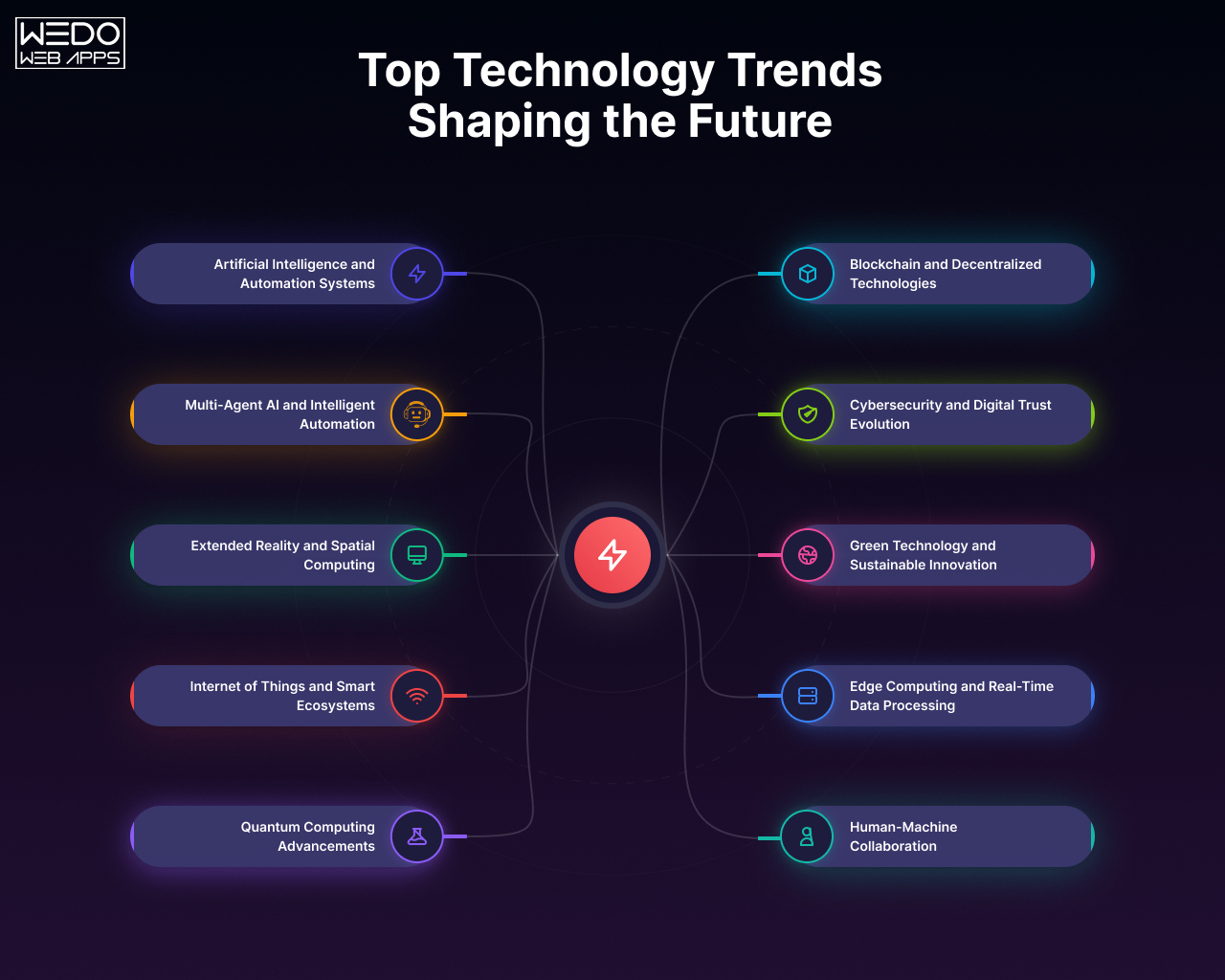
Understanding future technology trends becomes easier when you look at the innovations that are already gaining traction. These are not general ideas. They are actively being tested, adopted, and scaled across industries.
Below are the most important technology trends shaping the future, explained in a clear and practical way.
1. Artificial Intelligence and Automation Systems
Artificial intelligence continues to lead most emerging technologies. It is no longer limited to automation. AI agents are now capable of decision-making, prediction, and continuous learning.
Autonomous systems take this setup further. These systems operate with minimal human intervention, whether in customer support, logistics, or software operations.
Businesses are using AI to:
- Analyze large datasets.
- Personalize customer experiences.
- Automate repetitive workflows.
This makes AI one of the most influential future technology trends across sectors.
2. Multi-Agent AI and Intelligent Automation
Instead of a single AI system handling tasks, multiple AI agents can now work together.
These systems collaborate, assign tasks, and solve complex problems in real-time. This approach improves efficiency in areas like operations, software development, and enterprise workflows.
For companies, this shift in emerging technologies means moving from simple automation to coordinated intelligence.
3. Extended Reality and Spatial Computing
Extended Reality combines virtual reality, augmented reality, and mixed reality into a single ecosystem.
Spatial computing allows digital elements to interact with the physical world. This is already being used in training, product visualization, and remote collaboration.
As hardware improves, this will become a key part of technology trends shaping the future, especially in education, healthcare, and retail.
4. Internet of Things and Smart Ecosystems
The Internet of Things connects devices, systems, and environments.
From smart homes to industrial automation, connected systems collect and exchange data in real time. This helps businesses monitor operations, improve efficiency, and reduce downtime.
IoT continues to grow as one of the most practical future technology trends, especially when combined with AI and data analytics.
5. Quantum Computing Advancements
Quantum computing is still in its early stages, but it has the potential to solve problems that traditional computers cannot handle efficiently.
It is particularly relevant for:
- Complex simulations
- Cryptography
- Advanced data analysis
While adoption is limited today, it remains one of the most important emerging technologies to watch.
6. Blockchain and Decentralized Technologies
Blockchain is moving beyond cryptocurrencies.
It is now being used for secure transactions, digital identity management, and transparent record-keeping. A decentralized system reduces reliance on central authorities and improves trust in digital processes.
This makes blockchain a steady contributor to technology trends shaping the future.
7. Cybersecurity and Digital Trust Evolution
As technology advances, security threats also increase.
Modern cybersecurity focuses on proactive threat detection, zero-trust architecture, and real-time monitoring. Businesses are also prioritizing digital trust, ensuring that users feel safe when interacting with platforms.
Security is no longer optional. It is a core part of all future technology trends.
8. Green Technology and Sustainable Innovation
Sustainability is now influencing how technologies are built and used.
Green technology focuses on reducing environmental impact through energy-efficient systems, renewable energy integration, and responsible resource usage.
Organizations are aligning innovation with sustainability goals, making this one of the fastest-growing emerging technologies areas.
9. Edge Computing and Real-Time Data Processing
Edge computing processes data closer to the source instead of relying entirely on centralized systems.
This reduces latency and improves performance, especially for applications that require real-time decisions, such as IoT devices and autonomous systems.
It plays a critical role in scaling technology trends shaping the future.
10. Human-Machine Collaboration
Technology is not replacing humans. It is reshaping how people work.
Human-machine collaboration focuses on combining human creativity with machine efficiency. This includes AI-assisted tools, collaborative robots, and intelligent systems that support decision-making.
This trend highlights a practical shift in future technology trends, where technology acts as a partner rather than a replacement.
Quick Insight
These emerging technologies are not isolated. They often overlap and strengthen each other. For example, AI enhances IoT, while edge computing supports real-time AI decisions.
Understanding these connections helps businesses see the bigger picture behind technology trends shaping the future.
Impact of Future Technology Trends Across Industries
The real value of future technology trends is not just in innovation, but in how they transform industries in practical ways. Each sector adopts emerging technologies based on its unique challenges and goals.
Below is a closer look at how technology trends shaping the future are influencing key industries.
Healthcare
Healthcare is becoming more data-driven and patient-focused.
With the help of emerging technologies like AI and IoT.
- Doctors can detect diseases earlier using predictive analytics.
- Remote patient monitoring is improving access to care.
- Personalized treatment plans are becoming more common.
For hospitals and healthcare providers, these future technology trends are improving both efficiency and patient outcomes.
Finance
The finance sector is rapidly adopting automation and security-focused solutions.
Key impacts include:
- AI-driven fraud detection and risk analysis.
- Faster and more secure digital transactions through blockchain.
- Personalized financial services based on user behavior.
These technology trends shaping the future are helping financial institutions improve trust, speed, and customer experience.
Retail and eCommerce
Retail is shifting towards highly personalized and data-driven experiences.
With emerging technologies:
- Businesses can recommend products based on user preferences.
- Inventory management is becoming more accurate.
- Customer journeys are optimized across multiple channels.
This allows brands to respond quickly to changing consumer expectations, making future technology trends essential for staying competitive.
Manufacturing and Supply Chain
Manufacturing is becoming smarter and more connected.
Key transformations include:
- Real-time tracking of goods using IoT.
- Predictive maintenance to reduce downtime.
- Automation of production processes.
These improvements, driven by technology trends shaping the future, help companies reduce costs and increase operational efficiency.
Education and Learning
Education is moving beyond traditional classroom models.
With the adoption of emerging technologies:
- Online learning platforms are becoming more interactive.
- AI is helping personalize learning paths.
- Extended reality is enabling immersive training experiences.
These future technology trends are making education more accessible and adaptable to individual needs.
Quick Insight
Across all industries, one pattern is clear. Future technology trends are not just improving existing systems. They are changing how industries operate at a fundamental level.
Businesses that understand these shifts early are better positioned to adapt, innovate, and stay relevant.
Opportunities and Challenges of Emerging Technologies
Every shift driven by future technology trends brings a mix of advantages and obstacles. While emerging technologies open new possibilities, they also introduce complexity that businesses need to manage carefully.
Understanding both sides helps the organization make informed and practical decisions.
Key Opportunities
1. Improving Operational Efficiency
One of the biggest benefits of technology trends shaping the future is automation.
Businesses can streamline repetitive tasks, reduce manual errors, and optimize workflows. This leads to faster execution and better resource utilization.
2. New Revenue Streams
Emerging technologies allow companies to create new products and services.
For example:
- Subscription-based digital services.
- AI-powered tools.
- Data-driven offerings.
These opportunities help businesses expand beyond traditional models.
3. Better Customer Experience
Modern consumers expect speed, personalization, and convenience.
With future technology trends, companies can:
- Offer tailored recommendations.
- Provide faster support through AI.
- Create seamless user journeys.
This directly impacts customer satisfaction and retention.
4. Data-Driven Decision Making
Access to real-time data enables smarter business decisions.
Organization using technology trends shaping the future can:
- Predict market demand.
- Identify risks early.
- Optimize strategies based on insights.
This reduces guesswork and improves planning accuracy.
Major Challenges
1. High Implementation Costs
Adopting emerging technologies often requires significant investment.
Costs may include:
- Infrastructure upgrades.
- Skilled talent hiring.
- Ongoing maintenance.
For many businesses, especially startups, this can be a barrier.
2. Integration Complexity
New technologies do not always fit easily into existing systems.
Integrating future technology trends with legacy infrastructure can:
- Disrupt workflows
- Requires additional development
- Increase project timelines
This makes careful planning essential.
3. Talent Shortages
There is a growing demand for skilled professionals in areas like AI, data science, and cybersecurity.
Businesses adopting technology trends shaping the future often struggle to find the right talent, which slows down implementation.
4. Security and Privacy Risks
As systems become more connected, the risk of cyber threats increases.
Handling sensitive data requires:
- Strong security measures.
- Compliance with regulations.
- Continuous monitoring.
Ignoring these risks can lead to serious financial and reputational damage.
Quick Insight
Think of the emerging technology landscape as a powerful engine. They can accelerate growth, but only if handled with the right strategy and control.
Balancing opportunities with challenges is what separates successful adoptions from costly mistakes.
Skills and Mindset Needed for the Future Tech Landscape
Adopting future technology trends is not only about tools and systems. It also depends on how people think, learn, and adapt. As emerging technologies continue to evolve, the demand for the right skills and mindset is becoming just as important as the technology itself.
To stay relevant, professionals and teams need a balanced mix of technical understanding and practical thinking.
1. AI and Data Literacy
You do not need to be a data scientist to work with AI, but you do need to understand how it works.
Basic knowledge of:
- How AI systems make decisions
- How data is collected and used
- What limitations exist
This helps teams use technology trends shaping the future more effectively and responsibly.
2. Analytical and Problem-Solving Skills
Technology provides tools, but humans still define the problems.
Strong analytical thinking helps in:
- Interpreting data correctly
- Identifying patterns and insights
- Making informed decisions
This skill becomes essential when working with emerging technologies that generate large volumes of data.
3. Continuous Learning Approach
The pace of future technology trends means skills can become outdated quickly.
Professionals need to:
- Stay updated with new tools and platforms
- Learn through courses, workshops, and real projects
- Adapt to changes without resistance
Learning is no longer a one-time effort. It is an ongoing process.
4. Adaptability to Change
Technology often changes how work is done.
Being adaptable means:
- Accepting new tools and workflows
- Adjusting to evolving roles
- Staying open to experimentation
This mindset helps individuals keep up with technology trends shaping the future without disruption.
5. Collaboration Between Humans and Technology
Modern workplaces rely on collaboration between people and intelligent systems.
Instead of replacing jobs, emerging technologies are reshaping them.
Professionals need to:
- Work alongside AI tools
- Use automation to improve productivity
- Focus on creative and strategic tasks
6. Ethical Awareness and Responsibility
As technology becomes more powerful, responsible usage becomes critical.
Teams working with future technology trends should understand:
- Data privacy principles
- Fair use of AI systems
- Transparency in automated decisions
This builds trust and ensures long-term sustainability.
Quick Insight
Think of skills as the interface between people and technology. Even the most advanced emerging technologies deliver value only when individuals know how to use them effectively.
Ethical and Regulatory Considerations in Future Technologies
As future technology trends continue to evolve, the focus is no longer only on innovation. There is growing attention on how these technologies are used, who they impact, and how they are governed.
For businesses adopting emerging technologies, ethics and regulations are not optional. They are critical for building trust, avoiding risks, and ensuring long-term sustainability.
1. Data Privacy and Protection
Most technology trends shaping the future rely heavily on data.
This includes:
- Personal user information
- Behavioral data
- Transaction records
Handling this data responsibility is essential. Businesses must ensure:
- Secure storage and processing
- Clear user consent
- Compliance with data protection laws
Failure to manage data properly can lead to legal issues and loss of trust among users.
2. Responsible Use of AI
AI is one of the most powerful emerging technologies, but it also raises important concerns.
Key issues include:
- Bias in AI algorithms
- Lack of transparency in decision-making
- Over-reliance on automated systems
Organizations need to ensure that AI systems are fair, explainable, and used in a controlled manner.
3. Transparency and Accountability
Users today expect clarity on how technology works, especially when it affects decisions.
Businesses adopting future technology trends should:
- Clearly communicate how data is used.
- Explain automated decisions when possible.
- Take responsibility for system outcomes.
This builds confidence and reduces skepticism around new technologies.
4. Compliance with Regulations
Government and regulatory bodies are introducing rules to manage emerging technologies.
These may include:
- Data protection regulations
- Industry-specific compliance standards
- AI governance frameworks
Staying compliant is not just about avoiding penalties. It ensures that businesses operate within safe and accepted boundaries.
5. Security and Risk Management
As systems become more connected, risks increase.
Organizations must focus on:
- Protecting systems from cyber threats
- Monitoring vulnerabilities
- Responding quickly to incidents
Security is a core part of managing technology trends shaping the future, especially in data-sensitive industries.
Quick Insight
Think of ethics and regulation as guardrails. They do not slow down innovation. They ensure that future technology trends move in a direction that is safe, reliable, and trustworthy.
How Businesses Can Prepare for Future Technology Trends
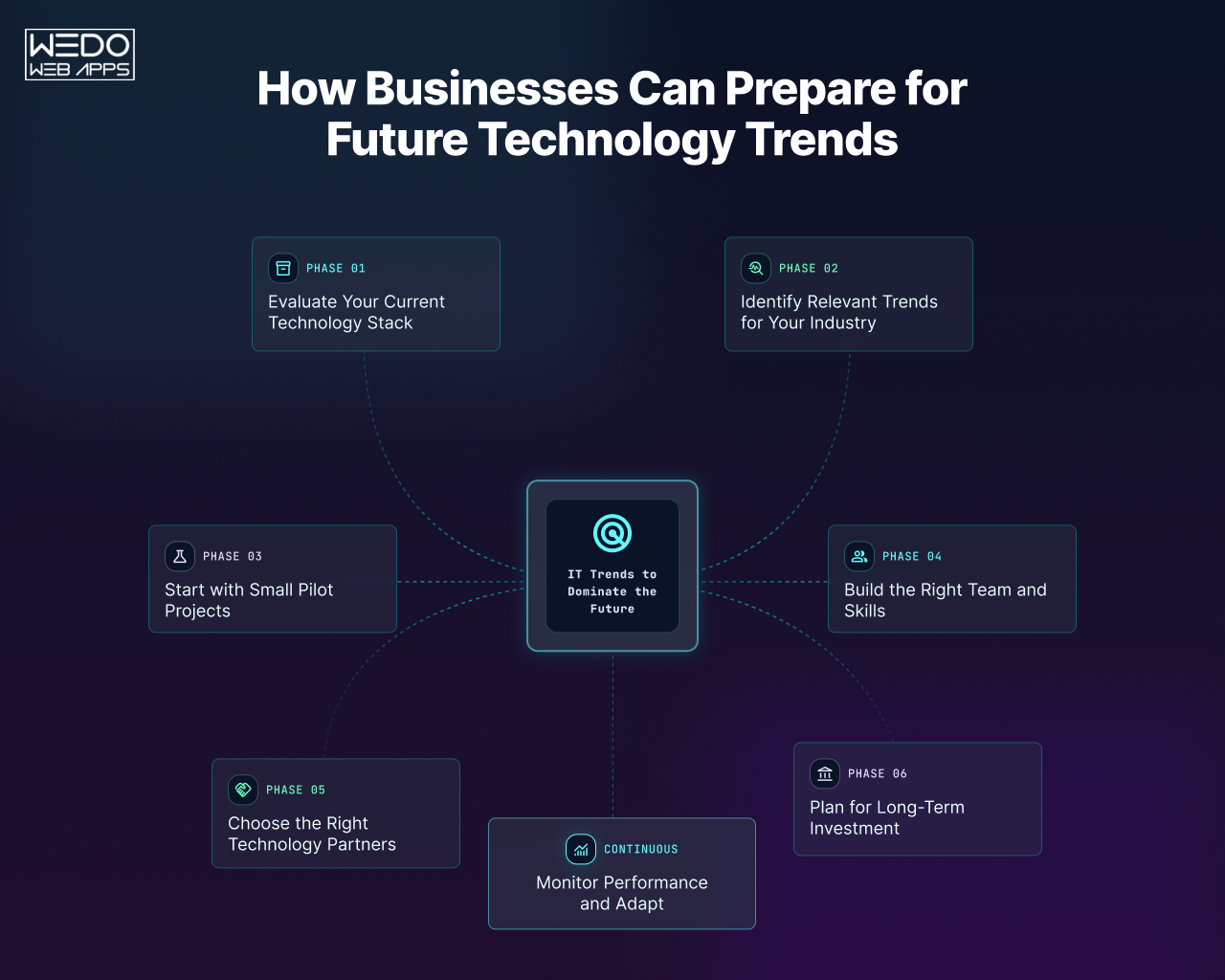
Understanding future technology trends is only the first step. The real value comes from knowing how to act on them. Businesses that prepare early are more likely to adapt smoothly, while others often struggle with rushed decisions and higher costs.
A structured approach helps turn emerging technologies into real business outcomes.
1. Evaluate Your Current Technology Stack
Start with a clear assessment of what you already have.
Look at:
- Existing tools and platforms
- System limitations
- Integration capabilities
This helps identify gaps and areas where technology trends shaping the future can bring immediate improvements.
2. Identify Relevant Trends for Your Industry
Not every trend applies to every business.
Focus on future technology trends that align with your:
- Industry requirements
- Business model
- Customer expectations
For example, AI may be critical for finance, while IoT may be more relevant for manufacturing.
3. Start with Small Pilot Projects
Avoid large-scale implementation at the beginning.
Test emerging technologies through:
- Proof of concepts
- Limited-scope pilots
- Controlled experiments
This approach reduces risk and helps validate real-world use cases before full adoption.
4. Build the Right Team and Skills
Technology alone does not drive results.
Ensure your team has:
- Basic understanding of new technologies
- Access to training and learning resources
- Ability to adapt to new workflows
This makes it easier to implement technology trends shaping the future effectively.
5. Choose the Right Technology Partners
Working with experienced partners can simplify adoption.
Look for partners who:
- Understand your business goals
- Have proven technical expertise
- Offer scalable solutions
The right collaboration can accelerate how you adopt future technology trends without unnecessary complexity.
6. Plan for Long-Term Investment
Adopting emerging technologies is not a one-time effort.
Create a roadmap that includes:
- Budget allocation
- Scalability planning
- Continuous improvement
This ensures that your technology strategy supports long-term growth.
7. Monitor Performance and Adapt
After implementation, continuous evaluation is important.
Track:
- Performance metrics
- User feedback
- Business impact
This helps refine your approach and stay aligned with evolving technology trends shaping the future.
Quick Insight
Preparing for future technology trends is like building a strong foundation before expansion. The better the preparation, the easier it becomes to scale and adapt without disruption.
How to Stay Updated on Future Technology Trends
Keeping up with future technology trends is not about following every new update. It is about filtering the right information and focusing on what is relevant to your business or career.
With the pace at which emerging technologies evolve, having a structured way to stay informed makes a clear difference.
1. Follow Trusted Industry Reports
Well-researched reports provide reliable insights into technology trends shaping the future.
Look for:
- Annual technology trend reports
- Market research studies
- Industry-specific insights
These sources often highlight patterns backed by data, not assumptions.
2. Join Tech Communities and Networks
Communities help you understand how technologies are used in real scenarios.
You can:
- Participate in online forums and discussions
- Join professional groups
- Engage with experts and practitioners
This gives practical exposure to how future technology trends are applied across industries.
3. Attend Conferences and Webinars
Events are a direct way to learn from industry leaders.
They provide:
- Insights into emerging technologies
- Real-world case studies
- Opportunities to ask questions and interact
Even virtual events can offer valuable knowledge without requiring travel.
4. Follow Thought Leaders and Experts
Industry experts often share early insights on technology trends shaping the future.
You can stay updated by:
- Following them on professional platforms
- Reading their blogs or newsletters
- Watching interviews and discussions
This helps you stay ahead of mainstream adoption.
5. Learn Through Hands-On Experimentation
Reading alone is not enough.
Try:
- Testing new tools and platforms
- Building small projects
- Exploring demos and trials
Practical experience makes it easier to understand how future technology trends actually work.
6. Set Up a Consistent Learning Routine
Consistency matters more than volume.
Instead of consuming random information:
- Allocate specific time each week
- Focus on relevant topics
- Track key updates and insights
This creates a habit of staying informed without feeling overwhelmed.
Quick Insight
Staying updated on emerging technologies is like tracking a moving target. The goal is not to chase everything, but to focus on what truly matters for your growth.
Conclusion
Technology will continue to evolve, but the real advantage lies in how well you understand and respond to change. Future technology trends are not just shaping industries, they are redefining how businesses operate and how professionals AI development company support.
By understanding how technology trends shaping the future emerge, evaluating their impact, and preparing with the right strategy, businesses can move with clarity instead of uncertainty.
The key is simple. Stay informed, stay adaptable, and focus on practical adoption. That is how emerging technologies turn into real opportunities rather than missed chances.