Introduction
When project requirements keep changing, a fixed development plan can quickly lose its relevance. A stakeholder may request a new feature. Customer feedback can shift priorities. Testing may reveal issues that push an important release further out.
For project managers and software teams, the challenge is keeping progress steady while adapting to these changes. You need a process that gives your team room to respond without losing sight of product goals, quality, or delivery timelines.
The Agile methodology of project management addresses this through iterative work, frequent feedback, and adaptive planning. Teams deliver smaller increments, review what they have built, and use those insights to decide what comes next.
So, what's agile methodology, and how does it apply to software development? From Agile software product development cycles and user stories to Scrum, SAFe, and modern AI-assisted practices, understanding the approach can help you assess whether it fits your project's needs.

What Is Agile Methodology? Definition and Meaning
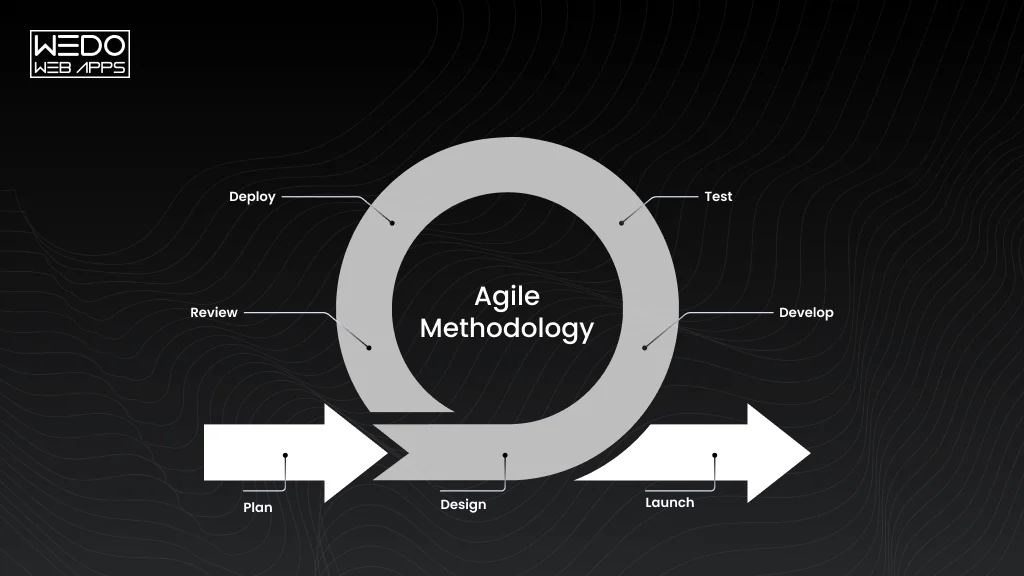
Agile methodology is an approach to managing and developing a project through short, iterative cycles. Instead of planning every detail upfront, teams deliver work in smaller increments, gather feedback, and adjust priorities as requirements change.
For project managers and software teams, this means planning remains flexible while delivery stays focused on measurable outcomes. Agile brings customers, stakeholders, and development teams into the process more frequently, helping teams respond to changing requirements without waiting until the end of the project.
Agile Methodology in One Line
Agile methodology is a way of managing work through iterative delivery, continuous feedback, collaboration, and adaptation.
The approach is built around four core ideas:
- Deliver useful work frequently.
- Respond to changing requirements.
- Collaborate closely with customers and teams.
- Improve the process through regular feedback.
Where Did Agile Methodology Come From?
The modern Agile movement began with the Agile Manifesto, published in 2001 by 17 software practitioners. They introduced four values and 12 principles to address common problems with heavyweight software development processes.
The manifesto prioritised working software, customer collaboration, team interaction, and responsiveness to change. These ideas later influenced frameworks such as Scrum, Extreme Programming, and other Agile approaches.
The 4 Values of the Agile Manifesto
| Agile Value | What it means in practice |
|---|---|
| Individuals and interactions over processes and tools | Give effective collaboration and communication priority when managing work. |
| Working software over comprehensive documentation | Focus on delivering usable software while keeping necessary documentation. |
| Customer collaboration over contract negotiation | Keep customers involved as requirements and priorities evolve. |
| Responding to change over following a plan | Adjust plans when new information changes what the project needs. |
These values do not mean that processes, documentation, contracts, or plans are unnecessary. They establish which side should receive greater emphasis when the two priorities conflict.
The 12 Principles Behind Agile
The Agile Manifesto also includes 12 principles that explain how teams can apply its values. They focus on areas such as:
- Delivering valuable software frequently
- Welcoming changing requirements
- Working closely with customers and stakeholders
- Supporting motivated, collaborative teams
- Maintaining technical quality
- Keeping development sustainable
- Reviewing progress regularly
- Improving the team's way of working
Together, these principles create a practical approach to handling uncertainty. Teams can learn from each delivery cycle instead of relying entirely on assumptions made at the beginning.
Agile vs Traditional Project Management
Agile and traditional project management differ mainly in how they approach planning, delivery, and change.
| Area | Agile | Traditional Approach |
|---|---|---|
| Planning | Continuous and adaptive | Usually defined extensively upfront |
| Requirements | Can evolve throughout the project | Often defined earlier and controlled through formal changes |
| Delivery | Smaller, frequent increments | Often delivered in larger stages or near the end |
| Customer Feedback | Collected throughout development | Often concentrated around specific milestones |
| Change | Expected and incorporated into planning | Usually handled through formal change processes |
| Testing | Performed continuously alongside development | Often concentrated in defined testing phases |
| Risk | Identified and addressed throughout iterations | May be addressed through upfront planning and scheduled reviews |
The difference is less about whether a team plans and more about how the team responds when new information changes the plan. Agile keeps planning active throughout delivery, allowing teams to adjust based on feedback, technical findings, and changing business priorities.
Agile Methodology of Project Management: How It Works
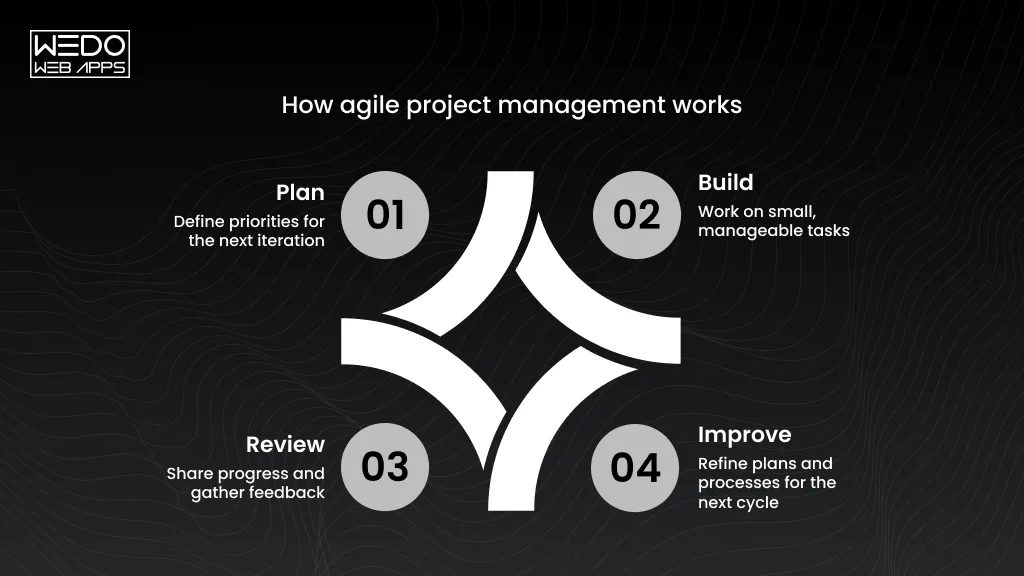
The agile methodology of project management gives teams a structured way to manage changing requirements without locking the entire project into one fixed plan. Work is prioritised, delivered in smaller increments, reviewed regularly, and adjusted based on what the team and stakeholders learn.
For anyone searching what's agile methodology or agile methodology what is, the key idea is simple: Agile keeps planning active throughout the project so teams can respond when priorities, customer needs, or technical requirements change.
Core Characteristics of Agile Project Management
A practical agile methodology description includes several practices that shape how teams plan and deliver work:
- Iterative delivery: Teams complete work in smaller cycles instead of waiting for one final release.
- Adaptive planning: Priorities can change as customer needs, business goals, or technical findings evolve.
- Customer collaboration: Stakeholders provide feedback throughout development rather than only at the end.
- Cross-functional teams: Different skills work together to move features from requirements to completion.
- Continuous feedback: Regular reviews help teams identify what is working and what needs adjustment.
- Incremental improvement: Teams refine both the product and their working process throughout delivery.
These characteristics make Agile useful for projects where requirements are expected to evolve.
The Agile Project Management Workflow
While Agile frameworks use different practices, the agile methodology of project management generally follows a repeating workflow:
- Define the project vision and goals
Establish the business problem, target users, expected outcomes, and project priorities.
- Create and prioritise the backlog
Break requirements into manageable items and arrange them according to value and priority.
- Plan the iteration or Sprint
Select a realistic amount of high-priority work for the upcoming delivery cycle.
- Develop and test the work
Build, integrate, review, and test selected items while addressing issues as they appear.
- Review the increment and gather feedback
Show completed work to stakeholders and use their feedback to refine future priorities.
- Reflect and adapt the process
Review how the team worked, identify improvements, and apply them to the next cycle.
The cycle continues as the product develops. Scrum commonly uses Sprints for this cadence, while Kanban focuses on continuous flow rather than fixed iterations.
Roles in Agile Project Management
Agile teams need clear ownership even when responsibilities are shared. The exact roles depend on the framework being used.
| Role | Primary Responsibility |
|---|---|
| Product Owner | Prioritises product work and represents customer and business needs. |
| Scrum Master or Agile Facilitator | Helps the team follow its chosen approach and removes process-related obstacles. |
| Developers and Specialists | Design, build, test, analyse, and deliver the product increment. |
| Stakeholders | Provide business context, feedback, requirements, and validation. |
In Scrum, these responsibilities are defined through specific accountabilities. Other Agile approaches may organise responsibilities differently.
Benefits of Agile Project Management
| Benefit | Practical Example |
|---|---|
| Faster Delivery | A software team can release a core checkout feature before completing every planned eCommerce feature. |
| Easier Adaptation | A product team can reprioritise a mobile feature after customer feedback reveals a different need. |
| Earlier risk detection | Regular testing can expose payment integration issues before it affects a larger release. |
| Greater visibility | Stakeholders can review working increments instead of relying only on progress reports. |
The value comes from shortening the gap between building, reviewing, learning, and adjusting. Teams get more opportunities to correct direction before problems become expensive to fix.
Common Agile Project Management Challenges
Agile introduces flexibility, but that flexibility still needs structure. Without clear practices, teams can struggle with changing priorities, unclear ownership, or excessive meetings.
| Challenge | Practical Response |
|---|---|
| Constant priority changes | Keep one prioritised backlog and establish clear criteria for adding urgent work. |
| Limited stakeholder involvement | Set regular review points and define who provides feedback and approval. |
| Poor backlog management | Refine backlog items regularly and remove outdated or low-value work. |
| Unclear responsibilities | Define ownership for product decisions, delivery, technical work, and stakeholder communication. |
| Too many Agile meetings | Keep ceremonies focused on decisions, collaboration, planning, and improvement. |
The same principles also shape the agile methodology of software development. Development teams apply iterative planning, continuous testing, frequent releases, and customer feedback to create and improve software.
This approach connects directly with agile software development cycles, where teams repeatedly build, test, release, review, and refine product increments. It also supports practices such as agile software development user stories, which help teams describe features from the user's perspective.
Popular Agile Frameworks Explained
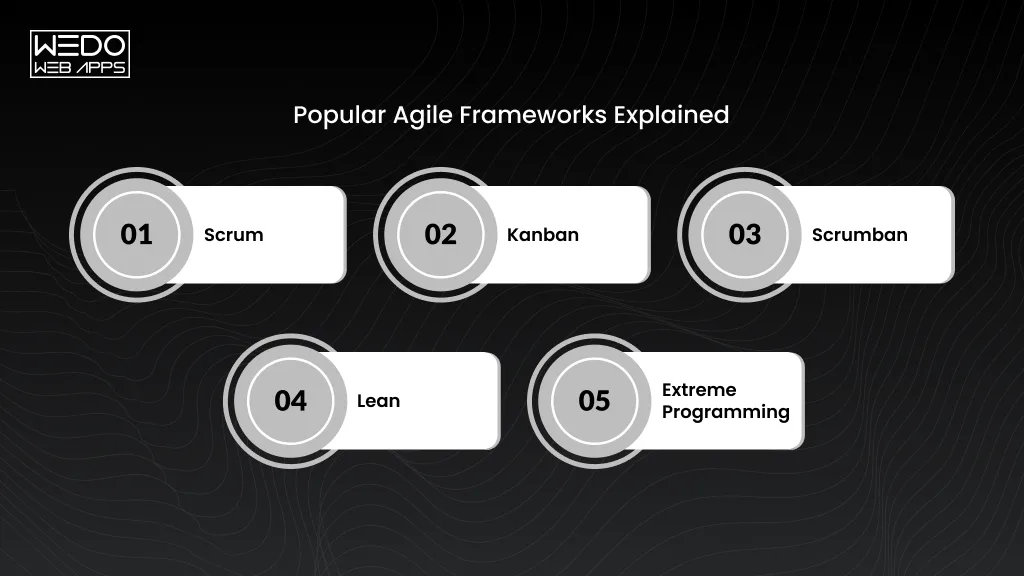
Agile provides the principles and values. Teams then use different frameworks and approaches to apply them in practice. Scrum, Kanban, Scrumban, Lean, and Extreme Programming are among the approaches commonly associated with Agile.
The right approach depends on how your teams handle planning, workflow, technical work, and changing priorities.
Scrum
Scrum is a structured Agile framework designed to help teams deliver work through short, time-boxed Sprints. A team typically maintains a product backlog, selects work during Sprint Planning, develops the increment, reviews the result, and reflects on how to improve.
Scrum defines accountabilities such as the Product Owner, Scrum Master, and Developers. It also provides specific events and artefacts to support planning, transparency, inspection, and adaptation.
Scrum is particularly relevant when a team benefits from a regular delivery cadence and clearly defined responsibilities.
Kanban
Kanban focuses on continuous flow rather than fixed-length Sprints. Teams visualise work on a board, limit work in progress, and monitor how quickly items move through the workflow.
For example, a software team might track work through stages such as:
Backlog -> Development -> Code Review -> Testing -> Ready for Release -> Done
Kanban can work well when incoming priorities change frequently or when work needs to move continuously through a service or development process.
Scrumban
Scrumban combines selected Scrum practices with Kanban's flow-based approach.
A team might retain Scrum planning and review practices while using Kanban boards and work-in-progress limits to manage its workflow. This can be useful for teams that need more flexibility than a strict Sprint structure provides.
Lean
Lean focuses on delivering customer value while reducing activities that consume time or resources without contributing enough value.
In software projects, Lean practices can encourage teams to reduce unnecessary handoffs, avoid excessive work in progress, shorten delivery times, and continuously improve how work moves through the system.
Extreme Programming
Extreme programming, commonly called XP, places strong emphasis on software engineering practices and frequent technical feedback.
Practices associated with XP include:
- Test-driven development
- Pair programming
- Continuous integration
- Frequent releases
- Continuous customer feedback
- Refactoring
XP is especially focused on improving software quality while keeping development responsive to changing requirements.
How These Agile Approaches Differ
| Approach | Main focus | Typical workflow |
|---|---|---|
| Scrum | Structured iterative delivery | Fixed-length Sprints |
| Kanban | Continuous flow | Ongoing movement of work |
| Scrumban | Flexibility and flow | Combination of Scrum and Kanban practices |
| Lean | Customer value and waste reduction | Continuous improvement |
| Extreme Programming | Software quality and engineering practices | Frequent development and feedback |
These approaches can support the broader agile methodology of software development, but they are not interchangeable. Understanding their differences becomes particularly important when deciding how your team should organise development work.
Scrum vs Agile Methodology: What's the Difference?
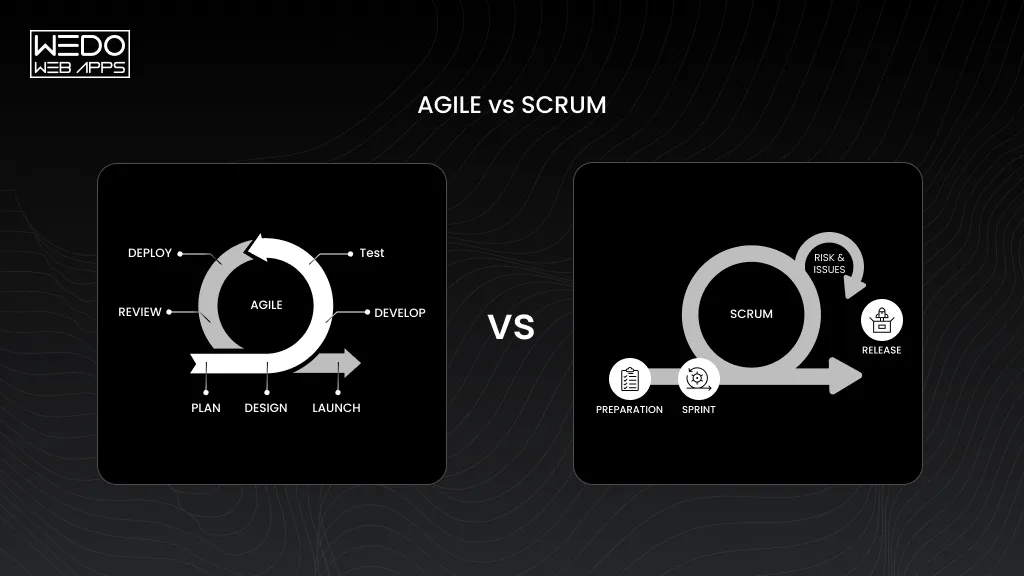
If you are comparing Scrum vs Agile methodology, it is easy to treat them as competing project management methods. They are not the same thing. Agile provides a broader set of values and principles, while Scrum is a specific framework for putting those principles into practice.
Agile Is a Set of Principles, Scrum Is a Framework
Agile defines how teams approach product development and project delivery. It encourages frequent delivery, customer collaboration, adaptation, and continuous improvement.
Scrum gives teams a more defined structure for applying those ideas. It establishes accountabilities, events, artefacts, and rules around how work is planned and delivered.
A simple way to understand the relationship is:
Agile -> Values and principles
Scrum -> Framework that applies Agile principles
Scrum is therefore Agile, but Agile does not mean Scrum.
Agile vs Scrum: Side-by-Side Comparison
| Area | Agile | Scrum |
|---|---|---|
| What it is | A set of values and principles | An Agile framework |
| Structure | Flexible | More defined |
| Delivery | Iterative or continuous, depending on approach | Uses fixed-length Sprints |
| Roles | Vary by approach | Product Owner, Scrum Master, Developers |
| Planning | Adaptable | Sprint Planning and ongoing backlog management |
| Feedback | Frequent | Built into Sprint Reviews and daily collaboration |
| Improvement | Continuous | Supported through Sprint Retrospectives |
| Scope of use | Can be applied through different approaches | Follows the Scrum framework |
The distinction matters when you are selecting an approach for your project. Saying that a team is "using Agile" does not automatically mean it needs to adopt every Scrum practice.
When Does Scrum Make Sense?
Scrum can be useful when your team needs a designed delivery rhythm and a clear way to organise changing product requirements.
It may fit when:
- You are developing a product with evolving requirements.
- The team can work toward short-term Sprint goals.
- Stakeholders can provide regular feedback.
- Product priorities need frequent review.
- The team benefits from defined accountabilities and regular inspection points.
For example, a product team building a new SaaS platform might use two-week Sprints to prioritise features, develop a working increment, collect stakeholder feedback, and adjust the backlog for the next Sprint.
When Might Kanban or Another Agile Approach Fit Better?
Scrum is not automatically the right framework for every Agile team. Kanban can be more suitable when work arrives continuously, and priorities change frequently.
A support or maintenance team, for example, may need to handle production issues, small enhancements, and urgent requests throughout the week. A continuous-flow approach can make more sense than forcing every item into a fixed Sprint.
Other teams may combine practices from different approaches based on their workflow, technical needs, and business context.
Can You Practice Agile Without Scrum?
Yes. Scrum is only one way to apply Agile principles.
A team can use Kanban, Extreme Programming, Lean practices, or another suitable approach while still working according to Agile values. Some teams also use a combination of practices rather than following one framework exactly.
The important distinction is understanding what is Agile methodology at its core and then choosing practices that support the project's goals. Framework adoption should solve a real delivery problem rather than add ceremonies simply because they are associated with Agile.
Agile Methodology at Scale: What Is SAFe?
When one Agile team becomes several teams, coordination can become harder. Multiple teams may depend on the same architecture, share technical components, or work toward the same product release. At that point, teams need a structured way to coordinate without losing the flexibility of Agile.
This is where agile methodology safe becomes relevant. SAFe, short for Scaled Agile Framework, guides the analysis of Lean and Agile practices across larger organisations and multiple teams.
Why Organisations Need Agile at Scale
A single software team can often manage its own backlog, planning, development, testing, and feedback. The situation becomes more complex when many teams contribute to the same product or solution.
Common challenges include:
- Teams working toward conflicting priorities.
- Dependencies between development teams.
- Different release schedules.
- Architecture decisions affecting multiple teams.
- Limited visibility across product areas.
- Business priorities not reaching delivery teams clearly.
The agile methodology of project management can support changing requirements at the team level. Scaling Agile adds structures that help coordinate those practices across multiple teams.
What Is the Scaled Agile Framework (SAFe)?
SAFe is a framework for applying Lean and Agile practices across larger organisations. It connects team-level Agile work with broader product, solution and portfolio activities.
SAFe includes concepts such as Agile Release Trains, Program Increments, Lean Portfolio Management, and Inspect and Adapt practices. These help organisations coordinate work across teams while connecting development activity with broader business objectives.
This makes SAFe different from Scrum. Scrum provides a framework for organising work within a Scrum Team, while SAFe addresses coordination across multiple teams and organisational levels.
Understanding this distinction also helps when comparing Scrum vs agile methodology. Scrum is one Agile framework, while SAFe provides structures for scaling Agile practices across a larger organisation.
SAFe Configurations
SAFe can be applied at different levels depending on an organization's size, structure, and delivery requirements. Its configurations have included Essential SAFe, Large Solution SAFe, Portfolio SAFe, and Full SAFe.
Essential SAFe provides core practices for coordinating Agile teams through an Agile Release Train Broader configurations and capabilities for larger solutions, portfolio activities, and organisation-wide coordination.
Because SAFe evolves through new framework versions, organisations should check the current SAFe guidance when selecting a configuration.
SAFe vs Scrum And Team-Level Agile
| Area | Scrum | SAFe |
|---|---|---|
| Primary scope | Individual Scrum team | Multiple teams and organizational levels |
| Planning | Product backlog and Sprint planning | Team planning plus broader planning and alignment |
| Delivery | Sprint-based increments | Coordinated delivery across Agile teams |
| Coordination | Primarily within and around the Scrum team | Designed for dependencies and cross-team alignment |
| Business alignment | Product-level focus | Extends Agile practices toward product and portfolio concerns |
| Typical use | Team-level product development | Larger, multi-team environments |
SAFe does not replace team-level Agile practices. It adds structures for coordinating those practices when a project or organisation becomes more complex.
Who Typically Uses SAFe?
SAFe may be considered by organisations managing complex products, large software initiatives, or multiple Agile teams with significant dependencies.
It can be relevant when:
- Multiple teams contribute to the same solution.
- Teams depend on shared components or services.
- Product and technology planning need stronger alignment.
- Releases require coordination across several teams.
- Business and portfolio priorities need to connect with delivery work.
A smaller team does not need SAFe simply because it follows Agile principles. The appropriate approach depends on the project's size, dependencies, governance needs, and delivery model.
The broader agile methodology description remains the same at its core: teams work iteratively, gather feedback, respond to change, and improve continuously. SAFe extends these ideas with additional structures for organisations managing Agile work at scale.
What Is Agile Software Development?
The question of what is agile software development process is comes down to one key idea: software is built and improved through smaller, repeated delivery cycles instead of being treated as one large project completed in a single pass.
The agile methodology of software development brings dedicated developers, testers, product specialists, and stakeholders into an ongoing delivery process. Teams build a workable feature, test it, collect feedback, and use what they learn to guide the next increment.
Agile Software Development Explained
In a traditional development approach, teams may spend significant time defining requirements before development begins. Agile software development keeps requirements open to refinement as the product evolves.
A typical cycle looks like:
Plan -> Build -> Test -> Review -> Improve -> Repeat
Each cycle produces a usable increment or meaningful progress toward one. This allows teams to identify technical issues, usability problems, and changing customer needs earlier in development.
How Agile Software Development Differs From Traditional SDLC
| Area | Agile development | Traditional sequential approach |
|---|---|---|
| Requirements | Refined throughout development | Usually defined earlier |
| Development | Incremental | Often follows planned phases |
| Testing | Repeated throughout development | Often concentrated in dedicated phases |
| Feedback | Frequent | Usually tied to milestones or later stages |
| Change | Expected and incorporated | Typically requires formal change management |
| Release | Smaller or more frequent releases | Often larger scheduled releases |
The goal is not to eliminate planning. It is to keep planning responsive as the team gains new information.
Core Practices in Agile Software Development
Several practices help teams maintain this iterative approach.
- Incremental development: Build and deliver smaller pieces of functionality.
- Continuous integration: Integrate code changes frequently to identify conflicts early.
- Automated testing: Run repeatable tests throughout development.
- Code reviews: Review changes before they become part of the shared codebase.
- Frequent releases: Deliver tested functionality when it provides sufficient value.
- Continuous feedback: Use customer and stakeholder input to guide future development.
These practices create the foundation for agile software development cycles, where each cycle gives the team another opportunity to deliver, test, learn, and adjust.
For broader testing requirements, quality assurance services can support software quality across different stages of development.
The same process also connects requirements with implementation. Features can be broken into agile software development user stories, giving developers a clear view of who needs a feature, what they need, and why it matters.
Agile Software Development Lifecycle: How the Development Cycle Works
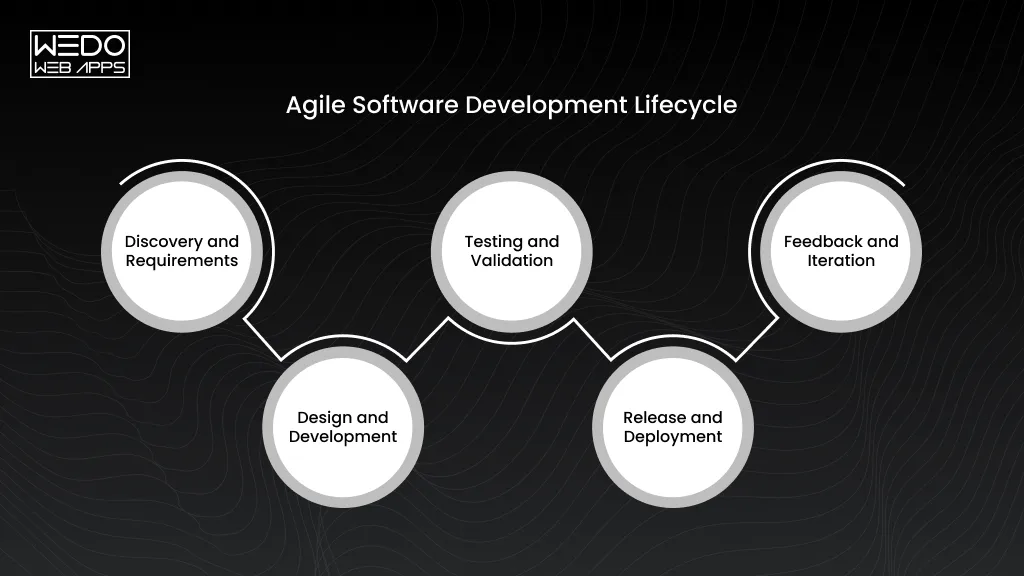
Agile development does not follow one fixed sequence that every team must use. Instead, teams move through recurring activities as they build, release, and improve software.
A practical agile software development cycle can be understood through five stages: discovery, development, testing, release, and feedback.
Stage 1: Discovery and Requirements
The team identifies the problem, target users, business goals, and required functionality. Requirements are prioritised and converted into manageable development items.
At this stage, agile software development user stories can help describe features from the user's perspective while keeping requirements focused on outcomes.
Stage 2: Design and Development
Designers and developers work on the selected requirements. The team creates the interface, architecture, code, and supporting components needed for the planned increment.
Rather than designing and building the entire product upfront, the team focuses on the functionality planned for the current cycle.
Stage 3: Testing and Validation
Testing happens alongside development rather than being left entirely until the end.
Developers and testers check functionality, integrations, usability, security, and other relevant quality requirements. Issues can then be fixed while the related work is still fresh.
Stage 4: Release and Deployment
Once the increment meets the agreed quality and acceptance requirements, it can be released to users or moved to the next deployment environment.
Not every completed increment needs to go directly to production. Release timing depends on the product, business requirements, risk, and deployment strategy.
DevOps consulting can help teams improve these areas and create a delivery process that supports regular Agile releases.
Stage 5: Feedback and Iteration
After release or stakeholder review, the team collects feedback and examines product performance. Now, findings can lead to changes in priorities, requirements, design, or technical work.
Agile Development Cycle at a Glance
| Stage | Main activity | Typical outcome |
|---|---|---|
| Discovery | Define needs and prioritise requirements | Refined development items |
| Design & Development | Design and build selected functionality | Working increment |
| Testing | Verify quality and acceptable criteria | Tested increment |
| Release | Deploy or prepare the increment | Available functionality |
| Feedback | Review results and gather insights | Updated priorities |
How Do Sprints Fit Into the Development Cycle?
Sprints are specific to Scrum. A Scrum Sprint provides a fixed period in which a team plans, develops, tests, and reviews a selected set of work.
Other Agile approaches can use continuous flow or different iteration patterns. So, agile software development cycles do not always mean two-week Sprints or follow one universal schedule.
The important idea is the repeated loop of building, testing, reviewing, and improving. Each cycle gives the team new information that can shape the next one.
User Stories in Agile Software Development
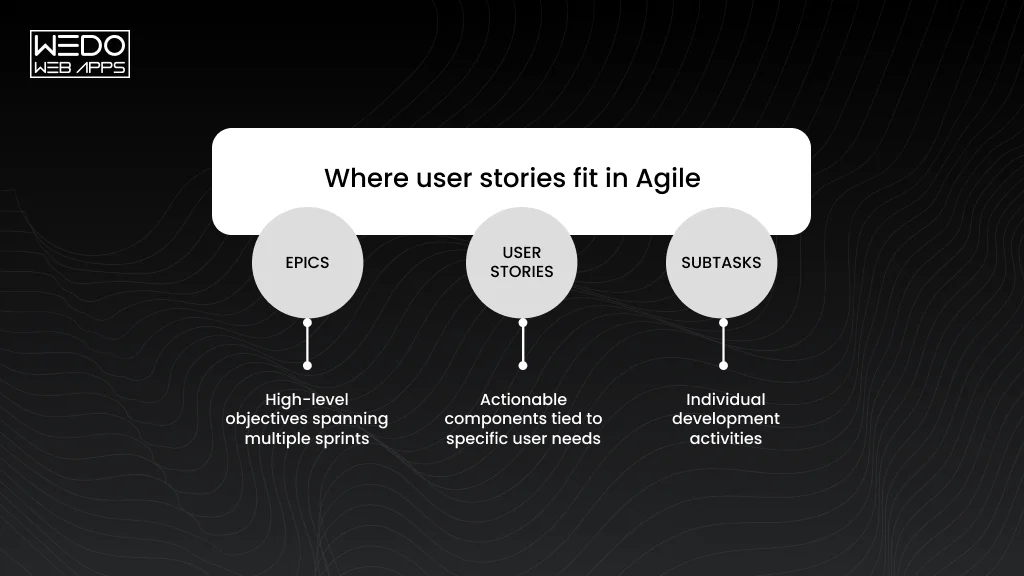
Requirements can be too broad to guide development directly. A user story makes a requirement easier to understand by describing what a user wants and the value they expect from it.
What Is an Agile User Story?
An agile software development user story is a short description of a feature written from the user's perspective. It focuses on the user, the request outcomes, and the reason behind it.
A common format is:
As a [user], I want [goal], so that [benefit].
For example:
As a customer, I want to save products to a wishlist, so that I can purchase them later.
The story explains the expected outcome without prescribing exactly how mobile app developers should build the feature.
User Stories vs Epics vs Tasks
These items operate at different levels of detail.
| Work item | Purpose | Example |
|---|---|---|
| Epic | Represents a larger area of functionality | Customer account management |
| User story | Describes a specific user need | As a customer, I want to reset my password |
| Task | Breaks the story into implementation work | Create password reset API |
An epic can contain multiple user stories, while each story can be broken into technical or design tasks.
How to Write Effective Agile User Stories
Good stories should give the team enough context without turning into lengthy technical specifications. The INVEST criteria provide a useful check:
- Independent: Can be developed with limited dependency on other stories.
- Negotiable: Leaves room for discussion about the implementation.
- Valuable: Provides a clear benefit to the user or business.
- Estimable: Gives the team enough information to estimate the work.
- Small: Can reasonably fit within the team's delivery cycle.
- Testable: Has clear conditions for verifying completion.
Acceptance Criteria and Definition of Done
Acceptance criteria define the conditions a user story must meet before it can be accepted.
For a password reset story, criteria might include:
- Users can request a reset link.
- A link is sent to the registered email address.
- Link expires after the defined period.
- Users can create a new valid password.
The definition of done goes further. It establishes the team's broader completion standard, which may include code review, agile methodology testing, documentation, and successful integration.
Agile User Story Examples
eCommerce
As a shopper, I want to filter products by price range, so that I can find items within my budget.
Healthcare
As a patient, I want to view upcoming appointments, so that I know when my next consultation is scheduled.
Fintech
As an account holder, I want transaction alerts, so that I can monitor activity on my account.
Each story connects a specific user need with a measurable outcome. That makes it easier for product and development teams to discuss priorities before work begins.
How AI Can Assist With User Stories
AI tools can help teams turn lengthy requirements, meeting notes, or customer feedback into initial user story drafts. They can also suggest acceptance criteria, identify missing details, and group similar requirements.
However, the team still needs to validate whether the story reflects the actual customer need and business priority. AI can speed up refinement, but product owners and stakeholders remain responsible for deciding what should be built.
How AI Is Changing Agile Project Management and Software Development
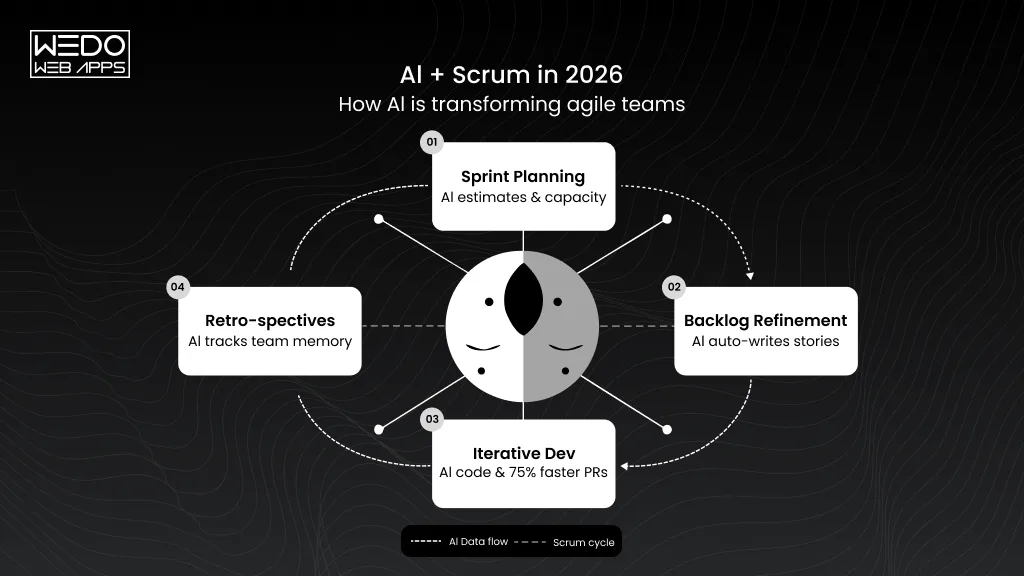
AI is changing how Agile teams handle repetitive planning, documentation, development, and testing tasks. Instead of replacing Agile practices, AI can support teams by processing information faster and reducing manual work.
For teams using the agile methodology of project management, the biggest opportunities are often around faster analysis, better preparation, and quicker feedback.
AI-Assisted Backlog and Sprint Planning
Backlogs can become difficult to manage when they contain hundreds of requirements, support requests, and feature ideas. AI can analyse larger volumes of information and help teams group similar items, summarise requirements, and identify potential priorities.
During planning, AI can also help surface dependencies or suggest questions that need clarification before development begins.
The final priority should still come from the product team based on business value, customer needs, technical constraints, and available resources.
AI-Assisted User Stories and Acceptance Criteria
AI can turn meeting notes, customer feedback, or requirement documents into initial user story drafts. It can also suggest acceptance criteria and identify missing details.
This can reduce the time spent preparing backlog items. Product owners and developers still need to review the output because AI-generated requirements may miss business context or introduce assumptions.
AI for Standups, Reporting, and Risk Signals
Agile teams generate information across meetings, tickets, pull requests, test results, and project updates. AI can help turn this information into concise summaries.
It can also highlight patterns such as:
- Repeated blockers
- Delayed work items
- Increasing defect counts
- Unresolved dependencies
- Changes affecting planned releases
These signals can help teams investigate potential issues earlier rather than waiting for a problem to affect delivery.
AI Coding and Testing Assistance
AI coding tools can assist developers with tasks such as generating code suggestions, explaining existing code, creating test cases, and identifying potential issues.
Testing teams can also use AI to generate test scenarios from requirements or analyse test results for patterns.
These capabilities can support agile software development cycles by shortening some development and testing tasks. Human review remains important because generated code and tests still need to be checked for correctness, security, performance, and compatibility.
Where Human Judgement Still Matters
AI can process information and generate suggestions, but Agile teams still need people to make decisions that depend on context and accountability.
| Area | Human responsibility |
|---|---|
| Business priorities | Decide which work creates meaningful business or customer value |
| Requirements | Confirm that requirements reflect actual user needs |
| Risk | Assess the impact and urgency of identified risks |
| Architecture | Make technical choices based on long-term system requirements |
| Customer feedback | Interpret feedback within its business context |
| AI output | Review and validate generated recommendations, code, and content |
AI integration can make parts of Agile delivery faster, but it does not remove the need for product ownership, technical expertise, collaboration, or accountability.

Agile Methodology Tools and Metrics
Agile teams need visibility into their work, but the tools and metrics should support the process rather than become the process itself. The right setup helps teams manage backlogs, track work, identify delays, and discuss improvements using real project data.
Common Agile Project Management Tools
Different tools support different parts of an Agile workflow.
| Tool | Common use |
|---|---|
| Jira | Backlog management, Sprint planning, issue tracking, and Agile reporting |
| Trello | Visual task management using boards and cards |
| Azure DevOps | Planning, development, testing, repositories, and delivery |
| Miro | Workshops, user story mapping, planning, and team collaboration |
Your choice should depend on team size, workflow, integrations, reporting needs, and the complexity of the project.
Agile Metrics Teams Can Track
Metrics can help teams understand how work is moving through the system and where improvements may be needed.
- Velocity: Shows how much work a team typically completes during an iteration. It is most useful for the team's own planning and should not be treated as a universal productivity score.
- Sprint burndown: Shows remaining work during a Sprint and helps identify whether planned work is progressing.
- Cycle time: Measures how long a work item takes from active development to completion.
- Lead time: Measures the time between a request being made and the work being delivered.
- Deployment frequency: Tracks how often software is deployed.
- Defect trends: Shows patterns in reported defects and can highlight areas that need attention.
The purpose of these metrics is to identify bottlenecks, improve planning, and support better delivery decisions. They should provide context for team discussions rather than become targets that encourage teams to optimise numbers instead of outcomes.
How to Get Started With Agile Methodology
Adopting Agile does not mean changing every project process at once. Start with the delivery problems you need to solve, choose practices that address them, and improve the approach as your team gains experience.
Define What You Want Agile to Improve
Start by identifying the problems affecting your current delivery process.
You may be dealing with changing requirements, delayed feedback, long release cycles, unclear priorities, or issues discovered too late. Define the specific outcomes you want to improve before choosing an Agile framework.
Choose a Framework That Fits Your Workflow
Select an approach based on your team's work rather than adopting a framework because it is widely used.
Consider:
- Team size and structure
- Type of development work
- Frequency of incoming requests
- Level of stakeholder involvement
- Dependencies between teams
- Release requirements
A product development team may benefit from Scrum, while a support team handling continuous requests may find Kanban more suitable.
Choosing an Agile framework is only one part of setting up an effective development process. You also need to align your technology choices, project requirements, architecture, and delivery goals with the wider business strategy. For complex software initiatives, software consulting can help you evaluate these areas before development begins.
Build and Prioritize the Backlog
Bring requirements, feature ideas, technical work, and defects into a visible backlog.
Prioritise items using factors such as customer value, business impact, dependencies, risk, and effort. Keep the backlog refined so the team has enough clarity to plan upcoming work.
For teams following the agile methodology of project management, a well-managed backlog connects business priorities with actionable development work.
Start With a Manageable Delivery Cycle
Begin with a realistic amount of work instead of trying to change the entire delivery process immediately.
If you use Scrum, establish a Sprint cadence. If you use Kanban, define workflow stages and appropriate work-in-progress limits. Track what happens and adjust the process based on actual results.
This allows your team to identify delivery issues before expanding the approach across other projects or teams.
Establish Feedback and Review Practices
Create regular opportunities for stakeholders and customers to review progress.
Use reviews, demonstrations, user feedback, analytics, support data, and other relevant signals to understand whether the product is solving the intended problem.
Team retrospectives can then help identify process improvements, while stakeholder reviews keep product priorities aligned with business needs.
Measure Results and Improve the Process
Track useful indicators such as cycle time, lead time, defect trends, release frequency, and customer feedback.
Use the data to identify bottlenecks and improvement opportunities. Avoid turning individual metrics into rigid performance targets, especially when they can encourage teams to optimize numbers rather than outcomes.
For example, velocity can help with Sprint planning, but it should not be treated as a direct measure of team productivity.
Common Mistakes to Avoid
Agile adoption can lose its value when teams focus on rituals instead of outcomes.
- Treating Agile as a meeting schedule: Daily standups, reviews, and retrospectives should support delivery and improvement rather than exist as routine obligations.
- Copying Scrum without understanding the need: Adopt practices that solve your team's actual problems instead of implementing every Scrum practice by default.
- Changing priorities without backlog control: Frequent changes can cause confusion when new requests enter development without clear prioritisation.
- Measuring only velocity: Velocity can help with Sprint planning, but it should not become a standalone measure of team productivity.
- Skipping technical quality: Fast delivery still requires testing, code reviews, security checks, maintainable architecture, and other appropriate engineering practices.
- Letting AI make project decisions independently: AI can assist with analysis, planning, coding, and testing. People should remain accountable for product priorities, requirements, technical decisions, and validation.
A successful Agile implementation develops over time. Start with a clear problem, establish a workable process, learn from each cycle, and adjust the approach as your team's needs change.
Final Thoughts on Agile Methodology
Agile methodology gives teams a practical way to manage changing requirements while keeping development focused on customer and business needs. Its iterative approach encourages teams to deliver, review, learn, and improve throughout the project.
The key is choosing practices that fit your workflow. Scrum, Kanban, SAFe, and other Agile approaches serve different needs. For software teams, iterative development, continuous testing, user stories, and regular feedback can make delivery easier to adapt as requirements evolve.
AI can also support the agile methodology of software development by helping with planning, documentation, coding, testing, and analysis. Human judgment still matters when setting priorities, validating requirements, and making technical or business decisions.
When Agile practices are aligned with clear goals and measurable outcomes, your team can build software with greater visibility and adapt the delivery process as the project develops.