
Introduction
You open your CRM. Then your listing portal. Then a spreadsheet, a shared inbox, and a lease folder. Somewhere in those tabs sits the lead you were supposed to call yesterday.
Sound familiar?
Each of these problems has a fix, and it sits in real estate technology. Choosing the right one is the hardest part.
Search for it, and you will get hundreds of real estate tech platforms. You will meet dozens of real estate software companies making nearly identical claims. Every demo promises more leads and fewer admin hours. Few tell you which tool fits your business.
This guide cuts through that. You will learn:
- Which types of platforms exist and what each one does.
- Which real estate software solutions suit your team size and goals.
- Where AI saves you time and where it still needs a human.
- What real estate application development involves, and how to choose a real estate app development company.
Read the guide straight through or jump to the part you need. Either way, you will know what to buy, what to build, and what to skip.
Let's start with the basics.
What Is Real Estate Technology (PropTech)?
Real estate technology is the software, platforms, and connected devices used to buy, sell, rent, manage, finance, and build property. The industry also calls it PropTech.
It covers more than you might expect. A listing site's search filters count. So does a rent-collection app, a lender's validation module, and a sensor that tracks a building's energy use.
Real Estate Tech vs PropTech vs Real Estate Software
These terms get used as if they mean the same thing. They do not, and the difference matters when you start comparing vendors.
| Term | What it means | Example |
|---|---|---|
| Real estate technology/PropTech | The whole category: software, hardware, and data services | A smart lock and the app that controls it |
| Real estate tech platform | A hub that connects several users or functions in one place | A marketplace linking buyers, agents, and lenders |
| Real estate software | A tool built for one specific job | A CRM that tracks leads, or a lease management tool |
Technology is the field, a platform is the hub, and the software is the tool. Most vendors you will evaluate sell the last two.
Marketplace Snapshot and Who Uses It
Analysts do not agree on one market size, which is worth knowing before you quote a figure in a report or pitch. Estimates for 2026 run from about $44.6 billion to about $53.2 billion, with forecast growth between roughly 11% and 18% a year depending on the firm. Treat the direction as reliable and the exact number as a range.
Adoption is where the shift shows most clearly. In NAR's 2026 Report, 23% of agents use AI daily and 25% use it weekly, while the share using no AI fell from 32% to 21% in a year. Yet RpR's survey found writing tools used by about 78% of AI-using agents, compared with about 47% for chatbots and assistants. Most teams are still using AI to write, not to run their workflows. That gap is where you have the most room to improve.
Types of Real Estate Tech Platforms
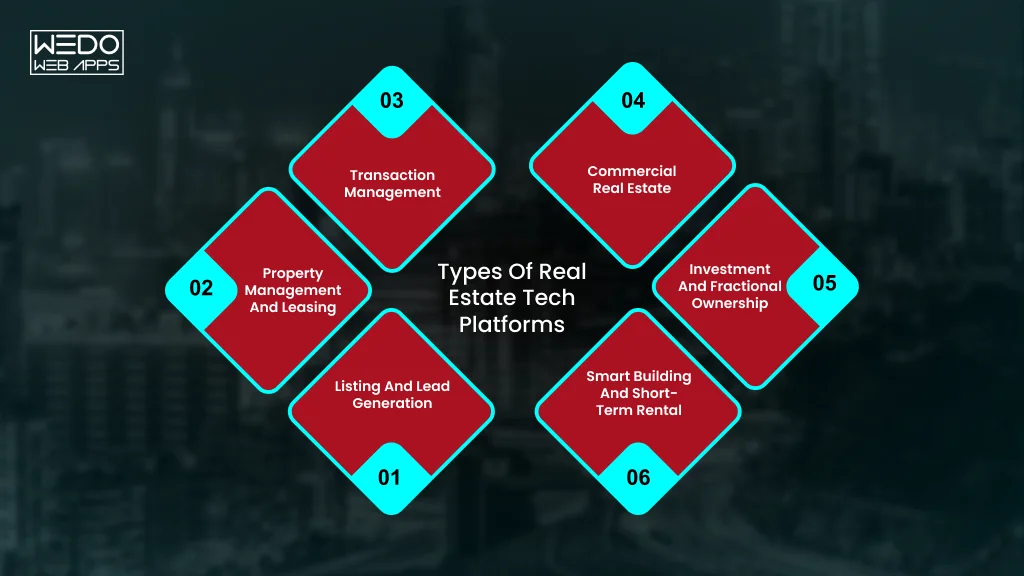
Most real estate tech platforms fall into size groups. Match your biggest problem to a group, and a long vendor list shrinks fast.
| Platform type | Problem it fixes | Example tools |
|---|---|---|
| Listing and lead generation | Too few qualified inquiries | Zumper, BoldLeads, Structurely |
| Property management and leasing | Rent, repairs, and tenant admin | Buildium, DoorLoop, EliseAI |
| Transaction management | Stalled deals, missing signatures | DocuSign |
| Commercial real estate | Lease dates and portfolio tracking | VTS, Re-Leased, Yardi Corom |
| Investment and fractional ownership | Spreadsheet reporting, access to ownership | Agora, Pacaso |
| Smart building and short-term rental | Energy costs, multi-channel bookings | Infogrid, Hostaway, Guesty |
Listing, Marketplace, and Lead Generation Platforms
These put your properties in front of buyers and renters. Then they capture the inquiries.
- Zumper: rental listings, credit reports, applications, and e-signatures in one place.
- BoldLeads: landing pages with automated email and text follow-ups.
- Structurely: an AI chatbot that qualifies leads and books appointments for you.
Property Management and Leasing Platforms
- Problem: rent collection, repairs, and tenant screening all in one platform.
- Fix: one system for accounting, leasing, maintenance, and tenant messages.
- Examples: Buildium bundles accounting, leasing, and mobile apps. DoorLoop suits small and mid-sized rental owners. Elise AI uses AI to talk to prospects and schedule tours, and the company reports an 80% drop in leasing agent workload.
Transaction Management and e-Signature Platforms
A typical deal runs like this on a good platform:
- Your offer is accepted, and a checklist is created automatically.
- Documents go out for e-signature (DocuSign is the best-known option).
- Deadlines trigger reminders before anyone misses one.
- Every party sees the same status through to closing.
Without a platform, steps 2 to 4 happen over email.
Commercial Real Estate Platforms
Commercial portfolios need lease tracking across many buildings. Three platforms handle it in different ways:
- VTS: a leasing and asset management platform for commercial real estate.
- Re-leased: cloud-based property management software for landlords and property managers.
- Yardi Corom: keeps leases, documents, clauses, and critical dates in one system for corporate real estate and legal teams.
Investment and Fractional Ownership Platforms
Changing how people own: Pacaso sells shares of luxury second homes through LLC co-ownership.
Changing how firms manage: Agora replaces spreadsheets with portfolio management and reporting for real estate investment firms.
Smart Building and Short-Term Rental Platforms
| Segment | What it handles | Example tools |
|---|---|---|
| Smart buildings | IoT sensors and AI to cut energy use and support ESG reporting; mobile building access | Infogrid, ButterflyMX |
| Short-term rentals | Bookings across Airbnb, Vrbo, and similar channels, with automated messaging and pricing | Hostaway, Guesty |
Which Platform Should You Look at First?
Tick the statement that sounds most like you:
- Leads are slow or low quality: start with listing and lead generation
- Admin buries your weeks: start with property management
- Deals stall over paperwork: start with transaction management
- You manage many leases: start with commercial platforms
- Reporting lives in spreadsheets: start with investment platforms
- You run buildings or rentals at scale: start with smart building or short-term rental tools
Most teams end up using two or three groups together, so how well they connect matters as much as what each one does. That is what the next section covers.
Real Estate Software Solutions: Core Features and Benefits
Good real estate software solutions share a short list of features. If a tool misses several of them, you will feel it within a month. You can consider this section a filter before you book any demo.
Features Every Real Estate Software Should Have
Use this as a checklist when you compare tools:
- Lead and contact management: every inquiry, call, and email sits in one record, so nobody asks a client the same question twice.
- Listing management: you publish a property once, and it appears on your site and connected portal.
- Document storage and e-signature: contracts, leases, and IDs stay in one place and get signed online.
- Online payments: tenants pay rent, and buyers pay deposits without cheques or bank visits.
- Reports and dashboards: you see leads, occupancy, and revenue without building a spreadsheet.
- Mobile access: you can answer a client or approve a repair from the property itself.
- Integrations: the tool connects to your accounting, email, calendar, and listing sources.
- User roles and security: an assistant sees what they need and nothing more.
- Automation: follow-ups, reminders, and routine replies run on their own, and some tools now use AI to draft or send them.
If you can only check six of the nine, rank them by what costs you the most time today. Start with that gap.
What You Gain From the Right Software
Every benefit below comes with a situation you may recognize.
- You respond to leads faster.
Example: a buyer fills in a form at night. The software sends a reply with three matching listings and a booking link. You wake up to a scheduled viewing.
- You spend less time on admin.
Example: a property manager sends rent reminders, collects payments, and logs receipts by hand each month. With software, reminders and receipts go out automatically.
- You make fewer mistakes.
Example: a lease renewal date sits in a notebook and gets missed. The software flags it 90 days ahead.
- You give clients a better experience.
Example: a tenant reports a leaking tap in an app, sees the repair status, and rates the visit. They stay longer because they never had to chase you.
- You make better decisions.
Example: a dashboard shows that one listing source brings most of your serious inquiries. You move your budget there.
Where Software Choices Get Tricky
You will meet two kinds of products as you shop. Some tools are built for one job, such as lead tracking. Others are platforms that try to cover everything. A specialist tool often does its one job better. An all-in-one platform saves you from juggling logins.
Large real estate software companies tend to sell broad platforms. Smaller vendors usually focus on one task. Neither type is better by default. The right choice depends on how your team works.
If no tool matches your process, you have another path. A real estate app development company can build a product around your exact workflow. We cover that choice, along with real estate application development, in the next sections.
How AI Is Changing Real Estate Software
About half of real estate professionals use AI every week. Most of that use is still content. Roughly 82% of agents use AI to write listing descriptions. The next gains lie behind the content. Among the brokerage leaders, 55% plan to expand AI for CRM and workflow automation, and 50% plan to adopt agentic tools that act, not just draft.
The payoff is real. In RPR's survey, 68% of agents said AI app development saves them at least one hour a week, and 34% said it saves more than four. If your real estate software solutions include AI, here is where it earns its place.
AI for Leads and Client Conversations
- What it does: answer inquiries, qualify leads, and book tours at any hour.
- Example: EliseAI talks to rental prospects and schedules tours. The company reports an 80% drop in leasing agent workload (vendor-reported).
- Room to grow: chatbots and assistants are used by about 47% of AI-using agents, far behind writing tools at about 78%.
AI for Leases, Documents, and Maintenance
- What it does: pulls key dates, clauses, and amounts out of lease files, and flags equipment problems early.
- Example: a commercial platform keeps every clause and critical date searchable. IoT sensors with AI, such as Infogrid, can warn you before a pump fails.
- Room to grow: this is where real estate technology saves operations teams the most manual work.
What to Check Before You Adopt AI
- Review output before clients see it. An agent in RPR's survey asked for more training and worried about accuracy.
- Ask where your data goes. Find out if the vendor stores it, shares it, or trains models on it. Brokerage leaders also cite governance, privacy, compliance, and integration as concerns.
- Apply fair housing rules to AI too. Screening, ads, and pricing carry the same legal duties whether a person or a model makes the call.
- Start with one workflow. Measure it for 30 days before you add another.
Many vendors now ship AI inside tools you already pay for, so ask each one what is live today and what is on the roadmap.

Real Estate Software Companies to Know in 2026
A few large names dominate this market, and many specialists compete around them. This list groups real estate software companies by who they serve. Each entry shows where the company fits best, so you can build a shortlist before you book a demo.
For Agents and Brokers
| Company | Best for | Standout strength |
|---|---|---|
| Follow Up Boss | Growing teams that win on speed to lead | Lead routing, assignment, and response-time reporting. It is a Zillow product. |
| Wise Agent | Solo agents and small teams | Flat monthly pricing with a few shared users. |
For Property Managers and Landlords
| Company | Best for | Standout strength |
|---|---|---|
| AppFolio | Mixed portfolios with a residential focus | Built-in accounting and agentic AI features |
| Buildium | Small portfolios | Simple tools at an entry-level price |
| Yardi (Voyager, Breeze) | Large portfolios that need deep accounting | Breeze suits residential portfolios that want a lighter setup |
| RealPage | Large companies that need advanced accounting and affordable housing tools | Strong in multifamily |
AppFolio's own comparison page ranks AppFolio first, so weight independent reviews alongside it.
For Commercial Real Estate
| Company | Best for | Standout strength |
|---|---|---|
| Yardi Voyager | Full-lifecycle operations | Enterprise scale |
| MRI Software | Enterprise-scale commercial and mixed-use portfolios | Global reach |
| CoStar | Commercial market data and analytics | One of the most comprehensive commercial databases |
| VTS | Commercial landlords and brokers | Leasing and asset management in one platform |
Fast-Growing PropTech Companies
Venture money is flowing to newer real estate tech platforms built around AI. AI-native companies in underwriting, construction technology, property operations, leasing automation, and financial infrastructure attract the largest share of investment.
- EliseAI: AI for leasing and resident communication.
- Infrogrid: IoT and AI for smart commercial buildings.
Pilot young vendors on one property or team before you commit. Their pricing and product can change fast.
How to shortlist: pick three vendors, ask each to demo with your own data, and check their integrations before you compare prices. Features and pricing change often, so confirm details on each vendor's site.
Buy, Customize, or Build: Choosing the Right Real Estate Software
You have three routes. Each one fits a different situation.
Off-the-Shelf vs White-Label vs Custom
Route 1: Buy off-the-shelf
- Best when: your process is standard, and you want to start this month.
- You get: working tools, support, and regular updates.
- Trade-off: you adapt to the tool, and fees grow as your team does.
Route 2: Customize or white-label
- Best when: you want your own brand or small changes on proven code.
- You get: faster launch than a full build.
- Trade-off: limits on what you can change, and you depend on the vendor's roadmap.
Route 3: Build custom
- Best when: your workflow gives you an edge, or you plan to sell the product.
- You get: full control over features, data, and branding.
- Trade-off: a higher upfront cost and upkeep. Maintenance runs 15% to 20% of the build cost each year.
A quick test: build only if you can say yes to two of these.
- Does an existing tool force you to change a process that makes you money?
- Will you sell or license the product to others?
- Do you need an integration no vendor offers?
- Can you find an MVP plus a year of upkeep?
Eight Questions to Ask Before You Sign
- Integrations: Which accounting, CRM, and listing sources connect out of the box?
- Data: Can I export everything if I leave?
- Security: Where is my data stored, and who can access it?
- AI: Which features are live today, and does my data train your models?
- Pricing: What changes in cost as my units, users, or listings grow?
- Support: What does onboarding include, and how fast do you reply?
- Scale: Can this handle twice my current volume?
- Proof: Can I speak with a customer of my size?
If most answers disappoint, a custom build deserves a closer look. That route needs a real estate app development company that understands your market, and the next section shows how to choose one.

Real Estate Application Development: Process, Features, and Cost
Real estate application development takes more than a designer and a coder. You need market knowledge, data integrations, and a plan for what comes after launch.
Here is what the work involves.
Types of Real Estate Apps You Can Build
- Listing and search portals: buyers browse, filter, and contact agents.
- Rental and tenant apps: applications, rent payments, and repair requests.
- Property management apps: owners and managers track units, leases, and maintenance.
- Agent and CRM apps: lead tracking and follow-ups from a phone.
- Investment platforms: users invest in property and track returns.
- Virtual tour apps: 3D walkthroughs and staging tools.
Features by Stage
| Stage | What goes in | Why this order |
|---|---|---|
| MVP | Sign-up, property with filters, map view, photo-rich detail page, saved listings, contact form or chat, admin panel. | Tests whether people want the product |
| Phase 2 | MLS/IDX feeds, agent portal, mortgage calculator, push alerts, payments, virtual tours | Adds depth once users arrive |
| Advanced | AI recommendations, AI valuation, chatbot, analytics dashboards | Costs the most and pays off at scale |
Tech Stack and Integrations
You will make a few choices early:
- App frameworks: cross-platform tools like React Native suit most real estate apps, since search, listings, messaging, and maps do not need heavy native device access.
- Maps: Google Maps or Mapbox for property pins, amenities, and commute times.
- MLS/IDX feeds: needed only if you show MLS-listed homes, and they require a licensed agent or broker partner.
- Payments and e-signature: for deposits, rent, and contracts.
- CRM and accounting links: so data flows to the tools your team already uses.
- AI services: recommendations, valuation, and chat through APIs.
The Development Process Step-by-Step
- Discovery (2 to 4 weeks): the team defines user personas, the features roadmap, and the technical plan, which cuts costly scope changes later.
- Design: wireframes and a clickable prototype that you test with a few target users.
- MVP build: typically 8 to 14 weeks.
- Testing and launch: quality checks, then app store review.
- Measure and improve: track search use, inquiries, and drop-off, then plan phase 2.
What Real Estate App Development Costs
Publish estimates vary widely. Current guides place a basic MVP between roughly $15,000 and $18,000, mid-range apps between $40,000 and $180,000, and enterprise platforms from $150,000 to $300,000 or more.
| Tier | Typical Scope | Estimated Cost | Timeline |
|---|---|---|---|
| MVP | Listings, search, maps, contact | $15,000 to $80,000 | 2 to 4 months |
| Mid-range | MLS/IDX, agent portal, payments | $40,000 to $180,000 | 4 to 8 months |
| Enterprise | Analytics, CRM, AI valuation, multiple user roles | $150,000 to $300,000+ | 8 to 14 months |
Four things move the number most:
- MLS/IDX integration: adds roughly $20,000 to $40,000 and 6 to 10 weeks.
- AI features: recommendations and predictive pricing add roughly $30,000 to $60,000.
- Team location: hourly rates run about $80 to $150 in Western Europe and $50 to $80 in Eastern Europe.
- Scope creep: every late feature resets part of the schedule.
These figures come from vendor-published guides, so collect two or three quotes for your own scope.
How to Choose a Real Estate App Development Company
Look for:
- Live real estate products you can open and test.
- Milestone-based pricing with a clear scope.
- Past work with MLS/IDX feeds, maps, and payments.
- Security practices such as encryption and multi-factor login.
- A support plan after launch.
- A contract that gives you ownership of the code and data.
Walk away if:
- They quote a fixed price without asking your users.
- They cannot show a real estate project.
- They have no plan for maintenance.
- They avoid questions about code ownership.
Not sure what your first version should include? Share your ideas with our team for a scoped estimate.
Real Estate Technology Trends and Challenges
Trends to Watch
- Agentic AI: tools that act on a task instead of drafting text. About half of brokerage leaders plan to adopt them. For you: test one workflow, such as lead follow-up.
- Platform consolidation: leaders see a shift toward integrated platforms. For you: fewer logins, so integration matters more than feature count.
- Virtual tours and digital twins: 3D and AR walkthroughs of real spaces. For you: you can qualify remote buyers before a site visit.
- Property tokenization: blockchain-based shared ownership. For you: watch the rules in your market before you build or invest.
- ESG and smart buildings: sensors that track energy and emissions. For you: reporting duties are pushing owners toward these tools.
- Embedded finance: rent payments, insurance, and loans inside the platform. For you: a possible new revenue line for your own product.
Challenges and How to Solve Them
| Challenge | What it looks like | How to fix it |
|---|---|---|
| Legacy systems | Data sits on old software and spreadsheets | Clean and map the data first. Migrate in phases and run both systems side by side for a month |
| Team adoption | Staff keep using old habits | Start with one workflow, name a champion, and train in short sessions. Agents in RPR's survey asked for more training |
| Security and compliance | Client IDs and financials live in the system | Use role-based access, encryption, and multi-factor login. Check each vendor's data policy against local privacy law. |
| Tool overload | Five tools that do not share data | Choose real estate tech platforms with open integrations and retire overlapping tools. |
| Unclear return | Usage is high, but results are not | Set one metric before rollout, such as response time or days to lease. One survey found 82% of agents use AI but only 17% report significant business impact. |
Conclusion
The right real estate technology fixes a specific problem. Name yours first. Then match it to a platform type, compare real estate software companies in that group, and ask the eight questions before you sign.
If no tool fits your process, real estate application development gives you a product built around it. Start with an MVP and add AI where it saves your real hours.
Take one action this week. List your three biggest time drains and check which platform type solves the worst one. Talk to our team about real estate software solutions or a custom build for you.