


Introduction - Is Headless Shopify with Oxygen Worth It?
If you are exploring headless Shopify with Hydrogen, you are likely trying to answer one core question:
"Will this actually improve my store's performance and growth, or just increase my costs?"
Because while Shopify Hydrogen promises faster storefronts, better UX, and more flexibility, it also comes with:
- Higher performance costs ($15K-$250K+)
- More technical complexity
- Longer implementation timelines
And that is where the confusion begins.
Between Hydrogen vs Liquid theme performance comparisons, Shopify Oxygen hosting, and Storefront API vs Admin API differences, most businesses struggle to understand what truly matters and what does not.
What This Guide Will Help You Decide?
This guide cuts through the noise and focuses on what actually impacts your decision:
- What Shopify Hydrogen really is (and how it works)
- Real headless Shopify development cost and timeline
- Hydrogen vs Liquid performance differences that affect conversions
- When headless Shopify is worth it, and when it is overkill
- How to evaluate ROI before investing.
If you are considering a Shopify headless storefront, this will help you make a clear, business-first decision, not a trend-driven one.

What is Headless Shopify?
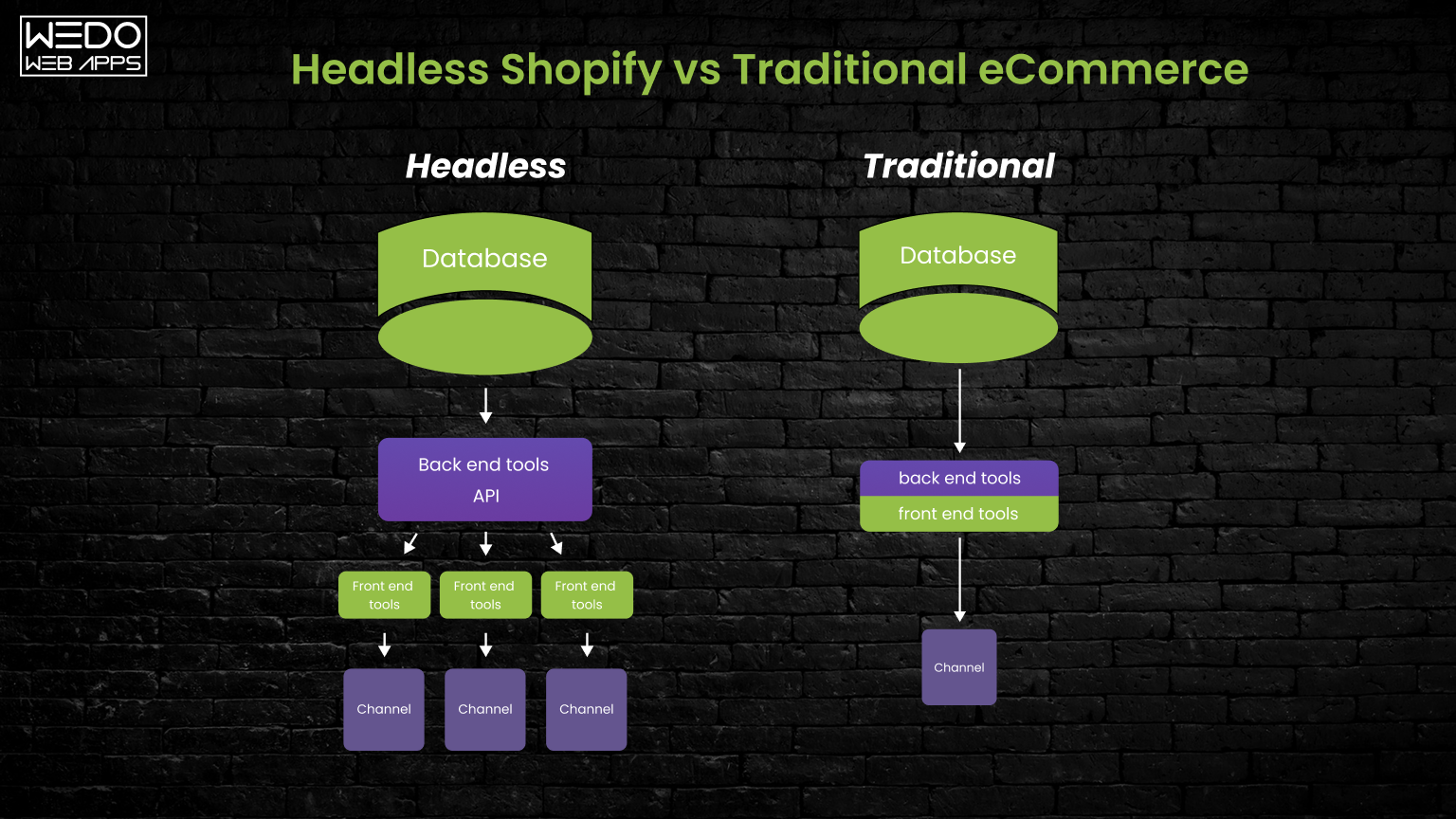
At its core, headless Shopify means separating what your customers see from how your store operates behind the scenes.
In a traditional Shopify setup, your frontend (design + user experience) and backend (products, checkout, orders) are tightly connected through a Liquid theme. This makes things simple and fast to launch, but also limits how far you can customize performance, interactions, and scalability.
Headless Shopify changes that.
Instead of relying on a theme, your storefront is built independently using modern frameworks like Shopify Hydrogen (React-based), while Shopify continues to handle the backend, products, inventory, checkout, and payments.
Think of it like this:
- Shopify (backend): Manages your business logic
- Hydrogen (frontend): Controls how your store looks and behaves
- APIs: Connects both layers in real time
This separation gives you far more control over the user experience, but it also introduces more complexity.
How a Shopify Headless Storefront Actually Works
When a user visits your site, they are no longer interacting with a Shopify theme. Instead:
- The Hydrogen frontend fetches product and store data using the Shopify Storefront API
- The backend (Shopify) processes product data, cart logic, and checkout (still handled by Shopify)
- Everything is hosted and delivered via Shopify Oxygen or external infrastructure
This setup allows for faster, more dynamic experiences, especially for stores that need more than what standard themes can offer.
Where Headless Shopify Starts Making Sense
From a business perspective, headless is not about technology; it is about removing limitations.
It becomes relevant when:
- Your current store feels restrictive in terms of UX or design flexibility
- You need high-performance storefronts for large traffic volumes
- You want to integrate multiple systems (apps, CMS, custom tools) seamlessly
- Your brand experience is a competitive advantage, not just a storefront
At this point, Shopify Hydrogen and a headless approach start to make strategic sense.
Where Most Businesses Get it Wrong
Many businesses jump into headless Shopify, assuming it is a direct upgrade. However, it is not.
Headless introduces:
- Higher upfront investment
- Ongoing development dependency
- More moving parts (APIs, hosting, performance layers)
Which means if your store does not actually need that flexibility, you are paying for complexity without real returns.
What is Shopify Hydrogen? (And Why it Exists)
Now that you understand how headless Shopify separates the frontend and backend, the next logical question is:
Where does Shopify Hydrogen actually fit into this setup?
In simple terms, Shopify Hydrogen is a React-based framework built specifically to create custom Shopify storefronts. It replaces traditional Liquid themes when you go headless.
Instead of working within Shopify's templating system, Hydrogen allows developers to build their storefront using modern frontend architecture, giving them far more control over performance, design, and user experience.
Why Shopify Built Hydrogen in the First Place
Before Hydrogen, going headless on Shopify meant stitching together custom frontend frameworks with Shopify APIs. It worked, but it was complex, inconsistent, and time-consuming.
Hydrogen was introduced to solve that.
It gives businesses a purpose-built foundation for Shopify headless storefront development, reducing the friction between flexibility and implementation.
What Makes Shopify Hydrogen Different
Hydrogen is not just another frontend framework; it is optimized specifically for commerce use cases.
Here is what that means in practice:
- It is built on React, making it highly flexible and component-driven
- It supports server-side rendering (SSR) for faster load times
- It comes with pre-built eCommerce components (products, carts, collections)
- It integrates directly with the Shopify Storefront API
This allows developers to create storefronts that are not only visually unique but also performance-optimized from the ground up.
How Shopify Hydrogen Works in a Headless Setup
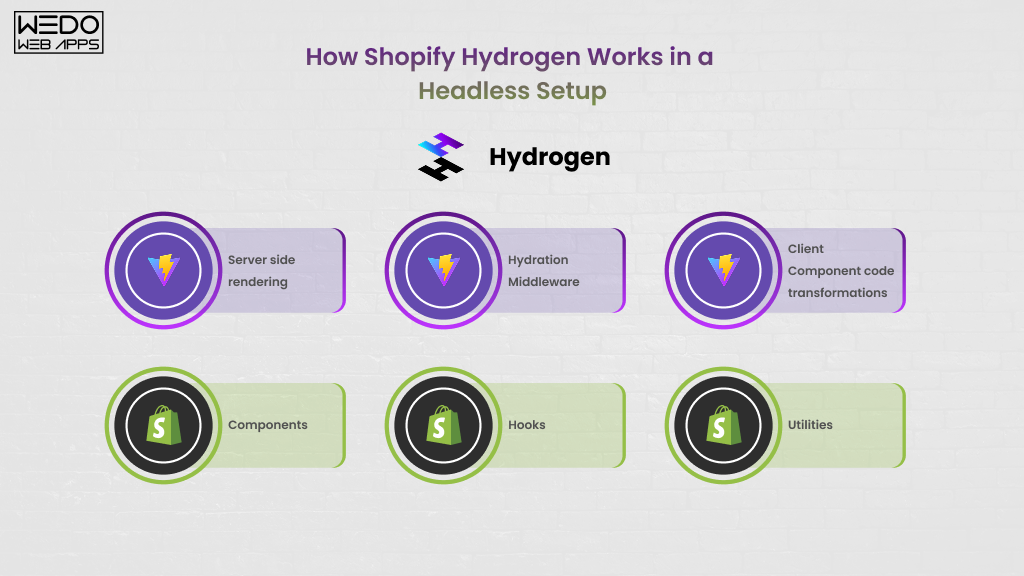
In a Shopify headless Hydrogen storefront, Hydrogen acts as the presentation layer.
It:
- Fetches product and store data using APIs
- Renders pages dynamically for users
- Controls interactions like navigation, filtering, and cart updates
Meanwhile, Shopify continues to handle checkout, inventory, orders, and payments.
So, while Hydrogen gives you flexibility, Shopify still ensures stability where it matters most.
Who Shopify Hydrogen is Actually Built for
Hydrogen is not designed for every Shopify store, and that is an important distinction.
It makes the most sense for businesses that:
- Need highly customized storefront experiences
- Care deeply about performance optimization
- Have complex product catalogs or user journeys
- Are scaling and want long-term flexibility
Who Should Avoid Shopify Hydrogen
If your store:
- Relies on standard eCommerce flows
- Does not require advanced customization
- Has limited technical resources or budget
Then a Liquid theme will often deliver better ROI with far less complexity.
The Key Takeaway: Shopify Hydrogen is powerful, but it is not a default upgrade.
It is a tool designed for businesses that have outgrown traditional themes and need more control over how their storefront performs and scales.
Shopify Hydrogen vs Liquid Theme: Performance, Flexibility, & Real Business Impact
This is where most decisions are actually made, not on technology, but on outcomes.
Because choosing between a Shopify Hydrogen storefront and a Liquid theme is not about which is "better." It is about which one delivers measurable business value for your current stage.
The Core Difference (In Practical Terms)
A Liquid theme is fast to launch, tightly integrated with Shopify, and works well for standard eCommerce needs.
A Hydrogen storefront, on the other hand, gives you full control over how your frontend behaves, but requires custom development to achieve it.
That trade-off shows up clearly in performance, flexibility, and scalability.
Performance: Where Hydrogen Gets the Attention
In most Shopify Hydrogen vs Liquid theme performance comparisons, Hydrogen tends to outperform, but not automatically.
Hydrogen enables:
- Server-side rendering (faster initial loads)
- Better control over assets and scripts
- Optimized data fetching via Storefront API
This can lead to:
- Faster page load times
- Smoother interactions
- Improved Core Web Vitals
But here is the nuance most blogs skip: Hydrogen only performs better when it is built correctly.
A poorly optimized Hydrogen storefront can easily perform worse than a well-optimized Liquid theme.
Flexibility: The Real Reason Businesses Go Headless
This is where Hydrogen clearly stands out.
With Liquid themes, you are working within Shopify's structure. Customization is possible, but only to a certain extent.
With Hydrogen:
- You control the entire frontend experience
- You can build completely custom UI/UX flows
- You can integrate external systems more seamlessly
This matters for businesses that:
- Want non-standard user journeys
- Need interactive or app-like storefronts
- Are building a strong brand-driven experience
Development & Maintenance: The Hidden Trade-Offs
What you gain in flexibility, you pay for in complexity.
Liquid themes:
- Faster to develop
- Easier to maintain
- Lower dependency on developers
Hydrogen storefronts:
- Require experienced React/Shopify developers
- Need ongoing maintenance and iteration
- Involve API management and performance tuning
This directly impacts your long-term cost and operational model.
Side-by-Side Comparison
| Factor | Shopify Liquid Theme | Shopify Hydrogen (Headless) |
|---|---|---|
| Setup Time | Fast (days to weeks) | Medium to long (weeks to months) |
| Performance | Good (Optimized themes) | High potential (if built correctly) |
| Customization | Limited (theme constraints) | Full flexibility |
| Developer Dependency | Low to moderate | High |
| Maintenance | Simple | Ongoing technical involvement |
| Scalability | Moderate | High (with proper architecture) |
What This Means for Your Business
If your goal is to:
- Launch quickly
- Keep costs predictable
- Run a standard eCommerce model
A Liquid theme is often the smarter choice.
But if your business depends on:
- Performance as a competitive edge
- Custom user experiences
- Long-term scalability and integrations
Then a Shopify Hydrogen headless storefront becomes a strategic investment, not just a technical upgrade.
The Reality Most Businesses Realize Too Late
The decision is not: "Hydrogen vs Liquid, Which is better?"
It is "Do we actually need what Hydrogen enables, and are we ready to invest in it?"
Headless Shopify Cost Breakdown (Hydrogen, Oxygen, and Real Investment Range)
The Short Line Answer (Before We Break it Down)
A Shopify Hydrogen headless storefront typically costs:
- $15,000 - $30,000: Basic Storefront (limited customization)
- $30,000 - $80,000: Mid-level (custom UI, integrations)
- $80,000 - $250,000: Advanced builds (enterprise-grade, complex UX, scalability)
But this range only makes sense once you understand what you are actually paying for.
1. Shopify Hydrogen Development Cost
This is where most of your investment goes.
Unlike Liquid themes (which use pre-built structures), Hydrogen requires custom frontend development using React; managing everything, from layouts to interactions, is built intentionally.
Your cost depends on:
- UI/UX Complexity: Basic templates vs fully custom, interactive experiences
- Number of Pages & Components: Product pages, collections, landing pages, dynamic sections
- Third-party Integrations: CRM, ERP, search tools, personalization engines
- Performance Optimization Level: Basic vs conversion-focused optimization
- Team Expertise: Shopify specialists vs generic React developers
This is why two "headless Shopify projects" can differ by $100K+.
2. Shopify Oxygen Hosting Cost & Setup
A common misconception is that hosting is a major added expense.
In reality, Shopify Oxygen (Shopify's hosting for Hydrogen storefronts) simplifies a lot of this.
Here is how it works:
- Oxygen is included with Shopify plans (especially Shopify Plus)
- It is optimized specifically for Hydrogen storefronts
- Deployment is tightly integrated with Shopify
So for most businesses:
- Initial hosting cost = minimal or included
- Scaling costs depend on traffic and architecture
That said, some businesses still choose external hosting (like Vercel) for more control, but that adds complexity and cost.
3. Ongoing Maintenance & Operational Cost
This is the part many businesses underestimate.
With a Liquid theme, updates are relatively simple.
With Hydrogen:
- You will need ongoing developer involvement
- Performance optimization is continuous
- APIs and integrations need monitoring
Typical ongoing costs:
- $1,000 - $5,000/month: Small to mid stores
- $5,000+/month: High-scale or enterprise setups
Hydrogen vs Liquid Theme: Cost Comparison
Here is a clearer side-by-side comparison to put things into perspective:
| Cost Factor | Shopify Liquid Theme | Shopify Hydrogen (Headless) |
|---|---|---|
| Initial Build Cost | $1,000 - $15,000 | $15,000 - $250,000+ |
| Time to Launch | 1-4 weeks | 4-16+ weeks |
| Hosting | Included | Oxygen (included or minimal) |
| Maintenance | Low | Medium to High |
| Customization Cost | Limited | High but flexible |
| Long-Term Scalability Cost | Moderate | Optimized for scale |
What Most Cost Discussions Miss:
The real question is not: "How much does Shopify Hydrogen cost?"
It's: "What level of complexity does my business actually need, and what is the ROI on that investment?"
Because if you do not need advanced customization or performance optimization:
A $60K-$100K Hydrogen build won't outperform a well-optimized $10K Liquid store in any meaningful way.
But if you do need it:
Not going headless could limit your growth, conversions, and scalability.
A Practical Way to Think About It
- Liquid = efficiency-focused investment
- Hydrogen = growth-focused investment
Neither is right nor wrong; the decision depends on where your business is today and where it is going.

Shopify Hydrogen Pricing Explained (What You Actually Pay For)
One of the most common misconceptions around Shopify Hydrogen pricing is that it is an expensive product you need to license.
It's not.
In fact, Shopify Hydrogen is completely free to use.
And that is exactly why so many businesses underestimate the real cost.
So, If Hydrogen is Free, Where Does the Cost Come From?
Hydrogen is a framework, not a product.
You are not paying for access; you are paying for everything required to design, build, and maintain a custom Shopify headless storefront using that framework.
That includes:
- Frontend development (React-based structure)
- UX/UI design tailored to your brand
- API integrations (Storefront API, third-party tools)
- Performance optimization and testing
- Ongoing maintenance and updates
So while the framework itself is free, the implementation is where the investment lies.
Understanding Total Cost of Ownership (TCO)
To make a smart decision, you need to look beyond just the initial build cost and consider the total cost of ownership over time.
With a Shopify Hydrogen storefront, your costs typically fall into three layers:
- Initial Development: One-time cost based on complexity ($15K - $250K+)
- Infrastructure & Hosting: Shopify Oxygen (often included or minimal cost), optional external hosting (if needed)
- Ongoing Maintenance & Iteration: Developer retainers, performance improvements, feature updates.
How Shopify's Plans Affect Your Investment
Your Shopify plan still plays a role, even in a headless setup.
- Standard Shopify Plans: Work with Hydrogen, but have limitations in checkout customization
- Shopify Plus: Unlocks more flexibility, especially around checkout extensibility, higher API limits, and better scalability for large businesses.
For most serious headless Shopify implementations, businesses eventually move toward Shopify Plus, not because Hydrogen requires it, but because the use case often does.
The Hidden Cost Most Businesses Miss
The biggest pricing mistake is not underestimating development. It is underestimating iteration.
With Hydrogen, your storefront becomes a living product, not a static theme.
That means:
- Continuous UX improvements
- A/B testing and experimentation
- Feature rollouts
This is where Hydrogen creates real value, but also when costs continue.
A Clear Way to Evaluate Shopify Hydrogen Pricing
Instead of asking: "How much does Shopify Hydrogen cost?"
Ask: "What level of control and performance do we need, and what are we willing to invest to achieve it?"
Because Hydrogen does not increase cost randomly, it increases capability.
And whether that capability translates into ROI depends entirely on your business model.
Shopify Storefront API vs Admin API: What is the Difference (And Why it Matters)
Once you move toward a Shopify Headless Storefront, APIs stop being a technical detail; they become the backbone of how your store functions.
And this is where a lot of confusion comes in:
Shopify Storefront API vs Admin API differences, what is the actual difference, and why should you care?
The Simple Way to Understand It
Think of Shopify as two layers:
- One that customers interact with
- One that you (the business) control behind the scenes
These two layers are powered by two different APIs.
1. Shopify Storefront API (Customer-Facing Layer)
The Storefront API is what your Hydrogen frontend uses to display and interact with your store.
It handles everything your customers experience, such as:
- Browsing products and collections
- Viewing product details
- Managing carts
- Accessing content dynamically
In a Shopify Hydrogen storefront, this API is constantly working in the background to fetch and render data in real time. Without the Storefront API, your headless frontend has nothing to display.
2. Shopify Admin API (Backend Operations Layer)
The Admin API is used for managing your store, not for customer interactions.
It handles:
- Product creation and updates
- Inventory management
- Order processing
- Customer data
This API is typically used by:
- Internal systems
- Third-party apps
- Backend workflows
Your customer never directly interacts with it.
The Key Difference (That Actually Matters)
The distinction is not just technical; it affects how your storefront is built and maintained.
- Storefront API: Powers user experience (speed, interaction, frontend logic)
- Admin API: Powers business operations (data control, automation, integrations)
In a headless Shopify setup, your frontend depends heavily on the Storefront API, so how efficiently it is used directly impacts performance.
Where Businesses Get it Wrong
Many assume that moving to headless means "more control over everything."
But in reality:
- You still rely on Shopify's backend systems
- Checkout is still controlled by Shopify
- Admin API access does not replace core platform limitations
So while Hydrogen gives you frontend flexibility, Shopify still defines backend boundaries.
Why This Matters for Your Decision
Understanding this difference helps you avoid unrealistic expectations.
If your goal is:
- Better frontend performance: Storefront API + Hydrogen helps
- Full backend control: Shopify will still have limits
This clarity becomes especially important when evaluating:
- Checkout customization possibilities
- Integration complexity
- Long-term scalability
The Practical Takeaway
Headless Shopify does not remove Shopify; it changes how you interact with it.
- The Storefront API becomes your frontend engine
- The Admin API remains your operational backbone
And your results depend on how well both are implemented together.
Shopify Oxygen Hosting: How it Works, Cost & When It's Enough
Once you decide to explore a Shopify Hydrogen headless storefront, the next practical question is:
"Where does this entire frontend actually live?"
That is where Shopify Oxygen comes in.
What is Shopify Oxygen (In Simple Terms)?
Shopify Oxygen is Shopify's native hosting solution for Hydrogen storefronts.
Instead of setting up external infrastructure (like AWS or Vercel), Oxygen allows you to:
- Deploy your Hydrogen storefront directly within Shopify's ecosystem
- Manage hosting without dealing with DevOps complexity
- Keep frontend and backend tightly integrated
In short, it is designed to make headless Shopify simpler to manage.
How Shopify Oxygen Works in a Headless Setup
In a traditional setup, your theme is hosted within Shopify automatically.
With Hydrogen:
- Your frontend (Hydrogen app) needs separate hosting
- Oxygen acts as the runtime environment for that frontend
- It connects seamlessly with Shopify APIs and backend systems
So when a user visits your store:
- Oxygen serves the Hydrogen frontend
- The frontend fetches data via the Storefront API
- Shopify handles checkout and core commerce logic
Shopify Oxygen Cost: What Should You Expect?
This is one of the more straightforward parts of headless Shopify.
For most businesses:
- Oxygen hosting is included with Shopify (especially Shopify Plus)
- There is no major upfront hosting cost
- Scaling is handled within Shopify's infrastructure
This makes Oxygen:
- More predictable than external hosting
- Easier to manage for growing businesses
When Shopify Oxygen is Enough
For a large number of businesses, Oxygen does exactly what's needed.
It works well when:
- You want a simplified deployment process
- Your architecture is primarily Shopify-centric
- You don't need deep infrastructure customization
In these cases, Oxygen reduces both:
- Setup time
- Operational overhead
When Businesses Choose External Hosting Instead
Despite Oxygen's advantages, some businesses still go beyond it.
This usually happens when they need:
- Advanced control over performance tuning
- Multi-region deployments or custom infrastructure setups
- Integration with broader frontend ecosystems
But this comes with trade-offs:
- Higher cost
- More DevOps complexity
- Longer setup and maintenance cycle
The Real Decision is Not About Hosting
Most businesses overthink this part.
The choice between Oxygen and external hosting is rarely the first decision you should make.
The real decision is:
Do you actually need a headless Shopify architecture in the first place?
Because if the answer is no:
- Hosting doesn't matter
- Hydrogen doesn't matter
- Cost savings come from staying simple
The Practical Takeaway:
- Oxygen is not a cost driver; it is a simplifier
- It makes Shopify Hydrogen more accessible
- It removes a layer of infrastructure complexity
But it does not change the core equation:
Headless Shopify is still a strategic investment, not just a technical upgrade.
Headless Shopify Checkout Customization: What's Possible (and What's Not)
This is where expectations often break.
Many businesses assume that moving to a Shopify headless Hydrogen storefront means full control over everything, including checkout.
It doesn't.
And understanding this clearly can save you from costly misalignment.
The Reality: Checkout is Still Controlled by Shopify
Even in a headless setup, Shopify owns the checkout layer.
That means:
- Customers are redirected to Shopify's checkout
- Core checkout logic remains unchanged
- You cannot fully rebuild checkout using Hydrogen
This is by design; Shopify keeps checkout standardized for security, compliance, and performance.
What You Can Customize
You are not completely restricted, but customization depends heavily on your Shopify plan.
With standard Shopify plans, your options are limited to:
- Basic branding (colors, fonts, logo)
- Some layout adjustments
- Payment and shipping configurations
With Shopify Plus, things open up significantly.
You can:
- Use Checkout Extensibility to modify parts of the experience
- Add custom logic (discounts, validations, UI extensions)
- Improve post-purchase and checkout flows
What You Cannot Do (Even with Headless)
This is where many businesses miscalculate.
You cannot:
- Fully redesign checkout UX from scratch
- Replace Shopify checkout with a completely custom one
- Bypass Shopify's payment flow
So even with a fully custom Shopify Hydrogen React storefront, checkout remains a controlled environment.
Why This Matters for Your Decision
If your primary goal for going headless is: "We want a fully custom checkout experience."
Then Shopify (headless or not) may not be the right platform.
But if your goal is:
- Better storefront performance
- Advanced UX before checkout
- Higher conversion through improved browsing experience
Then headless Shopify still makes strong sense.
Where Headless Actually Impacts Conversion
Most conversion gains don't come from checkout.
They come from:
- Faster product discovery
- Smoother navigation
- Better mobile experiences
- Personalized storefront interactions
That's exactly where Shopify Hydrogen shines.
The Practical Takeaway
- Headless Shopify gives you frontend freedom, not checkout control
- Checkout customization is limited but extendable (especially on Shopify Plus)
- Your ROI from headless comes before checkout, not during it
A Smarter Way to Think About It
Instead of asking: "Can we customize checkout completely?"
Ask: "Can we improve everything leading up to checkout enough to increase conversions?"
That's the real leverage point.
Is Headless Shopify Worth it? (Or Is It an Overkill for Your Business)
By this point, you understand how Shopify Hydrogen, APIs, and Oxygen fit together.
Now comes the only question that actually matters: "Should you invest in a Shopify headless storefront or not?"
Because the wrong decision here does not just waste budget, it creates long-term complexity that your business has to carry.
When Headless Shopify Actually Makes Sense
Headless is not about having better tech; it is about removing growth limitations.
It starts making real business sense when your store is hitting constraints that themes cannot solve efficiently.
For example, if you are experiencing:
- Performance bottlenecks affecting conversion rates
- Complex user journeys that standard themes cannot handle well
- A need for highly customized, brand-driven experiences
- Heavy reliance on integrations (CMS, personalization engines, custom tools)
- Scaling traffic where milliseconds impact revenue
In these scenarios, a Shopify Hydrogen storefront becomes a strategic investment, not an experiment.
When Headless Shopify is an Overkill
This is where most businesses go wrong.
They assume headless is a natural upgrade path.
It's not.
For many stores, especially early-stage or mid-sized ones, headless introduces more problems than it solves.
It is likely overkill if:
- Your store follows a standard eCommerce flow
- You don't have strong UX differentiation needs
- Your current performance issues can be solved with theme optimization
- Your budget is limited, or the ROI is unclear
- You don't have access to experienced Shopify development support.
In these cases, Liquid themes often deliver better results with far less risk.
The Cost vs Value Reality
Here is the uncomfortable truth:
An $80K - $150K Shopify Hydrogen build will not magically outperform a well-optimized $10K Liquid store, unless your business actually needs what headless enables.
That is why blindly going headless often leads to:
- Overengineering
- Slower iteration cycles
- Higher operational costs
A Simple Decision Framework
Instead of thinking in terms of technology, think in terms of constraints.
Ask yourself:
- Are we limited by our current storefront experience?
- Are we losing revenue due to performance or UX issues?
- Do we need flexibility that themes genuinely cannot provide?
- Can we justify the cost through measurable ROI?
If most answers are yes, headless is worth exploring.
If not, optimizing your current setup is the smarter move.
What High-Growth Brands Do Differently
Businesses can successfully adopt Shopify Headless Hydrogen, but do not start with technology.
They start with:
- A clear growth bottleneck
- A defined performance or UX goal
- A roadmap for ROI
Headless is then used as a means to solve a problem, not as a trend to follow.
The Practical Takeaway
- Headless Shopify is powerful, but situational
- It is best suited for businesses that are scaling or pushing UX boundaries
- For everyone else, it can become an unnecessary layer of complexity
One Line That Should Guide Your Decision
If you don't know exactly why you need headless Shopify, you probably do not need it yet.
Hybrid Approach: A Smarter Way to Go Headless (Without Full Complexity)
Not every business needs to go fully headless, and increasingly, they don't.
A hybrid Shopify approach (often called partial headless) gives you the flexibility of Hydrogen where it matters, while retaining the simplicity of Liquid where it doesn't.
In practical terms, this means:
- Building high-impact pages (homepage, landing pages, product discovery flows) using Shopify Hydrogen
- Keeping checkout and standard flows within Shopify's native environment.
What a Hybrid Shopify Setup Looks Like
A typical hybrid setup might include:
Hydrogen-powered:
- Homepage (performance + storytelling)
- Collection and search experiences
- Campaign landing pages
Liquid-powered:
- Checkout flow
- Standard account pages
- Basic operational pages
This allows you to improve performance and UX where it actually affects conversions, without rebuilding everything from scratch.
Why Businesses Choose Hybrid Instead of Full Headless
The decision usually comes down to balance.
A hybrid approach helps you:
- Reduce initial development cost
- Launch faster
- Test headless capabilities before committing fully
- Avoid unnecessary complexity
It is especially useful for:
- Growing brands not ready for a full headless investment
- Businesses validating performance improvements
- Teams with limited technical bandwidth
The Strategic Advantage
Instead of asking: "Should we go headless or not?"
You shift to: "Where does headless actually create value for our business?"
That's a far more practical and profitable way to approach Shopify Hydrogen.
Shopify Hydrogen Development Timeline (What to Expect Realistically)
Another area where expectations often go wrong is the timeline.
Headless Shopify projects are not just "theme builds with extra steps." They follow a structured development lifecycle.
Typical Development Phases
A Shopify Hydrogen storefront usually moves through these stages:
- Discovery & Planning (1-2 weeks): Understanding business goals, UX requirements, integrations, and architecture.
- UX/UI Design (2-4 weeks): Designing a custom storefront experience aligned with brand and conversion goals.
- Development (3-8+ weeks): Building the frontend using Hydrogen (React), integrating APIs, and setting up logic.
- API & Integration Setup (1-3 weeks, overlap with dev): Connecting storefront API, third-party tools, CMS, and backend workflows.
- QA & Testing (1-2 weeks): Performance testing, bug fixes, device/browser optimization.
- Deployment & Launch (1 week): Final rollout via Shopify Oxygen or external hosting.
Total Timeline by Project Size
- Small builds: ~4-6 weeks
- Mid-level builds: ~8-12 weeks
- Complex/enterprise: ~3-6 months
What Affects Your Timeline the Most
The timeline is not fixed; it expands based on:
- UX complexity
- Number of integrations
- Custom logic requirements
- Decision-making speed on your side
The Practical Takeaway: Headless Shopify is not slow; it is intentional.
And the more clarity you bring at the beginning, the faster and smoother your build will be.
ROI of Headless Shopify (How to Evaluate if it's Worth It)
Now we move from cost to return.
Because a Shopify Hydrogen investment only makes sense if it generates a measurable business impact.
Where ROI Actually Comes From
Headless Shopify does not create value by itself; it enables improvements that drive revenue.
The main ROI drivers are:
- Faster load times > higher conversion rates
- Better UX > improved engagement and retention
- Flexibility > faster experimentation and iteration
- Scalability > handling growth without performance drop-offs
A Simple ROI Thinking Model
Instead of complex calculations, start with this:
- Current conversion rate
- Expected uplift from performance/UX improvements
- Average order value (AOV)
- Monthly traffic
Even a 0.5%-1% conversion uplift at scale can justify a significant investment.
Where ROI is Strongest
ROI is typically highest for:
- Shopify Plus merchants
- High-traffic eCommerce stores
- Brands where UX directly impacts purchasing decisions
- Businesses investing in long-term growth
Where ROI is Weak
If:
- Traffic is low
- UX is not a differentiator
- Growth is still early-stage
Then, the ROI from headless is often limited.
The Real Insight: Headless Shopify is not a cost-saving decision. It is a revenue optimization and growth decision.

Common Mistakes Businesses Make with Headless Shopify
Most headless failures do not come from technology; they come from poor decisions early on.
- Going Headless Too Early: Adopting Hydrogen without a clear need leads to unnecessary cost and complexity.
- Underestimating Total Cost: Focusing only on development cost while ignoring maintenance and iteration.
- Ignoring Performance Strategy: Assuming headless automatically improves speed without proper optimization.
- Choosing the Wrong Development Partner: Working with teams that focus on code, not business outcomes.
- Treating Headless as a One-Time Project: Instead of an evolving product that requires continuous improvement.
How to Choose the Right Shopify Hydrogen Development Partner
If you decide to go headless, your results will depend heavily on who builds it.
What to Look For
- Product thinking, not just development
- Experience with Shopify Hydrogen and Storefront API
- Strong understanding of performance optimization
- Ability to align technology with business goals
Red Flags to Avoid
- Agencies that push headless as a default solution
- Unrealistically low cost estimates
- Lack of Shopify-specific experience
- No discussion of ROI or long-term strategy
What a Good Partner Actually Does
A strong partner does not just build your storefront; they help you:
- Decide if headless is right
- Define a clear roadmap
- Maximize ROI post-launch
Conclusion: The Right Decision isn't Headless vs Theme, it's Fit vs Misfit
By now, one thing should be clear:
Shopify Hydrogen and headless architecture are powerful, but not universally necessary.
The real decision is not about choosing the most advanced technology.
It is about choosing the right level of complexity for your business goals.
- If you need speed, flexibility, and scalability > headless can unlock growth
- If you need efficiency, simplicity, and faster execution > Liquid themes often win.
The best storefront is not the most advanced one; it is the one that delivers the highest return on investment.















 Sharing Project Details
 Let's have a call
 Got Questions? Let’s Chat!