Introduction
RAG vs fine-tuning for enterprise knowledge base development is quickly becoming one of the most critical AI architecture decisions for startups, SMEs, and large enterprises building internal AI chatbots, customer support automation, and knowledge-driven business systems. As organizations invest heavily in AI, the challenge is no longer whether to implement AI-powered knowledge bases. It is choosing the right foundation that balances cost, scalability, accuracy, speed, and long-term maintainability. This is why many organizations now seek specialized AI consulting before committing to a production-ready architecture.
For CXOs, product leaders, and engineering teams, the retrieval augmented generation vs fine tuning decision directly impacts how efficiently enterprise knowledge can be accessed, updated, governed, and scaled across departments. A startup may prioritize faster deployment and lower infrastructure costs, while an enterprise handling compliance-heavy workflows may focus more on auditability, response reliability, and domain-specific reasoning. Choosing the wrong approach can lead to expensive retraining cycles, outdated answers, rising infrastructure costs, and AI systems that struggle to adapt as business knowledge evolves. As a result, businesses increasingly partner with teams specializing in LLM development and enterprise AI deployment to reduce implementation risks and build scalable knowledge architectures.
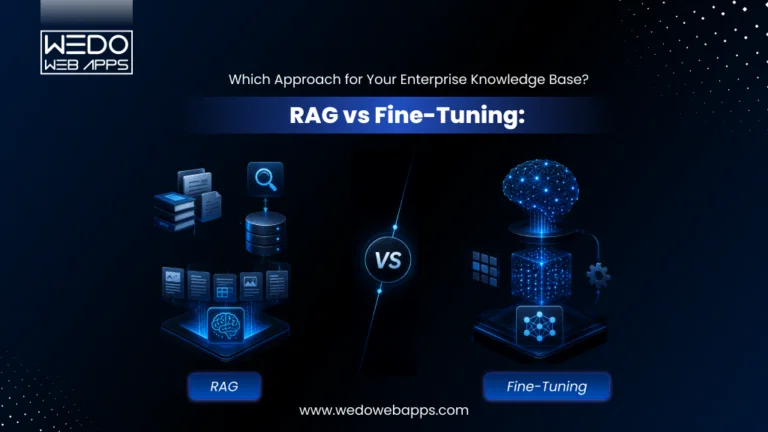
At a high level, RAG enables AI systems to retrieve information from external company documents before generating responses, making it ideal for dynamic and frequently changing knowledge bases. Fine-tuning, on the other hand, trains models on domain-specific behavior and terminology, helping organizations achieve more specialized reasoning and consistent outputs. The rag vs fine tuning debate ultimately comes down to how businesses manage knowledge freshness, operational complexity, query volume, and enterprise-scale AI performance through the right AI development strategy.
This guide explains how RAG and fine-tuning work, where each approach performs best, how vector databases support modern retrieval pipelines, practical techniques for reducing AI hallucinations, and the realistic cost of building enterprise AI knowledge-base systems in the coming years.
How RAG Works - The Retrieval-First Approach
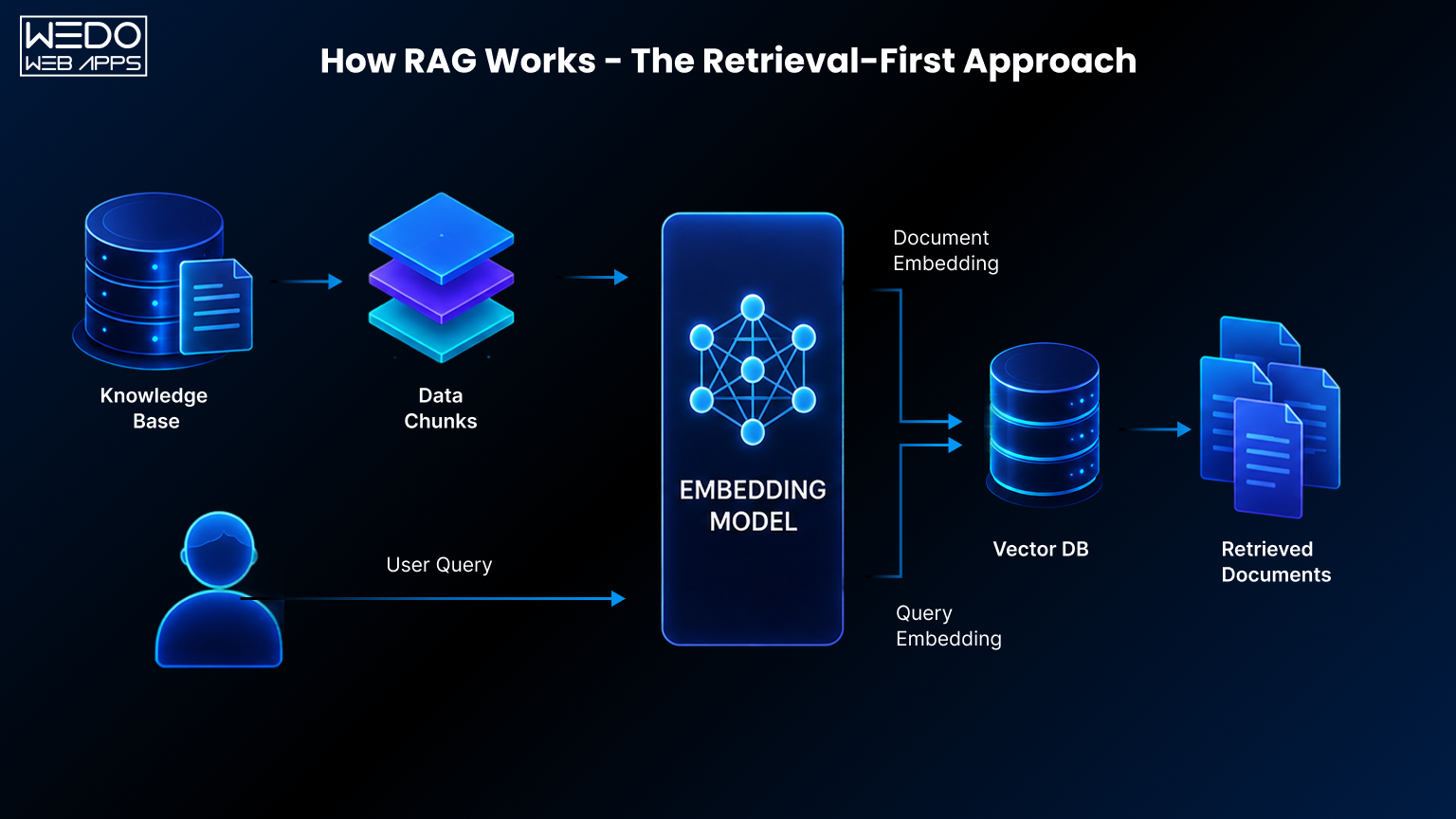
RAG (Retrieval-Augmented Generation) is an AI architecture used in Generative AI development where the language model retrieves relevant company documents before generating a response. Instead of depending entirely on pre-trained knowledge, the system searches through enterprise data sources such as internal documentation, support articles, policies, PDFs, CRM records, or knowledge bases to fetch the most relevant information for a query.
A simple way to understand RAG is to think of it as an open-book exam. Rather than memorizing everything, the AI system "looks up" information before answering. This makes RAG highly effective for startups, SMEs, and enterprises where business knowledge changes frequently and information must stay updated without constant retraining.
One of the biggest advantages of RAG is that enterprise documents remain separate from the model itself. If a company updates a policy, onboarding workflow, pricing document, or compliance guideline, the AI system can immediately access the latest version without retraining the model. This makes RAG systems faster to maintain, easier to scale, and more practical for dynamic business environments.
RAG is also the most cost-effective starting point for most organizations building AI-powered knowledge systems.
Pros of RAG
- Uses the latest business data without retraining
- Faster deployment and lower initial development cost
- Transparent responses with source citations
- No expensive GUP training infrastructure required
- Easier to scale across growing document repositories
Many businesses beginning their enterprise AI journey start with RAG-based systems alongside strategic AI consulting to validate architecture decisions and reduce deployment risks.
Cons of RAG
- Response quality depends heavily on retrieval quality
- Slightly slower responses due to document retrieval
- Can struggle with highly complex multi-document reasoning
- Requires well-structured enterprise documentation
- Poor chunking or retrieval setup can reduce answer accuracy
How Fine-Tuning Works - The Training Approach
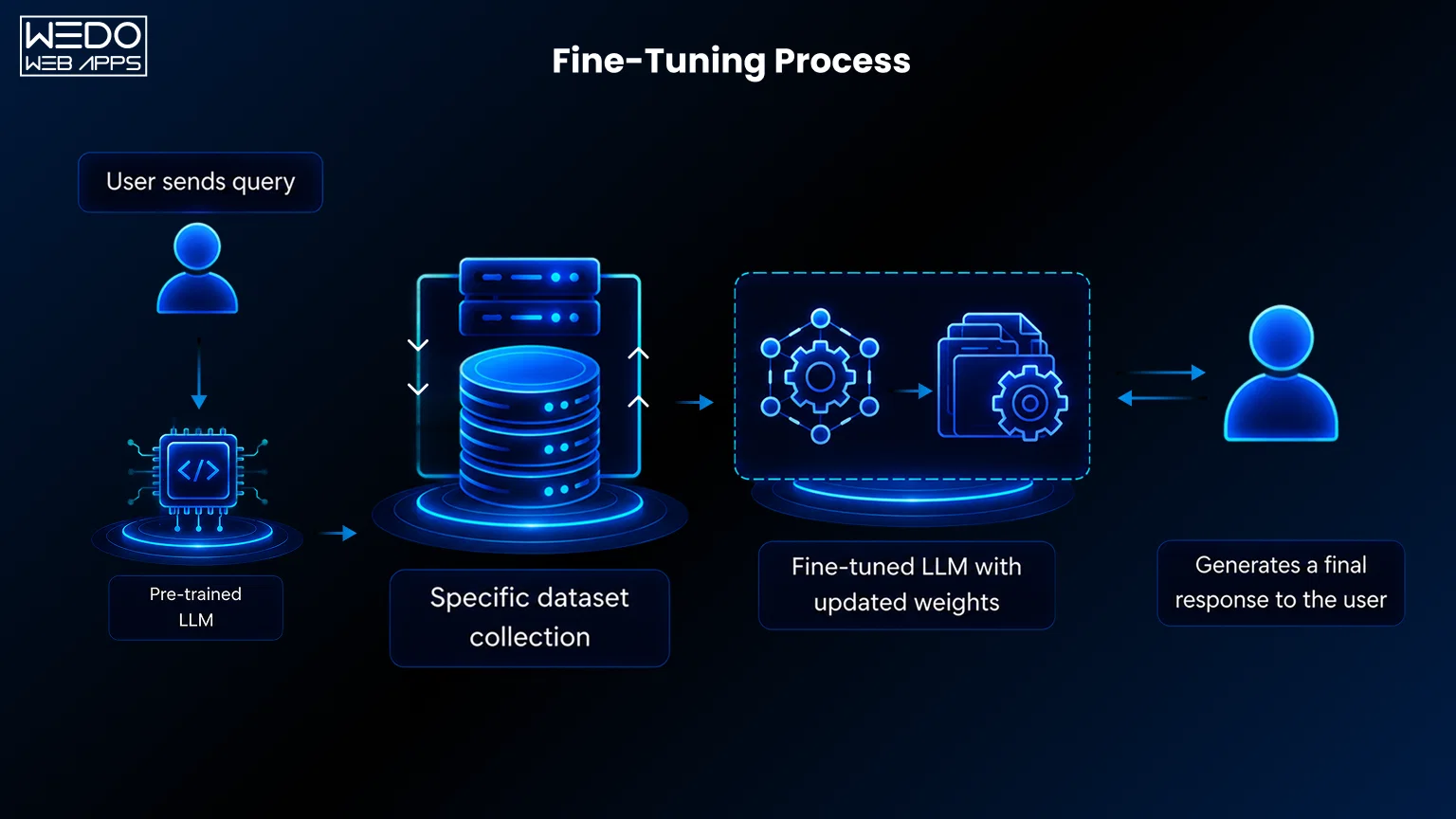
Fine-tuning is an AI approach where a language model is trained on domain-specific data, so it learns specialized terminology, workflows, response patterns, and business logic. Instead of retrieving external documents during every query, the knowledge and behavior become part of the model itself.
A simple way to understand fine-tuning is to compare it to training a new employee. Rather than handing someone a manual every time they need information, you train them deeply on company processes so they can respond instantly and consistently. This makes fine-tuning useful for organizations that require highly structured outputs, industry-specific reasoning, or consistent communication standards.
Unlike RAG systems, where documents remain external, fine-tuning embeds domain knowledge into the model weights. This allows faster responses because there is no retrieval step involved during interference. Fine-tuned systems are often used for specialized enterprise copilots, workflow automation, compliance-heavy tasks, and internal systems requiring standardized language and decision-making.
Pros of Fine-Tuning
- Faster response generation
- Better domain-specific reasoning capabilities
- More consistent tone, terminology, and output structure
- Lower per-query cost at a very large scale
- Useful for repetitive enterprise workflows
Fine-tuned systems are particularly valuable for businesses investing in advanced LLM development to create highly customized AI experiences tailored to industry-specific operations.
Cons of Fine-Tuning
- Expensive training and infrastructure costs
- Knowledge becomes outdated as business information changes
- Requires training when documents or workflows evolve
- Needs large, high-quality training datasets
- Risk of catastrophic forgetting during retraining
The fine tuning vs rag decision often comes down to whether an organization prioritizes knowledge freshness or highly specialized AI behavior. For many enterprises, fine-tuning becomes more valuable after the foundational retrieval architecture is already in place.
RAG vs Fine-Tuning - Decision Framework
Choosing between RAG and fine-tuning depends on how your organization manages knowledge, handles updates, controls costs, and scales AI operations over time. While both approaches improve enterprise AI performance, they solve very different business problems.
For most startups, SMEs, and enterprises building AI-powered knowledge systems for the first time, RAG is usually the safer and faster starting point. It is easier to deploy, cheaper to maintain, and better suited for environments where documents, policies, and workflows change frequently. Fine-tuning becomes more valuable when businesses need highly specialized reasoning, standardized outputs, or lower query costs at a very large scale.
RAG vs Fine Tuning Decision Table
| Factor | RAG Wins | Fine-Tuning Wins |
|---|---|---|
| Data changes frequently | Yes | No |
| Budget under $50K | Yes | No |
| Need source citations | Yes | No |
| Complex domain reasoning | No | Yes |
| High query volume | No | Yes |
| Small training dataset | Yes | No |
| Regulated industry audit trails | Yes | No |
| Custom terminology and tone | No | Yes |
When RAG Makes More Sense
RAG is usually the better option when businesses:
- Update documents frequently
- Need transparent AI responses
- Want faster deployment
- Have limited AI infrastructure
- Require a scalable internal search
This is why many organizations begin with RAG during early-stage AI consulting and architecture planning.
When Fine-Tuning Makes More Sense
Fine-tuning becomes valuable when organizations need:
- Highly specialized domain reasoning
- Structured outputs
- Repetitive workflow automation
- Consistent enterprise terminology
- Lower query cost at a very large scale
Businesses investing in advanced LLM development often combine fine-tuned models with retrieval systems for better enterprise performance.
Best Enterprise Strategy in 2026
For most enterprises, the strongest long-term approach is now:
- RAG for real-time knowledge retrieval
- Fine-tuning for reasoning and behavioral optimization
This hybrid AI development strategy, including Agentic AI with RAG, helps organizations balance:
- Scalability
- Knowledge freshness
- Operational efficiency
- Response accuracy
- Enterprise-grade reliability
RAG Architecture - Embeddings, Vector DB, & Retrieval Pipeline
A RAG implementation architecture with vector database is built around one core idea: retrieve the most relevant information before the AI generates a response. Instead of storing business knowledge directly inside the model, the system pulls information from external enterprise documents in real time.
Step-By-Step RAG Pipeline
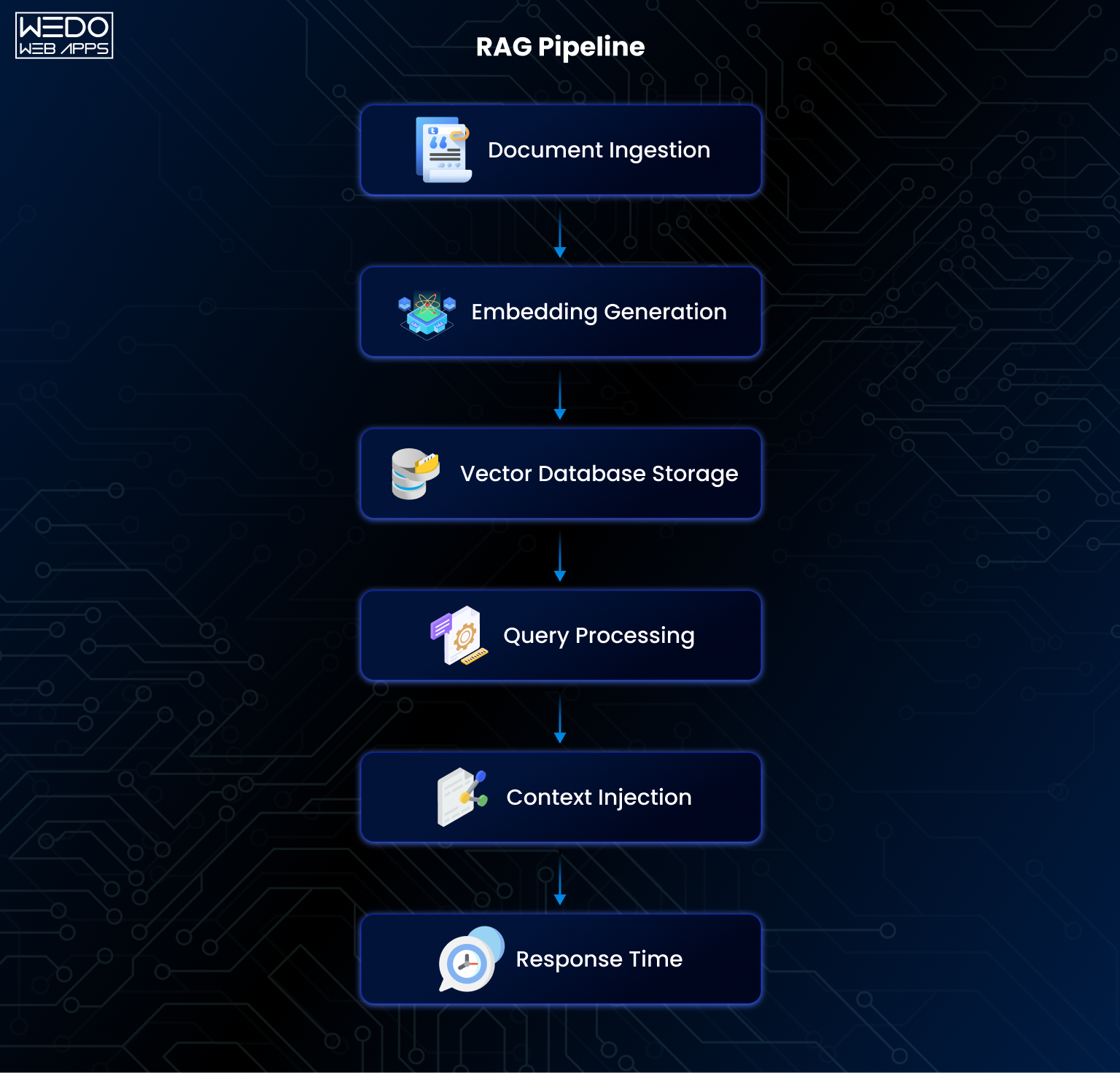
1. Document Ingestion
Enterprise documents are collected from sources such as:
- PDFs
- Confluence
- SharePoint
- CRM Systems
- Internal wikis
- Support documentation
These documents are then split into smaller chunks, usually:
- 500 tokens -> better precision
- 1000 tokens -> more context
2. Embedding Generation
Each document chunk is converted into vector embeddings using machine learning development models such as:
- OpenAI ada-002
- Cohere Embed
- Sentence-transformers
- BGE embeddings
These embeddings help the AI system understand semantic meaning instead of exact keywords.
3. Vector Database Storage
The embeddings are stored inside a vector database for fast similarity search. The vector database becomes the "memory layer" of the RAG system and allows instant retrieval of relevant business knowledge.
4. Query Processing
When a user asks a question:
- the query is converted into an embedding
- the vector database searches for the closest matching chunks
- the most relevant documents are retrieved
This retrieval process usually takes 50 - 200ms latency.
5. Context Injection
The retrieved chunks are added to the LLM prompt as context.
This allows the model to answer using actual enterprise data instead of relying only on pre-trained memory.
6. Response Time
The LLM generates a final answer using:
- Retrieved documents
- Business context
- Prompt instructions
- Enterprise guardrails
RAG Architecture Flow
User Query -> Embedding Model -> Vector DB Search -> Top-K Results -> LLM + Context -> Response
Important RAG Design Decisions
Chunk Size
- Smaller Chunks -> more accurate retrieval
- Larger chunks -> better contextual understanding
Chunk Overlap
Most enterprise systems use a 10-20% overlap. This prevents information loss between chunk boundaries.
Top-K Retrieval
Most production systems retrieve 3-5 chunks per query. Too many chunks increase noise and reduce answer quality.
Re-Ranking
Advanced RAG systems use re-rankers such as:
- Cohere Re-ranker
- Cross-encoders
- BM25 hybrid ranking
This improves retrieval relevance significantly.
For enterprises building production-scale knowledge systems, architecture quality directly impacts scalability, response accuracy, and hallucination control. This is where experienced AI development teams play a critical role in designing retrieval pipelines optimized for enterprise workloads.
Vector Database - Pinecone vs Weaviate vs Chroma vs Qdrant
Vector databases are the foundation of modern RAG systems. They store embeddings and help AI applications retrieve semantically relevant information in milliseconds. Choosing the right vector database depends on factors such as scalability, infrastructure ownership, query performance, and enterprise deployment requirements.
For startups and SMEs, ease of setup may matter most. Enterprises, on the other hand, usually prioritize scalability, hybrid search, compliance, and long-term infrastructure flexibility.
Pinecone
Pinecone is a fully managed vector database designed for fast deployment and minimal infrastructure management.
Best For: teams without dedicated DevOps resources, fast enterprise deployment, and managed cloud environments.
Pros:
- easiest setup experience
- highly scalable
- strong documentation
- fully managed infrastructure
Cons:
- expensive on a large scale
- vendor lock-in concerns
- no self-hosted option
Weaviate
Weaviate combines open-source flexibility with managed cloud deployment options.
Best For: enterprises wanting hybrid search, organizations needing deployment flexibility, and teams combining keyword + semantic search.
Pros:
- Hybrid search support
- GraphQL API
- Modular architecture
- Open-source ecosystem
Cons:
- Steeper learning curve
- More infrastructure complexity
Chroma
Chroma is a lightweight open-source vector database focused on developer simplicity.
Best for: prototypes, MVPs, and smaller internal AI tools
Pros:
- simple Python integration
- developer-friendly
- lightweight deployment
- fast experimentation
Cons:
- limited enterprise-scale maturity
- fewer production-grade features
Qdrant
Qdrant is a Rust-based vector database optimized for high-performance enterprise retrieval.
Best For: performance-critical enterprise systems, large-scale semantic search, and advanced filtering use cases.
Pros:
- extremely fast query speed
- strong filtering capabilities
- open-source flexibility
- enterprise scalability
Cons:
- smaller community compared to Pinecone
- fewer third-party integrations
Vector Database Comparison Table
| Feature | Pinecone | Weaviate | Chroma | Qdrant |
|---|---|---|---|---|
| Hosting | Managed | Both | Self-hosted | Both |
| Best For | Quick setup | Hybrid search | Prototyping | Performance |
| Pricing | Higher Cost ($$$) | Moderate Pricing ($$) | Free | Moderate Pricing ($$) |
| Scale | Enterprise | Enterprise | Small-Mid | Enterprise |
There is no universal "best" vector database for every business. Startups often prioritize deployment speed, while enterprises focus more on scalability, governance, and infrastructure control. During enterprise AI consulting and architecture planning, vector database selection becomes a critical decision because it directly impacts search quality, latency, operational cost, and long-term scalability.
Knowledge Base Chatbot - Development Cost by Complexity
The cost of building an AI-powered enterprise knowledge base depends on factors such as data complexity, integrations, compliance requirements, retrieval quality, and whether the system uses RAG, fine-tuning, or a hybrid architecture.
For most businesses, RAG-based systems are the more affordable starting point because they avoid expensive model training infrastructure. However, enterprise-scale AI platforms with advanced automation, compliance, and workflow intelligence require significantly larger investments.
Tier 1 - Basic RAG Chatbot
Estimated Cost - $15K - $40K
Timeline: 4-8 weeks
Best suited for: startups, internal knowledge assistants, small support teams, and basic document retrieval systems.
Typical Features:
- Single data source
- GPT-4 API integration
- Basic vector search
- Simple web interface
- Internal employee usage
- Limited analytics
Advantages:
- Fastest deployment
- Lower implementation risk
- Ideal for MVP validation
- Affordable starting point
Tier 2 - Production RAG Systems
Estimated Cost: $40K - $100K
Timeline: 2-4 months
Best suited for: SMEs, customer-facing AI assistants, multi-department knowledge systems, and scalable enterprise search
Typical Features:
- Multiple data sources
- Semantic + hybrid search
- Re-ranking models
- User authentication
- Role-based access
- Analytics dashboard
- Feedback loop system
Advantages:
- Better retrieval quality
- Improved scalability
- Enterprise-grade access control
- Stronger operational visibility
This is usually the stage where companies begin investing more heavily in enterprise AI development to support growing operational and customer support workloads.
Tier 3 - Enterprise AI Knowledge Platform
Estimated Cost: $100K - $250K+
Timeline: 4 - 8 months
Best suited for: large enterprises, regulated industries, healthcare, finance, and legal operations.
Typical Features:
- Hybrid RAG + fine-tuned models
- Multi-language support
- Advanced workflow automation
- Compliance logging
- Audit trails
- CRM/ERP integrations
- Custom UI/UX
- Advanced governance controls
Advantages:
- Enterprise-scale performance
- Higher reasoning quality
- Advanced security and compliance
- Operational automation across departments
Ongoing Operational Costs
Even after deployment, enterprise AI systems require continuous operational investment.
Common Ongoing Costs
- LLM API usage -> $500 - $5,000/month
- Vector database hosting -> $100 - $2,000/month
- Infrastructure monitoring
- Retrieval optimization
- Security updates
- Maintenance -> 15 - 20% of annual build cost
The final investment depends heavily on document volume, user traffic, retrieval complexity, compliance requirements, and integration depth. Businesses planning long-term AI adoption often work with specialized LLM development teams early in the process to estimate infrastructure requirements and avoid unexpected scaling costs later.

Reducing Hallucinations - Grounding, Guardrails, & Verifications
Hallucinations are one of the biggest risks in enterprise AI systems. Inaccurate responses can lead to compliance violations, operational mistakes, customer misinformation, and loss of trust in AI-driven workflows.
For startups, hallucinations may create support inefficiencies. For enterprises operating in finance, healthcare, or legal environments, they can become serious business and regulatory risks. This is why modern RAG systems rely heavily on grounding, verification, and response guardrails.
1. Grounding with Citations
Grounding forces the LLM to generate answers only from retrieved enterprise documents.
Best Practice
- Attach source references to every response
- Force the model to cite supporting documents
- Return "I don't know" if no reliable source exists
Why it Matters
- Improves trust
- Increase transparency
- Supports compliance requirements
- Reduces fabricated responses
2. Chunk Relevance Scoring
Not every retrieved chunk should be passed to the LLM.
Modern RAG systems score retrieved documents based on semantic similarity before generating answers.
Common Practice
- Minimum similarity threshold -> 0.75
- Low-confidence retrievals are rejected
- Only top-scoring chunks move forward
Benefit
- Reduces noisy context
- Improves answer precision
- Lowers hallucination probability
3. Output Verification Layer
Advanced enterprise systems often use a second LLM call to verify whether the generated answer is actually supported by retrieved context.
Verification Checks
- Factual consistency
- Unsupported claims
- Missing citations
- Answer completeness
Trade-Off
- Adds 200-500ms latency
- Significantly improves reliability
This is increasingly becoming a standard practice in enterprise AI development for customer-facing systems.
4. Structured Output Constraints
Structured response formats reduce unpredictable LLM behavior.
Common Constraints
- JSON schema validation
- Predefined response templates
- Controlled formatting
- Limited output scope
Benefit
- Prevents rambling responses
- Improves downstream automation
- Creates predictable AI behavior
5. Temperature Control
Temperature settings directly affect response creativity and hallucination rates.
Recommended Enterprise Settings
- Factual AI systems -> 0.0 - 0.2
- Balanced assistants -> 0.3 - 0.5
- Creative generation -> higher values
Important Insight
Higher temperature increases creativity, but also increases hallucination risk.
6. Human-in-the-Loop Verification
High-risk enterprise workflows still require human oversight.
Common Enterprise Use Cases
- Legal responses
- Healthcare recommendations
- Financial workflows
- Compliance-sensitive outputs
Typical Workflow
- Low-confidence answers are flagged
- Human reviewers validate responses
- Approved feedback improves future retrieval quality
Enterprise Hallucination Benchmarks
| System Type | Target Hallucination Rate |
|---|---|
| Basic RAG System | Under 5% |
| Enterprise Production System | Under 2% |
| Regulated Industries | Under 1% |
Fine-tuned models can sometimes hallucinate less on domain-specific workflows because specialized behavior is embedded into the model itself. However, they still struggle with knowledge freshness and require retraining when enterprise information changes. This is why many organizations combine retrieval systems, guardrails, and verification layers as part of a broader AI consulting and governance strategy.
Semantic Search - Beyond Keyword Matching for Internal Docs
Traditional Keyword search often fails inside enterprise knowledge systems because employees rarely search using the exact wording found in documents. A support agent may search for "refund policy," while the actual document is titled "return and exchange guidelines." The keywords do not match, but the meaning does.
Semantic search solves this problem by understanding intent and contextual meaning instead of relying only on exact keyword matches.
How Semantic Search Works
Semantic search converts both:
- Enterprise documents
- User queries
Into vector embeddings.
The system then compares semantic similarity between the two and retrieves results based on meaning rather than exact phrasing.
Semantic Search Can Handle
- Synonyms
- Rephrased questions
- Intent variations
- Conversational queries
- Natural language searches
This creates a significantly better search experience for employees, customers, and support teams.
Semantic Search Implementation Process
1. Document Preparation
Before indexing, enterprise documents are:
- Cleaned
- chunked
- Standardized
- Deduplicated
Well-structured data improves retrieval quality significantly.
2. Embedding Model Selection
The embedding model converts text into vectors.
Common Options
- OpenAI ads - 002
- Cohere Embed
- Sentence-transformers
- BGE models
Key Considerations
Businesses must balance:
- Retrieval accuracy
- Inference speed
- Operational cost
During model selection.
3. Index Building
The generated embeddings are stored inside a vector database for fast semantic retrieval.
This creates the searchable knowledge layer powering AI assistant.
4. Search API Layer
When users submit queries:
- The query becomes an embedding
- The vector database searches nearest matches
- Top relevant results are returned instantly
5. Hybrid Search Approach
Most enterprise systems combine:
- Semantic search
- Keyword search (BM25)
This hybrid approach improves both relevance and precision.
Business Impact of Semantic Search
Organizations implementing semantic search often report:
- 40-60% improvement in search success rates
- 25-35% reduction in support tickets
- Faster employee onboarding
- Lower internal knowledge friction
- Improved productivity across departments
Semantic retrieval becomes especially valuable for enterprises managing thousands of internal documents across multiple teams and systems. As enterprise AI ecosystems grow, semantic search is increasingly becoming a foundational capability in modern LLM development and scalable AI knowledge infrastructure.
Conclusion
For most startups, SMEs, and enterprises, RAG is the best starting point because it offers faster deployment, lower implementation costs, easier knowledge updates, and better transparency through citation-based retrieval. Fine-tuning becomes more valuable when organizations need specialized reasoning, consistent outputs, and high-volume workflow automation.
In reality, the future of enterprise AI is not RAG or fine-tuning alone. The strongest enterprise systems increasingly combine both approaches to balance scalability, knowledge freshness, operational efficiency, and AI performance.
Our team specializes in AI consulting, LLM development services, and enterprise AI architecture for scalable knowledge base systems. Whether you are evaluating RAG, fine-tuning, or hybrid AI deployment, we can help you design the right strategy for long-term business growth.
Need help building an enterprise AI knowledge base? Get a free architecture consultation today.