Introduction
Your app idea may be unique today. The challenge is making sure it stays that way. Before investing in development, many founders, startups, and business owners look for ways to protect the innovation behind their product and maintain a competitive advantage in the market.
This often leads to an important question: Can you patent an app idea?
The answer is yes. You can patent a mobile app idea if it includes a unique functionality, process, or technical solution that meets specific patent eligibility requirements. While an idea alone cannot be patented, the way your app works, solves a problem, or delivers a technical outcome may qualify for patent protection.
Securing a patent can help protect your intellectual property, strengthen your market position, attract potential investors, and create opportunities for future licensing or partnerships. However, understanding the app idea patent process is just as important as preparing documentation to filing applications and managing costs; each step plays a role in protecting your innovation.
In this guide, you will learn how to patent an app idea, the key app patent requirements you need to meet, the steps involved in the filing process, and the estimated mobile app development cost. Whether you are validating a new concept or preparing to launch your application, this guide will help you make informed decisions about protecting your app and the business value behind it.
Can You Patent an App Idea?
Yes, you can patent an app idea, but only if it involves a unique functionality, process, or technical innovation. While many people use the term patent an app idea, patents are generally granted for how an app works rather than the idea itself.
For businesses, patent protection can help safeguard innovation, strengthen competitive positioning, and increase the value of intellectual property. However, not every app concept qualifies for a patent. Understanding what can and cannot be protected is the first step in the app idea patent process.
What Parts of a Mobile App Can Be Patented?
A patent can protect specific elements of a mobile application that introduce a new and useful way of solving a problem. Depending on the innovation, patentable components may include:
- Unique app functionality and workflow.
- Technical processes and algorithms.
- Data processing methods.
- Security and authentication mechanisms.
- Artificial intelligence or machine learning implementations.
- System architectures that improve performance or efficiency.
The focus is typically on the technical innovation behind the application rather than the app as a whole.
What Cannot be Patented in an App?
Not every aspect of an app is eligible for patent protection. Some elements may be protected through copyrights or trademarks instead.
Generally, the following cannot be patented:
- Broad business ideas or concepts.
- Abstract ideas without technical implementation.
- Mathematical formulas by themselves.
- Generic app features already available in the market.
- App names, logos, and branding elements.
For example, creating another social networking app is unlikely to qualify for a patent unless it introduces a unique technical solution.
App Idea vs App Functionality: Understanding the Differences
One of the most common misconceptions is that an idea and a patentable invention are the same thing.
An app idea describes what the application does, while app functionality explains how it achieves that result. Patent protection is typically granted for the innovative functionality rather than the general concept.
| Example | Patent Eligible? |
|---|---|
| A food delivery app | No |
| A unique route optimization system for deliveries | Potential Yes |
| A fitness tracking app | No |
| A new method for analyzing and predicting workout performance | Potential Yes |
This distinction is important when evaluating whether your application meets app patent requirements.
Real-World Examples of Patented Mobile App Features
Many well-known applications have patented specific technologies that contribute to their success.
Examples include:
- Swipe-based interactions used in dating applications.
- One-click purchasing systems in eCommerce platforms.
- Location-based service technologies.
- Personalized recommendation engines.
- Mobile payment and authentication methods.
These patents protect the underlying functionality and technical processes rather than the overall app concept.
App Patent Requirements
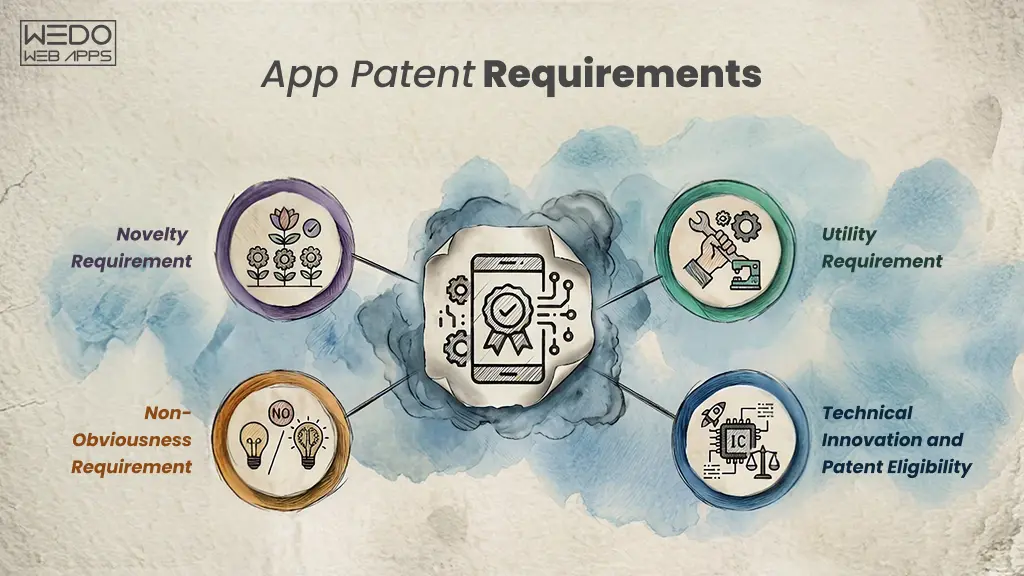
Before starting the app idea patent process, it's important to determine whether your application meets the requirements for patent protection. Patent offices evaluate inventions based on specific criteria to ensure they are genuinely innovative and useful.
Novelty Requirement
Your app must introduce something new that has not been publicly disclosed, patented, or described before. If a similar solution already exists, obtaining patent protection can become difficult.
For example, creating another messaging app is not enough. However, introducing a new method of secure communication may qualify as a novel invention.
Non-Obviousness Requirement
The innovation should not be an obvious improvement that someone with relevant technical knowledge could easily create.
A patent is more likely to be granted when the functionality solves a problem in a way that is not commonly used or expected within the industry.
Utility Requirement
The invention must serve a practical purpose and provide a clear benefit. In other words, the functionality should solve a real problem or improve an existing process.
Patent offices generally look for applications that offer measurable value rather than theoretical concepts.
Technical Innovation and Patent Eligibility
Most successful mobile app patents are based on technical innovation rather than business concepts alone. The patentable aspect often lies in how the application processes data, improves performance, enhances security, or delivers unique user eligibility requirements.
Documents Needed for an App Patent Application
Preparing accurate documentation is a key part of the patent filing process.
Common requirements include:
- Detailed description of the invention.
- Technical specifications and workflows.
- Diagrams or system architecture drawings.
- Claims defining what needs protection.
- Supporting documents and application forms.
Having clear documentation can improve the quality of your application and help patent examiners understand the innovation being protected.
| Requirement | What It Means |
|---|---|
| Novelty | The invention must be new |
| Non-Obviousness | The solution should not be an obvious improvement |
| Utility | The invention must have practical value |
| Technical Innovation | The app should provide a unique technical solution |
Step-by-Step App Idea Patent Process
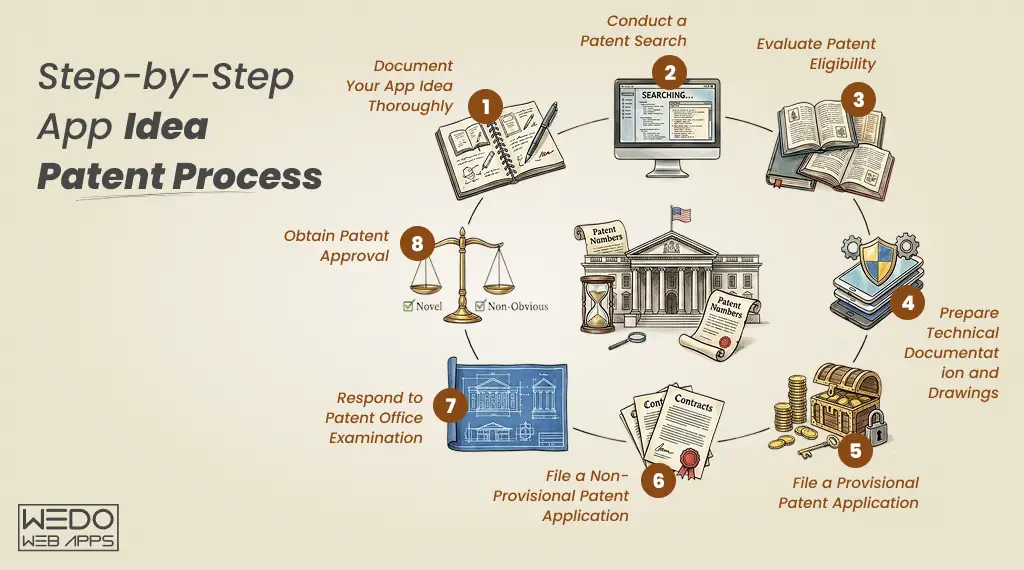
Understanding the app idea patent process is essential before investing time and resources into filing a patent application. While the process may vary slightly depending on the jurisdiction, the following steps are commonly involved in securing patent protection for a mobile app.
Step 1: Document Your App Idea Thoroughly
The first step is to create a detailed record of your app and the innovation behind it. Proper documentation helps establish ownership and makes it easier to explain your invention during the patent application process.
Include details such as:
- Core functionality and purpose of the app.
- Technical workflows and processes.
- Unique features and innovations.
- System architecture and user interactions.
The more clearly you document your invention, the stronger your foundation for the patent application.
Step 2: Conduct a Patent Search
Before filling an application, research existing patents and published applications to determine whether similar solutions already exist. This can help you assess the uniqueness of your invention and avoid unnecessary filing costs.
A patent search can help you:
- Identify similar patented technologies.
- Evaluate the novelty of your app.
- Reduce the risks of application rejection.
- Refine your invention if needed.
Many businesses work with patent professionals at this stage to conduct a more comprehensive search.
Step 3: Evaluate Patent Eligibility
Once you have completed your research, assess whether your app satisfies the key app patent requirements. Not every application qualifies for patent protection.
Your invention should generally be:
- New and not previously disclosed.
- Useful and capable of solving a problem.
- Non-obvious compared to existing solutions.
- Based on a technical innovation rather than a general concept.
This step helps determine whether pursuing a patent is a worthwhile investment.
Step 4: Prepare Technical Documentation and Drawings
Patent applications require detailed technical information that clearly explains how the invention works. The patent office uses this information to evaluate your application.
Typical documentation includes:
- Technical descriptions
- Flowcharts and process diagrams
- System architecture drawings
- Patent claims defining the scope of protection
Clear and accurate documentation can improve the quality of your application and reduce examination issues later.
Step 5: File a Provisional Patent Application
Many startups choose to file a provisional patent application first. This allows them to secure an early filing date while continuing development and market validation.
Benefits of a provisional application include:
- Lower initial filing costs
- Additional time to refine the product
- Opportunity to seek funding or partnerships
- Ability to establish an earlier priority date
In many cases, a provisional application remains valid for up to 12 months.
Step 6: File a Non-Provisional Patent Application
To move forward with the formal review process, you will need to file a non-provisional patent application. This submission contains complete details about the invention and the legal claims being protected.
The application typically includes:
- Detailed technical specifications
- Patent claims
- Supporting drawing and diagrams
- Required legal documentation
This is the application that will be examined by the patent office.
Step 7: Respond to Patent Office Examination
After reviewing the application, patent examiners may request additional information or raise objections regarding certain claims. This stage often involves communication between the applicant and the patent office.
You may need to:
- Clarify technical details
- Amend specific claims
- Provide supporting evidence
- Address examiner concerns
Timely and accurate responses can help keep the application moving forward.
Step 8: Obtain Patent Approval
If your application satisfies all legal and technical requirements, the patent office will grant patent protection for the approved invention.
A granted patent can provide:
- Exclusive rights to the patented functionality.
- Protection against unauthorized use.
- Potential licensing opportunities.
- Added value for investors and stakeholders.
Once approved, you will need to comply with any applicable maintenance requirements to keep the patent active.
App Patent Process Overview
| Step | Purpose |
|---|---|
| Document the idea | Record the invention and technical details |
| Conduct a patent search | Identify existing patents and prior art |
| Evaluate eligibility | Confirm patent qualification |
| Prepare documentation | Define and support the invention |
| File a provisional application | Secure an early filing date |
| File a non-provisional application | Begin formal examination |
| Respond to examination | Address patent office requests |
| Obtain patent approval | Receive patent protection |
Typical Timeline for the App Patent Process
| Stage | Estimated Time |
|---|---|
| Documentation and research | 1-4 weeks |
| Patent search | 1-3 weeks |
| Application preparation | 2-6 weeks |
| Provisional patent filing | 1-2 days |
| Non-provisional filing | 1-2 weeks |
| Patent examination | 12-36 months |
| Patent approval | Varies by complexity and jurisdiction |
While timelines vary, businesses should be prepared for a patent process that can take several months or even years. Starting early and maintaining thorough documentation can help streamline the journey from idea to protected innovation.
How Much Does It Cost to Patent a Mobile App?
One of the most common questions among founders and business owners is about the mobile app patent cost. The answer depends on several factors, including the complexity of the invention, the type of patent application, attorney involvement, and the jurisdiction where protection is sought.
In most cases, the total cost of patenting a mobile app can range from a few thousand dollars to tens of thousands of dollars. Understanding the different expenses involved can help you plan your budget more effectively.
Patent Search Costs
Before filing a patent application, it's advisable to conduct a patent search to identify similar inventions and assess the uniqueness of your app.
Patent search costs may vary depending on the depth of research and professional assistance required.
Typical expenses include:
- DIY patent search using public databases.
- Professional patent search services.
- Patentability assessment reports.
A thorough search can help reduce the risk of filing an application for an invention that already exists.
Patent Attorney Fees
Many businesses work with patent attorneys to prepare and file applications. While legal assistance increases upfront costs, it can also improve the quality of the application and reduce the likelihood of costly mistakes.
Attorney fees may cover:
- Patentability evaluations
- Application drafting
- Claim preparation
- Examiner response support
- Legal consultation throughout the process
The more complex the invention, the higher the legal fees are likely to be.
Provisional Patent Filing Costs
A provisional patent application is often the first step for startups and early-stage businesses. It established an initial filing date while providing time to refine the invention before submitting a full application.
Common costs include:
- Government filing fees
- Application preparation expenses
- Professional drafting support
This option is generally more affordable than filing a non-provisional application immediately.
Non-Provisional Patent Filing Costs
A non-provisional application begins the formal patent examination process and requires detailed technical documentation, claims, and supporting materials.
Expenses may include:
- Government filing fees
- Patent drafting costs
- Technical documentation preparation
- Legal review and submission support
This stage typically represents the largest portion of the overall mobile app patent cost.
Patent Maintenance Costs
Obtaining a patent is not always the final expense. In many jurisdictions, maintenance or renewal fees are required to keep the patent active and enforceable.
Ongoing costs may include:
- Periodic maintenance fees
- Administrative expenses
- Patent portfolio management costs
Businesses should account for these long-term obligations when planning their intellectual property strategy.
Factors That Affect App Patent Costs
The total cost of patenting an app can vary significantly depending on the invention and filing strategy.
Key cost factors include:
- Complexity of the app and underlying technology.
- Number of patent claims being filed.
- Attorney involvement and expertise.
- Geographic regions where protection is sought.
- Responses required during patent examination.
- Additional filings, amendments, or appeals.
Applications involving artificial intelligence, machine learning, fintech, or advanced software systems often require more detailed documentation, which can increase costs.
Mobile App Patent Cost Breakdown
| Cost Category | Estimated Cost Range |
|---|---|
| Patent search | $500-$3000 |
| Patent attorney fees | $2000-$10,000+ |
| Provisional patent application | $1000-$5000+ |
| Non-provisional patent application | $8000-$20,000+ |
| Patent maintenance fee | Varies by jurisdiction and patent type |
Startup Budget Considerations
For startups, patent protection should be evaluated as part of a broader business strategy rather than a standalone legal expense.
Before moving forward, consider:
- The commercial potential of the app.
- The competitive advantage provided by the invention.
- Available funding and budget constraints.
- The likelihood of competitors replicating the functionality.
- Long-term intellectual property goals.
In some cases, filing a provisional patent application first can provide an affordable way to secure an early filing date while continuing product development and market validation.
How Long Does the App Patent Process Take?
Securing patent protection is not an overnight process. While filing an application can be completed relatively quickly, obtaining final approval often takes much longer. The exact timeline depends on factors such as the complexity of the invention, application quality, patent office workload, and the number of examiner reviews required.
For most businesses, the app idea patent process can take anywhere from 18 months to several years from initial filing to patent approval.
Average Timeline for Patent Approval
The patent process involves multiple stages, each with its own review and preparation period.
| Stage | Estimated Time |
|---|---|
| Documentation and Research | 1-4 weeks |
| Patent Search | 1-3 weeks |
| Application Preparation | 2-6 weeks |
| Provisional Patent Filing | 1-2 days |
| Non-Provisional Patent Filing | 1-2 weeks |
| Initial Patent Office Review | Several months |
| Patent Examination | 12-36 months |
| Patent Approval | Varies by application complexity |
Although a provisional application can be filed quickly, the examination and approval stages generally require the most time.
Factors That May Delay Patent Approval
Several factors can extend the patent review process. Understanding these challenges can help businesses set realistic expectations.
Common causes of delays include:
- Incomplete or unclear documentation.
- Broad or complex patent claims.
- Existing patents with similar functionality.
- Requests for additional information from examiners.
- Application amendments and revisions.
- High application volumes at the patent office.
Submitting a well-prepared application can help reduce avoidable delays during examination.
Can You Launch an App While the Patent is Pending?
Yes, in many cases, businesses continue developing, testing, marketing, and even launching their applications while the patent application is under review.
This approach allows companies to:
- Validate market demand
- Generate revenue earlier
- Attract investors and stakeholders
- Continue product improvements during the review process
However, businesses should carefully manage public disclosures and consult an intellectual property professional when making decisions about launch timing.
While filing a patent application may take only a few weeks, obtaining full patent approval typically requires patience. Businesses should view patent protection as a long-term investment and plan product development, funding, and go-to-market strategies accordingly.
Patent vs Copyright vs Trademark for Mobile Apps
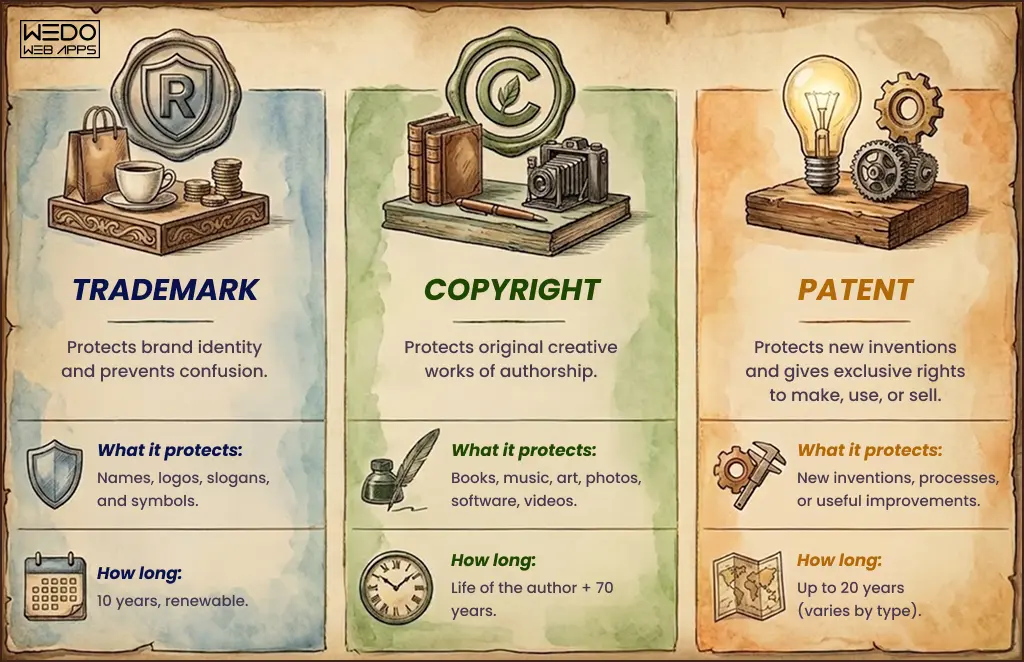
Many business owners assume that a patent is the only way to protect a mobile app. In reality, different forms of intellectual property protect different parts of an application. Understanding these differences can help you choose the right protection strategy for your product.
What Does a Patent Protect?
A patent protects the unique functionality, technical processes, or innovative methods used within an application. It gives the owner exclusive rights to the approved invention for a specific period.
Patents are commonly used to protect:
- Unique app functionalities.
- Technical workflows and processes.
- Data processing methods.
- Security and authentication systems.
- Innovative software technologies.
If you are looking to patent a mobile app idea, the patent typically covers how the innovation works rather than the app itself.
What Does Copyright Protect?
Copyright protects the original creative elements of an application. Unlike patents, it does not protect functionality or ideas.
Copyright protection generally applies to:
- Source code.
- User interface designs.
- App content and graphics.
- Images, videos, and written materials.
- Documentation and supporting materials.
Copyright is automatically created when original content is developed, although registration may provide additional legal benefits in some jurisdictions.
What Does a Trademark Protect?
A trademark protects the brand identity associated with your application. This helps prevent competitors from using similar names or branding that may confuse users.
Trademark protection can cover:
- App names.
- Company names.
- Logos.
- Taglines and slogans.
- Brand identifiers.
While a patent protects innovation, a trademark protects how customers recognize your product in the market.
Which Protection Does Your App Need?
Many successful applications use a combination of patents, copyrights, and trademarks to create a stronger intellectual property strategy.
For example:
- A patent can protect a unique recommendation algorithm.
- Copyright can protect the source code and design assets.
- A trademark can protect the app name and logo.
The right approach depends on your business goals, budget, and the type of innovation you are trying to protect.
Patent vs Copyright vs Trademark Comparison
| Protection Type | What It Protects | Example |
|---|---|---|
| Patent | Functionality, processes, and technical innovations | Unique payment processing |
| Copyright | Original code, content, and creative assets | Source code, graphics, app screens |
| Trademark | Brand identity and recognition | App name, logo, slogan |
| Trade Secret | Confidential business information | Proprietary algorithms and formulas |
If your goal is to protect a unique feature or technical innovation, a patent may be the most suitable option. If you are protecting code, content, or branding, copyright and trademark protection may be more appropriate. Many businesses use all three forms of protection to safeguard different aspects of their mobile applications.
Is Patenting an App Worth It for Startups and Businesses?
For many founders, the question is not just how to patent an app idea, but whether pursuing a patent is worth the investment. The answer depends on the uniqueness of your innovation, business goals, competitive landscape, and available resources.
While patent protection can offer significant advantages, it also requires time, effort, and financial commitment. Evaluating both the benefits and challenges can help determine whether a patent aligns with your business strategy.
Benefits of Patenting an App
A patent can provide more than legal protection. It can become a valuable business asset that supports growth and long-term competitiveness.
Potential benefits include:
- Protecting unique functionalities from competitors.
- Strengthening your market position.
- Increasing business valuation.
- Creating licensing and partnership opportunities.
- Supporting future expansion efforts.
For startups with innovative technology, a patent can help establish credibility in a competitive market.
Potential Challenges and Costs
Although patents offer valuable protection, they are not the right solution for every business.
Common challenges include:
- Significant filing and legal costs.
- Lengthy approval timelines.
- Ongoing maintenance requirements.
- Complex documentation and review processes.
- No guarantee of patent approval.
Businesses should carefully assess whether the expected value of the patent justifies the investment.
What a Patent Makes Business Sense
Patent protection is often worth considering when the app includes a unique technical innovation that provides a clear competitive advantage.
A patent may be a good fit if:
- The app solves a problem in a new way.
- Competitors could easily replicate the functionality.
- Intellectual property is central to the business model.
- Long-term growth and licensing opportunities exist.
The stronger the innovation, the greater the potential return on patent investment.
Alternatives to Patent Protection
In some situations, businesses may choose other forms of protection instead of pursuing a patent.
Possible alternatives include:
- Copyright protection for source code and creative assets.
- Trademark registration for brand identity.
- Non-disclosure agreements (NDAs).
- Trade secret protection for proprietary methods.
- Strong security and access controls.
These approaches may offer sufficient protection when a patent is not practical or financially justified.
Patenting an app is often worthwhile when the innovation provides meaningful business value and a sustainable competitive advantage. However, every business should evaluate the expected benefits, costs, timelines, and growth objectives before moving forward. The best decision is one that supports both your intellectual property strategy and long-term business goals.
Common Mistakes to Avoid When Patenting an App Idea
Even a strong application can face delays, additional costs, or rejection if common mistakes are overlooked. Understanding these pitfalls can help businesses navigate the app idea patent process more effectively and improve their chances of securing protection.
Sharing the Idea Before Filing
Publicly disclosing your invention before filing a patent application can affect your patent rights in certain jurisdictions. Sharing technical details through presentations, websites, product launches, or investor discussions without proper safeguards may create complications later.
To reduce risk:
- File before making public disclosures whenever possible.
- Use non-disclosure agreements (NDAs) when discussing sensitive information.
- Keep detailed records of what has been shared and when.
Skipping Patent Research
Many applicants move directly to filing without checking whether similar inventions already exist. This can result in wasted time, unnecessary expenses, and a higher likelihood of rejection.
Before filing:
- Conduct a patent search.
- Review similar products and technologies.
- Identify existing patents related to your concept.
- Assess how your invention differs from current solutions.
Assuming Every App Idea Is Patentable
Not all app concepts qualify for patent protection. Patents are generally granted for unique technical solutions rather than broad business ideas.
Keep in mind:
- Ideas alone cannot be patented.
- Generic app features are unlikely to qualify.
- Technical innovation is often the key factor.
- Patent eligibility should be evaluated early in the process.
Filling Incomplete Documentation
Patent examiners rely heavily on the information provided in the application. Missing details, weak claims, or unclear descriptions can slow the review process and weaken protection.
Your applications should clearly include:
- Technical descriptions.
- System workflows.
- Supporting diagrams.
- Detailed patent claims.
- Evidence of innovation.
Comprehensive documentation helps examiners understand the invention and evaluate its uniqueness.
Waiting Too Long to Start the Process
Many businesses delay patent planning until the product is nearly complete or already launched. Waiting too long can create unnecessary risks, especially if a competitor enters the market first.
Starting early can help:
- Secure an earlier filing date.
- Protect innovation before public release.
- Strengthen investor discussions.
- Support long-term intellectual property planning.
Quick Checklist Before Filing
Before starting the patent application process, make sure you have:
- Document your invention thoroughly.
- Conducted a patent search.
- Evaluated patent eligibility.
- Prepared technical documentation and drawings.
- Considered provisional patent filing options.
- Review your intellectual property strategy.
Avoiding these common mistakes can save time, reduce costs, and improve the likelihood of obtaining meaningful patent protection for your mobile app.
How to Protect Your App Idea Before Filing a Patent
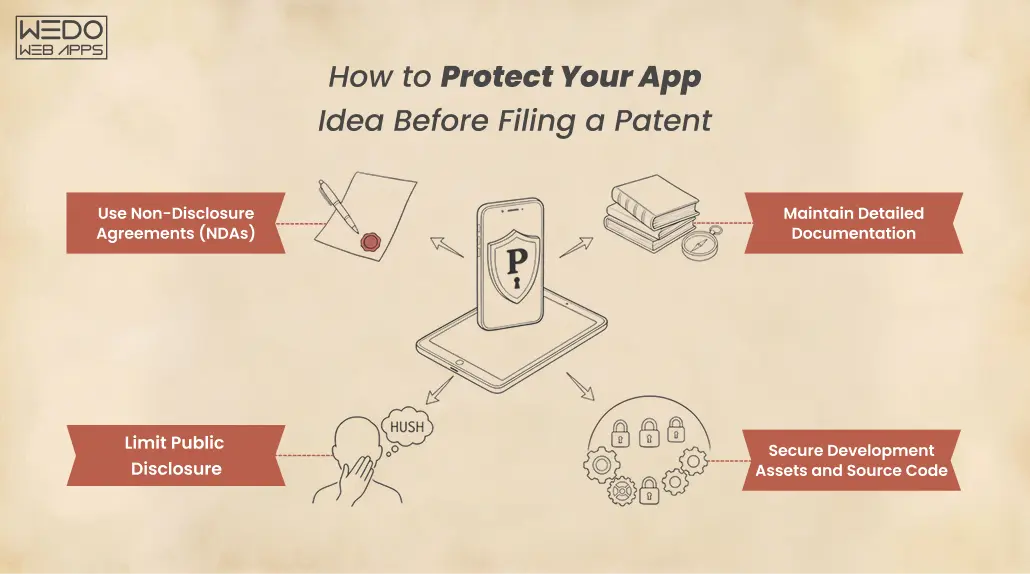
Patent protection can take time, and not every business is ready to file immediately. However, that doesn't mean your innovation should remain unprotected. Taking the right precautions early can help reduce risks and strengthen your position before starting the formal app idea patent process.
Use Non-Disclosure Agreements (NDAs)
If you need to discuss your app idea with developers, designers, consultants, investors, or business partners, consider using a Non-Disclosure Agreement (NDA). This legal document helps establish confidentiality and limits how shared information can be used.
An NDA can help:
- Protect sensitive business information.
- Reduce the risk of unauthorized disclosures.
- Create legal accountability for confidential discussions.
- Provide greater confidence when collaborating with third parties.
Maintain Detailed Documentation
Well-organized records can help demonstrate ownership and support future patent applications. Documentation also makes it easier to explain how your invention evolved over time.
Keep records of:
- Product requirements and specifications.
- Feature descriptions and workflows.
- Technical diagrams and architecture.
- Development milestones and updates.
- Research and testing activities.
Detailed documentation can be valuable if ownership or originality is ever questioned.
Limit Public Disclosure
Publicly sharing technical details before filing a patent application may impact your ability to obtain protection in certain jurisdictions.
To minimize risk:
- Avoid publishing technical details online.
- Limit product demonstrations before filing.
- Be cautious when discussing proprietary features publicly.
- Share only essential information during early business discussions.
Protecting confidential information early can help preserve future patent opportunities.
Secure Development Assets and Source Code
Your application's source code, technical documents, and design assets are valuable intellectual property. Strong security practices can help prevent unauthorized access or misuse.
Consider implementing:
- Access controls and permission management.
- Secure cloud storage and backups.
- Version control systems.
- Internal confidentiality policies.
- Regular security reviews.
Protecting development assets is an important part of safeguarding innovation, regardless of whether you pursue a patent.
Before filing a patent application, focus on protecting your idea through confidentiality, documentation, and security best practices. These measures can help preserve the value of your innovation while you evaluate patent options and prepare for the application process.
Key Considerations Before Investing in App Patent Protection
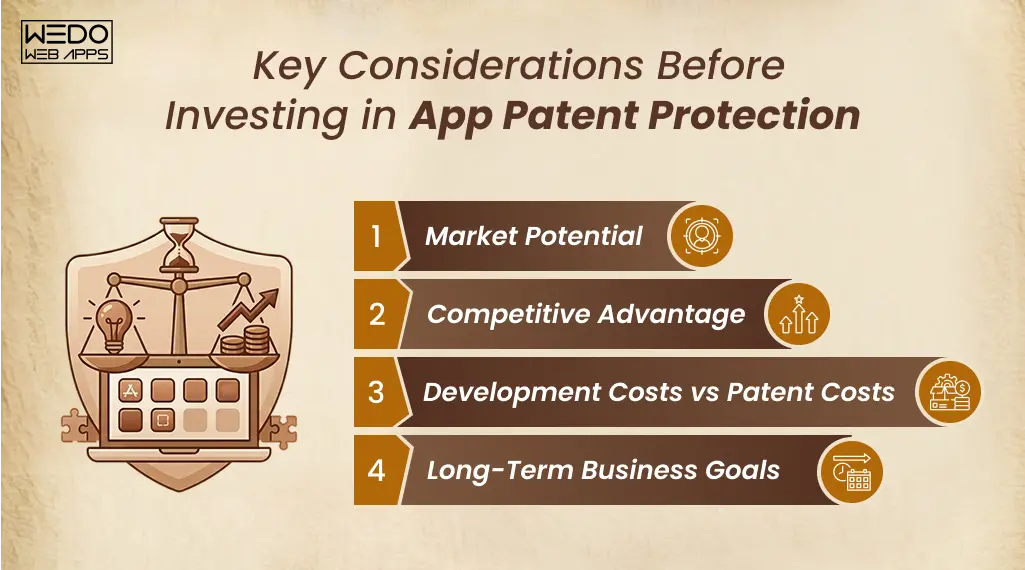
Patent protection can offer significant advantages, but it also requires time, effort, and financial investment. Before moving forward, businesses should evaluate whether pursuing a patent aligns with their product strategy, growth plans, and long-term objectives.
Market Potential
A patent becomes more valuable when the underlying product has strong commercial potential. Before investing in patent protection, assess the size of the market, customer demand, and revenue opportunities associated with the app.
Consider questions such as:
- Is there a clear market need for the solution?
- Does the app address a meaningful problem?
- Is there sufficient growth potential in the target market?
- Can the product generate long-term business value?
The stronger the market opportunity, the easier it becomes to justify patent-related expenses.
Competitive Advantage
Not every app requires patent protection. The decision often depends on how important the innovation is to your competitive position.
A patent may be worth considering if:
- The functionality is difficult to replicate.
- The innovation differentiates your product from competitors.
- Competitors could gain an advantage by copying the feature.
- Intellectual property plays a central role in your business model.
The greater the competitive value of the innovation, the stronger the case for patent protection.
Development Costs vs Patent Costs
Businesses should evaluate patent expenses alongside overall product development costs. In some cases, allocating resources to product development, market validation, or customer acquisition may deliver greater short-term returns.
Before processing, compare:
- Product development budget.
- Patent filing and legal expenses.
- Ongoing maintenance costs.
- Expected return on investment.
This assessment helps ensure that patent spending supports broader business priorities.
Long-Term Business Goals
Patent decisions should align with the company's future plans rather than immediate needs alone. What makes sense for a startup preparing to raise funding may differ from the priorities of an established business.
Patent protection may support goals such as:
- Attracting investors.
- Increasing company valuation.
- Expanding into new markets.
- Creating licensing opportunities.
- Building a stronger intellectual property portfolio.
When viewed as part of a long-term strategy, a patent can become a valuable business asset rather than just a legal document.
Questions to Ask Before Filing
Before starting the app idea patent process, consider the following:
- Does the app contain a unique technical innovation?
- Would copying the functionality impact the business significantly?
- Can the expected value justify the patent investment?
- Does patent protection support future growth plans?
- Are these alternative forms of intellectual property protection available?
Answering these questions can help determine whether patent protection is the right move for your app and overall business strategy.
Conclusion
Protecting an innovative app begins with understanding whether it qualifies for patent protection and what steps are involved in the process. From meeting app patent requirements to navigating the app idea patent process, taking the right software development approach early can help safeguard your intellectual property and support long-term business growth.
Whether you are validating a startup concept or developing a new digital product, evaluating patent protection alongside your overall business strategy can help you make informed decisions. With proper planning, a unique app idea can become a valuable and protected business asset.