Introduction
You have an app idea. You can see the users. You can even see the business potential. But one question can hold everything up: how much money can you make from an app?
The answer depends on what happens after the download. Do users keep coming back? Will they pay for premium features? Can advertising generate enough revenue? Does your pricing match what your audience is willing to spend?
A successful android app development needs a revenue model that fits the product and its users. Subscriptions, in-app purchases, advertising, paid downloads, and transaction fees can all generate income in different ways.
If you are planning to build an app, understanding these numbers and revenue models early can help you set realistic expectations and build around a business model that can actually generate revenue.
How Much Money Can You Make From an App?
The earning potential of an app can range from a small side income to substantial business revenue. There is no single figure that applies to every app.
How much money can you make from an app depends on what offer, who uses it, and how you turn that usage into revenue. An app with 10,000 downloads can earn less than another app with the same number of downloads if fewer users stay active or make purchases.
For example, a fitness app may charge a monthly subscription, while a gaming app may earn from in-app purchases and advertising. An eCommerce app can generate revenue through product sales, while a marketplace may charge a fee on every transaction.
Your revenue also depends on factors such as:
- Active users: More active users create more opportunities for purchases, subscriptions, or ad impressions.
- <Retention: Users who continue using your app give you more chances to generate revenue over time.
- Monetization model: Subscriptions, advertising, paid downloads, and in-app purchases produce revenue in different ways.
- Conversion rate: A larger user base does not guarantee higher earnings if very few users become paying customers.
- User location: Revenue potential can vary across markets because spending behavior and advertising rates differ by region.
- App category: Gaming, fitness, business, education, eCommerce, and other categories have different ways of generating revenue.
It is also important to separate app revenue from app profit. Your revenue is the money your app generates. Your profit is what remains after deployment, marketing, hosting, payment processing, platform fees, maintenance, and other operating costs.
So, if you are asking can you make money from apps, the answer is yes. The more useful question is how your app will generate revenue and whether that model can support your business goals.
What Determines How Much Money an App Makes?
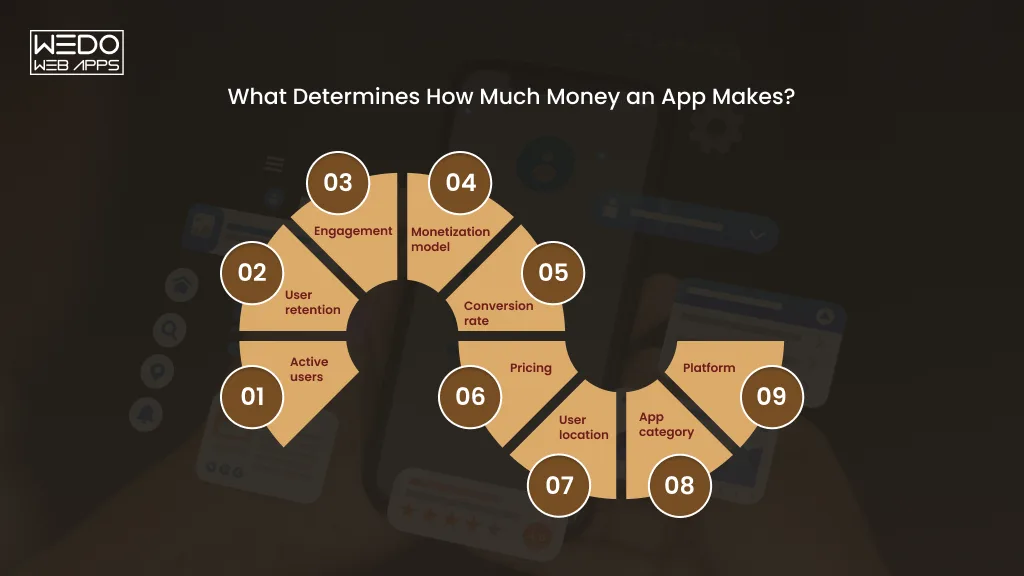
Two apps can have the same number of downloads and generate very different revenue. The difference usually comes from what users do after installing the app.
Here are the factors that can change your earning potential.
| Factor | Why it matters for revenue |
|---|---|
| Active users | A large download count means little if most users stop opening the app. |
| User retention | Returning users create more opportunities for subscriptions, purchases, and ad revenue. |
| Engagement | More sessions and meaningful activity can increase purchases or monetizable ad impressions. |
| Monetization model | Your revenue depends on whether you use subscriptions, advertising, in-app purchases, paid downloads, or another model. |
| Conversion rate | A small percentage of paying users can have a major impact on total revenue. |
| Pricing | Your subscription or purchase price affects both revenue per customer and willingness to pay. |
| User location | Spending behavior and advertising rates can vary significantly between markets. |
| App category | A gaming app has different revenue opportunities from a productivity or eCommerce app. |
| Platform | User behavior, pricing, and store economics can differ between iOS and Android. |
Downloads Are Only the Starting Point
A download tells you that someone installed the app. It does not tell you whether that person will use it tomorrow, subscribe next month, or make a purchase.
For revenue planning, metrics such as daily active users, retention rate, conversion rate, average revenue per user, and revenue per install give you a much clearer picture.
That is why an app with fewer downloads can sometimes generate more revenue than a high-download app. The quality and behavior of its user base can matter more than the raw installation count.
How Do Apps Make Money?
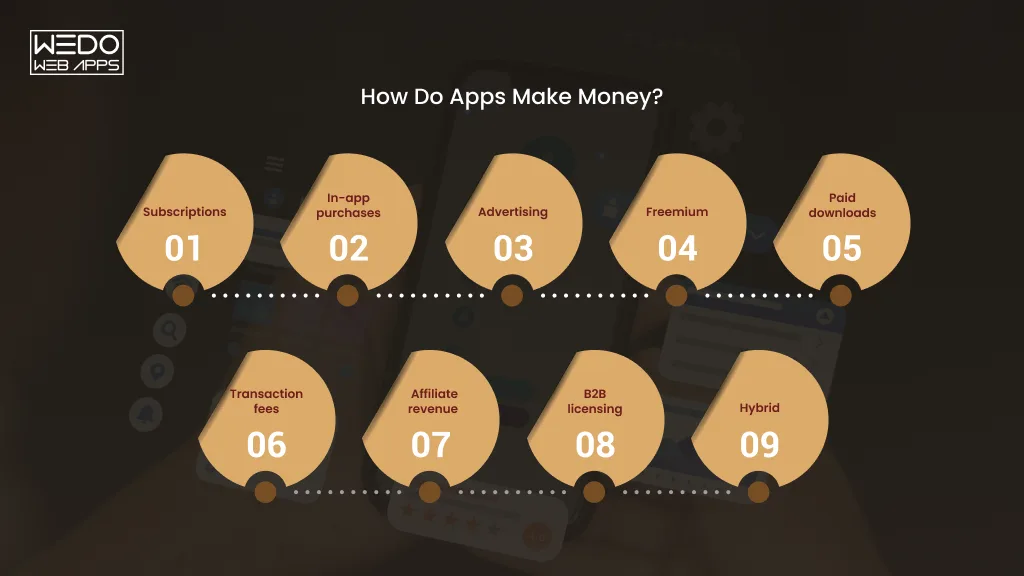
If you are asking how do apps make money, there are several ways to turn an app into a revenue-generating business. Some models charge users directly. Others generate income from transactions, advertising, or premium access.
The right choice depends on your audience, app category, usage pattern, and the value your product provides.
| Monetization model | How it works | Common app types |
|---|---|---|
| Subscriptions | Users pay recurring fees for continued access | Fitness, SaaS, education, media |
| In-app purchases | Users purchase digital items or features | Gaming, entertainment, consumer apps |
| Advertising | Businesses pay to reach your users | Gaming, content, social, utility |
| Freemium | Free core product with paid upgrades | Productivity, design, business |
| Paid downloads | Users pay before accessing the app | Professional tools, premium apps |
| Transaction fees | App takes a fee from completed transactions | Marketplaces, booking, delivery |
| Affiliate revenue | Apps earn commissions from referred sales | Shopping, travel, comparison |
| B2B licensing | Businesses pay to use the software | Enterprise, workflow, industry apps |
| Hybrid | Combines multiple revenue sources | Large consumer and marketplace apps |
Subscriptions
How it works: Users pay a recurring monthly or annual fee to access premium content, features, or services.
Works well for: Apps that provide ongoing value, including fitness platforms, productivity software, education apps, streaming services, and business tools.
Example: A fitness app could charge $9.99/month for personalized workout value to continue paying.
For this model, retention matters heavily. You need users to keep seeing enough value to continue paying.
In-App Purchases
Instead of charging every user upfront, you give users the option to purchase digital items or additional features inside the app.
Common examples include:
- Virtual currency and items in games
- Premium content
- Feature upgrades
- Extra storage
- Digital courses or resources
This model suits apps where users have different purchasing needs. Gaming is a particularly common example because users can decide what they want to buy as they use the product.
Advertising
Advertising can help you make money from apps without requiring every user to become a paying customer.
Your app displays advertisements and earns revenue based on factors such as impressions, clicks, engagement, and other advertiser or network metrics.
Common formats include:
- Banner ads
- Interstitial ads
- Native ads
- Rewarded video ads
Gaming, entertainment, content, social, and utility apps can use advertising when they have enough active users and engagement to generate meaningful ad activity.
Freemium Features
The freemium model gives users a useful free version and places selected features behind a paid plan.
Think of it as:
Free access -> Product experience -> Premium feature -> Upgrade
Good fit for: Productivity, design, communication, education, and business apps.
For example, a project management app could offer basic task management for free while charging for team collaboration, automation, reporting, or advanced permissions.
The challenge is finding the right balance. The free version needs enough value to attract users, while the premium features need to provide a clear reason to upgrade.
Paid Downloads
With a paid download model, users purchase the app before they can access it.
This approach is simple:
App listing -> Purchase -> Download -> Access
It can work for specialised tools, professional utilities, premium games, and niche applications where users already understand the product's value.
The trade-off is acquisition. An upfront price can make users more cautious about downloading an unfamiliar app.
Transaction Fees and Commissions
Here, your app earns when users complete transactions through the platform.
Revenue formula:
Transaction value x Commission rate = App revenue
For example, a marketplace processing $100,000 in transactions with a 5% commission would generate $5,000 in transaction revenue before applicable costs.
Common use cases:
- Marketplace apps
- Booking platforms
- Delivery apps
- Service marketplaces
- Payment platforms
This model is particularly relevant when your app connects buyers with sellers or facilitates a transaction.
Affiliate and Referral Revenue
Affiliate monetization works by sending users to another business and earning a commission when they complete a qualifying action.
Typical flow:
User discovers product -> Clicks referral -> Completes purchase -> Partner pays commission
Travel, shopping, comparison, finance, and recommendation apps can use this model when their content or recommendations influence purchasing decisions.
B2B Licensing
Consumer apps are not the only products that can generate revenue. A business app can sell access directly to companies through licensing agreements.
Businesses may pay for:
- User or seat access
- Annual software licences
- Usage-based access
- Enterprise features
- Custom deployments
This model is suitable for specialized software, workflow applications, industry-specific tools, and enterprise solutions where the customer receives measurable business value.
Hybrid Monetization
Some businesses combine multiple revenue streams instead of depending on one model.
For example:
| App type | Revenue combination |
|---|---|
| Fitness app | Free access + advertising + subscription |
| Gaming app | Advertising + in-app purchases |
| Marketplace | Transaction fees + promoted listings |
| Productivity app | Freemium + subscription |
| Travel app | Affiliate commissions + premium features |
A hybrid strategy can help you serve different user segments. However, each revenue stream should have a clear purpose and fit naturally into the product experience.
When deciding how to make money from apps, start with your users and their behavior. If people need ongoing access, subscriptions may fit. If they make transactions, commissions may make more sense. If your app attracts a large free audience, advertising could become part of the model.
Your monetization strategy should be considered alongside the product, pricing, and target market before development begins.
How Much Can an App Make From Advertising?
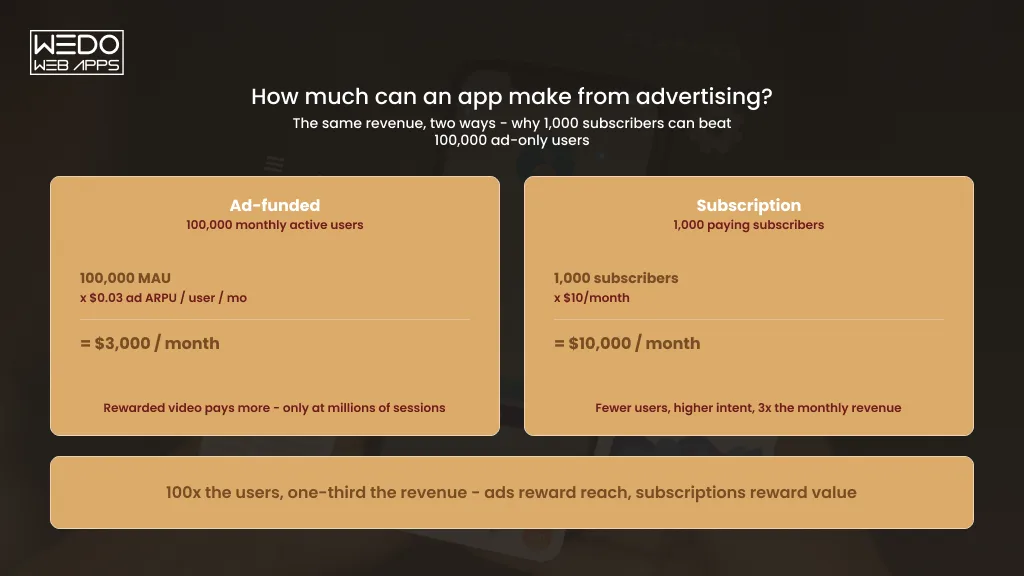
An app can generate advertising revenue without charging users for downloads or premium access. But the number of downloads alone does not tell you how much an app can make from advertising.
Your earnings depend on how many users remain active, how often they see ads, which formats you use, and the value advertisers place on your audience.
How Is App Advertising Revenue Calculated?
A simple way to estimate ad revenue is:
Ad revenue = Ad impressions / 1000 x eCPM
Here, eCPM represents the estimated revenue earned for every 1000 ad impressions.
For example, if your app generates 500,000 ad impressions and the effective CPM is $5: 500,000 / 1000 x $5 = $2,5000
This is a simplified calculation. Actual earnings can vary based on the ad network, full rate, user location, platform, ad format, and advertiser demand.
Which Ad Formats Can Generate Revenue?
Different ad formats create different opportunities for monetization.
| Ad format | How it appears | Common use |
|---|---|---|
| Banner ads | Small ads displayed within the interface | Utility and content apps |
| Interstitial ads | Full-screen ads between app experiences | Gaming and entertainment |
| Native ads | Ads designed to fit into the app's content | Social and content apps |
| Rewarded video | Users watch an ad in exchange for a benefit | Gaming and freemium apps |
Rewarded ads can be particularly useful when users receive something valuable in return, such as extra game lives, virtual currency, or temporary access to a premium feature.
What Affects Your Advertising Revenue?
Two apps with the same number of downloads can earn very different amounts from ads.
Your potential app advertising revenue can be affected by:
- Active users: More active users create more opportunities for ad impressions.
- Session frequency: Users who return frequently can generate more monetizable activity.
- Ad impressions: More impressions can increase revenue, provided they do not damage the user experience.
- Audience location: Advertiser demand and rates can vary between markets.
- Ad format: Different formats can produce different revenue levels.
- App category: Advertiser demand varies across industries and audiences.
- Platform: Advertising performance can differ between iOS and Android.
- User retention: Returning users give your app more opportunities to generate revenue over time.
A Large Audience Is Not Enough
Suppose two apps each have 100,000 downloads.
App A has low retention and users open it once before leaving.
App B has strong retention and users return several times each week.
App B can create significantly more ad impressions from the same download count.
That is why businesses planning an advertising-based app should track active users, retention, sessions, impressions, and revenue per user, rather than using downloads as the main revenue indicator.
Advertising can be a useful part of how to make money from apps, especially when your product is designed for frequent use and can build a large active audience without putting the core experience behind a paywall.
How Much Money Do Apps Make Per Download?
A download does not automatically generate income. Someone can install your app, open it once, and never return. Another user may install the same app, subscribe, make purchases, or generate hundreds of ad impressions over several months.
That is why there is no fixed answer to how much money do apps make per download. Your revenue per download depends on what happens after the installation.
What Happens After an App Download?
Think of the revenue journey like this:
Download -> Activation -> Engagement -> Retention -> Monetization -> Revenue
Each stage affects how much value you get from an acquired user.
| Monetization model | When the app generates revenue | What affects earnings |
|---|---|---|
| Paid app | When the user purchases the app | Price and number of purchases |
| Subscription | When the user starts and maintains a subscription | Conversion, pricing, and retention |
| In-app purchase | When the user completes a purchase | Purchase rate and average order value |
| Advertising | When the user generates monetizable ad activity | Impression, eCPM, location, and engagement |
| eCommerce | When the user completes a product purchase | Conversation rate and order value |
| Affiliate | When a referred user completes a qualifying action | Referral volume and commission |
| Transaction Fees | When a user completes a transaction | Transaction volume and fee percentage |
Why Downloads Alone Can Be Misleading
Imagine an app receives 50,000 downloads.
If only 5% of those users remain active, the business has a very different revenue opportunity from an app where 40% continue using it.
The same applies to paying users. An app with fewer downloads can generate more revenue if it attracts users who are more likely to subscribe or make a purchase.
This makes revenue per install a more useful metric for many app businesses than simply counting downloads.
Revenue Per Install Can Show More
Revenue per install helps you understand how much revenue your app generates from acquired users over a defined period.
For example:
Revenue per install = Revenue generated / Number of installs
If your app generates $10,000 from $20,000 installs:
$10,000 / $20,000 = $0.50 revenue per install
The timeframe matters. Revenue generated during the first 30 days will tell you something different from revenue tracked over a year.
For subscription apps, recent RevenueCat data illustrates how widely this metric can vary by market. Its 2026 subscription-app benchmark report, based on data from more than 115,000 apps, found median D60 revenue per install of $0.55 in North America, $0.42 on the App Store globally, and $0.16 in Google Play globally within its dataset. These figures apply specifically to subscription apps included in RevenueCat's dataset, so they should not be treated as a universal benchmark for every type of app.
The takeaway is simple: when you ask how much money can you make from an app, look beyond downloads. Track what users do after installing, how long they stay, and how effectively your product converts that activity into revenue.
Can You Make Money From Apps Without Charging Users?
Yes, you can make money from apps without charging users to download them. In many cases, keeping the initial experience free can help you attract a larger audience and give users a chance to experience the product before pricing.
The important question is what happens after the download.
Ways a Free App Can Generate Revenue
| Revenue source | How the free app earns |
|---|---|
| Advertising | Users see ads while using the app, generating advertising revenue. |
| Freemium upgrades | Users pay to unlock advanced features or remove limitations. |
| Subscriptions | Free users can upgrade to recurring premium plans. |
| In-app purchases | Users purchase digital products, content, or features. |
| Transaction fees | The app earns a fee when users complete transactions. |
| Affiliate revenue | The business earns commissions from qualifying referrals. |
| Lead generation | The app connects users with a business that pays for qualified leads. |
| eCommerce | The app generates revenue by selling physical or digital products. |
Your Free Users Still Have Business Value
A user does not have to pay directly for your app to contribute to revenue.
For example, a free user could:
Use the app -> View relevant ads -> Generate ad revenue
Or:
Use free features -> See premium benefits -> Upgrade to a subscription
A marketplace can take another route:
Browse products -> Contact seller -> Complete transaction -> Platform earns a fee
This is why can you make money from apps is not simply a question of whether users pay upfront. It is about whether your product creates enough value and activity to support a sustainable revenue model.
When a Free Model Makes Sense
A free entry point can work particularly well when:
- You want to build a large user base.
- Users need to experience the product before paying.
- Your app benefits from frequent usage.
- Advertising can support the free experience.
- Premium features provide a clear upgrade path.
- Your business earns from transactions rather than downloads.
However, free does not automatically mean profitable. You still need enough active users, engagement, retention, and monetization opportunities to cover the cost of acquiring and serving those users.
If your goal is to make money from apps, decide how a free user can eventually create business value before you build the product. That decision can influence your features, pricing, user journey, and acquisition strategy.
How to Make Money From Apps
Making money from an app starts before development. You need to know who will use it, what problem you are solving, and why someone would pay for the solution.
Use this process to turn an app idea into a revenue opportunity.
1. Start With a Problem Users Will Pay to Solve
Look for a problem that costs users time, money, effort, or missed opportunities.
For example, a business app that reduces manual reporting has a clearer commercial value than an app that simply adds another way to record information.
Ask yourself:
- Who has this problem?
- How often does it occur?
- What are they using today?
- Would solving it save them money or time?
2. Identify Your Target Audience
Your audience affects your pricing, features, acquisition strategy, and app monetization model.
Define your users by factors such as:
Industry -> User type -> Problem -> Buying behavior -> Budget
A consumer fitness app and an enterprise workflow app may solve very different problems, so they should not follow the same revenue strategy.
3. Choose Your Monetization Model
Decide how the app will generate revenue before you start building features.
You could use:
- Subscriptions for recurring access.
- In-app purchases for digital product upgrades.
- Advertising for a free, high-usage product.
- Transaction fees for marketplaces.
- Paid downloads for specialised applications.
- B2B licensing for business software.
Your choice should follow the way users receive value from the app.
4. Validate Demand Before Development
Do not spend heavily on development before checking whether people actually want the product.
You can validate the ideas through:
- Customer interviews
- Competitor research
- Landing pages
- Surveys
- Prototypes testing
- Small paid campaigns
- Pre-orders or early-access signups
Look for evidence that users have the problem and are willing to consider your solution.
5. Build an MVP
Start with the features required to solve the core problem.
An MVP lets you test the product with real users without committing your entire development budget upfront.
For example, if your app helps restaurants manage inventory, the first version may need stock tracking, alerts, and basic reporting. Advanced analytics can come later.
6. Test Your Pricing
Your first price does not have to be permanent.
Test different:
- Subscription plans
- Feature limits
- Trial periods
- One-time purchase prices
- Premium packages
Track how pricing affects conversion rate, retention, and revenue per user.
7. Track User Behavior
Once people start using the app, measure what happens after installation.
Key metrics include:
| Metric | What it tells you |
|---|---|
| Activation rate | Whether new users reach the first meaningful action |
| Retention rate | Whether users continue coming back |
| Conversion rate | How many become paying customers |
| ARPU | Average revenue generated per user |
| Revenue per install | Revenue generated from acquired installs |
| Churn | How quickly paying or active users leave |
These numbers help you identify where users are dropping off and where revenue opportunities exist.
8. Improve Retention and Conversion
Getting users into your app is only the beginning.
If users leave quickly, your acquisition spend becomes harder to recover. If users stay but never convert, you may need to rethink your pricing, premium features, or upgrade journey.
Use user feedback and behavioural data to improve both the product and the path to purchase.
9. Scale User Acquisition
Once you have evidence that users stay, engage, and generate revenue, you can invest more heavily in acquisition.
Depending on your audience, this could include:
App Store optimization -> Paid advertising -> Content marketing -> Social media -> Partnership -> Referral programmes
The goal is to acquire users at a cost that makes commercial sense compared with the revenue and lifetime value they generate.
The most important part of how to make money from apps is to connect the entire process. A good idea needs a defined audience, a clear value proposition, a suitable monetization model, and enough retention to turn users into sustainable revenue.
How to Make an App That Makes Money
A profitable app starts with a product people have a reason to keep using. If monetization is added after development, you may end up with features users do not need or a payment flow that feels disconnected from the experience.
If you want to know how to make an app that makes money, build the product and its revenue model together.
Validate the Problem
Start with the problem, not the feature list.
Talk to potential users and find out how they currently handle the problem. Look for frustration, recurring costs, inefficient processes, and gaps in existing solutions.
The stronger the problem, the easier it is to create a product with clear commercial value.
Research Your Market
Study competing apps before investing in development.
Look at:
- Features users value
- Pricing and subscription plans
- Customer reviews
- Common complaints
- Competitor strengths and gaps
- Monetization methods
This can show you where your app could provide a more useful experience.
Define Your Revenue Model
Decide how the product will generate revenue and connect that model to the user journey.
For example:
Problem-solving app -> Free core feature -> Premium capability -> Subscription
Or:
Marketplace -> Buyer and seller activity -> Transaction -> Platform commission
Your revenue model should influence product requirements from the beginning.
Build the Core Features First
Do not overload the first version with features simply because competitors have them.
Focus on the functions users need to achieve the main outcome. This keeps the app development cost under control and gives you a cleaner product to test.
Once users show demand, you can expand the feature set based on actual usage.
Create a Clear Free-to-Paid Journey
If your app uses freemium or subscription monetization, users should understand what they receive at each level.
A simple journey could look like:
Free feature -> Experience the value -> Premium benefit -> Upgrade
Your upgrade prompts should appear when the premium feature solves a real user need. Avoid interrupting important workflows with unnecessary payment prompts.
Measure Retention and Conversion
Downloads tell you how many people installed the app. They do not tell you whether the business model is working.
Track metrics such as:
| Metric | Why track it? |
|---|---|
| Activation | Shows whether users reach the app's core value |
| Retention | Shows whether users continue using the product |
| Conversion | Shows how effectively users become customers |
| ARPU | Shows average revenue per user |
| Revenue per install | Connects acquisition with revenue |
| Churn | Shows how quickly customers leave |
These metrics help you identify whether the problem is acquisition, product value, pricing, or monetization.
Improve Based on User Data
Your first version will give you information that planning alone cannot.
Use reviews, analytics, support conversations, and user behavior to identify friction. You may find that users love one feature while ignoring the others. That insight can guide your next release.
The goal is to keep improving the parts of the product that influence retention, engagement, and revenue.
Scale Once the Model Works
Do not treat user acquisition as the first measure of success.
First establish that people use the app, stay active, and generate enough revenue to support the business model. Then increase your app marketing strategy and acquisition efforts.
That gives you a clearer path to building an app that can generate sustainable revenue rather than simply accumulating downloads.
What Does It Cost to Build an App That Makes Money?
Building an app that generates revenue requires more than paying for the initial development. Your budget can also include research, UI/UX design, backend infrastructure, third-party services, testing, launch, marketing, and ongoing maintenance.
There is no single app development cost because the scope of the product determines how much work is involved.
What Influences App Development Cost?
| Cost factor | What can increase the budget? |
|---|---|
| Features | Advanced workflows, real-time functions, payments, chat, AI, or complex user roles |
| UI/UX Design | Custom interfaces, prototypes, animations, and user testing |
| Backend development | APIs, databases, authentication, dashboards, and server-side logic |
| Integrations | Payment gateways, maps, CRMs, analytics, social logins, and other third-party systems |
| Platforms | Building for iOS, Android, web, or multiple platforms |
| Security | Data protection, encryption, access controls, and compliance requirements |
| Testing | Functional, performance, security, and device testing |
| Maintenance | Bug fixes, updates, infrastructure, compatibility, and new features |
| Marketing | App Store optimization, advertising, content, partnerships, and user acquisitions |
Start With the Revenue-Critical Features
You do not need to build every planned feature in version one.
Suppose you are creating a subscription-based fitness app. The first version may need user accounts, workout plans, progress tracking, subscription payments, and basic notifications.
Advanced analytics, social challenges, wearable integrations, and personalized recommendations can come later.
This approach lets you test whether users actually value the core product before committing more budget to development.
Remember the Cost After Launch
Your initial development budget is only part of the financial picture.
You may continue spending on:
Hosting + third-party services + payment processing + maintenance + customer support + marketing
If your goal is to make money from apps, calculate these ongoing costs before setting your pricing or revenue targets.
A product that generates $20,000 in monthly revenue can have a very different business outcome depending on how much it costs to acquire users, operate the platform, and maintain the app.
App Revenue vs App Profit: What Do You Actually Keep?
Seeing an app generate $50,000 in revenue can sound impressive. But that does not mean the business keeps $50,000.
App revenue is the money generated through subscriptions, purchases, advertising, transactions, or other sources. App profit is what remains after you pay the costs involved in running and growing the business.
Where Does App Revenue Go?
Your actual profit can be affected by several expenses:
| Cost | What it can include |
|---|---|
| App store fees | Applicable platform commissions on qualifying purchases |
| Payment processing | Fees for processing payments |
| Development | Initial development and future feature work |
| Hosting | Servers, databases, storage, and bandwidth |
| Third-party services | APIs, analytics, messaging, maps, AI services, and other tools |
| Marketing | Paid acquisition, content, partnerships, and campaigns |
| Customer support | Staff and tools needed to assist users |
| Maintenance | Bug fixes, security updates, compatibility work, and ongoing improvements |
For example, an app that generates $30,000 in monthly revenue may have significantly lower profit if it spends heavily on advertising, infrastructure, development, and customer acquisition.
Revenue Does Not Tell the Whole Story
When evaluating how much money can you make from an app, track both sides of the equation:
Revenue -> Operating costs -> Profit
You should also consider customer acquisition cost and customer lifetime value. If acquiring a customer costs more than the revenue that customer generates over time, increasing downloads will not necessarily improve the business.
This is why your revenue target should be connected to your pricing, retention, acquisition costs, and operating expenses from the beginning.
How Much Can an App Developer Make?
If you are searching how much can an app developer make, you may be asking about a career or freelance income rather than the revenue generated by an app.
These are two different measures.
An app developer's earnings usually come from employment, freelance projects, contracts, or development services. The amount can vary based on experience, technical skills, location, employment type, and the technologies involved.
An app owner, meanwhile, earns from the business model behind the product. That could include subscriptions, advertising, in-app purchases, transaction fees, or paid downloads.
| App developers earnings | App revenue |
|---|---|
| Salary, freelance fees, or project payments | Money generated by the app |
| Influenced by skills and experience | Influenced by users and monetization |
| Usually paid for development work | Generated through customer activity |
| Can be earned before an app becomes profitable | Depends on the app's commercial performance |
So, queries such as how much does app developer make and how much does app developers earn should not be confused with how much money can you make from an app.
If your goal is to build and own an app, focus should be on the product's revenue model, user acquisition, retention, conversion, and operating costs.
Which App Monetization Model Should You Choose?
The right app monetization model depends on how your users receive value from the product. A subscription may suit an app that delivers ongoing content, while a marketplace may earn more naturally from completed transactions.
Use your app type as a starting point, then consider your audience, usage frequency, and willingness to pay.
| App type | Common revenue models | Why they can fit |
|---|---|---|
| Gaming | In-app purchases, advertising | Users can purchase virtual items or engage with rewarded ads |
| Productivity | Subscription, freemium | Advanced tools can sit behind a recurring plan |
| Fitness | Subscription, paid content | Users may pay for ongoing programs and personalized services |
| Education | Subscription, paid content, in-app purchases | Revenue can come from courses, lessons, or premium resources |
| eCommerce | Product sales | The app directly supports product purchases |
| Marketplace | Transaction fees, commissions | The platform earns when buyers and sellers transact |
| Media | Advertising, subscriptions | Free content can support ads while premium access supports subscriptions |
| B2B Software | Subscription, licensing | Businesses can pay for ongoing access to specialized tools |
Match Revenue With User Behavior
Ask three questions before choosing your model:
- How often will users need the product? Frequent, ongoing use can support subscriptions or advertising.
- What exactly are users paying for? A specific feature, digital item, service, or transaction may point toward a more targeted revenue model.
- When does your business create value? If value is created when users complete a transaction, a commission model may make sense. If value continues month after month, recurring pricing may be more suitable.
You can also combine models when your audience has different needs. For example, a productivity app could offer free basic features, a paid subscription for advanced tools, and an enterprise plan for larger teams.
The best starting point is the connection between user value and revenue generation. Your monetization model should make that connection clear to both your customers and your business.
Which App Revenue Metrics Should You Track?
Downloads can make an app look successful. They do not tell you whether it is making money.
If you want to understand how much money you can make from an app, you need to track what users do after they install it. These metrics connect user behavior with revenue.
| Metric | What it measures | Why it matters |
|---|---|---|
| Downloads | Number of app installations | Shows acquisition volume |
| DAU | Daily active users | Shows how many users engage with the app each day |
| MAU | Monthly active users | Shows the size of your active user base |
| Retention rate | Percentage of users who return | Helps measure ongoing product value |
| Conversion rate | Percentage of users who take a desired action | Shows how effectively users become paying customers |
| ARPU | Average revenue per user | Helps measure revenue generated per user |
| ARPDAU | Average revenue per daily active user | Useful for apps that generate frequent daily activity |
| Revenue per install | Revenue generated from acquired installs | Connects acquisition with monetization |
| Customer lifetime value | Expected revenue from a customer over their relationship with the business | Helps assess long-term customer value |
| Churn rate | Percentage of users or subscribers who leave | Shows where revenue may be leaking |
Which Metrics Matter Most?
The right metrics depend on your monetization model.
A subscription app should pay close attention to conversion, retention, churn, recurring revenue, and customer lifetime value.
An advertising-based app may focus more heavily on DAU, sessions, ad impressions, eCPM, and revenue per active user.
For an eCommerce or marketplace app, conversion rate, transaction volume, average order value, and revenue per user can provide a clearer picture.
The goal is to connect the numbers rather than analyse them separately.
For example:
More downloads -> more active users -> better retention -> higher conversion -> more revenue
If downloads increase but retention and conversion remain low, your acquisition number may look strong while the underlying revenue opportunity remains limited.
Tracking these metrics from the beginning gives you a clearer answer to how much money can an app make and which part of the business needs attention as you scale.
Conclusion
An app can become a meaningful revenue stream when the product, audience, and business model work together.
If you are planning to build an app, start by defining the problem you want to solve and the users you want to serve. Then choose a monetization model that fits how those users receive value.
Your download target is only one part of the equation. Retention, engagement, conversion, revenue per user, and operating costs will give you a much clearer view of the business opportunity.
At WEDOWEBAPPS, we can help you turn an app idea into a revenue-focused product with the right features, technology, and monetization strategy. If you have an idea in mind, talk to our app development team about your requirements and business goals.