Introduction
Every business wants to invest in AI, but not every business is ready for it.
As organizations race to automate processes, improve customer experiences, and gain a competitive edge, many jump into AI initiatives without evaluating whether they have the right data, infrastructure, processes, or an expert team in place. The result? Expensive projects, slow adoption, and AI solutions that fail to deliver meaningful business value.
An AI readiness assessment helps you answer one critical question before making that investment: Is your business truly prepared for AI? By evaluating your organization's technology, data, people, and operational readiness, you can identify potential gaps, reduce implementation risks, and build a roadmap for successful AI adoption.
Whether you are just beginning your AI journey or planning to scale existing initiatives, this guide will help you assess your business AI readiness, understand your AI adoption readiness, and use a practical AI readiness checklist to determine your next steps with confidence.
What is AI Readiness?
AI readiness is the process of evaluating whether a business has the strategy, data, technology, processes, and workforce needed to successfully adopt and scale artificial intelligence solutions. An AI readiness assessment helps organizations identify strengths, uncover gaps, and determine what improvements are required before investing in AI initiatives.
Being AI-ready does not mean your business already uses artificial intelligence. Instead, it means you have the right foundation to implement AI effectively and achieve measurable business outcomes. This includes having high-quality data, modern technology infrastructure, clearly defined business objectives, skilled teams, and governance practices that support responsible AI adoption.
Think of an AI readiness assessment as a health check for your organization. Rather than rushing into AI implementation, it evaluates whether your current capabilities can support AI-driven transformation and highlights the areas that need attention first.
Key Components of Business AI Readiness
A comprehensive business AI readiness assessment typically focuses on five essential areas:
- Business Strategy: Clear goals and measurable use cases for AI implementation.
- Data Readiness: Reliable, accessible, and well-governed data to train and support AI systems.
- Technology Infrastructure: Modern software, cloud platforms, APIs, and scalable systems that can integrate AI solutions.
- People and Skills: Leadership support, employee readiness, and access to AI expertise.
- Governance and Security: Policies for data privacy, compliance, risk management, and responsible AI use.
When these components work together, businesses are better positioned to accelerate AI adoption, reduce implementation risks, and maximize the return on their AI investments.
Why AI Readiness Matters Before Investing in AI
Artificial intelligence has the potential to improve efficiency, automate repetitive tasks, enhance customer experiences, and uncover valuable business insights. However, these benefits are only achievable when your organization has the right foundation in place. Investing in AI without evaluating your readiness can lead to implementation challenges, increased costs, and solutions that fail to deliver measurable results.
An AI readiness assessment helps businesses reduce uncertainty by identifying technical, operational, and organizational gaps before development begins. Instead of relying on assumptions, decision-makers gain a clear understanding of whether their current infrastructure, data, processes, and workforce are prepared to support AI initiatives.
Key Benefits of Assessing AI Readiness
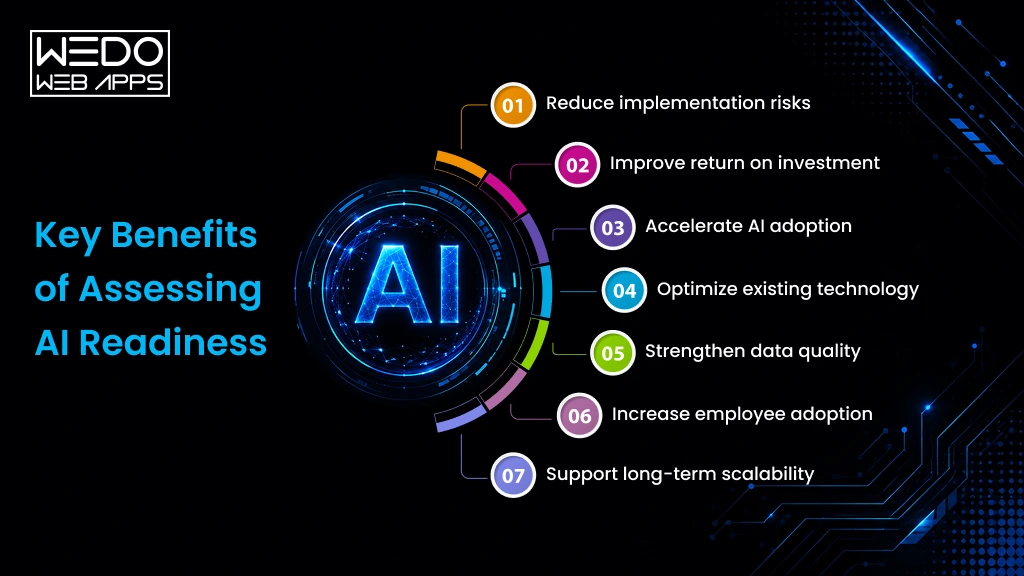
- Reduce implementation risks by identifying potential challenges before deployment.
- Improve return on investment (ROI) by focusing on AI projects that align with business goals.
- Accelerate AI adoption with a clear roadmap for implementation.
- Optimize existing technology by understanding whether current systems can support AI solutions.
- Strengthen data quality to improve the accuracy and reliability of AI-driven outcomes.
- Increase employee adoption through better planning, training, and change management.
- Support long-term scalability by building a strong foundation for future AI initiatives.
Businesses that evaluate their AI readiness before implementation are better equipped to prioritize the right use cases, allocate resources effectively, and achieve sustainable agentic AI development adoption rather than short-term experimentation.
AI Readiness Is More Than Technology
Many organizations assume AI readiness is simply about having the latest tools or cloud infrastructure. In reality, successful AI adoption readiness depends on aligning technology with business strategy, high-quality data, skilled teams, and well-defined processes.
For example, even the most advanced AI solution can struggle to deliver value if the underlying data is incomplete, business objectives are unclear, or employees aren't prepared to integrate AI into their daily workflows. A comprehensive AI maturity assessment helps uncover these gaps early, allowing businesses to address them before investing in development.
The Five Pillars of Business AI Readiness
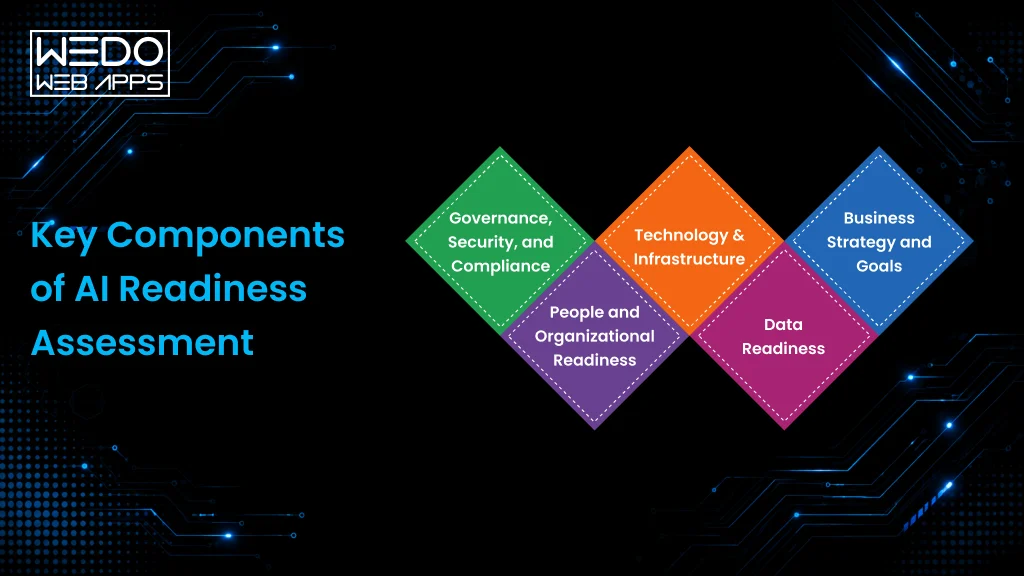
A successful AI readiness assessment goes beyond evaluating technology. It examines the core capabilities that determine whether your organization can effectively adopt, implement, and scale AI. These five pillars provide a practical framework for measuring business AI readiness and identifying areas that need improvement before investing in AI solutions.
1. Business Strategy and Goals
Every successful AI initiative starts with a clear business objective. Rather than adopting AI because it's trending, organizations should identify specific challenges AI can solve, such as improving customer service, automating repetitive tasks, optimizing operations, or generating actionable insights.
Ask yourself:
- Have we identified measurable business goals for AI?
- Do we know which processes will benefit the most?
- Have we defined how success will be measured?
Without a clear strategy, even technically successful AI projects may fail to deliver meaningful business value.
2. Data Readiness
AI systems rely on data to learn, analyze, and generate accurate outcomes, making machine learning development highly dependent on reliable data. Poor-quality, outdated, or fragmented data can significantly reduce the effectiveness of AI solutions.
Evaluate whether your business has:
- Accurate and reliable data
- Centralized and accessible data sources
- Consistent data governance practices
- Processes for maintaining data quality
Strong data readiness creates the foundation for reliable AI performance and better decision-making.
3. Technology and Infrastructure
Your existing technology should be capable of supporting AI integration without introducing unnecessary complexity. Modern cloud platforms, scalable applications, APIs, and secure infrastructure make AI implementation more efficient.
Consider whether your organization has:
- Scalable cloud or non-premises infrastructure
- Systems that support API integrations
- Modern business applications
- Security measures to protect AI workloads
The stronger your technology foundation, the smoother your AI implementation will be.
4. People and Organizational Readiness
Technology alone does not drive successful AI adoption; people do. Employees and leadership must understand how AI supports business objectives and be prepared to adapt to new ways of working.
Assess your organization's readiness by asking:
- Does leadership actively support AI initiatives?
- Do employees understand the benefits of AI?
- Are training and upskilling programs available?
- Is there access to AI expertise when needed?
Organizations that invest in people are more likely to achieve long-term AI adoption and maximize the value of their AI investments.
5. Governance, Security, and Compliance
As AI becomes more integrated into business operations, responsible governance becomes increasingly important. Businesses should establish policies that ensure AI systems are secure, compliant, transparent, and aligned with organizational standards.
A strong governance framework should include:
- Data privacy and security controls
- Regulatory and compliance requirements
- Ethical AI guidelines
- Risk management and monitoring processes
Effective governance helps businesses build trust while reducing operational and compliance risks associated with AI adoption.
Signs Your Business is Ready for AI?
Not every organization starts its AI journey from the same point. Some businesses already have the right infrastructure and processes in place, while others may need to address a few gaps before implementing AI solutions. Recognizing these indicators can help you evaluate your AI adoption readiness and determine whether it's the right time to move forward.
The following signs suggest your business has a strong foundation for successful AI adoption:
| Sign | Why It Matters |
|---|---|
| You have clearly defined business goals. | AI delivers the best results when aligned with measurable business objectives rather than broad experimentation. |
| Your business collects high-quality, organized data. | Reliable data improves the accuracy, performance, and efficiency of AI models. |
| Repetitive or time-consuming processes exist. | Tasks that follow consistent workflows are ideal for AI-powered automation. |
| Your technology infrastructure supports integration. | Modern applications, cloud platforms, and APIs simplify AI implementation and scalability. |
| Leadership is committed to AI adoption. | Executive support drives investment, organizational alignment, and long-term success. |
| Employees are open to adopting new technologies. | A collaborative workforce accelerates AI adoption and reduces resistance to change. |
| You understand the problems AI should solve. | Identifying practical use cases helps prioritize investments and maximize business value. |
| Data security and governance policies are established. | Strong governance reduces risks while ensuring responsible and compliant AI implementation. |
You Don't Need to Check Every Box
Very few businesses are perfectly prepared for AI from day one, and that is completely normal. The purpose of an AI assessment readiness is not to achieve one perfect score, but to identify your strengths, uncover improvement areas, and build a practical roadmap for successful implementation.
If your organization meets most of the indicators above, you are likely well-positioned to begin exploring AI initiatives. If not, the next step is understanding the common readiness gaps that can slow or prevent successful AI adoption.
Common AI Readiness Gaps That Delay Successful Adoption
Even businesses with ambitious AI goals can face challenges during implementation if foundational gaps aren't addressed early. An AI readiness assessment helps identify these obstacles before they become costly setbacks, allowing organizations to create a realistic roadmap for AI adoption.
Here are some of the most common AI readiness gaps businesses should address before investing in AI solutions.
1. Poor Data Quality
AI systems depend on accurate, consistent, and accessible data. If your business data is incomplete, duplicated, outdated, or spread across multiple systems, AI models may generate unreliable insights and reduce overall performance.
How to address it: Audit your data sources, improve data quality, and establish clear data governance practices.
2. Unclear Business Objectives
Many organizations adopt AI because competitors are doing it rather than because they have clearly defined business goals. Without measurable objectives, it is difficult to evaluate success or prioritize the right AI initiatives.
How to address it: Identify specific business challenges where AI can deliver measurable value, such as customer support, demand forecasting, or workflow automation.
3. Legacy Technology Infrastructure
Older software systems and disconnected applications often make AI integration more complex, increasing implementation time and costs.
How to address it: Modernize critical systems, improve API connectivity, and ensure your technology stack can support AI-powered applications.
4. Limited AI Skills and Internal Expertise
Successful AI adoption requires collaboration between business leaders, technical teams, and end users. A lack of AI knowledge can slow implementation and reduce employee confidence.
How to address it: Invest in AI training, encourage cross-functional collaboration, or work with experienced AI consultants and development partners.
5. Weak Governance and Security Practices
AI solutions often process sensitive business and customer data. Without clear governance policies, businesses may face compliance risks, security vulnerabilities, and ethical concerns.
How to address it: Establish policies for data privacy, security, regulatory compliance, and responsible AI usage before deployment.
6. Resistance to Organizational Change
Introducing AI often changes how teams work. If employees don't understand the purpose or benefits of AI, resistance to change can reduce adoption and limit the success of AI initiatives.
How to address it: Communicate the value of AI early, involve key stakeholders throughout the process, and provide ongoing training and support.
7. Turning Readiness Gaps Into Opportunities
Identifying these gaps is not a sign that your business is not ready for AI; it is an opportunity to prepare more effectively. The goal of an AI maturity assessment is to uncover these challenges early so you can prioritize improvements, reduce implementation risks, and build a stronger foundation for long-term AI success.
AI Readiness Checklist for Businesses
If you are wondering whether your organization is ready to adopt AI, use this practical AI readiness checklist as a starting point. While every business has unique goals and challenges, checking these essential areas can help you evaluate your current readiness and identify where improvements may be needed before investing in AI.
Business Strategy
Before implementing AI, make sure your organization has a clear direction.
- Define the business problems AI will solve.
- Set measurable goals and success metrics.
- Prioritize AI use cases based on business impact.
- Align AI initiatives with your long-term strategy.
Data Readiness
Reliable data is the foundation of every successful AI solution.
- Ensure your data is accurate, complete, and up to date.
- Centralize business data for easier access.
- Establish data governance and ownership.
- Protect sensitive information with strong security practices.
Technology Infrastructure
Your existing technology should support seamless AI integration.
- Review whether current systems can integrate with AI tools.
- Evaluate cloud, on-premises, or hybrid infrastructure.
- Confirm APIs and software integrations are available.
- Plan for future scalability as AI adoption grows.
People and Skills
AI success depends on people as much as technology.
- Gain leadership support for AI initiatives.
- Assess employee readiness and training needs.
- Encourage collaboration between business and technical teams.
- Identify internal skill gaps or external expertise requirements.
Governance and Risk Management
Responsible AI adoption requires clear governance.
- Define data privacy and compliance requirements.
- Establish ethical AI policies and approval processes.
- Monitor AI performance and potential risks.
- Create a plan for ongoing review and improvement.
How to Interpret Your Results
There is no such thing as a perfect score. The purpose of this AI readiness checklist is to understand where your business stands today and identify the areas that need attention before moving forward.
- Most boxes checked: Your business has a strong foundation for AI adoption and can begin evaluating implementation opportunities.
- Some boxes checked: You are on the right path, but addressing a few readiness gaps will improve your chances of success.
- Few boxes checked: Focus on strengthening your strategy, data, technology, and governance before investing in AI solutions.
Completing this checklist is an important first step, but it provides only a high-level view of your organization's preparedness. A more detailed AI maturity assessment can help you measure your current capabilities, benchmark your progress, and create a structured roadmap for long-term AI adoption.
AI Maturity Assessment Framework
An AI maturity assessment helps businesses understand how prepared they are to adopt, implement, and scale AI across the organization. Unlike a simple checklist, a maturity assessment measures your current capabilities and provides a roadmap for continuous improvement.
Most organizations fall into one of the following four AI maturity levels.| Maturity Level | Characteristics | Recommended Next Step |
|---|---|---|
| Level 1 - Exploring | AI discussions have started, but there is no formal strategy or implementation plan. | Define business objectives and identify high-value AI use cases. |
| Level 2 - Building Foundations | Data, infrastructure, and internal processes are improving, and pilot AI projects are being considered. | Strengthen data quality, modernize systems, and prepare teams for AI adoption. |
| Level 3 - AI Ready | The business has a clear AI strategy, reliable data, modern technology, and leadership support. | Launch AI project with measurable KPIs and monitor business outcomes. |
| Level 4 - AI Driven | AI is integrated into multiple business functions and continuously optimized for growth and innovation. | Scale successful AI initiatives and continuously improve governance and performance. |
Where Does Your Business Stand?
Ask yourself these questions:
- Have we identified clear business goals for AI?
- Is our data accurate, organized, and accessible?
- Can our existing technology support AI integration?
- Do our employees have the skills and support needed to adopt AI?
- Have we established governance, security, and compliance policies for AI?
If you answered "Yes" to most of these questions, your business is likely progressing toward a high level of AI adoption readiness. If several answers are "No", do not view it as a setback; it simply highlights the areas that should be addressed before implementing AI solutions.
Why AI Maturity Matters?
AI readiness is not a one-time milestone. As your business grows, your data evolves, and new AI technologies emerge, your level of readiness will change. Regularly reviewing your AI maturity helps ensure your organization continues to adopt AI strategically, manage risks effectively, and maximize long-term business value.
How to Successfully Prepare Your Business for AI
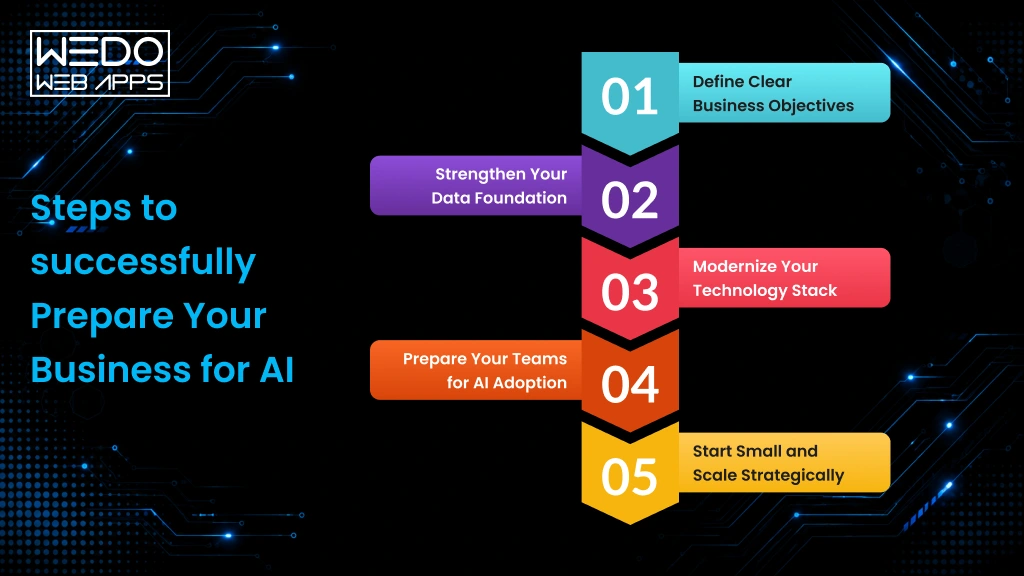
Completing an AI readiness assessment is only the beginning. The real value comes from turning your findings into a practical action plan. Whether your business is just starting its AI journey or preparing to scale existing initiatives, these steps can help you move forward with confidence.
Step 1: Define Clear Business Objectives
Identify the specific business challenges you want AI to solve. Focus on measurable outcomes, such as improving operational efficiency, enhancing customer experiences, reducing costs, or increasing productivity.
Step 2: Strengthen Your Data Foundation
Review the quality, accessibility, and governance of your business data. Clean, organized, and secure data is essential for building reliable AI solutions and generating meaningful insights.
Step 3: Modernize Your Technology Stack
Evaluate whether your current applications, infrastructure, and integrations can support AI implementation. Upgrading legacy systems where necessary will make AI adoption smoother and more scalable.
Step 4: Prepare Your Teams for AI Adoption
Successful AI implementation requires more than technology. Educate stakeholders, train employees, and encourage collaboration between business and technical teams to improve adoption and long-term success.
Step 5: Start Small and Scale Strategically
Instead of launching multiple AI initiatives at once, begin with a high-impact pilot project, such as Generative AI Development. Measure results, refine your approach, and expand AI adoption based on proven outcomes and business value.
When to Seek Expert Guidance
If your assessment reveals significant gaps in data, infrastructure, or strategy, working with an experienced AI consulting and AI-powered software development company can help you avoid costly mistakes. The right partner can evaluate your readiness, prioritize high-impact AI opportunities, and create a roadmap that aligns with your business goals and long-term digital transformation strategy.
AI Readiness Assessment vs. AI Consulting
While the terms AI readiness assessment and AI Consulting are often used together, they serve different purposes. An AI readiness assessment helps you understand whether your AI business is prepared to adopt AI, whereas AI consulting focuses on creating and executing a strategy to implement AI solutions successfully.
Think of an AI readiness assessment as the starting point, and AI consulting as the next step that helps turn your assessment into measurable business outcomes.
| AI Readiness Assessment | AI Consulting |
|---|---|
| Evaluates your organization's preparedness for AI adoption. | Develops a customized AI strategy aligned with business goals. |
| Identifies gaps in data, technology, processes, and workforce readiness. | Recommends the right AI solutions, technologies, and implementation approach. |
| Helps prioritize AI opportunities and investment decisions. | Guides AI development, integration, deployment, and optimization. |
| Provides a roadmap for becoming AI-ready. | Supports end-to-end AI implementation and long-term digital transformation. |
Which One Does Your Business Need?
If you are still exploring AI or unsure whether your organization has the right foundation, start with an AI readiness assessment. It helps you understand your current capabilities, identify improvement areas, and reduce implementation risks.
If you have already assessed your readiness and are ready to move forward, AI consulting can help you define your AI roadmap, select the right technologies, and successfully implement AI solutions that deliver measurable business value.
What Happens After an AI Readiness Assessment
Completing an AI Readiness Assessment is an important milestone, but it is only the beginning of your AI journey. The insights from your assessment should helo you prioritize initiatives, address readiness gaps, and create a structured plan for implementing AI solutions that align with your business goals.
Here is what businesses should do next:
1. Prioritize Business Opportunities
Start by identifying the areas where AI can deliver the greatest impact. Focus on business challenges that are repetitive, data-driven, and capable of producing measurable improvements in efficiency, customer experience, or decision-making.
2. Select High-Impact AI Use Cases
Not every process needs AI. Evaluate potential use cases based on business value, implementation complexity, and expected return on investment. Beginning with a focused, high-impact project often leads to faster results and valuable organizational learning.
3. Build an Implementation Roadmap
Create a phased roadmap that outlines project objectives, timelines, resource requirements, success metrics, and governance practices. A structured implementation plan helps keep AI initiatives aligned with long-term business goals while minimizing risks.
4. Launch a Pilot Project
Before scaling AI across the organization, validate your approach with a pilot implementation. A controlled pilot allows you to measure performance, gather user feedback, identify improvement opportunities, and refine your strategy before making larger investments.
5. Scale and Continuously Improve
Once your pilot delivers measurable results, expand AI adoption across relevant business functions. Continuously monitor performance, optimize AI models, strengthen governance practices, and adapt your strategy as business needs evolve.
Turning Readiness Into Real Business Value
An AI Readiness assessment provides the direction, but successful implementation require the right expertise, technology, and execution strategy. Partnering with an experienced AI Development Service provider can help you transform your roadmap into scalable AI solutions that deliver measurable business outcomes while supporting your broader digital transformation goals.
Conclusion
Artificial Intelligence can transform the way businesses operate, but successful AI adoption starts long before implementation. Assessing your organization's strategy, data, technology, people, and governance helps you understand whether you are truly prepared to invest in AI and where improvements are needed.
An AI readiness assessment is not about finding a perfect score; it is about making informed decisions that reduce risks, maximixe ROI, and create a clear path toward successful AI adoption. Whether you are exploring AI for the first time or planning to expand existing initiatives, taking the time to evaluate your readiness can save valuable time, resources, and effort in the long run.
If you are ready to move beyond assessment and turn your AI vision into reality, partnering with an experienced AI-powered software development company can make all the difference. From AI consulting and implementation planning to custom AI development services, the right technology partner can help you build secure, scalable, and business-focused AI solutions that support your long-term digital transformation goals.