Introduction
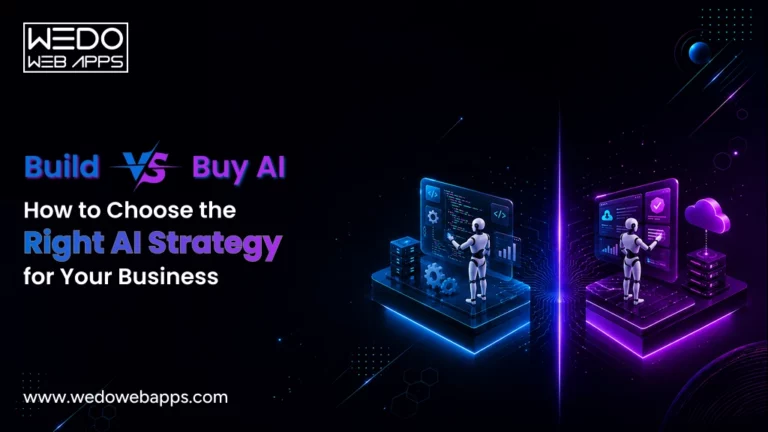
Every business these days wants to integrate AI into its business strategy to improve efficiency, automate workflows, and gain a competitive advantage. But once the decision to adopt AI is made, a much bigger question follows: Should you build custom AI software tailored to your business or buy an AI software that is ready to use? The answer is not always simple, and making the wrong choice can lead to unnecessary costs, longer implementation timelines, or technology that fails to support your long-term goals.
The build vs buy AI decision is about more than technology; it is about choosing an AI implementation strategy that aligns with your budget, business objectives, available resources, and future growth.
In this guide, we will compare both approaches, explore their costs, advantages, and limitations, and help you determine which option is the right fit for your business.
What Does Build vs Buy AI Mean?
The build vs buy AI decision for a business is to choose between developing custom AI software tailored to their business needs or purchasing an existing AI solution from a third-party provider. While both approaches help businesses adopt artificial intelligence, they differ significantly in terms of customization, implementation time, ownership, scalability, and long-term costs.
When you build AI, your development team or technology partner designs and develops an AI solution specifically for your business processes. This approach gives you complete control over features, integration data, and future enhancements.
When you buy AI software, you implement a ready-made platform that already includes AI capabilities such as automation, predictive analytics, chatbots, document processing, or customer support. These solutions can be deployed much faster but typically offer limited customization compared to custom-built AI applications.
Why Are Businesses Facing This Decision Today?
The rapid growth of generative AI and enterprise AI platforms has made AI more accessible than ever. Businesses can now choose from hundreds of ready-to-use AI tools or invest in building AI solutions that solve unique operational challenges. However, selecting the right AI implementation strategy is no longer just a technical decision. Organizations must evaluate factors such as:
- Business goals and competitive advantage
- Budget and expected ROI
- Implementation timeline
- Data privacy and regulatory compliance
- Integration with existing software
- Long-term scalability and maintenance
Examples of Build vs Buy AI
| Business Need | Build AI | Buy AI |
|---|---|---|
| Customer Support | Develop an AI assistant trained on proprietary products and internal knowledge | Use platforms like Intercom AI or Zendesk AI |
| Sales Forecasting | Create predictive models using your historical sales data | Use AI features in Salesforce or HubSpot |
| Document Processing | Build an AI solution for industry-specific document workflows | Purchase an AI-powered OCR or document automation platform |
| HR Recruitment | Develop AI that matches candidates based on custom hiring criteria | Use AI-enabled recruitment software |
Build vs Buy AI at a Glance
The choice between building custom AI software and buying AI software depends on factors such as your business objectives, available budget, implementation timeline, customization requirements, and long-term growth plans. The table below provides a quick comparison to help you understand which approach best aligns with your organization's needs.
| Factor | Build AI | Buy AI |
|---|---|---|
| Implementation Timeline | Longer development cycle with planning, design, development, and testing | Faster deployment with minimal setup |
| Upfront Cost | Higher initial investment | Lower upfront investment with subscription or licensing fees |
| Customization | Fully tailored to your business processes and workflows | Limited to the features offered by the vendor |
| Data Ownership | Complete control over your data, models, and intellectual property | Data policies depend on the software provider |
| Integration | Seamlessly integrates with your existing systems and workflows | Integration options vary by platform |
| Scalability | Easily evolves as your business and AI requirements grow | Scaling depends on vendor capabilities and pricing plans |
| Maintenance | Managed by your internal team or development partner | Handled primarily by the software vendor |
| Competitive Advantage | Enables unique AI capabilities that differentiate your business | Uses standardized features available to many businesses |
| Best For | Businesses with unique requirements, proprietary data, or long-term AI strategies | Businesses seeking rapid deployment and proven AI functionality |
Key Takeaway
There is no one-size-fits-all answer to the build vs buy AI debate. If your organization requires unique AI capabilities, deep integrations, and complete ownership, custom AI software is often the better long-term investment. However, if speed, affordability, and ease of implementation are your priorities, buying AI software can help you achieve results much faster.
Advantages of Building Custom AI Software
Building custom AI software gives businesses the flexibility to create AI solutions that align with their unique goals, workflows, and long-term growth strategy. Although it requires a higher upfront investment and longer development timeline, a custom-built solution can deliver greater business value, stronger competitive differentiation, and better control over future innovation.
Complete Customization
Unlike off-the-shelf platforms, custom AI software is designed around your specific business requirements. Whether you need intelligent workflow automation, Agentic AI Development, industry-specific AI models, or personalized customer experiences, every feature is built to support your operational needs instead of forcing your processes to fit existing software.
Full Ownership and Data Control
When you build AI, your organization owns the application, its architecture, and the underlying business logic. This provides greater control over sensitive business data, deep learning models, model training, security policies, and future enhancements, making it a preferred option for organizations with strict compliance or privacy requirements.
Seamless Integration with Existing Systems
Custom AI solutions can be integrated directly with your existing software ecosystem, including CRM platforms, ERP systems, internal databases, and business applications. This enables smoother workflows, improves data consistency, and reduces manual intervention across departments.
Better Scalability for Future Growth
As your business evolves, so do your AI requirements. Custom AI software allows you to add new features, support increasing workloads, and adapt to changing business processes without being limited by a vendor's product roadmap or licensing model.
Stronger Competitive Advantage
Generic AI software often provides the same capabilities to every customer. Building your own AI solution allows you to develop proprietary features, automate unique business processes, and create customer experiences that competitors cannot easily update.
Greater Long-Term Return on Investment
Although the initial development cost is higher, custom AI software can deliver better long-term value by eliminating recurring licensing fees, reducing dependency on third-party vendors, and continuously adapting to changing business needs. For organizations that view AI as a strategic asset rather than a short-term tool, this often results in a stronger return on investment over time.
When Building AI Makes Sense
Building AI is typically the right choice if your business:
- Has unique workflows that standard AI software cannot support.
- Relies on proprietary data to create business value.
- Requires advanced integrations with existing systems.
- Operates in highly regulated industries with strict security or compliance requirements.
- Views AI as a long-term competitive differentiator rather than a standalone productivity tool.
Advantages of Buying AI Software
Buying AI software allows businesses to adopt artificial intelligence without the time, cost, and complexity of building a solution from scratch. For organizations that need proven AI capabilities quickly, off-the-shelf platforms offer a practical way to improve productivity, automate routine tasks, and accelerate digital transformation.
Faster Implementation
Ready-made AI solutions can often be deployed within days or weeks instead of months. This allows businesses to start automating processes, improving customer experiences, or gaining data-driven insights much sooner than a custom development project.
Lower Upfront Cost
Building custom AI software requires significant investment in planning, development, testing, and infrastructure. In contrast, most AI platforms are available through subscription or licensing models, making them a more affordable option for businesses with limited budgets or short-term AI initiatives.
Access to Proven AI Capabilities
Established AI software providers continuously enhance their products with new features, security updates, and performance improvements. Businesses can benefit from mature, well-tested AI capabilities without investing in ongoing research and development.
Reduced Technical Complexity
Buying AI software eliminates many of the technical challenges associated with AI development, including model training, infrastructure management, and ongoing maintenance. This allows internal teams to focus on using AI effectively rather than building and supporting it.
Ongoing Vendor Support
Most AI software vendors provide implementation assistance, technical support, documentation, regular updates, and security patches. This reduces operational overhead and helps businesses maintain reliable AI performance over time.
Easier Adoption Across Teams
Many commercial AI platforms are designed with intuitive interfaces and built-in integrations, making it easier for employees to adopt the technology with minimal training. Faster user adoption can help businesses realize value from their AI investment more quickly.
When Buying AI Software Makes Sense
Buying AI Software is often the better option if your business:
- Needs AI capabilities within a short implementation timeline.
- Wants to minimize upfront development costs.
- Requires AI for common business functions such as customer support, sales, marketing, or HR.
- Has limited in-house AI expertise or development resources.
- Prefers vendor-managed maintenance, updates, and security.
Build vs Buy AI Cost Comparison
Cost is often the biggest factor when deciding whether to build custom AI software or buy AI software, but focusing only on the upfront investment can be misleading. Businesses should evaluate the total cost of ownership (TCO), which includes implementation, infrastructure, maintenance, upgrades, licensing, and long-term scalability.
While buying AI software generally requires a lower initial investment, recurring subscription fees and limited customization can increase costs over time. On the other hand, building custom AI software involves higher development costs but offers greater flexibility and long-term value for businesses with evolving AI needs.
| Cost Factor | Build AI | Buy AI |
|---|---|---|
| Initial Investment | High due to development, testing, and deployment | Low to moderate through subscriptions or licensing |
| Implementation Cost | Includes planning, development, integrations, and customization | Usually limited to setup, configuration, and onboarding |
| Infrastructure | Managed by the business or cloud provider | Typically included or managed by the vendor |
| Maintenance | Ongoing updates, monitoring, and enhancements | Included in the vendor's subscription or support plan |
| Customization Cost | High initially but tailored to business needs | Limited customization; advanced features may cost extra |
| Scalability Cost | Additional investment as new features are developed | Higher subscription tiers or usage-based pricing may apply |
| Long-Term Cost | Higher upfront but potentially lower over time | Lower upfront but recurring fees can accumulate |
Which Option Delivers Best ROI?
The answer depends on how your business plans to use AI. If AI supports a core product, differentiates your services, or automates business-critical operations, investing in custom AI software can generate stronger long-term returns through greater efficiency, flexibility, and ownership.
If your objective is to improve existing processes using proven AI capabilities and achieve results quickly, buying AI software often yields a faster return on investment and lower financial risk.
Decision Tip: Evaluate AI costs over a three- to five-year period rather than comparing only the initial investment. This provides a clearer picture of the true financial impact of each approach.
Hidden Costs Businesses Often Overlook
Whether you decide to build custom AI software or buy AI software, the total investment extends beyond development costs or subscription fees. Many businesses underestimate ongoing expenses that emerge after implementation, leading to budget overruns and lower-than-expected returns.
Understanding these hidden costs helps you choose an AI implementation strategy that aligns with your long-term business objectives rather than just your initial budget.
Integration with Existing Systems
AI solutions rarely operate in isolation. AI integration services can connect them with your CRM, ERP, databases, payment systems, or other business applications, but may require additional development, testing, and ongoing maintenance, especially if you are working with legacy systems.
Data Preparation and Management
AI systems rely on accurate, high-quality data to deliver reliable results. Cleaning, organizing, labeling, and maintaining data often requires considerable time and resources, regardless of whether you build or buy an AI solution.
Employee Training and Change Management
Successfully adopting AI involves more than deploying new technology. Employees need training to use AI effectively, while organizations must adapt workflows and processes to maximize adoption and productivity.
Ongoing Maintenance and Performance Optimization
Custom AI software requires continuous monitoring, model improvements, security updates, and feature enhancements, often supported by MLOps Consulting to maintain model performance. Even purchased AI platforms may require configuration updates, workflow optimization, and periodic adjustments as business requirements evolve.
Vendor Lock-In
Businesses that rely heavily on a single AI software provider may face challenges when switching platforms in the future. Limited portability, proprietary technologies, and changing pricing structures can increase long-term costs and reduce flexibility.
Security and Compliance
Organizations operating in industries such as healthcare, finance, or legal services often need additional investments in data protection, access controls, compliance audits, and regulatory requirements. These costs should be considered from the beginning rather than after implementation.
How to Avoid Unexpected AI Costs
Before choosing to build or buy AI, businesses should:
- Define clear business objectives and success metrics.
- Evaluate the total cost of ownership instead of upfront pricing alone.
- Assess integration requirements with existing systems.
- Plan for ongoing maintenance, updates, and user training.
- Consider future scalability and potential vendor dependency.
Expert Insight: The most successful AI projects are planned around long-term business value, not just implementation costs. Evaluating operational, technical, and organizational expenses early helps businesses avoid costly surprises later.
Which Businesses Should Build AI?
While off-the-shelf AI solutions work well for many organizations, they may not address every business requirement. Companies with unique workflows, proprietary data, or industry-specific challenges often benefit more from custom AI software that is designed around their long-term goals.
Here are the types of businesses where building AI typically delivers the greatest value.
Startups Building AI-Driven Products
If AI is a core feature of your product or service rather than an add-on, building a custom solution provides greater flexibility and differentiation. It allows startups to create unique user experiences, protect intellectual property, and scale their AI capabilities as the business grows.
Small and Medium-Sized Businesses with Unique Workflows
SMBs often rely on specialized processes that generic AI tools cannot fully support. A custom AI solution can automate repetitive tasks, improve operational efficiency, and integrate seamlessly with existing business systems.
Enterprises with Complex Operations
Large organizations typically manage multiple departments, legacy systems, and large volumes of data. Building AI enables deeper integrations, stronger governance, enhanced security, and the flexibility to support enterprise-scale operations.
Healthcare Organizations
Healthcare providers often require AI solutions that meet strict privacy, compliance, and security standards. Custom Healthcare AI software can support applications such as medical document processing, clinical decision support, patient engagement, and workflow automation while addressing regulatory requirements.
Financial Services
Banks, insurance companies, and fintech businesses handle sensitive financial data and complex regulatory obligations. Custom fintech AI software enables advanced fraud detection, risk assessment, customer insights, and intelligent automation tailored to business-specific policies.
Manufacturing and Supply Chain Businesses
Manufacturers can leverage custom AI to improve demand forecasting, predictive maintenance, quality control, inventory management, and production planning. Tailored solutions integrate more effectively with existing operational systems and deliver insights specific to manufacturing processes.
SaaS Companies
For SaaS businesses, AI can become a key product differentiator. Building custom AI allows companies to introduce intelligent features, personalize user experiences, automate workflows, and continuously innovate without depending on third-party software limitations.
Key Takeaway
Building AI is generally the right choice when artificial intelligence plays a strategic role in your business, your processes require extensive customization, or your competitive advantage depends on capabilities that standard AI software cannot provide.
Build vs Buy AI Decision Framework
Choosing between building custom AI software and buying AI software isn't about finding a universally better option; it's about selecting the approach that best supports your business strategy. Use the framework below to evaluate which solution aligns with your organization's priorities.
| Question | If Your Answer Is Yes | Recommended Approach |
|---|---|---|
| Is AI a core part of your product or competitive advantage? | You need AI capabilities that competitors can't easily replicate. | Build AI |
| Do you have unique workflows that standard AI tools cannot support? | Your business requires extensive customization. | Build AI |
| Do you need complete ownership of your AI models, data, and intellectual property? | Data privacy and control are business priorities. | Build AI |
| Do you need an AI solution within weeks rather than months? | Speed is more important than customization. | Buy AI |
| Is your budget limited for the initial implementation? | You prefer predictable subscription-based costs. | Buy AI |
| Will your AI requirements continue to evolve over time? | You expect frequent enhancements and new capabilities. | Build AI |
| Are your AI needs focused on common business functions like customer support, marketing, or HR? | Standard AI features meet your requirements. | Buy AI |
Questions to Ask Before Making a Decision
Before investing in AI, AI consulting can help you answer questions such as:
- What business problem are we trying to solve with AI?
- Will AI become a long-term competitive advantage or simply improve existing operations?
- Do we require industry-specific features or will standard functionality be sufficient?
- How important are data ownership, security, and regulatory compliance?
- What is our realistic budget and expected return on investment?
- Can our existing systems integrate with the chosen AI solution?
- How quickly do we need to implement AI?
Final Decision Guide
Choose custom AI software if your organization values customization, scalability, data ownership, and long-term innovation. While the initial investment is higher, it provides greater flexibility and a stronger competitive advantage as your business grows.
Choose AI software if your priority is rapid deployment, lower upfront costs, and access to proven AI capabilities. This approach is well suited for businesses looking to improve existing processes without the complexity of custom development.
Decision Tip: If you're unsure which approach is right, begin by defining your business objectives before evaluating technology. The most successful AI projects start with solving a business problem, not simply adopting AI because it's available.
Why a Hybrid AI Strategy Is Becoming the Preferred Choice
For many businesses, the decision is no longer simply build vs buy AI. Instead, organizations are combining both approaches to create a hybrid AI strategy that balances speed, flexibility, and long-term innovation.
Rather than building every AI capability from scratch or relying entirely on off-the-shelf software, businesses purchase proven AI technologies for common use cases while developing custom AI software for the processes that create the greatest competitive value.
What Does a Hybrid AI Strategy Look Like?
A hybrid approach typically involves buying standard AI capabilities and building custom solutions around them.
| Buy AI Software For | Build Custom AI Software For |
|---|---|
| AI chatbots and virtual assistants | Industry-specific AI workflows |
| Document processing and OCR | Customer-facing AI products |
| Speech-to-text and translation | Business-specific automation |
| Email and marketing automation | Proprietary recommendation engines |
| Meeting summaries and productivity tools | Internal decision-support systems |
Why Businesses Are Choosing a Hybrid Approach?
A hybrid strategy offers several advantages over relying entirely on one approach.
- Faster time to value by implementing proven AI tools where customization isn't required.
- Lower development costs by avoiding the need to build common AI capabilities from scratch.
- Greater flexibility by creating custom AI for processes that are unique to your business.
- Reduced risk through a phased AI implementation strategy instead of a large, all-at-once investment.
- Better scalability as businesses can expand custom AI capabilities while continuing to leverage commercial AI platforms.
Is a Hybrid AI Strategy Right for Your Business?
A hybrid approach is often the best choice if your organization:
- Wants to implement AI quickly while planning for long-term innovation.
- Has a mix of standard business processes and highly specialized workflows.
- Needs to balance development costs with customization.
- Plans to scale AI adoption gradually across multiple departments.
- Wants to minimize vendor dependency without building every AI capability internally.
Key Takeaway
Building and buying AI don't have to be competing strategies. For many organizations, the most effective AI implementation strategy is to combine the strengths of both. By purchasing proven AI solutions for common business functions and developing custom AI where it creates real business value, companies can accelerate adoption while maintaining the flexibility to innovate and grow.
Common Mistakes When Choosing Between Build and Buy AI
Choosing the right AI solution requires more than comparing features or pricing. Many businesses rush into AI adoption without fully evaluating their long-term objectives, resulting in higher costs, poor adoption, or solutions that fail to deliver meaningful business value.
Here are some of the most common mistakes to avoid when deciding whether to build or buy AI.
Prioritizing Cost Over Business Value
Choosing the least expensive option may reduce upfront spending, but it doesn't always deliver the best long-term return. Evaluate how the AI solution will improve productivity, customer experience, and operational efficiency instead of focusing solely on its initial cost.
Ignoring Long-Term Scalability
Your AI requirements will likely evolve as your business grows. Selecting a solution that cannot support future users, workflows, or integrations may lead to expensive upgrades or a complete replacement later.
Underestimating Integration Requirements
Even the most advanced AI solution can create challenges if it doesn't integrate smoothly with your existing CRM, ERP, databases, or internal applications. Assess compatibility early to avoid delays and additional implementation costs.
Overlooking Data Security and Compliance
Businesses handling sensitive customer or business data must consider security, privacy, and regulatory compliance before implementing AI. Ignoring these requirements can expose organizations to operational and legal risks.
Expecting AI to Solve Every Business Problem
AI is most effective when applied to clearly defined business challenges. Implementing AI without specific objectives or measurable success metrics often leads to disappointing outcomes and poor return on investment.
Choosing Technology Before Defining Business Goals
Many organizations evaluate AI platforms before identifying the problem they want to solve. A successful AI implementation strategy starts with business objectives, followed by selecting the technology that best supports those goals.
Key Takeaway
The most successful AI projects begin with a clear understanding of business priorities, not just technology preferences. By evaluating long-term value, scalability, integration, security, and strategic objectives, businesses can make more informed decisions and maximize the return on their AI investment.
Conclusion
The build vs buy AI decision is not about choosing the most advanced technology; it's about selecting the solution that creates the greatest long-term value for your business. While buying AI software offers faster deployment and lower upfront costs, custom AI software provides greater flexibility, deeper integration, complete ownership, and a stronger competitive advantage for businesses with unique requirements.
The right choice depends on your business objectives, budget, implementation timeline, existing technology ecosystem, and future growth plans. For many organizations, a hybrid AI approach that combines off-the-shelf AI tools with custom-built solutions can deliver the ideal balance of speed, innovation, and scalability.
If you're still evaluating the best AI implementation strategy, working with an experienced AI consulting partner can help you avoid costly mistakes and maximize your return on investment.