Introduction
If nearly every business is investing in AI, why are so few seeing meaningful financial returns?
That question sits at the centre of every AI strategy discussion today. While AI promises faster operations, lower costs, improved decision-making, and new revenue opportunities, business leaders are under increasing pressure to prove the AI ROI before committing significant budgets.
The challenge is that adopting AI and generating measurable business value are not the same thing. According to McKinsey's State of AI survey, 88% of organizations report using AI in at least one business function, yet only 39% report measurable EBIT impact at the enterprise level. This gap highlights a critical reality: successful AI initiatives are driven by business outcomes, not technology adoption alone.
At the same time, the potential upside remains significant. McKinsey estimates that generative AI could contribute between $2.6 trillion and $4.4 trillion in annual economic value across industries, with much of that value coming from customer operations, marketing, sales, software development, and research functions.
For executives, the real question is no longer whether AI has potential. It is whether a specific AI investment can generate measurable returns for their organization. That requires a clear understanding of expected costs, value drivers, implementation risks, and the timeframe needed to achieve results.
This guide explains how to evaluate AI business value, calculate return on AI, build a strong AI cost justification framework, and determine whether an AI initiative is likely to deliver a positive outcome before any investment is made. Whether you are assessing a software development company or planning a large-scale transaction programme, having a structured ROI model can help turn AI from a promising idea into a financially sound business decision.
What Is AI ROI?
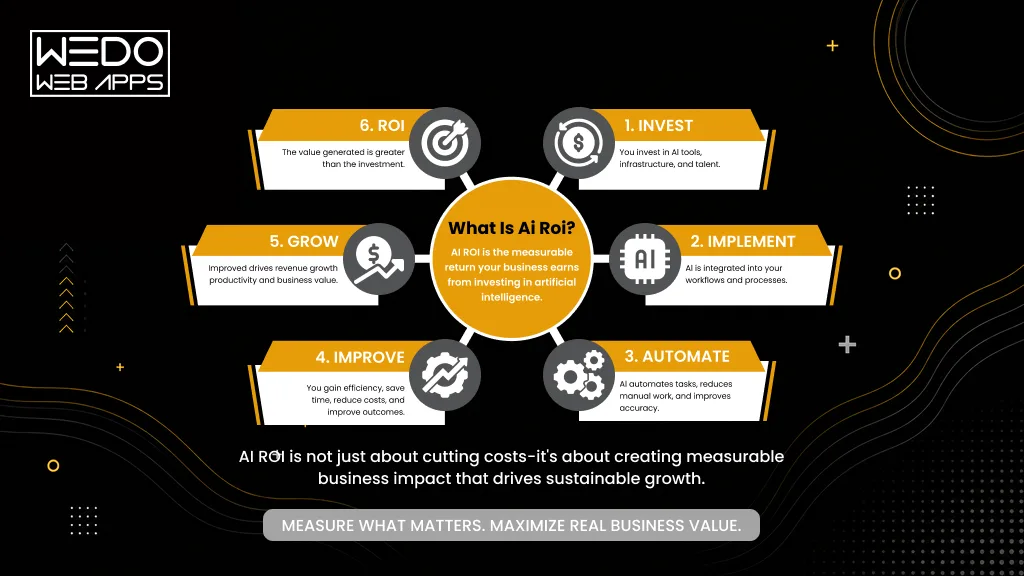
AI ROI (Return on Investment) measures the financial and operational value generated by an AI initiative compared to its total cost. Businesses calculate AI ROI by comparing benefits such as cost savings, productivity improvements, revenue growth, and customer experience gains against implementation, training, maintenance, and operational expenses.
In simple terms, AI ROI helps organisations determine whether an AI investment is delivering measurable business outcomes. A positive ROI indicates that the value generated exceeds the total investment, while a negative ROI suggests that costs outweigh the benefits.
For example, if an AI-powered customer support solution reduces operational costs, shortens response times, and improves customer satisfaction, the combined value of those improvements can be compared against the total cost of implementation to determine the overall return on AI.
AI ROI Formula
Businesses typically use the following calculations to evaluate AI business value and investment performance:
| Metric | Formula |
|---|---|
| AI ROI (%) | ((Total Benefits - Total Costs) ÷ Total Cost) × 100 |
| Payback Period | Total Investment ÷ Monthly Benefit |
| Net Business Value | Total Benefits - Total Cost |
Understanding These Metrics
- AI ROI (%) shows the percentage return generated from the investment.
- Payback Period indicates how long it takes for the investment to recover its initial cost.
- Net Business Value measures the actual financial gain after all costs have been deducted.
For decision makers, these metrics provide a structured way to assess whether an AI initiative aligns with business objectives and delivers sufficient value to justify the investment.
Quick Takeaway: A successful AI project is not measured by the technology deployed. It is measured by the business value created, the cost reduced, the revenue generated, and the speed at which the investment pays for itself.
What Is AI ROI and Why Does It Matter?
Every business investment comes with one fundamental question: Will the value generated outweigh the cost? When it comes to artificial intelligence, answering that question is often more complex than it is for traditional technology investments.
Unlike conventional software, AI can influence multiple areas of a business at the same time. It can reduce manual work, improve customer experiences, support faster decision-making, and create new revenue opportunities. As a result, measuring AI ROI requires looking beyond direct financial gains and evaluating the broader business impact.
For business leaders, understanding the return on AI is not simply about proving whether a project was successful. It is about determining where to invest, how much to invest, and which initiatives are most likely to deliver measurable outcomes.
Defining AI ROI in Business Terms
At its core, AI ROI measures the value an AI initiative generates compared to the total resources invested in implementing and maintaining it.
The value created by AI can come from several sources, including:
- Reduced operational costs through automation.
- Increased employee productivity and output.
- Faster business processes and workflows.
- Higher revenue from improved accuracy.
- Lower error rates and improved accuracy.
- Better business decisions supported by data insights.
For example, if a customer service team uses AI to automate routine enquiries and reduces support costs by £150,000 annually while spending £50,000 on implementation and maintenance, the initiative generates a positive return.
The key point is that AI business value is not limited to cost savings. Many organizations realise value through improved efficiency, stronger customer relationships, and increased scalability.
AI ROI vs AI Business Value vs Return on AI
These terms are often used interchangeably, but they serve different purposes when evaluating an AI investment.
| Term | Meaning | Primary Focus |
|---|---|---|
| AI ROI | Measures financial return relative to investment cost. | Financial performance |
| AI Business Value | Measures the broader impact AI creates across the organization. | Strategic outcomes |
| Return on AI | Overall gains generated from AI initiatives over time. | Financial and operational benefits |
A useful way to think about it is:
- AI ROI tells you whether the investment paid off financially.
- AI business value explains how AI consulting is important to business goals.
- Return on AI captures the total outcome generated from the investment.
Organizations that focus only on ROI may overlook long-term benefits such as improved customer retention, faster innovation cycles, or stronger competitive positioning.
Why AI Investments Face Greater Scrutiny Than Traditional Software Investments
Many software purchases have predictable costs and expected outcomes. AI projects are different because results often depend on several variables, including:
- Data quality and availability.
- Employee adoption rates.
- Process maturity.
- Integration with existing systems.
- Ongoing model optimization.
This uncertainty makes AI cost justification a critical step before approval.
Business leaders and finance teams typically want answers to questions such as:
- What problem will AI solve?
- How much value can it generate?
- When will the investment break even?
- What risks could affect the expected outcome?
- How will success be measured?
Without clear answers, even promising AI initiatives can struggle to secure budget approval.
The Risks of Measuring AI Success Incorrectly
One of the most common reasons organizations fail to demonstrate AI ROI is that they measure activity instead of outcomes.
For instance, businesses often track:
- Number of AI tools deployed.
- Number of employees using AI.
- Volume of AI-generated outputs.
While these metrics indicate adoption, they do not necessarily reflect business impact.
More meaningful indicators include:
- Revenue growth attributed to AI-assisted processes.
- Cost reductions achieved through automation.
- Hours saved across departments.
- Improvements in customer satisfaction scores.
- Reduction in processing time or operational errors.
When measurement is aligned with business objectives, organisations can build stronger cases for future AI investments and make more informed decisions about scaling successful initiatives.
In the next section, we will examine the specific ways organizations generate measurable AI business value and the value drivers that contribute most to long-term returns.
How Businesses Create Value from AI Investments
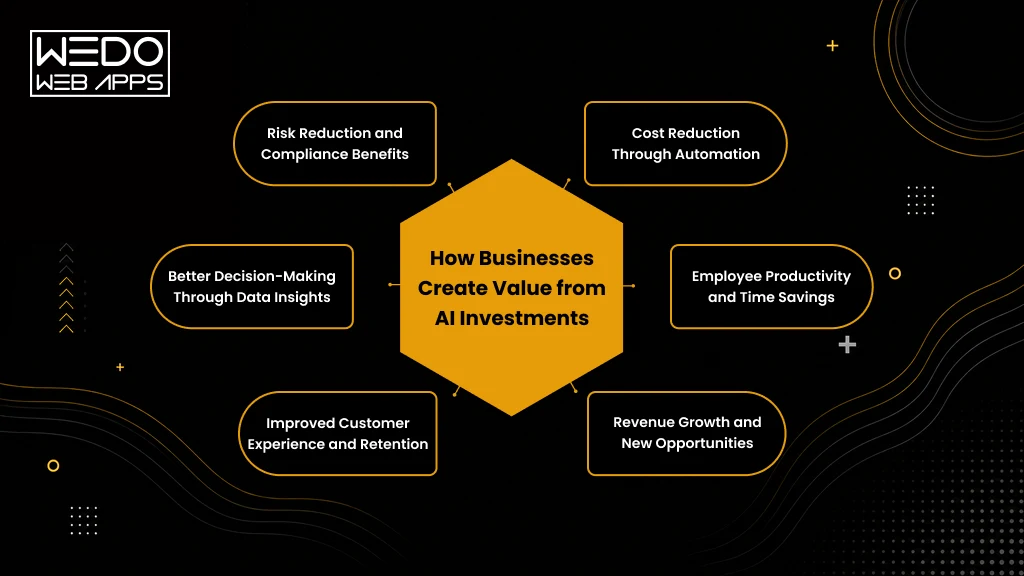
The success of an AI investment is ultimately determined by the value it creates for the business. While many organizations initially focus on automation and cost savings, the true impact of AI often extends much further. From increasing workforce productivity to unlocking new opportunities, AI can influence multiple areas of business performance simultaneously.
This is why organizations that consistently achieve strong AI ROI focus on business outcomes rather than technology adoption alone. They begin by identifying where AI can solve measurable problems and then track the value generated over time.
Cost Reduction Through Automation
One of the most immediate ways businesses realise return on AI is by automating repetitive, time-consuming tasks.
AI can handle activities such as:
- Data entry and document processing.
- Customer support enquiries.
- Invoice and payment processing.
- Scheduling and workflow management.
- Report generation and data analysis.
As manual effort decreases, organizations can reduce operational costs while allowing employees to focus on higher-value work.
Example: An accounts payable team that automates invoice processing can significantly reduce processing time, minimise human errors, and lower administrative costs.
Employee Productivity and Time Savings
Productivity improvements are often among the largest contributors to AI business value.
Instead of replacing employees, many AI solutions help teams complete tasks faster and more efficiently.
Common productivity gains include:
- Faster content creation and research.
- Reduced time spent searching for information.
- Improved knowledge management.
- Quicker analysis of large datasets.
- Accelerated software development and testing.
Even modest time savings across a large workforce can translate into substantial financial value over the course of a year.
Business Perspective: Saving just one hour per employee per week can create thousands of productive hours annually across a medium-sized organization.
Revenue Growth and New Opportunities
While cost savings are easier to measure, revenue generation often produces the most significant long-term AI ROI.
AI supports growth by helping organizations:
- Improve lead qualification and conversion rates.
- Deliver personalized customer experiences.
- Identify cross-sell and upsell opportunities.
- Optimise pricing strategies.
- Launch products and services more efficiently.
For sales and marketing teams, AI can provide insights that help prioritize high-value opportunities and improve customer engagement throughout the buying journey.
Improved Customer Experience and Retention
Customer expectations continue to rise, and AI is increasingly being used to meet those expectations at scale.
Businesses can improve customer experiences through:
- AI-powered chatbots and virtual assistants.
- Personalized recommendations.
- Faster response times.
- Predictive customer support.
- Proactive issue resolution.
The result is often higher customer satisfaction, improved retention rates, and stronger customer lifetime value.
Although these benefits may not always appear immediately in financial reports, they contribute significantly to overall AI business value.
Better Decision-Making Through Data Insights
Modern organizations generate vast amounts of data every day. AI helps transform that data into actionable insights that support faster and more informed decision-making. For businesses that need predictive models and data-driven solutions, machine learning development can help turn historical and real-time data into actionable predictions and automated decision support.
AI-driven analytics can help leaders:
- Identify emerging trends.
- Forecast demand more accurately.
- Detect operational inefficiencies.
- Assess risks before they escalate.
- Allocate resources more effectively.
When decision-makers have access to timely and relevant insights, organizations can respond more quickly to market changes and business challenges.
Risk Reduction and Compliance Benefits
Risk mitigation is often overlooked when calculating return on AI, yet it can represent a substantial source of value.
AI can support compliance and risk management by:
- Detecting fraud and unusual activity.
- Monitoring regulatory requirements.
- Identifying security vulnerabilities.
- Improving audit processes.
- Reducing human errors in critical workflows.
In industries where compliance failures can lead to significant penalties or reputational damage, these benefits can provide a compelling case for AI cost justification.
Businesses generate AI ROI through a combination of cost savings, productivity improvements, revenue growth, customer experience enhancements, and better decision-making. The strongest results typically come from initiatives that address multiple value drivers rather than focusing on a single outcome.
Before estimating returns, however, organizations must understand the full cost of implementation. In the next section, we will examine the complete cost structure behind an AI investment, including both visible and hidden expenses that influence ROI calculations.
The Complete Cost of an AI Investment
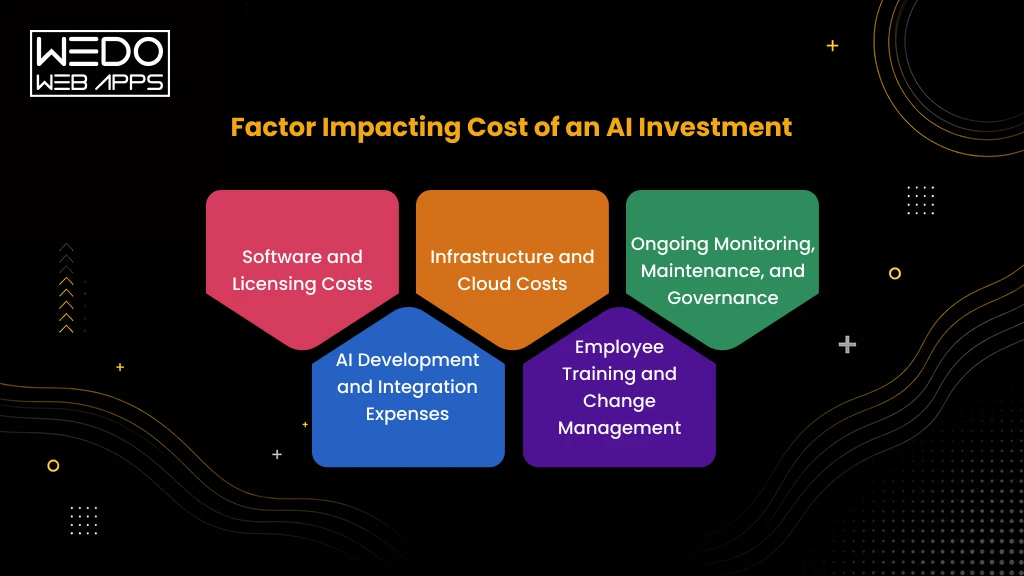
Many organizations overestimate the benefits of AI while underestimating the total cost required to achieve those benefits. This is one of the primary reasons why projected AI ROI and actual results often differ.
A successful AI investment involves far more than purchasing a software licence or subscribing to an AI platform. Costs can accumulate across implementation, integration, training, governance, and ongoing optimization. Without accounting for these expenses, businesses risk creating unrealistic ROI projections and weak AI cost justification models.
Before calculating the expected return on AI, decision-makers should understand every cost component involved in the initiative.
Software and Licensing Costs
For most businesses, software licensing is the most visible AI expense.
Depending on the solution, costs may include:
- Subscription fees for AI platforms.
- Usage-based pricing models.
- Enterprise licensing agreements.
- API access charges.
- Additional costs for premium features.
The pricing structure can vary significantly based on usage volume, number of users, and the complexity of AI workloads.
Consideration: A low initial subscription cost may become substantially higher as AI adoption expands across departments.
AI Development and Integration Expenses
Implementing AI often requires connecting it with existing business systems and workflows. Businesses evaluating AI development services should also account for the costs of custom solution development, system integration, data preparation, and ongoing optimisation.
Common integration costs include:
- CRM integration
- ERP integration
- Workflow automation setup
- Data migration and preparation
- Custom AI model development
- Internal and external development resources
For organisations with complex technology environments, integration expenses can represent a significant portion of the total investment.
Example: An AI solution that operates independently may deliver limited value if it cannot access the business data needed to support decisions and automation.
Infrastructure and Cloud Costs
Many AI solutions depend on cloud infrastructure and computing resources to operate effectively.
Potential infrastructure costs include:
- Cloud storage
- Data processing resources
- AI model hosting
- Computing power for training and inference
- Data security and backup systems.
As AI usage grows, these costs can increase alongside transaction volumes and processing requirements.
Businesses evaluating large-scale AI deployments should factor infrastructure growth into long-term ROI calculations rather than focusing solely on initial implementation expenses.
Employee Training and Change Management
Technology alone rarely determines AI success. Employee adoption often has a greater impact on realised AI business value.
Training-related expenses may include:
- User onboarding programmes
- AI literacy workshops
- Process redesign initiatives
- Documentation and support resources
- Change management activities
Many organisations overlook these costs during planning, only to encounter low adoption rates after implementation.
Why it matters: Even the most advanced AI solution will struggle to generate value if employees do not understand how or when to use it.
Ongoing Monitoring, Maintenance, and Governance
AI is not a one-time deployment. To maintain performance and compliance, organizations must continuously monitor and improve their systems.
Ongoing costs may include:
- Performance monitoring
- Model updates and retraining
- Security management
- Compliance reviews
- Governance frameworks
- Vendor support and maintenance
These expenses are often recurring and should be included when projecting long-term return on AI.
Hidden Costs That Affect AI ROI
Some of the most significant AI expenses are not immediately visible during the planning phase.
Common hidden costs include:
- Data cleansing and preparation.
- Process redesign efforts.
- Temporary productivity declines during adoption.
- Internal stakeholder alignment.
- Project management resources.
- Legal and compliance reviews.
- Additional cybersecurity requirements.
These costs may not appear on vendor invoices, but they can have a substantial impact on the overall profitability of an AI initiative.
AI Investment Cost Breakdown
The table below provides a simplified view of direct and indirect costs that should be included when evaluating an AI investment.
| Cost Category | Typical Examples |
|---|---|
| Software Costs | Licenses, subscriptions, API usage |
| Implementation Costs | Development, integrations, configuration |
| Infrastructure Costs | Cloud services, storage, computing resources |
| People Costs | Training, onboarding, risk management |
| Governance Costs | Security, compliance, risk management |
| Hidden Costs | Data preparation, process redesign, adoption challenges |
Accurately calculated AI ROI starts with understanding the full cost of ownership. Businesses that consider only software expenses often overestimate potential returns and underestimate the resources required for success. By accounting for direct, indirect, and hidden costs from the beginning, organisations can build a stronger AI cost justification framework and make more informed investment decisions.
The next step is to combine these costs with expected benefits and calculate the potential return before implementation. In the following section, we will walk through a practical framework for estimating AI ROI before you invest.
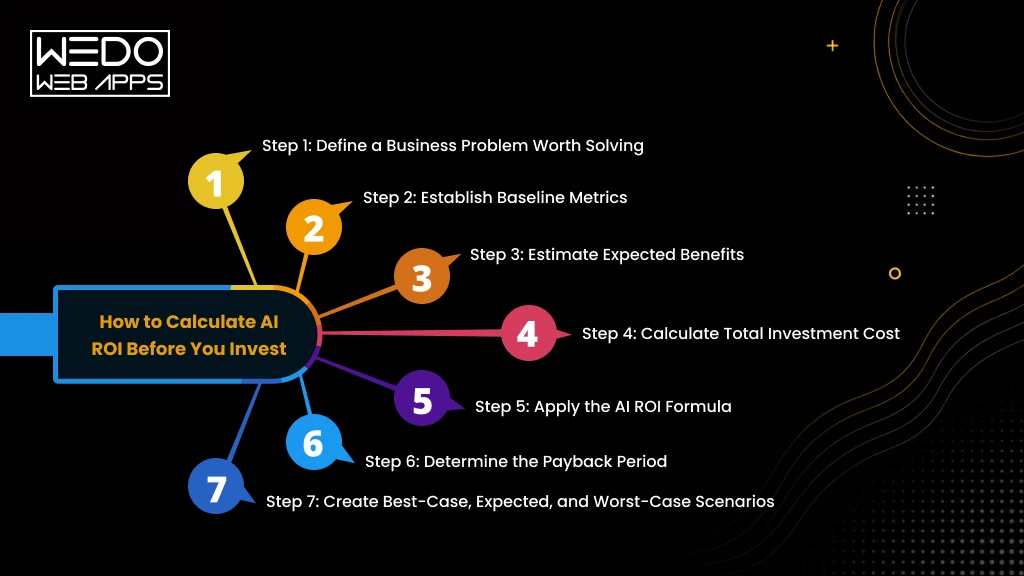
How to Calculate AI ROI Before You Invest
One of the biggest mistakes organisations make is waiting until after implementation to measure AI ROI. By that point, budgets have been approved, resources have been allocated, and expectations have already been set.
A more effective approach is to estimate the potential return on AI before investing. This allows decision-makers to compare opportunities, prioritise high-impact use cases, and build a stronger business core for stakeholders.
While no forecast can guarantee results, a structured ROI framework can provide a realistic view of the value an AI initiative is expected to generate.
Step 1: Define a Business Problem Worth Solving
The starting point for any AI initiative should be a clearly defined business challenge.
Instead of asking:
- "How can we use AI?"
Ask:
- "What business problem are we trying to solve?"
- "What outcome are we trying to improve?"
- "How will success be measured?"
The strongest AI investments are tied to specific objectives such as:
- Reducing customer support costs.
- Increasing sales conversion rates.
- Accelerating operational processes.
- Reducing compliance risks.
Without a measurable objective, calculating ROI becomes largely speculative.
Step 2: Establish Baseline Metrics
Before estimating future improvements, businesses need to understand their current performance.
Common baseline metrics include:
- Average process completion time.
- Cost per transaction.
- Customer acquisition cost.
- Customer satisfaction scores.
- Employee productivity levels.
- Error and rework rates.
These benchmarks create a reference point that allows organisations to quantify the value generated by AI.
Example: If customer support agents currently handle 100 tickets per day and AI is expected to increase productivity to 130 tickets per day, the improvement can be measured against a known baseline.
Step 3: Estimate Expected Benefits
Once baseline metrics are established, businesses can estimate the value AI is expected to create.
Potential benefits often fall into several categories:
Financial Benefits
- Reduced labour costs.
- Lower operational expenses.
- Increased revenue.
- Reduced customer churn.
Productivity Benefits
- Time saved across workflows.
- Faster decision-making.
- Improved employee output.
Strategic Benefits
- Better customer experiences.
- Increased scalability.
- Faster innovation cycles.
- Improved competitive positioning.
For ROI calculations, businesses should prioritise benefits that can be measured and assigned a financial value.
Step 4: Calculate Total Investment Cost
The next step is determining the full cost of the initiative.
This should include:
- Software and licensing fees.
- Integration and implementation costs.
- Training expenses.
- Infrastructure costs.
- Ongoing maintenance.
- Governance and compliance expenses.
A complete cost assessment helps prevent unrealistic ROI projections and strengthens AI cost justification efforts.
Step 5: Apply the AI ROI Formula
Once benefits and costs have been estimated, the organization can calculate projected AI ROI.
The standard formula is:
AI ROI (%) = ((Total Benefits - Total Costs) ÷ Total Costs) × 100
For example:
| Item | Value |
|---|---|
| Total Annual Benefits | £300,000 |
| Total Annual Costs | £100,000 |
| Net Gain | £200,000 |
| AI ROI | 200% |
In this scenario, every £2 in additional value.
This calculation provides a clear financial view of whether the initiative is likely to deliver a positive return.
Step 6: Determine the Payback Period
ROI alone does not tell the full story. Businesses also need to understand how quickly the investment will recover its cost.
The payback period is calculated as:
Payback Period = Total Investment ÷ Monthly Benefit
For example:
| Item | Value |
|---|---|
| Total Investment | £120,000 |
| Monthly Benefit | £15,000 |
| Payback Period | 8 months |
Many organizations prefer projects with short payback periods because they reduce financial risk and demonstrate value sooner.
Step 7: Create Best-Case, Expected, and Worst-Case Scenarios
AI outcomes rarely match projections exactly. Adoption rates, data quality, and operational challenges can all affect results.
To improve forecasting accuracy, businesses should evaluate multiple scenarios:
| Scenario | Expected Outcome |
|---|---|
| Best Case | Benefits exceed projections, and adoption is high. |
| Expected Case | Results align with forecasted assumptions. |
| Worst Case | Adoption is slower, and benefits take longer to materialise. |
Scenario planning helps leadership teams make more informed decisions and prepare for potential risks before approving an AI investment.
A Practical AI ROI Assessment Checklist
Before moving forward with an AI initiative, ask the following questions:
- Is there a clearly defined business problem?
- Have baseline performance metrics been established?
- Can expected benefits be quantified?
- Have all implementation and operational costs been included?
- Is the projected ROI positive?
- Is the payback period acceptable?
- Have potential risks and adoption challenges been considered?
If the answer to most of these questions is yes, the organisation is in a much stronger position to evaluate the true AI business value of the investment.
Calculating AI ROI before implementation helps organisations move beyond assumptions and evaluate opportunities based on measurable outcomes. By defining objectives, establishing baselines, estimating benefits, accounting for total costs, and analysing multiple scenarios, decision-makers can build a more accurate view of the potential return on AI and reduce the risk of investing in initiatives that fail to deliver value.
The next section provides a practical AI ROI calculator framework that business leaders can use to estimate returns and present investment proposals to stakeholders with greater confidence.
AI ROI Calculator Framework for Decision Makers
Calculating AI ROI becomes much easier when decision-makers follow a structured framework rather than relying on assumptions. A well-designed ROI model helps organizations estimate potential returns, compare investment opportunities, and build confidence among stakeholders before committing resources.
The goal is not to predict the future with perfect accuracy. Instead, it is to create a realistic financial model that connects expected business outcomes with the total cost of the initiative.
Whether you're evaluating a chatbot, AI-powered analytics platform, workflow automation solution, or generative AI tool, the same framework can be applied to assess potential AI business value.
Inputs Required for ROI Estimation
Every ROI model starts with two core inputs:
- Total investment costs.
- Expected business benefits.
Before building your calculations, gather the following data:
Cost Inputs
- AI software or platform fees.
- Implementation and integration costs.
- Infrastructure and cloud expenses.
- Employee training costs.
- Ongoing maintenance and support costs.
- Governance and compliance expenses.
Benefit Inputs
- Hours saved through automation.
- Productivity improvements.
- Labour cost reductions.
- Increased sales or revenue.
- Reduced operational errors.
- Customer retention improvements.
- Reduced compliance risks.
The more accurate these inputs are, the more reliable the projected return on AI will be.
Sample AI ROI Calculation Example
Consider a company implementing an AI-powered customer support solution.
Annual Costs
| Cost Category | Annual Cost |
|---|---|
| AI Platform Subscription | £30,000 |
| Integration and Setup | £20,000 |
| Employee Training | £10,000 |
| Ongoing Maintenance | £15,000 |
| Total Investment | £75,000 |
Annual Benefits
| Benefit Category | Annual Value |
|---|---|
| Reduced Support Labour Costs | £80,000 |
| Productivity Gains | £40,000 |
| Reduced Escalation Costs | £20,000 |
| Improved Customer Retention | £35,000 |
| Total Benefits | £175,000 |
ROI Calculations
| Metric | Value |
|---|---|
| Total Benefits | £175,000 |
| Total Costs | £75,000 |
| Net Gain | £100,000 |
| AI ROI | 133% |
In this example, the organization generates £1.33 in value for every £1 invested after recovering its original costs.
AI ROI Template Table
Business leaders can use the following template when evaluating any AI investment.
| Category | Estimated Value |
|---|---|
| Software Costs | £ |
| Integration Costs | £ |
| Training Costs | £ |
| Infrastructure Costs | £ |
| Ongoing Support Costs | £ |
| Total Investment | £ |
| Cost Savings Generated | £ |
| Productivity Gains | £ |
| Revenue Growth | £ |
| Risk Reduction Value | £ |
| Total Benefits | £ |
| Net Business Value | £ |
| AI ROI (%) | % |
This framework creates a consistent method for evaluating different AI initiatives across departments and business functions.
How Leadership Teams Use ROI Models for Budget Approval
Executives rarely approve investments based solely on technical capabilities. They want evidence that the initiative supports business objectives and delivers measurable outcomes.
When presenting an AI business case, leadership teams typically focus on:
- Expected financial return.
- Time required to recover the investment.
- Strategic alignment with business goals.
- Risks and mitigation plans.
- Resource requirements.
- Long-term scalability.
A strong ROI model helps answer these questions and provides a clear rationale for investment decisions.
To strengthen AI cost justification, include:
- Baseline performance metrics.
- Financial projections.
- Assumptions used in calculations.
- Best-case and worst-case scenarios.
- Expected payback period.
This approach demonstrates that the proposal is grounded in measurable business outcomes rather than technology trends.
What Decision Makers Should Look For?
Not every AI project needs to generate a triple-digit ROI to be valuable.
In many cases, successful initiatives share the following characteristics:
- A clear business objective.
- Measurable performance improvements.
- Realistic implementation costs.
- Strong employee adoption potential.
- A reasonable payback period.
- Scalability across the organisation.
Projects that meet these criteria are often better candidates for investment than initiatives built around technology experimentation alone.
An effective AI ROI framework transforms AI from a technology discussion into a business decision. By documenting costs, quantifying expected benefits, and calculating projected returns, organisations can evaluate opportunities more objectively and build stronger investment cases. The most successful businesses use ROI models not only to justify spending but also to prioritise the initiatives most likely to generate meaningful AI business value.
In the next section, we'll examine the key metrics organisations use to measure AI performance and track the actual value generated after implementation.
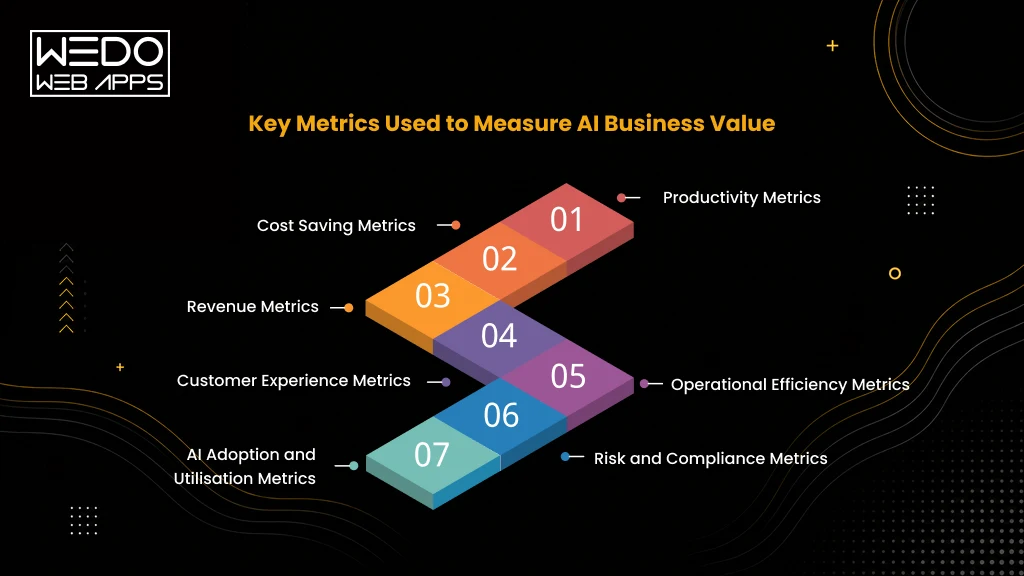
Key Metrics Used to Measure AI Business Value
Implementing AI is only the first step. To determine whether an initiative is delivering meaningful results, organisations need to track the right performance indicators over time.
One of the most common reasons businesses struggle to demonstrate AI ROI is that they focus on adoption metrics rather than business outcomes. While it is useful to know how many employees use an AI tool, leadership teams are ultimately interested in how that usage translates into measurable value.
The most effective measurement frameworks combine financial, operational, customer, and strategic metrics to provide a complete view of AI business value.
Productivity Metrics
Productivity improvements are often among the earliest indicators of a successful AI investment.
These metrics help organisations understand whether AI is enabling employees to work more efficiently.
Common productivity metrics include:
- Time saved per task.
- Average task completion time.
- Output per employee.
- Number of tasks automated.
- Reduction in manual effort.
- Increase in employee capacity.
Example: If an AI-powered reporting tool reduces report creation time from four hours to one hour, the organisation gains three hours of productive capacity for every report generated.
Questions to Ask
- Are employees completing tasks faster?
- Has AI reduced repetitive work?
- Are teams able to handle higher workloads without increasing headcount?
Cost Saving Metrics
Cost reduction remains one of the most direct ways to measure return on AI.
These metrics help quantify financial benefits generated through automation and operational improvements.
Key cost-related metrics include:
- Labour cost savings.
- Reduction in outsourcing expenses.
- Lower operational costs.
- Reduced support costs.
- Reduced processing costs.
- Decrease in error-related expenses.
For many organisations, cost savings provide the strongest foundation for AI cost justification because they can be directly linked to financial performance.
Questions to Ask
- Which costs have been reduced since implementation?
- Are operational expenses declining?
- How much value is being generated through automation?
Revenue Metrics
Some AI initiatives are designed primarily to support growth rather than reduce costs.
In these cases, revenue-focused metrics become essential.
Common revenue metrics include:
- Revenue growth.
- Conversion rate improvements.
- Average deal size.
- Customer lifetime value.
- Upsell and cross-sell revenue.
- Lead-to-customer conversion rates.
Example: An AI-powered recommendation engine that increases online sales by 10% can generate significant business value even if operational costs remain unchanged.
Questions to Ask
- Has AI contributed to higher sales performance?
- Are customers spending more?
- Is customer acquisition becoming more efficient?
Customer Experience Metrics
Customer experience improvements can have a substantial impact on long-term business performance.
Although these benefits may be harder to quantify initially, they often influence retention, loyalty, and revenue growth.
Important customer metrics include:
- Customer satisfaction (CSAT).
- Net Promoter Score (NPS).
- Customer retention rate.
- Customer churn rate.
- Average response time.
- First-contact resolution rate.
Organisations that improve customer experiences often see indirect gains that strengthen overall AI ROI over time.
Questions to Ask
- Are customers receiving faster service?
- Has satisfaction improved?
- Are retention rates increasing?
Operational Efficiency Metrics
AI is frequently used to optimize business processes and eliminate inefficiencies.
Operational metrics help measure the impact of these improvements.
Common efficiency metrics include:
- Process cycle time.
- Workflow completion rates.
- Resource utilisation.
- Error rates.
- Downtime reduction.
- Throughput increases.
These indicators are particularly important in operations, finance, supply chain, and customer support functions.
Questions to Ask
- Are workflows moving faster?
- Have bottlenecks been reduced?
- Is process accuracy improving?
Risk and Compliance Metrics
Risk reduction is often overlooked when evaluating AI business value, yet it can provide substantial financial and strategic benefits.
Relevant metrics include:
- Fraud detection rates.
- Compliance violation reductions.
- Security incident reduction.
- Audit efficiency improvements.
- Risk exposure reduction.
- Regulatory reporting accuracy.
For highly regulated industries, avoiding a single compliance issue can justify a significant AI investment.
Questions to Ask
- Has AI reduced operational risk?
- Are compliance processes more efficient?
- Have costly errors decreased?
AI Adoption and Utilisation Metrics
Business outcomes matter most, but adoption metrics help explain why certain results are being achieved.
If employees are not using AI tools effectively, ROI will likely fall short of expectations.
Useful adoption metrics include:
- Active users.
- Frequency of use.
- Departmental adoption rates.
- Feature utilisation.
- User satisfaction.
- Training completion rates.
These metrics should be used alongside business outcomes rather than as standalone indicators of success.
Questions to Ask
- Are employees actively using the solution?
- Which teams generate the most value from AI?
- Are adoption levels increasing over time?
Building a Balanced AI Measurement Framework
The most successful organisations avoid relying on a single KPI.
Instead, they create a balanced scorecard that combines multiple categories of metrics.
| Metric Category | Primary Purpose |
|---|---|
| Productivity Metric | Measure efficiency gains |
| Cost-Saving Metric | Measure direct financial impact |
| Revenue Metric | Measure growth contribution |
| Customer Metric | Measure customer experience improvements |
| Operational Metric | Measure process optimisation |
| Risk Metrics | Measure risk reduction and compliance improvements |
| Adoption Metrics | Measure usage and engagement |
Tracking a mix of these indicators provides a more accurate picture of return on AI and prevents businesses from overlooking important sources of value.
There is no single metric that defines AI ROI. The most effective measurement strategies combine productivity, cost savings, revenue growth, customer experience, operational efficiency, risk reduction, and adoption metrics. By tracking a balanced set of KPIs, organisations can gain a clearer understanding of the true AI business value generated by their investments and make better decisions about future AI initiatives.
The next step is understanding why many AI projects fail to achieve expected returns. In the following section, we'll examine the most common mistakes that reduce AI ROI and how organisations can avoid them.
AI Cost Justification: Building a Strong Business Case
A successful AI investment is not approved because of its technical capabilities. It is approved because it can deliver measurable business outcomes.
To secure stakeholder buy-in, organisations need to show how AI will solve a specific business challenge and generate value that exceeds the cost of implementation. This is the foundation of effective AI cost justification.
Businesses that need help evaluating AI opportunities, defining suitable use cases, and building an investment roadmap can also use AI consulting services to align technology decisions with measurable business outcomes.
Questions Executives Ask Before Approving AI Budgets
Before investing in AI, leadership teams typically want answers to questions such as:
- What problem are we solving?
- What business value will AI create?
- What is the projected AI ROI?
- How long is the payback period?
- What risks could affect results?
Clear answers help build confidence in the investment decision.
How to Connect AI Outcomes to Business Goals
The strongest business cases link AI initiatives directly to organisational objectives.
| Business Goal | Potential AI Outcomes |
|---|---|
| Reduce Costs | Process automation |
| Increase Revenue | Better lead conversion |
| Improve Productivity | Faster task completion |
| Improve Customer Experience | Personalised support |
| Reduce Risk | Automated monitoring |
This approach shifts the discussion from technology adoption to business impact.
Quantifying Soft Benefits and Intangible Value
Not all business value comes from direct cost savings.
Businesses should also consider:
- Improved customer satisfaction.
- Better employee experiences.
- Faster decision-making.
- Increased scalability.
- Stronger competitive positioning.
While these benefits can be harder to measure, they often contribute significantly to long-term return on AI.
Creating an Executive Summary for Stakeholders
A strong AI business case should clearly communicate:
- The business problem.
- The proposed AI solution.
- Expected benefits.
- Total investment required.
- Projected ROI and payback period.
- Key risks and mitigation plans.
Effective AI cost justification focuses on outcomes rather than technology. When organisations connect AI initiatives to measurable business goals and clearly demonstrate expected value, they are far more likely to secure approval and achieve positive AI ROI.

Common Mistakes That Reduce AI ROI
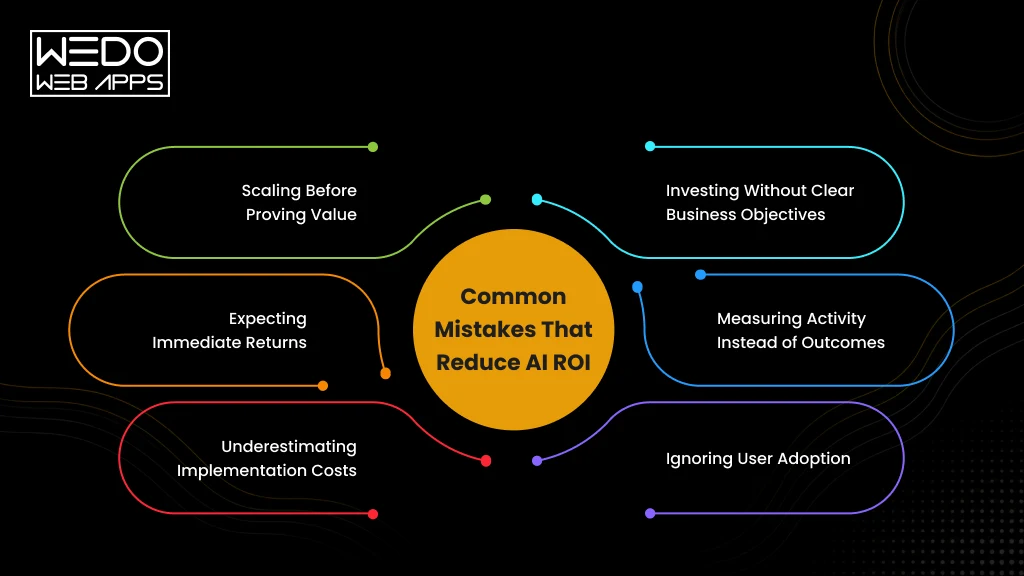
Even well-planned AI initiatives can fail to deliver the expected AI ROI if organisations overlook key factors during implementation and measurement. In many cases, the issue is not the technology itself but how it is deployed, managed, and evaluated.
Understanding these common mistakes can help businesses maximize AI business value and improve the chances of achieving a positive return on AI.
Investing Without Clear Business Objectives
Many organisations adopt AI because it is gaining attention in the market rather than because it solves a specific business problem.
Before investing, define:
- The problem being addressed.
- The desired outcome.
- The metrics that will measure success.
Without clear objectives, demonstrating ROI becomes difficult.
Measuring Activity Instead of Outcomes
Tracking usage alone does not prove business value.
For example, metrics such as:
- Number of AI users.
- Number of prompts generated.
- Number of automated tasks.
are useful, but they do not show whether AI is improving business performance.
Focus on outcomes such as cost savings, productivity gains, revenue growth, and customer satisfaction.
Ignoring User Adoption
AI delivers value only when employees use it effectively.
Low adoption often results from:
- Insufficient training.
- Poor workflow integration.
- Lack of stakeholder buy-in.
Organisations that invest in change management and employee enablement typically achieve stronger AI ROI.
Underestimating Implementation Costs
Many businesses focus on software costs while overlooking expenses such as:
- Integration.
- Training.
- Data preparation.
- Ongoing maintenance.
Failing to account for these costs can lead to unrealistic ROI expectations and weak AI cost justification.
Expecting Immediate Returns
Unlike traditional software purchases, AI often requires time to generate meaningful results.
Businesses may need to:
- Refine workflows.
- Improve data quality.
- Increase user adoption.
- Optimise AI models.
Measuring performance too early can create a misleading picture of success.
Scaling Before Proving Value
A common mistake is expanding AI initiatives across the organisation before validating results.
A better approach is to:
- Start with a pilot project.
- Measure outcomes.
- Refine the implementation.
- Scale successful use cases.
This reduces risk and helps ensure that future investments are supported by proven results.
Most AI failures are not caused by the technology itself. They result from unclear objectives, poor measurement, low adoption, underestimated costs, unrealistic expectations, and premature scaling. Avoiding these mistakes can significantly improve AI ROI and help organisations realise greater AI business value from their investments.
AI ROI Benchmarks Across Common Business Functions
The expected AI ROI varies depending on where AI is implemented and the business problem it is designed to solve. While every organisation has different goals, certain functions consistently deliver measurable value due to their reliance on repetitive tasks, data analysis, and customer interactions.
Rather than comparing your results against a universal benchmark, focus on identifying the areas where AI can create the greatest impact within your organisation.
Customer Support and Service
Customer support is often one of the fastest areas to realise return on AI.
Common value drivers include:
- Reduced response times.
- Lower support costs.
- Increased ticket resolution rates.
- Improved customer satisfaction.
AI chatbots, virtual assistants, and automated ticket routing can help teams manage higher volumes without increasing headcount.
Sales and Lead Qualification
Sales teams use AI to prioritise opportunities and improve conversion rates.
Potential benefits include:
- Faster lead qualification.
- Improved sales productivity.
- Higher conversion rates.
- More accurate sales forecasting.
When implemented effectively, AI can help sales teams spend more time engaging high-value prospects and less time on administrative tasks.
Marketing and Content Operations
Marketing departments often use AI to improve efficiency and campaign performance.
Typical outcomes include:
- Faster content production.
- Better audience targeting.
- Improved campaign optimization.
- Reduced manual workload.
The value generated often comes from a combination of productivity gains and increased marketing effectiveness.
Finance and Accounting
AI can streamline financial processes that require significant manual effort.
Common applications include:
- Invoice processing.
- Expense management.
- Financial forecasting.
- Fraud detection.
These use cases often contribute to AI business value through improved accuracy, reduced processing time, and lower operational costs.
Human Resources
HR teams increasingly use AI to automate administrative tasks and improve hiring processes.
Potential benefits include:
- Faster candidate screening.
- Reduced recruitment costs.
- Improved employee onboarding.
- Better workforce planning.
These efficiencies allow HR professionals to focus more on strategic initiatives and employee engagement.
IT and Internal Operations
IT departments frequently achieve strong ROI through automation and proactive monitoring.
Key value drivers include:
- Reduced system downtime.
- Faster issue resolution.
- Automated service management.
- Improved resource utilisation.
AI can help internal teams operate more efficiently while supporting business continuity.
There is no single benchmark that defines successful AI ROI. The most valuable AI initiatives are those that address high-impact business challenges and produce measurable improvements in cost, productivity, revenue, customer experience, or operational efficiency. By focusing on the functions where AI can deliver the greatest business value, organisations can prioritise investments with the strongest potential returns.
When Is AI Not a Good Investment?
AI can deliver significant business value, but it is not the right solution for every challenge. In some situations, the costs, complexity, or implementation effort may outweigh the potential benefits.
Recognising these scenarios early can prevent unnecessary spending and improve AI cost justification efforts.
Processes That Are Already Highly Efficient
If a process is already performing well with minimal manual effort, introducing AI may produce only marginal improvements.
Before investing, ask:
- Is there a measurable problem to solve?
- Will AI create meaningful business value?
- Can the expected gains justify the investment?
Sometimes process optimisation alone can deliver better results at a lower cost.
Lack of Reliable Data
AI systems depend on quality data to generate accurate outputs and insights.
Common challenges include:
- Incomplete datasets.
- Inconsistent data formats.
- Poor data governance.
- Limited historical information.
Without reliable data, achieving a positive AI ROI becomes much more difficult.
Undefined Success Metrics
Businesses often struggle to measure results when objectives are unclear.
Before launching an AI initiative, define:
- The desired outcome.
- Key performance indicators (KPIs).
- Expected financial or operational benefits.
If success cannot be measured, the return on AI cannot be evaluated accurately.
Small Problems With Minimal Business Impact
Not every challenge requires an AI solution.
If the problem affects only a small portion of the business or generates limited costs, the investment may not produce sufficient returns.
Focus AI efforts on areas where improvements can create measurable organisational value.
Limited Internal Adoption Readiness
Even the most advanced AI solution will fail to generate value if employees do not use it.
Warning signs include:
- Lack of leadership support.
- Resistance to change.
- Limited training resources.
- Unclear ownership of AI initiatives.
Organisations should address these challenges before making significant investments.
A successful AI investment starts with selecting the right use case. Businesses are less likely to achieve positive AI ROI when data quality is poor, objectives are unclear, adoption readiness is low, or the problem being solved has limited business impact. Evaluating these factors early helps organisations invest in AI where it can create the greatest AI business value.
Final Thoughts: Focus on Business Value Before Technology
The success of an AI investment is not determined by how advanced the technology is. It is determined by the business outcomes it delivers.
Before investing in AI, organisations should focus on identifying the problem they want to solve, the value they expect to create, and the metrics they will use to measure success. This approach helps build stronger AI cost justification, reduces implementation risk, and improves the likelihood of achieving a positive AI ROI.
Whether the goal is to reduce costs, improve productivity, increase revenue, or enhance customer experiences, the most successful AI initiatives are those that are tied to clear business objectives and have better digital transformation.
As AI adoption continues to grow, organisations that prioritise AI business value over technology trends will be better positioned to make informed investment decisions, maximise their return on AI, and create sustainable long-term growth.