Introduction
AI is quickly moving from a competitive advantage to a business necessity. What was once accessible only to large enterprises is now an advantage to businesses of all sizes through AI-powered tools, automation platforms, and intelligent analytics solutions. Yet, while interest in AI continues to grow, many small and medium businesses still struggle to answer a fundamental question:
Where should we start?The challenge is not a lack of technology. It is the lack of a clear strategy for adoption and scaling it effectively. Without a structured AI adoption framework, businesses often invest in tools before identifying their objectives, resulting in disconnected initiatives and limited business impact.
Successful business AI adoption starts with understanding where AI can create value, which processes should be prioritized, and how implementation aligns with broader business goals. This requires careful AI planning, realistic expectations, and a clear path from experimentation to measurable outcomes.
A well-defined AI roadmap helps organizations navigate this process by outlining priorities, resources, timelines, and success metrics with the software development approach. Combined with a practical approach to AI implementation, it enables businesses to reduce risk, improve operational efficiency, and create a stronger foundation for long-term growth.
In this guide, we will walk through a step-by-step framework that helps small and medium businesses assess their readiness, identify high-impact opportunities, develop an actionable roadmap, and implement AI initiatives that deliver real business value.
What Is an AI Adoption Framework?
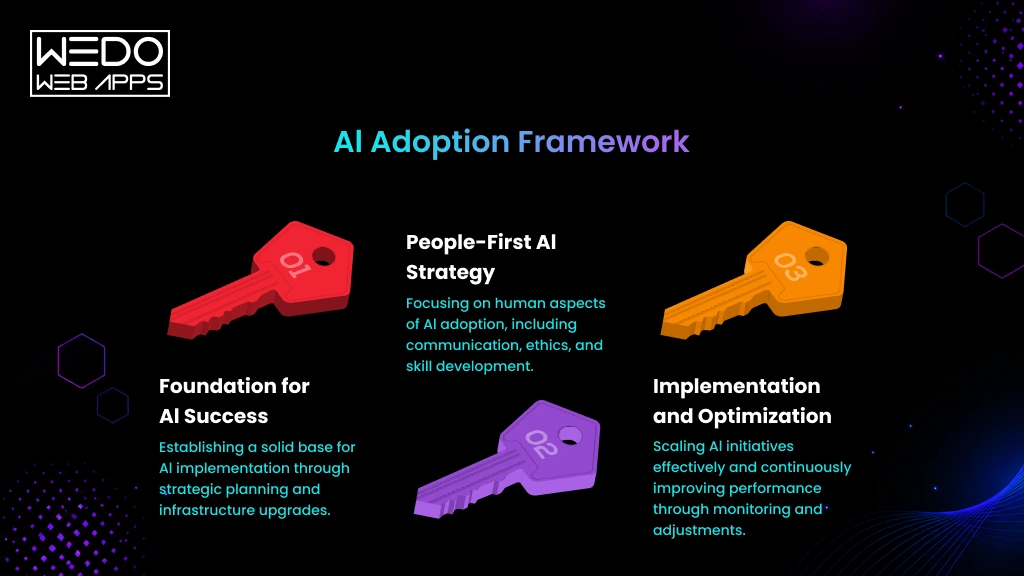
An AI adoption framework is a structured approach that helps businesses plan, deploy, manage, and scale artificial intelligence initiatives in alignment with their goals. Rather than implementing AI tools without a clear direction, businesses use a framework to identify opportunities, allocate resources, minimise risks, and measure outcomes.
For small and medium businesses, an AI adoption framework acts as a blueprint that connects AI planning, AI implementation, and long-term business objectives. It ensures that AI investments support operational improvements, customer experiences, and revenue growth instead of becoming isolated technology projects.
Why Businesses Need an AI Adoption Framework
Many organisations recognise the potential of AI but struggle to move from experimentation to measurable business results. A structured framework provides clarity on where to begin, what to prioritise, and how to scale initiatives effectively.
Key benefits include:
- Aligning AI initiatives with business goals.
- Prioritising high-value use cases.
- Reducing implementation risks and unnecessary spending.
- Creating a structured AI roadmap for growth.
- Establishing governance and accountability.
- Measuring the success of business AI adoption initiatives.
AI Adoption Framework vs AI Strategy vs AI Roadmap
Although these terms are often used interchangeably, they serve different purposes within an organisation's AI journey.
| Component | Purpose | Key Focus |
|---|---|---|
| AI Adoption Framework | Provides the overall structure for adopting AI across the business. | Governance, planning, implementation, and scaling. |
| AI Strategy | Defines why the business is investing in AI. | Business objectives, expected outcomes, and priorities. |
| AI Roadmap | Outlines how AI initiatives will be executed over time. | Milestones, timelines, resources, and deliverables. |
Think of it this way:
- The AI strategy defines the destination.
- The AI roadmap outlines the route.
- The AI adoption framework provides the system that keeps the entire journey organised and measurable.
Core Components of an AI Adoption Framework
A successful framework typically includes the following elements:
| Components | Purpose |
|---|---|
| Business Objective | Define what the organization aims to achieve with AI |
| Data Readiness | Assess data quality, accessibility, and governance |
| Technology Infrastructure | Evaluate existing systems and AI capabilities |
| Workforce Readiness | Identify training and skill requirements |
| AI Governance | Establish policies, compliance, and risk controls |
| Performance Measurement | Track outcomes and return on investment |
When these components work together, businesses can build a sustainable approach to AI planning, create a realistic AI roadmap, and execute AI implementation projects with greater confidence and control.
Why Many Small and Medium Businesses Delay AI Adoption
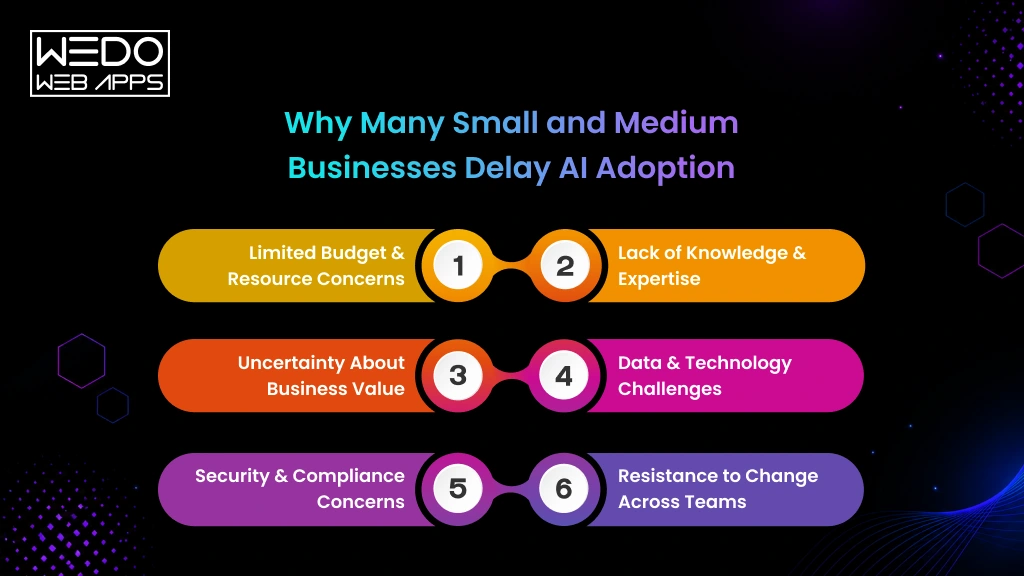
Small and medium businesses rarely reject AI because they do not see its potential. More often, they delay adoption because they are unsure where to start, what to prioritise, or how to justify the investment.
While AI tools have become more accessible, many businesses still face practical barriers that slow decision-making and implementation. Understanding these challenges is the first step toward building a successful AI adoption framework.
Limited Budget & Resource Concerns
For most SMBs, every technology investment competes with other business priorities.
Imagine having to choose between:
- Hiring an additional employee
- Upgrading business software
- Expanding marketing efforts
- Investing in AI initiatives
Without a clear business case, AI moves to the bottom of the list.
The good news is that modern business AI adoption does not always require large budgets or dedicated AI teams. Many businesses begin with affordable AI tools that automate repetitive tasks, improve customer service, or support internal operations before expanding their efforts.
What often changes leadership's perspective?
When AI is positioned as a solution to a specific business problem rather than a technology investment.
Lack of Knowledge & Expertise
One of the most common reasons businesses postpone AI planning is uncertainty. Business leaders frequently ask:
- Do we need an AI specialist?
- Which processes should we automate first?
- How do we know if AI will actually deliver value?
- What tools are worth investing in?
These questions create a decision bottleneck. Teams spend months researching AI opportunities but never move toward implementation because there is no clear framework for evaluating options.
In many cases, the challenge is not learning everything about AI. It is understanding where AI fits within existing business processes.
Uncertainty About Business Value
Several enterprises know what AI can do. But only fewer understand what AI should do for their business. Consider the following difference to have a clear idea:
| AI Activity | Business Outcome |
|---|---|
| Automating customer support | Faster response times and lower support costs |
| AI-powered forecasting | Better inventory planning |
| Marketing automation | Higher campaign efficiency |
| Document processing | Reduced administrative workload |
Here, the focus should never be on adopting AI for the sake of adoption. The focus should be on answering one question:
Which business problem will AI solve first?
Businesses that can answer this question usually build a stronger AI roadmap than those chasing multiple opportunities simultaneously.
Data & Technology Challenges
AI is compared to a high-performance engine. But even the most advanced engine cannot perform well if the fuel is poor. The same principle applies to data. Several SMBs discover that their information is:
- Stored across multiple systems
- Inconsistent or incomplete
- Difficult to access
- Lacking clear ownership
As a result, businesses may rush into AI implementation only to realise they need to address data quality issues first. Before evaluating AI tools, businesses should assess whether their existing data can support reliable outcomes. A simple readiness check can help:
- Customer data is organized
- Business records are up to date
- Systems can share information
- Teams know where critical data resides
The more boxes checked, the smoother the implementation journey tends to be.
Security & Compliance Concerns
For many business leaders and founders, the concern is not whether AI works. It is whether it can be used safely. Questions around data privacy, customer information, and regulatory compliance slow adoption decisions, particularly in industries that manage sensitive information.
| Concern | Why it Matters |
|---|---|
| Data privacy | Protects customer and business information |
| Access control | Limits unauthorised use of AI systems |
| Regulatory compliance | Reduces legal and operational risks |
| AI accuracy | Prevents decisions based on incorrect outputs |
Addressing these issues early strengthens trust and creates a more sustainable foundation of business AI adoption.
Resistance to Change Across Teams
Technology adoption is rarely a technology problem. It is often a people problem. Employees may worry that AI will change their responsibilities, replace tasks they currently perform, or introduce unfamiliar workflows.
When these concerns are not addressed, even well-planned initiatives can struggle to gain traction. Businesses that achieve successful adoption typically focus on three areas:
- Explaining why AI is being introduced.
- Demonstrating how it supports employees.
- Providing practical training and guidance.
When teams understand the purpose behind AI initiatives, adoption becomes significantly easier and more effective.
The AI Adoption Framework for SMBs
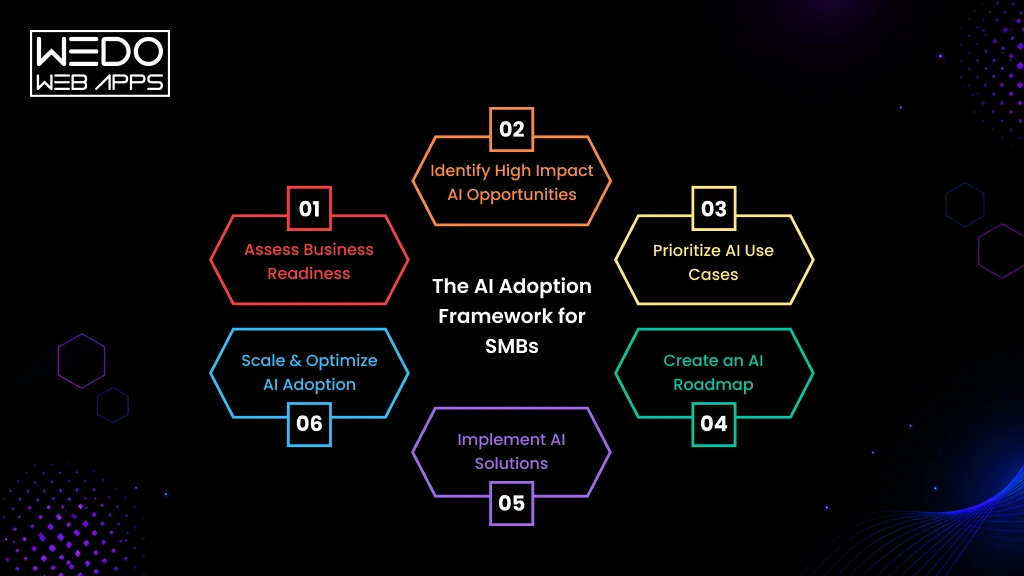
Many businesses make the mistake of treating AI adoption as a technology project. In reality, successful business AI adoption is a business transformation initiative supported by technology.
The organisations that see the greatest results are not necessarily the ones using the most advanced AI tools. They are the ones that follow a clear process for evaluating opportunities, implementing solutions, and measuring outcomes.
The framework below provides a practical approach that small and medium businesses can follow to move from AI exploration to measurable business impact. Let's break down each stage.1. Assess Business Readiness
Before evaluating AI tools, businesses need to evaluate AI readiness. Many AI projects fail because organisations jump directly into implementation without understanding whether their processes, data, and teams are ready to support AI.
Think of this stage as a pre-flight check. The goal is to identify gaps before investing time and resources. A data analytics company can help assess data readiness and identify gaps that may affect AI implementation.
Ask the following questions to yourself:
- Do we have clear business challenges that need solving?
- Is our data organised and accessible?
- Are our current systems capable of supporting AI tools?
- Do employees understand how AI could support their work?
- Is leadership aligned on the expected outcomes?
If the answer is "no" to several of these questions, focus on improving readiness before moving forward. AI does not fix broken processes. It amplifies what already exists.
2. Identify High Impact AI Opportunities
Once readiness is established, the next challenge is deciding where AI can create the greatest value. One of the biggest mistakes businesses make is trying to implement AI everywhere at once. Instead, focus on areas where repetitive tasks, high volumes of data, or manual processes are slowing productivity. Businesses exploring autonomous workflows can also consider agentic AI development services to build AI systems that plan, decide, and execute tasks across business processes.
Natural language processing can also support AI adoption by helping businesses automate tasks involving text, documents, customer queries, and other language-based workflows.
| Business Function | AI Opportunity |
|---|---|
| Customer Support | AI chatbots and automated ticket routing |
| Marketing | Content generation and campaign optimization |
| Sales | Lead scoring and sales forecasting |
| Operations | Workflow automation and reporting |
| Finance | Invoice processing and expense categorisation |
| HR | Candidate screening and employee onboarding support |
A core component of any AI adoption plan is business process automation, which helps businesses eliminate manual steps and streamline repetitive workflows before layering AI on top.
The objective isn't to find the most advanced use case. The objective is to find the use case that solves a real business problem.
3. Prioritize AI Use Cases
After identifying opportunities, businesses often face a new problem: too many options. Not every idea deserves immediate investment. A simple prioritisation exercise can help determine which initiatives should move forward first. What you need to do is to use the impact vs effort approach as follows.
- High Impact, Low Effort = Implement first
- High Impact, High Effort = Plan for future phases
- Low Impact, Low Effort = Consider if resources allow
- Low Impact, High Effort = Avoid or postpone
For example: Automating customer enquiries may deliver quick results with minimal disruption. Building a custom AI forecasting platform may require significantly more time, data, and investment. Not every process needs an AI solution. When prioritizing use cases, SMBs can separate tasks that require prediction or decision making from repetitive, rule-based processes that can be handled through RPA solutions. |
This stage is a critical part of effective AI planning because it prevents businesses from spreading resources too thin.
4. Create an AI Roadmap
Once priorities are clear, businesses need a plan. An AI roadmap transforms ideas into actionable milestones by defining what will be implemented, when it will happen, and how success will be measured. A simple roadmap often works better than an overly detailed one.
| Timeline | Focus |
|---|---|
| 1-3 Months | Assess readiness and select use cases |
| 4-6 Months | Launch pilot projects |
| 7-9 Months | Evaluate results and optimize processes |
| 10-12 Months | Expand successful initiatives |
A roadmap should answer these questions:
- What are we implementing?
- Who is responsible?
- How will we measure success?
Without these answers, even promising AI initiatives can lose momentum.
5. Implement AI Solutions
This is where strategy becomes action. However, successful AI implementation is rarely about deploying software and hoping for the best. The right approach depends on the business problem, data availability, and desired outcome. For businesses that need predictive models, intelligent automation, or data-driven decision-making, machine learning development services can support the development and deployment of customized ML solutions. The most successful organisations follow a phased approach:
Pilot -> Learn -> Improve -> Scale
For advanced adoption, AI Agent Development Company enables autonomous systems that act on your behalf across tools and workflows.
Here is a practical implementation checklist you can consider:- Select the appropriate AI solution.
- Prepare and validate data.
- Define success metrics.
- Train employees.
- Monitor adoption and performance.
- Gather feedback from users.
- Refine workflows as needed.
Businesses that begin with small pilot projects often identify challenges early, reducing risks before expanding adoption.
6. Scale & Optimize AI Adoption
The final step is where long-term value is created. Many businesses successfully launch AI projects but never move beyond the pilot stage. As a result, they achieve isolated improvements without creating broader organizational impact. To scale successfully, focus on three areas:
1. Expand Proven Use Cases
If an AI solution delivers measurable results in one department, evaluate where similar opportunities exist elsewhere.
2. Standardise Best Practices
Document successful workflows, governance policies, and implementation processes so future projects can build on previous successes.
3. Continuously Measure Results
You need to track metrics that include:
- Productivity improvements
- Cost savings
- Customer satisfaction
- Employee adoption rates
- Revenue impact
The most effective AI adoption framework is not a one-time initiative. It is an ongoing process of evaluation, improvement, and expansion.
How to Build an AI Roadmap for Your Business
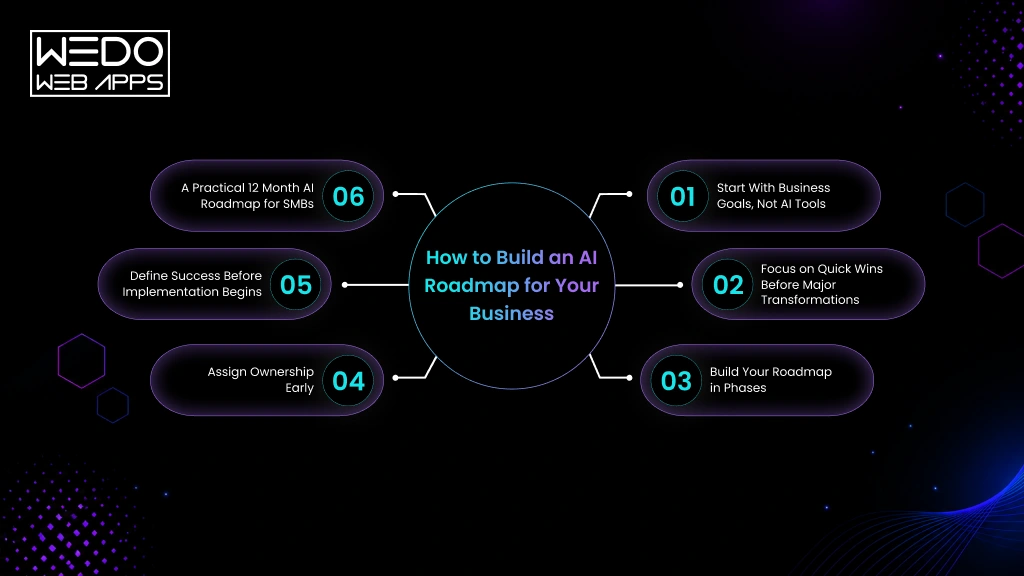
Many AI initiatives fail long before the implementation stage. Not because the technology falls short, but because businesses lack a clear plan for turning ideas into action. An AI roadmap bridges the gap between ambition and execution. It helps organisations define priorities, allocate resources, establish timelines, and track progress.
More importantly, it ensures that AI initiatives remain tied to business objectives rather than becoming standalone technology projects. For small and medium businesses, a roadmap does not need to be overly complex. It needs to be practical, realistic, and focused on outcomes.
Step 1. Start With Business Goals, Not AI Tools
One of the most common mistakes businesses make is evaluating AI tools before identifying the problems they want to solve. Imagine two companies:
- Company A invests in an AI platform because competitors are using it.
- Company B identifies that customer enquiries are overwhelming its support team and explores AI solutions to reduce response times.
Which company is more likely to see measurable results?
The second company has a clear business objective. The technology simply becomes a means to achieve it. Before creating an AI roadmap, ask:- What business challenge are we trying to solve?
- What outcome would define success?
- How will this initiative support our growth strategy?
When business goals lead the conversation, AI investments become far easier to justify and measure.
Step 2. Focus on Quick Wins Before Major Transformations
Many businesses become excited about AI's potential and immediately pursue large-scale projects. While ambitious initiatives may have long-term value, they often require significant investment, change management, and technical expertise. A more effective approach is to build momentum through early wins.
For example, an SMB might start by:
- Automating repetitive customer support requests.
- Generating routine reports using AI tools.
- Improving marketing campaign analysis.
- Streamlining internal knowledge sharing.
These projects typically require less effort, produce visible results faster, and help teams gain confidence in AI. Think of your first AI project as a proof point rather than a transformation programme.
Step 3. Build Your Roadmap in Phases
A successful AI roadmap should feel achievable. Breaking adoption into phases allows businesses to learn, adjust, and expand without creating unnecessary disruption.
| Phases | Primary Objective |
|---|---|
| Foundation | Assess readiness, identify opportunities, and define priorities |
| Pilot | Launch targeted AI initiatives and evaluate outcomes |
| Expansion | Extend successful use cases to additional teams or processes |
| Optimization | Refine performance and scale adoption across the business |
Rather than asking, "How can we transform the entire business with AI?", ask: "What is the next logical step in our AI journey?" This mindset often leads to more sustainable growth and better outcomes.
Step 4. Assign Ownership Early
Even the most promising roadmap can stall when nobody is accountable for moving it forward. AI initiatives often involve multiple departments, including operations, IT, marketing, customer service, and leadership teams. Without clear ownership, priorities can shift, and projects lose momentum. A simple approach is to define:
- Who approves AI investments.
- Who manages implementation.
- Who monitors performance.
- Who reports on business outcomes.
When responsibilities are clearly assigned, decision-making becomes faster, and progress becomes easier to track.
Step 5. Define Success Before Implementation Begins
Many businesses measure AI success after deployment. The strongest organisations define success before implementation starts. Consider the difference between these two goals:
Avoid "Improve customer service with AI" and not "Reduce average customer response times by 30% within six months". The second objective creates a measurable target that can guide decision-making throughout the project. Depending on the initiative, success metrics may include:
- Productivity improvements
- Cost reductions
- Customer satisfaction scores
- Revenue growth
- Employee adoption rates
- Process completion times
These metrics become an important part of both AI planning and long-term business AI adoption.
Step 6. A Practical 12 Month AI Roadmap for SMBs
While every organisation's journey will be different, most successful AI initiatives follow a similar progression. During the first few months, businesses focus on readiness assessments, identifying opportunities, and selecting high-value use cases. Once priorities are established, pilot projects are launched to validate assumptions and measure results.
As confidence grows, organisations begin expanding successful initiatives into additional workflows or departments. By the end of the first year, the focus shifts from experimentation to optimisation, ensuring that AI delivers consistent value across the business.
The goal is not to implement as much AI as possible within twelve months. The goal is to create a repeatable process for successful AI implementation that can support future growth.
AI Implementation Best Practices for SMBs
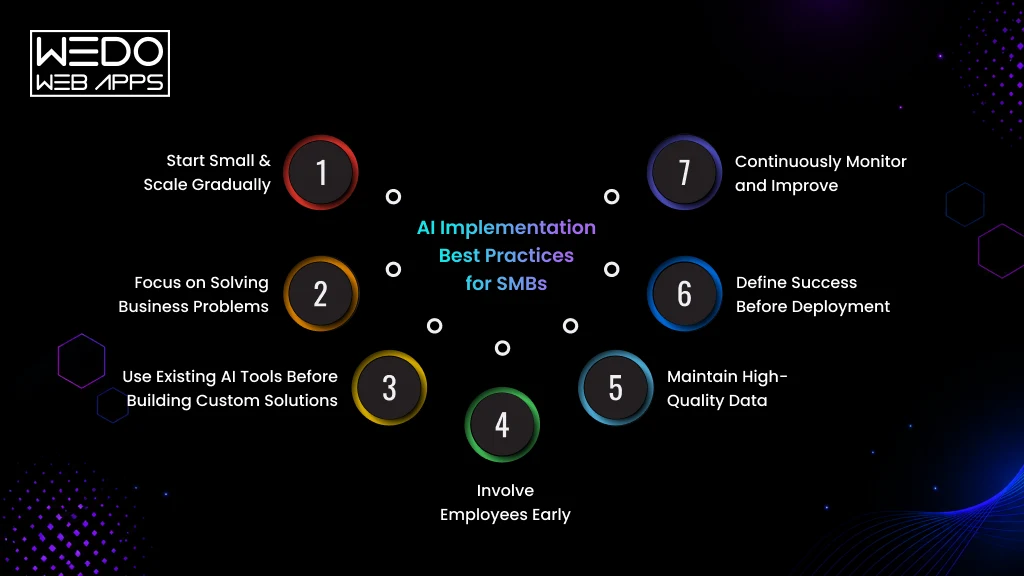
A successful AI implementation is rarely determined by the technology itself. More often, success depends on how well businesses prepare, execute, and manage adoption across teams. While every organisation's journey is different, the following practices can help SMBs reduce risks and achieve stronger outcomes.
Start Small & Scale Gradually
One of the biggest mistakes businesses make is trying to transform multiple processes simultaneously. This often creates unnecessary complexity and makes it difficult to measure results.
Instead, start with a single use case that can deliver visible business value within a reasonable timeframe. Once the initiative proves successful, it becomes much easier to expand AI into other areas of the organization.
Focus on Solving Business Problems
AI should always have a purpose beyond technology adoption. Before implementing any solution, ensure it addresses a challenge such as:
- Reducing repetitive manual work
- Improving customer response times
- Increasing operational efficiency
- Supporting better decision-making
When AI initiatives are tied to measurable business objectives, it becomes easier to demonstrate ROI and gain stakeholder support.
Use Existing AI Tools Before Building Custom Solutions
Many SMBs assume they need custom AI applications to see meaningful results. In reality, existing AI-powered platforms can often solve common business challenges without the cost and complexity of custom development. As AI requirements become more specialised, businesses may consider generative AI development services to build customised applications, assistants, or AI-powered workflows around their specific needs.
For example: Businesses can use AI for content creation, customer support automation, reporting, and workflow management using tools that are already available in the market. |
For most SMBs, the fastest path to value is adoption before customisation.
Involve Employees Early
Technology adoption becomes significantly easier when employees understand the purpose behind the change.
Rather than introducing AI after decisions have been made, involve key teams early in the process. Their feedback can help identify potential challenges, improve workflows, and increase adoption rates once implementation begins.
Maintain High-Quality Data
AI is only as effective as the data it receives. Poor quality data can lead to inaccurate outputs, unreliable insights, and reduced trust in AI systems. Before implementation, businesses should review whether their data is:
- Accurate
- Consistent
- Accessible
- Up to date
A strong data foundation often leads to smoother business AI adoption and better long-term results.
Define Success Before Deployment
Many organisations launch AI initiatives and only later decide how success will be measured. A more effective approach is to establish clear metrics from the beginning. Depending on the use case, these may include:
| Objective | Example Metric |
|---|---|
| Improve efficiency | Hours saved per week |
| Reduce costs | Lower operational expenses |
| Improve customer service | Faster response times |
| Increase productivity | Tasks completed per employee |
These benchmarks help businesses evaluate whether their AI implementation is delivering the expected outcomes.
Continuously Monitor and Improve
AI adoption is not a one-time project. Business needs, customer expectations, and technology capabilities will continue to evolve. Regular reviews can help identify:
- New optimisation opportunities
- Areas with low adoption
- Performance gaps
- Additional use cases worth exploring
Businesses that treat AI as an ongoing capability rather than a one-time deployment are often better positioned for long-term success.
Essential AI Governance Considerations for SMBs
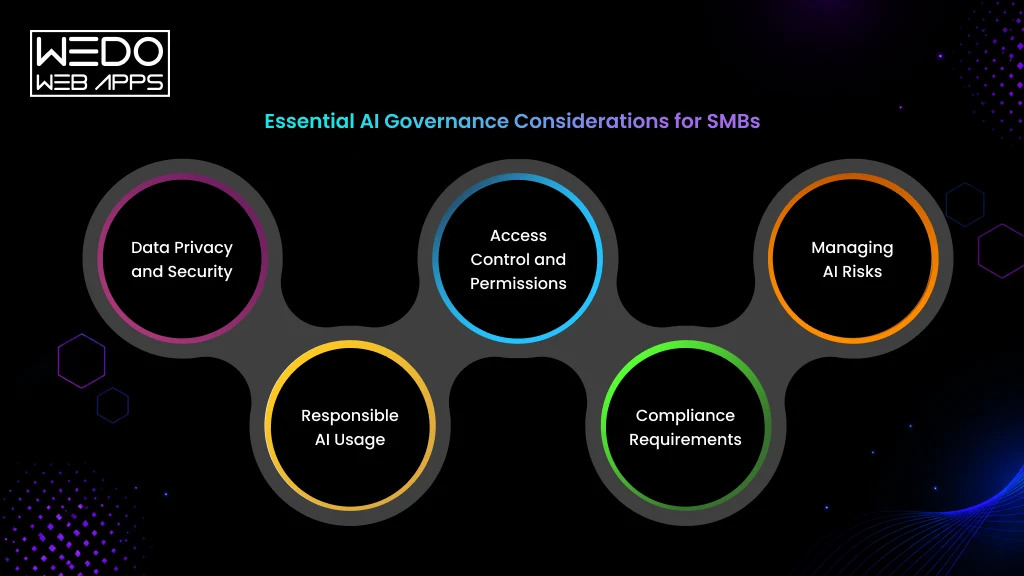
As AI becomes more integrated into daily operations, governance becomes just as important as implementation. Without clear guidelines, businesses risk exposing sensitive data, generating unreliable outputs, or creating compliance issues that can affect customer trust.
The good news is that governance does not have to be complicated. For most SMBs, it starts with a few practical safeguards that support responsible and sustainable business AI adoption.
Data Privacy and Security
Many AI tools require access to business information, customer records, internal documents, or operational data. Before granting access, businesses should establish clear rules around how information is shared and stored. A simple governance checklist includes:
- Reviewing what data AI tools can access
- Removing sensitive information when possible
- Using secure and approved AI platforms
- Regularly updating access permissions
- Training employees on safe AI usage
Think of AI as a new employee joining your organisation. You wouldn't give unrestricted access to every system on day one, and the same principle should apply to AI tools.
Responsible AI Usage
AI can generate content, recommendations, and insights quickly, but speed should not replace accountability.
| Responsible Use | Risky Use |
|---|---|
| Reviewing AI-generated reports before sharing them | Publishing AI-generated information without verification |
| Using AI to assist decision-making | Allowing AI to make critical decisions without oversight |
| Fact-checking AI outputs | Assuming every output is accurate |
The goal is not to eliminate human involvement. It is to ensure that employees understand where AI can assist and where human judgement remains essential.
Access Control and Permissions
Not every employee needs access to every AI tool. As adoption grows, businesses should define:
- Who can use specific AI platforms?
- What information can be shared with those tools?
- Which departments require approval before implementation?
- Who is responsible for monitoring usage?
Clear access controls reduce unnecessary risks while making AI implementation easier to manage.
Compliance Requirements
Regulations surrounding AI continue to evolve. While the specific requirements depend on your industry and location, businesses should ensure that AI initiatives align with existing legal, privacy, and data protection obligations. Before expanding AI usage, consider the following questions:
- Is customer data being collected, stored, and processed securely?
- Are employees aware of how sensitive information should be handled when using AI tools?
- Can AI-generated outputs and decisions be reviewed if necessary?
- Are there industry-specific regulations that may affect how AI is used?
Businesses operating in sectors such as healthcare, finance, legal services, and insurance should pay particular attention to compliance requirements, as these industries often have stricter standards for handling data and maintaining records.
Rather than treating compliance as a final checkpoint, it should be incorporated into AI planning from the beginning. This approach helps reduce risk and supports more sustainable business AI adoption as AI initiatives grow across the organisation.Managing AI Risks
No technology is completely risk-free, and AI is no exception. The key is to identify potential risks early and establish practical safeguards. Some of the most common risks include:
- Inaccurate outputs
- Biased recommendations
- Data exposure
- Overreliance on automation
- Lack of accountability
A useful rule for SMBs is simple:
"The greater the impact of an AI-generated output, the greater the level of human review it should receive."
This approach allows businesses to benefit from automation while maintaining control over important decisions.
Key Metrics to Measure AI Adoption Success
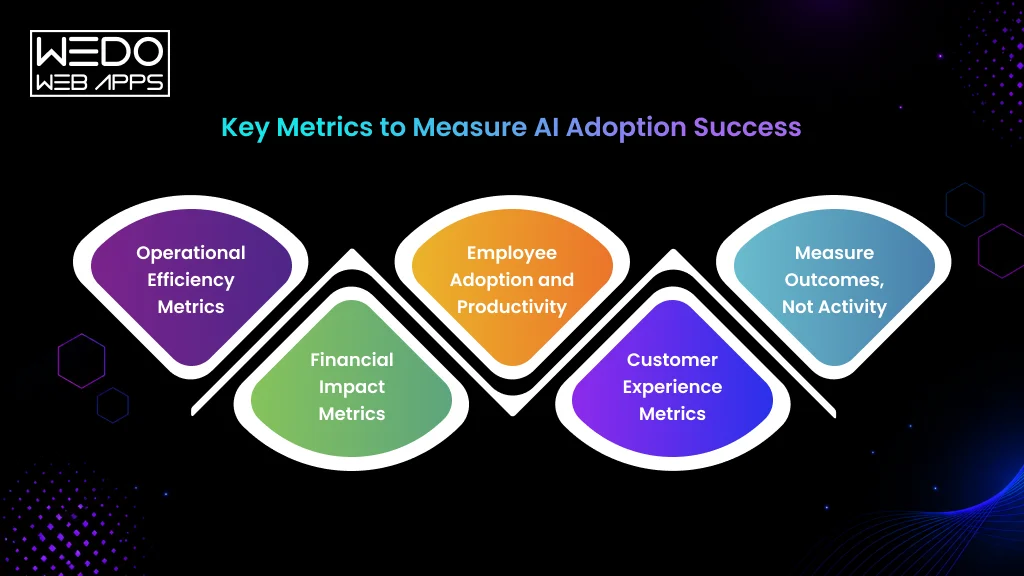
Implementing AI is only part of the journey. To understand whether your efforts are delivering value, you need a way to measure results consistently and support from an AI consulting company. Without clear metrics, businesses often struggle to determine whether their AI implementation is improving operations or simply adding another layer of technology.
The most effective approach is to track metrics that align with the goals established during AI planning and outlined in your AI roadmap.
Operational Efficiency Metrics
For many SMBs, the first benefits of AI appear in day-to-day operations. Tasks that previously required significant manual effort can often be completed faster and with fewer resources. Common metrics include:
- Hours saved through automation
- Reduction in manual tasks
- Faster process completion times
- Decrease in operational bottlenecks
For example: If an AI-powered support tool reduces average response times from four hours to one hour, the impact can be measured immediately. |
Financial Impact Metrics
Every business investment should contribute to measurable value, and AI is no exception. Consider tracking:
- Cost savings from automation
- Reduction in outsourcing expenses
- Increased revenue from AI-assisted initiatives
- Return on investment (ROI)
The goal is not just to prove that AI works. The goal is to demonstrate that it contributes to business performance.
Employee Adoption and Productivity
Even the most capable AI solution cannot create value if employees are not using it effectively. Signs of successful adoption include:
- Regular usage across teams
- Reduced time spent on repetitive work
- Increased employee productivity
- Positive employee feedback
Strong adoption rates often indicate that AI has been integrated successfully into existing workflows.
Customer Experience Metrics
For businesses using AI in customer-facing processes, customer experience should remain a key measurement area. Some useful indicators include:
| Metric | What it Helps Measure |
|---|---|
| Customer Satisfaction (CSAT) | Overall service quality |
| Response Time | Speed of customer support |
| Resolution Time | Efficiency in solving issues |
| Customer Retention | Long-term customer loyalty |
Improvements in these areas often signal that AI is helping create better customer experiences rather than simply increasing automation.
Measure Outcomes, Not Activity
One of the most common mistakes businesses make is focusing on usage rather than results. While adoption metrics can indicate whether employees are using AI tools, they do not necessarily show whether those tools are creating meaningful business value.
| Focus on Activity Metrics | Focus on Business Impact Metrics |
|---|---|
| Number of AI tools implemented | Time saved via automation |
| Number of employees with AI access | Productivity improvements |
| Number of AI projects launched | Cost reductions achieved |
| Number of AI-generated outputs | Revenue growth supported by AI |
| Number of AI platforms logins | Improvements in customer satisfaction |
Ultimately, the success of an AI adoption framework should be measured by business outcomes rather than implementation activity. The metrics that matter most are the ones that demonstrate efficiency gains, financial impact, and long-term value for the organisation.
AI Adoption Framework Checklist for SMBs
A successful AI adoption framework is built on careful preparation, clear priorities, and continuous measurement. Use the following checklists to assess your readiness and ensure your AI initiatives stay aligned with business objectives.
Readiness Assessment Checklist
Before investing in AI tools or projects, evaluate whether your business has the necessary foundation in place.
- Clear business goals have been identified.
- Leadership supports AI adoption initiatives.
- Key stakeholders understand the expected outcomes.
- Existing processes have been reviewed for improvement opportunities.
- Business data is accurate and up to date.
- Critical information is accessible across teams.
- Data governance policies are in place.
- Sensitive data has been identified and protected.
- Existing systems can support AI integrations.
- Required software and infrastructure are available.
- Security measures have been reviewed.
- Current technology limitations have been documented.
AI Planning Checklist
Effective AI planning helps ensure resources are directed toward initiatives with the highest potential impact.- Business challenges suitable for AI have been identified.
- Potential AI use cases have been documented.
- Expected benefits and outcomes have been defined.
- Costs and resource requirements have been estimated.
- Risks and implementation challenges have been assessed.
- Stakeholder expectations have been aligned.
- Success metrics have been established.
AI Roadmap Checklist
A well-structured AI roadmap provides direction and helps keep initiatives on track.- Short-term and long-term AI objectives have been defined.
- High priority use cases have been selected.
- Implementation timelines have been established.
- Project milestones have been documented.
- Ownership and responsibilities have been assigned.
- Required budget and resources have been allocated.
- Governance and compliance considerations have been included.
AI Implementation Checklist
Successful AI implementation requires more than selecting the right technology. It also depends on preparation, adoption, and ongoing optimisation.- Appropriate AI tools have been selected.
- Data sources have been validated and prepared.
- Pilot projects have been launched before scaling.
- Employees have received training and guidance.
- Workflows have been updated to support AI adoption.
- Human review processes have been established where necessary.
- Performance is being monitored regularly.
- Feedback is being collected from users and stakeholders.
Performance Measurement Checklist
Measuring results helps determine whether your business AI adoption efforts are delivering value.
- Productivity improvements are being tracked.
- Time savings are being measured.
- Operational costs are being monitored.
- Customer satisfaction metrics are being reviewed.
- Employee adoption rates are being assessed.
- Revenue impact is being evaluated where applicable.
- AI initiatives are being reviewed against original objectives.
- Opportunities for optimisation and scaling have been identified.
Final Check If you can confidently tick most of the items above, your business is in a strong position to move forward with AI planning, execute your AI roadmap, and achieve successful AI implementation. More importantly, these checklists can help ensure that your business AI adoption efforts remain focused on measurable outcomes rather than technology adoption alone. |
Conclusion
AI offers significant opportunities for small and medium businesses, but achieving meaningful results requires more than simply adopting new tools. Success comes from taking a structured approach that aligns AI initiatives with business goals, operational needs, and long-term growth plans.
A well-defined AI adoption framework provides that structure. It helps businesses assess their readiness, identify high-value opportunities, prioritise investments, and execute AI implementation initiatives with greater confidence. Combined with effective AI planning, a realistic AI roadmap, and clear performance measurement, organisations can reduce risk while maximising the value of their AI investments.
The most successful examples of business AI adoption are not necessarily the ones using the most advanced technologies. They are the organisations that start with clear objectives, focus on solving real business challenges, and continuously refine their approach based on measurable outcomes.
Whether you are exploring AI for the first time or looking to scale existing initiatives, or needing support for AI development, following a structured framework can help transform AI from an emerging technology into a practical driver of efficiency, innovation, and sustainable business growth.
 Continue using AI Cursor?Keep it onTurn Off