Introduction
The biggest obstacle to AI adoption is not choosing the right model; it is modernizing the systems that AI depends on. Many organizations are ready to invest in AI-powered automation, intelligent workflows, and predictive decision-making, yet they overlook the foundation required to make those initiatives successful. When critical business applications rely on aging architectures, fragmented data, and years of accumulated technical debt, AI becomes significantly harder to integrate, scale, and trust.
This shift has made legacy software modernization a boardroom conversation rather than just an IT responsibility. Modern enterprises are no longer modernizing applications simply because they are outdated; they are modernizing them to unlock AI capabilities, improve data accessibility, strengthen security, accelerate innovation, and support long-term digital transformation. In other words, modernization is no longer the end goal; it is the foundation that enables what's next.
The challenge is that not every legacy system needs to be replaced, and not every modernization strategy delivers the same business outcomes. Some applications can be enhanced through APIs and cloud services, while others require refactoring, rearchitecting, or complete replacement. Choosing the right path depends on your existing technology landscape, business priorities, compliance requirements, and future AI ambitions.
This guide explains how to evaluate your legacy applications, identify the barriers preventing successful AI integration, compare modernization strategies, and build an AI-ready technology ecosystem that supports sustainable business growth. Whether you are planning your first modernization initiative or optimizing enterprise software for advanced AI use cases, you will gain a practical framework for making informed technology decisions with confidence.
Why Legacy Software Modernization is No Longer Optional
There was a time when organizations could delay software upgrades for years without affecting business growth. That reality has changed. Today, technologies like AI, cloud computing, automation, and real-time analytics evolve much faster than traditional enterprise systems. As a result, businesses that continue relying on outdated software often struggle to innovate, integrate new technologies, and respond quickly to changing customer and market demands.
Legacy modernization is no longer driven solely by aging infrastructure; it is driven by the need to remain competitive. Whether the goal is to improve operational efficiency, enhance customer experiences, or enable AI-powered decision-making, modern businesses require technology ecosystems that are secure, scalable, and capable of evolving with business needs.
What is a Legacy System?
A legacy system is any software application, platform, or technology environment that continues to support critical business operations but no longer aligns with current technical, security, or business requirements. These systems may still perform their intended functions, yet they often rely on outdated programming languages, aging infrastructure, limited integration capabilities, or unsupported software versions.
A legacy system isn't necessarily "old." It becomes a legacy system when it slows innovation, increases maintenance complexity, or prevents the business from adopting modern technologies like AI, cloud services, and automation.
Why Do Businesses Still Depend on Legacy Applications?
Despite their limitations, legacy applications continue to power many core business functions because replacing them is not always practical or cost-effective.
Common reasons organizations continue using legacy software include:
- Years of business-critical data stored within existing systems.
- High costs and risks associated with complete replacement.
- Deep integration with internal processes and third-party applications.
- Industry-specific customizations developed over many years.
- Concerns about operational disruption during migration.
For many organizations, the challenge is not deciding whether to modernize; it is determining how to modernize without disrupting business continuity.
The Hidden Cost of Delaying Modernization
The financial impact of legacy systems extends far beyond maintenance expenses. As technology continues to evolve, delaying legacy software modernization increases both operational and strategic risks.
Organizations often experience:
- Growing technical debt that slows software enhancements.
- Higher infrastructure and maintenance costs.
- Increased cybersecurity and compliance exposure.
- Difficulty integrating AI, cloud platforms, and modern SaaS solutions.
- Longer development cycles that delay innovation.
- Reduced productivity caused by manual processes and disconnected systems.
Individually, these challenges may seem manageable. Together, they create a technology environment that limits business agility and makes future transformation initiatives significantly more complex and expensive.
Expert Insights: The cost of maintaining legacy software is not measured only by what businesses spend today; it is also measured by the opportunity they cannot pursue tomorrow. Every delayed modernization initiative can postpone AI adoption, automation, faster product delivery, abd data-driven innovation.
Legacy Modernization vs Software Replacement
One of the biggest misconceptions is that modernization always means replacing existing software. In reality, complete replacement is only one of several modernization approaches.
The right strategy depends on your business goals, application architecture, budget, and long-term technology roadmap.
| Legacy Modernization | Software Replacement |
|---|---|
| Enhances or transforms existing applications. | Replaces the entire application with a new solution. |
| Preserves valuable business logic where possible. | Often requires rebuilding processes and workflows. |
| Typically reduces business disruption through phased implementation. | May involve larger migration efforts and longer transition periods. |
| Supports gradual AI integration and cloud adoption. | Suitable when existing systems are no longer maintainable or scalable. |
For many organizations, the objective is not to start over; it is to maximize the value of existing investments while preparing the business for AI-driven innovation and long-term digital transformation.
Why Legacy Systems Struggle with AI Integration
Many organizations assume that adopting AI is as simple as connecting an AI model to their existing applications. In reality, AI is only as effective as the technology ecosystem supporting it. If enterprise systems cannot provide accurate, accessible, and real-time data, even the most advanced AI models will produce unreliable insights or require significant manual intervention.
This is why AI integration projects often uncover deeper technology challenges than expected. Legacy applications were typically designed to support specific business functions, not to exchange data seamlessly with cloud platforms, machine learning models, APIs, or modern enterprise applications. Before AI can deliver measurable business value, organizations must first address the limitations that prevent legacy systems from supporting intelligent technologies.
Technical Debt Limits Innovation
Technical debt is not just outdated code; it is the accumulation of short-term technology decisions that make future improvements slower, more expensive, and riskier.
Common signs of growing technical debt include:
- Applications built on unsupported frameworks or programming languages.
- Years of custom code with limited documentation.
- Monolithic architectures that are difficult to modify.
- Manual deployment and maintenance processes.
- Increasing time and effort required for even minor software updates.
When AI initiatives depend on systems affected by significant technical debt, development teams often spend more time maintaining infrastructure than delivering new AI capabilities.
Expert Insight: Organizations rarely postpone AI projects because the models are not ready. More often, they postpone them because modern AI cannot efficiently operate on outdated software architectures.
Disconnected Data Silos Reduce AI Effectiveness
AI relies on data; not just large volumes of it, but data that is accurate, consistent, and connected across the business.
Legacy environments frequently store information in isolated systems, making it difficult for AI to build a complete understanding of customers, operations, or business performance.
Typical examples include:
- Customer data stored separately from sales systems.
- Inventory information isolated from procurement platforms.
- Finance, HR, and operations using independent databases.
- Inconsistent data formats across business applications.
Without a unified data foundation, AI models often produce incomplete, biased, or inconsistent outputs because they cannot access the full business context.
Poor API Support Restricts Integration
Modern AI platforms are designed to communicate through APIs, enabling applications to exchange data securely and in real time.
Many legacy systems were developed before API-first architecture became standard. Instead, they rely on:
- Direct database connections.
- Batch file transfers.
- Proprietary interfaces.
- Manual data exports.
- Point-to-point integrations.
These approaches create bottlenecks that make AI integration slower, more complex, and harder to scale.
Modernization introduces API-driven connectivity, allowing AI services to interact with enterprise systems without extensive custom development.
Security and Compliance Challenges
AI systems often process sensitive business information, making security a critical requirement rather than an optional consideration.
Older applications may lack:
- Modern identity and access management.
- Encryption standards.
- Multi-factor authentication.
- Continuous security monitoring.
- Support for evolving compliance requirements.
Introducing AI into an environment with outdated security controls increases organizational risk and can create compliance challenges, particularly in regulated industries such as healthcare, finance, and insurance.
Modernization provides an opportunity to strengthen cybersecurity while preparing systems for AI-enabled operations.
Scalability Limitations Slow AI Adoption
AI workloads are fundamentally different from traditional business applications. They require flexible computing resources, rapid data processing, and the ability to scale as usage grows.
Many legacy environments were designed for predictable, on-premises workloads rather than dynamic AI services.
As a result, organizations often experience:
- Performance bottlenecks during high-demand periods.
- Limited computing capacity for AI models.
- Slow response times for intelligent applications.
- High infrastructure costs when scaling existing systems.
Cloud-native modernization enables organizations to scale infrastructure based on demand, making AI deployments more reliable and cost-effective.
Why AI Requires Connected, High-Quality Data
One of the biggest misconceptions is that better AI models automatically produce better business outcomes.
In reality, AI quality depends on data quality.
Successful AI initiatives require:
- Reliable and accurate enterprise data.
- Consistent data formats across systems.
- Real-time or near-real-time data access.
- Clear governance and ownership.
- Secure data sharing between applications.
Without these capabilities, AI models spend more time compensating for poor data than delivering meaningful intelligence.
Think of AI as a high-performance engine. Installing it in a vehicle with worn-out components won't improve performance. Similarly, integrating AI into disconnected legacy systems cannot deliver its full potential without first modernizing the underlying technology foundation.
Key Takeaway
The biggest barrier to AI integration isn't the AI technology itself; it's the ability of existing enterprise systems to support it. Technical debt, fragmented data, outdated integration methods, security gaps, and limited scalability all reduce AI's effectiveness. Addressing these challenges through legacy software modernization creates the reliable, connected, and scalable foundation needed for successful AI adoption and long-term digital transformation.
Building an AI-Ready Foundation Through Legacy Modernization
Modernizing legacy software isn't about replacing old applications with newer ones; it's about transforming the technology ecosystem that powers your business. AI doesn't operate in isolation; it depends on applications, infrastructure, data, and integrations working together seamlessly. If even one layer becomes a bottleneck, the value of AI diminishes.
That's why successful legacy software modernization focuses on more than code. It creates an environment where information flows securely, systems communicate efficiently, and new AI capabilities can be introduced without rebuilding the entire technology stack every few years.
Think of modernization as preparing every layer of your technology foundation-not just the software users interact with.
Application Modernization
Applications are often the first focus of modernization, but the objective extends beyond improving user interfaces or migrating to newer programming languages.
Modern application modernization aims to make software:
- Easier to maintain and update.
- Flexible enough to integrate with AI services.
- Scalable to support growing business demands.
- Compatible with cloud-native architectures.
- Faster to deliver new features and enhancements.
Organizations may modernize applications by breaking large monolithic systems into modular services, refactoring outdated code, or introducing APIs that allow existing applications to communicate with AI platforms and custom web development services.
Why it matters for AI
Modern AI solutions rely on applications that can exchange information quickly and securely. Modular, API-enabled applications make it significantly easier to integrate capabilities such as intelligent search, document processing, predictive analytics, and AI agent development without redesigning the entire system.
Infrastructure Modernization
Even well-designed applications struggle if the infrastructure underneath them cannot support modern workloads.
Many legacy environments still depend on aging servers, fixed hardware capacity, and manually managed infrastructure. While these environments may support day-to-day operations, they often lack the flexibility required for AI-driven workloads.
Infrastructure modernization focuses on creating a platform that is:
- Scalable as business demand grows.
- Resilient against failures and downtime.
- Easier to monitor and manage.
- Optimized for cloud and hybrid environments.
- Capable of supporting compute-intensive AI models.
Rather than treating infrastructure as a fixed asset, organizations increasingly view it as an adaptable platform that evolves alongside business needs.
Data Modernization
If applications are the engine of digital transformation, data is the fuel that powers AI.
Many organizations discover that their greatest modernization challenge isn't software; it's decades of fragmented, duplicated, and inconsistent business data.
Data modernization typically involves:
- Consolidating information from multiple systems.
- Improving data quality and consistency.
- Establishing governance and ownership.
- Enabling secure, real-time data access.
- Creating scalable data pipelines for analytics and AI.
Without these improvements, AI models spend more time cleaning and interpreting data than generating meaningful business insights.
Businesses dealing with complex legacy data environments can also use data engineering services to build scalable pipelines, integrate disparate data sources, and prepare enterprise data for analytics and AI.Expert Insight: Many AI projects don't require more data-they require better-organized data. Modernization creates the structure AI needs to deliver accurate, trustworthy outcomes.
API-First Architecture
One of the defining characteristics of modern enterprise software is connectivity.
Instead of relying on custom integrations or manual data transfers, API-first architecture enables applications, cloud services, and AI platforms to communicate through standardized interfaces.
The benefits include:
- Faster integration with AI services.
- Easier connectivity between business applications.
- Reduced dependence on custom point-to-point integrations.
- Greater flexibility when adopting new technologies.
- Simplified maintenance and future upgrades.
API-first design doesn't just improve today's integrations; it makes future innovation significantly easier.
Cloud-Native Transformation
Cloud migration and cloud-native transformation are often discussed together, but they aren't the same. Businesses modernizing legacy infrastructure can use cloud computing solutions to improve scalability, flexibility, and infrastructure readiness for AI workloads.
Migrating applications to the cloud without redesigning them may reduce infrastructure management, but it doesn't automatically improve flexibility, scalability, or AI readiness.
Cloud-native transformation focuses on building applications that fully leverage cloud capabilities such as:
- Elastic scaling.
- Containerization.
- Microservices.
- Automated deployments.
- Continuous monitoring.
- High availability.
These capabilities are especially valuable for AI applications, where workloads can fluctuate dramatically based on user demand and computational requirements.
Preparing Systems for AI
An AI-ready organization is built on more than modern applications or cloud infrastructure. It requires a technology ecosystem where applications, data, infrastructure, and integrations work together as a unified foundation.
Before implementing enterprise AI, organizations should evaluate whether their systems can:
- Share data securely across applications.
- Support API-based integrations.
- Scale resources as AI workloads increase.
- Meet security and regulatory requirements.
- Continuously monitor system performance.
- Adapt quickly to future technology changes.
When these capabilities are in place, AI becomes much easier to implement, expand, and optimize across the business.
Practical Example
Imagine a retail company running separate systems for inventory, sales, customer loyalty, and order management.
Without modernization:
- Customer data is scattered across multiple databases.
- Inventory updates occur in batches rather than real time.
- AI cannot accurately forecast demand because it lacks complete information.
- Personalization initiatives produce inconsistent recommendations.
After modernization:
- APIs connect all business systems.
- Customer and inventory data become unified.
- Cloud infrastructure scales automatically during seasonal demand.
- AI analyzes purchasing patterns in real time to improve forecasting, optimize inventory, and deliver personalized shopping experiences.
The AI model didn't become smarter; the technology foundation became stronger.
Building an AI-Ready Enterprise Checklist
Before investing in enterprise AI, ask these questions:
- Can your applications integrate through modern APIs?
- Is your business data accurate, connected, and governed?
- Can your infrastructure scale to support AI workloads?
- Are security and compliance requirements built into your architecture?
- Can new AI capabilities be deployed without disrupting core business operations?
If the answer to several of these questions is no, your organization will likely benefit from legacy software modernization before expanding AI initiatives.
Takeaway
AI success isn't determined by the sophistication of the model alone; it's determined by the strength of the technology foundation behind it. Legacy software modernization prepares applications, infrastructure, data, and integrations to work together, enabling organizations to adopt AI with greater confidence, scalability, and long-term business value. This foundation also makes it easier to evaluate the next critical decision: Which modernization strategy is the right fit for your business?
Choosing the Right Legacy Modernization Strategy
There is no universal approach to legacy modernization. The right strategy depends on factors such as your application's business value, technical complexity, budget, compliance requirements, and long-term AI goals. An organization modernizing a customer-facing platform will have different priorities than one updating an internal ERP or finance system.
Rather than asking, "Which strategy is the most modern?", ask, "Which strategy delivers the best balance between business continuity, investment, and AI readiness?"
The six modernization strategies below are commonly used to help organizations modernize legacy applications while minimizing disruption and maximizing long-term value.
Rehosting (Lift and Shift)
Rehosting moves an existing application from its current environment to a new infrastructure, typically the cloud, without making significant changes to the application's code.
Best suited for:
- Applications that are stable and business-critical.
- Organizations looking for a quick cloud migration.
- Businesses with limited modernization budgets.
Advantages
- Faster migration.
- Lower initial investment.
- Minimal changes to existing applications.
- Reduced infrastructure management.
Limitations
- Doesn't eliminate technical debt.
- Limited improvement in AI readiness.
- Existing architectural limitations remain.
Replatforming
Replatforming introduces targeted improvements while keeping the application's core architecture intact. This may include upgrading databases, operating systems, middleware, or runtime environments to improve performance and compatibility.
Best suited for:
- Applications that require better scalability.
- Organizations preparing for cloud-native services.
- Businesses seeking gradual modernization.
Advantages
- Better performance and reliability.
- Improved cloud compatibility.
- Lower risk than full redevelopment.
Limitations
- Core architectural constraints may still exist.
- Some technical debt remains.
Refactoring
Refactoring restructures and improves the application's internal code without changing its core functionality. The goal is to make the software easier to maintain, integrate, and evolve.
Best suited for:
- Applications with valuable business logic.
- Businesses planning long-term AI integration.
- Organizations looking to reduce technical debt.
Advantages
- Improved maintainability.
- Easier API integration.
- Better scalability.
- Strong foundation for AI and automation.
Limitations
- Higher development effort.
- Longer implementation timeline.
Rearchitecting
Rearchitecting redesigns significant parts of an application to support modern architectures such as microservices, event-driven systems, or cloud-native platforms.
This approach is often chosen when existing software can no longer support future business requirements.
Best suited for:
- Rapidly growing enterprises.
- High-traffic customer applications.
- Businesses adopting enterprise AI at scale.
Advantages
- Exceptional scalability.
- Greater flexibility.
- Easier integration with modern technologies.
- Long-term innovation platform.
Limitations
- Significant investment.
- Requires careful planning and governance.
Rebuilding
Rebuilding involves developing a completely new application while preserving the functionality and business objectives of the original system.
Best suited for:
- Applications built on obsolete technologies.
- Systems with excessive technical debt.
- Businesses requiring major functional improvements.
Advantages
- Modern technology stack.
- Improved user experience.
- Greater scalability and maintainability.
Limitations
- Longer implementation cycles.
- Higher development costs.
- Careful migration planning required.
Replacing
Replacing means retiring an existing application and adopting a commercial or SaaS solution that better meets current business requirements.
Best suited for:
- Commodity business processes.
- Applications with minimal competitive differentiation.
- Organizations seeking standardized functionality.
Advantages
- Faster access to modern capabilities.
- Lower maintenance responsibility.
- Vendor-managed updates and security.
Limitations
- Less customization.
- Possible vendor lock-in.
- Data migration and process changes may be required.
Legacy Modernization Strategy Comparison
| Strategy | Investment | Business Disruption | Time to Implement | AI Readiness | Best For |
|---|---|---|---|---|---|
| Rehosting | Low | Low | Short | ⭐⭐ | Quick cloud migration |
| Replatforming | Medium | Low | Short to Medium | ⭐⭐⭐ | Improving performance and scalability |
| Refactoring | Medium to High | Medium | Medium | ⭐⭐⭐⭐ | Reducing technical debt while enabling AI |
| Rearchitecting | High | Medium to High | Long | ⭐⭐⭐⭐⭐ | Enterprise transformation and AI-driven innovation |
| Rebuilding | High | High | Long | ⭐⭐⭐⭐⭐ | Replacing outdated custom applications |
| Replacing | Medium to High | Medium | Medium | ⭐⭐⭐⭐ | Standardizing non-core business functions |
Expert Recommendation
Don't choose a modernization strategy based solely on cost. Choose it based on business value and future AI requirements.
For example, rehosting may deliver quick infrastructure savings, but it won't solve architectural limitations that restrict AI integration. If AI-powered automation, intelligent analytics, or personalized customer experiences are part of your long-term roadmap, strategies like refactoring or rearchitecting often provide stronger long-term returns despite requiring greater upfront investment.
How to Choose the Right Strategy
Before committing to a modernization initiative, evaluate each application against these questions:
- How critical is this application to daily business operations?
- Does it support processes that differentiate your business?
- Can it integrate with modern APIs and AI platforms?
- Is the current architecture scalable and secure?
- Will modernization deliver greater long-term value than replacement?
- How quickly do you need measurable business outcomes?
The answers will often point toward the most practical modernization strategy; not just from a technology perspective, but from a business and investment standpoint.
Section Takeaway
The best legacy modernization strategy isn't the one with the newest technology; it's the one that aligns with your business objectives, minimizes unnecessary disruption, and prepares your organization for future AI integration. Evaluating applications individually and balancing short-term priorities with long-term innovation creates a modernization roadmap that supports sustainable digital transformation rather than one-time technology upgrades.
Step-by-Step Legacy Modernization Roadmap for AI Integration
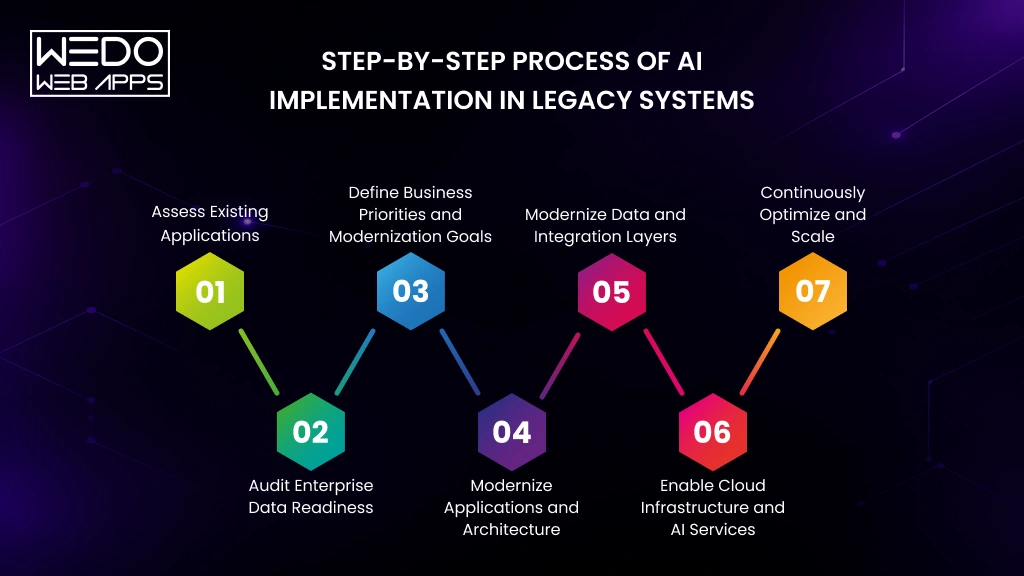
Successful legacy software modernization isn't a one-time migration project; it's a strategic transformation program. Organizations that achieve the best results don't start by rewriting code or moving everything to the cloud. They begin by understanding how technology supports business operations, identifying modernization priorities, and creating a roadmap that balances innovation with business continuity.
The following roadmap provides a practical framework for modernizing legacy applications while building a technology ecosystem that's ready for AI integration and long-term digital transformation.
Step 1: Assess Existing Applications
Every modernization initiative starts with understanding the current application landscape.
Rather than assuming every legacy system needs modernization, evaluate each application based on:
- Business criticality.
- Technical health.
- Maintenance costs.
- Security posture.
- Integration capabilities.
- User adoption and performance.
This assessment helps identify which applications should be modernized, replaced, retained, or retired.
Best Practice:
Create an application inventory before making modernization decisions. Many organizations discover duplicate systems, underutilized applications, or unnecessary maintenance costs during this phase.
Step 2: Audit Enterprise Data Readiness
AI is only as effective as the data it can access.
Before introducing AI capabilities, organizations should evaluate whether their data is accurate, consistent, secure, and accessible across business functions.
Focus on questions such as:
- Is customer, operational, and financial data stored in separate silos?
- Are data formats standardized?
- Can applications exchange information in real time?
- Are governance and compliance policies in place?
- Is data quality sufficient for AI-driven insights?
Resolving these issues early prevents costly delays during AI implementation.
Step 3: Define Business Priorities and Modernization Goals
Technology should support business outcomes, not the other way around.
Before selecting modernization strategies, define what success looks like.
Examples include:
- Reducing operational costs.
- Accelerating product delivery.
- Improving customer experiences.
- Enabling AI-powered automation.
- Increasing application scalability.
- Strengthening cybersecurity and compliance.
Clear objectives help organizations prioritize investments and measure modernization success.
Step 4: Modernize Applications and Architecture
Once priorities are established, begin modernizing the applications that deliver the greatest business value.
Depending on your strategy, this may involve:
- Refactoring legacy code.
- Introducing microservices.
- Building APIs.
- Replatforming applications.
- Rebuilding selected systems.
- Retiring obsolete software.
The goal isn't to modernize everything simultaneously; it's to modernize the systems that create the highest business impact.
Step 5: Modernize Data and Integration Layers
Many modernization projects focus on applications while overlooking the systems that connect them.
This stage strengthens the foundation that enables enterprise-wide AI.
Key activities include:
- Consolidating business data.
- Building API-driven integrations.
- Eliminating redundant data sources.
- Establishing governance policies.
- Implementing secure data pipelines.
By improving how information moves across the organization, businesses create a reliable environment for AI, analytics, and automation.
Step 6: Enable Cloud Infrastructure and AI Services
With applications and data prepared, organizations can begin introducing cloud capabilities and AI solutions with significantly lower implementation risk. A DevOps Consulting company can also help automate deployment pipelines, improve infrastructure reliability, and establish practices that support continuous delivery during modernization.
This may include:
- Cloud-native infrastructure.
- AI-powered document processing.
- Intelligent chatbots and virtual assistants.
- Predictive analytics.
- Workflow automation.
- Recommendation engines.
Rather than treating AI as a separate initiative, integrate it gradually into high-value business processes where it can deliver measurable outcomes.
Step 7: Continuously Optimize and Scale
Modernization doesn't end after deployment.
As business needs evolve, applications, infrastructure, and AI capabilities should continue evolving alongside them.
Organizations should establish processes to:
- Monitor application performance.
- Measure business outcomes.
- Strengthen security continuously.
- Optimize cloud resources.
- Improve AI model performance.
- Expand modernization initiatives incrementally.
Continuous optimization ensures technology remains aligned with changing business priorities rather than becoming tomorrow's legacy system.
Legacy Modernization Roadmap at a Glance
| Phase | Primary Objective | Expected Business Outcome |
|---|---|---|
| Assess Applications | Understand the current technology landscape | Better modernization decisions |
| Audit Data Readiness | Prepare reliable, connected data | Stronger AI performance |
| Define Business Goals | Align technology with business priorities | Higher ROI and measurable outcomes |
| Modernize Applications | Improve flexibility and maintainability | Faster innovation and easier integration |
| Modernize Data & Integrations | Enable connected systems | Improved AI readiness and collaboration |
| Enable Cloud & AI | Introduce scalable technologies | Increased efficiency and automation |
| Optimize Continuously | Improve performance over time | Sustainable digital transformation |
Expert Tip
Resist the urge to modernize every application at once. A phased approach focused on high-impact systems reduces implementation risk, minimizes business disruption, and allows teams to demonstrate measurable value before expanding modernization efforts across the enterprise.
Common Mistakes to Avoid During Modernization
Even well-planned projects can lose momentum when organizations:
- Treat modernization as an infrastructure project instead of a business initiative.
- Underestimate the importance of data quality.
- Attempt to modernize every application simultaneously.
- Choose technology before defining business objectives.
- Ignore employee adoption and change management.
- Delay cybersecurity improvements until after implementation.
Avoiding these pitfalls helps organizations achieve faster results while reducing cost, complexity, and operational risk.
Section Takeaway
A successful legacy software modernization initiative follows a structured roadmap that balances business priorities with technical transformation. By assessing existing applications, preparing enterprise data, modernizing incrementally, and integrating AI strategically, organizations create a scalable technology foundation that supports continuous innovation rather than one-time change.
How AI Accelerates Legacy Modernization
AI is often viewed as the end goal of modernization, but it has also become one of the most effective tools for accelerating modernization projects. From analyzing legacy code to generating documentation and automating software testing, AI helps development teams reduce manual effort, identify modernization opportunities faster, and improve overall project efficiency.
That doesn't mean AI replaces software engineers or solution architects. Instead, it acts as an intelligent assistant that supports repetitive, time-consuming tasks while allowing experts to focus on architectural decisions, business logic, security, and implementation strategy.
When used strategically, AI shortens modernization timelines without compromising software quality.
AI-Assisted Code Analysis
One of the biggest challenges in legacy modernization is understanding applications that have evolved over many years.
Some systems contain:
- Limited or outdated documentation.
- Complex business rules.
- Thousands of interconnected files.
- Custom integrations developed by multiple teams.
- Code written in legacy programming languages.
AI-powered code analysis tools can examine application structures, identify dependencies, detect obsolete components, and surface potential risks much faster than manual code reviews.
This allows development teams to spend less time understanding existing systems and more time planning modernization efforts.
Business Value
- Faster application assessment.
- Reduced project discovery time.
- Better visibility into technical debt.
- Improved modernization planning.
Automated Documentation Generation
Many legacy applications operate with incomplete, outdated, or missing technical documentation.
This creates challenges when:
- New developers join the project.
- Applications require modernization.
- Compliance audits are conducted.
- Business processes need to be understood.
Generative AI can analyze source code and automatically generate:
- Technical documentation.
- API documentation.
- System summaries.
- Workflow explanations.
- Dependency maps.
Although this documentation should always be reviewed by experienced engineers, it significantly reduces the time required to understand complex applications.
Intelligent Code Refactoring
Modernizing legacy software often involves restructuring code without changing business functionality.
AI-assisted development tools can:
- Recommend cleaner code structures.
- Detect duplicated logic.
- Suggest modern coding patterns.
- Highlight performance bottlenecks.
- Identify security vulnerabilities.
These recommendations help developers modernize applications more efficiently while maintaining software quality.
It's important to note that AI provides recommendations, not production-ready solutions. Human expertise remains essential for validating architectural decisions and ensuring business requirements are preserved.
AI-Powered Testing
Software testing is one of the most resource-intensive stages of any modernization project.
AI can improve this process by helping teams:
- Generate test cases automatically.
- Identify regression risks.
- Prioritize critical test scenarios.
- Detect application anomalies.
- Analyze test results more efficiently.
This enables faster release cycles while reducing the likelihood of introducing defects during modernization.
For organizations modernizing large enterprise applications, AI-assisted testing can significantly improve both speed and confidence.
Migration Planning with AI
Planning a modernization initiative requires analyzing applications, dependencies, business priorities, infrastructure, and potential risks.
AI can support planning by:
- Identifying application dependencies.
- Recommending modernization candidates.
- Estimating migration complexity.
- Detecting redundant components.
- Highlighting integration challenges.
These insights help organizations build more informed modernization roadmaps and allocate resources more effectively.
However, modernization strategy should always align with business objectives rather than AI-generated recommendations alone.
Predictive Monitoring After Modernization
The value of AI continues even after modernization is complete.
AI-powered monitoring solutions can:
- Detect abnormal application behavior.
- Predict infrastructure failures.
- Identify performance bottlenecks.
- Monitor cloud resource utilization.
- Recommend optimization opportunities.
Instead of reacting to problems after they occur, organizations can proactively maintain application performance and reliability.
This supports continuous improvement while ensuring the technology environment remains ready for future business growth.
Expert Tip
Use AI to accelerate engineering tasks, not to replace engineering judgment.
AI is highly effective for code analysis, documentation, testing, and identifying modernization opportunities. However, decisions involving application architecture, security, compliance, business processes, and long-term technology strategy should always be guided by experienced software architects and domain experts.
Where AI Delivers the Greatest Value During Modernization
| Modernization Activity | How AI Helps | Human Expertise Required |
|---|---|---|
| Code assessment | Identifies dependencies, technical debt, and obsolete components | Validate findings and prioritize modernization |
| Documentation | Generates technical documentation and system summaries | Review accuracy and add business context |
| Code refactoring | Suggests cleaner, modern coding patterns | Preserve business logic and architectural integrity |
| Software testing | Creates test cases and detects regression risks | Define testing strategy and approve releases |
| Migration planning | Analyzes applications and recommends modernization paths | Align decisions with business goals and compliance |
| Performance monitoring | Predicts issues and recommends optimizations | Implement improvements and oversee operations |
Section Takeaway
AI is no longer just the outcome of legacy software modernization; it has become a powerful accelerator for the modernization journey itself. By supporting code analysis, documentation, testing, migration planning, and ongoing monitoring, AI enables development teams to modernize more efficiently while reducing project risk. Combined with experienced engineering leadership, AI helps organizations deliver modernization initiatives faster, with greater confidence, and with a stronger foundation for long-term digital transformation.
Common Risks and Best Practices
Even with a well-defined roadmap, legacy software modernization isn't without challenges. Modernization projects involve critical business applications, enterprise data, multiple stakeholders, and evolving technology requirements. Without proper planning, organizations can experience delays, budget overruns, operational disruption, or modernization efforts that fail to deliver the expected business value.
The good news is that most modernization challenges are predictable and, more importantly, preventable. Understanding the risks early allows organizations to build mitigation strategies into their modernization plans instead of reacting after problems arise.
Risk-to-Solution Framework
| Common Risk | Why It Happens | Best Practice |
|---|---|---|
| Poor data migration | Inconsistent, duplicate, or incomplete data creates migration errors and unreliable AI outcomes. | Audit, cleanse, and validate data before migration begins. |
| Business disruption and downtime | Replacing critical systems all at once interrupts day-to-day operations. | Use phased modernization with staged deployments and rollback plans. |
| Security and compliance gaps | Legacy systems often lack modern security controls and regulatory alignment. | Build security and compliance requirements into every modernization phase. |
| Budget overruns | Project scope expands without clear priorities or measurable milestones. | Define realistic objectives, prioritize high-value applications, and modernize incrementally. |
| Integration complexity | Legacy applications weren't designed to communicate with modern platforms or AI services. | Adopt API-first architecture and standardized integration frameworks. |
| Employee resistance to change | Teams struggle to adapt to new tools, workflows, and business processes. | Invest in communication, training, and change management from the beginning. |
Don't Modernize Everything at Once
One of the most common mistakes organizations make is treating modernization as a single, large-scale project.
Attempting to modernize every application simultaneously often leads to:
- Competing business priorities.
- Resource constraints.
- Longer delivery timelines.
- Increased operational risk.
- Difficulty measuring success.
Instead, prioritize applications based on business impact, technical complexity, and AI readiness. Delivering incremental improvements allows teams to demonstrate value early, reduce risk, and refine their modernization approach before expanding it across the organization.
Best Practice:
Think in terms of a modernization portfolio rather than a single modernization project. Each application may require a different strategy, timeline, and level of investment.
Treat Data as a Business Asset, Not a Technical Task
Organizations often focus heavily on application modernization while underestimating the importance of data.
However, fragmented or poor-quality data affects:
- AI model accuracy.
- Business reporting.
- Customer experiences.
- Operational efficiency.
- Regulatory compliance.
Successful modernization initiatives establish clear data governance policies, define ownership, and improve data quality before introducing AI-driven capabilities.
Remember: modern applications cannot compensate for poor data.
Align Technology Decisions with Business Goals
A modernization initiative should never be driven solely by technology trends.
Before selecting tools, cloud platforms, or AI solutions, organizations should clearly define the business outcomes they want to achieve.
These might include:
- Reducing operational costs.
- Improving customer satisfaction.
- Accelerating product releases.
- Strengthening cybersecurity.
- Increasing operational efficiency.
- Enabling AI-powered business processes.
When modernization decisions are tied to measurable business objectives, it's much easier to evaluate ROI and prioritize investments.
Build Security into Every Phase
Security shouldn't be treated as the final step before deployment.
Every modernization activity, from application assessment to cloud migration and AI integration, should include security reviews, access controls, compliance validation, and continuous monitoring.
This proactive approach helps organizations:
- Reduce cyber risk.
- Meet regulatory requirements.
- Protect sensitive business data.
- Build trust with customers and stakeholders.
Security becomes significantly more effective when it's integrated into the modernization lifecycle rather than added afterward.
Invest in People Alongside Technology
Technology alone doesn't determine modernization success.
Employees must understand:
- Why modernization is happening.
- How new systems improve daily work.
- What changes to expect.
- Where to access training and support.
Organizations that actively involve business users, IT teams, and leadership throughout the modernization journey generally experience higher adoption rates and smoother transitions.
After all, even the most advanced technology delivers limited value if people don't use it effectively.
Expert Insight
Most modernization failures aren't caused by technology; they're caused by planning, governance, and change management. Organizations that combine a clear business strategy with phased implementation, strong stakeholder alignment, and experienced technical leadership consistently achieve better long-term outcomes than those focused solely on replacing legacy systems.
Modernization Success Checklist
- Before launching your modernization initiative, ask yourself:
- Have we prioritized applications based on business value?
- Is our enterprise data accurate and ready for AI?
- Have we selected the right modernization strategy for each application?
- Are security and compliance integrated into the project plan?
- Do we have a phased rollout strategy to minimize business disruption?
- Have we prepared employees for organizational change?
- Are we measuring success using business outcomes, not just technical milestones?
If you can confidently answer "yes" to these questions, your modernization initiative is far more likely to deliver lasting business value.
Section Takeaway
Every legacy modernization project involves risk, but those risks don't have to become roadblocks. By approaching modernization as a business transformation initiative, prioritizing data readiness, embedding security from the start, and modernizing incrementally, organizations can reduce uncertainty while building a stronger foundation for AI integration and sustainable digital transformation.
Business Outcomes Beyond Technology
The success of legacy software modernization shouldn't be measured by how many applications were migrated or how much legacy code was replaced. The real measure of success is the business value it creates. When modernization is aligned with organizational goals, it becomes a catalyst for innovation, operational excellence, and sustainable growth; not just a technology upgrade.
By building an AI-ready technology foundation, organizations can improve efficiency, respond faster to market changes, and create new opportunities that weren't possible with disconnected, aging systems.
Operational Benefits
Modernized systems simplify day-to-day operations by reducing complexity and enabling teams to work more efficiently.
Organizations commonly experience:
- Reduced technical debt, making applications easier to maintain and enhance.
- Faster software releases through modern development and deployment practices.
- Lower maintenance and infrastructure costs by retiring outdated technologies.
- Improved system reliability, reducing downtime and business interruptions.
- Greater operational efficiency by automating repetitive processes and minimizing manual work.
These improvements allow IT teams to shift their focus from maintaining legacy infrastructure to delivering new digital capabilities that support business growth.
Customer Benefits
Customers may never know your systems have been modernized, but they'll notice the difference in the experience you deliver.
Modernization helps organizations:
- Provide faster and more responsive digital experiences.
- Deliver personalized interactions powered by AI and connected customer data.
- Improve service availability through more resilient applications.
- Launch new products and features more quickly.
- Respond to customer needs with greater speed and accuracy.
In competitive markets, these improvements can strengthen customer satisfaction, increase retention, and create meaningful differentiation.
Strategic Benefits
The most significant value of legacy modernization often emerges over time.
Instead of simply solving today's technical challenges, modernization prepares organizations for tomorrow's opportunities.
Strategic outcomes include:
- Business agility, allowing teams to adapt quickly to changing market conditions.
- Scalable technology foundations that support future growth without repeated infrastructure overhauls.
- Faster AI adoption, enabling organizations to integrate intelligent capabilities as business needs evolve.
- Better decision-making through connected, high-quality enterprise data.
- Improved resilience, helping organizations respond more effectively to disruption and change.
These long-term capabilities position modernization as a strategic investment rather than a one-time project.
Legacy Modernization Business Impact
The table below summarizes how modernization translates into measurable business outcomes.
| Modernization Improvement | Business Outcome | Long-Term Value |
|---|---|---|
| Reduced technical debt | Faster development cycles | Continuous innovation |
| API-first architecture | Easier AI and system integration | Greater technology flexibility |
| Modernized data ecosystem | Better analytics and AI accuracy | Smarter business decisions |
| Cloud-native infrastructure | Improved scalability and reliability | Lower operating costs |
| Automated workflows | Increased productivity | Higher operational efficiency |
| Stronger security controls | Reduced business risk | Greater customer and stakeholder trust |
From Cost Center to Growth Enabler
For many years, legacy modernization was viewed primarily as a cost-saving initiative.
Today, that perspective has changed.
Organizations increasingly invest in modernization to:
- Launch AI-powered products and services.
- Accelerate digital innovation.
- Expand into new markets more quickly.
- Improve collaboration across departments.
- Create technology ecosystems that evolve alongside business strategy.
Rather than asking, "How much will modernization cost?", leading organizations ask, "What opportunities are we missing if we don't modernize?"
That shift in thinking is what separates organizations that react to change from those that lead it.
Executive Insight
Legacy software modernization isn't just about reducing operational costs; it's about increasing an organization's capacity to innovate. Businesses with modern, connected technology foundations are better positioned to adopt AI, respond to customer expectations, and capitalize on new market opportunities without being constrained by outdated systems.
Real-World Business Scenario
Consider a manufacturing company operating with separate systems for production, inventory, procurement, and customer orders.
Before modernization:
- Production planning relied on delayed reports.
- Inventory decisions were largely reactive.
- Customer updates required manual coordination across departments.
- AI forecasting initiatives struggled due to fragmented data.
After modernization:
- Operational data became available in real time through connected systems.
- AI helped forecast demand and optimize inventory levels.
- Teams collaborated using a unified technology platform.
- Leadership gained faster insights for strategic decision-making.
The result wasn't just better software; it was a business that could operate faster, make smarter decisions, and respond more effectively to market demand.
Section Takeaway
The greatest return on legacy software modernization isn't measured by technical improvements alone. It's reflected in faster innovation, stronger customer experiences, greater operational efficiency, and a technology foundation that supports continuous AI integration and digital transformation. When modernization is aligned with business strategy, it becomes a long-term investment in organizational growth rather than a short-term IT initiative.
Why Partner with an Experienced AI Software Development Company
Legacy software modernization is rarely just a technology upgrade. It often involves modernizing business-critical applications, integrating multiple enterprise systems, migrating sensitive data, strengthening security, and preparing the organization for future AI initiatives-all while keeping day-to-day operations running.
While internal development teams understand the business, they may not always have the specialized expertise or bandwidth required to execute large-scale modernization programs. Partnering with an experienced AI software development company brings proven methodologies, technical expertise, and strategic guidance that reduce implementation risk and accelerate business outcomes.
The right partner doesn't simply modernize software; they help build a technology foundation that supports long-term innovation.
Strategic Modernization Expertise
Every legacy environment is different.
Some applications require minor improvements, while others need complete architectural redesigns. Choosing the wrong modernization strategy can increase costs, delay projects, and create new technical debt.
An experienced modernization partner helps organizations:
- Assess the current technology landscape.
- Prioritize applications based on business value.
- Recommend the most suitable modernization strategy.
- Develop phased implementation roadmaps.
- Minimize disruption throughout the transformation journey.
This strategic planning ensures modernization investments deliver measurable business value rather than short-term technical improvements.
AI Integration Capabilities
Modernization and AI are no longer separate initiatives.
Organizations increasingly modernize software with future AI adoption in mind, making it essential to work with teams that understand both application modernization and AI integration services.
An experienced AI partner can help:
- Identify high-impact AI opportunities.
- Prepare enterprise data for AI.
- Design API-first architectures.
- Integrate AI into existing business workflows.
- Implement scalable AI solutions aligned with business goals.
By considering AI requirements during modernization, businesses avoid costly redesigns later.
Cloud and Digital Transformation Experience
Modernization often extends beyond applications.
It may also involve cloud migration, infrastructure optimization, cybersecurity improvements, workflow automation, and enterprise-wide transformation initiatives.
A partner with expertise in digital transformation services can help organizations create a connected technology ecosystem instead of managing isolated modernization projects.
This broader perspective enables:
- Better integration between business systems.
- Improved scalability.
- Greater operational resilience.
- Faster adoption of emerging technologies.
End-to-End Software Engineering
Legacy modernization is a continuous journey rather than a one-time implementation.
From discovery and planning to development, testing, deployment, and ongoing optimization, organizations benefit from working with teams capable of supporting every stage of the software lifecycle.
Comprehensive engineering capabilities typically include:
- Legacy application assessment.
- Custom software development.
- Cloud-native application development.
- API development and integration.
- AI solution implementation.
- Performance optimization.
- Ongoing maintenance and support.
Having a single technology partner throughout the lifecycle improves consistency, collaboration, and long-term maintainability.
A Business-First Approach to Modernization
Technology decisions should always support business outcomes.
The most successful modernization initiatives begin by understanding questions such as:
- What business challenges need to be solved?
- Which applications create the greatest value?
- Where can AI improve productivity or customer experiences?
- How can modernization reduce operational risk?
- What roadmap best supports future business growth?
A business-first approach ensures modernization investments remain aligned with organizational priorities instead of becoming isolated IT projects.
Partner Evaluation Checklist
Before choosing a modernization partner, consider these questions:
- Do they have experience modernizing enterprise applications?
- Can they support both modernization and AI integration?
- Do they recommend strategies based on business goals rather than technology trends?
- Can they provide end-to-end software engineering capabilities?
- Do they have relevant case studies demonstrating measurable business outcomes?
- Will they continue supporting optimization after deployment?
The answers to these questions often reveal whether a partner can deliver lasting business value, not just complete a migration project.
Why Organizations Choose WEDOWEBAPPS
At WEDOWEBAPPS, we combine software engineering expertise with AI-driven innovation to help businesses modernize legacy applications without losing the value built into existing systems. Our approach focuses on creating scalable, secure, and future-ready technology ecosystems that enable organizations to adopt AI with confidence.
Whether you're modernizing a single application or transforming an enterprise technology landscape, our team helps you:
- Assess and prioritize legacy systems.
- Define a modernization roadmap aligned with business goals.
- Build scalable cloud-native applications.
- Implement secure AI integration services.
- Accelerate digital transformation through custom software solutions.
- Continuously optimize applications as business needs evolve.
Rather than treating modernization as a standalone project, we help organizations create technology foundations that continue delivering value long after implementation.
Key Takeaway
Legacy software modernization isn't about replacing every legacy application; it's about creating a technology foundation that enables continuous innovation. Organizations that modernize strategically can reduce technical debt, improve data accessibility, strengthen security, accelerate AI integration, and build the agility needed for long-term digital transformation.
Before starting any modernization initiative, remember these five principles:
- Modernize with a business objective, not just a technology objective. Every decision should support measurable business outcomes such as operational efficiency, customer experience, or AI adoption.
- Prioritize high-value applications first. Focus on systems that create the greatest business impact instead of attempting to modernize everything at once.
- Treat data as a strategic asset. High-quality, connected, and governed data is essential for successful AI initiatives.
- Choose the right modernization strategy for each application. Rehosting, refactoring, rearchitecting, rebuilding, and replacing all serve different business needs.
- View modernization as an ongoing capability rather than a one-time project. Technology, customer expectations, and AI capabilities will continue to evolve, and your systems should be able to evolve with them.
Legacy Modernization at a Glance
| Focus Area | Key Question | Desired Outcome |
|---|---|---|
| Business Strategy | Why are we modernizing? | Clear business goals and measurable ROI |
| Applications | Which systems create the most value? | Prioritized modernization roadmap |
| Data | Is our data AI-ready? | Reliable, connected, and governed data |
| Technology | Which modernization strategy fits best? | Scalable and future-ready architecture |
| AI Readiness | Can our systems support intelligent capabilities? | Faster AI adoption and innovation |
| Continuous Improvement | How will we evolve after modernization? | Sustainable digital transformation |
Organizations that gain the greatest value from legacy software modernization don't chase the latest technology trends; they build adaptable technology ecosystems that can support whatever comes next. AI may be today's priority, but the real competitive advantage lies in having systems that can continuously integrate emerging technologies, respond to changing business needs, and scale without requiring another complete transformation.
Conclusion
Legacy software modernization is no longer just about upgrading outdated systems; it's about creating a technology foundation that enables successful AI integration and long-term digital transformation. Organizations that modernize strategically can reduce technical debt, improve business agility, and unlock new opportunities for innovation without disrupting critical operations.
The question isn't whether your legacy systems need to evolve; it's whether they're ready to support your next phase of growth. With the right modernization strategy, businesses can build scalable, AI-ready systems that deliver value today while preparing for tomorrow.