Introduction
Artificial Intelligence is reshaping how businesess complete, innovate, and grow; but success doesn't come from adopting AI tools alone. It comes from having a clear AI business strategy that aligns technology investments with business goals. Companies that approach AI strategically are better equipped to:
- Identify high-value AI opportunities
- Build a scalable AI roadmap
- Improve operational efficiency
- Reduce implementation risks
- Generate measurable business outcomes
Without structured AI planning, organizations often face fragmented initiatives, poor ROI, data challenges, and low user adoption. That is why leading businesses treat AI as a long-term business transformation initiative rather than a one-time technology project.
Whether you are evaluating your first AI initiative or scaling enterprise-wide adoption, a well-defined strategy provides the direction needed to prioritize investments, align stakeholders, and deliver sustainable value. An and AI-powered software development company can help you get the strategy right for your business.
In this guide, you will learn:
- What an AI business strategy is and why it matters
- How to align AI initiatives with your business objectives
- How to identify high-impact AI opportunities
- Why every business needs a structured AI roadmap
- The essential components of a successful AI strategy
- Practical AI use cases across business functions
- How to measure success and avoid common implementation mistakes
- Future AI trends that should shape your long-term strategy
By the end of this guide, you will have a practical framework to create an AI business strategy that supports sustainable business transformation and positions your organization for long-term growth.
Why AI Strategy Matters?
Artificial Intelligence is no longer an experimental technology reserved for large enterprises. Today, businesses of all sizes are adopting AI to automate processes, improve customer experiences, enhance decision-making, and uncover new growth opportunities. However, the difference between organizations that achieve lasting value and those that struggle often comes down to one factor: a well-defined AI business strategy.
An AI strategy provides a clear direction for how AI supports your business goals, guides investment decisions, and ensures every initiative contributes to measurable outcomes. Instead of implementing disconnected AI solutions, businesses can create a structured approach that drives sustainable business transformation and maximizes long-term value.
Key Takeaway: AI delivers the greatest impact when it's treated as a business strategy, not just a technology upgrade.
The Shift from AI Experimentation to Business Transformation
Many organizations begin their AI journey with isolated pilot projects or standalone automation tools. While these experiments can demonstrate potential, they rarely deliver enterprise-wide value without a long-term plan.
Today, leading businesses are shifting their focus from "Where can we use AI?" to "How can AI help us achieve our business objectives?" This strategic mindset enables organizations to:
- Align AI investments with business priorities.
- Improve operational efficiency across departments.
- Create consistent customer experiences.
- Make data-driven decisions faster.
- Scale AI initiatives with lower implementation risks.
Rather than viewing AI as another software purchase, successful organizations integrate it into their overall digital transformation services strategy to support continuous innovation and business growth.
Why AI Without a Strategy Often Fails
Many AI initiatives underperform, not because the technology is ineffective, but because organizations lack clear planning and governance.
Some of the most common reasons include:
| Challenge | Business Impact |
|---|---|
| Undefined business objectives | AI projects fail to solve meaningful business problems. |
| Poor data quality | AI models generate inaccurate or unreliable insights. |
| Disconnected AI initiatives | Teams work in silos, creating duplicate efforts and inconsistent outcomes. |
| Lack of executive support | Projects lose momentum and struggle to secure long-term investment. |
| No governance framework | Increased compliance, security, and ethical risks. |
Without structured AI planning, businesses often spend more time fixing implementation issues than creating value.
Benefits of an AI Business Strategy for Long-Term Growth
A well-planned AI business strategy provides more than a roadmap for AI adoption; it establishes a framework for continuous innovation, operational excellence, and competitive growth.
Organizations with a strategic approach are better positioned to:
- Align AI investments with business priorities to maximize value.
- Accelerate decision-making using reliable, data-driven insights.
- Increase operational efficiency through intelligent automation.
- Enhance customer experiences with personalized interactions.
- Improve scalability by expanding successful AI initiatives across the business.
- Strengthen competitive advantage through continuous innovation.
- Measure ROI using clearly defined business and operational KPIs.
Ultimately, AI should support business outcomes, not become an isolated technology initiative. A clear strategy ensures every AI investment contributes to measurable progress while laying the foundation for long-term business transformation.
Align AI with Your Business Objectives
Implementing AI without clear business objectives is like investing in new machinery without knowing what problem it should solve. Before selecting AI tools or technologies, organizations need to define why they are adopting AI and what business outcomes they expect to achieve. This is where effective AI planning begins. This is where effective AI planning begins.
A successful AI business strategy connects every AI initiative to measurable business goals. Whether the objective is reducing operational costs, improving customer satisfaction, accelerating product development, or increasing revenue, AI should serve as an enabler, not the objective itself.
Business-First Principle: Don't ask, "Where can we use AI?" Instead, ask, "Which business challenge should AI solve first?" Organizations that align AI initiatives with strategic priorities are more likely to achieve faster adoption, stronger stakeholder support, and measurable ROI.
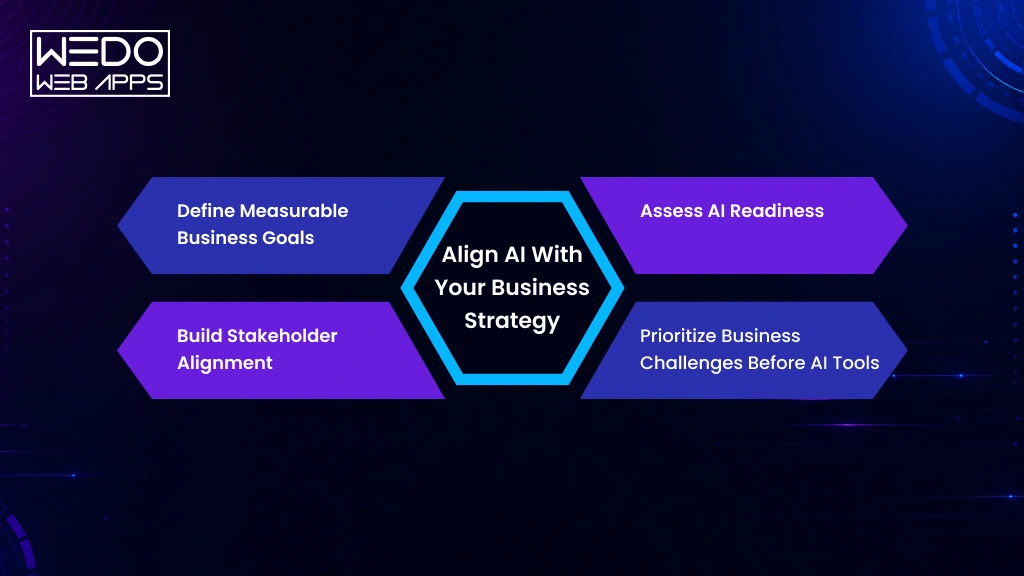
Define Measurable Business Goals
Every AI initiative should start with a clearly defined business objective. Vague goals like "becoming an AI-driven company" often lead to fragmented projects and unclear outcomes. Instead, focus on measurable objectives that support your overall business strategy.
Examples include:
| Business Goal | How AI Can Help |
|---|---|
| Reduce operational costs | Automate repetitive workflows and optimize resource allocation. |
| Increase sales conversions | Deliver personalized recommendations and predictive lead scoring. |
| Improve customer support | Deploy AI-powered chatbots and intelligent self-service solutions. |
| Accelerate decision-making | Analyze large datasets to generate actionable insights. |
| Improve product quality | Detect defects, predict maintenance needs, and enhance quality assurance. |
When objectives are measurable, it becomes easier to prioritize investments, evaluate progress, and demonstrate the business value of AI.
Assess AI Readiness
Not every organization is ready to scale AI immediately. Before building an implementation plan, evaluate whether your business has the necessary foundation to support AI initiatives. An AI readiness assessment typically considers:
- Data availability and quality
- Existing technology infrastructure
- Cloud and integration capabilities
- Internal AI skills and expertise
- Security and compliance requirements
- Organizational willingness to adopt AI
If gaps exist, addressing them early reduces implementation risks and improves long-term success.
Pro Tip: AI readiness is not about having the latest technology; it is about having the right combination of data, people, processes, and governance.
Build Stakeholder Alignment
AI initiatives rarely succeed when a single department drives them. Business leaders, IT teams, operations managers, and end users all play a role in successful implementation. Building alignment early helps organizations:
- Create shared business objectives.
- Secure execution sponsorship.
- Allocate budgets effectively.
- Minimize resistance to change.
- Encourage collaboration across departments.
Consider involving stakeholders from multiple business functions during planning to ensure AI initiatives address organization-wide priorities rather than isolated departmental needs.
Prioritize Business Challenges Before AI Tools
One of the biggest mistakes organizations make is choosing AI technologies before identifying the problems they need to solve. While the latest AI platforms may be impressive, they won't deliver value unless they are applied to meaningful business challenges.
A practical prioritization framework looks like this:
| Start With | Then Determine |
|---|---|
| Business challenge | Can AI realistically solve it? |
| Expected business outcome | How will success be measured? |
| Available data | Is the data sufficient for AI models? |
| Implementation complexity | What resources, skills, and timeline are required? |
| Business value | Does the expected ROI justify the investment? |
This approach ensures that AI investments remain focused on solving high-impact problems instead of chasing emerging technologies.
Key Takeaways: Successful AI planning starts with business objectives, validates organizational readiness, aligns stakeholders, and prioritizes problems before technologies. This business-first approach creates a stronger foundation for a scalable AI strategy and sets the stage for building a practical AI roadmap.
Identify High-Impact AI Opportunities
Not every business process needs artificial intelligence, and not every AI initiative will deliver the same value. One of the most important aspects of AI planning is identifying opportunities where AI can solve real business challenges, improve efficiency, or create new revenue streams.
Instead of implementing AI across every department at once, successful organizations focus on high-impact opportunities that align with their business objectives. This targeted approach reduces risk, delivers quicker wins, and builds confidence for larger business transformation initiatives.
Strategic Insight: The best AI opportunities are those that solve high-value business problems, have access to quality data, and can demonstrate measurable outcomes within a reasonable timeframe.
Evaluate Business Processes
Start by reviewing your existing workflows to identify repetitive, time-consuming, or data-intensive tasks. These processes often present the greatest opportunities for AI-driven improvements.
Ask questions like:
- Which processes consume the most manual effort?
- Where do employees spend time on repetitive tasks?
- Which decisions rely heavily on large volumes of data?
- Where do customers experience delays or friction?
- Which operational bottlenecks impact productivity or profitability?
Common business functions where AI can create immediate value include:
| Business Function | Potential AI Opportunity | Expected Business Impact |
|---|---|---|
| Customer Support | AI chatbots and virtual assistants | Faster response times and improved customer satisfaction |
| Sales | Lead scoring and sales forecasting | Higher conversion rates and better pipeline management |
| Marketing | Customer segmentation and personalized campaigns | Increased engagement and improved marketing ROI |
| Operations | Workflow automation and predictive maintenance | Greater efficiency and reduced operational costs |
| Finance | Invoice processing and fraud detection | Faster processing and improved accuracy |
| Human Resources | Resume screening and workforce analytics | Better hiring decisions and improved employee experience |
Rather than asking "Where can we use AI?", focus on "Where can AI create measurable business value?"
Quick Wins vs. Long-Term AI Initiatives
Not all AI projects should be treated equally. Some initiatives can deliver results within weeks, while others require significant investment, organizational change, and long-term planning.
A balanced AI business strategy includes both short-term wins and long-term transformation projects.
| Quick Wins | Long-Term Initiatives |
|---|---|
| AI-powered customer support | Enterprise-wide AI adoption |
| Automated document processing | AI-driven supply chain optimization |
| Intelligent search and knowledge management | Predictive business intelligence platforms |
| Marketing content personalization | AI-powered product innovation |
| Workflow automation | Organization-wide decision intelligence |
Quick wins help businesses:
- Demonstrate the value of AI early.
- Build stakeholder confidence.
- Generate measurable ROI faster.
- Encourage broader AI adoption.
Long-term initiatives, on the other hand, support sustainable growth and become integral to an organization's roadmap.
Best Practices: Allocate resources to both quick wins and strategic initiatives to maintain momentum while building long-term capabilities.
AI Use Case Prioritization
Once potential AI opportunities have been identified, the next step is deciding which initiatives deserve immediate attention. Prioritization ensures that resources are invested where they can deliver the highest business impact.
A practical prioritization framework considers four key factors:
| Evaluation Criteria | Questions to Ask |
|---|---|
| Business Value | Will this initiative solve a high-priority business problem? |
| Data Readiness | Is sufficient, high-quality data available? |
| Implementation Complexity | What level of effort, cost, and expertise is required? |
| Expected ROI | How quickly can measurable benefits be achieved? |
Projects that score high on business value and data readiness while requiring manageable implementation effort often make the best starting points.
You can also categorize opportunities using an Impact vs. Effort Matrix:
| Priority | Characteristics |
|---|---|
| High Impact, Low Effort | Start immediately; these are your quick wins. |
| High Impact, High Effort | Include in your long-term AI roadmap. |
| Low Impact, Low Effort | Consider only if resources are available. |
| Low Impact, High Effort | Avoid or revisit later. |
This structured approach helps organizations avoid investing in complex AI projects that offer limited business value while ensuring the most impactful initiatives receive priority.
Key Takeaway: High-impact AI opportunities aren't determined by the latest technology; they're determined by their ability to solve meaningful business challenges, align with strategic goals, and deliver measurable value. By evaluating business processes, balancing quick wins with long-term initiatives, and prioritizing use cases based on impact and feasibility, organizations can lay a stronger foundation for a successful AI business strategy and a scalable AI roadmap.
Why Every Business Needs an AI Roadmap
Once you have identified the right AI opportunities, the next question is not "Which AI tool should we implement?"; it is "How do we implement AI in a way that delivers long-term business value?"
That is where an AI roadmap becomes essential.
An AI roadmap is a strategic plan that outlines what AI initiatives to pursue, when to implement them, who will be responsible, and how success will be measured. It transforms ambitious AI ideas into a structured execution plan, ensuring every initiative aligns with your broader AI business strategy and business objectives.
Without a roadmap, organizations often launch disconnected AI projects that compete for resources, duplicate efforts, or fail to scale. A well-defined roadmap creates clarity, establishes priorities, and keeps every AI investment focused on delivering measurable business outcomes.
What is an AI Roadmap?
An AI roadmap is a phased implementation plan that helps businesses prioritize AI initiatives, allocate resources, manage risks, and scale AI adoption in alignment with strategic business goals.
Rather than being a static document, an AI roadmap should evolve as business priorities, technologies, and market conditions change.
Common Challenges Without AI Planning
Many organizations rush into AI adoption because of competitive pressure or the fear of missing out (FOMO). While enthusiasm is important, implementing AI without structured AI planning often creates more challenges than opportunities.
Here are some of the most common issues businesses face when they don't follow a roadmap:
| Challenge | Business Impact |
|---|---|
| Disconnected AI initiatives | Teams implement separate AI tools that don't integrate or share data. |
| Unclear priorities | Resources are spread across low-impact projects with limited business value. |
| Budget overruns | AI investments increase without measurable outcomes or ROI. |
| Poor adoption | Employees struggle to understand, trust, or effectively use AI solutions. |
| Data silos | Inconsistent or inaccessible data reduces AI accuracy and effectiveness. |
| Governance gaps | Compliance, privacy, and security risks increase as AI adoption grows. |
| Difficulty scaling | Successful pilot projects fail to expand across the organization. |
These challenges rarely stem from AI technology itself; they are usually the result of inadequate planning and a lack of strategic direction. Reality Check: Most AI failures are planning failures, not technology failures.
Benefits of a Structured AI Roadmap
An AI roadmap gives organizations a clear path from strategy to execution. Instead of reacting to AI trends, businesses can make informed decisions based on priorities, available resources, and expected outcomes.
Some of the biggest benefits include:
Better Investment Decisions: A roadmap helps organizations prioritize AI initiatives based on business value rather than hype. This ensures budgets are allocated to project with the highest potential impact.
Reduced Implementation Risks: By defining clear phases, dependencies, and governance practices, businesses can identify potential challenges early and minimize costly implementation mistakes.
Faster Return on Investment (ROI): Focusing on high-impact, achievable initiatives enables organizations to demonstrate measurable results sooner, building confidence for future AI investments.
Cross-Functional Alignment: An AI Roadmap creates a shared vision across leadership, IT, operations, and business teams. Everyone understands the objectives, timelines, responsibilities, and expected outcomes.
What Should an AI Roadmap Include?
While every organization's roadmap will differ, most successful AI roadmaps include the following components:
| Roadmap Component | Why It Matters |
|---|---|
| Business Objectives | Ensures every AI initiative supports strategic goals. |
| Prioritized AI Use Cases | Focuses resources on high-impact opportunities. |
| Implementation Phases | Breaks large initiatives into manageable milestones. |
| Technology and Data Requirements | Identifies infrastructure and integration needs. |
| Governance Framework | Supports responsible, secure, and compliant AI adoption. |
| Success Metrics | Defines how business value and ROI will be measured. |
| Change Management Plan | Encourages employee adoption and organizational readiness. |
Think of your AI roadmap as a business growth plan; not just a technology implementation checklist.
AI Roadmaps Are Living Strategies, Not One-Time Plans
One of the biggest misconceptions is that an AI roadmap is created once and then followed indefinitely. In reality, your roadmap should evolve as:
- Business priorities change.
- New AI capabilities emerge.
- Customer expectations shift.
- Regulations and compliance requirements evolve.
- New data becomes available.
- AI initiatives mature and scale.
Reviewing and refining your roadmap regularly helps ensure your AI investments continue delivering value as your organization grows.
Key Takeaway: An AI roadmap transforms your AI business strategy into a practical execution plan. It helps businesses prioritize the right initiatives, reduce implementation risks, align teams, and continuously adapt to changing business needs; making AI adoption more predictable, scalable, and results-driven.

Build an AI Roadmap for Sustainable Business Transformation
A well-defined AI roadmap bridges the gap between strategy and execution. While an AI business strategy defines why your organization is investing in AI, the roadmap outlines how you'll achieve those goals through a structured, phased approach.
Rather than launching multiple AI initiatives simultaneously, a roadmap helps businesses prioritize projects, allocate resources effectively, and measure progress over time. It also ensures that every AI investment contributes to long-term business transformation instead of becoming an isolated technology project.
Quick Definition: An AI roadmap is a step-by-step implementation plan that helps organizations prioritize AI initiatives, manage risks, allocate resources, and achieve measurable business outcomes.
Whether you're implementing your first AI solution or expanding AI across the enterprise, following a structured roadmap improves execution, reduces uncertainty, and accelerates business value.
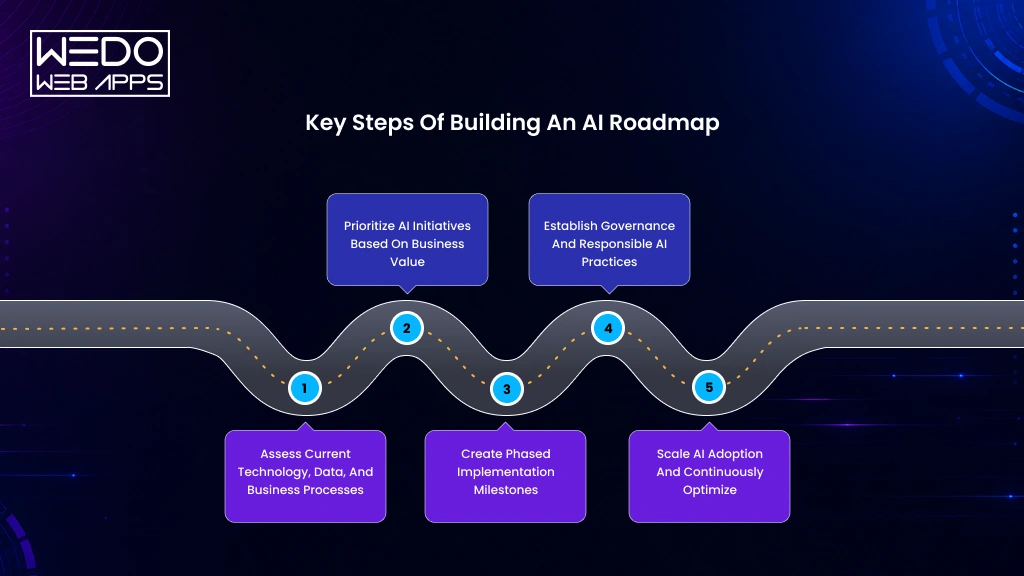
Step 1: Assess Current Technology, Data, and Business Processes
Every successful AI initiative begins with understanding your current capabilities. Before selecting AI tools or building new solutions, evaluate your existing technology ecosystem, business processes, and data readiness.
Focus on questions like:
- Is our current infrastructure capable of supporting AI?
- Do we have reliable, high-quality data?
- Which processes are repetitive or inefficient?
- Are our existing systems ready for AI integration?
- What skills and resources are available internally?
A comprehensive assessment helps uncover both opportunities and gaps, ensuring your AI initiatives are built on a strong foundation rather than assumptions.
Evaluate These Areas Before Moving Forward
| Assessment Area | Key Questions |
| Business Processes | Which workflows are repetitive, manual, or time-consuming? |
| Data Readiness | Is your data accurate, accessible, and well-governed? |
| Technology Infrastructure | Can existing systems support AI deployment and integrations? |
| Workforce Readiness | Do teams have the skills and support needed for AI adoption? |
| Security & Compliance | Are governance and regulatory requirements already in place? |
Best Practice: Don't begin with AI tools-begin with understanding your business environment.
Step 2: Prioritize AI Initiatives Based on Business Value
Not every AI opportunity deserves immediate investment. Once you've identified potential use cases, the next step is determining which initiatives will deliver the greatest business impact with the least implementation risk.
A simple prioritization framework considers four key factors:
- Business impact
- Implementation complexity
- Data availability
- Expected return on investment (ROI)
Projects that deliver quick, measurable wins should often be prioritized first, while larger transformation initiatives can be planned in later phases.
AI Prioritization Matrix
| Priority Level | Characteristics | Recommended Action |
|---|---|---|
| High Impact - Low Complexity | Quick wins with measurable ROI | Implement immediately |
| High Impact - High Complexity | Strategic transformation initiatives | Include in long-term roadmap |
| Low Impact - Low Complexity | Minor process improvements | Implement when resources allow |
| Low Impact - High Complexity | Limited business value | Reassess or postpone |
Prioritizing initiatives this way ensures your AI roadmap remains aligned with business objectives instead of becoming driven by technology trends.
Step 3: Create Phased Implementation Milestones
AI transformation doesn't happen overnight. Breaking implementation into manageable phases allows organizations to reduce risks, learn from early projects, and scale AI with greater confidence.
A phased roadmap typically includes:
Phase 1 - Foundation
- Assess AI readiness
- Define business objectives
- Improve data quality
- Establish governance
Phase 2 - Pilot Projects
- Launch high-impact, low-risk AI initiatives
- Validate business outcomes
- Gather stakeholder feedback
- Measure initial ROI
Phase 3 - Scale and Optimize
- Expand successful AI initiatives
- Integrate AI across departments
- Standardize governance and processes
- Continuously monitor and optimize performance
Business Insight: Organizations that scale AI gradually often achieve higher adoption rates and lower implementation risks than those attempting enterprise-wide deployments from day one.
Step 4: Establish Governance and Responsible AI Practices
As AI adoption grows, governance becomes just as important as technology. Without clear policies and accountability, businesses can face challenges related to data privacy, security, compliance, and ethical AI usage.
Your AI roadmap should define:
- Data governance standards
- AI security policies
- Compliance requirements
- Ethical AI guidelines
- Roles and responsibilities
- Performance monitoring processes
Governance shouldn't slow innovation; it should create a framework that enables organizations to scale AI responsibly and confidently.
Remember: Responsible AI protects your business, strengthens customer trust, and supports sustainable innovation.
Step 5: Scale AI Adoption and Continuously Optimize
Launching an AI solution isn't the finish line; it's the starting point. As your business grows, customer expectations evolve, and AI technologies advance, your roadmap should adapt accordingly.
Successful organizations continuously:
- Measure business outcomes against predefined KPIs.
- Gather feedback from employees and customers.
- Refine AI models and workflows.
- Expand successful initiatives across departments.
- Update their roadmap to reflect new business priorities.
This continuous improvement approach transforms AI from a collection of isolated projects into an organization-wide capability that drives long-term business value. AI Roadmap Framework at a Glance
| Roadmap Phase | Primary Objective | Expected Outcome |
|---|---|---|
| Assess | Evaluate readiness, data, and processes | Identify opportunities and capability gaps |
| Prioritize | Select high-value AI initiatives | Focus investments on measurable outcomes |
| Implement | Execute projects in phased milestones | Reduce risks and accelerate ROI |
| Govern | Establish responsible AI practices | Ensure security, compliance, and trust |
| Scale | Expand and optimize AI initiatives | Drive sustainable business transformation |
Following this structured framework helps organizations move beyond experimentation and build a scalable AI roadmap that delivers measurable business results.
Key Takeaway
Building an AI roadmap isn't about implementing every new AI technology-it's about creating a practical plan that aligns with your business goals, prioritizes high-value opportunities, and supports continuous improvement. By assessing your current capabilities, prioritizing initiatives strategically, implementing AI in phases, establishing strong governance, and continuously optimizing outcomes, your organization can turn its AI business strategy into a sustainable driver of business transformation.
Key Elements of an Effective AI Business Strategy
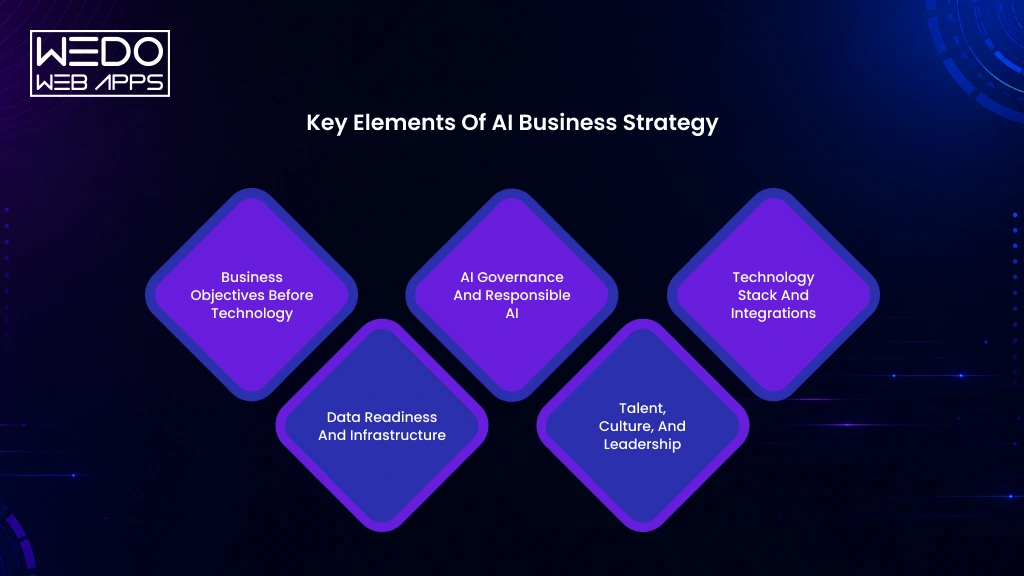
A successful AI business strategy isn't built around a single AI tool or use case. It's built on a strong foundation that ensures every AI initiative supports business goals, integrates with existing systems, and delivers measurable outcomes over time.
While every organization's AI journey is unique, the most successful strategies share a common set of building blocks. Focusing on these foundational elements helps businesses reduce implementation risks, improve adoption, and create a scalable framework for long-term business transformation.
At a Glance: An effective AI business strategy combines clear business goals, reliable data, strong governance, skilled teams, and the right technology ecosystem.
Business Objectives Before Technology
Many organizations make the mistake of selecting AI platforms before defining the problems they want to solve. As a result, they invest in impressive technologies that fail to deliver meaningful business outcomes.
Instead, start with your business strategy and let it guide your AI investments.
Before evaluating AI solutions, ask questions such as:
- What business problem are we solving?
- Which objectives will AI help us achieve?
- How will success be measured?
- Which departments will benefit the most?
- Does this initiative align with our long-term growth strategy?
When AI initiatives are tied to measurable business objectives, organizations can prioritize investments with confidence and clearly demonstrate ROI.
Best Practice: Business strategy should determine your AI roadmap; not the other way around.
Data Readiness and Infrastructure
AI is only as effective as the data that powers it. Poor-quality, incomplete, or disconnected data can limit model accuracy and reduce business value, regardless of how advanced the AI solution is. Businesses that require predictive models, intelligent automation, or data-driven decision-making can also leverage machine learning development to build customized solutions around their specific business needs.
Before implementing AI, assess whether your organization has the right data foundation.
Key areas to evaluate include:
- Data quality and consistency
- Data accessibility across departments
- Cloud infrastructure and storage
- System integrations
- Data security and privacy
- Scalability for future AI initiatives
Organizations with strong data readiness can move from pilot projects to enterprise-scale AI adoption much more efficiently.
| Data Readiness Checklist | Why It Matters |
|---|---|
| Clean and structured data | Improves AI accuracy and reliability |
| Centralized data sources | Eliminates silos and duplicate information |
| Secure infrastructure | Protects sensitive business and customer data |
| Scalable architecture | Supports future AI growth without major rework |
| Integrated systems | Enables seamless data flow across applications |
AI Governance and Responsible AI
As AI becomes more deeply embedded in business operations, governance is no longer optional; it's essential. AI governance establishes the policies, processes, and accountability needed to ensure AI systems operate responsibly, securely, and in compliance with regulations.
An effective governance framework should address:
- Data privacy and security
- Ethical AI usage
- Regulatory compliance
- Model transparency
- Bias detection and mitigation
- Human oversight and accountability
Responsible AI builds trust with customers, employees, and stakeholders while reducing legal and operational risks.
Remember: Responsible AI isn't about slowing innovation; it's about making innovation sustainable.
Talent, Culture, and Leadership
Technology alone won't drive AI success. Organizations also need people who understand, support, and adopt AI as part of their daily work. Building an AI-ready culture starts with leadership.
Successful organizations:
- Communicate a clear AI vision.
- Invest in employee training and upskilling.
- Encourage cross-functional collaboration.
- Address concerns about AI adoption.
- Promote continuous learning and innovation.
Executive sponsorship is equally important. When leadership actively supports AI initiatives, teams are more likely to embrace change and contribute to successful implementation. People drive AI success just as much as technology does.
Technology Stack and Integrations
Choosing the right technology stack is the final piece of a successful AI strategy. However, this decision should support your business objectives; not define them. A scalable AI ecosystem should integrate seamlessly with your existing technology landscape while allowing room for future growth.
When evaluating AI technologies, consider:
- Compatibility with existing systems
- API and third-party integration capabilities
- Cloud or on-premises deployment requirements
- Scalability and performance
- Security and compliance features
- Vendor support and long-term flexibility
Businesses often benefit from partnering with experienced providers offering AI integration services to ensure AI solutions connect smoothly with existing applications, workflows, and data sources.
Rather than building isolated AI solutions, focus on creating a connected technology ecosystem that enables AI to deliver value across the entire organization.
Key Takeaway
An effective AI business strategy goes beyond selecting AI tools. It starts with clear business objectives, is supported by reliable data and infrastructure, operates within a strong governance framework, empowers people through leadership and culture, and leverages a scalable technology ecosystem. Together, these elements create the foundation for sustainable AI adoption and long-term business transformation.
AI Use Cases That Drive Business Transformation
A successful AI business strategy isn't measured by how many AI tools an organization adopts; it's measured by the business value those tools create. The most impactful AI initiatives solve real operational challenges, improve customer experiences, and enable faster, data-driven decision-making.
From automating repetitive tasks to delivering predictive insights, AI is transforming every business function. The key is to identify use cases that align with your strategic goals and integrate them into your long-term AI roadmap.
Business Insight: AI creates the greatest impact when it's applied to high-value processes that influence revenue, efficiency, customer satisfaction, or innovation. Below are some of the most effective AI use cases driving business transformation across modern organizations.
Customer Experience
Customer expectations continue to evolve, and businesses are under constant pressure to deliver faster, more personalized experiences. AI helps organizations understand customer behavior, anticipate needs, and provide support at scale.
Common AI applications include:
- AI-powered chatbots and virtual assistants
- Personalized product and content recommendations
- Sentiment analysis from customer feedback
- Intelligent customer support routing
- Predictive customer retention and churn analysis
Business Benefits
- Faster response times
- Higher customer satisfaction
- Increased customer retention
- Personalized user experiences
- Reduced support costs
Sales and Marketing
AI enables sales and marketing teams to move beyond guesswork by using data to predict customer behavior, optimize campaigns, and improve conversion rates.
Popular AI use cases include:
- Lead scoring and qualification
- Sales forecasting
- Marketing campaign optimization
- Customer segmentation
- AI-generated content assistance
- Dynamic pricing recommendations
Business Benefits
- Better lead quality
- Improved campaign ROI
- Higher conversion rates
- More personalized customer engagement
- Faster sales cycles
Operations
Operations teams often deal with repetitive workflows, manual processes, and resource-intensive activities. AI helps streamline these processes, improving productivity while reducing costs.
Examples include:
- Workflow automation
- Inventory optimization
- Predictive maintenance
- Supply chain optimization
- Intelligent scheduling
- Quality inspection using computer vision
Business Benefits
- Lower operational costs
- Reduced manual effort
- Improved resource utilization
- Faster process execution
- Increased operational efficiency
Finance
Finance departments manage large volumes of data, making them ideal candidates for AI-driven automation and predictive analytics.
Common AI applications include:
- Automated invoice processing
- Expense management
- Fraud detection
- Financial forecasting
- Risk assessment
- Cash flow prediction
Business Benefits
- Improved financial accuracy
- Faster processing times
- Reduced fraud risks
- Better forecasting
- More informed financial decisions
Human Resources
HR teams are increasingly using AI to improve recruitment, employee engagement, and workforce planning while reducing administrative workloads.
Typical AI use cases include:
- Resume screening
- Candidate matching
- Employee onboarding automation
- Workforce analytics
- Employee sentiment analysis
- Learning and development recommendations
Business Benefits
- Faster hiring processes
- Improved candidate quality
- Better employee experiences
- Data-driven workforce planning
- Increased HR efficiency
Product Development
AI accelerates innovation by helping businesses understand customer needs, improve product quality, and reduce time-to-market.
Organizations commonly use AI for:
- Customer feedback analysis
- Product usage insights
- Feature prioritization
- Demand forecasting
- Prototype testing
- Predictive quality assurance
Business Benefits
- Faster product development cycles
- Better product-market fit
- Improved product quality
- Data-driven innovation
- Reduced development costs
Choosing the Right AI Use Cases for Your Business
While AI offers opportunities across every department, not every use case should be implemented at the same time. The best approach is to prioritize initiatives based on business value, implementation feasibility, and strategic alignment.
Use the following framework to evaluate potential AI opportunities:
| Evaluation Factor | Questions to Consider |
|---|---|
| Business Impact | Will this initiative solve a high-priority business challenge? |
| Data Availability | Do we have sufficient, high-quality data to support AI? |
| Implementation Complexity | What resources, budget, and expertise are required? |
| Expected ROI | How quickly can we measure business value? |
| Scalability | Can this solution expand across teams or departments? |
Projects that score highly across these criteria are often the best candidates for early implementation and can become the foundation of a scalable AI business strategy.
Key Takeaway: AI isn't limited to a single department or function. Whether it's enhancing customer experiences, optimizing operations, improving financial decisions, or accelerating product innovation, the right AI use cases can unlock measurable business value. By selecting initiatives that align with your strategic objectives, organizations can turn AI from a collection of isolated tools into a powerful driver of long-term business transformation.
Measure the Success of Your AI Business Strategy
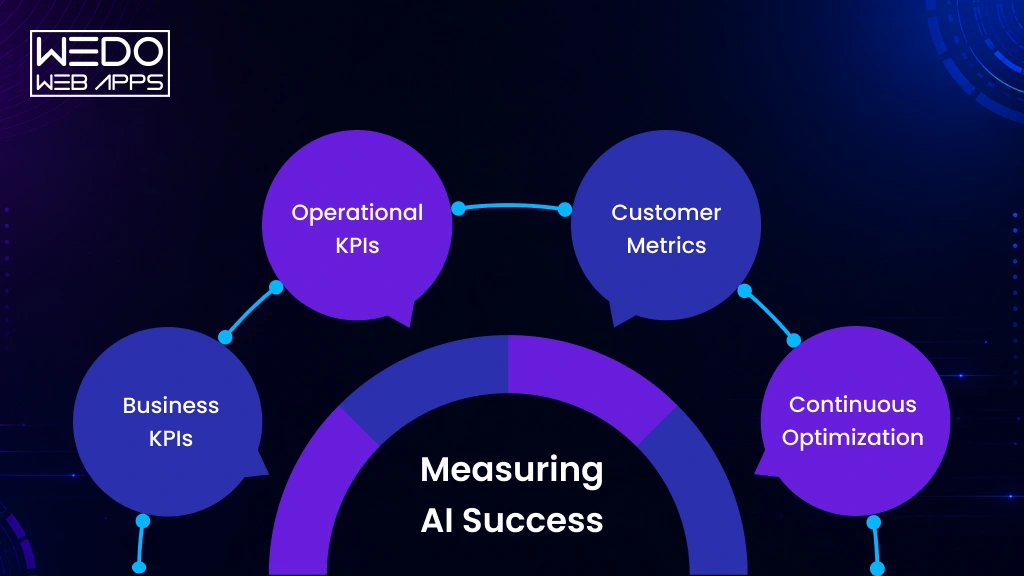
Implementing AI is only the beginning. The real measure of success lies in whether your AI business strategy delivers meaningful business outcomes.
Many organizations make the mistake of tracking technical metrics, such as model accuracy or processing speed, while overlooking the metrics that matter most to business leaders. A successful AI initiative should demonstrate improvements in efficiency, customer experience, revenue, cost savings, or innovation.
That's why every AI roadmap should include clearly defined success metrics before implementation begins.
Key Principle: If you can't measure the business impact of AI, you can't determine whether your strategy is working.
Instead of focusing solely on technical performance, evaluate AI initiatives through business-focused Key Performance Indicators (KPIs).
Business KPIs
Business KPIs measure how AI contributes to the organization's strategic objectives. These metrics help leadership understand whether AI investments are generating real business value.
Common business KPIs include:
- Revenue growth
- Cost reduction
- Profit margin improvements
- Customer acquisition rate
- Customer retention rate
- Time-to-market for new products
- Market share growth
| Business Goal | KPI to Measure |
|---|---|
| Increase revenue | Revenue growth, average order value |
| Reduce costs | Operational cost savings |
| Improve customer loyalty | Customer retention rate |
| Accelerate innovation | Time-to-market reduction |
| Improve productivity | Output per employee |
These indicators provide a high-level view of how AI supports long-term business growth.
Operational KPIs
Operational KPIs focus on process improvements and efficiency gains. They help organizations determine whether AI is streamlining workflows and improving day-to-day operations.
Track metrics such as:
- Process automation rate
- Average task completion time
- Manual effort reduced
- Workflow efficiency
- Error reduction
- Resource utilization
- System uptime
For example, if AI automates invoice processing, success should be measured by faster processing times, fewer manual interventions, and lower operational costs-not simply by the number of invoices processed.
Business Insight: Operational improvements often generate the fastest and most visible ROI from AI initiatives.
Customer Metrics
Customer experience is one of the strongest indicators of AI success. Whether AI is used for personalization, support automation, or predictive recommendations, the impact should be reflected in customer behavior and satisfaction.
Monitor metrics such as:
- Customer Satisfaction Score (CSAT)
- Net Promoter Score (NPS)
- Customer Effort Score (CES)
- First response time
- Average resolution time
- Customer churn rate
- Customer lifetime value (CLV)
| AI Initiative | Customer Metric |
|---|---|
| AI chatbot | First response time, CSAT |
| Personalized recommendations | Conversion rate, average order value |
| Predictive support | Customer retention, churn rate |
| Intelligent self-service | Resolution time, CES |
Tracking customer-focused KPIs ensures AI initiatives create experiences that strengthen long-term customer relationships.
Continuous Optimization
An effective AI business strategy is never static. Business priorities evolve, customer expectations change, and AI technologies continue to advance. Regular monitoring and optimization ensure your AI initiatives remain aligned with organizational goals and continue delivering value.
A continuous improvement cycle typically includes:
- Measure performance against predefined KPIs.
- Gather feedback from users and stakeholders.
- Identify opportunities for optimization.
- Update AI models, workflows, or business processes.
- Scale successful initiatives across the organization.
Rather than treating AI implementation as a one-time project, businesses should view it as an ongoing process of learning, refinement, and innovation.
Signs It's Time to Reassess Your AI Strategy
Review your AI roadmap if you notice:
- Business goals have changed.
- AI initiatives are not meeting expected ROI.
- Customer expectations have shifted.
- Data quality has improved or declined.
- New AI technologies create better opportunities.
- Regulatory or compliance requirements have evolved.
Regular reviews help organizations adapt quickly and maximize the long-term value of their AI investments.
AI Success Dashboard: Metrics That Matter
Instead of tracking dozens of disconnected metrics, focus on a balanced set of KPIs across four key areas.
| Success Area | Example Metrics | Business Outcome |
|---|---|---|
| Business Growth | Revenue, profit margin, market share | Measures strategic impact |
| Operational Efficiency | Automation rate, process time, cost savings | Measures productivity improvements |
| Customer Experience | CSAT, NPS, churn rate, CLV | Measures customer value |
| AI Adoption | User adoption, usage frequency, stakeholder satisfaction | Measures organizational readiness |
This balanced approach provides leadership with a clear view of how AI contributes to business performance while identifying areas that require improvement.
Key Takeaway: The success of an AI business strategy isn't determined by how advanced the technology is; it's determined by the business value it creates. By tracking business, operational, customer, and adoption metrics, organizations can measure ROI, optimize performance, and continuously refine their AI roadmap to support long-term business transformation.
Common AI Planning Mistakes to Avoid
A well-defined AI business strategy can accelerate innovation, improve efficiency, and create a competitive advantage, but only if it's executed correctly. Many organizations don't struggle because AI lacks potential; they struggle because they overlook the planning required to implement it successfully.
Avoiding these common mistakes can save time, reduce costs, and increase the likelihood of achieving measurable business outcomes.
Remember: Successful AI implementation is less about choosing the most advanced technology and more about making the right strategic decisions.
Starting with Technology Instead of Business Problems
One of the most common mistakes organizations make is adopting AI because it's trending rather than because it solves a specific business challenge.
Questions like "Which AI platform should we buy?" or "How can we use generative AI?" often come before defining the actual problem. This technology-first approach can lead to expensive solutions with limited business value.
Instead, begin with questions such as:
- Which business challenges are limiting growth?
- Which processes consume the most time and resources?
- Where can AI improve customer or employee experiences?
- Which opportunities offer the highest potential ROI?
Best Practice
Build your AI business strategy around measurable business outcomes; not around AI tools or vendor capabilities.
Ignoring Data Quality and Governance
AI models rely on data to generate accurate insights and recommendations. If the underlying data is incomplete, inconsistent, or outdated, even the most sophisticated AI solution will produce unreliable results.
Poor data governance can also introduce compliance, security, and ethical risks that become increasingly difficult to manage as AI adoption grows. Before scaling AI initiatives, evaluate:
- Data accuracy and consistency
- Data accessibility across systems
- Data privacy and security
- Compliance with industry regulations
- Data ownership and governance policies
Business Insight: Better data doesn't just improve AI performance; it improves business decision-making across the organization.
Lack of Leadership and Change Management
AI adoption is as much a people initiative as it is a technology initiative. Even well-designed AI solutions can fail if employees don't understand their purpose or leaders fail to champion organizational change.
Common signs of poor change management include:
- Low employee adoption
- Resistance to new workflows
- Lack of executive sponsorship
- Unclear ownership of AI initiatives
- Limited training and support
Successful organizations address these challenges by:
- Communicating a clear AI vision.
- Involving stakeholders early.
- Providing role-specific training.
- Encouraging collaboration across departments.
- Establishing executive accountability.
When leadership actively supports AI initiatives, employees are more likely to embrace change and contribute to successful implementation.
Treating AI as a One-Time Project
Many businesses view AI implementation as a project with a fixed start and finish. In reality, AI requires continuous monitoring, optimization, and adaptation. As your business evolves, your AI roadmap should evolve too.
Regular reviews help organizations:
- Prioritize new AI opportunities.
- Improve existing AI models.
- Respond to changing customer expectations.
- Address new regulatory requirements.
- Scale successful initiatives across the business.
Organizations that treat AI as an ongoing capability rather than a one-time deployment are better positioned to sustain long-term business transformation.
AI Planning Checklist Before You Invest
Before launching your next AI initiative, make sure you can answer "Yes" to these questions:
| Planning Question | Why It Matters |
|---|---|
| Have we defined the business problem? | Ensures AI addresses a meaningful challenge. |
| Do we have measurable success metrics? | Makes ROI easier to evaluate. |
| Is our data accurate and accessible? | Improves AI performance and reliability. |
| Are leadership and stakeholders aligned? | Increases adoption and long-term support. |
| Do we have a phased AI roadmap? | Reduces implementation risks and improves scalability. |
| Have we considered governance and compliance? | Supports responsible and secure AI adoption. |
If the answer to several of these questions is "No," it's worth strengthening your planning before investing in AI technologies.
Key Takeaway: Most AI implementation challenges don't stem from the technology itself; they stem from poor planning. By focusing on business problems first, strengthening data governance, engaging leadership, and treating AI as a continuous business capability, organizations can build a more resilient AI business strategy and achieve sustainable business transformation.
Future Trends Shaping AI Business Strategy
Artificial intelligence is evolving faster than ever, and businesses that rely on today's AI capabilities alone may struggle to remain competitive tomorrow. A forward-looking AI business strategy should not only address current business needs but also prepare organizations for emerging technologies, changing regulations, and evolving customer expectations.
While it's impossible to predict every innovation, several trends are already influencing how businesses approach AI planning, implementation, and long-term business transformation.
Looking Ahead: The most successful organizations won't be those that adopt every new AI technology, they'll be the ones that adapt their AI strategy as technology evolves.
Agentic AI
Traditional AI systems respond to prompts or automate specific tasks. Agentic AI takes this a step further by enabling AI systems to plan, make decisions, and complete multi-step tasks with minimal human intervention.
Instead of assisting with a single action, AI agents can manage entire workflows such as:
- Conducting market research
- Managing customer support requests
- Monitoring business operations
- Coordinating multi-step business processes
- Generating reports and recommendations
Why It Matters
Businesses can automate more complex processes, reduce manual effort, and improve operational efficiency while allowing employees to focus on strategic work.
Business Insight: Agentic AI shifts AI from being a productivity tool to becoming an intelligent operational partner.
Enterprise AI Copilots
AI copilots are becoming an integral part of everyday business operations. Rather than replacing employees, they assist teams by providing recommendations, generating content, analyzing data, and automating routine tasks within existing business applications.
Organizations are increasingly deploying AI copilots across:- Customer service
- Sales
- Marketing
- AI-powered Software development
- Finance
- Human resources
Business Benefits
- Faster decision-making
- Increased employee productivity
- Reduced repetitive work
- Improved knowledge sharing
- More consistent business processes
As AI copilots become more sophisticated, businesses will need to incorporate them into their AI roadmap while ensuring proper governance and user adoption.
Responsible AI
As AI adoption grows, so do expectations around transparency, fairness, privacy, and accountability. Customers, regulators, and stakeholders increasingly expect organizations to use AI responsibly.
Responsible AI involves establishing policies and practices that ensure AI systems are:
- Fair and unbiased
- Transparent and explainable
- Secure and compliant
- Respectful of user privacy
- Regularly monitored and audited
Organizations that embed responsible AI into their strategy are better positioned to build trust, reduce compliance risks, and support sustainable innovation.
Best Practice: Responsible AI should be integrated into every stage of the AI lifecycle, not added as an afterthought.
Continuous Roadmap Evolution
One of the biggest shifts in AI planning is the move away from static implementation plans. As AI capabilities continue to advance, businesses must regularly review and update their strategies to remain competitive.
An effective AI roadmap should evolve based on:
- Business priorities
- Market conditions
- Customer expectations
- Technology advancements
- Regulatory changes
- Lessons learned from previous AI initiatives
Organizations that continuously refine their AI roadmap can respond more quickly to new opportunities while avoiding costly investments in outdated technologies.
Emerging Trends Businesses Should Watch
While every organization has different priorities, these emerging trends are likely to influence AI adoption over the next few years.
| Trend | Business Impact |
|---|---|
| Multimodal AI | Combines text, images, audio, and video to improve decision-making and customer experiences. |
| Smaller, Domain-Specific AI Models | Delivers faster, more accurate results for industry-specific use cases while reducing infrastructure costs. |
| AI-Driven Decision Intelligence | Helps leaders make faster, data-backed business decisions using predictive insights. |
| Autonomous Business Workflows | Automates end-to-end processes with minimal human intervention. |
| AI Governance Platforms | Improves oversight, compliance, risk management, and responsible AI adoption across the enterprise. |
Rather than chasing every new trend, organizations should evaluate emerging technologies based on how well they support strategic business objectives.
Building an AI Strategy That Stands the Test of Time
Future-proofing your business isn't about predicting every technological breakthrough, it's about creating a strategy that's flexible enough to adapt. A future-ready AI business strategy should:
- Align AI investments with evolving business goals.
- Continuously assess new AI opportunities.
- Prioritize responsible and ethical AI adoption.
- Invest in employee skills and organizational readiness.
- Review and update the AI roadmap regularly.
- Measure outcomes and refine initiatives based on business performance.
Businesses that treat AI as an evolving capability rather than a one-time implementation will be better prepared to navigate future disruptions and maintain a competitive advantage.
Key Takeaway: AI technologies will continue to evolve, but the principles of a successful AI business strategy remain the same: align AI with business objectives, embrace continuous improvement, adopt AI responsibly, and evolve your roadmap as new opportunities emerge. Organizations that build adaptability into their strategy today will be better positioned to lead tomorrow.
Conclusion
Artificial intelligence is no longer just a competitive advantage, it's becoming a core driver of business growth, innovation, and operational excellence. However, the organizations that see the greatest returns aren't necessarily the ones investing the most in AI. They're the ones investing in a well-defined AI business strategy.
Throughout this guide, we've explored how businesses can align AI with strategic objectives, identify high-impact opportunities, build a scalable AI roadmap, establish strong governance, and measure success through meaningful business outcomes. Together, these elements create a framework that transforms AI from isolated experiments into a sustainable engine for business transformation.
As AI technologies continue to evolve, your strategy should evolve with them. Regularly reviewing your roadmap, refining priorities, and embracing continuous improvement will help your organization stay agile, maximize ROI, and remain competitive in an increasingly AI-driven marketplace.
Whether you're planning your first AI initiative or expanding AI across the enterprise, success starts with a clear strategy, not just the right technology. Opt for AI consulting services for better planning and execution of AI implementation.