Introduction
AI can accelerate growth, improve efficiency, and can also allow you to create new opportunities, but only when implemented with a clear purpose. Still, there are many organizations that invest heavily in artificial intelligence and still struggle to achieve meaningful results.
The reason is often not the technology itself. Most setbacks stem from preventable AI implementation mistakes that occur before and during execution. Unclear objectives, poor planning, unrealistic expectations, and weak adoption strategies can quickly turn a promising initiative into an expensive lesson.
Many cases of AI project failure can be traced back to overlooked AI planning mistakes rather than technical limitations during software development. Organizations that rush into AI without a well-defined AI strategy often find it difficult to scale initiatives, measure ROI, or gain stakeholder buy-in.
In this guide, we will examine the most common AI implementation mistakes businesses make and the practical steps to avoid them.
Why AI Projects Fail More Often Than Expected
Organizations are investing in AI at an unprecedented rate, yet many initiatives fail to deliver the expected business impact. The challenge is rarely the technology itself. More often, the problem lies in how AI is planned, implemented, and managed.
Many businesses approach AI with ambitious goals but without the foundation needed to achieve them. This disconnect often creates a gap between expectations and actual outcomes.
Quick Answer: Why Do AI Projects Fail?
Most cases of AI project failure occur because organizations lack clear business objectives, reliable data, stakeholder alignment, and a well-defined AI strategy. Combined with poor execution and common AI planning mistakes, these issues prevent AI initiatives from generating measurable business value.
The Gap Between AI Ambitions and Business Outcomes
Many companies adopt AI because they want to improve efficiency, reduce costs, or gain a competitive advantage. However, success becomes difficult when AI initiatives are driven by trends rather than business needs.
| AI Goal | Business Challenge |
|---|---|
| Implement AI tools | No clear problem to solve |
| Automate processes | Undefined success metrics |
| Deploy AI quickly | Limited organizational readiness |
When business outcomes are unclear, measuring success becomes equally difficult.
Common Patterns Behind AI Project Failure
Several AI implementation mistakes appear repeatedly across successful projects:
- Starting without defined objectives.
- Using poor quality or fragmented data.
- Expecting immediate ROI.
- Ignoring employee adoption and training.
- Scaling before validating results.
The Role of Strategy, Planning, and Execution
Successful AI initiatives are built on more than technology. They require a strong AI strategy, careful planning, and disciplined execution.
The most successful organizations typically:
- Align AI initiatives with business goals.
- Assess data readiness early.
- Establish measurable KPIs.
- Create a roadmap before development begins.
Without these fundamentals, even promising AI projects can struggle to deliver meaningful results.
The 13 Most Common AI Implementation Mistakes
Many organizations assume that selecting the right AI tool is the most important factor in project success. In reality, most AI implementation mistakes occur before weak adoption strategies; these mistakes can significantly increase the risk of AI project failure.
Let's start with one of the most common and costly mistakes businesses make:
Mistake 1: Launching AI Without Clear Business Objectives
One of the fastest ways to derail an AI initiative is to start with the technology instead of the business problem. Organizations often decide to "implement AI" without clearly defining the challenges needed to be solved.
When objectives are vague, teams struggle to prioritize use cases, allocate resources, and demonstrate ROI. As a result, projects may generate interesting outputs but fail to create meaningful business value.
What This Looks Like in Practice
| Approach | Likely Outcome |
|---|---|
| "We need an AI solution" | Unclear direction and success criteria |
| "Let's add AI to our processes." | Difficulty proving value |
| "We want to reduce customer support resolution time by 30%." | Measurable business outcome |
| "Let's automate invoice processing to reduce manual effort" | Clear implementation roadmap |
The difference is simple: successful AI initiatives start with a business objective, not a technology objective.
Why This Mistake Happens
Some of the most common reasons include:
- Pressure to keep up with competitors.
- Executive enthusiasm without a defined use case.
- Lack of alignment between business and technical teams.
- Absence of measurable success metrics.
- Focusing on AI capabilities rather than business outcomes.
These are often early AI planning mistakes that create challenges throughout the implementation lifecycle.
How to Avoid It
Before investing in any AI solution, answer these questions:
- What specific business problem are we solving?
- What KPI will define success?
- How will this initiative impact revenue, cost, productivity, or customer experience?
- What is the expected timeline for measurable results?
A strong AI strategy connects every AI initiative to a business goal. When objectives are clear from the start, organizations can prioritize the right use cases, measure outcomes effectively, and significantly reduce the likelihood of project failure.
Mistake 2: Treating AI as a Technology Project Instead of a Business Initiative
Many organizations view AI as an IT or engineering project. As a result, decisions are often driven by technical capabilities rather than business priorities. While technology is an important component, AI initiatives deliver value only when they support a specific business objective.
This mindset is one of the most common AI implementation mistakes because it creates a disconnect between development efforts and organizational goals. Teams may successfully deploy an AI solution, yet struggle to demonstrate its impact on efficiency, revenue, customer experience, or operational performance.
Technology First vs Business First
| Technology First Approach | Business First Approach |
|---|---|
| Focuses on AI features and models | Focuses on business outcomes |
| Success measured by deployment | Success measured by business impact |
| Limited stakeholder involvement | Cross-functional collaboration |
| Difficult to justify ROI | Clear value proposition and KPIs |
When AI is treated solely as a technology initiative, adoption often becomes an afterthought. Employees may not understand how to use the solution, leadership may question its value, and projects can lose momentum despite being technically successful.
Warning Signs of This Mistake
- Business teams are rarely involved in planning discussions.
- Success is defined by launching the solution rather than achieving results.
- AI use cases are selected based on trends rather than business needs.
- Teams cannot clearly explain the expected business impact.
These issues frequently contribute to AI project failure, especially when organizations attempt to scale AI across multiple departments.
How to Avoid It
A successful AI strategy starts by identifying business goals before evaluating tools or technologies.
Consider the following questions:
- Which business challenge are we trying to solve?
- Who will benefit from the solution?
- How will success be measured?
- What operational or financial impact do we expect?
Organizations that align AI initiatives with business objectives are far more likely to achieve measurable outcomes and avoid costly AI planning mistakes later in the project lifecycle.
Mistake 3: Choosing AI Use Cases With Low Business Impact
Not every business problem requires AI, and not every AI use case delivers meaningful value. One of the most overlooked AI implementation mistakes is investing time and resources into projects that generate limited business impact.
In many cases, organizations select use cases based on what's technically possible rather than what's strategically valuable. While these projects may demonstrate AI capabilities, they often struggle to justify investment or gain long-term support from stakeholders.
High Impact vs Low Impact AI Use Cases
| Low Impact Use Cases | High Impact Use Cases |
|---|---|
| Minor workflow enhancements | Revenue growth opportunities |
| Features with limited adoption | Customer expectation improvements |
| Nice-to-have automation | Cost reduction initiatives |
| Experimental projects without KPIs | Solutions tied to measurable business outcomes |
A use case may be technically impressive, but if it doesn't solve a meaningful business challenge, its value will be difficult to prove.
Signs You're Pursuing the Wrong Use Case
- The business impact cannot be clearly quantified.
- Success metrics are undefined.
- Stakeholders struggle to explain the expected ROI.
- The problem could be solved without AI.
- Adoption is expected to be low from the start.
These warning signs often lead to AI project failure because teams invest resources without creating measurable outcomes.
How to Avoid It
Before approving an AI initiative, evaluate each use case against three key criteria:
- Business Value: Will it increase revenue, reduce costs, improve efficiency, or strengthen customer experience?
- Feasibility: Do you have the data, resources, and expertise required?
- Scalability: Can the solution create value beyond a single team or department?
A well-defined AI strategy prioritizes use cases that align with business goals rather than trends. This approach helps organizations avoid common AI planning mistakes and focus on initiatives that can deliver measurable results.
Mistake 4: Skipping the AI Planning and Discovery Phase
Many organizations are eager to move from idea to implementation as quickly as possible. However, rushing into development without proper planning is one of the most costly AI implementation mistakes businesses can make.
The planning and discovery phase helps organizations validate use cases, assess data readiness, identify potential risks, and define success metrics before significant resources are committed. When this step is skipped, teams often encounter unexpected challenges that delay progress and increase costs.
What Happens When Planning Is Overlooked?
| Without Planning | With Proper Discovery |
|---|---|
| Unclear project scope | Clearly defined objectives |
| Data issues discovered late | Data readiness assessed early |
| Misaligned stakeholder expectations | Shared understanding of goals |
| Higher risk of delays and rework | Smoother implementation process |
Many cases of AI project failure can be traced back to decisions made before development even begins. A lack of preparation often leads to unrealistic timelines, budget overruns, and solutions that fail to address the intended business problem.
Common AI Planning Mistakes
- Starting development without defining KPIs.
- Failing to evaluate data quality and availability.
- Overlooking compliance and governance requirements.
- Not identifying key stakeholders early.
- Underestimating implementation costs and timelines.
How to Avoid It
Before launching an AI initiative, create a discovery roadmap that covers:
- Business objectives and expected outcomes.
- Data availability and quality assessment.
- Technical and operational requirements.
- Risk, compliance, and governance considerations.
- Success metrics and measurement plans.
A strong AI strategy begins long before implementation. Organizations that invest time in planning and discovery are better positioned to avoid costly setbacks and achieve sustainable business results.
Mistake 5: Understanding Data Quality Requirements
AI systems are only as reliable as the data they learn from. Even the most advanced models can produce inaccurate, biased, or inconsistent results when trained on poor quality data. This is why data-related issues remain one of the leading causes of AI project failure.
Many organizations assume they have enough data to support an AI initiative, only to discover that the data is incomplete, outdated, duplicated, or spread across multiple systems. These challenges can significantly affect model performance and business outcomes.
Common Data Quality Issues
| Data Challenge | Potential Impact |
|---|---|
| Missing data | Incomplete insights and predictions |
| Inaccurate records | Unreliable outputs |
| Duplicate entries | Distorted results |
| Inconsistent formats | Integrations and processing challenges |
| Siloed data sources | Limited visibility across operations |
Without addressing these issues, businesses risk making decisions based on flawed information.
Warning Signs of Poor Data Readiness
- Data is stored across disconnected systems.
- Teams frequently question data accuracy.
- There are no established data governance processes.
- Significant manual cleaning is required before analysis.
- Different departments report conflicting figures.
These problems often originate from overlooked AI planning mistakes and become more expensive to fix as the project progresses.
How to Avoid It
Before implementation begins, assess the quality, accessibility, and relevance of your data.
Focus on:
- Establishing data governance standards.
- Identifying and resolving data inconsistencies.
- Centralizing critical data sources where possible.
- Defining data ownership and accountability.
- Conducting a data readiness assessment before development.
A successful AI strategy treats data as a business asset rather than a technical requirement. Organizations that prioritize data quality early are far more likely to avoid costly AI implementation mistakes and achieve reliable results from their AI initiatives.
Mistake 6: Expecting Immediate ROI From AI Investments
AI has the potential to deliver significant business value, but expecting instant results is one of the most common AI implementation mistakes organizations make. Unlike traditional software deployments, AI initiatives often require time for data preparation, model training, testing, optimization, and user adoption.
When expectations are unrealistic, stakeholders may become frustrated if results do not appear within the first few weeks or months. This can lead to reduced support, budget cuts, or premature project termination.
The Reality of AI ROI
| Unrealistic Expectation | Realistic Expectation |
|---|---|
| Immediate business impact | Gradual improvement over time |
| Instant cost savings | Value increases as models mature |
| Perfect results from day one | Continuous optimization is required |
| Company-wide transformation | Success starts with focused use cases |
The most successful organizations view AI as a long-term investment rather than a quick fix.
Why Unrealistic Expectations Create Problems
- Projects are evaluated before they have time to mature.
- Teams focus on short-term wins instead of sustainable outcomes.
- Stakeholder confidence declines when expectations are not met.
- Resources may be redirected before value is fully realized.
These factors frequently contribute to AI project failure, even when the underlying solution has strong potential.
How to Avoid It
Set realistic expectations from the beginning by defining both short-term and long-term goals.
Consider tracking:
- Operational efficiency improvements.
- Time savings from automation.
- Customer experience metrics.
- Cost reductions over time.
- Revenue growth opportunities.
A well-planned AI strategy includes clear milestones, realistic timelines, and measurable KPIs. This helps organizations avoid common AI planning mistakes and evaluate progress based on business outcomes rather than unrealistic expectations.
Mistake 7: Ignoring Change Management and Employee Adoption
An AI solution can be technically successful and still fail to deliver business value if employees do not use it. This is why overlooking change management is one of the most expensive AI implementation mistakes organizations make.
Many businesses focus heavily on development and deployment but spend little time preparing employees for new workflows, responsibilities, or tools. As a result, resistance increases, adoption remains low, and the expected benefits never fully materialize.
Why Employees Resist AI Initiatives
Common concerns include:
- Fear of job displacement.
- Lack of understanding about how AI works.
- Uncertainty about new processes and responsibilities.
- Limited training and support.
- Concerns about the accuracy of AI-generated outputs.
When these concerns are not addressed, adoption becomes a significant barrier to success.
The Impact of Poor Adoption
| Challenge | Business Impact |
|---|---|
| Low user engagement | Reduced return on investment |
| Resistance to new workflows | Slower implementation progress |
| Lack of trust in AI outputs | Inconsistent usage across teams |
| Inadequate training | Lower productivity gains |
These issues often contribute to AI project failure, even when the technology performs as expected.
How to Avoid It
Organizations can improve adoption by:
- Involving employees early in the process.
- Clearly communicating the purpose and benefits of AI.
- Providing role-specific training and support.
- Gathering feedback throughout implementation.
- Demonstrating how AI supports employees rather than replacing them.
A successful AI strategy focuses on people as much as technology. Businesses that prioritize change management are more likely to avoid costly AI planning mistakes and achieve lasting value from their AI investments.
Mistake 8: Building AI Without Governance and Compliance Controls
Many organizations focus on what AI can do but spend far less time considering how it should be managed. This oversight is one of the most serious AI implementation mistakes, especially as regulations and data privacy requirements continue to evolve.
Without proper governance, AI systems can create risks related to data security, compliance, transparency, and accountability. What starts as a promising initiative can quickly become a legal, operational, or reputational challenge.
Why AI Governance Matters
AI governance establishes the policies, processes, and responsibilities needed to ensure AI systems are used responsibly and consistently.
Key areas include:
- Data privacy and protection.
- Regulatory compliance.
- Model transparency.
- Risk management.
- Accountability and oversight.
When these areas are ignored, organizations expose themselves to unnecessary risks that can undermine the success of the entire initiative.
Common Governance Gaps
| Governance Issue | Potential Impact |
|---|---|
| No data usage policies | Privacy and compliance concerns |
| Limited model oversight | Unreliable or biased outputs |
| Unclear ownership | Lack of accountability |
| Inadequate risk assessment | Increased operational risk |
| Poor documentation | Difficulty meeting compliance requirements |
These gaps often remain unnoticed until they create significant business problems.
How to Avoid It
Before deploying AI solutions, organizations should establish a governance framework that includes:
- Clear policies for data collection and usage.
- Defined roles and responsibilities.
- Regular model monitoring and audits.
- Risk assessment procedures.
- Compliance reviews for applicable regulations.
A strong AI strategy balances innovation with accountability. By building governance into the foundation of an AI initiative, organizations can reduce risk, strengthen trust, and avoid many of the factors that contribute to AI project failure.
Mistake 9: Selecting the Wrong AI Models or Tools
With hundreds of AI platforms, models, and frameworks available today, it is easy to assume that choosing the most advanced solution will produce the best results. In reality, selecting technology that does not align with business requirements is one of the most common AI implementation mistakes organizations make.
Common Tool Selection Mistakes
- Choosing tools based on popularity rather than business needs.
- Prioritizing features over practical requirements.
- Ignoring integration capabilities.
- Overlooking scalability and maintenance costs.
- Selecting models that require data the organization doesn't have.
These decisions can create technical challenges that slow implementation and reduce ROI.
Choosing the Right Fit
| Consideration | Key Question |
|---|---|
| Business Goals | Does the tool support the intended outcome? |
| Data Requirements | Do we have the data needed to make it effective? |
| Integration | Will it work with existing systems and workflows? |
| Scalability | Can it support future growth and expansion? |
| Cost | Does the expected value justify the investment? |
The best solution is not always the most powerful one. It is the one that solves the business problem efficiently and sustainably.
How to Avoid It
Before selecting an AI platform or model:
- Define business and technical requirements.
- Evaluate multiple solutions against the same criteria.
- Conduct pilot testing before full deployment.
- Assess integration and long-term maintenance needs.
- Consider both current and future business requirements.
A well-defined AI strategy helps organizations evaluate technology through a business lens rather than chasing trends. This approach reduces unnecessary complexity and lowers the risk of AI project failure caused by poor technology decisions.
Mistake 10: Failing to Integrate AI into Existing Workflows
An AI solution cannot deliver value if it operates separately from the processes employees use every day. Yet many organizations treat deployment as the finish line, only to discover that their new AI system is disconnected from existing workflows, tools, and decision-making processes.
Businesses looking to automate complex workflows can also explore agentic AI development services to build AI agents that can make decisions, execute tasks, and interact with existing business systems.
This is one of the most overlooked AI implementation mistakes because the technology may work exactly as intended, but employees are forced to switch between systems, manually transfer data, or bypass the solution altogether.
Signs of Poor AI Integration
- Employees continue using manual processes.
- AI outputs require significant manual intervention.
- Teams switch between multiple platforms to complete a task.
- Adoption remains low despite successful deployment.
- Business processes remain largely unchanged after implementation.
When AI is not embedded into day-to-day operations, its impact is often limited.
Workflow Integration Matters More Than Deployment
| Poor Integration | Effective Integration |
|---|---|
| AI operates as a separate tool | AI becomes part of existing workflows |
| Additional manual steps are required | Processes become faster and simpler |
| Low employee engagement | Higher adoption and usage |
| Limited business impact | Measurable operational improvements |
The goal should not be to add another tool to an employee's workload. The goal should be to make it easier, faster, or more accurate.
How to Avoid It
To maximize value from AI initiatives:
- Map existing workflows before implementation.
- Identify where AI can create the greatest impact.
- Minimize process disruptions where possible.
- Integrate AI outputs into systems employees already use.
- Collect user feedback and refine workflows after deployment.
A successful AI strategy focuses on business processes, not just technology. Organizations that prioritize workflow integration are far more likely to avoid AI project failure and realize the full value of their AI investments.
Mistake 11: Neglecting Monitoring and Performance Measurement
Many organizations stop evaluating their AI initiatives once the solution is deployed. However, AI is not a "set it and forget it" technology. Models can lose accuracy, business requirements can change, and data quality can decline over time.
For organizations managing machine learning models in production, MLOps consulting services can help establish automated pipelines, model monitoring, lifecycle management, and continuous performance optimization.Failing to monitor performance is one of the most costly AI implementation mistakes because issues often go unnoticed until they begin affecting business outcomes.
Why Continuous Monitoring Matters
Without ongoing measurement, organizations cannot determine whether an AI solution is delivering the expected value or identify opportunities for improvement.
Key areas to track include:
- Model accuracy and reliability.
- Business KPIs and ROI.
- User adoption rates.
- System performance and uptime.
- Data quality trends.
Regular monitoring helps teams detect problems early and make informed adjustments.
What Happens Without Performance Tracking?
| No Monitoring | Continuous Monitoring |
|---|---|
| Declining model accuracy goes unnoticed | Issues are identified and addressed early |
| Difficult proving ROI | Clear visibility into business impact |
| Reduced stakeholder confidence | Data-driven decision making |
| Missed optimization opportunities | Ongoing performance improvements |
Even high-performing AI solutions require periodic evaluation to remain effective.
How to Avoid It
Create a performance management framework before deployment.
This should include:
- Clearly defined KPIs.
- Regular performance reviews.
- Automated monitoring where possible.
- Feedback mechanisms for end users.
- A process for retraining and improving models.
A strong AI strategy does not end at implementation. Organizations that continuously measure and optimize their AI initiatives are better positioned to avoid AI project failure and sustain long-term business value.
Mistake 12: Scaling AI Before Proving Value
One successful pilot does not automatically mean an AI solution is ready for organization-wide deployment. Yet many businesses rush to expand AI initiatives before validating their impact, making this one of the most common AI implementation mistakes.
Scaling too early can amplify existing issues. If the solution has data quality challenges, adoption barriers, or unclear ROI, those problems become more difficult and expensive to resolve at a larger scale.
Why Premature Scaling Is Risky
Before expanding an AI initiative, organizations should have clear evidence that it delivers measurable business value.
Consider the difference:
| Scaling Too Early | Scaling at the Right Time |
|---|---|
| Limited proof of ROI | Demonstrated business impact |
| Unresolved technical issues | Stable and reliable performance |
| Low user retention | Strong engagement and feedback |
| Increased costs and complexity | Controlled and sustainable growth |
The objective is not to scale quickly. The objective is to scale successfully.
Signs You're Not Ready to Scale
- Success metrics have not been achieved consistently.
- User adoption remains low.
- Performance varies across different scenarios.
- Business value cannot be clearly measured.
- Teams are still addressing operational challenges.
These warning signs often indicate that further refinement is needed before broader deployment.
How to Avoid It
Before scaling an AI initiative:
- Validate results through a pilot program.
- Measure ROI against predefined KPIs.
- Gather feedback from users and stakeholders.
- Resolve technical and operational issues.
- Develop a phased rollout plan.
A well-executed AI strategy treats scaling as a milestone, not a starting point. Organizations that prove value first are far more likely to avoid AI project failure and achieve sustainable growth from their AI investments.
Mistake 13: Choosing the Wrong AI Development Partner
Even with a strong use case and a clear roadmap, the success of an AI initiative can depend heavily on the expertise of the team building it. Choosing a partner based solely on cost, promises, or technical jargon is one of the most expensive AI implementation mistakes organizations make.
An inexperienced partner may deliver a functional solution, but struggle with business alignment, scalability, integration, governance, or long-term support. These gaps can delay outcomes and increase the risk of AI project failure.
What to Look for in an AI Partner
The right partner should bring more than technical capabilities. They should understand your business goals and provide guidance throughout the implementation journey.
| Evaluation Area | What to Assess |
|---|---|
| Industry Experience | Have they solved similar business challenges? |
| Technical Expertise | Do they have experience with relevant AI technologies? |
| Strategic Guidance | Can they help define use cases and success metrics? |
| Integration Capabilities | Can they work with your existing systems? |
| Post-Deployment Support | Do they offer optimization and ongoing support? |
A strong partner acts as an advisor, not just a service provider.
Red Flags to Watch For
- Promising unrealistic timelines or ROI.
- Focusing only on technology without discussing business outcomes.
- Limited experience with similar projects.
- Lack of a clear implementation methodology.
- No plan for governance, monitoring, or long-term support.
These issues often surface later in the project when they are more difficult and costly to address.
How to Avoid It
Before selecting an AI partner:
- Review relevant case studies and client success stories.
- Assess both technical and business expertise.
- Ask about implementation processes and governance practices.
- Evaluate communication and collaboration capabilities.
- Clarify expectations around support, maintenance, and scalability.
A successful AI strategy requires the right combination of technology, planning, and expertise. Partnering with an experienced AI development team can help organizations avoid common AI planning mistakes, reduce implementation risks, and accelerate the path to measurable business outcomes.
AI Planning Mistakes That Occur Before Development Begins
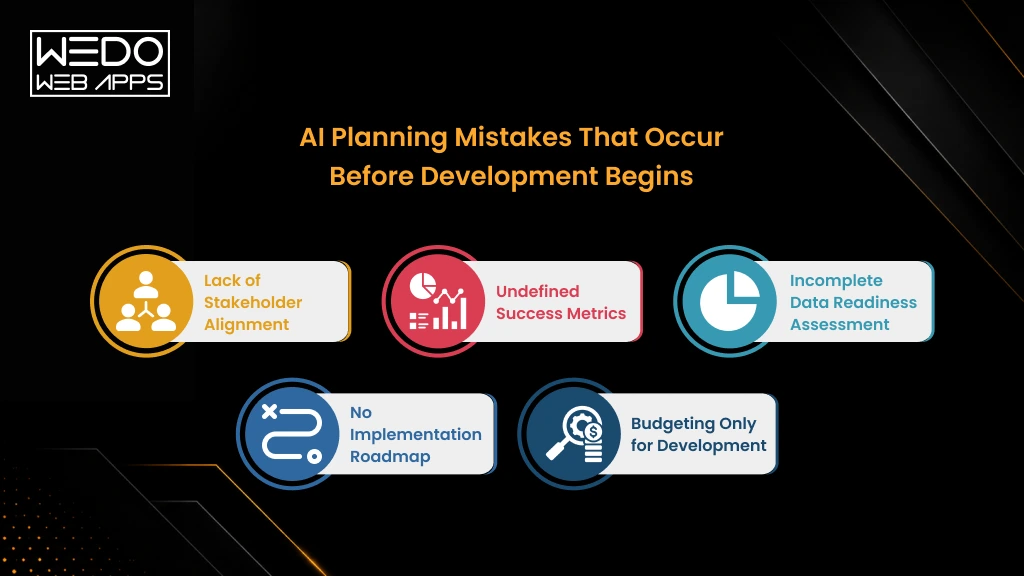
Many organizations assume that AI projects fail during development or deployment. In reality, some of the most damaging AI planning mistakes happen long before a solution is built. Decisions made during the planning phase influence everything from project scope and budget to adoption and ROI.
When organizations skip critical planning activities, they often spend months addressing issues that could have been identified in the early stages. This not only increases costs but also raises the likelihood of AI project failure.
The table below highlights some of the most common planning mistakes and their potential impact:
| AI Planning Mistake | Potential Consequence |
|---|---|
| Lack of stakeholder alignment | Conflicting priorities and delayed decisions |
| Undefined success metrics | Difficulty measuring ROI and business impact |
| Poor data readiness assessment | Unexpected implementation challenges |
| No implementation roadmap | Scope creep and project delays |
| Underestimating total costs | Budget overruns and resource constraints |
Lack of Stakeholder Alignment
AI initiatives often involve multiple teams, including leadership, operations, IT, data, compliance, and end users. When these stakeholders are not aligned on goals, priorities, and expectations, projects can lose momentum before they even begin.
Common signs of misalignment:
- Different teams have different definitions of success.
- Decision-making becomes slow and inconsistent.
- Business and technical teams operate in silos.
Undefined Success Metrics
One of the most common AI implementation mistakes is launching a project without knowing how success will be measured.
Before development starts, organizations should establish clear KPIs such as:
- Cost reduction targets.
- Productivity improvements.
- Customer satisfaction metrics.
- Revenue growth opportunities.
Without measurable outcomes, proving the value of an AI initiative becomes difficult.
Incomplete Data Readiness Assessment
Many businesses overestimate the quality and availability of their data. Discovering data issues after development begins can lead to delays, rework, and additional costs.
Before moving forward, evaluate:
- Data quality and accuracy.
- Data accessibility.
- Data governance practices.
- Availability of historical data.
No Implementation Roadmap
A roadmap provides structure and direction throughout the project lifecycle. Without one, teams often struggle with changing priorities, unrealistic timelines, and unclear responsibilities.
A basic roadmap should outline:
- Business objectives.
- Project milestones.
- Resource requirements.
- Success metrics.
- Deployment and scaling plans.
Budgeting Only for Development
Many organizations allocate budgets for building AI solutions but overlook expenses related to integration, training, governance, maintenance, and optimization.
To create a sustainable AI strategy, budgeting should account for the full lifecycle of the initiative rather than just the development phase.
The stronger the planning process, the lower the risk of costly mistakes later. Organizations that address these foundational gaps early are far more likely to achieve successful AI outcomes.
Warning Signs Your AI Project Is at Risk of Failure
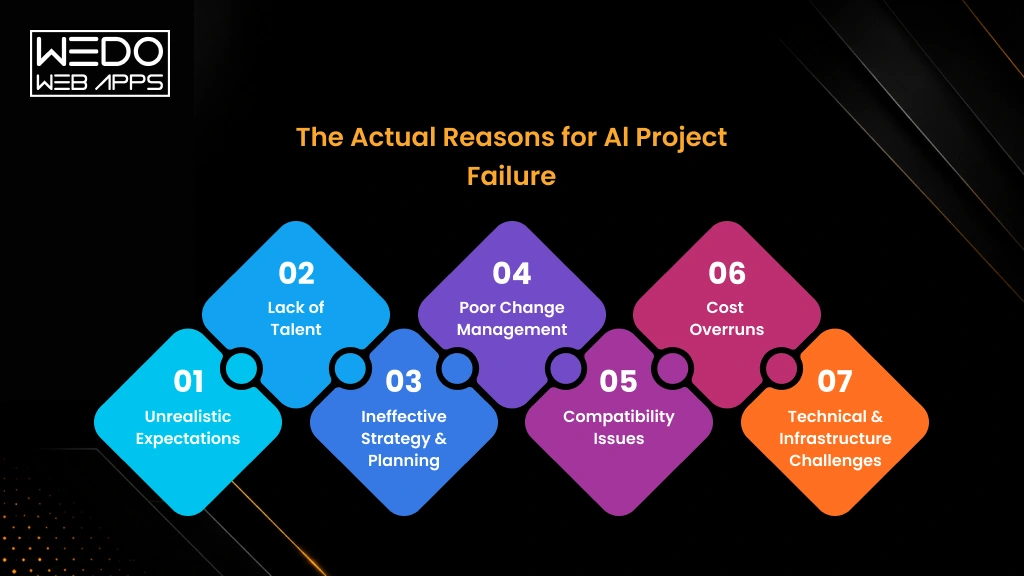
Not every AI initiative fails suddenly. In most cases, warning signs appear weeks or even months before major issues become visible. The challenge is that many organizations overlook these signals until they begin affecting timelines, budgets, or business outcomes.
Recognizing these early indicators can help teams address problems before they turn into costly AI implementation mistakes.
Objectives Continue to Change
Project goals should evolve only when business requirements change. If objectives are constantly shifting, teams may struggle to prioritize tasks, measure success, or maintain momentum.
Potential impact:
- Scope creep.
- Delayed timelines.
- Misaligned stakeholder expectations.
Teams Lack Ownership
Successful AI initiatives require clear accountability. When no individual or team is responsible for driving outcomes, decision-making slows and progress becomes inconsistent.
Common signs include:
- Unclear roles and responsibilities.
- Delayed approvals.
- Frequent project bottlenecks.
AI Outputs Are Not Trusted
Even highly accurate AI systems can fail if employees do not trust the results. Low confidence often leads users to ignore recommendations or return to manual processes.
| Warning Sign | Business Impact |
|---|---|
| Employees double-check every output | Reduced productivity gains |
| Teams avoid using AI recommendations | Low adoption rates |
| Frequent complaints about reliability | Limited business value |
This issue is often linked to poor change management and communication.
Adoption Rates Remain Low
One of the clearest indicators of potential AI project failure is low user engagement after deployment.
If employees are not actively using the solution, investigate whether the problem is related to:
- Training gaps.
- Workflow integration issues.
- Lack of perceived value.
- User experience challenges.
Costs Rise Without Measurable Results
AI projects require investment, but costs should be accompanied by visible progress and measurable outcomes.
If expenses continue to increase while KPIs remain unchanged, it may indicate:
- Poor project planning.
- Misaligned use cases.
- Technology selection issues.
- Gaps in the overall AI strategy.
A Practical AI Strategy Framework to Reduce Failure Risk
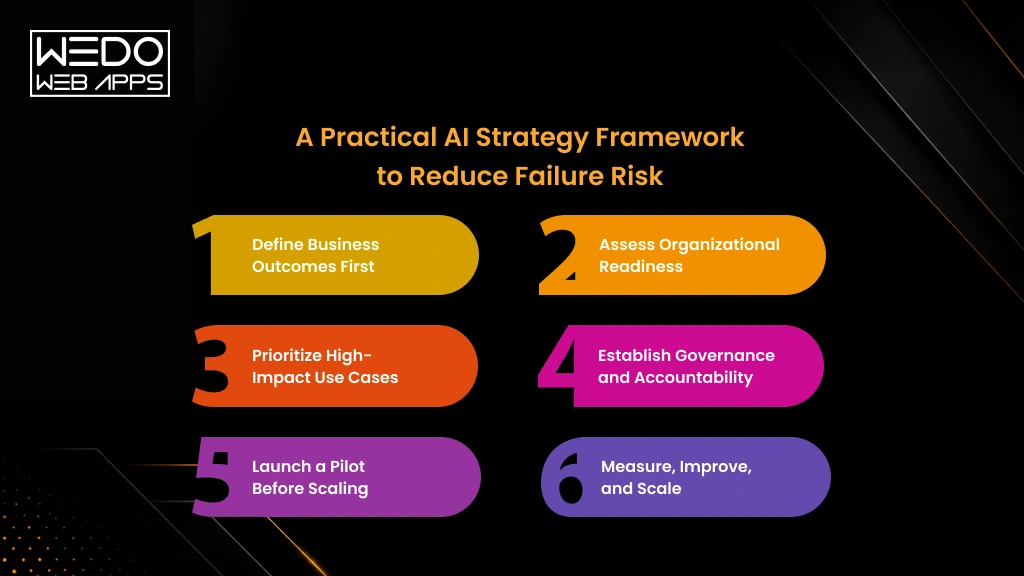
Avoiding AI implementation mistakes is not just about fixing problems as they arise. It requires a structured approach that aligns business goals, data, people, and technology from the start. Organizations that consistently achieve positive outcomes follow a clear AI strategy rather than pursuing isolated AI initiatives.
The framework below can help reduce the risk of AI project failure and create a stronger foundation for long-term success.
Step 1: Define Business Outcomes First
Before discussing tools, models, or platforms, define the business outcome you want to achieve.
Ask questions such as:
- What problem are we solving?
- How will success be measured?
- What business value do we expect?
Clear objectives help prevent many common AI planning mistakes later in the project.
Step 2: Assess Organizational Readiness
Not every organization is ready to implement AI at scale.
Evaluate:
- Data quality and availability.
- Technical infrastructure.
- Internal expertise.
- Leadership support.
- Employee readiness.
Identifying gaps early reduces implementation risks and unexpected delays.
Step 3: Prioritize High-Impact Use Cases
Rather than launching multiple AI initiatives at once, focus on use cases that offer measurable business value.
Prioritization criteria:
- Business impact.
- Feasibility.
- Scalability.
- Resource requirements.
This approach helps organizations generate quick wins while minimizing risk.
Step 4: Establish Governance and Accountability
Strong governance ensures AI systems remain secure, compliant, and aligned with organizational objectives.
Key focus areas include:
- Data governance.
- Compliance requirements.
- Risk management.
- Performance monitoring.
- Stakeholder accountability.
Step 5: Launch a Pilot Before Scaling
Pilot projects provide an opportunity to validate assumptions, test performance, and gather user feedback before broader deployment.
A pilot should answer three critical questions:
- Does the solution work?
- Do users adopt it?
- Does it deliver measurable business value?
Step 6: Measure, Improve, and Scale
AI initiatives should evolve based on data, feedback, and performance insights.
Track metrics such as:
- ROI.
- Productivity gains.
- Cost savings.
- User adoption.
- Customer impact.
Once value has been demonstrated consistently, organizations can scale with greater confidence and a lower risk of AI project failure.
By following this framework, businesses can move beyond experimentation and build an AI strategy that supports sustainable growth, operational efficiency, and measurable outcomes.
Real Examples of AI Project Failure and the Lessons Learned
Many organizations learn valuable lessons from failed AI initiatives, but those lessons often come at a high cost. Examining real-world scenarios helps illustrate how common AI implementation mistakes can affect business outcomes and what organizations can do differently.
Example 1: Poor Data Led to Inaccurate Predictions
A retail company invested in an AI-driven demand forecasting solution to improve inventory planning. However, the model was trained on incomplete and inconsistent historical data.
What went wrong?
- Data quality issues were identified too late.
- Historical records contained inaccuracies.
- No comprehensive data readiness assessment was conducted.
Lesson learned: Even advanced AI models cannot compensate for poor quality data. Data preparation should be a priority before development begins.
Example 2: Strong Technology, Weak Adoption
A financial services organization deployed an AI-powered recommendation system to support internal decision-making. While the technology performed well during testing, employees rarely used it after launch.
| Challenge | Outcome |
|---|---|
| Limited employee training | Low adoption rates |
| Lack of trust in AI outputs | Continued reliance on manual processes |
| Poor workflow integration | Minimal business impact |
Lesson learned: Technology alone does not drive success. Employee adoption and change management play a critical role in achieving measurable value.
Example 3: Scaling Too Quickly
A company achieved positive results from a small AI pilot and immediately expanded the solution across multiple departments. As usage increased, data inconsistencies, integration issues, and performance challenges began to emerge.
What went wrong?
- The pilot did not fully validate scalability.
- Operational challenges were not resolved before expansion.
- Governance processes were still evolving.
Lesson learned: One of the most common AI planning mistakes is assuming a successful pilot guarantees enterprise-wide success. Scaling should happen only after performance, adoption, and ROI have been validated.
Key Takeaways From These Examples
Across industries, the causes of AI project failure are often surprisingly similar:
- Poor data quality.
- Weak stakeholder alignment.
- Low employee adoption.
- Inadequate planning.
- Premature scaling.
Organizations that address these challenges early and build a clear AI strategy are far more likely to achieve sustainable results from their AI investments.
AI Implementation Readiness Checklist
Before investing in AI, organizations should evaluate whether they have the foundation needed for success. Many AI implementation mistakes occur because businesses focus on the technology while overlooking AI readiness factors such as data quality, governance, stakeholder alignment, and success measurement.
Use the checklist below to assess your organization's preparedness before launching an AI initiative.
Strategic Readiness
| Question | Status |
|---|---|
| Have you identified a clear business problem to solve? | Yes/No |
| Are AI objectives aligned with business goals? | Yes/No |
| Have success metrics and KPIs been defined? | Yes/No |
| Is there executive sponsorship for the initiative? | Yes/No |
Data and Technology Readiness
| Question | Status |
|---|---|
| Is the required data available and accessible? | Yes/No |
| Is the data accurate, complete, and up to date? | Yes/No |
| Can your existing infrastructure support AI adoption? | Yes/No |
| Have integration requirements been evaluated? | Yes/No |
Organizational Readiness
| Question | Status |
|---|---|
| Are stakeholders aligned on project goals? | Yes/No |
| Have ownership and responsibilities been defined? | Yes/No |
| Is there a plan for employee training and adoption? | Yes/No |
| Have potential risks and resistance factors been identified? | Yes/No |
Governance and Risk Readiness
| Question | Status |
|---|---|
| Are data governance policies in place? | Yes/No |
| Have compliance requirements been reviewed? | Yes/No |
| Is there a framework for monitoring AI performance? | Yes/No |
| Have accountability and oversight roles been assigned? | Yes/No |
How To Interpret Your Results
| Readiness Score | Assessment |
|---|---|
| 13-16 Yes Answers | Strong foundation for AI implementation |
| 9-12 Yes Answers | Moderate readiness with some gaps to address |
| 5-8 Yes Answers | Significant preparation required before implementation |
| 0-4 Yes Answers | High risk of AI project failure without further planning |
Organizations that complete this assessment before starting an initiative are better positioned to avoid common AI planning mistakes, allocate resources effectively, and build an AI strategy that delivers measurable business outcomes.
How AI Consulting Partners Help Prevent Implementation Mistakes
Building and scaling AI initiatives requires more than technical expertise. Organizations must align business objectives, data, processes, governance, and adoption strategies to achieve meaningful results. This is where the right consulting partner can make a significant difference.
Experienced AI consultants help organizations identify and address potential risks before they become costly AI implementation mistakes. They bring proven frameworks, industry knowledge, and practical experience that can accelerate outcomes while reducing uncertainty.
Where AI Consulting Partners Add Value
| Area | How Consultants Help |
|---|---|
| Strategy | Define goals, use cases, and success metrics |
| Planning | Create implementation roadmaps and timelines |
| Data Readiness | Assess data quality and infrastructure requirements |
| Governance | Establish compliance and risk management frameworks |
| Adoption | Support training, communication, and change management |
| Optimization | Monitor performance and identify improvement opportunities |
Common Challenges They Have Solved
Many businesses seek external expertise when they encounter challenges such as:
- Unclear AI priorities.
- Limited in-house expertise.
- Difficulty identifying high-value use cases.
- Concerns around compliance and governance.
- Low adoption or uncertain ROI.
Addressing these issues early can significantly reduce the likelihood of AI project failure.
Questions to Ask Before Choosing an AI Partner
Not all consulting firms offer the same level of expertise. Before selecting a partner, consider the following:
- Do they have experience with similar projects or industries?
- Can they demonstrate measurable business outcomes?
- Do they provide strategic guidance in addition to technical support?
- How do they approach governance, security, and compliance?
- What support do they offer after deployment?
The Value of Expert Guidance
A strong AI strategy is built on informed decisions, realistic expectations, and a clear roadmap. The right consulting partner can help organizations avoid common AI planning mistakes, accelerate implementation, and maximize the value of their AI investments.
Rather than reacting to problems after they occur, businesses can benefit from expert guidance that helps them plan, execute, and scale AI initiatives with greater confidence.
Conclusion
AI has the potential to transform operations, improve decision-making, and create measurable business value. However, success is rarely determined by technology alone. As we've seen throughout this guide, many cases of AI project failure stem from avoidable decisions related to planning, execution, governance, and adoption.
From unclear objectives and poor data quality to weak change management and premature scaling, these AI implementation mistakes can significantly impact outcomes and ROI. The good news is that most of these challenges can be prevented with the right preparation and a structured approach, along with the help of an experienced AI app development company.
Organizations that invest time in avoiding common AI planning mistakes are better equipped to identify high-value use cases, align stakeholders, manage risks, and measure success effectively. More importantly, they are able to build an AI strategy that supports long-term business goals rather than short-term experimentation.
As AI adoption continues to grow, the organizations that succeed will not necessarily be the first to implement AI. They will be the ones that approach it with clear objectives, strong foundations, and a commitment to continuous improvement.