Introduction
Finding an AI vendor is easy.
Finding one that can turn your investment into measurable business results is much harder.
Many businesses start their search with a list of promising vendors, polished presentations, and impressive technology claims. Yet, projects still miss deadlines, exceed budgets, struggle with adoption, or fail to deliver the expected ROI.
The problem is rarely the idea behind the project.
More often, it comes down to choosing the wrong AI software development company.
When evaluating a vendor, technical expertise is only one part of the equation. You also need a partner who understands your industry, aligns with your business objectives, manages data effectively, and can support your solution long after deployment.
That is where AI vendor selection becomes challenging.
The market is filled with AI software companies, consulting firms, and AI outsourcing providers that offer similar services on the surface. Without a structured evaluation process, it can be difficult to determine which partner is equipped to solve your specific business challenges.
Whether you are planning your first AI initiative or expanding existing capabilities, the decision you make today can influence project success, operational efficiency, customer experience, and long-term growth.
This guide will walk you through how to choose an AI development partner, what factors to evaluate during the AI vendor selection process, how to compare AI outsourcing with in-house development, and what separates leading AI software companies from the rest.
Why Choosing the Right AI Development Partner Matters
Selecting an AI development partner is not simply a technology decision. It is a business decision that can affect project timelines, operational efficiency, customer experience, and return on investment.
The difference between the right and wrong partner often becomes visible only after development begins. By then, switching vendors can be expensive and time-consuming.
| Area | Working With the Right AI Partner | Working With the Wrong AI Partner |
|---|---|---|
| Project Outcomes | Solutions align with business goals. | Solutions solve technical problems but miss business objectives. |
| Delivery Timeline | Clear planning and predictable execution. | Frequent delays and scope changes. |
| AI Performance | Models are trained, tested, and optimized properly. | Poor accuracy and unreliable results. |
| Scalability | Systems support future growth. | Rework is needed as requirements expand. |
| Long-Term Support | Continuous monitoring and improvement. | Limited support after deployment. |
| ROI | Measurable business impact. | Uncertain value from the investment. |
The Business Impact of the Right AI Partner
A strong AI software company focuses on outcomes, not just deliverables.
For example, if your goal is to reduce customer support costs, the right partner will measure success through metrics such as resolution rates, response times, and operational savings. They will connect the AI solution to a business objective instead of simply deploying a chatbot and moving on.
This approach helps you gain value from AI faster while reducing the risk of wasted investment.
Risks of Selecting the Wrong AI Vendor
Many AI projects struggle because the vendor lacks experience with the client's industry, data environment, or long-term goals.
Common consequences include:
- Delayed project delivery
- Budget overruns
- Poor model performance
- Data security concerns
- Low user adoption
- Expensive redevelopment efforts
These issues can impact more than a single project. They can reduce confidence in future AI initiatives across your organization.
What Sets Top AI Software Companies Apart
When evaluating AI vendor selection options, look beyond technical capabilities.
Leading providers typically share several characteristics:
- They start with business objectives before discussing technology.
- They have proven experience across multiple AI use cases.
- They follow a structured development and deployment process.
- They provide ongoing optimization and support.
- They can demonstrate measurable results through case studies and client success stories.
The best partners act as advisors throughout the engagement. Their goal is not only to build an AI solution but also to help you create lasting business value from it.
If your organization is still defining its AI roadmap, working with experienced AI consulting services can help clarify opportunities, risks, and implementation priorities before development begins.
Define Your AI Requirements Before Evaluating Vendors
Many businesses begin the AI vendor selection process by comparing providers, reviewing proposals, and scheduling discovery calls.
The challenge is that even the most experienced vendor cannot recommend the right solution if your objectives are unclear.
Before approaching an AI development partner, take time to define what you want to achieve, what resources you already have, and how success will be measured. This preparation can help you make faster decisions and avoid costly changes later in the project.
Identify the Problem You Want AI to Solve
Start with the business problem, not the technology.
Ask yourself:
- Are you trying to automate repetitive tasks?
- Do you want to improve customer support?
- Are you looking to generate insights from large volumes of data?
- Do you need more accurate forecasting or decision-making?
For example, a retailer struggling with customer retention may benefit from AI-driven recommendation systems, while a logistics company may focus on route optimization and demand forecasting.
The clearer the problem, the easier it becomes to identify a vendor with relevant experience.
Determine Your AI Project Scope and Goals
Once the problem is defined, establish what success looks like.
A project goal such as "implement AI" is too broad.
Instead, define measurable objectives such as:
- Reduce support response times by 40%.
- Automate 60% of repetitive manual tasks.
- Improve forecasting accuracy by 25%.
- Increase lead qualification efficiency.
Specific goals give both you and your vendor a clear target to work toward.
Assess Internal Resources and Technical Capabilities
Not every organization starts from the same position.
Consider the resources you already have:
- Available data sources.
- Internal development team.
- Cloud infrastructure.
- Subject matter experts.
- Budget and timeline expectations.
Understanding your current capabilities helps determine whether you need a full-service AI software company, specialized expertise, or ongoing support from a dedicated team.
Establish Success Metrics and Expected ROI
One of the biggest mistakes organizations make is launching AI projects without defining how results will be measured.
Before engaging vendors, identify the metrics that matter most to your business.
These may include:
- Revenue growth
- Cost reduction
- Process efficiency
- Customer satisfaction
- Employee productivity
A reliable vendor should be able to connect the proposed solution to these outcomes and explain how progress will be tracked over time.
If your AI initiative is part of a larger modernization effort, aligning it with broader digital transformation services can help ensure that the technology supports long-term business goals rather than solving a single short-term challenge.
Quick Readiness Check
Before contacting vendors, make sure you can answer these four questions:
- What business problem are we solving?
- What outcomes do we expect?
- What resources do we already have?
- How will we measure success?
If you can answer these confidently, you are in a much stronger position to evaluate potential AI partners and choose a solution that delivers measurable value.
Types of AI Development Partners and How to Choose the Right One
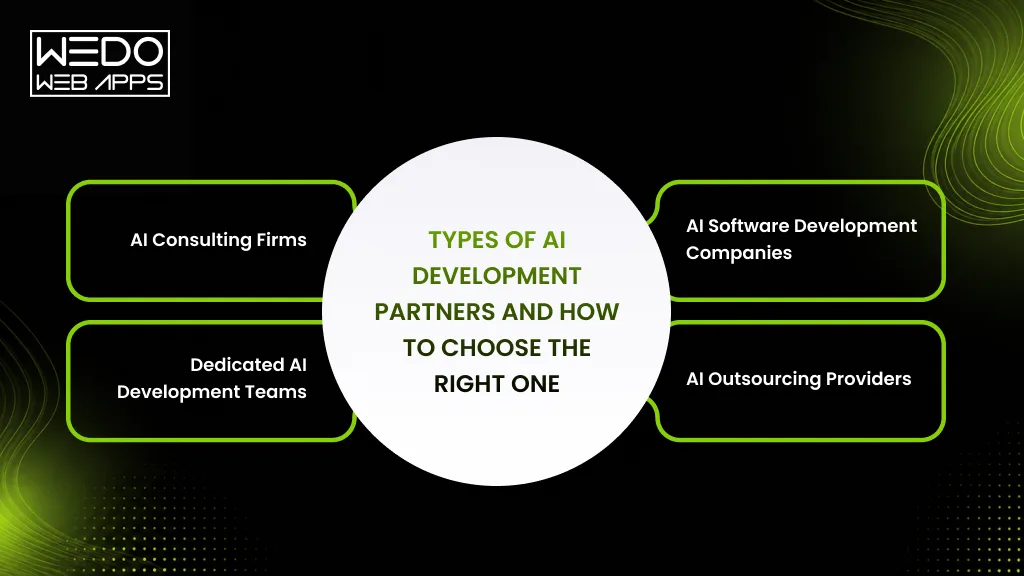
Not all AI vendors offer the same level of involvement, expertise, or service scope.
Some focus on strategy. Others specialize in development and implementation. Some provide dedicated teams that work as an extension of your organization.
Understanding these differences can make the AI vendor selection process much easier and help you invest in the right type of partner from the start.
At a Glance: Which AI Partner Fits Your Needs?
| Partner Type | Best For | Typical Engagement |
|---|---|---|
| AI Consulting Firms | Businesses defining their AI strategy. | Advisory, planning, and roadmap development. |
| AI Software Development Companies | Organizations ready to build AI solutions. | End-to-end design, development, and deployment. |
| Dedicated AI Development Teams | Companies needing long-term AI expertise. | Team augmentation and ongoing development. |
| AI Outsourcing Providers | Businesses seeking cost-effective execution. | Project-based or managed development services. |
AI Consulting Firms
An AI consulting firm helps you determine where AI can create the most value within your business.
This option is often suitable when:
- You are exploring AI opportunities for the first time.
- Multiple use cases need evaluation.
- Stakeholders require a clear implementation roadmap.
- Technical and business teams need strategic alignment.
For example, a healthcare provider considering AI across diagnostics, patient support, and operations may benefit from consulting before committing to development.
AI Software Development Companies
An AI software company is responsible for designing, building, deploying, and supporting AI-powered applications and custom web development solutions.
This option works well when:
- Your use case is already defined.
- You need technical expertise across the entire development lifecycle.
- Internal AI resources are limited.
- Speed to market is a priority.
Many businesses choose this route because they gain access to data scientists, AI engineers, developers, and solution architects through a single engagement.
If your goal is to move from concept to implementation, partnering with a provider that offers comprehensive AI development services can help streamline delivery and reduce coordination challenges.
Dedicated AI Development Teams
A dedicated team functions as an extension of your in-house workforce.
This model is commonly chosen when:
- AI development is an ongoing initiative.
- Internal teams need additional expertise.
- Product development requires long-term support.
- Knowledge retention is important.
Instead of outsourcing a single project, you gain consistent access to specialists who become familiar with your systems, processes, and business goals.
AI Outsourcing Providers
AI outsourcing involves assigning part or all of your AI development activities to an external partner.
Organizations often select this approach when they need:
- Faster project execution
- Specialized expertise
- Lower recruitment costs
- Flexible resource allocation
For instance, a startup may outsource AI development to accelerate product launches without investing heavily in an internal AI department.
Which Option Is Best for Your Business?
The right choice depends on your current stage, internal capabilities, and long-term objectives.
Use this quick guide:
- Need strategy and planning? -> AI consulting firm
- Need a complete AI solution? -> AI software development company
- Need ongoing expertise? -> Dedicated AI team
- Need cost-effective execution? -> AI outsourcing provider
The most effective partnerships occur when the engagement model matches your business needs. Before comparing vendors, identify the type of support your organization requires. This simple step can significantly narrow your shortlist and improve your chances of finding the right AI development partner.
11 Key Factors to Consider When Choosing an AI Development Partner
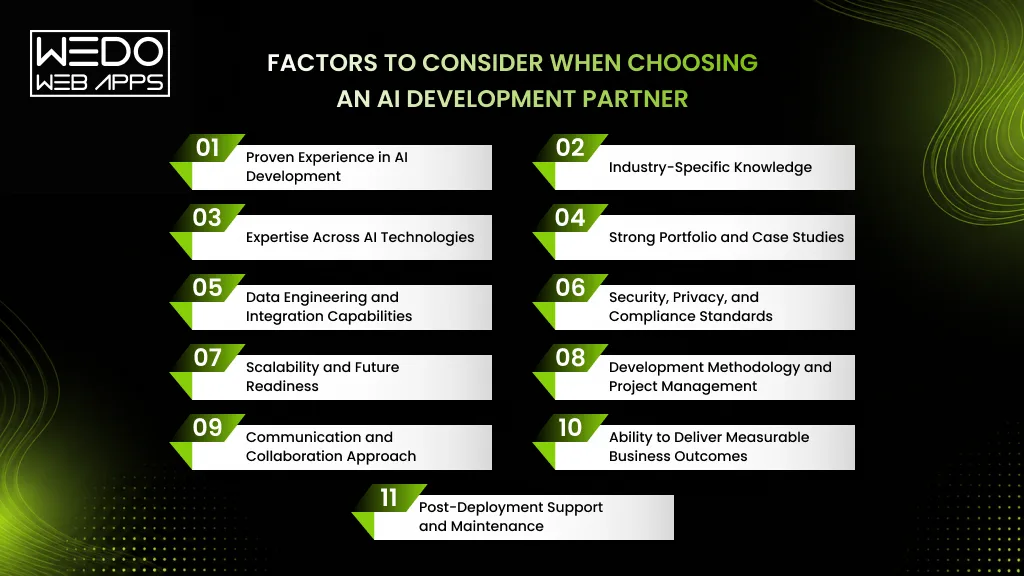
A polished website and a convincing sales pitch do not guarantee successful project delivery.
The real challenge is identifying whether a vendor has the expertise, processes, and business understanding needed to turn your AI initiative into measurable results.
Use the following factors as your evaluation framework when comparing potential partners.
1. Proven Experience in AI Development
Experience matters, but relevant experience matters more.
Ask vendors about projects similar to yours. A company that has built AI solutions for customer support may not be the best fit for predictive maintenance or computer vision applications.
Look for evidence of successful deployments, measurable outcomes, and long-term client relationships.
What to verify: Case studies, client references, and AI project success metrics.
2. Industry-Specific Knowledge
Every industry has unique challenges, regulations, and workflows.
A partner familiar with your sector can understand requirements faster and anticipate potential roadblocks.
For example, healthcare AI projects often involve strict compliance requirements, while retail AI solutions may focus heavily on personalization and customer behavior analysis.
What to verify: Industry case studies and domain expertise.
3. Expertise Across AI Technologies
Not every AI project requires the same technology stack.
A capable AI development partner should be able to recommend the most suitable approach instead of forcing a preferred technology into every project.
Evaluate expertise in:
- Machine learning Development
- Generative AI
- Natural Language Processing (NLP)
- Computer Vision
- AI Agents
What to verify: Technical certifications, project examples, and AI architecture capabilities.
4. Strong Portfolio and Case Studies
Case studies reveal how a vendor approaches challenges, implementations, and results.
Pay attention to outcomes rather than technical descriptions alone.
A strong portfolio should clearly explain:
- The business challenge
- The solution implementation
- The measurable results achieved
Reviewing a relevant custom software project can provide valuable insight into a vendor's problem-solving approach.
What to verify: Documented project outcomes and client testimonials.
5. Data Engineering and Integration Capabilities
AI systems depend on data quality.
Even the most advanced models can underperform if the underlying data is incomplete, inconsistent, or difficult to access.
Your vendor should understand data preparation, migration, governance, and integration requirements.
What to verify: Data pipeline experience and integration capabilities.
Also, evaluate their data analytics services capabilities to ensure they can turn business data into actionable insights.
6. Security, Privacy, and Compliance Standards
AI projects often process sensitive business and customer information.
A reliable vendor should have clear policies for data security, access control, encryption, and compliance.
This becomes especially important in regulated industries such as healthcare, finance, and insurance.
What to verify: Security certifications, compliance processes, and data handling practices.
7. Scalability and Future Readiness
Your AI solution should support future growth.
A system that works for 10,000 users today should not require a complete rebuild when usage doubles, or business requirements expand.
Evaluate whether the proposed architecture can adapt to new data sources, additional users, and future AI capabilities.
What to verify: Cloud architecture experience and scalability planning.
8. Development Methodology and Project Management
A structured delivery process often separates successful projects from unsuccessful ones.
Ask vendors how they manage planning, development, testing, deployment, and stakeholder communication.
A transparent process helps reduce uncertainty and improves accountability throughout the project lifecycle.
What to verify: Development frameworks, reporting processes, and delivery governance.
9. Communication and Collaboration Approach
Technical expertise alone is not enough.
You need a partner who communicates clearly, provides regular updates, and works collaboratively with your team.
Poor communication can create misunderstandings that lead to delays, budget overruns, and missed expectations.
What to verify: Communication channels, reporting frequency, and project management practices.
10. Ability to Deliver Measurable Business Outcomes
The best AI software companies focus on business value rather than technical outputs.
Instead of asking what technology will be used, ask what results will be achieved.
A strong vendor should be able to explain:
- How success will be measured
- Which KPIs will be tracked
- Expected business impact
- Long-term optimization plans
The goal is not simply to launch an AI solution. The goal is to create measurable improvements that justify the investment.
What to verify: ROI frameworks, KPI tracking, and business outcome reporting.
11. Post-Deployment Support and Maintenance
AI solutions require continuous monitoring, updates, and optimization.
Models can lose accuracy over time as business conditions, user behavior, and data patterns change.
A dependable partner should provide ongoing support after deployment to maintain performance and address emerging requirements.
What to verify: Support agreements, monitoring processes, and optimization services.
Quick Evaluation Checklist
Before making a final decision, ask yourself:
- Does the vendor have relevant AI experience?
- Have they delivered results in my industry?
- Can they support future growth?
- Do they understand both business and technical requirements?
- Will they provide long-term support after launch?
If the answer to any of these questions is unclear, continue evaluating other vendors before making a commitment.
Questions to Ask Before Selecting an AI Vendor
Even after reviewing portfolios, case studies, and service offerings, you may still struggle to differentiate one vendor from another.
The right questions can reveal how a company approaches problem-solving, manages risk, and delivers results.
When conducting AI vendor selection, use the following questions to assess whether a potential partner is the right fit for your business.
Questions About Technical Expertise
Technical capability goes beyond knowing the latest AI tools and frameworks.
Ask questions such as:
- Have you delivered a project similar to ours?
- Which AI technologies would you recommend for our use case and why?
- How do you handle data preparation and model training?
- How do you evaluate model accuracy and performance?
- Can you explain your approach to AI integration with existing systems?
What you're looking for: Clear explanations, relevant examples, and recommendations tailored to your business rather than generic responses.
Questions About Project Delivery
A strong development process reduces surprises later in the project.
Consider asking:
- What does your typical project lifecycle look like?
- How do you manage scope changes?
- What project management methodology do you follow?
- How often will we receive progress updates?
- Who will be our primary point of contact?
What you're looking for: Transparency, accountability, and a structured delivery approach.
Questions About Data Security and Compliance
Data security should be addressed early in the conversation, especially if customer or operational data is involved.
Important questions include:
- How do you protect sensitive business data?
- What security practices do you follow?
- How do you manage access controls?
- Have you worked with compliance requirements relevant to our industry?
- What happens to our data after project completion?
What you're looking for: Clearly documented security processes and a strong understanding of compliance obligations.
Question About Long-Term Support
The relationship should not end once the solution is deployed.
Ask:
- Do you offer ongoing support and maintenance?
- How do you monitor AI model performance after launch?
- What happens if business requirements change?
- How frequently are models reviewed and updated?
- What support response times can we expect?
What you're looking for: A long-term partnership mindset rather than a project-only engagement.
Questions About Pricing and Engagement Models
Cost is important, but understanding how pricing works is equally important.
Ask questions such as:
- What is included in the proposed cost?
- Are there any ongoing licensing or infrastructure expenses?
- How are change requests handled?
- Do you offer fixed price, dedicated team, or time and materials models?
- What factors could affect the final project cost?
What you're looking for: Pricing transparency and a clear understanding of future costs.
Red Flags to Watch For
While evaluating vendors, pay attention to warning signs that may indicate future challenges:
- Unrealistic promises about timelines or results.
- Vague answers about security and compliance.
- Limited evidence of previous AI projects.
- No clear post-deployment support plan.
- Difficulty explaining business outcomes.
A qualified AI development partner should be able to discuss both technical implementation and business impact with confidence.
By asking the right questions early, you can make a more informed AI vendor selection decision and reduce the risk of costly surprises later in the project.
AI Outsourcing vs In-House Development: Which Approach Is Right for You?
One of the biggest decisions businesses face is whether to build AI capabilities internally or work with an external partner.
The answer depends on factors such as budget, hiring capacity, project complexity, and long-term goals.
While some organizations prefer complete control through an internal team, others choose AI outsourcing to access specialized expertise and accelerate delivery.
AI Outsourcing vs In-House Development at a Glance
| Factor | AI Outsourcing | In-House Development |
|---|---|---|
| Time to start | Faster | Slower due to hiring and onboarding |
| Access to expertise | Immediate access to specialists | Limited to internal hiring capabilities |
| Upfront investment | Lower | Higher recruitment and infrastructure |
| Scalability | Flexible resource allocation | Depends on hiring capacity |
| Knowledge retention | Shared with external partner | Remains within the organization |
| Management overhead | Lower | Higher internal management effort |
Benefit of AI Outsourcing
Many businesses choose AI outsourcing because it provides immediate access to experienced professionals without the time and expense of building a team from scratch.
Key advantages include:
Faster project execution
An established vendor already has data scientists, AI engineers, and solution architects in place.
Example: A startup developing an AI-powered SaaS product can begin development within weeks instead of spending months recruiting talent.
Access to specialized expertise
You gain access to professionals who have worked on multiple AI projects across industries.
Example: A retailer implementing demand forecasting can benefit from experts who have already solved similar challenges for other businesses.
Lower operational burden
The vendor handles recruitment, team management, and technical oversight.
Example: Your internal team can focus on business priorities while the external partner manages development activities.
Challenges of AI Outsourcing
Like any business decision, outsourcing also comes with considerations.
| Challenge | How to Reduce the Risk |
|---|---|
| Communication gaps | Establish regular reporting and meetings |
| Limited visibility into development | Define milestones and progress reviews |
| Dependence on external expertise | Document processes and knowledge transfer plans |
| Quality concerns | Review case studies, references, and pilot projects |
Most of these challenges can be addressed by selecting the right AI development partner and establishing clear expectations from the start.
Benefit of Building an In-House AI Team
An internal team can be a strong option for organizations that view AI as a long-term strategic capability.
Benefits include:
Greater organizational knowledge
Internal teams understand company processes, customers, and business objectives.
More direct control
You have full oversight of priorities, workflows, and resource allocation.
Long-term capability building
AI knowledge remains within the organization and can support future initiatives.
However, building an internal team often requires significant investment in recruitment, training, and retention.
Cost and Resource Comparison
Before making a decision, consider the true cost beyond salaries alone.
An in-house AI team may require:
- Recruitment expenses
- Competitive salaries
- Employee benefits
- Training programs
- Infrastructure and tooling
- Ongoing retention efforts
By contrast, outsourcing converts many of these fixed costs into a more predictable project or service-based investment.
For businesses launching their first AI initiative, partnering with a provider offering AI development services is often the most cost-effective way to validate an idea before making larger investments.
When a Hybrid Approach Makes Sense
For many organizations, the best solution is not choosing one approach over the other.
A hybrid model combines internal business knowledge with external AI expertise.
For example:
- Internal teams define objectives and priorities.
- External specialists design and implement AI solutions.
- Knowledge is gradually transferred to internal stakeholders.
This approach allows you to move quickly while still developing internal capabilities over time.
Choose AI outsourcing if speed, specialized expertise, and cost efficiency are your top priorities.
Choose an in-house team if AI is expected to become a core organizational capability and you have the resources to build and maintain it.
If you want the benefits of both, a hybrid model often provides the most balanced path forward.
Step-by-Step AI Vendor Selection Process
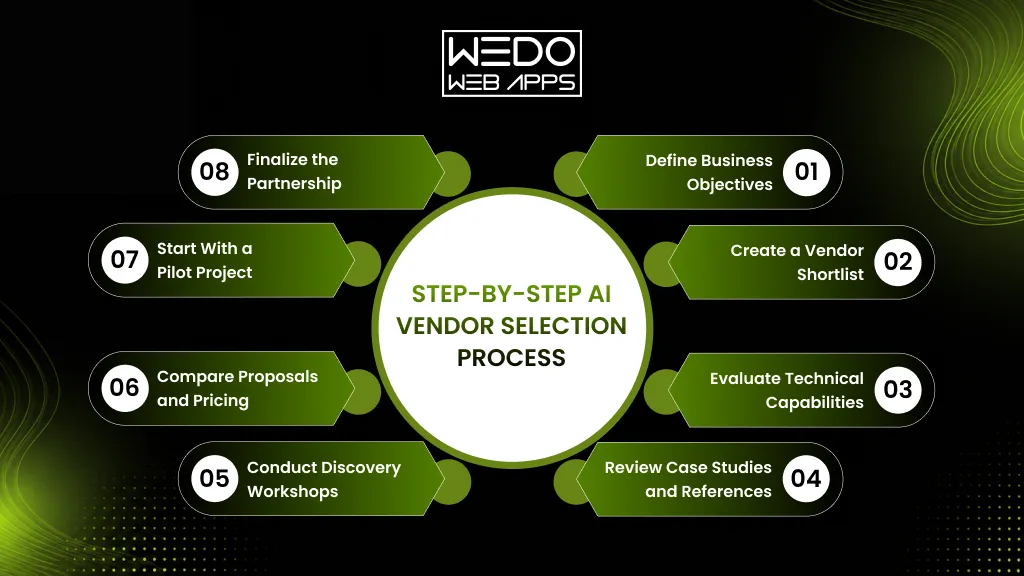
The best AI partnerships rarely happen by chance.
They result from a clear evaluation process that aligns business goals, technical requirements, and long-term expectations before a contract is signed.
Use the following framework to choose an AI development partner that can support both your immediate project needs and future growth plans.
Step 1: Define Business Objectives
Start by identifying the outcome you want to achieve.
Focus on business goals rather than technology requirements.
Ask questions such as:
- What problem are we trying to solve?
- Which processes need improvement?
- What results would make this project successful?
A clear objective helps vendors recommend the most appropriate solution.
Step 2: Create a Vendor Shortlist
Once your requirements are defined, create a shortlist of potential partners.
Evaluate vendors based on:
- Relevant AI experience
- Industry expertise
- Service offerings
- Client reviews
- Case studies
At this stage, aim for three to five strong candidates rather than evaluating dozens of providers.
Step 3: Evaluate Technical Capabilities
Review each vendor's ability to handle your specific requirements.
Look beyond technology buzzwords and focus on practical experience.
Key areas to assess include:
- AI technologies and frameworks
- Data engineering capabilities
- Integration expertise
- Security practices
- Scalability planning
The goal is to identify whether the vendor can deliver a solution that fits your business needs today and in the future.
Step 4: Review Case Studies and References
Past performance often provides the best indication of future performance.
When reviewing case studies, focus on:
- The business challenge
- The proposed solution
- Implementation approach
- Measurable outcomes
Whenever possible, request client references to gain additional insight into the vendor's working style and reliability.
Step 5: Conduct Discovery Workshops
Before committing to a project, schedule discovery sessions with shortlisted vendors.
This stage helps you evaluate:
- Problem-solving approach
- Communication style
- Technical understanding
- Strategic thinking
Pay attention to the questions they ask.
A strong AI development partner will spend time understanding your business before proposing a solution.
Step 6: Compare Proposals and Pricing
Price should be evaluated alongside value.
Use the following criteria when comparing proposals:
| Evaluating Area | What to Compare |
|---|---|
| Scope | Deliverables and responsibilities |
| Timeline | Project milestones and deadlines |
| Team | Experience and expertise |
| Support | Post-deployment services |
| Pricing | Total project cost and future expenses |
The lowest proposal is not always the most cost-effective option.
Step 7: Start With a Pilot Project
A pilot project allows you to validate assumptions before committing to a larger investment.
Benefits of a pilot include:
- Lower risk
- Faster learning
- Early performance validation
- Better stakeholder confidence
Many successful AI initiatives begin with a limited-scope proof of concept before scaling further.
Step 8: Finalize the Partnership
Before signing an agreement, confirm:
- Project scope
- Success metrics
- Ownership of data and intellectual property
- Security requirements
- Support and maintenance expectations
- Communication processes
A well-defined agreement helps prevent misunderstandings and creates a stronger foundation for collaboration.
Quick Summary
The most successful AI vendor selection processes follow a simple pattern:
Define goals -> Shortlist vendors -> Evaluate capabilities -> Validate experience -> Run a pilot -> Finalize the partnership
By following these steps, you can reduce uncertainty, minimize project risk, and improve your chances of selecting an AI software company that aligns with your long-term business objectives.How Leading AI Software Companies Approach AI Development
Not all AI projects follow the same path. However, successful implementations typically follow a structured process that reduces risks, improves collaboration, and increases the likelihood of achieving business objectives.
Understanding how leading AI software companies approach development can help you evaluate vendors more effectively and set realistic expectations for your project.
Discovery and Strategy Phase
Every successful AI project starts with understanding the business problem.
During this phase, the vendor works closely with stakeholders to identify challenges, objectives, data availability, and success criteria.
Typical activities include:
- Business requirement analysis
- Stakeholder workshops
- Data assessment
- Technical feasibility evaluation
- Roadmap planning
A strong partner spends more time asking questions than recommending solutions at this stage.
If a vendor proposes a technology stack before understanding your business goals, it may be a warning sign.
Proof of Concept Development
Before committing to a large-scale implementation, many organizations validate ideas through a Proof of Concept (PoC).
The objective is to test whether the proposed solution can achieve the desired outcome using available data and resources.
A PoC helps answer questions such as:
- Is the data sufficient?
- Can the model achieve acceptable accuracy?
- What business value can be expected?
- What challenges may arise during implementation?
This stage helps reduce investment risks and builds confidence among stakeholders.
AI Model Training and Validation
Once feasibility is confirmed, development moves into model creation and optimization.
This phase typically includes:
| Activity | Purpose |
|---|---|
| Data Preparation | Clean and structure data for training |
| Feature Engineering | Improve model performance using relevant variables |
| Model Training | Develop and train AI models |
| Testing and Validation | Evaluate accuracy, reliability, and consistency |
| Performance Optimization | Refine models based on results |
The goal is not simply to build a model but to create one that performs reliably in real business environments.
Deployment and Integration
A model only delivers value when it becomes part of everyday business operations.
This phase focuses on deploying the solution and connecting it with existing systems.
Depending on the project, this may involve:
- CRM integration
- ERP integration
- Customer support platforms
- Internal business applications
- Cloud infrastructure
This is where expertise in AI integration services becomes particularly valuable, as poor integration can limit adoption and reduce overall project impact.
Continuous Monitoring and Improvement
AI development does not end at deployment.
Business conditions change. Customer behavior evolves. New data becomes available.
As a result, AI models require ongoing monitoring and optimization.
Leading vendors typically provide:
- Performance monitoring
- Model retraining
- Security updates
- Accuracy improvements
- Scalability enhancements
This ongoing support helps ensure that the solution continues delivering value long after implementation.
What This Means for Your Vendor Selection
When evaluating an AI development partner, look for evidence of a structured development lifecycle rather than isolated technical capabilities.
Vendors that follow a clear process are generally better equipped to manage risks, maintain quality standards, and deliver measurable business outcomes throughout the project lifecycle.
Modern AI Trends to Consider Before Choosing a Partner
The AI market is evolving quickly.
A few years ago, many projects focused on predictive analytics and process automation. Today, organizations are exploring advanced use cases that involve Generative AI, AI agents, and multimodal systems.
This does not mean your project needs every new AI capability. However, your AI development partner should understand these technologies and know when they can create real business value.
Generative AI and Enterprise LLM Solutions
Generative AI has expanded the possibilities for customer support, content generation, knowledge management, and employee productivity.
Businesses are increasingly using Large Language Models (LLMs) to:
- Build intelligent chatbots
- Automate document processing
- Create internal knowledge assistants
- Improve employee self-service experiences
When evaluating vendors, ask whether they have experience building secure enterprise applications rather than simply integrating public AI tools.
The difference can significantly affect performance, security, and scalability.
AI Agents and Autonomous Workflows
AI agents can perform tasks, make decisions based on predefined rules, and interact with multiple systems with minimal human intervention.
Potential applications include:
- Customer support automation
- Lead qualification
- Appointment scheduling
- Internal workflow management
For example, an AI agent can receive a customer inquiry, retrieve relevant information, draft a response, and update internal systems automatically.
As adoption grows, organizations may benefit from working with vendors that understand how to design and govern agent-based workflows effectively. Businesses planning autonomous AI solutions can also explore agentic AI development services to build AI agents that can reason, act, and interact with business systems.
Retrieval Augmented Generation (RAG)
One of the biggest challenges with traditional AI models is that they may generate responses using outdated or incomplete information.
Retrieval Augmented Generation (RAG) addresses this issue by connecting AI systems to trusted data sources.
This approach is commonly used for:
- Knowledge bases
- Internal documentation
- Customer support portals
- Compliance resources
If your organization relies on large volumes of internal information, RAG capabilities can become an important evaluation criterion during AI vendor selection.
Multimodal AI Applications
Modern AI systems can process multiple forms of information, including text, images, audio, and video.
This creates opportunities across industries.
Examples include:
| Industry | Potential Multimodal Use Case |
|---|---|
| Healthcare | Medical image analysis with clinical documentation |
| Retail | Visual product search and recommendations |
| Manufacturing | Image-based quality inspection |
| Insurance | Claims processing using images and text |
| Logistics | Document and shipment verification |
While not every business requires multimodal AI today, understanding a vendor's capabilities in this area can help future-proof your investment.
Responsible and Trustworthy AI Development
As AI adoption increases, so do concerns about privacy, security, bias, and transparency.
Organizations are paying closer attention to how AI systems are trained, deployed, and monitored.
A reliable AI software company should have clear practices around:
- Data privacy
- Security controls
- Model monitoring
- Bias mitigation
- Regulatory compliance
These considerations are especially important in industries where AI-driven decisions can directly impact customers, employees, or business operations.
What This Means for Your Business
You do not need to select a vendor based on trend adoption alone.
Instead, focus on whether the vendor can evaluate emerging technologies objectively and recommend solutions that align with your goals.
The best partners understand when to use the latest AI capabilities and when a simpler approach can deliver better business results.
Real World Example: What an Effective AI Partnership Looks Like
The benefits of selecting the right AI development partner become easier to understand when viewed through a practical business scenario.
The following example illustrates how a structured partnership can help transform an AI initiative from an idea into measurable business value.
Business Challenge
Imagine a mid-sized eCommerce company struggling to manage a growing volume of customer inquiries.
Support agents spend hours answering repetitive questions about orders, returns, shipping updates, and product availability.
As the business grows, customer response times increase and operational costs continue to rise.
The company wants to improve customer service without significantly expanding its support team.
AI Solution Implemented
Instead of immediately deploying a chatbot, the chosen AI software company begins with a discovery phase.
The team evaluates:
- Customer support workflows
- Existing support data
- Frequently asked questions
- Integration requirements
- Business objectives
Based on these findings, the company develops an AI-powered support assistant capable of:
- Answering common customer questions
- Retrieving order information
- Providing shipping updates
- Escalating complex issues to human agents
The solution is integrated with the existing customer support platform to ensure a seamless experience.
Results Achieved
The project delivers value beyond simple automation.
The business benefits from:
- Faster response times
- Reduced workload for support agents
- Improved customer experience
- Better scalability during peak demand periods
- More time for employees to focus on high-value interactions
Most importantly, the solution addresses the original business challenge rather than introducing technology for the sake of innovation.
Lessons Learned
Several key lessons emerge from this example:
Start with the problem, not the technology
Successful AI initiatives focus on business objectives first.
Data quality matters
Well-organized and accessible data often plays a major role in project success.
Integration is as important as development
Even a highly accurate AI model can struggle to deliver value if it is disconnected from existing business processes.
Long-term support should be part of the plan
AI systems require monitoring, optimization, and updates to maintain performance over time.
The Bigger Takeaway
An effective partnership is not defined by the complexity of the technology being used.
It is defined by how well the solution aligns with business goals, integrates into existing workflows, and continues delivering value after deployment.
That is why choosing the right AI development partner often has a greater impact on project success than the technology itself.
AI Vendor Selection Checklist
By this stage, you should have a clear understanding of what to look for in an AI partner. Before making a final decision, use this checklist to evaluate and compare potential vendors side by side.
A strong AI vendor selection process should assess technical expertise, business alignment, security practices, and long-term support capabilities.
Technical Evaluation Checklist
Review whether the vendor can meet your technical requirements both today and in the future.
- Proven experience delivering AI projects
- Expertise in relevant AI technologies and frameworks
- Strong data engineering capabilities
- Experience integrating AI with existing systems
- Scalable architecture and infrastructure planning
- Clear development and testing processes
- Ability to support future enhancements
Business Evaluation Checklist
Technical skills are important, but business understanding often determines whether a project delivers meaningful results.
- Understanding of your industry and business model
- Ability to align AI initiatives with business objectives
- Clearly defined success metrics and KPIs
- Relevant case studies and client references
- Transparent project planning and delivery approach
- Realistic timelines and expectations
- Focus on measurable business outcomes
Security and Compliance Checklist
If your project involves sensitive business or customer information, security should be a priority from the start.
- Data protection and privacy practices
- Access control and authentication measures
- Regulatory compliance experience
- Secure development processes
- Data ownership and governance policies
- Risk management and monitoring procedures
Partnership and Support Checklist
An AI project does not end when the solution goes live.
Evaluate how the vendor will support your organization after deployment.
- Dedicated communication channels
- Ongoing monitoring and maintenance services
- Model retraining and optimization support
- Defined service level agreements (SLAs)
- Knowledge transfer and documentation
- Long-term scalability planning
- Commitment to continuous improvement
Final Decision Questions
Before selecting an AI development partner, ask yourself:
- Do they understand our business goals?
- Can they demonstrate relevant experience?
- Are their security and compliance practices sufficient?
- Do they offer long-term support?
- Can they clearly explain how success will be measured?
Conclusion
Choosing the right AI development partner is about more than technical expertise.
The vendor you select should understand your business objectives, recommend solutions that align with your goals, and support your organization beyond the initial deployment.
A structured AI vendor selection process can help you move past marketing claims and focus on the factors that truly influence project success. From evaluating technical capabilities and industry experience to assessing security practices and long-term support, each step plays a role in reducing risk and maximizing the value of your investment.
As AI adoption continues to grow, businesses that approach vendor selection strategically will be better positioned to implement solutions that improve efficiency, strengthen customer experiences, and create measurable business outcomes.
Before making a final decision, take the time to define your requirements, compare potential vendors carefully, and validate their ability to deliver results.