Introduction
You know your business needs AI. Maybe you want to automate a repetitive process, add an AI feature to your existing software, build a generative AI application, or use AI agents to handle more complex workflows. The question is, who should you hire to make it happen?
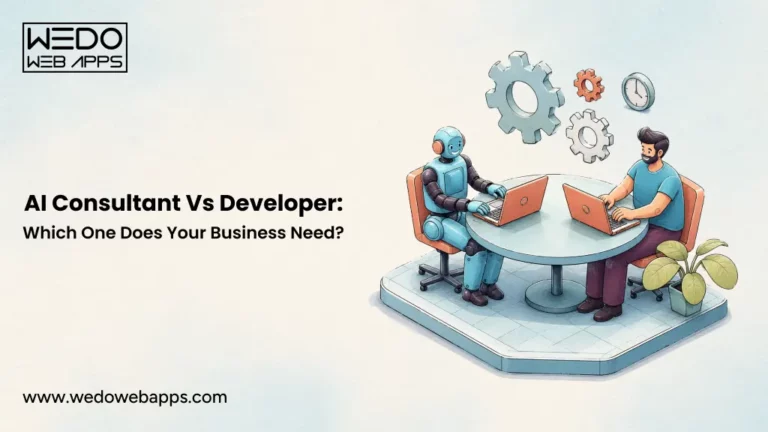
This is where the AI consultant vs developer decision becomes difficult. An AI consultant helps you determine where AI makes business sense, what you should build, and how to approach the project. An AI developer turns that direction into a working solution.
The right choice depends on where you are starting. If your use case, data, or AI strategy is still unclear, consulting may be the better first step. If you already know what you want to build and have defined technical requirements, development may be the next move.
So, do I need an AI consultant, or can I hire an AI developer directly? And when should you hire an AI developer instead of a consultant?
This guide breaks down AI consulting vs development, what each professional handles, when you need one or both, and how to choose the right approach for your AI project.
AI Consultant vs Developer: What Is the Difference?
The simplest way to understand AI consulting vs development is to look at the question each role answers.
An AI consultant focuses on the business decision. They help you determine where AI can create value, which use cases are worth pursuing, whether your data and system are ready, and what implementation approach makes the most sense. The output may include an AI roadmap, feasibility assessment, use case priorities, or implementation plan.
An AI developer focuses on technical execution. Once the requirements are clear, they build the AI solution, connect it with your existing systems, test its performance, deploy it, and support further improvements.
Think of the distinction this way:
"The consultant helps you decide what to build and why. The developer makes sure it works."
What Does an AI Consultant Do?
An AI consultant looks at your business before recommending a technology. Their work can include:
- Identifying suitable AI use cases.
- Assessing data and technical readiness.
- Evaluating build, buy, or integration options.
- Estimating project feasibility and potential ROI.
- Defining an AI strategy and roadmap.
- Identifying risks related to security, privacy, or compliance.
- Setting business and performance metrics.
For example, suppose your customer support team spends hours answering the same questions. A consultant may assess whether an AI chatbot is actually the right solution, determine which conversations should be automated, identify the data the system needs, and define how success will be measured.
That assessment can prevent you from building an AI system simply because the technology is available.
What Does an AI Developer Do?
An AI developer takes a defined requirement and turns it into a functioning product or feature.
Their work may involve:
- Integrating AI models and APIs.
- Building AI-powered applications.
- Developing RAG systems.
- Creating AI agents and automated workflows.
- Preparing data pipelines.
- Connecting AI with existing software.
- Testing and evaluating system performance.
- Deploying and maintaining the solution.
For instance, once the customer support chatbot has been approved, the developer can connect the required knowledge sources, implement the retrieval system, integrate the chatbot with your support platform, and deploy it for customers.
AI Consultant vs AI Developer at a Glance
| Area | AI Consultant | AI Developer |
|---|---|---|
| Primary focus | Business strategy and feasibility | Technical implementation |
| Main question | What should we build and why? | How should we build it? |
| Typical starting point | Business problem | Define technical requirements |
| Key work | Use cases, roadmap, feasibility, ROI | Coding, integration, testing, deployment |
| Main output | Strategy and implementation direction | Working AI solution |
| Best suited for | Unclear or early-stage AI initiatives | Validation and clearly defined projects |
The two roles are not competing choices. They address different stages of an AI project. If you already have a validated use case and clear requirements, you may be ready for development. If you are still deciding where AI fits your business, consulting can help you make that decision first.
Do I Need an AI Consultant?
Not every business needs an AI consultant. If you already have a validated use case, clear technical requirements, and an experienced AI team, you may be able to move directly to development.
However, consulting can be useful when you know AI can help your business but are unsure where to start or what to build. A consultant can assess your goals, processes, data, and existing technology before you commit development resources.
Here are some situations where hiring an AI consultant makes sense.
You Know You Need AI But Do Not Know Where to Start
You may have several processes that could benefit from AI, but you are unsure which one deserves investment.
For example, your sales team may want AI lead scoring while your support team wants an AI chatbot. A consultant can compare both opportunities based on business value, feasibility, data availability, and expected results.
If you need help evaluating these opportunities, AI consulting services can provide a structured assessment before development begins.
You Have Multiple AI Ideas But a Limited Budget
You do not need to build every AI idea at once.
A consultant can help prioritize projects based on factors such as expected ROI, implementation effort, data availability, and business impact. This gives you a clearer starting point instead of spreading your budget across several untested ideas.
You Need to Build a Business Case for AI
If you need to justify an AI investment to your leadership team, you need more than a list of features.
You need to understand what the project could cost, what business problem it addresses, which KPIs should improve, and how its results will be measured. An AI consultant can help turn the idea into a practical business case.
You Are Unsure Whether Your Data is Ready
Having a large amount of data does not automatically mean you are ready for AI.
Your data may be incomplete, poorly structured, difficult to access, or unsuitable for the intended use case. An AI readiness assessment can help identify these gaps before development starts.
Your Previous AI Project Did Not Deliver
If an earlier AI project failed to produce the expected results, the problem may not have been the technology itself.
The use case may have been poorly defined. The available data may have been insufficient. The solution may not have matched the workflow. A consultant can help identify where the project went wrong before you invest in another development cycle.
A simple rule: If you are still deciding what AI should do for your business, consider an AI consultant first. If you already know what needs to be built, you may be ready for an AI developer.
When to Hire an AI Developer?
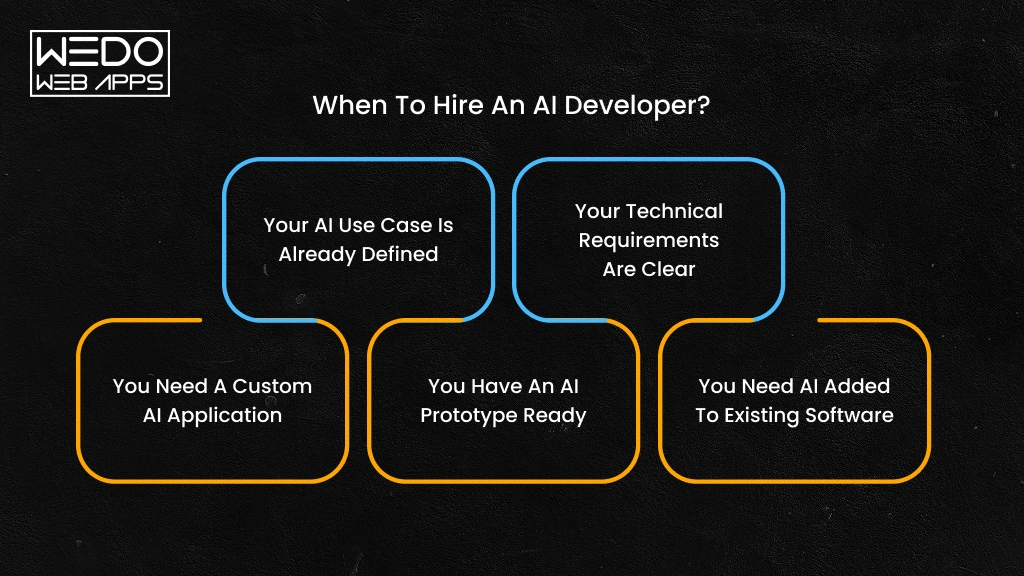
You should hire an AI developer when the business problem is clear, and you have a defined idea of what the solution needs to accomplish.
At this stage, the question is no longer whether AI is useful. You need someone who can turn an approved concept into a working product, feature, or integration.
Your AI Use Case is Already Defined
If you know the process you want to improve, who will use the solution, and what outcome you expect, you may not need another strategy phase.
For example, you may have already decided to add an AI assistant to your customer portal that answers questions using your internal documentation. The next step is building and integrating that solution.
Your Technical Requirements Are Clear
Development becomes easier to scope when you already know the required data sources, integrations, platforms, security requirements, and expected functionality.
A developer can then assess the technical approach and begin implementation without spending weeks defining the business problem from scratch.
You Need a Custom AI Application
Existing AI tools may not fit every business process. You may need a solution that connects with your CRM, ERP, website, mobile application, or internal database.
This is where AI development services can help turn specific requirements into a custom solution.
You Have an AI Prototype Ready
A prototype can prove that an idea works, but it is not necessarily ready for real users.
If you have already tested the concept, an AI developer can take it towards production by improving reliability, handling integrations, adding security controls, testing different scenarios, and preparing it for deployment.
You Need AI Added to Existing Software
You may not need to build a completely new AI product.
Supporting your existing CRM already manages customer information, but you want AI to summarize customer interactions and suggest follow-up actions. A developer can integrate the required AI capabilities into the existing workflow.
The key signal is clarity. When you know what needs to be built and why, an AI developer can focus on turning that requirement into a usable solution.
AI Consulting vs AI Development: How the Work Differs
The difference between AI consulting vs development becomes clearer when you look at what happens to an AI idea from the first business discussion to production.
Consider a retailer that wants to use AI to reduce cart abandonment. The consultant may examine customer behavior, existing systems, available data, and possible AI approaches. The developer comes in when the business has decided what solution it wants to build.
Here is how the responsibilities typically differ across the project:
| Project Stage | AI Consulting | AI Development |
|---|---|---|
| Problem definition | Identifying and evaluating the business problem | Uses the approved requirements |
| Use case selection | Compares potential AI opportunities | Assesses technical feasibility |
| Data assessment | Reviews availability, quality, and readiness | Prepares and connects required data |
| Solution planning | Recommends the right implementation approach | Designs and builds the technical solution |
| Development | May guide technical direction | Codes and integrates the solution |
| Testing | Defines business success criteria | Tests functionality and AI performance |
| Deployment | Helps plan adoption and rollout | Deploys and maintains the systems |
| Measurement | Tracks business outcomes and ROI | Monitors technical performance |
Where the Responsibilities Can Overlap
The boundary is not always fixed.
A consultant with strong technical expertise may recommend a model, API, or architecture. An experienced developer may also suggest a better workflow when they identify a technical limitation during deployment.
The difference is the primary objective.
Consulting asks:
- Is this the right AI solution for the business?
Development asks:
- How do we build and operate this solution effectively?
Why Both Perspectives Matter
Suppose you want an AI agent that handles customer service requests. Building the agent is only part of the challenge.
Someone needs to determine which requests it should handle, when a human should take over, what information it can access, how its performance will be evaluated, and what risks need controls.
Once those decisions are settled, developers can build the agent around defined workflows and technical requirements.
That is why AI consulting and development often work best as connected stages rather than competing services.
When Should You Hire an AI Consultant Before a Developer?
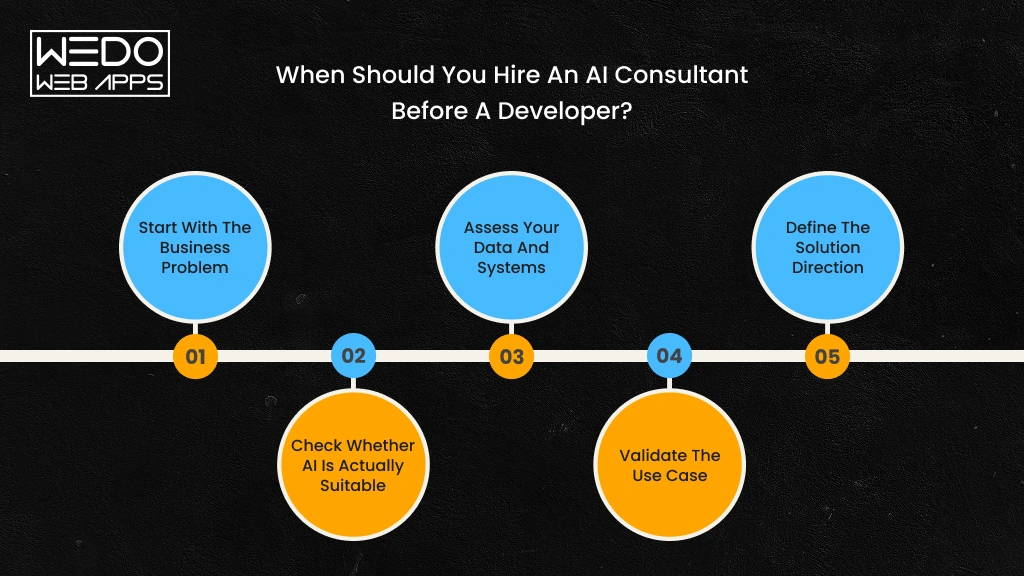
You do not need to hire a consultant simply because your project involves AI. The stronger reason is uncertainty.
If you are still making decisions about the problem, use case, data, or implementation approach, consulting can reduce that uncertainty before development begins.
A practical sequence looks like this:
Business problem -> AI readiness -> Use case validation -> Solution direction -> Development
1. Start With the Business Problem
Define what you want to improve before discussing models or platforms.
For example, "We want AI" is not a development requirement. "We want to reduce the time support agents spend searching internal documentation" gives you a measurable problem to investigate.
2. Check Whether AI Is Actually Suitable
Not every process needs AI.
A consultant can compare AI with traditional automation, existing software, or third-party tools. This can help you avoid spending on a custom solution when a simpler option would meet the same objective.
3. Assess Your Data and Systems
Your proposed solution may depend on customer records, documents, transaction history, APIs, or other business data.
Before development starts, you need to know whether that information is accessible, usable, secure, and sufficient for the intended application. An AI readiness assessment can help identify these gaps.
4. Validate the Use Case
A promising idea still needs to make business sense.
Assess it against a few practical questions:
- What business outcomes should improve?
- Who will use the solution?
- What data will it require?
- What would implementation involve?
- How will you measure success?
If the answers are unclear, development may be premature.
5. Define the Solution Direction
Once the use case is validated, the project can move toward a specific approach. This could involve an existing AI API, RAG, an AI agent, machine learning, or integration with your current software.
At this point, the developer has a much clearer brief to work from.
The simple test: If you are still deciding what to build, consult first. If you already know what to build, you can move toward development.
When Can You Skip AI Consulting and Hire a Developer Directly?
AI consulting is useful when you have unanswered strategic questions. It is not a mandatory step for every AI project.
You often move directly to an AI developer when the business and technical direction are already clear.
You Have a Proven Use Case
If you have already identified the problem, users, expected outcome, and success metrics, there may be little value in adding another discovery phase.
For example, your team may have already validated that an AI document summarization feature can reduce the time employees spend reviewing reports. You now need someone to build it.
Your Technical Team Has Already Defined the Requirements
You may already know which systems need integration, what data the application will use, which platform it must support, and what security requirements apply.
In that situation, a developer can focus directly on implementation rather than redefining the project.
You Already Have AI Expertise In-House
Your CTO, product team, or internal AI specialists may already handle strategy and feasibility.
If they have assessed the use case and prepared the technical direction, bringing in another consultant can add unnecessary cost or delay.
You Are Adding a Specific AI Feature
Some projects have a narrow scope.
For instance, you may want to add an LLM-powered summarization feature to an existing CRM or connect an AI API to your customer portal. The requirement is clear, and the expected output is known.
Here, development may be the most direct route.
Your Existing Prototype Has Already Been Validated
A tested proof of concept gives developers something concrete to work from. The focus can shift toward production requirements such as reliability, security, integrations, scalability, and monitoring.
Skip consulting when the important decisions have already been made. Your goal should be to avoid paying for strategy you already have while making sure the development team has enough information to build the right solution.
When Should You Hire Both an AI Consultant and an AI Developer?
Some AI projects need strategy and implementation at the same time. This is common when the idea has business potential but the technical path is still uncertain.
A good example is a company planning an AI agent that can handle customer requests across its CRM, billing system, and support platform. The business needs to decide what the agent should handle, while the technical team needs to determine how those systems can work together safely.
The Consultant Defines the Direction
The consultant focuses on the decisions that shape the project. This can include:
- Identifying and prioritizing AI use cases.
- Building the business case.
- Assessing data readiness.
- Recommending a suitable technology approach.
- Defining KPIs and expected outcomes.
- Addressing governance and risk.
- Creating the implementation roadmap.
For example, if you want to introduce an AI agent for customer support, the consultant can determine which tasks the agent should handle and when human intervention should be required.
The Developer Builds the Solution
Once the direction is clear, the developer handles the technical execution.
This may include application development, model integration, APIs, data pipelines, system integrations, testing, deployment, and ongoing maintenance.
The developer also provides technical feedback when an approach needs to change because of system limitations, performance concerns, or integration requirements.
The Consultant and Developer Work as One Delivery Team
Keeping both roles connected can prevent a common problem: the business requirement says one thing while the final product does another.
For instance, a consultant may define response accuracy as a key KPI. During development, the team may find that improving accuracy requires better source data or a different retrieval approach. Addressing that issue together keeps the technical work aligned with the intended business outcome.
The Recommended Sequence
For projects that require both roles, a practical workflow is:
Assess -> Prioritize -> Validate -> Design -> Develop -> Deploy -> Measure -> Improve
The sequence does not have to be strictly linear. Developer input can begin during assessment, while consultants can remain involved after deployment to evaluate business results.
The objective is simple: make the right AI decisions before significant development investment, then keep those decisions connected to how the solution is built and measured.
AI Consultant vs Developer: Which One Should You Hire?
There is no universal answer to the AI consultant vs developer question. The right choice depends on what you have already figured out and what is still uncertain.
Use this quick decision guide:
| If you are in this situation | Consider hiring |
|---|---|
| You want to use AI but have no defined use case | AI Consultant |
| You have several AI ideas and need to prioritize them | AI Consultant |
| You are unsure whether your data is ready | AI Consultant |
| You need an AI strategy or business case | AI Consultant |
| You have a validated use case and clear requirements | AI Developer |
| You need a custom AI application | AI Developer |
| You need to add AI to existing software | AI Developer |
| You have an internal team handling AI strategy | AI Developer |
| You need both strategic planning and technical execution | AI Consultant + AI Developer |
A Simple Way to Decide
Ask yourself these three questions:
- Do I know what business problem I want AI to solve?
If not, start with consulting.
- Do I know what the solution needs to do and how it should fit into my systems?
If yes, you may be ready for development.
- Do I need help with both the business direction and technical execution?
If yes, combining consulting and development may be the better approach.
For example, a business that wants to "use AI to improve sales" still needs strategic guidance. A business that has already defined an AI lead scoring system, its data sources, required integrations, and success metrics can move much closer to development.
The important point is not to hire based on the job title alone. Hire according to the decisions your project still needs to make.
How Much Does AI Consulting Cost Compared With AI Development?
Comparing AI consulting vs development costs is not as simple as comparing two hourly rates. The final investment depends on what you are trying to achieve, how complex the project is, and how much work is required before and after implementation.
A short consultation for one AI use case will have different requirements from a company-wide AI strategy. Similarly, integrating an existing AI API into your application is very different from developing a custom AI platform.
Factors That Affect AI Consulting Cost
Consulting costs generally increase with the scope and depth of strategic work involved.
| Factor | How it affects cost |
|---|---|
| Project scope | More departments, processes, or requirements require more analysis |
| Business complexity | Complex workflows require deeper business and technical assessment |
| Number of use cases | Evaluating several AI opportunities takes more time |
| Data assessment | Poorly structured or distributed data may require additional analysis |
| Strategy depth | A detailed AI roadmap requires more work than a basic recommendation |
| Governance requirements | Regulated or sensitive use cases may require additional risk assessment |
| Engagement duration | Workshops and ongoing advisory support increase the overall cost |
Factor That Affects AI Development Cost
Development costs are usually tied to the technical complexity of the solution.
For example, an AI-powered search feature may require less development than an agent that connects with your CRM, inventory system, and payment platform.
The major cost drivers include:
- AI solution type: A chatbot, predictive model, RAG system, and AI agent have different development requirements.
- Model or API requirements: Costs can vary depending on whether you use an existing model, fine-tune one, or build a custom model.
- Data preparation: Cleaning, structuring, labeling, and connecting business data can require substantial engineering work.
- Custom development: More complex applications require more development and testing.
- Third-party integrations: Each external system can add development and testing requirements.
- Infrastructure and security: Hosting, access controls, data protection, and monitoring can affect the budget.
- Testing and deployment: Production systems need functional testing, AI evaluation, deployment configuration, and ongoing maintenance.
Why the Cheapest Option is Not Always the Lowest Cost
Suppose you spend less by skipping discovery and immediately building an AI customer service tool. Six months later, you find that the available data cannot support the expected responses and the system does not fit your support workflow.
AI Consultant or Developer: What Should You Do Next?
The answer to AI consultant vs developer depends on what you already know.
If you have an AI idea but cannot define the right use case, assess the feasibility, or determine whether your data is ready, start with consulting.
If you have already validated the use case and know what needs to be built, you can move directly to development.
If the project involves significant business uncertainty and technical complexity, bringing both roles together can make more sense.
A useful way to assess your position is:
- Still deciding what to build? -> AI consultant
- Know what to build -> AI developer
- Need strategy and implementation? -> Both
Your choice should also account for the type of AI you are considering. A straightforward AI integration may need a developer. A RAG system using sensitive business information may require careful planning before implementation. An AI agent that can take actions across multiple systems may need both strategic and technical expertise.
The goal is not to hire the most people or the most expensive specialist. It is to make sure you have the right expertise for the stage your project is in.
When you approach AI this way, AI consulting and development become connected steps towards a business outcome rather than separate services you have to choose between AI development partners.
Final Takeaway: Consultant or Developer?
The AI consultant vs developer decision becomes easier when you stop treating it as a choice between two job titles.
If you are still trying to identify the right AI use case, understand your data requirements, build a business case, or create an implementation roadmap, an AI consultant can help you establish the direction.
If your use case is already validated and the requirements are clear, an AI developer can turn that plan into a working solution.
For larger initiatives, you may need both. The consultant can guide the business strategy while the developer handles the technical execution.
Before you hire, ask yourself one question:
Do I need help deciding what to build, or do I need someone to build what I have already decided?
That answer can tell you whether you need consulting, development, or a combination of both.
The best AI investment starts with a clear problem and ends with measurable business value. The technology you choose should support that objective, not become the objective itself.