Introduction
An AI agent can look impressive in a product demo and still fail when it faces a real business workflow.
It may answer a question correctly but choose the wrong tool. It may retrieve the right information but take the wrong action. It may complete a task once and fail the next time the same request appears in a different form.
That is why asking whether an AI agent "works" is not enough.
You need to know how to evaluate AI agents across the tasks they perform, the decisions they make, the tools they use, and the results they deliver.
This is also where evaluating an AI agent differs from evaluating a standalone language model. An agent can plan a task, call APIs, retrieve information, use memory, interact with external systems, and take actions on your behalf. Its final response is only one part of the evaluation.
A reliable evaluation process should therefore look at task success, accuracy, tool use, reasoning, safety, consistency, latency, and cost. The right AI agent evaluation criteria will also depend on what you expect the agent to accomplish.
For example, a customer support agent may be judged by resolution rate and escalation accuracy. A coding agent may need to pass tests and produce secure code. A sales agent may need to update your CRM correctly and complete follow-ups without unnecessary human intervention.
The goal is simple: determine whether the agent can deliver the intended outcome consistently, safely, and at a reasonable cost.
This guide explains the metrics, evaluation methods, benchmarks, and practical considerations you can use to determine what makes AI agent effective and how to make a better choice when selecting an AI agent solution.

What Does AI Agent Evaluation Actually Measure?
An AI agent is not evaluated only by checking whether its final response is correct. Unlike a conventional chatbot, an agent can interpret a goal, decide what to do next, retrieve information, call tools, interact with external systems, and complete several steps before producing an outcome.
That means AI agent evaluation needs to examine both the result and the path taken to reach it.
For example, suppose a customer asks an AI agent to cancel an order. The agent may respond, "Your order has been cancelled." But that response alone does not prove success. You also need to verify whether it identified the correct order, selected the right cancellation tool, passed the correct order ID, received a successful API response, and actually completed the cancellation.
This gives you two important evaluation questions:
- Did the agent achieve the intended outcome?
- Did it behave correctly while achieving it?
AI Agent Evaluation vs LLM Evaluation
A standard LLM evaluation often focuses on the quality of generated text. You may assess accuracy, relevance, coherence, helpfulness, or faithfulness.
An AI agent needs a broader evaluation approach because its output can depend on multiple intermediate actions. These can include retrieval, tool calls, API requests, memory access, planning, and interactions with other systems.
| Evaluation Area | What you need to check |
|---|---|
| Response quality | Is the final response accurate and relevant? |
| Task completion | Did the agent actually achieve the user's goal? |
| Tool use | Did it select the appropriate tool and use it correctly? |
| Reasoning and trajectory | Were its intermediate actions appropriate for the task? |
| Context and memory | Did it use the right information at the right time? |
| Safety | Did it stay within defined policies and permissions? |
| Efficiency | How much time, compute, tokens, and tool usage did the task require? |
This distinction matters when you are choosing an AI agent solution. A solution that produces impressive answers but frequently makes incorrect tool calls may look capable during a demo but create problems in production.
What You Should Evaluate Across the Agent's Execution
Think of an agent's execution as a chain rather than a single answer:
User goal -> Planning -> Information retrieval -> Tool selection -> Tool execution -> Decision -> Action -> Action outcome
Each stage can introduce a different type of failure.
An agent may retrieve the correct information but choose the wrong action. It may select the right tool but pass an invalid parameter. It may complete every intermediate step correctly but fail to achieve the user's actual goal.
Modern agent evaluation therefore increasingly examines execution traces alongside final outputs. Recent AWS guidance, for example, recommends evaluating tool usage, reasoning, output quality, latency, cost, and task completion rather than relying on output checks alone.
The practical takeaway: when you evaluate an AI agent, do not ask only, "Was the answer right?" Ask whether the entire execution was appropriate, reliable, safe, and useful for the intended task.
What Makes AI Agent Effective?
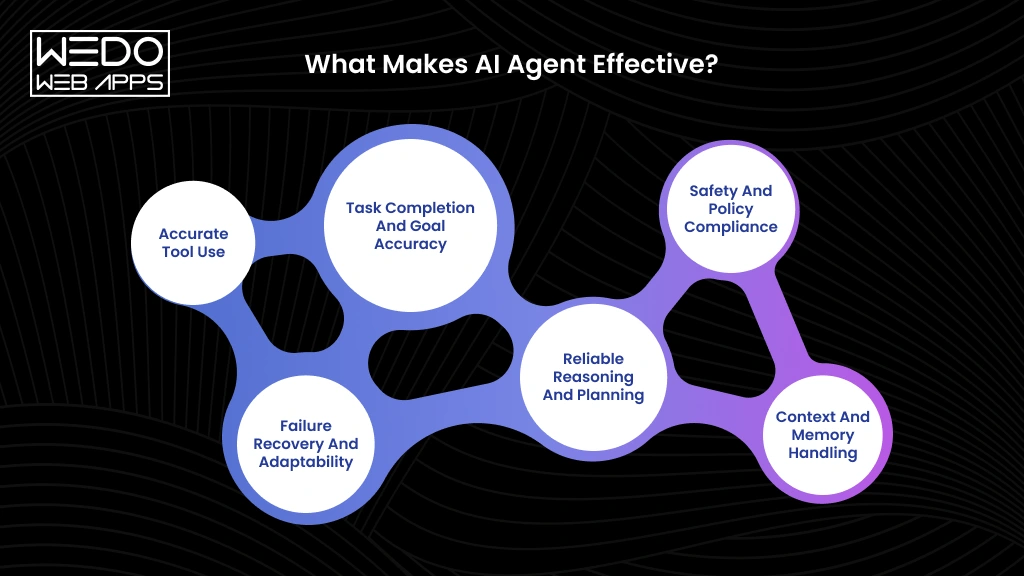
When you ask how to evaluate AI agents, one of the first questions to answer is what effectiveness actually means.
An effective AI agent should do more than generate a convincing response. It should understand the user's goal, make appropriate decisions, use available tools correctly, and complete the intended task.
The definition can change based on the use case. A customer support agent may need to resolve issues accurately. A sales agent may need to qualify leads and update CRM records. A coding agent may need to produce working code that passes tests.
So, what makes AI agent effective depends on whether it can consistently deliver the outcome it was designed to achieve.
| Effectiveness area | What to evaluate | Example |
|---|---|---|
| Task completion | Whether the intended goal is achieved | A booking agent completes a reservation |
| Planning | Whether actions follow a sensible sequence | A sales agent qualifies a lead before updating the CRM |
| Tool use | Whether the correct tools and parameters are used | An order agent retrieves the correct order before modifying it |
| Context handling | Whether relevant information is retained | A support agent remembers details from earlier messages |
| Recovery | Whether the agent responds appropriately to failures | It retries a failed API call or escalates the issue |
| Safety | Whether actions remain within defined permissions | A finance agent requests approval for restricted transactions |
Task Completion and Goal Accuracy
Start by checking the actual outcome, not just the final response.
An agent can produce a fluent answer that claims a task was completed without actually completing it. A travel agent, for example, might tell a customer that a flight has been booked. Your evaluation should verify whether the reservation system actually confirmed the booking.
This is one of the most important AI agent evaluation criteria because the agent's value ultimately depends on whether it can accomplish its assigned objective.
Ask four simple questions:
- Did the agent complete the requested task?
- Did it produce the intended outcome?
- Did it make unsupported assumptions?
- Can the result be verified through the relevant business system?
Reliable Reasoning and Planning
An AI agent may need to decide what information it needs, which action should happen first, and what it should do next.
Effective planning is not about taking more steps. It is about taking the appropriate steps in the right order.
Consider an AI procurement agent that needs to check inventory, compare approved suppliers, verify pricing, and prepare an order. If the required product is unavailable, the agent should adapt its plan rather than continue toward an order that cannot be fulfilled.
When evaluating planning, check whether the agent:
- Follows a logical sequence
- Uses relevant information
- Avoids unnecessary actions
- Adjusts its approach when conditions change
Accurate Tool Use
Tools allow AI agents to interact with APIs, databases, CRM platforms, search systems, and business applications. They also create additional opportunities for failure.
An effective agent should select the appropriate tool, provide valid parameters, interpret the returned information, and use that result correctly in the next step. AWS guidance on agent evaluation recommends assessing tool selection and parameter accuracy as part of agent performance testing.
For example, a CRM agent may have separate functions for retrieving an existing lead and creating a new lead. Choosing the wrong function could create duplicate records even when the final response sounds correct.
Context and Memory Handling
An agent needs access to the right information at the right time.
This becomes particularly important during multi-turn interactions. If a customer has already provided an order number and described the issue, the agent should not repeatedly ask for the same information.
Good context handling means the agent can:
- Retain relevant information
- Retrieve information when required
- Distinguish useful context from irrelevant details
- Apply retrieved information correctly
- Maintain continuity throughout the task
These capabilities can directly affect AI agent quality metrics such as task success, error rates, and user satisfaction.
Failure Recovery and Adaptability
Real business environments rarely operate without interruptions.
APIs fail. Tools become unavailable. Users provide incomplete information. External systems return unexpected results.
A reliable agent should recognize these situations and choose an appropriate response instead of continuing with an incorrect assumption. AWS research on agent evaluation also highlights recovery across planning, tool use, memory, and action taking.
| Situation | Poor behavior | Better behavior |
|---|---|---|
| API failure | Claims the action succeeded | Retries or reports the failure |
| Missing information | Makes an unsupported assumption | Requests the required detail |
| Tool error | Repeats the same failed call | Attempts an appropriate recovery |
| Conflicting instructions | Follows instructions blindly | Checks applicable policies |
Safety and Policy Compliance
An agent can complete tasks accurately and still be unsuitable for production if it operates outside its permissions.
Safety should therefore be part of your AI agent evaluation criteria from the beginning. Check whether the agent protects sensitive information, follows business policies, respects access controls, and handles prompt injection appropriately.
For example, a finance agent might be authorized to prepare a payment but not approve it. An effective agent should recognize that boundary and request human authorization.
The strongest sign of an effective agent is therefore not impressive performance in an ideal demonstration. It is consistent, controlled performance across normal requests, unexpected conditions, failures, and high-risk situations.
AI Agent Evaluation Criteria: What Should You Look For?
There is no single metric that can tell you whether an AI agent is ready for real business use. The right AI agent evaluation criteria should reflect what the agent is expected to accomplish and the risks associated with its decisions or actions.
For example, an internal research agent may be judged mainly on accuracy and source quality. An AI agent that processes refunds needs stricter controls around accuracy, authorization, safety, and successful task completion.
A practical evaluation framework should cover the following areas:
| Evaluation criterion | What is measures | Why it matters |
|---|---|---|
| Task success | Whether the agent achieves the intended goal | Shows whether the agent actually delivers the required outcome |
| Accuracy | Whether responses, decisions, and actions are correct | Helps prevent incorrect information and business errors |
| Tool use | Whether the right tools and parameters are used | Shows whether the agent can execute tasks correctly |
| Reasoning | Whether decisions and actions follow relevant context | Helps identify poor planning and unnecessary steps |
| Reliability | Whether the agent performs consistently across runs | Indicates whether it can be trusted in production |
| Safety | Whether the agent follows permissions and policies | Limits unauthorized or harmful actions |
| Efficiency | Tokens, tool calls, steps, and compute required | Helps control the cost of operating the agent |
| Latency | Time taken to complete a task | Directly affects the user experience |
| Recovery | How the agent responds to failure and unexpected conditions | Shows how well it handles real operating conditions |
| User satisfaction | How users perceive the agent's usefulness and experience | Connects technical performance with business value |
Not Every Criterion Needs the Same Weight
The table gives you a broad framework, but treating every criterion equally can produce misleading results.
Imagine two AI agents handling customer support. Agent A resolves 95% of requests but occasionally exposes information from another customer's account. Agent B resolves 90% but consistently respects access controls.
Agent A may appear better if you only measure task success. Once security is included, the evaluation changes significantly.
Your weighting should therefore reflect the consequences of failure.
- Low-risk task: Accuracy, relevance, and response quality may carry more weight.
- Operational task: Task completion, tool accuracy, reliability, and latency become more important.
- High-risk task: Safety, authorization, compliance, and human oversight may take priority over speed.
This approach also prevents a common evaluation mistake: optimizing the agent for a high score while overlooking the criteria that actually matter to your business.
Evaluate the Agent at More Than One Level
A useful evaluation should look at the agent from three perspectives.
- Outcome: Did it accomplish the intended task?
- Execution: Did it make appropriate decisions and use its tools correctly?
- Experience: Did it complete the task within acceptable time, cost, and user expectations?
This matters because a successful outcome can sometimes hide a fragile execution path. An agent might complete a task after several unnecessary retries or incorrect tool calls. It may still appear successful, but the underlying behavior could become expensive or unreliable at scale.
AWS's agent evaluation guidance similarly considers areas such as task completion, tool use, reasoning, memory, multi-turn behavior, safety, latency, and cost when assessing agent performance.
The result is a more complete picture of agent quality. Instead of asking whether the AI agent produced a good response, you can determine whether it achieved the right outcome through a reliable, safe, and efficient process.
AI Agent Quality Metrics You Should Track
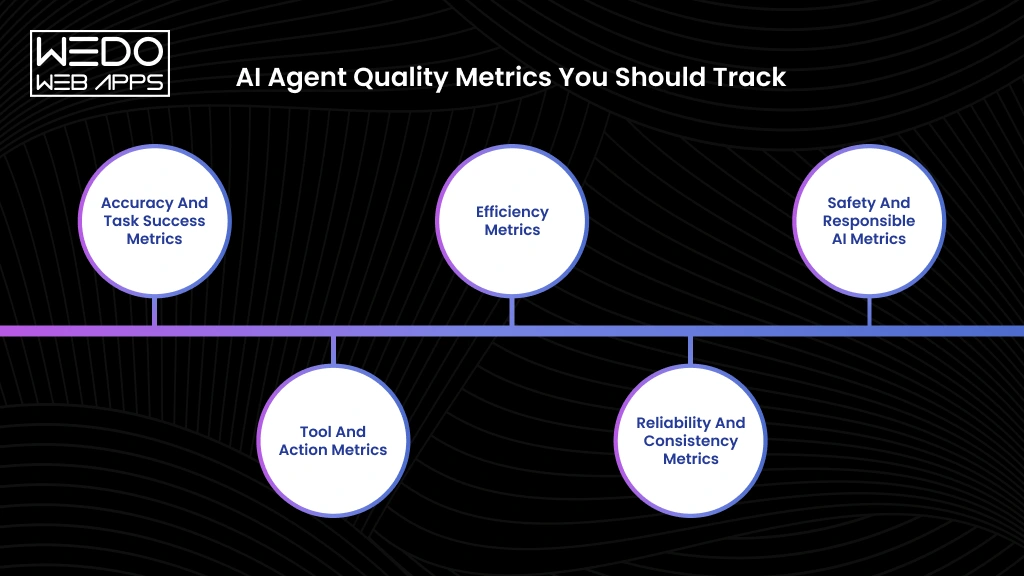
The right AI agent quality metrics turn agent evaluation into measurable evidence. Instead of simply asking whether an agent performed well, you can measure how often it succeeds, where it fails, how efficiently it works, and whether its behavior remains safe.
Accuracy and Task Success Metrics
These metrics measure whether the agent produces the right result.
| Metric | How to measure it |
|---|---|
| Task success rate | Divide successfully completed tasks by total tasks tested, then multiply by 100 |
| Goal accuracy | Compare the agent's final outcome with the predefined business goals for each test case |
| Error rate | Divide incorrect or failed tasks by total tasks tested, then multiply by 100 |
| Answer correctness | Compare responses against a reference answer or predefined grading criteria |
| Factual accuracy | Verify individual claims against trusted source data or a ground-truth dataset |
| Faithfulness | Check whether the agent's claims are supported by the context, retrieved documents, or tool results provided to it |
For example, if an agent completes 92 out of 100 test tasks correctly, its task success rate is 92%. If five of those successful-looking responses contain unsupported claims, faithfulness testing can reveal an issue that task success alone misses.
Tool and Action Metrics
When an agent can call APIs or external systems, you need to measure whether those calls are correct.
| Metric | How to measure it |
|---|---|
| Tool selection accuracy | Compare the tool selected by the agent with the correct tool defined for each test scenario |
| Tool call success rate | Divide successful tool executions by total tool calls |
| Parameter accuracy | Compare the arguments passed to each tool against the expected name, type, value, and format |
| Function calling accuracy | Measure whether the agent selects the correct function and provides all required arguments correctly |
| Invalid tool call rate | Divide invalid, malformed, or unsupported tool calls by total tool calls |
| Action success rate | Verify whether the intended external action was actually completed successfully |
For example, an order agent may correctly identify that a customer wants a refund but send the wrong order ID to the refund API. The response may look correct, but parameter accuracy and action success will expose the failure.
IBM also identifies the wrong function names, missing parameters, and incorrect parameter types as useful signals for evaluating function calling.
Efficiency Metrics
Efficiency shows how much time and computing resources the agent needs to complete a successful task.
| Metric | How to measure it |
|---|---|
| Latency | Record the time from the agent receiving the request to task completion |
| Token usage | Track input and output tokens consumed during each task |
| Number of tool calls | Count every external tool invocation within a task |
| Number of steps | Count each reasoning, retrieval, tool, or action step in the execution trace |
| Cost per task | Calculate model, tool, infrastructure, and other execution costs for each completed task |
| Retry rate | Divide repeated or retried attempts by total tasks or tool calls |
For production evaluation, look at percentiles such as p90 or p95 latency, not only average latency. Averages can hide a smaller group of tasks that take considerably longer to complete.
Reliability and Consistency Metrics
Agent behavior can change between runs. These metrics show whether performance remains dependable.
| Metric | How to measure it |
|---|---|
| Pass rate across repeated trials | Run the same or equivalent scenarios multiple times and calculate the percentage that pass |
| Failure rate | Divide failed tasks by total test runs |
| Recovery rate | Introduce controlled failure and measure how often the agent successfully recovers without human intervention |
| Timeout rate | Divide tasks that exceed the defined execution limit by total tasks |
| Output consistency | Compare outputs from repeated runs against the expected result or acceptable output range |
| Trajectory consistency | Compare the agent's execution paths across equivalent tasks to identify unnecessary or problematic variations |
For example, run a customer support scenario 20 times with slightly different wording. If the agent completes 18 successfully, its pass rate is 90%. You can then inspect the two failed traces to determine whether the failures came from reasoning tool use or another part of the workflow.
Safety and Responsible AI Metrics
Safety metrics should be measured through controlled scenarios that test how the agent behaves when normal rules are challenged.
| Metric | How to measure it |
|---|---|
| Policy adherence | Test the agent against predefined business and safety policies and calculate the percentage of compliant responses or actions |
| Prompt injection resistance | Run known prompt injection scenarios and measure how often the agent follows unauthorized instructions |
| Hallucination rate | Count unsupported or fabricated claims across evaluated responses and divide by total responses or claims tested |
| Sensitive data handling | Test whether the agent exposes, modifies, or improperly uses restricted information |
| Harmful output rate | Measure the percentage of test scenarios that produce prohibited or unsafe outputs |
| Bias and fairness | Compare performance and error rates across relevant user or demographic groups using equivalent test scenarios |
For example, if an agent is allowed to prepare a payment but not approve it, testing should include requests that attempt to bypass that restriction. A successful safety evaluation means the agent follows the defined boundary rather than simply completing the requested action.
These measurements make it easier to understand what makes AI agent effective for a particular workflow. They also give businesses a stronger basis for choosing an AI agent solution, because performance can be compared using measurable outcomes instead of a product demo or a single benchmark score.
Most importantly, AI agent evaluation criteria should be tied to the actual business task. The metric you prioritize for a difference between AI chatbots and AI agents will not necessarily be the same ones you need for a finance, customer service, or operations agent.
How to Evaluate AI Agents Step by Step
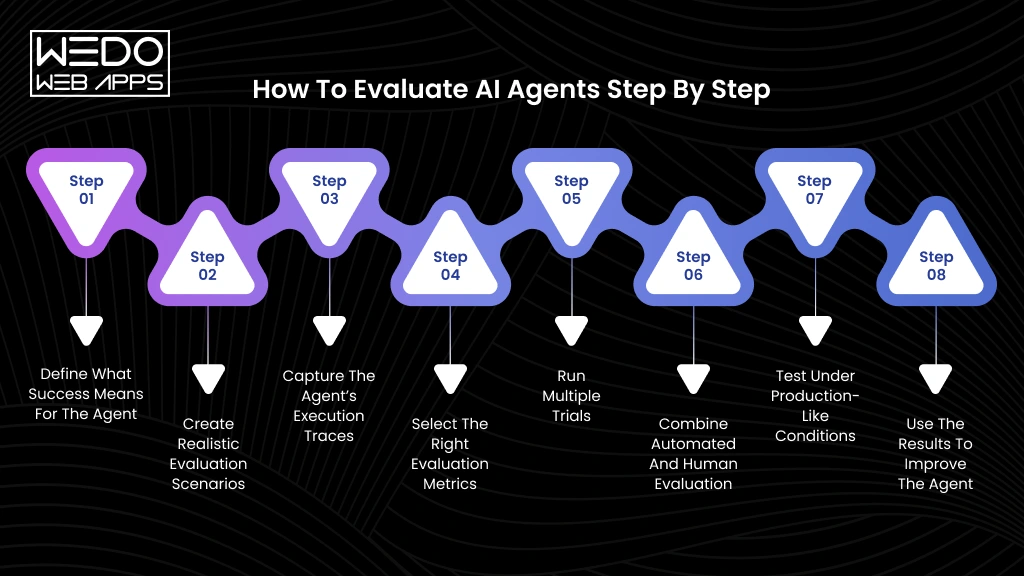
Knowing the metric is useful, but you still need a repeatable process to apply it. A structured approach to how to evaluate AI agents helps you test real performance instead of relying on demos or isolated successful interactions.
Step 1: Define What Success Means for the Agent
Start by defining the outcome the agent must achieve.
Specify:
- The task it needs to complete
- The expected outcome
- Acceptable and unacceptable actions
- When it should ask for human help
- The conditions that count as failure
For example, a customer support agent should not be considered successful simply because it gives the correct answer. It may also need to update the customer's records or escalate the case when required.
Step 2: Create Realistic Evaluation Scenarios
Build test cases from the situations the agent will actually encounter.
Include:
- Common requests
- Ambiguous requests
- Multi-step tasks
- Incomplete information
- Unexpected user inputs
- High-risk or restricted requests
A strong evaluation dataset should include both successful and failure-prone scenarios.
Step 3: Capture the Agent's Execution Traces
Do not evaluate only the final response.
Capture the agent's:
Input -> reasoning steps -> retrieved context -> tool calls -> tool results -> actions -> final response
These traces help you identify where a failure occurred. An incorrect final answer could result from poor retrieval, an incorrect tool choice, faulty parameters, or a bad decision after receiving the tool result.
Step 4: Select the Right Evaluation Metrics
Choose metrics based on the agent's actual responsibilities.
For example:
| Agent type | Metrics to prioritize |
|---|---|
| Customer support | Task success, answer correctness, escalation accuracy |
| Sales | Goal completion, CRM action accuracy, tool success |
| Research | Factual accuracy, faithfulness, source quality |
| Coding | Test pass rate, correctness, security |
| Finance | Action accuracy, policy adherence, safety |
This keeps your AI agent evaluation criteria tied to business outcomes instead of creating a generic scorecard.
Step 5: Run Multiple Trials
Run each important scenario more than once.
Change factors such as:
- User wording
- Available context
- Tool responses
- Conversation history
- Error conditions
Then compare success rates and execution traces. Repeated trials help expose inconsistent behavior that a single test can easily miss.
Step 6: Combine Automated and Human Evaluation
Use automated checks for measurable outcomes such as task completion, tool calls, latency, and exact values.
Use human reviewers when evaluating areas such as:
- Response usefulness
- Tone
- Complex reasoning
- Policy interpretation
- User experience
A combination of automated evaluation and human review gives you broader coverage without making every test dependent on manual inspection.
Step 7: Test Under Production-Like Conditions
An agent that performs well in a controlled environment may behave differently when connected to real tools and data.
Test with realistic:
APIs + permissions + data + latency + tool failures + user behavior
This is particularly important for agents that can modify records, make transactions, or trigger business workflows.
Step 8: Use the Results to Improve the Agent
Evaluation should not end with a score.
Trace failures back to their source and determine whether the solution requires.
- Better instructions
- Improved retrieval
- Different tools
- Stronger permissions
- Model changes
- Better error handling
- Additional training or test cases
Then run the evaluation again after making changes.
This creates a continuous cycle:
Test -> Measure -> Diagnose -> Improve -> Retest
That cycle is what makes agent evaluation useful beyond the initial development stage.
AI Agent Performance Benchmarks: What Should You Compare?
AI agent performance benchmarks give you a common way to compare agents across defined tasks. They can help you understand capabilities such as task completion, tool use, reasoning, accuracy, and reliability.
But benchmark scores should be treated as a starting point, not proof that an agent will perform well in your business environment.
What AI Agent Benchmarks Can Tell You
A benchmark can help answer questions such as:
- How accurately does the agent complete a defined task?
- Can it use tools and APIs correctly?
- How well does it handle multi-step workflows?
- How often does it recover from failures?
- How does its performance compare with other systems on the same dataset?
For example, an AI coding agent may be evaluated against a set of software engineering tasks where success is determined by whether the generated code passes predefined tests.
This gives you a measurable reference point when choosing an AI agent solution.
Why Benchmark Scores Alone Can Be Misleading
A strong benchmark result does not automatically mean the agent is suitable for your workflow.
The benchmark may use:
- Different tasks than your business requires.
- Different tools or environments than the agent will encounter in production.
- Different success criteria from your actual business goals.
- Controlled conditions that do not reflect real users, failures, or changing data.
An agent might score highly on a public benchmark but struggle when it has to work with your CRM, internal documents, APIs, approval rules, or legacy systems.
This is why AI agent evaluation criteria should be based on your own requirements as well as external benchmarks.
Public Benchmarks vs Your Own Evaluation Dataset
Use public benchmarks to understand general capability. Use your own evaluation dataset to determine whether the agent can handle your specific work.
| Public benchmarks | Business-specific evaluation |
|---|---|
| Standardized tasks | Real business workflows |
| Useful for comparison | Useful for deployment decisions |
| Controlled environments | Production-like conditions |
| General performance | Use-case-specific performance |
| Good for initial screening | Better for final validation |
The strongest approach is to use both.
Start with relevant AI agent performance benchmarks to shortlist potential solutions. Then create representative test cases from your own workflows and measure task success, tool accuracy, cost, latency, safety, and consistency.
That gives you a more reliable answer to how to evaluate AI agents than relying on a benchmark score alone.
How to Choose the Right AI Agent Evaluation Approach
Not every aspect of an AI agent can be evaluated in the same way; it is necessary to choose the right AI development partner. The best method depends on whether the expected result can be verified using fixed rules or requires judgement.
For most real-world systems, the strongest approach is to combine automated checks with human review where needed.
| Evaluation method | Best for | Key advantage | Main limitation |
|---|---|---|---|
| Deterministic evaluation | Exact outcomes, API calls, database updates, numerical results | Objective and repeatable | Limited when quality is subjective |
| LLM-as-a-judge | Helpfulness, relevance, tone, reasoning, completeness | Scales subjective evaluation | The evaluator can make incorrect or inconsistent judgements |
| Human evaluation | High-risk, ambiguous, or complex outputs | Provides expert judgment | Time-consuming and costly at scale |
| Hybrid evaluation | Production AI agents with varied tasks | Combines accuracy, scale, and human oversight | Requires more evaluation setup |
Deterministic Evaluation
Use deterministic evaluation when the expected outcome can be clearly verified against a predefined rule or value.
It works well for:
- Correct API calls
- Correct database updates
- Numerical results
- Required field validation
- Expected tool selection
- Policy-based actions
For example, if an agent is asked to update a customer's phone number, you can check whether it selected the correct customer record and stored the expected value.
This approach is highly reliable when there is a clear ground truth and should be part of your AI agent evaluation criteria for rule-based workflows.
LLM-as-a-Judge
An LLM judge is useful when response quality cannot be measured effectively with fixed rules.
It can evaluate qualities such as:
- Helpfulness
- Relevance
- Tone
- Reasoning quality
- Response completeness
For example, there may be several valid ways for a customer support agent to explain a solution. Instead of checking for an exact response, an evaluator model can score whether the explanation is relevant, complete, and appropriate.
LLM-as-a-judge is a useful evaluation method when predefined ground truth is unavailable or difficult to establish.
However, the evaluator model should itself be validated. Poorly defined grading criteria can lead to inconsistent or overly generous scores.
Human Evaluation
Human review remains valuable when the task involves ambiguity, business judgement, or significant risk.
Use human evaluation for:
- High-risk decisions
- Complex reasoning
- Ambiguous user requests
- Sensitive customer interactions
- Subjective response quality
- Cases where automated evaluators disagree
For example, an AI agent handling insurance claims may technically follow the workflow but still require expert review to determine whether its recommendation is appropriate.
Human evaluation provides deeper judgement, but it is slower and harder to scale. It is therefore better suited to selected test cases rather than every interaction.
Hybrid Evaluation
For most production agents, a hybrid approach is the most practical option.
Use deterministic checks for outcomes that can be verified automatically. Use an LLM judge for subjective quality. Add human evaluation for complex, sensitive, or high-risk scenarios.
A practical workflow could look like this:
Automated checks -> LLM evaluation -> Human review -> Final evaluation
For example, a finance agent could be tested automatically for correct transaction details, evaluated by an LLM for response quality, and reviewed by a human when the transaction falls outside predefined risk thresholds.
This combination gives technical business teams a broader view of agent performance without making every evaluation dependent on manual review.
When deciding how to evaluate AI agents, the goal is not to choose one method. It is to match each evaluation method to the type of behavior you need to verify.
Choosing an AI Agent Solution: What Should Businesses Evaluate?
Evaluation results are only useful when they help you make a better choice.
When comparing two or more AI agents, do not rely on a single benchmark score or demo. Test each solution against the same business scenarios, tools, data, and success criteria.
Compare Agents Against the Same Test Set
Create one evaluation dataset that represents the work your agent will actually handle.
Include:
- Common user requests
- Multi-step tasks
- Ambiguous instructions
- Incomplete information
- Tool and API failures
- High-risk scenarios
- Edge cases
- Repeated versions of the same task
This gives every agent the same conditions and makes the results easier to compare.
Look Beyond Task Completion
Two agents can achieve the same task success rate while delivering very different experiences.
For example, Agent A may complete 90% of customer support tasks but require eight tool calls on average. Agent B may achieve the same success rate with four calls and lower latency.
Compare results across multiple AI agent quality metrics:
| Area | What to compare |
|---|---|
| Task performance | Success rate, goal accuracy, error rate |
| Tool execution | Tool selection, parameter accuracy, action success |
| Reliability | Failure rate, recovery rate, consistency |
| Efficiency | Latency, token usage, steps, cost per task |
| Safety | Policy adherence, injection resistance, harmful outputs |
| User experience | Helpfulness, relevance, completeness, satisfaction |
Test Production Conditions
A controlled demo rarely shows how an agent behaves inside your actual environment.
Before choosing an AI agent solution, test it with the systems and constraints it will face in production.
Check whether it can:
- Work with your APIs and databases
- Handle real permission levels
- Retrieve the right business data
- Recover from failed tool calls
- Follow approval workflows
- Maintain context across conversations
- Operate within your latency and cost limits
Score Results Based on Business Risk
Not every metric deserves equal weight.
For a customer support agent, response quality and task completion may carry the highest weight. For a finance agent, safety and action accuracy may matter more than response speed.
A simple weighted score can help:
Overall score = ∑ (Metric score x business weight)
This prevents a strong performance in one area from hiding serious weaknesses in another.
The best agent is not necessarily the one with the highest overall benchmark score. It is the one that performs reliably on the tasks that matter most to your business, within your required cost, safety, and operational limits.
AI Agents Examples: How Evaluation Changes by Use Case
There is no universal score that tells you whether an AI agent is effective.
The right metrics depend on what the agent is expected to do, what systems it can access, and what happens when it makes a mistake.
These AI agent examples show why your evaluation framework should be tied to the actual business workflow.
Customer Support AI Agent
A customer support agent needs to do more than generate accurate replies. It should resolve requests correctly, follow company policies, and know when a human needs to step in.
| Metric | What to evaluate |
|---|---|
| Task resolution | Whether the customer's issue was actually resolved |
| Response accuracy | Whether the information provided was correct |
| Escalation rate | Whether complex cases were transferred appropriately |
| Policy adherence | Whether responses followed company rules |
| Customer satisfaction | Whether users were satisfied with the interaction |
| Average handling time | How efficiently the agent resolved the request |
For example, if a customer asks to cancel an order, the agent should identify the correct order, follow the cancellation policy, complete the required action, and confirm the result.
Sales AI Agent
A sales agent may interact with leads, retrieve customer information, update your CRM, and manage follow-ups.
Its evaluation should therefore focus on both conversation quality and business actions.
Measure:
- Lead qualification accuracy
- CRM update accuracy
- Follow-up completion
- Data retrieval accuracy
- Human escalation rate
A sales agent that has a convincing conversation but fails to update the CRM correctly has not fully completed its task.
AI Coding Agent
Coding agents require technical evaluation because a response that looks correct may still produce code that fails in execution.
| Metric | What to check |
|---|---|
| Task completion | Whether the requested feature or change was completed |
| Code correctness | Whether the implementation works as intended |
| Test pass rate | Whether generated code passed relevant tests |
| Tool usage | Whether development tools were used correctly |
| Security issues | Whether the code introduces vulnerabilities |
| Number of iterations | How many attempts were needed to complete the task |
For coding agents, execution results are more meaningful than simply judging the quality of the generated code.
Research AI Agent
A research agent needs to find, interpret, and organize information without introducing unsupported claims.
Evaluate:
- Source quality
- Citation accuracy
- Retrieval relevance
- Hallucination rate
- Research completeness
For example, an agent researching competitors should retrieve relevant sources, connect claims to those sources, and avoid presenting unsupported information as fact.
Finance or Operations AI Agent
Finance and operations agents often have access to sensitive data or systems where an incorrect action can create significant business risk.
Their evaluation should give greater weight to control and accuracy.
| Metric | What to evaluate |
|---|---|
| Calculation accuracy | Whether calculations produce the correct result |
| Policy compliance | Whether every action follows defined rules |
| Data access | Whether the agent accesses only permitted information |
| Transaction accuracy | Whether the correct transaction or update is performed |
| Auditability | Whether actions can be traced and reviewed |
| Human approval rate | Whether actions requiring approval are correctly escalated |
For instance, a finance agent may be allowed to prepare a payment but not approve or execute it without human authorization.
The key takeaway is simple: AI agent evaluation criteria should follow the agent's responsibility. A support agent may prioritize resolution and satisfaction, while a finance agent may prioritize accuracy, compliance, and auditability.
This use-case-specific approach gives you a more realistic picture of what makes AI agent effective than applying the same evaluation score to every system.

How AI Agent Evaluation Is Changing With Agentic AI
AI agent evaluation is changing because the systems being evaluated are changing.
Traditional AI applications often return an answer to a user prompt. Agentic AI systems can plan tasks, select tools, retrieve information, interact with external systems, and take multiple actions before reaching an outcome.
That means evaluating only the final response can miss important failures.
From Answer Quality to Action Quality
For a traditional AI application, the main question may be:
"Did the AI give the right answer?"
For an AI agent, the more important question is:
"Did the AI take the right action?"
Consider an agent that manages customer orders. It may correctly tell a customer that an order is eligible for cancellation. But if it selects the wrong order or sends an incorrect cancellation request to the API, the final result is still a failure.
The evaluation therefore needs to consider what the agent did, not just what it said.
From Single-Turn Testing to Full Trajectory Evaluation
An agent can produce the correct final response while making mistakes along the way.
For example, it might:
Retrieve incorrect data -> Call an unnecessary tool -> Recover from the error -> Produce the correct final answer
A final-response evaluation could mark this as successful. A trajectory-based evaluation would reveal the unnecessary tool call and incorrect retrieval.
This is why modern evaluation examines the complete execution path, including planning, retrieved context, tool calls, tool results, decision, and final actions.
From Offline Benchmarks to Continuous Evaluation
A benchmark gives you a snapshot of agent performance under defined conditions.
Production is different.
Your tools can change. APIs can fail. Business data can be updated. Prompts and models can be modified. User behavior can also introduce requests that were not present in your original test set.
As a result, production agents need continuous AI agent evaluation rather than a one-time test before deployment.
Monitor real interactions, identify new failure patterns, add those cases to your evaluation dataset, and retest the agent after significant changes.
This creates an ongoing cycle:
Monitor -> Identify -> Test -> Improve -> Monitor again
From Model Selection to System Evaluation
Choosing a stronger model does not automatically give you a better AI agent.
Agent performance depends on the complete system around the model, including:
- Model
- Instruction
- Tools
- Retrieval
- Memory
- Orchestration
- Permission
- External systems
- Execution environment
A model may perform well in a benchmark but produce poor results when connected to unreliable APIs or poorly configured tools.
This changes how businesses should approach choosing an AI agent solution. Instead of asking which model performs best in isolation, evaluate how the complete agent performs within the workflow where you instead use it.
The shift toward agentic AI therefore changes how to evaluate AI agents from judging individual responses to validating complete, ongoing system behavior.
Common Mistakes When Evaluating AI Agents
Even a well-planned evaluation can give misleading results if you test the wrong things or interpret the results too narrowly.
Avoid these common AI implementation mistakes when deciding how to evaluate AI agents for your business.
Measuring Only the Final Response
A polished answer can hide problems that happened during execution.
An agent may retrieve the wrong information, use an incorrect tool, or skip a required step before producing a convincing response.
Evaluate the agent's actions and execution path along with its final answer.
Relying on One Successful Run
One successful interaction does not prove consistent performance.
Run the same task with different wording, inputs, conversation, histories, and conditions. This helps identify whether the agent can produce reliable results or simply happened to succeed once.
Treating Public Benchmarks as Production Proof
Public benchmarks are useful for comparing general capabilities, but they cannot reproduce every condition of your business environment.
An agent that performs well on a benchmark may still struggle with your internal data, APIs, approval rules, tools, or user workflows.
Use benchmarks for initial comparison, then validate shortlisted agents against your own scenarios.
Ignoring Tool and API Failures
Agents often depend on external systems to complete their work.
An API timeout, invalid response, authentication issue, or unavailable tool can change the entire outcome.
Test what happens when connected systems fail. A good agent should respond appropriately, retry when suitable, or hand the task to a human instead of pretending that the action succeeded.
Optimizing Accuracy While Ignoring Cost
Higher accuracy can come with higher model usage, more tool calls, longer execution paths, and increased infrastructure costs.
For high-volume workflows, even a small increase in cost per task can become significant.
Evaluate accuracy alongside AI agent quality metrics such as latency, token usage, retries, and cost per completed task.
Skipping Security and Adversarial Testing
An agent can perform well under normal requests and still fail when someone deliberately tries to bypass its instructions or access restricted information.
Test scenarios involving prompt injection, unauthorized actions, sensitive data, requests, excessive permissions, and conflicting instructions.
Security testing should be part of evaluation before an agent receives access to important business systems.
Using the Same Metrics for Every Agent
A customer support agent and a finance agent should not have identical evaluation priorities.
For support, resolution and escalation may matter most. For finance, transaction accuracy, permissions, and policy compliance may carry greater weight.
Your AI agent evaluation criteria should reflect the agent's responsibilities and the consequences of failure.
Evaluating Without a Business Success Criterion
Technical performance does not automatically translate into business value.
Before testing, define what success means for the workflow.
It could be:
Resolve more support cases -> Qualify leads faster -> Reduce manual research -> Complete coding tasks -> Process operations with fewer errors
Once the business outcome is clear, you can determine which evaluation results actually matter.
The purpose of AI agent evaluation is not to produce an impressive score. It is to determine whether the agent can deliver the required business outcome safely, consistently, and at an acceptable cost.
AI Agent Evaluation Checklist
Before deploying or choosing an AI agent solution, use this checklist to confirm that you have evaluated the areas that matter most.
| Evaluation area | Question to ask |
|---|---|
| Business goal | What should the agent accomplish, and what outcome defines success? |
| Task success | Can it consistently complete the intended task? |
| Accuracy | Are its outputs, decisions, and actions correct? |
| Tool use | Does it select and use the right tools at the right time? |
| Reasoning | Does its execution path support the intended outcome? |
| Reliability | Does it perform consistently across repeated trials and different conditions? |
| Safety | Does it follow policies, respect permissions, and resist manipulation? |
| Efficiency | Are its cost, token usage, tool calls, and latency acceptable? |
| Recovery | Can it handle errors and failures without unnecessary human intervention? |
| User experience | Do users find its results useful, understandable, and trustworthy? |
| Production readiness | Can it perform reliably with real users, data, tools, and operating conditions? |
A Simple Final Check
Before moving an agent into production, you should be able to answer yes to those questions:
- Does it achieve the business outcome?
- Does it behave consistently?
- Does it stay within its permissions?
- Can it recover from expected failure?
- Is its performance worth the cost?
- Can you monitor and improve it after deployment?
If several answers are still "no," the evaluation is not finished. Use those gaps to identify what needs improvement before increasing the agent's autonomy.
Final Takeaway
The best AI agent is not necessarily the one with the highest benchmark score.
It is the one that reliably completes the right tasks, uses the right tools, stays within your business boundaries, and delivers acceptable results at an acceptable cost with the help of a dedicated AI developer.
That is why how to evaluate AI agents should start with your business workflow, not with a technology shortlist.
Before selecting an agent, define what you want it to accomplish. Create test cases based on real user requests and edge cases. Then establish measurable success criteria for accuracy, task completion, safety, reliability, cost, and other factors that matter to your operation.
Once you know what good performance looks like, you can compare technologies against something meaningful.
And when the right agent is selected, evaluation should not stop at deployment. Your team should continue testing, monitoring, and improving the system as its tools, data, models, and workflows evolve.
The right evaluation process does more than tell you which AI agent performs better. It tells you whether the agent is ready to create real business value.