skip to content

How to Use AI eCommerce Personalization to Boost Business Sales

AI Personalization in eCommerce Web Development 

AI is not just transforming eCommerce, it is personalizing it.

In today’s highly competitive digital market, being unique and standing out is not about offering more products; it is about offering smarter, more personalized experiences. That is exactly what AI eCommerce personalization allows you to do. 

With features like AI-powered product recommendations, intelligent and active chatbots that guide the shoppers just like a real assistant, artificial intelligence is redefining how brands connect with their customers. In fact, studies show that 80% of the online shoppers are more likely to purchase from brands that deliver personalized experiences. 

So, what does this mean for your business?

It means that if you are still relying on static product pages and one-size-fits-all type promotions, you are not just lacking behind, you are leaving on the table. The smartest eCommerce brands are using AI-powered personalization in eCommerce to understand customer behavior, deliver real-time recommendations, and optimize every step of the buyers’ journey. 

In this guide, we will talk about how to:

  • Use AI to improve the customer experience 
  • Implement personalization strategies that convert
  • Understand real-world use cases and success stories
  • Decide whether to build AI tools or integrate existing ones

Whether you are a startup, a growing D2C brand, or an enterprise looking to scale, AI-powered eCommerce personalization is no longer a ‘nice to have’, it is a must to have, it is your next competitive edge.

Want to build a smart, personalized eCommerce platform? Talk with an eCommerce development company.

What is AI-Powered Personalization in eCommerce?

Imagine that you walk into a store and the shelves start rearranging themselves based on your preferences, past purchases, and your current mood. That is what AI-powered personalization in eCommerce aims to do, but digitally. 

At its core, this approach makes use of artificial intelligence and machine learning algorithms to collect, analyze, and take action on customer data in real-time. The outcome? A personalized shopping experience that adapts to every visitor. 

How AI Improves Customer Experience

AI does not just automate, it personalizes at scale. Here’s how:

  • It learns from the customer behavior patterns like clicks, searches, purchase history. 
  • It predicts preferences and offers personalized suggestions.
  • It responds to real-time actions, like exit intent or cart abandonment, with dynamic messages and offers. 

Such intelligent interactions make buyers feel understood and valued, which is the ultimate secret behind higher engagement and loyalty.  

How Can Machine Learning Change Customer Experience

Machine Learning lets the system get smarter over time. Let’s say for an example,

  • If a customer is repeatedly skipping certain brands or price points, the algorithm filters them out.
  • If someone prefers to shop more during the sale, the system is trained to push discount-based notifications the next time the buyer comes to the eCommerce website. 

That is the power of AI eCommerce personalization, which means that it keeps on improving and learning each time someone interacts with your store. 

What Does This Look Like in Action

  • AI-powered product recommendations, which shows shoppers the most relevant items first. 
  • Personalized email content, providing dynamic subject lines and offering based on browsing history.
  • AI chatbots, assisting your customers 24/7 with smart, contextual responses.
  • Personalized landing pages, serving different home pages to different segments. 

Unlike traditional segmentation, AI creates micro-personalized experiences, based on individuals, not just group behavior. 

In the next section of this blog, we will explore the real-world benefits of this approach and how it translates to higher conversions, better customer satisfaction, and scalable growth.

Benefits of AI and Personalization in eCommerce

In the digital-first world, delivering personalized experiences is not just a competitive edge, it is a customer’s basic expectation. With AI-powered personalization in eCommerce, you can meet these expectations in speed, precision, and measurable results. 

Below is how AI improves the customer experience and your bottom line:

1. Increased Conversion Rates

When shoppers are shown products that are personalized to their needs and preferences, they are more likely to buy. 

  • According to McKinsey, personalization can boost sales by 10% to 15%

How it Works:

  • Display AI-powered product recommendations based on browsing and buying history 
  • Trigger personalized offers when someone is about to leave the website or has idle time
  • Offer smart filters based on user intent.

2. Higher Average Order Value (AOV)

With the right AI logic, upselling and cross-selling become smooth.

How to use AI to improve the customer experience and boost AOV:

  • “Complete the look” suggestions on fashion product pages. 
  • Personalized bundles and volume-based discounts.
  • Recommending complementary items right before the checkout. 

Retailers using product recommendations report a 50% increase in AOV, according to Salesforce. 

3. Stronger Customer Retention and Loyalty

When your eCommerce website remembers preferences and behaviors, customers are more likely to return back to your website. 

AI does this by:

  • Sending behavior-based reminders and restock alerts 
  • Personalizing email campaigns and homepages 
  • Creating dynamic loyalty programs based on purchase frequency. 

This is not just AI eCommerce personalization, this is experience building.

4. Better Marketing ROI

Stop wasting ad spend on your guesswork. AI segments your audience based on real-time behavior and personalizes campaigns accordingly.

Examples:

  • Personalized email campaigns with dynamic product blocks. 
  • Retargeting ads that show products a user actually considered.
  • A/B tested headline optimized via AI. 

5. Enhanced Shopping Experience (UX)

Today’s shoppers expect Amazon-like intelligence. If your store feels static or clunky, you risk shopping cart abandonment. 

AI delivers a smoother user experience through:

  • Visual and voice-enabled search 
  • Intelligent site navigation 
  • Smart chatbots for instant support 

How can chatbots improve customer service?

By handling queries 24/7, recommending products, and even helping with returns – all without the wait.

6. Scalability Without Compromising Personalization

Unlike manual creation, AI handles millions of unique users, simultaneously and intelligently. Whether you have 100 OR 1 million SKUs, AI ensures each customer sees what matters to them. 

Quick Recap – What You Gain from AI eCommerce Personalization

  • More conversions
  • Larger orders per customer 
  • Higher return visits 
  • Smarter marketing 
  • Smoother shopping experience. 

Up next, we will look at real-world examples of AI-powered personalization and how global brands are already leveraging it for explosive eCommerce growth. 

Real-World Use Cases of AI in eCommerce

So far we have explored the what and why of AI personalization. Now, let’s bring it to life with real-world examples that show how to use AI to improve customer experience and drive serious results. 

Here is how brands are leveraging AI eCommerce personalization to improve engagement, increase conversions, and scale efficiently. 

1. Boosting Conversions and Engagement

A. AI-Powered Product Recommendations 

The gold standard of personalization. Show customers exactly what they are looking for, sometimes before they even know it. 

How it works:

  • Based on browsing, purchase, and behavioral data 
  • Updates dynamically in real time 
  • Can be placed on home page, product pages, cart, or emails 

This is the best way AI improves the customer experience, by removing friction and adding value. 

B. Chatbots that Actually Help

Gone are the days with frustrating bots. Today’s AI chatbots use natural language processing to:

  • Answer product and shipping questions
  • Make product suggestions 
  • Upsell or cross-sell intelligently
  • Handle returns or order tracking

How can chatbots improve customer service?

By offering instant, context-aware support, reducing load on human teams, and boosting human satisfaction.

C. Voice and Visual Search

Some shoppers would rather say “red running shoes under $50” than click 10 filters.

AI allows:

  • Voice-enabled product search
  • Visual search (upload a photo, find a match)

These updates streamline the shopping journey, especially on mobile. 

2. Increasing Sales and Profitability

A. Dynamic Pricing

AI tools monitor demand, inventory levels, and competitor pricing to adjust prices in real-time. 

Benefits:

  • Maximize profits without manual work
  • Launch flash sales instantly
  • Stay competitive without undercutting value. 

B. Personalized Promotions and Discounts

AI segments your audience and delivers targeted offers based on:

  • Purchase history
  • Browsing behavior 
  • Cart status (e.g., offer discount on abandoned cart)

It is not just about offering discounts, it is about offering the right one to the right customer.

3. Streamlining Operations

A. Inventory Forecasting

AI predicts stock requirements by analyzing trends, seasonality, and real-time demand. This helps:

  • Prevent stockouts and overstocking 
  • Optimize warehousing and logistics 
  • Reduce dead stock costs

B. Order Fulfillment Optimization

By analyzing shipping data and patterns, AI can:

  • Assign the best fulfillment center for each order 
  • Suggest the fastest and cheapest shipping method 
  • Improve delivery accuracy 

C. Fraud Detection and Risk Management

AI systems can flag unusual behaviors like:

  • Suspicious transactions 
  • Rapid address changes 
  • Multi-country order attempts from same IP

This helps reduce chargebacks and build customer trust. 

Mini Case Study: Fashion Commerce

A fast-growing fashion brand partnered with WEDOWEBAPPS to implement AI-powered personalization features including:

  • Smart product recommendations 
  • Dynamic pricing based on customer segments
  • Behavior-triggered chatbots and popups.

Results within 90 days:

  • +32% repeat purchases.
  • +28% increase in average order value
  • 2.1x return on marketing investments 

Client Said: The AI integration made our customer journey feel curated and seamless. WEDOWEBAPPS delivered more than we imagined. 

Coming Up Next: How top brands use AI in eCommerce and how you can implement similar systems

How Top Brands Use AI to Win in eCommerce

You don’t have to be Amazon to benefit from AI eCommerce personalization, but learning from the giants is never a waste. These brands are setting the standard by using AI not just to sell more, but to create experiences that keep customers coming back. 

Here is a look at how some of the world’s most successful eCommerce companies are using AI to improve customer experiences and sales.

1. Stitch Fix – The Personalization Powerhouse

Stitch Fix uses machine learning to deliver fashion choices personalized to individual customer styles and fit preferences. Their AI algorithms analyze body type, style choices, climate, and even user feedback to curate every clothing box.

Takeaway: Personalization goes beyond product recommendations, AI can power entire business models. 

2. Sephora – Virtual Try-Ons and AI Chat

Sephora has blended AI-powered product recommendations with augmented reality through their Virtual Artist tool. Customers can try on makeup virtually and get personalized recommendations based on skin tone, preferences, and purchase history. 

Bonus: Their chatbot provides smart beauty tips and guides users to the right products instantly. 

3. Amazon – Predictive and Personalized at Scale

Amazon’s secret weapon is its AI. From personalized homepages to “Customers also bought” recommendations, Amazon uses AI across the entire customer journey:

  • Anticipating what users might need next 
  • Suggesting bundles 
  • Even optimizing fulfillment with predictive shipping

Result? 35% of Amazon’s sales comes from their AI recommendation engine. 

4. Walmart – Smart Inventory and Fulfillment

Walmart integrates AI to manage inventory across thousands of stores and warehouses. Their algorithms predict demand, prevent overstocking, and streamline restocking. 

They also use AI to improve customer support through voice assistants and smart kiosks. 

5. Target – Dynamic Pricing for Competitive Wins

Target uses AI to adjust pricing in real time, matching competitor prices and optimizing margins based on regional demand and seasonality. 

Impact: Higher conversion rates without devaluing products through excessive discounts.

You Can Do This Too – Without Amazon’s Budget

Big brands spend millions, but small and mid-sized businesses can use the same AI principles with smarter implementation. That is where we come in. 

hiring in house AI team

Next up, we’ll walk through 7 practical steps to implement AI in your eCommerce business, even if you’re starting from scratch.

7 Steps to Implement AI and Personalization in Your Store

If AI feels too complex, or “only for the big giants”, you are not alone. But the truth is: you do not need a team of data scientists to unlock the power of AI eCommerce personalization. 

Below is a simplified, result-driven roadmap to get started:

1. Define Your Goals

Start with what you want to improve:

  • Do you want more conversions?
  • Higher average order value?
  • Lower bounce rates?
  • Smart support?

This will determine whether you need AI-powered product recommendations, chatbots, dynamic pricing, or all of the above. 

2. Audit Your Tech Stack

You need a solid tech foundation to support AI:

  • Is your eCommerce platform flexible enough (Shopify, WooCommerce, Magento, Headless?)
  • Can it integrate with AI tools?
  • Is your product/customer data clean and accessible?

Pro Tip: A customer or headless eCommerce platform offers greater flexibility for AI-driven features.

3. Choose the Right AI Tools – or Build Custom

Based on your goals, follow eCommerce site best practices and select from:

  • Third-party AI tools (Clerk.io, Vue.ai, Tidio, etc)
  • Custom solutions that scale with your brand

Some features like AI-powered product recommendations and chatbots can be plug-and-play. Others may require deeper development. 

custom AI development

4. Start Small, Scale Smart

You do not need to transform anything at once. 

Begin with:

  • Product recommendations on product pages and cart
  • Chatbot on your homepage or help desk
  • Personalized banners or pop ups based on user behavior

Test, analyze, and then expand. 

5. Integrate With Your CRM, Email, and Analytics

To make the most of AI, connect it with:

  • Customer Relationship Management (CRM)O tools 
  • Email Marketing Platforms (for personalized campaigns)
  • Google Analytics or heatmaps to measure behavior shifts

This helps AI collect deeper behavioral insights and personalize smarter. 

6. Monitor and Optimize Regularly

AI learns best when guided:

  • Use A/B Testing to measure performance
  • Monitor key KPIs (conversion rate, AOV, bounce rate, etc.)
  • Feed successful behaviors back into the AI engine.

Retailers that optimize personalization see 6-10% revenue lift, which is 2 to 3x faster than their competitors. – Stated by Boston Consulting Group

7. Stay Ethical and Privacy Compliant

AI uses customer data, therefore always:

  • Get consent for tracking and cookies
  • Comply with GDPR, CCPA, and other privacy laws
  • Let users manage preferences or opt out.

Being transparents builds long-term trust and better results. 

Implementation does not need to be overwhelming – The key is taking smart steps, using the right tools, and partnering with experts who can align AI personalization with your business strategy. 

AI implementation

Do you want a team that handles AI implementation from planning to optimization? WEDOWEBAPPS – an eCommerce development company, would love to help.

Next, let’s explore whether you should build or integrate AI features, and how to choose the path that makes the most sense for your brand and budget.

Now we’re getting into decision-making territory, which is key for conversions. Next section helps the reader answer:

Should I use existing AI tools or invest in custom-built solutions?

Should You Build or Integrate?

When it comes to adopting AI-powered personalization in eCommerce, one major question stands out:

Should you use third-party AI tools or build your own AI solutions from scratch?

Well, there is no one-size-fits-all answer, but in the next section we will help you decide based on your goals, budget, and tech maturity. 

Option1: Integrate Existing AI Tools

This is ideal for:

  • Small to mid-sized businesses 
  • Quick launches with lower investment 
  • Teams without in-house developers 

You can plug AI into your store using tools like: 

  • Clerk.io or Vue.ai for AI-powered product recommendations 
  • Tidio or Landbot for AI chatbots 
  • Optimonk or Persado for personalized pop ups and messaging 

Pros:

  • Fast to implement
  • Low upfront costs 
  • Often comes with dashboard and support 

Cons:

  • Limited customization
  • Pay-as-you-scale pricing can get expensive
  • Integration may feel disjointed on custom platforms

Option2: Build Custom AI Personalization Solutions

Ideal for:

  •  Brands with complex product catalogs 
  • Businesses scaling rapidly 
  • Teams wanting total control over features, data, and performance. 

You can create:

  • Custom recommendation engines 
  • AI-driven content generation and segmentation
  • Machine learning model trained on your own customer data 

Pros:

  • Full control and customization
  • More cohesive experience across the platform 
  • Better long-term ROI for high-volume stores 

Cons: 

  • Requires more time and investment 
  • Needs experienced development and data science teams 
  • Ongoing maintenance and optimization needed.

So, what is right for you?

Need Go With
Launch quickly with minimal development  Off-the-shelf AI tools 
Unique UX and total control  Custom AI development 
Need hybrid(start simple, grow) Mix of both

At WEDOWEBAPPS, we help you evaluate, integrate, or build the right AI solution – customized to your business, your platform, and your future goals. 

Whether you need a quick-start integration or a fully custom AI engine, we are here to 0architect it with performance, personalization, and profit in mind. Book your free AI consultation. 

Next in this blog, we will look at why custom development gives you a long-term edge, especially when you are serious about scaling with AI. 

Why AI Works Better with Custom eCommerce Development?

If you are serious about leveraging AI-powered personalization in eCommerce, you need more than just plug-and-play tools; you need control, flexibility, and scalability.

That is exactly what custom eCommerce development brings to the table. 

1. Off-the-Shelf AI Has Limits

While third-party tools are great to get started, they often:

  • Can’t adapt to unique business logic
  • Limit how deeply you can personalize 
  • Don’t scale well with high traffic or complex workflows 
  • Create data silos, hurting the accuracy of personalization 

Example: Imagine trying to apply dynamic pricing for a 3-tier wholesale system. Most out-of-the-box tools just don’t support that level of nuance. 

2. Custom Development Aligns AI With Your Business Strategy

With a custom-built eCommerce website, AI is not just an add-on – it becomes a part of your platform’s DNA. 

That means:

  • Product recommendations based on real-time inventory and user behavior 
  • AI chatbots trained on your customer data and tone
  • Personalized campaigns that adapt based on past and predictive behavior 

You also get the freedom to:

  • Integrate APIs from multiple AI vendors
  • Train your own machine learning models 
  • Automate backend operations (order fulfillment, shipping, returns)

3. Performance + Personalization = Profit

A custom eCommerce platform helps you:

  • Optimize load speed and UX for AI-driven pages 
  • Fine-tune user journeys with contextual personalization 
  • Increase Average Order Value (AOV), retention, and customer lifetime value (CLV)

A Quick Case Study

One of our retail clients increased their conversion rate by 23% in 90 days after we integrated a custom AI engine with their headless Shopify setup. 

The leveraged AI for:

  • Personalized landing pages
  • Real-time inventory-based product carousels 
  • Automated customer segmentation for email and SMS. 

Let Us Build Your Smart Commerce Future

We specialize in developing custom, AI-ready eCommerce platforms that grow with your business. From Magento and Shopify to headless setup with Next.js, our expert developers and AI consultants help you plan, design, and deploy a system that delivers real, measurable impact. 

AI and Personalization Trends to Watch in 2025 and Beyond

The future of eCommerce is not coming, it is already here and is powered by AI and hyper-personalized experiences. 

Below are the top trends shaping how brands engage, convert, and retain customers in 2025 and beyond:

1. Conversational Commerce with GenAI

AI chatbots have evolved from scripted responses to context-aware, emotion-sensitive virtual assistants.

Tools like ChatGPT and Claude AI are being trained on brand tone, customer FAQs, and product catalogs to offer near-human conversations 24/7.

Expect chatbots to take over not just support, but product discovery, cross-selling, and post-purchase journeys. 

2. Predictive Product Discovery

Why wait for customers to search when AI can predict what they want?

Machine learning + behavioral data is powering:

  • Predictive search suggestions 
  • “Before you ask” product placement 
  • Geo-intent targeting 

This can reduce bounce rates by up to 20% according to McKinsey. 

3. Dynamic and Personalize Pricing

AI now allows real-time price optimization based on:

  • Customer type 
  • Time of day 
  • Inventory availability 
  • Competitor trends 

 Price is no longer static, it is a smart variable in the personalization engine. 

4. Hyper-Segmented Email Campaigns 

Forget broad email blasts. AI helps you create micro-targeted campaigns with:

  • Dynamic subject lines
  • Personalized offers based on CLV
  • Send-time optimization

According to Campaign Monitor, this can boost open rates by 26% and revenue by 760%

5. Visual and Voice AI Integration 

Voice search and visual recognition engines are becoming table stakes.

Consumers now expect to:

  • Search with a photo 
  • Ask Alexa for personalized offers 
  • Try products virtually (AR/VR + AI)

Retailers using visual/voice AI see higher mobile engagement and lower cart abandonment.

6. Privacy First Personalization

As third-party cookies fade out, AI-driven personalization will rely more on:

  • First-Party Data 
  • Contextual Signals 
  • Zero-Party Data (voluntarily shared preferences)

Transparency, consent, and ethical AI usage will define which brands consumers trust. 

Brands that embrace AI-powered personalization today will define the eCommerce leaders of tomorrow. 

Future Ready AI Expert

Ready to Build Your AI-Powered eCommerce Experience?

AI and personalization are no longer nice-to-have, they are non-negotiables for any eCommerce business that wants to stay competitive in 2025 and beyond. 

So ask yourself:

  • Do you want more conversions without increasing ads spend?
  • Are you ready to deliver Netflix-level shopping personalization?
  • Would your customers benefit from predictive product discovery and AI-powered support?

If the answer is yes, then you need more than just plugins, you need a strategic eCommerce development partner who can align yours eCommerce goals with AI.

Why Partner With WEDOWEBAPPS?

At WEDOWEBAPPS, we help businesses of all sizes, from startups to enterprise brands, transform their online stores with:

  • Custom eCommerce Website Development – Customized UI/UX, scalable architecture, and secure payment gateways.
  • AI and Machine Learning Integration – From product recommendations to dynamic pricing and chatbots.
  • Ongoing Optimization and Support – We do not just launch. We help you grow and scale with confidence. 
  • Proven Results, Global Clients – We have helped businesses in the USA, UK, UAE, and India turn AI Investments into real ROI. 

Let’s Build the Future of Your Store

Don’t let competitors out-personalize you. Don’t let customers bounce to someone who gets them. 

Let’s build a shopping experience so intelligent that it feels like it was made just for every individual visitor. 

Book Your Free AI eCommerce development consultation today. Let’s explore how we can help you unlock growth through personalization.
10 Best AI Programming Languages to Focus on in 2025

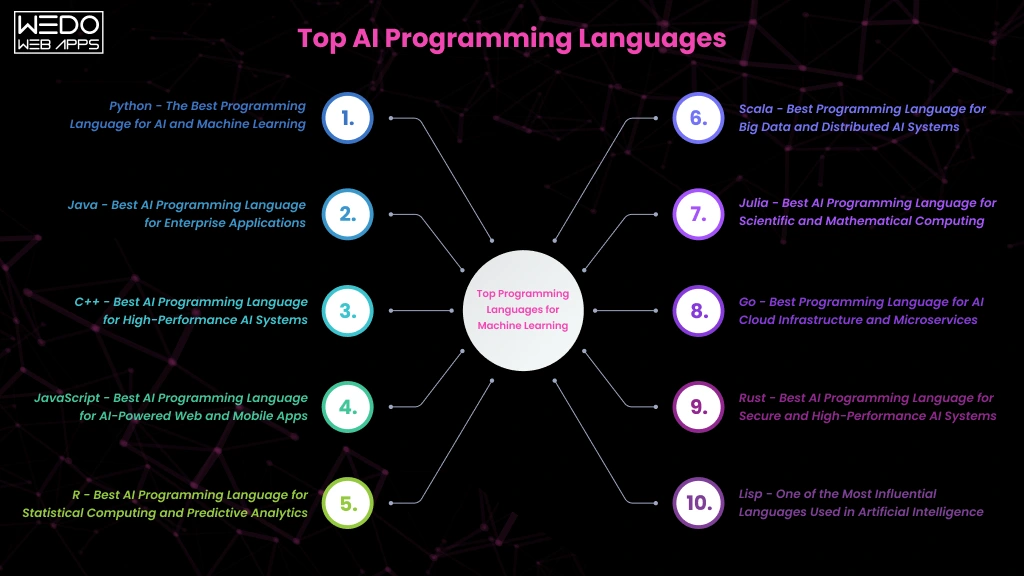
AI is on everyone’s lips these days. With tools like OpenAI’s Dall-E creating images from text and DeepMind using AI to predict protein structures, the possibilities seem endless. Even natural language processing is advancing, making chatbots and search engines smarter.

But with all this excitement, it can be tough to cut through the noise. The variety of programming languages and frameworks out there can be confusing. That’s why in this post, we’ll take a look at the top languages for AI development and help you figure out which one is right for your next project.

Best Programming Languages for AI 2024

Let’s take a look at why these AI programming languages are so popular and how they are used in different scenarios.

1. Python

Python is a favorite in the AI community, mainly because of its strong data visualization and analytics capabilities. Its straightforward and easy-to-read syntax makes it a popular choice among data scientists and analysts.

One of the great things about Python is its automatic memory management, thanks to garbage collection. Plus, since it’s an interpreted language, you can quickly develop and test your code without needing to recompile.

Python shines in scientific computing with libraries like NumPy, which provide excellent support for working with matrices and running complex AI algorithms, such as statistical models and neural networks.

Moreover, Python offers a wealth of AI-focused libraries and frameworks like scikit-learn, TensorFlow, and PyTorch, making it easier to handle machine learning, deep learning, and building neural networks.

How is Python Used in AI?

Python is incredibly popular in the AI world. It’s used for everything from machine learning systems and computer vision applications to natural language processing. If you’re building predictive models, neural networks, or diving into deep learning, Python is the way to go. It’s also perfect for tasks like image recognition, face detection, chatbots, and document analysis.

However, keep in mind that Python might not be the best choice for computationally intensive tasks. For those, you’ll need to consider your project requirements carefully and possibly look at other languages.

2. R Language 

R is the preferred language for statistical computing and is extensively used in data science. It’s particularly powerful for AI algorithms that rely on statistical techniques, such as probabilistic modeling, simulations, and data analysis.

R’s rich ecosystem of packages is perfect for manipulating and visualizing data, which is crucial for AI development. The caret package, for instance, boosts machine learning capabilities with its preprocessing and validation options.

Additionally, R allows for creating custom data visualizations and professional graphics through the flexible layered grammar of graphics concepts offered by ggplot2. The TensorFlow for R package makes it possible to implement scalable, production-grade deep learning by leveraging TensorFlow’s robust capabilities.

How is R Used in AI?

R is widely used for various statistical machine learning tasks, such as Naive Bayes and random forest models. It’s great for data mining, creating association rules, clustering data, and dimensionality reduction. When it comes to time series forecasting, R shines with ARIMA and GARCH models, as well as multivariate regression analysis.

R is also a go-to for risk modeling techniques, from generalized linear models to survival analysis. In bioinformatics, it’s used for sequencing analysis and statistical genomics.

R is perfect for early-stage experimentation and research. However, it’s not the best choice for later stages like deploying machine learning models into real-world products, as it lacks compilers and memory management. It also has a learning curve for those outside the data science field.

3. Java 

Java is a popular choice for AI systems that need to integrate with existing business setups and runtimes. The JVM lets you deploy AI while keeping the code compatible. Java’s extensive ecosystem offers a wealth of libraries, tools, stable runtimes, a large community of developers, and cross-platform portability. This makes it easy to build and deploy AI applications that work seamlessly across different hardware and software.

For example, DeepLearning4j supports neural network architectures on the JVM. The Weka machine learning library provides a range of algorithms for classification, regression, and clustering, while Mallet brings natural language processing capabilities to AI systems.

How is Java Used in AI?

Java is ideal for creating standalone AI agents and integrating analytics into business software. It’s used in monitoring and optimization scenarios, such as predictive maintenance and performance tuning agents. With Java’s libraries for natural language processing, you can develop conversational interfaces like chatbots and voice assistants.

Java also powers recommendation engines, helping to suggest relevant products and target advertising effectively.

Java is a great choice for large business AI systems that need to turn algorithms into reliable software. Its speed, reliability, and cross-device compatibility make it an excellent option.

4. C++

For deploying AI models in low-latency production environments, C++ is a great choice. As a compiled language with direct memory control, C++ can run machine learning programs quickly and efficiently. This makes it perfect for AI projects requiring significant processing power.

C++ code can be compiled into standalone executable programs, ensuring high performance across all operating systems and chips like Intel and AMD. This means you can deploy complex AI software reliably and with hardware acceleration anywhere.

In terms of libraries, the TensorFlow C++ interface lets you directly use TensorFlow’s machine learning capabilities. Caffe2 is ideal for deep learning tasks, while ONNX provides a standard for exchanging neural networks, making it easy to switch models between tools. Additionally, OpenCV offers crucial building blocks for computer vision projects.

How is C++ Used in AI?

C++ is ideal for scenarios that require millisecond latency and scalability, such as high-frequency trading algorithms, autonomous robotics, and embedded appliances. It’s also great for production environments that need large-scale or latency-sensitive inferencing due to its speed. Additionally, C++ works well alongside Python, making it possible to prototype in Python and then deploy high-performance applications with C++.

Using both C++ and Python together is a good idea for building scalable AI prototypes.

5. Julia

Julia uses a multiple dispatch technique to make functions more flexible without slowing them down. It’s also great for parallel programming and using many cores efficiently. Whether you’re running multiple threads on one machine or distributing tasks across many machines, Julia handles it smoothly.

One of the best things about Julia is that it works well with existing Python and R code. This means you can take advantage of the mature libraries from Python and R while benefiting from Julia’s strengths.

Julia’s key libraries for data manipulation (DataFrames.jl), machine learning (Flux.jl), optimization (JuMP.jl), and data visualization (Plots.jl) are continually improving. The IJulia project also integrates Jupyter Notebook functionality, making it easy to use.

How is Julia Used in AI?

Julia is quickly becoming a favorite for data science prototyping, with results often later moved to Python for production. It excels in areas that require heavy computation, such as scientific simulations and models, bioinformatics and computational biology research, time series analysis, and signal processing workflows. Julia’s strong mathematical capabilities and high performance make it a valuable tool for engineers, scientists, and analysts.

6. JavaScript

JavaScript is great for adding AI to websites and web apps. It makes it easy to build AI features using the same language you use for web development. This is why it’s popular for full-stack development and integrating AI into web interactions.

JavaScript’s event-driven model lets you update pages and handle user inputs in real-time without any lag. It’s also flexible, allowing for quick prototyping because it doesn’t require strict typing.

For libraries, TensorFlow.js lets you use Google’s ML framework in the browser and with Node.js. Brain.js offers neural networks for deep learning, while Synaptic.js provides flexible neural networks. Node-RED makes it easy to integrate models with its visual workflow.

How is JavaScript Used in AI?

JavaScript toolkits can bring advanced ML features to the browser, such as analyzing images and speech right on the client side without needing backend calls. Node.js makes it easy to host and run machine learning models using serverless architectures.

Using frameworks like React Native, JavaScript helps build AI-driven interfaces for web, Android, and iOS from a single codebase. While GPU acceleration and other specialized libraries in lower-level languages are better for training complex models, JavaScript’s versatility makes it ideal for adding intelligent features to media-rich applications.

7. Lisp

Lisp is a powerful language known for its use in rule-based AI applications and logical reasoning. It can represent both code and data in the same structures, and it can even modify its own code while running through metaprogramming.

The syntax of nested lists in Lisp makes it easy to analyze and process, which is crucial for modern machine learning. Modern versions of Lisp keep its core strengths while adding useful features like memory management.

For dialects and ecosystems, Clojure brings Lisp’s capabilities to Java virtual machines. CLIPS helps in building expert systems. By connecting with TensorFlow, Lisp can now use modern techniques like neural networks while keeping its symbolic strengths.

How is Lisp Used in AI?

Lisp is great for AI systems that need to handle complex symbolic knowledge or logic, such as automated reasoning, natural language processing, game-playing algorithms, and logic programming. It represents information as code and data symbols, making it easy to encode concepts and rules for AI applications.

While it was a pioneer in AI, Lisp has become less popular compared to statistical machine learning and neural networks. However, it is still perfect for expert systems and decision-making logic that rely on symbolic reasoning instead of data models.

Lisp’s ability to rewrite its own code also makes it highly adaptable for automated programming applications.

8. Haskell

Haskell is a purely functional programming language that relies on mathematical functions for AI algorithms. By avoiding side effects within functions, it helps reduce bugs and makes verification easier, which is important for safety-critical systems.

One of the best things about Haskell is its lazy evaluation, meaning it only runs calculations when necessary, which boosts efficiency. It also allows you to easily create and reuse AI components.

Haskell offers libraries like HLearn and LambdaNet for machine learning and neural networks. It also provides Haxcel and BayesHaskell for support with linear algebra and probability math.

How is Haskell Used in AI?

Haskell is a great choice for AI systems that rely on logic and symbolism, such as proving theorems, constraint programming, probabilistic modeling, and combinatorial search. It elegantly translates mathematical specifications into running code, making it a good match for how data scientists define AI algorithms.

With its strong foundations and robust data types, Haskell offers both correctness and flexibility for math-heavy AI tasks.

For quality-critical AI applications that need verifiable logical representation, Haskell is a solid option.

9. Prolog

Prolog is a logic programming language that uses facts and rules to encode knowledge, similar to how humans organize information. It automatically draws conclusions by connecting these logical declarations.

This query-based, declarative approach makes it easier to focus on high-level AI goals rather than detailed step-by-step procedures.

For libraries and frameworks, SWI-Prolog is a popular open-source implementation. For advanced probabilistic reasoning, ProbLog allows you to include uncertainty in your logic. Libraries like DeepLogic combine traditional Prolog with deep neural networks, integrating symbolic and differentiable components.

How is Prolog Used in AI?

Prolog is excellent for AI systems that need to represent and reason with knowledge, such as expert systems, intelligent agents, formal verification, and structured databases. Its declarative approach makes it easy to model complex logical constraints and automate tasks through logic programming.

For creating explainable, rule-based AI systems that can verify and validate models or capture detailed relational knowledge, Prolog is a great choice.

10. Scala

Scala blends object-oriented and functional programming, allowing you to use classes and methods for modular data abstraction while benefiting from mathematical clarity through pattern matching and immutability.

Its advanced type system uses inference for flexibility and ensures robustness through static checking. Scala also supports asynchronous processes, making it easier to distribute AI workloads across parallel infrastructure.

Specialty libraries enhance Scala’s AI capabilities. ScalNet provides neural networks, Breeze handles numerics, and it supports distributed machine learning on Spark. Scala also integrates well with Java ecosystems like DeepLearning4J. This combination of advanced language features and a rich technology stack makes Scala highly productive for AI development.

How is Scala Used in AI?

Scala is great for deploying machine learning models into high-performance production environments. It supports real-time model serving and building streaming analytics pipelines, along with distributed data processing and robust feature engineering.

Scala works well with big data tools like Spark, which speeds up the math transformations used in many machine learning techniques. This integration helps create scalable, DevOps-ready AI applications using a single, reliable language.

Comparative Analysis of Best AI Programming Languages

Language Strengths Weaknesses Usability Common AI Applications Examples of AI Applications
Python Easy to learn, lots of libraries, very productive Can be slow, threading issues with GIL High, great for beginners and experts Machine learning, computer vision, natural language processing Siri, Alexa, Tesla Autopilot
R Excellent for statistical modeling and analysis Not a general-purpose language, hard to learn Moderate, best for data scientists Statistical analysis, data mining IBM Watson Analytics, Google BigQuery ML
Java Works on many platforms, ready for enterprise use, strong typing Verbose code, not specialized for AI Moderate, good for production environments Search algorithms, natural language processing, enterprise AI Google Search, Cortana, Banking APIs
C++ Very fast, efficient, good control over hardware Complex, hard to learn Hard, for advanced developers Optimized machine learning applications, robotics Stock trading systems, self-driving cars
Julia Very fast, great for math and numerical analysis Newer language, smaller community Moderate, similar to Python Data science, numerical analysis Used by a central bank in the US and the NY Fed for ML modeling
JavaScript Widely used, great for full-stack web development Not the best for math and machine learning Moderate, mainly for front-end use Browser-based machine learning, Node.js backends Chrome ML image search, Angular recommendation engine
Lisp Great for symbolic AI, treats code as data Not widely used today, fewer libraries Moderate, niche use Early AI research, pattern recognition SPIKE, the planning tool for the Hubble Space Telescope
Haskell Purely functional, strong type safety Abstract, not widely used for AI Hard, niche research use Theoretical machine learning research Meta’s Sigma platform for handling over a million requests per second
Prolog Excellent for logic programming, pattern matching Limited use and libraries Moderate, uses a declarative style Expert systems, natural language processing Small Prolog interpreter for network setup in Microsoft Windows NT
Scala Combines Java’s strengths with functional programming Hard to learn Moderate, good for big data Machine learning on Spark, distributed systems eSentire uses Scala for real-time cybersecurity solutions

Choosing the Best AI Programming Language for Your Needs

Selecting the right AI programming language depends on your specific goals and use case since different languages are suited for different tasks.

For example, Python is a great choice for most AI applications, thanks to frameworks like TensorFlow and PyTorch. However, if you’re working on specialized systems that require a lot of computational power, you might want to consider languages like C++, Java, or Julia.

Think about your needs, and don’t hesitate to use more than one language if necessary. Focus on making your AI systems work well together. Make smart choices that fit your long-term goals and use good design principles to create AI solutions that are ready for the future.

Discovering the Next Best Thing: Alternatives to Replika

In the ever-evolving landscape of technology, artificial intelligence (AI) has made significant strides, particularly in the realm of personal companionship apps. Replika stands out as a pioneering platform in this space, providing users with a conversational agent capable of mimicking human-like interaction. However, as the demand grows, so does the search for apps like Replika that deliver similar or even enhanced experiences. This article will explore the multifaceted world of AI companionship, examining various alternatives to Replika and their unique offerings.

In the rapidly evolving landscape of artificial intelligence (AI), apps like Replika have carved out a unique niche. These AI-driven companions offer conversation and interaction that can mimic human empathy and understanding, providing a fascinating glimpse into the future of human-AI relationships. But Replika is not alone in this journey. The digital world is brimming with innovative apps that promise to enhance our lives through AI technology. At WeDoWebApps, we’ve explored the horizon of AI applications, uncovering alternatives that share Replika’s vision of personal AI interaction.

The Rise of AI Companionship Apps

AI technology has made leaps and bounds, moving from simple automated tasks to complex emotional intelligence. Apps like Replika represent the forefront of this transition, offering users not just a service, but a relationship. For those curious about the technology behind these interactions, our article on AI App Development in 2024 sheds light on the latest trends and innovations driving these personal companions.

In an age where digital interaction is as commonplace as face-to-face encounters, AI companionship apps have carved a niche for themselves. Replika, with its sophisticated chatbot technology, has paved the way for a new type of digital interaction. These apps have not only become a source of entertainment but also a solace for those seeking empathy and a listening ear. The market’s expansion for apps akin to Replika is a testament to the changing dynamics of human-digital relationships.

The appeal of Replika lies in its ability to simulate human-like conversations, offering a sense of companionship that is often lacking in the fast-paced digital age. This appeal has led to the development of a range of AI-driven applications that promise to offer a similar sense of connection and understanding.

Beyond Replika: A Universe of AI

While Replika might be one of the most well-known names in the realm of AI companions, it’s just the tip of the iceberg. The digital universe is teeming with apps designed to educate, entertain, and even assist with mental health. For instance, our exploration of Innovative Mobile App Ideas for Restaurants showcases how AI can transform customer service and operational efficiency in the hospitality industry.

The Future of AI in Everyday Life

The integration of AI into our daily lives is becoming more seamless and intuitive. From smart home devices to AI-driven healthcare solutions, the potential for AI to improve every aspect of our lives is immense. Our deep dive into the Potential of E-commerce Development Companies illustrates how AI is revolutionizing the way we shop, offering personalized experiences that were once the domain of science fiction.

Navigating the AI Landscape

As we stand on the brink of a new era in technology, it’s essential to stay informed about the advancements and opportunities presented by AI. Whether you’re a developer looking to create the next big AI app or a user curious about the latest AI companions, resources like WeDoWebApps offer valuable insights and guidance. For those interested in the technical side of AI development, our article on Hiring an App Developer: A Guide provides a comprehensive overview of what to look for in a developer specializing in AI applications.

Defining AI in the Context of Personal Apps

AI, in the context of personal companion apps, transcends the traditional boundaries of machine functionality. It encapsulates the essence of human-like responsiveness, learning from interactions to deliver increasingly personalized experiences. Chatbots like Replika have pushed the envelope, demonstrating that AI can not only perform tasks but also engage in meaningful dialogue.

This interaction is made possible through a complex web of algorithms and machine learning techniques, allowing these AI companions to mimic emotional intelligence and engage users on a deeper level.

Personalization in AI Companionship Apps

Personalization is the cornerstone of any successful AI companionship app. It’s not just about responding to user inputs but also understanding and adapting to individual preferences and behaviors. This level of customization enhances the user experience, fostering a deeper bond between the AI companion and the user.

Machine learning plays a crucial role here, as it enables AI companions to learn from past interactions, thus improving future communications. The more a user interacts with the app, the more personalized the responses become.

Top Alternatives to Replika for AI Interaction

While Replika may be one of the most well-known AI companionship apps, there are numerous others that offer varied features that may appeal to different users. These alternatives are not just clones of Replika; they bring their own unique twist to AI companionship.

Some apps focus more on mental wellness, offering therapeutic conversations, while others might emphasize language learning or provide entertainment through gamified interactions. Users are encouraged to explore these options to find the AI companion that best suits their needs.

Cognitive Abilities of Competing AI Apps

Competing AI apps have focused on enhancing cognitive abilities to stand out in the crowded market. They aim to understand context and emotions better, providing responses that are not only relevant but also empathetic.

The cognitive sophistication of these apps is often reflected in their ability to handle complex conversations and provide thoughtful insights, mirroring the nuances of human interaction.

User Engagement and Retention Strategies

To keep users coming back, AI companionship apps employ various engagement and retention strategies. Gamification elements, such as earning rewards for regular interaction, add a layer of fun to the experience.

Additionally, community features allow users to connect with others, sharing their experiences and forming bonds over their shared interest in AI companionship. This sense of community not only retains users but also helps in attracting new ones.

Privacy and Security in AI Companionship Apps

In a world where digital privacy is of paramount importance, apps like Replika must ensure the highest standards of user data protection. These apps are often privy to personal conversations and sensitive information, making security a top priority.

Users are advised to review the privacy policies of these apps carefully, ensuring that their data is handled responsibly and securely.

**The Future of AI Apps

in Daily Life** The trajectory of AI companionship apps suggests a future deeply integrated with daily life. Predictions for the next generation of AI companions hint at even more seamless interactions, possibly through augmented reality (AR) or virtual reality (VR), bringing digital companions into a more tangible realm.

This integration promises to further blur the lines between human and AI interaction, offering companionship in more immersive and interactive ways.

Customization and User Control in AI Companions

A successful AI companion app offers extensive customization options, allowing users to tailor the personality and responses of their digital companion. This degree of control enhances the user experience, making the interactions feel more personal and genuine.

User feedback is integral to the development of these apps, ensuring they evolve in a direction that consistently meets user expectations and preferences.

AI Companions in Mental Health Support

Some AI apps, like Replika, have ventured into the mental health domain, offering conversations designed to provide emotional support. These apps are not substitutes for professional therapy but serve as a supplementary tool for those seeking solace and a non-judgmental space to express themselves.

User testimonials often highlight the therapeutic effects of such interactions, showcasing the potential of AI companions in supporting mental well-being.

Innovations and Technological Advancements

The field of AI companionship is ripe with innovation. Newer apps are introducing features that push the boundaries of what AI can do, from detecting emotional tone to providing more contextually aware responses.

These advancements are a glimpse into the future of technology, where AI companions could become indistinguishable from human interaction in complexity and empathy.

AI Companions for Children and Education

AI companions are also finding a place in children’s education, offering interactive learning experiences. These educational AI apps engage children in conversations that can aid in language development and critical thinking skills.

However, the responsibility of safeguarding children’s privacy in these interactions is paramount. Developers must ensure that these educational tools are not only effective but also secure.

The Integration of AI Companions in Social Media

AI companions are beginning to play a role in social media, enhancing how users connect and interact online. They can offer new ways to engage with content and communities, providing personalized recommendations and facilitating discussions.

As AI becomes more prevalent in social media, it will be interesting to observe how these digital interactions influence online social dynamics.

Monetization Models for AI Companionship Apps

The monetization of AI companionship apps can take various forms. While some opt for a subscription model, others may offer a free basic service with the option to purchase additional features.

Understanding the different monetization strategies can help users decide which app provides the best value for their needs and preferences.

Global Reach and Localization of AI Apps

The global appeal of AI companionship apps necessitates a focus on localization. Multilingual support and cultural adaptations are critical for these apps to resonate with users worldwide.

This global reach has the potential to not only expand the user base but also enrich the AI companionship experience with diverse perspectives.

Building Trust with AI Companions

Building trust between users and AI companions is crucial. Overcoming initial skepticism is often achieved through transparency in how the AI operates and the benefits it offers.

User stories and testimonials play a significant role in building this trust, providing real-world examples of positive interactions with AI companions.

Comparing the AI App Ecosystem

A comprehensive analysis of the AI companionship app market can provide insights into the strengths and weaknesses of various offerings. Competitor benchmarking helps users make informed decisions about which app best meets their needs.

This comparison not only informs users but also drives competition, spurring innovation and improvement across the industry.

Conclusion and Future Directions

AI companionship apps offer a blend of technology and empathy, creating digital spaces for users to find conversation, support, and entertainment. As the technology behind these apps continues to evolve, the future holds exciting possibilities for even more personalized and engaging AI interactions.

The exploration of alternatives to Replika is not just about finding a substitute; it’s about discovering a companion that resonates with individual needs and preferences, enhancing the human experience through the power of AI.

Global Presence

wedowebapps-usa-hq-new-jersey-map
usa-location-icon USA
address-icon-img HQ : 21 Charles St, Clifton,
New Jersey, 07013.
wedowebapps-usa-hq-new-jersey-map
usa-location-icon USA
address-icon-img BO : 450 Paradise Isle Blvd Suite 306 Hallandale Beach, Florida 33009.
wedowebapps-uk-london-office-map
address-icon-img 2 Garrick Rd, London
NW96AA, UK.
wedowebapps-australia-melbourne-office-map
address-icon-img 70 Everton Road , Truganina
Victoria 3029
wedowebapps-canada-ontario-office-map
address-icon-img 14 Alfredo Ave, Brampton,
Ontario Canada L6P 1K1
wedowebapps-india-ahmedabad-office-map
India-location-icon INDIA
address-icon-img A 706/707 Empire Business Hub, Science City Road, Ahmedabad – 380060
Call Mail Whatsapp