Introduction
A single software bug can delay releases, frustrate users, and increase development costs within hours. That is why modern businesses no longer treat testing as the final step of development. Instead, they rely on agile testing methodology to test software continuously during every sprint and release cycle.
A well-structured agile software testing process helps teams identify issues early and improve collaboration between developers and QA teams. This delivers faster updates without affecting product quality. Along with this, continuous testing in agile and strong agile QA process practices allows businesses to validate code changes in real-time and maintain stable application performance.
As applications become more complex, companies are also adopting technical agile testing methodology supported by automation, API testing, regression testing, and CI/CD workflows. By following proven agile testing principles, teams can release reliable software faster while reducing testing bottlenecks and production risks.
In this guide, you will learn how agile testing works, its core principles, technical testing practices, and the best approaches for managing quality in modern software development.

What Is Agile Testing Methodology?
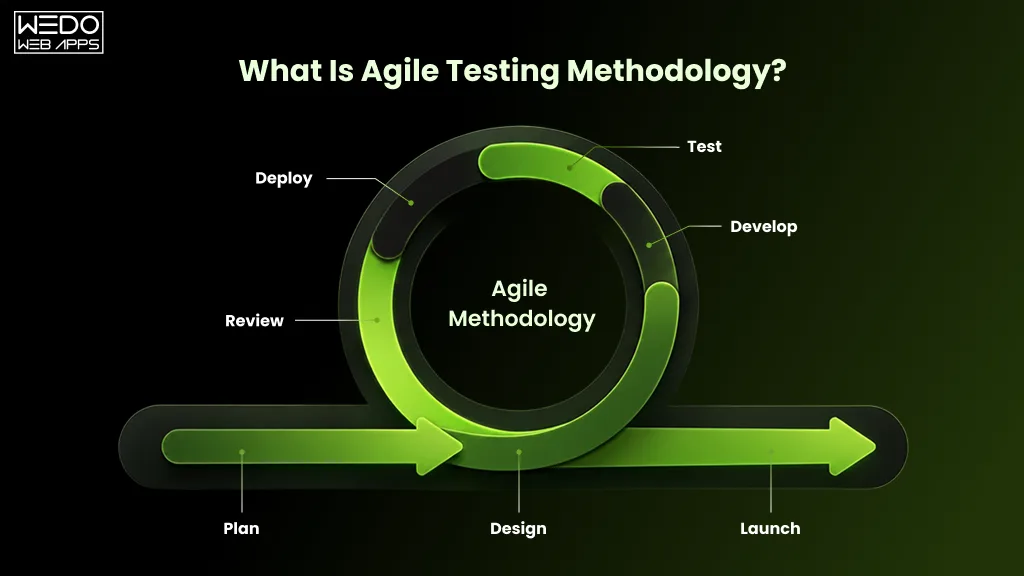
Agile testing methodology is a software testing approach where testing happens continuously throughout the development cycle instead of waiting until the project is completed. It works closely with agile development practices, where developers, testers, and product teams collaborate during every sprint to identify and fix issues early.
Unlike traditional testing methods, agile testing focuses on quick feedback, continuous improvement, and faster software delivery. Every new feature is tested during development, which helps teams maintain the product quality while releasing updates more frequently.
Key goals of the agile software testing process include:
- Detecting bugs early before they affect production.
- Improving collaboration between QA and development teams.
- Supporting faster and more stable software releases.
- Adapting quickly to changing project requirements.
- Maintaining better product quality during continuous updates.
A strong agile QA process also combines manual testing, automation testing, and real-time validation to reduce delays and improve testing efficiency. This approach has become important for businesses that follow rapid release cycles and modern CI/CD workflows.
What Is Technical Agile Testing Methodology?
Technical agile testing methodology is a testing approach that focuses on validating the technical quality of software throughout the agile development cycle. Instead of testing only at the final stage, technical testing is performed continuously during every sprint to identify issues early and maintain stable software performance.
This approach combines automation, continuous testing, and collaboration between developers and QA teams. It helps businesses release software faster while reducing production risks and quality-related issues.
Understanding Technical Testing in Agile
In agile development, technical testing runs alongside coding activities during every sprint. Teams continuously validate application behavior, integrations, APIs, and system performance while new features are being developed.
Technical validation during sprints helps teams:
- Detect defects before deployments.
- Reduce last-minute testing delays.
- Improve software stability.
- Support faster release cycles.
- Maintain better product performance.
A strong agile software testing process also integrates testing directly into the development workflow. This allows QA engineers and developers to identify issues in real-time instead of waiting for separate testing phases.
Core Components of Technical Agile Testing
Modern technical agile testing methodology includes several testing practices that improve software reliability and release quality.
Important components include:
- Automated functional testing.
- API testing and integration validation.
- Performance and load testing.
- CI/CD pipeline testing.
- Continuous regression testing.
- Security and compatibility testing.
These practices support continuous testing in agile and help teams maintain application quality during rapid development cycles.
How Technical Teams Collaborate in Agile
Agile testing depends heavily on collaboration between technical teams. Developers, testers, DevOps engineers, and product owners work together throughout the sprint instead of operating in separate phases.
This collaboration helps teams:
- Resolve defects faster.
- Improve communication between QA and development.
- Maintain shared ownership of software quality.
- Reduce testing bottlenecks.
- Deliver stable releases more consistently.
A well-managed agile QA process ensures testing becomes part of everyday development activities rather than a final checkpoint before release.

Agile Testing Principles Every Team Should Follow
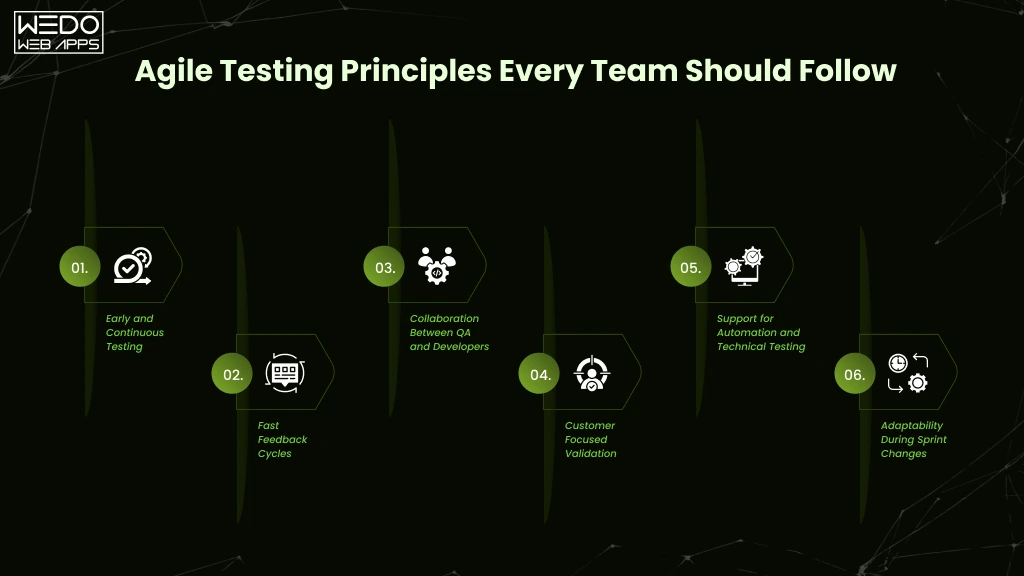
Successful agile projects are not built only on faster development. They depend on strong testing practices that help teams maintain software quality during continuous releases. This is where agile testing principles play an important role.
These principles help teams improve collaboration, reduce testing delays, and identify issues early in the development cycle.
Early and Continuous Testing
One of the most important agile testing principles is testing early and testing continuously. Teams validate features during development instead of waiting for the final release stage.
This supports:
- Faster bug detection
- Better sprint quality
- Reduced production issues
- Improved release confidence
This approach is also a core part of continuous testing in agile environments.
Fast Feedback Cycles
A strong agile QA process focuses on quick feedback between developers, testers, and stakeholders. Faster validation helps teams resolve issues immediately and avoid delays during sprint completion.
Collaboration Between QA and Developers
In a modern agile software testing process, QA teams and developers work together throughout the project lifecycle. This collaboration improves communication, reduces testing gaps, and increases overall product quality.
Customer Focused Validation
Agile testing ensures every feature is validated according to business goals and user expectations. Teams continuously test whether the application delivers the expected user experience and functionality.
Support for Automation and Technical Testing
Modern technical agile testing methodology relies heavily on automation, regression testing, API validation, and CI/CD-based quality checks. These practices help teams manage large applications with faster and more accurate testing.
Adaptability During Sprint Changes
Project requirements often change during agile development. Agile testing principles support flexibility, allowing teams to quickly update test cases, priorities, and testing workflows without affecting delivery timelines.
Agile Software Testing Process Explained
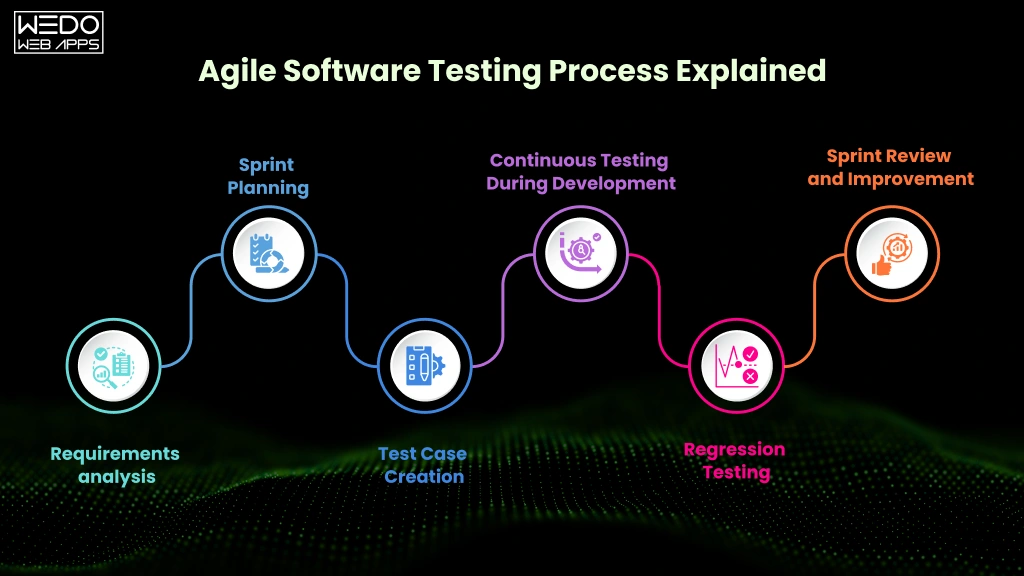
The biggest difference between traditional testing and an agile software testing process is timing. In traditional models, testing usually starts after development is completed. In agile development, testing is part of the sprint from day one. Every feature is checked, improved, and validated while the product is still being built.
This approach helps teams release updates faster without waiting for long testing cycles at the end of development.
Here is how the process typically works:
1. Requirement Analysis
Before development starts, QA teams review user stories, business goals, and feature requirements. This helps testers understand what needs validation and identify possible risks early.
2. Sprint Planning
Developers and testers plan sprint activities together. Teams decide:
- What features will be tested?
- Which test cases are needed?
- What should be automated?
- Testing priorities for the sprint.
This step keeps the agile QA process aligned with development goals.
3. Test Case Creation
QA teams prepare manual and automated test cases based on expected user behavior. In many projects, automation scripts are also created during this stage to support continuous testing in agile workflows.
4. Continuous Testing During Development
As developers write code, QA teams simultaneously validate features through:
- Functional testing
- API testing
- Integration testing
- Technical testing in agile environments
This reduces the chances of major defects appearing near release deadlines.
5. Regression Testing
Every new update can affect existing functionalities. Regression testing ensures previous features continue working properly after new code changes are introduced.
This is one of the most important parts of the technical agile testing methodology because it protects application stability during rapid releases.
6. Sprint Review and Improvement
At the end of the sprint, teams review completed work, validate software quality, and discuss areas for improvement. This continuous feedback loop helps improve future sprint performance and testing accuracy.

Continuous Testing in Agile Development
Speed without testing often leads to unstable releases. Modern development teams push updates frequently, which makes manual validation alone difficult to manage. This is where continuous testing in agile helps businesses maintain software quality without slowing down development cycles.
Instead of waiting until the final stage, teams test applications continuously during development, integration, and deployment. This helps identify issues early and reduces the risk of production failures.
What Continuous Testing Means
Continuous testing in agile is the process of automatically validating software throughout the development lifecycle. Every code change is tested immediately to ensure new updates do not affect existing functionality.
This testing approach supports:
- Faster feedback
- Early defect detection
- Stable sprint deliveries
- Improved software reliability
It also plays an important role in a modern agile software testing process, where rapid releases and continuous improvements are part of daily development activities.
How Continuous Testing Works in CI/CD
In CI/CD environments, automated tests are connected directly with the development pipeline, while cloud computing solutions can provide scalable environments for testing and deployment. Whenever developers commit new code, the system automatically triggers testing workflows.
This process may include:
- Functional testing
- API validation
- Regression testing
- Integration testing
- Performance checks
If issues are detected, teams can resolve them immediately before deployment. This improves release confidence and reduces production risks in technical agile testing methodology workflows.
Benefits of Continuous Testing in Agile
Businesses use continuous testing because it improves both development speed and software quality.
Main benefits include:
- Faster release cycles with fewer delays.
- Reduced production bugs and development failures.
- Better code quality during rapid development.
- Faster defect resolution.
- Improved collaboration between QA and developers.
It also strengthens the overall agile QA process by making testing part of every sprint activity.
Popular Tools Used for Continuous Testing
Many agile teams use automation and testing tools to support continuous validation workflows.
Popular tools include:
- Jenkins for CI/CD automation.
- Selenium for automated web testing.
- Postman for API testing and validation.
- JUnit for unit testing in Java applications.
How the Agile QA Process Works
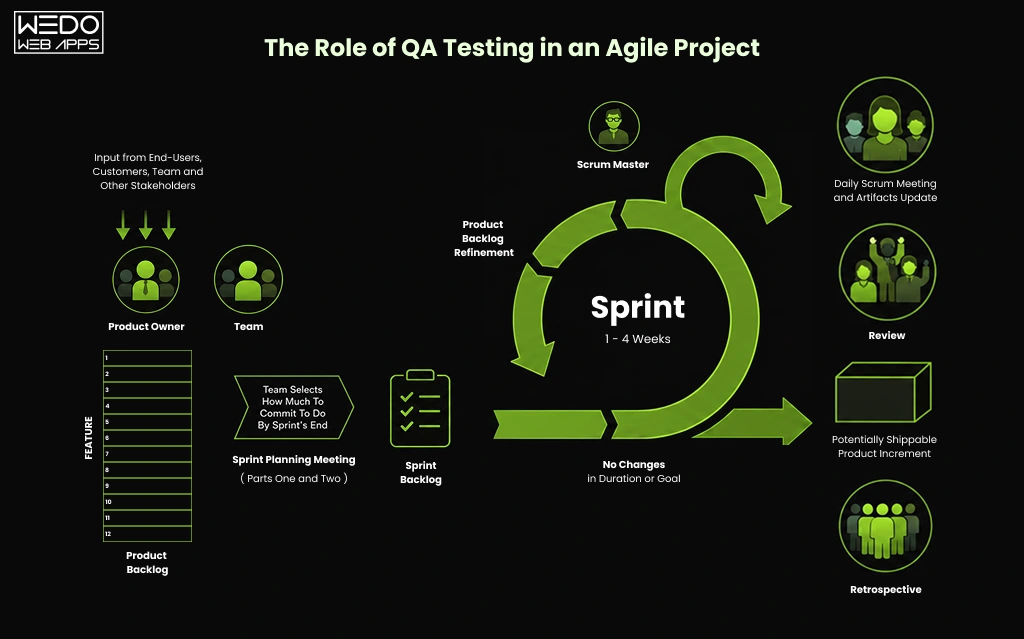
In agile development, QA is not limited to finding bugs after coding is completed. A modern agile QA process focuses on maintaining product quality throughout the entire sprint. QA teams work closely with developers from planning to deployment, helping businesses reduce delays and improve release stability.
This approach makes testing faster, more collaborative, and better aligned with business goals.
QA Involvement from Day One
QA teams participate from the early planning stage instead of joining only during testing phases. They review user stories, identify testing requirements, and help define acceptance criteria before development begins.
Early involvement helps:
- Reduce requirement misunderstandings
- Identify risks sooner
- Improve testing accuracy
- Support smoother sprint execution
Daily Collaboration During Sprints
A strong agile software testing process depends heavily on collaboration between developers and QA engineers. Teams communicate regularly during standups, sprint reviews, and testing activities to resolve issues quickly.
This continuous coordination improves:
- Sprint visibility
- Testing speed
- Defect tracking
- Release quality
Defect Tracking and Reporting
In agile environments, bugs are identified and resolved continuously during development. QA teams track defects, document issues, and work closely with developers for faster resolution.
This helps teams avoid large testing backlogs near release deadlines.
Acceptance Testing in Agile
Before a feature is marked complete, QA teams validate whether it meets business requirements and expected user behavior. Acceptance testing ensures the delivered functionality works properly from both a technical and user perspective.
Automation in Agile QA Process
Modern technical agile testing methodology also includes automation testing to support rapid sprint cycles. Automated testing helps teams validate repetitive test cases faster and improves the efficiency of continuous testing in agile workflows.
Common automation areas include:
- Regression testing
- API testing
- Functional validation
- CI/CD testing workflows
Types of Technical Testing in Agile
Modern applications handle a large amount of user data, integrations, and real-time interactions. Because of this, teams cannot rely on only one testing method during agile development. A strong technical agile testing methodology includes multiple testing types that work together to improve software stability, security, and performance.
Each testing type focuses on a different area of the application and helps teams identify issues before deployment.
Functional Testing
Functional testing checks whether application features work according to business requirements. QA teams validate user actions, workflows, and expected outputs during every sprint.
This is one of the most common parts of an agile software testing process.
API Testing
Modern applications depend heavily on APIs for communication between systems and services. API testing validates data flow, response accuracy, authentication, and integration behavior.
It also helps teams detect backend issues early before they affect the user interface.
Regression Testing
When new features are added, existing functionalities can sometimes break unexpectedly. Regression testing ensures older features continue working properly after code updates.
This testing type is essential for continuous testing in agile environments where applications are updated frequently.
Performance Testing
Performance testing checks how the application behaves under different workloads and traffic conditions. Teams analyze:
- Application speed
- Server response time
- Stability under heavy usage
- Scalability during peak traffic
This helps businesses maintain a smooth user experience during high demand.
Security Testing
Security testing identifies vulnerabilities that may expose sensitive user or business data. Agile teams regularly validate authentication systems, access controls, and data protection mechanisms to reduce security risks.
Usability Testing
Usability testing focuses on user experience and interface behavior. QA teams evaluate whether the application is easy to use, responsive, and aligned with customer expectations.
A balanced agile QA process combines all these testing methods to improve software quality while supporting faster release cycles.
Agile Testing Methodology vs Traditional Testing
The biggest difference between traditional testing and agile testing methodology is how and when testing happens during software development. Traditional testing usually begins after development is completed, while agile testing runs continuously throughout the project lifecycle.
This shift allows agile teams to identify issues earlier, improve collaboration, and release updates faster without waiting for long testing phases.
Key Difference Between Agile and Traditional Testing
| Agile Testing Methodology | Traditional Testing |
|---|---|
| Testing happens during every sprint | Testing starts after development |
| Continuous feedback and validation | Delayed feedback cycles |
| Faster bug detection | Issues found later in the project |
| Strong collaboration between QA and developers | Separate development and testing teams |
| Supports automation and CI/CD workflows | Mostly manual testing processes |
| Flexible with changing requirements | Difficult to adapt to requirement changes |
Which Approach Works Better for Modern Development?
For businesses managing frequent releases and evolving customer demands, agile testing offers better flexibility and faster delivery cycles. A modern agile software testing process helps teams adapt quickly, improve software quality, and reduce production risks during continuous deployments.
Traditional testing can still work for projects with fixed requirements and longer development timelines. However, most modern applications rely on continuous testing in agile and automation-driven workflows to maintain release speed and application stability.
Common Challenges in Agile Testing
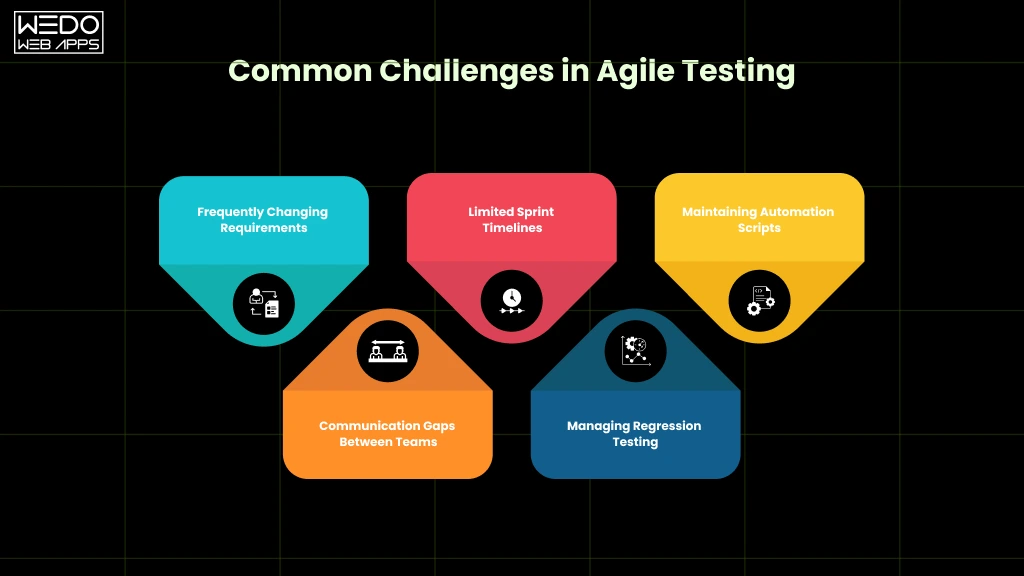
While agile testing methodology improves speed and collaboration, it also introduces several testing challenges for development teams. Frequent releases, changing requirements, and tight sprint timelines can make quality management difficult without a structured testing strategy.
Understanding these challenges helps teams improve their agile QA process and reduce delivery risks.
Frequently Changing Requirements
Agile projects often evolve during development. New features, user feedback, or business priorities can change sprint goals quickly. This makes it difficult for QA teams to maintain updated test cases and testing workflows.
Teams usually solve this challenge through:
- Flexible test planning
- Continuous communication
- Regular sprint reviews
Limited Sprint Timelines
Testing must be completed within short sprint cycles. Manual testing alone often becomes difficult when teams are releasing updates frequently.
This is why many businesses adopt:
- Automation testing
- Continuous integration workflows
- Faster regression testing practices
Maintaining Automation Scripts
In a modern technical agile testing methodology, automation plays an important role. However, frequent UI or feature changes may break automation scripts, increasing maintenance effort for QA teams.
Regular script updates and reusable test frameworks help reduce this issue.
Communication Gaps Between Teams
Agile development depends heavily on collaboration between developers, testers, and product teams. Poor communication can lead to:
- Missing test scenarios
- Delayed defect resolution
- Requirement misunderstandings
Daily standups and shared sprint planning help teams stay aligned throughout the development cycle.
Managing Regression Testing
As applications grow, regression testing becomes more time-consuming. Teams must continuously verify that new code changes do not affect existing functionalities.
This challenge is commonly managed through:
- Automated regression testing
- Prioritized test execution
- CI/CD-based testing pipelines
A strong agile software testing process helps businesses handle these challenges more effectively while maintaining product quality during rapid development cycles.
Best Practices for Agile Software Testing Process
A successful agile software testing process depends on more than fast development cycles. Teams also need clear communication, continuous validation, and well-managed testing workflows to maintain software quality during frequent releases.
Following the right testing practices helps businesses reduce delays, improve release stability, and strengthen the overall agile QA process.
Automate Repetitive Test Cases
Manual testing alone can slow down agile projects. Teams should automate repetitive tasks such as regression testing, API validation, and smoke testing to save time and improve testing accuracy.
Automation also supports faster continuous testing in agile environments.
Integrate Testing into CI/CD Pipelines
Testing should be connected directly with deployment workflows. Automated testing within CI/CD pipelines helps teams validate every code change before release and reduces production risks.
This practice is an important part of modern technical agile testing methodology.
Maintain Clear Communication Between Teams
Strong collaboration between developers, QA engineers, and product managers helps teams identify issues faster and reduce testing gaps during sprint execution.
Regular standups, sprint reviews, and shared reporting tools improve workflow transparency.
Prioritize Regression Testing
Frequent code updates can affect existing application functionalities. Regular regression testing helps teams maintain software stability and reduce unexpected failures after deployment.
Use Real-Time Reporting Tools
Real-time dashboards and defect tracking tools help teams monitor testing progress, identify blockers, and resolve issues quickly during active sprints.
Review and Update Test Cases Regularly
Agile projects change continuously, so testing strategies should also evolve with project requirements. QA teams should review and update test cases regularly to maintain testing accuracy and coverage.
Conclusion
Modern software development moves fast, and testing methods need to keep pace with it. Businesses can no longer rely on delayed testing cycles that identify issues only after development is completed. A well-planned agile testing methodology helps teams detect problems early, improve collaboration, and release software with greater confidence.
From continuous feedback cycles to automation-driven workflows, a strong agile software testing process supports faster releases without compromising product development. Practices such as continuous testing in agile, regression testing, API validation, and CI/CD-based quality checks help teams maintain stable application performance during frequent updates.
At the same time, adopting the right technical agile testing methodology and following proven agile testing principles allows businesses to reduce production risks, improve testing efficiency, and strengthen their overall agile QA process.
As applications continue to become more complex, agile testing is no longer optional for modern development teams. It has become an important strategy for building reliable, scalable, and high-performing software in competitive markets.