Introduction
A startup launches its platform using a backend framework that helps them build quickly and release faster. In the beginning, everything works smoothly – development moves fast, costs stay low, and new features roll out without major delays.
Then the product grows.
User traffic increases, APIs become heavier, integrations expand, and performance issues start appearing more often. The development team begins spending more time fixing scalability problems than building new features. Eventually, the business faces a difficult reality: the backend architecture that once supported growth is now slowing it down.
This is one of the biggest reasons why choosing the right backend framework has become a critical business decision for modern companies. The backend framework you select today can directly influence your application’s scalability, development speed, infrastructure costs, security, and long-term flexibility.
With dozens of backend frameworks for web development available in the market, businesses are no longer choosing technologies based only on popularity. Startups, enterprises, and digital product teams now evaluate backend development frameworks based on scalability potential, cloud compatibility, real-time capabilities, ecosystem maturity, and future business requirements.
From SaaS products and enterprise platforms to AI-powered applications and high-traffic digital ecosystems, every product has different backend architecture needs. A framework that works well for rapid MVP development may not always support enterprise-scale growth efficiently.
In this guide, we compare the leading backend frameworks in 2026, including their strengths, limitations, scalability capabilities, and ideal business use cases. This backend framework comparison will help you understand which technologies are best suited for building scalable, high-performance web applications in today’s competitive digital landscape.
Why Choosing the Right Backend Framework Matters for Modern Businesses
A Backend framework is no longer just a development tool; it directly affects how efficiently a business can build, scale, maintain, and expand its digital products. As applications become more complex, businesses are increasingly prioritizing backend frameworks for scalable applications that support long-term growth instead of short-term convenience.
Below are the key reasons why backend framework selection has become a strategic business decision:
1. Faster Product Development
The right backend development frameworks help development teams accelerate coding, simplify integrations, and reduce repetitive tasks. This allows businesses to launch MVPs, SaaS platforms, and enterprise applications faster while improving overall development efficiency.
2. Application Scalability
Modern applications must handle growing traffic, expanding databases, API requests, and real-time interactions without performance degradation. Leading backend frameworks are designed to support scalable architectures that can grow alongside business demands.
3. Long-Term Maintenance & Flexibility
Backend frameworks influence how easily applications can be upgraded, modified, or expanded in the future. Frameworks with strong ecosystems, modular architecture, and active community support help businesses reduce technical debt and simplify long-term maintenance.
4. Security & Compliance Readiness
Security vulnerabilities can create operational and reputational risks for businesses. Popular backend frameworks often include built-in security features, authentication support, and compliance-friendly architecture that strengthen application security.
5. Cloud & Microservices Compatibility
Businesses are increasingly adopting cloud-native infrastructure and microservices architecture for flexibility and scalability. Modern backend frameworks for web development now support containerization, distributed systems, and API-first development more effectively than traditional architectures.
6. Development Cost Optimization
The wrong backend framework can increase infrastructure expenses, slow down development cycles, and create future migration challenges. Choosing the right framework early helps businesses optimize both development and operational costs over time.
7. Better Performance for Modern Applications
Applications such as SaaS platforms, AI-powered systems, eCommerce platforms, and real-time applications require backend frameworks capable of processing large volumes of data efficiently. Performance optimization is now a critical factor in backend frameworks comparison.
8. Easier Hiring & Developer Availability
Framework popularity also affects hiring flexibility. Businesses often prefer backend frameworks with strong developer communities and large talent pools because they simplify recruitment, onboarding, and project scalability.
As businesses continue prioritizing scalability, performance, and faster innovation, selecting the best backend frameworks has become a foundational decision that influences both technical success and long-term business growth.
Key Factors to Evaluate Before Choosing a Backend Framework
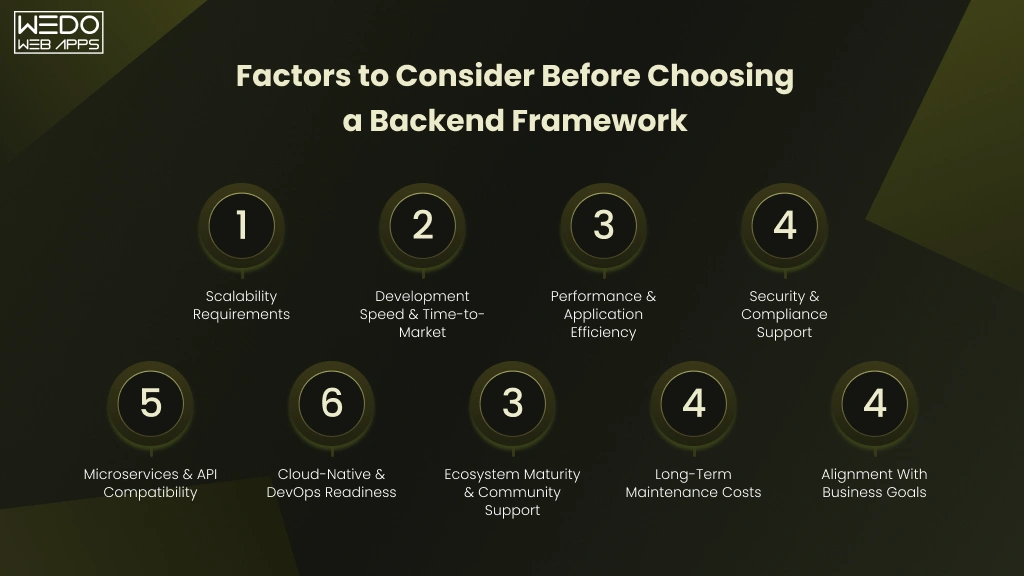
Not every backend framework is built for the same type of application. Some frameworks prioritize rapid development, while others focus on enterprise scalability, high performance, or microservices architecture. Before selecting a backend framework for web development, businesses should evaluate both technical and operational requirements carefully.
Below are the most important backend architecture considerations that decision-makers should consider during backend frameworks comparison.
1. Scalability Requirements
A backend framework should support both current application needs and future business growth. As user traffic, databases, integrations, and APIs expand, the framework must handle increasing workloads without affecting performance.
Businesses building SaaS platforms, enterprise applications, marketplaces, or high-traffic systems often prioritize backend frameworks for scalable applications that support distributed architecture, load balancing, and cloud stability efficiently.
2. Development Speed & Time-to-Market
For startups and rapidly growing businesses, development speed can directly impact market competitiveness. Frameworks with reusable modules, built-in libraries, and simplified development workflows help teams launch products faster.
Backend development frameworks that support rapid MVP development are especially valuable for businesses looking to validate ideas quickly while controlling development costs.
3. Performance & Application Efficiency
Application performance affects both user experience and operational stability. Backend frameworks should efficiently process requests, manage databases, support concurrent users, and maintain responsiveness during high traffic loads.
Performance becomes even more crucial for:
- Real-time applications
- Streaming platforms
- AI-powered systems
- Fintech platforms
- Large eCommerce ecosystems
This is why performance is now a major consideration when evaluating popular backend frameworks.
4. Security & Compliance Support
Security vulnerabilities can create serious financial and reputational risks for businesses. Modern backend frameworks should provide strong authentication systems, secure data handling, access control, and protection against common cyber threats.
For industries such as healthcare, fintech, and enterprise SaaS, compliance readiness also becomes a critical evaluation factor.
5. Microservices & API Compatibility
Modern applications increasingly rely on APIs, third-party integrations, and microservices architecture. Businesses should choose backend frameworks that support modular services, API-first development, and flexible communication between distributed systems.
Backend frameworks designed for microservices often provide better scalability and infrastructure flexibility for growing applications.
6. Cloud-Native & DevOps Readiness
Cloud-native deployment has become standard for modern web applications. Businesses should evaluate whether a framework supports:
- Containerization
- CI/CD pipelines
- Kubernetes deployment
- Serverless architecture
- Multi-cloud environments
Frameworks with strong DevOps compatibility simplify deployment, scaling, and infrastructure management.
7. Ecosystem Maturity & Community Support
The strength of a framework’s ecosystem affects development stability and long-term maintainability. Mature backend frameworks often provide:
- Better documentation
- Larger developer communities
- Frequent updates
- Extensive plugins & integrations
- Faster issue resolution
This reduces development risks while improving long-term reliability.
8. Long-Term Maintenance Costs
Choosing a backend framework is a long-term investment. Businesses should consider:
- Future upgrade complexity
- Developer hiring availability
- Infrastructure costs
- Maintenance requirements
- Scalability expenses
The most popular backend frameworks are often preferred because they reduce operational challenges and simplify long-term support.
9. Alignment With Business Goals
Ultimately, the best backend framework depends on the business model, scalability expectations, product complexity, and future roadmap. A framework suitable for startup MVPs may not always be ideal for enterprise-scale systems handling millions of users.
This is why businesses should evaluate backend frameworks not only from a development perspective, but also from a long-term business growth perspective.
Backend Frameworks Comparison Table
Choosing between the leading backend frameworks becomes easier when businesses compare them based on scalability, performance, development speed, enterprise readiness, and ideal use cases. Each framework offers different strengths depending on the type of application being developed.
The table below provides a quick backend frameworks comparison to help businesses identify which technologies align best with their scalability and development requirements.
| Backend Framework | Best For | Scalability | Development Speed | Enterprise Readiness | Performance | Ideal Business Type |
|---|---|---|---|---|---|---|
| NestJS | Enterprise APIs, SaaS platforms, scalable Node.js applications | High | High | High | High | Startups, SaaS, Enterprises |
| Django | Rapid development, secure web applications | High | High | High | Moderate-High | Startups, Enterprise Platforms |
| FastAPI | AI-powered applications, high-performance APIs | High | High | Growing | Very High | AI Startups, Modern SaaS |
| Spring Boot | Enterprise systems, microservices architecture | Very High | Moderate | Very High | High | Large Enterprises |
| ASP.NET Core | Enterprise-grade web applications | Very High | Moderate-High | Very High | High | Enterprises, Corporate Platforms |
| Laravel | Web applications, ecommerce platforms, MVPs | Moderate-High | Very High | Moderate | Moderate-High | SMBs, Startups |
| Express.js | Lightweight APIs and web applications | Moderate-High | High | Moderate | High | Startups, Small-Medium Applications |
| Ruby on Rails | Rapid MVP development | Moderate | Very High | Moderate | Moderate | Startups, SaaS Products |
| Fastify | High-performance Node.js applications | High | High | Growing | Very High | Scalable APIs, Real-Time Apps |
| Gin / Fiber (Go) | High-concurrency applications | Very High | Moderate | High | Extremely High | Large-Scale Platforms |
While all popular backend frameworks support modern web development, the right choice depends heavily on business priorities. Startups often prioritize development speed and faster product launches, whereas enterprises focus more on scalability, security, maintainability, and infrastructure flexibility.
For example:
- NestJS and FastAPI are gaining popularity for modern scalable applications and API-first systems.
- Spring Boot and ASP.NET Core remain strong choices for enterprise-grade backend architecture.
- Laravel and Ruby on Rails are still preferred for rapid development and MVP-focused projects.
- Go-based backend frameworks are increasingly being updated for high-performance distributed systems.
Instead of selecting frameworks based only on popularity, businesses should evaluate how well a backend framework aligns with their long-term scalability goals, product complexity, and operational requirements.
10 Leading Backend Frameworks for Modern Web Development
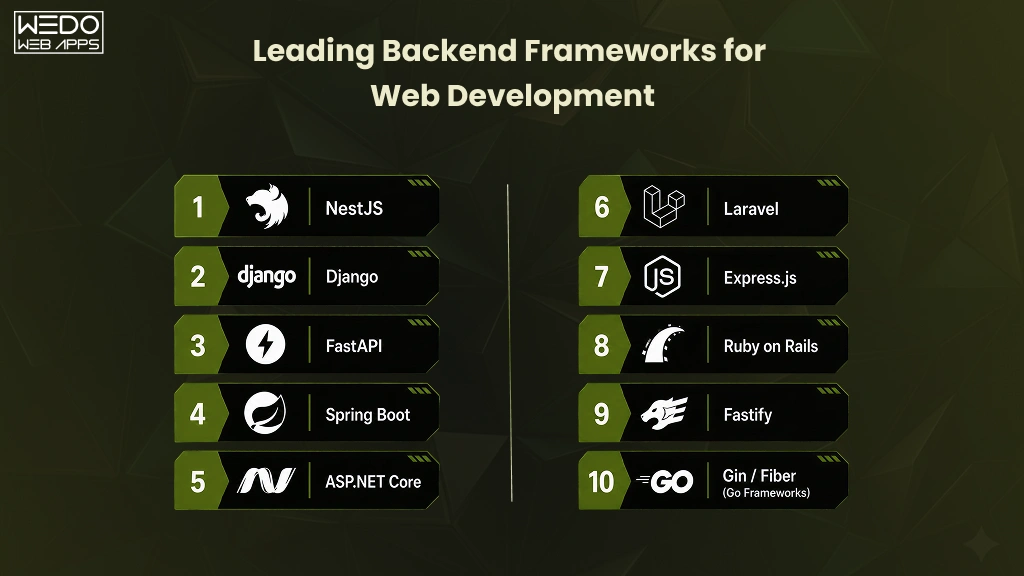
Modern businesses require backend frameworks that support scalability, security, flexibility, and faster product development. However, not every framework is suitable for every application type. Some backend frameworks are designed for enterprise-grade systems, while others are better suited for startups, rapid MVP development, or high-performance APIs.
Below are the leading backend frameworks businesses are using in 2026 to build scalable web applications, SaaS platforms, enterprise systems, and modern digital products.
1. NestJS
NestJS has emerged as one of the most popular backend frameworks for scalable NodeJS applications. Built with TypeScript, it offers a structured architecture that helps businesses build maintainable and enterprise-ready applications efficiently.
Best Use Cases:
- SaaS platforms
- Enterprise APIs
- Real-time applications
- Fintech platforms
- Scalable web applications
Why Businesses Choose NestJS
- Strong scalability support
- TypeScript-first architecture
- Modular development structure
- Microservices compatibility
- Excellent API development capabilities
Potential Limitations
NestJS may feel slightly complex for smaller applications or teams unfamiliar with TypeScript-based architecture patterns.
Best Fit For
Businesses looking for backend frameworks for scalable applications with strong long-term maintainability and enterprise flexibility.
2. Django
Django remains one of the leading backend frameworks for businesses prioritizing rapid development, security, and stable architecture. Its “batteries-included” ecosystem simplifies backend development significantly.
Best Use Cases
- Enterprise platforms
- Content-heavy applications
- SaaS products
- Secure web applications
- Data-driven platforms
Why Businesses Choose Django
- Fast development cycles
- Strong security features
- Large ecosystem support
- Excellent documentation
- Scalable architecture capabilities
Potential Limitations
Django may introduce unnecessary overhead for lightweight or highly customized real-time systems.
Best Fit For
Businesses seeking reliable backend development frameworks with faster development workflows and strong security support.
3. FastAPI
FastAPI is rapidly becoming one of the best backend frameworks for AI-powered applications and modern APIs. Its high performance and asynchronous processing capabilities make it ideal for data-intensive systems.
Best Use Cases
- AI-powered applications
- Machine Learning platforms
- High-Performance APIs
- Real-time data systems
- Cloud-native applications
Why Businesses Choose FastAPI
- Extremely fast performance
- Async request handling
- Automatic API documentation
- Lightweight architecture
- Strong Python development ecosystem compatibility
Potential Limitations
FastAPI’s ecosystem is still growing compared to older backend frameworks like Django or Spring Boot.
Best Fit For
Businesses building modern API-first applications of AI-integrated digital products.
4. Spring Boot
Spring Boot remains a dominant choice among enterprise backend frameworks because of its scalability, reliability, and microservices compatibility.
Best Use Cases
- Enterprise software
- Banking systems
- Large-scale distributed applications
- Microservices architecture
- Complex backend ecosystems
Why Businesses Choose Spring Boot
- Enterprise-grade scalability
- Strong security capabilities
- Mature ecosystem
- Excellent microservices support
- High long-term scalability
Potential Limitations
Spring Boot often requires larger development teams and longer development timelines compared to lightweight frameworks.
Best Fit For
Large enterprises building mission-critical applications with long-term scalability requirements.
5. ASP.NET Core
ASP.NET Core is widely used for enterprise-grade backend systems requiring high performance, security, and cloud compatibility.
Best Use Cases
- Enterprise platforms
- Corporate Portals
- ERP systems
- Cloud-native applications
- Large-scale APIs
Why Businesses Choose ASP.NET Core
- Excellent performance
- Strong Microsoft ecosystem support
- High security standards
- Cross-platform development flexibility
- Enterprise scalability
Potential Limitations
Businesses heavily outside the Microsoft ecosystem may face integration learning curves initially.
Best Fit For
Enterprises seeking scalable backend frameworks with strong infrastructure support and long-term maintainability.
6. Laravel
Laravel continues to be one of the most popular backend frameworks for businesses prioritizing rapid development and developer-friendly workflows. Laravel development services use a PHP-based framework known for its elegant syntax, powerful features, and developer-friendly ecosystem.
Best Use Cases:
- eCommerce platforms
- Startup MVPs
- CRM systems
- Web applications
- Customer portals
Why Businesses Choose Laravel
- Fast development speed
- Clean syntax
- Strong developer ecosystem
- Built-in authentication support
- Cost-effective development
Potential Limitations
Laravel may require additional optimization for very large-scale, high-concurrency applications.
Best Fit For
Startups and growing businesses seeking backend frameworks for web development with faster delivery cycles.
7. Express.js
Express.js remains one of the most lightweight and flexible backend frameworks within the Node.js ecosystem.
Best Use Cases:
- APIs
- Lightweight web applications
- Real-time systems
- Startup products
- Single-page applications
Why Businesses Choose Express.js
- Minimalistic architecture
- Fast setup
- Strong Node.js ecosystem
- Flexible customization
- Efficient API handling
Potential Limitations
Large-scale applications may require additional architecture planning due to Express.js’s unopinionated structure.
Best Fit For
Businesses needing lightweight backend development frameworks with fast implementation flexibility.
8. Ruby on Rails
Ruby on Rails remains highly popular among startups because of its rapid product development capabilities.
Best Use Cases:
- MVP development
- SaaS products
- Startup applications
- Marketplace platforms
- Internal business tools
Why Businesses Choose Ruby on Rails
- Faster development cycles
- Convention-over configuration approach
- Strong startup ecosystem
- Efficient prototyping
- Mature community support
Potential Limitations
Rails may face scalability limitations for extremely high-performance distributed systems.
Best Fit For
Startups focused on rapid market validation and faster product launches.
9. Fastify
Fastify is gaining attention as one of the best backend frameworks for high-performance Node.js applications.
Best Use Cases:
- Real-time applications
- High-speed APIs
- Streaming platforms
- Scalable backend services
- Performance-focused applications
Why Businesses Choose Fastify
- Exceptional speed
- Low overhead architecture
- Plugin-based ecosystem
- Efficient request processing
- Strong scalability capabilities
Potential Limitations
Its ecosystem is smaller compared to Express.js or NestJS.
Best Fit For
Businesses prioritizing performance optimization and scalable API infrastructure.
10. Gin / Fiber (Go Frameworks)
Go-based backend frameworks are increasingly popular for high-concurrency and distributed applications.
Best Use Cases:
- High-traffic platforms
- Distributed systems
- Cloud-native infrastructure
- Streaming applications
- Performance-intensive systems
Why Businesses Choose Go Frameworks:
- Extremely high performance
- Efficient concurrency handling
- Lightweight resource usage
- Excellent scalability
- Cloud-native compatibility
Potential Limitations
Development speed may be slower compared to frameworks with larger built-in ecosystems.
Best Fit For
Businesses building large-scale systems requiring maximum performance and infrastructure efficiency.
Best Backend Frameworks Based on Business Use Cases
The best backend framework is not always the most popular one, it is the framework that aligns best with your business goals, scalability expectations, product complexity, and development priorities. Different applications require different capabilities, which is why businesses should evaluate backend frameworks based on practical use cases instead of trends alone.
Below are the best backend frameworks for scalable applications based on different business requirements.
Best Backend Framework for Startup MVPs
Startups often prioritize faster development, lower costs, and shorter launch timelines. Backend frameworks that simplify development workflows and reduce complexity are usually the best fit during early growth stages.
Recommended Frameworks
- Laravel
- Ruby on Rails
- Django
Why These Frameworks Work Well
- Faster MVP development
- Large plugin ecosystems
- Lower development complexity
- Reduced time-to-market
- Easier feature iterations
For startups validating product-market fit, development speed often matters more than building highly complex backend initially.
Best Backend Framework for Enterprise Applications
Enterprise applications require stability, security, scalability, compliance support, and long-term maintainability. Large organizations also need frameworks capable of supporting complex workflows, distributed systems, and large development teams.
Recommended Frameworks
- Spring Boot
- ASP.NET Core
- NestJS
Why These Frameworks Work Well
- Enterprise-grade scalability
- Strong security architecture
- Microservices support
- Long-term ecosystem stability
- Better maintainability for large applications
These leading backend frameworks are widely used for banking systems, ERP platforms, enterprise SaaS products, and mission-critical business applications.
Best Backend Framework for AI-Powered Applications
AI-driven applications require backend frameworks capable of handling asynchronous processing, large datasets, API-heavy workflows, and machine learning integrations, and Data Engineering Services efficiently.
Recommended Frameworks
- FastAPI
- Django
- Go Frameworks
Why These Frameworks Work Well
- High-performance API handling
- Strong Python AI ecosystem support
- Faster asynchronous processing
- Better scalability for AI workloads
- Cloud-native compatibility
FastAPI, in particular, has become one of the most popular backend frameworks for modern AI-powered platforms.
Best Backend Framework for High-Traffic Applications
Applications handling massive user traffic require backend frameworks optimized for performance, concurrency, and infrastructure efficiency.
Recommended Frameworks
- Go Frameworks (Gin/Fiber)
- Fastify
- NestJS
Why These Frameworks Work Well
- High concurrency support
- Faster request handling
- Lower infrastructure overhead
- Better scalability under heavy traffic
- Efficient distributed architecture support
These backend frameworks for scalable applications are increasingly adopted for streaming platforms, real-time systems, and large-scale digital ecosystems.
Best Backend Framework for Microservices Architecture
Microservices architecture allows businesses to scale applications more flexibly by separating services into independent components.
Recommended Frameworks
- Spring Boot
- NestJS
- ASP.NET Core
Why These Frameworks Work Well
- Strong modular architecture
- API-first development support
- Better service isolation
- Cloud-native deployment compatibility
- Easier scalability management
Businesses building complex enterprise ecosystems often prioritize backend development frameworks that simplify microservices adoption.
Best Backend Framework for Real-Time Applications
Real-time applications require low-latency communication, efficient event handling, and fast data processing.
Recommended Frameworks
- NestJS
- Express.js
- Fastify
Why These Frameworks Work Well
- WebSocket support
- Real-time event processing
- Fast request-response handling
- Lightweight architecture
- Strong Node.js ecosystem integration
These frameworks are commonly used for chat platforms, collaboration tools, gaming systems, and live-streaming applications.
Best Backend Framework for Rapid Web Development
Some businesses prioritize faster feature delivery and shorter development cycles to remain competitive in rapidly changing markets.
Recommended Frameworks
- Laravel
- Django
- Ruby on Rails
Why These Frameworks Work Well
- Built-in development tools
- Faster coding workflows
- Large reusable ecosystems
- Easier maintenance
- Simplified application setup
These popular backend frameworks remain strong choices for businesses seeking faster product launches without overcomplicating backend architecture.
Choosing the best backend framework ultimately depends on balancing scalability, development speed, infrastructure complexity, security, and long-term business goals. Instead of following industry trends blindly, businesses should evaluate which backend framework aligns most effectively with their operational and growth requirements.
Monolithic vs Microservices Backend Architectures
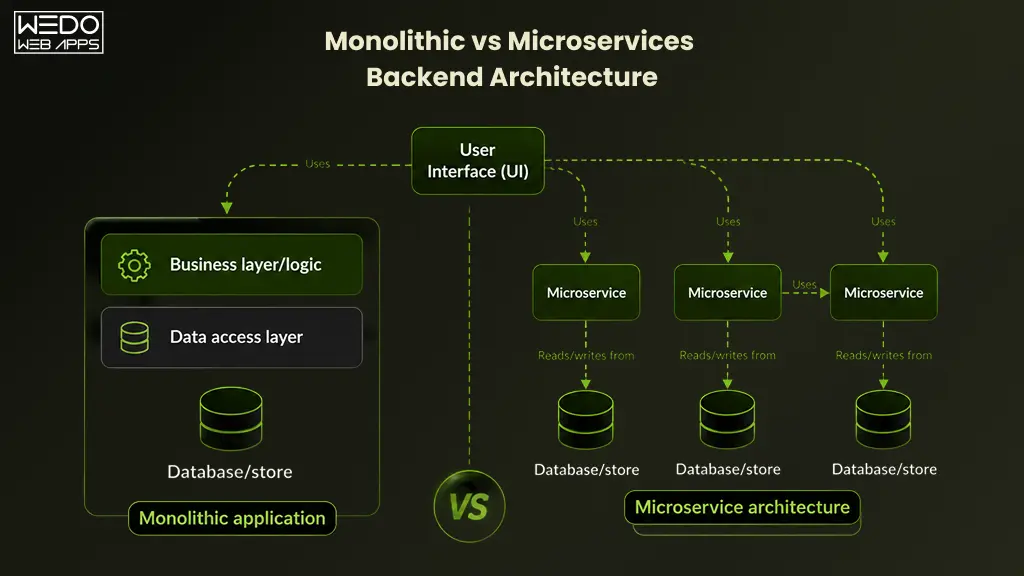
Choosing the right backend framework is important, but selecting the right backend architecture is equally critical. Many businesses focus only on frameworks without evaluating whether a monolithic or microservices architecture better supports their long-term scalability goals.
Both architecture offers different advantages depending on the size, complexity, and growth stage of the application.
What is a Monolithic Architecture?
In a monolithic architecture, all backend components operate as a single unified application. Features such as authentication, payment systems, APIs, databases, and business logic are managed within one codebase.
This approach is commonly used for:
- Startup MVPs
- Small-to-medium web applications
- Early-stage SaaS products
- Applications with limited operational complexity
Advantages of Monolithic Architecture
- Faster initial development
- Simpler deployment workflows
- Easier debugging and testing
- Lower infrastructure complexity
- Faster product launch timelines
Limitations of Monolithic Architecture
- Scalability challenges as applications grow
- Slower development coordination across teams
- Higher risk during deployments
- Difficulties managing large codebases
- Limited flexibility for independent service scaling
Many businesses initially choose monolithic backend frameworks because they simplify development during early growth stages. However, scaling monolithic systems can become increasingly difficult as user traffic and feature complexity increase.
What is Microservices Architecture?
Microservices architecture separates backend functionality into smaller independent services. Each service handles a specific business function and can scale, deploy, and operate independently.
This architecture is commonly used for:
- Enterprise platforms
- High-traffic applications
- Distributed systems
- AI-powered ecosystems
- Large SaaS platforms
Advantages of Microservices Architecture
- Better scalability flexibility
- Independent service deployment
- Faster feature releases across teams
- Improved fault isolation
- Easier infrastructure scaling
- Better support for cloud-native environments
Limitations of Microservices Architecture
- Higher infrastructure complexity
- More challenging monitoring and debugging
- Increased DevOps requirements
- Higher operational costs
- Greater architectural planning needs
Microservices are often preferred for backend frameworks for scalable applications because they support long-term growth more efficiently than tightly coupled monolithic systems.
Which Backend Architecture is Better for Businesses?
The answer depends on the application’s growth stage, operational complexity, and scalability requirements.
Monolithic Architecture is Often Better for:
- Startup MVPs
- Early-stage SaaS products
- Smaller development teams
- Faster time-to-market requirements
- Applications with simpler workflows
Microservices Architecture is Often Better for:
- Enterprise-grade systems
- Large-scale digital platforms
- Applications handling massive traffic
- Businesses requiring independent service scaling
- Complex multi-team development environments
Many modern businesses begin with a monolithic backend architecture and gradually transition toward microservices as operational demands increase.
Best Backend Frameworks for Monolithic Architecture
Some backend frameworks are particularly effective for monolithic development because they simplify rapid application building and centralized code management.
Popular Choices
- Django
- Laravel
- Ruby on Rails
These frameworks are widely used for rapid web development and startup-focused products.
Best Backend Frameworks for Microservices Architecture
Certain backend frameworks are better optimized for distributed systems, APIs, and cloud-native infrastructure.
Popular Choices
- NestJS
- Spring Boot
- ASP.NET Core
- Go Frameworks
These leading backend frameworks provide stronger support for scalable microservices ecosystems and enterprise-grade backend architecture.
As modern applications continue growing in complexity, businesses should evaluate backend frameworks and architecture strategies together instead of treating them as separate decisions. The right combination of framework and architecture can significantly improve scalability, development efficiency, operational stability, and long-term maintainability.
Common Mistakes Businesses Make When Choosing Backend Frameworks
Many businesses select backend frameworks based on popularity, short-term trends, or developer preference without fully evaluating long-term scalability and operational impact. While a framework may work well during initial development, the wrong decision can create performance bottlenecks, maintenance challenges, and expensive migration costs later.
Below are some of the most common mistakes businesses make when evaluating backend frameworks for web development.
Choosing Frameworks Based Only on Popularity
A popular backend framework is not automatically the right fit for every application. Many businesses adopt trending technologies without considering whether the framework aligns with their scalability goals, infrastructure requirements, or product complexity.
Why This Becomes a Problem
- Misaligned architecture decisions
- Unnecessary development complexity
- Performance inefficiencies
- Higher long-term maintenance costs
The best backend framework should support your business model, not just industry trends.
Ignoring Long-Term Scalability Requirements
Some backend frameworks work well for small applications but struggle under increasing traffic, large databases, or distributed systems. Businesses often underestimate future scalability requirements during early development stages.
Why This Becomes a Problem
- Infrastructure bottlenecks
- Slower application performance
- Expensive backend migrations
- Difficulty scaling engineering teams
Scalability should always be evaluated before selecting backend frameworks for scalable applications.
Prioritizing Speed Over Architecture Quality
Rapid product development is important, especially for startups. However, choosing backend development frameworks solely for faster development can create technical debt if scalability and maintainability are ignored.
Why This Becomes a Problem
- Poor code structure
- Reduced application stability
- Difficult feature expansion
- Higher refactoring costs later
Businesses should balance development speed with long-term architecture planning.
Overengineering Early-Stage Applications
Some businesses adopt highly complex microservices architecture too early, even when simpler monolithic systems would be more practical.
Why This Becomes a Problem
- Increased infrastructure complexity
- Higher operational costs
- Slower development cycles
- Unnecessary DevOps overhead
Startups and MVP-focused products often benefit more from simpler backend architecture during initial growth stages.
Underestimating Security & Compliance Needs
Security is framework treated as a secondary concern during backend framework selection. However, industries such as fintech, healthcare, and enterprise SaaS require strong compliance and data protection capabilities from the beginning.
Why This Becomes a Problem:
- Increased security vulnerabilities
- Compliance risks
- Data protection challenges
- Higher long-term remediation costs
Modern backend frameworks should support secure authentication, authorization, and data handling practices.
Ignoring Developer Ecosystem & Hiring Availability
A technically powerful framework may still create operational challenges if businesses struggle to hire experienced backend developers or maintain long-term support.
Why This Becomes a Problem:
- Slower hiring processes
- Increased development costs
- Limited community support
- Longer issue resolution timelines
Popular backend frameworks with strong ecosystems often simplify long-term development scalability.
Failing to Align Framework Selection With Business Goals
Some businesses evaluate frameworks only from a technical perspective instead of considering business priorities such as:
- Growth expectations
- Operational costs
- Product roadmap
- Maintenance requirements
- Future integrations
Why This Becomes a Problem
- Technology limitations during scaling
- Misaligned infrastructure investments
- Reduced operational flexibility
- Difficulty adapting to future business needs
The right backend framework should support both technical requirements and long-term business growth strategy.
Avoiding these common mistakes helps businesses build backend architecture that remains scalable, maintainable, and adaptable as applications evolve. Instead of focusing only on immediate development needs, companies should evaluate backend frameworks from both technical and strategic business perspectives.
Emerging Backend Development Trends in 2026
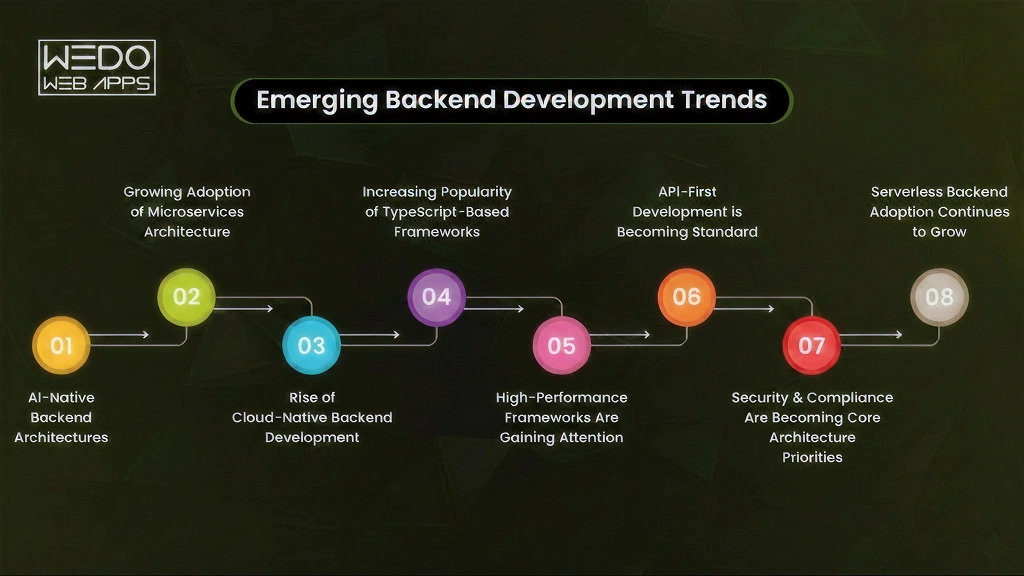
Backend development is evolving rapidly as businesses adopt cloud-native infrastructure, AI-powered systems, distributed architectures, and real-time digital experiences. Modern backend frameworks are no longer evaluated only on development speed, businesses now prioritize scalability, flexibility, performance, and long-term adaptability.
Below are some of the biggest backend development trends shaping modern web applications in 2026.
AI-Native Backend Architectures
AI-powered applications are becoming increasingly common across SaaS platforms, ecommerce systems, enterprise tools, and customer-facing applications. This shift is driving demand for backend frameworks capable of handling:
- asynchronous processing
- large-scale APIs
- data-intensive workloads
- machine learning integrations
- real-time data pipelines
Frameworks like FastAPI, NestJS, and Go-based backend frameworks are gaining popularity because they support high-performance AI workflows efficiently.
Growing Adoption of Microservices Architecture
Businesses are continuing to move away from tightly coupled monolithic systems toward microservices-based backend architecture. This approach allows teams to scale services independently while improving deployment flexibility.
Why Businesses Are Adopting Microservices
- Better scalability
- Faster deployment cycles
- Improved fault isolation
- Easier cloud scalability
- More flexible infrastructure management
As a result, backend frameworks for scalable applications increasingly prioritize API-first and modular architecture capabilities.
Rise of Cloud-Native Backend Development
Cloud-native development has become a standard requirement for modern digital products. Businesses are now selecting backend frameworks that integrate smoothly with:
- Kubernetes
- Docker
- serverless infrastructure
- CI/CD pipelines
- multi-cloud environments
Backend development frameworks with strong cloud compatibility help businesses improve scalability, operational efficiency, and deployment automation.
Increasing Popularity of TypeScript-Based Frameworks
TypeScript adoption continues growing rapidly across modern web development ecosystems. Frameworks like NestJS are becoming highly popular because they improve:
- code maintainability
- development scalability
- type safety
- large-team collaboration
- long-term project stability
For enterprise-grade applications and scalable SaaS platforms, TypeScript-based backend frameworks are increasingly viewed as future-ready solutions.
High-Performance Frameworks Are Gaining Attention
As applications process larger volumes of real-time data and concurrent users, businesses are prioritizing backend frameworks optimized for speed and infrastructure efficiency.
Popular High-Performance Backend Frameworks
- Fastify
- Go Frameworks (Gin/Fiber)
- FastAPI
- ASP.NET Core
These frameworks help businesses reduce latency, improve request handling, and optimize cloud infrastructure costs.
API-First Development is Becoming Standard
Modern applications depend heavily on APIs for mobile apps, third-party integrations, AI services, payment systems, and distributed platforms.
This shift is increasing demand for backend frameworks that support:
- REST APIs
- GraphQL
- microservices communication
- real-time APIs
- scalable API management
API-first architecture is now considered a foundational requirement for scalable web application development.
Serverless Backend Adoption Continues to Grow
Businesses are increasingly exploring serverless backend architecture to reduce infrastructure management complexity and improve operational flexibility.
Benefits of Serverless Backend Systems
- Reduced operational overhead
- Faster scalability
- Lower infrastructure maintenance
- Cost optimization for variable workloads
- Improved deployment agility
Backend frameworks with strong serverless compatibility are becoming more valuable for modern cloud-native applications.
Security & Compliance Are Becoming Core Architecture Priorities
As cyber threats and data regulations continue evolving, businesses are prioritizing backend frameworks with stronger built-in security capabilities.
Modern backend frameworks are increasingly expected to support:
- secure authentication
- role-based access control
- API security
- encrypted data handling
- compliance-friendly architecture
Security is no longer treated as an add-on, it is now a core backend architecture requirement.
The future of backend development is shifting toward scalable, cloud-native, API-driven, and AI-ready architectures. Businesses evaluating leading backend frameworks should focus not only on current development needs, but also on how effectively a framework can support future innovation, scalability, and evolving digital ecosystems.
How to Choose the Right Backend Framework for Your Business
There is no single backend framework that works best for every business. The right choice depends on your product goals, scalability expectations, infrastructure complexity, development timelines, and long-term growth strategy.
Instead of selecting backend frameworks based only on popularity, businesses should evaluate which technology aligns most effectively with their operational and technical requirements.
Below are some practical considerations that can help businesses make smarter backend framework decisions.
For Startups Building MVPs
Startups often need to launch products quickly while controlling development costs and validating market demand.
Key Priorities
- Faster development speed
- Lower infrastructure complexity
- Cost efficiency
- Easier feature iteration
- Shorter time-to-market
Recommended Backend Frameworks
- Laravel
- Ruby on Rails
- Django
These backend frameworks for web development simplify rapid product development and allow startups to adapt quickly during early growth stages.
For Scaling SaaS Platforms
SaaS products typically require scalable APIs, multi-user support, subscription management, and flexible backend architecture.
Key Priorities
- Application scalability
- API-first development
- Long-term maintainability
- Cloud-native compatibility
- Efficient database handling
Recommended Backend Frameworks
- NestJS
- Django
- FastAPI
These leading backend frameworks support scalable SaaS architecture while maintaining development flexibility.
For Enterprise Applications
Enterprise-grade systems require stability, security, compliance support, and long-term operational reliability.
Key Priorities
- Security & compliance
- Large-scale scalability
- Team collaboration
- Microservices compatibility
- Long-term ecosystem stability
Recommended Backend Frameworks
- Spring Boot
- ASP.NET Core
- NestJS
These backend development frameworks are commonly used for complex enterprise ecosystems and mission-critical applications.
For AI-Powered & Data-Intensive Applications
AI-driven platforms require backend frameworks capable of handling large datasets, asynchronous processing, and high-performance APIs efficiently.
Key Priorities
- Async processing
- High-performance APIs
- AI ecosystem compatibility
- Real-time data handling
- Cloud scalability
Recommended Backend Frameworks
- FastAPI
- Go Frameworks
- Django
These frameworks are increasingly preferred for AI-native application development and modern data-heavy systems.
For High-Traffic Applications
Applications handling large volumes of concurrent users require backend frameworks optimized for performance and infrastructure efficiency.
Key Priorities
- High concurrency support
- Faster request handling
- Low-latency architecture
- Efficient resource usage
- Distributed scalability
Recommended Backend Frameworks
- Fastify
- Go Frameworks
- NestJS
These backend frameworks for scalable applications help businesses maintain stability under heavy workloads.
For Businesses Planning Long-Term Scalability
Businesses expecting rapid growth should avoid making backend decisions based only on short-term development convenience.
Important Questions to Evaluate
- Will the framework support future scaling requirements?
- Is the developer ecosystem strong enough for long-term hiring?
- Does the framework support cloud-native deployment?
- Can the architecture evolve into microservices later?
- Will maintenance remain manageable as the product grows?
Backend framework selection should support both current product needs and future operational scalability.
Why Strategic Backend Planning Matters
Backend architecture decisions directly affect:
- product scalability
- development efficiency
- infrastructure costs
- application performance
- long-term maintainability
This is why many businesses now work with experienced backend development partners during framework evaluation and architecture planning. A strategic approach helps reduce future technical debt while ensuring backend systems remain scalable, secure, and adaptable as business requirements evolve.
Choosing the best backend framework is ultimately about aligning technology decisions with long-term business growth, operational flexibility, and product scalability goals.
How WEDOWEBAPPS Helps Businesses Build Scalable Backend Architectures
Building scalable applications requires more than simply selecting a popular backend framework. Businesses also need the right architecture strategy, scalability planning, API structure, and long-term development approach to ensure their applications can evolve efficiently as user demands grow.
At WEDOWEBAPPS, backend development is approached from both a technical and business scalability perspective. Instead of applying the same technology stack to every project, the focus remains on identifying backend frameworks that align with the product’s performance requirements, growth expectations, infrastructure complexity, and future roadmap.
Backend Architecture Planning
Every application has different scalability requirements. Some businesses need rapid MVP development, while others require enterprise-grade backend ecosystems capable of supporting distributed infrastructure and high user traffic.
The backend architecture planning process typically focuses on:
- scalability requirements
- API-first architecture
- database optimization
- cloud-native compatibility
- future microservices readiness
- long-term maintainability
This helps businesses avoid backend limitations that often create scaling challenges later.
Framework Selection Based on Business Goals
Different backend frameworks solve different business problems. WEDOWEBAPPS evaluates factors such as:
- application complexity
- expected user growth
- real-time functionality
- security requirements
- third-party integrations
- infrastructure scalability
before recommending backend development frameworks for a project.
This strategic approach helps businesses select technologies that support both immediate development goals and long-term operational growth.
Scalable API & Microservices Development
Modern applications increasingly rely on APIs, distributed systems, and cloud-native architecture. Backend systems are designed with scalability and flexibility in mind to support:
- microservices architecture
- third-party integrations
- mobile applications
- SaaS ecosystems
- enterprise workflows
- real-time applications
This allows businesses to scale backend infrastructure more efficiently as application demands increase.
Performance & Security Optimization
Application performance and security are essential for maintaining user experience and operational reliability. Backend development processes often include:
- performance optimization
- secure authentication systems
- scalable database architecture
- API security implementation
- infrastructure efficiency improvements
This helps businesses maintain stable backend performance while supporting future scalability.
Long-Term Technology Maintainability
Backend systems should remain adaptable as products evolve. Technology decisions are made with long-term maintainability, developer scalability, and operational flexibility in mind to reduce technical debt and simplify future expansion.
As businesses continue investing in scalable digital products, backend framework selection and architecture planning have become foundational decisions for long-term success. A strategic backend development approach helps ensure applications remain scalable, secure, efficient, and future-ready as business requirements continue evolving.
Conclusion
Choosing the right backend framework is no longer just a technical development decision, it is a long-term business strategy that directly impacts scalability, performance, development efficiency, and future growth potential. As modern applications become more complex, businesses need backend frameworks that can support evolving user demands, cloud-native infrastructure, API-driven ecosystems, and long-term operational flexibility.
While there are many leading backend frameworks available today, the best choice depends entirely on the product’s architecture requirements, scalability expectations, industry needs, and development priorities. Frameworks like NestJS, Django, FastAPI, Spring Boot, ASP.NET Core, Laravel, and Go-based frameworks each offer unique advantages depending on the type of application being built.
For startups, faster development and flexibility may be the highest priority. For enterprises, scalability, security, and maintainability often become more critical. Similarly, AI-powered applications, high-traffic platforms, and microservices ecosystems require backend architectures optimized for performance, distributed scalability, and real-time processing.
This is why businesses should evaluate backend frameworks not only based on popularity, but also on long-term technical sustainability, infrastructure efficiency, ecosystem maturity, and alignment with future business goals.
As backend development continues evolving in 2026, businesses that invest in scalable backend architecture and strategic framework selection will be better positioned to build high-performance digital products that can adapt, scale, and grow in an increasingly competitive digital landscape.