Introduction – Which Industries Actually Benefit from Mobile Apps
Which industries truly generate revenue from mobile apps, not just downloads, engagement, or vanity metrics?
The answer is not as obvious as it used to be.
While many sectors have adopted mobile technology, only a subset of profitable mobile app development industries consistently deliver measurable business outcomes, whether that is direct revenue, operational efficiency, or long-term customer value. For decision-makers, the real question is no longer “Should we build an app?” but “Which industry use cases justify the investment?”
Today, mobile apps are no longer standalone digital products. They are:
- Revenue channels
- Customer experience layers
- Operational tools
- And in many cases, entire business models
From fintech platforms generating transaction-based income to logistics apps optimizing supply chain visibility, the industries that benefit from mobile apps the most are those that align technology with clear monetization strategies.
This guide is designed to go beyond generic lists of top industries using mobile apps. Instead, it breaks down:
- Industries that benefit from mobile apps based on real-world adoption and ROI
- Mobile apps by industry use cases that solve actual business problems
- Mobile app business models by industry (how companies make money, not just build apps)
- Industry sectors for mobile app growth in recent years and beyond
Whether you are a startup evaluating your next product or an enterprise leader planning digital transformation, this breakdown will help you identify where mobile apps create real, scalable business value.
Ultimately, the success of a mobile app is not defined by downloads; it is defined by how effectively it drives business outcomes in the right industry context.
What Makes an Industry Profitable For Mobile Apps? (A Decision-Making Framework for Businesses)
Before evaluating the top industries using mobile apps, it is important to step back and ask a more strategic question:
“What actually makes an industry profitable for mobile app investment?”
Because not every industry that adopts mobile technology translates into sustainable revenue or ROI.
From a business perspective, the most successful mobile apps are built in industries where user behavior, monetization potential, and operational impact align. Below is a practical framework for decision-makers to evaluate industry sectors for mobile app growth before committing resources.
1. User Frequency & Engagement Patterns
Industries with high-frequency user interactions tend to outperform others in mobile environments.
- Daily usage industries: fintech, eCommerce, fitness
- Weekly usage industries: education, entertainment
- Occasional usage industries: real estate, travel
The more frequently users engage, the more opportunities businesses have to monetize, upsell, and retain customers.
This is why many profitable mobile app industries are built around habit-driven behavior.
2. Clear Monetization Pathways
A mobile app without a defined revenue model is a cost center, not a business asset.
Strong industries typically support one or more of the following:
- Subscription-based models (fitness, education)
- Transaction-based models (fintech, eCommerce)
- Commission-based models (travel, real estate)
- Enterprise SaaS models (construction, manufacturing, logistics)
When evaluating mobile app business models by industry, clarity in monetization is often the biggest differentiator between success and failure.
3. Operational Efficiency Gains
Not all value comes from direct revenue.
In industries like construction, logistics & supply chain, manufacturing, and energy & utilities, mobile apps drive profitability by:
- Reducing delays
- Improving communication
- Enabling real-time decision-making
In these sectors, the ROI is often measured through cost savings, productivity gains, and operational control.
4. Scalability & Market Expansion Potential
Industries that benefit the most from mobile apps are those that can scale beyond physical limitations.
Mobile apps enable:
- Geographic expansion
- Digital customer acquisition
- Automated service delivery
For example:
- eLearning platforms scale globally
- Fintech apps onboard users without physical branches
- Entertainment apps distribute content instantly
This scalability is what transforms apps into long-term growth engines, not just digital tools.
5. Digital Adoption & Industry Readiness
Some industries are naturally more adaptable to mobile-first ecosystems than others.
- High adoption industries include fintech, eCommerce, and entertainment.
- Growing adoption industries include healthcare, construction, and manufacturing
- Emerging adoption industries include energy & utilities and traditional logistics networks
Understanding where an industry stands helps businesses identify early-mover advantages vs saturated competition.
6. Customer Experience Dependency
In many industries, mobile apps are no longer optional; they are the primary interface for customer interaction.
Industries where experience drive success include travel & hospitality, eCommerce, fitness, and entertainment.
In these sectors, mobile apps directly impact:
- Retention
- Brand perception
- Customer lifetime value
Why This Framework Matters for Business Decision-Makers
Evaluating mobile app opportunities requires more than identifying industries with high adoption rates.
For businesses, the real value lies in understanding:
- Why certain industries achieve stronger mobile app ROI
- How different sectors monetize mobile experiences
- Where scalability, retention, and operational efficiency create long-term growth
This strategic perspective helps organizations evaluate:
- Investment viability
- Monetization potential
- Competitive positioning
- And long-term digital scalability
Instead of following short-term trends, businesses can make more informed decisions based on sustainable market opportunities and measurable business impact.
Top Profitable Mobile App Industries in 2026 (Use Cases, Business Models, & ROI Insights)
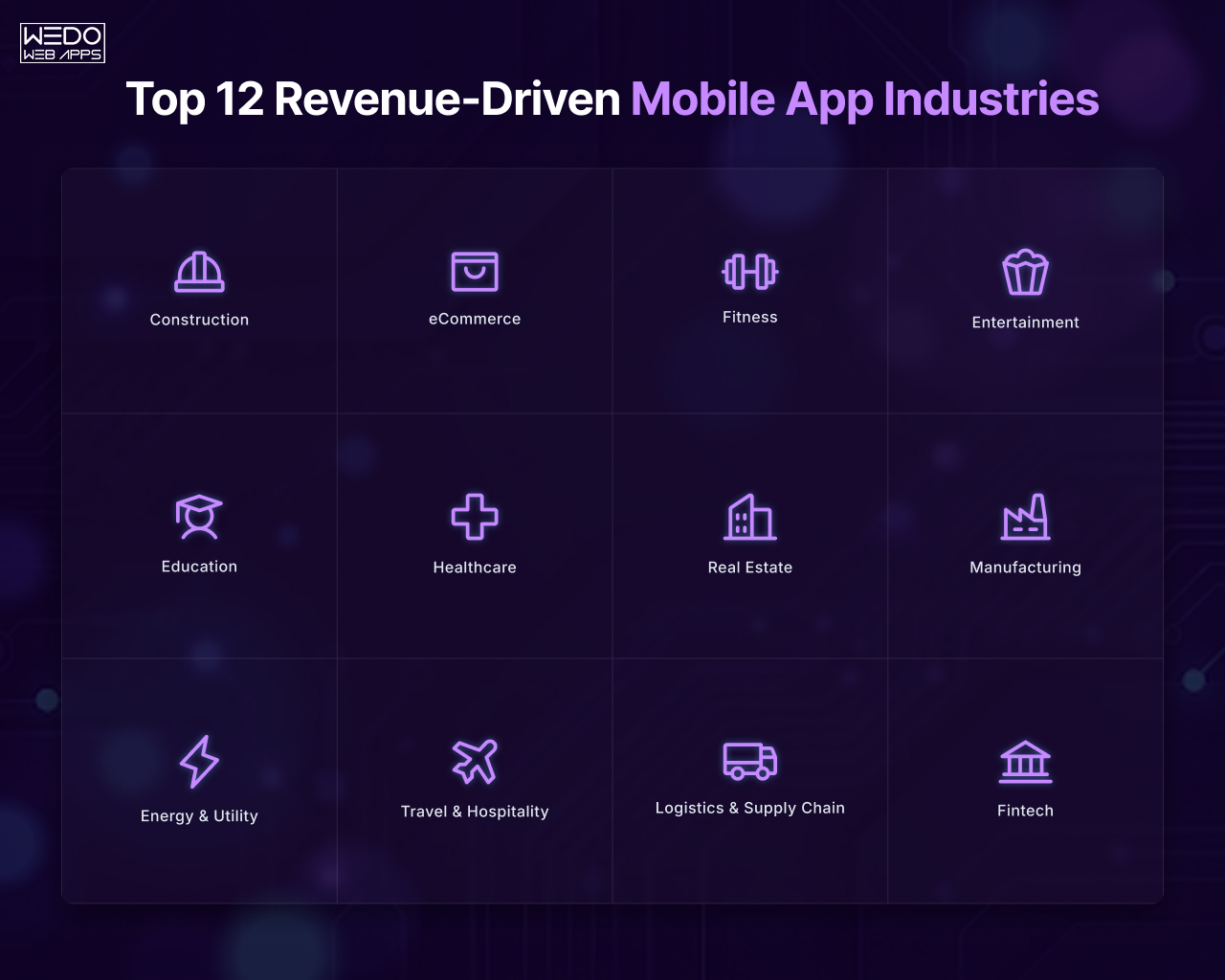
The industries that benefit from mobile apps the most are not necessarily the ones with the highest number of apps; they are the ones where mobile experiences directly influence revenue, efficiency, customer retention, or operational scalability.
Below is the breakdown of the top industries using mobile apps to drive measurable business growth, along with the business models and use cases shaping their success.
1. Construction
For years, construction remained one of the least digitized industries. But growing project complexity, distributed teams, and rising operational costs have accelerated mobile adoption across the sector.
Today, construction is becoming one of the most important industry sectors for mobile app growth, especially for companies focused on field operations and real-time collaboration.
Why Construction Businesses Benefit from Mobile Apps
Construction teams operate across multiple locations where delays, communication gaps, and manual reporting can significantly impact profitability.
Mobile app help businesses:
- Improve coordination between field and office teams
- Monitor project progress in real time
- Reduce documentation delays
- Streamline workforce management
For contractors and enterprise construction firms, mobile technology is increasingly tied to operational efficiency and project visibility.
Common Mobile App Use Cases in Construction
Some of the most valuable mobile apps by industry use cases in construction include:
- Project management and task tracking apps
- Site inspection and reporting tools
- Equipment monitoring systems
- Workforce attendance and scheduling apps
- Safety compliance and incident reporting platforms
- Real-time document and blueprint access
These applications help teams make faster decisions while reducing administrative friction across large-scale projects.
How Businesses Make Money With Construction Mobile Apps
Unlike consumer-focused industries, construction apps typically generate value through operational optimization and enterprise service models.
Common mobile app business models by industry in construction include:
1. Enterprise SaaS Licensing: Construction technology provides offer subscription-based platforms to contractors and enterprises.
2. Operational Cost Reduction: Apps reduce delays, paperwork, rework, and resource inefficiencies, directly improving project profitability.
3. Workflow Automation Services: Businesses monetize integrations with ERP systems, procurement tools, and project management platforms.
4. White-Label Construction Solutions: Some companies develop customizable mobile platforms for specialized contractors or infrastructure firms.
Why Construction is a Growing Mobile App Industry
Several factors are accelerating mobile transformation in construction:
- Increasing adoption of cloud-based project management
- Labor shortages requiring better workforce efficiency
- Growing infrastructure investments globally
- Demand for real-time project visibility
As digital adoption increases, construction companies are shifting from reactive operations to data-driven project management models powered by mobile technology.
Key Business Insight:
In construction, mobile apps are not just communication tools, they are operational systems that directly influence timelines, workforce productivity, and project profitability. For businesses entering this space, success depends less on adding features and more on solving real field-level operational challenges at scale.
2. eCommerce
Among all profitable mobile app industries, eCommerce remains one of the strongest examples of how mobile experiences directly drive revenue.
As mobile shopping behavior continues to grow, businesses are increasingly investing in apps that improve personalization, retention, and purchasing convenience. In many cases, mobile apps now outperform websites in customer engagement and repeat purchases.
For retailers and digital-first brands, mobile apps have evolved from optional sales channels into core revenue generating ecosystems.
Why eCommerce Businesses Benefit from Mobile Apps
eCommerce apps create faster, more personalized shopping experiences compared to traditional web platforms.
Businesses use mobile apps to:
- Simplify purchasing journeys
- Improve customer retention
- Increase repeat orders
- Personalize product recommendations
- Build stronger loyalty ecosystems
Because users spend significantly more time on mobile devices, brands that optimize for app-based engagement often gain stronger long-term customer value.
Common Mobile App Use Cases in eCommerce
Some of the most effective mobile apps by industry use cases in eCommerce include:
- Mobile storefronts and shopping apps
- AI-driven product recommendation systems
- Loyalty and rewards applications
- One-click checkout experiences
- Push notification marketing systems
- AR-based product visualization tools
These features help businesses improve conversion rates while reducing cart abandonment.
How Businesses Make Money With eCommerce Mobile Apps
eCommerce offers one of the clearest examples of scalable mobile app business models by industry.
1. Direct Product Sales: Apps generate revenue through seamless in-app purchasing experiences.
2. Subscription Commerce: Brands monetize recurring deliveries, memberships, and premium customer programs.
3. Upselling & Cross-Selling: AI-driven recommendations increase average order value and repeat purchases.
4. Marketplace Commission Models:Multi-vendor platforms generate revenue from seller commissions and transaction fees.
5. In-App Advertising & Partnerships: Large platforms monetize visibility placements and brand collaborations.
Why eCommerce Continues to Lead Mobile App Growth
Several trends continue to accelerate growth in mobile commerce:
- Mobile-first consumer behavior
- AI-powered personalization
- Social commerce integration
- Faster digital payment ecosystems
- Increasing demand for convenience-driven shopping
As customer expectations evolve, businesses investing in mobile commerce are focusing not only on transactions, but also on creating long-term engagement ecosystems.
Key Business Insight:
The most successful eCommerce apps are no longer competing only on products or pricing, they compete on personalization, convenience, and customer retention. Businesses that treat mobile apps as strategic customer experience platforms rather than simple sales channels often achieve stronger long-term growth.
3. Education
The education sector has experienced one of the biggest digital shifts in recent years, making it one of the fastest-growing industry sectors for mobile app growth.
What began as a convenience-driven learning model has evolved into a large-scale digital ecosystem where mobile apps support:
- Remote learning
- Skill development
- Certification programs
- Corporate training
- And personalized education experiences
Today, educational institutions, startups, and enterprise training providers are increasingly using mobile technology to deliver scalable learning environments across global audiences.
Why Education Business Benefits from Mobile Apps
Mobile apps make learning more accessible, flexible, and engagement-driven.
Unlike traditional classroom systems, mobile platforms allow users to:
- Learn at their own pace
- Access educational content from anywhere
- Consume short-form interactive lessons
- Track progress in real-time
For businesses, this creates opportunities to scale educational services without the limitations of physical infrastructure.
This scalability is a major reason education remains one of the most promising industries that benefit from mobile apps.
Common Mobile App Use Cases in Education
Some of the most effective mobile apps by industry use cases in education include:
- eLearning and online course platforms
- Live virtual classroom applications
- Language learning apps
- Exam preparation and assessment tools
- Corporate employee training platforms
- Microlearning and skill development apps
Many platforms also integrate AI-driven recommendations, gamification, and progress tracking to improve student engagement and retention.
How Businesses Make Money With Education Mobile Apps
The education industry supports multiple scalable mobile app business models by industry, particularly subscription and content-based monetization.
1. Subscription-Based Learning: Users pay monthly or yearly fees for access to courses and learning resources.
2. Course & Certification Sales: Platforms monetize premium programs, certifications, and specialized learning tracks.
3. Freemium Models: Basic content is offered free while advanced lessons and features remain paid.
4. Corporate Training Partnerships: Businesses license training platforms for employee development and compliance programs.
5. In-App Purchases: Apps monetize downloadable resources, mentoring sessions, and personalized coaching.
Why Education is a Strong Mobile App Growth Sector
Several trends continue to fuel mobile app adoption in education:
- Growing acceptance of remote learning
- Increasing demand for upskilling and reskilling
- Mobile-first learning behavior among younger audiences
- Enterprise investment in workforce training
- AI-powered personalized learning experiences
As digital education matures, businesses are focusing more on engagement, retention, and measurable learning outcomes rather than just content delivery.
Key Business Insight:
The long-term success of education apps depend less on content volume and more on learning experience quality, personalization, and retention strategy. Businesses that combine accessibility with engagement-driven design often build stronger recurring revenue models and long-term user loyalty.
4. Entertainment
Entertainment continues to be one of the highest-engagement profitable mobile app industries, driven by changing consumer behavior and rising demand for on-demand digital experience.
From streaming platforms and gaming ecosystems to creator-driven content apps, mobile technology has fundamentally changed how users consume entertainment.
Today, businesses in this sector are not only competing from attention, they are competing for daily user engagement and long-term retention.
Why Entertainment Businesses Benefit from Mobile Apps
Entertainment is naturally suited for mobile-first experiences because users consume content continuously throughout the day.
Mobile apps allow businesses to:
- Deliver instant access to content
- Personalize recommendations
- Increase session duration
- Build habitual engagement patterns
- Monetize recurring user activity
This high engagement frequency makes entertainment one of the strongest industries that benefit from mobile apps.
Common Mobile App Use Cases in Entertainment
Popular mobile apps by industry use cases in entertainment include:
- Video streaming platforms
- Music streaming apps
- Mobile gaming ecosystems
- Live streaming and creator platforms
- Short-form content applications
- Interactive social entertainment apps
Many platforms now combine AI-driven recommendation engine with community engagement features to maximize user retention.
How Businesses Make Money With Entertainment Mobile Apps
Entertainment apps support several high-performing mobile app business models by industry.
1. Subscription-Based Revenue: Streaming services monetize through recurring monthly memberships.
2. Advertising Models: Free platforms generate revenue through display ads, sponsored content, and video advertising.
3. In-App Purchases: Gaming and creator platforms monetize digital items, upgrades, and premium content access.
4. Hybrid Monetization: Many apps combine subscriptions, ads, and premium purchases simultaneously.
5. Creator Economy Partnerships: Platforms generate revenue through revenue-sharing models with influencers and content creators.
Why Entertainment Continues to Dominate Mobile Usage
Several factors continue to drive mobile app growth in entertainment:
- Increasing smartphone screen time
- Expansion of creator-driven ecosystems
- Rising demand for personalized content
- Growth of mobile gaming markets
- Faster internet and streaming infrastructure
As competition intensifies, entertainment businesses are increasingly investing in personalization, AI recommendations, and immersive user experiences.
Key Business Insight:
In entertainment, user retention is often more valuable than initial downloads. The platforms that scale successfully are those that continuously increase engagement through personalization, community interaction, and content relevance rather than relying solely on content quality.
5. Fitness
The fitness industry has rapidly evolved from gym-centered experiences into digital wellness ecosystems powered by mobile technology.
Today, fitness apps are used for:
- Workout tracking
- Virtual coaching
- Nutrition planning
- Habit building
- And wearable device integration
Because fitness is deeply tied to routine behavior and long-term engagement, it remains one od the most sustainable industry sectors for mobile app growth.
Why Fitness Business Benefit from Mobile Apps
Fitness apps create consistent user engagement by becoming part of daily routines.
Businesses use mobile apps to:
- Increase customer retention
- Offer personalization wellness experiences
- Scale coaching services digitally
- Create subscription-based communities
- Integrate real-time health tracking
The combination of personalization and habit-driven engagement makes fitness one of the strongest profitable mobile app industries for recurring revenue models.
Common Mobile App Use Cases in Fitness
Popular mobile apps by industry use cases in fitness include:
- Workout and exercise tracking apps
- Personal training platforms
- Meditation and mental wellness apps
- Nutrition and meal planning tools
- Wearable fitness integrations
- Live virtual fitness class platforms
Many businesses also incorporate gamification and progress analytics to improve motivation and user consistency.
How Businesses Make Money With Fitness Mobile Apps
Fitness apps typically rely on recurring engagement-based mobile app business models by industry.
1. Subscription Memberships: Users pay monthly or yearly fees for workouts, coaching, or wellness programs.
2. Premium Feature Unlocks: Advanced analytics, custom plans, and guided coaching are monetized separately.
3. Virtual Coaching Services: Apps connect users with trainers, nutritionists, and wellness experts.
4. Wearable & Device Integrations: Businesses monetize partnerships with fitness device ecosystems.
5. Brand Collaborations & Wellness Partnerships: Some platforms generate additional revenue through affiliate wellness products ans partnerships.
Why Fitness Apps Continue to Grow
Several trends continue driving growth in mobile fitness ecosystems:
- Rising health awareness
- Demand for flexible home-based fitness
- Wearable technology adoption
- Increasing focus on mental wellness
- AI-driven personalization in health tracking
Consumers are increasingly looking for convenience, personalization, and continuous progress tracking, all of which mobile apps deliver effectively.
Key Business Insight:
The most successful fitness apps are not just workout platforms, they are behavior-driven engagement systems. Businesses that build long-term user habits through personalization, accountability, and community engagement often achieve stronger retention and recurring revenue growth.
6. Healthcare
Healthcare has become one of the most transformative industries that benefit from mobile apps, especially as patients and providers increasingly expect accessible, digital-first healthcare experiences.
What was once limited to appointment scheduling has now expanded into telemedicine, remote patient monitoring, digital health records, medication management, and AI-assisted healthcare support.
For healthcare providers, clinics, startups, and enterprise healthcare systems, mobile apps are improving both patient engagement and operational efficiency.
Why Healthcare Businesses Benefit from Mobile Apps
Healthcare mobile apps solve two major challenges simultaneously, ie, accessibility and efficiency
Patients increasingly prefer mobile-first healthcare interactions for convenience and faster communication, while providers use apps to streamline workflows and improve service delivery.
Businesses use healthcare apps to:
- improve patient communication
- reduce administrative bottlenecks
- enable remote consultations
- monitor patient data in real time
- increase patient retention and engagement
As healthcare systems continue digitizing, mobile platforms are becoming essential infrastructure rather than optional digital tools.
Common Mobile App Use Cases in Healthcare
Some of the most impactful mobile apps by industry use cases in healthcare include:
- telemedicine and virtual consultation apps
- appointment booking and scheduling systems
- remote patient monitoring platforms
- medication reminder applications
- electronic health record access systems
- fitness and preventive healthcare integrations
Many healthcare apps now also incorporate AI-powered symptom analysis, wearable integrations, and personalized patient engagement features.
How Businesses Make Money With Healthcare Mobile Apps
Healthcare supports multiple scalable mobile app business models by industry, especially across B2B and subscription ecosystems.
1. Subscription-Based Healthcare Services: Patients pay recurring fees for virtual healthcare access and wellness programs.
2. Consultation & Service Fees: Telemedicine platforms generate revenue from appointment-based transactions.
3. Enterprise Licensing: Hospitals and healthcare organizations license healthcare management platforms.
4. Insurance & Healthcare Partnerships: Apps monetize integrations with insurers, clinics, and diagnostic providers.
5. Data & Analytics Solutions: Some enterprise healthcare platforms monetize operational insights and predictive healthcare analytics.
Why Healthcare Is a Fast-Growing Mobile App Industry
Several factors continue accelerating mobile adoption in healthcare:
- growing acceptance of virtual healthcare
- increasing demand for remote patient access
- aging populations requiring continuous care
- expansion of wearable health technologies
- AI-driven healthcare personalization
Healthcare organizations are also prioritizing digital transformation to improve scalability while reducing operational strain.
Key Business Insight:
The most successful healthcare apps prioritize trust, accessibility, and usability over excessive feature complexity. In healthcare, user confidence and seamless experience design often have a greater impact on adoption than technical sophistication alone.
7 Real Estate
The real estate industry has shifted dramatically toward digital-first property discovery, making mobile technology a core part of modern buying, renting, and investment experiences.
Today, mobile apps are transforming how users:
- search properties
- schedule visits
- connect with agents
- explore virtual tours
- and evaluate investment opportunities
As buyer behavior becomes increasingly mobile-driven, real estate remains one of the most valuable industry sectors for mobile app growth.
Why Real Estate Businesses Benefit from Mobile Apps
Property decisions are heavily research-driven, and mobile apps simplify access to information throughout the customer journey.
Businesses use real estate apps to:
- improve lead generation
- simplify property discovery
- increase customer engagement
- accelerate communication between buyers and agents
- streamline listing management
Mobile platforms also help real estate businesses maintain continuous engagement with users during longer purchasing cycles.
Common Mobile App Use Cases in Real Estate
Popular mobile apps by industry use cases in real estate include:
- property listing and search platforms
- virtual property tour applications
- real estate investment tracking apps
- lead management systems for agents
- rental and lease management platforms
- mortgage and financing calculators
Many platforms now integrate AI-based property recommendations and location intelligence tools to personalize user experiences.
How Businesses Make Money With Real Estate Mobile Apps
Real estate apps support several scalable mobile app business models by industry.
1. Listing & Advertising Fees: Platforms charge agents, brokers, and developers for premium property visibility.
2. Lead Generation Models: Apps monetize buyer and seller leads for real estate professionals.
3. Subscription Services: Businesses offer premium market insights, analytics, or investment tools through recurring plans.
4. Transaction & Referral Commissions: Platforms generate commissions from successful deals, financing, or partner referrals.
5. Enterprise Solutions: Property management and brokerage firms license operational platforms and CRM systems.
Why Real Estate Mobile Apps Continue to Grow
Several market trends continue driving digital transformation in real estate:
- mobile-first property search behavior
- rising demand for virtual property experiences
- growth of real estate investment platforms
- increasing urbanization and rental mobility
- AI-powered personalization in property discovery
Users now expect faster, more transparent, and digitally accessible property experiences.
Key Business Insight:
The strongest real estate apps are not simply listing platforms, they are decision-support ecosystems that simplify research, communication, and transaction confidence. Businesses that reduce friction during the property discovery process often achieve higher engagement and lead conversion rates.
8. Manufacturing
Manufacturing is rapidly evolving into a technology-driven industry where mobile applications support real-time operations, automation, and workforce coordination.
As Industry 4.0 adoption increases, manufacturers are investing heavily in digital tools that improve visibility across production environments.
This shift has made manufacturing one of the most strategically important top industries using mobile apps for operational transformation.
Why Manufacturing Businesses Benefit from Mobile Apps
Manufacturing operations often involve complex workflows, distributed teams, and time-sensitive production processes.
Mobile apps help businesses:
- monitor production activities in real time
- improve inventory visibility
- reduce operational delays
- streamline maintenance reporting
- enhance communication across facilities
For enterprise manufacturers, mobile technology improves responsiveness while supporting data-driven operational decisions.
Common Mobile App Use Cases in Manufacturing
Some of the most valuable mobile apps by industry use cases in manufacturing include:
- inventory and warehouse management systems
- production monitoring applications
- predictive maintenance platforms
- quality control and inspection tools
- workforce communication systems
- IoT-connected equipment monitoring apps
Many businesses also integrate AI and analytics tools to improve forecasting and reduce downtime.
How Businesses Make Money With Manufacturing Mobile Apps
Manufacturing apps typically generate value through enterprise-focused mobile app business models by industry.
1. Enterprise SaaS Platforms: Manufacturers subscribe to operational management and monitoring systems.
2. Process Optimization: Apps improve efficiency, reduce downtime, and lower production costs.
3. Predictive Maintenance Solutions: Businesses monetize analytics-driven maintenance tools that prevent equipment failure.
4. Industrial Automation Integrations: Technology providers offer custom integrations with ERP, IoT, and supply chain systems.
5. Data & Reporting Services: Advanced manufacturing platforms monetize operational intelligence and performance analytics.
Why Manufacturing Is a Growing Mobile App Sector
Several factors continue driving mobile adoption in manufacturing:
- increasing automation initiatives
- Industry 4.0 transformation
- demand for real-time operational visibility
- rising focus on predictive analytics
- global supply chain complexity
As manufacturers modernize operations, mobile apps are becoming central to efficiency and scalability strategies.
Key Business Insight:
In manufacturing, the value of mobile apps comes less from customer engagement and more from operational intelligence. Businesses that improve visibility, responsiveness, and decision-making efficiency often achieve the strongest long-term ROI from mobile technology.
9. Energy & Utility
The energy and utility sector is undergoing significant digital transformation as organizations modernize infrastructure, improve operational visibility, and respond to growing consumer expectations for real-time service access.
Mobile technology is increasingly helping utility providers manage:
- energy consumption monitoring
- outage reporting
- smart grid operations
- field workforce coordination
- and customer engagement systems
As smart infrastructure adoption grows, energy & utility is emerging as one of the most important industry sectors for mobile app growth.
Why Energy & Utility Businesses Benefit from Mobile Apps
Utility operations depend heavily on real-time communication, infrastructure monitoring, and rapid issue resolution.
Mobile apps help businesses:
- provide real-time service updates
- improve customer communication
- streamline field service operations
- monitor energy consumption patterns
- reduce operational inefficiencies
For utility providers, mobile platforms improve both customer experience and operational responsiveness.
Common Mobile App Use Cases in Energy & Utility
Some of the most effective mobile apps by industry use cases in this sector include:
- smart energy consumption tracking apps
- outage reporting and service alert platforms
- smart meter monitoring systems
- field technician workforce management apps
- utility billing and payment applications
- renewable energy management platforms
Many businesses are also integrating IoT systems and predictive analytics into mobile environments to improve infrastructure visibility.
How Businesses Make Money With Energy & Utility Mobile Apps
The energy sector primarily benefits from enterprise-driven mobile app business models by industry focused on operational optimization and service delivery.
1. Enterprise Utility Management Platforms: Utility providers invest in large-scale operational monitoring systems.
2. Smart Infrastructure Services: Businesses monetize smart grid integrations and connected energy systems.
3. Operational Efficiency Improvements: Apps reduce downtime, manual processes, and field coordination inefficiencies.
4. Subscription-Based Energy Analytics: Platforms provide businesses and consumers with advanced energy consumption insights.
5. Customer Self-Service Ecosystems: Mobile apps reduce support costs through automated billing, reporting, and account management.
Why Energy & Utility Mobile Apps Are Growing
Several trends are accelerating mobile adoption across the sector:
- expansion of smart city infrastructure
- growing renewable energy investments
- increasing demand for energy transparency
- IoT-driven utility modernization
- consumer preference for self-service platforms
As infrastructure becomes more connected, mobile technology is becoming essential for both operational management and customer engagement.
Key Business Insight:
In the energy and utility sector, mobile apps create value by improving visibility, responsiveness, and infrastructure efficiency. The businesses seeing the strongest results are those using mobile technology to simplify complex operations while delivering more transparent customer experiences.
10. Travel & Hospitality
Travel and hospitality has long been one of the most mobile-driven industries, with customers relying heavily on apps for planning, booking, and real-time travel experiences.
Today, mobile apps influence nearly every stage of the customer journey, including:
- trip discovery
- reservations
- itinerary management
- check-ins
- customer support
- and loyalty engagement
Because convenience and personalization strongly impact purchasing behavior, travel remains one of the most competitive profitable mobile app industries.
Why Travel & Hospitality Businesses Benefit from Mobile Apps
Travel decisions are highly experience-driven, and mobile apps simplify interactions before, during, and after the trip.
Businesses use travel apps to:
- improve booking convenience
- increase customer retention
- deliver personalized recommendations
- streamline communication
- enhance loyalty programs
For hospitality brands, mobile apps also create opportunities to maintain direct customer relationships instead of relying entirely on third-party platforms.
Common Mobile App Use Cases in Travel & Hospitality
Popular mobile apps by industry use cases in travel include:
- hotel and flight booking apps
- itinerary management platforms
- digital check-in and room access systems
- local experience and activity discovery apps
- travel expense management tools
- loyalty and rewards applications
Many businesses are also integrating AI-powered recommendations and real-time travel assistance into their mobile ecosystems.
How Businesses Make Money With Travel Mobile Apps
Travel businesses leverage multiple scalable mobile app business models by industry.
1. Booking & Reservation Commissions: Apps generate revenue from hotel, flight, and activity bookings.
2. Subscription Travel Services: Premium memberships offer exclusive discounts, upgrades, or travel assistance.
3. Partner & Affiliate Revenue: Travel apps monetize partnerships with airlines, hotels, restaurants, and local businesses.
4. In-App Upselling: Businesses increase revenue through upgrades, experiences, insurance, and add-on services.
5. Loyalty Ecosystems: Apps improve customer retention and repeat bookings through rewards programs.
Why Travel Apps Continue to Grow
Several trends continue driving mobile app growth in travel and hospitality:
- mobile-first travel planning behavior
- increasing demand for seamless digital experiences
- personalized travel recommendations
- contactless check-in and service systems
- growth of experiential travel markets
Customers increasingly expect travel experiences that are fast, personalized, and accessible entirely through mobile platforms.
Key Business Insight
The most successful travel apps reduce friction across the customer journey. Businesses that simplify discovery, booking, communication, and post-trip engagement often achieve stronger customer retention and higher lifetime value.
11. Logistics & Supply Chain
Logistics and supply chain operations rely heavily on speed, visibility, and coordination, making mobile technology essential for modern operational management.
As global supply chains become more complex, businesses are increasingly using mobile apps to improve:
- shipment tracking
- fleet management
- warehouse coordination
- delivery optimization
- and communication across distributed operations
This growing dependence on real-time operational visibility has made logistics one of the fastest-growing industries that benefit from mobile apps.
Why Logistics Businesses Benefit from Mobile Apps
Supply chain disruptions and operational inefficiencies can directly impact profitability.
Mobile apps help logistics businesses:
- track deliveries in real time
- improve route optimization
- reduce manual coordination delays
- streamline warehouse operations
- improve communication across stakeholders
For logistics companies, mobile technology supports faster decisions while increasing operational transparency.
Common Mobile App Use Cases in Logistics & Supply Chain
Some of the most impactful mobile apps by industry use cases in logistics include:
- fleet tracking and route optimization apps
- warehouse management systems
- shipment tracking platforms
- driver communication and dispatch systems
- inventory and delivery management apps
- supply chain analytics dashboards
Many businesses also integrate AI-powered forecasting and IoT tracking systems to improve efficiency and predictive visibility.
How Businesses Make Money With Logistics Mobile Apps
Logistics apps typically generate value through enterprise-focused mobile app business models by industry.
1. SaaS Logistics Platforms: Businesses subscribe to operational management and tracking systems.
2. Delivery Optimization Services: Apps reduce fuel costs, delays, and routing inefficiencies.
3. Supply Chain Visibility Solutions: Businesses monetize real-time tracking and operational analytics.
4. Enterprise Integrations: Technology providers integrate logistics apps with ERP, warehouse, and transportation systems.
5. Marketplace Logistics Models: Some platforms monetize freight matching and delivery coordination ecosystems.
Why Logistics Mobile Apps Continue to Grow
Several market shifts are accelerating mobile adoption in logistics:
- increasing eCommerce demand
- growing customer expectations for real-time tracking
- supply chain digitization initiatives
- AI-driven route optimization
- rising focus on operational resilience
Businesses are prioritizing technologies that improve agility, transparency, and delivery efficiency.
Key Business Insight:
In logistics, mobile apps are critical operational infrastructure rather than optional digital tools. Companies that improve visibility and coordination across the supply chain often gain stronger efficiency, customer trust, and long-term scalability.
12. Fintech
Fintech has become one of the most disruptive and rapidly expanding top industries using mobile apps, fundamentally reshaping how consumers and businesses manage money.
From digital payments and online banking to investment platforms and lending ecosystems, mobile apps now power a significant portion of modern financial activity.
Because financial interactions happen frequently and require convenience, fintech remains one of the strongest profitable mobile app industries in terms of engagement and monetization potential.
Why Fintech Businesses Benefit from Mobile Apps
Consumers increasingly expect instant, mobile-first financial experiences.
Fintech apps help businesses:
- simplify transactions
- improve financial accessibility
- automate money management
- increase user engagement
- deliver personalized financial insights
For financial service providers, mobile platforms also reduce dependency on physical infrastructure while improving scalability.
Common Mobile App Use Cases in Fintech
Popular mobile apps by industry use cases in fintech include:
- digital payment and wallet apps
- online banking platforms
- lending and credit management apps
- investment and trading applications
- expense tracking and budgeting tools
- cryptocurrency and digital asset platforms
Many fintech companies now integrate AI-driven fraud detection, financial analytics, and personalized recommendations into their platforms.
How Businesses Make Money With Fintech Mobile Apps
Fintech supports some of the most scalable mobile app business models by industry.
1. Transaction Fees: Apps generate revenue from payments, transfers, and financial processing services.
2. Subscription Financial Services: Users pay for premium analytics, advisory tools, or advanced account features.
3. Lending & Interest-Based Revenue: Platforms monetize loans, credit products, and financing services.
4. Investment & Trading Commissions: Apps generate income through trading fees and portfolio management services.
5. Embedded Finance Partnerships: Fintech businesses monetize integrations with eCommerce, banking, and enterprise ecosystems.
Why Fintech Continues to Lead Mobile Innovation
Several factors continue driving fintech mobile app growth:
- rapid digital payment adoption
- increasing demand for financial accessibility
- mobile-first banking behavior
- expansion of embedded finance ecosystems
- AI-driven financial personalization
As financial services become more digitized, mobile apps are increasingly becoming the primary channel for user engagement and transactions.
Key Business Insight:
The most successful fintech apps balance convenience with trust. Businesses that prioritize security, simplicity, and seamless user experience often achieve stronger adoption, retention, and long-term customer value.
Mobile App Business Models by Industry
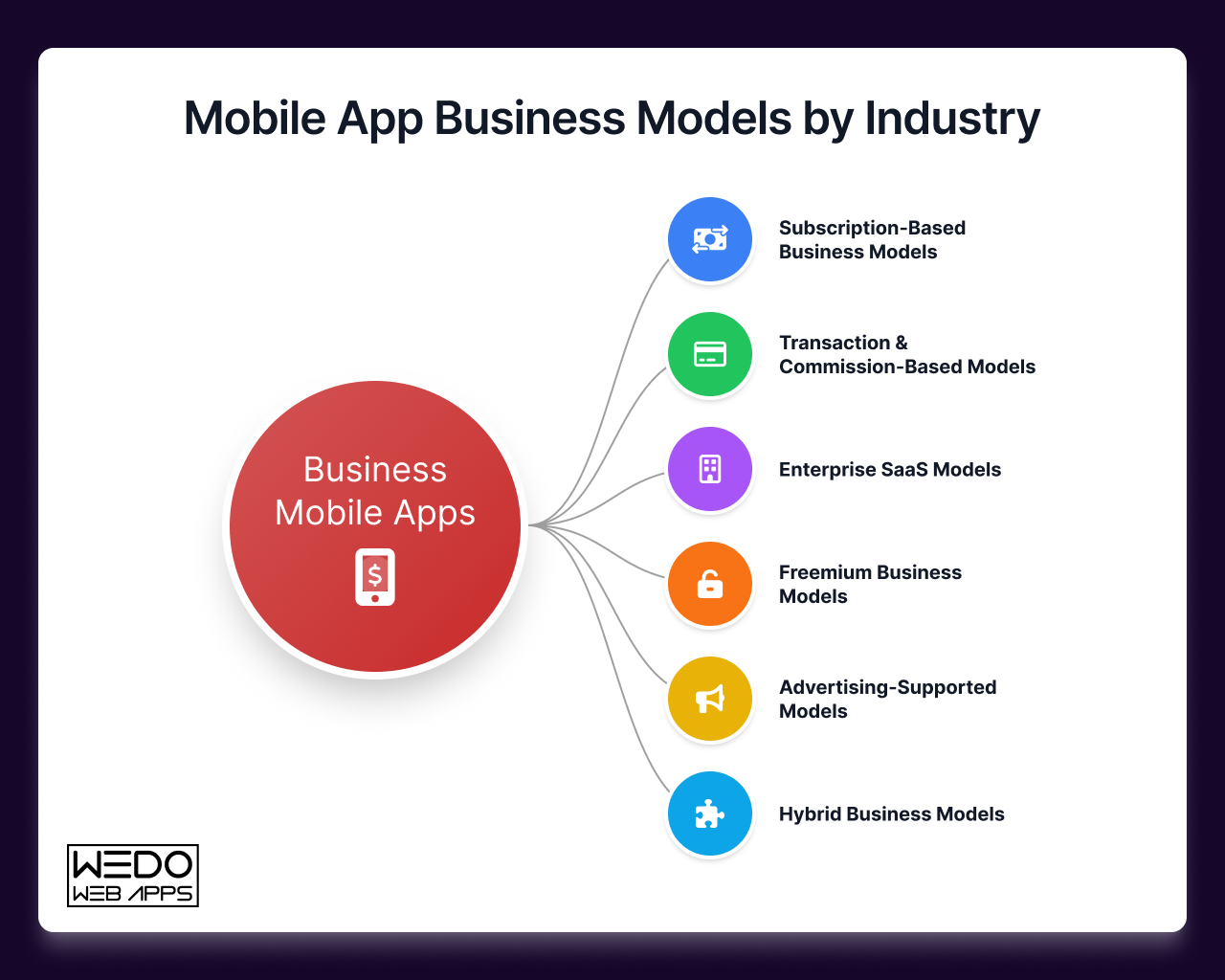
Building a successful mobile app is not only about choosing the right industry, it is also about choosing the right monetization strategy.
Different sectors generate revenue in different ways depending on customer behavior, usage frequency, operational goals, and market expectations.
Understanding these differences is essential for businesses evaluating long-term scalability and ROI.
Below is a breakdown of the most common mobile app business models by industry and how they align with different sectors.
1. Subscription-Based Business Models
Subscription models generate recurring revenue by offering continuous access to services, content, or premium experiences. This model works best in industries where users engage consistently over time.
Industries using Subscription models include:
- Fitness
- Education
- Entertainment
- Healthcare
- Productivity-focused enterprise apps
Why it Works
Recurring engagement creates predictable revenue streams while improving customer lifetime value. Businesses also benefit from:
- Higher retention opportunities
- Continuous upselling potential
- Long-term customer relationships
Examples of Subscription-Based Mobile Experiences
- Streaming platforms
- Virtual fitness coaching apps
- eLearning memberships
- Telemedicine services
For many businesses, subscription ecosystems provide more stable growth compared to one-time transaction models.
2. Transaction & Commission-Based Models
This model generates revenue whenever users complete transactions within the platform. It is one of the most scalable monetization approaches among profitable mobile app industries.
Industries Using Transaction Models:
- Fintech
- eCommerce
- Travel & Hospitality
- Real estate marketplaces
- Logistics platforms
Why it Works
The more platform activity increases, the more revenue the business generates. These apps often scale effectively because:
- Customer acquisition directly impacts transaction volume
- Monetization happens continuously
- Marketplaces benefit from network effects
Common Revenue Streams
- Payment processing fees
- Booking commissions
- Marketplace transaction percentages
- Lead generation charges
This model is especially powerful in industries with high-frequency customer activity.
3. Enterprise SaaS Models
Enterprise SaaS models focus on operational efficiency, workflow automation, and large-scale business management solutions. Rather than targeting customers directly, these apps generate revenue through enterprise subscriptions or licensing agreements.
Industries Using Enterprise SaaS Models:
- Construction
- Manufacturing
- Logistics & Supply chain
- Energy & Utility
- Enterprise healthcare systems
Why it Works
Businesses are willing to invest in technologies that:
- Reduce operational costs
- Improve productivity
- Increase visibility
- Streamline communication
Enterprise-focused apps often achieve:
- Higher contract values
- Long-term client retention
- Scalable recurring revenue
Examples:
- Fleet management platforms
- Workforce coordination apps
- Predictive maintenance systems
- Utility infrastructure monitoring tools
This model is particularly valuable for B2B technology companies focused on long-term digital transformation.
4. Freemium Business Models
Freemium apps provide basic functionality for free while charging users for advanced features or premium experiences. This model is commonly used to accelerate user acquisition before monetization.
Industries Using Freemium Models
- Education
- Entertainment
- Fitness
- Fintech
- Productivity applications
Why it Works
Free access lowers adoption barriers while premium upgrades generate revenue from engaged users. Businesses benefit from:
- Rapid user growth
- Increased product exposure
- Scalable upeslling opportunities
Typical Premium Features
- Advanced analytics
- Ad-free experiences
- Premium content access
- Personalized recommendations
- Enhanced customization tools
Freemium models work best when businesses can demonstrate ongoing value beyond the free experience.
5. Advertising-Supported Models
Advertising remains one of the most common monetization strategies in high-engagement mobile ecosystems. This model performs best in apps with large user bases and extended session durations.
Industries Using Advertising Models:
- Entertainment
- Gaming
- Social content platforms
- Media and publishing apps
Why it Works
Higher user engagement creates more advertising inventory and monetization opportunities.
Revenue streams often include:
- Display advertising
- Sponsored content
- Video ads
- Brand partnerships
However, businesses must balance monetization with user experience to avoid reducing retention.
6. Hybrid Business Models
Many successful apps combine multiple monetization strategies instead of relying on a single revenue source. This hybrid approach helps businesses diversify revenue while adapting to changing user behavior.
Industries Commonly Using Hybrid Models:
- Fintech
- Entertainment
- Travel
- Fitness
- eCommerce
Examples of Hybrid Monetization:
- Subscriptions + ads
- Transactions + Premium memberships
- Freemium Access + in-app purchases
- Commissions + partner integrations
Hybrid models are increasingly common because they allow businesses to maximize monetization across different customer segments.
How Businesses Choose the Right Mobile App Business Model
Selecting the right monetization strategy depends on several factors:
- User Behavior: How frequently users engage with the platform.
- Industry Expectations: Whether users expect free access, subscriptions, or transactional pricing.
- Customer Lifetime Value: Long-term revenue potential per customer.
- Scalability Potential: How effectively the business model can grow with increased adoption.
- Operational Complexity: Whether the app focuses on customer engagement or enterprise efficiency.
Businesses that align monetization strategy with industry behavior often achieve stronger profitability and long-term sustainability.
Key Business Insight:
The most successful mobile apps are not built around features alone, they are built around sustainable business models.
Understanding how businesses make money with mobile apps is often more important than understanding the technology itself. Because ultimately, long-term growth depends on how effectively an app converts engagement, efficiency, or operational value into scalable revenue.
Emerging Opportunities: Industry Sectors for Mobile App Growth in 2026 and Beyond
The mobile app market is no longer growing through adoption alone—it is evolving through smarter, more connected, and highly personalized digital experiences.
As businesses move beyond basic mobile functionality, the next phase of growth is being shaped by:
- AI-driven automation
- predictive analytics
- connected ecosystems
- and industry-specific digital transformation
For decision-makers evaluating long-term investments, understanding these emerging trends is critical when identifying future-ready industry sectors for mobile app growth.
1. AI-Powered Mobile Applications
Artificial intelligence is becoming one of the biggest growth drivers across nearly every industry using mobile apps.
Businesses are increasingly integrating AI into mobile experiences to:
- personalize user interactions
- automate workflows
- improve customer support
- generate predictive insights
- enhance operational decision-making
Industries Seeing Rapid AI Adoption
- eCommerce
- healthcare
- fintech
- logistics & supply chain
- entertainment
Examples include:
- AI-powered shopping recommendations
- predictive healthcare monitoring
- intelligent fraud detection systems
- AI-based route optimization
- personalized content delivery platforms
As AI capabilities mature, mobile apps are evolving from reactive tools into intelligent business ecosystems.
2. Hyper-Personalization Across Customer Experiences
Modern users increasingly expect digital experiences tailored to their behavior, preferences, and usage patterns.
This demand is accelerating investment in:
- personalized recommendations
- dynamic user journeys
- behavior-driven notifications
- adaptive app interfaces
Industries Leading Hyper-Personalization
- eCommerce
- entertainment
- fitness
- travel & hospitality
- fintech
Businesses that deliver highly personalized mobile experiences often see:
- stronger retention
- higher engagement
- increased conversion rates
- improved customer lifetime value
This shift is making personalization a competitive necessity rather than a premium feature.
3. Enterprise Mobility & Operational Intelligence
Enterprise-focused industries are rapidly investing in mobile solutions that improve visibility, communication, and operational control.
This is especially important in industries where real-time coordination directly impacts efficiency and profitability.
Industries Driving Enterprise Mobility Growth
- construction
- manufacturing
- logistics & supply chain
- energy & utility
- healthcare
Key growth areas include:
- workforce mobility platforms
- predictive maintenance systems
- IoT-connected monitoring apps
- real-time reporting dashboards
- field operations management tools
As enterprise digital transformation accelerates, mobile apps are becoming central operational infrastructure.
4. IoT & Connected Mobile Ecosystems
The growth of connected devices is expanding how businesses use mobile applications across physical and digital environments.
Mobile apps increasingly serve as control centers for:
- smart devices
- connected infrastructure
- wearable technologies
- industrial systems
Industries Benefiting Most From Connected Ecosystems
- manufacturing
- energy & utility
- healthcare
- fitness
- logistics
Examples include:
- smart factory monitoring
- wearable health tracking
- connected fleet systems
- smart energy management platforms
This convergence of IoT and mobility is creating new opportunities for automation and real-time decision-making.
5. Embedded Finance & Digital Payment Expansion
Financial functionality is increasingly being integrated into non-financial mobile ecosystems.
This trend—commonly called embedded finance—is transforming how businesses monetize mobile platforms.
Industries Adopting Embedded Finance
- eCommerce
- travel
- logistics
- healthcare
- real estate
Examples include:
- buy-now-pay-later integrations
- in-app insurance services
- embedded lending solutions
- digital wallet integrations
Businesses are increasingly using financial services to improve customer convenience while opening new revenue streams.
6. Low-Code & Faster App Development Ecosystems
As businesses demand faster digital transformation, low-code and rapid development frameworks are accelerating mobile innovation.
This trend is helping organizations:
- reduce development timelines
- launch MVPs faster
- validate market demand quickly
- scale digital products efficiently
While enterprise-grade applications still require custom development expertise, businesses are increasingly prioritizing agility and faster deployment cycles.
What These Trends Mean for Businesses
The future of mobile app growth is no longer centered around simply having an app.
Competitive advantage now depends on:
- intelligent automation
- personalization
- operational integration
- scalability
- and continuous digital innovation
Businesses that align mobile investments with long-term industry transformation trends are more likely to achieve sustainable growth and competitive differentiation.
Key Business Insight
The industries experiencing the strongest mobile app growth are those where technology directly improves decision-making, customer experience, or operational efficiency.
In 2026 and beyond, successful mobile apps will increasingly function as connected business ecosystems, not standalone digital products.
How to Choose the Right Industry for Your Mobile App Investment
Not every mobile app idea leads to sustainable growth. The industries that generate the strongest returns are usually the ones where business goals, customer behavior, and monetization opportunities align clearly.
Before investing in development, businesses should evaluate whether the industry supports long-term mobile adoption and scalable value creation.
Here are the most important factors decision-makers should assess before entering any of the top industries using mobile apps.
1. Validate Real Market Demand
A growing market does not automatically guarantee product success.
Businesses should evaluate:
- customer pain points
- existing digital adoption
- demand for mobile-first experiences
- competitive gaps within the industry
The strongest opportunities often exist where mobile technology solves operational inefficiencies or improves convenience significantly.
2. Define the Revenue Model Early
One of the biggest mistakes businesses make is building an app before defining how it will generate value.
Before development begins, companies should identify:
- subscription opportunities
- transaction potential
- operational efficiency gains
- enterprise licensing possibilities
- customer retention benefits
Understanding how businesses make money with mobile apps helps prevent unclear product direction later.
3. Evaluate User Engagement Frequency
Industries with higher engagement frequency generally create stronger monetization opportunities.
For example:
- fintech and eCommerce apps encourage daily interaction
- fitness apps build habit-driven engagement
- logistics apps support continuous operational usage
Frequent interaction improves:
- retention
- upselling opportunities
- customer lifetime value
4. Assess Scalability Potential
The best mobile app opportunities support long-term growth without proportional operational expansion.
Businesses should evaluate:
- geographic scalability
- automation opportunities
- infrastructure requirements
- integration capabilities
- long-term operational sustainability
Scalable industries often provide stronger long-term ROI than trend-driven markets.
5. Prioritize User Experience & Simplicity
Even the strongest idea can fail if the user experience creates friction.
Businesses investing in mobile apps should focus on:
- intuitive navigation
- performance optimization
- personalized experiences
- fast onboarding processes
- seamless functionality across devices
In highly competitive industries, customer experience often becomes the biggest differentiator.
Key Business Insight
The most successful mobile app investments are usually driven by business strategy; not trend adoption.
Companies that focus on solving meaningful industry problems while aligning monetization, scalability, and user behavior tend to build stronger long-term digital products.

Common Mistakes Businesses Make When Building Industry-Specific Mobile Apps
As mobile adoption increases across industries, many businesses rush into development without fully evaluating long-term strategy, scalability, or market alignment.
While the opportunities are significant, poor planning can quickly turn mobile investments into expensive operational burdens.
Here are some of the most common mistakes businesses make when entering industry sectors for mobile app growth.
Building Around Trends Instead of Business Value
Many businesses pursue trending app ideas without validating whether the product solves a meaningful problem.
Successful apps are typically built around:
- operational efficiency
- customer convenience
- recurring engagement
- or measurable business outcomes
Trend-driven products without long-term value often struggle with retention and scalability.
Ignoring Monetization Strategy Early
A mobile app should support a clear business objective from the beginning.
Without a defined monetization model, businesses often face:
- unclear product priorities
- weak revenue potential
- rising operational costs
- and low scalability
Defining the right mobile app business model by industry early helps create stronger product direction.
Overbuilding Features in Early Stages
Many businesses attempt to launch with excessive functionality instead of validating core user demand first.
This often leads to:
- delayed launches
- higher development costs
- complex user experiences
- maintenance challenges
A focused MVP approach usually creates faster market validation and more efficient scaling opportunities.
Underestimating Scalability Requirements
Apps that perform well initially may struggle later if scalability is ignored during development.
Industries like:
- fintech
- logistics
- eCommerce
- healthcare
often require strong backend architecture and long-term infrastructure planning.
Scalability should be considered from the earliest development stages—not after growth begins.
Treating Mobile Apps as Standalone Products
Modern mobile apps rarely function independently.
Successful businesses integrate mobile ecosystems with:
- analytics platforms
- CRM systems
- payment infrastructure
- cloud environments
- and operational workflows
Businesses that think beyond isolated app experiences usually achieve stronger operational and customer value.
Key Business Insight
The biggest mobile app failures are rarely caused by technology alone—they are usually caused by weak business alignment, unclear monetization, or poor long-term planning.
Businesses that prioritize strategy before development often achieve stronger ROI and more sustainable digital growth.
Why the Right Development Partner Matters
Building a successful mobile app requires more than technical execution. In many industries, long-term success depends on how well the product aligns with business goals, scalability requirements, and user expectations.
The right development partner helps businesses move beyond feature development toward building scalable digital ecosystems.
This becomes especially important in industries where:
- operational complexity is high
- customer expectations evolve rapidly
- integrations are critical
- and scalability directly impacts profitability
An experienced development team can help businesses:
- validate product direction
- prioritize high-impact features
- improve scalability planning
- optimize user experience
- and reduce long-term technical limitations
For businesses entering competitive profitable mobile app industries, strategic product thinking often matters as much as development itself.
Companies like WEDOWEBAPPS increasingly work with businesses not only on application development, but also on aligning mobile solutions with operational goals, customer engagement strategies, and long-term digital growth.