skip to content

React Native 0.76 – Embracing the Era With Enhanced Performance and Modern Architecture

Introduction

React Native 0.76 has officially landed on npm, bringing with it the highly anticipated New Architecture. This release marks a significant milestone in the evolution of React Native, as detailed in the accompanying blog post.

The New Architecture supports modern React features, including Suspense, Transitions, automatic batching, and useLayoutEffect. It also introduces revamped Native Module and Native Component systems, enabling developers to write type-safe code with direct access to native interfaces, effectively removing the need for a bridge.

This update is the culmination of a comprehensive rewrite of React Native, a project that has been in development since 2018. The team has prioritized a gradual migration path, establishing the New Architecture Working Group in 2021 to facilitate a smooth transition for the community.

Most applications should find adopting React Native 0.76 straightforward, as many popular libraries already align with the New Architecture. Additionally, an automatic interoperability layer ensures backward compatibility with libraries built for the previous architecture, easing the upgrade process for developers.

With these advancements, React Native 0.76 positions itself as a robust choice for developers looking to leverage the latest in mobile technology.

Here’s a concise rewrite that captures all the important points about the New Architecture:

What is the New Architecture?

The New Architecture is a complete overhaul of the core systems of React Native, improving component rendering, communication between JavaScript and native abstractions, and work scheduling across threads. While most users won’t need to delve into the technical details, these changes enhance performance and capabilities.

In the previous architecture, React Native relied on an asynchronous bridge to communicate with native platforms, serializing and enqueuing calls. This design prevented the main thread from being blocked, ensuring smooth rendering and function calls. However, user expectations for immediate feedback required some updates to render synchronously, which the old system couldn’t accommodate.

The old architecture also faced bottlenecks due to serialization, making it difficult to achieve consistent 60+ FPS, and synchronization issues could cause visual glitches when the JavaScript and native layers fell out of sync. Additionally, the single-threaded layout computation limited urgent updates, hindering responsiveness.

To address these issues, the New Architecture includes four main components:

  1. New Native Module System: Offers synchronous access to the native layer, allowing for both asynchronous and synchronous event handling and layout reading. Native modules are lazily loaded by default, enhancing performance.
  2. New Renderer: Capable of managing multiple in-progress trees across threads, supporting concurrent updates and enabling responsive UIs without jank.
  3. Event Loop: Processes tasks in a defined order, allowing urgent user interactions to interrupt rendering and align with web standards for features like microtasks and MutationObserver.
  4. Removal of the Bridge: Facilitates faster startup and direct communication between JavaScript and the native runtime, improving error reporting and reducing crashes.

The New Architecture is now production-ready and successfully used at scale in Meta’s Facebook app and others. Companies like Expensify and Kraken have already implemented it in their production environments, showcasing its effectiveness.

1. The New Native Module System

The new Native Module System, implemented in C++, offers a more seamless and efficient approach to handling complex tasks, akin to the way AI programming languages streamline communication in machine learning applications. By enabling direct communication between JavaScript and native code, developers can harness the full power of AI-driven apps with minimal latency. This upgrade brings several key benefits:

  • Synchronous communication with the native runtime
  • Type safety between JavaScript and native code
  • Code sharing across platforms
  • Lazy module loading by default

In the new system, JavaScript and the native layer can communicate synchronously via the JavaScript Interface (JSI), eliminating the need for an asynchronous bridge. This allows custom Native Modules to call functions and return values directly, enhancing functionality:

Old Architecture

Old Architecture

New Architecture

New Architecture

The New Module System allows the use of C++ for native implementations, ensuring modules work across platforms like Android, iOS, Windows, and macOS. This enhances memory management and performance optimizations.

Additionally, Codegen defines a strongly typed contract between JavaScript and native layers, helping to prevent cross-boundary type errors that often cause crashes. It also generates necessary boilerplate code, streamlining development.

Finally, with lazy loading, modules are only loaded when needed, reducing startup time and maintaining efficiency as the application scales.

Libraries like react-native-mmkv have already benefited from migrating to the new Native Modules, showcasing the performance improvements.

2. New Render

The Native Renderer has undergone a complete rewrite, introducing several key enhancements:

– Updates can now be rendered across multiple threads with varying priorities.

– Layout information can be accessed synchronously across different threads.

– The renderer, implemented in C++, is shared across all platforms.

The updated Native Renderer organizes the view hierarchy in an immutable tree structure, ensuring thread-safe processing of updates. This allows for multiple in-progress trees, facilitating background rendering during transitions without blocking the UI or interrupting main-thread updates in response to user interactions.

By supporting multiple threads, React can prioritize urgent updates, such as user input, while resuming lower-priority updates as needed. The ability to read layout information synchronously enables background calculations and immediate layout adjustments, like repositioning tooltips.

Rewriting the renderer in C++ allows for consistent performance across platforms, including iOS, Android, Windows, and macOS, eliminating the need for platform-specific implementations. 

These changes align with the broader Many Platform Vision, as features like View Flattening—previously exclusive to Android—are now available on iOS, automatically benefiting from the shared C++ core.

With these improvements, React Native fully supports Concurrent React features like Suspense and Transitions, enabling developers to create complex, responsive user interfaces free from jank and delays. Future updates will leverage this architecture to enhance built-in components such as FlatList and TextInput.

This also opens the door for smoother integrations of UI components like a React carousel library, ensuring that dynamic elements like image sliders or carousels render efficiently without compromising performance.

3. The Event Loop

The New Architecture has enabled the implementation of a well-defined event loop processing model, which aligns with the HTML Standard. This model standardizes how React Native handles tasks on the JavaScript thread.

By bridging gaps between React DOM and React Native, the event loop brings their behaviors closer together, making it easier for developers to learn once and write anywhere.

Benefits of the Event Loop

– Interruptible Rendering: The event loop allows React to pause low-priority updates to process urgent user events, enabling more responsive interactions.

– Alignment with Web Specifications: It aligns event and timer behaviors with web standards, enhancing familiarity for developers transitioning between React DOM and React Native.

– Foundation for Browser Features: While features like microtasks, MutationObserver, and IntersectionObserver are not yet available in React Native, the event loop sets the stage for their future implementation.

Additionally, the event loop works in tandem with the New Renderer to support synchronous layout reading. This integration allows for proper implementation of `useLayoutEffect`, enabling developers to read layout information and update the UI within the same frame, ensuring elements are positioned correctly before being displayed.

4. Removal of the Bridge

In the New Architecture, React Native has completely eliminated its dependency on the bridge, opting instead for direct and efficient communication between JavaScript and native code through the JavaScript Interface (JSI).

Benefits of Removing the Bridge

– Improved Startup Time: By avoiding the need for bridge initialization, the app starts faster. In the old architecture, global methods required a module to be initialized at startup, which introduced delays:

Removal of the Bridge

We can directly bind methods from C++ in the new architecture:

Removal of the Bridges

– Enhanced Error Reporting: The rewrite improves error handling for JavaScript crashes during startup and reduces crashes due to undefined behavior. If issues arise, the updated React Native DevTools facilitate easier debugging.

The bridge will remain available for backward compatibility during the gradual migration to the New Architecture, but it is planned for removal in future updates.

New Features in React Native’s New Architecture 0.76

The New Architecture fully supports React 18, including concurrent features and `useLayoutEffect`. Key updates include:

1. Transitions

Introduced in React 18, transitions differentiate between urgent updates (like typing) and non-urgent ones (UI changes). This allows React Native to render these updates separately, enhancing user experience by making interactions feel immediate while deferring less critical updates. Developers can use the `startTransition` API to mark state updates as transitions:

Transitions

This separation leads to a smoother UI, especially when rendering complex components.

2. Automatic Batching

With the New Architecture, React Native benefits from automatic batching introduced in React 18. This feature consolidates state updates, reducing the rendering of intermediate states and improving performance without requiring additional code from developers.

3. useLayoutEffect

The New Architecture allows for synchronous layout reading using `useLayoutEffect`, eliminating the need for asynchronous `onLayout` events. This means layout information can be accessed and updated within the same frame, allowing for precise positioning of UI elements:

useLayoutEffect with The old architecture 

useLayoutEffect

useLayoutEffect with The new architecture

useLayoutEffects

4. Full Support for Suspense

React Native now fully supports Suspense, enabling developers to manage loading states declaratively. This allows for smoother user interactions by rendering suspended content in the background while prioritizing user input on visible elements.

Overall, these enhancements make React Native more powerful and responsive, allowing developers to create sophisticated applications that provide a seamless user experience.

React Native DevTools 

The React Native team has announced the release of the first stable version of React Native DevTools. These are designed to enhance the debugging experience for the developers across all platforms. The team behind React Native has announced the release of the first stable version of React Native DevTools, designed to enhance the debugging experience for developers across all platforms.

The end goal of these tools is to provide reliable, familiar, simple, and cohesive debugging tools. This new set of tools is closely aligned with browser developer tools and integrates seamlessly with React Native. The key features of React Native DevTools include: 

  1. Familiar, Web-Aligned Tooling: React native DevTools offers a fully featured Debugger based on Chrome DevTools. This debugger ensures reliable breakpoints, watch values, step-through debugging, stack inspection, and a complete JavaScript console. These necessary functions perform consistently across reloads. 
  2. Enhanced Integration with React DevTools: The updated tools include a built-in React components inspector and profiler which provides faster and more dependable component highlighting. 
  3. Improved User Experience: The launch of a new “Paused in Debugger” overlay clearly indicates when your application is halted at a breakpoint. Moreover, warnings in the LogBox are now summarized and hidden when DevTools are active. This streamlines the debugging process. 
  4. Reliable Reconnection Behavior: JavaScript breakpoints now maintain their functionality across reloads, even when DevTools disconnects and reconnects. The tools can also reconnect to the same application after a native rebuild.
  5. Instant Launch: React Native DevTools is available by default with zero configuration required. Developers can easily access it through the in-app Dev Menu or by using the CLI server, which now supports multiple emulators and devices.

This release marks a significant departure from previous debugging options, including the Experimental Debugger introduced in version 0.73. The new DevTools utilize a completely rebuilt backend debugging stack developed over the past year, resulting in improved compatibility and a more reliable overall experience. The team plans to expand this new stack in future updates, with features like Performance and Network panels on the horizon.

contact to Upgrade to React Native 0.76

Gradually Upgrade to React Native 0.76: What to Expect

The 0.76 release makes the New architecture and React 18 the default setup. For most apps, upgrading will be as simple as any other release, but taking full advantage of the New Architecture requires gradual migration of code and libraries. 

Key Points for Upgrading:  

– Interoperability Layer: On upgrade, apps will run on the New Architecture with an automatic interop layer to support old architecture code. While most apps won’t need immediate changes, this layer has some limitations, such as lacking access to custom Shadow Nodes and concurrent features.  

– Concurrent Features: To use features like Suspense and Transitions, apps must align with Concurrent React principles.  

– Gradual Migration: Developers can migrate at their own pace, starting with small sections of their apps. For new components fully migrated to the New Architecture, concurrent features are immediately available. Existing code may need updates before enabling these features.  

React Native’s team has collaborated with the community to ensure smooth adoption. Over 850 popular libraries, including those with more than 200K weekly downloads, now support the New Architecture. 

This release aims to deliver a seamless upgrade path, helping developers modernize their apps without breaking existing functionality.

Breaking Changes – Removing the Bridge for Faster Performance

The New Architecture eliminates React Native’s reliance on the bridge, enabling direct communication between JavaScript and native code. This change improves performance, shortens startup times by avoiding bridge initialization, and enhances crash reporting and debugging.

Example: Old vs. New Initialization

Old Bridge-Based Initialization:

Old Bridge-Based Initialization

New Direct Initialization:

New Direct Initialization

The bridge remains available temporarily for backward compatibility, but the long-term plan is to phase it out entirely. This transition ensures smoother, faster app performance without sacrificing functionality during migration.

Conclusion

React Native 0.76 marks a major milestone in the framework’s evolution, delivering improved performance, seamless concurrent rendering, and better developer tools. While the transition to the New Architecture may require incremental adjustments, the upgrade path is designed to be smooth. With direct native communication and powerful new features, mobile app developers can build more responsive and efficient mobile apps. This release positions React Native as a forward-looking solution for creating high-performance cross-platform applications. If you are looking forward to considering React Native Mobile Application Development, WEDOWEBAPPS has the expertise you require. Get in touch.

12 Best Java Frameworks for Your Next Web Development Project

Introduction

Before talking about the top frameworks for Java development, it is crucial to know that Java serves as a backend technology. Herein, developers have the flexibility to use various Java frameworks specifically available for backend development. The backend of a website is technically known as its server side.

It organizes and manages data in such a way that the website works efficiently on the client side. The website’s backend is inaccessible and cannot be viewed by the user. The developers use the latest backend technologies with its core being the Java framework.

What is a Java Framework?

Java framework is a collection of pre-defined codes used by developers for web application development. These frameworks in Java are functions and classes that control hardware, process input, and communicate with system applications. These frameworks have pre-written codes and libraries which eliminates the need for the developers to write every piece of code from scratch. Java frameworks are also referred to as libraries and APIs.

However, picking the correct Java framework can be a difficult task. Don’t worry! In this blog, you will learn about some of the best frameworks of Java for web development.

Why Use Java Framework?

The frameworks of Java play an important role in establishing a systematic approach to application development. By creating customized frameworks for testing, online applications, and object-relational mapping (ORM), developers can automate various tasks ensuring dependable outcome generation.

For example, Java web development frameworks consist of both backend and frontend frameworks simplifying the lives of developers and allowing them to focus on business logic rather than generic code employed across a domain or application.

Market Overview of Java Frameworks in 2024

The market for Java frameworks is poised for significant growth in 2024, driven by the increasing adoption of backend and enterprise-level technologies. Prominent frameworks such as Spring, Hibernate, and Micronaut continue to dominate, thanks to their robust ecosystems and support for cloud-native and microservice architectures. Additionally, new trends such as AR/VR development and expanded mobile applications further boost Java’s relevance, particularly on the Android platform.

Spring Framework, in particular, has seen increased adoption across enterprises, offering powerful dependency injection and integrations for building scalable systems. Hibernate remains essential for simplifying database management with its ORM capabilities. Meanwhile, frameworks like Micronaut cater to modern, lightweight microservices, addressing the growing demand for highly performant cloud applications.

Regional trends indicate strong demand for Java-based solutions in North America, Europe, and Asia-Pacific, fueled by industries such as finance, retail, and telecommunications. The focus on cloud solutions is also growing, with many frameworks shifting toward SaaS or hybrid-cloud models.

This expanding market also reflects the global talent demand, with Java developers commanding competitive salaries. In North America, salaries for experienced Java developers range between $120,000 to $180,000 annually, while developers in Eastern Europe earn around $60,000 per year. This makes us curious about how to find the best Java development services for our web development projects. We’ll talk about that too, but let us first know the best Java development frameworks available at ease.

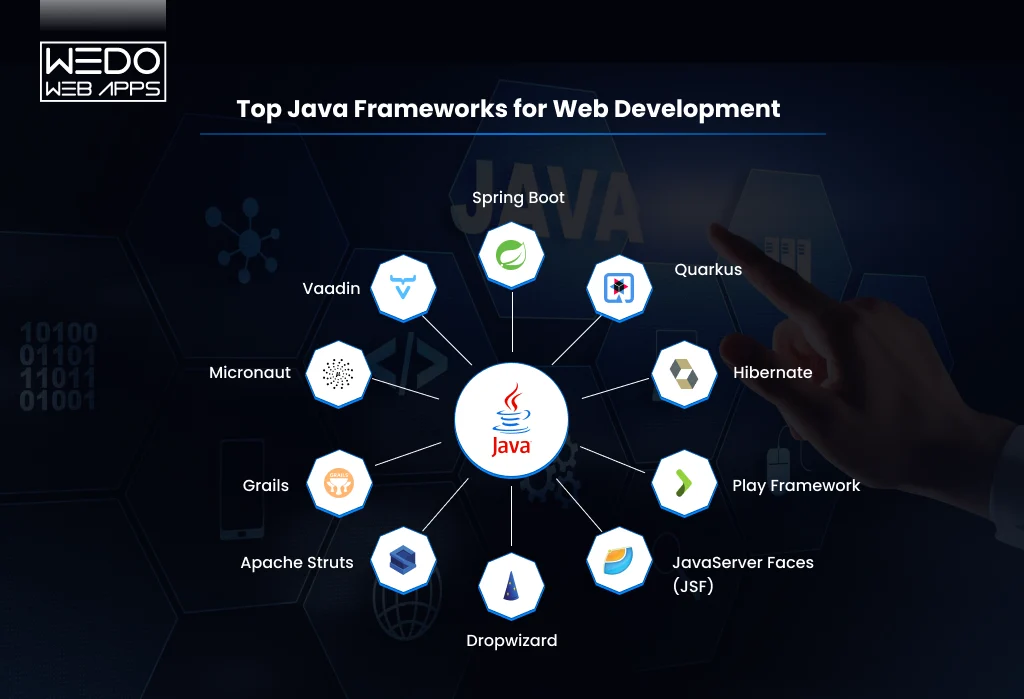
Top Web Development Frameworks for Java?

Best Java Frameworks

1. Spring

Spring is a lightweight Java Web Development Framework that opiates as an open-source platform. It offers the essential infrastructure for the development of Java applications. Commonly known as the Java Enterprise Edition (JEE) framework, Spring allows developers to develop high-performing applications by using plain old Java objects (POJOs).

Key Features

  • Admin Features
  • Properties Files
  • Type-Safe Configuration
  • Externalized Configuration
  • Web Development
  • Application Listeners and Events
Advantages and Disadvantages of Spring
Advantages Disadvantages
  • Lightweight design for server-independent triggering
  • Support for XML, annotation-based configuration, modularity
  • POJO model for lightweight class structure
  • Support for declarative programming
  • Flexible Configuration Methods
  • Large ecosystem, supportive community, videos
  • Developers focus simply on business logic
  • Comprehensive third-party libraries
  • Eliminates manual dependency management
  • Free module association and easy testing
  • Suitable for all web development layers
  • High Emphasis on Flexibility
  • Potential complexity for newcomers
  • Lengthy preparation procedure

2. Google Web Toolkit (GWT)

Google Web Toolkit, is one of the most preferred Java Frameworks for software developers. This is the best Java Web UI framework having a huge open-source community ensuring as many apps developed with GWT. The framework is extremely lightweight which makes it easy to integrate.

Key Features of GWT

  • Simple RPC mechanism
  • Provides full-featured Java Debugging Support
  • Unit Testing Integration
  • Reusable and Dynamic UI Components
  • Browser History Management
  • Support for localization and Internationalization
Advantages and Disadvantages of GWT
Advantages Disadvantages
  • Java to JavaScript Compilation
  • Security
  • Code Reusability
  • Cross-browser Compatibility
  • Strong Typing
  • Built-in Debugging
  • Rich Widgets and UI Components
  • Limited Community Support
  • Slow Compilation
  • Steep Learning Curve

3. Hibernate

Hibernate, standing out as one of the leading frameworks in web development offers a valuable abstraction layer. With this framework, the developers are relieved from the pressure of handling implementation as it efficiently manages performance internally. This includes tasks such as establishing connections and writing queries for performing CRUD operations, making it a prominent choice and securing its position at the top of the frameworks Java.

Key Features of Hibernate

  • Object-Relational Mapping (ORM)
  • Lightweight
  • Caching
  • High Performance
  • Hibernate Query Language (HQL)
  • Auto Generation
Advantages and Disadvantages of Hibernate
Advantages Disadvantages
  • Lightweight, easily modifiable, scalable, and configurable
  • Simple API for writing and retrieving Java objects from the database
  • Excellent Command-line tools and IDE plugins
  • Compatible with both RDBMS and NoSQL databases
  • Streamline data manipulation requires less code
  • Operates with no need for an application server
  • Fetching strategies that minimize database access
  • Lower performance for complex queries
  • Complexity can be challenging for beginners
  • Steep Learning curve.

4. Struts

Struts stand out as one of the premier frameworks for Java Development that uses a range of technologies like JSP, JSTL, XML, and more. This framework follows MVC architecture, serving as a robust Java MVC framework with an integrated validation system. Strut’s strength lies in its flexible model layer that seamlessly integrates with leading Java frameworks such as Spring, Hibernate, JDBC, and others.

Key Features

  • Actions based on Plain Old Java Objects (POJOs)
  • Seamless Integration Support
  • Extensive Tag Support
  • Template and Theme Compatibility
  • Configurable Model-View-Controller (MVC) Elements
  • Support for Asynchronous JavaScript and XML
Advantages and Disadvantages of Struts
Advantages Disadvantages
  • The steep learning curve for beginners
  • Documentation is based on active web developers
  • Provides XML files for centralized configuration
  • Follows application development based on MVC
  • Limited AJAX support in Strut 1.X
  • Configuration complexity with extensive XML files
  • Verbosity can lead to larger codebases
  • Potential for tight coupling between components
  • Limited built-in support for RESTful services
  • Faces competition for newer, more modern frameworks

5. Play

Play is a resilient open-source framework of Java tailored for web development. It is ranked among the top Java REST API frameworks. It provides type-safe RESTful web services through Scala and includes key components like a web server, an application server, and a profiler. Using the Scala programming language significantly contributes to the efficiency of the development process.

Key Features of Play

  • Powerful Build and Console Tools
  • Built-in Testing Tools
  • Streamlined Hit Refresh Workflow
  • IDE support for IntelliJ IDEA and Eclipse
  • Type Safety
  • High-performance app development
Advantages and Disadvantages of Play
Advantages Disadvantages
  • User-friendly integration with play-JSON and play-WS
  • Numerous components available as independent competencies
  • Powerful Test Libraries
  • Support from Saclatst and Specs2
  • Facilitates hot swapping of class files for improved development speed
  • Simplifies end-to-end testing
  • Compatibility with FluentLenium
  • Designed with a functional programming core
  • Allows hot swapping of class files
  • Occasional Volatility
  • Steep learning curve
  • Recently shifted to dependency injection by default.
  • Backward compatibility issues.

6. Grails

Grails, a top open-source framework in Java, is used to create dynamic web applications using Java, Groovy, and SQL. This powerful framework helps develop dynamic websites and applications in less time and effort with groovy language. Grails is a leading development platform that is used to develop enterprise applications, dynamic websites, and mobile applications.

Key Features of Grails

  • Spring Boot Foundation
  • Optimum Reloading Agent
  • Plugin Library
  • Seamless Java Integration
  • Built-in Testing Framework
  • Groovy Lineage
Advantages and Disadvantages of Grails
Advantages Disadvantages
  • Spring Boot Integration
  • Hot Reloading
  • Rich set of plugins to extend functionality
  • Rapid Development
  • Built-in ORM
  • Auto-generates code for CRUD operation, speeding development
  • Simplifies Java Development with dynamic features of Groovy.
  • Steep Learning Curve
  • Smaller community support compared to other frameworks in Java
  • Fewer integrations with modern IDEs and tools
  • Limited Scalability, Not suitable for very large-scale applications
  • Higher memory consumption

7. JavaServer Faces

JavaServer Faces (JSF) is an open-source framework that is used to develop rich interfaces using Java. It is one of the best web UI frameworks of Java that provides components for designing user interfaces. JSF meaning JavaServer Face is a framework that works with Java Servlet API and JavaServer Pages (JSP) technology.

Key Features of JavaServer Faces

  • Built on top of the Servlet API
  • Automatic State Management
  • Reliable and Stable Java Framework
  • Component-Based Architecture
  • Follows MVC software design
Advantages and Disadvantages of JavaServer Faces
Advantages Disadvantages
  • Simplifies UI development with reusable components
  • Integration with Java EE
  • Automates request handling and event processing
  • Rich Standard Components
  • Supported by IDEs like IntelliJ and Eclipse for faster development
  • Backed by Oracle, strong enterprise support and long-term stability
  • State Management
  • Steep Learning Curve
  • Outdated design
  • Customizing components can be challenging
  • Can be slower due to heavy abstractions
  • Not ideal for REST APIs

8. Dropwizard

Dropwizard framework helps in the creation of RESTful services. It majorly relies on hibernate, a powerful data access layer offering object database functionality. Using a client API for database access, this framework establishes secure communication between the app and the database through an HTTP-based API.

Key Features of Dropwizard

  • Incorporates the Hibernate Validator API
  • Packages each application as a JAR instead of a War File
  • Facilitates Monitoring through the Metrics library
  • Uses LogBack and SLF4J for Logging
Advantages and Disadvantages of Dropwizard
Advantages Disadvantages
  • Scalable
  • Simple to set up and get started with
  • Includes mature Java libraries
  • Has good convention
  • Provides extensive documentation
  • Provides many features without becoming too complicated
  • Assumptions constantly change and distribution and monitoring are generally complex
  • The distribution environment requires constant testing

9. Vaadin

Vaadin, one of the premier Java frameworks, allows developers to build robust, cross-platform compatible web applications. Based on the Java programming language, Vaadin uses Java Swing components to develop web applications and features a UI builder allowing designers to create interactive and attractive UI.

Key Features of Vaadin Framework Java

  • Includes two pre-built themes – Material and Lumo
  • Styling options directly from Java
  • Seamless navigation without reloading the full page
  • Exclusive Java-only type-safe web development
  • Java API for web-based elements
  • Accommodation of Deep Linking and Back Button Functionality
Advantages and Disadvantages of Vaadin
Advantages Disadvantages
  • No need to develop web services, enhance security
  • Displays the UI directly in the browser
  • Uses existing Java libraries and tools
  • Easier Java code writing and debugging
  • AJAX interaction between the web browser and the server
  • Requires substantial server memory for UI rendering
  • Challenges in achieving scalability with the solution
  • Needs Java API for widget development

10. Wicket

Wicket is yet another framework in Java that enables you to create a full-featured web application using Java programming. This framework is fully compatible with J2EE containers such as Tomcat, Glassfish, Geronimo, and JBoss EAP.

Key Features of Wicket

  • Configurable MVC components
  • AJAX support
  • Various Result Types
  • Theme and template support
  • POJO based Actions
  • Integration support
Advantages and Disadvantages of Wicket
Advantages Disadvantages
  • Customizable components to fit specific needs
  • AJAX components are built-in, enabling dynamic UIs without extra JavaScript
  • Offer built-in protection against common security vulnerabilities
  • Allows reusable UI components, simplifying development
  • Cleanly separates Java Code and HTML templates
  • Can load to excessive boilerplate for complex UIs
  • Smaller community compared to modern Java frameworks
  • Better suited for traditional web apps rather than stateless API services

11. Blade

The blade framework comes up as the top choice for Java development as it offers a lightweight and high-performance MVC architecture for Java Web Development. Commonly known for its efficiency, it is a major choice for full-stack web application development. Additionally, this framework is built upon Java Version 8.

Key Features of Blade Java Framework

  • Modular Approach
  • RESTful Style Routing Interface
  • Support Plugin Extension Mechanism
  • Embedded Template Engine and Jetty Server Support
  • Supports jdk 1.6 and other higher versions
  • Lightweight
Advantages and Disadvantages of Blade
Advantages Disadvantages
  • No external dependencies
  • Easy deployment process
  • Lightweight framework with minimal footprint
  • Built-in web server
  • Template Support
  • Short learning curve
  • Limited availability of tutorials and example projects
  • Decreased developer activity

12. ATG

ATG is a Java-based web-commerce platform that stands out as a flexible and customizable framework for developing eCommerce websites. ATG is owned by Oracle and is designed to support both large and complex B2B and B2C applications. While ATG may be a bit expensive for the small scale projects, it is an ideal choice for businesses who want to delve into eCommerce website development. Learning ATG can boost your technical skills and deepen your domain understanding.

Key Features of ATG

  • Personalization Capabilities
  • Data Anywhere Architecture
  • Payment Integration Support
  • Application Server Support
  • ATG content administrations tools
  • ATG Merchandising Concepts Provision
Advantages and Disadvantages of ATG
Advantages Disadvantages
  • Includes both B2B and B2C offerings
  • Allow owners to manage and sell complex services and products
  • Personalization available for better client experience
  • Customizable campaigns, sites, and content
  • Versatility in handling complex products and services
  • Complexity and Learning curve
  • High implementation and maintenance  costs
  • Limited Community compared to other open-source platforms.
  • Resource Intensive
  • Dependency on Java
  • Potential for over-engineering

Benefits of Using Java Frameworks for Web Development

Below are some of the top benefits of using Java and frameworks for web development

1. Code Simplification

Java frameworks help simplify code by reducing the need to write everything from scratch. With built-in libraries and preset codes, developers can significantly cut down redundant code.

2. Multiple Development Options

These frameworks offer diverse features and tools, enabling developers to create responsive applications efficiently by following established standards and rules.

3. Security and Reliability

Java frameworks enhance application security with reliable libraries, secure algorithms, and adaptive methods, ensuring smooth, disruption-free performance.

4. Better Support

Many Java frameworks have active communities, forums, and extensive documentation, providing quick solutions to problems and facilitating continuous learning.

5. Enhanced Efficiency

Frameworks streamline development by offering predefined functions, reducing the time and effort required for repetitive tasks, and accelerating the overall process.

Comparison Table of Popular Java Frameworks

Framework Strength Weakness Ideal For
Spring Lightweight, flexible, modular Complex for beginners Enterprise applications of all sizes
GWT Java-to-JavaScript Compilation, Cross-browser compatibility Steep learning curve, slow compilation Building rich, client-side applications
Hibernate Powerful ORM, simplifies data access Difficult to learn for beginners Development with relational databases
Struts MVC architecture, integrates with other frameworks Steeper learning curve, complex configuration, limited AJAX support Traditional web application development with JSP and JSTL
Play Type-safe REST APIs, Scala Integration Backward compatibility issues, steeper learning curve Building high-performance web services
Grails Rapid development, Groovy integration, built-in ORM Performance issues, smaller community Developing web applications with dynamic scripting
JavaServer Faces Component based UI, part of Java EE ecosystem Outdated design, limited client-side interactivity Enterprise web applications with complex UI requirements
Dropwizard Scalable, simple to set up, secure Assumptions can change, needs constant testing Developing RESTful services with Hibernate Integration
Vaadin Cross-platform UI, drag-and-drop builder, Java-only development Requires significant server memory, challenges in scalability Creating rich web applications with minimal JavaScript
Wicket Component oriented, Reusable UI components Steep learning curve, higher memory usage Building stateful, component-based web applications
Blade Lightweight, MVC architecture, efficient Limited tutorials and examples, decreases developer activity Rapid development of full-stack web applications
ATG Flexible, customizable for B2B/B2C eCommerce Complex, expensive for small projects, limited community Large-scale eCommerce websites with advanced features

With these options, you can explore various Java with framework combinations that aligns with your project’s specific needs.

Conclusion

So, above were some of the best Java frameworks for web application development. Undoubtedly, after seeing so many frameworks in Java, you might havegot confused with which one to choose. Well, it depends on the niche and needs of your business.

Technology is moving so fast and you need to match the pace in order to stay in the competition. So, to clear your confusion and get your web application developed by professional, get in touch with a best Java Development company like WEDOWEBAPPS and discuss your business requirements.

Comprehensive Guide to Cross-Platform Mobile App Development

Introduction

Almost every firm in the business world requires a mobile app. To remain competitive, businesses must have a mobile application for their customers and staff – an application that can run seamlessly on both iOS and Android platforms. The company decides whether it requires a separate codebase for each operating system or to employ a cross-platform mobile app development solution.

Apart from aligning the primary features and adhering to the client’s expectations, the most common problem that the development business faces while establishing an app is cross-platform app development. App developers clearly know that it is easier said than done.

As of 2025, Android holds approximately 71.67% of the global mobile operating system market, while iOS has a 27.73% share.

In this post, we have outlined the benefits of cross-platform app development, popular cross-platform frameworks, and real-time case studies. As it is the era of cross-platform apps, companies like WEDOWEBAPPS, a mobile app development company in the USA, are driving innovation by developing mobile apps that function seamlessly across all platforms.

What is Cross-Platform App Development?

The idea of cross-platform allows businesses to reach as many customers as possible by developing software that runs smoothly across multiple operating systems. This development approach allows a wide range of users to use apps that are compatible with all digital environments. Developing apps for multiple platforms allows developers to launch products faster by writing code just once. This approach reduces costs while ensuring the app maintains high performance and quality across different operating systems.

Developers leveraging multiplatform mobile app development strategies can achieve wider reach and faster deployment. By using frameworks like Flutter or React Native, businesses can ensure that their applications perform efficiently across various operating systems, such as Android and iOS, without needing separate codebases.

Why is Cross-Platform Mobile App Development Important?

With a high number of platforms emerging at the same time, going with fully native Android or iOS is a bit risky. Additionally, programming an app individually for each platform is time-consuming and costly, regardless of the fact that they appear and function almost similarly. The solution to this problem is to use a cross-platform development strategy that allows you to develop an app with smooth functioning on all the operating systems at the same time and the money required to develop an app for one platform using a third-party software development kit.

The debate of native app vs cross platform often arises when businesses decide on their mobile app strategy. While native apps are known for optimized performance and deep integration with the device’s hardware, cross-platform solutions offer faster development and cost efficiency, making them ideal for businesses targeting diverse audiences.

Important Facts Below:

  • The reusability of code and databases results in saved money and time.
  • Having numerous apps with different backends increases the upgrade and maintenance costs.
  • Good user experience is an important factor for an application’s success. Cross-platform app development allows for a consistent user experience across all devices and OS, resulting in higher engagement.
  • Cross-platform app development can take a single mobile app idea and deploy it to various platforms (Android, iOS, etc.) without the need to start it from scratch for each platform. It also lets you make changes to every platform at the same time.

Benefits of Cross-Platform Development

Here’s a deeper look into the key benefits of cross-platform development:

1. Cost-Efficiency

Using cross-platform frameworks, developers can program a single codebase for multiple platforms, thereby minimizing the development costs compared to developing separate apps for iOS and Android. The lower resource needs of this approach make it attractive, especially for startups and small businesses with limited budgets.

2. Quick Development

Since this approach works on the “write once deploy anywhere” technique, the development cycle is comparatively shorter. This allows faster time-to-market, hence, giving businesses a competitive edge. Cross-platform tools like Flutter and React Native offer hot-reload features, boosting the application testing process.

3. Wider Audience Reach

By developing mobile apps for multiple platforms (like iOS, Android, and the web) simultaneously, companies can reach a wider audience without developing separate versions. This approach ensures market penetrations in regions with varied user bases, i.e., between Android and iOS, maximizing user engagement.

4. Easier Maintenance and Updates

Cross-platform apps are way easier to maintain because the updates only need to be made in a single codebase and those are reflected across all platforms. This reduces the workload for development teams and ensures that the features and performance remain consistent on all platforms.

Overall, cross-platform development allows businesses to balance cost, speed, and reach without compromising on the quality of the app, thereby making cross-platform development an essential and go-to strategy in today’s competitive mobile app industry.

Popular Cross-Platform Frameworks

1. React Native 

React Native, one of the best mobile app development tools developed by Facebook, allows mobile app developers to develop mobile apps that look and feel like native apps by combining JavaScript and React. Large community, continuously updated documentation and cross-platform component reusability are some of the benefits of React Native development. To provide the users with access to native device capabilities and APIs, React Native also allows the integration of native modules.

React Native Hermes, a lightweight JavaScript engine, significantly enhances the performance of applications. Hermes optimizes app startup time and memory usage, providing a smoother user experience, especially on devices with limited resources.

Examples of Successful Apps developed with React Native

  • Facebook- This social media giant relies heavily on React Native for some parts of its mobile app.
  • Instagram- The explore page feature is developed using React Native in the Instagram app.
  • Walmart- This giant application improved app performance and minimized development time using this framework.

2. Flutter

Flutter is another preferred option for cross-platform app development developed by Google. It has a wide range of pre-built widgets and Dart Programming Language for creating user interfaces. One of the most useful benefits of Flutter Development is its fast rendering feature that allows for fluid animations and transitions. Additionally, it offers the hot reload feature which lets the developers view changes immediately without restarting the application.

Examples of Successful Apps developed with Flutter

  • Google Ads- This application is developed by Google and offers seamless control over ad campaigns.
  • Alibaba- This eCommerce giant uses Flutter for some parts of its user experience.
  • Reflectly- A journalism-based application developed purely on Flutter.

3. Telerik

Telerik, though, not in use anymore, was a great framework for mobile app development. It offered robust UI components and tools for building cross-platform apps. The frameworks supported by Telerik were Angular and NativeScript, making it a popular choice amongst developers. Telerik was known for its powerful backend mobile app development services which streamlined the development process.

Examples of Successful Apps Developed with Telerik

  • Scripps Networks- Utilized Telerik tools to build smooth and functional mobile interfaces.
  • KFC- The well-known fast food chain developed part of its food ordering app using the components of Telerik.

4. PhoneGap

PhoneGap, developed by Adobe and based on Apache Cordova, allows developers to build hybrid applications using HTML, CSS, and JavaScript. It provides access to the APIs of native devices and works well for apps requiring minimal native interactions.

Examples of Successful Apps Developed with PhoneGap

  • Wikipedia- The world’s largest encyclopedia app uses PhoneGap for parts of its interface.
  • TripCase- A travel management app developed using PhoneGap offering a seamless user experience.

5. Ionic

Ionic is a popular open-source framework that enables developers to build cross-platform mobile apps using technologies like HTML, CSS, and JavaScript. With integration support of Angular, React, and Vue; it offers flexibility and a rich library of UI components. Ionic’s capacitor plugin gives access to the device’s native features, ensuring near-native performance. Its strong community and cost-effective development make it an ideal choice for hybrid mobile app projects.

Examples of Successful Apps Developed with Ionic

  • Untappd- A well-known social app for beer lovers, untappd has leveraged Ionic development to cater to both Android and iOS users.
  • Sworkit- A fitness app delivering personalized workout plans is developed using the Ionic framework to ensure cross-platform consistency.
  • JustWatch- A streaming search engine app developed in Ionic to ensure a seamless experience across devices.

Cross-Platform Case Studies and Success Stories

1. Instagram with React Native Powerhouse

Instagram’s shift to React Native is truly remarkable. Initially, it was just a photo posting app but it has with time modified into an interactive app with millions of users engaging daily. By migrating to React Native, Instagram has seen the heights of popularity. It has achieved a smooth user experience with interactive features like Stories, Reels, and IGTV. Additionally, these features now work seamlessly across both Android and iOS platforms with minimal codebase divergence.

2. Xianyu by Alibaba with Flutter Framework

Xianyu, also known as Idle Fish, is Alibaba Group’s secondhand marketplace that blends e-commerce with sustainability, allowing users to buy, sell, and exchange pre-owned goods. Built on Alibaba Cloud’s serverless architecture, the platform achieves exceptional speed and stability while minimizing maintenance efforts. Xianyu also leverages Flutter to ensure a seamless and consistent experience across Android and iOS, setting a high standard for hybrid app development in large-scale applications.

iDreamers: Achieving Cross-Platform Success with WEDOWEBAPPS

iDreamers, a platform for creatives to connect and showcase their talents, partnered with WeDoWebApps to build a high-performance mobile app across Android and iOS. To optimize costs and accelerate development, the project leveraged Flutter, a cross-platform framework that enables a native-like experience using a single codebase.

By adopting this cross-platform approach, WEDOWEBAPPS delivered the app 40% more cost-efficiently compared to native development. The unified design ensured a seamless user experience across platforms, while simultaneous deployment allowed iDreamers to quickly reach a wider audience. The scalable architecture also makes it easier to roll out updates and new features.

The collaboration with WEDOWEBAPPS highlights the benefits of cross-platform development, helping iDreamers launch efficiently, enhance user engagement, and position themselves for sustainable growth in a competitive market.

contact for Cross-Platform Success

Conclusion

Cross-platform development offers a practical, efficient way to meet the growing demands of the mobile app industry. From cost savings to faster time-to-market and easier maintenance, businesses can no longer ignore the advantages of using these frameworks. React Native, Flutter, Ionic, and PhoneGap are a few best cross-platform mobile app development tools that have empowered companies to build successful apps quickly and effectively.

Ready to build your next cross-platform app?

Cross-Platform mobile app development companies like WEDOWEBAPPS specialize in tailor-made cross-platform mobile solutions that cater to your business needs. With expertise in frameworks like Flutter and React Native, we ensure high performance, seamless user experiences, and faster time-to-market for all your mobile apps.

Hire mobile app developers and unlock new possibilities with WeDoWebApps’ cross-platform development solutions!

Comprehensive Guide to Mobile App Development Services in Key Regions

Introduction

The mobile app development market is booming across the globe and every regional market offering different levels of expertise, technologies, and pricing models. As businesses these days rely on mobile solutions to engage with their customers, understanding the different mobile app development regions is important for making informed decisions. When hiring mobile app developers, prioritize pricing, time zones, technology specializations, and compliance needs to ensure successful collaboration.

Whether you want to develop a cutting-edge fintech solution or a fully functional eCommerce platform, there is a region that can perfectly fit your development requirements. This guide will help you navigate the complexities of global mobile app development services – choose wisely and let your app reach its full potential in the hands of experienced professionals.

Mobile App Development Market Share by Region

The mobile app market continues to grow globally across key regions, driven by the increased use of smartphones and increased demand for digital services.

Mobile App Development in USA

  • The USA is a leading mobile app development market, accounting for a significant global app revenue with a CARG of 14.1% through 2030.
  • Gaming, eCommerce, and entertainment are the dominating sectors in the USA, with strong monetization through subscriptions and In-app purchases.

Mobile App Development in Australia

  • Even though Australia’s market is comparatively smaller, it is continuously expanding, especially in the gaming, fintech, and digital health sectors. Businesses in Australia focus on the mobile-first approach to improve customer experience.

Mobile App Development in UK

  • The European market was valued at $52.38 billion in 2023, with the UK leading the region in healthcare, retail, and travel apps. Germany and France also show significantly strong demand for social media, gaming, and financial apps, supported by investments in 5G and Artificial Intelligence technologies. Learn more about the advantages of using advanced technologies like AI and AR/VR in our post on Emerging Technologies in Mobile App Development.

Together, these regions show different market strengths, with the USA leading in monetization, Europe balancing innovation with privacy, and Australia excelling in fintech and entertainment solutions.

How to Choose a Regional Mobile App Development Partner – Key Factors to Consider

Selecting the right mobile app development company is highly important for the success of your app. Your choice can make or break your project, impacting everything from functionality and user experience to launch time and budget.

1. Industrial Experience and Expertise

Looking for a mobile app development company with a proven track record and experience in your industry is important. Evaluate their portfolio and look for the successful apps they have developed similar to your app, showcasing expertise in relevant technologies.

Comprehensive Guide to Mobile App Development Services in Key Regions

2. Technological Proficiency

Evaluate the company’s proficiency and knowledge in the latest mobile app development technologies. A competent mobile app development company stays updated with the latest trends and technologies, ensuring your application is developed using the most innovative and efficient tools, contributing to its long-term success in the rapidly evolving mobile landscape.

3. Platform Specialization

When approaching a development company, it is important to assess their specialization in different app types. If you have a specific app idea in mind, ask whether the company possesses expertise in developing iOS and Android platforms, ensuring that it can optimize your app’s performance on native platforms. Additionally, inquire about the team’s experience in hybrid app development languages like Flutter, React Native, or Xamarin; if you have a cross-platform app development idea. This will guarantee that your hired company can address your project requirements and deliver a seamless application experience.

4. Approach Towards Project Management

The approach used for project management is highly important for the success of app development. Look for a company having a structured methodology that includes timelines, milestones, and deliverables along with regular updates to keep the project on track. Also, check if the company uses tools like Jira, Trello, or any other progress-tracking tool to ensure timely task completion. This will lead to a well-coordinated and efficient development process.

5. Recent Projects

Before hiring app developer, carefully review their portfolio and ask for project examples similar to those of your app’s idea/vision. Pay closer attention to the user interface in the apps they are showcasing, as a well-designed UI is crucial for smooth user interactions and feature accessibility. Hire app developers with a proven track record of delivering intuitive and user-friendly interfaces, as it shows their ability to improve user experience and meet your project expectations.

6. Client Focus and Communication

Effective communication is the cornerstone of a successful partnership between the client and the mobile app development partner. It involves understanding the client’s goals, maintaining transparent updates on progress and challenges, and fostering regular feedback. A client-focused method ensures collaboration and flexibility which leads to a more satisfying and successful result.

7. Reviews and References

Just like checking a review on Booking.com before choosing a hotel, it is highly crucial to check the app developer’s review before making any decision. Look for reviews on platforms like Goodfirms or Clutch to gain insights into app developers’ past clients about quality, communication, and project management skills. A trustworthy app development company will provide references and reviews to showcase its successful projects and demonstrate transparency. This feedback offers valuable insights, helping you make an informed decision for your project.

8. Cost and Value

When seeking mobile app development services, compare quotes from different providers to assess pricing models and ensure a significant ROI (return on investment). Do not just look for the initial development costs but also consider the total cost of ownership, including the ongoing maintenance and support. Select a company with a transparent pricing model that outlines all costs and aligns with your budget, fostering a long-term relationship. Prioritizing financial clarity will help you avoid unexpected costs and offer a smooth collaboration.

9. Additional Considerations

It is important to understand the company’s development process and the methodology to ensure that it meets your expectations for timelines and quality control. Inquire about the company’s post-launch support which may include bug fixes, updates, and ongoing maintenance. Research the company’s online presence and read client reviews to learn about its industry reputation and past performance.

App Development in Key Regions contact now

Mobile App Development in Key Regions

Here, we will discuss mobile app development in various key regions globally along with the benefits and challenges. Also look at some of the best Mobile app development success stories in Sydney, Melbourne, London, Columbus, and more.

Mobile App Development in Australia

Australia, known for high-quality development services, has a strong focus on user experience, fintech, healthcare, and educational app development. This region heavily focuses on security and design standards which makes it an ideal choice for businesses seeking creative innovation and user-friendly apps. Nonetheless, the cost of development can be high, especially in major cities. Australia is home to a thriving tech industry with several cities known for their mobile app development expertise (Sydney, Melbourne, Perth, Adelaide).

1. Mobile App Development Sydney: The Financial and Enterprise Hub

Sydney, known for its vibrant tech ecosystem and a large pool of talented developers, is the business capital of Australia and is home to major banks, multinational enterprises, and financial institutions. As a result, Sydney’s focus is on developing fintech apps, enterprise solutions, and healthcare platforms. The development agencies in Sydney have extensive experience in security protocols, scalable apps, and backend systems to meet the requirements of large organizations.

Specializations

  • Fintech applications with advanced payment systems and integrated blockchain technology.
  • Enterprise solutions that focus on scalability and security
  • Healthcare platforms that are compliant with medical data privacy laws

Notable Case Study: MedApps

Sydney-based MedApps provides healthcare solutions for hospitals, helping them streamline patient data management. It reflects Sydney’s strength in secure, enterprise-grade healthcare applications.

Benefits

  • You get access to top-notch fintech developers
  • Strong government support for tech innovation through grants
  • Excellent infrastructure and proximity to large enterprises

Challenges

  • High development costs due to competition for top talent
  • Longer timelines due to high demand from enterprises

2. Mobile App Development Melbourne: A Creative Hub for UX and Retail Apps

Melbourne stands out as a creative and cultural hub in Australia. Developers here focus on design-first consumer apps, e-commerce platforms, and retail solutions. The city’s strong design culture makes it an ideal destination for businesses that need beautiful, intuitive apps.

Specializations

  • E-commerce apps with advanced product catalogs and seamless checkout experiences
  • Retail apps that integrate loyalty programs and customer engagement features
  • UI/UX design services that elevate user experiences

Notable Case Study: Catch.com.au

Catch.com.au’s mobile app, developed in Melbourne, handles high transaction volumes while offering a seamless shopping experience. It showcases the city’s expertise in e-commerce platforms.

Benefits

  • Exceptional focus on user experience and design
  • A large talent pool of creative professionals
  • Suitable for startups and consumer-focused apps

Challenges

  • High developer rates and competition for talent
  • Longer development cycles due to demand

3. Perth: Niche Development with Focus on Logistics and Mining

Perth, located on Australia’s west coast, has a unique advantage in the mining and logistics industries. Development services in Perth cater to industry-specific solutions, particularly for resource management, supply chains, and logistics apps. The city also offers cost-effective development, attracting startups looking for affordable services.

Specializations

  • Logistics and supply chain apps
  • Mining operation management platforms
  • Cost-effective app development for small businesses

Notable Case Study

In collaboration with major mining corporations, a Perth-based development firm created an industrial safety app designed to improve workplace safety in remote mining operations. The app enables real-time incident reporting, safety compliance tracking, and equipment monitoring, ensuring that safety protocols are followed across mining sites. This project highlights Perth’s niche expertise in developing industry-specific solutions for mining and logistics. By leveraging local knowledge and offering cost-effective services, Perth continues to attract resource-based industries looking for tailored, technology-driven solutions.

Benefits

  • Lower development costs compared to Sydney and Melbourne
  • Niche expertise in resource management and logistics

Challenges

  • Limited talent pool and fewer large-scale projects
  • Relatively smaller tech community compared to eastern Australian cities

4. Adelaide: Growing Focus on Government and Education Apps

Adelaide’s mobile development scene is rapidly growing, with an emphasis on government-backed projects and EdTech solutions. The city offers affordable services for small businesses and startups and strong government incentives to encourage innovation.

Specializations

  • Education apps and e-learning platforms
  • Government service apps focusing on digital transformation
  • Affordable development options for startups

Notable Case Study

Adelaide’s tech ecosystem collaborated with local hospitals and healthcare providers to develop a health monitoring app designed to enhance patient care.  This project highlights Adelaide’s strength in EdTech and government-backed digital transformation, aligning with efforts to improve public services through technology.

Benefits

  • Government incentives to support tech innovation
  • Affordable services compared to Sydney and Melbourne

Challenges

  • Smaller talent pool and limited exposure to global markets

Mobile App Development in the USA

While cities like San Francisco and New York dominate the tech scene, Columbus, Ohio, offers high-quality and affordable app development services. The USA remains a leader in mobile app development, with Columbus, Ohio, being a notable hub for tech innovation.

Mobile app development Columbus Ohio

The city is a growing tech industry supported by local universities and a strong business community. It is an ideal regional mobile app development city known for fintech startups, logistics platforms, and SaaS products. Columbus benefits from low operational costs and a strong tech talent pool nurtured by local universities.

Specializations

  • Fintech apps for insurance, banking, and payment solutions
  • SaaS platforms targeting enterprise customers
  • IoT-based logistics and supply chain apps

Notable Case Study: Root Insurance

Root Insurance, a usage-based insurance app developed in Columbus, personalizes insurance policies based on driving behavior. This project reflects the city’s strength in fintech and data-driven applications.

Benefits

  • Affordable development compared to larger U.S. tech hubs
  • Strong focus on logistics and insurance industries
  • Access to government support and university talent

Challenges

  • Smaller tech ecosystem compared to New York or Silicon Valley
  • Limited exposure to international markets

Mobile App Development in the UK

The UK’s tech ecosystem is mature and highly regulated, making it ideal for fintech, e-commerce, and enterprise apps. London and Birmingham offer different advantages: London specializes in high-end development, while Birmingham offers affordable solutions for startups and SMEs.

1. Mobile App Development London: A Global Leader in Fintech and E-commerce

London, a major global tech hub with a diverse talent pool and strong financial backing, is a global fintech hub known for secure payment platforms, mobile banking apps, and scalable enterprise solutions. With strict GDPR regulations, developers in London focus on security and compliance.

Specializations

  • Fintech apps with blockchain and payment gateways
  • Enterprise solutions for financial institutions
  • E-commerce apps with multi-language support

Notable Case Study: Revolut

Revolut, a mobile banking app built in London, offers multi-currency accounts and has millions of users. It exemplifies London’s expertise in fintech solutions.

Benefits

  • Access to top talents and eCommerce expertise
  • Proximity to Fintech institutions and Fintech leadership
  • Robust ecosystem and infrastructure
  • Regulatory Expertise and Compliance

Challenges

  • High development costs and competition for skilled talent
  • Strict compliance requirements can complicate projects

2. Mobile App Development Birmingham: Affordable Solutions for Startups

Birmingham offers cost-effective mobile app development services for startups and small businesses. The city is growing as a tech hub, focusing on social apps, educational platforms, and enterprise solutions.

Specialization

  • Developing social networking platforms
  • Educational apps and eLearning tools
  • Enterprise-level software for small businesses

Though Birmingham’s key focus area is social networking apps, educational platforms, and enterprise apps; it also has a significant focus on logistics and manufacturing, capitalizing on its historical strength in these sectors. The integration of mobile technology in these fields is aimed at improving efficiency and adopting smart manufacturing practices.

Notable Case Study: Gymshark

Gymshark, a fitness app supporting the activewear brand, reflects Birmingham’s strength in social platforms and branded apps.

Benefits

  • Lower costs than London
  • Ideal for startups and SMEs with limited budgets

Challenges

  • Birmingham has a smaller tech community and limited exposure to high-end projects

Benefits of regional mobile app development services

Choosing regional app development services offers several advantages for businesses, from cost savings to better collaboration. Here’s a breakdown of the key benefits:

1. Local Market Expertise

Regional developers have a deeper understanding of local customer preferences, business regulations, and cultural nuances, ensuring the app resonates with the target audience. For example: In cities like London, apps often prioritize GDPR compliance and financial regulations, while in Perth, the focus might be on mining operations and logistics solutions.

2. Cost-Effective Solutions

Development costs in regional hubs like Perth and Adelaide are often lower compared to larger tech centers such as Sydney, Melbourne, or London, making them ideal for startups and small businesses with budget constraints.

3. Proximity and Improved Collaboration

Having the development team nearby allows for face-to-face meetings, faster communication, and a smoother collaboration process, especially for complex projects. For Example, Businesses working with Adelaide-based developers benefit from close coordination on government and educational projects.

4. Industry-Specific Expertise

Many regional firms specialize in niche industries based on the local economy, such as fintech in London, manufacturing in Birmingham, or mining and logistics in Perth. This tailored expertise leads to better solutions for industry-specific challenges.

5. Support for Local Economies and Talent Development

Partnering with local developers promotes the growth of regional tech ecosystems and creates job opportunities. It also gives businesses access to emerging talent from regional universities and innovation hubs.

6. Government Incentives

Some regions, such as Adelaide, offer government incentives to encourage innovation, making it easier for companies to access funding and support for their digital projects.

7. Faster Maintenance and Support

Working with a regional partner ensures quicker post-launch support and maintenance since the service provider is within the same time zone, reducing delays in addressing issues.

In summary, regional mobile app development services provide cost-effective, specialized, and collaborative solutions, making them an excellent choice for businesses looking to leverage local expertise and resources.

Conclusion: Choosing the Right Regional Development Partner

Each city and region offers distinct advantages, so choosing the right partner requires a clear understanding of your project’s goals, budget, and timeline. Whether you need secure fintech solutions from London, affordable SaaS development in Columbus, or user-friendly retail apps from Melbourne, you have the best mobile app development companies in Australia, USA, UK, and other regions. Choosing the one that aligns with your needs in the right region is key to project success. By evaluating each location’s specialties, benefits, and challenges, businesses can find the perfect partner to build high-quality apps that drive growth and innovation. At WeDoWebApps, we leverage our global presence to deliver top-notch Mobile App Development Services tailored to your needs.

Maximizing Your Online Presence By Choosing a Website Design Company in New York

Introduction

Digitalization and internet accessibility trends are at their peak today. No company can function without its own online presence. If you want your business to stand out, you have to have a fully functional website. A well-designed website can work as a visual storefront for your business, often making a first impression on visitors. This is where the role of a professional web design company comes in.

With a focus on creating unique and extraordinary web solutions for businesses of all sizes, a web design agency New York like WEDOWEBAPPS offers a comprehensive suite of services ranging from responsive website design to custom web applications and eCommerce websites. 

However, selecting a web design company in a city full of talent can be daunting. Therefore, if you are looking for a website design company New York, this blog is for you. Professional website designers in NY can help you ensure that your design aligns perfectly with your business goals. 

Elements of a Modern Web Design

To develop a website that provides a competitive advantage, you need to consider a few elements. First of all, it is crucial to take care of the responsiveness of the site, that is, the website should function smoothly on mobile, tablets, laptops, and all other devices. It is also crucial to provide intuitive navigation to the user so they can easily find the information they need. Additionally, colors, font, and selected graphics also have an impact on the perception of the website users. 

The Importance of UI and UX in the Process

User Interface (UI) and User Experience (UX) are the key elements of a website. While UX focuses on providing a positive user experience, UI focuses on the appearance and interaction of the users with the interface of the website. By combining these two elements,  web designers New York can create a consistent and engaging experience for users which later transforms into increased conversions and user engagement.

User Experience plays a crucial role in web design New York, as the user expectations are high. Designing your website while keeping in mind the industry standards will ensure a positive user experience. Easy navigation, readability of the content, page load speed, and intuitive forms directly have an impact on the users. Interactive web design agency in New York like WEDOWEBAPPS have expertise in creating web pages that are not only visually stunning but also user-friendly and easy to use.

The Role of Responsive Design in Gaining a Competitive Advantage

Users these days use a variety of devices to search the internet, therefore, a responsive website is a key element to gaining a competitive advantage. A website should not only be optimized for computer displays but also for mobile displays like smartphones and tablets. Remember that responsiveness is not only for a matter of convenience for users but it also affects the search result rankings,

How to Choose a Top Web Design Company New York

1. Understanding Your Business Needs

Before you start looking for a website design company, you need to understand your own business needs. This self-evaluation will not only help you communicate your requirements more effectively but also help you evaluate your partner accurately. Consider these points:

  • What are your website goals? Are you trying to increase online sales, generate leads, or do you just want to establish your online presence?
  • Who is your target audience? Identify who your ideal customers are and know their online preferences and behaviors.
  • What essential features do you need on your website? Whether you want an eCommerce platform, a content management system, or integration with specific tools.
  • What is your budget and timeline? Be realistic about your financial resources and set a timeline for your website launch.

By knowing these aspects, you will be better able to find a suitable web design company in New York that meets your business requirements. 

2. Evaluating Experience and Expertise

Work Experience Matters, Period. When you are looking for a Web Designing Company New York, considering experience is crucial.  Along with creativity, a city’s competitive market also demands a deep understanding of user behavior and industry trends.

  • A company’s portfolio should have a diverse portfolio showcasing their range of skills and industries worked with. Look for a project like the one you envision for your own website. 
  • Client Testimonials can provide insights into a company’s work ethics, communication style, and ability to deliver results. 
  • Though versatility is important, having expertise in your particular industry can be a significant advantage. This means that the company already knows the challenges and best practices related to your business.
  • Top web design companies in New York offer a comprehensive suite of services which includes UI/UX design, Responsive, and mobile-first design, e-commerce development, custom web application development solutions, digital marketing, and SEO services.

3. Technical Proficiency and Innovation

In today’s continuously expanding web design landscape, staying in the competition is the key. A leading web design company must showcase:

    • Responsive Design Expertise: With mobile internet users surpassing desktops, the company must ensure seamless performance on mobile and desktop. 
    • SEO Integration: A good web design company incorporates SEO techniques in its design process to create a visually appealing and discoverable website.
    • Advanced Features: From AI-driven chatbots to custom web applications, your chosen web design company should be able to integrate modern tools that set your website apart. 
  • Performance Optimization: Fast loading times and smooth performance are both crucial for user engagement and search engine rankings.

4. Communication and Project Management 

The success of your web design project relies heavily on clear communication and effective project management. When choosing a partner, consider:

  • Responsiveness: How quickly they address your inquiries.
  • Project Management Tools: Ensure they use modern approaches to keep tasks organized.
  • Transparency: Look for clarity on timelines, milestones, and costs.
  • Collaboration: Check if they value your input and explain processes well.

A company excelling in these areas, like Designs by Dave O., ensures smooth development and a final product that aligns with your vision.

5. Post-Launch Support and Maintenance

Your partnership with a web design company should extend beyond the initial launch. Long-term success relies on ongoing support and maintenance. Look for a company that offers:

  • Regular Updates and Security Patches: Ensuring your website stays secure and current.
  • Training and Resources: Providing you with the tools to manage content independently.
  • Scalability Options: Allowing your website to evolve as your business grows.
  • Analytics and Performance Monitoring: Delivering insights to help you make informed, data-driven decisions.

These services ensure your site remains effective and adaptable over time.

6. Local Expertise and Understanding

Choosing a company for website design New York provides several key advantages:

  • In-depth Market Knowledge: Local firms understand the unique dynamics of New York’s business ecosystem.
  • Consumer Insights: They are well-versed in local consumer behaviors and preferences.
  • Localized Design: They can integrate New York-specific elements that resonate with the city’s audience.
  • Networking Opportunities: Strong connections within the local business community can enhance your web presence.

This local expertise can be instrumental in creating a website that effectively connects with your target market in New York.

The Advantages of Hiring a New York Web Design Agency

Access to More Resources

Designing a professional website in New York requires significant effort, from creating content to optimizing for search engines and maintaining updates. By hiring website designers, you gain access to experienced designers, copywriters, and ongoing support. This ensures your website not only looks great but also performs well for users and search engines, without the burden of handling everything yourself. Continuous updates and fixes remain essential to keep your site running smoothly post-launch, freeing up time for other business priorities.

Enhanced Professionalism

Website design NYC encompasses more than just aesthetics; it aims to meet business objectives efficiently. Expert designers collaborate with you to understand your goals and target market, crafting a website that enhances user engagement, establishes a strong brand identity, and drives sales. A well-designed site captivates users, helping them explore your offerings while increasing conversions, whether through purchases or newsletter sign-ups. Ultimately, professional design removes uncertainty, ensuring your website effectively turns visitors into customers.

Brand Loyalty 

A website’s primary objective is to attract users and encourage them to explore its products and services. If users encounter difficulties or confusion, they are likely to seek a better experience elsewhere. Expert web designers play a crucial role in helping businesses achieve their goals through effective website design. They create layouts that engage users and guide them toward actions like signing up or making purchases. Additionally, skilled designers strategically place call-to-action buttons to enhance the likelihood of converting visitors into customers.

Get More Visibility on Search Engines

A skilled web developer will design your website with search engine optimization (SEO) in mind, using effective design strategies and modern techniques. This approach enhances your website’s visibility, ensuring potential clients can easily discover it through targeted keyword searches. By integrating SEO best practices, your site can rank higher in search results, ultimately attracting more visitors and increasing engagement.

Market Trends

  1. Minimalism: Minimalistic web design is a growing trend that emphasizes simplicity and essential elements. This approach not only enhances visual appeal but also improves user experience by making navigation smoother. A clean design often leads to faster loading times and better user retention, which is crucial in a fast-paced digital environment​.
  1. Interactivity: Engaging users through interactive elements is becoming vital. Features such as hover effects, dynamic sliders, and interactive infographics encourage users to explore content more deeply, potentially leading to higher conversion rates.
  1. AI and Voice Search Optimization: The integration of AI technologies is transforming user experiences by providing personalized interactions based on user data. Additionally, optimizing websites for voice search is becoming essential as more consumers use digital assistants for browsing.
  1. Accessibility: Ensuring that websites are accessible to all users, including those with disabilities, is no longer optional. Adhering to accessibility standards helps reach a broader audience and demonstrates a commitment to inclusivity.
  1. Sustainable Practices: There is an increasing focus on eco-friendly web design. Many firms are adopting practices that reduce their digital carbon footprint, such as optimizing site performance to decrease energy consumption.

Opportunities

  1. E-commerce Growth: With the rise of online shopping, there’s a significant opportunity to enhance e-commerce platforms by improving the checkout process and incorporating features like one-click purchasing and multiple payment options.
  1. Local Business Support: New York’s vibrant local business scene offers numerous opportunities for website designer new york to help small and medium enterprises (SMEs) establish a robust online presence, making them competitive in a crowded market​.
  1. Emphasizing User Experience (UX): Companies that prioritize UX in their web design are likely to see increased customer satisfaction and loyalty. By focusing on intuitive design and fast loading times, businesses can differentiate themselves from competitors​.

By staying attuned to these trends and leveraging the opportunities within the New York market, web design professionals can create impactful solutions that meet the evolving needs of businesses and consumers alike. 

New York-Specific Challenges and Solutions in Web Design

Designing websites in New York presents unique challenges that require tailored solutions. Here’s a look at some of these challenges along with potential strategies to overcome them:

1. Intense Competition

Challenge: The NYC market is saturated with businesses vying for attention online.
Solution: Focus on creating unique branding and user experiences that differentiate your website. Utilize data analytics to understand user behavior and refine your strategy continually.

Case Study: Urban Outfitters implemented a distinctive branding strategy and improved user navigation, resulting in a 30% increase in conversions over six months.

2. Diverse Audience

Challenge: New York’s population is incredibly diverse, requiring a design that resonates across various demographics.
Solution: Implement inclusive design practices, ensuring your website is accessible to all users. Research user preferences and cultural influences to tailor content and aesthetics effectively.

Case Study: NYC Community Services redesigned its website to include multilingual support and culturally relevant visuals, leading to a 50% increase in engagement.

3. High Expectations for Performance

Challenge: New Yorkers expect fast-loading, high-performing websites.
Solution: Optimize website performance through efficient coding, image compression, and content delivery networks (CDNs) to enhance load times and responsiveness.

Case Study: Gothamist improved its page speed by 40% through optimization techniques, significantly decreasing bounce rates and increasing user retention.

4. Evolving Technologies

Challenge: Keeping up with the latest web technologies and trends can be daunting.
Solution: Partner with a New York web design company that prioritizes ongoing education and innovation, ensuring your site stays current with the latest advancements in design and technology.

Case Study: TechNest collaborated with a web agency to integrate AI-driven chatbots into their website, improving customer support response times and enhancing user experience.

5. Regulatory Compliance

Challenge: New York has strict regulations concerning data privacy and accessibility.
Solution: Work with design professionals familiar with compliance issues, such as the Americans with Disabilities Act (ADA) and General Data Protection Regulation (GDPR), to ensure your website meets all legal requirements.

Case Study: Green Financial Advisors revamped its website for ADA compliance, resulting in a 20% increase in clientele as it became more accessible to a broader audience.

6. Seasonal Trends and Events

Challenge: NYC businesses must adapt to changing seasonal trends and local events that impact consumer behavior.
Solution: Use dynamic content management systems that allow for quick updates and seasonal promotions, keeping your website fresh and relevant.

Case Study: Central Park Retailers utilized its website to launch seasonal sales and events, leading to a 25% increase in online traffic during peak shopping periods.

By addressing these challenges with targeted solutions and learning from local case studies, businesses can create effective, user-friendly websites that thrive in New York’s dynamic environment.

No-Code Technologies – The Future of New York Web Design 

New York is one of the US’s major technological and economic hub. It is the best place to implement innovations, one of which is no-code technologies which are emerging as the future of web development. With these no-code technologies, you can develop fast, accessible, and efficient solutions for entrepreneurs who want to keep up with time.

No-Code and the Changing Dynamics of Web Design in New York

Thanks to no-code platforms, New York businesses can now adapt swiftly to market changes. Whether it’s creating a campaign for a film festival, launching a tech startup site, or setting up an online store for a local artist, no-code enables rapid development and iteration. This speed is essential in a city that thrives on innovation and agility.

How No-Code is Impacting Local Businesses

New York’s diverse market, from restaurants to IT firms, benefits greatly from no-code solutions. A restaurant can easily update its digital menu, an art gallery can showcase new exhibitions instantly, and a tech company can efficiently manage customer inquiries—all with minimal time and technical expertise. This flexibility allows businesses to stay relevant in a fast-paced environment.

Benefits for Entrepreneurs

No-code platforms lower the cost and technical barriers for small and medium businesses, allowing them to compete with larger companies. By simplifying web development, local businesses in New York can quickly establish a strong online presence without sacrificing the authenticity or personal touch of their brand.

No-Code Platforms: The New Frontier in Web Development

As traditional hand-coding becomes less prevalent, no-code platforms are empowering businesses to create functional and visually appealing websites without technical skills. Below are some of the most popular no-code platforms in use in New York:

  • Wix: Known for its simplicity, Wix provides a drag-and-drop interface with a rich library of templates, making it perfect for building professional websites quickly.
  • Squarespace: With a focus on design and aesthetics, Squarespace offers sleek templates ideal for creative industries like fashion, photography, and art. It also integrates seamlessly with marketing and analytics tools.
  • Webflow: Offering more control over customization, Webflow combines ease of use with advanced design capabilities, appealing to those who need a flexible yet intuitive tool.
  • Shopify: For e-commerce, Shopify leads the no-code market with a strong emphasis on online sales. Its comprehensive tools simplify order management and payment processing.
  • WordPress with Elementor: A hybrid solution combining the power of WordPress with the no-code flexibility of Elementor. This combination offers enhanced functionality, making it a go-to for more complex websites.

By leveraging no-code tools, businesses in New York—from startups to established brands—can effectively position themselves online, streamlining their operations while maintaining creative control.

Conclusion

In New York’s competitive market, a well-designed website is crucial for businesses to stand out. Partnering with a website design company New York can ensure that your site is responsive, visually engaging, and optimized for user experience (UX) and user interface (UI). Key elements like mobile responsiveness, intuitive navigation, and fast loading speeds are essential for keeping visitors engaged and improving SEO rankings.

Local expertise is a key advantage of hiring a New York web design company, as they understand the New York City website design business environment and consumer behavior. Market trends such as minimalism, interactivity, AI integration, and accessibility are shaping modern web design in NYC, while opportunities like e-commerce growth and no-code platforms provide further advantages for businesses. Choosing the right firm involves evaluating their experience, technical skills, and ability to communicate and manage projects efficiently.

By staying updated on these trends and utilizing local knowledge, businesses in New York can create impactful websites that enhance brand visibility and drive conversions. If you are looking for the best New York Website Design Company, contact us and get your individual quote now.

Top Mobile App Development Technologies and Trends to Watch

Understanding Mobile App Development Technologies

Mobile applications are at the heart of how people communicate, shop, work, and entertain themselves in this ever-growing digital landscape. What worked yesterday may not necessarily meet today’s expectations of the tech-savvy users. Each year introduces new technologies into the mobile app landscape and sets new benchmarks for usability, performance, and security.

Rapid technological advancement and changing expectations of users drive mobile application development. AI, AR/VR, 5G, improved security, and IoT are going to shape apps’ future. Now with us being in the advanced technical era, it is more important for developers, businesses, and other tech organizations to stay ahead. Adaptation to these innovations is not just about staying in touch with the times; it is about creating apps that predict needs and provide meaningful, seamless experiences. It may be using AI for personalization, the full potential of 5G for high-speed performance or robust security to protect the data of users. Challenges and opportunities are perhaps higher in mobile app development today than ever before.

In this blog, we will explore the top app development trends that would shape mobile app development, best practices followed by successful mobile application development companies, and the challenges to overcome mobile applications to stay at the top. Let us delve into the future of mobile applications and explore a strategy for navigating this constantly evolving landscape!

Top Mobile App Development Trends to Look for

Below are a few top mobile app development trends that reflect technological advancements, user expectations, and the need for innovative solutions in all industries.

1. Artificial Intelligence (AI) and Machine Learning (ML)

AI and ML work to improve the applications’ functionality with advanced features like predictive analysis, natural language processing, and voice recognition. These technologies offer personalization, improve decision-making, and enable applications to adapt to user behavior in real-time. AI and ML are used in AI chatbots, recommendation engines, and to incorporate advanced security measures in the apps.

2. 5G Technology

The rollout of 5G continues to revolutionize app performance by enabling ultra-low latency, faster speeds, and enhanced capabilities for AR/VR apps and real-time multiplayer games. Developers need to ensure compatibility with 5G networks while leveraging its potential for richer app experiences​.

3. Augmented Reality (AR) and Virtual Reality (VR)

AR and VR are expanding beyond gaming into areas like retail, healthcare, and education. Apps use these technologies for virtual try-ons, immersive training simulations, and enhanced user interactions. The integration of AR/VR in mobile apps is driven by the growing demand for interactive and engaging experiences​.

4. Super Apps

Super apps, which consolidate multiple services into a single platform, are gaining traction globally. These apps streamline access to features like payments, messaging, shopping, and more, catering to users’ preferences for convenience and efficiency.

5. Blockchain Technology

Blockchain enhances mobile app security by providing decentralized solutions for data storage and transactions. This is particularly relevant for apps in the fintech, healthcare, and supply chain industries. Blockchain also supports the rise of decentralized apps (dApps)​

6. Mobile Commerce (m-Commerce)

The growth of mobile commerce apps reflects the increasing reliance on mobile devices for shopping and payments. Features like mobile wallets (e.g., Apple Pay, Google Pay) and seamless integration with eCommerce platforms are now essential for businesses​

7. Beacon Technology

Beacon technology is becoming a powerful tool for proximity marketing, offering personalized, location-based notifications. It’s particularly useful in retail, healthcare, and hospitality, providing a tailored user experience​

8. Wearables Integration

With the growing adoption of wearables, apps are being designed to sync with devices like smartwatches and fitness trackers. This trend supports health monitoring, navigation, and real-time communication features​

9. Focus on Sustainability

Sustainable app development practices, including energy-efficient coding and eco-friendly business models, are becoming a priority for companies to align with user expectations and global sustainability goals​

Adopting these trends can position apps to meet the evolving demands of users and businesses in 2024. For developers and organizations, integrating these innovations ensures relevance in a competitive market. If you’d like a deeper dive into implementing these trends, let me know!

Top Mobile App Development Technologies and Tools

1. Cross-Platform App Development Tools

Cross-platform frameworks like React Native and Flutter continue to dominate others because of their efficiency in minimizing development time and costs. Let’s discuss both frameworks in detail:

a.) React Native

React Native was developed by Facebook and has emerged as the most widely used cross-platform framework for mobile applications. The developers can now use JavaScript and the library of React to develop native apps, which will work on Android and iOS. Instead of relying completely on web-based rendering, React Native compiles directly to native components, with near-native performance.

Differentiator:

Its “learn once, write anywhere” philosophy allows teams to move from web development to mobile application development.

Use Cases:

Apps like Instagram, Facebook, and Walmart leverage React Native features for consistent performance across platforms.

b.) Flutter

Overview:

Flutter was developed by Google and it uses the Dart programming language. Developed by Google, it is known for its ability to create expressive and responsive UI using pre-designed, customizable widgets. Flutter apps compile to native code which ensures high performance and consistent behavior across all the platforms.

Key differentiator

Flutter’s “hot reload” allows a developer to see code changes right away, improving their productivity significantly during the development cycle.

Use Cases:

Top brands like Google Pay and Alibaba use Flutter for its flexibility and expressive designs.

Why Cross-Platform App Development Matters?

Cross-platform app development frameworks allow developers to reach a wider audience with minimal investment of resources while ensuring quality.

2. Native App Development Technologies

C.) Kotlin

Overview:

Kotlin is a modern, statically typed programming language officially supported by Google for Android app development. It addresses many of Java’s shortcomings, offering concise syntax, enhanced type safety, and interoperability with Java codebases.

Key Differentiator:

Its null safety and built-in support for coroutines (used for asynchronous programming) make it a favorite for scalable and bug-free app development.

Use Cases: Kotlin is widely used in enterprise applications like Pinterest and Trello because of its powerful capabilities.

D.) Swift

Overview:

Swift, developed by Apple, is a powerful and intuitive programming language used for iOS app development, including developing an iPad app, macOS, watchOS, and tvOS applications. It’s designed to be faster than its predecessor, Objective-C, and more developer-friendly with features like type inference and functional programming paradigms.

Key Differentiator:

Swift’s playgrounds provide an interactive coding environment, making it easier to experiment with new code without compiling an entire project.

Use Cases:

Popular applications like LinkedIn and Lyft rely on Swift for their iOS platforms.

Why Native App Development Matters?

Native app development ensures optimal performance and access to platform-specific features, making it crucial for apps requiring high reliability.

3. Low-Code Development Platforms

E.) Microsoft Power Apps

Overview:

Microsoft PowerApps is a low-code development platform that enables businesses to create custom applications with minimal programming knowledge. It provides an intuitive, drag-and-drop interface, pre-built connectors to popular services, and robust data integration capabilities through Microsoft Dataverse.

Key Differentiator:

Its seamless integration with the Microsoft ecosystem (e.g., Excel, SharePoint, and Azure) makes it a top choice for businesses already leveraging these tools.

Use Cases:

Startups and small businesses benefit from low-code platforms to quickly create apps for testing ideas or automating business processes.

F.) Mendix

Overview:

Both Mendix and OutSystems are low-code platforms that simplify the creation of enterprise-grade apps. They offer templates, visual development tools, and scalable deployment options, empowering non-technical teams to participate in app creation.

Key Differentiator:

Their enterprise focus includes advanced features like AI-driven suggestions and integration with legacy systems.

Use Cases:

Startups and small businesses benefit from low-code platforms to quickly create apps for testing ideas or automating business processes.

Why Low Code Development Matters?

These platforms lower the barrier to entry, allowing businesses to innovate without heavy investment in technical expertise.

4. Blockchain for Security

Overview:

Blockchain is a decentralized, distributed ledger technology that ensures data is stored immutably and transparently, making it an ideal choice for sensitive use cases like parking app development. Unlike traditional systems, blockchain eliminates the need for intermediaries, enhancing trust and reducing vulnerabilities.

Key Differentiator:

Its decentralized nature ensures higher security and transparency compared to traditional centralized systems, making it ideal for apps prioritizing user trust and data protection​.

Applications in Mobile Apps:
  • Cryptocurrency Wallets: Securely manage digital assets.
  • Smart Contracts: Automate tasks like payments or supply chain processes based on predefined conditions.
  • Data Integrity: Protect user information in apps dealing with sensitive data, like healthcare or fintech.
Use Cases: 
  • Fintech: Apps like Coinbase use blockchain for secure cryptocurrency transactions.
  • Supply Chain: Tracks product authenticity and movement in logistics apps.
  • Healthcare: Safeguards sensitive patient data.

Why Blockchain Matters for Mobile App Development?

As digital threats grow, blockchain provides robust solutions to build user trust while enabling cutting-edge functionalities.

Best Practices for Mobile App Developers

1.) Agile Development Methodologies

The agile development framework allows teams to deliver the applications faster by breaking the development process into sprints. This repetitive process allows developers to adapt to changing environments and address issues quickly. This approach is important because it reduces time-to-market and improves collaboration. Use tools like Trello or Jira to manage sprints effectively.

2.) User-Centric Design

User experience (UX) is key to app success. Developers need to conduct thorough user research and usability testing to ensure the design aligns with user expectations. To create a positive user experience, developers should create an intuitive design with fast loading times and seamless navigation. User-centric design is important to Increase user satisfaction and retention. Use prototyping tools like Figma to gather early feedback.

3.) Continuous Integration and Continuous Deployment (CI/CD)

CI/CD practices automate code integration and delivery, reducing manual errors and improving release frequency. This allows developers to release new features or fixes quickly and efficiently. Continuous integration and deployment are important because they ensure smooth updates and minimize downtime. Use platforms like GitHub Actions or Jenkins for automation.

4.) Regular Security Audits

Security audits help identify vulnerabilities in the codebase, ensuring the app remains secure against potential threats. Regular assessments are essential, especially for apps handling sensitive user data. If you conduct regular security audits, it builds trust and avoids security breaches. Conduct penetration testing and follow OWASP guidelines.

5.) Data-Driven Development

Analyzing user data provides valuable insights into how an app is used, enabling better decision-making. From feature prioritization to UI improvements, data-driven decisions increase app efficiency. Data-driven development is important because it aligns development with user needs and improves. One must leverage tools like Google Analytics or Firebase.

6.) Inclusivity and Accessibility

Develop applications that can be accessed by all users, including those with disabilities. To achieve this, integrate features like voice commands, captions, and screen reader compatibility.

Overcoming challenges in mobile app development

1.) Cross-Platform Compatibility

Ensuring that the applications are running seamlessly across multiple platforms (iOS, Android, etc.) can be challenging. Cross-platform frameworks like Flutter and React Native simplify this process by allowing code reuse.

Solution: Adopt cross-platform frameworks for faster development and uniform user experience.

2.) Maintaining App Performance

App users expect mobile applications to load quickly and run smoothly. Performance issues can lead to poor reviews and uninstalls.

Solution: Optimize code, minimize third-party dependencies, and conduct load testing regularly.

3.) Ensuring Data Security

Data breaches can harm brand reputation and result in regulatory fines. Developers must prioritize security throughout the app lifecycle.

Solution: Implement encryption, use secure APIs, and comply with data privacy laws.

4.) Managing Development Costs

Building high-quality apps, be it enterprise mobile apps or any other type, can be expensive. Effective budgeting and resource allocation are essential to keep development costs in check.

Solution: Use open-source tools, prioritize essential features, and adopt cloud infrastructure to reduce costs.

5.) User Retention Strategies

Attracting users is only half the battle; retaining them is crucial for long-term success. Push notifications, loyalty programs, and regular feature updates can keep users engaged.

Solution: Use personalized messaging and analyze user behavior to improve engagement.

6.) Keeping Up with Rapid Technological Advancements

The rapid pace of technological change in mobile app development is both thrilling and demanding. Developers must keep on enhancing their skills and adjust to new tools and frameworks to stay updated and competitive.

Solution: Invest in continuous learning through courses, certifications, and developer communities. Adopt agile practices to quickly integrate emerging tools and frameworks into workflows.

7.) Balancing Innovation with User Needs

While innovation is crucial, it should not compromise user satisfaction. Developers must balance app usability and reliability with the latest mobile app features. If you have an innovative app idea, hire mobile app developers from WEDOWEBAPPS, our experts will integrate your innovative app idea with your users’ needs.

Solution: Conduct user feedback sessions to prioritize features that enhance the user experience. Implement incremental updates to introduce new functionalities without overwhelming users.

Future Outlook. What’s Coming Next For Mobile Apps

Emerging technologies like edge computing, wearables, and IoT integration promise to redefine mobile app functionalities. As 5G becomes ubiquitous, expect apps to deliver more real-time and interactive experiences.

Businesses and developers who embrace these innovations while adhering to user-centric development practices will lead the charge in creating transformative apps.

8 Best ECommerce Apps Redefining the Future of Online Shopping

Introduction

Whether you are ready or not, eCommerce is here to STAY!

Online shopping today is a glamming example of the eCommerce’s revolution. With the widespread use of smartphones, technology’s influence continues to expand daily, and mobile shopping is becoming increasingly popular. The growing demand for more convenient browsing for clothing, accessories, footwear, and even groceries has made mobile devices indispensable in the retail sector. Research shows that nearly one-third of US internet users preferred mobile shopping in 2021, enjoying the convenience it offers on a weekly basis.

By 2025, mobile commerce is projected to reach $710.4 billion, accounting for 44% of all online purchases. This surge in demand for convenience means that small businesses must adapt if they wish to capture even a portion of their target market through custom eCommerce development. Drawing inspiration from successful eCommerce trends is essential for these businesses in 2024.

Mobile Commerce

Top eCommerce apps have redefined the shopping experience by combining affordability and ease. They have revitalized revenue channels for consumer markets and breathed new life into online businesses. Enhanced user experience and customer service have allowed eCommerce to drive both market and business growth gracefully.

The development of mobile applications and the exponential rise in mobile users worldwide have been major forces behind this transformation. These apps have successfully met the digital demands of mobile consumers, paving the way for businesses to adapt to the evolving needs of tech-savvy clients. Even there is an exponential rise in the opportunities for a mobile app development company as the businesses are moving online.

This blog will highlight the 7 best e commerce mobile apps in 2024 that have attracted large audiences and thrived amid intense competition. These apps can help even those with little experience in the eCommerce space strategize for growth. Let’s dive into the details:

The Rise of eCommerce Apps

The App Store and the Android Market (which is now called Google Play) launch in 2008 marked a critical turning point in mobile app development. This critical milestone gave way to a successful app ecosystem that opened the door to rapid growth.

By 2024, the total number of apps on prominent platforms was estimated to be around 4.3 million, with the Google Play Store accounting for about 2.3 million apps and the Apple App Store boasting about 2 million apps. This meaningful increase is a good indication of the ever-increasing number of mobile applications which also show the growing importance of mobile solutions in the digital economy.

This accession has brought much to the eCommerce field which is the area of rapid growth that even mobile solutions have a hand in it. A simple reason why this is happening is that people want to be able to do things easily and without problems. The idea of modern days is to have the ability to shop without being limited to a certain place and at times when the consumer is on the road. Consequently, mobile apps for eCommerce are more preferred than websites, as they are quick, user-friendly, and adaptable.

Shopify’s data gives a very interesting finding: during Black Friday and Cyber Monday of 2019, e-commerce channels and mobile devices took the lead over the internet and gained a 69% share in total sales. This data provides information on the increasing influence of the smartphone in e-commerce.

It is the right time to start selling your products on the web through eCommerce. The decision to embark on this journey is becoming more urgent as the competitive landscape becomes more attractive with time. This is your time to seize the chance as it is growing stronger.

With the growing importance of mobile solutions in the digital economy, businesses, especially those exploring eCommerce website development London, have immense opportunities to thrive.

Why is a Mobile App a Must Have for an eCommerce Business?

eCommerce Business

Step into the shoes of a consumer and think what are the two important factors you consider while you are shopping? The answer is convenience and speed. These are the two important priorities for today’s consumers, and eCommerce mobile apps deliver these opportunities right into their hands. Enhanced user experience, such as features like BigCommerce advanced search, allow customers to find what they need with ease, contributing to higher conversion rates. Below are a few more reasons why customers these days want you to sell on a native mobile application:

  • Customers prefer mobile eCommerce apps: Online shopping apps are the preferred way to shop for today’s consumers.
  • Seamless Checkout: Mobile application allows users to pay without any hassle, eliminating the need to enter their account details every time or face unnecessary redirections.
  • Direct-to-Consumer Marketing: Through online selling apps, you can sell your offerings directly to the consumers and also establish a direct communication channel.
  • More access to Mobile Native features: With mobile commerce, you can take benefit of five native features but not with desktop commerce: voice, accelerometer, GPS, camera, and device pairing. Therefore, mobile commerce gives a more interactive user experience.
  • Strong Branding: A stand-alone brand allows you to implement a unique set of features, including enhanced targetability, increased brand awareness, customer loyalty, consistency, and higher levels of user engagement.

Top 7 Companies With the Best eCommerce Apps

1. Amazon

Amazon is the world’s most preferred online shopping apps that provides a wide range of products, from high-tech gadgets to groceries. The mobile app improves the user experience by providing services like One-Click Ordering and Prime Membership, which offer benefits such as free delivery and exclusive deals. The app also allows users to use Voice Shopping through Alexa and place orders hands-free. Amazon’s vast selection of product reviews and unique recommendations based on a user’s preferences guide consumers to make informed decisions, thus, making it the best choice for online shopping.

Key Attributes of Amazon

Robust Backend Infrastructure: Uses AWS for scalable cloud services, ensuring fast load times and reliability.

Advanced Search Functionality: The system utilizes sophisticated machine learning algorithms to ensure that searches are catered exactly to customer’s preferences.

Seamless Payment Integration: Make payment facilitation easier by having options ranging from Amazon Pay, credit, or debit cards, and gift cards.

2. Alibaba Group (AliExpress)

Alibaba’s AliExpress is known to be a major marketplace for international buyers, featuring millions of products at competitive prices. The strength of this online selling application lies in its dropshipping capabilities, making it easier for businesses to source products without holding inventory.

It supports multiple languages and currencies, catering to a diverse global audience. AliExpress also offers a buyer protection program, ensuring safe transactions and encouraging trust among users. Whether it’s supporting multilingual users or optimizing operations, businesses considering Magento 1 to 2 Migration Cost need to understand the potential benefits of scalability.

Key Attributes of Alibaba Group (AliExpress)

Multilingual Support: Alibaba allows users to shop in different languages, improving accessibility.

Responsive Design: Runs seamlessly across devices, thereby ensuring enhanced user experience.

Dropshipping Features: Provides tools for the sellers to manage their products and inventory without holding stock.

3. Walmart

Walmart’s app combines the convenience of online shopping with its vast physical presence. Users can enjoy features like in-store pickup and grocery delivery, seamlessly merging their online and offline shopping experiences. The app also features real-time inventory tracking, helping customers locate products in nearby stores. With its rollback pricing and price matching, Walmart aims to provide the best value while ensuring customer loyalty.

Key Attributes of Walmart

Integration with Physical Stores: Walmart offers features like in-store pickup and online grocery shopping to bridge the gap between online and offline shopping.

User-Friendly Interface: It focuses on a simple design that makes it easy for users to navigate and find products.

Dynamic Pricing: Adapts pricing based on competition and demand in order to keep prices competitive.

4. eBay

eBay is known for its auction-style listings and vast marketplaces. Its online selling application allows users to bid on items or purchase them directly, providing flexibility in shopping. eBay features an extensive search filter system, enabling buyers to find specific items quickly. The app also includes real-time bidding notifications, keeping users engaged and informed about auction status.

Its focus on unique and second-hand products sets it apart in the eCommerce landscape. eBay’s success also highlights the importance of keeping platforms updated with Magento maintenance and support services, ensuring consistent performance.

Key Attributes of eBay

Auction and Fixed Price Options: Gives flexibility to the users by supporting both bidding and direct purchase.

Detailed Product Pages: Includes comprehensive product descriptions, high-quality images, and user reviews to facilitate informed purchasing.

Advanced Seller Tools: Provides analytics and performance tracking for sellers to optimize their listings.

5. Etsy

Etsy specializes in handmade, vintage, and unique items, fostering a community of creators and buyers. The app allows sellers to easily manage their shops and interact with customers through features like customization options for products. Etsy’s focus on niche markets and personalized shopping experiences sets it apart, appealing to consumers looking for distinctive items. The app also includes community forums where sellers can share tips and insights, promoting collaboration.

Key Attributes of Etsy

Seller Dashboard: Provides tools for sellers to manage their shops, track sales, and analyze customer data.

Customization Features: Allows sellers to offer personalized items, enhancing user interaction and satisfaction.

Community Engagement Tools: Includes forums and resources for sellers to connect and collaborate, fostering a sense of community.

6. IKEA

IKEA is a globally well-known brand that specializes in affordable ready-to-assemble furniture and home accessories. The IKEA app is packed with tons of features that enable users to not only browse but also visualize and purchase items directly from their mobiles. Besides the uniqueness of IKEA’s simple yet elegant designs of the material, this model also boasts a “Place in Your Room” function that uses Augmented Reality (AR) to demonstrate products in the real room they are planning to buy.

This tool eliminates buyer’s remorse since buyers are sure what they are paying for is a useful product. Using AR features to visualize furniture in real-time places IKEA among the top innovators, similar to the convenience provided by Amazon webstore service for diverse retail needs.

Key Attributes of IKEA

Augmented Reality Integration: Users can visualize products in their space using AR, enhancing confidence in purchase decisions.

Seamless Shopping Experience: The app supports shopping lists, inventory checks, and pickup/delivery, merging online and offline shopping.

Personalized Recommendations: Tailored suggestions help users discover items that match their style and preferences.

7. Fashion Nova

The Fashion Nova app focuses on delivering a seamless user experience with a design that prioritizes ease of navigation and trendy visuals. It features a clean and responsive UI, making browsing fast and enjoyable. The app leverages push notifications to engage users, notifying them of sales, new arrivals, and exclusive offers.

Fashion Nova’s integration of social media sharing options aligns with its marketing strategy, making it easy for users to share products and encourage brand visibility. These app features effectively drive customer engagement and streamline the shopping process.

Key Attributes of Fashion Nova

User-Friendly Interface: The app offers a clean and easy-to-navigate interface, allowing users to quickly browse and filter through hundreds of clothing items.

Push Notifications for Deals: The app sends push notifications for sales, exclusive discounts, and new arrivals, keeping users engaged and driving purchases.

Social Media Integration: The app integrates social sharing options, allowing users to share their favorite products, aligning with Fashion Nova’s strong social media presence.

8. Shopify

Shopify is a leading eCommerce apps empowering businesses to create their own online stores. Its app offers a user-friendly interface with customizable storefront templates, allowing merchants to tailor their shops to their branding. Shopify’s extensive app ecosystem provides tools for marketing, analytics, and customer support, making it a comprehensive solution for online selling. Features like POS integration allow businesses to manage sales both online and in physical locations.

Key Attributes of Shopify

Customizable Templates: Offers a wide range of templates that allow merchants to create unique storefronts.

App Ecosystem: A vast library of plugins to add features such as marketing, SEO, and inventory management.

Mobile Optimization: Ensures the app is fully responsive and provides a seamless shopping experience on mobile devices.

Key Elements for Your eCommerce App

  1. Safe and Secure Payments: Integrate in-app payment options for secure and streamlined transactions, supporting various methods like credit cards, wallets (e.g., Google Pay, Apple Pay), and online transfers.
  2. Diverse Shipping Choices: Offer multiple shipping options with detailed charges and delivery estimates, giving users control over their deliveries.
  3. Augmented Reality (AR): Use AR to let users visualize products in their space, enhancing the decision-making process and reducing abandoned carts (e.g., used by Sephora and IKEA).
  4. Detailed Product Information: Provides comprehensive product details—dimensions, materials, warranties—to help users make informed decisions and reduce returns.
  5. Effortless Filtering & Sorting: Enable intuitive product filtering and sorting to help users quickly find desired items, improving the shopping experience.
  6. Rewards & Coupons: Use referral coupons, rewards, and flash sales to drive engagement and boost sales.
  7. Push Notifications: Leverage push notifications for updates on new products, sales, and offers, increasing customer engagement.
  8. Personalized Recommendations: Provide customized product suggestions using recommendation engines to match user preferences, boosting conversions.

Incorporating these key features ensures a smooth and engaging user experience, ultimately increasing brand loyalty and app success.

Conclusion

With 12 to 24 million eCommerce brands globally and new ones emerging constantly, now is the perfect time to explore eCommerce development services.

Concerned about the cost of developing an eCommerce app? Don’t worry— we have a cost-effective solution.

WEDOWEBAPPS, a renowned eCommerce mobile app development company, can help you develop an eCommerce app from scratch and can also transform your website into a fully responsive application. Simply let our experts know and we’ll create a cost-effective app for your clothing store.

Don’t hesitate. Just seize this opportunity to enter the competitive market with our support!

Global Presence

wedowebapps-usa-hq-new-jersey-map
usa-location-icon USA
address-icon-img HQ : 21 Charles St, Clifton,
New Jersey, 07013.
wedowebapps-usa-hq-new-jersey-map
usa-location-icon USA
address-icon-img BO : 450 Paradise Isle Blvd Suite 306 Hallandale Beach, Florida 33009.
wedowebapps-uk-london-office-map
address-icon-img 2 Garrick Rd, London
NW96AA, UK.
wedowebapps-australia-melbourne-office-map
address-icon-img 70 Everton Road , Truganina
Victoria 3029
wedowebapps-canada-ontario-office-map
address-icon-img 14 Alfredo Ave, Brampton,
Ontario Canada L6P 1K1
wedowebapps-india-ahmedabad-office-map
India-location-icon INDIA
address-icon-img A 706/707 Empire Business Hub, Science City Road, Ahmedabad – 380060
Call Mail Whatsapp