



Introduction: Why Design Still Decides Whether Customer Will Buy or Leave
A customer lands on your eCommerce website.
They like your product.
They are ready to explore.
But the design feels outdated. Navigation is confusing. Pages take too long to load. Product information is not easy to scan.
Within seconds, they leave and buy from your competitor.
This is a real impact of design in today’s eCommerce landscape.
Design is no longer just about aesthetics. It directly influences trust, usability, brand perceptions, and conversions. For businesses building an eCommerce website using Magento, design becomes even more critical because the platform offers powerful flexibility, but only when used strategically.
An eye-catching eCommerce website design Magento users expect is not simply visually attractive. It is:
- Easy to navigate
- Fast and responsive
- Brand-consistent
- Conversion-focused
When designing for Magento, the right combination of layout, user experience, and performance optimization transforms your store into a high-performing digital asset.
Whether you choose a ready-made Magento theme ecommerce solution or custom Magento templates ecommerce businesses prefer for scalability, success depends on how well design supports the customer journey.
This blog explains how to approach designing an eye-catching ecommerce website using Magento to improve engagement, strengthen user experience, and increase conversions. You’ll learn why Magento is a strong choice for eCommerce design, which design principles matter most, and how professional Magento design and development services can help turn your online store into a revenue-generating platform.
Why Magento Is a Top Choice for eCommerce Website Design
Magento is one of the most widely used platforms for building scalable and customizable eCommerce stores. For businesses planning an ecommerce website using Magento, the platform offers unmatched flexibility, performance, and design control.
Unlike rigid platforms, Magento allows deep customization of layouts, user experience, and functionality, making it ideal for brands that want a unique and conversion-focused store.
Here’s why Magento stands out for eCommerce website design:
Flexible Architecture for Custom Design
Magento’s modular architecture allows developers to customize nearly every visual and functional element.
This means your ecommerce website design Magento store can be:
- Fully branded
- Layout-customized
- Feature-rich
- Scalable
You are not limited to cookie-cutter designs.
Large Ecosystem of Magento Themes and Templates
Magento provides access to thousands of Magento theme eCommerce options and Magento templates eCommerce businesses can use as a foundation.
These themes:
- Speed up development
- Provide responsive layouts
- Support modern UX patterns
More importantly, they can be extended or customized to match your brand identity.
Built-In SEO and Performance Capabilities
Magento includes SEO-friendly features such as:
- Custom URLs
- Meta tags
- Sitemap generation
- Structured data support
These features help your ecommerce website using Magento gain better visibility in search engines while maintaining fast page load times.
Mobile-First and Responsive Design Support
Magento supports responsive design frameworks that adapt to different screen sizes.
This ensures:
- Consistent experience across devices
- Better engagement
- Higher conversion rates
Mobile-first design is essential for modern eCommerce success.
Designed for Growth and Scalability
Magento can handle:
- Large product catalogs
- High traffic volumes
- Multi-store setups
- Global expansion
This makes it a strong long-term platform choice.
Key Takeaway: Magento provides the foundation needed for creating a visually appealing, high-performing, and scalable ecommerce website design Magento businesses can rely on for growth.
Key Principles of Designing for Magento: Creating an Eye-Catching eCommerce Website
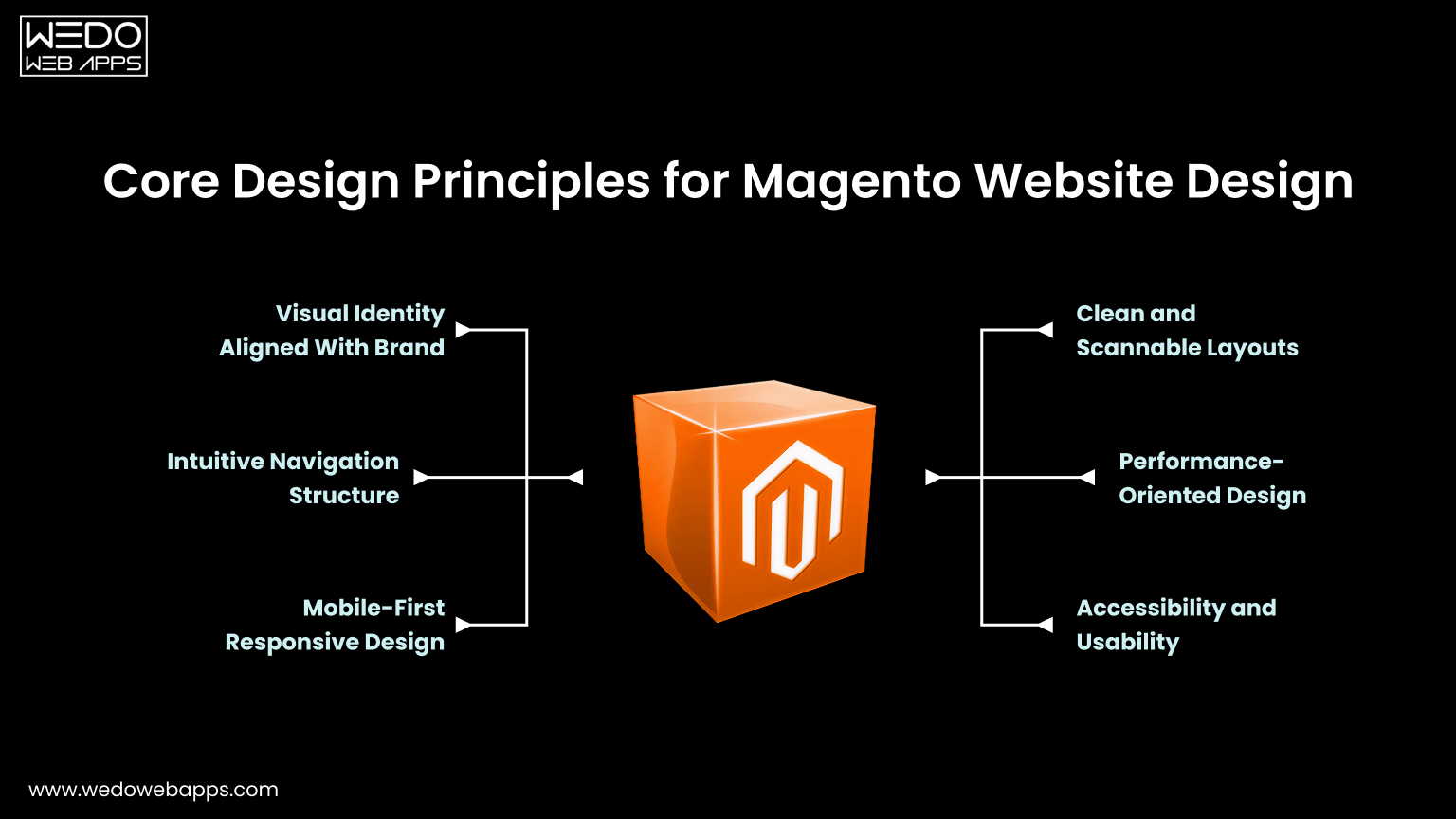
Designing an eye-catching ecommerce website using Magento requires more than choosing a visually appealing theme. It involves combining branding, usability, performance, and conversion strategy into one cohesive experience.
Below are the core principles that guide effective designing for Magento.
Visual Identity Aligned With Brand
Your website design should instantly communicate who you are as a brand.
Key elements:
- Consistent color palette
- Brand typography
- Logo placement
- Visual style guidelines
Strong visual identity builds recognition and trust.
Intuitive Navigation Structure
Visitors should find products with minimal effort.
Best practices:
- Clear categories
- Logical menu hierarchy
- Sticky navigation
- Prominent search bar
Good navigation improves exploration and reduces bounce rate.
Mobile-First Responsive Design
Most users browse on mobile devices.
Your ecommerce website design Magento implementation must:
- Adapt to all screen sizes
- Use touch-friendly elements
- Maintain fast load speeds
Mobile-first design is essential.
Clean and Scannable Layouts
Users scan pages. They don’t read everything.
Use:
- White space
- Short paragraphs
- Bullet points
- Clear headings
Scannable layouts improve comprehension.
Performance-Oriented Design
Heavy visuals can slow websites.
Balance aesthetics with performance by:
- Optimizing images
- Limiting animations
- Using lightweight components
Fast websites convert better.
Accessibility and Usability
Design should be usable for all users.
Consider:
- Readable font sizes
- High contrast colors
- Keyboard navigation
- Clear buttons
Accessibility improves the overall experience.
Key Takeaway: Great designing for Magento blends aesthetics with usability and performance to create an eye-catching ecommerce website that converts.
Magento Website Design Best Practices for Higher Conversions
An eye-catching ecommerce website using Magento should not only look good, it must guide users toward taking action.
These ecommerce website design Magento best practices are proven to increase engagement and conversions.
Clear and Compelling Homepage Messaging
Your homepage should immediately communicate:
- What you sell
- Who it’s for
- Why it’s valuable
Use a strong hero section with a clear value proposition and primary CTA.
High-Quality Product Presentation
Product pages play a critical role in conversions.
Best practices:
- Multiple product images
- Zoom functionality
- Product videos
- Consistent image styling
High-quality visuals increase buyer confidence.
Persuasive Product Descriptions
Avoid generic descriptions.
Use benefit-driven copy that explains:
- What problem the product solves
- Key features
- Use cases
Good copy supports decision-making.
Strong Calls-to-Action (CTAs)
CTAs should be:
- Visible
- Action-oriented
- Consistent across pages
Examples: Add to Cart, Buy Now, Get Started.
Trust Signals and Social Proof
Build credibility using:
- Customer reviews
- Ratings
- Testimonials
- Security badges
Trust reduces hesitation.
Streamlined Checkout Design
Checkout should be:
- Simple
- Fast
- Distraction-free
Offer guest checkout and multiple payment options.
Key Takeaway: Conversion-focused Magento website design combines clarity, persuasion, and trust.

How Magento Themes and Templates Support eCommerce Website Design
One of Magento’s biggest strengths is its extensive ecosystem of Magento theme eCommerce solutions, and Magento templates eCommerce businesses can use as a starting point for design.
However, success is not about simply installing a theme. It’s about choosing and customizing the right foundation.
Ready-Made Magento Themes for Faster Launch
Magento offers a wide range of pre-built themes designed for different industries and store types.
Benefits include:
- Faster development
- Responsive layouts
- Modern UI patterns
- Built-in design components
These themes provide a solid baseline for an ecommerce website using Magento.
Customizable Magento Templates for Brand Differentiation
Templates can be extended or modified to match your brand identity.
Customization allows you to:
- Adjust layouts
- Change typography and colors
- Add custom sections
- Create unique product page designs
This ensures your store does not look generic.
Performance-Optimized Theme Architecture
Well-built Magento themes:
- Use clean code
- Support caching
- Load assets efficiently
Performance-focused themes help maintain fast load times, which directly impact conversions.
Compatibility With Extensions and Features
Magento themes are designed to work with:
- SEO extensions
- Personalization tools
- Payment gateways
- Analytics platforms
This makes it easier to enhance functionality without redesigning everything.
When to Choose Custom Theme Development
Businesses often choose custom themes when they:
- Need unique branding
- Have complex UX requirements
- Want higher performance control
- Plan long-term scalability
Custom themes provide maximum flexibility.
Key Takeaway: Choosing the right Magento theme eCommerce foundation, and customizing it strategically plays a major role in creating an eye-catching and high-performing store.
Our Magento Design and Development Process
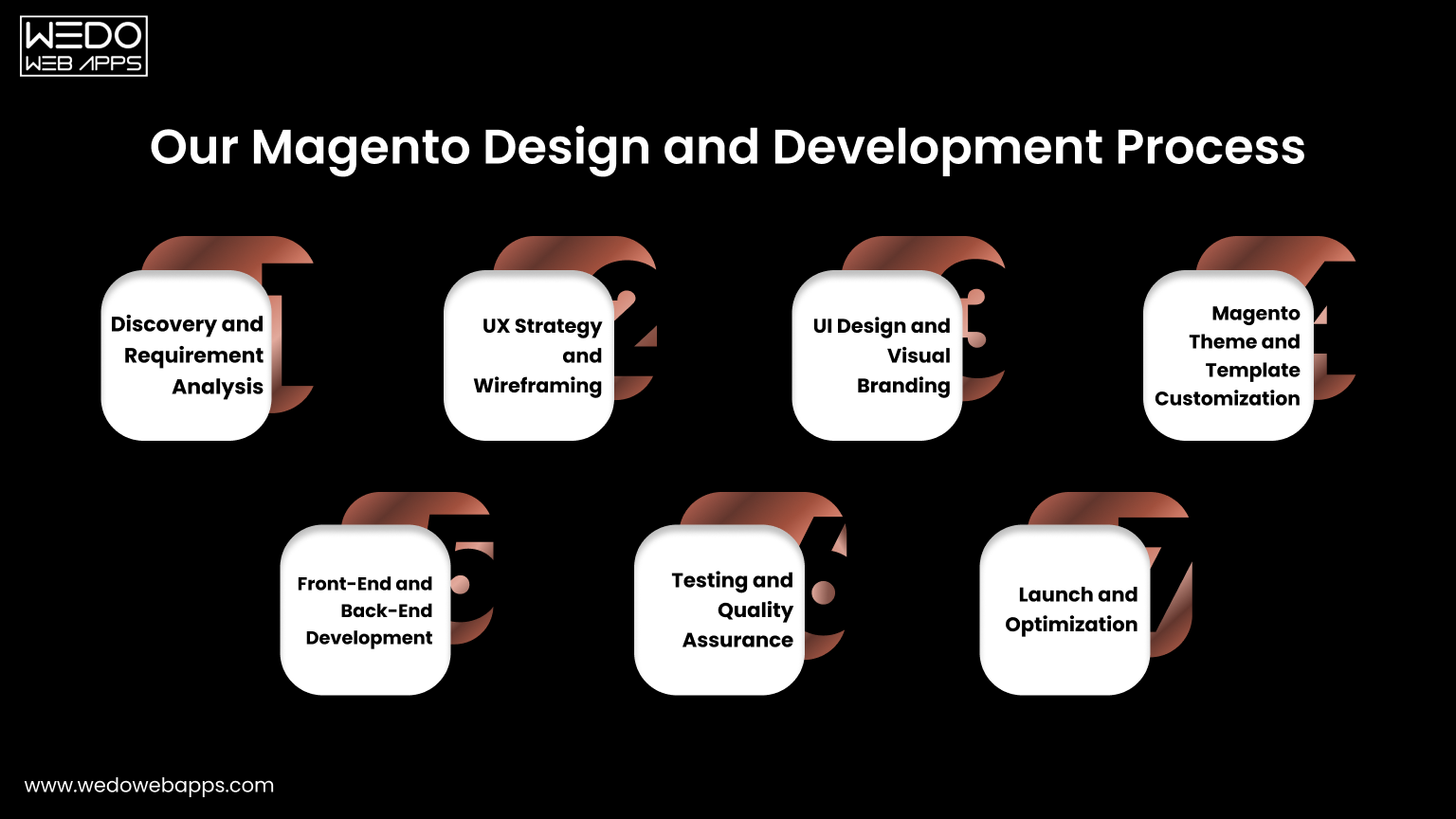
Designing an eye-catching ecommerce website using Magento requires a structured, proven process. A well-defined approach ensures your store is not only visually appealing but also fast, user-friendly, and conversion-focused.
Here’s how a professional Magento design and development process typically works:
Discovery and Requirement Analysis
We start by understanding:
- Your business goals
- Target audience
- Product catalog structure
- Competitors and market positioning
This phase defines the foundation.
UX Strategy and Wireframing
Before visuals, we map user flows and page structures.
This includes:
- Homepage layout
- Category structure
- Product page flow
- Checkout journey
Wireframes ensure usability before design.
UI Design and Visual Branding
Designers create high-fidelity visuals that reflect your brand.
Focus areas:
- Color schemes
- Typography
- Visual hierarchy
- Component styling
The result is a cohesive look.
Magento Theme and Template Customization
We select or build the right Magento theme ecommerce foundation, and customize templates.
Customization includes:
- Layout changes
- Component styling
- Responsive behavior
This ensures uniqueness.
Front-End and Back-End Development
Developers implement designs using Magento best practices.
They integrate:
- Extensions
- Payment gateways
- Third-party tools
Functionality and performance are prioritized.
Testing and Quality Assurance
We test:
- Responsiveness
- Page speed
- Browser compatibility
- Checkout flow
Issues are resolved before launch.
Launch and Optimization
After deployment, we monitor performance and optimize.
This includes:
- Speed improvements
- UX refinements
- Conversion optimizations
Key Takeaway: A structured Magento design and development process ensures your ecommerce website design Magento project delivers measurable business results.

Metrics That Matter for Magento Website Design Success
Design success is not based on how attractive a website looks. It is measured by how well your ecommerce website using Magento performs in terms of engagement, usability, and conversions.
Tracking the right metrics helps you understand whether your eCommerce website design Magento efforts are delivering real business impact.
Conversion Rate
Shows the percentage of visitors who complete a purchase.
Why it matters: Higher conversion rates indicate your design is guiding users toward action.
Bounce Rate
Shows how many visitors leave after viewing only one page.
Why it matters: High bounce rates often signal poor first impressions, slow speed, or confusing layout.
Average Session Duration
Shows how long users stay on your site.
Why it matters: Longer sessions indicate an engaging and easy-to-navigate design.
Pages Per Session
Shows how many pages users explore.
Why it matters: Higher numbers suggest better product discovery and navigation.
Cart Abandonment Rate
Shows how many users leave after adding products to the cart.
Why it matters: Helps identify checkout and trust-related design issues.
Mobile Conversion Rate
Shows conversion performance on mobile devices.
Why it matters: Validates the effectiveness of responsive and mobile-first design.
Key Takeaway: Great designing for Magento is validated by performance data, not opinions.
Common Magento Website Design Mistakes to Avoid
Even with a powerful platform like Magento, design mistakes can quietly damage performance, conversions, and user trust. Many businesses invest in themes and visuals but overlook usability, performance, and conversion strategy.
If you’re building an ecommerce website using Magento, avoid these common pitfalls.
1. Using Overly Complex Designs
Heavy animations, cluttered layouts, and excessive visual elements overwhelm users.
Problems caused:
- Slower page load times
- Visual distraction from products
- Confusing user journeys
Simple, clean, and purpose-driven design consistently performs better.
2. Choosing the Wrong Magento Theme
Not all Magento theme ecommerce options are optimized for performance and scalability.
Poor theme choices can lead to:
- Slow speed
- Limited customization
- Compatibility issues with extensions
Always evaluate code quality, performance, and flexibility before selecting a theme.
3. Ignoring Mobile-First Design
Most shoppers browse and purchase on mobile.
Common mobile mistakes:
- Small text
- Hard-to-click buttons
- Broken layouts
Your ecommerce website design Magento approach must prioritize mobile experience first.
4. Inconsistent Branding Across Pages
Different fonts, colors, and layouts across pages create confusion.
Inconsistent branding:
- Weakens brand identity
- Reduces trust
- Feels unprofessional
Consistency strengthens recognition and credibility.
5. Poor Navigation Structure
If users can’t find products quickly, they leave.
Navigation issues include:
- Too many categories
- Unclear labels
- Deep menu hierarchies
Navigation should be simple, logical, and intuitive.
6. Hiding Important Purchase Information
Customers expect transparency.
Hiding or delaying:
- Shipping costs
- Delivery timelines
- Return policies
- Warranty details
creates hesitation and abandonment.
7. Overloading Pages With Extensions
Installing too many extensions can:
- Slow down site speed
- Create conflicts
- Increase maintenance complexity
Only use extensions that provide clear business value.
8. Weak Product Page Design
Product pages that lack detail fail to convert.
Common issues:
- Few images
- No videos
- Thin descriptions
- Missing reviews
Strong product pages are essential for conversions.
9. No Clear Calls-to-Action (CTAs)
If users don’t know what to do next, they won’t act.
CTAs should be:
- Visible
- Action-oriented
- Consistent
Every key page should guide users forward.
10. Skipping Conversion Rate Optimization (CRO)
Design without testing leads to guesswork.
CRO includes:
- A/B testing
- Heatmap analysis
- Funnel optimization
CRO ensures your design decisions are backed by data.
Key Takeaway: Avoiding these mistakes ensures your ecommerce website design Magento project delivers strong user experience, better conversions, and long-term scalability.
Conclusion: Turn Your Magento Website Design Into a Growth Engine
Design plays a decisive role in whether visitors stay, engage, and convert. For businesses building an ecommerce website using Magento, great design is not just about looking good. It’s about delivering fast, intuitive, and conversion-focused experiences.
When you combine the right design principles, optimized ecommerce website design Magento practices, high-quality Magento theme ecommerce foundations, and a structured development process, your store becomes a powerful sales platform, not just an online catalog.
An eye-catching Magento website:
- Builds trust
- Improves usability
- Enhances brand perception
- Increases conversions
If your goal is to create a store that attracts attention and turns visitors into customers, investing in professional Magento development services is one of the smartest decisions you can make.
The right partner can help you design, build, and optimize a Magento store that supports your business goals today, and scales with you tomorrow.
 Sharing Project Details
 Let's have a
call
Let's have a
call Got
Questions? Let’s Chat!
Got
Questions? Let’s Chat!