



Introduction: The Shift Toward Headless Ecommerce
Ecommerce platforms are increasingly being evaluated not just on features, but on how well their architecture supports speed, flexibility, and long-term scalability. As customer experiences expand across web, mobile, and emerging digital touchpoints, many businesses are rethinking traditional monolithic storefront models.
This shift has accelerated the adoption of headless Magento, where the frontend experience is decoupled from the core commerce engine. Instead of relying on a tightly coupled theme layer, Magento operates as a backend system that exposes commerce functionality through APIs, allowing frontend applications to evolve independently.
For ecommerce teams focused on performance optimization, omnichannel consistency, and frontend innovation, headless architecture offers a fundamentally different way to design and scale digital commerce experiences. Understanding why businesses are moving in this direction, and what architectural changes it introduces, is the foundation for evaluating the benefits of headless Magento in modern ecommerce environments.
What Is Headless Magento?
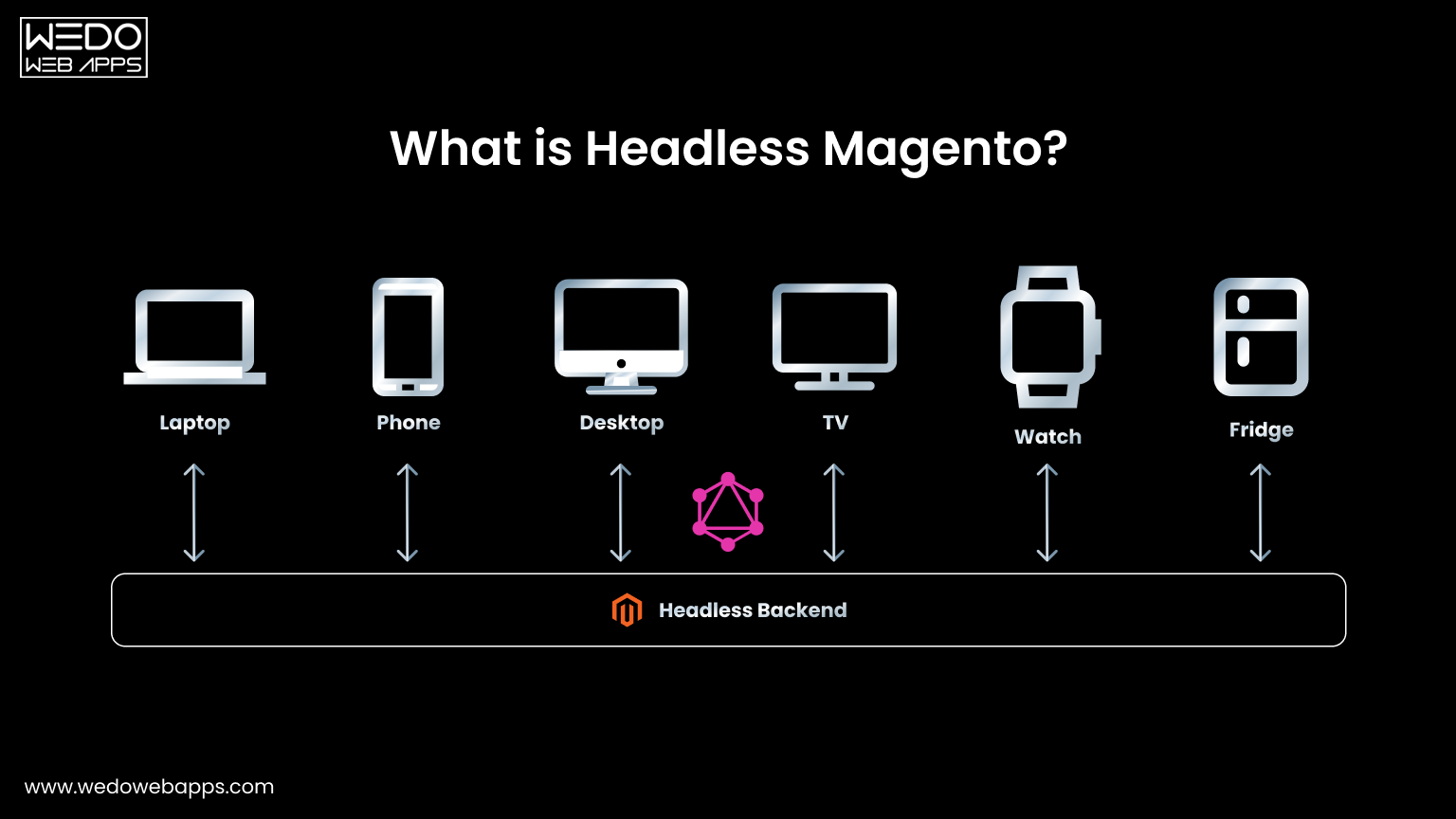
Headless Magento refers to a decoupled ecommerce architecture where Magento functions purely as the backend commerce engine, while the customer-facing frontend is built and managed independently. Instead of relying on Magento’s traditional theme-based rendering, the frontend communicates with Magento through APIs to access commerce data and functionality.
In this model, Magento continues to handle core ecommerce responsibilities, while the presentation layer is free to evolve using modern frontend technologies.
At a high level, headless Magento involves:
- Magento manages backend commerce logic such as products, pricing, inventory, checkout, and orders
- APIs act as the communication layer between Magento and external frontends
- One or more frontend applications are responsible for rendering the user experience
This separation allows ecommerce teams to treat the frontend as a flexible experience layer rather than a tightly coupled extension of the commerce platform.
Key characteristics of headless Magento include:
- A clear separation between commerce logic and presentation
- API-first access to Magento’s core capabilities
- Independence between frontend development cycles and backend updates
By decoupling these layers, headless Magento enables a more modular approach to ecommerce architecture, one that prioritizes adaptability, performance, and multi-channel readiness over traditional storefront constraints.
How Headless Magento Works
In a headless setup, Magento operates as a centralized commerce backend that exposes its functionality through APIs. The frontend, whether a website, mobile app, or other digital interface, consumes these APIs to retrieve data and execute commerce actions without being tightly bound to Magento’s presentation layer.
Rather than rendering pages server-side using Magento themes, the frontend becomes an independent application responsible for user experience, while Magento focuses solely on commerce operations.
From an architectural perspective, headless Magento works as follows:
- Magento manages core commerce functions such as product catalogs, customer data, pricing rules, promotions, checkout, and order processing
- APIs serve as the interface through which frontend applications interact with Magento
- Frontend frameworks handle layout, navigation, interactivity, and experience logic
This decoupling allows each layer to evolve independently, reducing constraints imposed by traditional, tightly coupled storefront architectures.
Common architectural patterns in headless Magento include:
- A single frontend consuming Magento APIs for a web storefront
- Multiple frontends (web, mobile, in-store systems) sharing the same Magento backend
- Integration with external content management or experience platforms alongside Magento
By separating experience delivery from commerce execution, headless Magento enables greater architectural flexibility while preserving Magento’s role as a robust ecommerce engine.
Key Benefits of Headless Magento eCommerce
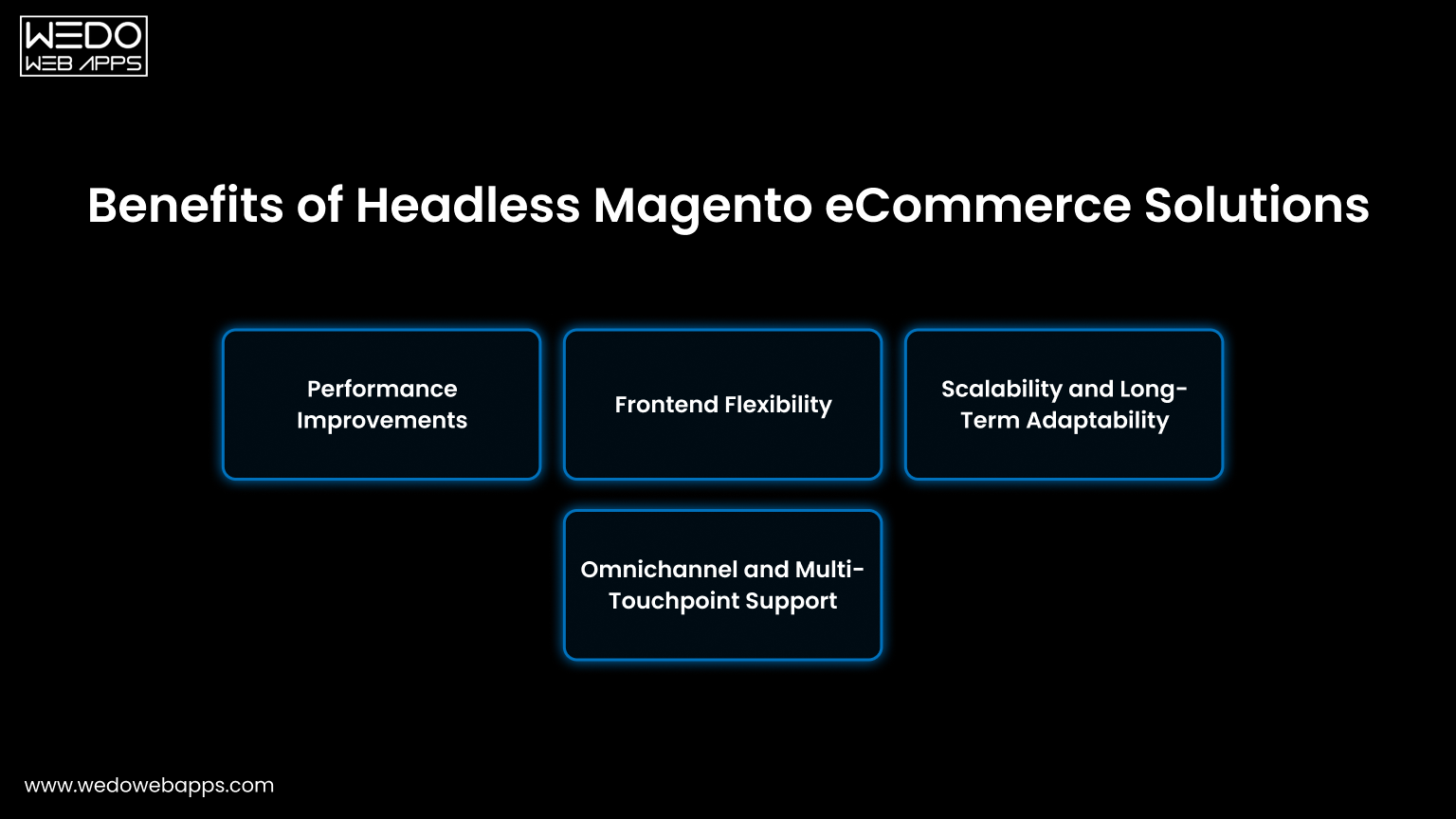
The primary advantage of headless Magento lies in architectural freedom. By decoupling the frontend from the backend, businesses gain greater control over performance, experience design, and scalability while continuing to use Magento as a stable commerce engine.
Below are the key benefits of Magento eStore that drive adoption across modern ecommerce environments.
Performance Improvements
Frontend performance is one of the most cited reasons for moving to headless Magento. Decoupling removes frontend rendering limitations commonly associated with traditional theme-based storefronts.
- Faster page load times through lightweight frontend frameworks
- Improved potential for Core Web Vitals optimization
- Reduced dependency on backend processes for frontend performance
This makes headless Magento particularly attractive for performance-sensitive ecommerce use cases.
Frontend Flexibility
Headless architecture allows frontend teams to work independently from Magento’s backend constraints, enabling faster experimentation and experience iteration.
- Freedom to use modern JavaScript frameworks
- Independent frontend release cycles
- Easier customization of user interfaces and interactions
As a result, the frontend becomes an adaptable experience layer rather than a fixed extension of the commerce platform.
Scalability and Long-Term Adaptability
In a headless Magento setup, frontend and backend components can scale independently based on demand and usage patterns.
- Backend commerce logic remains stable as traffic grows
- Frontend applications can be optimized or replaced without reworking core commerce systems
- Architecture supports long-term evolution without full platform reimplementation
This separation supports sustainable scaling as business requirements change.
Omnichannel and Multi-Touchpoint Support
Headless Magento enables consistent commerce functionality across multiple customer touchpoints.
- Web storefronts, mobile apps, and emerging digital channels can share the same backend
- Centralized commerce logic ensures data consistency
- New channels can be added without disrupting existing experiences
This makes headless Magento well-suited for businesses pursuing omnichannel or experience-led ecommerce strategies.
Headless Magento vs Traditional Magento
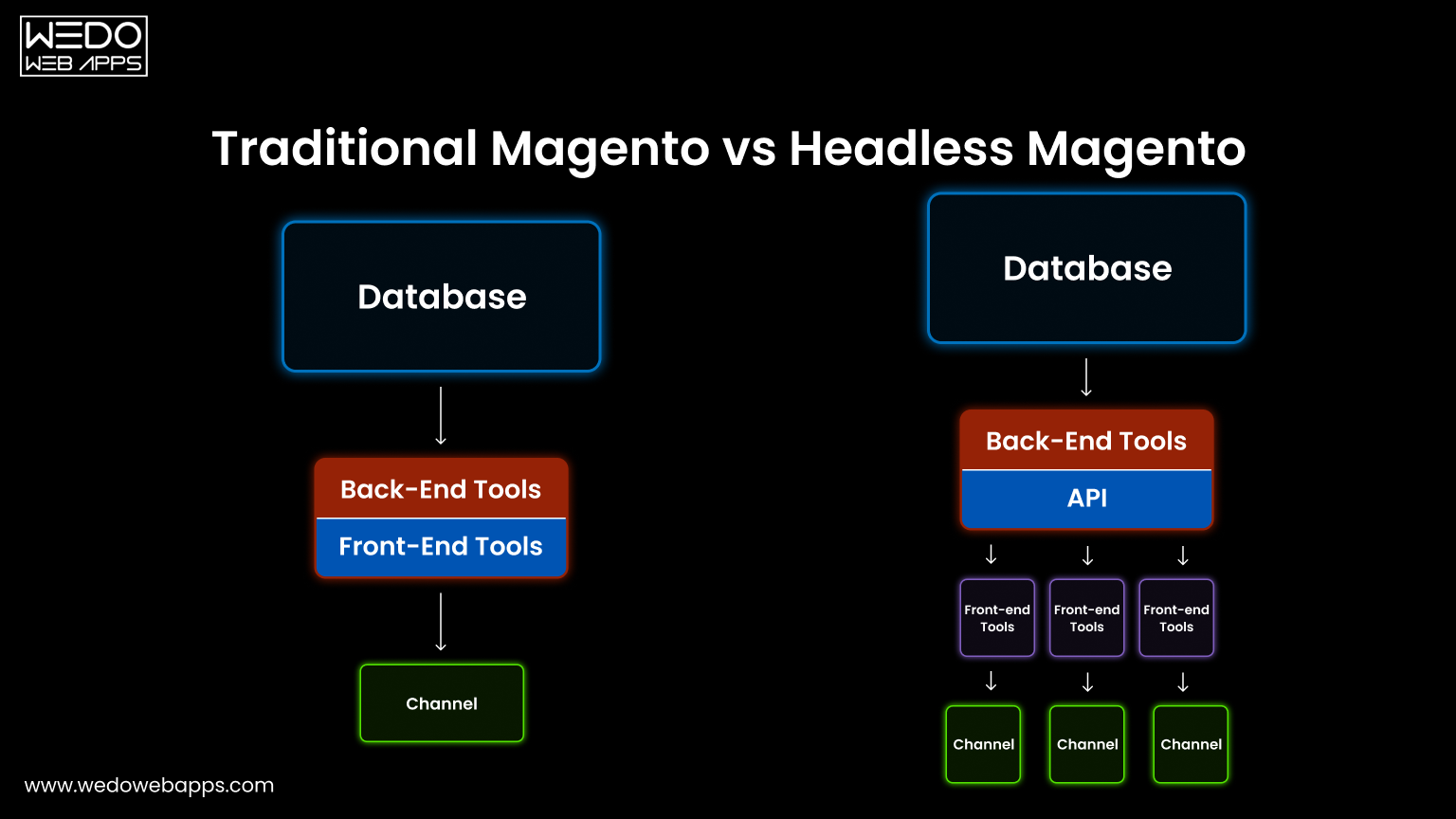
Choosing between headless Magento and traditional Magento largely comes down to architectural priorities. While both approaches use Magento as the core commerce platform, they differ significantly in how frontend experiences are built, delivered, and maintained.
Traditional Magento follows a tightly coupled model where the frontend and backend are part of the same system. Headless Magento, by contrast, separates these layers to allow independent development and scaling.
Key architectural differences include:
- Frontend coupling
- Traditional Magento relies on theme-based rendering
- Headless Magento uses independent frontends consuming APIs
- Development flexibility
- Traditional setups follow Magento’s frontend constraints
- Headless setups allow greater freedom in frontend technologies
- Performance optimization
- Traditional Magento performance is influenced by backend processes
- Headless Magento enables frontend-focused performance tuning
- Multi-channel readiness
- Traditional Magento is primarily web-centric
- Headless Magento supports multiple touchpoints from a single backend
While headless Magento introduces more flexibility, traditional Magento remains a viable option for many businesses.
Traditional Magento may be better suited when:
- A standard web storefront meets current experience requirements
- Time-to-market is a higher priority than architectural flexibility
- Frontend complexity is relatively low
Headless Magento becomes more relevant as experience complexity, performance expectations, and channel diversity increase. Understanding these trade-offs is essential before evaluating headless architecture as a long-term ecommerce strategy.

Headless Magento and PWA Studio
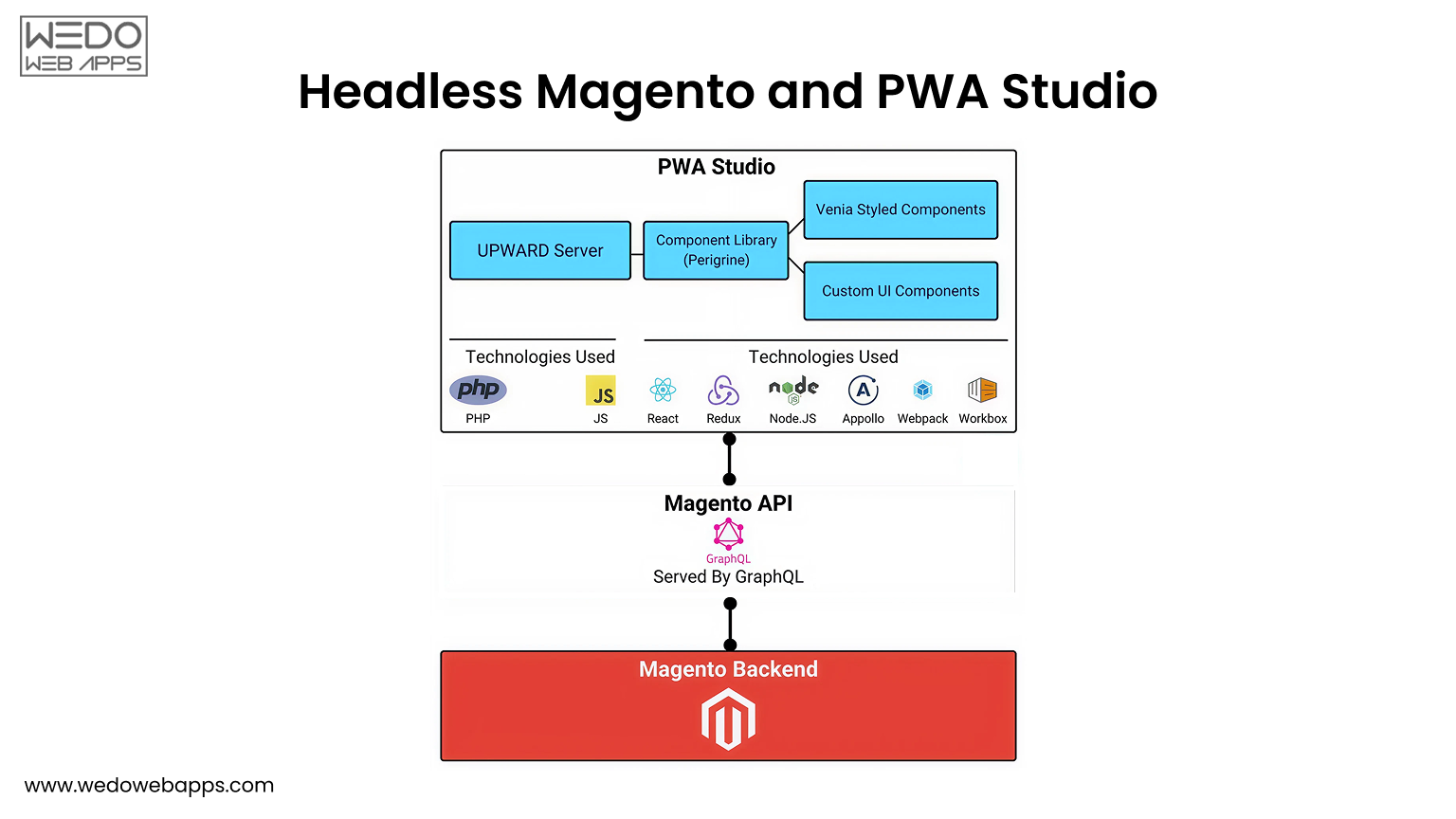
PWA Studio is Magento’s reference framework for building progressive web applications in a headless context. It demonstrates how Magento can function as a backend commerce engine while a modern frontend handles experience delivery through APIs.
Rather than being a requirement for headless Magento, PWA Studio represents one of several possible approaches to frontend development within a decoupled architecture.
In the context of headless Magento, PWA Studio:
- Acts as a frontend framework designed specifically for Magento’s API layer
- Illustrates how a PWA can consume Magento Commerce data and functionality
- Supports app-like experiences such as fast navigation and offline-friendly behavior
It is commonly evaluated by teams looking to adopt a headless approach while remaining closely aligned with Magento’s ecosystem.
However, headless Magento is not limited to PWA Studio.
Depending on architectural goals, teams may choose alternative frontend frameworks or custom experience layers that better align with performance, design, or channel-specific requirements.
Key considerations when evaluating PWA Studio include:
- Alignment with Magento’s API structure
- Suitability for the desired frontend experience
- Flexibility compared to fully custom headless frontends
Understanding the role of PWA Studio helps clarify how Magento supports headless commerce, while reinforcing that frontend choices remain independent in a truly decoupled architecture.
Common Use Cases for Headless Magento
Headless Magento is typically adopted when experience complexity or scalability requirements exceed what traditional storefront architectures can comfortably support. Rather than being a default choice, it is often applied to specific ecommerce scenarios where decoupling delivers measurable architectural benefits.
Common use cases for headless Magento include:
- High-traffic ecommerce stores: Stores with significant traffic volumes often benefit from decoupled frontends that can be optimized independently for speed and stability.
- Experience-driven or content-heavy brands: Brands that prioritize customized user journeys, dynamic content, or frequent frontend updates gain flexibility through a headless approach.
- Multi-channel commerce environments: Businesses operating across web, mobile apps, in-store systems, or emerging touchpoints can centralize commerce logic while delivering tailored experiences per channel.
- Enterprise or rapidly scaling operations: Larger organizations often adopt headless Magento to support long-term scalability and evolving digital requirements without reworking core commerce systems.
These use cases highlight where headless Magento adds strategic value, particularly in environments where frontend agility and architectural adaptability are critical.
Challenges and Limitations of Headless Magento
While headless Magento offers architectural flexibility, it also introduces additional complexity that is not suitable for every ecommerce business. Understanding these limitations is essential when evaluating headless architecture as a long-term strategy rather than a short-term trend.
Some of the key challenges associated with headless Magento include:
- Increased architectural complexity: Decoupling the frontend and backend adds more moving parts, which can increase the overall complexity of the system.
- Higher development and maintenance effort: Managing independent frontend and backend codebases often requires broader technical expertise and ongoing coordination.
- Greater reliance on frontend performance optimization: Since the frontend is fully responsible for rendering and experience delivery, performance outcomes depend heavily on frontend architecture and execution.
- Not ideal for simpler ecommerce requirements: For businesses with straightforward storefront needs, the added flexibility of headless Magento may not justify the overhead.
These limitations do not diminish the value of headless Magento but highlight the importance of aligning architectural decisions with business maturity, technical readiness, and long-term goals. If you are also facing challenges during Magento development, hire Magento expert developers for an amazing online presence.
When Headless Magento Makes Sense
Headless Magento is most effective when adopted as a strategic architectural decision rather than a reactive upgrade. Its value depends on an organization’s technical maturity, experience goals, and long-term ecommerce roadmap.
Headless Magento typically makes sense when:
- Experience requirements extend beyond a standard storefront: Businesses seeking highly customized, interactive, or rapidly evolving user experiences benefit from frontend independence.
- Multiple digital touchpoints need to share commerce logic: A decoupled backend allows consistent pricing, inventory, and checkout processes across channels.
- Performance optimization is a critical priority: Teams focused on frontend performance metrics may require the flexibility that headless architecture provides.
- Internal teams can support architectural complexity: Successful headless implementations depend on the ability to manage and maintain separate frontend and backend systems.
Conversely, headless Magento may introduce unnecessary overhead if experience needs are limited or if architectural simplicity is a higher priority. Evaluating readiness is as important as understanding potential benefits.

The Future of Headless Ecommerce with Magento
Headless commerce continues to gain relevance as ecommerce platforms evolve toward API-first and composable architectures. Rather than being a short-term trend, headless Magento reflects a broader shift in how digital commerce systems are designed and extended over time.
As customer expectations grow and digital touchpoints multiply, commerce platforms are increasingly expected to integrate seamlessly with content systems, experience platforms, and external services. Headless architecture supports this direction by allowing Magento to function as a specialized commerce engine within a larger, modular ecosystem.
Key factors shaping the future of headless Magento include:
- Continued adoption of API-driven commerce models
- Growing emphasis on composability and modular system design
- Increased separation of experience layers from core commerce logic
Within this context, headless Magento remains relevant not because of frontend trends, but because it enables long-term architectural adaptability in complex ecommerce environments.
Closing Perspective
Headless Magento represents a strategic approach to ecommerce architecture rather than a universal replacement for traditional storefront models. By decoupling the frontend from the backend, it offers greater flexibility, performance potential, and multi-channel readiness for businesses with advanced experience requirements.
However, its value depends on alignment with business goals, technical capabilities, and long-term digital strategy. Evaluated thoughtfully, headless Magento can play a key role in modern ecommerce architecture, supporting scalable, experience-driven commerce without locking organizations into rigid presentation layers.
For teams exploring broader Magento ecommerce architecture and advanced ecommerce development approaches, headless models provide a framework for building adaptable, future-ready digital commerce systems.
 Sharing Project Details
 Let's have a
call
Let's have a
call Got
Questions? Let’s Chat!
Got
Questions? Let’s Chat!