skip to content

Top SDKs, Frameworks, and Libraries for Android App Development in 2021

Android has been among the leading mobile operating systems worldwide in January 2021, occupying the mobile OS market with 71.93 percent shares. It’s no wonder; android mobile application development is highly in demand. Android app development takes more time than iOS development because of the large number of android devices. 

Whether you are a novice developer or experienced one, you know that performing a simplest task can be complicated sometimes. Luckily, there are many android frameworks, SDKs (Software Development Kits), and Libraries that can help you reduce the complexity of development, increase the speed of development and optimize your application’s performance. So, here are some of the essential Android Libraries, SDKs, and Frameworks that will accelerate your android application development.

Top Frameworks to Use for Android Application Development

There are many frameworks available for Android Application Development, which also includes many cross-platform frameworks like Flutter and React Native. Let’s talk about some of the popular frameworks out there.

1.Kotlin

Kotlin is a programming language that has gained outstanding popularity and interest among developers. According to Google’s Google’s #IO17 announcement, Kotlin has become an official language for Android apps. Its clean language-design and powerful features make it popular among developers. Kotlin aims to bring together the features of programming languages that have proven beneficial for large-scale projects. 

Even though developers can use Kotlin anywhere Java is used, it is primarily used in android app development. Many companies like Google, Trello/Atlassian, Pinterest, Kickstarter, and Uber are using Kotlin for their benefits. Some of its benefits include writing less code, easy adoption, fully compatible with Java, and imposes no runtime overhead. 

Kotlin being more fault-proof, the app developed through Kotlin will be easier and cheaper to maintain. Kotlin also helps you in faster development as it is briefer. Fewer lines of code mean less time spent on coding and less money spent on development. Isn’tIsn’t this great? You can also transform your app from one platform to another if required.

2.Flutter

Flutter is an open-source mobile app SDK developed by Google in 2017. Dart is the language in which Flutter applications are developed. It is quite a simple language to start with and a clear language intended by Google to replace JavaScript. Since Flutter has recently entered the list of cross-platform app development frameworks, the great ideas have caused it to catch on among the developers. 

Although there are many successful frameworks in the industry, many big companies like The Google Ads app, Alibaba, The eBay Motors app, etc. that are choosing Flutter for android application development. Even Though Flutter is quite capable, it is still new in the industry and continuously updating its features.

The most significant benefit of Flutter for most businesses is hiring only one team for both iOS and Android Platforms. Flutter allows developers to build stunning and attractive interfaces. However, there are many other benefits of Flutter Framework such as high productivity, fast and simple development, excellent performance, compatibility, and most importantly, Flutter is open-source. 

3.React Native

React Native is among the most popular JavaScript libraries used to develop both Android and iOS applications. React Native can help you develop native applications for all devices and operating systems. It’s an open-source, cross-platform framework that is developed by Facebook. Using React Native, developers can develop high-performance apps with faster deployment time in less duration. 

It uses JavaScript and helps in developing rich, responsive, and unique apps. In 2021, React Native has gained popularity in the top mobile app development frameworks. React Native provides a set of unbelievable native components like Views, Text, etc. It supports JavaScript, which is crucial for full-stack development.

React Native offers some outstanding features like low code, support for third-party libraries, short development time, live reload, and declarative API for predictive UPI. These are some of the features that make many famous companies like Facebook, SoundCloud, Instagram, Ubereats, and Airbnb use React Native. By migrating to React Native, you’ll find a simple architecture, increased app performance, and also you will be easily able to control the builds.

4.Ionic

Ionic is an entirely free and open-source framework developed with Angular and Apache Cordova. It allows the developers to develop apps for iOS, Windows, and Android. Ionic is used to build cross-platform mobile applications for high mobile performance. Mobile App Developers use Ionic Framework for powerful and fully-featured mobile application development.

One of the most significant advantages of the Ionic Framework is that developers can use several UI elements in their application development. The UI elements like ListViews, Forms, filters, action sheets, navigation menus, and tab bars help developers develop high-performance, robust, and responsive mobile applications. 

Ionic is a feature-rich cross-platform development framework. It can prove to be the best framework if the developer is well-experienced with HTML, JavaScript, or CSS. There are various features in Ionic Framework like Cordova Plugin, easy and fast development, JavaScript Components, complete control over app building, and much more. These features make Ionic one of the best frameworks for cross-platform development.

Useful Libraries for Cross-platform Mobile Application Development 

Using third-party libraries in your mobile application development can help you boost the productivity of your app, whether it is iOS or Android. But the important thing is, with so many third-party libraries in the market, which could be the ones worth using? Let’s discuss some of the best Libraries to use while cross-platform application development.

Android Jetpack

Android Jetpack is a series of libraries that helps the mobile app developers to follow best practices, decrease standard code, and write code that constantly works across all the Android devices and android versions so that the mobile app developers can focus on the code they care about. Below is the list of the libraries most commonly used for developing an android app.

Dependency Injection Frameworks

1.Dagger

Dagger is a library developed for low-end devices and is based on annotations. Dagger is based on Java Specification Code 330 and uses code generation. The code generated by Dagger is straightforward to read and troubleshoot.

2.Koin

Koin is an intelligent Injection Framework that helps you focus on your app, not on the tools. It is a realistic, lightweight dependency Injection Framework developed in Kotlin. It generates less standard code as compared to Dagger. 

3.ButterKnife

Butterknife uses annotation development to generate modified Java classes that are based on annotations. It allows you to interpret the views and OnClickListeners. Butterknife also involves findById methods that simplify the code to find views on a View, Activity, or Dialog.

Network Libraries

1.Retrofit

In Android Application Development, Retrofit is a REST Client for Android and Java developed by Square Inc. under Apache 2.0. It is a simple library used for network transactions. To seamlessly capture JSON response by web services or web API, Retrofit can be the best choice. It is an easy and fast library to recover and upload JSON or any other structured data through REST-based web services.

2.Volley 

Volley is a network library developed by Google. It is an HTTP library that makes networking more accessible and faster. It supports the arrangement of network requests. If you are searching for a network client for network operations, Volley will be a better choice than Retrofit.

Image Loading

1.Fresco

Fresco is a library created by Facebook. It is the library developed explicitly for loading images. It works faster than the other Image Loading Libraries and does not slow down the app, which is in process. Fresco also reduces the OutOfMemoryError. 

2.Coil

The coil is the very first image loading library for android app development backed by Kotlin. It is fast, lightweight, easy to use, and a modern library. It is Kotlin-first and makes use of modern libraries, including Coroutines, Okio, OkHttp, and AndroidX Lifecycles.

3.Picasso

Picasso is a famous library developed by Square Inc. It displays and caches images. Picasso Library is famous because it requires only one line of code and has a similar coding style for each of its features. 

4.Glide

Glide is an open-source, fast and efficient image loading library for Android that includes memory and disk caching, media decoding, and merging the resources into the simple and easy-to-use interface. It supports fetching, decoding, and displaying video stills, GIFs, and images. 

Analytics and Crash reporting

1.Firebase Analytics

Firebase Analytics is a library that helps you to know how visitors are engaging with our application. From the first step, i.e., setup, Firebase Analytics will automatically start tracking defined sets of events, and we can also add our custom set of events for tracking.

2.Crashlytics

Crashlytics provides multi-platform support for Android and iOS to help you find out crash analytics and the errors that affect your apps and cause the apps to crash. Moreover, it identifies and highlights the exact line of code that produces problems. It is a free and straightforward tool that SDK to help you make your work easier.

Read more about New Trends In Mobile App Development

Conclusion

Here we conclude the list of Top SDKs, Frameworks, and Libraries for android app development. There are many SDKs, frameworks for developing your mobile app, but we have collected some of the best ones. Choose the best ones and make your mobile app development exciting and more effortless; knowing these frameworks will help you enhance the performance of your mobile applications.

10+ Trending Mobile App Ideas to Inspire Your Next Big Project

Introduction

The mobile app market is ever-evolving, with countless opportunities for businesses and developers to create impactful solutions. Whether you’re a budding entrepreneur or an experienced app developer, finding the right app idea can be a game-changer. With the global app economy projected to reach $935 billion in revenue by 2023 (Statista), the demand for innovative and user-centric apps continues to grow.

This blog dives into trending app ideas that align with current user needs and technological advancements. Whether you’re interested in AI-powered tools, sustainable solutions, or community-based platforms, these ideas are designed to spark creativity and help you build an app that stands out in today’s competitive market.

How to Choose the Right Mobile App Idea

Before you dive into development, it’s essential to choose an app idea that aligns with your goals and meets market demands. Here’s a step-by-step guide to help you select the best concept:

  1. Identify a Problem to Solve:
    • Understand your target audience’s pain points. What problems can your app address effectively?
    • Example: If users struggle with managing fitness routines, consider creating an AI-driven fitness tracker.
  2. Analyze Current Trends:
    • Use tools like Google Trends to identify trending app categories.
    • Explore platforms like Statista to understand market projections and popular app features.
  3. Evaluate Resources:
    • Assess whether your team, budget, and tools can support the development of your app idea.
    • If resources are limited, consider starting with a Minimum Viable Product (MVP) to test your concept.
  4. Research Competitors:
    • Study existing apps in your niche to identify gaps you can fill or features you can enhance.
    • Example: If competitors’ fitness apps lack personalized meal plans, incorporate that feature in your app.

Latest Trending Mobile App Ideas

1. AI-Powered Fitness Tracker

With the increasing focus on health and wellness, AI-powered fitness trackers are in high demand. Features to include:

  • Personalized workout plans based on user data.
  • AI analysis of exercise form via camera integration.
  • Integration with wearables for real-time tracking of vitals like heart rate and calorie burn.

2. Real-Time Language Translator

A real-time language translation app can revolutionize communication across different cultures. Features:

  • Offline translation for accessibility in remote areas.
  • Voice-to-text and text-to-voice capabilities.
  • Support for multiple languages and dialects, ideal for global travelers or business professionals.

3. Sustainable Shopping Assistant

Eco-conscious consumers are looking for ways to make informed purchases. Build an app that helps users choose sustainable products with:

  • Barcode scanning to analyze environmental impact.
  • Recommendations for eco-friendly alternatives.
  • Integration with e-commerce platforms for direct purchases.

4. AR-Powered Interior Design App

Augmented reality (AR) is transforming interior design by enabling users to visualize changes before implementation. Key features:

  • Upload a photo of a room and visualize furniture placements.
  • Wall color matching with AR overlays.
  • Direct integration with furniture stores for seamless shopping.

5. Hyperlocal Delivery Tracker

Hyperlocal delivery apps cater to small businesses and individual users. Features:

  • GPS-enabled live tracking of packages.
  • A centralized dashboard for managing multiple deliveries.
  • Notifications for real-time delivery updates.

6. Mental Health and Wellness App

Mental health apps are becoming increasingly popular for their ability to support well-being. Features to include:

  • Mood tracking with personalized suggestions.
  • Guided meditations and breathing exercises.
  • Virtual therapy sessions with licensed professionals.

7. Career Guidance Platform

Help users navigate their career paths with an interactive career guidance app. Features:

  • AI-based assessments to recommend suitable career options.
  • Access to certified courses and training programs.
  • Community forums to connect with industry experts and mentors.

8. Recipe Finder with AI Integration

Enhance cooking experiences with a recipe finder app powered by AI. Features:

  • Users input available ingredients, and the app suggests recipes.
  • Filters for dietary preferences, cooking time, and difficulty.
  • AR-guided cooking for hands-free step-by-step instructions.

9. Emotional Food Matcher

Build a fun and engaging app that recommends meals based on users’ emotions. Features:

  • Mood-based questionnaires to assess emotions.
  • Food recommendations tailored to user preferences.
  • Integration with local restaurant delivery services.

10. Smart Home Automation Controller

With smart homes becoming mainstream, a unified controller app can simplify management. Features:

  • Compatibility with multiple smart devices and brands.
  • Custom automation routines for lighting, temperature, and appliances.
  • Energy usage insights to promote sustainability.

11. On-Demand Tutoring App

Remote education is on the rise, creating opportunities for on-demand tutoring apps. Features:

  • Instant booking of qualified tutors for various subjects.
  • Real-time video conferencing for interactive learning.
  • Session recordings for future reference.

Key Considerations Before App Development

  1. Technical Feasibility:
    • Ensure your app idea is technically viable. Use prototyping tools to validate the concept.
  2. Monetization Strategy:
    • Decide whether your app will generate revenue through ads, subscriptions, or in-app purchases.
  3. User-Centric Design:
    • Prioritize ease of use and accessibility in your app’s interface to enhance user experience.
  4. Scalability:
    • Design your app with future scalability in mind to accommodate growing user demand.

Marketing Strategies for Your Mobile App

Developing an app is only half the battle; marketing plays a critical role in its success. Here are some proven strategies:

  1. Social Media Campaigns:
    • Use visually appealing posts and stories on Instagram, TikTok, and LinkedIn to create buzz.
  2. Influencer Collaborations:
    • Partner with influencers in your niche to promote your app to a targeted audience.
  3. App Store Optimization (ASO):
    • Optimize your app title, description, and screenshots for better visibility in app stores.
  4. Content Marketing:
    • Publish blogs, case studies, and how-to guides to establish authority and attract organic traffic.

Conclusion

The mobile app market is brimming with opportunities for innovation and growth. From AI-driven fitness trackers to AR-powered interior design solutions, the app ideas outlined in this blog offer immense potential to cater to diverse user needs. By aligning your app with current trends, focusing on user-centric design, and leveraging robust marketing strategies, you can position your app for success.

Are you ready to turn your app idea into reality? Collaborate with a trusted mobile app development company to bring your vision to life. Let’s build something extraordinary together!

Top On-Demand Niches & App Ideas in Android App Development (2025 Edition)

Introduction

Be it ordering food or scheduling fitness sessions, users today expect services at their fingertips, fast, seamless, and personalized. This shift in consumer behavior has given rise to one of the most dynamic sectors in the digital ecosystem, which is on-demand Android app development. Whether it’s food delivery, telemedicine, or beauty services, the Android platform continues to empower businesses to meet real-time demand with intuitive, scalable mobile solutions. 

What makes Android stand out is its massive global reach, device flexibility, and the freedom it gives developers to innovate. In a world where more than 70% of mobile devices run on Android, startups and entrepreneurs are increasingly turning to Android on-demand service app development to deliver value and convenience across diverse markets. With the right approach, even a small idea can evolve into a thriving on-demand business, powered by technology and driven by user needs. 

In this blog, we will explore the top on-demand Android app development niches, the latest app ideas shaping the market, and key trends in the USA and beyond. If you are planning to enter the on-demand economy or expand your digital presence, these insights will help you find the right niche and build an app that stands out in 2025.

Android app development services

Understanding On-Demand Android App Development 

In simple terms, on-demand Android app development focuses on creating digital platforms that connect customers to service instantly, anywhere, anytime. These apps function as the bridge between user needs and real-world solutions, whether it is booking a taxi, ordering food, or finding a nearby handyman. Android’s open-source flexibility, massive device coverage, and affordability make it the most powerful operating system for developing and scaling such applications globally. 

Unlike traditional service apps that operate on fixed schedules or locations, Android on-demand service app development enables real-time interaction and instant gratification. A user can browse, book, pay, and track a service within seconds, all through a seamless Android interface. From integrating secure payment gateways to implementing GPS-based tracking and AI-driven recommendations, the Android ecosystem provides everything needed to build user-first on-demand experiences. 

Modern on-demand Android app development goes beyond basic functionality. It leverages emerging technologies like:

  • AI and Machine Learning to deliver personalized recommendations and automate decision-making.
  • IoT (Internet of Things) to connect users with smart home or fitness devices.
  • Predictive Analysis to forecast user demand and improve service delivery.
  • Cloud Integration for real-time data syncing and performance optimization.

How Android On-Demand App Development Empowers Startups and Businesses 

For startups and growing enterprises, Android offers a cost-effective, flexible, and scalable route to market. The Google Play ecosystem provides massive visibility, while the wide range of devices, from budget to flagship, guarantees access to every segment of the customer base. Whether it is launching a niche delivery platform or building a multi-service app, Android’s developer-friendly framework enables faster deployment, real-time feature updates, and measurable user engagement. 

In short, Android is not just a mobile OS; it is the backbone of the on-demand digital revolution, giving businesses the power to innovate and grow in a highly competitive market.

Key Market Trends in On-Demand Android Apps (2025 Edition)

Latest on-demand Android app development trends

The on-demand ecosystem has evolved from a convenience to a necessity, redefining how users interact with businesses. As of 2025, the global on-demand app market has exceeded $350 billion, with Android leading this surge, thanks to its accessibility, flexibility, and the vast user base. In the USA, startups and enterprises are rapidly embracing Android on demand service app development to meet shifting consumer expectations and deliver seamless digital experiences. 

Here is a look at the most significant on demand Android app development trends USA and globally that are shaping the future of mobile innovation:

1. AI-Powered Personalization

Artificial Intelligence continues to be the backbone of on demand android app development. From predicting user behavior to recommending services in real time, AI helps brands personalize every touchpoint. This leads to more engagement, higher retention, and smarter automation across on-demand platforms. 

2. Predictive Analytics for Smarter Decisions

Data-driven insights are the secret weapon of successful on-demand businesses. Predictive analytics helps forecast demand surges, manage delivery networks, and improve resource allocation. Android’s flexible architecture makes integrating analytics APIs seamless and efficient. 

3. UI/UX is the Prime Focus

Modern on-demand users do not just want functional apps, they crave intuitive, visually appealing, and responsive interfaces. In 2025, UI/UX design has become a primary driver of success in Android on demand service app development, influencing user trust and brand credibility. Startups investing in minimal, gesture-based designs and dark-mode adaptability are seeing better user retention. 

4. 5G Technology Accelerating Performance

The global rollout of 5G is transforming how on-demand apps operate. Faster download speeds, ultra-low latency, and enhanced connectivity enable richer app experiences, from real-time tracking to HD video consultations. For Android developers, 5G integration opens new possibilities for instant data transfers and immersive service interactions.

5. Cloud-Integrated Mobile Apps

Cloud technology is now essential for scaling on-demand apps. Cloud integration ensures real-time synchronization, secure data storage, and smooth performance even during traffic surges. Businesses investing in cloud-backed on demand Android app development are improving uptime, scalability, and cost-efficiency

6. Cloud-Platform Development Efficiency 

Frameworks like Flutter and Kotlin Multiplatform are revolutionizing Android app development. These tools reduce time-to-market while maintaining near-native performance across platforms. For startups, it is a game-changer, offering rapid prototyping and deployment without compromising quality. 

7. AR and VR Integration

Augmented and Virtual Reality are unlocking new experiences for on-demand apps, from trying beauty services virtually to exploring rental properties in 3D. In 2025, AR?VR will become a staple in Android on demand service app development, enhancing engagement and brand differentiation. 

8. Gamification for Higher Engagement

Adding game-like elements such as rewards, badges, or progress bars keeps users motivated and returning for more. Gamification is becoming a core retention strategy, especially in eLearning, fitness, and wellness-based Android apps. It merges psychology and technology to boost engagement organically.

9. Integration with Wearables and IoT Devices 

The synergy between Android and IoT continues to strengthen. From smartwatch-based ride tracking to home automation, on-demand apps are leveraging connected devices to improve convenience and personalization.

10. Emergence of Super Apps

Inspired by models like Gojek and Grab, developers in the USA are now experimenting with multi-service “super apps” that offer food delivery, payments, ride-sharing, and local services under one umbrella. Android’s scalability makes it the perfect foundation for building these all-in-one ecosystems. 

As these on demand Android app development trends USA unfold, one thing remains clear, Android continues to dominate the on-demand space by enabling smarter, faster, and more human-centered digital solutions. 

Stay ahead of Android on-demand app development trends

Top On-Demand Niches for Android App Development (with App Ideas) 

1. Healthcare and Telemedicine Apps 

The healthcare sector has become one of the top-performing niches in on demand Android app development, driven by post-pandemic digital transformation and patient demand for real-time care. Android users, especially in the USA, now expect healthcare services that are as accessible as ordering food or booking a cab.

Modern Android on demand service app development in healthcare is focused on enabling:

  • Instant doctor consultations via chat, voice, or video.
  • ePrescriptions and medicine delivery tracking. 
  • Remote health monitoring through IoT-enabled devices.
  • Appointment scheduling and digital health record management. 

Such apps not only improve convenience for patients but also create opportunities for healthcare providers to expand their reach beyond physical clinics. 

On-Demand App Idea:

“MediConnect+”, an Android app that connects patients to certified doctors instantly, integrates wearable data (like heart rate or glucose monitoring), and sends smart reminders for prescriptions or follow-ups. 

With a focus on HIPAA-compliant cloud integration and AI-driven health insights, this niche continues to dominate the on-demand ecosystem for 2025

With a focus on HIPAA-compliant cloud integration and AI-driven health insights, this niche continues to dominate the on-demand ecosystem for 2025.

2. Food & Grocery Delivery Apps

Food and grocery delivery remains the undisputed leader in the on-demand Android app space. Fueled by convenience-driven lifestyles and hyperlocal delivery models, this niche continues to evolve with technology and customer behavior. 

Today’s customers expect real-time delivery tracking, personalized meal suggestions, and instant checkout, all of which can be built seamlessly with on demand Android app development frameworks. For startups, it is a playground for innovation powered by AI, 5G, and cloud stability.

Key differentiators in modern Android on demand service app development for food and grocery include:

  • suggest meals based on dietary habits or past orders. 
  • integrated with geofencing and smart route optimization.
  • weekly meal kits, recurring grocery delivery, or chef-prepared meal plans.
  • reward points or streaks for frequent orders.

On-Demand App Idea:

“FreshlyGo”, an Android-based grocery and meal delivery platform that uses AI to predict when users might need a refill, auto-generates their cart, and offers eco-friendly delivery slots to reduce carbon footprint.

With 5G-powered tracking and real-time order status, such apps not only elevate user experience but also empower startups to scale fast in competitive markets like the USA.

3. Fitness & Wellness Apps

As users become more health-conscious, fitness and wellness apps have evolved into one of the best on demand niches for Android apps. From guided home workouts to meditation routines and diet tracking, these apps have transformed the way people manage their health from their smartphones. 

For startups, this niche offers incredible flexibility, whether it is integrating live personal training sessions, AI-based nutrition plans, or even AR-powered workout visualization. With the rise of wearable devices and connected ecosystems, on demand Android app development for fitness has entered a whole new era of personalization.

Key innovation areas in Android on demand service app development for this niche include:

    AI-Driven Fitness Coaching: smart recommendations based on progress and goals. 
  • Wearable Integration: sync with smartwatches, heart-rate monitors, and step counters.
    • Gamified Fitness Challenges: compete with friends, earn points, and maintain streaks.
    • AR/VR-Based Experiences: immersive yoga, pilates, or workout sessions from home.
  • Mental Wellness Integration: meditation and mood-tracking features for holistic health.

On-Demand App Idea:

“FitSphere”, an Android fitness app that connects users to certified trainers for live sessions, tracks activity via wearable devices, and uses AI to adjust workout intensity automatically. It can also integrate cloud-based progress tracking, ensuring users can access their data anywhere. 

As one of the hottest Android on demand app development trends in the USA, fitness apps merge lifestyle, tech, and convenience, making them a must-watch niche for entrepreneurs in 2025.

4. Home Services Apps

Home service solutions have become a cornerstone of the on demand Android app development market, especially as urban lifestyles leave little time for routine tasks like cleaning, repairs, or maintenance. These apps bring together users and verified professionals for everything from pest control to appliance repair, all through a few taps. 

In the USA, home service demand surged as homeowners sought trusted, same-day solutions. This trend is driving entrepreneurs to invest in Android on demand service app development that prioritizes user safety, instant bookings, and digital payments.

Key innovations transforming this niche include:<

  • automatically pairs users with nearby professionals based on skills and availability.
  • Real-Time Tracking & Scheduling: manage job status, ETAs, and payment updates in-app.
  • Subscription or Membership Models: monthly home maintenance packages or preferred-customer benefits. 
  • In-App Reviews and Identity Verification: building user trust and accountability.
  • Chatbots & Instant Communication: enhance support and reduce no-shows. 

On-Demand App Idea:

“FixMate”, an Android-based home service marketplace connecting customers to verified local experts for cleaning, plumbing, electrical, and other repairs. The app can feature AI-powered scheduling, digital invoicing, and real-time professional tracking for seamless service delivery. 

With cloud integration and intuitive UI/UX design, this niche not only drives repeat usage but also positions startups as local problem-solvers in a rapidly digitizing service company.

Thinking of building an on-demand Android service

5 Beauty & Salon Apps

Convenience is redefining the beauty industry, and on demand Android app developmentis at the heart of this transformation. Users today prefer booking stylists, makeup artists, or skincare experts directly from their smartphones, skipping long salon queues or wait times.

The result? A surge in Android on demand service app developmentfocused on personalized grooming experiences, doorstep beauty services, and instant booking options. For entrepreneurs, this is a golden opportunity to tap into a luxury-meets-convenience segment that continues to grow rapidly in both metropolitan and suburban markets.

Key innovation areas driving this niche include:

  • Geo-based stylist discovery: find the nearest available professional instantly.
  • In-home beauty services: makeup, manicure, haircare, and spa sessions at home.
  • Dynamic scheduling & availability management: seamless booking and rescheduling options.
  • Digital portfolios & reviews: clients can view the stylist’s work before booking.
  • AR-powered try-on features: preview hairstyles, makeup shades, or nail colors in real time.

On-Demand App Idea:

“GlamGo”, an Android app that allows users to book beauty experts for in-home appointments. Using AR/VR-based virtual trials and real-time stylist tracking, GlamGo offers a premium and interactive beauty experience.

By blending immersive UI/UX design with AI-driven personalization, this niche offers massive potential for startups targeting lifestyle and self-care audiences, especially in the USA market, where convenience-first beauty experiences are booming.

6. Logistics & Courier Apps

The logistics and courier industry has seen a complete digital overhaul, powered by on demand Android app development. From small eCommerce stores to large supply chains, businesses are adopting mobile-first delivery management systems to ensure faster, more transparent, and cost-efficient logistics.

In today’s fast-paced environment, Android on demand service app development for logistics focuses on real-time data visibility, fleet tracking, and automated route optimization, turning traditional logistics into a smart, scalable ecosystem.

Key features transforming this niche include:

  • Real-time GPS tracking: monitor driver routes and estimated delivery times.
  • AI-based route optimization: minimize fuel costs and delivery delays.
  • Digital proof of delivery (e-signature, photo capture): enhances accountability.
  • Fleet and warehouse management integration: centralized data for end-to-end visibility.
  • Automated notifications & analytics dashboards: keep users and businesses updated.

On-Demand App Idea:

“ShipSwift”, an Android-based logistics and courier management app that helps businesses handle on-demand deliveries with live tracking, predictive route mapping, and instant invoice generation. Built with cloud-integrated architecture, it supports seamless scalability and real-time analytics.

With the rise of eCommerce, hyperlocal delivery, and same-day logistics, this niche continues to rank among the most profitable and impactful segments of on demand Android app development trends in the USA.

7. eLearning & Tutoring Apps

Education has gone digital, and the demand for on demand Android app development in the e-learning space has exploded. With remote learning becoming the norm, Android platforms are now enabling personalized, accessible, and interactive education experiences for learners of all ages.

For startups and edu-tech entrepreneurs, Android on demand service app development presents a chance to revolutionize traditional education models. These apps are not just for online classes; they’re for mentorship, language learning, certification prep, and even micro-learning for professionals.

Key innovations shaping this niche include:

  • AI-driven adaptive learning: courses adjust difficulty levels based on user progress.
  • Video-on-demand classes: pre-recorded lessons available anytime.
  • Live tutoring sessions: one-on-one interaction with real educators.
  • Gamified quizzes and leaderboards: to increase retention and engagement.
  • Offline access & progress tracking: essential for remote and low-connectivity users.

On-Demand App Idea:

 “TutorLoop”, an Android eLearning platform that connects students with verified tutors in real time. It features AI-based course recommendations, in-app whiteboards, and gamified challenges to make learning immersive.

With 5G and cloud-based video streaming, TutorLoop-style apps make education flexible and scalable, aligning perfectly with modern Android on demand app development trends in the USA.

8. Travel & Mobility Apps

The travel and mobility sector continues to be a powerhouse for on demand Android app development, driven by growing consumer expectations for convenience, personalization, and real-time updates. From instant cab bookings to hotel reservations and itinerary planners, Android apps are revolutionizing how people move and explore.

For startups and travel tech companies, investing in Android on demand service app development offers a direct route to monetizing seamless travel experiences. With travelers seeking instant accessibility and control, features like live tracking, predictive pricing, and digital concierge services have become must-haves.

Key innovation areas include:

  • AI-powered route planning: personalized travel suggestions and cost-efficient trip paths.
  • On-demand ride-sharing & rentals: real-time driver availability and in-app navigation.
  • AR-based navigation & destination previews: interactive travel assistance.
  • Multi-service integration: hotels, flights, activities, and insurance in one app.
  • Gamified loyalty programs: rewards for repeat bookings or referrals.

On-Demand App Idea:

“TripMate”, an Android travel app offering personalized itinerary planning, AR-guided tours, and real-time transport updates. Integrated with AI-based recommendation engines and cloud synchronization, TripMate adapts to user preferences and trip history for an enhanced experience.

As 5G technology and IoT mature, travel and mobility apps are evolving into smart companions, setting a new standard for convenience and personalization in on demand Android app development trends USA.

9. Pet Care & Veterinary Apps

Pet ownership has surged globally, especially in the USA, where people are investing more in their pets’ health, grooming, and well-being. This growing market has opened up new opportunities for on demand Android app development tailored to pet care and veterinary services.

Modern pet owners expect the same level of convenience for their pets as they do for themselves, quick bookings, trusted vets, grooming at home, and real-time health updates. That’s where Android on demand service app development plays a transformative role, connecting pet parents to professionals within minutes.

Key features driving this niche include:

  • Instant vet consultations: video calls and chat support for quick diagnosis.
  • Pet grooming & sitting services: schedule home visits or daycare sessions.
  • Vaccination & medical record tracking: reminders and cloud-synced reports.
  • GPS pet tracking integration: real-time location updates for pet safety.
  • Pet supplies & subscription boxes: recurring deliveries of food, toys, or medication.

On-Demand App Idea:

“PawPal”, an Android pet care and veterinary app that connects pet owners with local vets, groomers, and trainers. With AI-based health insights and IoT tracking collars, PawPal ensures pets receive real-time attention and continuous care.

This niche is booming as startups blend compassion with technology, making on demand Android app development in pet care a highly profitable and emotionally engaging business avenue for 2025 and beyond.

10.Event & Entertainment Apps

As digital experiences continue to redefine how people connect and celebrate, on demand Android app development in the event and entertainment sector is surging. From booking live shows to managing event vendors, Android apps are making entertainment more accessible, interactive, and personalized than ever before.

For startups, Android on demand service app development in this space offers endless potential, whether you’re helping users find local events, hosting virtual concerts, or even creating interactive fan experiences powered by AR and gamification.<

Key trends shaping this niche include:

  • Event discovery & booking platforms: find and purchase tickets instantly.
  • Virtual & hybrid event streaming: powered by 5G and cloud integration.
  • Artist and vendor management systems: simplified coordination for organizers.
  • AI-based recommendations: personalized event suggestions based on interest or location.
  • Gamified fan engagement: loyalty rewards, polls, and digital collectibles (NFT-style experiences).

On-Demand App Idea:

“Eventify”, an Android event discovery and booking app that uses AI-powered personalization to suggest concerts, workshops, and local activities. With real-time ticketing, AR previews, and social sharing, Eventify helps users plan, attend, and enjoy experiences effortlessly.

In a world where digital engagement defines social life, event and entertainment apps are fast becoming a dominant niche in on demand Android app development trends USA, offering both cultural and commercial scalability.

Benefits of Investing in On-Demand Android App Development


Key benefits of investing in an on-demand Android app

As industries embrace mobile-first operations, on demand Android app development has become more than just a convenience; it is a growth accelerator. From scalability to customer engagement, on-demand solutions empower businesses to deliver faster, smarter, and more personalized services than ever before. 

Here is a breakdown of the key benefits driving this evolution:

1. Unmatched Market Reach

Android dominates the global mobile market, holding over 70% of the user share. This vast audience gives startups and enterprises an instant edge to target millions of potential customers, especially in regions like the USA, UK, and Asia, where on-demand usage is skyrocketing. 

By launching an Android app first, businesses can tap into cost-efficient customer acquisition and gain early traction in competitive niches. 

2. Seamless User Experience and Personalization

Modern Android on demand service app development focuses on creating user-centric interfaces powered by AI and predictive analytics. From personalized recommendations to one-tap reordering, a smooth user experience builds loyalty and turns first-time users into regular customers.

Enhanced UI/UX design, responsive layouts, and micro-interactions make on-demand Android apps not just functional but addictive to use.

3. Real-Time Efficiency and Transparency

On-demand apps thrive on real-time capabilities, tracking, notifications, status updates, and payments, ensuring users stay informed at every step.

For businesses, this transparency enhances trust and reduces service friction. For customers, it offers peace of mind, knowing exactly when their order, driver, or service provider will arrive.

4. Business Scalability with Cloud Integration

Cloud technology plays a critical role in modern on demand Android app development. Whether it’s managing a growing user base, handling high traffic, or syncing multi-location data, cloud infrastructure allows startups to scale seamlessly without massive hardware costs.

It also enhances data security, analytics, and real-time collaboration across platforms, crucial for on-demand industries like logistics, healthcare, and e-learning.

5. Improved Brand Recognition and Retention

On-demand apps act as a direct bridge between businesses and customers, strengthening brand recall through consistent engagement. Push notifications, loyalty rewards, and in-app communication build lasting connections that traditional channels can’t match.

Moreover, investing in custom Android on demand app development helps businesses differentiate themselves with unique branding and personalized user flows.

6. Revenue Expansion Opportunities

With flexible monetization models, such as commissions, subscriptions, premium listings, and ads, on-demand apps open multiple revenue streams.

Entrepreneurs can easily diversify income by introducing in-app purchases, referral programs, and membership tiers, maximizing profitability without compromising user experience.

7. Competitive Edge in Emerging Niches

The on-demand market is constantly evolving, and businesses that adapt early often lead the charge. By leveraging AI, 5G, AR/VR, and gamification, Android apps gain a distinct competitive advantage, offering innovation that directly improves customer satisfaction and retention.

In essence, on-demand Android apps don’t just meet consumer demand; they create it.

Emerging On-Demand Android App Ideas for 2025 and Beyond

The on-demand economy is evolving, and Android app developmentis at the core of this revolution. As technology, sustainability, and personalization redefine consumer behavior, new niches are emerging with immense potential. Here are some future-ready on-demand app ideas that entrepreneurs should watch closely.

1. Sustainable Delivery Apps (EV-Based, Carbon-Neutral)

With climate awareness growing, eco-friendly delivery platforms are gaining traction. These apps can optimize logistics using electric vehicles (EVs), route mapping, and carbon tracking features. Android’s open ecosystem makes it ideal for integrating IoT sensors, GPS analytics, and sustainability dashboards.

2. AI-Powered Virtual Assistant or Concierge Apps

Imagine an AI-driven personal assistant that books appointments, manages schedules, and orders essentials, all through a single app. Powered by Machine Learning and Natural Language Processing, these apps can deliver hyper-personalized experiences. Android’s flexibility enables deep AI integration via APIs like TensorFlow Lite and Dialogflow.

3. On-Demand Home Chef or Meal Prep Planner

Health-conscious users are increasingly opting for home-cooked meal services. An on-demand home chef app can connect users with local chefs or nutritionists, offering menu customization, calorie tracking, and real-time booking. Android’s broad user base and easy payment gateway integrations make it perfect for scaling such services.

4. Drone-Based Micro Logistics Delivery Apps

As drone technology becomes mainstream, last-mile drone delivery apps could revolutionize logistics. These apps can handle small packages, medicines, and groceries in minutes. Android-based systems allow developers to integrate real-time flight tracking, geofencing, and compliance checks seamlessly.

5. Telewellness + VR Mental Health Support Apps

Mental wellness is no longer optional. Combining teleconsultation with immersive VR therapy, these apps offer users mindfulness sessions and emotional health support from home. Android’s ARCore and VR SDKs enable developers to create realistic environments for mental health therapy.

6. Hyperlocal Marketplace for Small Businesses

Local entrepreneurs need visibility, and a hyperlocal on-demand marketplace helps connect nearby customers with neighborhood shops. From delivery tracking to loyalty points, Android apps can offer scalable, location-aware commerce platforms that empower small businesses.

Each of these ideas represents not just a niche but a future opportunity, ready to be turned into the next big thing in on-demand Android app development.

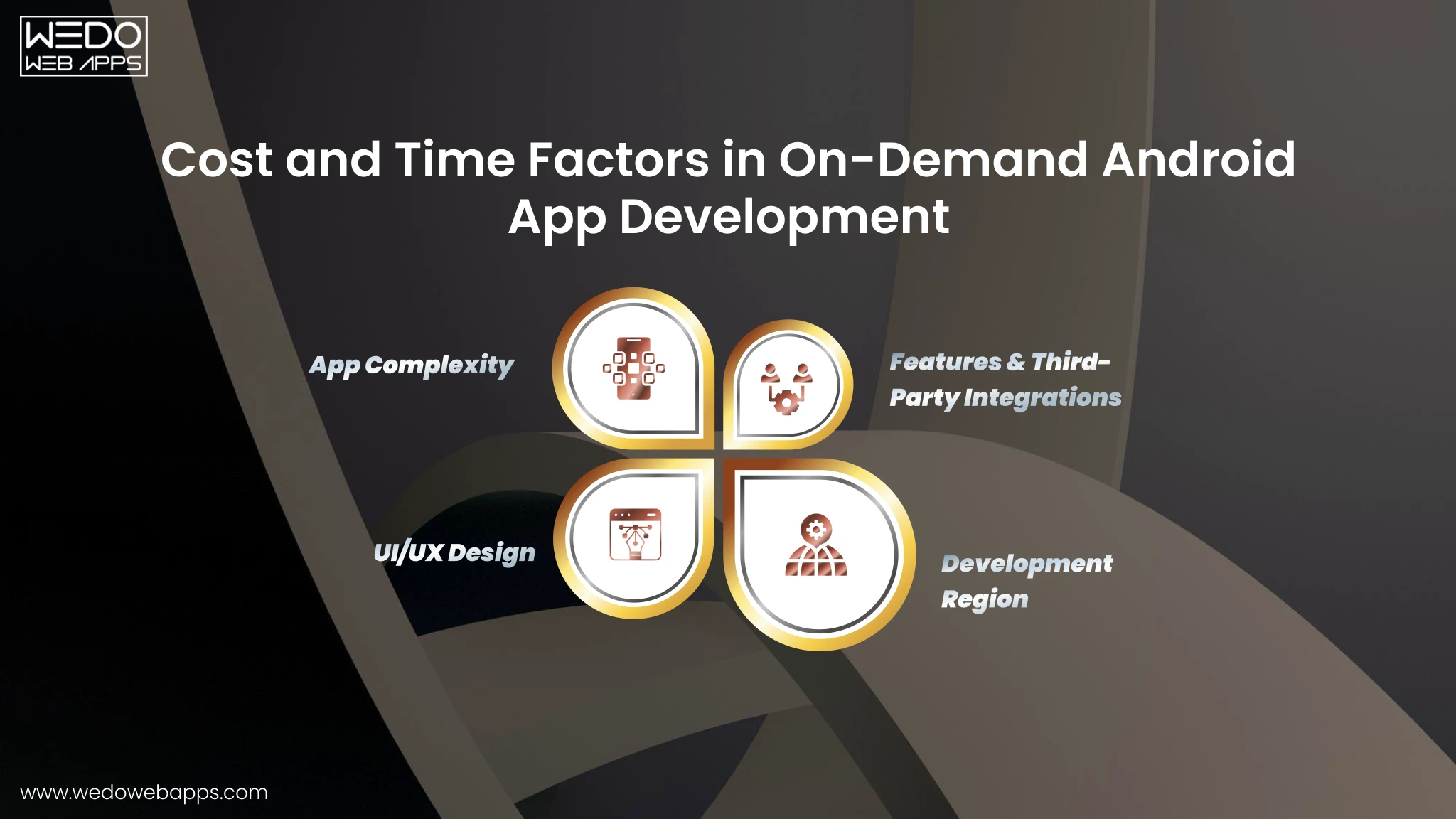
Cost and Time Factors in On-Demand Android App DevelopmentMain cost and time factors in on-demand Android app development
Developing a high-performing on-demand Android app requires strategic budgeting and time planning. The total cost depends on several technical and design-related variables.

Key Factors Influencing Development Cost

  • App Complexity: Simple apps (single-feature) cost less than those with multi-role functionality or AI-driven personalization.
  • UI/UX Design: Intuitive, aesthetic designs built around user psychology require more design hours, but also improve retention.
  • Features & Third-Party Integrations: Integrating maps, payment gateways, or chat APIs (like Twilio or Firebase) affects both cost and timeline.
  • Development Region: Developers in India typically charge60–70% less than those in theUSA or Europe, without compromising on quality.

Why the MVP Approach Works Best

A Minimum Viable Product (MVP) helps startups launch faster with only core features, gather real user feedback, and then iterate for scale. It’s an efficient way to validate your idea while optimizing resources.

Recommended Tech Stack

For on-demand Android app development developers commonly use:

  • Languages: Kotlin, Java, Dart (for Flutter cross-platform app development
  • Backend:Firebase, Node.js, AWS
  • Database: Firestore, MongoDB, or MySQL
  • Other Tools: Android Studio, Retrofit, Google Maps API, Stripe

An experienced development team can help you balance innovation, performance, and cost to achieve faster time-to-market.

Why Choose WEDOWEBAPPS for On-Demand Android App Development

At WEDOWEBAPPS, we specialize in creating high-performing, scalable, and intuitive Android apps tailored to your business goals. Whether you’re a startup validating an idea or an enterprise scaling operations, our end-to-end approach ensures your app stands out in a competitive market.

Expertise Across Multiple Niches

From food delivery and logistics to eLearning and healthcare, our team has hands-on experience across various on-demand sectors, allowing us to tailor solutions that align with industry trends.

End-to-End Development Process

Our comprehensive process covers:

  • Ideation & Strategy: We identify user pain points and map value propositions.
  • UI/UX Design: Crafted for conversion and usability.
  • Development: Built using modern frameworks like Kotlin, Flutter, and Firebase.
  • Quality Assurance: Multi-stage testing ensures performance, security, and stability.
  • Support & Maintenance: Continuous optimization post-launch for scalability.

Technology-Driven Results

Our developers leverage AI, cloud, and predictive analytics to make your on-demand Android app smarter and more adaptive. Security, scalability, and high-speed performance are at the core of every project.

Proven Success Stories

We’ve built apps that improved delivery efficiency by 40%, boosted user engagement by 60%, and reduced server costs by up to 35% for clients worldwide.

Build your next-gen on-demand Android app with WEDOWEBAPPS

Conclusion

The rise of on-demand Android apps marks a new era in digital convenience. With millions of Android users seeking instant, personalized services, businesses that adapt quickly are bound to lead the market.

From mobility and food tech to wellness and eCommerce, Android’s open-source flexibility and massive global reach make it the best platform for innovation. Whether you’re a startup aiming to disrupt or an enterprise optimizing operations, investing in an Android app development company ensures long-term scalability and growth.

At WEDOWEBAPPS, we help you transform your vision into a robust, future-ready solution, built with performance, user experience, and innovation at its core.

Ready to turn your on-demand idea into reality? Let’s redefine convenience together, one tap at a time.

10 Android App Development Secrets to Grow Your Business

Introduction

Building an Android app is not just a tech decision, it is a business growth strategy.

With more than 3 billion active Android devices worldwide, the platform offers outstanding reach, flexibility, and innovation potential for startups and enterprises alike. Whether you are aiming to boost customer engagement, streamline internal processes, or tap into a new revenue stream. Android gives you the tools to scale efficiently.

In 2025, Android is more than just a mobile OS, it is a dynamic ecosystem of smartphones, foldable devices, wearable devices, smart TVs, and even in-car systems. But succeeding in this space takes more than coding. It requires strategic thinking, tech foresight, and a clear growth plan.

That is where this blog helps you.

We have compiled 10 powerful secrets that go beyond conventional development advice. From choosing the right tech stack to leveraging modern UI frameworks and ensuring continuous delivery, these insights are crafted to help your business not just build an app, but build a successful, scalable, Android product.

Are you ready to unlock your Android App’s full potential? Let’s dive in.

Why Businesses Choose Android in 2025 and Beyond?

When it comes to scaling operations, reaching a global audience, and building sustainable digital products, Android business app development continues to dominate the mobile landscape. As of 2025, Android holds over 70% of the global mobile operating system market share, making it the first choice for brands looking to develop impactful mobile experiences.

But it is not just about market share, Android empowers businesses with:

1. Flexibility Across Devices

From smartphones and tablets to foldable devices, smart TVs, wearables, and even in-car systems like Android Auto, Android’s device ecosystem is vast. This flexibility allows developers to create best business Android apps that work seamlessly across multiple touchpoints, maximizing user engagement.

2. Affordable Development and Deployment

The cost of publishing apps on Google Play Store is significantly lower compared to iOS. This affordability gives startups and small businesses an edge when entering the Android App business, allowing for rapid prototyping and iterative development without high overheads.

3. Global Reach with Localized Access

Android’s dominance in emerging markets, like India, Southeast Asia, Latin America, and Africa, makes it a perfect launchpad for android app development business strategies aimed at mass user acquisition. With built-in localization tools and wide device availability, Android apps can scale across borders effortlessly.

4. Open Ecosystem Encouraging Innovation

Unlike more restrictive platforms, Android encourages customizations, third-party integrations, and innovative design. This allows developers to build unique, business-specific features that give companies a competitive edge in their domain.

Whether you are building an internal dashboard, an eCommerce store, or an on-demand service app, Android offers the perfect platform to launch, test, and grow. And if you are aiming to turn your Android app business into a long-term success, understanding what makes Android development effective in 2025 is the key.

Let’s explore the top secrets Android App developers are using to deliver high-performing, revenue-generating apps for businesses like yours.

10 Secrets to Android App Development Success

Developing a competitive android app for your business in today’s crowded market requires far more than just a clean code. You need a strategy that blends modern tools, deep platform understanding, and business foresight. Below are 10 powerful secrets Android app developers use to build scalable, secure, and growth-ready apps.

1. Elevate User Experience with Android 16 and Material You 4.0

Android 16 has redefined how users interact with apps. Features like predictive back gestures, adaptive layouts, dynamic theming with Material You 4.0, and improved haptic feedback offer a more personalized and fluid experience.

Modern UI/UX is now a competitive differentiator, not just a design concern. Apps that adopt the latest UX patterns often see longer session durations and higher retention.

Real Example: WEDOWEBAPPS redesigned a finance management app for Android 16 using dynamic color theming and smooth transitions. The result? A 22% boost in daily active users (DAUs) and a 15% drop in bounce rate.

Takeaway: For android business app development, UI must align with OS evolution to meet user expectations and build trust.

2. Adopt a Scalable Modern Architecture

Choosing a modern architecture early sets the tone for performance, testability, and scale. In 2025, MVVM (Model-View-ViewModel) continues to be a popular pattern, especially when paired with Jetpack components like LiveData, ViewModel, and Navigation.

Add in modularization, Clean Architecture principles, and proper separation of concerns, and your app becomes far easier to maintain and extend.

Example: For a hyperlocal delivery app, modularizing their ANdroid project into UI, data, domain, and core modules, will result in faster builds and parallel team development.

Pro Tip: A solid architecture is the foundation of every mobile app development, be it iOS or Android, aiming for long-term scale.

3. Leverage Kotlin for Maximum Development Efficiency

Kotlin is now the de facto standard for Android development. Its concise syntax, null safety, and powerful features like coroutines and extension functions lead to fewer bugs and faster development.

With the rise of Kotlin Multiplatform Mobile (KMM), developers can now share business logic across Android and iOS apps, reducing duplication and improving consistency.

Example: Switching from Java to Kotlin helped one of our clients reduce codebase size by 30%, while coroutine-based API calls improved loading speed by 40%

Bonus: Kotlin is also supported by Google Cloud Functions, making it a smart choice for full-stack Kotlin applications.

4. Build the Right Android App Development Team

Behind every great android app business, there is always a strong team. The ideal team setup varies by project size and complexity but generally includes:

  • Android Developer (Kotlin + Jetpack Compose)
  • UI/UX Design Service Provider (Figma, Material Design)
  • QA Tester (JUnit, Espresso, Firebase Test Lab)
  • Project Manager (Agile, Jira)

For bigger apps, you may also need a backend engineer (Firebase, Node.js, or AWS) and DevOps support.

Case Study: A real estate firm partnered with our dedicated Android team. With weekly sprints, in-app messaging, and automation, they launched 2 months ahead of schedule.

Takeaway: Whether in-house or outsourced, the right team is crucial for sustainable android business app development.

5. Start with a Strategic Development Roadmap

Too many apps fail due to lack of planning. Start with a well-defined MVP that solves a core user problem, then iterate based on feedback.

Adopt agile methodology with sprint planning, retrospectives, and user testing cycles. Tools like Analytics, Firebase, Mixpanel, and AppMetrica help track user behavior and inform decisions.

Pro Tip: Align your roadmap with key business goals like user acquisition, monetization, or retention, and track them continuously.

6. Prioritize CI/CD for Speed and Quality

In 2025, CI/CD pipelines are not a luxury, they are essential. Continuous Integration (CI) ensures that your app is tested every time the code is committed. Continuous Delivery (CD) enables you to push updates seamlessly, reducing time-to-market and improving reliability.

Example: We set up GitHub actions and Fastlane for a SaaS android app. Release cycles dropped from biweekly to weekly, and 90% of bugs were caught before going live.

Recommended Tools:

  • CI: GitHub Actions, Bitrise, Jenkins
  • CD: Firebase App Distribution, Fastlane

SEO Tip: Mentioning CI/CD enhances your android app development authority by signaling modern development practices.

7. Establish a Comprehensive Testing Strategy

Testing is not just about avoiding crashes, it is about ensuring seamless experience across devices, network conditions, and OS versions. In 2025, smart teams use:

  • Unit Tests: JUnit, Mockito
  • UI Tests: Espresso, Robolectric 
  • Automated Testing: Firebase Test Lab, BrowserStack
  • Real Device Cloud Testing for edge cases. 

For example, after integrating a testing suite across staging builds, an on-demand service app can reduce app store complaints by 50-60%

Tip: Simulate battery drain, memory usage, and bad network conditions, especially if you are building one of the best business android apps.

8. Stay Compliant with Android 16 Data and Privacy Policies

With increasing scrutiny on data collection, Android 16 emphasizes runtime permission management, data transparency, and sensitive permission audits.

Avoid requesting unnecessary permissions. Encrypt user data. Be transparent with what you collect and why?

Example: After updating a news app’s permission flow and implementing Secure SharedPreferences, Play Store approval time dropped by 3 days, and user trust improved.

Compliance Checklist:

  • Use Android Permission Manager 
  • Enable data minimization
  • Adhere to GDPR, CCPA, and India’s DPDP Act.

9. Optimize App Performance for Speed and Battery

Today’s users expect apps to be fast, light, and battery-efficient. Use Android Profiler, Lint, and LeakCanary to detect memory leaks and performance issues.

Adopt Android App Bundles to reduce app size, lazy-load non-critical modules, and compress images and assets.

Example: By converting large splash animations into Lottie files and reducing network calls, a shopping app’s load time reduced from 4.2s to 2.1s.

Tip: Google prioritizes performance-optimized apps for featured listings on the Play Store.

10. Add Interactive and Intelligent Features for Retention

Stand out by integrating features that users genuinely enjoy and engage with. From smart notification to dynamic widgets to gesture controls and on-device ML Models, these features drive retention.

Example: A podcast app we helped build added interactive media controls on Android notifications. This led to a 3X increase in episode completion rate.

Bonus: Use TensorFlow Lite to power personalized suggestions (Offline) while respecting user privacy.

These 10 secrets go beyond coding—they’re the blueprint for building a future-proof android app business. In 2025, success comes to those who plan wisely, execute efficiently, and evolve rapidly.

Whether you’re launching your first mobile product or scaling your android app development business, these strategies will help you build smarter and grow faster.

Most Used Tools in Android App Development

To stay competitive in the android app development business, using the right set of tools is non-negotiable. These tools do not just help you code faster, they enable better performance, automated testing, smoother deployment, and deep user analytics.

Here are the must-have tools for android business app development in 2025, categorized by purpose:

1. Android Studio (Official IDE)

  • Most powerful integrated development environment personalized for Android .
  • Includes emulator, layout editor, and performance profilers.
  • Helps detect UI/UX issues across devices. 

Pro Tip: Use its Layout Validation Tool to ensure your UI scales across foldables and tablets.

2. Jetpack Libraries (Compose, Navigation, WorkManager)

  • Compose: Declarative UI Toolkit for building beautiful, adaptive interfaces. 
  • Navigation: Manages complex navigation patterns.
  • WorkManager: Handles background tasks, even with app restarts. 

Example: Using Jetpack Compose helped our clients cut UI development time by 40%.

3. Firebase Suite (Analytics, Crashlytics, Remote Config)

  • Firebase Analytics: Tracks user behavior and funnels.
  • Crashlytics: Real-time crash reporting.
  • Remote Config: Allows dynamic updates without re-publishing.

4. GitHub Actions and FastLane (CI/CD Automation)

  • GitHub Actions: Automates testing, building, and deploying code.
  • FastLane: Simplifies Play Store updates and versioning.

Why it Matters: These tools streamline releases, essential for growing android app businesses that ship features regularly.

5. Espresso and Firebase Test Lab (Testing Stack)

  • Espresso: Automates UI Testing.
  • Firebase Test Lab: Tests apps across hundreds of real devices in the cloud.

Pro Tip: Run regression tests on every pull request to prevent breaking core features.

6. Android App Bundles and Play Console Tools

  • App Bundles: Shrinks app size by serving only necessary code to each device.
  • Play Console: Offers vitals, ratings insights, ANR crash metrics.

Bonus: Smaller app = higher install rate = better growth.

7. Lottie and Glide (For media optimization)

  • Lottie: Lightweight animations from After Effects
  • Glide: Efficient image loading and caching

Why Use: Enhances visual appeal without draining performance or bandwidth.

Takeaway: The right tool chain helps you build smarter, faster, and high-performing apps, which is at the heart of every successful android business app development strategy.

Data Security and Privacy Practices in Android Apps Development

In the digital era, trust is currency. If users do not trust your app, they would not use it, no matter how good it looks or performs. That is why data security and privacy are at the core of successful android app business strategies.

1. Comply with Android 16 Privacy Policies

Android 16 enforces stricter runtime permission handling and audit logs for sensitive APIs. Apps must now explain why they need access to permissions and show it contextually.

  • Use the PermissionManager API to show permissions only when relevant (for example, ask for permission only when a user navigate to the map)

2. Stay Legally Compliant (GDPR, CCPA, DPDP)

No matter where you are building your android business app, you must comply with relevant data protection laws:

  • GDPR: for EU audiences
  • CCPA: for California residents 
  • DPDP (India): Data Privacy Law coming into effect in 2025. 

Always display a privacy policy in-app and on your Play Store listing.

3. Encrypt All Sensitive Data

Data stored locally or in transit must be encrypted. Use:

  • EncryptedSharedPreferences for storing small private values
  • SQLCipher for encrypting local databases 
  • TLS 1.3 for secure API communication

Example: We helped a fintech client reduce fraud risks by encrypting all local storage, protecting over 40000 user accounts.

4. Enable Google Play Integrity API

To prevent app tampering and bot access, enable the Play Integrity API. It ensures that your app is running on a genuine Android device and has not been modified.

5.  Practice Data Minimization

Collect only what you need. For example, don’t ask for contacts or device ID unless critical. Fewer permissions = Higher trust + better Play Store approval rates.

Takeaway: A secure app is not just a good practice, it is a ranking factor, a user expectation, and a business enabler. For modern android app development business models, security is a core feature, not an add-on.

Real-World Business Benefits from Android Apps

Adopting Android for your mobile strategy is not just about market coverage, it is about unlocking tangible business outcomes. With over 71% global market share, Android offers unparalleled reach, cost-efficiency, and customization.

Here is how investing in android business app development translates into measurable gains:

1. Wider Market Penetration

Android dominates emerging markets like India, Brazil, and Southeast Asia. For businesses targeting mass adoption, Android is the smart choice.

Example: An e-Learning platform built a lightweight Android app personalized for low-bandwidth regions. They gained 1 million new users in rural areas within 6 months.

2. Higher ROI with Lower Development Costs

Compared to iOS, Android App Development often offers better ROI due to:

  • Lower device cost for testing
  • Open-source flexibility 
  • Broad talent availability 

Stats: According to Clutch, an Android project costs 20-30% less for similar scope MVPs compared to iOS-only apps.

3. Seamless Business Integrations

From CRM systems to payment gateways and wearable integrations, Android allows deep backend connectivity, ideal for logistics, fintech, eCommerce, and healthcare.

Example: A real-estate client integrated WhatsApp and Google Maps directly into their android app business, reducing lead-to-call time by 40%.

4. Data-Driven Decision Making

Android’s tight integration with Firebase, Google Analytics, and BigQuery allows advanced user segmentation, churn tracking, and campaign optimization.

Example: A grocery delivery app increased conversion by 27% after identifying high-exit screens through Firebase Analytics and redesigning them.

5. Faster Iteration and Innovation

The combination of CI/CD, open APIs, and early access to developer previews means Android apps can ship updates faster and test innovations early.

Bonus: With tools like Firebase Remote Config, businesses can A/B Test features in real-time without app re-releases.

Common Mistakes to Avoid in Android App Development

Even the best ideas can fail if executed poorly. Here are the most frequent mistakes businesses make, and how to avoid them your android app development journey:

1. Ignoring User Research and Feedback

Building without real user input can lead to irrelevant features or complex UX.

Solution: Use MVP + in-app surveys + analytics to validate every feature or complex UX.

2. Skipping Testing Across Devices 

Android fragmentation is real. Apps that crash on low-end or old devices lose users fast.

Solution: Use Firebase Test Lab or test across 1000s of real devices in the cloud.

3. Overlooking App Store Optimization (ASO)

An excellent app with a poor listing won’t get discovered.

Solution: Use keyword-rich titles, engaging screenshots, and 5-star incentives. Tools like AppTweak and Sensor Tower can help.

4. Requesting Too Many Permissions

Overreaching permissions (like contacts, location, microphone) without clear use cases lowers trust and can get your app suspended.

Solution: Follow Android 16 guidelines and ask for permissions only when needed.

5. Not Planning Monetization Early

Monetization should be built into the core flow, not added as an afterthought. 

Solution: Choose a model early – freemium, ads, subscriptions, and design around it.

Conclusion: Turn Android App Development Into Business Growth

If you want your mobile presence to generate real business results, investing in the right strategy, tools, and team is essential. Android in 2025 offers immense opportunities, but only for those who approach it with precision and innovation.

By applying these 10 secrets, from using Kotlin and Jetpack to adopting CI/CD and ensuring top-notch data security, you are not just building an app, you are building a growth engine for your business.

Whether you are launching your first product or scaling an existing platform, collaborating with a trusted Android app development company ensures you make the most of these capabilities. The right android app development services can fast-track your idea from concept to market-ready, user-loved application.

Choose wisely. Develop smart. And let your Android app power the next stage of your business success.

Helpful guidelines to simplify iOS app development process

Smartphones have taken over the traditional method of browsing through the desktop, easing communication. The revolutionary Internet and growing trend of mobile websites and applications have taken mobile popularity to the next level. People of every age are busy exploring different mobile apps either for entertainment or purchasing goods and services. Therefore, the app development industry is thriving! However, high-end mobile applications have become the most preferred choice among customers due to its impressive features and functionalities. And as we know, it is iOS that offer high-end apps to ease the life of customers, which has led even iOS app developers to showcase their creativity level in new horizons.

There are millions of apps available in the store, and every day, a new app is added. So in this ever-growing competition, developing a unique iOS app is quite challenging. Thus, employing an iOS Development Company is an ideal choice. These companies have a large pool of talents that enable them to deliver exceptional and innovative iOS applications. Not only an iOS development company but being an entrepreneur, you must also be well-versed with the guidelines that will help you boost the iOS app development process.

Moreover, an app programming guide helps iOS developers to keep factors like performance tips, app architecture, app lifecycle, app power consumption, etc., in every limelight.

Focus on the app success factors

From searching a critical app idea and turning it into a popular app becomes an essential task for the company offering the app development project. Comprehensive research and analysis that emphasize on vital aspects make it easier to find the advantages and disadvantages of the app development process. Therefore, it helps in concentrating more on the intricate issues and discovering an agile method that enables the app to emerge in the “Showcase” section of iTunes.

This section gives advantages to all thriving apps, including innovative ideas. Hence, the iOS app developer needs to think unconventionally to deliver vibrant and quality features and functionalities in the app to draw the attention of more users and intensify app download ratio by placing their app in the “Showcase” section.

Understand app approval process

Obtaining app approval from the store is tough, but if you understand well the rules and app review guidelines of iOS, before beginning your app, then things are quite more comfortable. After you accomplish the app development process, perform testing by adhering to the app store guidelines, before you deploy your app for approval.

Apple Store tests your app and provides approval only if they find your app informative. In case of bugs, they will send your app back with a reason for not approving. However, you have the flexibility to resend your app after resolving the issue bug for approval. It would help if you also had expertise about actions to take when your app gets refused.

Prioritize app promotion

iOS app development process entails various stages such as research & analysis, wireframe, conceptualization, design & architecture, integration of front-end and back-end coding, software architecture planning, testing, and launching. Well, still, your work is not accomplished; you are one step behind.

After that, the primary task in the app development process is running the promotion of your mobile app to boost the visibility of your app in the app store. Marketing your app using targeted keywords and using search engine optimization helps you to rank in SERPs of iTunes search results.

Continuous app development process

When it comes to setting the timeframe for the app development process, things become more difficult, especially in the case of developing high-end iOS applications. It requires researching excellent resources including iOS app development company or iOS developers, consult with them in detail concerning the app concept and project goals as well as the timeframe, promotion activities, launch period, and more.

Besides, publishing and promoting an app is not the end phase of your app development process, which has become a fact. The process never ends; you need to maintain, add new features, fix bugs, make implementation, and provide the latest updates to establish long-lasting relationships between your app and its users. Getting reviews/ responses/ feedback of your users about the app and integrating their demands in your next versions also becomes an essential part of the app development process that needs to be considered before stepping in the development process.

Read also: iOS App Development Tools and Remarkable Apple Store Apps

Don’t forget; free apps fuel the growth

Many businesses find it challenging when it comes to deploying free or paid apps in the App store. It is because earning profitable outcomes are based on numerous factors, which is the successful promotion of the app. Usually, people aim to choose the free app first if they find pleasing features in it.

Therefore, making your app habituated for people habituated is a crucial aspect. Then adding advanced features to the paid version, entice your customers to buy the app with a small amount. It comprehends to attract more users as compared to the paid app.

Right from creating app icon designs to screen designs and smooth coding, each stage is relatively essential when it comes to driving app success for the iOS app development process. Each step has its significance and needs proficiency to make an app appealing, attractive engaging, and user-friendly as well as flourishing.

In such scenarios, an expert iOS app development company can tremendously guide you in making your iOS app development process agile and easy which results in a successful iOS app that delivers profitable outcomes.

How to choose the right iOS development company for your business? 

There are certain factors, which need to be noted to choose the right iOS development company. Your choice is very critical for the growth of your business, so make a wise decision by keeping the following factors in mind:

  • Relevant experience

Developing an iPhone app is not a cakewalk. You can let anyone without start without any prior experience handover your project. A long year of experience in designing and developing an iOS application is highly essential for achieving your business goals efficiently. Never hand over the project to the company without revising its portfolio quality.

  • Artistic minds

Only innovative thinking will help your app reach your targeted audience quickly. As you already know, only a great featured iOS app outfits the plenty of other apps available in the App store can be successful. Check whether the company boasts a developer’s team that is proficient in their skills, dedicated and creative.

  • Cost-effectiveness

The top iPhone application development companies can offer you the best quote for Custom iPhone applications. These companies can deliver apps with exceptional quality at a reasonable price. Check out their previous apps. Do remember that your app quality is essential and never compromise the quality of the app for the price.

  • User-friendly app design

The ultimate aim or the success of an iOS app depends highly on its efficiency to reach the target audience at the right time. Your iPhone development company should be flexible in providing you with a range of innovative and user-friendly designs for your iPhone app.

  • Technical excellence

Only the technical expertise of the company will help you in developing a unique and interactive iOS app. The iOS developers and programmers of the app development company must be skilled and experienced. They should have an in-depth knowledge of OS framework, iPhone simulators, and Mac OS X framework, which will help you in developing a distinguishing iPhone app.

In conclusion

With the right guidelines concerning the app development process, iOS app developers can efficiently build a successful app. Right from understanding the app concept, app store approval process, designing & coding integration, app promotion activities, app testing, as well as finding an expert app development company; everything needs practical guidelines to convert your unique idea into a successful and profitable app. An expert iOS app development company can develop innovative apps using the best techniques for the mobile app development process to make it successful.

Magento 2 vs BigCommerce – Choose the One Smartly

Choosing an eCommerce platform has never been easy for store owners, especially newcomers to the online world. WooCommerce, Shopify, Magento, and BigCommerce are some of the big players in this industry that consistently rank at the top. As you can see, Magento custom development has always been more popular than BigCommerce in the last five years. What is the reason for this? Now, if you’ll excuse me, I’d want you to follow me to Choosing an eCommerce platform has never been simple for store owners, especially newcomers. WooCommerce, Shopify, Magento, and BigCommerce are some of the big players in this industry that consistently rank at the top. As a result, you must select the one that best suits your company. Some platforms are ideal for tiny businesses until they get adjusted to the world of online commerce, while others are only appropriate for huge firms, and yet others are appropriate for all online stores, regardless of size. Following that, we’ll go over two of the most popular systems, Magento 2 and BigCommerce, and explain the key distinctions between them so you can make the best choice. Magento 2 is the most popular platform on the planet, and it benefits from the parent company’s reputation. It is used by some of the world’s greatest corporations, like Ford, Coca-Cola, and Nike, and is popular because of its ease of use and ability to be customised to the tiniest detail. It’s currently used by over 290,000 internet shops all around the world. BigCommerce is a premium platform that includes hosting and other integrated services. This means you won’t have to worry about additional technical concerns or hosting: all you have to do is choose the bundle that best meets your needs and get started creating your dream store. Throughout 62,000 online stores use BigCommerce around the world. Confused, Right? We’ll help you with the major differences in both platforms that will help you choose the right platform for your business. 

BigCommerce vs. Magento 2 – The Key Differences 

1. Pricing

Pricing disparities between eCommerce platforms might play a crucial part in selecting a decision, depending on your budget.

BigCommerce Pricing

The pro plans are automatically enrolled in BigCommerce stores that sell more than 125,000 USD per year. The cost is also determined by the number of orders placed. Low-cost plans come with fewer features. The base subscription, for example, does not have an abandoned cart saver, fraud monitoring, product filtering, and other features that you may require. For less than $400k in online sales, the pro plan starts at $299.95/mo, plus $150/mo for each subsequent $200k in online sales. Price plans also include variable credit card processing charges, so businesses must account for this expense in addition to the monthly fee for using the programme. Per card transaction, the normal plan is 2.9 percent + 0.3 USD. This transaction fee might easily add up if your store produces a lot of sales.

Magento Pricing

Magento, on the other hand, is a completely free platform to utilise. To get their eCommerce stores up and running, users only need to pay for hosting. FREE Community Edition Hosting: $4-$100+ each month Enterprise Edition: Customized pricing based on your business requirements. Users of Magento should also consider hiring a developer to set up and manage their store. Overall, running a Magento site is less expensive than maintaining a BigCommerce site. Magento costs can be considerably lowered when the software’s monthly pricing and transaction fees are considered.

2. Popularity

Each platform’s popularity among eCommerce businesses and the general public varies. Magento is used to create 8% of all eCommerce sites. Magento is used by 1.12 percent of the top million eCommerce sites, while BigCommerce is used by only 0.42 percent. BigCommerce is used by fewer than 1% of the top 10,000 eCommerce sites, while Magento 2 is used by 1.51%. Magento has BigCommerce beat when it comes to successful, large-scale web stores.

3. Design

Another factor that contributes to an online store’s success is its design. Free design templates are available for both Magento and BigCommerce. BigCommerce offers seven free, attractive templates as well as a variety of paid templates ranging from $145 to $235. Because Magento is open-source, there are a plethora of additional themes accessible through Magento Connect and third-party websites. Magento allows you to customise almost every aspect of the design. As a result, you’ll be able to design a store that appears precisely the way you want it to. Because BigCommerce only provides for a limited number of design options, the site you create will be far less customizable. For a mobile-friendly purchasing experience, both have responsively designed themes. Because an increasing number of clients choose to purchase on their mobile devices, responsive design is a major bonus for both platforms.

4. SEO

SEO plays a very crucial role when it comes to gaining the trust of clients. SEO is the process of optimising a website in order to achieve a high search engine ranking. Magento 2 is the finest eCommerce platform for increasing SEO rankings, according to a rating of the best eCommerce systems. Using Magento 2 is a fantastic way to increase site traffic and visibility. Read also: BigCommerce To Magento 2 Migration: How To Do It?

5. Ease of Use

Another element to consider when choosing a platform is how simple it is to use, especially for novices. BigCommerce is far more user-friendly than Magento for newcomers. Magento is well-suited to developers, but it can be difficult to navigate for newbies. BigCommerce provides a simple, clean dashboard that allows users to quickly get their site up and running. When users initially open the dashboard, they are given step-by-step instructions. A website builder is included in the platform, allowing users to create and administer stores without having any prior knowledge of web development.

6. Community Support

Which eCommerce platform offers the best customer service? The success of internet stores is used to assess this. BigCommerce is backed by BigCommerce Unversity, which helps users learn how to boost sales. Store owners may communicate with the Magento Community and even request support from the developers they purchase from, thanks to a large number of users. With the help of the supporting community, everything becomes a lot easier.

Still weighing your options? Dive deeper into Magento vs. other ecommerce platforms to understand why Magento might be the best fit for your business.

7. Hosting 

Hosting is one of the most significant differences between these two shopping cart platforms. Magento is self-hosted, which means store owners will have to pay for hosting from a third-party provider. Companies like SiteGround and HostGator offer this for as cheap as $2.75 per month. However, it is an additional cost to consider and is best suited for expert eCommerce users. BigCommerce, on the other hand, is a hosted solution, thus using it as a platform eliminates the need to find and pay for hosting. BigCommerce takes care of everything, making it an excellent solution for fledgling eCommerce businesses. The cost of hosting can be factored into the total cost of Magento 2 website development and maintenance. But it’s not all bad news. Self-hosting allows business owners to pick and select whatever services they want in a hosting plan, as well as how much they want to pay for it. Read also: Hire Dedicated BigCommerce Developers

8. Extensions

Extensions are digital tools that make your life a lot easier, thus we couldn’t help but talk about them. Again, Magento 2 comes out on top since you have access to both free and paid Magento 2 extensions, which will help you create the best online store possible. Hire Magento 2 developer who will help you integrate all the necessary extensions into your website. 

Which is the Best – Magento 2 or BigCommerce?

When deciding between different e-commerce platforms for the development of your websites, such as Magento and BigCommerce, consider the features, cost, design, and other factors. BigCommerce can be exactly what you’re searching for if you’re looking for a small to the mid-level solution. Magento, on the other hand, is your best pick if you’re looking for an enterprise solution or one with tremendous flexibility and the ability to adjust as your business expands. If you are looking for Magento Development services, WeDoWebApps has the best Magento Developers India. Get in touch and we will help you with your requirements be it design, development, migration, or even consultancy.