skip to content

Ecommerce Business Development: How to Build and Grow a Profitable Online Store

Introduction

eCommerce is not just a sales channel; it is a core business engine.

Whether you are launching your first online store or trying to scale an existing one, the way you approach eCommerce business development directly determines how fast you grow, how efficiently you acquire customers, and how sustainably you generate revenue.

This is why more founders and decision-makers are asking:

  • How to develop an eCommerce website the right way?
  • How to grow eCommerce business beyond initial sales?
  • What should we focus on when starting an eCommerce website?

The challenge is that building an online store is easy, but building an eCommerce business that grows consistently is not.

True eCommerce success requires a combination of strategic planning, smart technology choices, strong user experience, scalable infrastructure, and growth-oriented marketing, all working together.


Ecommerce business development strategy

What is eCommerce Business Development?

eCommerce business development is the process of building, optimizing, and scaling an online business in a way that drives consistent revenue growth, customer acquisition, and long-term profitability.

It goes far beyond creating a website.

While eCommerce website development focuses on launching an online store, eCommerce business development focuses on making that store successful as a business.

It combines:

  • Business strategy
  • Technology and platform decisions
  • User experience design
  • Marketing and acquisition planning
  • Operations and fulfillment
  • Data-driven optimization

In short, eCommerce business development connects what you sell, how you sell, and how you grow.

eCommerce Website vs eCommerce Business

An eCommerce website answers: Can customers buy online?

eCommerce business development answers: Can the business scale profitably online?

This difference is critical.

You can have a visually appealing website and still struggle with:

  • Low conversions
  • High acquisition costs
  • Poor retention
  • Operational inefficiencies

eCommerce business development addresses these issues systematically.

Why eCommerce Business Development Matters

For startups, it determines whether the idea gains traction.

For SMBs, it determines whether growth plateaus or accelerates.

For enterprises, it determines whether market leadership is maintained.

Businesses that treat eCommerce as a business system, not just a website, consistently outperform those that don’t.

Critical Steps Before Starting an eCommerce Website

Many eCommerce projects fail not because of poor design or code, but because the business skipped foundational planning.

Before starting an eCommerce website, these steps create clarity, reduce risk, and improve your chances of success.

1. Validate Market Demand

Confirm that people actually want what you plan to sell.

  • Research search demand
  • Analyze buying trends
  • Identify customer pain points

Strong demand is the base of every successful eCommerce business.

2. Define Your Target Customer

You need clarity on:

  • Who they are?
  • What problem they are trying to solve?
  • Why they would choose you?

Clear personas guide design, messaging, and marketing.

3. Analyze Competitors

Study:

  • Product positioning
  • Pricing strategies
  • Website experience
  • Marketing channels

The goal isn’t copying, it’s finding gaps and differentiation.

4. Define Your Value Proposition

Answer:

Why should customers buy from you instead of others?

This impacts branding, design, and content.

5. Plan Your Product Catalog & Pricing

Decide:

  • Initial product range
  • Pricing model
  • Bundles or upsells

This affects platform selection and UX.

6. Outline Fulfillment & Operations

Determine:

  • Inventory management
  • Shipping partners
  • Returns process

Operational clarity prevents future bottlenecks.

Why These Steps Matter

Skipping these steps often leads to:

  • Low conversions
  • High marketing costs
  • Confused positioning

Strong planning makes later development and eCommerce growth far more effective.

How to Develop an eCommerce Website for Growth

Developing an eCommerce website isn’t just about building pages and adding products. It’s about creating a platform that supports acquisition, conversion, retention, and scaling.

Here are the core elements that matter.

1. Choose the Right eCommerce Platform

Your platform should support:

  • Scalability
  • Customization
  • Security
  • Integration flexibility

Popular options include Shopify, WooCommerce, Magento development, and custom builds, but the “right” choice depends on your business model and growth goals.

2. Prioritize User Experience (UX)

Growth-focused eCommerce websites:

  • Make navigation simple
  • Highlight products clearly
  • Reduce steps to checkout
  • Build trust visually

Good UX directly increases conversions.

3. Build Mobile-First

Most eCommerce traffic is mobile.

Your website must:

  • Load fast on mobile
  • Be easy to navigate with touch
  • Offer seamless checkout

Mobile-first design is no longer optional.

4. Implement Strong Technical SEO Foundations

Include:

  • Clean URL structures
  • Fast page speed
  • Proper indexing
  • Schema where appropriate

SEO ensures long-term, low-cost traffic.

5. Ensure Security & Compliance

Customers need to feel safe.

  • SSL certificates
  • Secure payment gateways
  • Data protection measures

Security affects trust and conversion.

6. Design for Scalability

Plan for:

Scalability prevents costly rebuilds later.

Bottom Line

If your goal is how to grow eCommerce business, the answer starts with how to develop eCommerce website correctly.

A growth-ready website becomes the foundation for everything else.


Ecommerce website development guidance for scalable online stores

How to Grow an eCommerce Business (Core Strategies)

Once your eCommerce website is live, growth depends on how effectively you attract visitors, convert them into customers, and bring them back.

Here are the core strategies successful brands focus on.

1. Invest in SEO & Content Marketing

SEO builds sustainable traffic over time.

  • Optimize product and category pages
  • Publish helpful content
  • Target buyer-intent keywords

This supports predictable, compounding growth.

2. Use Paid Acquisition Strategically

Channels like Google Ads and social ads help you:

  • Test offers quickly
  • Scale winning products
  • Reach new audiences

Paid traffic works best when combined with strong landing pages.

3. Build Email & Retention Marketing

Email remains one of the highest ROI channels.

  • Abandoned cart emails
  • Post-purchase follow-ups
  • Loyalty campaigns

Retention lowers customer acquisition cost.

4. Optimize Conversion Rate (CRO)

Small improvements add up.

  • Test headlines
  • Improve product descriptions
  • Simplify checkout

Higher conversion means more revenue from the same traffic.

5. Leverage Data & Analytics

Track:

  • Traffic sources
  • Conversion rates
  • Customer lifetime value

Data-driven decisions outperform guesses.

Growth Reality

There is no single tactic that grows eCommerce businesses. Growth comes from systems working together.


Ecommerce store optimization for growth and conversions

Operational Considerations (Logistics, Payments, Support)

Strong marketing and a great website mean little if operations can’t support demand.

Operational readiness directly impacts customer satisfaction and repeat business.

1. Fulfillment & Shipping

Decide early:

  • In-house vs third-party fulfillment
  • Shipping regions and costs
  • Delivery timelines

Reliable fulfillment builds trust.

2. Payment Methods

Offer multiple secure payment options:

  • Credit/debit cards
  • Digital wallets
  • Local payment methods

Convenient payments reduce checkout friction.

3. Returns & Refunds

Clear return policies:

  • Increase buyer confidence
  • Reduce disputes
  • Improve brand reputation

Make policies easy to find and understand.

4. Customer Support

Provide:

  • Email or ticket support
  • Live chat or chatbots
  • FAQ knowledge base

Fast support reduces churn.

Why Operations Matter for Growth

Operational issues:

  • Create negative reviews
  • Increase refunds
  • Kill retention

Strong operations protect your brand as you scale.

Common Pitfalls and How to Avoid Them

Many eCommerce businesses struggle not because their idea is bad, but because they repeat the same avoidable mistakes.

Here are the most damaging ones.

1. Launching Without a Clear Strategy

Problem: Building a site before defining audience, positioning, and goals.

Avoidance: Create a simple eCommerce business roadmap before development.

2. Choosing Technology Based Only on Cost

Problem: Cheap platforms that can’t scale.

Avoidance: Choose technology based on long-term growth needs.

3. Ignoring Mobile Experience

Problem: Desktop-first design in a mobile-first world.

Avoidance: Design and test the mobile experience first.

4. Underestimating Marketing

Problem: Assuming traffic will come automatically.

Avoidance: Plan SEO and paid marketing from day one.

5. Not Tracking Data

Problem: Operating blindly.

Avoidance: Implement analytics and dashboards early.

6. Treating eCommerce as a One-Time Project

Problem: No ongoing optimization.

Avoidance: Continuously improve site, marketing, and operations.

Reality Check

Successful eCommerce businesses treat development as a continuous growth process, not a launch event.

Conclusion

eCommerce success doesn’t come from simply launching an online store.

It comes from approaching eCommerce business development as a long-term strategy that connects planning, technology, user experience, marketing, and operations into one growth system.

Whether you’re starting an eCommerce website, rebuilding an existing store, or looking for better ways to grow your eCommerce business, the fundamentals remain the same:

  • Build on the right platform
  • Design for users
  • Optimize for search and conversions
  • Operate efficiently
  • Improve continuously

When these pieces work together, your eCommerce website becomes more than a sales channel; it becomes a scalable business asset.

At WeDoWebApps, we provide end-to-end eCommerce development solutions that help startups, SMBs, and enterprises plan, build, and scale high-performing online stores with growth at the core.

If you’re ready to develop or upgrade an eCommerce website with growth in mind, now is the right time to start.


Build a growth ready ecommerce business website

Benefits of Availing the Services of Custom Web Development in Sydney

Getting online is the best way to expand your business. Perhaps, this is the reason why many companies are going online with their website. WeDoWebApps LLC is making this dream come true for many companies with its custom web development company. If you too are among such business enthusiast, we will be providing a complete solution for your IT requirements.

Here is a glimpse of the benefits you will get while getting the services from us. Please go through them and develop a proper understanding of it.

Benefits of Availing the services of Custom Web Development Sydney from WeDoWebApps LLC

Exposure to Various Technologies

Our developers are capable of developing a project with any given technology. We believe in the constant innovation process. Therefore, we will be able to deliver our services in any given technology you want. Whether it is Java, PHP, Laravel, Drupal, Different types of CMS or whatever you wish from us. We offer the overall solutions as far as your IT related requirement are concerned.

In-depth understanding of the Different Business Domains

WeDoWebApps LLC constitutes an extensive experience of serving the clients functioning in a various business environment. We are in this field for an extended period. As a result, we have created websites for multiple businesses such as sports, personal, health and lifestyle, blogging, eCommerce development services and a lot more. Therefore, we will be having effective solutions ready for all your problems and issues. Furthermore, we have in-depth experience in handling the clients so you will feel comfy with us while developing your business website.

Multiple Options

We are always providing our clients with multiple options. You are free to choose from the different types of technologies as per your convenience. Apart from that, we also offer opportunities to you while selecting the themes, templates as well as colour combinations as per the notion of your business. Due to this, the website which we will develop for you will be as per your demands and requirements.

Read also: Essentials of Custom E-commerce Development

Client-Centric Approach for Development

We believe in delivering the optimum solutions for all your requirements. Therefore, we will keep you updated on the status of your project. Besides that, we will also record your feedback on the various parts and make the changes in the platform as per the necessity.

Ethics and Morals are Supreme

For us, our ethics and moral values matter the most. We don’t make use of any sub-standard quality elements while developing the project. You will always get top of the line components from us. As a result, your website will be functioning smoothly, irrespective of the device, platform, browser it is accessed from. In this manner, your users will love accessing it and use it for their betterment.

Do you wish to work with us on your next project? Discuss it with our expert team of Custom Web Development Sydney and get a solution for all your requirements.

Figure out the biggest pros and cons of custom iOS application development

The mobile industry influences all areas, from food to fashion and business.

But how to go mobile, especially for iOS? Which is better for developing a custom mobile application or utilizing the benefits of a white label solution Each version has its advantages, but custom iOS app development proves to be a better option.

So let’s start with some new Information.

To understand whether you need to invest in custom iOS application development, first of all, we need to define what is the development of the customized iOS application itself and how it differs from the solution on the shelf.

Custom development is also known as custom software. If we talk about applications, it means that custom mobile applications offer functions that are not off-the-shelf solutions.

Consider this simple example. The two same degree doctors have almost identical medicine for their patients. But at the same time, they have entirely different strategies to check-up his patients.

Thus, The design and functionality of the application should depend on the objectives of each store and in each case. The notable feature of custom application development is its ability to implement your idea precisely as it was designed.

In other words, the custom iOS application development is to meet the needs of your business, and the final product will be suitable for the operation of your business. In contrast, the off-the-shelf solution provides a universal platform for everyone to engage as many companies as possible.

This means a specific outcome – the performance of the same design and applications, without taking into account the business objectives of each company. Such applications can be sold as SaaS (software as a service), which involves companies paying rent to use the app.

Of course, this solution will cost less. But you have to keep the maxim in mind – “get what you pay for,” as this is especially the case with software development.

developers should need to setup visual voicemail on iPhone as its really beneficial for programming.

Pros and cons of custom iOS app development

The obvious benefits to businesses from creating custom applications include scalability, easy deployment, and increased productivity.

But for the final decision, let’s go and consider all the pros and cons.

Data & Resource Security

Data security is one of the primary reasons why businesses can invest in custom applications. This assumption becomes more critical if the application works with personal data to ensure the security of users’ data in the era of globalization.

You should use a personalized approach in iOS application development. Custom applications allow you to eliminate threats and risks by integrating security measures and data encryption. The customized approach also meets the requirements of various operating systems and APIs.

Centralize Customer service

Personal development allows you to create a strong optimization strategy with each customer. This is possible due to the integration of analytical tools in the early stage of application development. You can track each client’s preferences and make individual offers to fit their needs. Building a deep customer relationship has never been easier. It Highlights business competitiveness.

Mobile applications should highlight the factors that differentiate their offerings, as stated in the example of a doctor, while Custom applications allow this. At the same Time, the formulated solutions are built to provide strictly defined functionalities. These types of applications cannot expand their features by adding new features,

So a company’s mobile offerings are limited. If you try to add some extra features, your app will turn into a fake cabriolet – good looking, but with terrible performance.

Invest in yourself

Custom application development wins the battle with a solution designed for one simple reason – when you create a custom app, you become its owner.

Cons of custom iOS app development that effect too.

Take Time to develop the applications.

Time is one of the main disadvantages of custom application development. With a pre-built solution, you can get a job application quickly. To develop your custom application, you must go through a software development process, which can take weeks, months, or even years for large and ambitious projects. Consider the iPhone app development services and weigh them against the pros and cons of custom iOS development.

Error corrections, strategy changes, design improvements – all these can delay the launch of the final product. However, you are not insured for errors when using an off-the-shelf solution. Also, these bugs can and do cause significant business errors.

It cost more than a local app

It is clear that developing a custom application requires significantly more resources and thus comes with a large amount of cost and risk. Changes in the overall strategy that occur due to identifying new needs during the development process are widespread. This, however, results in additional costs, as it takes more development time and effort.

Web Application Development in London: Personalized, Agile, and AI-Driven Solutions

Web Application Development in London

London’s tech ecosystem is buzzing, with startups launching bold new ideas, enterprises adopting digital transformation, and customers expecting a smooth user experience. And right at the center of all this, smart, scalable, custom-built web applications are emerging.

If you are exploring ways to streamline your business, serve your customers better, or launch a digital product, a web application might be a strategic move. But building a web application is not just about coding; it is about solving real business problems with the right strategy, design, and technology.

That is where we come in. WEDOWEBAPPS, our team of web app developers, helps London-based businesses and global brands turn your idea into a powerful web application that is fast, secure, user-friendly, and built to grow as you grow.

In this blog, we will talk about what makes great web apps work, why London is a great place to get your web app developed, and how our process goes from start to support. Get ready to dive in, and you will find plenty of insights along with the action steps ahead.

Looking to start your digital project in London

Why London is a Hub for Web App Development

If you are searching for the perfect place to get your next digital product developed, London might be the perfect place for you. Be its first-class tech ecosystem or its talented pool of web and app developers and designers, this city is where innovation comes to reality and scales fast.

London’s startup ecosystem is growing, supported by leading accelerators, incubators, and global investors. This city is also home to different industries like finance, retail, healthcare, logistics, and education, all of which are driving demand for smart, reliable, and scalable web application development in London.

But it is not just about technology, it is about talent. If you are looking for frontend specialists, backend engineers, UX strategists, or AI experts, London offers access to some of the best digital minds in the world. That means faster development cycle, better collaboration, and a shared understanding of business goals, especially if you are a UK-based company looking to work closely with your tech team.

And let’s not forget the regulatory advantage. With a strong focus on data protection and GDPR compliance, building your web app in London ensures that privacy and security aren’t just afterthoughts; they are baked into the process from day one.

Long story short? If you are serious about launching or scaling a digital product, web application development in London puts you right at the intersection of innovation, expertise, and opportunity.

Key Elements of High-Quality Web App Design

High-quality web app design focuses on user experience through easy and smooth navigation, responsive design, and engaging visuals. The key elements of high-quality web design include clear CTAs, fast loading times, and accessible content. A strong focus on visual hierarchy, consistent branding, and effective use of white space also contributes to a positive user experience.

Core Elements of a High-Quality Web App Design

1. User Experience

Designing for ease of use and enjoyment is important. This includes clear and smooth navigation, clear CTAs, and a layout that is easy to understand and interact with.

2. Responsive Design

The application should adjust seamlessly to different devices like desktops, tablets, and phones, and screen sizes. This ensures a consistent experience across all platforms.

3. Accessibility

Making the app usable by everyone, including those with disabilities, is important. This involves considering factors like screen reader compatibility, keyboard navigation, and color contrast.

4. Fast Loading Times

Slow-loading pages can frustrate users and lead to abandonment. Optimizing the app for speed is essential for user satisfaction.

5. Visual Hierarchy

Using visual elements such as typography, color, and imagery to guide the user’s eye and highlight important information helps users quickly understand the app’s structure and content.

6. Consistent Branding

Maintaining a consistent visual style (fonts, colors, imagery) across the app reinforces brand identity and creates a cohesive user experience.

7. White Space

Effective use of white space (or negative space) helps to separate elements, improve readability, and create a cleaner, more visually appealing design.

8. Clear and Concise Content

Using clear and concise language, avoiding jargon, and structuring content logically make the app easier to understand and use.

9. Engaging Visuals

Well-chosen images, icons, and other visual elements can enhance the user experience and make the app more visually appealing.

10. Intuitive UI Elements

Using universally recognized icons and clear, concise labels for buttons and other interactive elements helps users interact with the app.

11. User Interface (UI)

The UI encompasses the visual elements and interactive components of the app, including buttons, forms, and menus. A well-designed UI is essential for a positive user experience.

12. Interactive Design

This focuses on how users interact with the app, including animations, transitions, and feedback mechanisms. Effective interactive design can make the app feel more responsive and engaging.

13. Testing and Feedback

Regularly testing the app with real users and gathering feedback is important for identifying areas for improvement and ensuring the app meets user needs.

Custom Web Application Development in London

Custom Web Application Development in London involves developing personalized software solutions to meet specific business needs, going beyond standard website features. Companies like GoodCore, Megh Technologies, and WEDOWEBAPPS are examples of companies offering such services in London. Custom development services include frontend and backend development, cloud integration, and ongoing maintenance.

Key Aspects of Custom Web Application Development

1. Personalized Solutions

Custom web applications are designed to address unique business challenges and opportunities, offering functionalities not found in standard software.

2. Full-Stack Development

Many companies offer comprehensive development services, covering frontend (user interface), backend (server-side logic), and cloud infrastructure.

3. Scalability and Integration

Custom applications are built to be scalable, accommodating future growth and integrating with other systems like CRMs, ERPs, and third-party services.

4. User Experience

Focus is on creating intuitive and engaging user interfaces (UI) and seamless user experiences (UX).

5. Modern Technologies

Companies use a range of technologies, including various programming languages, frameworks, and cloud platforms, to ensure high performance and security.

6. Strategic Approach

Many companies adopt a strategic approach, working closely with clients to understand their business goals and develop solutions that align with their overall objectives.

7. Ongoing Support

Beyond development, many companies offer ongoing maintenance, updates, and support to ensure the application remains functional and secure.

Benefits of Custom Web Applications

1. Improved Efficiency

Automating Tasks and streamlining workflows can lead to significant efficiency gains.

2. Enhanced User Experience

Customized applications can provide a more engaging and smoother experience for users.

3. Competitive Advantage

Custom Solutions can help businesses differentiate themselves from competitors.

4. Data-Driven Insights

Applications can be designed to collect and analyze data, providing valuable insights into business performance.

5. Cost Savings

In the long run, custom solutions can be more cost-effective than relying on multiple disparate systems.

Examples of Custom Web Applications

SaaS Platforms: Software as a service applications offered on a subscription basis.

Business Applications: Applications designed to support specific business processes, such as project management or customer relationship management.

Web Portals: Platforms that provide access to information and services for a specific group of users.

Progressive Web Apps (PWAs): Web applications that offer a native app-like experience on mobile devices.

Agile Web Application Development in London

Agile Web Application Development in London involves using flexible and iterative development methodologies to build and improve web applications. Many companies in London offer agile web app development services, focusing on collaboration, continuous improvement, and delivering value to clients. Companies like WEDOWEBAPPS specialize in web app development.

Key Aspects of Web App Development in London

1. Iterative Development

Agile methodologies break down the development process into small, manageable iterations, allowing for flexibility and frequent feedback.

2. Collaboration

Agile emphasizes close collaboration between developers, clients, and stakeholders throughout the development cycle.

3. Continuous Improvement

Agile teams continuously reflect on their processes and identify areas for improvement, leading to better quality and efficiency.

4. Client Focus 

Agile development focuses on delivering value to the client, with a focus on meeting their needs and adapting to challenging requirements.

5. Specialized Companies 

Many companies in London specialize in agile web app development, offering a range of services from initial consultation to ongoing support.

Examples

Companies in London provide agile web app development services, offering expertise in various technologies, including frontend, backend, and cloud development.

  1. Personalized Solutions: Companies offer custom web application development services, crafting bespoke solutions that meet specific business needs.
  2. Focus on ROI: Agile development can help businesses achieve a higher return on investment by delivering functional and user-friendly web applications.

SaaS Web Application Development in London

SaaS (Software as a Service) web application development in London involves creating and deploying cloud-based software accessible through the internet, rather than requiring local installation. This approach offers benefits like reduced infrastructure costs, automatic updates, and accessibility from various devices.

Key Aspects of SaaS Web Application Development in London

1. Cloud-Based

SaaS applications are hosted on cloud platforms (like AWS, Azure, or Google Cloud), allowing users to access them through a web browser or mobile app.

2. Focus on User Experience

SaaS development prioritizes user-friendly interfaces and seamless functionality to ensure a positive user experience.

3. Scalability and Flexibility

SaaS applications are designed to be scalable, accommodating varying user loads and business needs.

4. Cost-Effectiveness

SaaS can be more cost-effective than traditional software, as it eliminates the need for significant upfront infrastructure investments and reduces ongoing maintenance costs.

5. Rapid Development 

SaaS development can be faster and more efficient, especially when using agile methodologies and frameworks.

Benefits of Choosing London for SaaS Development

1. Access to Skilled Developers

London has a pool of experienced web developers, including those specializing in SaaS development.

2. Strong Tech Ecosystem

London boasts a thriving tech scene with numerous startups, scale-ups, and established companies involved in SaaS development.

3. Proximity to Clients

London is a central location and strong connectivity, which makes it convenient for developers to collaborate with clients in the UK and Europe.

4. Established Development Processes

Many London-based companies have well-defined SaaS development processes, ensuring quality and efficiency.

Examples of SaaS Web Applications

Web Applications like Zoom, Canva, Dropbox, Shopify, and Google Workspace are based on SaaS platforms.

AI-Powered Web App Development in London

AI-Powered Web Application Development in London is a growing field, with many companies offering services to build intelligent and innovative applications. These companies utilize AI and machine learning to create features like natural language processing, image recognition, and predictive analytics. This enables businesses to improve user experience, improve efficiency, and gain a competitive advantage.

Key Aspects of AI-Powered Web App Development in London

1. Utilizing AI and Machine Learning

  •  Features: Companies use AI and Machine Learning to integrate features like chatbots, personalized recommendations, and predictive analytics.
  • User Experience: These features lead to more engaging and efficient user experiences.
  • Efficiency: AI can automate tasks, optimize processes, and improve overall app performance.

2. Key Technologies

  • Cloud Computing: Provides secure data storage and synchronization.
  • Cross-Platform Development: Ensures performance on both iOS and Android.
  • Blockchain Technology: Used for secure data verification and financial transactions.
  • Internet of Things (IoT): Enables real-time monitoring and data collection.
  • Augmented and Virtual Reality (AR/VR): Can be integrated for immersive user experiences.

3. Benefits of AI-Powered Web Apps

  • Increased User Engagement: AI-driven features can create more engaging and personalized experiences.
  • Improved Efficiency: AI can automate tasks and optimize processes, leading to increased productivity.
  • Competitive Advantage: AI-powered apps can offer unique features and functionality, helping businesses stand out.
  • Data-Driven Insights: AI can analyze data to provide valuable insights for business decision-making.

Choosing an AI Development Company

  • Expertise: Look for companies with proven experience in AI and machine learning.
  • Technology Stack: Ensure the company uses cutting-edge technologies that are relevant to your needs.
  • Communication and Collaboration: Select a company that prioritizes clear communication and fosters a collaborative approach.

Web App Development with Post-Launch Support

Web Application Development with Post-launch Support includes the entire lifecycle of creating and maintaining a web application, from initial concept to ongoing optimization and user satisfaction.

Web App Development

This phase involves designing, coding, and deploying the web application. Key activities include:

  1. Requirement Gathering and Planning: Defining the application’s purpose, features, and target audience.
  2. Design and Prototyping: Creating user interfaces, user experiences, and interactive prototypes.
  3. Development: Writing code for both frontend and backend components, integrating databases, and implementing functionalities.
  4. Testing: Thoroughly testing the application for bugs, performance issues, and security vulnerabilities.
  5. Deployment: Launching the application to a live environment server and making it accessible to users.

Post-Launch Support

This critical phase ensures the long-term success and relevance of your web application after its initial release. It involves continuous activities such as:

  1. Bug Fixes and Error Resolution: Identifying and rectifying any issues or defects that arise in the live environment.
  2. Performance Monitoring and Optimization: Tracking application performance, identifying bottlenecks, and implementing improvements for speed and efficiency.
  3. Security Updates and Patches: Regularly updating frameworks, libraries, and dependencies, and implementing security measures to protect against vulnerabilities.
  4. Feature Enhancements and Updates: Adding new functionalities, improving existing features, and adapting the application based on user feedback and market trends.
  5. User Support and Feedback Management: Providing channels for users to report issues and seek assistance, and analyzing user feedback to inform future development.
  6. Scalability Improvements: Ensuring the application can handle increasing user loads and data volumes as it grows.
  7. Compatibility Updates: Maintaining compatibility with new operating system versions, browsers, and devices.

In essence, web app development with post-launch support signifies a commitment to delivering a powerful, secure, and evolving digital product that meets user needs and remains competitive in the market.

Want expert guidance tailored to your business goals

Our Web App Development Process

Our web application development process represents a common and effective approach to building and maintaining web applications. This structured process ensures a smooth workflow from initial concept to ongoing user satisfaction.

Our Process Follows as Such:

1. Ideation and Research

The foundation of any successful project begins with a visionary idea. During this stage:

  • Define the purpose of your web application and identify the problems it is going to solve.
  • Conduct thorough market research to understand user needs, preferences, and pain points. 
  • Study existing solutions to identify potential gaps and make your web app stand out. 
  • For example, if you want to develop a task management tool for remote teams, research tools like Trello and Asana to identify the unique features that you can offer.

2. Planning and Strategy

Once you are clear with your idea, you may be ready to create the roadmap. This stage involves:

  • Gather and document requirements like features, functionalities, and technical specifications. 
  • Choose a correct tech stack, like tools, frameworks, and programming languages.  
  • Create a project timeline by breaking the development process into milestones and setting deadlines. 
  • If you are planning to develop a recipe-sharing app with user profiles, a searchable user database, a social sharing features, technologies like React for the frontend and NodeJS for the backend can be the best fit.

3. UI/UX Design

Design is important in shaping user experiences. A well-designed web application is smooth and visually appealing. During this phase:

  • We create a wireframe of your web app to visualize the layout 
  • Develop interactive prototypes to test the user journey
  • Focus on the design and usability, ensuring a seamless user experience across devices. 
  • We have expertise in using tools like Figma to design web applications with a clear navigational menu, attractive product pages, and simple checkout processes. 

4. Development 

The development stage is where your web app idea comes to life, which involves:

  • Frontend Development, involving building the client-side elements using HTML, CSS, and JavaScript frameworks. 
  • Backend Development, which involves the server-side logic, database interactions, and API integrations. 
  • Quality Assurance, involving bug testing and ensuring that the app meets the performance standards. 
  • For example, if you are planning to build a fitness tracker app where users can track workouts, view progress, and set goals, WEDOWEBAPPS can help you develop a competitive web application using technologies like React, Python, Django, and more.

5. Testing

Testing is an important step to ensure the reliability of your web app. Key testing methods include:

  • Functional Testing, which ensures that all the features are working as intended.
  • Performance Testing, which assesses the speed and responsiveness of the web app under varying loads. 
  • Security Testing, which identifies vulnerabilities to protect user data. 
  • For example, testing a payment gateway integration for an eCommerce app to ensure transactions are processed securely and without errors. 

6. Deployment

Once your app has passed all the tests, it is now time to launch. This involves:

  • Choosing a reliable hosting provider 
  • Secure a domain name that reflects your brand 
  • Uploading the web app to the server and making it accessible to the users 
  • We have expertise in cloud platforms like AWS, Google Cloud, and monitor the user feedback post-launch.

7. Maintenance and Updates 

This is the final stage that involves keeping your web app updated and functional. Key tasks include:

  • Resolving any bugs and issues reported by the users
  • Adding new functionalities based on user feedback
  • Continuously improving speed and reliability 

Real-World Use Cases & Industries Saved 

Web Applications are not useful only for tech companies; they are changing how businesses across London operate, connect, and grow. From streamlining logistics to enhancing patient care, the demand for web application development in London spans nearly every sector.

Here is how different industries are using custom web apps to solve real problems:

  1. Retail and eCommerce: From inventory management systems to AI-driven recommendation engines, web apps help London-based retailers personalize shopping experiences and optimize operations.
  2. Healthcare: Secure patient portals, appointment scheduling platforms, and telehealth interfaces are transforming care delivery – built with full GDPR compliance in mind.
  3. Education & eLearning: Schools and training providers are using custom web apps for virtual classrooms, learning management systems, and school progress tracking.
  4. Logistics & Transportation: Real-time tracking, route optimization, and automated dispatch solutions are helping logistics firms move smarter and faster.

Each solution is designed with the user and industry in mind. We have built apps that handle thousands of transactions per day, integrate with legacy systems, and support businesses long-term after launch.

Looking for a web app development in London personalized to your industry? WEDOWEBAPPS would be happy to explore what is possible for your business.

Why Choose WEDOWEBAPPS as Your Web App Partner in London

Choosing the right web application developers in London can make all the difference in turning your idea into a high-performing product. At WEDOWEBAPPS, we blend creativity, technical expertise, and business insight to craft web apps that aren’t just functional, they’re future-ready.

Here’s why businesses across London trust us:

London-Focused Expertise

We understand the unique digital needs and compliance standards of UK-based businesses, from GDPR to localised UX.

End-to-End Web App Services

Whether it’s strategy, web app design in London, development, testing, or support, we handle it all under one roof.

User-Centric Development 

Every product we build revolves around your users. We prioritise intuitive navigation, speed, and accessibility.

Scalability & Security 

Our web apps are built to grow with you. We use robust frameworks, follow secure coding practices, and ensure data protection from day one.

Transparent Collaboration 

We believe in clear communication, agile delivery, and shared goals. No jargon, no surprises, just results.

So if you’re looking for a team that brings the best of web app development London has to offer, WEDOWEBAPPS is ready to partner with you.

Final Thoughts: Building the Future with Smart Web Applications

Whether you’re a startup aiming to disrupt the market or an enterprise seeking better digital efficiency, a high-performing web application can be your competitive edge. London’s thriving tech scene demands solutions that are fast, secure, and user-focused, and that’s exactly what we deliver.

At WEDOWEBAPPS, we bring together top-tier web application developers in London, proven processes, and innovative design thinking to help businesses thrive in the digital world. From ideation to launch and beyond, we’re here to make your web app vision a scalable reality.

Ready to Build Your Web App in London

Shopify Website Design

Shopify is an excellent platform for eCommerce website development. With an increase in the shops going online, there is also an increase in the number of shop owners who are wishing to start an online store. WeDoWebApps LLC is an organization providing the services of Shopify Website Design to such clients wanting to enter the online World.

If you too are among those shop owners, who want to establish their client base all over the World. Then, the Shopify website design services of WeDoWebApps LLC are a must-have for you!

Why should you drop your choice on WeDoWebApps LLC for Shopify Website Design?

Effective Website Designing

While designing a website, there are many things the web designer has to look after. It includes the graphics of the site, the use of better themes, templates, color combinations, and a lot more. It is of utmost essential for the website to appear as per the nature of the business. Perhaps, this is the reason why web designers at WeDoWebApps LLC embark on the proper web designing. A website that appears well attract a more significant number of users and a higher ROI. Hence, you have to check the design of your site correctly.

Read more about How to Choose the Best Responsive Website Design Services

Better Web Development

Knowing all the tools and techniques for website development, WeDoWebApps LLC is creating an excellent website for our worldwide clients. When our developers take a project on hand, they take care of your requirements from the project. Developing the plan as per the clientele requires is our prime goal. We are keeping the sections and tabs as well as making it easier for the user to access the various functions. Our main aim is to make the website easily accessible from the front end.

Perfect Customization of Themes

Choosing an appropriate theme is a prerequisite for an eCommerce website. In such sites, the developers require handling a lot of data, including graphics, content, and other such details regarding the products. As a result, improper use of themes might make it difficult for the web pages to load correctly. It might also result in a tedious webpage that wouldn’t correctly display the products. With a wide variety of options available in the themes, it will be a simple task.

Order Management System

They are managing the orders from their order till delivery requires accuracy. WeDoWebApps LLC are providing the services of developing an efficient Order Management System. With the help of such OMS, tracking the product at its place, it is reached in the delivery chain becomes extremely simple.

Innovative Developers

We take pride in our team of innovative developers who create excellent Shopify websites for the clients. They are always in touch with the changing technology. Apart from that, they are also keen on learning new things to offer you the best continuously.

Read more about Hire Dedicated Shopify Developers

Wish to discuss your next project on Shopify Website Design with us? Get in touch with our team of Consultants at WeDoWebApps LLC.

Why WeDoWebApps LLC is the Best Choice For a Laravel Website Development?

With the change in time, there is also a massive change in information technology services. WeDoWebApps LLC is providing the services of Laravel Website Development Company to the clients who wish to enhance their business performance.

The business’s website is the first thing that a client will notice. Thus, it is very much necessary to focus while creating a business website. Here are some benefits that a client will get while developing a Laravel website from us.

Why WeDoWebApps LLC as a Laravel Website Development Company?

Competitive Pricing

WeDoWebApps LLC is a Laravel Website development company that develops a project at a competitive rate. We provide the services of development at an affordable price. With our fair pricing model, we justify the rates at which we offer the service.

Infrastructural Facilities

We develop a Laravel website with better infrastructural facilities. This will make the site appear extremely attractive from the front end. Additionally, integrating the best of the features on the website, we make sure that the users gain the maximum benefit from them. The aesthetics of the site makes a notable impact on its performance. With the better infrastructural facilities, we assure the navigating through the various tabs; sections will become much simpler for the users.

Consistent Services

WeDoWebApps LLC always aims at offering consistent services to users. With our consistency, the client’s trust in us is still at a higher level. We use proven methodologies and better strategies for the development of a project. Moreover, our Laravel website developers are entirely familiar with the platform. Hence, achieving the target that we had set is very much simple. We will take care of the deadlines we promised to you during the discussion.

Secure Development

Developing a Laravel website with WeDoWebApps LLC is exceptionally secure. With the strategies we are following, there wouldn’t be any data loss, glitches, or errors in the functioning of the application. This assures the security of the data entered from the admin panel as well as from the admin’s end.

Transparent Consultation and Communication

Before proceeding with the project, our consultation team of experts will discuss your idea. Suggesting the inputs in the project, they provide the optimum solutions as per your requirement. We are clear and transparent in all communications. We will provide you with the precise details of the project, and when asked, we will deliver what you wish.

Context-Driven Applications

WeDoWebApps LLC provides real-world business solutions. We duly check the performance of the use with our context-driven applications, test it, solve the errors in it, and deliver it to you. This prevents the issues which might occur in the app when it goes live. Our such kind of practices will ensure that the user is accessing the app and all of its functions with ease.

Wish to create a Laravel Website? Get a quote from Best Laravel Website Development Company, WeDoWebApps.

Magento Development Career: Opportunities, Skills, and Industry Outlook

Introduction

What if your coding skills could directly shape the success of global online stores?

A career in Magento development offers exactly that, an opportunity to work on high-impact ecommerce projects while mastering one of the most versatile and widely used platforms in the industry.

For professionals exploring eCommerce development careers, Magento provides unmatched flexibility and scalability. From designing custom store solutions to integrating complex payment systems, developers are empowered to build experiences that influence both business performance and customer satisfaction.

Pursuing a Magento development career goes beyond programming. It’s about joining a dynamic ecosystem and an experienced Magento development company where your skills contribute to real-world eCommerce growth, high industry demand ensures job security, and continuous learning keeps your career trajectory on the rise. In the following sections, we will dive into the skills, opportunities, and future trends that define success in the Magento development landscape.

Overview of Magento Development Careers

The world of eCommerce is growing faster than ever, and developers who specialize in Magento are at the forefront of the digital revolution. A Magento development career offers not just technical challenges but also opportunities to shape online business creators.

Professionals in this field work on diverse projects from building custom storefronts to integrating advanced payments and analytics systems, making their role vital in today’s eCommerce ecosystem.

Why Choose a Career in Magento Development

A Magento development career provides a rare mix of creative problem-solving, technical expertise, and professional growth.

Key advantages include:

  • High demand for skilled professionals across industries globally.
  • Diverse skill application: frontend, backend, integrations, and performance optimization.
  • Career growth and recognition via certifications and leadership opportunities.
  • Direct impact on business success by improving revenue and customer experience.

Overview of the Magento Ecosystem

The Magento ecosystem is a thriving community of developers, merchants, solution partners, and technology providers. It offers developers:

  • Community support: forums, open-source projects, and knowledge-sharing networks.
  • Learning resources: tutorials, certifications, and professional guidance.
  • Project diversity: work on both small customizations and large-scale eCommerce solutions.
  • Industry recognition: credibility and career growth through community contributions.

This ecosystem ensures Magento developers are in-demand, continuously learning, and equipped to handle complex projects with confidence.

hire top Magento developers

Current Demand for Magento Developers

The demand for Magento developers is stronger than ever, fueled by the rapid growth of eCommerce and businesses seeking tailored online experiences. Companies across retail, B2B, and service industries are investing heavily in Magento to build scalable, customized stores, creating a steady need for skilled professionals.

Key insights on Magento developer demand include:

  • Rising industry adoption: Magento powers thousands of online stores worldwide, driving demand for developers.
  • Competitive salaries: Experienced developers are highly valued and often offered lucrative compensation packages.
  • Global opportunities: Companies across the globe, from startups to enterprise-level organizations, actively hire Magento professionals.
  • Evolving eCommerce trends: Features like mobile-first design, AI integrations, and omnichannel capabilities increase the need for developers who can adapt and innovate.

Industry Growth and Job Trends

The Magento development industry is experiencing steady growth. As online shopping continues to dominate global retail, businesses require developers who can create personalized, high-performing stores. Job trends show that:

  • Magento developer roles are increasingly included in tech and eCommerce hiring plans.
  • There is a growing need for expertise in custom eCommerce development, Magento, and integration with modern technologies.
  • Certification in Magento development significantly boosts hiring potential and professional credibility.

Key Sectors Hiring Magento Developers

Magento developers find opportunities across multiple industries, including:

  • Retail and Fashion: Online stores require customized shopping experiences.
  • B2B Commerce: Platforms handling large catalogs and complex ordering processes.
  • Health and Beauty: eCommerce sites with product personalization and subscription models.
  • Technology and Services: Companies leveraging Magento for SaaS-based or service-focused eCommerce solutions.

With the Magento ecosystem constantly evolving, professionals with the right skill set are not only in demand but also well-positioned for long-term career growth in eCommerce development.

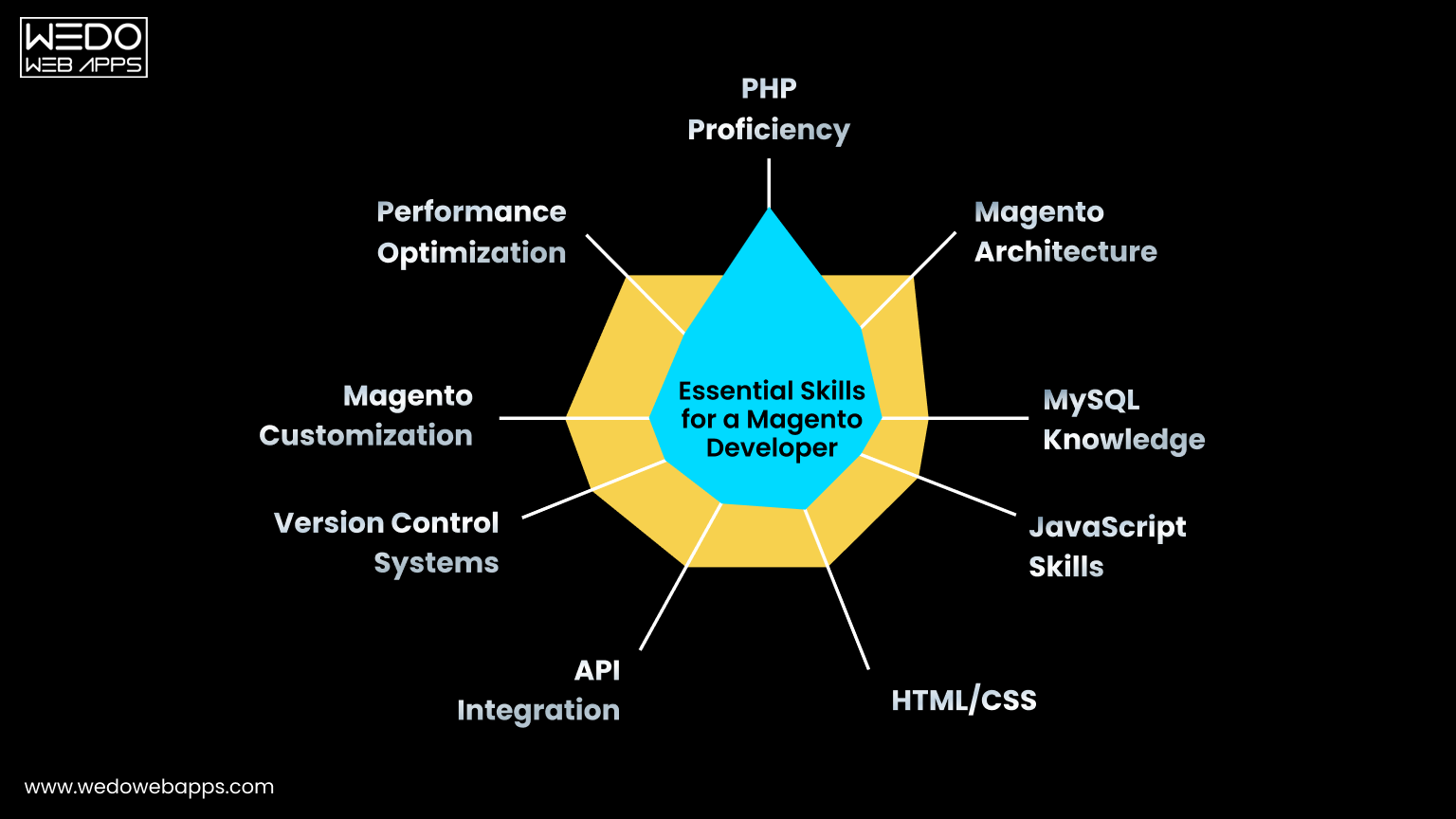
Essential Skills for a Magento Developer

Essential Skills for Magento Developer

A successful Magento development career requires a blend of technical expertise, problem-solving abilities, and a keen understanding of eCommerce workflows. As businesses increasingly demand Magento development services, developers must possess both foundational and advanced skills to deliver high-quality, scalable solutions.

Technical Skills Required

Mastering Magento developer skills is critical for success in a Magento development career. Developers must be comfortable with both core technologies and platform-specific tools to handle custom development projects effectively. Key technical skills include:

  • PHP and MySQL: Foundation for building and customizing Magento stores.
  • Magento Modules and Extensions: Ability to develop and manage custom modules for tailored functionality.
  • Frontend Technologies: Proficiency in HTML, CSS, JavaScript, and UI frameworks to deliver seamless user experiences.
  • API Integration: Connecting third-party systems like payment gateways, shipping, and analytics.
  • Performance Optimization: Techniques for caching, indexing, and improving site speed and reliability.

These skills ensure developers can tackle complex projects, deliver custom solutions, and maintain high-quality eCommerce platforms.

Soft Skills That Boost Your Career

While technical expertise is essential, soft skills significantly enhance a developer’s impact in a Magento development career. These skills help developers collaborate efficiently and solve business-critical problems:

  • Problem-Solving: Handling challenges in development with innovative solutions.
  • Communication: Explaining technical concepts clearly to non-technical teams.
  • Project Management: Managing tasks, deadlines, and team collaboration effectively.
  • Adaptability: Staying agile to meet evolving client and eCommerce requirements.

Combining technical and soft skills positions developers as highly valued professionals within the Magento ecosystem.

Learning Resources and Certifications

Continuous learning is key to maintaining advanced Magento developer skills and staying relevant in the dynamic Magento ecosystem. Recommended resources include:

  • Magento U Courses: Official programs for mastering Magento development.
  • Community Forums: Participate in discussions to solve problems and share knowledge.
  • Certifications: Magento 2 Developer, Frontend Developer, and Solution Specialist credentials enhance credibility.
  • Blogs and Tutorials: Expert insights and practical guides for real-world projects.
  • Webinars and Workshops: Stay updated on the latest tools, updates, and best practices.

Leveraging these resources ensures developers remain skilled, marketable, and capable of delivering high-quality development solutions.

Exploring Custom Magento Development

The demand for custom Magento development continues to rise as businesses seek eCommerce platforms tailored to their unique needs. Standard Magento setups often don’t fully meet brand requirements or advanced functionality expectations, creating opportunities for skilled developers. Engaging in custom development allows professionals to build personalized, high-performing stores that enhance user experience and deliver measurable business results. For anyone pursuing a Magento development career, understanding and mastering custom development is essential to remain competitive in the growing Magento ecosystem.

What is Custom Magento Development

Custom Magento development refers to building tailored eCommerce solutions that go beyond the standard platform capabilities. It allows businesses to:

  • Design unique store layouts and brand-specific features.
  • Develop or modify extensions to add specialized functionality.
  • Integrate APIs for payment, analytics, or third-party tools.
  • Optimize performance for speed, scalability, and reliability.
  • Implement advanced security measures to protect customer data.

Mastering these skills makes developers highly valuable within the Magento ecosystem, as businesses increasingly rely on custom solutions to differentiate themselves online.

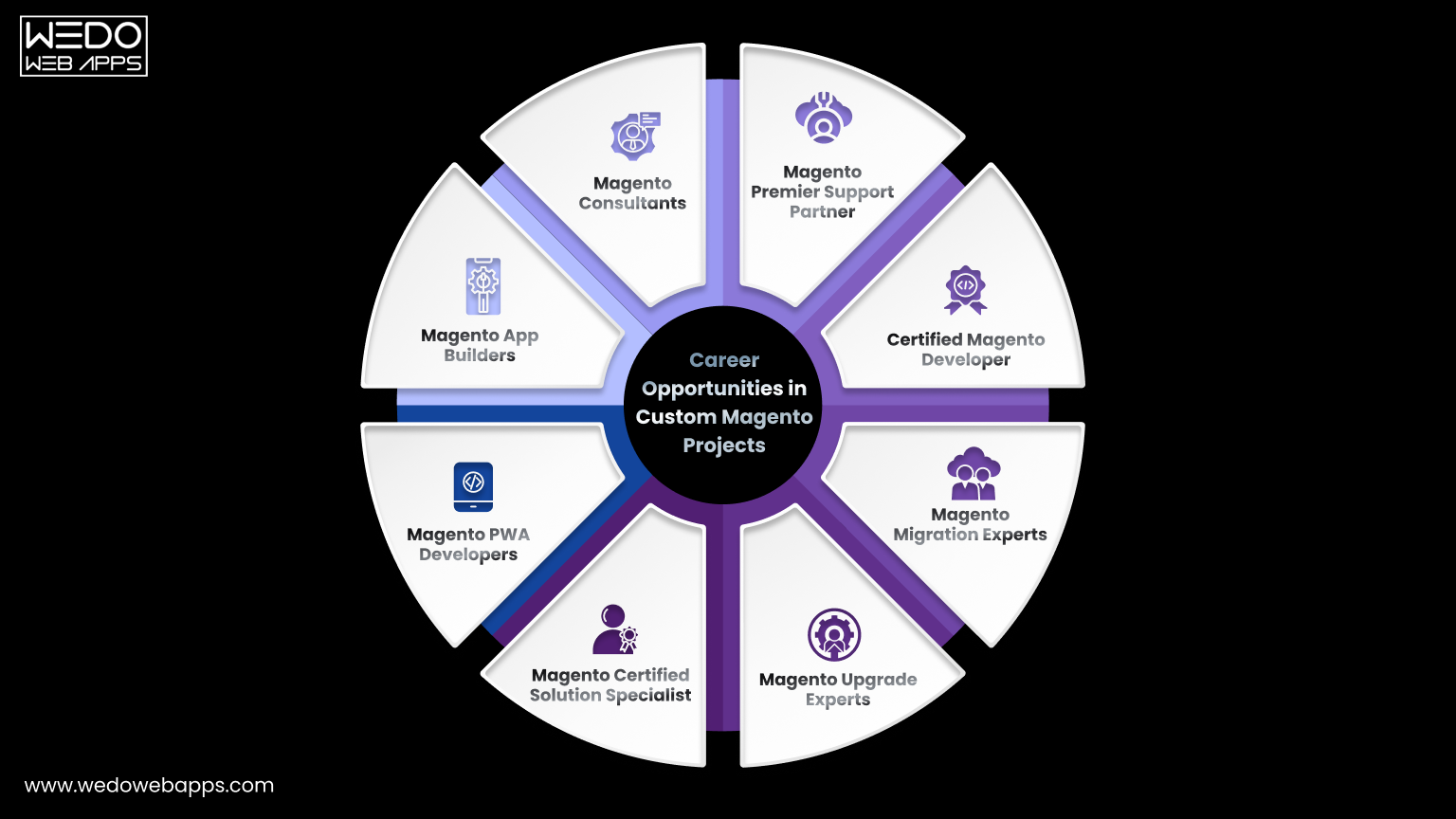
Career Opportunities in Custom Magento Projects

Career Opportunities in Custom Magento Projects

Professionals skilled in Magento development have access to diverse, high-growth career paths:

  • Full-Stack Magento Developer: Handle both frontend and backend of complex eCommerce stores.
  • Magento Solution Specialist: Focus on integrations, optimization, and advanced features.
  • Frontend/Backend Developer: Specialize in UI/UX or server-side logic.
  • Magento Consultant: Guide businesses on custom solutions and strategy.
  • Freelance Magento Developer: Work independently on a variety of tailored projects.

Expertise in Magento development not only enhances career prospects but also positions developers as trusted contributors to the Magento ecosystem, with opportunities for leadership and specialized projects.

Magento Development and eCommerce Careers

The Magento development industry has become a cornerstone of modern eCommerce, powering thousands of online stores globally. For professionals considering eCommerce development careers, Magento offers a platform that is both versatile and in high demand. Its scalability, robust features, and customization capabilities make it a preferred choice for businesses seeking high-performing online stores. A career in Magento development not only provides technical challenges but also positions developers to make a tangible impact on the success of digital businesses.

How Magento Fits into the eCommerce Industry

Magento is more than a development platform. It is an integral part of the eCommerce ecosystem:

  • Enterprise Adoption: Many leading retail, B2B, and niche online businesses rely on Magento for its flexibility and scalability.
  • Customizable Solutions: Magento allows developers to tailor online stores to specific business needs, enhancing customer experience.
  • Omnichannel Capabilities: Integration across web, mobile, and physical stores creates seamless shopping experiences.
  • Growing Industry Demand: Businesses constantly seek developers skilled in Magento development to stay competitive.

By understanding how Magento fits into the eCommerce industry, developers can align their skills with market needs and position themselves for impactful roles in the Magento development industry.

Career Paths Beyond Development

A Magento development career doesn’t have to be limited to coding. Developers can explore a variety of paths beyond standard development roles:

  • Solution Architects: Design and oversee end-to-end Magento projects.
  • Consultants: Advise businesses on strategy, platform selection, and custom solutions.
  • Project Managers: Lead teams working on large-scale Magento implementations.
  • Freelancers/Entrepreneurs: Build and manage custom Magento solutions for multiple clients.
  • Technical Trainers/Community Contributors: Share expertise, mentor junior developers, and contribute to the Magento ecosystem.

These roles expand career opportunities for professionals exploring an eCommerce development company that offers leadership, creativity, and strategic impact beyond traditional development work.

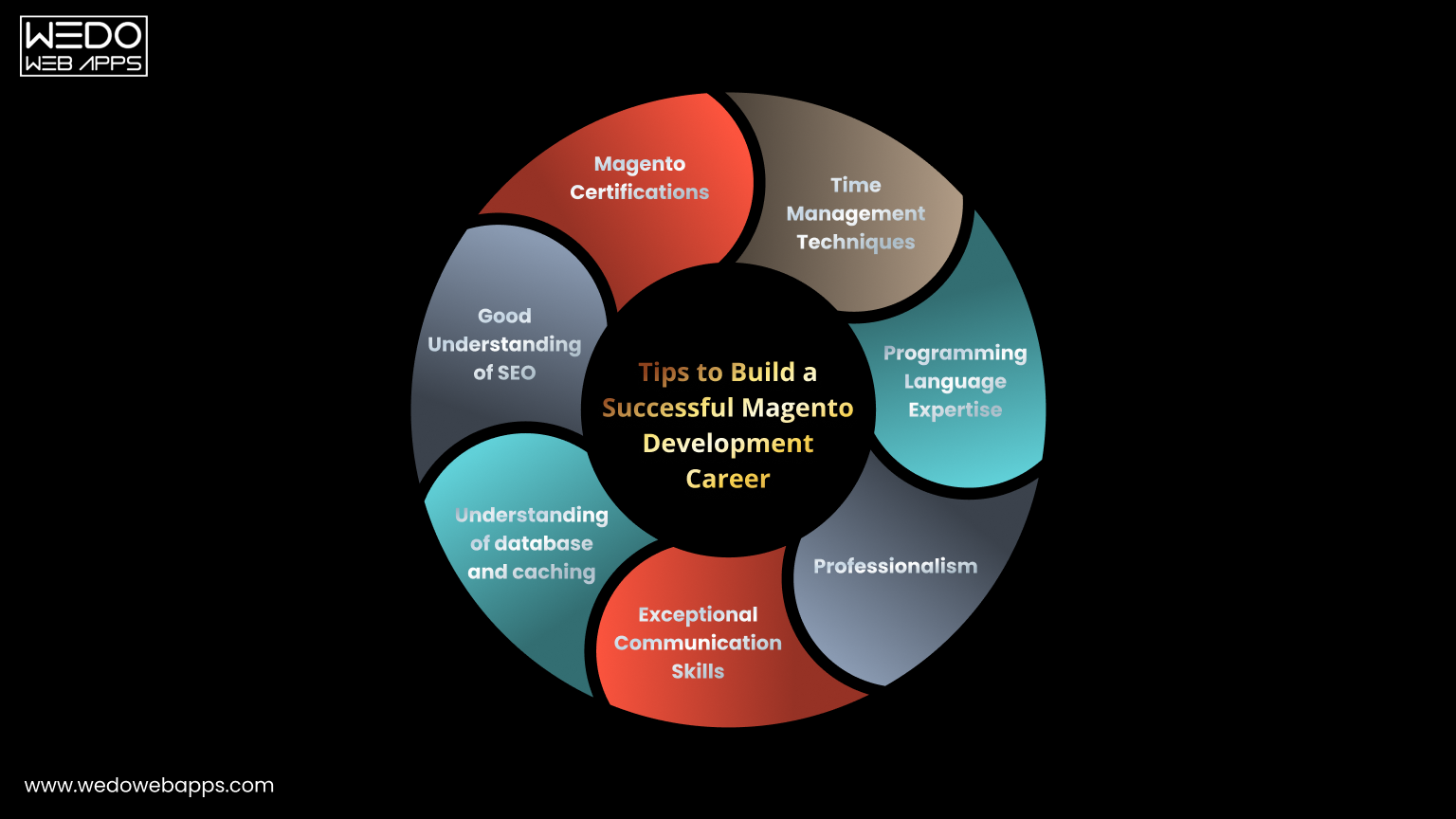
Tips to Build a Successful Magento Development Career

Build a Successful Magento Development Career

Building a rewarding Magento development career goes beyond mastering technical skills. It requires staying connected with the community, keeping up with platform updates, and continuously refining your expertise. The Magento ecosystem provides ample opportunities for learning, collaboration, and professional growth. Developers who leverage these resources position themselves as valuable contributors to the Magento development industry and can accelerate their career trajectory.

Networking and Community Participation

Engaging with the Magento ecosystem is essential for professional growth. Networking and community participation help developers improve their Magento developer skills while opening doors to new opportunities:

  • Join Community Forums: Connect with global developers to share knowledge and solve challenges.
  • Attend Meetups and Conferences: Gain insights into the latest tools, updates, and best practices.
  • Contribute to Open-Source Projects: Showcase expertise and build credibility within the Magento community.
  • Mentorship and Collaboration: Learn from experienced developers and provide guidance to juniors.

Active involvement in the Magento ecosystem enhances skills, strengthens professional networks, and increases visibility in the industry.

Keeping Up with Magento Updates and Trends

Staying updated on platform changes is critical to remain competitive in the Magento development industry:

  • Follow Magento Release Notes: Understand new features, performance improvements, and security updates.
  • Subscribe to Blogs and Newsletters: Get insights from official Magento channels and industry experts.
  • Experiment with New Features: Test updates in sandbox environments to gain hands-on experience.
  • Track Industry Trends: Learn how emerging technologies like PWA, AI, and headless commerce impact Magento development.

Keeping pace with updates ensures developers remain proficient, relevant, and ready to leverage opportunities across the Magento ecosystem.

Future Outlook for Magento Developers

The Magento development industry is poised for continued growth as eCommerce becomes increasingly central to business strategies worldwide. Developers with expertise in Magento are likely to remain in high demand, particularly those skilled in custom eCommerce and Magento development and capable of integrating advanced features like AI, personalization, and omnichannel solutions. For anyone pursuing a Magento development career, understanding emerging trends is essential to staying competitive and maximizing career growth.

Emerging Opportunities in the Magento Ecosystem

The Magento ecosystem continues to expand, creating diverse opportunities for developers:

  • Integration with AI and Automation: Developers can build intelligent features like product recommendations, chatbots, and automated workflows.
  • Headless Commerce and PWA Development: Increasing demand for fast, flexible, and mobile-first experiences.
  • Global eCommerce Expansion: Businesses entering new markets require scalable, multilingual, and multi-currency Magento solutions.
  • Open-Source Contributions: Opportunities to enhance the platform, develop extensions, and engage with the global community.

Staying engaged with the Magento ecosystem ensures developers are positioned for future growth and emerging opportunities in the Magento development industry.

Salary Expectations and Growth Potential

A Magento development career offers strong growth potential and competitive compensation:

  • High Demand Roles: Experienced Magento developers command premium salaries, especially when skilled in Magento development and modern integrations.
  • Career Advancement: Skills in integrations, PWA, and performance optimization open paths to senior developer, solution architect, or consultant roles.
  • Freelance Opportunities: Independent Magento projects provide flexibility and additional income potential.
  • Long-Term Security: Continued adoption of Magento in global eCommerce supports career longevity.

Developers who invest in their skills and remain updated with industry trends can enjoy a sustainable, rewarding career in Magento development.

Conclusion

The Magento development career offers a powerful combination of technical challenge, creativity, and long-term growth potential. With businesses increasingly relying on Magento to power their online stores, developers skilled in custom Magento and engaged in the Magento ecosystem are in high demand.

Whether you’re starting out or looking to advance, investing in the right skills, staying updated with platform trends, and participating in the Magento community can elevate your career. For professionals exploring eCommerce development careers, Magento provides not only opportunities to build impactful solutions but also a pathway to leadership, specialization, and global recognition in the rapidly growing eCommerce industry.

By embracing continuous learning and leveraging the resources within the Magento ecosystem, you can secure a rewarding, sustainable, and future-ready career in Magento development.

Custom Magento Development for Online Store

Is Your Extended Search Abates at BigCommerce? Everything You Need to Know About

It’s been over a year since we first got the news of the lockdown in India. The same new “thing” happened gradually to the entire world. Everything in the whole world came to a halt. No business, no company, nothing was to open for a few days. The news has shaken the entire world. A tiny organism, invisible to the eyes, has taken the whole world by storm. Soon the outbreak transformed into an epidemic and continued to become something extremely massive, and the name changed to – “pandemic.” We can bet a huge mass of people were not familiar with the word “pandemic” until the COVID-19 outbreak took place.

Humongous changes withstood as a consequence of the pandemic. Until the first few weeks, the public was quite optimistic about the lockdown taking abate. Discerning the unprecedented and awful continuation of the lockdowns, people realized that this outbreak wasn’t analogous to some flu that announces its spell around every year. People have now come to know that COVID-19 wasn’t saying goodbye for a long, long time.

BigCommerce development

This leads us to a different world altogether. Now the vegetable vendor wasn’t going to tell at his highest pitch to call out all the ladies of a colony. The milkman wasn’t going to screech his vehicle’s horn for almost a minute every day or knock at the doors since that could potentially transmit the virus. People locked in their homes were now practicing untouchability- something that took the pinnacle of Gandhi’s efforts to get abolished.

Understand the benefits of Volusion development for personalized stores by reading about extended search features in BigCommerce.

The same time took us to explore the digital world. The old uncle sitting on his balcony was now seen using his mobile phone a lot more often than usual. Students took to mobile phones and tablets, and laptops, shifting their focus from books. Groceries were now delivered in the big cardboard boxes instead of the cloth bags that made their way to our mothers’ shoulders every month. Even vegetables were now being provided at the doorstep with a quick doorbell resulting from the delivery boys’ panicky touch.

We all have taken bountiful advantage of online shopping websites. Be it Amazon, Grocery shopping websites and apps, veggies shopping sites, dairy products, cloth, shoes, etc. Almost everything has been delivered deliberately at our doorsteps in the past year. Revenue from these websites and apps definitely went up. Amazon, for instance, saw a remarkable increase of 37% in its earnings. Online shopping is highly convenient for its users. We often forget to mention the amount of effort for sin to develop and maintain an e-commerce website or application. Developers worldwide work their heads off day in and day out to create a reasonable, high fidelity, seamless e-commerce website so that the users encounter an effortless experience for shopping the essentials even in the abysmal times the one discovered very recently.

When it comes to developing an e-commerce website, the first name most of the developers preach is- BigCommerce. It’s the most preferred platform for e-commerce developments. Gradually, you will get an idea of how BigCommerce has diminished a developer’s search.

Let us first look at what BigCommerce is and how it came into existence.

What is BigCommerce?

Bigcommerce is a platform that enables the development of e-commerce websites. It comes in handy as it allows the developers to build the online stores in no time with minimal effort. BigCommerce development services are provided by several companies that furnish technical development services. Bigcommerce has a giant reach as it has been used in more than 150 countries to develop e-commerce websites. Going by the data on Wikipedia, BigCommerce is a technical development company that extensively provides eCommerce developments based on SaaS.

BigCommerce websiteBigCommerce allows the developer to do everything on his own. There are no to minimal restrictions. In a world where a minimalist lifestyle is preferred nowadays, the limitations while developing a website must be minimized to zero. A platform that enables the developer to design the website or online store providing the drag and drop function has got to be the top one in developers’ list. BigCommerce development services are extensively valuable to the customer. Several businesses are on the hunt for a good, convenient, and superior quality e-commerce development platform. BigCommerce puts an end to that hunt by empowering the BigCommerce developers with their incredible functionalities and services.
History:

Initiated in 2009, the company now has over 600 employees and is flourishing each day due to BigCommerce development services’ high demands. With headquarters situated in Austin, Texas, the platform gives space for a bunch of features which include customer groups and segmentation, web hosting, Search Engine Optimisation(SEO), and many more.

Read also: Is BigCommerce Dropshipping Really Worth It?

An online chatroom meeting hosted in 2003 led to the discussion of two Australians-Eddie Machaalani and Mitchell Harper. This meeting further led to the invention of the company we now prominently recognize as BigCommerce. It wasn’t until 2009 that the ideologies and strategies took shape and led to this platform’s formation. 2009 marked a great significance in the history of BigCommerce development services. The two pioneers then launched the company in 2009 and established its first office in the United States. The company ran in bootstrap for a long time. It was 100% bootstrap till the year 2011.

BigCommerce isn’t limited to a particular online shopping platform. It can largely provide the developers with numerous industries. These industries can be fashion, electronics, health, grocery, dairy, jewelry, gifts, medical products, etc.

From SEO /SEM optimization to getting your products to the top seller websites, ranking your products at the top of the list, managing the tax and shipping of the products, a lot goes into the development of an e-commerce website. Here’s an easier way to get all of this without extra hassle. Down below, we have attempted to list a few reasons to choose BigCommerce development services over any other e-commerce development platform.

Get to know the various services of BigCommerce development while learning everything about extended search features.

Why is BigCommerce a Big success?

Someone who wishes to build an online e-commerce store- either a business or even a developer, or an individual, would indulge in a certain amount of research before handing in the project to someone naive. And we suggest that you must take this step before opting for any of the technical development.s any business venture or any individual who is eyeing a technological development in the form of an online store, an application, a London mobile app, a website, or even a web page, must go through as much information as possible. This not only helps you gain additional knowledge about how your technical stuff will work but also ascertains a certain amount of security.

Well, coming back to the BigCommerce development services, there are plenty of reasons why you should opt for the big name you might have come across all this while doing your research. BigCommerce has a lot to offer; what do you need? We have substantial justifications for our preference of BigCommerce as our go-to e-commerce development service.

  • SEO and more: data from Smart Insights implies that 81% of people look online for a product. Isn’t that pretty relatable? We all do, don’t we? A new product has come in the market, heard of something you are not familiar with, or looking for a new device for your convenience?

Bigcommerce SEO

– we take out our phone or computer and get down with all the searches in no time. BigCommerce provides business with no friction. The buyer doesn’t have to face any obstacles while buying an online e-commerce store. This characteristic ensures a great ranking of your online business, thereby accounting to paramount to your successful career. We all know the most significant thing in any online business is the site’s occurrence at the foremost position in the searches. Bigcommerce ensures your business venture has the security of getting on the top, leaving behind others.

Though numerous platforms provide SEO optimization, BigCommerce is one such platform that gives you security regarding SEO. BigCommerce has a big name in the SEO industry and has proven to be of value to its clients extensively. Others would provide you at most with optimization in sectors like meta description, headings, alt texts, page titles, etc. But with BigCommerce, it doesn’t end here. It provides an extensive range of SEO optimization services that we will talk about down below.

« Friendly Google URLs: search engine so not too friendly with the lengthy, haywire URLs. They seem to be amicable with the short, to-the-point URLs. Google, specifically, doesn’t entertain the extended URLs. With other platforms, the URLs that your store will develop might not be up to the mark and hence drag you backward in the process. With BigCommerce, however, you are free to choose your URL and make it time-bound that accelerates the performance in the upward direction.

« Accelerated Mobile Pages: the AMPs or accelerated mobile pages are the flaked-off versions of the standard web pages. Since it gets a bit lighter, deliberately, the speed also increases, and the web page becomes faster, more interesting, and clearer to read.

« Redirects now became easier to manage: for those who do not know, let us get you an idea of what is redirecting briefly. Whenever you make certain changes in the products or the pages of your online store, placing a redirect on the formal page is crucial. This helps the browser find the new page easily. BigCommerce enables you to generate these redirects automatically, unlike other platforms, which propel you to take the hassled path and create these redirects yourself.

BigCommerce is substantially the best platform for the quality SEO optimization that you need. You will need to comprehend the keywords game on an individual level because no platform has got the scope of doing all of the hard work itself.

« Customisation is a gift: testing produce creation on different platforms, we have found with subjective experience that BigCommerce is your best friend when it comes to uploading products on an e-commerce platform. BigCommerce has taken the customization game up a notch.

« Templates that you’ll love: well, not only the designs but the templates are also to die for because of the free access and easily editable inability. This means the ready-made templates are not the only choice you have. Several platforms provide free templates. BigCommerce, on the contrary, provides these free templates with accessibility to editing them as per your requirements. Editing the content of templates is in itself a big accomplishment.

Furthermore, the ease with which this editing is made possible on BigCommerce is commendable. The drag and drop interface allows the user to have the best experience while choosing templates for his or her e-commerce store. So, now you can build seamlessly the structure you envisioned of your commerce outlook.

« Bulk editing: we all have noticed the online shopping websites that possess an outline that is divided into several categories of products which gives them an edge over other websites because of the seamless organization of products. This helps businesses involve a humongous range of products that meet to categorize their products to provide their customers with an effortless experience.

  • BigCommerce doesn’t empty pockets: e-commerce development is not a cheap task. It costs huge lots of money to the big businesspersons out there. Getting an e-commerce platform that is off the ground and providing just the right features you desire can be a heavy endeavor in your pockets. To minimize this expenditure to a minimum, we suggest opting for BigCommerce anytime. It never gets heavy for your banks and gives you the apt amount of services that you aspire. A startup can itself be a hefty maneuver for an individual. The whole procedure including, the development, inventory, and management, further incorporating the staff salaries, can put you in a difficult position. On this, if you get to choose an e-commerce development service, you might lose what’s left. To ensure this doesn’t happen, BigCommerce development services are just the right services for you.

« Bigcommerce doesn’t charge any transaction fee on all plans. « Event credit card fees are also lower than other platforms. « Standard level provides extensive values.

  • Support and management at Bigcommerce are second to none: whenever there’s a glitch in the working of an app or a website, the only thing we all need is someone to come up and solve it as soon as possible. BigCommerce provides the kind of support system that you can turn to any time, anywhere. The majority of report types on BigCommerce are free and accessible by anyone. Though the expert level “E-commerce insights” package does come with an additional cost, all other standards report packages are free and highly useful for the time when you get stuck. Customer support is all around the clock at BigCommerce. The extensive support users get at BigCommerce is commendable with 24/7 services.
  • BigCommerce will take you to new heights: unlike any other platform that does not ensure a business’s growth, BigCommerce is the place where your business will thrive in no time. It considers the major and crucial aspects of a business and focuses on developing those areas better. BigCommerce provides you with a multicurrency option that expands your reach to a large mass. No worries if the customers leave their items in the shopping cart. BigCommerce has a three email follow-up system that facilitates a decrease in losses.

Concluding Words

With that, we would conclude the blog on the note that BigCommerce is actually a big platform for big earnings and big success. If you are looking for an e-commerce development service provider, do not miss out on BigCommerce at any cost. Additional benefits are also there on the list, such as functionalities, cookie consent rules, email support, etc. These are not going to end anytime soon. So, take the right decision and go for BigCommerce to witness an unprecedented windfall in your business.

If you need a free consultation on how to work BigCommerce and how you can get BigCommerce work for you, contact our BigCommerce development services experts today.

How to Optimize Images for WordPress to Boost Site Speed & SEO

Optimize Images for WordPress And Grow Faster

You launch your WordPress website, and everything looks perfect: design is best, bold visuals, and flawless layout.

But when you check it for the load speed, it fails. Your homepage takes a few seconds to appear, your SEO score decreases, and the Google PageSpeed keeps showing the red line.

As a successful business, it is frustrating because you have done everything right. Except for that one thing, which is that your images are too heavy for the web.

In most WordPress websites, images account for nearly half of the total page weight. That means every unoptimized banner, product photo, or blog image is quietly slowing down the performance of your website. This pushes the visitors away before they even see your content.

The solution is not adding fewer images; it is adding the smarter ones.

With the proper image compression, next-gen formats like WebP, and a well-chosen WordPress optimization plugin, you can make your website load fast without losing pixel and quality.

In this guide, you will learn how to optimize images for WordPress, explore the best image optimization plugin for WordPress, and the best WordPress image optimizer. You will also know what makes your website load twice as fast with the help of WEDOWEBAPPS and turn your website into a seamless experience.

Why Optimizing Images Matters for Your WordPress Website

When it comes to optimize images for WordPress, the visuals are both your greatest asset and your biggest performance risk. Even the beautiful design can lose its impact on the website if it takes too long to appear, and that’s exactly what happens when images are not optimized properly.

In other words, improving the image optimisation WordPress website is one of the fastest and most effective ways to improve the overall user experience and SEO.

Now you must be thinking how the image size is connected with the speed and performance of the website. So, let’s just know about the connection between the image size and the speed of the page.

Every image your site loads requires browser resources, and the large size of the image multiples the demand for resources.

Every single oversized banner can add several seconds to your page to load. And for the visitors, these seconds decrease the chances of staying on that page.

By using the best WordPress image optimizer, you can resize it to the next-gen format and optimise WordPress images for site speed and have more visitors.

Every factor is affected if your website has heavy loading visuals, and let’s just know about that.

How Core Web Vitals are Affected by Heavy Media

Unoptimized images give a direct impact on your score of Core Web Vitals and Google’s key performance metrics:

  • Large Contentful Paint (LCP): Slows when the hero image takes longer to render.
  • Cumulative Layout Shift (CLS): Increases when the image does not have clearly defined dimensions.
  • First Input Delay (FID): Gives greater impact when a heavy asset blocks the main thread.

Optimizing the image improves all these metrics collectively and gives your website better results with smoother interaction and higher SEO potential.

Benefit in SEO, User Experience and Conversion Rates

A fast website not only pleases your users but also increases the chances of having better search visibility. Google’s ranking algorithm rewards performance-focused websites because they give a better experience to readers.

Here’s what happens when you get it right:

  • Users stay longer on your website.
  • Pages rank higher because of strong Core Web Vitals.
  • Conversion rises because this site feels trustworthy.

In simple terms, the image optimisation WordPress website is not about the pixels, it is about the performance and profits.

How WEDOWEBAPPS Help in Improving the Speed

At WEDOWEBAPPS, we make sure that our clients do not face issues when it comes to loading their pages.

For our clients, we make use of the images that are compressed and convert them to WebP so that the average load time drops from 4.8 seconds to 2.9 seconds, and have a better visitor experience on the site because of its speed.

If you want the same support as our WordPress Development team can help you in faster browsing, better SEO ranking, and increase the visitors.

WordPress site speed optimization

Understanding Image Optimization for WordPress

Image optimization steps for WordPress

Before you start using any plugin or tool, it is important that you have a clear understanding of what image optimisation WordPress website really means.

Optimize images for WordPress is a process of reducing the file size without reducing the quality of visuals. Ensuring that your website loads quickly, performs efficiently, and maintains the same design is appealing to maintain the overall performance.

Images hold roughly 40% of a webpage’s total weight and making them one of the leading factors behind slow loading speed is important. When you optimize images for WordPress, you can immediately improve the overall load time, SEO performance, and user satisfaction.

What Image Optimization Really Means

Optimization is about maintaining the balance of the image while keeping the high quality, while cutting the excess data. Every image includes unnecessary elements such as metadata, unused color profiles, or oversized dimensions. By removing all these elements from the image, you can reduce the size of the file by up to 70% without visible loss.

For any WordPress website, these secure options translate into faster rendering with better Core Web Vitals and lead to stronger rankings.

Compression and Formats

When applying image compression for WordPress, these two methods are commonly used:

  • Lossy Compression: Removes some data for a smaller file size for ideal photos, banners, and blog images.
  • Lossless Compression: Retain full quality but still optimize the structure best for logos and infographics.

Choosing the right format enhances the result further:

  • JPEG for photos with color depth.
  • PNG for transparent graphics.
  • WebP or AVIF for next-generation delivery with up to 30% smaller file sizes.

Switching to these formats is one of the most effective ways to optimise WordPress images for site speed.

How WordPress Handles Images by Default

WordPress automatically creates multiple image sizes upon uploading, but it does not compress deeply or convert the file to modern formats.

This means that your media library may contain resized dimensions, but still appear to be a heavy file. To truly optimize the image for WordPress, pair these built-in tools with manual preparation or a dedicated optimization plugin.

When you understand these basics, you can give your optimization strategy a strong foundation to ensure that every image enhances in terms of performance rather than slowing down the website speed.

How to Optimize Images for WordPress Manually (Before Uploading)

Steps to optimize images for WordPress

When it comes to optimizing the image before uploading, it gives you proper control over maintaining the quality and performance. Instead of relying completely on the various plugins, these practical steps will help you prepare every image for maximum speed and clarity. Setting a clear foundation helps you to be sure about the speed and clarity of a faster and SEO-ready website.

Here are the factors that you can consider:

1. Resize Images to Match Display Dimensions

Uploading a 4000px image for a section that displays at 1200px is wasting data. Every extra pixel adds unnecessary weight and slows your page’s running time.

Best Practices:

  • Resize the image to the exact dimension used in your WordPress theme.
  • For the hero banner section, keep the size around 1200-1600px width.
  • For thumbnails, keeping it between 300-600px often works perfectly.

This will result in faster rendering, cleaner layout, and a smoother user experience.

2. Apply Smart Compression Before Uploading

Compression removes the redundant data while preserving the quality of the image. The cornerstone of image compression for WordPress can maintain performance and also there different ways to manage WordPress web development.

Recommended Tools:

  • TingPNG: Best for maintaining the balance of speed and clarity.
  • Sqoosh: Give support for fine-grained quality control.
  • Compressor.io: The reliable option for bulk optimization.

You can compare lossy vs lossless to have better results and pick the smallest file that still looks visually sharp and clear.

3. Choose the Right File Format

Selecting the right format is the best-suited way to improve the quality of the image by maintaining the balance of quality and load speed.

Format  Best For Why Use It
JPEG Photographs and gradients Support lossy compression with great color depth and gradients.
PNG Logos and icons Uses Lossless comparison while resulting in sharp edges and detailed graphics.
WebP/AVIF Next-gen format Superior quality compared to JPEG and PNG.

Converting your asset to WebP or AVIF is the best or effective way to optimise WordPress images for site speed.

4. Rename Files and Add Descriptive ALT Text

Search engines make use of file names and ALT text to understand the images. A file named wordpress-image-optimization.jpg tells Google more than the IMG_0012.jpg.

Checklist:

  • Use lowercase and a hyphen to separate the filename.
  • Write the ALT text that describes the image’s purpose.
  • Avoid keyword stuffing and keep it natural and contextual.

By this, you can maintain the keyword-rich file before uploading to WordPress.

5. Remove Unnecessary Metadata

Image files often include the details on the camera, GPS data, and the hidden attributes that do not serve any purpose on the web.

Use tools like:

  • ImageOptim: For Mac users to remove unnecessary data from the image.
  • EXIF Cleaner: For Windows users to maintain the quality of the image.

This can shave off the extra kilobytes from every file while keeping your image assets safe and lightweight.

6. Keep a Consistent Workflow

Organize your optimized images before uploading them on the site. Use a clear folder structure, for example:

/assets/images/optimized/

Having a consistent process ensures that your design team, developer, or content manager all follow the same optimization standards.

By following these steps, you can manually optimize the image by taking a few extra minutes per image. This gives the result in faster load times, stronger SEO signals, and a better overall user experience.

Before adding automation or the best WordPress image optimizer, this manual groundwork can ensure that images start in peak condition.

call to action for faster WordPress image performance

Best WordPress Image Optimization Plugins (Tested & Updated for 2025)

top WordPress image optimization plugins list

If you want consistent and automated performance, then you can make use of the best WordPress image optimizer to save hours of manual work and deliver with better compression, conversion, and delivery.

Each plugin below has been tested for compression quality, ease of use, CDN compatibility, and WebP/AVIF support. The four factors that matter the most when you optimize WordPress images for site speed without losing visual quality.

Plugins Key Features Ease of Use Free Plan Best For
Optimole Built-in CDN with real-time optimization. Automate the conversion with WebP/AVIF and make the image responsive. Very easy to use with the support of full automation. Yes, upto 2000 images for a month. Agencies with high-traffic and media-heavy websites.
ShortPixel Support bulk optimization, smart lossy/lossless compression with image backups. Offer custom compression modes. This is moderate to use and is developer-friendly. Upto 100 images per month. Developers and professionals who need control over file size reduction.
Imagify Maintain balance with conversion to WebP. Automate resizing and smoothly integrate with WP Rocket. Extremely easy and gives support for one-click setup option. Yes, 20MB file size limit for a month. Small businesses and WP Pocket users.
Smush (Pro) Automate resizing of lazy-loading images. Bulk optimization and CDN delivery with WebP conversion. For beginners, it is easy to use. Yes, it is limited, but Pro is available as part of a membership. Bloggers, freelancers, and portfolio sites.
EWWW Image Optimizer Compresses your server while maintaining focus on privacy. Support WebP/AVIF to easily include the IO CDN. Moderate as it supports options for advanced users. Free core plugin with unlimited self-hosts. Developers, data-sensitive or high-degree websites.
TinyPNG Plugin Reduces the PNG/JPEG size to WebP. Give support for quick setup with a simple dashboard. Extremely easy with the minimal setup requirements. Yes, approximately 500 compressions per month. Small websites, startups, and personal blogs.

When you are choosing between the best image optimization plugin WordPress then keep these options in mind.

1. Optimole

Optimole is one of the best image optimization plugins for WordPress in recent years. It compresses images in real-time and serves them from the global CDN, adapting each image to the visitor’s screen size.

  • Uses both lossy and lossless comparison methods.
  • Automatically convert the image to WebP for modern businesses.
  • Provide lazy loading and cloud-based storage for fast delivery.
  • Ideal for agencies or high-traffic websites that need more optimization.

Why it stands out: Optimole handles everything remotely, and the server stays light to scale the website smoothly.

2. ShortPixel

ShortPixel remains a top choice for professionals who need control and reliability.

  • Support bulk optimization and smart compression profiles.
  • Automatically converts PNG to JPEG when it is beneficial.
  • Allow smooth integration with third-party CDNs.
  • Preserves the EXIF data when needed and is useful for photographers.

Best for: Developers or site owners who need fine-tuned image compression for WordPress without sacrificing control over the visuals.

3. Imagify

Created by the WP Rocket team. Imagify offers simplicity in managing the compression and performance in one package.

  • One-click optimization directly gives the impact on WordPress dashboard.
  • Converts to WebP automatically and serves the right format per browser.
  • Seamlessly integrate with the WP Rocket caching, which creates the all-in-one performance stack.
  • Free plan includes 20MB/month, with the premium option for bulk uploads.

Best for: WordPress users who are already using WP Rocket and who want an effortless integration to optimise WordPress images for site speed.

4. Smush

Smush by WPMU DEV is an effective option for beginners who want to optimize images.

  • Offers both free and Pro versions with lazy loading and bulk optimization.
  • Resizes the larger images automatically during the upload time.
  • The Pro version enables WebP conversions and CDN optimization.
  • Includes the detailed dashboard that shows how much space you have saved with compression.

Best for: Bloggers, small business owners, and the team who prefer simplicity with clear and visible results.

5. EWWW Image Optimizer

EWWW stands out for users who value privacy and server-side processing over any other processes.

  • Performs optimization directly on your own server and ensures no data leaves the site.
  • Offer WebP and AVIF conversion along with lazy loading.
  • Works well for developers who need more backend control.

Best for: Websites handling sensitive data or developers who prefer local optimization over cloud-based processing.

6. TinyPNG Plugin

TinyPNG is simple, lightweight, and reliable for a perfect starting point for small businesses.

  • Uses the popular TinyPNG API for lossy compression.
  • Maintain excellent visual quality with minimal setup.
  • Converts PNG and JPEG formats to smaller sizes quickly.
  • Support WebP conversion for modern browsers.

Best for: Lightwright sites, portfolios, or business pages that require quick loading and effective compression with minimal configuration.

Short Summary For You

If you are looking for the best image optimization plugin for WordPress, start with your goals:

  • Need full automation? Optimole
  • Want fine control? ShortPixel
  • Already using WP Rocket? Imagify
  • Focused on privacy? Smush
  • Need something minimal? TingPNG Plugin

Choosing the right plugin depends on your workflow, hosting setup, and performance expectations. With any of these options, you can optimize images for WordPress efficiently while preserving design quality.

cloud themed WordPress optimization partnership

Advanced Tips to Optimize WordPress Images for Site Speed

advanced tips to optimize WordPress images

Once you have chosen the best WordPress image optimizer, you can take your website performance even further by following a few advanced practices.

These techniques you have chosen go beyond the compression, and this ensures that every image on your WordPress website loads intelligently, efficiently, and contributes to stronger Core Web Vitals.

For advancement, you can follow these practices:

1. Implement Lazy Loading

Lazy loading delays the loading of offscreen images until the user scrolls to them. This accurately improves the largest contentful paint (LCP) and initial render time.

How to do it:

  • Use native WordPress lazy loading enabled by version 5.5.
  • For enhanced control, enable the feature within the plugins like Optimole, Smush, or Short Pixel AI.

Result: Faster page loading and reduced the initial data requests.

2. Serve Images via a CDN

A content delivery network (CDN) stores and delivers the images from servers closest to your visitor. This not only improves the speed of the website loading but also reduces the server load and bandwidth usage.

Recommended options:

  • Use built-in CDNs from Optimole, EWWW, or Smush Pro.
  • Integrate external CDNs like Cloudflare Images or Key CDN for global reach.

Benefit: Consistent loading speed worldwide, which is important for eCommerce and international websites.

3. Convert Images to Next-Gen Formats

The use of modern formats like WebP and AVIF compresses better than JPEG or PNG while maintaining the visual quality. These are new and supported by all major browsers.

How to implement:

  • Enable automatic conversion within your optimization plugins.
  • Manually convert the images before upload using tools such as Squoosh or Cloud Convert.

Outcome: Up to 30-40% smaller file size with no noticeable loss in quality.

4. Optimize Image Delivery with Responsive Sizing

Serving the images at the right size for each device prevents mobile users from downloading oversized desktop files.

Quick steps:

  • Use srcset and sizes attributes in WordPress.
  • For background or custom images, upload the device-specific sizes manually.

Result: Lighter payloads and improved the cumulative layout shift (CLS).

5. Combine Caching and Image Optimization

Caching complements the image optimization process by storing the compressed versions for repeat visitors. Using a cache plugin such as WP Rocket, LiteSpeed Cache, or W3 Total Cache allows you to be sure that optimized images are always served instantly.

6. Audit and Re-Optimize Periodically

With time, image libraries can grow, especially on blogs and eCommerce websites. Regularly auditing allows you to ensure that no outdated or oversized assets slow your site.

Pro Tips:

  • Use GTmetrix or PageSpeed Insights monthly.
  • Re-optimize heavy images using your plugin’s bulk reprocessing tools.

7. Keep Original Quality Backups

Always store uncompressed the original image before optimization. They are useful for future redesign or if you need to regenerate a larger version for new layouts.

Advanced optimization is about efficiency, not just compression. By combining lazy loading, CDN delivery, next-gen formats, and responsive sizing can optimise WordPress images for site speed while ensuring a smooth and professional experience for every visitor.

Manual vs Plugin-Based Optimization: Which Is Right for You?

When it comes to image optimization WordPress website, there are two primary approaches: doing it manually before uploading or automating the process using the best image optimization plugin WordPress.

Manual Optimization

Manual optimization means preparing every image before it is uploaded to your media library. This approach gives full control over modifying the code, server settings, and scaling the project. It makes it ideal for maintaining perfection and giving value to the developers.

Advantages:

  • Full control over image quality and size.
  • Ensures consistency across branding and design.
  • No dependency on plugin updates or APIs.

Limitations:

  • Time-consuming for large websites or eCommerce stores.
  • Requires manual resizing of images, conversion, and naming.
  • Limited scalability without the automation tools.

Best For: 

Portfolio websites, creative agencies, or smaller blogs with limited media updates.

Plugin-Based Optimization

Using the best WordPress image optimizer you can easily automate most of the process, like compression, resizing, and converting images as you upload them. Plugins also allow re-optimization of the existing media library, saving hours of manual work.

Advantages:

  • Real-time compression and delivery optimization.
  • Built-in CDN and next-gen format support.
  • Scalable for large sites with regular media updates.

Limitations:

  • Dependent on external services or APIs.
  • Some plugins store processed images on third-party servers.
  • Slight server overhead if processing loyalty.

Best For: 

Growing websites, blogs with frequent content updates, and eCommerce platform managing the various product images.

Quick Comparison

Factor Manual Optimization Plugin-Based Optimization
Control Over Quality Full control over the custom settings. Moderate depends on plugin settings.
Time Efficiency Slower and manual processing. Fully automated with a faster workflow.
Scalability Limited for high-volume sites. Ideal for large or growing websites.
Technical Knowledge Support basic design and compression tools when required. Minimal with the plugin handle processes.
Formats Supported Depends on external tools. Usually includes WebP and AVIF.

If you publish occasionally and prefer pixel-level control and manual optimization is the smarter route. But if you manage frequent uploads or want speed and consistency, using a plugin-based image compression for WordPress setup is far more practical.

The most efficient strategy for 2025 is the hybrid approach by optimizing the image manually before uploading, and letting them handle the ongoing compression and delivery to optimise WordPress images for site speed.

improving WordPress image optimization

Common Mistakes to Avoid While Optimizing Images

List of common mistakes to avoid when optimizing images for WordPress

Even if you are using the best WordPress image optimizer, a few common mistakes can reduce the impact of your efforts. Here is what to avoid and how to correct it to better optimise images for WordPress.

    • Uploading oversized images: Larger images add unnecessary weight to your site and slow down the loading time.
    • Using the wrong file format: Choosing a format like PNG for photos can effectively increase the file size.
  • Compressing too aggressively: Excessive compression can make the image appear more blurry or pixelated.
  • Ignoring descriptive filenames and ALT text:Using generic filenames like “IMG_001.jpg” and missing ALT tags can hurt SEO and accessibility.
  • Skipping lazy loading: Loading all images at once can affect the performance and Core Web Vitals.
  • Not using CDN for image delivery:Serving images from a single server slows the delivery for users in different regions.
  • Neglecting old and existing media:Older images often remain uncompressed, taking up unnecessary storage.
  • Skipping backups of original files:Once an image is over-compressed, quality loss cannot be reversed.


Image optimization is not about reducing the size; it is about maintaining the balance between quality, performance, and SEO value.

Avoiding these mistakes will help you optimise WordPress images for site speed and enhance the Core Web Vitals by creating a faster and more reliable user experience.

Conclusion: Faster Images, Faster Websites, Better SEO

A fast website does not just appear professional but also runs effortlessly.

Images often carry the most weight on a page, and optimizing them is one of the quickest ways to boost the speed, SEO, and user satisfaction.

With the right WordPress development company image optimization strategy, you can maintain the quality of the image while improving the performance. Whether you prefer hands-on control or automation with the best WordPress image optimizer plugins, the goal is the same, which is fast loading, better engagement, and strong results.

At WEDOWEBAPPS, we have seen how small changes in image compression for WordPress can deliver measurable growth. Start optimizing today to have the speed that is not technical but maintain the competitive edge.

WordPress website speed audit to improve Core Web Vitals and performance