
Introduction
“How much does it cost to hire dedicated developers?”
For startups, enterprises, and growing digital businesses, this is often the first question that comes up while planning a software product, scaling an engineering team, or accelerating development times. But the real challenge is not just finding developers within budget; it is understanding what actually affects the dedicated developer cost.
The cost of hiring dedicated developers can vary significantly based on developer expertise, project complexity, hiring model, technology stack, and location. While lower hourly rates may seem cost-effective initially, poor communication, delayed delivery, and scalability issues can increase long-term development expenses.
This is why many businesses today prefer dedicated remote developers and scalable development teams over traditional hiring models. Dedicated teams offer faster onboarding, specialized expertise, flexible scaling, and reduced operational overhead for startups and enterprises alike.
In this guide, we will break down:
- Average dedicated developer hourly rates
- Factors affecting developer hiring cost
- Offshore vs in-house hiring comparisons
- Hidden costs businesses often overlook
- How to optimize development budgets without compromising product quality
More importantly, this guide will help you evaluate hiring dedicated developers from a long-term business and scalability perspective instead of focusing only on hourly pricing.
What Does it Cost to Hire Dedicated Developers: Quick Answer
The cost of hiring dedicated developers typically ranges between $20 to $150+ per hour, depending on the developer’s experience, technology expertise, project complexity, and geographic location. Businesses hiring offshore developers from regions like India or Eastern Europe usually pay significantly lower rates compared to hiring developers in North America or Western Europe.
For startups and growing businesses, the average monthly cost to hire remote developers can range from $3,000 to $12,000 per developer, depending on the engagement model and technical requirements. Senior developers, AI specialists, DevOps engineers, and enterprise architects generally command higher dedicated developer hourly rates due to their specialized expertise.
Average Dedicated Developer Hourly Rate by Region
| Region | Average Hourly Rate |
|---|---|
| North America | $80 – $150+ |
| Western Europe | $60 – $120 |
| Eastern Europe | $35 – $70 |
| India & Asia | $20 – $50 |
| Latin America | $30 – $60 |
However, the dedicated developer cost is not determined by hourly pricing alone. Factors like communication efficiency, scalability, development speed, code quality, and long-term maintenance can significantly impact the total development investment.
For example, businesses often reduce operational overhead and hiring delays by partnering with dedicated development teams instead of building large in-house teams from scratch. This is one of the reasons startups, SaaS companies, and enterprises increasingly prefer flexible remote development models for long-term product growth.
Typical Monthly Cost to Hire Remote Developers
| Developer Level | Estimated Monthly Cost |
|---|---|
| Junior Developer | $3,000 – $5,000 |
| Mid-Level Developer | $5,000 – $8,000 |
| Senior Developer | $8,000 – $12,000 |
The final hiring dedicated developers cost depends on several factors, including:
- Developer seniority
- Technology stack
- Project scope
- Hiring model
- Project duration
- Communication requirements
- Scalability expectations
This is why businesses should evaluate dedicated developers based on long-term delivery value rather than choosing developers purely based on the lowest hourly rate.
What Does Hiring Dedicated Developers Actually Mean?
Hiring dedicated developers means working with remote developers or a dedicated development team that focuses exclusively on your project for a fixed period or long-term engagement. Unlike freelancers handling multiple clients simultaneously, dedicated developers work as an extension of your internal team and align closely with your business goals, workflows, and delivery timelines.
This hiring model has become increasingly popular among startups, SaaS companies, eCommerce businesses, and enterprises looking for faster product development without the complexity of building large in-house engineering teams.
Dedicated Developers vs Traditional Hiring
Traditional in-house hiring often involves:
- Lengthy recruitment cycles
- Onboarding delays
- Infrastructure costs
- Employee benefits
- Long-term operational overhead
In comparison, hiring dedicated developers gives businesses access to experienced technical talent with significantly faster onboarding and more flexible scaling options.
For example, startups launching MVPs often hire dedicated remote developers to accelerate product development while keeping operational costs manageable. Similarly, enterprises use dedicated teams to scale engineering capacity, modernize legacy systems, or support specialized technology requirements.
Common Dedicated Hiring Models
Dedicated Developers
Businesses hire individual developers based on specific technology requirements, such as:
- React developers
- NodeJS developers
- Flutter developers
- Shopify developers
- AI/ML developers
This model works well for businesses that already have internal technical leadership and need additional development capacity.
Dedicated Development Teams
Companies hire an entire remote development team that may include:
- Frontend developers
- Backend developers
- QA engineers
- DevOps specialists
- Project managers
This model is ideal for startups and enterprises building scalable long-term products.
Staff Augmentation
Businesses extend their existing in-house teams with remote developers for short-term or specialized requirements. Staff augmentation is commonly used for:
- Faster project delivery
- Temporary scaling
- Specialized expertise
- Enterprise modernization projects
Why Businesses Prefer Dedicated Developers
The growing demand for dedicated developers is largely given by:
- Faster hiring timelines
- Lower operational overhead
- Flexible team scaling
- Access to global talent
- Reduced recruitment risks
- Specialized technical expertise
More importantly, businesses gain the flexibility to scale development resources based on product requirements instead of committing to permanent in-house hiring immediately.
For startups and growing companies, this approach often creates a more cost-effective and scalable path for long-term product development.
Dedicated Developer Hourly Rates by Region
The dedicated developer hourly rate varies significantly across regions due to differences in living costs, talent availability, technical expertise, and market demand. For businesses planning development budgets, understanding these regional differences is essential before choosing a hiring model.
However, lower pricing should not be the only decision factor. Communication efficiency, scalability, time-zone overlap, and development quality also influence the actual cost of hiring dedicated developers over the long term.
| Region | Average Hourly Rate | Best Suited For |
|---|---|---|
| North America | $80 – $150+ | Enterprise systems, high-complexity products |
| Western Europe | $60 – $120 | Regulated industries, enterprise applications |
| Eastern Europe | $35 – $70 | Scalable SaaS and product development |
| India & Asia | $20 – $50 | Startups, eCommerce, long-term scaling |
| Latin America | $30 – $60 | US businesses needing timezone alignment |
North America
Developers in the US and Canada typically have the highest hourly rates due to strong market demand and higher operational costs. Businesses often prefer North American developers for enterprise-grade projects requiring local collaboration, advanced domain expertise, or strict compliance requirements.
Eastern Europe & Western Europe
European developers are widely preferred for SaaS platforms, fintech solutions, and enterprise applications. Eastern Europe offers a balance between affordability and technical expertise, while Western Europe generally comes with higher development costs.
India & Asia
India remains one of the most popular destinations for businesses looking to hire remote developers cost-effectively. Startups and growing companies often choose dedicated developers from India for:
- Flexible scaling
- Strong technical talent
- Long-term development support
- Reduced operational overhead
This hiring model is especially common for startups building MVPs and businesses seeking scalable product development within controlled budgets.
Latin America
Latin America has become increasingly popular among North American companies due to timezone compatibility and faster communication cycles. Businesses often choose this region for collaborative agile development and ongoing product support.
Ultimately, the right hiring decision depends on your project complexity, scalability goals, communication requirements, and long-term product strategy, not just the lowest dedicated developer cost.
Factors Affecting Developer Hiring Cost

The cost of hiring dedicated developers depends on far more than just hourly rates. Businesses evaluating development budgets should consider technical, operational, and scalability factors that directly influence the overall project investment.
Understanding these factors helps startups and enterprises make smarter hiring decisions while avoiding unexpected development costs later.
Developer Experience Level
Developer seniority is one of the biggest factors affecting developer hiring cost.
- Junior developers usually handle basic development tasks at lower hourly rates.
- Mid-level developers offer a balance between affordability and practical experience.
- Senior developers and technical architects command higher pricing due to their ability to handle complex systems, scalability challenges, and faster problem-solving.
For long-term or high-complexity projects, experienced developers often reduce overall development costs by improving execution and reducing technical issues.
Technology Stack
The dedicated developer hourly rate also varies depending on the technologies required for the project.
For example:
- React and NodeJS developers may have moderate pricing
- AI/ML engineers and DevOps specialists usually charge higher rates
- eCommerce technologies like Shopify and Magento may require platform-specific expertise.
Specialized skills generally increase the cost to hire remote developers because experienced talent is more limited globally.
Project Complexity
Simple MVPs and basic applications usually require smaller teams and lower development budgets. In contrast, enterprise platforms, SaaS products, and large eCommerce ecosystems often involve:
- Advanced architecture
- Third-party integrations
- Security requirements
- Scalability planning
- Ongoing maintenance
As project complexity increases, the hiring dedicated developers cost also rises due to higher technical demands.
Hiring Model
The engagement model significantly impacts long-term development expenses.
For example:
- Freelancers may offer lower upfront costs
- In-house teams involve recruitment and operational overhead
- Dedicated development teams provide scalability and long-term collaboration advantages
Businesses increasingly prefer dedicated developers because they combine flexibility, faster onboarding, and predictable scaling without the challenges of traditional hiring.
Team Size & Project Timeline
Larger teams and urgent delivery timelines typically increase development costs. Businesses trying to accelerate product launches often require:
- Multiple developers
- Parallel development cycles
- QA engineers
- Project managers
- DevOps support
This directly affects the overall dedicated developer cost.
Communication & Collaboration Requirements
Projects requiring frequent meetings, overlapping work hours, agile collaboration, and dedicated project pricing. However, strong communication processes often reduce delays, rework, and operational inefficiencies in the long run.
Ultimately, businesses should evaluate developer hiring costs based on delivery efficiency, scalability, and long-term product goals rather than comparing hourly rates alone.

Hidden Costs Businesses Often Ignore While Hiring Developers
Many businesses estimate software development budgets based only on the dedicated developer hourly rate. However, the actual cost of hiring dedicated developers often includes several operational and long-term expenses that are overlooked during the initial planning stage.
Ignoring these hidden costs can lead to budget overruns, delayed product launches, and scalability challenges later.
Recruitment & Onboarding Costs
Building an in-house development team requires significant investment in:
- Recruitment
- Onboarding
- Training
- Infrastructure setup
For startups and growing businesses, these processes can slow down product development timelines and increase operational overhead before actual development even begins.
Delayed Delivery & Rework
Hiring developers purely based on lower pricing can create expensive long-term issues. Poor code quality, communication gaps, and inefficient workflows often result in:
- Missed deadlines
- Repetitive revisions
- Technical debt
- Increased maintenance costs
In many cases, businesses end up spending more fixing poorly executed development work than they initially saved on hiring costs.
Scalability Challenges
As products grow, businesses may need:
- Additional developers
- DevOps support
- QA engineers
- Performance optimization
- Cloud infrastructure scaling
Teams that are not structured for long-term scalability often struggle to handle increasing product complexity, which directly impacts future development costs.
Communication & Management Overhead
Managing distributed teams without clear workflows and communication processes can reduce development efficiency significantly. Time-zone gaps, unclear project ownership, and inconsistent reporting often slow down delivery cycles.
This is one reason many businesses prefer experienced dedicated development teams that already follow structured collaboration and agile development processes.
Developer Replacement Risks
Developer turnover can disrupt project continuity, delay releases, and create additional onboarding costs. Businesses working with unstable hiring models often face productivity losses whenever key developers leave mid-project.
For long-term projects, stability and continuity are just as important as the initial dedicated developer cost.
Ultimately, businesses should evaluate developer hiring from a total cost of ownership perspective rather than focusing only on short-term hourly pricing.
Cost Comparison: Dedicated Developers vs Freelancers vs In-House Teams
Choosing the right hiring model is just as important as understanding the cost of hiring dedicated developers. While freelancers, in-house teams, and dedicated developers all have their advantages, the ideal choice depends on your project goals, scalability requirements, budget, and long-term product vision.
For startups and enterprises alike, the wrong hiring model can increase operational costs, slow product delivery, and create scalability limitations later.
| Factor | Freelancers | In-House Teams | Dedicated Developers |
|---|---|---|---|
| Upfront Hiring Cost | Low | High | Moderate |
| Scalability | Limited | Slow | Flexible |
| Recruitment Time | Fast | Lengthy | Fast |
| Long-Term Reliability | Moderate | High | High |
| Operational Overhead | Low | High | Moderate |
| Team Expansion | Difficult | Expensive | Easy |
| Specialized Expertise | Limited | Depends on hiring | Easily accessible |
Freelancers
Freelancers are often suitable for short-term tasks, quick fixes, or highly specific project requirements. Businesses with limited budgets may initially prefer freelancers due to lower upfront costs.
However, freelancers can create challenges for:
- Long-term product development
- Team collaboration
- Scalability
- Project continuity
Managing multiple freelancers across larger projects may also increase communication and coordination overhead.
In-House Development Teams
In-house teams provide businesses with full control over workflows, culture, and internal collaboration. This model works well for enterprises managing highly sensitive systems or long-term internal operations.
However, in-house hiring usually involves:
- Higher recruitment costs
- Employee benefits
- Infrastructure expenses
- Slower onboarding timelines
For many startups, building large in-house engineering teams too early can become financially difficult.
Alternatively, IT Staff Augmentation gives you flexible team scaling without the long-term overhead of full-time hiring.
Dedicated Developers
Dedicated developers offer a balance between scalability, flexibility, and operational efficiency. Businesses gain access to experienced remote developers who work as an extension of their internal team without the long hiring cycles associated with traditional recruitment.
This model is preferred for:
- SaaS development
- eCommerce platforms
- Startup MVPs
- Enterprise modernization
- Long-term product scaling
Compared to freelancers, dedicated developers provide greater continuity and collaboration. Compared to in-house hiring, they offer faster scaling and lower operational overhead.
For businesses planning long-term digital growth, dedicated development teams often provide the most cost-effective balance between expertise, flexibility, and scalability.

How Startups Can Reduce Dedicated Developer Hiring Costs
For startups, managing development budgets efficiently is critical during the early growth stages. While hiring experienced developers is important, controlling unnecessary operational expenses is equally essential for long-term sustainability.
The good news is that startups can significantly reduce the cost of hiring dedicated developers without compromising product quality or scalability.
Start With a Lean MVP Team
Many startups overspend by hiring large development teams too early. Instead, businesses should begin with a lean MVP-focused team that includes only the essential roles required for initial product validation.
This approach helps startups:
- Reduce early-stage development costs
- Validate product-market fit faster
- Avoid unnecessary hiring overhead
Prioritize Core Features First
Trying to build every feature during the first development phase often increases both timelines and budgets. Startups should focus on solving the primary user problem before expanding functionality.
A focused product roadmap usually leads to:
- Faster launches
- Lower development costs
- Easier product iterations
Use Offshore Developers Strategically
Hiring offshore dedicated developers allows startups to access experienced technical talent at more affordable hourly rates compared to local hiring markets.
For many businesses, this reduces:
- Recruitment expenses
- Infrastructure costs
- Operational overhead
- Long hiring timelines
However, businesses should evaluate offshore teams based on communication quality, technical expertise, and scalability, not pricing alone.
Scale Teams Gradually
One of the biggest startup hiring mistakes is scaling engineering teams aggressively before achieving product validation. Instead of hiring large teams upfront, businesses should expand development capacity gradually based on:
- User growth
- Product complexity
- Funding stage
- Market demand
This helps maintain healthier operational efficiency and development ROI.
Choose Long-Term Development Partners Carefully
The cheapest development option is not always the most cost-effective long-term. Experienced dedicated development teams often help startups reduce technical debt, improve delivery speed, and avoid expensive redevelopment later.
For startups planning scalable digital products, choosing the right development partner can significantly impact both development costs and long-term business growth.

When Should Businesses Hire Dedicated Developers?
Hiring dedicated developers becomes a strategic decision when businesses need faster development, specialized expertise, or scalable engineering support without expanding internal hiring operations.
While freelancers may work for short-term tasks and in-house teams suit certain enterprise environments, dedicated developers are often the better choice for businesses planning long-term product growth.
Startup MVP Development
Startups building MVPs often hire dedicated developers to accelerate product launches while keeping operational costs manageable. Dedicated teams help startups:
- Launch faster
- Scale gradually
- Access specialized expertise
- Avoid lengthy recruitment cycles
This approach is especially useful for non-technical founders and early-stage SaaS businesses.
Scaling SaaS & Digital Products
As products grow, businesses usually require:
- Additional developers
- Faster release cycles
- Ongoing feature development
- Performance optimization
Dedicated development teams provide the flexibility to scale engineering capacity without rebuilding internal teams repeatedly.
eCommerce Expansion
Growing eCommerce businesses frequently hire remote developers for:
- Platform customization
- Third-party integrations
- Performance optimization
- Multi-store management
- Long-term technical support
Dedicated developers are commonly preferred for platforms like Shopify, Magento, and custom eCommerce ecosystems that require continuous improvements.
Enterprise Modernization Projects
Enterprises often use dedicated developers for:
- Legacy system modernization
- Cloud migration
- Enterprise application upgrades
- Digital transformation initiatives
In these cases, dedicated teams help businesses access specialized expertise without disrupting existing internal operations.
Faster Product Delivery Requirements
Businesses facing aggressive launch timelines or market competition often choose dedicated developers to speed up development without increasing internal recruitment pressure.
Instead of spending a month hiring locally, companies can quickly onboard experienced remote developers aligned with their project goals.
Ultimately, businesses should hire dedicated developers when flexibility, scalability, speed, and long-term collaboration become more important than maintaining large fixed internal teams.
Questions Businesses Should Ask Before Hiring Dedicated Developers
Hiring dedicated developers is not just about comparing hourly rates or technical skills. Businesses should evaluate communication processes, scalability, project management practices, and long-term collaboration potential before making a hiring decision.
Asking the right questions early can help startups and enterprises avoid expensive development mistakes later.
What Experience Do You Have With Similar Projects?
Businesses should assess whether the development team has experience handling similar:
- Industries
- Technologies
- Product types
- Scalability requirements
Relevant project experience often reduces onboarding time and improves development efficiency.
How Do You Handle Communication & Reporting?
Clear communication is critical for remote development success. Businesses should understand:
- Reporting frequency
- Project management tools
- Escalation processes
- Meeting schedules
- Timezone overlap availability
Strong communication workflows usually improve delivery speed and reduce operational friction.
How Quickly Can the Team Scale?
As products grow, businesses may require additional developers, QA engineers, or DevOps specialists. Companies should evaluate how easily the development team can scale resources based on changing project needs.
This is especially important for startups planning rapid growth phases.
Who Owns the Code & Intellectual Property?
Before starting development, businesses should clarify
- Source code ownership
- NDA policies
- Intellectual property rights
- Security practices
Clear ownership agreements reduce future legal and operational risks.
How Do You Ensure Code Quality?
Development quality directly affects long-term maintenance costs and scalability. Businesses should ask about:
- Code review processes
- Testing practices
- QA workflows
- Performance optimization standards
Strong engineering processes often reduce technical debt significantly over time.
What Happens if a Developer Leaves Mid-Project?
Developer replacement planning is an overlooked but important factor affecting developer hiring cost and project continuity. Businesses should understand how team transitions, knowledge transfer, and backup resources are managed.
Ultimately, businesses should evaluate dedicated developers based on long-term collaboration efficiency rather than focusing only on the lowest pricing.
Common Mistakes Businesses Make While Hiring Remote Developers
Many businesses focus heavily on reducing the dedicated developer cost during the hiring process. However, choosing developers based only on lower pricing often leads to operational challenges, delayed delivery, and higher long-term development expenses.
Avoiding these common hiring mistakes can help businesses improve product quality, scalability, and overall development ROI.
Choosing Based Only on Hourly Rates
The lowest dedicated developer hourly rate does not always deliver the best long-term value. Lower-cost developers may lack the experience required for scalable architecture, efficient workflows, or complex problem-solving.
Businesses that prioritize quality, communication, and delivery efficiency often reduce overall project costs over time.
Hiring Too Many Developers Too Early
Startups frequently overestimate their initial development requirements and build larger teams before validating product-market fit. This increases:
- operational overhead
- management complexity
- unnecessary development costs
A lean and scalable hiring approach is usually more effective during early growth stages.
Ignoring Communication Processes
Even technically skilled developers can slow projects down if communication workflows are unclear. Poor reporting structures, inconsistent collaboration, and timezone gaps often create delays and repeated revisions.
Strong communication processes are especially important when hiring remote developers across distributed teams.
Not Evaluating Scalability
Some businesses hire developers for immediate requirements without considering future product growth. As applications scale, businesses may require:
- additional developers
- cloud infrastructure support
- DevOps expertise
- , performance optimization
Teams that cannot scale efficiently often create bottlenecks later.
Overlooking Long-Term Product Maintenance
Development costs continue even after product launch. Businesses should evaluate whether their development team can support:
- future feature updates
- security improvements
- performance monitoring
- ongoing maintenance
Ignoring post-launch scalability often increases long-term software costs significantly.
Failing to Assess Technical Leadership
Strong technical leadership improves architecture decisions, development speed, and code quality. Businesses hiring dedicated developers for complex projects should evaluate whether experienced senior developers or technical leads are involved.
This is especially important for SaaS platforms, enterprise systems, and large ecommerce applications.
Ultimately, businesses should approach developer hiring as a long-term growth decision rather than simply a short-term cost-saving exercise.
How to Hire Dedicated Developers Successfully
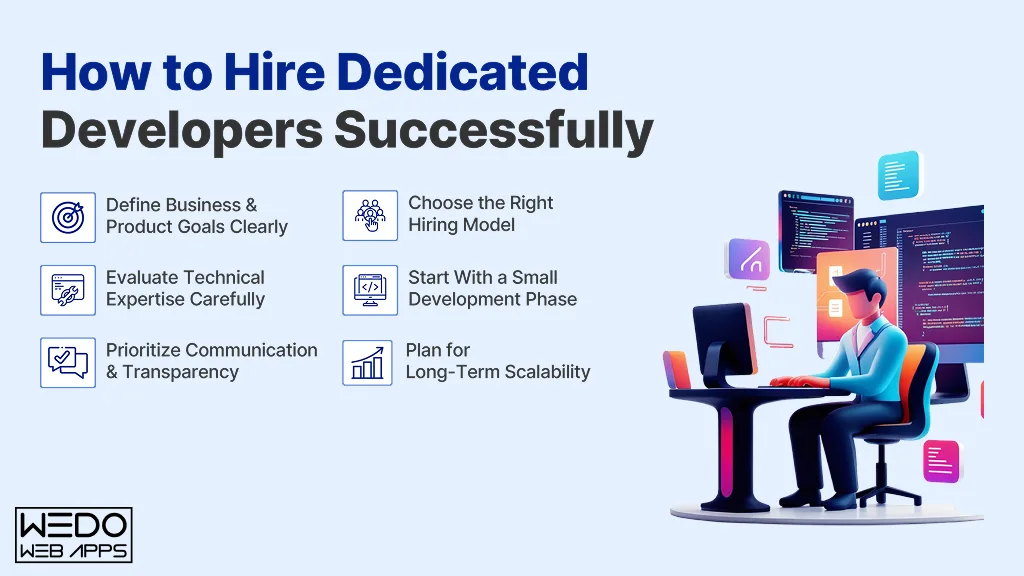
Hiring dedicated developers successfully requires more than comparing pricing and portfolios. Businesses should follow a structured hiring approach that aligns technical expertise, scalability, communication processes, and long-term product goals.
A well-planned hiring strategy helps reduce operational risks while improving development efficiency and product delivery timelines.
Define Business & Product Goals Clearly
Before hiring developers, businesses should identify:
- project scope
- core product requirements
- expected timelines
- scalability expectations
- long-term development goals
Clear project planning helps avoid unnecessary hiring costs and development confusion later.
Choose the Right Hiring Model
Different projects require different engagement models. Businesses should evaluate whether they need:
- individual dedicated developers
- a full dedicated development team
- staff augmentation support
- short-term specialized expertise
Choosing the right model directly affects both scalability and overall development costs.
Evaluate Technical Expertise Carefully
Beyond technical skills, businesses should assess:
- industry experience
- problem-solving ability
- architecture understanding
- communication efficiency
- collaboration workflows
Experienced developers often improve delivery quality while reducing long-term maintenance challenges.
Start With a Small Development Phase
Many businesses reduce hiring risks by starting with:
- a trial sprint
- MVP development phase
- smaller project module
This allows companies to evaluate workflow compatibility, communication quality, and delivery performance before scaling the team further.
Prioritize Communication & Transparency
Successful remote development depends heavily on:
- regular reporting
- agile workflows
- clear ownership
- milestone tracking
- transparent collaboration
Businesses should ensure the development team follows structured project management and communication practices from the beginning.
Plan for Long-Term Scalability
As products evolve, businesses may require:
- additional developers
- QA engineers
- DevOps specialists
- cloud support
- ongoing maintenance
Hiring scalable, dedicated development teams early helps businesses expand engineering capacity more efficiently without rebuilding teams repeatedly.
Ultimately, the most successful businesses evaluate dedicated developers based on long-term business value, delivery efficiency, and scalability, not just hourly pricing alone.
Why Businesses Prefer Dedicated Development Partners for Long-Term Growth
As digital products become more complex, many startups and enterprises are moving beyond traditional hiring models and choosing dedicated development partners for long-term scalability and operational efficiency.
Instead of managing fragmented teams, lengthy recruitment cycles, and ongoing hiring challenges internally, businesses increasingly prefer dedicated developers who can align closely with their product vision and growth roadmap.
One of the biggest advantages of dedicated development partnerships is flexibility. Businesses can scale teams based on changing product requirements without going through repeated recruitment and onboarding processes. This is especially valuable for SaaS companies, eCommerce businesses, and startups operating in fast-moving markets.
Dedicated development teams also help businesses reduce operational overhead associated with:
- Infrastructure setup
- Employee management
- Internal hiring
- Training
- Resource scaling
For growing companies, this often creates a more efficient and predictable development model compared to building large in-house teams early.
Another major reason businesses prefer dedicated remote developers is access to specialized expertise. Modern software products frequently require skills across:
- Frontend development
- Backend architecture
- DevOps
- Cloud infrastructure
- AI integrations
- eCommerce customization
Partnering with experienced development teams allows businesses to access these capabilities faster without maintaining large permanent engineering departments internally.
Long-term development partnerships also improve:
- Project continuity
- Communication efficiency
- Product understanding
- Delivery consistency
Over time, dedicated teams become more aligned with business goals, user expectations, and product workflows, which often improves overall development efficiency significantly.
For startups and enterprises focused on sustainable digital growth, dedicated developers provide a scalable balance between flexibility, technical expertise, and long-term cost optimization.
Conclusion
The cost of hiring dedicated developers depends on factors like technical expertise, project complexity, scalability goals, and long-term product requirements. Instead of focusing only on hourly pricing, businesses should prioritize development quality, communication efficiency, and scalable collaboration for better long-term ROI.
For startups and enterprises planning sustainable digital growth, partnering with experienced teams offering dedicated developers can help accelerate product development while reducing operational challenges and scaling efficiently over time.