Introduction
Choosing the wrong AI programming language can slow down development, increase infrastructure costs, create scaling issues, and limit how your AI product evolves in the future. Yet many businesses still select their AI tech stack based on trends instead of actual product requirements.
The reality is that different AI programming languages solve different business problems. Python may dominate machine learning development, but it is not always the best choice for real-time AI systems, enterprise infrastructure, or AI-powered mobile applications. Similarly, languages like Java, C++, JavaScript, and Scala each bring unique advantages depending on performance needs, scalability goals, and deployment environments.
For startups, enterprises, and decision-makers investing in artificial intelligence, choosing the right language is not just a technical decision anymore. It directly impacts development speed, hiring costs, scalability, AI integration capabilities, and long-term product maintenance.
In this guide, we compare the best programming languages for AI development based on real-world business use cases, machine learning capabilities, scalability, and AI application requirements to help you choose the right technology stack for your AI product.
Why Choosing the Right AI Programming Language Matters
The programming language used in Artificial Intelligence development affects far more than just coding preferences. It influences how quickly businesses can launch AI products, scale infrastructure, integrate machine learning models, and maintain long-term performance.
A language that works well for an AI startup MVP may not be the right fit for an enterprise-scale AI system handling millions of users or real-time processing. Similarly, some AI programming languages are optimized for rapid experimentation, while others are designed for performance-heavy applications like robotics, predictive analytics, or edge AI.
Before selecting an AI development language, businesses should evaluate several critical factors:
Development Speed and Time-to-Market
Startups and growing businesses often prioritize faster AI development cycles. Languages with strong AI ecosystems, pre-built libraries, and larger developer communities can significantly reduce development time and accelerate MVP launches.
Machine Learning and AI Framework Support
The best programming languages for AI offer strong compatibility with frameworks like TensorFlow, PyTorch, Scikit-learn, LangChain, and Hugging Face. Framework availability directly impacts how efficiently developers can build, train, and deploy AI models.
Scalability and Performance
AI applications handling large datasets, real-time inference, or enterprise workloads require languages capable of delivering stable performance under heavy demand. Scalability becomes especially important for AI SaaS products, automation systems, and customer-facing AI platforms.
AI Integration with Mobile and Web Applications
Businesses building AI-powered mobile apps or web platforms need programming languages that support seamless backend integration, API connectivity, and cross-platform compatibility. This is where languages like JavaScript, Kotlin, Swift, and Python often work together within modern AI ecosystems.
Infrastructure and Maintenance Costs
The wrong AI development language can increase cloud expenses, infrastructure complexity, and long-term maintenance challenges. Businesses should balance rapid development with operational efficiency before finalizing their AI tech stack.
Ultimately, the best AI programming language depends on the type of AI product being developed, business scalability goals, deployment requirements, and user experience expectations. This is why modern AI applications are often built using multiple programming languages instead of relying on a single technology stack.
Best AI Programming Languages Compared
Choosing between different AI programming languages becomes easier when businesses compare them based on scalability, performance, machine learning support, and real-world implementation scenarios. While some languages dominate machine learning and generative AI development, others are better suited for enterprise systems, mobile AI applications, or high-performance processing.
The table below compares the top AI programming languages used in modern artificial intelligence development.
| AI Programming Language | Best For | Key Strengths | Limitations |
|---|---|---|---|
| Python | Machine learning, generative AI, AI SaaS products | Massive AI ecosystem, rapid development, strong framework support | Slower execution speed for performance-heavy systems |
| Java | Enterprise AI applications | Scalability, security, backend stability | Slower AI experimentation compared to Python |
| C++ | Real-time AI systems, robotics, edge AI | High performance, low-level optimization | Complex development process |
| JavaScript | AI-powered web and mobile applications | Frontend integration, cross-platform flexibility | Limited for advanced model training |
| R | Predictive analytics and statistical AI | Strong data analysis capabilities | Less suitable for production-grade AI apps |
| Scala | Big data and distributed AI systems | Apache Spark integration, scalability | Smaller developer ecosystem |
| Julia | Scientific computing and AI research | High-speed mathematical computation | Limited community and framework maturity |
| Go | AI microservices and cloud infrastructure | Concurrency, lightweight scalability | Smaller machine learning ecosystem |
| Rust | Secure and performance-critical AI systems | Memory safety, system-level efficiency | Steeper learning curve |
| Lisp | AI research and symbolic processing | Strong support for recursive AI algorithms | Limited modern enterprise adoption |
Each language solves different AI development challenges. For example, Python remains the best programming language for AI and machine learning projects that prioritize speed and flexibility, while Java and Scala are often preferred for enterprise AI systems that require scalability and stability.
Similarly, businesses building AI-powered mobile apps frequently combine multiple technologies, such as Python for AI model development, JavaScript for frontend experiences, and Kotlin or Swift for mobile integration.
Understanding these differences is essential before selecting a technology stack for long-term AI product development.
Top 10 AI Programming Languages to Build Scalable Applications
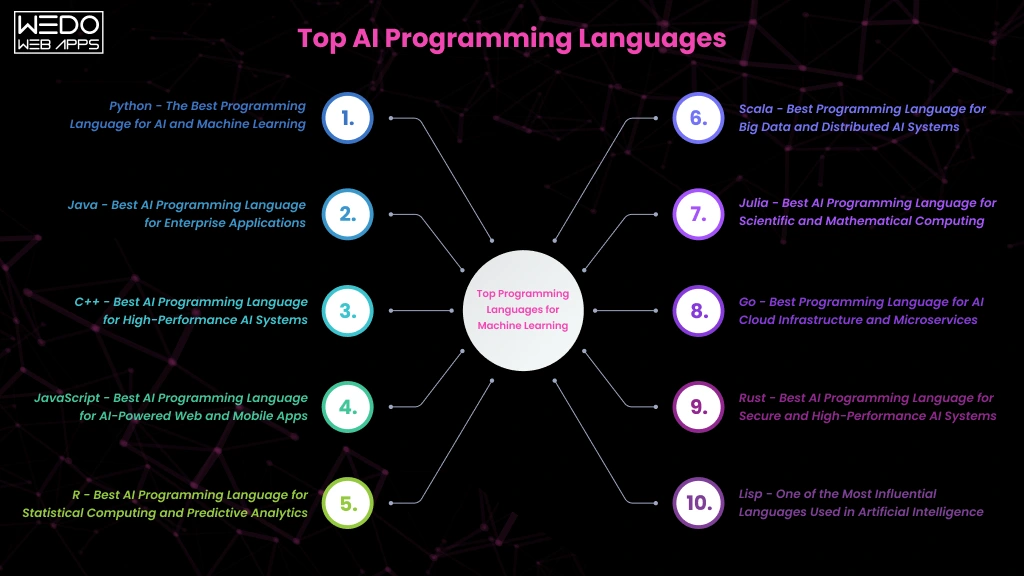
1. Python – The Best Programming Language for AI and Machine Learning
Python is widely considered the best programming language for AI because of its simpler syntax, rapid development capabilities, and massive machine learning ecosystem. It powers everything from generative AI tools and AI chatbots to predictive analytics platforms and AI-powered mobile applications.
One of Python’s biggest strengths is its compatibility with leading AI frameworks like TensorFlow, PyTorch, Scikit-learn, Keras, LangChain, and Hugging Face. These frameworks simplify AI model development, training, and deployment, helping businesses reduce development time and accelerate AI implementation.
Best Use Cases of Python in AI Development
- Generative AI applications and LLM-based platforms
- AI chatbots and virtual assistants
- Machine learning and predictive analytics systems
- Computer vision and image recognition software
- AI-powered mobile and web applications
- Recommendation engines and automation platforms
For startups and businesses prioritizing faster AI product development, Python offers the right balance of scalability, flexibility, and strong developer support. However, performance-heavy AI systems sometimes combine Python with languages like C++ for better optimization and speed.
2. Java – Best AI Programming Language for Enterprise Applications
Java remains one of the top AI programming languages for enterprises building large-scale, secure, and high-performance AI systems. Its scalability, platform independence, and strong backend architecture make it a preferred choice for businesses handling complex AI operations.
Unlike Python, which is often preferred for rapid AI experimentation, Java is commonly used in production-grade AI environments where long-term stability and system reliability are critical.
Java supports multiple AI and machine learning libraries, including:
- Deep Java Library (DJL)
- Weka
- Deeplearning4j
- Apache Spark MLlib
These tools help businesses develop scalable artificial intelligence applications while integrating AI capabilities into existing enterprise systems.
Best Use Cases of Java in AI Development
- Enterprise AI platforms
- AI-powered CRM and ERP systems
- Banking and financial AI applications
- Fraud detection systems
- Large-scale data processing solutions
- AI-based business automation tools
Java is especially valuable for enterprises already operating within Java-based ecosystems because it simplifies AI integration without requiring a complete infrastructure shift. Its strong security features and scalability also make it suitable for long-term enterprise AI deployment.
3. C++ – Best AI Programming Language for High-Performance AI Systems
C++ is one of the best programming languages for AI applications that require high-speed processing, low latency, and hardware-level optimization. Unlike higher-level AI programming languages, C++ gives developers greater control over memory management and system performance, making it ideal for performance-critical AI environments.
Many real-time AI systems rely on C++ to process massive datasets and execute complex computations efficiently. It is also commonly used alongside Python to optimize resource-intensive AI operations.
Popular AI libraries and frameworks compatible with C++ include:
- TensorFlow C++ API
- OpenCV
- Shark
- mlpack
Best Use Cases of C++ in AI Development
- Robotics and autonomous systems
- Real-time AI applications
- Edge AI and IoT systems
- Gaming AI engines
- Computer vision software
- AI-powered cybersecurity tools
Businesses developing AI products that demand speed, efficiency, and real-time responsiveness often choose C++ for backend optimization and high-performance AI processing. However, its development complexity and longer development cycles can increase implementation time compared to languages like Python.
4. JavaScript – Best AI Programming Language for AI-Powered Web and Mobile Apps
JavaScript has become an important AI programming language for businesses building AI-powered web platforms and mobile applications. While it is not typically used for training complex machine learning models, JavaScript plays a major role in delivering AI-driven user experiences across browsers, web apps, and cross-platform mobile applications.
With technologies like TensorFlow.js and Node.js, developers can integrate AI capabilities directly into frontend and backend environments without relying entirely on separate AI infrastructures.
JavaScript is widely used for:
- Real-time AI interactions
- AI-powered dashboards
- Chatbots and virtual assistants
- Recommendation systems
- AI-enabled customer portals
Best Use Cases of JavaScript in AI Development
- AI-powered web applications
- Cross-platform AI mobile apps
- AI chat interfaces
- Real-time customer engagement platforms
- AI-based analytics dashboards
- Browser-based machine learning applications
For businesses focused on customer-facing AI products, JavaScript helps create responsive and interactive AI experiences while supporting faster frontend development and seamless API integration with AI models.
5. R – Best AI Programming Language for Statistical Computing and Predictive Analytics
R is one of the most widely used programming languages for machine learning, statistical analysis, and data visualization. It is particularly popular among businesses and research teams working with predictive modeling, large datasets, and analytics-driven AI systems.
Unlike some AI programming languages focused on application development, R is designed specifically for data processing and statistical computing. It offers a strong ecosystem of machine learning libraries and visualization tools that help businesses generate actionable insights from complex datasets.
Popular AI and machine learning libraries in R include:
- Caret
- randomForest
- TensorFlow for R
- e1071
- ggplot2
Best Use Cases of R in AI Development
- Predictive analytics platforms
- Healthcare and medical AI research
- Financial forecasting systems
- Statistical machine learning models
- Business intelligence solutions
- Data visualization applications
R is especially useful for businesses prioritizing data analysis and forecasting accuracy. However, compared to Python or Java, it is less commonly used for large-scale production AI applications and enterprise deployment.
6. Scala – Best Programming Language for Big Data and Distributed AI Systems
Scala is one of the top AI programming languages for businesses managing large-scale data processing and distributed machine learning systems. Its seamless integration with Apache Spark makes it highly effective for enterprise AI environments handling massive datasets.
Scala combines object-oriented and functional programming capabilities, allowing developers to build scalable AI applications optimized for big data ecosystems.
Popular frameworks and tools compatible with Scala include:
- Apache Spark
- Breeze
- DeepLearning.scala
- TensorFlow Scala
Best Use Cases of Scala in AI Development
- Big data AI platforms
- Distributed machine learning systems
- Real-time analytics applications
- Enterprise AI infrastructure
- Recommendation engines
- AI-driven customer behavior analysis
Scala is commonly used by enterprises building data-intensive AI solutions where scalability, distributed computing, and high-speed processing are critical.
7. Julia – Best AI Programming Language for Scientific and Mathematical Computing
Julia is gaining attention as one of the best programming languages for AI applications requiring high-performance mathematical computation and scientific processing. It combines the simplicity of Python with significantly faster execution speeds for numerical operations.
The language is particularly useful for AI researchers, data scientists, and businesses working with simulation-heavy AI models and computational analysis.
Popular AI and machine learning libraries in Julia include:
- Flux.jl
- MLJ.jl
- Knet.jl
- TensorFlow.jl
Best Use Cases of Julia in AI Development
- Scientific AI research
- Deep learning experimentation
- Financial modeling systems
- Simulation-based AI platforms
- High-performance machine learning applications
- Mathematical optimization systems
Although Julia offers impressive computational performance, its ecosystem and enterprise adoption are still smaller compared to more established AI programming languages like Python.
8. Go – Best Programming Language for AI Cloud Infrastructure and Microservices
Go, also known as Golang, is becoming increasingly popular in AI development for building scalable backend systems, cloud-native AI applications, and microservice architectures. Its lightweight concurrency model allows businesses to manage multiple AI operations efficiently.
Unlike Python, which is commonly used for model training, Go is often used for deploying AI services, APIs, and scalable infrastructure environments.
Popular AI libraries and frameworks in Go include:
- Gorgonia
- GoLearn
- TensorFlow Go
- Gonum
Best Use Cases of Go in AI Development
- AI cloud infrastructure
- AI deployment pipelines
- Scalable backend AI systems
- Real-time AI APIs
- AI microservices
- Cloud-native AI platforms
Businesses building enterprise AI ecosystems often use Go to improve infrastructure scalability, backend stability, and deployment efficiency.
9. Rust – Best AI Programming Language for Secure and High-Performance AI Systems
Rust is emerging as one of the most reliable programming languages for AI applications requiring performance optimization, memory safety, and secure system architecture. It helps businesses build efficient AI systems while reducing risks related to memory leaks and system crashes.
Rust is particularly valuable for performance-critical AI workloads where security and low-level optimization are essential.
Popular Rust AI libraries and frameworks include:
- tch-rs
- Burn
- Linfa
- SmartCore
Best Use Cases of Rust in AI Development
- Edge AI systems
- AI cybersecurity platforms
- Secure AI infrastructure
- Real-time AI processing applications
- Performance-intensive AI workloads
- Autonomous AI systems
Although Rust has a steeper learning curve than many AI programming languages, it is becoming increasingly popular for modern AI infrastructure and secure system development.
10. Lisp – One of the Most Influential Languages Used in Artificial Intelligence
Lisp is one of the oldest programming languages used in artificial intelligence development and has played a foundational role in the evolution of AI research. It became popular because of its strong symbolic processing capabilities and support for recursive programming.
Even though modern AI development largely relies on languages like Python and Java, Lisp remains influential in academic research and symbolic AI systems.
Popular Lisp-based AI environments include:
- Common Lisp
- Clojure
- Racket
Best Use Cases of Lisp in AI Development
- Symbolic AI systems
- Knowledge representation applications
- Experimental AI research
- Recursive AI algorithms
- Academic AI projects
- Rule-based AI systems
While Lisp is no longer the primary choice for enterprise AI application development, its historical importance and flexibility continue to influence modern artificial intelligence programming concepts.
Which AI Programming Language Is Best for Different Business Goals?
Choosing the best AI programming language depends entirely on the type of AI product a business wants to build. While Python dominates general AI and machine learning development, other languages often perform better for enterprise systems, mobile applications, real-time processing, or cloud infrastructure.
Here is how businesses typically choose programming languages for artificial intelligence based on their goals:
| Business Goal | Best AI Programming Languages |
|---|---|
| Generative AI and LLM applications | Python, Julia |
| Enterprise AI platforms | Java, Scala |
| AI-powered mobile applications | JavaScript, Python, Kotlin, Swift |
| Real-time AI systems | C++, Rust |
| Predictive analytics and forecasting | R, Python |
| Big data AI processing | Scala, Go |
| AI cloud infrastructure | Go, Rust |
| AI research and experimentation | Python, Lisp, Julia |
| AI chatbots and virtual assistants | Python, JavaScript |
| Computer vision applications | Python, C++ |
For startups, Python is often the preferred AI programming language because it enables faster MVP development, easier experimentation, and lower initial development complexity. On the other hand, enterprises managing large-scale AI infrastructure may prioritize Java or Scala for long-term scalability and backend stability.
Similarly, businesses building AI-powered mobile apps usually combine multiple technologies within the same AI ecosystem. For example:
- Python handles machine learning and AI model development
- JavaScript powers frontend interactions
- Kotlin and Swift manage native mobile experiences
- Go or Rust support scalable backend infrastructure
This multi-language approach allows businesses to optimize different layers of AI application development without depending entirely on a single programming language.
How Businesses Choose the Right AI Development Stack
Selecting the right AI programming language is only one part of building a successful AI product. Businesses also need to evaluate the overall AI development stack, including frameworks, infrastructure, scalability requirements, and integration capabilities.
Many companies make the mistake of choosing AI development languages based only on popularity. In reality, the right decision depends on the product’s long-term business goals, technical complexity, and deployment environment.
Before finalizing an AI technology stack, businesses should evaluate the following factors:
Type of AI Product Being Developed
Different AI applications require different technical capabilities. For example:
- Generative AI platforms prioritize framework flexibility and model integration
- Real-time AI systems require high-speed processing
- AI-powered mobile apps need seamless frontend-backend communication
- Enterprise AI systems focus heavily on scalability and security
The AI product itself often determines which programming languages and frameworks will work best.
Scalability Requirements
An AI MVP serving a few thousand users may not require the same infrastructure as an enterprise AI platform handling millions of requests daily. Businesses should evaluate whether the selected AI programming language can support future scaling without increasing infrastructure complexity.
AI Framework and Ecosystem Support
Strong framework support speeds up AI development significantly. Languages with mature AI ecosystems allow businesses to integrate machine learning models, APIs, and automation workflows more efficiently.
For example:
- Python dominates machine learning frameworks
- Scala works well with Apache Spark ecosystems
- Java supports stable enterprise AI integration
Integration With Existing Systems
Enterprises often need AI solutions that integrate smoothly with existing software infrastructure, cloud environments, databases, and business applications. Choosing compatible programming languages helps reduce migration and integration challenges.
Development and Maintenance Costs
Some AI programming languages enable faster development but may create scaling or maintenance challenges later. Others require longer implementation cycles but offer better long-term stability.
Businesses should balance:
- development speed
- infrastructure costs
- developer availability
- maintenance complexity
- scalability requirements
Modern AI applications rarely rely on a single programming language. Instead, businesses combine multiple technologies to build scalable AI ecosystems optimized for performance, flexibility, and user experience.
Common Mistakes Businesses Make When Choosing AI Programming Languages
Choosing the wrong AI programming language can increase development costs, slow product scalability, and create long-term infrastructure challenges. Many businesses focus only on trends or framework popularity without evaluating how the language aligns with their actual AI product requirements.
Here are some of the most common mistakes businesses make during AI technology selection:
Choosing Languages Based Only on Popularity
Python is one of the best programming languages for AI, but it is not automatically the right choice for every AI application. Some businesses select technologies simply because they are trending instead of evaluating performance requirements, scalability goals, or infrastructure compatibility.
Ignoring Scalability Requirements
A programming language that works well for an MVP may struggle when the AI product scales. Businesses often overlook how increasing users, real-time processing demands, and larger datasets can impact long-term AI system performance.
Overlooking Infrastructure and Maintenance Costs
Certain AI development languages simplify rapid development but increase cloud costs, optimization challenges, or maintenance complexity later. Businesses should evaluate the long-term operational impact before finalizing an AI tech stack.
Using a Single Language for Every AI Component
Modern AI ecosystems typically use multiple programming languages together. For example:
- Python may handle AI model training
- JavaScript powers frontend experiences
- Go manages scalable APIs
- Rust or C++ optimize performance-critical operations
Relying entirely on one language can limit scalability and flexibility.
Ignoring Developer Availability and Ecosystem Support
Some AI programming languages offer strong performance advantages but have smaller developer communities and limited framework ecosystems. This can make hiring, maintenance, and future upgrades more difficult.
Not Aligning Language Selection With Business Goals
The best programming language for AI development depends on the business objective. A startup building a generative AI MVP has different technical priorities than an enterprise deploying AI automation across large-scale infrastructure.
Businesses that align AI language selection with scalability, performance, and long-term product goals are more likely to build sustainable and future-ready AI applications.
Future Trends in AI Programming Languages
Artificial intelligence development is evolving rapidly, and the technologies used to build AI applications are changing alongside it. As businesses invest more heavily in generative AI, automation, and intelligent digital products, AI programming languages are also adapting to support faster development, scalable infrastructure, and real-time processing.
Here are some major trends shaping the future of AI development languages:
Growing Demand for Generative AI Development
The rise of LLMs, Agentic AI, and generative AI platforms has significantly increased demand for programming languages that support rapid AI experimentation and framework integration. Python continues to dominate this space because of its strong ecosystem around LangChain, Hugging Face, TensorFlow, and PyTorch.
Rise of Multi-Language AI Architectures
Modern AI applications are increasingly built using multiple programming languages instead of relying on a single technology stack. Businesses now combine:
- Python for AI model development
- JavaScript for frontend experiences
- Go for cloud infrastructure
- Rust or C++ for performance optimization
This hybrid approach improves scalability, flexibility, and overall system performance.
Increased Focus on Edge AI and Real-Time Processing
As AI expands into IoT devices, robotics, and smart applications, businesses require programming languages capable of handling real-time inference and low-latency processing. This is driving more adoption of C++, Rust, and Go in performance-critical AI systems.
Expansion of AI-Powered Mobile Applications
AI is becoming a core feature in modern mobile apps, from personalized recommendations and AI chatbots to voice assistants and predictive user experiences. Businesses building AI-powered mobile applications are increasingly combining AI backend systems with cross-platform and native mobile technologies.
Greater Importance of AI Infrastructure Scalability
As AI workloads grow larger, businesses are prioritizing programming languages that support scalable cloud infrastructure, distributed computing, and microservice architectures. Languages like Scala and Go are becoming more valuable for enterprise AI ecosystems managing large-scale data processing.
The future of artificial intelligence development will likely rely less on a single “best” programming language and more on selecting the right combination of technologies for specific AI business goals, scalability requirements, and user experiences.
Common Mistakes Businesses Make When Choosing AI Programming Languages
Choosing the wrong AI programming language can increase development costs, slow product scalability, and create long-term infrastructure challenges. Many businesses focus only on trends or framework popularity without evaluating how the language aligns with their actual AI product requirements.
Here are some of the most common mistakes businesses make during AI technology selection:
Choosing Languages Based Only on Popularity
Python is one of the best programming languages for AI, but it is not automatically the right choice for every AI application. Some businesses select technologies simply because they are trending instead of evaluating performance requirements, scalability goals, or infrastructure compatibility.
Ignoring Scalability Requirements
A programming language that works well for an MVP may struggle when the AI product scales. Businesses often overlook how increasing users, real-time processing demands, and larger datasets can impact long-term AI system performance.
Overlooking Infrastructure and Maintenance Costs
Certain AI development languages simplify rapid development but increase cloud costs, optimization challenges, or maintenance complexity later. Businesses should evaluate the long-term operational impact before finalizing an AI tech stack.
Using a Single Language for Every AI Component
Modern AI ecosystems typically use multiple programming languages together. For example:
- Python may handle AI model training
- JavaScript powers frontend experiences
- Go manages scalable APIs
- Rust or C++ optimize performance-critical operations
Relying entirely on one language can limit scalability and flexibility.
Ignoring Developer Availability and Ecosystem Support
Some AI programming languages offer strong performance advantages but have smaller developer communities and limited framework ecosystems. This can make hiring, maintenance, and future upgrades more difficult.
Not Aligning Language Selection With Business Goals
The best programming language for AI development depends on the business objective. A startup building a generative AI MVP has different technical priorities than an enterprise deploying AI automation across large-scale infrastructure.
Businesses that align AI language selection with scalability, performance, and long-term product goals are more likely to build sustainable and future-ready AI applications.
Conclusion
There is no single best AI programming language for every business or AI application. The right choice depends on factors like scalability goals, development speed, infrastructure requirements, performance expectations, and the type of AI product being built.
Python continues to lead artificial intelligence development because of its massive machine learning ecosystem, rapid development capabilities, and strong framework support. However, languages like Java, C++, JavaScript, Scala, Go, and Rust each offer unique advantages for enterprise AI systems, real-time processing, cloud infrastructure, and AI-powered mobile applications.
As AI ecosystems become more advanced, businesses are increasingly adopting multi-language development approaches to optimize different parts of their AI architecture. This allows companies to balance flexibility, scalability, performance, and long-term maintainability more effectively.
For startups, enterprises, and decision-makers investing in AI development, choosing the right programming languages early can directly impact development costs, product scalability, user experience, and long-term business growth. This is why successful AI application development requires not only strong AI models, but also the right technology foundation to support future expansion and evolving business needs.