Introduction
A few years ago, building the next social media platform sounded unrealistic for most businesses.
Today, it is a very different story.
From creator communities and fitness networks to professional platforms and industry-specific social apps, startups and enterprises are launching niche social ecosystems that attract highly engaged users without competing directly with Instagram.
The challenge is not whether the idea can be built.
The challenge is understanding what it will actually cost.
When founders start researching the cost to develop an app like Instagram, they quickly run into conflicting answers. Some sources claim it can be built for under $20,000, while others suggest budgets exceeding $500,000. The reality lies somewhere in between and depends heavily on the features, scalability requirements, technology stack, and long-term business goals behind the product.
For example, a startup validating a new creator platform may only need core features such as user profiles, content sharing, comments, and messaging. An enterprise launching a large-scale social network, however, may require AI-powered recommendations, advanced monitoring systems, real-time communication, video infrastructure, and the ability to support hundreds of thousands of users.
That is why there is no one-size-fits-all answer to the Instagram app development cost.
In this guide, we will break down everything decision-makers need to know before investing in social media platform, including Instagram like app features, development timelines, hidden expenses, and the key factors affecting app development cost. Whether you are planning an MVP or a full-scale social networking platform, this article will help you estimate budgets more accurately and make smarter development decisions.
Quick Answer – How Much Does it Cost to Develop an App Like Instagram?
The cost to develop an app like Instagram typically ranges from $30,000 to $500,000+, depending on the app’s features, platform selection, scalability requirements, and overall complexity.
A simple social media MVP focused on content sharing and user engagement can often be launched for under $60,000. However, if your vision includes advanced capabilities such as short-form video content, real-time messaging, AI-powered recommendations, content moderation, and enterprise-grade infrastructure, the investment can increase significantly.
Instagram App Development Cost Breakdown
| App Type | Estimated Cost | Timeline |
|---|---|---|
| Basic Social Media MVP | $30,000 – $60,000 | 3 – 5 Months |
| Mid-Level Social Media App | $60,000 – $150,000 | 5 – 8 Months |
| Advanced Instagram-Like App | $150,000 – $300,000 | 8 – 12 Months |
| Enterprise Social Platform | $300,000 – $500,000 | 12+ Months |
It is important to note that most businesses are not building a complete Instagram alternative from day one. Instead, they launch a focused product that solves a specific user problem, validates market demand, and expands features over time.
For example, a startup building a fitness community app may initially focus on user profiles, content sharing, comments, and messaging. A creator-focused platform may prioritize video uploads, engagement tools, and subscription features. Enterprise social platforms often require advanced analytics, AI-driven recommendations, moderation systems, and infrastructure capable of supporting large user bases.
Key Factors Affecting Instagram App Development Cost
Several variables influence the final social media app development cost:
| Factor | Impact on Cost |
|---|---|
| Number of Features | Very High |
| Video Upload and Streaming | Very High |
| Real-Time Messaging | High |
| AI Recommendations | High |
| Platform Choice | Medium |
| UI/UX Complexity | Medium |
| Third-Party Integrations | Medium |
| Scalability Requirements | Very High |
| Security and Compliance | High |
As a result, two social media apps may look similar on the surface while having completely different development budgets behind the scenes.
Before setting a budget, businesses should first identify their core user journey, required features, growth expectations, and monetization strategy. These decisions often have a greater impact on cost than the technology itself.
Why Businesses are Still Investing in Instagram Like Apps
At first glance, building a social media platform may seem like a difficult market to enter. After all, platforms like Instagram, TikTok, Facebook, LinkedIn, and X already have billions of active users worldwide.
However, most successful social media startups are not trying to replace these platforms. Instead, they focus on serving specific audiences, industries, or communities that larger networks often overlook.
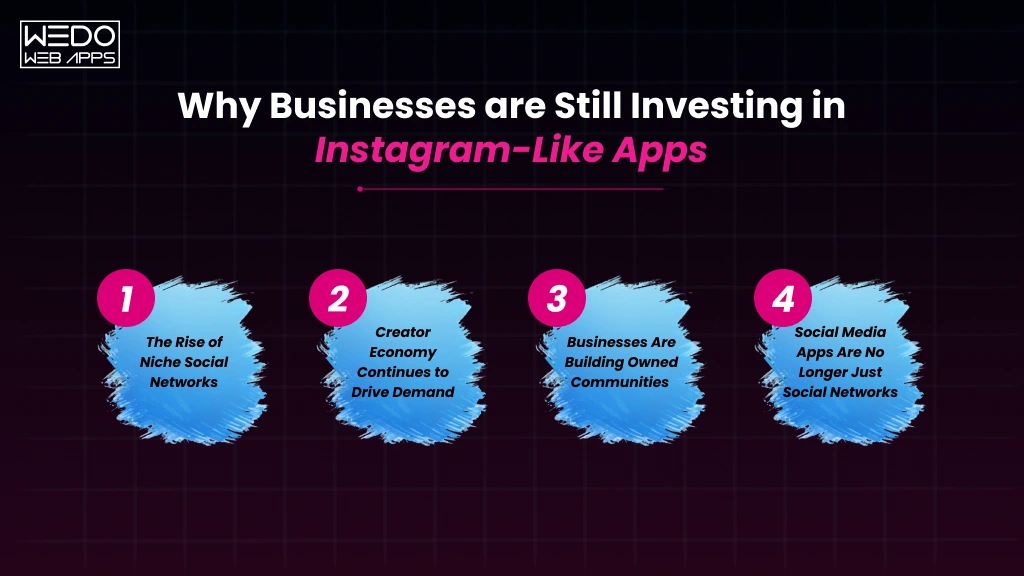
This shift is one of the biggest reasons businesses continue investing in social networking platforms despite the competition.
The Rise of Niche Social Networks
Modern users are increasingly seeking communities built around their interests, professions, lifestyles, and goals rather than broad social networks designed for everyone.
As a result, niche social platforms are gaining traction across industries such as:
- Fitness and wellness
- Education and learning
- Professional networking
- Healthcare communities
- Creator and influencer networks
- Gaming communities
- Industry-specific business networks
For startups and entrepreneurs, this creates opportunities to build highly engaged communities without needing to compete directly with Instagram’s massive user base.
Creator Economy Continues to Drive Demand
The creator economy has transformed how individuals and brands engage with audiences online.
Content creators, coaches, educators, trainers, consultants, and influencers increasingly look for platforms that provide more control over audience engagement, monetization, and community building.
This has led to growing demand for social media platforms that offer features such as:
- Content sharing
- Short form video publishing
- Community engagement
- Direct messaging
- Membership programs
- Subscription-based content
Many businesses now choose to build dedicated platforms rather than relying entirely on third-party social networks where algorithms and platform policies can change without notice.
Businesses Are Building Owned Communities
One of the biggest trends driving social media app development cost investments is the move toward owned digital communities.
Instead of renting attention on existing platforms, businesses are creating environments where they control user experience, data, engagement, and monetization opportunities.
Examples include:
- Customer communities
- Employee networking platforms
- Brand engagement apps
- Learning communities
- Industry collaboration networks
These platforms often combine social networking features with business-specific functionality, creating stronger user retention and long-term value.
Social Media Apps Are No Longer Just Social Networks
Today’s social applications often serve multiple business purposes beyond content sharing.
An Instagram-inspired platform may include:
- eLearning capabilities
- Marketplace functionality
- Subscription management
- Event hosting
- Live streaming
- AI-powered recommendations
- Community management tools
This flexibility allows businesses to create platforms that align with their unique business models while leveraging familiar social networking experiences that users already understand.
For many founders and enterprises, the question is no longer whether social platforms can generate value. The real question is how to build a platform that serves a specific audience, delivers a unique experience, and justifies the investment required for development.
What Makes Instagram Expensive to Build?
Many founders researching the cost to develop an app like Instagram are surprised by how quickly development budgets can grow. On the surface, Instagram appears to be a simple platform where users share photos and videos, follow other accounts, and interact through likes and comments.
Behind the scenes, however, social media applications are among the most technically demanding digital products to build and scale.
Unlike standard business applications, social platforms must continuously process large volumes of content, support real-time interactions, and deliver seamless experiences to thousands or even millions of users simultaneously. These requirements significantly influence the overall cost to develop app like Instagram.
Media-Heavy Infrastructure
Photos, videos, stories, and reels form the foundation of modern social media platforms.
Every piece of content uploaded by users must be processed, compressed, stored, secured, and delivered efficiently across multiple devices and network conditions. As user-generated content grows, businesses often need scalable cloud infrastructure, content delivery networks (CDNs), and advanced storage solutions to maintain performance.
This is one of the biggest factors affecting app development cost, especially for platforms focused on video content.
Real-Time User Engagement
Users expect instant interactions when using social applications.
Actions such as:
- Likes
- Comments
- Direct Messages
- Push Notifications
- Live Interactions
must happen in real time without delays.
Building and maintaining this level of responsiveness requires additional backend development, database optimisation, and communication services, all of which contribute to the overall social media app development cost.
Personalized Content Feeds
One of Instagram’s most powerful features is its ability to deliver personalized content to every user.
Instead of displaying posts in chronological order, modern social platforms use recommendation systems that analyze user behavior, engagement patterns, interests, and content preferences.
Creating intelligent feed requires:
- Data collection systems
- Recommendation algorithms
- Analytics infrastructure
- AI and machine learning capabilities
While basic feeds are relatively affordable to build, advanced personalisation features can significantly increase development complexity and budget requirements.
High Scalability Requirements
Many mobile applications serve a limited number of users at a given time.
Social media platforms operate differently.
A successful platform may experience thousands of users uploading content, sending messages, viewing videos, and interacting simultaneously. The application architecture must be designed to support growth without sacrificing performance or reliability.
Planning for scalability from the beginning often requires additional investment but helps avoid costly development in the future.
Security and Content Moderation
Users trust plays a critical role in the success of any social networking platform.
Businesses must protect personal information, secure user accounts, prevent unauthorized access, and comply with privacy regulations. At the same time, they must monitor content to reduce spam, abuse, misinformation, and inappropriate material.
As a result, social media platforms frequently require:
- User verification systems
- Privacy controls
- Reporting mechanisms
- Content moderation tools
- Security monitoring solutions
These features may not be immediately visible to users, but they are essential components of a successful social media platform and have a direct impact on development costs.
Ultimately, the Instagram like app development cost is driven by far more than user-facing features. Infrastructure, scalability, security, real-time communications, and content management requirements often represent a significant portion of the overall investment, especially for businesses planning long-term growth.
Essential Instagram-Like App Features and Their Development Cost
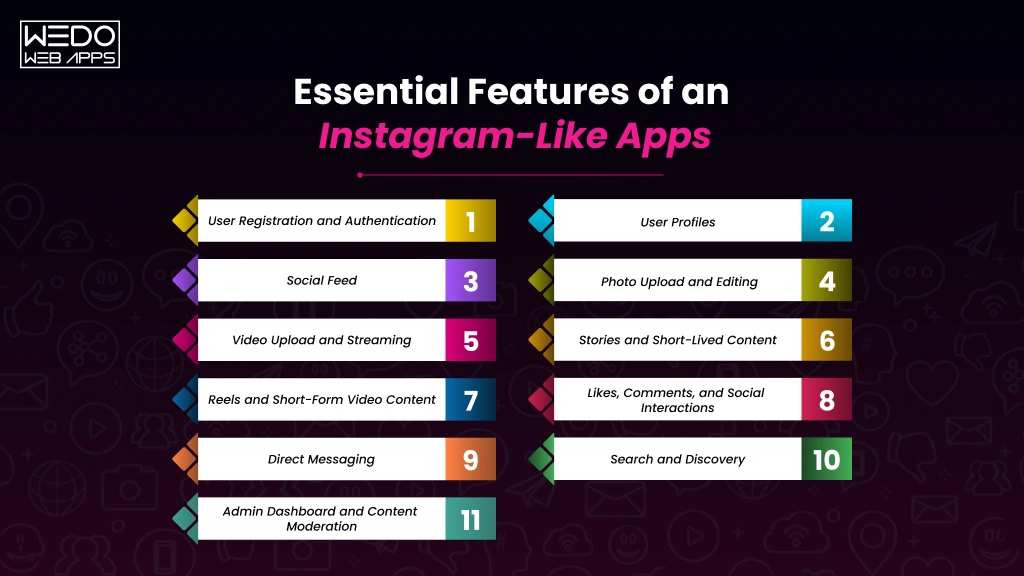
The features you choose will have the biggest impact on the cost to develop an app like Instagram. While many businesses initially want every feature Instagram offers, successful social media products typically launch with a focused feature set and expand based on user feedback and market demand.
Understanding which features are essential and how they influence the Instagram app development cost can help businesses allocate budgets more effectively and avoid unnecessary development expenses.
| Feature | Business Purpose | Estimated Cost Range |
|---|---|---|
| User Registration & Authentication | Secure user onboarding and account management | $2,000 – $5,000 |
| User Profiles | Personalization and user identity | $3,000 – $8,000 |
| Social Feed | Content discovery and engagement | $8,000 – $20,000 |
| Photo Upload & Editing | Core content creation functionality | $5,000 – $12,000 |
| Video Upload & Streaming | Support video-based engagement | $10,000 – $30,000+ |
| Stories | Temporary content sharing | $8,000 – $20,000 |
| Reels/Short Videos | Increase engagement and retention | $15,000 – $40,000+ |
| Likes, Comments & Shares | Community interaction | $5,000 – $12,000 |
| Direct Messaging | User communication | $8,000 – $25,000 |
| Push Notifications | User retention and engagement | $3,000 – $8,000 |
| Search & Discovery | Content and user exploration | $5,000 – $15,000 |
| Admin Dashboard | Platform management and reporting | $8,000 – $20,000 |
| Content Moderation Tools | Community safety and compliance | $5,000 – $20,000+ |
1. User Registration and Authentication
Every social media platform requires a secure onboarding process.
Users should be able to register through email, phone numbers, or social logins while maintaining strong security standards. Features such as password recovery, multi-factor authentication, and account verification can further increase development complexity and cost.
2. User Profiles
Profiles help users establish their identity within the platform.
A basic profile may include profile pictures, bios, and activity history, while advanced profiles can support creator badges, verification status, portfolio sections, subscriptions, and personalized content preferences.
3. Social Feed
The social feed is often the most frequently used feature within the application.
A simple chronological feed is relatively straightforward to develop. However, personalized feeds that prioritize content based on user behavior, engagement patterns, and relevance require more sophisticated backend systems and recommendation engines.
4. Photo Upload and Editing
Photo sharing remains one of the most recognizable social networking features.
Businesses often incorporate image filters, cropping tools, tagging functionality, captions, hashtags, and location tagging to improve engagement and user experience.
5. Video Upload and Streaming
Video functionality significantly increases the social media app development cost.
Unlike photos, videos require processing, compression, storage optimization, adaptive streaming, and high-performance delivery systems. The more video-centric the platform becomes, the higher the infrastructure and development requirements.
6. Stories and Short-Lived Content
Stories have become a standard feature across most social networking platforms.
Because stories automatically disappear after a specific time period, they require additional content management logic, media processing, and notification systems.
7. Reels and Short-Form Video Content
Short-form video is one of the most expensive yet valuable features to implement.
Reels often require advanced video processing, recommendation algorithms, content ranking systems, and engagement analytics. For many modern social platforms, this feature alone can represent a significant portion of the overall development budget.
8. Likes, Comments, and Social Interactions
Engagement features encourage users to participate within the platform and help build active communities.
Although they appear simple from a user perspective, these interactions often involve real-time updates, notification systems, and backend data synchronization.
9. Direct Messaging
Private communication has become an essential component of most social platforms.
Messaging systems require real-time infrastructure, media sharing support, message delivery tracking, read receipts, and notification capabilities, making them more complex than many businesses initially expect.
10. Search and Discovery
Search functionality helps users find content, creators, communities, and topics relevant to their interests.
As content volume grows, advanced search capabilities often require indexing systems, filtering options, and recommendation engines to deliver accurate results quickly.
11. Admin Dashboard and Content Moderation
Every successful social media platform needs administrative controls.
Admin dashboards allow platform owners to manage users, monitor engagement, review reports, analyze performance metrics, and oversee platform activity. Content moderation tools help maintain community standards and support long-term scalability.
When estimating the Instagram-like app development cost, businesses should prioritize features that directly support their target audience and business goals rather than attempting to replicate every Instagram feature at launch.
Cost Breakdown to Develop an App Like Instagram
The total cost to develop an app like Instagram depends largely on the scope of the product being built. While feature-level estimates provide useful guidance, most businesses plan their budgets based on overall product vision, growth strategy, and target audience.
A startup validating a new social networking idea will have very different requirements than an enterprise launching a large-scale community platform. Understanding these differences can help founders and decision-makers invest more strategically and avoid overbuilding during the early stages.
Instagram-Like App Development Cost by Project Scope
| App Type | Estimated Cost | Timeline | Best For |
|---|---|---|---|
| Basic Social Media MVP | $30,000 – $60,000 | 3 – 5 Months | Startups and Idea Validation |
| Mid-Level Social Media App | $60,000 – $150,000 | 5 – 8 Months | Growing Businesses |
| Advanced Instagram-Like Platform | $150,000 – $300,000 | 8 – 12 Months | Established Brands and Scale-Ups |
| Enterprise Social Network | $300,000 – $500,000 | 12+ Months | Large Organizations and Enterprises |
1. Basic Social Media MVP
A minimum viable product focuses on validating the business concept while minimizing initial investment.
Instead of replicating every Instagram feature, MVPs typically include:
- User registration and login
- User profiles
- Content posting
- Basic social feed
- Likes and comments
- Push notifications
- Basic admin panel
This approach allows startups to test market demand, gather user feedback, and attract potential investors before committing to larger development budgets.
Estimated Cost: $30,000 – $60,000
Estimated Timeline: 3 – 5 Months
Best For: Startup founders, early-stage businesses, niche community platforms, market validation projects, etc.
2. Mid-Level Social Media App
Once a product gains traction, businesses often invest in additional functionality to improve engagement and retention.
Common additions include:
- Advanced user profiles
- Search functionality
- Direct messaging
- Stories
- Media management
- Content recommendations
- Enhanced analytics
At this stage, the application begins to resemble a fully functional social networking platform while remaining manageable from a budget and scalability perspective.
Estimated Cost: $60,000 – $150,000
Estimated Timeline: 5 – 8 Months
Best For: Growing startups, creator platforms, membership communities, industry-specific social networks, etc.
3. Advanced Instagram-Like Platform
An advanced social media application is designed to compete at a much larger scale.
These platforms often include:
- Reels and short-form video content
- Advanced recommendation engines
- Real-time messaging
- Video streaming
- Monetization tools
- Community management features
- Advanced moderation systems
- Comprehensive analytics
The infrastructure and engineering requirements increase significantly at this level, which directly impacts the overall Instagram app development cost.
Estimated Cost: $150,000 – $300,000
Estimated Timeline: 8 – 12 Months
Best For: Scale-ups, creator economy platforms, consumer-focused social networks, businesses targeting rapid growth, etc.
4. Enterprise Social Network
Enterprise-grade social platforms are built to support large user bases, complex workflows, strict security requirements, and extensive customization.
These solutions may include:
- AI-powered personalization
- Enterprise integrations
- Advanced security controls
- Multi-region deployment
- Large-scale content moderation
- High-availability infrastructure
- Custom reporting and analytics
- Compliance management tools
Enterprise platforms require significant planning, architecture design, and long-term scalability considerations, making them the most expensive category of social media application development.
Estimated Cost: $300,000 – $500,000+
Estimated Timeline: 12+ Months
Best For: Large enterprises, global brands, corporate communities, high-growth digital platforms, etc.
Which Option is Right for Your Business?
For most startups and growing businesses, launching with an MVP is often the smartest approach. It allows teams to validate assumptions, reduce risk, accelerate time-to-market, and make data-driven decisions before investing in advanced functionality.
Businesses that attempt to build a full-featured Instagram alternative from day one often face longer development cycles, higher costs, and increased market risk. A phased development strategy typically delivers better outcomes by aligning investment with actual user demand and business growth.
The right budget is not necessarily the largest one. It is the budget that aligns with your product goals, target audience, and long-term growth strategy.
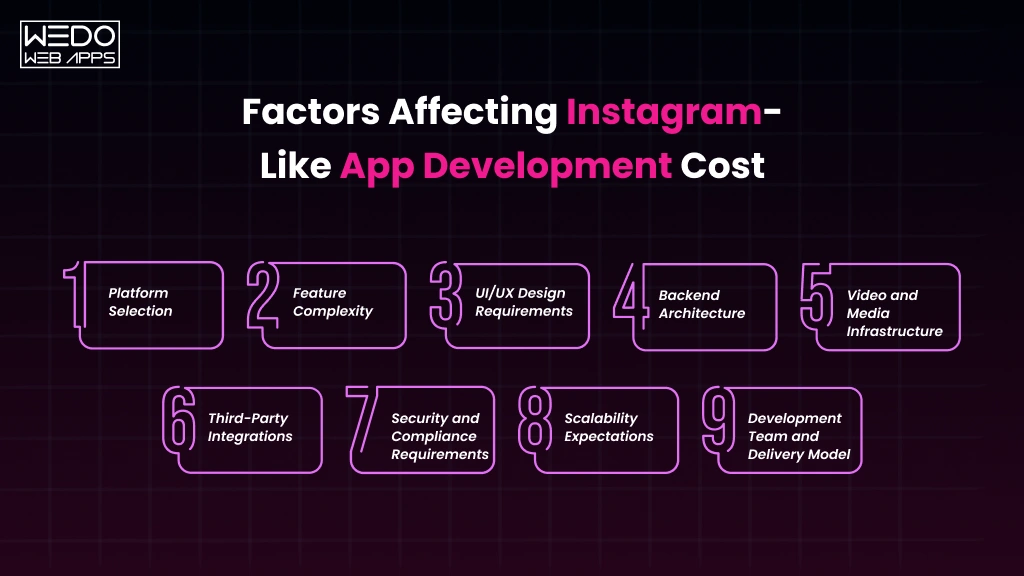
Factors Affecting App Development Cost
No two social media applications cost exactly the same to build.
Even if two businesses want similar features, their final budgets can differ significantly based on technical requirements, growth expectations, design preferences, and long-term business objectives. Understanding these variables can help decision-makers estimate the cost to develop an app like Instagram more accurately and allocate resources effectively.
1. Platform Selection
The platform you choose has a direct impact on development cost, timeline, and maintenance requirements.
Businesses typically choose between:
- iOS app development
- Android app development
- Cross-platform app development
Developing separate native applications for iOS and Android often requires more development time and resources. Cross-platform frameworks such as Flutter and React Native can reduce initial development costs while accelerating time-to-market.
For startups launching their first social media product, cross-platform development is often the most cost-effective approach.
2. Feature Complexity
Feature requirements remain one of the largest contributors to the overall cost to develop app like Instagram.
Basic functionality such as user registration, profile creation, and content sharing requires significantly less effort than advanced capabilities such as:
- Real-time messaging
- Video streaming
- AI-powered recommendations
- Live broadcasting
- Content moderation systems
- Advanced search and discovery
As feature complexity increases, so do development hours, testing requirements, and infrastructure needs.
3. UI/UX Design Requirements
Design plays a critical role in the success of social media platforms.
A simple interface focused on usability may require a moderate design investment. However, businesses seeking highly customized user experiences, advanced animations, personalized user journeys, and premium visual elements should expect additional design and development costs.
Because social applications compete heavily on user experiences, investing in intuitive and engaging design can significantly influence user retention and growth.
4. Backend Architecture
The backend serves as the foundation of every social networking application. It manages:
- User data
- Content storage
- Authentication
- Notifications
- Messaging
- Analytics
- Platform administration
Applications designed for a few thousand users require a very different architecture than platforms expected to support hundreds of thousands or millions of users. As scalability requirements increase, backend complexity and development costs rise accordingly.
5. Video and Media Infrastructure
Video-focused platforms typically require higher budgets than text-based or image-based applications.
Features such as:
- Video uploads
- Reels
- Live streaming
- Video processing
- Media compression
- Content delivery optimization
require specialized infrastructure and additional engineering effort.
This is one of the primary reasons why modern social media app development cost estimates vary so widely across projects.
6. Third-Party Integrations
Many social applications rely on external services to accelerate development and enhance functionality.
Common integrations include:
- Social logins
- Payment gateways
- Cloud storage services
- Analytics platforms
- Push notification services
- Video processing tools
- AI and machine learning platforms
While third-party tools can reduce development time, they may introduce recurring licensing and usage costs that should be considered during budgeting.
7. Security and Compliance Requirements
As user data volumes increase, security becomes increasingly important. Businesses often implement:
- Multi-factor authentication
- Data encryption
- Privacy controls
- User verification
- Fraud prevention systems
- Regulatory compliance measures
Applications operating in regulated industries such as healthcare, finance, or education may require additional compliance-related investments that increase overall development costs.
8. Scalability Expectations
One of the most overlooked factors affecting app development cost is scalability planning.
A platform designed for 5,000 users can be built differently than one expected to support 500,000 users.
Planning for growth may require:
- Scalable cloud infrastructure
- Database optimization
- Load balancing
- Content delivery networks
- Performance monitoring systems
While these investments increase upfront costs, they help prevent expensive reengineering efforts as the platform grows.
9. Development Team and Delivery Model
The composition of the development team also influences project costs.
Businesses may choose:
- Freelancers
- In-house developers
- Dedicated development teams
- Full-service app development companies
Each option offers different advantages in terms of expertise, project management, scalability, and long-term support. The best choice often depends on project complexity, internal capabilities, and business objectives.
Ultimately, the most accurate way to estimate the Instagram-like app development cost is to evaluate the combination of features, platforms, scalability requirements, and business goals rather than relying on generic pricing averages. A clear product roadmap helps businesses prioritize investments and avoid unnecessary development expenses.
MVP vs Full Instagram Clone – Which Should You Build?
One of the biggest mistakes businesses make when estimating the cost to develop an app like Instagram is assuming they need every feature from day one.
In reality, most successful social media platforms start with a focused set of features designed to validate the concept, attract early users, and gather real-world feedback. Once the product demonstrates market demand, businesses can gradually introduce more advanced functionality based on user behavior and growth objectives.
The question is not whether you can build a full Instagram-like platform. The question is whether you should.
MVP vs Full Instagram-Like App Comparison
| Factor | Social Media MVP | Full Instagram-Like Platform |
|---|---|---|
| Estimated Cost | $30,000 – $60,000 | $150,000 – $500,000 |
| Development Timeline | 3 – 5 Months | 8 – 12+ Months |
| Feature Set | Core Features Only | Advanced Social Ecosystem |
| Investment Risk | Lower | Higher |
| Time to Market | Faster | Slower |
| User Feedback Collection | Earlier | Delayed Until Launch |
| Scalability Requirements | Moderate | High |
When an MVP Makes Sense
An MVP, or Minimum Viable Product, focuses on solving a specific problem for a specific audience.
Instead of building a complete social networking platform, businesses launch with the features necessary to deliver value and test assumptions.
A typical social media MVP may include:
- User registration and authentication
- User profiles
- Content posting
- Social feed
- Likes and comments
- Push notifications
- Basic administration tools
This approach allows startups to validate market demand before investing heavily in advanced functionality.
For founders operating with limited budgets, an MVP often provides the fastest path to launch and the lowest level of financial risk.
Benefits of Building an MVP First
Launching an MVP can help businesses:
- Validate product-market fit
- Reduce initial development costs
- Enter the market faster
- Gather real user feedback
- Attract investors more effectively
- Prioritize future features using real data
Many successful platforms evolved significantly after launch because they learned what users actually wanted rather than relying solely on assumptions during development.
When a Full Instagram-Like Platform Makes Sense
A full-featured social platform may be appropriate when businesses have:
- Established market demand
- Significant funding
- Clear monetization strategies
- Existing user communities
- Long-term growth objectives
These platforms typically include advanced functionality such as stories, reels, real-time messaging, video streaming, AI-powered recommendations, advanced search and discovery, creator monetization tools, comprehensive analytics, etc.
While these features can improve engagement and retention, they also increase the overall Instagram app development cost, development timelines, and operational complexity.
The Cost of Building Too Much Too Early
One of the most common reasons digital products exceed budget expectations is overdevelopment during the initial launch phase.
Businesses often invest heavily in features users may never use or value.
For example, a niche fitness community may achieve strong user engagement with content sharing, comments, and messaging alone. Investing in advanced recommendation algorithms or complex video infrastructure before validating demand can increase costs without delivering immediate business value.
A phased development strategy often produces better results because investment decisions are based on actual user behavior rather than assumptions.
Recommended Approach for Most Startups
For most startups and growing businesses, launching with an MVP is the most practical strategy.
Start by building the core experience your audience needs. Once engagement grows and user feedback becomes available, expand the platform with additional features that support retention, monetization, and long-term growth.
This approach reduces risk, shortens time-to-market, and provides a clearer path to scaling without unnecessarily increasing the social media app development cost during the early stages of the project.
Hidden Costs Most Founders Overlook
When businesses calculate the cost to develop an app like Instagram, they often focus entirely on design and development expenses.
However, launching the application is only the beginning.
Social media platforms require continuous investment in infrastructure, maintenance, security, and performance optimization to ensure a reliable user experience. Ignoring these expenses can lead to inaccurate budgeting and unexpected costs after launch.
Before starting development, founders should understand the total cost of ownership rather than focusing solely on the initial development budget.
Cloud Hosting and Infrastructure
Every social media application requires infrastructure to store content, process user activity, and deliver data efficiently.
As the platform grows, businesses often need to invest in:
- Cloud servers
- Databases
- Load balancing
- Backup systems
- Performance monitoring
Infrastructure costs vary based on traffic volume, user activity, and content consumption. Applications with thousands of active users naturally require larger infrastructure investments than newly launched platforms.
Media Storage and Content Delivery
Photos and videos are among the most resource-intensive components of social media platforms.
Every uploaded file must be:
- Stored securely
- Optimized for performance
- Delivered quickly across different regions
- Protected against data loss
Businesses frequently use Content Delivery Networks (CDNs) and cloud storage services to improve performance and reduce loading times.
As media libraries grow, storage and delivery costs increase accordingly.
Maintenance and Feature Updates
Launching an application does not eliminate development needs.
Mobile operating systems, third-party services, security standards, and user expectations evolve constantly. To maintain platform stability and competitiveness, businesses typically release updates throughout the year.
Ongoing maintenance often includes:
- Bug fixes
- Performance improvements
- Security updates
- Compatibility updates
- Feature enhancements
Many businesses allocate an annual maintenance budget to ensure the platform continues operating smoothly after launch.
Security and Data Protection
Security becomes increasingly important as user numbers grow.
Social networking platforms manage large volumes of user-generated content and personal information, making them attractive targets for malicious activity.
Common security-related investments include:
- Security audits
- Vulnerability testing
- Data encryption
- Account protection measures
- Threat monitoring systems
These costs may not be visible to end users, but they play a critical role in protecting the platform and maintaining user trust.
Third-Party Service Costs
Many modern social media applications rely on external services to support specific functionality.
Examples include:
- Push notifications
- Analytics platforms
- Authentication services
- Payment gateways
- AI and machine learning tools
- Communication services
While these integrations accelerate development and improve functionality, they often introduce recurring monthly or usage-based fees.
Content Moderation and Community Management
As user-generated content increases, maintaining platform quality becomes more challenging.
Businesses may need moderation systems to:
- Review reported content
- Detect spam
- Prevent abuse
- Enforce community guidelines
Depending on platform size, moderation may involve automated tools, dedicated moderation teams, or a combination of both.
Scaling Costs as User Growth Increases
One of the most overlooked aspects of social media app development cost is scalability.
The infrastructure that supports 5,000 users may not be sufficient for 100,000 users.
As engagement grows, businesses often need to invest in:
- Additional server capacity
- Database optimization
- Advanced caching solutions
- Improved monitoring tools
- Performance engineering
While these investments support growth, they should be considered during the planning stage rather than after performance issues appear.
Development Cost Is Only Part of the Investment
Many founders ask, “How much does it cost to build an app like Instagram?”
A more practical question is:
“How much will it cost to launch, maintain, and scale the platform successfully?”
The answer includes far more than development alone. Businesses that plan for infrastructure, maintenance, security, and future growth from the beginning are often better positioned to scale efficiently and avoid unexpected expenses after launch.
Understanding these hidden costs helps create a more realistic budget and ensures the platform remains sustainable as user adoption increases.
How Long Does It Take to Build an App Like Instagram?
The timeline to build an Instagram-like application depends on the project’s scope, feature requirements, design complexity, and development approach.
While many founders focus primarily on budget, time-to-market is equally important. A shorter development timeline can help businesses validate ideas faster, respond to market opportunities, and begin generating user feedback sooner.
The good news is that not every social media platform requires a year-long development cycle. Most businesses can launch an MVP significantly faster by focusing on core functionality first.
Estimated Development Timeline by Project Scope
| App Type | Estimated Timeline |
|---|---|
| Basic Social Media MVP | 3 – 5 Months |
| Mid-Level Social Media App | 5 – 8 Months |
| Advanced Instagram-Like Platform | 8 – 12 Months |
| Enterprise Social Network | 12+ Months |
While these estimates provide a general benchmark, actual timelines vary depending on project requirements and the development team’s execution process.
Discovery and Planning Phase
Every successful social media application begins with planning.
During this stage, businesses define:
- Business objectives
- Target audience
- Core features
- User journeys
- Technical requirements
- Product roadmap
Investing time in planning often reduces costly revisions later in the development process.
Estimated Timeline: 2 – 4 Weeks
UI/UX Design Phase
Once requirements are finalized, the design team creates the user experience and interface.
This phase typically includes:
- Wireframes
- User flows
- Visual designs
- Interactive prototypes
- Design validation
Because social media applications rely heavily on user engagement, design quality can have a direct impact on adoption and retention.
Estimated Timeline: 3 – 6 Weeks
Application Development Phase
Development is usually the longest stage of the project.
Frontend and backend teams work together to build:
- User authentication
- Profiles
- Content feeds
- Media uploads
- Messaging systems
- Notifications
- Administrative tools
The complexity of these features significantly influences both the timeline and the Instagram app development cost.
Estimated Timeline: 8 – 24+ Weeks
Testing and Quality Assurance
Before launch, every feature must be tested across multiple devices, operating systems, and usage scenarios.
Testing typically covers:
- Functional testing
- Performance testing
- Security testing
- Usability testing
- Device compatibility testing
A thorough testing process helps reduce launch risks and improve overall product quality.
Estimated Timeline: 2 – 6 Weeks
Launch and Deployment
After testing is completed, the application is prepared for release.
This stage often involves:
- App Store submission
- Google Play submission
- Infrastructure deployment
- Performance monitoring setup
- Analytics configuration
Although deployment is one of the shortest phases, proper preparation is critical for a successful launch.
Estimated Timeline: 1 – 2 Weeks
What Causes Development Delays?
Several factors can extend project timelines:
- Expanding feature requirements
- Frequent scope changes
- Complex integrations
- Extensive customization
- Delayed stakeholder feedback
- Scalability requirements
The more clearly project requirements are defined at the beginning, the easier it becomes to maintain development schedules and control costs.
How Can Businesses Reduce Development Time?
Businesses looking to accelerate time-to-market often:
- Launch with an MVP
- Prioritize essential features
- Use cross-platform development
- Follow an agile development process
- Work with experienced development teams
These strategies can help reduce development timelines without compromising product quality.
Ultimately, the fastest path to launching a social media platform is not building fewer features. It is building the right features first. A focused product roadmap allows businesses to validate ideas sooner, control budgets more effectively, and scale based on actual user demand.
How Startups Can Reduce Social Media App Development Cost
Building a social networking platform does not necessarily require a massive budget.
Many successful products begin with limited resources and scale gradually as user adoption increases. The key is to invest strategically rather than attempting to replicate every Instagram feature from day one.
If you are concerned about the cost to develop an app like Instagram, the following strategies can help reduce expenses while maintaining a strong foundation for future growth.
1. Focus on Core Features First
One of the most common reasons development costs increase is feature overload.
Founders often try to launch with every feature available on established platforms such as Instagram, TikTok, or LinkedIn. However, many of these features were introduced years after those platforms launched.
Instead of building everything at once, focus on features that directly support your business goals and user needs.
For most social media startups, the initial feature set can include:
- User registration and authentication
- User profiles
- Content sharing
- Social Feed
- Likes and comments
- Push notifications
Launching with a focused feature set can significantly reduce both development costs and time-to-market.
2. Start With an MVP
An MVP allows businesses to validate product-market fit before making larger investments.
Rather than spending hundreds of thousands of dollars upfront, startups can launch a functional product, gather feedback, and prioritize future development based on actual user behavior.
Benefits of an MVP approach include:
- Lower initial investment
- Faster launch timelines
- Reduced business risk
- Better feature prioritization
- Easier investor validation
For many startups, an MVP is the most effective way to manage Instagram app development cost while maintaining growth flexibility.
3. Choose Cross-Platform Development
Developing separate applications for iOS and Android can increase both development time and cost.
Cross-platform frameworks such as Flutter and React Native allow businesses to use a shared codebase across multiple platforms.
Advantages include:
- Faster development
- Lower initial costs
- Easier maintenance
- Consistent user experience
For startups targeting both Android and iOS users, cross-platform development often provides the best balance between performance and budget.
4. Prioritize Scalability Without Overengineering
Scalability is important, but many startups make the mistake of preparing for millions of users before acquiring their first thousand.
A more practical approach is to build a scalable foundation that can evolve as demand grows.
This allows businesses to avoid unnecessary infrastructure expenses while still supporting future expansion when needed.
5. Leverage Proven Third-Party Solutions
Building every component from scratch can dramatically increase development costs.
Many social media applications successfully integrate existing solutions for:
- Authentication
- Push notifications
- Analytics
- Cloud storage
- Media processing
- Payment processing
Using proven technologies can reduce development effort, accelerate launch timelines, and improve reliability.
6. Make Data-Driven Feature Decisions
Every feature added to a platform increases development effort, testing requirements, maintenance responsibilities, and long-term costs.
Before introducing new functionality, businesses should evaluate:
- User demand
- Business impact
- Revenue potential
- Development complexity
This approach helps ensure that every investment contributes meaningful value to the product.
7. Partner With an Experienced Development Team
Development mistakes are often more expensive than development itself.
Poor architecture decisions, scalability issues, security vulnerabilities, and inefficient workflows can lead to costly rework after launch.
Working with an experienced mobile app development team can help businesses:
- Define realistic budgets
- Prioritize features effectively
- Select appropriate technologies
- Avoid common development pitfalls
- Accelerate time-to-market
The right development partner focuses not only on building the application but also on aligning technical decisions with business objectives.
Reducing Cost Should Never Mean Reducing Quality
The goal is not to build the cheapest social media app possible.
The goal is to build the right product with the right features at the right stage of growth.
Businesses that focus on validating ideas early, prioritizing high-impact features, and making strategic development decisions are often able to control social media app development cost more effectively while creating a stronger foundation for long-term success.
How to Choose a Mobile App Development Company for a Social Media App
Choosing the right development partner can have as much impact on project success as the budget itself.
Many businesses focus heavily on the cost to develop an app like Instagram, but selecting the wrong development team can lead to delays, scalability issues, poor user experiences, and unexpected expenses later in the project lifecycle.
Whether you’re building a niche community platform, creator network, professional networking application, or large-scale social ecosystem, evaluating development partners carefully can help reduce risk and improve long-term outcomes.
Look Beyond Development Cost
Price is important, but it should not be the only decision factor.
An unusually low estimate may indicate:
- Limited feature understanding
- Incomplete project scope
- Inexperienced resources
- Future change request costs
- Scalability limitations
Instead of focusing solely on development cost, businesses should evaluate overall value, technical expertise, and long-term support capabilities.
Evaluate Relevant Industry Experience
Social networking applications introduce challenges that differ from many traditional mobile applications.
Features such as:
- Content feeds
- Real-time messaging
- Media management
- User engagement systems
- Recommendation engines
- Content moderation
require specialized experience.
When evaluating a development company, review previous projects, case studies, and technical capabilities related to social platforms, media-heavy applications, or community-driven products.
Assess Technical Expertise
The technology decisions made during development can directly affect performance, scalability, security, and future maintenance costs.
A reliable development partner should be able to explain:
- Recommended technology stack
- Platform strategy
- Scalability approach
- Security considerations
- Infrastructure planning
Businesses should feel confident that technical recommendations align with both current requirements and future growth plans.
Understand Their Development Process
A structured development process often leads to better project outcomes.
Ask potential partners how they handle:
- Discovery and planning
- Feature prioritization
- UI/UX design
- Development sprints
- Quality assurance
- Launch preparation
A clear process improves communication, reduces misunderstandings, and helps maintain project timelines.
Discuss Scalability Early
Many social media applications are built with growth in mind.
Even if the initial launch targets a small user base, the architecture should support future expansion without requiring a complete rebuild.
Development partners should be able to discuss:
- Scalability planning
- Cloud infrastructure
- Database growth strategies
- Performance optimization
- User growth management
These discussions are particularly important when estimating the long-term Instagram app development cost.
Review Post-Launch Support Capabilities
Launching the application is only the first phase of the product journey.
Ongoing support may include:
- Maintenance updates
- Security improvements
- Performance optimization
- Feature enhancements
- Infrastructure management
Businesses should understand what level of support will be available after launch and how future development requests will be handled.
Prioritize Communication and Transparency
Successful development projects rely on strong collaboration between business stakeholders and technical teams.
Look for partners that provide:
- Clear project estimates
- Transparent communication
- Regular progress updates
- Defined responsibilities
- Realistic timelines
Open communication often helps prevent budget overruns and project delays.
Choose a Partner That Understands Business Goals
The best development companies do more than write code.
They help businesses:
- Validate ideas
- Prioritize features
- Reduce development risk
- Plan for scalability
- Align technology decisions with business objectives
This strategic perspective is particularly valuable when building social media platforms, where user engagement, growth, and monetization are often just as important as technical functionality.
Ultimately, the right development partner should help you build a product that supports your long-term vision rather than simply delivering a list of requested features. Businesses that invest time in selecting the right team are often better positioned to control costs, accelerate growth, and maximize return on investment.
Real-World Budget Scenarios
Every social media application has unique requirements, making it difficult to assign a single development cost to every project. However, reviewing realistic scenarios can help founders and decision-makers understand how project scope influences both budget and timeline.
Scenario 1: Startup Creator Community App
A startup wants to build a niche platform where creators can share content, engage with followers, and build communities around their expertise.
Key Features
- User registration and profiles
- Content sharing
- Social feed
- Likes and comments
- Push notifications
- Basic messaging
- Admin dashboard
Estimated Cost: $30,000 – $60,000
Estimated Timeline: 3 – 5 Months
Ideal For
- Early-stage startups
- Creator communities
- Membership platforms
- Niche social networks
This approach allows founders to validate user demand before investing in advanced functionality.
Scenario 2: Fitness Social Platform
A fitness company wants to build a platform where users can share workout content, follow trainers, participate in challenges, and interact with community members.
Key Features
- User profiles
- Content sharing
- Video uploads
- Challenges and activity feeds
- Messaging
- Search and discovery
- Push notifications
Estimated Cost: $80,000 – $180,000
Estimated Timeline: 6 – 9 Months
Ideal For
- Fitness brands
- Wellness communities
- Coaching businesses
- Subscription-based platforms
Because video content plays a significant role, development costs increase due to additional infrastructure and media processing requirements.
Scenario 3: Enterprise Social Network
An enterprise wants to create a large-scale social platform designed for employee engagement, knowledge sharing, collaboration, and communication.
Key Features
- Advanced user management
- Real-time communication
- Video content support
- Analytics dashboards
- Enterprise integrations
- AI-powered recommendations
- Content moderation
- Advanced security controls
Estimated Cost: $250,000 – $500,000+
Estimated Timeline: 10 – 15 Months
Ideal For
- Enterprises
- Global organizations
- Corporate communities
- Industry collaboration platforms
Enterprise platforms require significant investment in security, scalability, and integration capabilities, which contributes to higher development costs.
Final Thoughts
The cost to develop an app like Instagram depends on much more than the number of features included in the application. Platform strategy, scalability requirements, infrastructure planning, user engagement goals, and long-term business objectives all influence the final investment.
While some businesses may only require a focused MVP to validate a new idea, others may need advanced social networking platforms capable of supporting large user communities, complex interactions, and enterprise-grade functionality.
The most successful social media products are rarely built by launching every possible feature at once. They are built by identifying a specific audience, solving a clear problem, and expanding strategically based on user demand and business growth.
Before starting development, take time to define your goals, prioritize essential functionality, understand long-term operating costs, and create a roadmap that aligns technology investments with business outcomes. A well-planned approach can help reduce risk, improve time-to-market, and maximize the return on your social media app development investment.
If you’re evaluating the feasibility of a social media platform, consulting with an experienced mobile app development team can help you estimate costs accurately, identify potential challenges early, and build a scalable product roadmap tailored to your business objectives.