skip to content

Is Magento Right for Your Business? A Practical Suitability Guide

Choosing an ecommerce platform is not just a technical decision, it directly affects your costs, scalability, and day-to-day operations. Many businesses consider Magento because of its reputation for flexibility and power, but a common question remains: Is Magento right for your business, or will it introduce unnecessary complexity?

Magento, also known as Adobe Commerce, is widely recognized for supporting advanced ecommerce requirements. However, its capabilities are best suited for certain types of businesses, while others may be better served by simpler platforms.

This guide is designed to help you evaluate Magento objectively. Rather than promoting a specific solution, it focuses on qualification. It explains who Magento works best for, who should avoid it, and how factors such as business size, operational complexity, and long-term growth plans should influence your decision.

What Is Magento and What Is It Designed For?

Magento is a feature-rich ecommerce platform built to support businesses with complex requirements. It is designed to handle advanced catalog structures, custom workflows, multi-store setups, and deep system integrations.

Unlike simpler hosted platforms, Magento offers a high level of control and extensibility. This makes it suitable for businesses that need flexibility. At the same time, that flexibility comes with added responsibility in terms of configuration and ongoing management.


Request a free Magento platform assessment

Types of Businesses Magento Is Well Suited For

Growing and Mid-Sized Ecommerce Businesses

Magento is often a good fit for businesses that have moved beyond basic ecommerce needs. As product catalogs grow and customer journeys become more complex, Magento’s architecture can support these changes without requiring a platform switch.

Businesses with Complex Product Catalogs

If your store manages thousands of products, multiple attributes, variations, or pricing rules, Magento provides the structure needed to handle that complexity efficiently.

B2B and Wholesale Ecommerce Models

Magento includes features that support B2B ecommerce, such as company accounts, custom pricing, and approval workflows. These capabilities make it suitable for manufacturers, wholesalers, and distributors.

Businesses Planning Long-Term Scalability

Magento is designed with scalability in mind. Businesses that expect growth in traffic, orders, or geographic reach often benefit from Magento’s ability to scale without major architectural changes.

When Magento May Not Be the Right Choice

Magento is a powerful platform, but power alone does not determine suitability. In some situations, choosing Magento can introduce unnecessary complexity.

Magento may not be the right choice if:

  • You are launching a very early-stage or experimental store
  • Your product catalog is small and unlikely to grow significantly
  • You only need basic ecommerce functionality with minimal customization
  • You prefer an all-in-one hosted platform with minimal technical involvement
  • You do not have access to technical resources or a development partner

In these cases, simpler platforms often allow faster setup, lower operational overhead, and easier management.

Magento Compared to Other Ecommerce Platforms

Many businesses compare Magento with platforms such as Shopify when evaluating options. Shopify focuses on simplicity and speed of setup, while Magento emphasizes flexibility and control.

For businesses deciding between platforms, understanding these trade-offs is critical. A detailed comparison of Magento vs Shopify can help clarify which platform aligns better with your business model and long-term goals.

PlatformBest ForCore Strength
Magento (Adobe Commerce)Businesses needing customization and scalabilityFlexibility and control
ShopifyBusinesses wanting fast setup and easy managementSimplicity and convenience
WooCommerceContent-focused sites adding ecommerceWordPress-based flexibility

Magento is built for control and extensibility.

Simpler platforms are built for speed and ease of use.

The right choice depends on how complex your business requirements are today and in the future.


Book a free Magento platform consultation

Key Factors to Consider Before Choosing Magento

Business Size and Growth Plans

Consider not only where your business is today, but where it is heading. Magento is often chosen for its ability to support future growth.

Operational Complexity

Evaluate how complex your pricing, fulfillment, and customer management processes are. More complexity often favors Magento.

Budget and Maintenance Capacity

Magento is an investment in flexibility. Businesses should be prepared to manage ongoing updates and platform maintenance.

Magento Cost Reality. What Businesses Should Understand

Magento itself is not inherently expensive, but it is a platform designed for customization and flexibility, which affects overall cost.

Businesses evaluating Magento should be aware of the following cost components:

  • Platform edition (Open Source vs Adobe Commerce)
  • Custom development and configuration
  • Hosting and infrastructure
  • Ongoing maintenance, updates, and security patches

Unlike fully hosted platforms, Magento requires technical involvement to build, optimize, and maintain. For businesses that need advanced functionality, this investment is often justified. For simpler stores, these costs may outweigh the benefits.

Buyer Perspective:

Magento is best viewed as an investment in long-term capability rather than a low-cost entry platform.

Signs Magento Might Be the Right Fit for You

  • Your store requires advanced pricing or customer segmentation
  • You operate multiple storefronts or regions
  • Your business relies on integrations with ERP or CRM systems
  • You plan to scale significantly over time

If several of these apply, Magento may be a strong candidate.

Quick Self-Check. Is Magento a Good Fit for Your Business?

Use the checklist below to quickly assess suitability:

  • My store requires advanced pricing or customer segmentation
  • I manage a large or growing product catalog
  • My business needs custom workflows or integrations
  • I plan to scale significantly over time
  • I have access to technical resources or a development partner

If you check several of these, Magento is likely a strong candidate.

If most do not apply, a simpler ecommerce platform may be a better choice.

How Magento Supports Long-Term Ecommerce Strategy

Magento is not just a tool for selling products. It is a platform that can evolve with your business. Its modular architecture allows features to be added or adjusted as requirements change, making it suitable for businesses with long-term digital strategies.


Talk to a Magento development expert

Final Thoughts. Making the Right Platform Choice

Magento is a powerful ecommerce platform, but power alone does not determine suitability. The right choice depends on your business size, complexity, resources, and long-term goals.

By understanding who Magento is designed for and who may be better served by other platforms, businesses can make confident decisions that avoid unnecessary complexity while supporting sustainable growth.

Businesses that confirm Magento is the right fit often work with a Magento development partner to ensure proper architecture, scalability, and long-term performance.


Get a free Magento ecommerce consultation

45 Stellar Mobile App Ideas that will Kickstart your Business

Where do we go without our mobile phones? What are we without our mobile phones? It’s a bitter truth to digest; we humans in the 21st century are so dependent on our mobile phones that we cannot imagine being away from them even for a single day. Owing to the fact, the mobile app industries are not just profited with this but also flooded with unique and engaging app inquiries so that businesses can manage the tremendous amount of users in the growing digital market. In this first quarter of 2020, a report published by statistia stated that the Google Play app store encompasses approx. 2.9 million applications, whereas the Apple store has made it to 1.85 million applications till the first quarter of 2020. With such huge figures, it is merely impossible for themobile app development company to find app ideas for its clients. App Ideas that are unique as well as enticing and have never been heard or thought of before. Mobile Applications dominate the entire internet market. Whether it is small to medium sized business or a big enterprise, everyone is getting their dedicated mobile apps developed to attract more customers through mobile devices. So if you have an unusual mobile app idea for your business, we are glad that you’ve come here. From the best mobile app frameworks 2019 to advanced frameworks of 2021, technology differs in a whole lot of ways as we see what revolutionary changes the IT industry has brought in our day-to-day lives. WeDoWebApps LLC has a talented pool of developers and designers that use the top 10 mobile app development frameworks to produce the best application that meets your business needs. Here in this article, we have listed 101 Mobile App Development ideas separated by various industries. But before knowing about the best mobile app ideas 2021, it is essential to know various mobile app development types. Understanding different types of mobile apps will help you select the platform that will be suitable for your business niche. Read further to know about the types of mobile app development.

Types of Mobile Applications

Based on the application’s technical features, they can be grouped into three different categories: native mobile applications, web applications, and hybrid applications. But what are these? Follow the blog to know more about mobile app development types

  1. Native Applications: Native applications are those which are built to use on a particular platform or an operating system. 
  2. Web Applications: Web Application is a program stored on the remote server and delivered over the Internet through a browser interface. Web apps are comparatively more reactive than websites and can operate on any operating system, be it Android or iOS.
  3. Hybrid Applications: Like the native apps run on the device and written with the web technologies like HTML, CSS, and Javascript, hybrid applications run under the native containers and leverage the browser engine.

These are various types of mobile applications that can be developed to potentialize your business. Now that we know the different types of mobile apps, let’s discuss some of the fantastic mobile app ideas that can steal the market in 2021.

45 Best Mobile App Development Ideas in 2021

Remember the times when one would jokingly say, “I wish there was an app for that.” Now, this is the time where there is an app for almost everything one wishes for. In this blog, along with the trending app ideas covered for practically every industry, we have also listed some of the best app objectives that one can be considered for a startup. So, let’s have a quick look at the best Mobile App Development Ideas 2021. 

Healthcare App Ideas

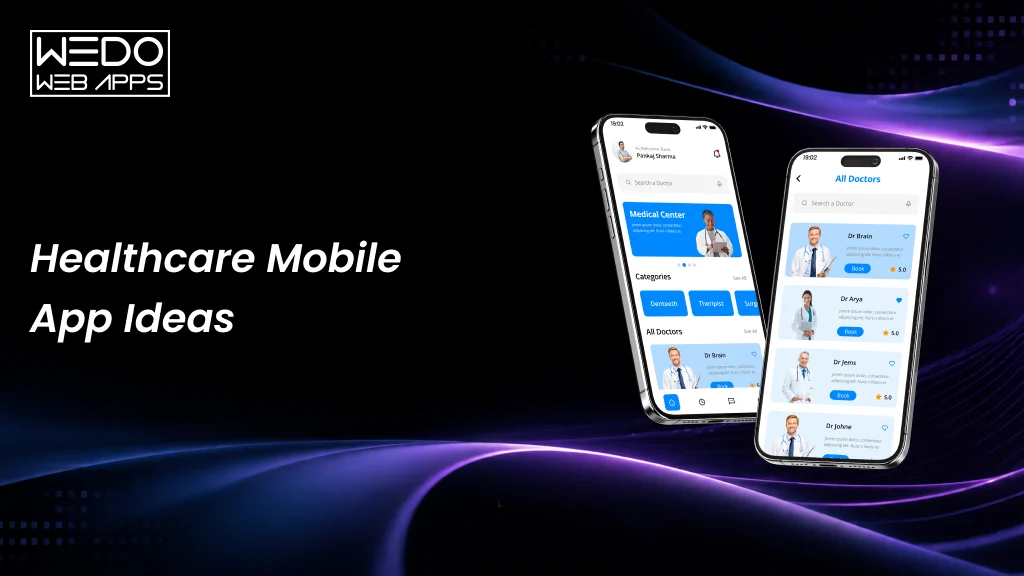
Healthcare App IdeasMedical Applications, mHealth solutions, or, you can say, Healthcare application solutions for patients have now acquired an important position in the market. Development and usage of healthcare applications are increasing along with the global growth of smartphone usage. Here are some of the trending Healthcare App Ideas for your business.

1. Personal Medical Records App

This app idea is basically a diary kind of application where patients can add their personal health-related records manually and share them with the doctor whenever necessary. This will enable the doctors to know about the patient’s health history and prescribe medicines accordingly or take any other further action.

2. Healthcare Monitoring App

Healthcare Monitoring Apps are mainly developed to keep track of chronic conditions like diabetes, sugar levels, cancer, blood pressure, and much more. The app allows doctors or healthcare professionals to monitor and track the health conditions of every patient by keeping their health history and providing the perfect treatment or prescription to the patients.

3. Appointment Booking App

Appointment Booking apps are usually built for the doctor’s or healthcare professional’s benefits. Various medical practitioners or doctors develop their own mobile applications for their clients to book an appointment. With this application, patients can even check the availability of doctors. Another alternative is to create a portal for the patients and the doctors to connect with each other to share the medical problems and solutions, respectively. 

4. Mental Health Application

Stress, Depression, and a sad lifestyle are some of the significant mental issues observed in people these days. Hence, you can develop an application mainly for people fighting with these mental health issues. One of the most innovative app ideas is to create an app that can track people who are feeling lonely or need urgent help. Lack of sleep is another mental illness faced by people worldwide. The high work pressure has led to so many people being sleep-deprived. You can help these users by developing a relaxing music application. Also, the app should help users in developing a fixed routine for sleep.

5. Pharmacy Delivery App

The COVID-19 pandemic has forced people to stay indoors for a longer time. During this pandemic, we ordered many things online, and one such thing was medicines or other pharmacy-related products. No doubt the situation is getting better day by day, but many people still fear going outdoors. Keeping this in mind, you can develop an application where the users will be able to upload the e-prescriptions on the application and will be able to order the medicines online. The demand for such applications is only going to increase with time. Hence, a pharmacy delivery app is an excellent idea if you are planning to launch a startup. 

6. Medical Translation App

One of the very best ideas for medical app development is the medical translation app for doctors. Many doctors have international patients who are unable to discuss their health issues properly due to the language barrier. Hence, a medical translation app can be very beneficial for the doctors and the staff as well. Doctors and staff can use this kind of application to understand the health issues of their patients and can prescribe the medication accordingly.

7. Online Therapy App

With an intention to make therapies accessible to as many people as possible, you can develop an Online therapy app to allow users to pay the subscription fees. In addition, such applications can help patients to reduce the hesitation of talking in person about their health matters.Much more study is done in the health sector, which can be done with such healthcare app development. In addition, professional therapists can also interact with each other and reach more patients and grow their networking. 

8. Recovery App for Drug Addicts 

Somewhere somehow, we all are addicted to something or the other. But some addictions can take the life out of you, take your time, take your everything, and put you on a different track in life. Alcohol addiction, caffeine addiction, Drug addiction, and many other addictions need to be abandoned as soon as possible. A drug recovery app can help patients get rid of their addictions and come back to their lives. WeDoWebApps LLC can help you develop an application that can help people get rid of any kind of addiction. 

9. General Health and Wellness Test App

General Health and Wellness Test Apps are used for the people who are either suffering from a disease or want to track their health with tools like blood pressure monitor, heart rate tests, or measure diabetes. In addition, these types of applications are used by people who want to track and record their health data on a regular basis. 

10. Health Reminder Apps

Health Reminder Apps work as alarms for the users to improve their health by reminding them to perform specific tasks and achieve their personal health goals. For instance, a medication reminder app can be developed to allow users to monitor medication intake and set reminders regarding the medicines and their dosage.A great example of this can be a Healthy Living app that provides users to track their daily intake of medications. You can even develop a water reminder app that reminds the users to consume water at regular intervals. Likewise, you can consider many different ideas for healthcare apps for your business.

Best Food App Ideas 

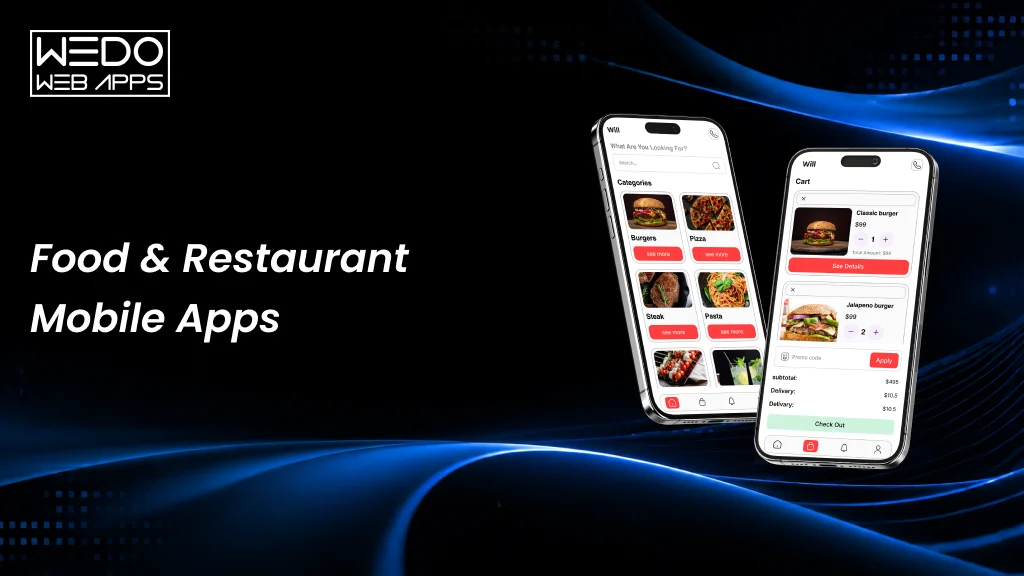
Best Food App IdeasThe food industry is an ever-evolving and developing sector. Food businesses do not lose their plot, given they always provide good food to their consumers. When it comes to opening a food business startup, developing a food application with the current tech can be beneficial for maintaining demand and supply balance. Hence, if you want your customers to use the strength of food on-demand apps using amazingly designed applications, below are some exclusive food app ideas that will promote your business online.

1. Grocery Delivery App

According to the report from Statista, an average person visits a grocery store approximately 1.6 times a week and an average of around 60 hours per year. Now imagine if there was an application that would have delivered the grocery items to your doorstep. Isn’t it so convenient?If you are planning to launch a startup in this field, you can build a grocery shopping and delivery app that will allow the customers to hunt for grocery stores near them and place an order with the shopkeeper to get the doorstep delivery done. 

2. Food Coupons and Discounts App

One of the most unique and brilliant food app ideas that will take no time in development and find the right audience. This app will give you alerts when any restaurant is offering discounts or a coupon offering free food. This will also help the restaurants in promoting their brands. Restaurant promotions take place the whole year, and providing food at discounted rates will increase sales and marketing across the world and will attract new customers. Many people stay unaware of such delicious offers and miss the deal. This is where such apps come into action and thereby provide a beneficial deal for the restaurants and the consumers as well. 

3. Calorie Tracker App 

The food you eat is directly related to your health. Therefore, the more healthy you eat, the fitter you will be. Therefore, tracking daily calories is essential. These Days, it has become very simple to track the calories. There are several applications available where people can track every calorie they eat to maintain their healthy life. 

4. Apps for Exploring Restaurants

Technology has made so many advancements in the current times. One such technological advancement is you can explore so many places sitting at home using AR technology. The same is the case with restaurants. Using Augmented reality, you can promote your restaurant business to maintain client satisfaction and engagement. Many visitors select restaurants on the basis of how lively the environment of the restaurants is. Using Augmented Reality, you can achieve this and attract new customers to your restaurant. 

5. Customized Cooking App

Many people love to eat the dishes with their preferred ingredients. So you can build a customized cooking application in which the customers would be able to choose their favorite cuisine and ingredients to get the dish cooked by an expert chef. This will make each and every customer of the restaurant feel special. To take your restaurant ahead of the competition, you should introduce such an application. Moreover, you can also add the necessary ingredients to the cuisine in order to maintain the authenticity of your food. This will preserve the uniqueness of your business. 

6. Food Delivery App

 Food Delivery, as the name suggests, these applications are used for doorstep food delivery. For food lovers, this is the only way to get delicious food delivered at their doorsteps. This can be done by just enabling the location of their phones in the application.In case you are planning to launch an online food delivery application but do not have the source to deliver the food to the customers, you can hire a third party for the food delivery like zomato, swiggy, UberEats, etc. Read more about 3 Leading On-Demand Food Delivery Platforms for Achieving Success in the Restaurant Industry

7. Food Recipe App

If you are a Foodie, you might love cooking new dishes, watching YouTube, or reading books. What if these recipes come under an application? It would be very convenient. Isn’t it? You can develop an application with step-by-step guidelines to cook any dish. With this application, even inexperienced chefs can cook a great meal. You can even add different categories for various cuisines, which will help the user find cuisine and a dish they want quickly. 

8. Food Wastage Reduction App

We usually see a lot of food getting wasted at restaurants and homes. Therefore, a very unique and helpful idea is to develop a Food Wastage Reduction Application. A startup company looking to launch a food application can develop this app to provide the leftover food of the restaurants and homes to the poor individuals in need. As the poor and homeless population grows with time, developing such an app can benefit both the company and the poor people. 

9. Reviews and Rating Application

Nowadays, people choose the food and the restaurant based on the reviews and ratings of the restaurants posted on different websites. Therefore, any food ordering application comprises this type of feature as this helps the customers select food on the basis of customer reviews. And also help the owners know their weak points where improvements are needed. Therefore, a great startup idea is to develop a review and rating application where people can post their reviews in order to help other people select the best food. The owners can ask the people to post the feedback. This app will definitely help people get delicious food and owners in improving their services. 

10. Restaurant Reservation Application

What if you could make restaurant reservations from your phone while also getting cashback? Well, by developing a restaurant reservation app, it’s possible! Just by signing up to the account, the user can start making reservations at their favorite restaurants using the app. With every visit to an eligible restaurant across the city, you get points that can then be redeemed for cashback and coupons.

Fitness App Ideas

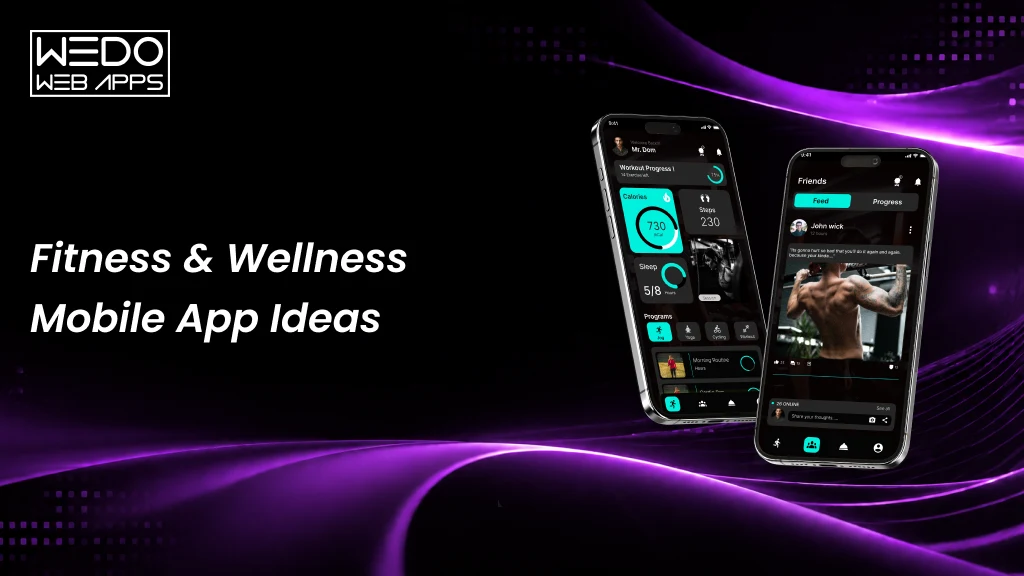
Fitness App IdeasHealth and Fitness are the primary concern for people of all ages these days. It is crucial to keep part of your body functioning well and avoid diseases that could stop us from performing our daily activities. Generally, the people who prefer to do gyming hire personal gym trainers and dieticians to stay fit and healthy. Therefore, developing fitness apps can be a very beneficial idea for starting your startup. Below are some of the latest and trendy fitness app ideas you can choose for your business.

1. Fitness Tracking Application

Fitness tracking apps are top-rated among every age group and around every corner of the world. Therefore, investing in fitness apps could be a great deal for your business. Generally, these kinds of apps take the data from the users and record their progress. Thus, these apps track every activity of the user and keep a record. Fitness Tracking Applications record the number of steps walked per day, the number of stairs climbed, number of push-ups completed, duration of time spent on a particular exercise, and other fitness measures. These days, many fitness apps are coming with fitness trackers. So, if you want to stay in the competition, develop a fitness application with the in-built fitness tracker. 

2. Workout and Exercise Guide Applications

These Apps are generally used by fitness freaks. These apps provide a set of exercises or a complete Workout guide to the people who love and want to be fit as per their requirements. Additionally, it also helps users to create and follow their regular workout and diet plans. 

3. Diet and Nutrition Guide Apps

The Diet and Nutrition apps guide the users with their diet plans and the nutrition they should take. These kinds of applications suggest what and what not to eat, guiding you with what you should eat in higher quantities and what you should stop eating to stay healthy and fit. If you are developing such apps, you can also add the feature of guiding the users with the right time to eat a particular food item. All these suggestions are given based on your daily workout plan. Therefore, developing such an application will definitely be profitable for your business. 

4. Fitness Assessment Application

People who are fitness freaks like to take their fitness assessments on a regular basis. If you are planning to launch a startup, then developing a fitness assessment application can give you a tremendous amount of profit. Fitness Assessment Applications are the ones that take weekly or monthly fitness assessments of the users to track their progress. For example, the app you will develop can take the data of weight loss, weight gain, user’s stamina, or the ability to practice heavy workouts, etc. 

5. One-On-One Fitness Consultation App

There might be many beginners who might be thinking of getting started with their fitness journey. But, unfortunately, these beginners do not trust workout guides, diet plans, etc., thereby needing one-on-one fitness consultation sessions with the fitness experts. Therefore, invest in an application that offers a personal consultation session for those fitness freaks who are initially unable to trust the diet plans and the workout guides. 

6. Yoga Application

Even though Yoga is not a gym-related activity but is related to people’s Fitness, many people do not get time from their daily activities to go to the yoga centers or the gyms to stay fit. For those people, a yoga application can be beneficial. If your niche is Yoga or Fitness, invest in developing a Yoga Application that will teach people to practice Yoga taking out time from their busy schedule. 

7. Fitness Video Tutorials Apps

If you are considering developing a fitness video tutorial application, you can provide fitness-related video tutorials made by expert fitness trainers. These applications are predominantly used by absolute beginners and do not know the proper technique for performing different exercises. Users can learn and perform the different workouts and physical exercises by watching the video tutorials on the application. 

8. Daily Fitness Activity Checklist

You can either create a separate application or add this feature into your complete fitness app; both would be suited. However, I suggest you go with the second option, as creating a separate app for the daily checklist makes no sense. A fitness checklist allows the users to check every fitness-related activity they compete on a particular day. It will help the users to make sure that they are not missing any fitness activity of the day. 

Educational App Ideas

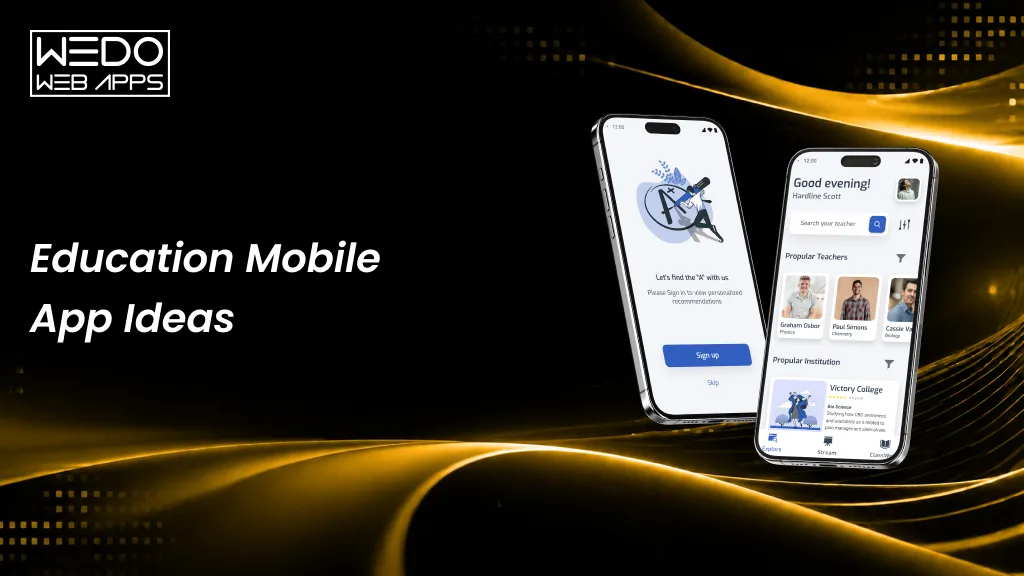
Educational App IdeasThe Coronavirus pandemic has hit humankind with the most massive waves of digitization. There is not a single industry spared from digitization, and the education industry is one of them. As we can see, almost everything has moved to online applications. There are so many educational applications available on the app store. How to get recognized in the competition then? Education applications have made the learning process easy and full of fun. Therefore, if you invest in developing educational applications, you will earn a huge profit. Here are some of the best and in-trend educational app ideas that will help you earn more.

1. Application for Handicapped Kids

Handicapped kids or the specially-abled kids having some or the other disabilities, education startups should feel honoured to develop an educational app for such people. These kinds of applications should be made keeping in mind that any type of disabled person can use that app easily. The features of this app may include connecting the students with the teachers, other students via calls or messages, listening and writing activities, and you can also have specially designed games for them. 

2. Student’s Progress Tracking Application

Schools and universities find it difficult to keep up with the progress of the students. As a result, it becomes difficult for the teachers to pick up the students who are the year’s best performers. Students’ progress tracking applications help the teachers keep track of the student’s performance in studies and other co-curricular activities. Teachers can allocate the grades according to the overall development of the students that are tracked in the application. The same application can also be used for student-teacher interaction and learning purposes. It will be a beneficial educational app idea for both the teachers and the students. 

3. Language Learning App

Today, students participate in exchange programs, international competitions, or foreign activities, allowing them to learn other languages. Therefore, developing a language learning app may be an excellent idea for people who want to learn different languages and will definitely benefit your business. You can add a unique functionality in your app where the students will be able to set a pre-decided time to learn the different languages of their choice. The application will remind them at that particular time to ensure that the students do not forget to remember. The users can also track the progress of their learning. This education app idea will make you stand out from your competitors. 

4. Competitive Exam Preparation Application

Many competitive exams like GRE, GMAT, SLAT, CAT, JEE, etc., require thorough learning and understanding of the concepts. Therefore, investing in an application that can benefit the entrance exam aspirants can make a massive profit for your business. A Competitive Exam Preparation application can be a savior for the students in stressful times. The application developed by you can provide essential questions and answers, checklists, ebooks, progress tracking, reference, to-do list, or anything required by the students. The entrance exam aspirants can even give mock tests and check their performance. 

5. Career Guidance Application

Choosing the right career path may be very challenging at times. However, selecting the wrong direction may destroy a student’s entire career. This is where a career guidance application comes into the actual film. A career guidance application can help students to select what’s best for their careers. You can even add the functionality for contacting expert career counselors to help the students choose the path that may take their careers to different heights. If you are ready to develop a career guidance application, you can also add a list of programs users should enroll in to make their future. The developers at WeDoWebApps LLC offer the best mobile app development gold coast; they will deliver the best application according to your requirements. 

6. Private Tutor Mobile App

The recent COVID-19 pandemic had a significant impact on the tutorship. Teachers and the students were unable to meet in person, cutting a tutors’ income too short. In such a case, developing a private tutor application can prove to be a great way to connect the teachers and the students as they will no longer be limited to any geographical position. Additionally, the app will allow the teachers and students to connect, no matter what the circumstances are. Therefore, making this type of application is one of the most excellent opportunities for your business. 

7. Question and Answer App

Question and Answer or Educational Applications add an exciting dimension to learning new things. If you are a startup and develop a question and answer application, you can rely on an app that allows users to increase their knowledge through frequent reading or posting answers. Most importantly, these learning apps are significant from a creative point of view; users can add new questions and answers at regular intervals or post answers to the already posted questions. Furthermore, you can keep these updates either free or paid; this will give you an opportunity to obtain significant revenue from your app. 

Banking and Finance App Ideas

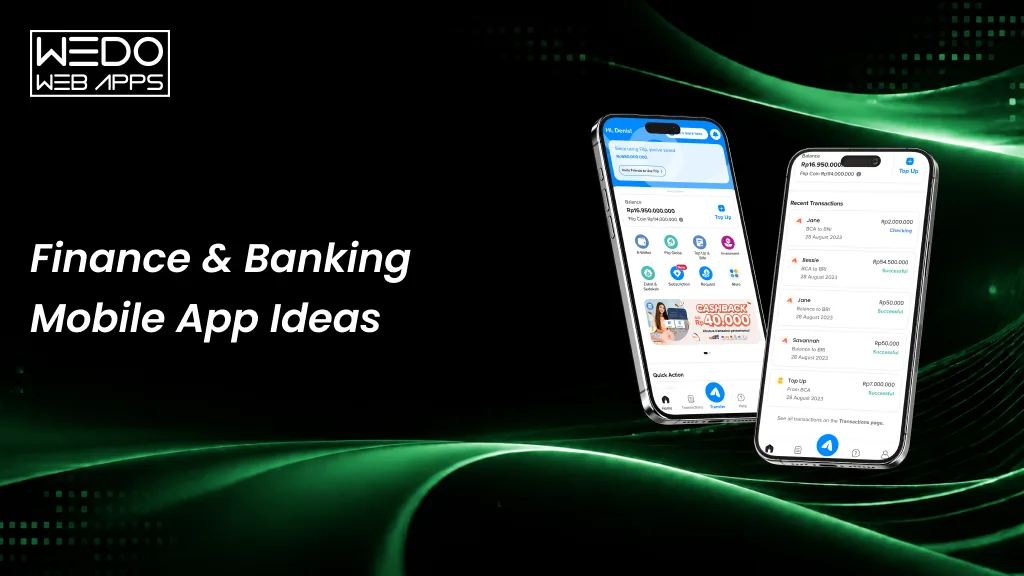
Banking and Finance App IdeasThe bank and finance apps manage all the transactions of a company or a person. In today’s rapidly growing world, in-person physical transactions are time-consuming and outdated; the world has moved on to the digital world, so have the banking and finance sectors. Banking and Finance Apps are real-world solutions for speeding up secure transactions. Read further to get some insight about banking and finance app ideas for your startup.

1. eWallets

eWallets are the most in-demand banking applications that offer users the convenience of making payments within the blink of an eye. With eWallets, users do not have to carry any physical wallet or credit/debit cards to purchase grocery, household items, or other products. A report from Grand View Research shows the popularity of eWallets and unveils that the global eWallet market will reach up to $7581 billion by 2024. Is there anything else we need to say about the popularity Mobile eWallets have gained? Therefore, you should consider developing a Mobile eWallet as a startup and step into the line of succession. 

2. P2P Payment Solutions

The peer-to-peer payment market has grown swiftly in no time. Google Pay, Venmo, Zelle, and PayPal are some of the notable examples of the P2P Payment Program. These payment programs are perfect for sending money to individuals such as acquaintances or relatives. Therefore, developing P2P payment solutions is a great idea for your startup business.People using these solutions can conveniently send money from their bank accounts to other people’s digital wallets. Furthermore, these apps are made to eliminate the need for any middlemen, allowing the users to save money on commission fees when they are doing transactions. If you plan to develop a P2P payment application, the most eminent technologies that can be used are NFC, voice commands, and facial recognition. 

3. Loan Lending App

These applications are primarily used to fill the gap between the people who want loans and the loan lenders. Using such apps, those people can connect and fulfill their requirements. A loan lending app can help lenders reach more customers and offer them loans at a higher interest rate. In the same way, it can also allow the borrowers to connect with various lenders and take loans from the one offering the loan at a lower interest rate. If you are developing a loan lending application, you need to ensure that you add privacy and security features to make users feel secure about their loans.

4. Crypto Exchange App

Cryptocurrency apps target users looking to enter the decentralized markets by dealing with cryptocurrencies. In these kinds of apps, users can choose from a variety of digital coins and exchange them for foreign currencies. One of the real benefits of crypto exchange apps is the information security of blockchain. These apps enable users to exchange one cryptocurrency with the other, receive crypto tokens for fiat money, and buy/sell cryptocurrencies. 

5. Personal Finance Management App

Developing a Personal Finance Management Application is another excellent idea for the startup mobile app idea. This app allows users to keep track of their spendings, investments, savings, and earnings. You can even add the unique functionality to categorize their expenses and set the monthly expenses limit. In addition, the app will give users an alarm when the expense crosses the set limit. A personal finance management app will help the users to smartly and efficiently manage their finances and savings. If you consider this idea for mobile app development, make sure that the app is user-friendly, functional, and appealing. Consider hiring a mobile app development company that will help you develop such applications. 

6. Financial Advisory Apps

These applications are developed for providing customized financial advice on the basis of user’s spending patterns and income for the entire future. In addition, these apps are smart enough to discover after-tax profits by examining the user’s expenses and assets. Additionally, the app automatically recommends some financial management solutions so that individuals can make informed decisions for their future investments. 

7. Blockchain Apps

Blockchain technology is getting famous with each passing day; people use cryptocurrency to make their transactions. Hence, developing a blockchain app that allows users to make transactions using cryptocurrency can be an innovative and the best idea for your startup. Veem, Circle, LAToken, We.Trade and PayStand are some of the notable examples of Blockchain applications. If you consider this app idea for your startup, make sure to go through the above applications to properly understand their business model, monetization strategy, and other requirements. 

8. Digital Banks

Users can open an account, trade, block or unblock cards, add beneficiaries, and much more by utilizing digital banks that need only a few clicks on the developed applications. Thus, digital banking apps have already served a large audience online in this digital era. Moreover, because of the integration of AI chatbots, such an application is ideal for financial assistance and quick consultations. 

9. RegTech Applications

RegTech App is yet another finance and banking app idea that is fascinating to the market. These applications allow financial companies and institutions to obey both local and global standards and follow the rules for the correct practice in finance. These kinds of applications will automate the major processes like customer identity verification, report compilation and submission, transaction monitoring, and many more. The goal of such applications is to practice customer retention and seek customer satisfaction. Therefore, regTech applications can prove to be the best idea for your startup.

10. Insurance Apps

Insurance is the best service for every banking and financial institution. Insurance tech apps offer highly specialized and personalized options and risk analysis. As a result, insurance companies can accelerate operations and improve the quality of their customer service by using FinTech app solutions.  Leverage expert mobile app development services in Brisbane and Melbourne for innovative iPhone solutions tailored to your business needs.

Look at these best single page apps to find inspiration for your business.

Summing Up

Regardless of which app idea you choose for your startup, the success of a mobile app depends on the mobile app development company you have hired. It also includes the expertise, and the efforts the development team has put into crafting an app. Sometimes a highly-featured mobile application with the most complex functionalities fails to reach the targeted audience, whereas a simple yet intelligently developed application reaches the desired goal. Therefore, the only difference is how the mobile app development company transforms your app idea into a final product. Since 2021 has shown a massive shift to the digital world, there will be an application present for almost everything you wish to do in the near future. So, why not grab the opportunity now? If you have an app idea from the above list that completely suits your business requirements, or you have any other app idea in your mind that would hit the market differently, contact us and discuss your query. We will develop a promising application from your unique vision to transform the idea into reality. 

Top Profitable Mobile App Industries (Use Cases, Business Models & ROI Insights)

Introduction – Which Industries Actually Benefit from Mobile Apps

Which industries truly generate revenue from mobile apps, not just downloads, engagement, or vanity metrics?

The answer is not as obvious as it used to be.

While many sectors have adopted mobile technology, only a subset of profitable mobile app development industries consistently deliver measurable business outcomes, whether that is direct revenue, operational efficiency, or long-term customer value. For decision-makers, the real question is no longer “Should we build an app?” but “Which industry use cases justify the investment?”

Today, mobile apps are no longer standalone digital products. They are:

  • Revenue channels
  • Customer experience layers
  • Operational tools
  • And in many cases, entire business models

From fintech platforms generating transaction-based income to logistics apps optimizing supply chain visibility, the industries that benefit from mobile apps the most are those that align technology with clear monetization strategies.

This guide is designed to go beyond generic lists of top industries using mobile apps. Instead, it breaks down:

  • Industries that benefit from mobile apps based on real-world adoption and ROI
  • Mobile apps by industry use cases that solve actual business problems
  • Mobile app business models by industry (how companies make money, not just build apps)
  • Industry sectors for mobile app growth in recent years and beyond

Whether you are a startup evaluating your next product or an enterprise leader planning digital transformation, this breakdown will help you identify where mobile apps create real, scalable business value.

Ultimately, the success of a mobile app is not defined by downloads; it is defined by how effectively it drives business outcomes in the right industry context.

What Makes an Industry Profitable For Mobile Apps? (A Decision-Making Framework for Businesses)

Before evaluating the top industries using mobile apps, it is important to step back and ask a more strategic question:

“What actually makes an industry profitable for mobile app investment?”

Because not every industry that adopts mobile technology translates into sustainable revenue or ROI.

From a business perspective, the most successful mobile apps are built in industries where user behavior, monetization potential, and operational impact align. Below is a practical framework for decision-makers to evaluate industry sectors for mobile app growth before committing resources.

1. User Frequency & Engagement Patterns

Industries with high-frequency user interactions tend to outperform others in mobile environments.

  • Daily usage industries: fintech, eCommerce, fitness
  • Weekly usage industries: education, entertainment
  • Occasional usage industries: real estate, travel

The more frequently users engage, the more opportunities businesses have to monetize, upsell, and retain customers.

This is why many profitable mobile app industries are built around habit-driven behavior.

2. Clear Monetization Pathways

A mobile app without a defined revenue model is a cost center, not a business asset.

Strong industries typically support one or more of the following:

  • Subscription-based models (fitness, education)
  • Transaction-based models (fintech, eCommerce)
  • Commission-based models (travel, real estate)
  • Enterprise SaaS models (construction, manufacturing, logistics)

When evaluating mobile app business models by industry, clarity in monetization is often the biggest differentiator between success and failure.

3. Operational Efficiency Gains

Not all value comes from direct revenue.

In industries like construction, logistics & supply chain, manufacturing, and energy & utilities, mobile apps drive profitability by:

  • Reducing delays
  • Improving communication
  • Enabling real-time decision-making

In these sectors, the ROI is often measured through cost savings, productivity gains, and operational control.

4. Scalability & Market Expansion Potential

Industries that benefit the most from mobile apps are those that can scale beyond physical limitations.

Mobile apps enable:

  • Geographic expansion
  • Digital customer acquisition
  • Automated service delivery

For example:

  • eLearning platforms scale globally
  • Fintech apps onboard users without physical branches
  • Entertainment apps distribute content instantly

This scalability is what transforms apps into long-term growth engines, not just digital tools.

5. Digital Adoption & Industry Readiness

Some industries are naturally more adaptable to mobile-first ecosystems than others.

  • High adoption industries include fintech, eCommerce, and entertainment.
  • Growing adoption industries include healthcare, construction, and manufacturing
  • Emerging adoption industries include energy & utilities and traditional logistics networks

Understanding where an industry stands helps businesses identify early-mover advantages vs saturated competition.

6. Customer Experience Dependency

In many industries, mobile apps are no longer optional; they are the primary interface for customer interaction.

Industries where experience drive success include travel & hospitality, eCommerce, fitness, and entertainment.

In these sectors, mobile apps directly impact:

  • Retention
  • Brand perception
  • Customer lifetime value

Why This Framework Matters for Business Decision-Makers

Evaluating mobile app opportunities requires more than identifying industries with high adoption rates.

For businesses, the real value lies in understanding:

  • Why certain industries achieve stronger mobile app ROI
  • How different sectors monetize mobile experiences
  • Where scalability, retention, and operational efficiency create long-term growth

This strategic perspective helps organizations evaluate:

  • Investment viability
  • Monetization potential
  • Competitive positioning
  • And long-term digital scalability

Instead of following short-term trends, businesses can make more informed decisions based on sustainable market opportunities and measurable business impact.
Validate Your App Idea

Top Profitable Mobile App Industries in 2026 (Use Cases, Business Models, & ROI Insights)
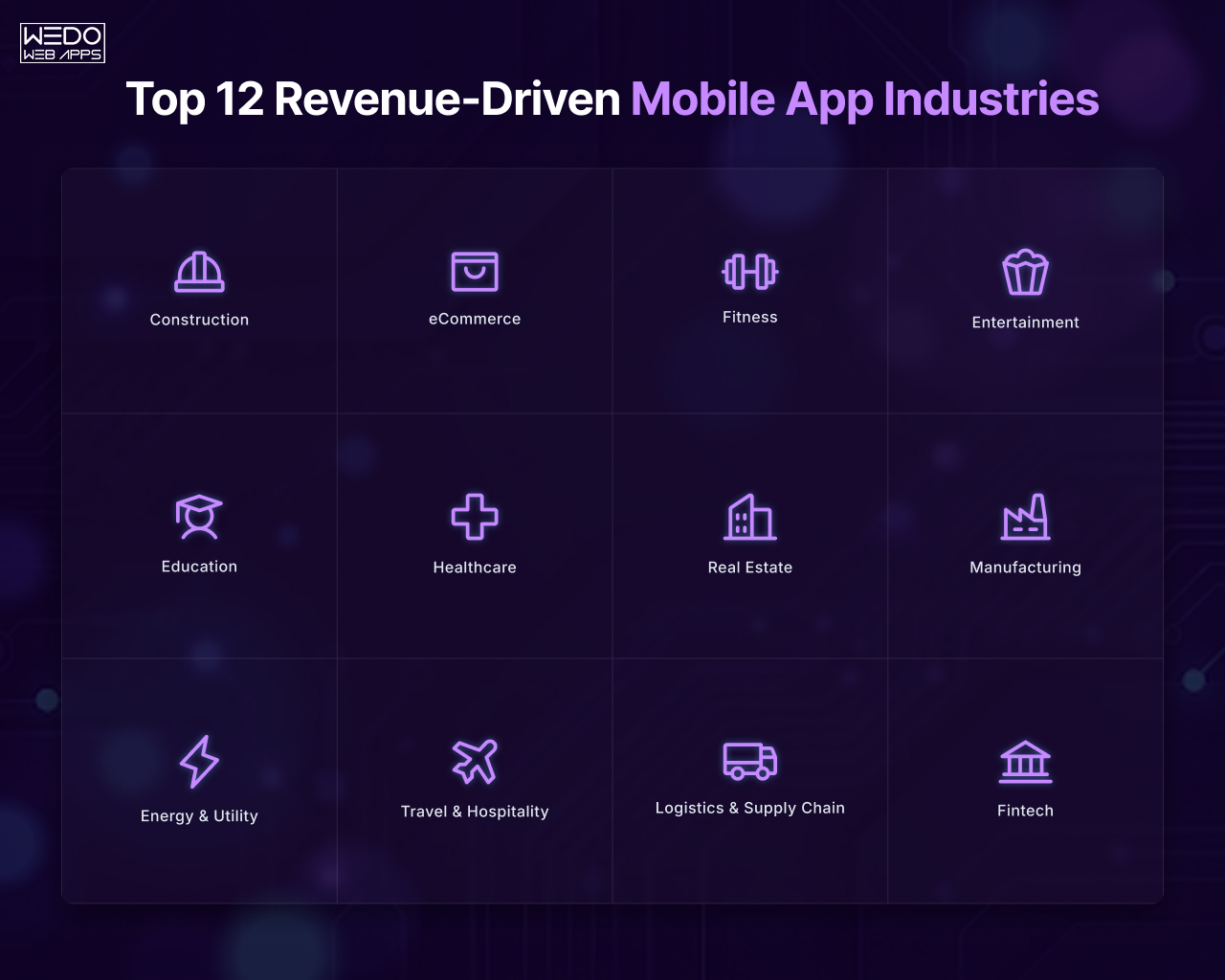
Top 12 Revenue-Driven Mobile App Industries

The industries that benefit from mobile apps the most are not necessarily the ones with the highest number of apps; they are the ones where mobile experiences directly influence revenue, efficiency, customer retention, or operational scalability.

Below is the breakdown of the top industries using mobile apps to drive measurable business growth, along with the business models and use cases shaping their success.

1. Construction

For years, construction remained one of the least digitized industries. But growing project complexity, distributed teams, and rising operational costs have accelerated mobile adoption across the sector.

Today, construction is becoming one of the most important industry sectors for mobile app growth, especially for companies focused on field operations and real-time collaboration.

Why Construction Businesses Benefit from Mobile Apps

Construction teams operate across multiple locations where delays, communication gaps, and manual reporting can significantly impact profitability.

Mobile app help businesses:

  • Improve coordination between field and office teams
  • Monitor project progress in real time
  • Reduce documentation delays
  • Streamline workforce management

For contractors and enterprise construction firms, mobile technology is increasingly tied to operational efficiency and project visibility.

Common Mobile App Use Cases in Construction

Some of the most valuable mobile apps by industry use cases in construction include:

  • Project management and task tracking apps
  • Site inspection and reporting tools
  • Equipment monitoring systems
  • Workforce attendance and scheduling apps
  • Safety compliance and incident reporting platforms
  • Real-time document and blueprint access

These applications help teams make faster decisions while reducing administrative friction across large-scale projects.

How Businesses Make Money With Construction Mobile Apps

Unlike consumer-focused industries, construction apps typically generate value through operational optimization and enterprise service models.

Common mobile app business models by industry in construction include:

1. Enterprise SaaS Licensing: Construction technology provides offer subscription-based platforms to contractors and enterprises.

2. Operational Cost Reduction: Apps reduce delays, paperwork, rework, and resource inefficiencies, directly improving project profitability.

3. Workflow Automation Services: Businesses monetize integrations with ERP systems, procurement tools, and project management platforms.

4. White-Label Construction Solutions: Some companies develop customizable mobile platforms for specialized contractors or infrastructure firms.

Why Construction is a Growing Mobile App Industry

Several factors are accelerating mobile transformation in construction:

  • Increasing adoption of cloud-based project management
  • Labor shortages requiring better workforce efficiency
  • Growing infrastructure investments globally
  • Demand for real-time project visibility

As digital adoption increases, construction companies are shifting from reactive operations to data-driven project management models powered by mobile technology.

Key Business Insight:

In construction, mobile apps are not just communication tools, they are operational systems that directly influence timelines, workforce productivity, and project profitability. For businesses entering this space, success depends less on adding features and more on solving real field-level operational challenges at scale.

2. eCommerce

Among all profitable mobile app industries, eCommerce remains one of the strongest examples of how mobile experiences directly drive revenue.

As mobile shopping behavior continues to grow, businesses are increasingly investing in apps that improve personalization, retention, and purchasing convenience. In many cases, mobile apps now outperform websites in customer engagement and repeat purchases.

For retailers and digital-first brands, mobile apps have evolved from optional sales channels into core revenue generating ecosystems.

Why eCommerce Businesses Benefit from Mobile Apps

eCommerce apps create faster, more personalized shopping experiences compared to traditional web platforms.

Businesses use mobile apps to:

  • Simplify purchasing journeys
  • Improve customer retention
  • Increase repeat orders
  • Personalize product recommendations
  • Build stronger loyalty ecosystems

Because users spend significantly more time on mobile devices, brands that optimize for app-based engagement often gain stronger long-term customer value.

Common Mobile App Use Cases in eCommerce

Some of the most effective mobile apps by industry use cases in eCommerce include:

  • Mobile storefronts and shopping apps
  • AI-driven product recommendation systems
  • Loyalty and rewards applications
  • One-click checkout experiences
  • Push notification marketing systems
  • AR-based product visualization tools

These features help businesses improve conversion rates while reducing cart abandonment.

How Businesses Make Money With eCommerce Mobile Apps

eCommerce offers one of the clearest examples of scalable mobile app business models by industry.

1. Direct Product Sales: Apps generate revenue through seamless in-app purchasing experiences.

2. Subscription Commerce: Brands monetize recurring deliveries, memberships, and premium customer programs.

3. Upselling & Cross-Selling: AI-driven recommendations increase average order value and repeat purchases.

4. Marketplace Commission Models:Multi-vendor platforms generate revenue from seller commissions and transaction fees.

5. In-App Advertising & Partnerships: Large platforms monetize visibility placements and brand collaborations.

Why eCommerce Continues to Lead Mobile App Growth

Several trends continue to accelerate growth in mobile commerce:

  • Mobile-first consumer behavior
  • AI-powered personalization
  • Social commerce integration
  • Faster digital payment ecosystems
  • Increasing demand for convenience-driven shopping

As customer expectations evolve, businesses investing in mobile commerce are focusing not only on transactions, but also on creating long-term engagement ecosystems.

Key Business Insight:

The most successful eCommerce apps are no longer competing only on products or pricing, they compete on personalization, convenience, and customer retention. Businesses that treat mobile apps as strategic customer experience platforms rather than simple sales channels often achieve stronger long-term growth.

3. Education

The education sector has experienced one of the biggest digital shifts in recent years, making it one of the fastest-growing industry sectors for mobile app growth.

What began as a convenience-driven learning model has evolved into a large-scale digital ecosystem where mobile apps support:

  • Remote learning
  • Skill development
  • Certification programs
  • Corporate training
  • And personalized education experiences

Today, educational institutions, startups, and enterprise training providers are increasingly using mobile technology to deliver scalable learning environments across global audiences.

Why Education Business Benefits from Mobile Apps

Mobile apps make learning more accessible, flexible, and engagement-driven.

Unlike traditional classroom systems, mobile platforms allow users to:

  • Learn at their own pace
  • Access educational content from anywhere
  • Consume short-form interactive lessons
  • Track progress in real-time

For businesses, this creates opportunities to scale educational services without the limitations of physical infrastructure.

This scalability is a major reason education remains one of the most promising industries that benefit from mobile apps.

Common Mobile App Use Cases in Education

Some of the most effective mobile apps by industry use cases in education include:

  • eLearning and online course platforms
  • Live virtual classroom applications
  • Language learning apps
  • Exam preparation and assessment tools
  • Corporate employee training platforms
  • Microlearning and skill development apps

Many platforms also integrate AI-driven recommendations, gamification, and progress tracking to improve student engagement and retention.

How Businesses Make Money With Education Mobile Apps

The education industry supports multiple scalable mobile app business models by industry, particularly subscription and content-based monetization.

1. Subscription-Based Learning: Users pay monthly or yearly fees for access to courses and learning resources.

2. Course & Certification Sales: Platforms monetize premium programs, certifications, and specialized learning tracks.

3. Freemium Models: Basic content is offered free while advanced lessons and features remain paid.

4. Corporate Training Partnerships: Businesses license training platforms for employee development and compliance programs.

5. In-App Purchases: Apps monetize downloadable resources, mentoring sessions, and personalized coaching.

Why Education is a Strong Mobile App Growth Sector

Several trends continue to fuel mobile app adoption in education:

  • Growing acceptance of remote learning
  • Increasing demand for upskilling and reskilling
  • Mobile-first learning behavior among younger audiences
  • Enterprise investment in workforce training
  • AI-powered personalized learning experiences

As digital education matures, businesses are focusing more on engagement, retention, and measurable learning outcomes rather than just content delivery.

Key Business Insight:

The long-term success of education apps depend less on content volume and more on learning experience quality, personalization, and retention strategy. Businesses that combine accessibility with engagement-driven design often build stronger recurring revenue models and long-term user loyalty.

4. Entertainment

Entertainment continues to be one of the highest-engagement profitable mobile app industries, driven by changing consumer behavior and rising demand for on-demand digital experience.

From streaming platforms and gaming ecosystems to creator-driven content apps, mobile technology has fundamentally changed how users consume entertainment.

Today, businesses in this sector are not only competing from attention, they are competing for daily user engagement and long-term retention.

Why Entertainment Businesses Benefit from Mobile Apps

Entertainment is naturally suited for mobile-first experiences because users consume content continuously throughout the day.

Mobile apps allow businesses to:

  • Deliver instant access to content
  • Personalize recommendations
  • Increase session duration
  • Build habitual engagement patterns
  • Monetize recurring user activity

This high engagement frequency makes entertainment one of the strongest industries that benefit from mobile apps.

Common Mobile App Use Cases in Entertainment

Popular mobile apps by industry use cases in entertainment include:

  • Video streaming platforms
  • Music streaming apps
  • Mobile gaming ecosystems
  • Live streaming and creator platforms
  • Short-form content applications
  • Interactive social entertainment apps

Many platforms now combine AI-driven recommendation engine with community engagement features to maximize user retention.

How Businesses Make Money With Entertainment Mobile Apps

Entertainment apps support several high-performing mobile app business models by industry.

1. Subscription-Based Revenue: Streaming services monetize through recurring monthly memberships.

2. Advertising Models: Free platforms generate revenue through display ads, sponsored content, and video advertising.

3. In-App Purchases: Gaming and creator platforms monetize digital items, upgrades, and premium content access.

4. Hybrid Monetization: Many apps combine subscriptions, ads, and premium purchases simultaneously.

5. Creator Economy Partnerships: Platforms generate revenue through revenue-sharing models with influencers and content creators.

Why Entertainment Continues to Dominate Mobile Usage

Several factors continue to drive mobile app growth in entertainment:

  • Increasing smartphone screen time
  • Expansion of creator-driven ecosystems
  • Rising demand for personalized content
  • Growth of mobile gaming markets
  • Faster internet and streaming infrastructure

As competition intensifies, entertainment businesses are increasingly investing in personalization, AI recommendations, and immersive user experiences.

Key Business Insight:

In entertainment, user retention is often more valuable than initial downloads. The platforms that scale successfully are those that continuously increase engagement through personalization, community interaction, and content relevance rather than relying solely on content quality.

5. Fitness

The fitness industry has rapidly evolved from gym-centered experiences into digital wellness ecosystems powered by mobile technology.

Today, fitness apps are used for:

  • Workout tracking
  • Virtual coaching
  • Nutrition planning
  • Habit building
  • And wearable device integration

Because fitness is deeply tied to routine behavior and long-term engagement, it remains one od the most sustainable industry sectors for mobile app growth.

Why Fitness Business Benefit from Mobile Apps

Fitness apps create consistent user engagement by becoming part of daily routines.

Businesses use mobile apps to:

  • Increase customer retention
  • Offer personalization wellness experiences
  • Scale coaching services digitally
  • Create subscription-based communities
  • Integrate real-time health tracking

The combination of personalization and habit-driven engagement makes fitness one of the strongest profitable mobile app industries for recurring revenue models.

Common Mobile App Use Cases in Fitness

Popular mobile apps by industry use cases in fitness include:

  • Workout and exercise tracking apps
  • Personal training platforms
  • Meditation and mental wellness apps
  • Nutrition and meal planning tools
  • Wearable fitness integrations
  • Live virtual fitness class platforms

Many businesses also incorporate gamification and progress analytics to improve motivation and user consistency.

How Businesses Make Money With Fitness Mobile Apps

Fitness apps typically rely on recurring engagement-based mobile app business models by industry.

1. Subscription Memberships: Users pay monthly or yearly fees for workouts, coaching, or wellness programs.

2. Premium Feature Unlocks: Advanced analytics, custom plans, and guided coaching are monetized separately.

3. Virtual Coaching Services: Apps connect users with trainers, nutritionists, and wellness experts.

4. Wearable & Device Integrations: Businesses monetize partnerships with fitness device ecosystems.

5. Brand Collaborations & Wellness Partnerships: Some platforms generate additional revenue through affiliate wellness products ans partnerships.

Why Fitness Apps Continue to Grow

Several trends continue driving growth in mobile fitness ecosystems:

  • Rising health awareness
  • Demand for flexible home-based fitness
  • Wearable technology adoption
  • Increasing focus on mental wellness
  • AI-driven personalization in health tracking

Consumers are increasingly looking for convenience, personalization, and continuous progress tracking, all of which mobile apps deliver effectively.

Key Business Insight:

The most successful fitness apps are not just workout platforms, they are behavior-driven engagement systems. Businesses that build long-term user habits through personalization, accountability, and community engagement often achieve stronger retention and recurring revenue growth.

6. Healthcare

Healthcare has become one of the most transformative industries that benefit from mobile apps, especially as patients and providers increasingly expect accessible, digital-first healthcare experiences.

What was once limited to appointment scheduling has now expanded into telemedicine, remote patient monitoring, digital health records, medication management, and AI-assisted healthcare support.

For healthcare providers, clinics, startups, and enterprise healthcare systems, mobile apps are improving both patient engagement and operational efficiency.

Why Healthcare Businesses Benefit from Mobile Apps

Healthcare mobile apps solve two major challenges simultaneously, ie, accessibility and efficiency

Patients increasingly prefer mobile-first healthcare interactions for convenience and faster communication, while providers use apps to streamline workflows and improve service delivery.

Businesses use healthcare apps to:

  • improve patient communication
  • reduce administrative bottlenecks
  • enable remote consultations
  • monitor patient data in real time
  • increase patient retention and engagement

As healthcare systems continue digitizing, mobile platforms are becoming essential infrastructure rather than optional digital tools.

Common Mobile App Use Cases in Healthcare

Some of the most impactful mobile apps by industry use cases in healthcare include:

  • telemedicine and virtual consultation apps
  • appointment booking and scheduling systems
  • remote patient monitoring platforms
  • medication reminder applications
  • electronic health record access systems
  • fitness and preventive healthcare integrations

Many healthcare apps now also incorporate AI-powered symptom analysis, wearable integrations, and personalized patient engagement features.

How Businesses Make Money With Healthcare Mobile Apps

Healthcare supports multiple scalable mobile app business models by industry, especially across B2B and subscription ecosystems.

1. Subscription-Based Healthcare Services: Patients pay recurring fees for virtual healthcare access and wellness programs.

2. Consultation & Service Fees: Telemedicine platforms generate revenue from appointment-based transactions.

3. Enterprise Licensing: Hospitals and healthcare organizations license healthcare management platforms.

4. Insurance & Healthcare Partnerships: Apps monetize integrations with insurers, clinics, and diagnostic providers.

5. Data & Analytics Solutions: Some enterprise healthcare platforms monetize operational insights and predictive healthcare analytics.

Why Healthcare Is a Fast-Growing Mobile App Industry

Several factors continue accelerating mobile adoption in healthcare:

  • growing acceptance of virtual healthcare
  • increasing demand for remote patient access
  • aging populations requiring continuous care
  • expansion of wearable health technologies
  • AI-driven healthcare personalization

Healthcare organizations are also prioritizing digital transformation to improve scalability while reducing operational strain.

Key Business Insight:

The most successful healthcare apps prioritize trust, accessibility, and usability over excessive feature complexity. In healthcare, user confidence and seamless experience design often have a greater impact on adoption than technical sophistication alone.

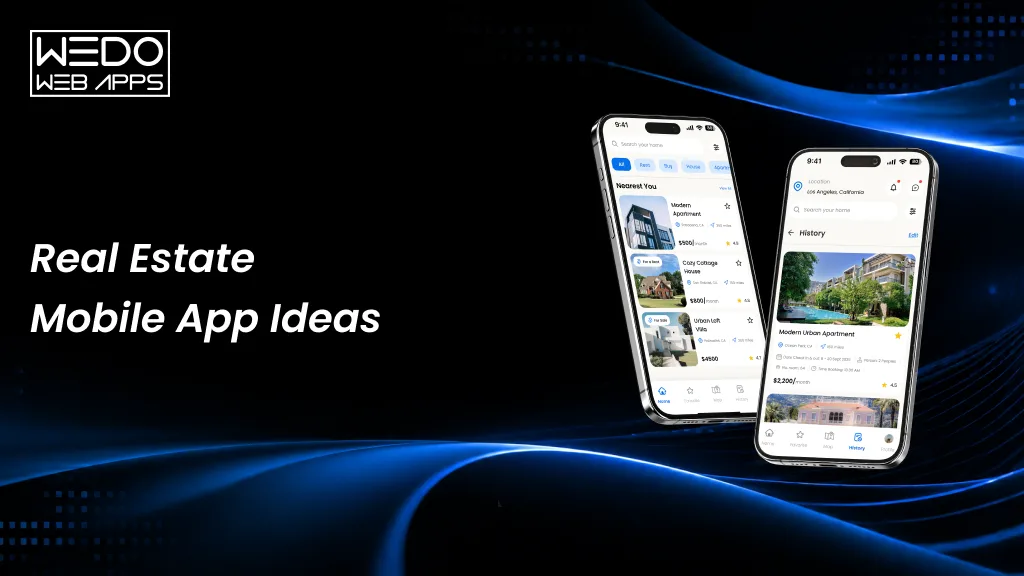
7 Real Estate

The real estate industry has shifted dramatically toward digital-first property discovery, making mobile technology a core part of modern buying, renting, and investment experiences.

Today, mobile apps are transforming how users:

  • search properties
  • schedule visits
  • connect with agents
  • explore virtual tours
  • and evaluate investment opportunities

As buyer behavior becomes increasingly mobile-driven, real estate remains one of the most valuable industry sectors for mobile app growth.

Why Real Estate Businesses Benefit from Mobile Apps

Property decisions are heavily research-driven, and mobile apps simplify access to information throughout the customer journey.

Businesses use real estate apps to:

  • improve lead generation
  • simplify property discovery
  • increase customer engagement
  • accelerate communication between buyers and agents
  • streamline listing management

Mobile platforms also help real estate businesses maintain continuous engagement with users during longer purchasing cycles.

Common Mobile App Use Cases in Real Estate

Popular mobile apps by industry use cases in real estate include:

  • property listing and search platforms
  • virtual property tour applications
  • real estate investment tracking apps
  • lead management systems for agents
  • rental and lease management platforms
  • mortgage and financing calculators

Many platforms now integrate AI-based property recommendations and location intelligence tools to personalize user experiences.

How Businesses Make Money With Real Estate Mobile Apps

Real estate apps support several scalable mobile app business models by industry.

1. Listing & Advertising Fees: Platforms charge agents, brokers, and developers for premium property visibility.

2. Lead Generation Models: Apps monetize buyer and seller leads for real estate professionals.

3. Subscription Services: Businesses offer premium market insights, analytics, or investment tools through recurring plans.

4. Transaction & Referral Commissions: Platforms generate commissions from successful deals, financing, or partner referrals.

5. Enterprise Solutions: Property management and brokerage firms license operational platforms and CRM systems.

Why Real Estate Mobile Apps Continue to Grow

Several market trends continue driving digital transformation in real estate:

  • mobile-first property search behavior
  • rising demand for virtual property experiences
  • growth of real estate investment platforms
  • increasing urbanization and rental mobility
  • AI-powered personalization in property discovery

Users now expect faster, more transparent, and digitally accessible property experiences.

Key Business Insight:

The strongest real estate apps are not simply listing platforms, they are decision-support ecosystems that simplify research, communication, and transaction confidence. Businesses that reduce friction during the property discovery process often achieve higher engagement and lead conversion rates.

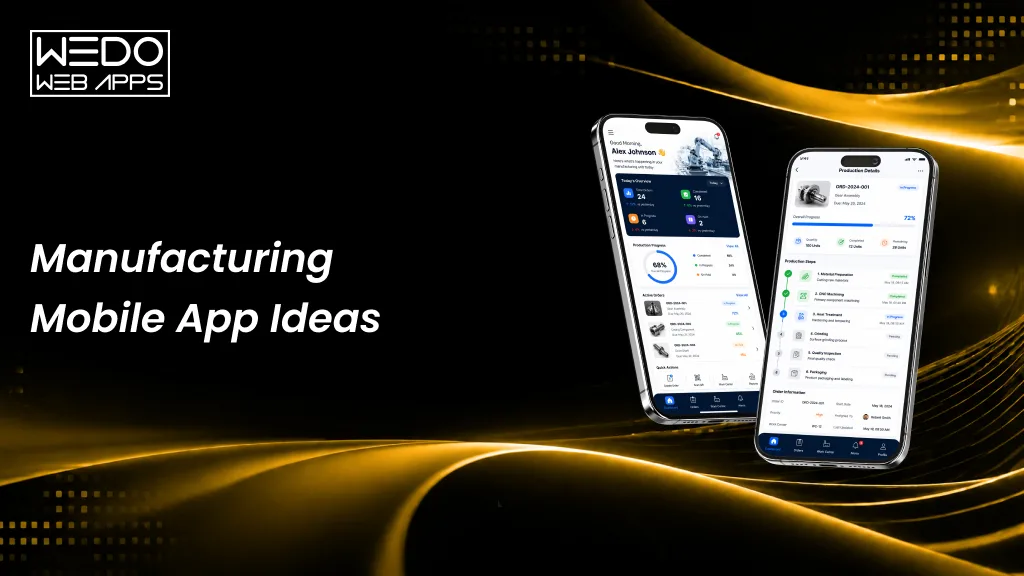
8. Manufacturing

Manufacturing is rapidly evolving into a technology-driven industry where mobile applications support real-time operations, automation, and workforce coordination.

As Industry 4.0 adoption increases, manufacturers are investing heavily in digital tools that improve visibility across production environments.

This shift has made manufacturing one of the most strategically important top industries using mobile apps for operational transformation.

Why Manufacturing Businesses Benefit from Mobile Apps

Manufacturing operations often involve complex workflows, distributed teams, and time-sensitive production processes.

Mobile apps help businesses:

  • monitor production activities in real time
  • improve inventory visibility
  • reduce operational delays
  • streamline maintenance reporting
  • enhance communication across facilities

For enterprise manufacturers, mobile technology improves responsiveness while supporting data-driven operational decisions.

Common Mobile App Use Cases in Manufacturing

Some of the most valuable mobile apps by industry use cases in manufacturing include:

  • inventory and warehouse management systems
  • production monitoring applications
  • predictive maintenance platforms
  • quality control and inspection tools
  • workforce communication systems
  • IoT-connected equipment monitoring apps

Many businesses also integrate AI and analytics tools to improve forecasting and reduce downtime.

How Businesses Make Money With Manufacturing Mobile Apps

Manufacturing apps typically generate value through enterprise-focused mobile app business models by industry.

1. Enterprise SaaS Platforms: Manufacturers subscribe to operational management and monitoring systems.

2. Process Optimization: Apps improve efficiency, reduce downtime, and lower production costs.

3. Predictive Maintenance Solutions: Businesses monetize analytics-driven maintenance tools that prevent equipment failure.

4. Industrial Automation Integrations: Technology providers offer custom integrations with ERP, IoT, and supply chain systems.

5. Data & Reporting Services: Advanced manufacturing platforms monetize operational intelligence and performance analytics.

Why Manufacturing Is a Growing Mobile App Sector

Several factors continue driving mobile adoption in manufacturing:

  • increasing automation initiatives
  • Industry 4.0 transformation
  • demand for real-time operational visibility
  • rising focus on predictive analytics
  • global supply chain complexity

As manufacturers modernize operations, mobile apps are becoming central to efficiency and scalability strategies.

Key Business Insight:

In manufacturing, the value of mobile apps comes less from customer engagement and more from operational intelligence. Businesses that improve visibility, responsiveness, and decision-making efficiency often achieve the strongest long-term ROI from mobile technology.

9. Energy & Utility

The energy and utility sector is undergoing significant digital transformation as organizations modernize infrastructure, improve operational visibility, and respond to growing consumer expectations for real-time service access.

Mobile technology is increasingly helping utility providers manage:

  • energy consumption monitoring
  • outage reporting
  • smart grid operations
  • field workforce coordination
  • and customer engagement systems

As smart infrastructure adoption grows, energy & utility is emerging as one of the most important industry sectors for mobile app growth.

Why Energy & Utility Businesses Benefit from Mobile Apps

Utility operations depend heavily on real-time communication, infrastructure monitoring, and rapid issue resolution.

Mobile apps help businesses:

  • provide real-time service updates
  • improve customer communication
  • streamline field service operations
  • monitor energy consumption patterns
  • reduce operational inefficiencies

For utility providers, mobile platforms improve both customer experience and operational responsiveness.

Common Mobile App Use Cases in Energy & Utility

Some of the most effective mobile apps by industry use cases in this sector include:

  • smart energy consumption tracking apps
  • outage reporting and service alert platforms
  • smart meter monitoring systems
  • field technician workforce management apps
  • utility billing and payment applications
  • renewable energy management platforms

Many businesses are also integrating IoT systems and predictive analytics into mobile environments to improve infrastructure visibility.

How Businesses Make Money With Energy & Utility Mobile Apps

The energy sector primarily benefits from enterprise-driven mobile app business models by industry focused on operational optimization and service delivery.

1. Enterprise Utility Management Platforms: Utility providers invest in large-scale operational monitoring systems.

2. Smart Infrastructure Services: Businesses monetize smart grid integrations and connected energy systems.

3. Operational Efficiency Improvements: Apps reduce downtime, manual processes, and field coordination inefficiencies.

4. Subscription-Based Energy Analytics: Platforms provide businesses and consumers with advanced energy consumption insights.

5. Customer Self-Service Ecosystems: Mobile apps reduce support costs through automated billing, reporting, and account management.

Why Energy & Utility Mobile Apps Are Growing

Several trends are accelerating mobile adoption across the sector:

  • expansion of smart city infrastructure
  • growing renewable energy investments
  • increasing demand for energy transparency
  • IoT-driven utility modernization
  • consumer preference for self-service platforms

As infrastructure becomes more connected, mobile technology is becoming essential for both operational management and customer engagement.

Key Business Insight:

In the energy and utility sector, mobile apps create value by improving visibility, responsiveness, and infrastructure efficiency. The businesses seeing the strongest results are those using mobile technology to simplify complex operations while delivering more transparent customer experiences.

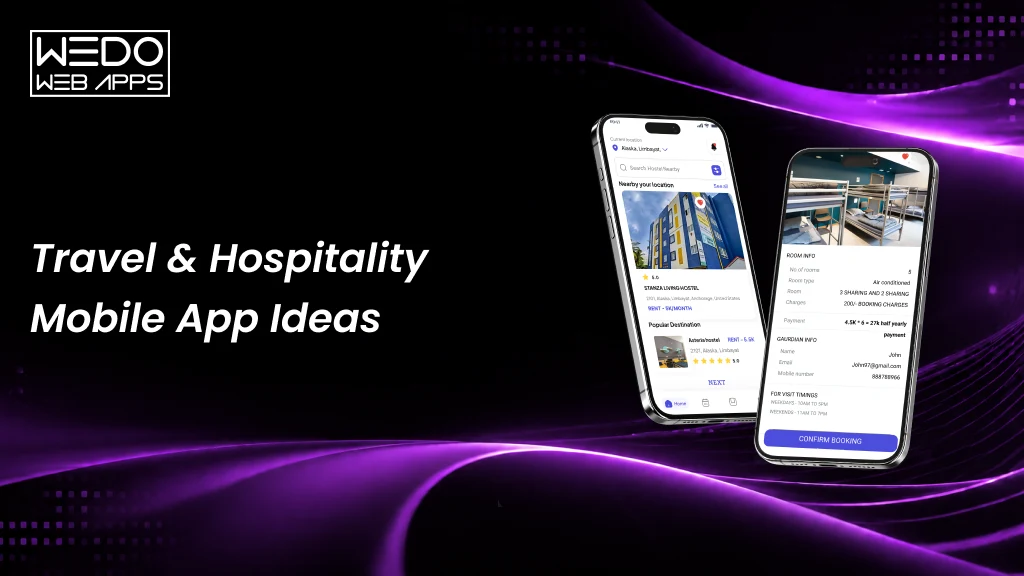
10. Travel & Hospitality

Travel and hospitality has long been one of the most mobile-driven industries, with customers relying heavily on apps for planning, booking, and real-time travel experiences.

Today, mobile apps influence nearly every stage of the customer journey, including:

  • trip discovery
  • reservations
  • itinerary management
  • check-ins
  • customer support
  • and loyalty engagement

Because convenience and personalization strongly impact purchasing behavior, travel remains one of the most competitive profitable mobile app industries.

Why Travel & Hospitality Businesses Benefit from Mobile Apps

Travel decisions are highly experience-driven, and mobile apps simplify interactions before, during, and after the trip.

Businesses use travel apps to:

  • improve booking convenience
  • increase customer retention
  • deliver personalized recommendations
  • streamline communication
  • enhance loyalty programs

For hospitality brands, mobile apps also create opportunities to maintain direct customer relationships instead of relying entirely on third-party platforms.

Common Mobile App Use Cases in Travel & Hospitality

Popular mobile apps by industry use cases in travel include:

  • hotel and flight booking apps
  • itinerary management platforms
  • digital check-in and room access systems
  • local experience and activity discovery apps
  • travel expense management tools
  • loyalty and rewards applications

Many businesses are also integrating AI-powered recommendations and real-time travel assistance into their mobile ecosystems.

How Businesses Make Money With Travel Mobile Apps

Travel businesses leverage multiple scalable mobile app business models by industry.

1. Booking & Reservation Commissions: Apps generate revenue from hotel, flight, and activity bookings.

2. Subscription Travel Services: Premium memberships offer exclusive discounts, upgrades, or travel assistance.

3. Partner & Affiliate Revenue: Travel apps monetize partnerships with airlines, hotels, restaurants, and local businesses.

4. In-App Upselling: Businesses increase revenue through upgrades, experiences, insurance, and add-on services.

5. Loyalty Ecosystems: Apps improve customer retention and repeat bookings through rewards programs.

Why Travel Apps Continue to Grow

Several trends continue driving mobile app growth in travel and hospitality:

  • mobile-first travel planning behavior
  • increasing demand for seamless digital experiences
  • personalized travel recommendations
  • contactless check-in and service systems
  • growth of experiential travel markets

Customers increasingly expect travel experiences that are fast, personalized, and accessible entirely through mobile platforms.

Key Business Insight

The most successful travel apps reduce friction across the customer journey. Businesses that simplify discovery, booking, communication, and post-trip engagement often achieve stronger customer retention and higher lifetime value.

11. Logistics & Supply Chain

Logistics and supply chain operations rely heavily on speed, visibility, and coordination, making mobile technology essential for modern operational management.

As global supply chains become more complex, businesses are increasingly using mobile apps to improve:

  • shipment tracking
  • fleet management
  • warehouse coordination
  • delivery optimization
  • and communication across distributed operations

This growing dependence on real-time operational visibility has made logistics one of the fastest-growing industries that benefit from mobile apps.

Why Logistics Businesses Benefit from Mobile Apps

Supply chain disruptions and operational inefficiencies can directly impact profitability.

Mobile apps help logistics businesses:

  • track deliveries in real time
  • improve route optimization
  • reduce manual coordination delays
  • streamline warehouse operations
  • improve communication across stakeholders

For logistics companies, mobile technology supports faster decisions while increasing operational transparency.

Common Mobile App Use Cases in Logistics & Supply Chain

Some of the most impactful mobile apps by industry use cases in logistics include:

  • fleet tracking and route optimization apps
  • warehouse management systems
  • shipment tracking platforms
  • driver communication and dispatch systems
  • inventory and delivery management apps
  • supply chain analytics dashboards

Many businesses also integrate AI-powered forecasting and IoT tracking systems to improve efficiency and predictive visibility.

How Businesses Make Money With Logistics Mobile Apps

Logistics apps typically generate value through enterprise-focused mobile app business models by industry.

1. SaaS Logistics Platforms: Businesses subscribe to operational management and tracking systems.

2. Delivery Optimization Services: Apps reduce fuel costs, delays, and routing inefficiencies.

3. Supply Chain Visibility Solutions: Businesses monetize real-time tracking and operational analytics.

4. Enterprise Integrations: Technology providers integrate logistics apps with ERP, warehouse, and transportation systems.

5. Marketplace Logistics Models: Some platforms monetize freight matching and delivery coordination ecosystems.

Why Logistics Mobile Apps Continue to Grow

Several market shifts are accelerating mobile adoption in logistics:

  • increasing eCommerce demand
  • growing customer expectations for real-time tracking
  • supply chain digitization initiatives
  • AI-driven route optimization
  • rising focus on operational resilience

Businesses are prioritizing technologies that improve agility, transparency, and delivery efficiency.

Key Business Insight:

In logistics, mobile apps are critical operational infrastructure rather than optional digital tools. Companies that improve visibility and coordination across the supply chain often gain stronger efficiency, customer trust, and long-term scalability.

12. Fintech

Fintech has become one of the most disruptive and rapidly expanding top industries using mobile apps, fundamentally reshaping how consumers and businesses manage money.

From digital payments and online banking to investment platforms and lending ecosystems, mobile apps now power a significant portion of modern financial activity.

Because financial interactions happen frequently and require convenience, fintech remains one of the strongest profitable mobile app industries in terms of engagement and monetization potential.

Why Fintech Businesses Benefit from Mobile Apps

Consumers increasingly expect instant, mobile-first financial experiences.

Fintech apps help businesses:

  • simplify transactions
  • improve financial accessibility
  • automate money management
  • increase user engagement
  • deliver personalized financial insights

For financial service providers, mobile platforms also reduce dependency on physical infrastructure while improving scalability.

Common Mobile App Use Cases in Fintech

Popular mobile apps by industry use cases in fintech include:

  • digital payment and wallet apps
  • online banking platforms
  • lending and credit management apps
  • investment and trading applications
  • expense tracking and budgeting tools
  • cryptocurrency and digital asset platforms

Many fintech companies now integrate AI-driven fraud detection, financial analytics, and personalized recommendations into their platforms.

How Businesses Make Money With Fintech Mobile Apps

Fintech supports some of the most scalable mobile app business models by industry.

1. Transaction Fees: Apps generate revenue from payments, transfers, and financial processing services.

2. Subscription Financial Services: Users pay for premium analytics, advisory tools, or advanced account features.

3. Lending & Interest-Based Revenue: Platforms monetize loans, credit products, and financing services.

4. Investment & Trading Commissions: Apps generate income through trading fees and portfolio management services.

5. Embedded Finance Partnerships: Fintech businesses monetize integrations with eCommerce, banking, and enterprise ecosystems.

Why Fintech Continues to Lead Mobile Innovation

Several factors continue driving fintech mobile app growth:

  • rapid digital payment adoption
  • increasing demand for financial accessibility
  • mobile-first banking behavior
  • expansion of embedded finance ecosystems
  • AI-driven financial personalization

As financial services become more digitized, mobile apps are increasingly becoming the primary channel for user engagement and transactions.

Key Business Insight:

The most successful fintech apps balance convenience with trust. Businesses that prioritize security, simplicity, and seamless user experience often achieve stronger adoption, retention, and long-term customer value.
Discuss Your Mobile App Strategy

Mobile App Business Models by Industry
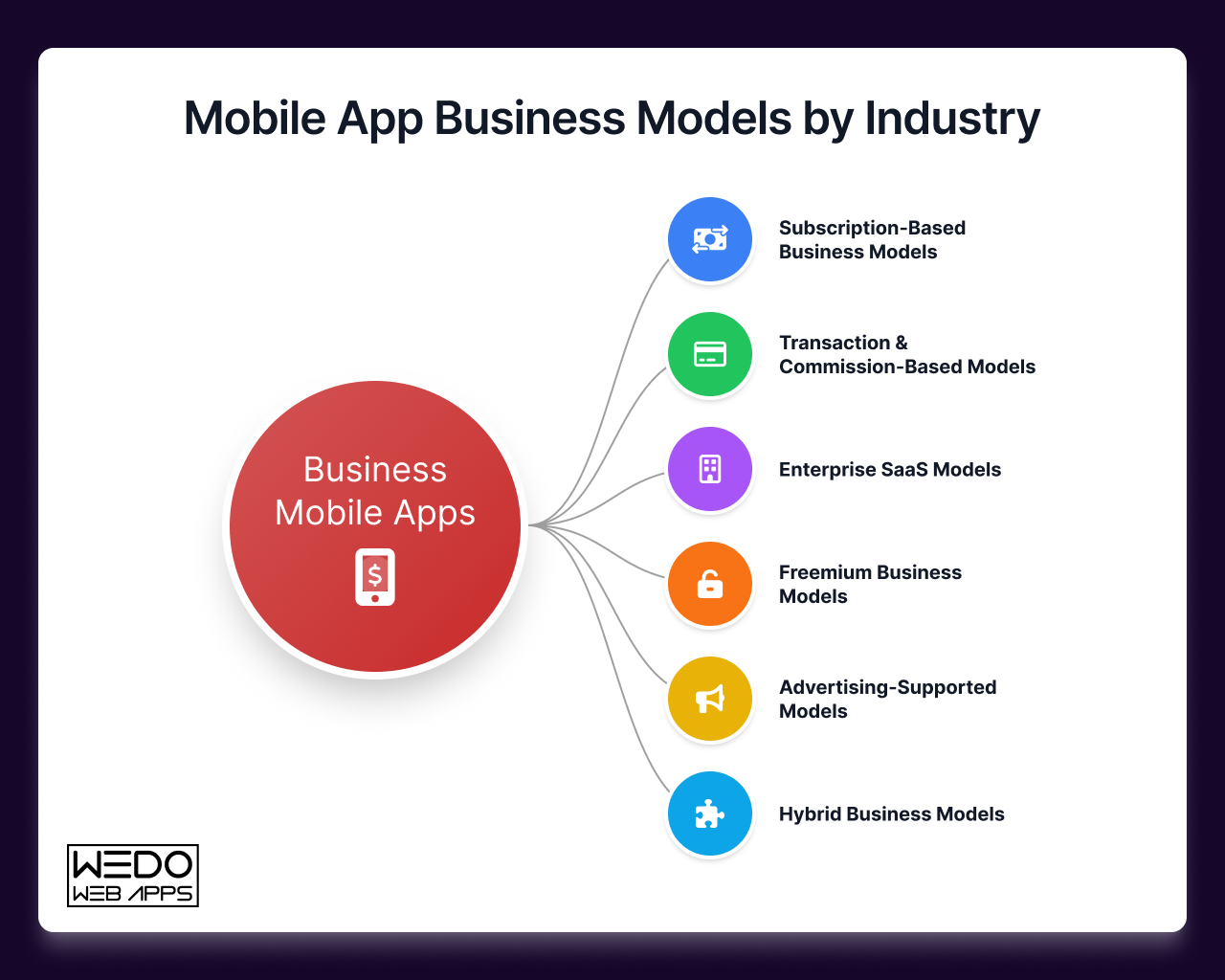
Mobile App Business Models by Industry

Building a successful mobile app is not only about choosing the right industry, it is also about choosing the right monetization strategy.

Different sectors generate revenue in different ways depending on customer behavior, usage frequency, operational goals, and market expectations.

Understanding these differences is essential for businesses evaluating long-term scalability and ROI.

Below is a breakdown of the most common mobile app business models by industry and how they align with different sectors.

1. Subscription-Based Business Models

Subscription models generate recurring revenue by offering continuous access to services, content, or premium experiences. This model works best in industries where users engage consistently over time.

Industries using Subscription models include:

  • Fitness
  • Education
  • Entertainment
  • Healthcare
  • Productivity-focused enterprise apps

Why it Works

Recurring engagement creates predictable revenue streams while improving customer lifetime value. Businesses also benefit from:

  • Higher retention opportunities
  • Continuous upselling potential
  • Long-term customer relationships

Examples of Subscription-Based Mobile Experiences

  • Streaming platforms
  • Virtual fitness coaching apps
  • eLearning memberships
  • Telemedicine services

For many businesses, subscription ecosystems provide more stable growth compared to one-time transaction models.

2. Transaction & Commission-Based Models

This model generates revenue whenever users complete transactions within the platform. It is one of the most scalable monetization approaches among profitable mobile app industries.

Industries Using Transaction Models:

  • Fintech
  • eCommerce
  • Travel & Hospitality
  • Real estate marketplaces
  • Logistics platforms

Why it Works

The more platform activity increases, the more revenue the business generates. These apps often scale effectively because:

  • Customer acquisition directly impacts transaction volume
  • Monetization happens continuously
  • Marketplaces benefit from network effects

Common Revenue Streams

  • Payment processing fees
  • Booking commissions
  • Marketplace transaction percentages
  • Lead generation charges

This model is especially powerful in industries with high-frequency customer activity.

3. Enterprise SaaS Models

Enterprise SaaS models focus on operational efficiency, workflow automation, and large-scale business management solutions. Rather than targeting customers directly, these apps generate revenue through enterprise subscriptions or licensing agreements.

Industries Using Enterprise SaaS Models:

  • Construction
  • Manufacturing
  • Logistics & Supply chain
  • Energy & Utility
  • Enterprise healthcare systems

Why it Works

Businesses are willing to invest in technologies that:

  • Reduce operational costs
  • Improve productivity
  • Increase visibility
  • Streamline communication

Enterprise-focused apps often achieve:

  • Higher contract values
  • Long-term client retention
  • Scalable recurring revenue

Examples:

  • Fleet management platforms
  • Workforce coordination apps
  • Predictive maintenance systems
  • Utility infrastructure monitoring tools

This model is particularly valuable for B2B technology companies focused on long-term digital transformation.

4. Freemium Business Models

Freemium apps provide basic functionality for free while charging users for advanced features or premium experiences. This model is commonly used to accelerate user acquisition before monetization.

Industries Using Freemium Models

  • Education
  • Entertainment
  • Fitness
  • Fintech
  • Productivity applications

Why it Works

Free access lowers adoption barriers while premium upgrades generate revenue from engaged users. Businesses benefit from:

  • Rapid user growth
  • Increased product exposure
  • Scalable upeslling opportunities

Typical Premium Features

  • Advanced analytics
  • Ad-free experiences
  • Premium content access
  • Personalized recommendations
  • Enhanced customization tools

Freemium models work best when businesses can demonstrate ongoing value beyond the free experience.

5. Advertising-Supported Models

Advertising remains one of the most common monetization strategies in high-engagement mobile ecosystems. This model performs best in apps with large user bases and extended session durations.

Industries Using Advertising Models:

  • Entertainment
  • Gaming
  • Social content platforms
  • Media and publishing apps

Why it Works

Higher user engagement creates more advertising inventory and monetization opportunities.

Revenue streams often include:

  • Display advertising
  • Sponsored content
  • Video ads
  • Brand partnerships

However, businesses must balance monetization with user experience to avoid reducing retention.

6. Hybrid Business Models

Many successful apps combine multiple monetization strategies instead of relying on a single revenue source. This hybrid approach helps businesses diversify revenue while adapting to changing user behavior.

Industries Commonly Using Hybrid Models:

  • Fintech
  • Entertainment
  • Travel
  • Fitness
  • eCommerce

Examples of Hybrid Monetization:

  • Subscriptions + ads
  • Transactions + Premium memberships
  • Freemium Access + in-app purchases
  • Commissions + partner integrations

Hybrid models are increasingly common because they allow businesses to maximize monetization across different customer segments.

How Businesses Choose the Right Mobile App Business Model

Selecting the right monetization strategy depends on several factors:

  • User Behavior: How frequently users engage with the platform.
  • Industry Expectations: Whether users expect free access, subscriptions, or transactional pricing.
  • Customer Lifetime Value: Long-term revenue potential per customer.
  • Scalability Potential: How effectively the business model can grow with increased adoption.
  • Operational Complexity: Whether the app focuses on customer engagement or enterprise efficiency.

Businesses that align monetization strategy with industry behavior often achieve stronger profitability and long-term sustainability.

Key Business Insight:

The most successful mobile apps are not built around features alone, they are built around sustainable business models.

Understanding how businesses make money with mobile apps is often more important than understanding the technology itself. Because ultimately, long-term growth depends on how effectively an app converts engagement, efficiency, or operational value into scalable revenue.

Emerging Opportunities: Industry Sectors for Mobile App Growth in 2026 and Beyond

The mobile app market is no longer growing through adoption alone—it is evolving through smarter, more connected, and highly personalized digital experiences.

As businesses move beyond basic mobile functionality, the next phase of growth is being shaped by:

  • AI-driven automation
  • predictive analytics
  • connected ecosystems
  • and industry-specific digital transformation

For decision-makers evaluating long-term investments, understanding these emerging trends is critical when identifying future-ready industry sectors for mobile app growth.

1. AI-Powered Mobile Applications

Artificial intelligence is becoming one of the biggest growth drivers across nearly every industry using mobile apps.

Businesses are increasingly integrating AI into mobile experiences to:

  • personalize user interactions
  • automate workflows
  • improve customer support
  • generate predictive insights
  • enhance operational decision-making

Industries Seeing Rapid AI Adoption

  • eCommerce
  • healthcare
  • fintech
  • logistics & supply chain
  • entertainment

Examples include:

  • AI-powered shopping recommendations
  • predictive healthcare monitoring
  • intelligent fraud detection systems
  • AI-based route optimization
  • personalized content delivery platforms

As AI capabilities mature, mobile apps are evolving from reactive tools into intelligent business ecosystems.

2. Hyper-Personalization Across Customer Experiences

Modern users increasingly expect digital experiences tailored to their behavior, preferences, and usage patterns.

This demand is accelerating investment in:

  • personalized recommendations
  • dynamic user journeys
  • behavior-driven notifications
  • adaptive app interfaces

Industries Leading Hyper-Personalization

  • eCommerce
  • entertainment
  • fitness
  • travel & hospitality
  • fintech

Businesses that deliver highly personalized mobile experiences often see:

  • stronger retention
  • higher engagement
  • increased conversion rates
  • improved customer lifetime value

This shift is making personalization a competitive necessity rather than a premium feature.

3. Enterprise Mobility & Operational Intelligence

Enterprise-focused industries are rapidly investing in mobile solutions that improve visibility, communication, and operational control.

This is especially important in industries where real-time coordination directly impacts efficiency and profitability.

Industries Driving Enterprise Mobility Growth

  • construction
  • manufacturing
  • logistics & supply chain
  • energy & utility
  • healthcare

Key growth areas include:

  • workforce mobility platforms
  • predictive maintenance systems
  • IoT-connected monitoring apps
  • real-time reporting dashboards
  • field operations management tools

As enterprise digital transformation accelerates, mobile apps are becoming central operational infrastructure.

4. IoT & Connected Mobile Ecosystems

The growth of connected devices is expanding how businesses use mobile applications across physical and digital environments.

Mobile apps increasingly serve as control centers for:

  • smart devices
  • connected infrastructure
  • wearable technologies
  • industrial systems

Industries Benefiting Most From Connected Ecosystems

  • manufacturing
  • energy & utility
  • healthcare
  • fitness
  • logistics

Examples include:

  • smart factory monitoring
  • wearable health tracking
  • connected fleet systems
  • smart energy management platforms

This convergence of IoT and mobility is creating new opportunities for automation and real-time decision-making.

5. Embedded Finance & Digital Payment Expansion

Financial functionality is increasingly being integrated into non-financial mobile ecosystems.

This trend—commonly called embedded finance—is transforming how businesses monetize mobile platforms.

Industries Adopting Embedded Finance

  • eCommerce
  • travel
  • logistics
  • healthcare
  • real estate

Examples include:

  • buy-now-pay-later integrations
  • in-app insurance services
  • embedded lending solutions
  • digital wallet integrations

Businesses are increasingly using financial services to improve customer convenience while opening new revenue streams.

6. Low-Code & Faster App Development Ecosystems

As businesses demand faster digital transformation, low-code and rapid development frameworks are accelerating mobile innovation.

This trend is helping organizations:

  • reduce development timelines
  • launch MVPs faster
  • validate market demand quickly
  • scale digital products efficiently

While enterprise-grade applications still require custom development expertise, businesses are increasingly prioritizing agility and faster deployment cycles.

What These Trends Mean for Businesses

The future of mobile app growth is no longer centered around simply having an app.

Competitive advantage now depends on:

  • intelligent automation
  • personalization
  • operational integration
  • scalability
  • and continuous digital innovation

Businesses that align mobile investments with long-term industry transformation trends are more likely to achieve sustainable growth and competitive differentiation.

Key Business Insight

The industries experiencing the strongest mobile app growth are those where technology directly improves decision-making, customer experience, or operational efficiency.

In 2026 and beyond, successful mobile apps will increasingly function as connected business ecosystems, not standalone digital products.

How to Choose the Right Industry for Your Mobile App Investment

Not every mobile app idea leads to sustainable growth. The industries that generate the strongest returns are usually the ones where business goals, customer behavior, and monetization opportunities align clearly.

Before investing in development, businesses should evaluate whether the industry supports long-term mobile adoption and scalable value creation.

Here are the most important factors decision-makers should assess before entering any of the top industries using mobile apps.

1. Validate Real Market Demand

A growing market does not automatically guarantee product success.

Businesses should evaluate:

  • customer pain points
  • existing digital adoption
  • demand for mobile-first experiences
  • competitive gaps within the industry

The strongest opportunities often exist where mobile technology solves operational inefficiencies or improves convenience significantly.

2. Define the Revenue Model Early

One of the biggest mistakes businesses make is building an app before defining how it will generate value.

Before development begins, companies should identify:

  • subscription opportunities
  • transaction potential
  • operational efficiency gains
  • enterprise licensing possibilities
  • customer retention benefits

Understanding how businesses make money with mobile apps helps prevent unclear product direction later.

3. Evaluate User Engagement Frequency

Industries with higher engagement frequency generally create stronger monetization opportunities.

For example:

  • fintech and eCommerce apps encourage daily interaction
  • fitness apps build habit-driven engagement
  • logistics apps support continuous operational usage

Frequent interaction improves:

  • retention
  • upselling opportunities
  • customer lifetime value

4. Assess Scalability Potential

The best mobile app opportunities support long-term growth without proportional operational expansion.

Businesses should evaluate:

  • geographic scalability
  • automation opportunities
  • infrastructure requirements
  • integration capabilities
  • long-term operational sustainability

Scalable industries often provide stronger long-term ROI than trend-driven markets.

5. Prioritize User Experience & Simplicity

Even the strongest idea can fail if the user experience creates friction.

Businesses investing in mobile apps should focus on:

  • intuitive navigation
  • performance optimization
  • personalized experiences
  • fast onboarding processes
  • seamless functionality across devices

In highly competitive industries, customer experience often becomes the biggest differentiator.

Key Business Insight

The most successful mobile app investments are usually driven by business strategy; not trend adoption.

Companies that focus on solving meaningful industry problems while aligning monetization, scalability, and user behavior tend to build stronger long-term digital products.
Talk to Product Experts

Common Mistakes Businesses Make When Building Industry-Specific Mobile Apps

As mobile adoption increases across industries, many businesses rush into development without fully evaluating long-term strategy, scalability, or market alignment.

While the opportunities are significant, poor planning can quickly turn mobile investments into expensive operational burdens.

Here are some of the most common mistakes businesses make when entering industry sectors for mobile app growth.

Building Around Trends Instead of Business Value

Many businesses pursue trending app ideas without validating whether the product solves a meaningful problem.

Successful apps are typically built around:

  • operational efficiency
  • customer convenience
  • recurring engagement
  • or measurable business outcomes

Trend-driven products without long-term value often struggle with retention and scalability.

Ignoring Monetization Strategy Early

A mobile app should support a clear business objective from the beginning.

Without a defined monetization model, businesses often face:

  • unclear product priorities
  • weak revenue potential
  • rising operational costs
  • and low scalability

Defining the right mobile app business model by industry early helps create stronger product direction.

Overbuilding Features in Early Stages

Many businesses attempt to launch with excessive functionality instead of validating core user demand first.

This often leads to:

  • delayed launches
  • higher development costs
  • complex user experiences
  • maintenance challenges

A focused MVP approach usually creates faster market validation and more efficient scaling opportunities.

Underestimating Scalability Requirements

Apps that perform well initially may struggle later if scalability is ignored during development.

Industries like:

  • fintech
  • logistics
  • eCommerce
  • healthcare

often require strong backend architecture and long-term infrastructure planning.

Scalability should be considered from the earliest development stages—not after growth begins.

Treating Mobile Apps as Standalone Products

Modern mobile apps rarely function independently.

Successful businesses integrate mobile ecosystems with:

  • analytics platforms
  • CRM systems
  • payment infrastructure
  • cloud environments
  • and operational workflows

Businesses that think beyond isolated app experiences usually achieve stronger operational and customer value.

Key Business Insight

The biggest mobile app failures are rarely caused by technology alone—they are usually caused by weak business alignment, unclear monetization, or poor long-term planning.

Businesses that prioritize strategy before development often achieve stronger ROI and more sustainable digital growth.

Why the Right Development Partner Matters

Building a successful mobile app requires more than technical execution. In many industries, long-term success depends on how well the product aligns with business goals, scalability requirements, and user expectations.

The right development partner helps businesses move beyond feature development toward building scalable digital ecosystems.

This becomes especially important in industries where:

  • operational complexity is high
  • customer expectations evolve rapidly
  • integrations are critical
  • and scalability directly impacts profitability

An experienced development team can help businesses:

  • validate product direction
  • prioritize high-impact features
  • improve scalability planning
  • optimize user experience
  • and reduce long-term technical limitations

For businesses entering competitive profitable mobile app industries, strategic product thinking often matters as much as development itself.

Companies like WEDOWEBAPPS increasingly work with businesses not only on application development, but also on aligning mobile solutions with operational goals, customer engagement strategies, and long-term digital growth.

Start Your Mobile App Project

How Multilingual Mobile Apps Drive Global Customer Acquisition

Introduction

Why do users uninstall an app within minutes, even when the product is good?

In many cases, the answer is simple. The app does not feel familiar to them. Language shapes how users interact, trust, and connect with a mobile experience. If users struggle to understand navigation, instructions, or communication, they are far more likely to leave.

This is why businesses are investing in a multilingual app for customer acquisition. Brands expanding into international markets are using localization to create mobile experiences that feel natural for different audiences. A well-planned mobile app development strategy helps businesses improve accessibility, build customer trust, and increase engagement across regions.

Today, the benefits of multilingual mobile apps go far beyond translation. From improving multilingual app user engagement to supporting global customer acquisition through apps, localization has become a major growth driver for modern businesses.

In this blog, we will understand how multilingual mobile apps support acquisition, improve user engagement, strengthen localization efforts, and help businesses scale successfully across global markets.

What Is a Multilingual Mobile App?

A multilingual mobile app is an application designed to support multiple languages so users can interact with the app in the languages they are most comfortable with. Instead of forcing every user to follow the same language experience, the app adapts its interface, content, and communication according to user preferences or geographic regions.

For businesses, it creates a smoother and more personalized experience for global users. From onboarding screens and customer support to notifications and payment instructions, every interaction becomes easier to understand and more comfortable to use.

What Makes a Mobile App Multilingual?

A multilingual app does much more than simply change text into another language. It creates an experience that feels natural for users from different regions.

A multilingual app may include:

  • Multiple language options within the app.
  • Region-specific content and messaging.
  • Local currencies and payment methods.
  • Date, time, and number formatting based on location.
  • Localized push notifications.
  • Support for region-specific search behavior.
  • Customer support in different languages.

For example, a food delivery app in the UAE may support Arabic and English, while also adjusting payment methods and promotional offers according to regional preferences.

Examples of Multilingual Mobile Apps Across Industries

IndustryHow Multilingual Support Helps
eCommerceProduct details and checkout in local languages
TravelBooking information based on regional preferences
BankingEasier financial communication and trust building
HealthcareBetter understanding of medical information
EducationLearning content accessible to a wider audience
Food DeliveryLocal menus and promotions based on regional preferences

Translation, Localization, and Internationalization Explained

Many businesses confuse translation with localization, but both serve different purposes. Internationalization is another important part of the process.

Translation

Translation focuses on converting words from one language into another.

Example: Changing “Track Order” from English to French.

This helps users understand the content, but it does not fully personalize the experience.

Localization

Localization adjusts the app according to language, culture, and regional expectations. It focuses on making the app feel native to users.

This may include:

  • Local currencies
  • Regional date formats
  • Culturally relevant visuals
  • Native communication style
  • Region-specific offers

Example: An eCommerce app showing festive discounts during Diwali in India and Christmas offers in Europe.

Internationalization

Internationalization is the technical foundation that allows an app to support multiple languages and regions without major redevelopment later.

It prepares the app structure for future expansion.

A simple way to understand this is:

  • Translation changes the words.
  • Localization changes the experience.
  • Internationalization prepares the system.

Why Multilingual Mobile Apps Matter Today

Users are more likely to trust and continue using apps that communicate clearly in their preferred language. Even small language barriers can affect engagement, purchases, and customer retention.

This is why businesses are increasingly investing in a multilingual app for customer acquisition. A properly localized app helps brands connect with wider audiences while improving usability and customer satisfaction.

The benefits of multilingual mobile apps are visible across customer acquisition, engagement, retention, and global expansion. Businesses that prioritize localization often create stronger relationships with international users because the app experience feels more familiar and accessible.

Why Multilingual Apps Matter for Customer Acquisition

Expanding into global markets is no longer only about launching an app internationally. The real challenge is making users feel comfortable enough to stay, engage, and convert. This is where multilingual experiences make a measurable difference.

Users are more likely to trust and interact with apps that communicate in a language they understand naturally. From onboarding and product browsing to payments and customer support, language directly influences user behavior at every stage.

Users Prefer Apps in Their Native Language

Most users do not want to spend extra time translating menus, understanding instructions, or guessing app functionality. They prefer experiences that feel familiar from the first interaction.

When apps support native languages, users often:

  • Navigate faster.
  • Feel more confident while using features.
  • Trust payment and registration processes more.
  • Spend more time inside the app.

This is why businesses using a multilingual app for customer acquisition are often able to improve both user satisfaction and conversion rates across different regions.

Language Personalization Improves First-Time User Conversion

First impressions strongly influence whether users continue using an app or uninstall it within minutes. If onboarding instructions or signup forms are difficult to understand, many users leave before completing registration.

Language personalization helps remove this friction.

A localized onboarding experience can improve:

  • Account registration completion.
  • Product exploration.
  • First purchase confidence.
  • App retention rates.

For example, users are more likely to complete a subscription process when instructions, pricing details, and configuration messages are available in their preferred language.

Multilingual Apps Expand Reach Across International Markets

Businesses no longer need to build separate applications for every country. A properly localized app can support multiple regions from a single platform.

This allows companies to:

  • Enter new countries faster.
  • Serve wider audiences efficiently.
  • Launch region-specific campaigns.
  • Scale intentionally without rebuilding the app.

A strong multilingual mobile app strategy gives businesses the flexibility to adapt content and communication for different markets while maintaining a consistent brand experience.

Better Communication Reduces Drop-Off Rates

Confusing communication is one of the biggest reasons users abandon apps during onboarding or checkout.

When users clearly understand:

  • Registration steps
  • Product details
  • Payment instructions
  • Subscription terms
  • Delivery information

They are more likely to complete actions successfully.

This directly improves multilingual app user engagement while reducing drop-offs during critical user journeys.

Localized Apps Build Stronger Brand Credibility

Localized messaging helps businesses appear more customer-focused instead of simply translating content for expansion purposes.

Users often view localized apps as:

  • More trustworthy
  • More professional
  • More reliable for support
  • Better suited for local needs

This is one of the strongest mobile app localization benefits for brands targeting long-term international growth.
Impact of Multilingual Apps on Business Growth

Business GoalImpact of Multilingual Apps
Customer AcquisitionHigher app installs
User EngagementLonger session duration
Conversion RateBetter purchase completion
Customer TrustStronger brand credibility
Global ExpansionEasier market entry

Key Benefits of Multilingual Mobile Apps

Benefits of Multilingual Apps for Growth

Adding multiple languages to a mobile app is not only about accessibility. It directly influences how users interact with the platform, how businesses enter new markets, and how brands compete internationally. A multilingual app creates a smoother experience for users while opening new growth opportunities for businesses.

Improved Global Customer Acquisition

One of the biggest advantages of multilingual apps is a wider audience reach. Businesses can connect with users across different countries without developing separate applications for every region.

A localized experience helps businesses:

  • Attract users from international markets.
  • Improve app downloads across regions.
  • Increase accessibility for non-English speaking audiences.
  • Create stronger regional marketing campaigns.

This makes global customer acquisition through apps more practical and scalable.

Higher User Engagement and Retention

Users spend more time on apps they understand comfortably. When navigation, notifications, and content appear in a familiar language, users interact with the app more confidently.

This often results in:

  • Longer session duration
  • Better feature interaction
  • Increased repeat usage
  • Higher customer retention

These improvements directly support better multilingual app user engagement.

Better App Store Visibility in Different Regions

Localized app titles, descriptions, and keywords can improve visibility in region-specific app store searches. This increases the chances of attracting users searching in their native language.

For example, a fitness app optimized for Spanish keywords can perform better in Spanish-speaking markets compared to an English-only listing.

This is one of the most overlooked mobile app localization benefits for businesses targeting organic growth.

Increased Revenue Opportunities

Users are more likely to make purchases when pricing details, product information, and payment instructions are easy to understand.

Multilingual apps can help businesses improve:

  • In-app purchases
  • Subscription conversions
  • Product sales
  • Cross-border transactions

Even small localization improvements can positively impact revenue generation.

Enhanced Customer Support Experience

Customer support becomes more effective when users can communicate in their preferred language. It reduces misunderstandings and helps businesses resolve issues faster.

Localized support can include:

  • Multilingual chat support
  • Native language FAQs
  • Region-specific help centers
  • Localized support emails and notifications

This creates a more reliable and customer-friendly experience.

Stronger Emotional Connection With Users

Language creates familiarity. When users interact with an app in their native language, this experience feels more personal and welcoming.

It is similar to walking into a store where every sign, conversation, and recommendation already feels familiar. Users naturally feel more connected and valued.

Competitive Advantage in International Markets

Many businesses still launch apps with limited language support. Companies that invest in localization early often gain an advantage in international markets because users prefer apps that feel easier and more accessible.

A strong multilingual mobile app strategy helps businesses stand out while building trust across diverse customer groups.

Multilingual Apps for Global Customer Growth

How Mobile App Localization Improves User Engagement

How App Localization Boosts User Engagement

Strong user engagement does not happen only because an app has good features. Users stay active when the experience feels simple, familiar, and easy to understand. This is where mobile app localization benefits become highly valuable for businesses targeting international audiences.

A localized app helps users interact more comfortably by adapting language, communication, and content according to regional preferences. This directly improves multilingual app user engagement and creates a better overall user experience.

Personalized User Experiences Increase Interaction

Users are more likely to interact with apps that feel personalized to their needs. When content appears in a user’s preferred language, the app becomes easier to navigate and more comfortable to use.

This often improves:

  • Product browsing
  • Feature interaction
  • Content engagement
  • Repeat app usage

A well-planned multilingual mobile app strategy helps businesses create experiences that feel more relevant to users from different regions.

Localized Notifications Improve Response Rates

Push notifications are far more effective when users instantly understand the message. Notifications written in native languages feel more natural and relatable, which increases interaction rates.

Localized notifications can improve engagement for:

  • Promotional offers
  • Order updates
  • Subscription reminders
  • Event notifications
  • Personalized recommendations

This is one of the practical benefits of multilingual mobile apps because better communication encourages users to return to the platform more frequently.

Region-Specific Content Creates Better Relevance

Users from different regions respond differently to promotions, visuals, and messaging styles. Localization helps businesses create content that feels more suitable for local audiences instead of showing identical communication everywhere.

Localization AreaExample
Promotional CampaignsFestival-specific offers
Product RecommendationsRegion-based suggestions
Content MessagingLocal language communication
Visual ElementsCulturally relevant designs

This localized approach supports stronger global customer acquisition through apps because users connect more easily with region-specific experiences.

Native Language Navigation Reduces User Friction

Users should not struggle to understand menus, categories, or checkout instructions. Clear navigation in native languages helps users complete actions faster and with more confidence.

This can improve:

  • Signup completion
  • Product searches
  • Checkout success rates
  • Subscription conversion
  • Feature adoption

Reducing friction is one of the biggest mobile app localization benefits for businesses trying to improve engagement and retention.

Multilingual Customer Support Improves Satisfaction

Customer support experiences strongly affect user satisfaction. When users can communicate problems in their preferred language, support interactions become smoother and more effective.

Multilingual support helps businesses:

  • Resolve issues faster
  • Improve customer trust
  • Reduce frustration
  • Increase long-term retention

This directly contributes to stronger multilingual app user engagement across international audiences.

Example of Localization Improving Engagement

An eCommerce app expanding into Southeast Asian markets initially offered only English language support. Many users abandoned the app during product browsing and checkout because the experience felt difficult to understand.

After implementing a multilingual app for customer acquisition, the business added localized product descriptions, native language navigation, and region-specific promotions. Within months, the app experienced:

  • Higher engagement rates
  • Better checkout completion
  • Increased repeat purchases
  • Longer user session duration

The localized experience helped users feel more comfortable interacting with the platform, which improved both engagement and customer retention.

Localized Apps for Global User Retention

Multilingual App Strategy for Global Expansion

Expanding into international markets requires more than simply adding new languages to an app. Businesses need a clear strategy that helps them localize the experience according to user behavior, regional expectations, and market demand.

A strong multilingual mobile app strategy allows businesses to scale efficiently while creating better experiences for users across different regions.

Identify High-Potential Regions First

Not every market delivers the same growth opportunities. Before adding multiple languages, businesses should analyze where international demand already exists.

Important factors to evaluate include:

  • App downloads by country.
  • Website traffic from international regions.
  • Regional purchasing behavior.
  • Market competition.
  • Demand for similar apps.

This helps businesses focus localization efforts on regions with stronger growth potential.

Prioritize Languages Based on Usage Data

Adding too many languages at once can increase development and maintenance complexity. Businesses should prioritize languages according to actual customer demand instead of assumptions.

For example:

Business Expansion GoalRecommended Focus
Enter Middle Eastern marketsArabic support
Target Latin American usersSpanish and Portuguese
Expand across EuropeFrench and German
Reach wider Asian audiencesHindi, Chinese, or Japanese

Choosing the right languages improves the effectiveness of a multilingual app for customer acquisition.

Research Cultural Preferences Before Localization

Localization is not limited to translating text. User expectations often differ across regions, including communication styles, visuals, offers, and payment behavior.

Businesses should localize:

  • App messaging
  • Promotional campaigns
  • Images and graphics
  • Payment methods
  • Date and currency formats

This creates a more natural user experience and improves multilingual app user engagement.

Localize Content Beyond Simple Text Translation

Direct translation may communicate the message, but it may not always sound natural to local users. Businesses should adapt content according to regional communication styles.

This includes:

  • Product descriptions
  • Push notifications
  • Customer support responses
  • Marketing campaigns
  • Onboarding instructions

Proper localization improves customer trust and strengthens mobile app localization benefits across different regions.

Create Region-Specific Marketing Campaigns

Different regions respond to different marketing approaches. Businesses should adjust campaigns according to local trends, festivals, and user interests.

For example:

  • Holiday promotions based on regional festivals.
  • Country-specific discounts.
  • Local influencer collaborations.
  • Regional app store campaigns.

This supports stronger global customer acquisition through apps by making marketing efforts more relevant to local audiences.

Optimize App Store Listings for Different Languages

Localized app store optimization helps businesses improve visibility in regional searches. Translating app titles and descriptions using region-specific keywords can improve organic downloads.

A localized app listing should include:

  • Native language app titles
  • Localized descriptions
  • Region-specific keywords
  • Relevant screenshots
  • Country-focused promotional visuals

Build a Scalable Localization Workflow

As businesses expand, managing multiple languages manually becomes difficult. A scalable localization process helps to maintain consistency across updates and new features.

Businesses should create workflows for:

  • Translation management
  • Content updates
  • Regional testing
  • Multilingual customer support
  • Localization quality checks

A structured process helps businesses maintain app quality while scaling internationally.

Multilingual App Launch Checklist

Before launching multilingual support, businesses should confirm:

  • Language switching works properly.
  • Content translations are accurate.
  • Navigation supports all languages.
  • Payment systems match regional preferences.
  • Notifications are localized.
  • App store listings are optimized.
  • Customer support supports regional users.

A well-planned localization strategy helps businesses improve customer acquisition, user engagement, and long-term growth across global markets.

Multilingual Apps for Global Engagement

Essential Features of a Successful Multilingual Mobile App

Essential Features for Multilingual Apps

Adding multiple languages alone does not guarantee a smooth user experience. A successful multilingual app must be designed to support different regions, communication styles, and user expectations without creating confusion or usability issues.

Businesses focusing on a strong multilingual mobile app strategy often prioritize features that improve accessibility, navigation, personalization, and engagement across global audiences.

Easy Language Switching

Users should be able to change languages quickly without struggling through settings or complicated menus. A simple and visible language switcher improves usability and creates a more user-friendly experience.

Best practices include:

  • Language selection during onboarding.
  • One-tap language switching.
  • Automatic language detection based on location.
  • Remembering user language preferences.

This helps to improve multilingual app user engagement by making the app more accessible from the beginning.

Local Currency and Payment Integration

Users feel more comfortable making purchases when pricing and payment methods match local expectations.

Localized payment experience may include:

Localization FeatureUser Benefit
Local currency displayEasier price understanding
Region-specific payment methodsFaster transactions
Local tax calculationBetter pricing transparency
Native payment instructionReduced checkout confusion

These features directly support global customer acquisition through apps by improving conversion opportunities in international markets.

Region-Specific Push Notifications

Notifications should feel relevant to users instead of being generic. Localized messaging based on language and region improves engagement rates and encourages repeat interactions.

Businesses can personalize notifications using:

  • Native language communication
  • Local festivals and events
  • Regional offers
  • Location-based updates
  • Personalized recommendations

This is one of the important mobile app localization benefits for customer retention.

RTL Language Support

Languages such as Arabic and Hebrew follow a right-to-left reading structure. Apps targeting these audiences must properly support RTL layouts to maintain readability and usability.

Without proper RTL support, apps may appear broken or difficult to navigate, negatively affecting engagement and trust.

Multilingual Search Functionality

Users should be able to search products, services, or content using their native language. Multilingual search improves navigation and helps users find relevant information faster.

This feature becomes especially important for:

  • eCommerce apps
  • Travel platforms
  • Educational apps
  • Streaming applications

Clear search experiences improve overall user satisfaction and support better customer acquisition.

Dynamic Content Management System

Managing multilingual content manually can become difficult as apps grow. A dynamic content management system helps businesses update translations, notifications, and region-specific content more efficiently.

This helps businesses:

  • Maintain content consistency.
  • Update multiple languages faster.
  • Manage localization centrally.
  • Scale content operations smoothly.

Geo-Based Personalization

Geo-based personalization allows apps to customize content according to user location. This creates more relevant experiences for users from different regions.

Examples include:

  • Showing local offers.
  • Displaying nearby services.
  • Recommending region-specific products.
  • Adjusting content according to local trends.

Such personalization improves engagement while strengthening the overall benefits of multilingual mobile apps.

A multilingual app should not feel like a translated version of the original platform. It should feel natural and user-friendly for every audience it serves.

Businesses that combine localization with smart feature planning are more likely to improve engagement, retention, and long-term international growth.

Common Challenges in Multilingual App Development

Building a multilingual app creates new growth opportunities, but it also introduces several technical and operational challenges. Businesses often assume localization only involves translating content, but maintaining a smooth experience across multiple languages requires careful planning.

Without the right strategy, localization issues can affect usability, customer trust, and overall app performance.

Maintaining Translation Accuracy

Direct translation tools may convert words correctly, but they often fail to capture meaning, tone, or context. Poor translations can confuse users and make the app feel unprofessional. For example, a marketing message that works well in English may sound unnatural or even misleading in another language.

To maintain accuracy, businesses should:

  • Use native language experts.
  • Review translations regularly.
  • Avoid word-for-word translation.
  • Maintain consistent terminology across the app.

This is especially important for businesses using a multilingual app for customer acquisition, where trust and communication directly affect conversions.

Managing UI Changes Across Languages

Different languages take up different amounts of space on mobile screens. A short English phrase may become much longer in German or French, which can disrupt layouts and button placements.

Common UI challenges include:

UI ChallengeImpact on User Experience
Text expansionBroken layouts
Smaller mobile screensContent overlap
Long translationsButton alignment issues
RTL language layoutsNavigation inconsistencies

Apps must be designed with flexible layouts to support multiple languages smoothly.

Supporting Different Character Formats

Multilingual apps often need to support various writing systems and character formats. Languages such as Arabic, Chinese, Japanese, and Hindi require different font rendering and display handling.

Businesses may face issues with:

  • Font compatibility
  • Character encoding
  • Right-to-left language support
  • Text alignment
  • Search functionality across languages

Ignoring these technical details can negatively affect multilingual app user engagement.

Cultural Misinterpretation Risks

Localization is not only about language. Cultural differences also influence how users respond to color, visuals, icons, offers, and communication styles.

Something acceptable in one region may feel confusing or inappropriate in another.

For example:

  • Certain colors may carry different meanings.
  • Promotional campaigns may not fit local customs.
  • Images or symbols may create misunderstanding.

This is why businesses should adapt content carefully as part of their multilingual mobile app strategy.

Increased Testing Requirements

Every additional language increases testing complexity. Businesses must ensure that all app features function properly across different languages, devices, and operating systems.

Localization testing usually includes:

  • Language accuracy checks
  • UI and layout testing
  • RTL compatibility testing
  • Region-specific payment testing
  • Notification testing
  • Device compatibility testing

Proper testing helps businesses avoid usability issues that could affect customer acquisition and retention.

Handling Multilingual Customer Support

As apps expand internationally, customer support becomes more challenging. Users expect assistance in their preferred language, especially when dealing with payments, subscriptions, or technical problems.

Managing multilingual support often requires:

  • Regional support teams
  • Multilingual chat systems
  • Localized FAQs
  • Translation workflows for support tickets

Although this increases operational effort, it also improves customer satisfaction and strengthens the overall benefits of multilingual mobile apps.

Why Businesses Must Prepare Early

Many localization problems become expensive to fix later in development. Businesses that plan multilingual support early can avoid redesign costs, translation inconsistencies, and user experience issues during expansion.

A well-structured localization process helps businesses scale internationally while maintaining app quality and user trust.

Best Practices for Multilingual Mobile App Development

A multilingual app should feel natural for every user, regardless of language or region. Simply translating content is not enough to create a smooth experience. Businesses need proper planning, flexible app architecture, and continuous localization improvements to achieve long-term success.

Following the right development practices helps businesses improve engagement, reduce localization issues, and scale more efficiently across global markets.

Start Localization During Early Development

Many businesses treat localization as a final step, which often creates unnecessary development challenges later. Adding multilingual support early makes it easier to design flexible layouts, manage translations, and support future expansion.

Early planning helps businesses:

  • Reduce redesign costs
  • Avoid layout issues
  • Prepare scalable app architecture
  • Simplify future language additions

This creates a strong foundation for a successful multilingual mobile app strategy.

Use Native Language Experts Instead of Direct Translation Tools

Automated translation tools may save time, but they cannot fully understand tone, context, or cultural meaning. Poor translations can reduce trust and make the app feel less professional.

Native language experts help businesses:

  • Maintain accurate communication
  • Adapt messaging naturally
  • Avoid cultural misunderstandings
  • Create more relatable user experiences

This improves the overall quality of a multilingual app for customer acquisition.

Keep UI Flexible for Text Expansion

Different languages require different amounts of screen space. If the app design is too rigid, translated text may overlap buttons, break layouts, or affect readability.

To avoid this, businesses should:

  • Use responsive layouts
  • Avoid fixed text containers
  • Test screen spacing for multiple languages
  • Support scalable typography

Flexible UI design improves usability and supports better multilingual app user engagement.

Perform Regional User Testing

An app may work technically, but still feel confusing for users from certain regions. Regional testing helps businesses understand how local users interact with the app in real situations.

Testing should evaluate:

Testing AreaPurpose
Language accuracyClear communication
Navigation flowEasier usability
Payment experienceBetter conversion
Cultural relevanceImproved engagement
Device compatibilityConsistent performance

User testing helps businesses identify issues before launching internationally.

Update Localized Content Regularly

Localization should continue even after the app launches. Businesses often update products, offers, and features, but forget to update translated content at the same pace.

Regular localization updates help to maintain:

  • Consistent communication
  • Accurate product information
  • Relevant promotional messaging
  • Better customer trust

Outdated translations can negatively affect usability and brand credibility.

Monitor User Engagement by Region

Different markets often respond differently to app experiences. Businesses should monitor engagement data separately for each language and region.

Important metrics include:

  • App retention rates
  • Session duration
  • Conversion rates
  • Feature usage
  • User feedback

This helps businesses improve localization strategies based on real-user behavior.

Build Localization Around User Experience

The most successful multilingual apps focus on making users feel comfortable, understood, and valued. When localization supports usability instead of simply translating content, users are more likely to engage with the app regularly.

This is where the true mobile app localization benefits become visible through stronger engagement, better retention, and improved global growth opportunities.

Industries Benefiting Most From Multilingual Mobile Apps

Businesses across multiple industries are using multilingual apps to improve accessibility, customer engagement, and international growth. As users increasingly prefer localized digital experiences, companies that support multiple languages often gain a stronger advantage in competitive markets.
The impact of a multilingual app for customer acquisition becomes even more visible in industries where communication, trust, and personalization directly influence user decisions.

eCommerce and Retail Apps

eCommerce businesses often serve customers from different countries and language backgrounds. Localized shopping experiences help users understand product details, pricing, shipping information, and payment instructions more comfortably.

Multilingual support helps eCommerce apps improve:

  • Product discovery
  • Checkout completion
  • Customer trust
  • International sales

This is one of the strongest benefits of multilingual mobile apps for global online stores.

Travel and Hospitality Apps

Travel apps interact with users from different regions every day. Language barriers during bookings, itinerary planning, or payment processes can quickly affect customer experience.

Localized travel apps can provide:

  • Native language booking support
  • Region-specific travel recommendations
  • Local currency pricing
  • Multilingual customer assistance

This helps businesses improve global customer acquisition through apps while making travel planning easier for international users.

Healthcare Apps

Healthcare communication must be clear and accurate. Multilingual support helps patients understand medical instructions, appointment details, and healthcare services more confidently.

Healthcare apps often localize:

  • Consultation information
  • Medication instructions
  • Appointment reminders
  • Patient support services

Clear communication improves accessibility and builds stronger patient trust.

FinTech and Banking Apps

Financial applications handle sensitive user information, so clarity and trust are extremely important. Users are more likely to complete transactions and use banking features when the experience feels easy to understand.

Multilingual banking apps help improve:

Banking FeatureLocalization Benefit
Transaction detailsBetter financial clarity
Security notificationsImproved trust
Customer supportFaster issue resolution
Payment instructionsReduced confusion

This directly supports better multilingual app user engagement in financial platforms.

Food Delivery Apps

Food delivery platforms often operate across multiple cities and regions with diverse user groups. Localized interfaces make it easier for users to browse menus, place orders, and track deliveries.

Localization can improve:

  • Menu understanding
  • Order accuracy
  • Offer engagement
  • Customer satisfaction

Apps that support regional languages often experience stronger repeat usage and customer loyalty.

Education and eLearning Platforms

Students learn more effectively when educational content is available in their preferred language. Multilingual learning platforms help businesses reach wider audiences while improving learning accessibility.

Localized education apps may include:

  • Multilingual video subtitles
  • Native language quizzes
  • Localized study materials
  • Regional learning support

This makes educational content more accessible for global learners.

Why Multilingual Support Matters Across Industries

Regardless of industry, users prefer apps that communicate clearly and feel familiar. Businesses that invest in localization are better positioned to improve customer trust, increase engagement, and expand into international markets more successfully.

A well-planned multilingual mobile app strategy allows businesses to serve diverse audiences without compromising user experience.

Technologies and Frameworks Used for Multilingual App Development

Building a multilingual app requires more than adding translated content. Businesses need the right technologies and development frameworks to manage multiple languages, maintain performance, and deliver a smooth user experience across devices and regions.

Modern app development frameworks now provide built-in localization support, making it easier for businesses to implement a scalable multilingual mobile app strategy.

Flutter Localization Support

Flutter provides strong multilingual support through its internationalization and localization libraries. Developers can manage translations, language switching, and region-based formatting from a single codebase.

Flutter helps businesses:

  • Support multiple languages efficiently
  • Maintain consistent UI across platforms
  • Reduce development time
  • Simplify localization management

This makes Flutter a popular choice for businesses building a multilingual app for customer acquisition.

React Native Localization Libraries

React Native supports multilingual development through localization libraries that help apps manage translations and language preferences smoothly.

Businesses using React Native can:

  • Add dynamic language switching
  • Support regional formatting
  • Manage translations centrally
  • Build multilingual apps for Android and iOS together

This approach helps reduce development costs while supporting international expansion.

iOS Multilingual Development

Apple provides built-in localization tools that help developers create region-specific experiences for iPhone and iPad users.

iOS localization features support:

  • Multiple language resources
  • Region-specific formatting
  • Right-to-left language layouts
  • Localized notifications

These features improve usability and contribute to better multilingual app user engagement.

Android Localization Features

Android supports multilingual app development through resource-based localization systems. Developers can create separate language files and customize app content according to regional settings.

Android localization allows businesses to manage:

Android Localization FeaturePurpose
Language resource filesMultiple language support
RTL layout compatibilityBetter regional usability
Local formattingDates, currency, and numbers
Device language detectionAutomatic localization

This flexibility supports smoother global customer acquisition through apps across Android devices worldwide.

Translation Management Systems

Managing translations manually becomes difficult as apps grow. Translation management systems help businesses organize multilingual content, collaborate with translators, and maintain consistency across updates.

These systems help businesses:

  • Store translations centrally
  • Update localized content faster
  • Maintain language consistency
  • Reduce manual localization errors

This improves the overall quality of multilingual app development.

Content Management Integration

Many businesses integrate multilingual content management systems with their apps to simplify updates across regions.

This allows teams to:

  • Publish region-specific content
  • Manage multilingual notifications
  • Update localized product information
  • Control translations more efficiently

Efficient content management is important for maintaining long-term localization quality.

Choosing the Right Technology Stack

The ideal framework depends on business goals, target markets, app complexity, and scalability requirements.

Businesses should evaluate:

  • Supported languages
  • Scalability needs
  • Development budget
  • Performance requirements
  • Future expansion plans

The right technology foundation helps businesses maximize the benefits of multilingual mobile apps while reducing future development challenges.

How to Measure the Success of a Multilingual App Strategy

Launching a multilingual app is only the beginning. To understand whether localization efforts are actually improving business growth, companies need to track the right performance metrics across different regions and languages.

Measuring localization success helps businesses identify what is working, where users face friction, and which markets offer stronger growth opportunities.

Customer Acquisition Metrics

One of the first indicators of a successful multilingual app for customer acquisition is growth in international users. Businesses should monitor whether localized experiences are helping attract more app downloads and registrations from targeted regions.

Important acquisition metrics include:

  • App installs by country
  • New user registrations
  • Cost per acquisition by region
  • Organic downloads from localized app store searches

Increasing acquisition numbers often indicate that localization efforts are improving market reach.

Regional Conversion Rates

Localization should also improve conversions. If users clearly understand pricing, product details, and payment instructions, they are more likely to complete purchases or subscriptions.

Businesses should track:

Conversion MetricWhat It Measures
Checkout completionPurchase success rates
Subscription signupsUser commitment
In-app purchasesRevenue generation
Lead form completionCustomer interest

Monitoring regional conversion data helps businesses refine their multilingual mobile app strategy more effectively.

User Retention Across Languages

User retention reveals whether localized experiences are keeping users engaged after installation. Strong retention usually indicates that users feel comfortable using the app regularly.

Businesses should analyze:

  • 7-day retention rates
  • 30-day retention rates
  • Repeat session frequency
  • Returning customer percentages

This helps evaluate long-term multilingual app user engagement across different markets.

App Engagement Metrics

Engagement data helps businesses understand how users interact with the app after localization.

Useful engagement indicators include:

  • Average session duration
  • Screen interaction rates
  • Push notification response rates
  • Feature usage by language
  • Time spent on product pages

If engagement improves after localization, it often signals that users are finding the experience easier and more relevant.

Revenue Growth by Market

One of the strongest indicators of localization success is revenue growth from international regions.

Businesses should monitor:

  • Revenue by country
  • Average order value
  • Subscription growth
  • Regional customer lifetime value

This helps businesses understand which localized markets are generating the best return on investment.

User Feedback and Reviews

User reviews often reveal localization issues that analytics alone cannot identify. Feedback can highlight problems related to translation quality, navigation confusion, or cultural relevance.

Businesses should regularly review:

  • App store ratings by region
  • Customer support feedback
  • Language-related complaints
  • Feature requests from local users

This helps improve overall mobile app localization benefits over time.

Why Continuous Optimization Matters

Localization is not a one-time process. User behavior, language trends, and regional preferences continue changing over time. Businesses that regularly monitor performance and optimize multilingual experiences are more likely to improve customer engagement, retention, and global expansion results.

A data-driven approach helps businesses make smarter localization decisions while maximizing long-term growth opportunities.

Future Trends in Multilingual Mobile Apps

As businesses continue expanding into international markets, multilingual mobile apps are becoming more advanced, personalized, and intelligent. Companies are no longer focusing only on language translation. They are building experiences that adapt to user behavior, regional preferences, and real-time interactions.

These innovations are shaping the future of global customer acquisition through apps and improving how businesses connect with users worldwide.

AI-Powered Real-Time Translation

Artificial intelligence is making multilingual communication faster and more efficient. Modern apps can now translate conversations, product information, and support interactions in real time.

This helps businesses:

  • Reduce language barriers instantly
  • Improve customer communication
  • Support international users more efficiently
  • Deliver faster multilingual experiences

AI-driven translation is becoming an important part of a scalable multilingual mobile app strategy.

Voice-Based Multilingual Interfaces

Voice search and voice assistants are increasingly being integrated into mobile apps. Users now prefer speaking commands instead of typing, especially for shopping, travel, and customer support interactions.

Multilingual voice features can improve:

  • Accessibility
  • Search experiences
  • Customer support interactions
  • User convenience

Apps that support voice interactions in multiple languages are likely to see stronger multilingual app user engagement in the coming years.

Hyper Personalized Regional Experiences

Businesses are moving beyond basic localization by creating highly personalized regional experiences for users.

Future multilingual apps may personalize:

Personalization AreaExample
PromotionsRegion-specific discounts
RecommendationsLocal product preferences
ContentLanguage and cultural adaptation
NotificationsUser behavior-based messaging

This level of personalization helps businesses create stronger emotional connections with users.

AI-Driven Localization Automation

Managing multilingual content manually becomes difficult as apps scale globally. AI-powered localization tools are helping businesses automate translation updates, content adaptation, and language management processes.

Automation can help businesses:

  • Update multilingual content faster
  • Reduce localization costs
  • Maintain translation consistency
  • Improve scalability across regions

This allows companies to manage multilingual experiences more efficiently while expanding internationally.

More Focus on Cultural Localization

Future localization efforts will focus more on cultural adaptation instead of only language support. Businesses are increasingly understanding that users connect more with apps that match local communication styles and preferences.

This includes adapting:

  • App visuals
  • Marketing campaigns
  • Payment experiences
  • User onboarding
  • Customer communication

These improvements strengthen the overall benefits of multilingual mobile apps for international growth.
Smarter Localization Through User Data

Businesses are also using analytics and user behavior data to improve localization strategies. Apps can now identify user preferences, language patterns, and engagement trends automatically.

This helps businesses:

  • Deliver more relevant content
  • Improve regional engagement
  • Personalize user journeys
  • Optimize customer acquisition strategies

Data-driven localization will continue shaping the future of multilingual app development.

Scalable Multilingual Apps for Global Growth

Why Businesses Should Invest in Multilingual Mobile Apps Now

Users prefer apps that feel familiar and easy to understand. If an app supports their preferred language, they are more likely to trust the platform, stay engaged, and complete actions confidently.

This is why businesses are investing in Android app development for customer acquisition. A localized app helps brands connect with international users, improve engagement, and enter new markets more effectively.

The benefits of multilingual mobile apps go beyond translation. A strong multilingual mobile app strategy helps businesses improve user experience, strengthen customer relationships, and support global customer acquisition through apps.

As competition continues to grow worldwide, businesses that invest in localization early are better positioned to attract and retain global audiences.

Best Android App Maker Online: Create Android Apps Without Coding in 2026

Online Android App Maker: A Quick Guide

Creating an Android app with the recent updates is not an issue with the availability of online Android app makers. This no longer requires the coding experience or a team of expert developers.

With the use of the online Android App Maker, anyone from a small business owner to a creator can launch the application with zero technical knowledge.

These platforms offer a drag-and-drop interface, pre-built templates, and even real-time access to the code preview. This allows to have the faster development of the app, is affordable, and accessible.

In this guide, we will be exploring how the Android app maker for Android works, the best platform to try, and what to consider when choosing the right Android app development service company for your goals.

What Is an Android App Maker and Who Should Use It?

An Android app maker is an online platform that allows users to build an Android application without coding. These tools are specifically designed to offer simplicity, visual editors, drag and drop features, and pre-built templates. It allows for making the app creation more accessible to non-developers.

How most Android app makers work:

  • Choose Template: Allow you to choose the template and make an effective design for your application.
  • Customize Visuals: The available drag-and-drop option makes it streamlined to add various possible features.
  • Preview on Real-time: Make it simple to see how your app will look on the different Android devices.
  • Publish Your App: Simplify this the application can be added to the Play Store of Android devices.

The Difference Between an App Maker and Hiring Developers

Well, hiring a professional Android App Developer and connecting the agency it offers with access to various features allows for complex integration, and maintains scalability. This does come with a higher cost and longer timeline.

App MakerHiring Developers
Faster launch and MVP developmentIdeal for complex, scalable apps
Budget-friendlyHigher costs involved
No coding neededRequires technical collaboration
Great for simple appsBetter for custom features and integrations

If you need a fully customized, high-performance app,hiring Android App developers may be a better solution for your application. But if you want to get started fast, an app maker is often the smarter choice.

Benefits of Using an Online App Maker

Several benefits are being offered by the online Android app maker. This includes cost-effectiveness, no code required, improved speed, and is easy to use for beginners.

Here are several benefits of included with the use of online app maker:

  • No coding required  – Build the app with the use of built-in templates.
  • Quick deployment – Make it faster with the attached features and components.
  • Cost-effective – These app builders significantly reduce the cost of app development.
  • Ideal for startups, small businesses, and non-tech users – The offered flexibility of these tools makes it possible to access web-based applications. 

How Do Online Android App Makers Work?

An online Android app maker makes it easier to build an effective application for maintaining work effectively. This includes access to various features, simplifying testing, debugging, and deployment tools to maintain the backend processes.

With the rise in the use of mobile devices, Online Android app makers allow for simpler processes and effective editors, and automation tools.

These tools eliminate the need for coding, making app creation accessible to anyone, from entrepreneurs to educators.

With these platforms, you can easily manage both the front-end design and back-end functionality of your app, all within a browser-based environment.

Common Features in Modern App Builders

For building an effective app, this Android app maker for Android streamlined the processes with its added features. Best Android app makers come with a robust set of built-in tools to streamline the app creation process:

  • Drag-and-Drop UI Editors – Build interfaces visually with zero coding.
  • Pre-Built Templates – Start with ready-to-use designs tailored to various industries.
  • Android App Previews – See real-time previews on mobile screens.
  • Push Notifications & Monetization – Integrate tools like AdMob and in-app messaging.

Typical Workflow in an Android App Maker

The use of the best Android app maker not only improves the different processes but also makes it a more reliable source for handling workflow.

Here’s how a typical app-building process works with an online tool:

  • Sign up for a builder – Create an account on your chosen platform.
  • Choose a Template – Pick a layout suited for your business or app type.
  • Customize Design & Content – Use drag-and-drop blocks to personalize.
  • Add Features – Integrate elements like chat, forms, payment gateways, or media.
  • Test Your App – Use built-in preview or emulators to check performance.
  • Publish to Play Store – Generate an APK or directly publish to the Google Play Store.

These app builders allow you to cut down the cost related to Android app development and also reduce the chances of connecting with the developers. Now let’s know about the top online Android app maker that can be used.

effective feature and develop the app

Top 7 Online Android App Makers in 2026 (Free & Paid)

For creating the advanced application, it is required to have clear access to the various tools that allow no-code development. Whether you are supposed to build the app for personal productivity or a full-featured e-commerce app, selecting the right Android app maker online is essential.

Below are the discussed details so that you can know about the most powerful, user-friendly feature, and the added support to build the app.

1. Appy Pie  – For Beginners

Appy Pie is the best platform to use when it comes to beginners because it offers no-code development choices. This helps the users to build the Android app as well as the iOS without having any knowledge of the programming language. This is known for its user-friendly interface and the fast supported development cycle.

Included Features:

  • Faster drag and drop features.
  • Pre-built Templates for different industries.
  • Give support to publishing on the App Store.
  • Integrations with GPS, push notifications, chatbots, and payment gateways.
  • Multilingual support for global app launches.

Why does it stand out:

Apple Pie is ideal when it comes to creating an app for small businesses, a different app for scheduling, or other processes. It automates the workflow for beginners to maintain accuracy.

Pros: 

  • Ideal for beginners with access to zero coding options.
  • Access to wide template libraries.
  • 24/7 customer support in case of issues.

Cons:

  • Limited design flexibility with lower plans.
  • This may lack the advanced customization option for maintaining complex apps.

2. Thunkable  – best for customization

This is also a no-code platform that allows developers to have access to advanced functionality. This offers clear drag-and-drop features for maintaining the advanced logic-based app with proper customization.

Offered features:

  • Accessibility towards block-based programming.
  • Effective cross-platform programming for Android and iOS.
  • Live testing is available for the app and its connected devices.
  • Integration with the advanced APIs and database.
  • Access to device features.

Why does this stand out:This gives users control over maintaining the logic of the app while keeping the UI simple. It is perfect for ensuring app user authenticity by incorporating dynamic content and enabling real-time data management.

Pros:

  • Offer flexibility for creating better writing codes.
  • Maintain a strong community and extensive documentation.
  • Supportive when it comes to creating educational purposes and prototypes.

Cons:

  • Slightly slow learning curve.
  • Included with the free edition, but the problem is the attached watermark.

3. Andromo – Best for Content Creators

This is particularly effective for converting content like blogs, basic content apps, some native mobile apps, and making monetizable Android apps quickly and easily.

Key Features:

  • Access to a ready-to-use template for developing the ebooks or media.
  • Support for the different supportive applications.
  • Push notification and subscription models.
  • Offline mode for developing content-based applications.
  • Real-time analytics.

Why does this stand out:

This is the premium application that allows you to create an app for both Android and iOS. Andromo excels in helping users generate revenue from content. You can embed RSS feeds, videos, or audio files to create multimedia apps in just a few steps.

Pros:

  • Monetization built-in
  • Fast content app generation
  • No coding needed

Cons:

  • Not ideal for highly interactive or transactional apps
  • UI customization options are somewhat limited

4. AppGyver – Best Free Option with Logic Flows

AppGyver is supported by SAP, with free access and no-code development. This platform offers powerful logic flow and integration for making ideal and complex tools for advanced business applications.

Key Features:

  • Visual drag-and-drop logic editor
  • Component-based UI builder
  • REST API support and third-party integrations
  • Real-time testing and debugging
  • Native performance with responsive layouts

Why It Stands Out:

This has been powerful in maintaining the efficiency of the platform. It gives support to the simple apps and complex enterprise applications with seamless handling of the app and UI responsiveness.

Pros:

  • Free for individual developers and small teams
  • Extremely flexible with powerful backend logic
  • Suitable for web, Android, and iOS

Cons:

  • Steeper learning curve than beginner platforms
  • Less beginner-friendly without a background in app workflows

5. BuildFire – Best for Business Apps

This is a cloud-based mobile app development platform that allows you to build highly scalable and effective business apps. Making it ideal for internal tools, CRM apps, employee portals, or client-facing mobile experiences.

Key Features:

  • Plugin marketplace with 150+ integrations
  • White-labeling and custom branding
  • Push notifications, analytics, and user segmentation
  • Advanced integrations (Zapier, Salesforce, Google Workspace)
  • Developer SDK for custom functionality

Why It Stands Out: This offers custom-based services for maintaining high functionality. Given the wide range of business features to build an app that is a more tailored solution.

Pros:

  • Ideal for growing businesses and enterprise apps
  • Modular plugin system with developer-friendly architecture
  • Excellent support and scalability

Cons:

  • High starting cost ($189/month)
  • It may be overkill for simple app projects

6. Kodular – Best for Educational Use

This has been the ideal Android app maker online when it comes to developing the application for educational purposes. Offer the free version while making it more affordable for institutions and educational sources.

Key Features:

  • User-friendly approaches
  • Extensive component library
  • Built-in features and custom ad components
  • Open-source for development
  • Firebase and Google support

Why this matters: Widely used because of its offered interface, which makes the app appear to be more valuable and allows for making interactive educational apps.

Pros:

  • Maintain a clear focus on the development.
  • Offer tools to generate revenue from apps.
  • Use for future development of applications.

Cons:

  • Not ideal for building cross-platform and iOS apps.
  • Limited customization options and a lack of flexibility.

7. GoodBarber – Best for E-commerce

Best Android app maker for creating powerful and feature-rich mobile applications. This is specifically designed for developing a retail application and mobile checkout system.

Key Features:

  • Product catalog management
  • Payment gateway integrations (Stripe, PayPal)
  • Cart, order tracking, and customer login
  • Progressive Web Apps (PWAs) support
  • Marketing tools like coupons and push notifications

Why It Stands Out: If you’re an online retailer or Shopify seller wanting a native Android app, GoodBarber makes it easy with ready-to-use e-commerce features.

Pros:

  • Mobile-first e-commerce design
  • Supports in-app purchases and cart recovery
  • Great UI/UX for mobile shoppers

Cons:

  • E-commerce features are only available on premium plans
  • Limited 3rd-party integrations compared to other platforms

Comparison Table: Top Android App Makers in 2026

App MakerStarting Price (Monthly)Key FeaturesBest ForSupport Options
Appy Pie$16Drag-and-drop builder, real-time preview, app publishingBeginners & SMBs24/7 live chat, tutorials
ThunkableFree / $13+ (Pro)Block-based logic, cross-platform, API integrationCustom apps, prototypingEmail, docs, community forum
AndromoFree / $8+Content monetization, offline support, AdMob & Facebook AdsContent creatorsEmail, FAQs, ticket system
AppGyverFreeVisual logic editor, API integration, responsive layoutsDevelopers & enterprisesCommunity, docs, Slack channel
BuildFire$189Plugin marketplace, advanced integrations, white-label optionsBusiness & enterprise appsLive support, onboarding calls
KodularFreeMonetization, Firebase integration, block-based programmingEducation & learnersCommunity support, tutorials
GoodBarber$25 (Content App) / $35+ (Shopping App)E-commerce tools, product catalog, PWAs, in-app paymentsE-commerce businessesEmail, tutorials, live chat (paid)

Android App Maker for Android Devices: Is It Possible to Build on Mobile?

Yes, the Android app maker for Android allows you to build the app directly. This offers the control and flexibility to have a mobile-first app maker with evolved features. Allow users to create the apps without the need for a laptop or PC.

These mobile tools are useful for beginners and also for experienced developers to have faster development and handle edits.

Recommended Mobile-First App Makers

Here are some of the best Android app maker platforms that you can use to build Android apps directly on Android devices:

Sketchware

It is a powerful and open-source Android app maker that makes use of drag-and-drop options to create a better programming interface. Allow users to build the real Android APKs.

  • Key Features:
    • No coding required
    • Generates actual Java code in the background
    • Allows export of APKs
    • This includes logic, UI components, and custom code choices
  • Best For: Hobbyists, students, and rapid prototyping.

Kodular Companion

This allows you to build the Android app with live testing. While Kodular is a web-based builder, the Kodular Companion app lets you test, preview, and debug your projects directly on your Android device.

  • Key Features:
    • Real-time preview on mobile
    • Scan QR codes to sync projects
    • Ideal for testing design and functionality
  • Best For: Those using Kodular on the web who want quick mobile testing.

AIDE (Android IDE)

AIDE is a comprehensive tool that allows you to build Android applications directly on Android devices. This allows you to compile, write, and run Android using Java, Kotlin, and C++.

  • Key Features:
    • Write and compile real Android apps
    • Git integration and file manager
    • Supports Android Studio project import
  • Best For: Experienced developers who prefer mobile workflows.

Pros and Cons of Making Apps on Android Devices

Here is a table that gives a reflection on the pros and cons of making an Android app on Android devices with the use of Android App Maker.

AspectProsCons
AccessibilityCan build apps anytime, anywhere using just a mobile deviceLimited screen size can make UI design cumbersome
Hardware RequirementNo need for a computer or laptopPhones may experience lag or crashes during builds
Ease of UseGreat for beginners using visual buildersLacks advanced features like version control or emulators
Speed of DeploymentQuick testing and preview via companion appsNot ideal for developing complex apps or business platforms
Tool AvailabilityTools like Sketchware and Kodular Companion support mobile workflowsFewer professional-grade app makers built exclusively for mobile
Development ControlSuitable for rapid prototyping or MVPsDifficult to integrate APIs or manage backend configurations

How to Choose the Right Android App Maker for Your Needs

Choosing the best Android app maker is critical for keeping the app running smoothly. This also depends on the goal, experience, level, and type of application that needs to be developed.

Here is the structured guide that allows you to make an effective decision:

1. Define Your Purpose

Know about the objective of your application. Are you building any content-based application, a business solution, or an MVP?

  • Content-based apps: Consider platforms like Andromo or GoodBarber.
  • Business or e-commerce apps: BuildFire and GoodBarber are great choices.
  • Educational or learning apps: Kodular or AppGyver provide flexibility.

2. Evaluate the Need for Features

Make sure that the app maker includes the essentials with aligning with the needs of your features.

  • Drag and drop option for visual editors.
  • Access to a ready-made template for fulfilling various needs.
  • Push notification and monetization tools.
  • Firebase integration and the proper advanced backend options.
  • In-app analytics and user behaviour tracking.

3. Compare Pricing Model

Make that before selecting any ideal Android app maker, you can compare their different pricing models. Know about the offered plan and free subscription for the tool.

  • Free tools: AppGyver, Kodular offer limited features but no cost.
  • Free but Premium platform: Appy Pie, Thunkable offer a basic free tier, but for upgraded features cost is required.
  • Paid Platform: BuildFire offers the full feature with a monthly subscription.

4. Check Support and Community Resources

Good documentation and reliable customer support are critical, especially for beginners.

  • Look for platforms with active user communities or discussion forums
  • Consider those that offer direct support channels like chat or ticket systems

5. Mobile vs Desktop Access

If you want to make the appropriate mobile device and choose the tools that offer app-building functionality or the accurate real-time previewing option.

  • Mobile-friendly tools: Sketchware, Kodular Companion
  • Desktop-first tools: AppGyver, BuildFire

Should You Use an Online Android App Maker?

Online Android app maker is a great option if you want to start building a simple app and maintain the functionality of coding. These tools offer speed, affordability, and an easy-to-use interface for creating and testing the app.

However, for apps requiring advanced features, long-term scalability, or custom integrations, working with a professional development team is the smarter investment.

custom feature and scalability for your app

Top On-Demand Niches & App Ideas in Android App Development (2025 Edition)

Introduction

Be it ordering food or scheduling fitness sessions, users today expect services at their fingertips, fast, seamless, and personalized. This shift in consumer behavior has given rise to one of the most dynamic sectors in the digital ecosystem, which is on-demand Android app development. Whether it’s food delivery, telemedicine, or beauty services, the Android platform continues to empower businesses to meet real-time demand with intuitive, scalable mobile solutions. 

What makes Android stand out is its massive global reach, device flexibility, and the freedom it gives developers to innovate. In a world where more than 70% of mobile devices run on Android, startups and entrepreneurs are increasingly turning to Android on-demand service app development to deliver value and convenience across diverse markets. With the right approach, even a small idea can evolve into a thriving on-demand business, powered by technology and driven by user needs. 

In this blog, we will explore the top on-demand Android app development niches, the latest app ideas shaping the market, and key trends in the USA and beyond. If you are planning to enter the on-demand economy or expand your digital presence, these insights will help you find the right niche and build an app that stands out in 2025.

Android app development services

Understanding On-Demand Android App Development 

In simple terms, on-demand Android app development focuses on creating digital platforms that connect customers to service instantly, anywhere, anytime. These apps function as the bridge between user needs and real-world solutions, whether it is booking a taxi, ordering food, or finding a nearby handyman. Android’s open-source flexibility, massive device coverage, and affordability make it the most powerful operating system for developing and scaling such applications globally. 

Unlike traditional service apps that operate on fixed schedules or locations, Android on-demand service app development enables real-time interaction and instant gratification. A user can browse, book, pay, and track a service within seconds, all through a seamless Android interface. From integrating secure payment gateways to implementing GPS-based tracking and AI-driven recommendations, the Android ecosystem provides everything needed to build user-first on-demand experiences. 

Modern on-demand Android app development goes beyond basic functionality. It leverages emerging technologies like:

  • AI and Machine Learning to deliver personalized recommendations and automate decision-making.
  • IoT (Internet of Things) to connect users with smart home or fitness devices.
  • Predictive Analysis to forecast user demand and improve service delivery.
  • Cloud Integration for real-time data syncing and performance optimization.

How Android On-Demand App Development Empowers Startups and Businesses 

For startups and growing enterprises, Android offers a cost-effective, flexible, and scalable route to market. The Google Play ecosystem provides massive visibility, while the wide range of devices, from budget to flagship, guarantees access to every segment of the customer base. Whether it is launching a niche delivery platform or building a multi-service app, Android’s developer-friendly framework enables faster deployment, real-time feature updates, and measurable user engagement. 

In short, Android is not just a mobile OS; it is the backbone of the on-demand digital revolution, giving businesses the power to innovate and grow in a highly competitive market.

Key Market Trends in On-Demand Android Apps (2025 Edition)

Latest on-demand Android app development trends

The on-demand ecosystem has evolved from a convenience to a necessity, redefining how users interact with businesses. As of 2025, the global on-demand app market has exceeded $350 billion, with Android leading this surge, thanks to its accessibility, flexibility, and the vast user base. In the USA, startups and enterprises are rapidly embracing Android on demand service app development to meet shifting consumer expectations and deliver seamless digital experiences. 

Here is a look at the most significant on demand Android app development trends USA and globally that are shaping the future of mobile innovation:

1. AI-Powered Personalization

Artificial Intelligence continues to be the backbone of on demand android app development. From predicting user behavior to recommending services in real time, AI helps brands personalize every touchpoint. This leads to more engagement, higher retention, and smarter automation across on-demand platforms. 

2. Predictive Analytics for Smarter Decisions

Data-driven insights are the secret weapon of successful on-demand businesses. Predictive analytics helps forecast demand surges, manage delivery networks, and improve resource allocation. Android’s flexible architecture makes integrating analytics APIs seamless and efficient. 

3. UI/UX is the Prime Focus

Modern on-demand users do not just want functional apps, they crave intuitive, visually appealing, and responsive interfaces. In 2025, UI/UX design has become a primary driver of success in Android on demand service app development, influencing user trust and brand credibility. Startups investing in minimal, gesture-based designs and dark-mode adaptability are seeing better user retention. 

4. 5G Technology Accelerating Performance

The global rollout of 5G is transforming how on-demand apps operate. Faster download speeds, ultra-low latency, and enhanced connectivity enable richer app experiences, from real-time tracking to HD video consultations. For Android developers, 5G integration opens new possibilities for instant data transfers and immersive service interactions.

5. Cloud-Integrated Mobile Apps

Cloud technology is now essential for scaling on-demand apps. Cloud integration ensures real-time synchronization, secure data storage, and smooth performance even during traffic surges. Businesses investing in cloud-backed on demand Android app development are improving uptime, scalability, and cost-efficiency

6. Cloud-Platform Development Efficiency 

Frameworks like Flutter and Kotlin Multiplatform are revolutionizing Android app development. These tools reduce time-to-market while maintaining near-native performance across platforms. For startups, it is a game-changer, offering rapid prototyping and deployment without compromising quality. 

7. AR and VR Integration

Augmented and Virtual Reality are unlocking new experiences for on-demand apps, from trying beauty services virtually to exploring rental properties in 3D. In 2025, AR?VR will become a staple in Android on demand service app development, enhancing engagement and brand differentiation. 

8. Gamification for Higher Engagement

Adding game-like elements such as rewards, badges, or progress bars keeps users motivated and returning for more. Gamification is becoming a core retention strategy, especially in eLearning, fitness, and wellness-based Android apps. It merges psychology and technology to boost engagement organically.

9. Integration with Wearables and IoT Devices 

The synergy between Android and IoT continues to strengthen. From smartwatch-based ride tracking to home automation, on-demand apps are leveraging connected devices to improve convenience and personalization.

10. Emergence of Super Apps

Inspired by models like Gojek and Grab, developers in the USA are now experimenting with multi-service “super apps” that offer food delivery, payments, ride-sharing, and local services under one umbrella. Android’s scalability makes it the perfect foundation for building these all-in-one ecosystems. 

As these on demand Android app development trends USA unfold, one thing remains clear, Android continues to dominate the on-demand space by enabling smarter, faster, and more human-centered digital solutions. 

Stay ahead of Android on-demand app development trends

Top On-Demand Niches for Android App Development (with App Ideas) 

1. Healthcare and Telemedicine Apps 

The healthcare sector has become one of the top-performing niches in on demand Android app development, driven by post-pandemic digital transformation and patient demand for real-time care. Android users, especially in the USA, now expect healthcare services that are as accessible as ordering food or booking a cab.

Modern Android on demand service app development in healthcare is focused on enabling:

  • Instant doctor consultations via chat, voice, or video.
  • ePrescriptions and medicine delivery tracking. 
  • Remote health monitoring through IoT-enabled devices.
  • Appointment scheduling and digital health record management. 

Such apps not only improve convenience for patients but also create opportunities for healthcare providers to expand their reach beyond physical clinics. 

On-Demand App Idea:

“MediConnect+”, an Android app that connects patients to certified doctors instantly, integrates wearable data (like heart rate or glucose monitoring), and sends smart reminders for prescriptions or follow-ups. 

With a focus on HIPAA-compliant cloud integration and AI-driven health insights, this niche continues to dominate the on-demand ecosystem for 2025

With a focus on HIPAA-compliant cloud integration and AI-driven health insights, this niche continues to dominate the on-demand ecosystem for 2025.

2. Food & Grocery Delivery Apps

Food and grocery delivery remains the undisputed leader in the on-demand Android app space. Fueled by convenience-driven lifestyles and hyperlocal delivery models, this niche continues to evolve with technology and customer behavior. 

Today’s customers expect real-time delivery tracking, personalized meal suggestions, and instant checkout, all of which can be built seamlessly with on demand Android app development frameworks. For startups, it is a playground for innovation powered by AI, 5G, and cloud stability.

Key differentiators in modern Android on demand service app development for food and grocery include:

  • suggest meals based on dietary habits or past orders. 
  • integrated with geofencing and smart route optimization.
  • weekly meal kits, recurring grocery delivery, or chef-prepared meal plans.
  • reward points or streaks for frequent orders.

On-Demand App Idea:

“FreshlyGo”, an Android-based grocery and meal delivery platform that uses AI to predict when users might need a refill, auto-generates their cart, and offers eco-friendly delivery slots to reduce carbon footprint.

With 5G-powered tracking and real-time order status, such apps not only elevate user experience but also empower startups to scale fast in competitive markets like the USA.

3. Fitness & Wellness Apps

As users become more health-conscious, fitness and wellness apps have evolved into one of the best on demand niches for Android apps. From guided home workouts to meditation routines and diet tracking, these apps have transformed the way people manage their health from their smartphones. 

For startups, this niche offers incredible flexibility, whether it is integrating live personal training sessions, AI-based nutrition plans, or even AR-powered workout visualization. With the rise of wearable devices and connected ecosystems, on demand Android app development for fitness has entered a whole new era of personalization.

Key innovation areas in Android on demand service app development for this niche include:

    AI-Driven Fitness Coaching: smart recommendations based on progress and goals. 
  • Wearable Integration: sync with smartwatches, heart-rate monitors, and step counters.
    • Gamified Fitness Challenges: compete with friends, earn points, and maintain streaks.
    • AR/VR-Based Experiences: immersive yoga, pilates, or workout sessions from home.
  • Mental Wellness Integration: meditation and mood-tracking features for holistic health.

On-Demand App Idea:

“FitSphere”, an Android fitness app that connects users to certified trainers for live sessions, tracks activity via wearable devices, and uses AI to adjust workout intensity automatically. It can also integrate cloud-based progress tracking, ensuring users can access their data anywhere. 

As one of the hottest Android on demand app development trends in the USA, fitness apps merge lifestyle, tech, and convenience, making them a must-watch niche for entrepreneurs in 2025.

4. Home Services Apps

Home service solutions have become a cornerstone of the on demand Android app development market, especially as urban lifestyles leave little time for routine tasks like cleaning, repairs, or maintenance. These apps bring together users and verified professionals for everything from pest control to appliance repair, all through a few taps. 

In the USA, home service demand surged as homeowners sought trusted, same-day solutions. This trend is driving entrepreneurs to invest in Android on demand service app development that prioritizes user safety, instant bookings, and digital payments.

Key innovations transforming this niche include:<

  • automatically pairs users with nearby professionals based on skills and availability.
  • Real-Time Tracking & Scheduling: manage job status, ETAs, and payment updates in-app.
  • Subscription or Membership Models: monthly home maintenance packages or preferred-customer benefits. 
  • In-App Reviews and Identity Verification: building user trust and accountability.
  • Chatbots & Instant Communication: enhance support and reduce no-shows. 

On-Demand App Idea:

“FixMate”, an Android-based home service marketplace connecting customers to verified local experts for cleaning, plumbing, electrical, and other repairs. The app can feature AI-powered scheduling, digital invoicing, and real-time professional tracking for seamless service delivery. 

With cloud integration and intuitive UI/UX design, this niche not only drives repeat usage but also positions startups as local problem-solvers in a rapidly digitizing service company.

Thinking of building an on-demand Android service

5 Beauty & Salon Apps

Convenience is redefining the beauty industry, and on demand Android app developmentis at the heart of this transformation. Users today prefer booking stylists, makeup artists, or skincare experts directly from their smartphones, skipping long salon queues or wait times.

The result? A surge in Android on demand service app developmentfocused on personalized grooming experiences, doorstep beauty services, and instant booking options. For entrepreneurs, this is a golden opportunity to tap into a luxury-meets-convenience segment that continues to grow rapidly in both metropolitan and suburban markets.

Key innovation areas driving this niche include:

  • Geo-based stylist discovery: find the nearest available professional instantly.
  • In-home beauty services: makeup, manicure, haircare, and spa sessions at home.
  • Dynamic scheduling & availability management: seamless booking and rescheduling options.
  • Digital portfolios & reviews: clients can view the stylist’s work before booking.
  • AR-powered try-on features: preview hairstyles, makeup shades, or nail colors in real time.

On-Demand App Idea:

“GlamGo”, an Android app that allows users to book beauty experts for in-home appointments. Using AR/VR-based virtual trials and real-time stylist tracking, GlamGo offers a premium and interactive beauty experience.

By blending immersive UI/UX design with AI-driven personalization, this niche offers massive potential for startups targeting lifestyle and self-care audiences, especially in the USA market, where convenience-first beauty experiences are booming.

6. Logistics & Courier Apps

The logistics and courier industry has seen a complete digital overhaul, powered by on demand Android app development. From small eCommerce stores to large supply chains, businesses are adopting mobile-first delivery management systems to ensure faster, more transparent, and cost-efficient logistics.

In today’s fast-paced environment, Android on demand service app development for logistics focuses on real-time data visibility, fleet tracking, and automated route optimization, turning traditional logistics into a smart, scalable ecosystem.

Key features transforming this niche include:

  • Real-time GPS tracking: monitor driver routes and estimated delivery times.
  • AI-based route optimization: minimize fuel costs and delivery delays.
  • Digital proof of delivery (e-signature, photo capture): enhances accountability.
  • Fleet and warehouse management integration: centralized data for end-to-end visibility.
  • Automated notifications & analytics dashboards: keep users and businesses updated.

On-Demand App Idea:

“ShipSwift”, an Android-based logistics and courier management app that helps businesses handle on-demand deliveries with live tracking, predictive route mapping, and instant invoice generation. Built with cloud-integrated architecture, it supports seamless scalability and real-time analytics.

With the rise of eCommerce, hyperlocal delivery, and same-day logistics, this niche continues to rank among the most profitable and impactful segments of on demand Android app development trends in the USA.

7. eLearning & Tutoring Apps

Education has gone digital, and the demand for on demand Android app development in the e-learning space has exploded. With remote learning becoming the norm, Android platforms are now enabling personalized, accessible, and interactive education experiences for learners of all ages.

For startups and edu-tech entrepreneurs, Android on demand service app development presents a chance to revolutionize traditional education models. These apps are not just for online classes; they’re for mentorship, language learning, certification prep, and even micro-learning for professionals.

Key innovations shaping this niche include:

  • AI-driven adaptive learning: courses adjust difficulty levels based on user progress.
  • Video-on-demand classes: pre-recorded lessons available anytime.
  • Live tutoring sessions: one-on-one interaction with real educators.
  • Gamified quizzes and leaderboards: to increase retention and engagement.
  • Offline access & progress tracking: essential for remote and low-connectivity users.

On-Demand App Idea:

 “TutorLoop”, an Android eLearning platform that connects students with verified tutors in real time. It features AI-based course recommendations, in-app whiteboards, and gamified challenges to make learning immersive.

With 5G and cloud-based video streaming, TutorLoop-style apps make education flexible and scalable, aligning perfectly with modern Android on demand app development trends in the USA.

8. Travel & Mobility Apps

The travel and mobility sector continues to be a powerhouse for on demand Android app development, driven by growing consumer expectations for convenience, personalization, and real-time updates. From instant cab bookings to hotel reservations and itinerary planners, Android apps are revolutionizing how people move and explore.

For startups and travel tech companies, investing in Android on demand service app development offers a direct route to monetizing seamless travel experiences. With travelers seeking instant accessibility and control, features like live tracking, predictive pricing, and digital concierge services have become must-haves.

Key innovation areas include:

  • AI-powered route planning: personalized travel suggestions and cost-efficient trip paths.
  • On-demand ride-sharing & rentals: real-time driver availability and in-app navigation.
  • AR-based navigation & destination previews: interactive travel assistance.
  • Multi-service integration: hotels, flights, activities, and insurance in one app.
  • Gamified loyalty programs: rewards for repeat bookings or referrals.

On-Demand App Idea:

“TripMate”, an Android travel app offering personalized itinerary planning, AR-guided tours, and real-time transport updates. Integrated with AI-based recommendation engines and cloud synchronization, TripMate adapts to user preferences and trip history for an enhanced experience.

As 5G technology and IoT mature, travel and mobility apps are evolving into smart companions, setting a new standard for convenience and personalization in on demand Android app development trends USA.

9. Pet Care & Veterinary Apps

Pet ownership has surged globally, especially in the USA, where people are investing more in their pets’ health, grooming, and well-being. This growing market has opened up new opportunities for on demand Android app development tailored to pet care and veterinary services.

Modern pet owners expect the same level of convenience for their pets as they do for themselves, quick bookings, trusted vets, grooming at home, and real-time health updates. That’s where Android on demand service app development plays a transformative role, connecting pet parents to professionals within minutes.

Key features driving this niche include:

  • Instant vet consultations: video calls and chat support for quick diagnosis.
  • Pet grooming & sitting services: schedule home visits or daycare sessions.
  • Vaccination & medical record tracking: reminders and cloud-synced reports.
  • GPS pet tracking integration: real-time location updates for pet safety.
  • Pet supplies & subscription boxes: recurring deliveries of food, toys, or medication.

On-Demand App Idea:

“PawPal”, an Android pet care and veterinary app that connects pet owners with local vets, groomers, and trainers. With AI-based health insights and IoT tracking collars, PawPal ensures pets receive real-time attention and continuous care.

This niche is booming as startups blend compassion with technology, making on demand Android app development in pet care a highly profitable and emotionally engaging business avenue for 2025 and beyond.

10.Event & Entertainment Apps

As digital experiences continue to redefine how people connect and celebrate, on demand Android app development in the event and entertainment sector is surging. From booking live shows to managing event vendors, Android apps are making entertainment more accessible, interactive, and personalized than ever before.

For startups, Android on demand service app development in this space offers endless potential, whether you’re helping users find local events, hosting virtual concerts, or even creating interactive fan experiences powered by AR and gamification.<

Key trends shaping this niche include:

  • Event discovery & booking platforms: find and purchase tickets instantly.
  • Virtual & hybrid event streaming: powered by 5G and cloud integration.
  • Artist and vendor management systems: simplified coordination for organizers.
  • AI-based recommendations: personalized event suggestions based on interest or location.
  • Gamified fan engagement: loyalty rewards, polls, and digital collectibles (NFT-style experiences).

On-Demand App Idea:

“Eventify”, an Android event discovery and booking app that uses AI-powered personalization to suggest concerts, workshops, and local activities. With real-time ticketing, AR previews, and social sharing, Eventify helps users plan, attend, and enjoy experiences effortlessly.

In a world where digital engagement defines social life, event and entertainment apps are fast becoming a dominant niche in on demand Android app development trends USA, offering both cultural and commercial scalability.

Benefits of Investing in On-Demand Android App Development


Key benefits of investing in an on-demand Android app

As industries embrace mobile-first operations, on demand Android app development has become more than just a convenience; it is a growth accelerator. From scalability to customer engagement, on-demand solutions empower businesses to deliver faster, smarter, and more personalized services than ever before. 

Here is a breakdown of the key benefits driving this evolution:

1. Unmatched Market Reach

Android dominates the global mobile market, holding over 70% of the user share. This vast audience gives startups and enterprises an instant edge to target millions of potential customers, especially in regions like the USA, UK, and Asia, where on-demand usage is skyrocketing. 

By launching an Android app first, businesses can tap into cost-efficient customer acquisition and gain early traction in competitive niches. 

2. Seamless User Experience and Personalization

Modern Android on demand service app development focuses on creating user-centric interfaces powered by AI and predictive analytics. From personalized recommendations to one-tap reordering, a smooth user experience builds loyalty and turns first-time users into regular customers.

Enhanced UI/UX design, responsive layouts, and micro-interactions make on-demand Android apps not just functional but addictive to use.

3. Real-Time Efficiency and Transparency

On-demand apps thrive on real-time capabilities, tracking, notifications, status updates, and payments, ensuring users stay informed at every step.

For businesses, this transparency enhances trust and reduces service friction. For customers, it offers peace of mind, knowing exactly when their order, driver, or service provider will arrive.

4. Business Scalability with Cloud Integration

Cloud technology plays a critical role in modern on demand Android app development. Whether it’s managing a growing user base, handling high traffic, or syncing multi-location data, cloud infrastructure allows startups to scale seamlessly without massive hardware costs.

It also enhances data security, analytics, and real-time collaboration across platforms, crucial for on-demand industries like logistics, healthcare, and e-learning.

5. Improved Brand Recognition and Retention

On-demand apps act as a direct bridge between businesses and customers, strengthening brand recall through consistent engagement. Push notifications, loyalty rewards, and in-app communication build lasting connections that traditional channels can’t match.

Moreover, investing in custom Android on demand app development helps businesses differentiate themselves with unique branding and personalized user flows.

6. Revenue Expansion Opportunities

With flexible monetization models, such as commissions, subscriptions, premium listings, and ads, on-demand apps open multiple revenue streams.

Entrepreneurs can easily diversify income by introducing in-app purchases, referral programs, and membership tiers, maximizing profitability without compromising user experience.

7. Competitive Edge in Emerging Niches

The on-demand market is constantly evolving, and businesses that adapt early often lead the charge. By leveraging AI, 5G, AR/VR, and gamification, Android apps gain a distinct competitive advantage, offering innovation that directly improves customer satisfaction and retention.

In essence, on-demand Android apps don’t just meet consumer demand; they create it.

Emerging On-Demand Android App Ideas for 2025 and Beyond

The on-demand economy is evolving, and Android app developmentis at the core of this revolution. As technology, sustainability, and personalization redefine consumer behavior, new niches are emerging with immense potential. Here are some future-ready on-demand app ideas that entrepreneurs should watch closely.

1. Sustainable Delivery Apps (EV-Based, Carbon-Neutral)

With climate awareness growing, eco-friendly delivery platforms are gaining traction. These apps can optimize logistics using electric vehicles (EVs), route mapping, and carbon tracking features. Android’s open ecosystem makes it ideal for integrating IoT sensors, GPS analytics, and sustainability dashboards.

2. AI-Powered Virtual Assistant or Concierge Apps

Imagine an AI-driven personal assistant that books appointments, manages schedules, and orders essentials, all through a single app. Powered by Machine Learning and Natural Language Processing, these apps can deliver hyper-personalized experiences. Android’s flexibility enables deep AI integration via APIs like TensorFlow Lite and Dialogflow.

3. On-Demand Home Chef or Meal Prep Planner

Health-conscious users are increasingly opting for home-cooked meal services. An on-demand home chef app can connect users with local chefs or nutritionists, offering menu customization, calorie tracking, and real-time booking. Android’s broad user base and easy payment gateway integrations make it perfect for scaling such services.

4. Drone-Based Micro Logistics Delivery Apps

As drone technology becomes mainstream, last-mile drone delivery apps could revolutionize logistics. These apps can handle small packages, medicines, and groceries in minutes. Android-based systems allow developers to integrate real-time flight tracking, geofencing, and compliance checks seamlessly.

5. Telewellness + VR Mental Health Support Apps

Mental wellness is no longer optional. Combining teleconsultation with immersive VR therapy, these apps offer users mindfulness sessions and emotional health support from home. Android’s ARCore and VR SDKs enable developers to create realistic environments for mental health therapy.

6. Hyperlocal Marketplace for Small Businesses

Local entrepreneurs need visibility, and a hyperlocal on-demand marketplace helps connect nearby customers with neighborhood shops. From delivery tracking to loyalty points, Android apps can offer scalable, location-aware commerce platforms that empower small businesses.

Each of these ideas represents not just a niche but a future opportunity, ready to be turned into the next big thing in on-demand Android app development.

Cost and Time Factors in On-Demand Android App DevelopmentMain cost and time factors in on-demand Android app development

Developing a high-performing on-demand Android app requires strategic budgeting and time planning. The total cost depends on several technical and design-related variables.

Key Factors Influencing Development Cost

  • App Complexity: Simple apps (single-feature) cost less than those with multi-role functionality or AI-driven personalization.
  • UI/UX Design: Intuitive, aesthetic designs built around user psychology require more design hours, but also improve retention.
  • Features & Third-Party Integrations: Integrating maps, payment gateways, or chat APIs (like Twilio or Firebase) affects both cost and timeline.
  • Development Region: Developers in India typically charge60–70% less than those in theUSA or Europe, without compromising on quality.

Why the MVP Approach Works Best

A Minimum Viable Product (MVP) helps startups launch faster with only core features, gather real user feedback, and then iterate for scale. It’s an efficient way to validate your idea while optimizing resources.

Recommended Tech Stack

For on-demand Android app development developers commonly use:

  • Languages: Kotlin, Java, Dart (for Flutter cross-platform app development
  • Backend:Firebase, Node.js, AWS
  • Database: Firestore, MongoDB, or MySQL
  • Other Tools: Android Studio, Retrofit, Google Maps API, Stripe

An experienced development team can help you balance innovation, performance, and cost to achieve faster time-to-market.

Why Choose WEDOWEBAPPS for On-Demand Android App Development

At WEDOWEBAPPS, we specialize in creating high-performing, scalable, and intuitive Android apps tailored to your business goals. Whether you’re a startup validating an idea or an enterprise scaling operations, our end-to-end approach ensures your app stands out in a competitive market.

Expertise Across Multiple Niches

From food delivery and logistics to eLearning and healthcare, our team has hands-on experience across various on-demand sectors, allowing us to tailor solutions that align with industry trends.

End-to-End Development Process

Our comprehensive process covers:

  • Ideation & Strategy: We identify user pain points and map value propositions.
  • UI/UX Design: Crafted for conversion and usability.
  • Development: Built using modern frameworks like Kotlin, Flutter, and Firebase.
  • Quality Assurance: Multi-stage testing ensures performance, security, and stability.
  • Support & Maintenance: Continuous optimization post-launch for scalability.

Technology-Driven Results

Our developers leverage AI, cloud, and predictive analytics to make your on-demand Android app smarter and more adaptive. Security, scalability, and high-speed performance are at the core of every project.

Proven Success Stories

We’ve built apps that improved delivery efficiency by 40%, boosted user engagement by 60%, and reduced server costs by up to 35% for clients worldwide.

Build your next-gen on-demand Android app with WEDOWEBAPPS

Conclusion

The rise of on-demand Android apps marks a new era in digital convenience. With millions of Android users seeking instant, personalized services, businesses that adapt quickly are bound to lead the market.

From mobility and food tech to wellness and eCommerce, Android’s open-source flexibility and massive global reach make it the best platform for innovation. Whether you’re a startup aiming to disrupt or an enterprise optimizing operations, investing in an Android app development company ensures long-term scalability and growth.
At WEDOWEBAPPS, we help you transform your vision into a robust, future-ready solution, built with performance, user experience, and innovation at its core.

Ready to turn your on-demand idea into reality? Let’s redefine convenience together, one tap at a time.