skip to content

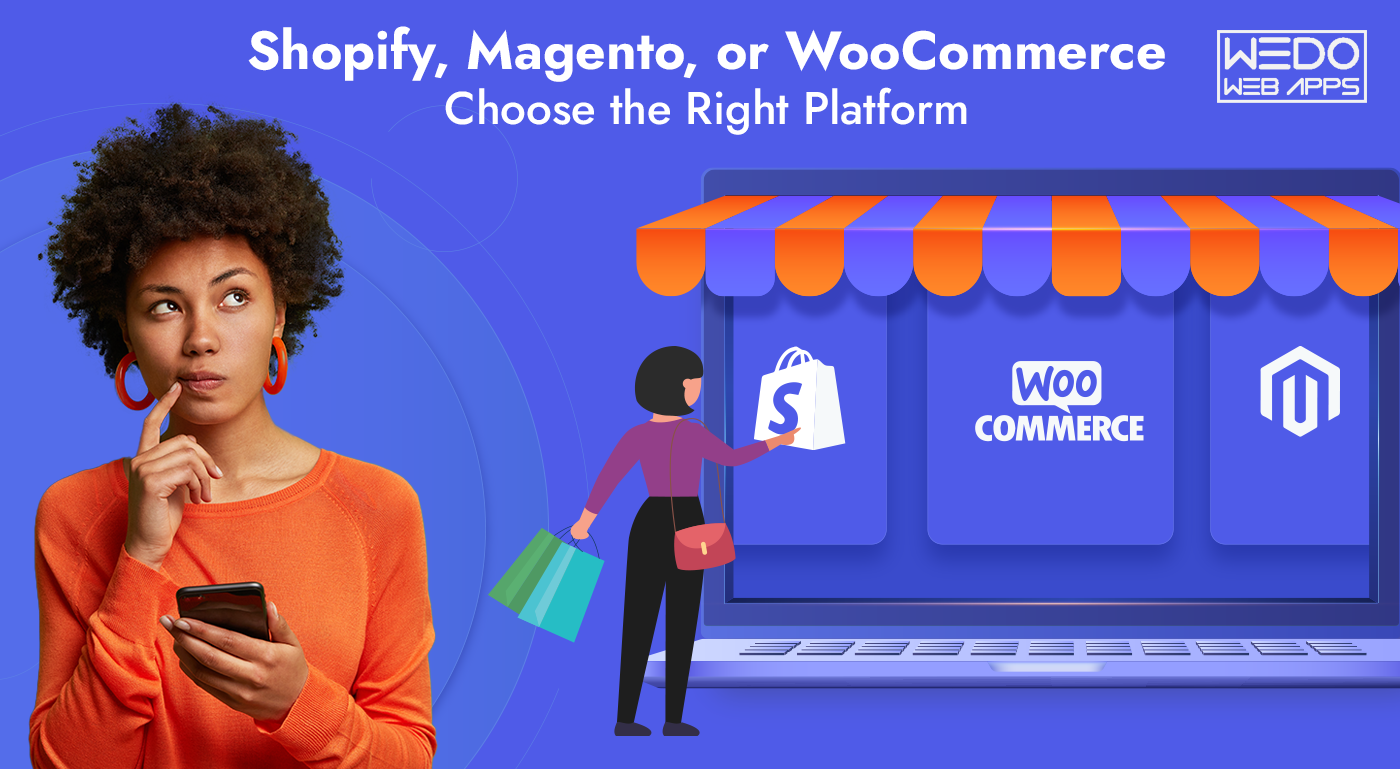
Shopify, Magento, or WooCommerce – Choose the Right Platform

With digitalization, eCommerce website development seems to be the right choice if you are looking for long-term growth in your business. The idea of moving to the digital world sounds cool, but there is much more to it. Whether it is about products or services, startup or enterprise, an online store is something that pushes your business beyond boundaries.  Setting up an online website with the best digital experiences is on the bucket list of every small to the enterprise-level business owner. However, making the right choice to set up an online store is the most crucial decision a business owner should take. Choosing an inappropriate website design platform may be an obstacle to your business growth.  Choosing the right eCommerce platforms is crucial as It involves various factors like website loading time, features list, type of platform, plugins, and tools. There are different eCommerce platforms in the market, but among them, there are the top 3 competitors – Shopify, Magento, and WooCommerce. Therefore, you need to know which eCommerce best suits your business needs.  Before diving into the eCommerce platforms, let’s talk about what eCommerce is, its characteristics, and why businesses need an eCommerce website. So Here we go.

What is an eCommerce Website?

An eCommerce or electronic commerce website allows you to buy or sell your products or services on the web. In other words, eCommerce websites are the online portals that facilitate you to buy or sell your offerings over the internet. 

What are the Characteristics of an eCommerce Web Store?

Since there are many websites present on the World Wide Web these days, customers are loaded with the options for online shopping. So, to attract customers to your online store, you need to provide an excellent user experience to convince your customers to buy from you. In addition, you need to build trust in them that your products are worth buying.  Characteristics of an eCommerce Web Store Therefore, here we are with specific characteristics of an eCommerce store, including those which will make your website look appealing. 
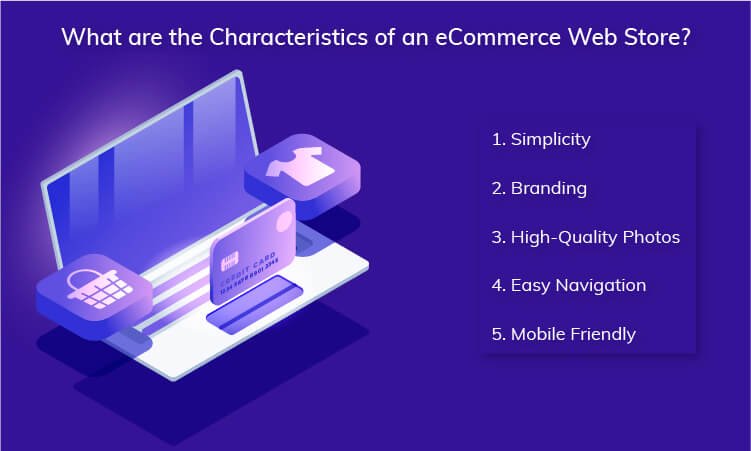
1. Simplicity

The main focus of a website should be on the products rather than on extravagant design. An excessive website design for no legitimate reason can only do harm but no good to your business. It will distract the customers from the products on your site. Simplicity in design helps in enhancing the user experience. Therefore, designing a website that is simple and easy to use makes more sales.

2. Branding 

Most online shoppers prefer to buy products from the top brands in the market. Therefore, it is essential to establish a brand name not only in the online market but also in the offline market. In case you sell both online and offline, a website is just one part of the overall branding.  It should operate well with other branding efforts in order to make your customers feel that the website is safe. If you are a startup, branding must be a long-term goal as you don’t have the advantage of trusted customers. 

3. High-Quality Photos and Images 

Selling online is way more different than selling offline. The customer cannot physically touch the product. It is a big thing to buy a product without touching it; therefore, you need to build trust for quality. Providing quality images and videos that exactly mirror the product can help overcome this challenge and help the visitors make their decision easily. The product photo is important as the customer will judge your product and your company just by seeing the product image. 

4. Easy Navigation

The very first requirement of buying or selling a product/service is that the customers should be able to find what they are looking for. Easy navigation is vital for any website, but it is especially crucial for online storefronts.  Lost visitors will eventually result in decreased sales; therefore, every effort should be made to make the website clean and easy to navigate.  Read also: How Shopify Web App Development can Increase your profit!

5. Mobile Friendly 

Nowadays, around 60% of the people prefer mobile phones for online shopping. However, suppose you have a website that works well on a PC or laptop but is not compatible with mobile devices. Now what? The mobile customers will go and look for other websites to buy what they want.  Therefore, a website should be compatible with all types of screens, be it laptops, PCs, tablets, or mobile phones. This will ultimately help you gain more customers and increase sales which is the primary concern of an eCommerce website. 

Why do Businesses Need eCommerce Websites?

An eCommerce website has become the most vital part of your business plan in the rapidly growing global economy. The increased amount of online shoppers is the powerful catalyst for eCommerce development.  If you are still confused about launching your online store, ask yourself why eCommerce is so much in trend around the world. Here, you will find various benefits of developing an online store.

1. eCommerce Helps in Cost Reduction

If you have an online store, it is not necessary to have all the products available to you in physical space. In fact, there are various companies that operate on the World Wide Web, where they show all their products through their eCommerce store.  This implies saving money not only by renting or purchasing a premises, but also internet, electricity, etc. On the other hand, if you still want to have a physical store for your customers to come and visit, it should not necessarily be that large. In either case, you will be saving your money. 

2. eCommerce Platforms help Businesses Go Global

In connection to the above point, eCommerce platforms allow you to post your products for sale anywhere worldwide. Therefore, the customers will not need to travel to your place to see what you offer. If you have a physical store, you will be limited to your geographical area, whereas by having an online store, you will have the opportunity to grow your customer outreach. Furthermore, it will eliminate all your geographical and linguistic barriers. Your eCommerce store translated into different languages will allow the customers to buy from other areas of the world.

3. Increase in Sales

eCommerce is mainly focused on one thing that is increasing sales. At the end of the day, the primary purpose of your eCommerce store is to sell more, and therefore this is what it is aimed at.  Having an eCommerce store will ultimately increase your business reach, improve your products thanks to the customer reviews, or be available all round the clock. 

4. Maximum Security of Transactions

Today, shopping over the internet has become more safer than a physical store. You can sit back at your home with nobody spying over the secret number of your online transactions. Of Course, the online storefronts will have SSL certificates. This certificate not only allows safe shopping but also keeps your data encrypted in a way that it is absolutely safe to enter passcodes and keys.  It also protects even more confidential data, such as your credit card information. Security will continue to be the most significant concern in the near future, and eCommerce stores are absolutely safe to shop at. 

5. You can Easily Receive Feedbacks on the Products

You might have always wanted to know what your customers think of your product so that you can improve where you lack. One of the greatest advantages of having an eCommerce store is that you can ask your customers to leave genuine feedback on your website. Additionally, customer feedback will build trust in your current and upcoming customers.  The more positive feedback you get, the more customers believe in your store, and ultimately more will be the purchase. eCommerce reviews are kind of a channel where the customers can see what they can expect from your website.  So, this was all about eCommerce and its importance. Now let us come to our main focus point, i.e., Which platform is the best for eCommerce web design and development Before getting into the detailed comparison, let’s look at the brief application of each platform. Shopify is a subscription-based eCommerce platform with more than 1000 apps to add various functionalities to your website. Magento is appropriate for enterprise-grade businesses and can host multiple websites with just one admin panel. It also includes various plugins and tools free and paid.  Talking about WooCommerce, it is suitable for SMEs. It can create a web store from scratch by just using WordPress. To create an enticing eCommerce store, we would suggest you hire a website design company. A web design agency can ensure a website that includes everything you want in your store.  Cannot decide between Magento, Shopify, and WooCommerce? You are not the only one; each and every business faces this situation while developing an eCommerce store. These three platforms are the most popular eCommerce platforms in the industry today. Let’s read further to clear your confusion and let you select the best. Read more: Grow your E-Commerce business with best Woocommerce Development Services

Shopify Overview

Founded in 2006, Tobias Lütke, Daniel Weinand, and Scott Lake launched Shopify after the attempt of opening Snowdevil. Snowdevil is a web store for snowboarding equipment. From just five people in a coffee shop, Shopify has grown to approximately 5000 people across the globe. Till 2009, Shopify powered more than 1 million stores in over 175 countries.  With this rapid growth, Shopify became the most popular platform to start, run, and grow your business. It offers online businesses a wide range of services like payments, marketing, shipping, and customer engagement tools. These features simplify the process of running an online store for small businesses.  Whether a jewelry designer, musician selling mixtapes, or a business looking to grow, with Shopify, you can sell anything you want. The sky’s the limit to what you can sell on this platform. In addition, Shopify offers numerous features that will improve your web store

Features of Shopify

Features of Shopify

1. SEO

Search Engine Optimization is a fundamental requirement for all online business owners. This helps improve search engine ranking and visibility and thereby driving more traffic and customers to your website. Shopify comes with several SEO tools that help website owners appeal to search engines while they are busy working on other features of the website.

2. Securit

Shopify is capable of handling hacker protection, security compliances, and upgrades. This will allow you to focus on raising money and conversion rate. Also, you would be able to access dedicated support whenever you face any problem. The support team provides valuable assistance to the startup that wants a solution with no or fewer expenses. 

3. Analytical Tools

You can also keep track of the website’s progress with Shopify’s Analytical Tools. Through this feature, business owners can actually track how the visitors located them online and other helpful information that can help them enhance their marketing efforts. 

4. Hassle-free customization

Business owners with less or no technical knowledge can also use Shopify to develop a high-quality web store. This is all because of its easy customization features. It is extremely simple and convenient to set up an online web store with Shopify’s interface. It also includes guides and instructions to facilitate the development of a user-friendly website design. 

5. Integration

There are many business owners that rely on third-party software tools to ease their business processes. Shopify provides you the convenience of integrating useful tools like WooCommerce, MailChimp. This helps businesses streamline the entire work process, thereby eliminating the hassle of individually accessing the different programs.  Since each and every website development platform has specific benefits and drawbacks, therefore, let’s discuss Shopify’s pros and cons to get a clear idea about whether to use Shopify or not. 

Strengths of Shopify

1. Built-in Tools

Shopify offers top-notch in-built tools for finding products to sell, creating your website, marketing your products, and many more. If you are a budding startup, you can keep your investment down by using Shopify’s free tools. With these extensive free tools, businesses can have a better Point of sale for a more profitable business. 

2. Easy to Configure and Setup 

Shopify offers the convenience of quickly opening a web store with no extra cost. Since all the features are conversion-optimized, the user interface is tidy, user-friendly, and easily understandable. Shopify offers a 14-day free trial in which you can learn the features. The trial period does not ask for any coding experience.  On the Shopify website, you can find the documentation and the video tutorials for your reference. If that doesn’t work within your skill set, you can ask for help from responsive website development companies. 

3. Ease of Use

Shopify is an easy-to-use and robust website development platform. This enables you to create and launch your eCommerce website in a minimal time. If you are looking for a customized design, then the development can go for a few weeks. If you are a non-tech person, hire web design firms as per your needs. 

Drawback of Shopify

1. Not for Long Run

It is not easy to move your eCommerce store to a different platform. Because of this, choosing an eCommerce platform becomes tricky as you have to plan for the future. No doubt, you can use Shopify, but for a business that wishes to manage everything, it is better to move to a self-hosted platform. 

2. Shopify Pricing 

Shopify Storefront owners depend on the add-on features that advance Shopify plans and offers. The free version of Shopify only gives the basic features. So for advanced plans and built-in tools, you need to pay a higher cost. The pricing plan of Shopify or any other hosted platform will eventually become expensive.  In general, Shopify is an effective eCommerce platform, but in the end, the decision falls as per the company’s needs. 

Magento Overview

Magento – An open-source eCommerce platform developed by Varien Inc., is now known as Magento Inc. It is a very useful platform for businesses looking to grow online. It is a scalable eCommerce platform and has many control options. This helps the developers build user-friendly and search engine-friendly websites.  Magento was first launched on March 31, 2008, as an open-source eCommerce software. Till then, it has helped small business organizations build online businesses. It offers searching and sorting of products in several seamless ways. In addition, it is easily integrated with various third-party sites that are needed to run an online business effectively.  Magento is one of the best eCommerce platforms in the web development industry. This is a PHP-based software that provides several features and an easy user interface. In addition, it offers almost all the facets required for an eCommerce solution to be successful. These facets include managing products, catalogs, and orders, along with marketing and promotion. 

Features of Magento
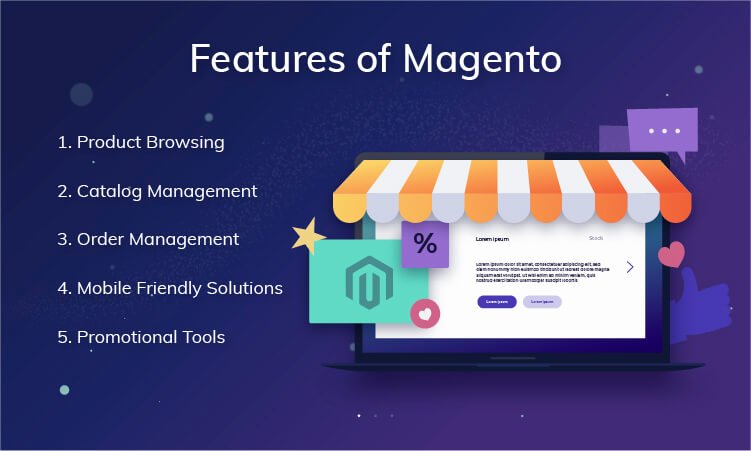
Features of Magento

1. Product Browsing

Suppose you visit a website that is having a bad user experience, and you fail to find the product you wanted. Would you continue browsing on the same website? No, Right? Therefore, Magento provides functionalities that help you deliver an enhanced user experience to your customers. The functions include zoom-in and zoom-out on the image, multiple product images, wishlist addition, and many more.

2. Catalog Management 

No matter what you are selling, the catalog of your web store holds absolute importance. Magento is a comprehensive platform that helps you in various ways. For example, you can showcase your products virtually, edit and delete product reviews, inventory management, and many more.  It also supports sharing the products on social media. Avail of web design services from us if you are looking for a professional Magento eCommerce website

3. Order Management

Magento also offers the feature of Order Management of your eCommerce website. This feature includes viewing, creating, and editing the products from the admin panel. Some of the advanced features include Multiple invoice printing, email notifications, call-center support, and RSS feed for new orders. Also, customization of the order status can be availed with Magento.

4. Mobile-Friendly Solutions

We all know that more than 60% of online shoppers prefer shopping from their mobile devices. And with Magento, you can attract this vast demographic of mobile users. Building mobile-friendly websites and applications with Magento is a seamless process. It offers mobile HTML5 for creating mobile-compatible eCommerce stores. 

5. Marketing and Promotional Tools

Magento also offers various promotional and marketing tools, which makes your advertising and marketing accessible. This Magento feature offers up-selling and cross-selling products, promotional pricing, free shipping, and monitoring coupon usage. Hence, Magento helps you to promote your products easily.  Magento is one of the biggest eCommerce platforms. Just like Shopify and WooCommerce, Magento has hundreds of web stores worldwide. However, being the most responsive web design service, we have seen some of the strengths and failings of Magento. Here we go!

Advantages of Magento

1. Highest Flexibility 

Magento allows you to start selling your products or services with just a primary shop. However, when it grows, its design becomes quite challenging. For Magento, flexibility is crucial; hence its plans are designed to increase its progressions. Furthermore, due to its open-source nature, we could modify the source code as per our needs and desires. 

2. Large Community of Users 

Magento has a large community of users because it is the most used eCommerce website development platform worldwide. This community of users always ensures quick support. Moreover, they are motivated to develop numerous plugins and extensions. Therefore, if you have any issue related to Magento, you are more likely to get quick support as there is a massive community of Magento users.

3. Magento Unique features that other platforms lack

Magento has a variety of features helping you manage multiple stores, allow multiple locations, currencies, language, and pricing. Compare any other platform with Magento, and it will definitely stand out with its ample features. For example, with Magento, you can set up the product price according to a group of people.  You can keep different prices for your staff, regular customers, and VIPs, respectively. Additionally, with the community version of Magento, you can enjoy various features that other eCommerce platforms lack. 

Disadvantages of Magento

1. It’s Expensive

Magento has many versions, the community version is free, and the enterprise version costs you more than approximately $15,000. Furthermore, the premier Magento version of which is targeted at large businesses, costs you more than approximately $22000 per annum. Add an extra third-party fee if you are unable to install the extension by yourself. Hence, Magento is way too expensive.

2. Time Consuming 

This eCommerce platform is time-consuming as it has a slow loading time. Therefore, it isn’t easy to customize your website in Magento as compared to other eCommerce platforms. In addition, it is not easy to migrate from another eCommerce platform to Magento as it imports data at a prolonged rate.  Due to its flexible architecture, it becomes complex and time-consuming to set up a Magento store. This is one of the reasons behind the slow loading time of the Magento platform.

WooCommerce Overview

WooCommerce is a free plugin for WordPress and has been downloaded around 3.9 million times by January 2020 worldwide. WooCommerce operates approximately over 37% of the websites on the world wide web. It was primarily developed by the WordPress Theme Developer WooThemes. WooThemes further hired developers, namely Mike Jolley and James Koster at Jigowatt, to work on Jigoshop that ultimately became WooCommerce. When WooCommerce is integrated into a WordPress website, it adds basic functionalities to it such as product management and shopping cart..  WooCommerce can help you develop a basic online store that can sell a variety of products and services. You can sell physical goods, digital goods, ongoing membership, and affiliate transactions. WooCommerce can manage various essential features like inventory management, international customers, sales tax management, coupons, and shipping cost calculation. 

WooCommerce Features
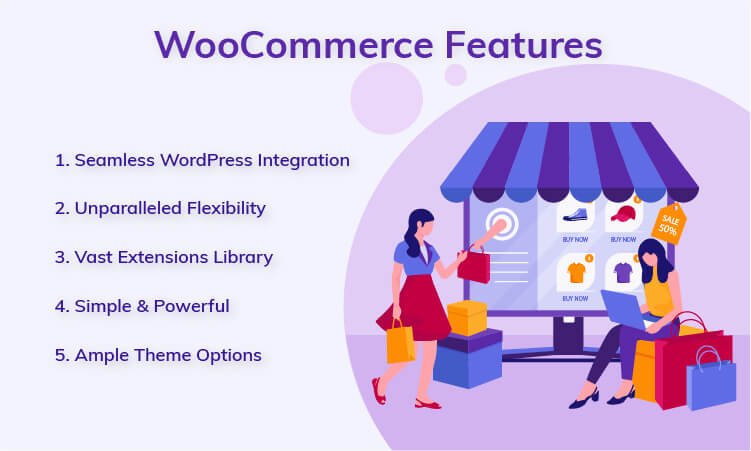
WooCommerce Features

1. Seamless WordPress Integration

The significant advantage of choosing WooCommerce is that it is developed on the most popular CMS worldwide – WordPress. As a result, the concepts that work on WordPress also work the same on WooCommerce. Since using WordPress is so easy, the integration of WooCommerce with WordPress makes a website owner’s work much easier. 

2. Unparalleled Flexibility 

Whether you are selling physical products, virtual products, or even if you are working with external/affiliate products, WooCommerce is the right choice for you. You can easily customize WooCommerce to sell any kind of product/service. The best part of WooCommerce is that you don’t have to be technically strong to customize it. 

3. Vast Extensions Library

If you are planning to build an eCommerce store, you need a lot more than just a website and products. You need to set up shipping, payments, marketing, accounts, and a whole lot of things. WooCommerce comes with a massive variety of extensions that makes the website functionality much easier. WooCommerce extensions library comprises more than 400 extensions. 

4. Simple & Powerful

Even Though WooCommerce is a small platform, it does not only target developing small stores. With WooCommerce, you can even create professional storefronts. With the robust in-built tools, you can do a lot of things like managing orders, updating delivery status, and many more. In all, WooCommerce has everything that is needed in a professional web store. 

5. Ample Theme Options

Have you seen two Bath and Body Works stores? You haven’t, right? Similarly, there cannot be two stores that are exactly the same. To stand out from your peers, you need to develop a store that is unique and speaks your own story. WooCommerce is compatible with WordPress themes.  Now that we know the features of WooCommerce let us now discuss the advantages and disadvantages of WooCommerce. Read further to learn more. 

Advantages of WooCommerce

1. Great Flexibility 

One of the major reasons for using WooCommerce is you can sell any kind of product regardless of your business niche. You can sell physical products, virtual products like downloadable novels, external products, and more. It also offers flexibility that allows businesses of all types and sizes to set up a store. You won’t have to worry about your business expanding past plugin capabilities. 

2. Maximum Security 

WooCommerce being an online platform, must have secure payment gateways in place. This should be done to ensure that your customer’s credentials are not compromised. WooCommerce comes with secure payment gateways like Stripe and PayPal. Because of the popularity of this platform, hackers constantly try to target it.  WooCommerce developers keep updating the platform regularly in order to prevent it from cyber-attacks. However, the plugin does not come with a backup facility to restore the data in case the attack is successful. With WooCommerce, you can add a backup that will keep the customer data stored in an encrypted form. 

3. Infinite Customization Options

WooCommerce helps you develop a website that is specific to your business niche. It has limitless free plugins available on the WordPress Plugin Directory. If you want the paid versions, you can find them on WooCommerce.com and Codecanyon.  Even though the free themes are limitless and impressive, if you don’t find a theme to suit your business, you can choose the one that is similar and customize it according to your business niche.  One of the huge benefits of using WooCommerce is that you don’t need to be technically strong. WooCommerce Wizard allows you to create a site with no knowledge in HTML and CSS. 

Disadvantages of WooCommerce

1. It’s WordPress Specific

Even Though WooCommerce has many advantages, it is still a plugin. Therefore, you cannot use it in websites that are not hosted by WordPress. This thing makes it difficult for the businesses who want to use WooCommerce but have a website on some other platform. They will need to migrate their website to WordPress for WooCommerce.

2. Not a Cost-Effective Solution

While it is free to download and install WooCommerce, some extensions may require payment to make your website work at a suitable capacity. This is the most significant disadvantage of WooCommerce as it feels like there are hidden costs for business owners.  Let’s say you want a payment gateway other than Paypal; for that, you will have to pay a bill. In addition, various extensions will require subscriptions that means you will have to deal with those every year. These subscriptions may cost you anywhere from $39 – $249, depending on how advanced you want your store to be.  It looks like you’ve gained enough knowledge about all three platforms. Congratulations! You’ve cleared a critical step. But a lot of things might confuse you to choose a platform for your website development. The very first thing may be which eCommerce platform you should start your business with.  This year everyone seemed to be tempted with Magento; earlier, it was WooCommerce and Shopify. The more you speak with the website design companies or the marketing companies, the more confused you will be.  All three platforms have billion-dollar companies behind them, which will assure you of getting updated and enhanced with time. Since all the three are well supported and famous, all have an intense competition when it comes to choosing one.  Shopify offers the easiest way to start your online business but compromising the flexibility, Magento provides enterprise-level flexibility but for the sake of ease of use. However, WooCommerce sits somewhere in the middle of both platforms, offering a significant amount of flexibility while staying easy to use.  Confused about which platform you should go with? Let’s carry on with a detailed comparison between the three platforms to help you choose the most appropriate one for your website development. 

Magento vs. Shopify

Magento and Shopify both are eCommerce platforms, and both offer us exorbitant products. As such, both these platforms should be in close competition with each other, right? Absolutely Not. The reason it would be unfair to compare these two platforms is that both platforms serve different parts of the industry. Magento vs. Shopify would be like matching a fresher programmer with an experienced one – same platform, different experience. Nonetheless, both have their own value in the market. Shopify is preferred over Magento because it has more affordable pricing, comprehensive out-of-the-box functionalities, and numerous built-in themes. At the same time, there are many who choose Magento over Shopify because of its open-source nature, endless flexibility, outstanding features, and a massive dedicated community.  Shopify is the perfect eCommerce solution for beginners or people with no prior coding experience. On the other hand, Magento is appropriate for experienced developers and businesses who have been in the eCommerce industry for a very long time. When you plan to build on Magento, it will require more human work, and assume that you have prior coding knowledge. 

Shopify vs. WooCommerce 

Shopify is superior to WooCommerce as it offers specific features at each subscription stage, out-of-the-box rich features, and requires no coding skills. Whereas you should consider WooCommerce over Shopify because it has powerful SEO functionality, ample plugins, add-ons to choose from, and most importantly, rich customization potential to meet your business needs.  Both Shopify and WooCommerce are good eCommerce website development solutions. However, the choice comes down to individuals’ preference and their business requirements.  If you want a user-friendly, plug ‘n’ play solution and less customization, Shopify would be the perfect fit for your web design. But if you are an experienced WordPress user looking for a flexible eCommerce platform, WooCommerce would be a great and lucrative option. It comes with varying costs approved by stand-alone applications as well as extensions.

Magento vs. WooCommerce

Just like we compared Magento and Shopify, the comparison between Magento and WooCommerce also falls under the same class. This makes the selection between the two relatively easy. Just choose one that suits your business requirements.  Both the platforms require prior experience and knowledge, and it can be expensive to set up a web store with these two. As such, if you are comparing Magento and WooCommerce, it’s the debate about business needs, not the capabilities.  Magento is suitable for large businesses looking for a better and more customized solution built from scratch. And also to the companies who are not afraid to invest their time, money, and efforts.  WooCommerce will be best for small companies or budding startups looking for a cost-effective eCommerce web solution. While WooCommerce requires some pre-knowledge of WordPress, it is more suitable for beginners as compared to Magento. 

Shopify vs. WooCommerce vs. Magento

Now that we have seen the detailed description of each platform individually and have also compared them with each other, it is clear that all three have their target audience and strengths.  Shopify is an eCommerce platform that is suitable for small businesses looking for an eCommerce solution without investing too much time, effort, and money. For businesses that are already running a WordPress website but are looking for a more flexible and enriched eCommerce functionality, WooCommerce is an excellent way to go. Magento is the best solution for medium and enterprise-level businesses who are looking for a comprehensive and tailored eCommerce solution absolutely from scratch. 

Final Words

Having analyzed WooCommerce, Shopify, and Magento, the biggest question that arises is – Which Platform to Choose? This is often the case in such questions, and the simple answer to these questions is – It Depends! There are a lot of factors that are to be considered while choosing an eCommerce platform for your website. For example, your technical skills, size of the store, features required, and also budget, all these factors help you decide which eCommerce platform is perfect for your online business. 

There are three scenarios where there is a clear answer to this question. 

  • You have fewer technical skills and want to quickly launch your store with minimum fuss, go with Shopify.
  • You have a great budget and want the most perfect solution to launch an enterprise eCommerce solution, go with Magento.
  • You are interested in learning new things for yourself and want a solution that will grow your business without restricting its potential, WooCommerce is for you. 

Now the decision is yours. You need to analyze your business requirements, budget, skills, and the necessary things before choosing any website design platform. If you lack the technical skills and want to hire a responsive website development company, WeDoWebApps LLC would be honored to help you with our outstanding eCommerce website development services. Get in touch to know more about eCommerce platforms and our services. So, WooCommerce, Magento, or Shopify. What are your thoughts?
WooCommerce Experts at Your Service: Unlocking the Full Potential of Your Online Store

WooCommerce is an ecommerce platform for building an online store. It is one of the best online ecommerce platforms, and it is trendy as well. Like all the other similar platforms, it has all the tools required to create an online store as per your liking. Developers can make the store according to the needs of their clients. And store owners can design their store and control it.

Crucial WooCommerce Development Services

Ecommerce has taken shopping to a whole new level, and it is somewhat successful. People are leaning more and more towards online shopping as time passes. Building an eCommerce store isn’t that difficult as it was before. There are many ecommerce service providers on the internet, and WooCommerce Development Services stand out due to some of its unique features. A list of its essential features is given below with a brief explanation for each. Kindly read it and understand it correctly.

Creating a store

WooCommerce offers extensive customization for store owners to bring their vision of a store to reality. The first thing is to build the storefront, and one can select from various themes as they see fit. WooCommerce is designed in such a way that it works flawlessly with any theme one decides. Owners can choose from the default WordPress themes or the countless themes available from around the world.

Customization and Blogging

WooCommerce aims to make it easy for the store owners to modify their sites in any way they can. There are many options to edit the online store, and WooCommerce has all the provisions for that purpose. Right from the homepage layout to the buy button, everything is customizable. A built-in blogging feature makes it easier to write and publish great content about the store.

While learning about the services of WooCommerce development, discover why the WooCommerce eCommerce platform is the next big milestone for online businesses.

Product Management

Product Management has never been easier. WooCommerce Development Services allows owners to create shortcodes to link products directly to the blogs. Or they can create specific landing pages that take the customers straight to checkout. Customers can easily search for products they are looking for with the help of tags.

Orders and Payment

WooCommerce allows owners to sell both physical and digital items, a lesser-known feature. Customers can even see products available on other sites and also purchase them. WooCommerce has made the payment the easiest. Customers can choose to pay from PayPal, Credit or debit cards, direct bank transfers, Cheque, or even Cash on Delivery.

As you explore the services of WooCommerce development, don’t miss out on understanding the key considerations for Shopify website development for a well-rounded eCommerce strategy.

Customer Management

Customers will now find it easier to register for an account on a WooCommerce online store. Once the Sign-Up, the store will make further login processes easier. Refunds will be more relaxed, and owners can manage them from the dashboard itself.Thus, looking at all the WooCommerce Development Services, one can conclude that it is one of the best ecommerce solutions. It powers nearly 28% of online stores and has more than proven itself. The services are excellent and very much affordable. We hope that this guide has made you understand WooCommerce correctly.

Is BigCommerce Dropshipping Really Worth It?

In the era of digitalization, where almost every business is transferring themselves to digitalization, dropshipping has become intensively popular in recent years. As per Statista, in 2021, there are 2.14 billion people are expected to buy products online.  As the growth in the dropshipping domain is at peak, such businesses are quick to expand and thrive. If you are planning your business through dropshipping, you may come across numerous platforms that can help you to start your business as a drop shipper. Bigcommerce, Shopify are the most famous dropshipping platforms. However, Bigcommerce is more efficient and prominent to develop a dropshipping business.     Well, In this blog, We are going to discuss how you can create an online store and sell online through it with the help of Bigcommerce dropshipping. Get Bigcommerce development services to get more out of your business. So, Let’s read ahead to get in-depth insight!

What is Dropshipping?

Dropshipping is the business model in which a person earns without investing in the stocks of the products. In dropshipping, the retailer does not have to buy the product from the supplier and sell or deliver it further to the customer. Retailers just take orders from the buyer and pass that order to the supplier, and the supplier supplies the product directly to the customer.  Here the retailer acts as an intermediator, who places an indirect relationship between the producer and consumer by selling the product without investing in them. Through the model of dropshipping, you can sell numerous things such as toys, furniture appliances, dresses, jewellery, and so on. Moreover, you can start dropshipping your own with very little budget. 

What is the work process of Bigcommerce Dropshipping

Bigcommerce is an eCommerce platform that provides remarkable dropshipping services since 2009. As if we compare it to other platforms, Bigcommerce is highly focused upon your comfort and ease. It facilitates you to create your online store where you can showcase your products at your convenience so you can target the audience with your ease. process of Bigcommerce Dropshipping Bigcommerce dropshipping is a highly commendable service in the domain of dropshipping especially. BigCommerce gives plenty of features to you for expanding your store. Along with that, It also provides a broad market to sell your products through dropshipping.  It makes it accessible for you to reach customers worldwide, according to the statistical data on the official website of BigCommerce. It has almost 4000+ customers till now.  For developing your online store, you approach a mobile app development company or can prefer to hire a BigCommerce store expert developer to avail benefit from BigCommerce development services with a touch of expertise.

How to set up the Dropshipping with the help of Bigcommerce  

Setting up the business through Bigcommerce is quite a technical task as well as a detailed one. Suppose you are thinking of transferring your offline shop to an online shop and planning to create your own Bigcommerce website. DropShipping business without technical knowledge and sufficient balance, you can hire a bigcommerce developer.. In that case, you can hire a certified BigCommerce developer who is an expert in settling up the dropshipping Store.

Advantages of Bigcommerce Dropshipping 

With Bigcommerce dropshipping, one can create a significant hype in their online business and can make a handsome amount of money through it. There are several underlying advantages of Bigcommerce dropshipping that are as follow : Read also: Is Your Extended Search Abates at BigCommerce?

An astonishing platform to build up the most interactive Website 

Bigcommerce facilitates you to build your website with a personalized touch with high quality shopping experience. Here you can get the tempting themes and graphics for your website. Moreover, you can create your eCommerce store much more interactive with Bigcommerce.  Promotes the growth of your business  Big Commerce also has a feature to promote the growth of your business and helps to increase the traffic of your website with best user experience. Like the other eCommerce platforms, it assists with enhanced traffic by providing search engine optimization services.  For marketing it, there is also a tempting feature of email marketing. With the help of email marketing, You can also retain your old customers to your website by sending them interactive emails for your product.

A platform where you can do shipping throughout the world 

  • With the help of Bigcommerce, you can get a wide market to sell your product. It allows you to sell your product and expand your business around the world, and along with that, It also provides shipping throughout the world, though many of the similar platforms do not provide this choice.

Read also: BigCommerce Development Services

Dropshipping Apps by Bigcommerce  

At the Bigcommerce app store, you may also find multiple apps that will fuel up your business to extreme heights. In addition, the apps may offer different tasks which can be accessible for your business, such as the merchandising and advertising of your business. Along with this, there is also a section that offers abundant options for dropshipping apps, from which, you can choose according to your convenience.  The two best Apps of the Bigcommerce apps are as follows :

  •  Ecomdash: This is the prominent app of the Bigcommerce app store that provides the service related to the successful delivery of a product to the customer. Furthermore, this app plays a vital role in maintaining the growth in the sales of the product enlisted on your website.
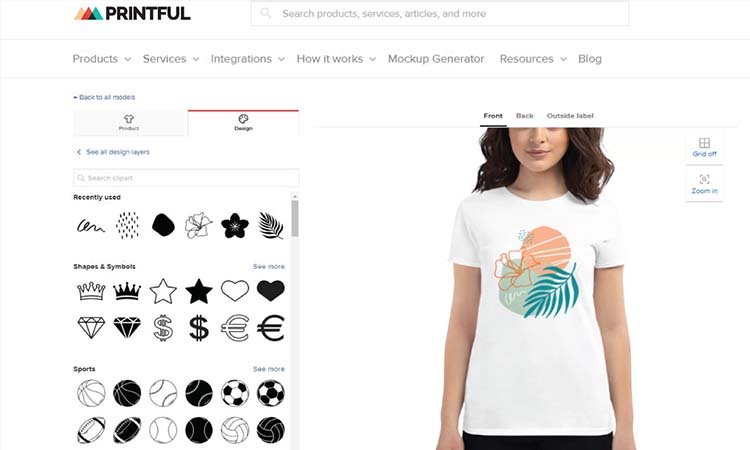
  • Print full App:

Print full App This app is widely preferable for the designers at the big commerce app. When the customer places an order to your site, they access it while printing the designs onto the product and then deliver that to the customer.

How to monitor the supplier’s Fulfilment Effectiveness through BigCommerce Dropshipping business

The retailer must take care of the order and track its delivery process until it gets delivered to the customer. It is a crucial step that has to be followed as it plays an important role in maintaining the success of a retailer’s business.  If there is any kind of trouble happening with the delivery of the ordered product, this will affect the image of the retailer as the consumer may give a negative review of the retailer. It will be considered the best if you monitor the supplier’s fulfillment effectiveness and run a big scale business. It is highly recommendable to monitor the supplier’s effectiveness.  To tackle this issue, Bigcommerce has come up with a solution in which tracking information of the order is presented to both the consumer and the retailer. To track your customer’s order, you also have the option for a third-party app to integrate within your store, which helps you monitor the shipping and is accessible to manage the inventories and others.  Ecomdash can be an example of that third-party app, which can manage all these tasks for your app. 

Is Dropshipping worth it with Bigcommerce?

It is an avid truth that Bigcommerce is quite a wide platform for dropshipping. At Bigcommerce, you may come across enormous competitors in your field. There is intense competition for you at Bigcommerce. In other words, we can say that it will be a bit complex for you to establish your unique brand as most of the people are selling similar products that you are selling. Therefore, you may come across the challenge where most of your earnings will go to the supplier, and you might earn lower returns by selling the product. You may cross the challenge where the supplier may deliver a low-quality product, or your customer may return the product due to low satisfaction, and this will affect your image in front of the customers. Besides the challenges, there may be other challenges a retailer can face when going to start a dropshipping business. But that doesn’t blur the impact of the BigCommerce platform if you run your business with proper techniques. One day, you will see significant hype in your business.

A Word from us! 

In this write-up, we have focused on opening your online store through Bigcommerce – dropshipping. So we hope you are cleared with your doubt about Bigcommerce dropshipping. Creating an online store through BigCommerce is a big tech task. This task needs expertise. If you are going to develop your online store, we suggest that you contact a reliable company to hire  Bigcommerce developer for settling up your store through BigCommerce with quality work.  We also provide BigCommerce development services. Well, You can also contact WEDOWEBAPPS LLC, an expert BigCommerce development company which offers high quality work and we also have years of experience. Let’s have a free consultation session.   We hope you are now confident enough to turn those dropshipping dreams into reality and get started.

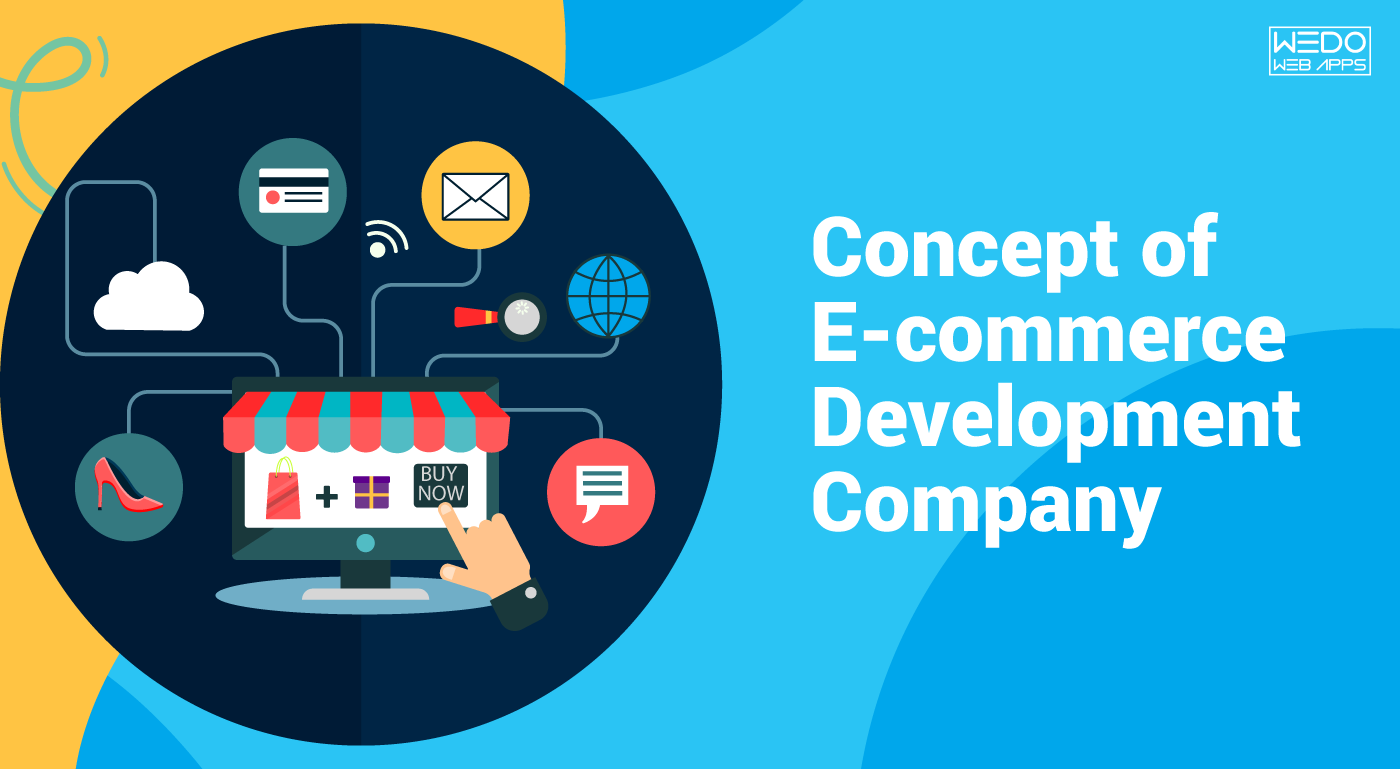
Unleashing the Potential of E-commerce Development Companies for Business Expansion

Running a business towards success is not just about the idea of the hard pushes. Instead, it requires the right strategy application at the right stage of development. E-commerce Development Company is one of these strategies that prove to be an adequate standard for most of the organizations.

How can e-commerce Development Company enact business Development?

In simple terms, developing E-commerce services for a defined company involves the use of online services to support the functions of the company or provide its knowledge to the audience. Developing E-commerce websites offer businesses with an open medium for consumers to access the benefits that they can have from the organization. In return, this becomes a more natural way for the company to reach its customers.

Here are some of the points that will describe how a development company supports the growth of a business.

  1. Expertise towards the right steps for the venture: The most significant advantage of having the support via a compatible e-commerce website is that their market experts completely handle the business venture prospects. Depending on the type of venture a business endorses, the right support is always exclaimed by the experts themselves.
  2. Delivering the right content to potential customers: It might be difficult for some businesses to directly explore the consumers. Thanks to E-commerce services enlisting the services of an organization, the customers tend to access the service themselves. In this manner, the company will save extra expenses for reaching out to every consumer.
  3. Dedicated divisions to deliver projects within time sanctioned: The point clearly defines the work of a development company composes of dedicated eCommerce developers to providing timely solutions to the company in the adjacent services. They intend to serve and maintain a longer relationship with the company so both can endure success.
  4. Save productive time for company officials: Since the professionals are engaged in maintaining the online services, the burden is shaking off the company’s employees. There is no need to recruit individual divisions, and the employees can concentrate on other aspects of the business. This eventually saves valuable time for the company, which proves to be profitable in the long term.
  5. The concept of E-commerce development: The online business industry has been booming for the past few years. It is a powerful tool in the event of almost any kind of business. E-commerce is an attractive concept for entrepreneurs and many retailer leaders all over the world. Hence, developing your online business obtaining help from the development company will help you in generating more revenue.Read also about Grow your E-Commerce business with best Woocommerce Development Services

Conclusion:

Several more favorable points may favor E-commerce support for any business. To boost brand capabilities in front of the market and create a defining position, it is significant that experts in this field are sought. Hence, these points clearly define the importance of the e-commerce Development Company in the n growth of different businesses or organizations.

Explore the potential of e-commerce development companies and the range of e-commerce services they offer to boost your online business effectively. Explore the potential of Drupal development to boost your online presence and enhance your business operations effectively.


Magento Customization Services: Unleashing Magento’s Full Potential

Introduction

Imagine launching your Magento store with high expectations, a strong product lineup, competitive pricing, and a growing marketing budget. In the first few months, traffic increases, and orders start coming in. But soon, cracks begin to show. Customers abandon carts. The checkout feels slow. The store design looks similar to competitors. Simple business workflows require manual workarounds.

Nothing is technically “broken.” But the store is not performing the way your business needs it to.

This is a common situation for businesses using Magento out of the box.

Magento is a powerful eCommerce platform known for its flexibility and scalability. However, its real strength is unlocked through customization. Without customizing Magento to your specific business model, user expectations, and growth goals, you only experience a fraction of what the platform can offer.

Magento customization allows businesses to adapt their store’s design, functionality, checkout experience, integrations, and performance to match their exact needs, transforming a standard Magento installation into a high-performing, conversion-focused eCommerce engine.

In this guide, you will learn what Magento customization means, how it unlocks Magento’s full potential, essential types of customization, costs, timelines, challenges, and how to choose the right Magento customization company. This helps you confidently plan your store’s optimization and growth.


Call to action for Magento store customization audit

What is Magento Customization?

Magento customization is the process of modifying Magento’s design, features, and functionality to match specific business requirements beyond the platform’s default capabilities.

In simple terms, Magento customization means adapting your store so it works the way your business operates, rather than forcing your business to adjust to Magento’s default setup.

Magento customization can involve:

  • Changing the visual appearance of the store
  • Modifying existing features
  • Adding new functionality
  • Integrating third-party systems
  • Optimizing performance and user experience

Magento Configuration vs Magento Customization

These two terms are often confused, but they are different.

Magento Configuration: Uses built-in admin settings to adjust existing options such as tax rules, shipping methods, or product attributes.

Magento Customization: Involves coding changes, theme modifications, module development, or architectural enhancements to create new or improved functionality.

Configuration extends what already exists. Customization creates what Magento does not offer by default.

What Can Be Customized in Magento?

  • Storefront design and layout
  • Product pages and catalogs
  • Checkout and cart experience
  • Payment and shipping logic
  • Admin workflows
  • Integrations with external systems

Magento’s open-source nature makes it highly extensible, which is why it is a preferred platform for businesses that need personalized eCommerce development solutions.

How Magento Customization Unlocks Magento’s Full Potential

Magento is designed as a flexible platform, but flexibility alone does not guarantee results. Customization is what transforms Magento from a standard eCommerce system into a platform that actively supports your business strategy.

Here is how Magento customization unlocks Magento’s full potential:

Personalized Shopping Experiences

Customization allows you to personalize:

  • Homepage layouts
  • Product recommendations
  • Navigation structure
  • Search and filtering

This creates personalized experiences that make it easier for customers to find what they want and complete purchases.

Scalable Architecture

Customizing Magento’s architecture ensures your store can:

  • Handle growing traffic
  • Support large product catalogs
  • Manage complex pricing rules
  • Expand into new markets

Instead of rebuilding later, customization prepares your store for growth from the start.

Optimized Store Performance

Performance-focused customization improves:

  • Page load speed
  • Server response times
  • Caching mechanisms

Faster stores lead to better user experience, improved SEO rankings, and higher conversions.

Business-Specific Workflows

Every business operates differently. Magento customization enables:

  • Custom order processing
  • Automated inventory handling
  • Role-based admin permissions
  • Tailored reporting

This reduces manual work and operational errors.

Seamless Integrations

Custom integrations connect Magento with:

  • ERP systems
  • CRM platforms
  • Accounting tools
  • Marketing automation software

This results in unified operations and better data visibility.

Why Businesses Invest in Magento Store Customization

Businesses don’t customize Magento just for aesthetics. They invest in Magento store customization because it directly impacts revenue, efficiency, and scalability.

Here are the main reasons:

Improved User Experience (UX)

Customized stores provide:

  • Cleaner navigation
  • Faster browsing
  • Intuitive product discovery

A better UX reduces friction and increases conversions.

Higher Conversion Rates

Magento store customization allows optimization of:

  • Product pages
  • Checkout flow
  • Calls-to-action

Small improvements in these areas often lead to measurable revenue gains.

Strong Brand Differentiation

With theme and UI customization, your store:

  • Reflects your brand identity
  • Stands out from competitors
  • Builds customer trust

Better Operational Efficiency

Customized admin workflows automate repetitive tasks, saving time and reducing errors.

Long-Term Scalability

Magento store customization ensures your platform can grow without major rework.

Essential Types of Magento Customization

Magento supports multiple levels of customization depending on business goals, complexity, and scale. Below are the most essential and commonly used types.

Magento Theme Customization

Magento theme customization focuses on modifying the visual design and user interface of your store to match your brand and improve usability.

Common theme customization areas include:

  • Homepage layout design
  • Product page layout changes
  • Header, footer, and navigation design
  • Typography and color schemes
  • Mobile responsiveness

Theme customization ensures your store looks unique, professional, and conversion-focused.

Magento Extension & Module Customization

Extensions add functionality to Magento. Customization may involve:

  • Modifying existing extensions
  • Combining multiple Magento extensions
  • Building custom modules

This allows businesses to implement features that are not available out of the box.

Checkout & Cart Customization

Checkout customization improves conversion rates by:

  • Reducing checkout steps
  • Adding one-page checkout
  • Custom payment methods
  • Custom shipping logic

A smoother checkout experience leads to fewer abandoned carts.

Performance & Speed Optimization Customization

Performance customization focuses on:

  • Caching strategies
  • Code optimization
  • Image compression
  • Database optimization

Faster stores improve SEO and user satisfaction.

Integration Customization

Integration customization connects Magento with:

  • ERP systems
  • CRM platforms
  • Payment gateways
  • Shipping and inventory systems

This creates seamless data flow across business tools.


Call to action for Magento customization consultation

Magento Customization vs Out-of-the-Box Magento

Magento’s default installation offers strong baseline features. However, businesses with growth goals often outgrow these capabilities.

Below is a practical comparison.

Aspect Out-of-the-Box Magento Customized Magento
Design Standard themes Brand-specific UI/UX
Functionality Limited to core features Tailored business features
Flexibility Moderate High
Scalability Basic scaling Built for growth
Integrations Limited Custom integrations
Performance General optimization Advanced optimization
Competitive Edge Low differentiation Strong differentiation

Key Takeaway: Out-of-the-box Magento works for basic stores. Customized Magento works for businesses aiming for scale, differentiation, and higher conversions.

When Should You Customize Magento?

Magento customization becomes essential when your business starts to outgrow standard platform capabilities.

For Startups

Customize Magento when you need:

  • Unique branding
  • Essential third-party integrations
  • Simple checkout optimization

Early customization helps establish a strong foundation.

For Small & Medium Enterprises (SMEs)

Customize Magento when you want:

  • Conversion-focused UX improvements
  • Automated workflows
  • Performance optimization

This supports consistent growth.

For Enterprises

Customize Magento when you require:

  • Complex pricing models
  • Large catalogs
  • Advanced integrations
  • High scalability

Enterprise customization enables operational efficiency at scale.

How to Customize Magento Store: Step-by-Step Process

A structured approach ensures Magento customization delivers business value without unnecessary risk.

Step 1: Requirement Gathering

This stage focuses on understanding your business goals, identifying pain points in the current store, and documenting the features or improvements you need. Requirements are prioritized based on impact, budget, and timeline to create clarity from the beginning.

Step 2: Solution Design

During solution design, the technical team decides the best customization approach, whether through theme changes, module customization, or integrations. A technical roadmap is created to outline architecture, dependencies, and implementation strategy.

Step 3: Development

Developers implement approved customizations, including theme modifications, module development, and system integrations. Coding follows Magento best practices to ensure stability and scalability.

Step 4: Testing

All customizations undergo functional, performance, and security testing to ensure they work correctly, load efficiently, and do not introduce vulnerabilities.

Step 5: Deployment

Changes are first deployed to a staging environment for final validation. After approval, customizations are released to the live store.

Step 6: Maintenance

Post-launch, the store is monitored for performance and stability. Bugs are fixed, and enhancements are added as business needs evolve.


Request a project estimate for Magento customization services

Cost of Magento Customization Services

The cost of Magento customization services varies depending on the scope of work, complexity of features, and level of customization required. There is no one-size-fits-all price, but understanding the main cost drivers helps set realistic expectations.

One of the biggest factors is the type of customization. Simple theme adjustments or small feature changes cost significantly less than building custom modules or complex integrations.

Another major factor is project complexity. Customizing checkout flows, multi-store setups, or advanced pricing rules requires more development effort than basic UI changes.

Third-party integrations also affect pricing. Connecting Magento with ERP, CRM, payment gateways, or logistics systems increases development time and testing requirements.

The experience level of the Magento customization company matters as well. Experienced teams may charge higher rates, but they typically deliver higher-quality, scalable solutions with fewer risks.

High-Level Cost Ranges (Indicative)

  • Small customizations: A few thousand dollars
  • Medium-level customization projects: Mid five figures
  • Large or enterprise-level customization: Five figures to six figures+

(Exact pricing depends on detailed requirements and discovery.)

Cost Optimization Tips

Starting with a prioritized feature list, building an MVP, reusing reliable extensions where possible, and planning customization in phases can help control costs.

How Long Does Magento Customization Take?

Magento customization timelines depend on the scope of work, complexity, and number of features involved. Smaller changes can be completed quickly, while large customization projects require phased execution.

Small customizations, such as minor theme changes, layout adjustments, or simple feature tweaks, usually take a few days to one or two weeks.

Medium-level customizations, including checkout optimization, extension customization, or performance improvements, typically take a few weeks to one or two months.

Large or complex customizations, such as custom module development, multi-system integrations, or enterprise-level workflows, may take several months and are often delivered in phases.

A discovery phase at the start of the project helps define accurate timelines and reduces surprises later.

Common Magento Customization Challenges & How to Overcome Them

While Magento customization unlocks powerful capabilities, it also introduces technical and operational challenges. Knowing these in advance helps reduce risk.

Compatibility Issues: Customizations may conflict with existing extensions or Magento updates.

Solution: Follow Magento coding standards and test changes in staging environments.

Performance Impact: Poorly written custom code can slow down the store.

Solution: Optimize code, use caching, and conduct performance testing.

Upgrade Conflicts: Custom features may break during Magento version upgrades.

Solution: Use upgrade-safe development practices and maintain documentation.

Security Risks: Custom code can introduce vulnerabilities if not built securely.

Solution: Implement secure coding practices and regular security audits.

Why Working with a Magento Customization Company Maximizes Results

Magento customization is not just about writing code. It requires platform expertise, architectural understanding, and experience handling complex eCommerce scenarios.

A professional Magento customization company brings:

Platform Expertise: Experienced teams understand Magento’s architecture, best practices, and limitations, ensuring stable and scalable solutions.

Faster Delivery: Proven processes and reusable components help reduce development time.

Quality & Reliability: Customizations are built using standards that minimize bugs and future conflicts.

Long-Term Support: Ongoing maintenance, updates, and optimization ensure your store continues performing well.

At WEDOWEBAPPS, we help startups, SMEs, and enterprises deliver high-performing Magento stores through tailored customization, performance optimization, and scalable development.

Conclusion

Magento is a powerful eCommerce platform, but its true capabilities are realized only when it is customized to match your business model, customer expectations, and growth strategy.

Whether it’s theme customization, feature enhancements, checkout optimization, performance improvements, or system integrations, Magento customization enables you to build an eCommerce store that is faster, more flexible, and conversion-focused.

For businesses aiming to scale, relying solely on out-of-the-box functionality often becomes a limitation. Strategic customization helps overcome these limitations and transforms Magento into a platform that actively supports long-term growth.

Working with an experienced Magento development company ensures that customization is done correctly, securely, and in an upgrade-safe manner. The right partner can guide you through planning, implementation, and ongoing optimization, reducing risk while maximizing ROI.

If your goal is to unlock Magento’s full potential and build a high-performing online store, investing in professional Magento customization is a practical and future-ready decision.


Talk to Magento experts about store customization

Why Businesses Prefer WooCommerce to Run an Online Store

Introduction

Launching an online store today is not just about getting products online. It is about choosing a platform that won’t limit your business six months down the road.

Many business owners start their eCommerce journey excited by “quick setup” platforms, only to discover hidden transaction fees, rigid decision structures, limited customization, or rising monthly costs as their store grows. Others worry about being locked into a system they don’t truly own.

This is where WooCommerce continues to stand out.

Across industries and business sizes, WooCommerce is widely preferred because it gives store owners more control, more flexibility, and more long-term freedom compared to many hosted eCommerce platforms.

In this guide, we will explain why businesses prefer WooCommerce to run an online store, what practical advantages it offers, and when it makes sense, so you can decide if it aligns with your business goals.


WooCommerce development experts for scalable stores

What is WooCommerce?

WooCommerce is an open-source eCommerce platform built as a plugin for WordPress that enables businesses to create and manage an online store directly on their website.

Instead of operating as a separate hosted system, WooCommerce integrates into WordPress. This means your website and your online store exist within the same environment. This structure gives businesses greater control over how their store functions, looks, and evolves.

At its core, WooCommerce allows businesses to:

  • List and manage products
  • Process online payments
  • Handle orders and customer accounts
  • Configure shipping methods and taxes
  • Run promotions and discounts

Because WooCommerce is open-source, its underlying code is publicly available and continuously improved by a global community of developers. This openness is a key reason businesses are drawn to the platform. It avoids vendor lock-in and allows stores to be customized beyond predefined templates or rigid feature sets.

Another important aspect of WooCommerce is its extension ecosystem. Thousands of plugins and add-ons exist to extend functionality, including:

  • Payment gateways
  • Marketing and email integrations
  • Subscription and membership features
  • Advanced product configurations
  • Reporting and analytics tools

This means businesses don’t have to switch platforms as their needs grow. They can gradually enhance their store’s capabilities over time.

Most importantly, WooCommerce is designed to work for a wide range of business types, including:

  • Small startups launching their first store
  • Growing brands expanding product lines
  • Content-driven businesses selling alongside blogs
  • Service businesses offering digital products

In simple terms, WooCommerce provides the foundation for building an online store that is owned, customizable, and adaptable. This directly explains why so many businesses choose it as their eCommerce platform.

Key Reasons Businesses Prefer WooCommerce

Businesses don’t choose WooCommerce because it is trendy or popular. They choose it for building a premium eCommerce website because, in real-world use, it solves practical problems that many hosted ecommerce platforms struggle with.

Below are the main reasons why WooCommerce continues to be a preferred choice for running an online store.

Lower Cost of Entry and Better Cost Control

One of the most important benefits of WooCommerce for businesses is how it handles costs.

WooCommerce itself is free to use. There are no mandatory monthly platform fees and no forced transaction percentages charged by WooCommerce. This immediately gives businesses more control over their ecommerce budget.

Instead of paying a fixed subscription tier, businesses decide where to spend:

  • Hosting based on traffic and performance needs
  • Premium themes or design customization
  • Plugins for specific functionality
  • Ongoing maintenance or enhancements

This modular cost structure means you only pay for what your business actually requires.

For many businesses, this leads to better long-term economics:

  • No surprise price jumps when revenue increases
  • No forced upgrades to access basic features
  • Easier forecasting of operational expenses

Compared to hosted platforms where costs scale automatically as sales grow, WooCommerce allows businesses to grow revenue without proportionally increasing platform fees.

This level of cost predictability is a major reason why WooCommerce advantages for small and medium businesses are often centered around affordability and control.

High Flexibility for Custom Store Experiences

Every business has unique branding, workflows, and customer journeys. WooCommerce is built to accommodate this reality.

Because WooCommerce is open-source and built on WordPress, businesses are not restricted to a limited set of layouts or predefined store structures. Nearly every aspect of the store can be customized, including:

  • Homepage layout
  • Product page design
  • Checkout experience
  • Customer account areas
  • Navigation and filtering

Businesses can start with a theme and gradually tailor the store as they learn what works best for their customers.

Beyond visual customization, WooCommerce also supports functional flexibility:

  • Custom product types
  • Complex pricing rules
  • Bundles and kits
  • Subscriptions and memberships
  • Multi-vendor setups

This level of WooCommerce flexibility for online stores allows businesses to shape their ecommerce experience around their business model, rather than forcing their business model to fit the platform.

Complete Ownership of Website and Data

Ownership is one of the most underestimated factors when choosing an ecommerce platform.

With WooCommerce:

  • You own your website files
  • You control your database
  • You choose where your store is hosted

There is no dependency on a single platform provider’s infrastructure or policies.

This matters because it gives businesses:

  • Full access to customer data
  • Freedom to move hosting providers
  • Ability to modify code if needed
  • Long-term security against sudden platform rule changes

On hosted platforms, businesses are often bound by terms of service, feature limitations, and ecosystem restrictions.

WooCommerce’s ownership model gives businesses independence, which is a major reason why choose WooCommerce for ecommerce is such a common search.

SEO-Friendly Foundation for Long-Term Traffic

Organic search traffic remains one of the most valuable acquisition channels for ecommerce businesses.

WooCommerce inherits WordPress’s strong SEO foundation, making it easier for businesses to:

  • Optimize product pages
  • Create SEO-friendly URLs
  • Add metadata and schema
  • Publish supporting content such as blogs and guides

Since WooCommerce and WordPress exist within the same system, content marketing and ecommerce live together naturally.

This allows businesses to build topical authority through:

  • Educational blog posts
  • Buying guides
  • Category-level content
  • Internal linking strategies

Over time, this structure supports sustainable traffic growth without relying entirely on paid advertising.

For businesses that value organic visibility, WooCommerce for business websites offers a significant advantage.

Scales With Business Growth

Many businesses worry that choosing WooCommerce means sacrificing scalability. In reality, people see WooCommerce as the next eCommerce milestone. WooCommerce can support small stores as well as large catalogs with proper setup.

WooCommerce can scale through:

  • Optimized hosting environments
  • Caching and performance plugins
  • Content delivery networks (CDNs)
  • Database optimization
  • Efficient theme and plugin choices

Businesses can start small and gradually enhance infrastructure as traffic and orders increase.

This incremental scaling approach prevents overpaying for enterprise-level solutions before they are truly needed.

Large Plugin and Extension Ecosystem

WooCommerce has one of the largest extension marketplaces in ecommerce.

Businesses can easily add functionality for:

  • Payments and checkout options
  • Marketing automation
  • Email integrations
  • CRM connections
  • Accounting software
  • Shipping carriers

This ecosystem reduces development time and allows businesses to experiment quickly.

Instead of rebuilding features from scratch, businesses can leverage existing, proven extensions and customize only where necessary.


WooCommerce support for high-performing online stores

WooCommerce Advantages for Small and Medium Businesses

Small and medium-sized businesses often face a unique set of challenges when launching or growing an online store:

  • Limited budgets
  • Small internal teams
  • Need for faster time-to-market
  • Desire to test and refine ideas quickly

WooCommerce aligns well with these realities, which is why it is widely adopted by growing businesses.

Faster and More Affordable Store Launch

WooCommerce allows businesses to launch an online store without heavy upfront platform costs.

Many businesses start with:

  • A reliable hosting plan
  • A professionally built theme or starter template
  • Essential plugins only

This approach makes it possible to go live quickly and improve the store iteratively, instead of waiting months for a complex build.

For small and medium businesses, speed to market often matters more than having every feature perfect on day one.

Easier Experimentation and Optimization

As businesses grow, they naturally want to test:

  • New product layouts
  • Alternative checkout flows
  • Pricing strategies
  • Promotional offers
  • Upsell and cross-sell techniques

WooCommerce makes this easier because:

  • Features can be added or removed modularly
  • Plugins can be swapped if a better solution is found
  • Customizations can be layered gradually

This flexibility supports continuous improvement without forcing a full platform migration.

No Forced Feature Bundles

Many hosted platforms bundle features into pricing tiers. Businesses end up paying for tools they never use just to access one important feature.

WooCommerce’s ecosystem works differently.

Businesses select:

  • Only the plugins they need
  • Only the integrations they use
  • Only the services that add value

This keeps operational complexity and costs under control.

Strong Community and Knowledge Base

WooCommerce benefits from a massive global community of developers, designers, and store owners.

For businesses, this means:

  • Extensive documentation
  • Tutorials and guides
  • Community forums
  • Third-party tools

When issues arise, solutions are often already documented, reducing dependency on a single vendor for support.

Suitable for Many Business Models

WooCommerce is not limited to one type of store.

It works well for:

  • Physical product stores
  • Digital product sellers
  • Subscription-based businesses
  • B2B catalogs
  • Hybrid content plus ecommerce sites

This versatility gives small and medium businesses confidence that the platform can adapt as their business model evolves.

When WooCommerce Is Not the Ideal Choice

While WooCommerce offers strong advantages, it is not the best solution for every type of business. Being aware of its limitations helps set realistic expectations and supports better decision-making.

Extremely Large Enterprise Operations

Massive enterprises with:

  • Millions of products
  • Complex multi-region tax structures
  • Highly specialized ERP integrations
  • Heavy real-time data processing needs

may require dedicated enterprise ecommerce platforms or custom-built systems.

WooCommerce can be extended significantly, but at a certain scale, purpose-built enterprise platforms may be more efficient.

Businesses Wanting Zero Technical Responsibility

WooCommerce gives businesses control, but with control comes responsibility.

This includes:

  • Hosting management
  • Updates and maintenance
  • Security monitoring
  • Backups

Businesses that prefer a completely hands-off technical experience may find fully hosted platforms more comfortable.

Ultra-Simple One-Product Stores

For businesses selling a single product with no plans to expand, a lightweight hosted solution may be sufficient.

WooCommerce shines most when:

  • Multiple products are involved
  • Customization is important
  • Growth is anticipated

Businesses Without Any Customization Needs

If a business is fully satisfied with:

  • A standard template
  • Fixed checkout flows
  • Limited integrations

then the flexibility of WooCommerce may not provide significant additional value.

This honesty is important because the real strength of WooCommerce lies in matching platform capabilities with business goals, not forcing a one-size-fits-all solution.

WooCommerce vs Hosted Ecommerce Platforms High-Level Comparison

WooCommerce vs hosted ecommerce platforms comparison

When businesses compare WooCommerce with hosted ecommerce platforms such as Shopify, Wix, and BigCommerce, the real differences usually come down to ownership, flexibility, cost structure, and long-term control.

The table below highlights the major distinctions at a glance.

Factor WooCommerce Hosted Ecommerce Platforms
Platform Ownership Full ownership of the site and data Platform-controlled environment
Customization Flexibility Highly customizable Limited to the platform framework
Cost Structure Pay for hosting and chosen tools Monthly plans plus feature tiers
Transaction Fees None from WooCommerce Often charged by the platform
SEO Capabilities Strong (WordPress-based) Moderate
Content Management Advanced blogging and pages Basic Content Management System (CMS)
Scalability Approach Infrastructure upgrades Plan upgrades
Data Access Full database access Restricted access

While both approaches can power successful online stores, they appeal to different business mindsets.

WooCommerce tends to attract businesses that want control, flexibility, and long-term ownership, even if it requires some technical involvement.

Hosted platforms tend to attract businesses that prefer simplicity and managed infrastructure, even if that means accepting platform limitations.

This fundamental difference explains why WooCommerce is often preferred by businesses planning to grow, customize, and build long-term digital assets rather than operate inside a closed ecosystem.

Why WooCommerce Works Well for Business Websites

Many businesses don’t just want an online store. They want a complete business website that supports branding, marketing, content, and customer engagement alongside ecommerce.

WooCommerce fits this requirement naturally because it is built on WordPress.

Instead of treating ecommerce as a separate system, WooCommerce allows businesses to manage their store and their website as a single, unified platform.

Ecommerce and Content in One Place

With WooCommerce and WordPress working together, businesses can:

  • Publish blog articles
  • Create landing pages
  • Build resource sections
  • Run an online store

All within the same dashboard.

This integration is important because content plays a major role in:

  • Educating potential customers
  • Supporting SEO
  • Building trust
  • Driving organic traffic

Businesses can create buying guides, comparison articles, FAQs, and tutorials that directly link to product pages, creating a seamless path from information to purchase.

Strong Branding Control

WooCommerce does not impose rigid design systems.

Businesses can:

  • Design custom layouts
  • Follow brand style guides
  • Control typography, colors, and spacing
  • Create unique user experiences

This helps businesses stand out in crowded markets instead of looking like variations of the same template.

Marketing and Tool Integrations

WooCommerce integrates easily with popular marketing tools, including:

  • Email marketing platforms
  • CRM systems
  • Analytics tools
  • Social media integrations
  • Advertising platforms

This allows businesses to build a connected marketing stack that supports customer acquisition and retention.

Supports Long-Term Digital Asset Building

A WooCommerce store is not just a sales channel. It is a long-term digital asset owned by the business.

Over time, businesses build:

  • Domain authority
  • Content libraries
  • SEO rankings
  • Customer databases

These assets continue to generate value beyond individual campaigns.

This long-term perspective is a major reason WooCommerce is preferred for business websites rather than short-term store setups.

How Businesses Typically Implement WooCommerce Successfully

While WooCommerce provides a powerful foundation, successful stores usually follow certain implementation principles that improve performance, usability, and scalability.

These are patterns seen across high-performing WooCommerce stores.

Choosing the Right Foundation Theme vs Custom Build

Most businesses start with one of two approaches:

  • A high-quality WooCommerce-compatible theme
  • A custom-designed theme built specifically for their brand

Themes are faster and more budget-friendly for early stages.

Custom builds provide greater control and long-term flexibility.

The key is choosing a foundation that:

  • Loads quickly
  • Is well-coded
  • Supports future customization

Poorly built themes often become a bottleneck as the business grows. Therefore, if you want to get your WooCommerce website developed by the experts, you must choose the right WooCommerce Development Company that can help you accelerate your business potential.

Prioritizing Performance and Speed

Store speed directly affects:

  • Conversion rates
  • Bounce rates
  • SEO rankings

Successful WooCommerce stores typically invest in:

  • Optimized hosting
  • Caching solutions
  • Image optimization
  • Minimal, well-chosen plugins

Rather than installing many plugins, they focus on quality and necessity.

Focusing on User Experience UX

Good WooCommerce stores are designed around how customers browse and buy.

Common UX priorities include:

  • Simple navigation
  • Clear product categories
  • Easy filtering
  • Clean product pages
  • Smooth checkout

Small UX improvements can have a large impact on sales.

Planning for Security and Maintenance

Because WooCommerce is self-hosted, responsible store owners:

  • Keep WordPress and plugins updated
  • Use security plugins
  • Run regular backups
  • Monitor uptime

These steps protect business continuity.

Getting Expert Implementation Support When Needed

Many businesses handle basic setup internally, but seek expert help for:

  • Custom functionality
  • Performance optimization
  • Complex integrations
  • Scaling improvements

Working with WooCommerce development experts or teams offering custom WooCommerce solutions can prevent costly mistakes and accelerate growth.


Custom WooCommerce solutions for performance issues

Final Thoughts

WooCommerce continues to be a preferred ecommerce platform because it aligns with how many businesses actually operate.

Businesses want:

  • Control over their website
  • Flexibility to customize
  • Predictable costs
  • Strong SEO foundations
  • Room to grow

WooCommerce delivers these advantages without locking store owners into rigid systems or escalating platform fees.

At the same time, it is not a universal solution. Businesses that understand their goals, technical comfort level, and growth plans can more accurately determine whether WooCommerce is the right fit.

For businesses seeking a flexible, scalable, and ownership-driven approach to ecommerce, WooCommerce remains one of the most practical choices available today.

If you would like guidance on building or improving a WooCommerce store, working with experienced WooCommerce development experts can help ensure your store is set up for long-term success.


WooCommerce consultation for online store planning

Magento 2 eCommerce Website Development : Steps to Create an Engaging One

These days, when the internet overruns our lives, online shopping has become immensely popular. Where there were around 1.92 billion online buyers in 2019, the expected number of online buyers in 2020 was 2.05 billion. And in 2021, the expected number of digital buyers is 2.14 billion. 

Irrespective of where the online buyers buy their products from, online buying is gradually increasing with time. Now that it is a pandemic, people are scared of going to the physical stores for shopping, and they prefer buying their stuff from online stores. Thus, building a solid online presence is very vital to make good sales. If you have not yet jumped into eCommerce web development, it’s never too late. 

There are several ready-to-use eCommerce platforms that have made website development seamless and efficient. Magento 2 is the most suitable option among various other eCommerce platforms because of its unique features, functionalities, flexibility, scalability, and customizability. Robust performance is the plus point.

For businesses that want to build or grow their online presence effectively, investing in professional ecommerce development services can ensure a robust, scalable, and SEO-friendly Magento 2 store from the start.

In this article, we will discuss why Magento 2 is the right choice for website development and will also provide a step-by-step guide to develop a Magento 2 eCommerce website. So, let’s dive deep into it. 

But first, What is Magento 2?

An open-source eCommerce platform developed by Roy Rubin and Yoav Kutner under Varien Inc., released on March 31, 2007; Magento 2 is very useful software for building your digital presence and is currently the most comprehensive custom eCommerce development platform. 

Magento is one of the  highly used content management systems for creating engaging online stores by its robust and scalable architecture. It can go well with the latest technologies like PHP7. This means a faster loading time as compared to Magento 1. Magento 2 enables users to update their eCommerce websites automatically. 

Due to the rich features and extensible codebase of Magento 2, organizations with small and large operations worldwide use it for a wide variety of projects. As a result, Magento custom development is highly in demand in 2021, and the market will continue to increase. 

Why is Magento 2 the Right Choice for eCommerce Website Development?

In this tech-savvy world, any retailer thinking to build a successful digital presence is the smartest decision they can make. However, a suitable platform is required to build that presence. And among all the available eCommerce platforms, custom Magento development can be the right choice to kick start your business. For businesses considering upgrading from Magento 1, it’s crucial to factor in the Magento 1 to 2 migration cost while planning the transition. Wanna know why Magento 2 is the right choice? Let us get to that straight. Collaborating with a Magento integration agency can help businesses seamlessly add advanced features and third-party tools to their store.

1. Open-source Platform

The best part of Magento website development is that Magento 2 is open-source. This means it allows developers to build an attractive and engaging eCommerce store by integrating the extensions. It offers a multitude of extensions, themes, and many more to make your Store one of the best storefronts on the internet. 

2. Numerous Customizations and Tools

This eCommerce platform offers customization facilities by which you can develop the storefronts according to your business requirements. In addition, various analytical tools like Google Analytics, bigCommerce Analytics, Inspect Let, etc., can be easily integrated with Magento 2. 

3. It comes with a Digital Marketing Assistant.

Being an open-source platform, Magento 2 offers SEO, meta tags, site maps, URL suggestions, keyword suggestions, etc., to optimize your eCommerce store. In addition, Magento 2 comes with an in-built digital marketing assistant that assists businesses in managing traffic. All the digital marketing features in Magento 2 have helped the companies to rank their eCommerce storefronts to the top of the search engine. 

4. Mobile-Friendly Websites

Smartphones these days are the basic necessity of a human. Approximately 70% of the people prefer buying products from their mobile phones, making it crucial for the businesses to develop their website mobile-friendly. With Magento 2 web development, one can easily drag and drop, zoom in and zoom out, or slide the products listed on the website. These features make Magento 2 stand out from the competition. 

5. Provides Security

Providing security to the eCommerce platform is very necessary to keep it safe from hackers. If you want your website to be safe from hackers, I advise you to Hire Magento Web Development Company that specializes in providing security to your websites. Magento 2 offers high-level security to eCommerce websites. With 5 folders in the root directory, it makes websites less vulnerable to cyber attacks. Hence, it ensures developing secure eCommerce stores. In addition to robust in-built security features, Magento maintenance and support services ensure your eCommerce store remains protected and updated.

Master the art of eCommerce with our web development services, tailored to leverage Magento 2’s powerful features for creating engaging online stores. Dive into how we can help build your ideal eCommerce platform!

Let’s get an idea about the top brands using Magento 2 for eCommerce website development.

Magento 2 being the most used eCommerce website development platform, you would be surprised to know how many companies are using Magento 2 for the benefit of their business:

  • Fred Perry
  • Hermès
  • Christian Louboutin
  • Paul Smith
  • Missguided
  • Oliver Sweeney
  • Kurt Geiger
  • Agent Provocateur
  • BVLGARI
  • Nike
  • Liverpool FC
  • Helly Hansen
  • K Swiss

The list continues to go on. But, you can see so many big companies using Magento 2 for their business website development and competing in the agile market. Due to the obvious reasons mentioned above in this blog – the reasons to choose Magento 2 for eCommerce website development. 

OK, so how to build a Business Storefront using Magento 2?

Read also: Hire Dedicated BigCommerce Developers

How to Build an eCommerce Storefront Using Magento 2?

Now, as we know that Magento 2 has robust development tools and features that can give your website a promising online business launch, let’s go through the critical steps to develop an eCommerce website using Magento 2. For those considering Shopify to Magento 2 migration, working with experts ensures a smooth transition without affecting your existing store’s performance.

In this blog post, let us learn the process to set up an eCommerce website using Magento 2, as this is the most used platform among eCommerce businesses. So, here goes the steps for the same: 

Before diving into technical stack requirements, it’s crucial to define a related ecommerce strategy that outlines business goals, customer experience priorities, and growth expectations for your Magento 2 store.

Step 1: Review the Technology Stack Requirements

Like other web development platforms, even Magento 2 has specific technology stack requirements, which are as follows: 

OS: Linux x86-64, and other Linus distributions. Magento 2 is currently not supported by iOS or Windows. However, you can develop the Magento 2 websites locally on Mac and Windows using virtualizations and NAMP applications. 

Web Server: Apache 2.4 or Nginx 1.x. For Apache, you need to enable Apache mod_rewrite and mod_version modules. 

Memory: At Least 2GB of RAM is required to install and update Magento 2 and other extensions. 

Database: 

  • MySQL 5.6 – Magento 2.0.x and 2.1.1
  • MySQL 5.6, 5.7 – Magento 2.1.2 and higher
  • MySQL 8.0 – for On-premise installations

PHP: PHP 7.2 and PHP 7.3 is supported by Magento 2. Magento 2.4 – the new version of Magento 2 supports PHP 7.4.0. To optimize performance and avoid the common issues, you must jot down the PHP extensions, PHP settings, PHP OPcache.

Security: 

  • Secure Socket Layer Certificate for HTTPS
  • Transport Layer Security for PayPal integration.

Mail Server:

  • Mail Transfer Agent
  • SMTP server

Step 2: Select the Hosting Provider

To ensure your website’s stable performance and build a successful online business, choosing a reliable web hosting provider is imperative. Always remember that the hosting services you choose should satisfy Magento 2 system requirements. Many hosting vendors in the market offer the required equipment and tools for running Magento 2. Moreover, some people specialize in the platform and provide one-click installation. If you’re planning to migrate WooCommerce to Magento, choosing a hosting provider that supports Magento 2 requirements is critical.

Choose a server with a fast response time. If you want to improve the conversion rate of your Magento 2 website, it should not take more than 2 seconds to load. Therefore, always evaluate before choosing any hosting provider. The hosting plan for Magento 2 and other payment gateways should always contain SSL certificates. Instead of choosing a hosting plan according to your current business requirements, choose a plan that is scalable to your future needs. 

The Magento 2 Hosting price may vary from company to company. However, always choose a reliable one rather than going for low costs. Lastly, there are always potential issues that may lead to a website shutdown. Therefore, you will need a dedicated team who is ready to support you 24*7. These factors are essential to be considered while choosing a hosting provider. 

Step 3: Download and Install Magento 2

Downloading and installing Magento 2 right away is a controversial topic. Some people think that the new versions take time to get stable, whereas Magento 2 always recommends staying updated with the latest versions, i.e., Magento 2.4.0. You can get Magento 2 open-source from the official website of Magento. Whether you’re starting from scratch or considering Volusion to Magento migration, the platform offers scalable solutions for all business sizes.

Once you have downloaded and installed Magento 2, follow this path to get to a page where you can download the package: Product> Where to Start> Get Started, or Resource> More Resources> Download Release and Patches, or community> Connect> Get Open-source. 

Now, choose a method to install Magento 2. There are two popular options for online businesses: Composer and Achiever. With this step, you can download Magento 2 with or without the sample data. As a Magento web development company, we recommend you choose the composer option for most situations. Nonetheless, you will need technical skills to use the composer method. If you are a beginner in Magento 2 and lack technical skills, it is better to hire an experienced Magento website development company. 

Step 4: Complete General Configuration

Once you have installed Magento 2 successfully next, you should complete the essential information for your website. 

From the Dashboard, go to Stores> Settings> Configuration> General. Here, finish the basic initial settings regarding country, region, languages, store name, etc. Filling the initial settings is crucial for legal compliance and the customers to get a clear idea about your business. The information provided by you will be present in the emails sent by your website.

Step 5: Update your Store Design

An excellent user experience is something that customers always consider while they visit any online store. In addition, the beautiful appearance of the website can impress online buyers. Therefore, it is necessary that you develop a visually appealing and user-friendly website. 

From the dashboard, you can navigate to Content> Elements. From here, you can create pages, blocks, and widgets. In this, you can create pages to showcase your catalog and other helpful information. Blocks allow the admin to add and manage the HTML code. Finally, widgets can be added to HTML codes for improving the core functionalities. 

Now that you have created the CMS pages, blocks, and widgets, the next step is to customize your website’s visual by going to Content> Design> Configuration. Then click on the edit button to customize the website you want to set up. Apart from these basic settings, it is vital to configure your website’s theme. The correct and visually appealing theme plays a crucial role in attracting more and more customers to your website. 

As a business owner, you can choose the default theme or customize a theme on your own. A default theme called LUMA is available with Magento 2, which consists of anything you need to start selling. If you do not want to use the default theme, you can even shop the theme templates from the 3000+ themes available on the Magento Marketplace. Here you can find a theme that is specially designed for your offerings. 

Ready to build an engaging Magento 2 ecommerce website? We’re a leading Ecommerce Development Company specializing in Magento solutions!

Step 6: Configure Catalog

Products/Services, categories, subcategories are the vital components of any eCommerce website. Magento 2 provides you the right to add or upload and manage your catalog efficiently. With Magento 2, you can create as many categories and subcategories as you want to be on your eCommerce store. 

How to add a new product to your storefront? Catalog> Products> Add Product. Following are the categories you can use to define your product: Simple Product, Grouped Product, Configurable Product, Virtual Product, Downloadable Product, or Bundle Product. Product Name, SKU, Price, other attributes, description, product images or videos, and so on. These are the sections available on Magento 2 for adding a new product. 

If you want to import products in bulk, you can do it via a CSV file by following this path: System> Data Transfer> Import. After that, categorization can be done. Arranging the products with the categories and subcategories helps the customers to navigate to what they want quickly. 

People developing a website using Magento 2 always make the mistake of creating layers of subcategories, due to which the customer has to click 3-4 times to reach the final product page. This irritates the customer, and they leave your website. Therefore, if you want to develop an eCommerce website, we would suggest you hire dedicated eCommerce developers as they know what your customers actually want. 

Read also about PSD to Drupal and Magento Conversion

Step 7: Set up a Shipping and Payment Method

When it comes to eCommerce websites, shipping and payment methods impact the abandoned cart rate. This is not the issue with Magento 2. Magento 2 offers a wide range of shipping and payment methods that give shoppers various ways to pay for their purchases. 

If you want to find the shipping method configuration, you can find it under the Store> Settings> Configuration> Sales> Delivery Methods. With Magento 2, you also get the option to set up for allowing multiple shipping addresses and define numerous product categories for different shipping addresses. 

When you check the Payment method bar, you will get the various payment methods you can set up for your eCommerce website. These payment methods include PayPal, Braintree, Klarna, Check/Money order, Bank Transfer, AmazonPay, COD, etc. 

You can set up your payment method and configure your integrated payment gateways. Magento 2 even enables you to extend payment options with third-party payment modules or API integration.

Step 8: Preview and Go live

 When all the above steps are performed well, recheck your website to ensure everything is placed correctly. 

If you are configuring your website locally, the last step you need to perform, i.e., push your files on the webserver. Once this is done, your website is now live on the internet for the customers to enjoy shopping. 

Alongside platform-specific tactics, following proven ecommerce best practices for store layout, checkout flow, and performance optimization helps ensure your Magento 2 website reaches its full potential.

Summing Up

Magento 2 is a compelling eCommerce website development platform that is always in high demand and will continue Advantages of using Magento 2 for e-commerce website development include a wide range of customization options, scalability, and strong support for SEO and marketing to grow. If you want to get your website developed by a professional Magento web development company, WEDOWEBAPPS LLC is the right choice for you. Contact us and share your requirements for unique website development and delivery. Contact us for Magento developer Florida.


Key Considerations for Getting Services of a Joomla Development

For any flourishing online business, it is essential having an appropriate content management system. Among various platforms for developing cms, Joomla is an extremely versatile platform. Our present blog on Getting Services of a Joomla development company is about the things a business owner must lookout for while hiring a company for Joomla development services.

Important points to keep in mind while Getting Services of a Joomla development company

Below is a list of some of the important considerations one must keep while getting Joomla development services from any company.

Services available in the company

The business owners look for a variety of services in Joomla. These services include plugin development, designing and developing a website, maintaining an existing Joomla platform, integrating the site with third-party applications, migration of data from one platform to another, and SEO of any the Joomla platform.

Developing an attractive website

It is essential for developing an attractive website to enhance user engagement with the site. People generally prefer the website that appears pleasing to their eyes. Thus, the developer must use a combination of colors, themes, widgets, and should make the website easily accessible for the user.

Cost-efficient services

The services of the Joomla development company must be available at low rates. Due to this, it will be able to survive against the competitors in the market. The standards must be kept in a manner that profits both the client as well as the company.

Highly Qualified Developers

The developers are the backbone of the company. Having highly efficient developers with them makes the company capable of delivering better services to their clients. If the developers are well experienced, they will be familiar with the essential tools and techniques one requires while availing services of PSD to Joomla development.

Constant Sitemap

Offering the constant sitemap on all the platforms is among the prerequisites of any website. The website must appear the same from all the platforms to prevent any ambiguity among the users. Thus, the developers must develop the site in a manner that compresses itself according to the platform. As you explore the key considerations for Joomla development, find out more about How to Get Services of Joomla Development for your project needs.

Delve into the key considerations for Joomla development services and uncover the factors affecting mobile development companies to better navigate your tech choices.

Easy to use

The website must be more straightforward while operating. It should be more comfortable navigating through various tabs and sections. In this way, the user will be easily able to find any content on the website. This will result in a high-performing website convenient for both the user and the online business owner. While reviewing the key considerations for getting Joomla development services, also learn how to navigate PSD to HTML conversion conflicts for smoother web development. Explore essential Joomla development considerations and enhance your website’s effectiveness with cutting-edge link building strategies for SEO.

Completing the Project on time

Projects generally come with a deadline. The developers must follow the timeline and complete the Project on or before the date of commitment. This will give a better impression of the company before the business owner. It is also essential as far as business ethics are concerned.

In the present blog on Getting Services of a Joomla development company, we explained to you about the things one must lookout for a while getting Joomla services from any development company.

Magento Developer Hourly Rate: Cost Breakdown and Pricing Factors

Introduction

Understanding the Magento developer hourly rate is one of the first steps businesses take when planning an eCommerce project. Before choosing features, timelines, or platforms, decision-makers want clarity on what Magento development typically costs and how those costs are calculated. This research phase is not about selecting vendors. It is about setting realistic budgets and expectations.

Magento is a powerful eCommerce platform, but its flexibility and scalability also mean that development costs can vary widely. The cost of Magento development depends on several factors, including developer experience, project complexity, geographic location, and long-term support needs. As a result, businesses often see a broad range when comparing Magento developer pricing across regions and engagement models.

For founders, eCommerce managers, and growing businesses, researching Magento developer hourly rates helps answer practical questions:

What is a reasonable hourly cost? Why do rates differ so much between countries? How does hourly pricing translate into total project investment?

This guide is designed to provide pricing intelligence, not recommendations on hiring or vendor selection. It breaks down average Magento developer costs, explains what influences pricing, and shows how businesses use hourly rates to plan Magento development budgets more effectively.

By the end, you should have a clearer understanding of Magento development cost per hour and how to use that information to make informed, financially sound decisions.

Struggling to estimate Magento development cost

Average Magento Developer Hourly Rate (Global Overview)

When businesses research the Magento developer hourly rate, they are usually trying to establish a realistic cost range, not an exact number. Magento development pricing varies widely due to differences in skill level, project scope, and regional cost structures.

At a global level, the average Magento developer hourly rate typically falls within this broad range:

  • $20 – $50 per hour for entry-level or basic Magento development work
  • $50 – $100 per hour for experienced, mid-level Magento developers
  • $100 – $150+ per hour for senior or highly specialised Magento development

These figures reflect market trends, not fixed pricing benchmarks.

Why Magento hourly rates vary so much

Several factors cause wide differences in Magento developer cost per hour, even for similar projects:

  • Experience level: Junior developers usually charge less but may take longer to deliver.
  • Type of work involved: Simple theme changes cost less than custom module development or complex integrations.
  • Project responsibility: Architecture decisions, performance optimisation, and scalability planning increase hourly pricing.

Because of these variables, averages alone can be misleading. Two developers with the same hourly rate may produce very different total project costs depending on efficiency, problem-solving ability, and scope clarity.

How businesses should use average hourly rates

Rather than treating averages as final numbers, businesses typically use them to:

  • Validate whether a quoted Magento developer pricing range is reasonable
  • Compare regional cost differences at a high level
  • Estimate early-stage budgets before detailed scoping

Understanding global averages helps set expectations, but accurate budgeting always requires deeper context, especially when comparing Magento development cost per hour across regions.

In the next section, we’ll break down Magento eCommerce developer hourly rates by region, showing how location significantly impacts pricing.

Magento Developer Hourly Rates by Region

One of the biggest factors influencing the Magento developer hourly rate is geographic location. Differences in labour costs, market maturity, and demand for Magento expertise cause hourly pricing to vary significantly across regions.

Below is a regional breakdown to help businesses understand Magento developer rates by country and how location affects overall development budgets.

United States

Magento development rates in the United States are typically among the highest globally. This is largely due to higher operating costs, strong ecommerce demand, and the concentration of experienced Magento specialists.

Typical Magento developer hourly rates in the USA:

  • $100 – $150+ per hour for experienced Magento developers
  • Senior specialists or consultants may exceed this range for complex projects

Why rates are higher in the US:

  • Higher labour and operational costs
  • Strong demand for enterprise ecommerce expertise
  • Greater focus on performance, security, and compliance

These rates are often reflected in large-scale or highly customised Magento implementations.

United Kingdom

The UK market sits slightly below the US in terms of pricing but still commands premium rates compared to many other regions.

Typical Magento developer hourly rates in the UK:

  • £70 – £120 per hour, depending on experience and project scope

Key pricing influences in the UK:

  • High demand for ecommerce modernisation
  • Strong Magento adoption among mid-sized and enterprise businesses
  • Regulatory and security considerations

UK rates often balance advanced technical expertise with slightly lower costs than US-based development.

Europe

Magento developer pricing across Europe varies widely between Western and Eastern regions, making it one of the most diverse markets in terms of cost.

Typical Magento developer hourly rates in Europe:

  • Western Europe: €80 – €130 per hour
  • Eastern Europe: €40 – €80 per hour

Why European rates vary:

  • Differences in local labour costs
  • Availability of skilled Magento developers
  • Growing ecommerce markets in Eastern Europe

Many businesses explore Europe for a balance between cost efficiency and technical depth when estimating Magento developer pricing.

India and Offshore Markets

India and other offshore regions are commonly researched for their cost advantages in Magento development. However, pricing can still vary widely within these markets.

Typical Magento developer hourly rates in India and offshore regions:

  • $20 – $50 per hour for standard Magento development work
  • Higher rates for specialised or senior expertise

What influences offshore pricing:

  • Developer experience and certification
  • Communication and project management requirements
  • Time zone overlap and collaboration needs

Lower hourly rates can reduce upfront Magento development cost per hour, but total project cost still depends on scope clarity and execution efficiency.

Understanding regional differences helps businesses realistically compare Magento developer costs and plan budgets that align with project expectations, not just hourly rates.

Hourly Magento developer rates across countries

Factors That Influence Magento Developer Pricing

While location plays a major role, geography alone does not determine the Magento developer hourly rate. Two developers in the same country can charge very different prices based on experience, project requirements, and long-term responsibilities.

Below are the key factors that consistently influence Magento developer pricing and the overall cost of Magento development.

Experience and Skill Level

Developer experience is one of the strongest pricing drivers.

Typical pricing impact by experience:

  • Junior Magento developers: Lower hourly rates, suitable for well-defined or repetitive tasks
  • Mid-level Magento developers: Moderate rates with balanced efficiency and problem-solving ability
  • Senior Magento developers: Higher hourly pricing due to architectural expertise and risk management

Experienced developers often reduce total project cost by avoiding rework and technical debt, even if their Magento development cost per hour is higher.

Project Complexity

The complexity of a Magento project directly affects hourly pricing. Examples of complexity-based cost differences:

  • Basic store setup or theme adjustments
  • Multi-store or multi-language configurations
  • High-traffic ecommerce platforms
  • Advanced performance and scalability requirements

As complexity increases, businesses should expect higher Magento developer cost due to planning, testing, and optimization efforts.

Customization and Integrations

Magento’s flexibility allows deep customization, but this comes with pricing implications.

Custom work that increases hourly rates includes:

  • Custom Magento modules
  • ERP, CRM, or payment gateway integrations
  • Third-party service connections
  • Custom checkout or pricing logic

These tasks often require specialised expertise, increasing Magento developer pricing beyond standard development work.

Ongoing Support and Maintenance Requirements

Some Magento projects involve more than just initial development. Support-related cost factors:

  • Post-launch bug fixes and enhancements
  • Platform updates and security patches
  • Performance monitoring and optimisation

Projects with ongoing responsibilities may carry higher hourly rates due to long-term platform ownership expectations.

Understanding these factors helps businesses evaluate Magento developer hourly rates more accurately and avoid comparing costs without proper context.

Hourly vs Fixed-Price Magento Projects (High-Level Comparison)

When estimating Magento development cost, businesses often compare hourly pricing with fixed-price project models. Each approach affects budgeting differently, and neither is universally better. Understanding how these models work helps teams plan Magento projects more realistically.

Hourly Magento Development Pricing

Hourly pricing is commonly used when the project scope is flexible or evolving.

How hourly pricing typically works:

  • Development time is tracked based on actual hours worked
  • Costs adjust as requirements change
  • Billing reflects real effort rather than predefined deliverables

Why businesses choose hourly pricing:

  • Suitable for complex or evolving Magento projects
  • Easier to accommodate changes and refinements
  • More transparent for ongoing development work

However, hourly pricing requires careful tracking to prevent cost overruns, especially when estimating Magento development cost per hour without a clearly defined scope.

Fixed-Price Magento Projects

Fixed-price models are based on predefined scope and deliverables.

Key characteristics of fixed pricing:

  • The total project cost is agreed upon upfront
  • Scope changes typically require renegotiation
  • Budget predictability is higher

Why businesses prefer fixed pricing:

  • Easier budgeting and internal approval
  • Lower financial uncertainty
  • Suitable for well-defined Magento implementations

While fixed pricing limits flexibility, it can simplify planning when requirements are stable and clearly documented.

Choosing Between Hourly and Fixed Pricing

Businesses often decide based on:

  • Project complexity and clarity
  • Internal budget controls
  • Expected changes during development

Both models rely on understanding Magento developer hourly rates, even when final pricing is fixed. Hourly costs often form the basis of fixed-price estimates behind the scenes.

Hourly vs Fixed-Price Magento Projects (High-Level Comparison)

When estimating Magento development cost, businesses often compare hourly pricing with fixed-price project models. Each approach affects budgeting differently, and neither is universally better. Understanding how these models work helps teams plan Magento projects more realistically.

Hourly Magento Development Pricing

Hourly pricing is commonly used when the project scope is flexible or evolving.

How hourly pricing typically works:

  • Development time is tracked based on actual hours worked
  • Costs adjust as requirements change
  • Billing reflects real effort rather than predefined deliverables

Why businesses choose hourly pricing:

  • Suitable for complex or evolving Magento projects
  • Easier to accommodate changes and refinements
  • More transparent for ongoing development work

However, hourly pricing requires careful tracking to prevent cost overruns, especially when estimating Magento development cost per hour without a clearly defined scope.

Fixed-Price Magento Projects

Fixed-price models are based on predefined scope and deliverables.

Key characteristics of fixed pricing:

  • The total project cost is agreed upon upfront
  • Scope changes typically require renegotiation
  • Budget predictability is higher

Why businesses prefer fixed pricing:

  • Easier budgeting and internal approval
  • Lower financial uncertainty
  • Suitable for well-defined Magento implementations

While fixed pricing limits flexibility, it can simplify planning when requirements are stable and clearly documented.

Choosing Between Hourly and Fixed Pricing

Businesses often decide based on:

  • Project complexity and clarity
  • Internal budget controls
  • Expected changes during development

Both models rely on understanding Magento developer hourly rates, even when final pricing is fixed. Hourly costs often form the basis of fixed-price estimates behind the scenes.

Magento Developer Cost vs Total Magento Project Cost

A common hiring mistake businesses make during planning is assuming the Magento developer hourly rate directly represents the total cost of a Magento project. In reality, hourly pricing is only one component of overall investment.

Understanding the difference between hourly development cost and total project cost helps businesses avoid budget surprises later.

Why hourly rate ≠ the total project cost

Hourly pricing shows how much time costs, not how much time will be needed.

The total Magento project cost is influenced by:

  • Number of development hours required
  • Scope clarity at the start of the project
  • Testing, optimisation, and deployment effort
  • Post-launch adjustments and refinements

Two projects with the same Magento development cost per hour can end up with very different total budgets.

Cost components beyond development hours

When planning Magento budgets, businesses often consider hiring factors like:

  • Discovery and planning: Time spent defining requirements and technical architecture
  • Quality assurance and testing: Ensuring performance, security, and compatibility
  • Deployment and launch support: Environment setup, monitoring, and initial optimisation
  • Future scalability considerations: Preparing the platform for growth and traffic spikes

These elements add to the total cost even though they may not always appear in basic hourly estimates.

Why cheaper hourly rates don’t always mean lower cost

Lower Magento developer pricing can reduce upfront costs, but it doesn’t guarantee savings.

Common reasons total cost increase:

  • Longer development timelines
  • Rework due to unclear implementation
  • Performance or scalability issues discovered late

For this reason, businesses evaluate hourly rates alongside efficiency, experience, and scope control when estimating Magento developer costs.

Magento Project Cost Planning

Common Magento Developer Pricing Misconceptions Explained

During cost research, businesses often encounter assumptions that can distort how they interpret the Magento developer hourly rate. Clearing up these misconceptions helps teams plan more accurately and avoid unrealistic expectations.

“Higher hourly rates always mean higher total cost.”

A higher Magento development cost per hour does not automatically lead to a higher project budget.

Why this assumption can be misleading:

  • Experienced developers often complete tasks faster
  • Fewer errors reduce rework and testing time
  • Better architectural decisions lower future maintenance costs

In many cases, efficiency matters more than the hourly number alone.

“Offshore development is always cheaper.”

While offshore regions may offer lower Magento developer pricing, the total cost still depends on execution quality.

Factors that affect offshore cost outcomes:

  • Requirement clarity and documentation
  • Communication efficiency
  • Time spent on revisions or corrections

Lower hourly rates can be cost-effective, but only when paired with a clear scope and structured workflows.

“Hourly pricing is more expensive than fixed pricing.”

Hourly pricing is often perceived as risky, but it is not inherently more expensive.

In reality:

  • Fixed-price projects are frequently calculated using estimated hourly costs
  • Changes in scope can increase fixed-price budgets indirectly
  • Hourly pricing can reduce costs when requirements evolve gradually

Both models rely on understanding realistic Magento developer hourly rates.

How Businesses Plan Magento Development Budgets

Businesses use hourly pricing data as a planning reference, not a final commitment. Budgeting typically happens in stages, using cost ranges rather than exact numbers.

Step 1: Early-stage cost estimation

At the research stage, businesses often:

  • Review average Magento developer cost ranges
  • Compare regional pricing differences
  • Identify minimum and maximum budget thresholds

This step helps determine whether Magento aligns with financial expectations.

Step 2: Scope definition and prioritisation

Once Magento is shortlisted, budgeting becomes more detailed.

Common practices include:

  • Separating essential features from optional ones
  • Estimating hours for core development tasks
  • Allocating buffers for unexpected changes

Hourly pricing helps convert scope into financial projections.

Step 3: Planning for long-term costs

Magento development is rarely a one-time expense.

Businesses often budget for:

  • Post-launch enhancements
  • Performance optimisation
  • Platform updates and security maintenance

These considerations influence how Magento development cost per hour is evaluated over time.

When Magento Development Costs Make Sense for Businesses

Magento is not positioned as a low-cost ecommerce platform. Its pricing reflects flexibility, scalability, and customization potential.

Magento development costs tend to make sense when:

  • Businesses require advanced ecommerce functionality
  • Scalability and performance are long-term priorities
  • Custom workflows or integrations are necessary

For simpler ecommerce needs, lower-cost platforms may require less investment. Magento is typically evaluated when growth and complexity justify higher Magento developer pricing.

Using Magento Developer Hourly Rates for Smarter Planning

Researching the Magento developer hourly rate allows businesses to plan with clarity rather than assumptions. Hourly pricing helps compare regions, estimate budgets, and understand how complexity affects overall cost.

Used correctly, this information supports:

  • Better financial forecasting
  • More realistic project timelines
  • Clearer expectations around Magento investment

As part of broader Magento development projects and ecommerce development planning, hourly rate research plays a critical role in informed decision-making, without pushing premature hiring or vendor selection.

Conclusion: Using Magento Developer Hourly Rates for Smarter Budgeting

Researching the Magento developer hourly rate is less about finding the lowest number and more about understanding how pricing aligns with business goals, project complexity, and long-term ecommerce plans. Hourly rates provide context, not certainty, and are most useful when viewed as budgeting indicators rather than final cost commitments.

By comparing Magento developer pricing across regions, experience levels, and engagement models, businesses can set realistic expectations and avoid underestimating total investment. When combined with scope clarity and long-term planning, hourly rate research becomes a practical tool for informed decision-making, helping teams plan Magento development with confidence, not assumptions.

Magento development project scope