skip to content

Volusion to Magento 2 Migration: Most Detailed Guide

Volusion ecommerce has been ruling the ecommerce world since 1999.

Unfortunately, the ecosystem didn’t keep up with advanced technologies and hence today the Volusion ecommerce is much smaller than Magento commerce. 

And that’s the reason why so many small businesses and large organizations migrate from Volusion to Magento 2

Magento 2 is highly customizable, scalable, and optimized for mobile devices, making it an ideal choice for businesses of all sizes. Magento 2 also boasts a large and active community of developers and users who provide support and assistance..

While both platforms offer a range of features and benefits, Magento 2 is generally considered more flexible and scalable than Volusion, with more customization options and a more comprehensive range of integrations and extensions. 

So, if you are looking to migrate from Volusion to Magento 2, this guide is for you. Let’s begin.

Stage 1: Preparing for the Volusion to Magento Migration Process

Step 1: Evaluating the current Volusion store and identifying potential issues to address during migration.

Migrating from Volusion to Magento 2 is a complex process that requires careful planning and execution. Before you start the migration, it’s important to evaluate your current Volusion store and identify any potential issues that may arise during the migration process

After discussing with various users, we found some of the major problems in the process like data files migration, losing product categories, and altered import settings.

Step 2: Evaluate Magento 2 Store hosting provider

Hosting and server have a direct impact on your eCommerce store’s performance and that’s why you need to choose one which can manage your prevailing traffic with respect to Magento 2 theme.

Step 3: Select required extensions and integrations 

The next step involves picking up highly-functional extensions and integrations which can give you better control for your new store like payment gateways, shipping providers, and marketing tools.
Magento migration services

Stage 2: Data Migration Process

Step 1: Export Data From Volusion And Import to Magento 2

Data migration process is a crucial step as you need to hire Magento migration experts to export data from Volusion and import to Magento 2 without any data loss. Doing this without any tool or experts can be complex owing to the fact that both Volusion and Magento 2 are based on different data structures and formats.

Step 2: Ensuring Data Accuracy And Addressing Any Issues That Arise During The Migration Process.

Before you begin the data migration process, ensuring data accuracy is important. This involves carefully reviewing all data to ensure it is complete and accurate. You may need to clean up data and resolve any data inconsistencies before importing it into Magento 2.

Stage 3: Magento 2 Store Customization

Step 1: As per the new store’s design and layout, you need to work on optimizing the design to ensure higher user experience.

So, if you are planning to customize your Magento 2 store you must work on making your store easy to navigate, clear CTA buttons, mobile responsiveness and optimization. 

Step 2: Magento 2 Extensions and Integrations Installation

Added functionalities come with Magento 2 and for that you can look out for various extensions and integrations available. With extensions you can enable various payment gateways, shipping functionalities, tools for data analysis.  Ensure to check reviews of these tools as they can make your store slow down in terms of loading or rendering. 

Stage 4: Test and Launch Magento Store

Step 1: Find bugs after frontend and backend testing

They say, the more you test your Magento 2 store the better you can make it. And that’s true as when you test, you get to know if all the functions are performing well and as intended. In this, you should also do a small market test within your team and take feedback related to user experience and make sure all processes are optimized.

Step 2: Launch your Magento eCommerce store

After all debugging and testing, it’s time to follow some of the right practices to launch your Magento store and ensure you pick up a day on which your site has maximum traffic. 

Also, before launching don’t forget to take the final backup of your store so that you have a copy. We understand you have already tested your store, but it’s crucial to re-test so that all the data is intact and functions like payment gateways are working fine.

Once everything is set, it’s time to plan an email shootout with some attractive offer – this will help in two ways. One, your audience knows about the new store launch (if design is changed), and two offers will entice them to shop and you can check if order processing is working fine. 

Understanding the Differences Between Volusion Ecommerce and Magento 2

It’s important to understand the key differences between Volusion and Magento 2. 

Volusion is an all-in-one e-commerce platform that provides businesses with everything they need to launch and manage an online store. But, Magento 2 is a more flexible and powerful e-commerce platform when your business eCommerce store demands complex features and functionalities be it extensions or tools to manage ever-growing product catalogs.

While Volusion is a good option for small to medium-sized companies with comparatively simple e-commerce needs, Magento 2 is better suited for companies with more extensive catalogs, complex pricing structures, and advanced customization needs. 

Furthermore, Magento 2 is an open-source platform, giving companies more control over the features and appearance of their online stores.

Reasons why businesses should consider Volusion Store to Magento 2 Store migration:

1. Scalability

2. Customization

3. Mobile Optimization

4. Better SEO

5. Better Support

So, if you are a business which is planning to scale your eCommerce business, migrating to Magento 2 from Volusion is the most suitable option.

Read also about Handy Magento 2 Migration Checklist For Your E-commerce Business

Volusion to Magento 2 Migration

Final Thoughts 

When it comes to migrating from Volusion to Magento 2, careful planning and execution are crucial for a successful transition. Therefore, it’s important to work with experienced developers who can guide you through the process and ensure that everything is set up correctly, from data migration to SEO optimization. 

One of the most important considerations is ensuring that your site is redirected correctly, which can help preserve your existing SEO rankings and prevent any traffic loss. 

Ultimately, migrating from Volusion to Magento 2 can offer significant benefits for your online store, including increased flexibility, scalability, and improved performance and data security. 

However, careful planning and execution are critical to ensuring a smooth transition and making the most of these benefits. By working with Magento 1 to Magento 2 migration service from WEDOWEBAPPS LLC and taking the time to plan and execute the migration process properly, you can ensure that your online store is set up for success in the long run.

The Ultimate SEO Checklist Magento To Magento PWA Migration

So, you migrated to Magento 2 recently? But don’t know why your site is not ranking? 

You might say, “I have thousands of products on your site, but only a few have no customers. Why? 

Most likely reason is broken SEO. 

However, migration from Magento to Magento PWA can have negative impacts if not handled well. 

So, in this blog, we will be discussing an ultimate SEO Magento checklist for businesses looking to migrate from Magento to PWA. We have already prepared a list of mistakes that most people make during the Magento migration process. 

So, if you’re planning to migrate from Magento to PWA, this blog is a must-read for you. 

Magento Search Engine Optimization Checklist

Use this SEO checklist template and tick maximum boxes. 

#1. On-page SEO

On-page SEO is an essential aspect of any website, and it becomes even more important when migrating from Magento to PWA. This is because, during the migration process, it is crucial to ensure that the website’s search engine visibility is not affected. 

On-page SEO includes optimizing the website’s content, meta tags, and meta descriptions, which can help improve the website’s rankings in search engine results pages (SERPs).

Steps to optimize website content

  • Conduct keywords research 

One of the first steps in optimizing content is conducting keyword research. This involves identifying the keywords and phrases that people use to search for products or services related to your business. 

Once you have a list of keywords, you can use them to optimize your website’s content, meta tags, and descriptions. If you want to learn How to choose SEO keywords, you can refer to Moz or Semrush

  • Don’t Forget The Tags 

It’s important to review your tags after determining your indexing strategy to ensure proper implementation. Meta tags and descriptions are HTML tags that provide information about your website to search engines. 

Rel canonicals should be present for all products, directing towards themselves and any other CMS pages that are unique. 

Additionally, images should be equipped with ALT tags to give search engines a better understanding of their content For multi-store websites that have varying location targets, it’s crucial to implement hreflang tags across the store. This notifies Google of the existence of alternative versions of your main store and helps to ensure that the correct version is displayed to the right customers.

So, it’s important to keep in mind that all on-site activities should align with your search engine marketing strategy.

  • Internal linking is a technique that helps search engines understand the structure of your website and the relationship between its pages. It also helps visitors navigate your website more easily. It is important to use internal linking throughout your website, as it can help improve the website’s visibility in SERPs.\

Magento pwa migration

Tips To Improve User Experience

A clear navigation structure can help visitors find the information they need more easily. It is important to organize the website’s content logically and to use a simple and consistent navigation structure throughout the website.

A clean and simple design can help visitors focus on the website’s content and find the information they need more easily. It is also important to ensure that the website’s design is responsive, so that it looks good on all devices.

Improving website load times: Website load times can have a big impact on user experience. It is important to optimize the website’s images and code to reduce load times. 

This can be done by compressing images, minifying code, and using a content delivery network (CDN). By improving website load times, you can help ensure that visitors have a good experience when they visit your website.

#2. Off-page SEO

Off-page SEO refers to the optimization techniques that are used outside the website to improve its ranking in the search engine results pages (SERPs). 

It is an important aspect of SEO, as it helps to increase the visibility and credibility of a website. In the context of Magento to PWA migration, off-page SEO is crucial as it helps to establish the new PWA as a reputable and trustworthy source of information.

Steps to improve link building

  • Acquiring backlinks from reputable sources – Backlinks are links from other websites that point to your website. They are important for SEO because they signal to search engines that other sites consider your content to be valuable and relevant. 

To improve link building, it is essential to acquire backlinks from reputable sources such as industry-specific blogs, news websites, and other high-authority sites.

  • Social media is an effective tool for building brand awareness and driving traffic to a website. By creating engaging and shareable content, businesses can attract more followers and increase their reach. 

This can lead to more backlinks, which can improve link building and off-page SEO.

  • Creating valuable content that is likely to be shared is another important aspect of link building. This can include blog posts, infographics, videos, and other types of content that are relevant and informative. 

By providing high-quality content that is likely to be shared, businesses can attract more backlinks and improve their off-page SEO.

#3. Technical SEO

Technical SEO is crucial for ensuring that a website is easily accessible and crawlable by search engines. 

During a migration from Magento to a Progressive Web App (PWA), it is important to ensure that all technical SEO considerations are taken into account in order to maintain or improve the website’s search engine rankings.

Steps to ensure proper website structure and architecture

  • Proper website structure and architecture including the XML sitemap is essential for technical SEO. During a Magento to PWA migration, the following steps should be taken to ensure that the website’s structure and architecture is optimized.. 
  • Properly redirecting pages: All pages that are being removed or replaced during the migration should be properly redirected to the appropriate new pages in order to maintain link equity and avoid 404 errors.
  • Properly handling canonical tags: Canonical tags should be used to ensure that search engines understand which pages are the preferred versions of the content.
  • Utilizing proper header tags: Proper header tags (H1, H2, H3, etc.) should be used to structure the content and make it easy for search engines to understand the hierarchy of information on the page.
  • Ensuring mobile responsiveness: The website should be optimized for mobile devices to ensure that it is accessible to the increasing number of mobile users.

Tips to improve website speed and performance

  • Website speed and performance is an important factor for SEO and user experience. The following tips can be used to improve website speed and performance during a Magento to PWA migration:
  • Minimizing code bloat: Remove any unnecessary code and scripts that may slow down the website.
  • Optimizing images: Optimize images by compressing them and using appropriate file types.
  • Utilizing a Content Delivery Network (CDN): A CDN can help distribute website content to users based on their geographic location, which can help to improve website speed.

#4. Preserving the URL Structure

Preserving the URL structure during the migration process is important because it can help ensure that the website’s search engine visibility is not negatively impacted. Search engines rely on URLs to understand the structure of a website and to determine which pages are relevant to a particular search query.

  • Implementing 301 redirects is a way to redirect users and search engines from the old URLs to the new URLs. This can help ensure that users and search engines are directed to the correct pages, even if the URLs have changed. 
  • Preserving the existing URL structure of a website during the migration process is crucial to ensure that any existing backlinks and indexed pages are redirected to the new URLs. 

It is important to ensure that the new URLs are as similar as possible to the old URLs to minimize any potential loss of search engine visibility. 

For example, if a website’s old URL is “example.com/product/123”, the new URL should be “example.com/product/123” as well. By preserving the URL structure, businesses can ensure that any existing backlinks and indexed pages are redirected to the new URLs, preserving the website’s search engine visibility.

  • Mapping the old URLs to the new URLs is an important step in ensuring that the website’s search engine visibility is not negatively impacted. This can include creating a spreadsheet that lists all the old URLs and the corresponding new URLs.

#5 Utilizing Structured Data Markup Implementation 

Structured data is a type of code that helps search engines understand the content of a website. When migrating from Magento to PWA, it’s essential to ensure that structured data is properly implemented and optimized.

Structured data helps search engines understand the content of a website, making it easier for them to index and rank the website in search results. 

In addition, structured data can also be used to enhance the appearance of a website in search results, making it more likely to be clicked on. Another benefit of structured data is your site can appear in rich snippets for further online store optimization. 

Considering a platform change? Explore the benefits and steps involved in a Squarespace to Magento migration to boost your site’s performance and SEO.

  • Implementing structured data for PWA

When migrating from Magento to PWA, it’s essential to ensure that structured data is properly implemented and optimized. This can be done by using a structured data markup helper such as Google’s Structured Data Markup Helper to add structured data to the website’s code.

  • Testing structured data for errors

After implementing structured data, it’s essential to test it for errors using the structured data markup helper tool.  This can be done by using a structured data testing tool such as Google’s Rich Results Test to ensure that the structured data is properly implemented and free of errors.

#6. Monitoring Analytics

Monitoring your website’s analytics is essential to understanding how your website is performing and identifying areas that need improvement. By tracking  Google Analytics for key metrics such as traffic, bounce rate, and conversion rate, you can gain valuable insights into how your website is being used and what changes need to be made to improve it.

By analyzing your website’s analytics data, you can identify which pages are performing well and which pages are not. This information can be used to optimize your website’s content and structure to improve its overall performance.

Magento development

By monitoring your website’s analytics, you can also identify which pages need optimization. This information can be used to make changes to your website’s content, structure, and design to improve its overall performance.

What’s The Concept of Magento PWA and Why Does It Make Sense To Migrate Magento to Magento PWA?

PWAs are web applications that provide a native app-like experience to users and are designed to work offline. 

They are faster, more responsive, and provide a better user experience than traditional websites. This is why many businesses are now migrating from Magento to PWA Magento migration. 

  1. Better Conversions 

Moving your frontend to PWA provides increased flexibility and the potential for increased conversion rates. You will no longer be restricted by the design limitations of the CMS your store runs on, giving you the freedom to optimize the frontend for better user experience and conversion. 

Alibaba, for instance, experienced a remarkable 77% increase in conversion after transitioning to PWA.

  1. Make Quick Tweaks Effortlessly 

By separating the frontend from the backend, you can make quick modifications to the design without disrupting the backend operations. 

This provides ample opportunities for testing and finding the most effective design choices, leading to improved performance.

  1. Override app store restrictions

Progressive web applications offer a unique advantage for businesses as they don’t have to comply with the limitations and restrictions imposed by the App Store and Play Market. 

So, this can be a great opportunity for companies that are not yet prepared to invest in native app development. Furthermore, moving to PWA can be a viable solution for businesses operating in niche markets that fall under the “gray” eCommerce category.

Why does SEO matter during the migration process?

SEO (Search Engine Optimization) is an important consideration during the migration process as it can have a significant impact on the website’s search engine visibility. 

Businesses should take steps to ensure that the migration process does not negatively impact their website’s search engine visibility.

  • Conducting a Thorough SEO Audit is an important first step in identifying any issues that may be impacting the website’s search engine visibility. This can include identifying any technical issues, such as broken links or duplicate content, as well as any issues related to the content of a website and structure.
  • Analyzing website traffic data can help businesses understand how users are interacting with their website. This Google Search Console data includes information such as the number of visitors, where they are coming from, and which pages they are visiting. This information can be used to identify areas of the website that may need to be optimized.
  • Identifying high-performing pages can help businesses understand which pages are driving the most traffic and engagement. This information can be used to inform the migration process and to ensure that these pages are preserved during the migration.
  • Identifying areas for improvement can help businesses understand what changes need to be made to the website in order to improve its search engine visibility. This can include making changes to the website’s structure, content, and technical elements.

To ensure your migration is seamless and optimized for success, explore our expert Magento web development services that cover every aspect of your e-commerce needs.

Conclusion

Migrating from Magento to PWA can bring many benefits, including improved user experience, increased website speed, and better search engine rankings. It can also help to increase conversions and revenue. However, it is important to ensure that the migration process is done in a way that does not negatively impact the website’s search engine visibility. 

SEO should be a major consideration during the migration process. It is important to conduct a thorough SEO audit, preserve the URL structure, optimize for speed, utilize structured data, and monitor analytics.

The process of SEO is ongoing and requires continuous efforts. Even after the migration process is complete, businesses should continue to monitor the website’s search engine visibility and make adjustments as necessary.

So. by following the ultimate SEO checklist , businesses can ensure that their online store is successful and that their website continues to perform well in search engine results.

Contact WEDOWEBAPPS LLC if you are looking to migrate your store from Magento 1 to Magento 2. For a detailed guide on the process, check out our data migration explained and discover the top themes for Magento 2 migration to ensure a smooth transition.

Android News 2025: What’s Latest, What’s Next, and Why It Matters

Android News and Its Growing Impact

Android has always been one of the most used mobile operating systems. Every year, it brings the updates that make the smartphone smarter, faster, and safer. The year 2025 continues this journey by releasing the latest Android version, Android 16. It has maintained the focus on better performance, improved security, and added smarter features powered by artificial intelligence.

These updates are not just about how it feels or looks. They show how Google is preparing Android for the future, where devices, apps, and users connect more effortlessly. Whether someone owns a business, develops mobile apps, or simply uses Android every day, they know what the Android news is helping with and how these changes are having an impact on tasks.

In this blog, we will look at the latest Android version 2025, what’s the developer news, and news on Android technologies shaping the future of Android.

A Quick Look at the Latest Android Version 2025

The latest Android version 2025, is already here, and it has brought more comfort and intelligence to the way users use their phones. Google has maintained focus on small details that make a big difference, from how fast apps open to how securely we can manage our data.

This version shows how much effort goes into keeping Android apps running smoothly in the mobile space. It is not just about adding new features but about making sure that every part of the system works better together.

With the latest technology in Android app development, Google is setting the stage for what is next in the future of Android.

Android 16 Overview and Key Updates

Android 16 announced at Google I/O, comes with a mix of design upgrades and smart improvements. The goal is to make your phone easy to use, safer, and more responsive.

Here is a quick overview of what’s new:

  • Fresh Look: The interface feels smoother with clever icons, simple layouts, and better animations.
  • Improved Privacy:Updated privacy dashboard 2.0 makes it easier to see what data your app uses and lets you manage permissions in one place.
  • Better App Support:Apps now load faster, lag less, and work well across different devices from phone to foldables.
  • Built-in AI:Android 16 uses AI to adjust battery use, suggest apps, and improve how you interact with your devices.

All these changes highlight how Android news continues to stay ahead in innovation and keep up with what users and developers expect from modern devices.

How These Updates Improve Everyday User Experience

The news Android updates are not just a small technology update, but it is more about making the everyday usage feel smoother.

Here’s how it helps:

  • Longer Battery Life: The system is smarter about what runs in the background, helping you maintain the longer battery life.
  • Smart Notifications: Important messages show up when you need them, while less useful alerts stay silent.
  • Easy Multitasking: The split-screen mode and app switching are quicker, making it easier to get things done smoothly.

For users, these changes mean fewer issues and longer battery life. For app creators, it is a chance to build better and faster apps, which will definitely shape the future of Android.

Compatibility and Rollout Details

Android 16 started rolling out first to the Google Pixel devices, followed by the top brands like Samsung, OnePlus, and Xiaomi. Depending on your phone model and the region. The update might already be available.

To check it on your phone:

  1. Go to settings → system → software update.
  2. Tap to check for updates to see if Android 16 is ready to install.

A developer can test a new feature through the Android Beta Program, which gives early access to the latest builds. Keeping up with the Android news and official developer news helps users and developers to stay aware of the new releases, tools, and upcoming changes in the Android ecosystem.

Android 16 App Development

Android News 2025: The Most Talked-About Updates and Announcements

The year 2025 has brought a lot of attention to Android, especially after Google shared the information at its annual Google I/O event. These announcements were not just about design and features; it was about how Android is becoming smarter, more efficient, and more focused on user privacy. From on-device AI to better engagement, the latest Android news gives a clear idea of what the platform is heading toward.

Highlights from Google I/O and Industry Reports

At Google I/O 2025, Android 16 was the center of attention. The event introduced many updates that developers and tech experts have been waiting for.

 Here are the key highlights:

  • Smarter Android Experience: Google has introduced a new AI model that runs directly on Android devices without the need for constant internet.
  • Better Security Measures: Android 16 adds extra protection against malware and unsafe app installations.
  • Refined App Development Tools: The Android Studio updates are now improved with the addition of emulators and code suggestions that make the app testing faster.
  • Cross-Device Functionality: Android now connects more easily with Chromebooks, wearables, and smart TVs.

According to the recent developer news, these updates are focusing more on making Android development faster and helping users enjoy smoother performance across devices.

How Google Is Integrating AI and Sustainability in Android

One of the biggest focuses of Android news 2025 is Google’s push for AI-powered features and sustainable technology. Android 16 uses built-in machine learning to understand how users interact with their smart devices. It automatically adjusts the performance, manages notifications, and saves battery life without user input. 

Google has also been working on an energy-efficient system to support sustainability. With the smarter background management, Android reduces unnecessary power use which helps both the environment and device performance. These updates show how Android is moving closer to a future built on on-device intelligence and long-term efficiency.

What These Changes Mean for Users and Developers

For everyday users, the latest Android version 2025 means faster apps, fewer delays, and stronger data protection. The smarter use of AI creates a more personal experience, from recommending apps to predicting what a user might need in action.

For developers, the updates in Android 16 make testing easier with the improved APIs, and give better support for foldable and large-screen devices. The new tools also reduce the time it takes to build and release stable apps.

Together, these improvements make an exciting step in the future of Android. One that blends intelligence, privacy, and performance into a smoother experience for everyone.

Developer News: How Android 2025 Empowers App Creation

The latest Android version 2025 is not just about a better user experience, but it is also about giving developers smarter tools to create apps that are faster and run smoothly with fewer errors.

Google’s recent developer news shows how AI, better APIs, and upgraded tools are transforming the way apps are built. These updates highlight how Android continues to stay ahead in the latest technology in Android development. This sets the strong direction of the future of Android.

The Evolution of Android Studio and AI Integration

One of the biggest updates shared in Android news 2025 is the smarter version of Android Studio. The development environment now includes AI support that helps developers write, test, and fix code more efficiently. 

Key improvements include:

  • AI-Assisted Coding: Android Studio can now suggest complete code snippets, detect bugs early, and guide the developer in real-time.
  • Real-Time Debugging:The upgraded system helps in locating and fixing the performance issues instantly while apps are being built.
  • Faster Build Performance:Project complies, helping teams reduce build time and release updates quickly.

These features make app development easier, especially for hiring Android developer team to manage larger projects and testing across multiple devices.

New APIs and Tools for Smarter Development

Google has also introduced new APIs and updates that make the app creation more adaptive and connected across the platform.

Some major additions include:

  • Jetpack Compose Enhancements: New UI components make it easier to design modern and responsive layouts for different screens.
  • Cross-Platform Support: Android developers can now create apps that work smoothly across phones, tablets, watches, and even cars.
  • Adaptive Design Tools: Layouts automatically adjust to foldable displays and larger screen devices for a consistent experience.

These tools reflect how Android continues to evolve through the latest technology in Android development. This encourages innovation across devices and various app categories.

Why These Advancements Matter Beyond Coding

This Android news are not the small technical improvements; they are a direct reflection of how users experience apps every day.

Here’s what it means in practice:

  • Faster App Launches:With the improved tools and build performance, apps open quicker and run more smoothly.
  • Better Optimization: Developers can fine-tune apps easily for performance and battery use.
  • Improved Accessibility: New design features make the app more inclusive and user-friendly.

By increasing the focus on smarter development tools, Google has shaped the future of Android. This has streamlined the connection of creativity, performance, and user experience more effectively than ever before.

For developers who are following Android and developer news, these changes open new possibilities to build high-quality apps that stand out in the competitive market.

Android 2025 app update

The Latest Technology in Android Development in 2025

The latest technology in Android development innovation is changing how apps are built, tested, and used. With the latest Android version 2025, Google is giving developers access to the smarter tools that make apps more adaptive and connected than ever before.

From AI-driven systems to cross-platform solutions and stronger security controls, Android news continues to evolve in different ways that benefit both users and creators.

Artificial Intelligence and Machine Learning Take the Lead

AI has become a major part of Android’s growth story. Developers are now using artificial intelligence and machine learning as the best source to make an app that is more predictive and personalized.

Here’s how AI is shaping app development in 2025:

  • Predictive Behavior: Apps can now anticipate what users might do next, whether it is suggesting content or completing the actions with automation.
  • Automation: Routine tasks like scheduling, reminders, or sorting files are now handled by an intelligent algorithm.
  • Recommendation Systems: From shopping to entertainment, AI-powered recommendations help users find what’s most relevant and faster.

These updates align with the growing trend in Android news 2025, where AI plays an important role in improving both app performance and engagement.

Rise of Cross-Platform Frameworks and Scalable Development

Cross-platform development is becoming one of the biggest shifts in Android app creation. Tools like Kotlin Multiplatform and Flutter are helping developers to build apps that work across Android, iOS, and web, all from a single codebase.

Benefits of this approach include:

  • Lower Development Cost: Teams can save time and resources by writing code once and using it across multiple platforms.
  • Better Consistency: Apps look and behave the same way, no matter what device or operating system users have.
  • Faster Updates: New features and fixes can be rolled out more efficiently.

This evolution is among the most exciting parts of current developer news, showing how the latest technology in Android development supports scalability and maintains collaboration among global app projects.

Cloud Connectivity and Security Enhancements

Many apps rely on data exchange, and Android has made cloud integration and security stronger in 2025. The latest Android version 2025 focuses on creating a safe and reliable environment for both users and businesses.

Key improvements include:

  • Advanced Cloud Integration: Apps now sync data seamlessly between devices and offer a smooth user experience.
  • Secure Access Controls: Android 16 adds new layers of encryption and verification to prevent unauthorized access.
  • Data Protection: The updated policies help developers to easily manage how user information is stored and shared.

These improvements do not include a strong privacy policy, but also build trust. Android news and developer news are becoming something that is increasingly important for better development.

Together, these updates show how the future of Android is being shaped by smarter, faster, and more efficient technology that connects innovation with everyday users.

The Future of Android: What Lies Ahead

The future of Android looks promising with its growing presence across new devices and smarter systems. As Google continues to refine the latest Android version 2025, it is clear that Android will become the backbone of a wider connected ecosystem that brings all devices together and maintains the user experience in smarter ways.

The Expanding Android Ecosystem

Android has been growing faster in terms of powers such as foldables, wearables, cars, TVs, and IoT devices. These updates allow smooth connectivity in a single app experience.

Here’s what this expansion means:

  • Foldables: Developers now have more freedom to design with a flexible interface that not only adjusts smoothly but also maintains a smooth experience when users switch screen modes.
  • Wearables: Android-powered smartwatches are focusing on fitness tracking, health insights, and quicker app interactions.
  • Automotive: With Android Auto and Android Automotive OS, vehicles are becoming smarter while offering the support of voice navigation, real-time updates, and a personalized experience.
  • IoT Devices: From smart home systems to industrial automation, Android’s open framework helps to connect and control the devices more effectively.

The Android ecosystem is growing into the various connected networks of intelligent devices while creating endless possibilities for Android app developers and users alike.

AI-Driven Personalization and Automation

As artificial intelligence continues to make improvements, AI-driven personalization will define how Android will function in the coming years. The focus is shifting from user input to contextual awareness, where the system easily understands the user’s environment and preferences.

This evolution will bring:

  • Smart Recommendations: Apps will suggest actions or content based on the user’s behavior and work schedules.
  • Adaptive Interfaces: Android will make the adjustment in brightness, layouts, and notifications for how the device is supposed to be managed.
  • Automated Tasks: From managing the messages to optimizing the battery of the system, automation will make the device more proactive and less dependent on manual controls.

With the help of these developments how the future of Android mobile app development is designed which make daily interactions smoother and more intuitive.

What Businesses and Development Should Prepare For

With the speed of changes in the Android system, the development means that both businesses and developers need to maintain focus on having flexibility. Building the app with the latest Android version 2025 requires a mix of technical readiness and user awareness.

Here’s how to stay ahead:

  • Adopt AI Tools: Make use of machine learning APIs and automation frameworks to create a smarter and more predictive app experience.
  • Optimize for Multiple Screens: With Android now running on various devices, testing across various screens is important.
  • Focus on Privacy-First Design: Transparency in handling the data builds trust and aligns with following Android’s privacy guidelines.
  • Use Cloud Integration Wisely: Managing a connected experience securely across the various devices, which ensures consistent performance and reliability.

Staying updated with the developer news and news about Android allows you to adapt quickly to the various changes in the business. The future of Android belongs to those who can combine creativity with the updates in technology that maintain a better user experience.

Android 2025 technology

Turning Android 2025 Innovations Into Real Opportunities

The latest Android version 2025 brings new tools, features, and technologies that can turn simple app ideas into smarter and user-focused applications. But innovation alone is not enough; it requires having more advancements in the right technical direction and giving the development support. 

Here are some of the requirements that need to be taken care of to turn Android news into real opportunities:

From Concept to Market-Ready App

Every day, Android apps are generating better concepts for Android development. But the real challenge lies in transforming that concept into a polished and reliable product. Working with the experienced Android development team helps to bridge the efficiency gap.

Here’s why it matters:

Advancements Its Impact
Strategic Planning Helps in defining the app’s purpose, target audience, and the requirements of functionality before writing a single line of code.
Technical Experts Skilled developers understand how to make use of the latest technology in Android development to build fast and scalable apps.
Time Efficiency A structured approach helps to reduce the delays, manage resources, and reach the market faster.

Whether you are a startup aiming to launch a new product or a business enterprise trying to expand its digital presence with the help of the right team, and ensure that every step is moving closer to maintaining a strong market presence.

How Expert Guidance Helps You Stay Ahead

The future of Android is changing, and so is the way of developing apps. With the constant updates, new APIs, and smarter tools running the regular maintenance, testing, and optimization, keep the app relevant and smooth across different devices.

Expert development support ensures:

  • Performance Consistency: apps remain fast and responsive even after the frequent Android updates.
  • Security Strength: Continuous monitoring and updates allow for the protection of data and possible vulnerabilities.
  • User Retention: Optimization ensures that users will get a reliable and enjoyable experience while encouraging long-term usage.

Keeping up with the Android news and adopting the various improvements early gives businesses a clear and effective way to improve performance and trustworthiness.

Why WEDOWEBAPPS Is The Right Partner for Android Projects

At WEDOWEBAPPS, our team has been working more on the Android app development for startups, SMEs, and even enterprises. We combine technical expertise with practical understanding that will help you keep up with the various updates to adapt to the latest Android version 2025 and beyond.

Our experience includes:

  • Developing the app powered by AI integration for maintaining better personalization and automation.
  • Implement the scalable design that performs well across all Android devices.
  • Deliver the secure, high-performing solution that is tailored to each business’s goals.

Talk to our team to see how we can help you build future-ready Android apps that match the pace of technology and user expectations.

Final Thoughts

The latest Android version 2025 shows how far mobile technology has come and where it is headed next. With smarter tools, better connectivity, and AI-powered capabilities, Android continues to shape how users interact with digital experiences every day.

For developers and businesses, this is more than just Android news; it is a reminder that innovation moves fast, and adapting to these technologies allows them to stay ahead of the market. By working with a trusted Android development company, you can turn these updates into a practical solution that helps your app grow effectively.

If you are ready to make the most out of the latest technology in Android development, then reach out to us. Our experts can help you build secure, scalable, and future-ready Android apps that meet your business objectives.

Future-ready Android app development

A Step-By-Step Guide To Creating Price Rules For Magento 2 Catalogs

Are you looking for ways to increase sales and customer loyalty in your Magento 2 online store?

Catalog price rules can revolutionize your e-commerce business. 

By offering targeted discounts on specific products or categories, you can make sure your customers buy more and return for more. 

This article helps you understand how to create a catalog price rule in Magento 2, including setting up promotions, defining customer groups, and creating special pricing. 

With this guide, you will learn how to master dynamic pricing with Magento 2 – regardless of your experience level.

What Is the Cart Price Rule?

Cart price rule

The Cart Price Rule is a special rule you define in your store’s configuration that allows your customers to purchase a particular product at a discounted price based on certain conditions you set in your store. Anyone can create this rule without being an extreme couponer. 

Store admins can use Magento configurations to create a coupon code, which customers must enter into the Apply Discount box during checkout. Then, on the Order Review, you can check the coupon value.

With the help of this feature, you can attract customers, increase sales, and create targeted marketing campaigns to increase sales. In addition, you can customize Cart Price Rules in several ways, such as percentage discounts, fixed amounts discounts, free shipping, and more.

Steps to Create Cart Price Rule In Magento 2

With a Cart Price Rule in Magento 2, you can attract more customers and boost your store’s revenue. You can follow this step-by-step guide to create one for your store.

Step 1: Create a New Rule

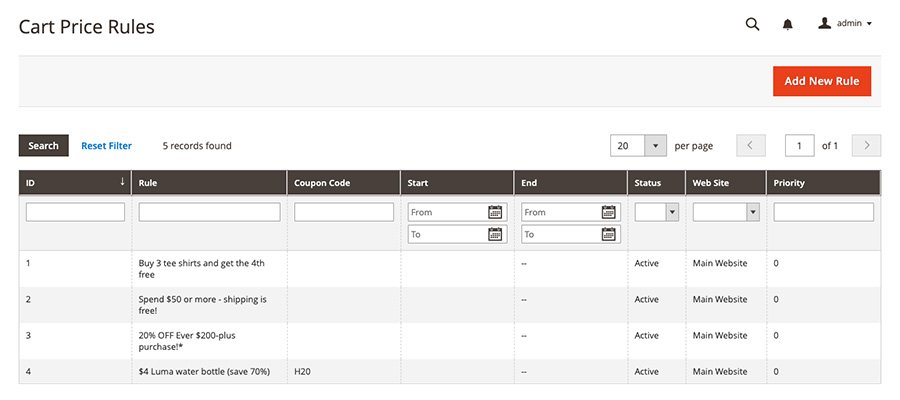
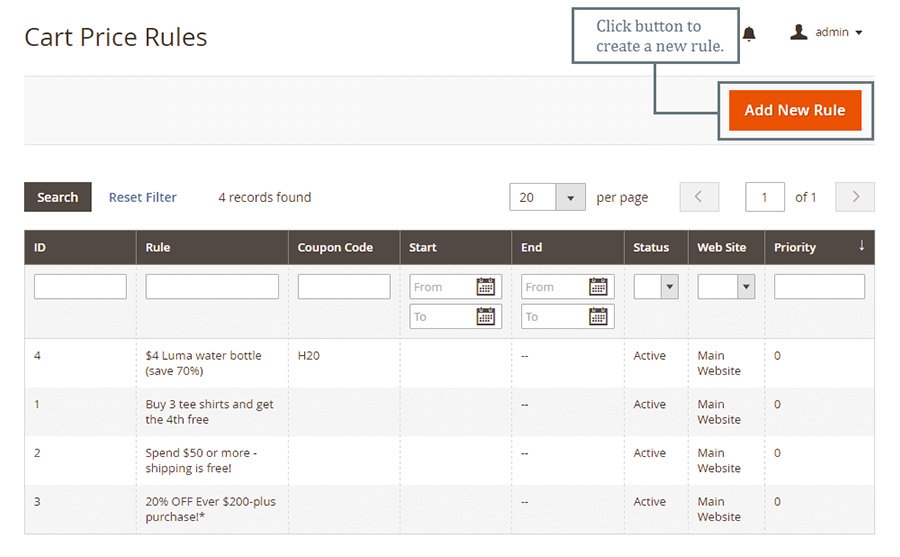
You can find the Cart Price Rule under Marketing > Promotions in the Admin Panel.

Catalog price rule


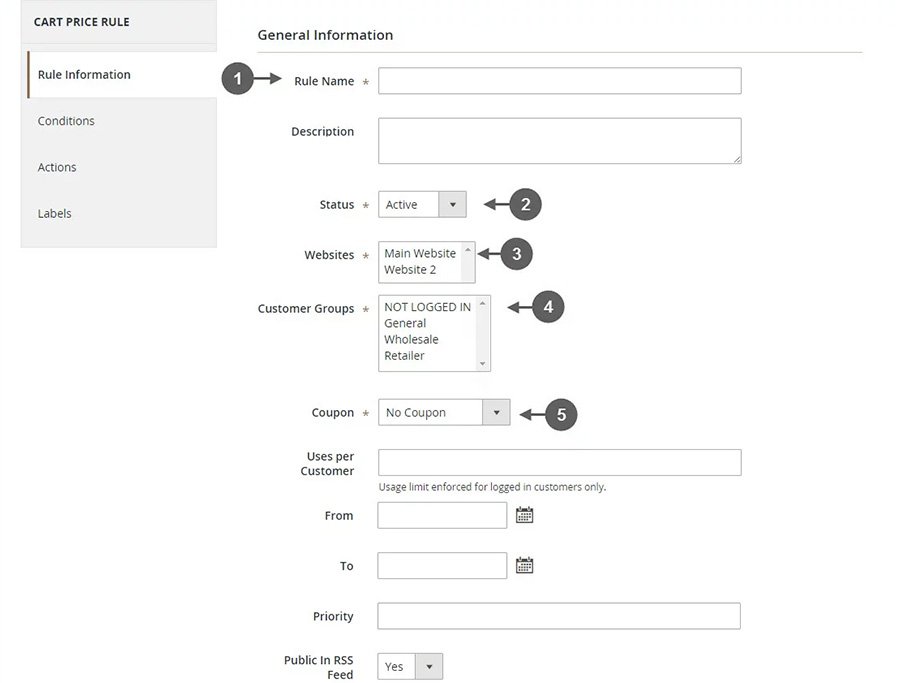
You can add a new rule by clicking on the Add Rule button and filling in four tabs: Rule Information, Conditions, Actions, and Labels.

New cart price

  • Put a name for your rule in the General Information section, and if necessary, write some descriptions.
  • Make the rule Enable when Status is Active.
  • Make sure the rule is assigned to the Website and Customer groups.
  • The promotion is not available for guests that belong to the NOT LOGGED IN group or customers that do not log in to their accounts when placing an order.
  • Select the Specific Coupon option on the Coupon field to enable the rule along with the coupon.
    • Use the Coupon Code when completing the checkout process. After saving the rule, enable the Use Auto Generation checkbox to publish multiple coupon codes.
  • In the Uses per Coupon and User per Customer fields, limit the number of times a coupon is valid. If there is no limitation, leave them empty.
    • The number of uses per coupon is determined by the number of times the coupon code is used.
    • In Uses per Customers, the number of times the same customer uses a coupon code is set.

Step 2: Set the Conditions

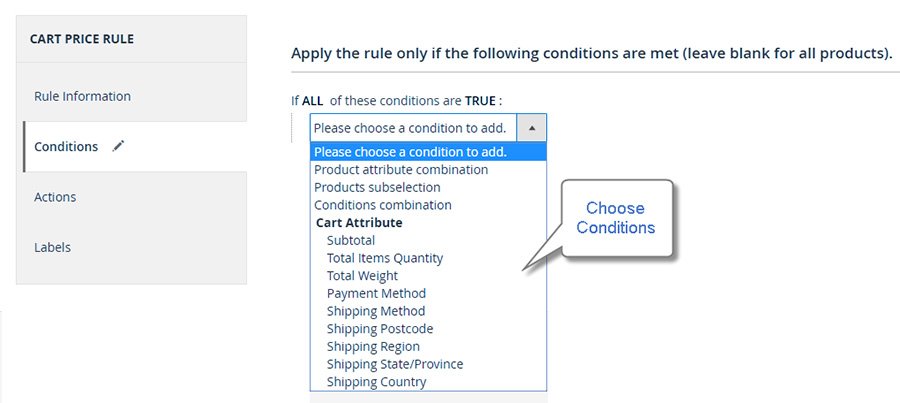
There is a statement in the Conditions tab entitled “If ALL of these conditions are TRUE.”

You can edit the statement by clicking the bold links “All” and “TRUE”.

  • You can choose from ALL or ANY options by clicking the ALL link.
  • You can choose TRUE or FALSE when you click the TRUE link.

If you want to apply to all products, leave the conditions blank Or to remove a statement, simply click the Delete button.

Set the conditions

Step 3: Set the Actions

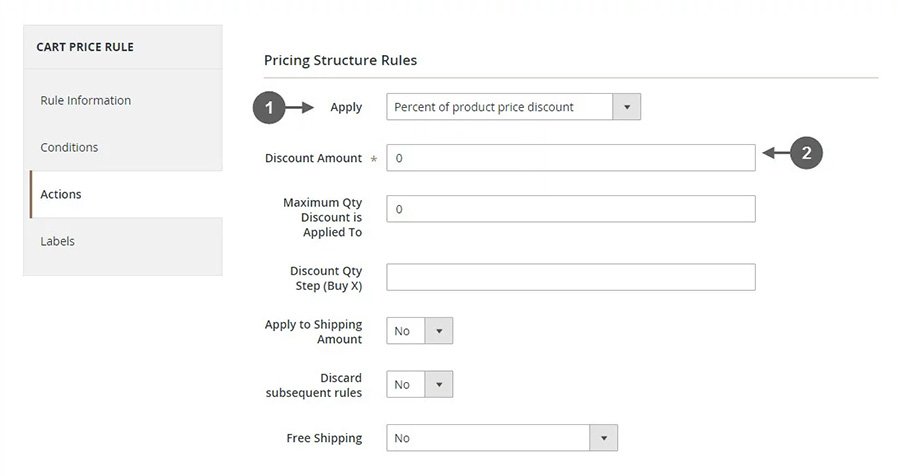
A Cart Price Rule applies to all actions you specify here when all conditions are met.

Set the actions

To change the catalog price rule, click the Action tab on the left panel. In the Apply field, you can select any one of the following options:

  • Percent of product price discount
  • Fixed amount discount
  • Fixed amount discount for whole cart
  • Buy X get Y free

Make sure you only enter numbers for the Discount Amount.

Step 4: Set the Labels

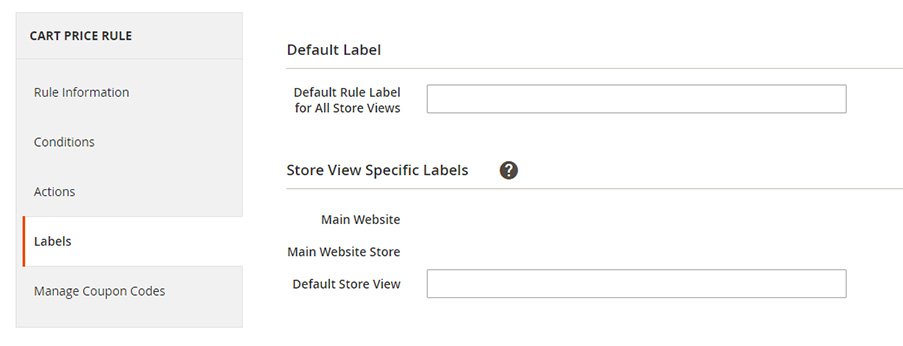
Click on the Labels tab. 

Enter the text in the Default Rule Label for All Store Views section of the Default Label section. 

Set the labels for each store view under Store View Specific Labels.

Set the labels

Step 5: Apply the Rule

Save Rule to finish. That’s it. You have successfully added a cart price rule for your product. Now you understand how to create a Magento 2 Cart Price Rule; you can use it to offer discounts and promotions. 

However, the Cart Price Rule is one of many types of pricing rules you can use in Magento 2. We’ll explore another price rule in the next section: Magento Catalog Price Rule

What Is Magento Catalog Price Rule?

Using Magento Catalog Price Rules, you can assign discounts to products in the catalog based on customer groups, product attributes, and other criteria.

Whenever a product falls under the catalog prices rule, the discount will be applied directly to the product and instantly appear in the catalog.

As a result, customers see discounts when browsing through your store without using coupon codes. In turn, this encourages them to purchase more.

So, What do you need to do to set them up? The answer is

Create Catalog Price Rules In Magento 2

One effective way to optimize your Magento 2 online store sales and revenue is by creating catalog price rules. The following guide explains how to create Magento 2 catalog price rules step-by-step.

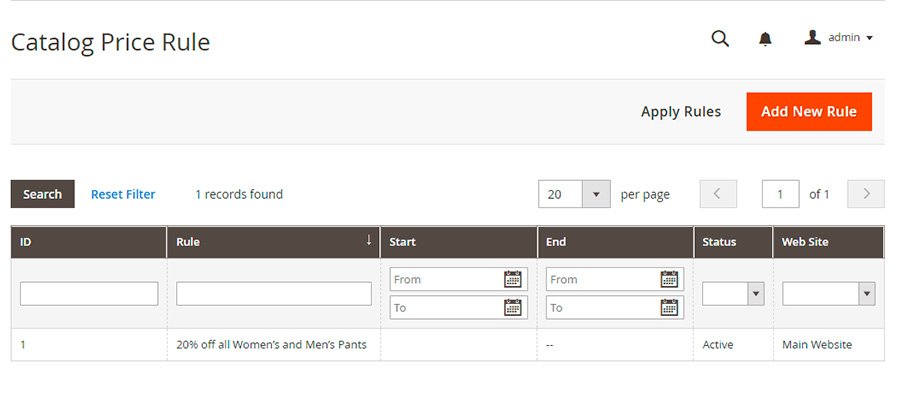
Catalog price rule

Step 1: Add A New Rule name

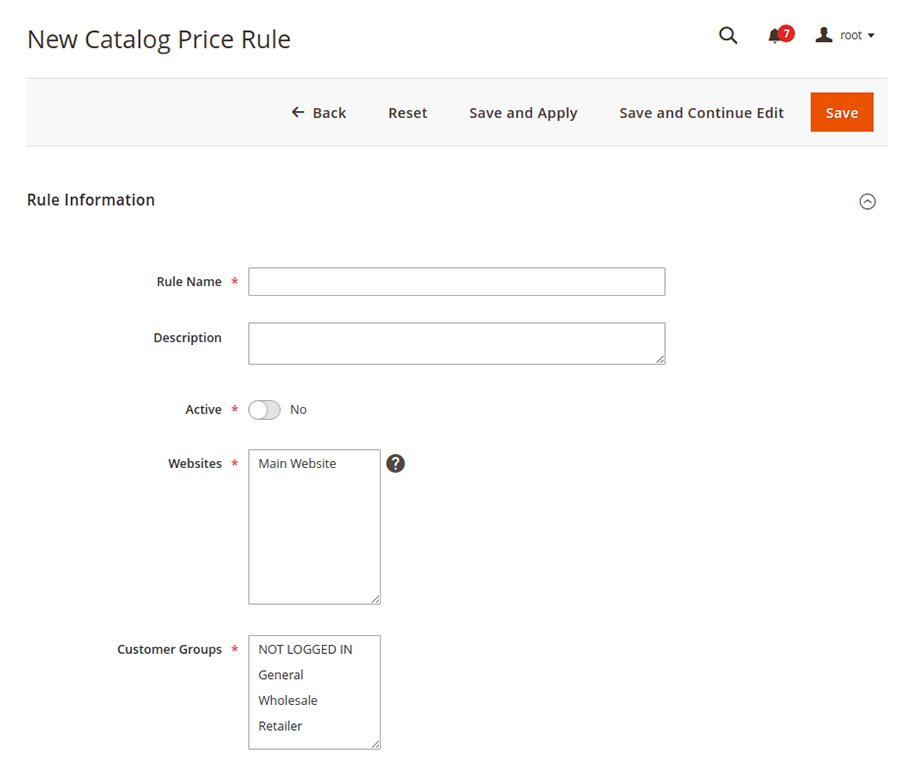
  • Login to Magento Admin Panel, navigate to Marketing > Promotions > Catalog Price Rule and add a new rule.

New catalog price rules

Expand and complete the Rule Information section

Rule Information

  1. Enter the Rule Name and Description, then select Yes to activate it.
  2. Select the price rule that will get applied to the Websites catalog.
  3. Specify the Customer Groups for which this rule should get created.Rule information

Choose the Date From and To, as well as the time frame during which you would like the catalog price rule to be enabled and Prioritize rules.

Note: Prioritizing is crucial Whenever a product meets the same criteria as one or more Magento Catalog price rules, the system applies the rule with the highest priority.

Conditions

Step 2: Define The Conditions

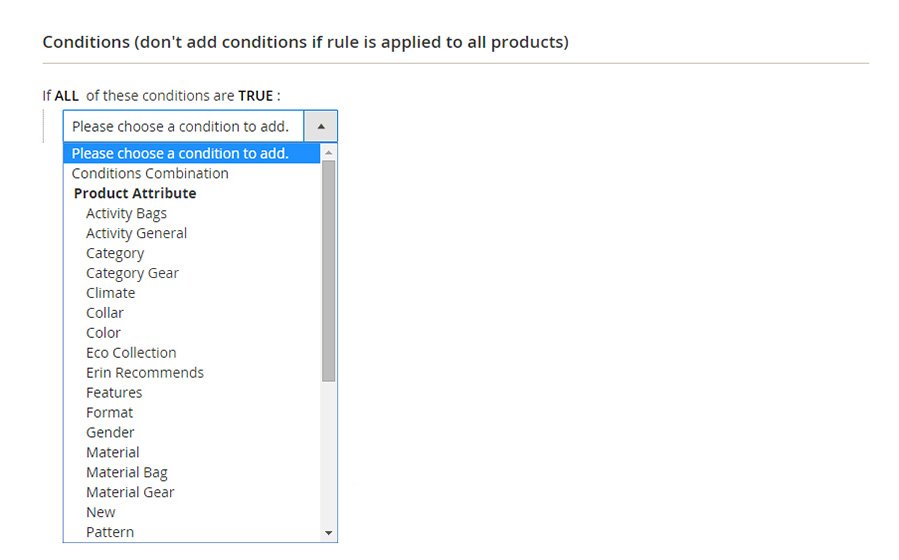
You will define the conditions in this section based on the attributes of the products to be used in the rule. Leave the conditions blank if you are not going to apply the rule to all product attributes.

Following these guidelines will help you expand the Conditions section:

Select Condition

Choose the condition under which the rule applies to all products. As a default, the first condition states: All of the conditions are TRUE.

Choose any of the following:

  1. Click ALL and select ALL or ANY.
  2. Click TRUE and select TRUE or FALSE.
  3. The condition can be left unchanged if you want to apply it to all products.
Add Conditions

 To add a new item, click Add(+) icon and select:

  • Conditions Combination
  • Product Attribute

Once you have completed all conditions, repeat the process.

Note: Click on the Delete (Delete icon) if you want to delete a particular condition statement portion.

Step 3: Define The Actions

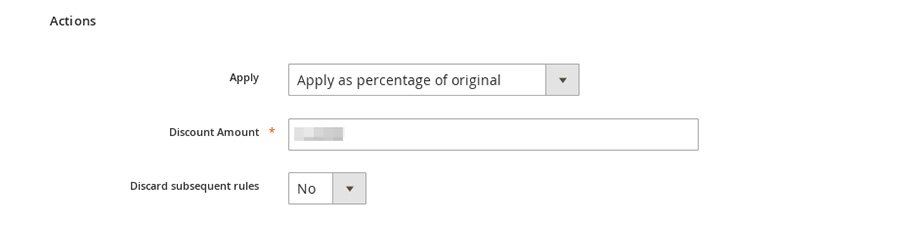
Define the actions

Here, you define actions that apply to the products based on the above conditions.

1: The first step is to expand the Action and select the method for applying the discount. Choose from the following options:

  • Apply as a percentage of the original
  • Apply as a fixed amount
  • Adjust final price to this percentage
  • Adjust final price to discount value

2: Discount Amount: Select the Discount Amount from the drop-down menu. According to your chosen method, the discount amount will be calculated in either percentage or currency.

3: Discard subsequent rules: If there are any subsequent rules, select Yes.

To further enhance your store’s profitability, explore how our tailored Magento pricing strategies can meet all your e-commerce needs.

Step 4: Save And Test The Rule

Save the changes at the top of the page to complete the process. This will redirect you to the Catalog Price Rule page. Then click the Apply Rules button.

Field Descriptions

Rule Information

  • Rule name (Required): This is for internal reference only.
  • Description: Describe how the rule is used and its purpose.
  • Websites (Required): List of websites where this rule can be applied.
  • Customer Groups (Required): Lists the customer groups affected by the rule.
  • Priority: A number indicating the relative importance of this rule. The highest priority is 1.
  • Status (Required):  Indicates whether the rule is currently active. Options: Yes / No
  • From: The date on which the price rule takes effect If left blank, the rule takes effect immediately.
  • To: specify when the price rule will end. If left blank, the price rule will continue indefinitely.

Conditions

It specifies when a catalog price rule goes into effect and the conditions that must be met. If left blank, the catalog price rule applies to all products.

Magento development services

Actions

  • Apply determines how the purchase is calculated. Options:
    • Apply as percentage of original – Decreases price by a percentage.
    • Apply as fixed amount – Subtracts a fixed amount from the regular price.
    • Adjust final price to this percentage – Reduces the final price by a percentage.
    • Adjust final price to discount value – Determines the final price based on a fixed, discounted amount.

Note: The regular price refers to the base product price without any advanced pricing (specials, tiers, or group discounts). The final price is the discounted price displayed in your shopping cart.

  • Discount Amount (Required) – This is the amount of the discount.
  • Discard Subsequent Rules – Determines whether this purchase is eligible for additional rules. Select Yes to prevent multiple discounts from being applied to the same order. Options: Yes / No

The Difference Between Catalog Price and Cart Price Rule

The Catalog Price Rules and Cart Price Rules might create confusion as they both serve the same purpose, namely to manage and manage discounts on your store. However, you can still distinguish them based on the following characteristics:

A catalog price rule is a special discount applied in a catalog so customers can see it while surfing the website. If conditions are met, discounts will be applied automatically without needing a coupon code. 

Looking to make the switch? Learn how Squarespace to Magento migration can give you greater control over pricing and enhance your e-commerce capabilities.

The product attributes determine a product’s price so that the after-discount price will be displayed on the checkout page and in the cart. As a result, customers cannot see the discount amount in these steps.

Meanwhile, Cart Price Rules are applied to the shopping cart based on shopping cart attributes so that customers can only see the sale when they are at the checkout stage.

The Cart Price Rules can get adapted with a coupon. Shoppers can apply coupons to online stores, or else discounts are automatically applied. This type allows the discount amount to be seen in the cart and during checkout.

Magento development services

You can also use the cart price rule for shipping fees, which is not allowed with catalog price rules.

Understanding the differences between these two concepts will help you create one that is appropriate for your store.

Read More: 18 Best Magento Migration Companies All Over The World

Conclusion

You can boost your online store’s sales and customer loyalty with catalog price rules in Magento 2. You can encourage customers to purchase more and return for future deals with targeted discounts on specific products. You can also streamline your sales and marketing efforts by implementing catalog price rules, which can help you better manage your pricing and promotions.

You can differentiate your store from competitors by mastering Magento 2’s catalog price rules, which will drive more sales and keep your customers coming back for more. In the rapidly evolving world of e-commerce, catalog price rules can help businesses of all sizes achieve their sales and marketing goals. To fully leverage your pricing strategies, consider our comprehensive Magento development services that can enhance every aspect of your e-commerce site.

An Ultimate Guide On How To Estimate and Optimize The Real Costs of Magento 2 Migration

Wait, are you a store owner who want’s to migrate to Magento 2 and take your eCommerce business to next level digitally? You must read the entire article because we will sort the most sensitive matter called ‘Pricing, or Cost to migrate to magento for ecommerce. As store owners, the most challenging part of running a business is a well-versed understanding of places where investment is worthwhile, meaning you’ve made the most out of your budget. When it comes to IT expenses, a lack of knowledge and understanding eventually leads to ‘not making enough out of the cost price.’ In this guide, we shall run through the pricing of Magento migration checklist service to Magento 1 and Magento 2, everything that needs to be highlighted and all crucial explanations about where the money is worth spending! We’ll reveal pricing priorities and break down the standard pricing of Magento 1 and Magento 2 migration. Let’s dive in!

Magento 2 Server Migration Service: A Brief Guide 

As stated above, many business owners have considered the shift to Magento 2 from Magento 1 insignificant. However, that is shady. In a survey conducted in 2021. It has been revealed that out of 195425 live Magento stores, only 87012 Magento stores have upgraded to Magento 2.  Magento 2 server migration might not have been well-reciprocated by merchants and traders, but the migration initiative stands important. Many E-Commerce platforms like Tile Giant, Land Rover, and Pino’s have undergone the Magento 2 migration process, understanding that this one step could entirely change the business’s fate. Have you thought about securing your e-commerce store from hacks and thefts, improved interfaces that win the audience’s interest, powerful security, and more? Well, if you are thinking, you must have migrated or planned migration to Magento 2. Let’s see the future of your eCommerce store on Magento 2 in the sub-topics below. 

Why Migrate to Magento 2? 

Talking to magento store owners has led us to understand why owners agree to migrate to Magento 2 but never really do it! As per our conclusions, there are three major reasons behind this:

  • They fear the change and want to stick to what it is
  • The Magento Development Cost Scares Them or Magento Migration Cost Scares Them
  • They have yet not understood the significance of doing it right away

Whether you have a Magento 1 store or not, here are a few reasons why you should be deliberate in migrating it to Magento 2:

  • Security

Magento 2 is a secured and encrypted platform where the security of your store remains end-locked. Moreover, security patches on Magento 2 haven’t been updated since the summer of 2020. Thus, before you fall prey to hacks, penalties, and fines, migrate to Magento 2.

  • Updates and Customizations

Magento 2 takes timely updates without you having to indulge and do it manually. Magento 1 has stopped taking automatic updates, which means that you will be stuck with the old version. Additionally, you might have to spend on customization and features.

  • Features That Are Better Than Ever

Not migrating to Magento 2 is letting you be unaware of features that are better than before. They include SEO tweaks, better checkouts, mobile optimization abilities and others. Be as quick as possible and run through the exciting features.

What Is the Cost of Migration from Magento 1 to Magento 2

The Magento 2 Migration cost varies on numerable factors, including:

  • Complexity and Size of the Magento Store
  • Customer Density and Number of Products
  • Custom features and functions as per individual needs

Below is a list of factors that might considerably affect the total cost of Magento 2 migration.

  • Magento Licence Fee

There’s a subsequent cost for a Magento licence for commercial sites. This might start from $22,000 annually. Additionally, you get cloud hosting (as Magento Cloud Commerce). The cloud-based hosting will enable you to host your Magento store. It is the Enterprise edition hosted version. The licensing charge ranges from $40,000 annually to $190000 a year as per the total number of users.

  • Cost for Optimal Data Import

Correct data importing is crucial to ensuring a smoother Magento migration process. One can do it manually or take the help of a migrating tool. In manual execution, you might be expected to pay $200 an hour for data entry. When taking the assistance of a tool, the Magento migration cost depends on the kind of tool used.

  • Cost For Extension

In case you are using any third-party extension on the current site, you must also carve the budget for the cost of all such extensions on the Magento 2 platform. It would start with mapping extensions in Magento 2 and changing the existing extensions to new ones.  It might be the case that you haven’t received any extension on the current purchase, so you would have to get it constructed from the beginning. The third-party Magento 1 extensions can be taken to a new platform to make it sound more convenient. However, the time and cost would depend on the extensions’ complications. 

  • Cost for Theme Building

Magento 2 has its new architecture for the theme. This means that the old themes would not do for the newer version. So, there needs to be a separate budget carved for new theme construction on Magneto by your partner agency. The cost would depend on the theme’s complexity.

  • Customization

In case your site has some custom code, the Magento 2 migration cost would require to get factored as well. The price range for customizations can range from $0-$10,000.

  • Agency Partnership

Now, if you have no team to migrate to Magento 2, you would require a Magento Migration company to partner with. In this scenario, the cost would vary as per the scope of work and the kind of agency you choose.

How To Optimize The Magento 2 Migration Cost?

1. Data Migration

In data migration, essential information, such as customer accounts, product details, orders, store configurations, custom functions etc., is migrated. Hiring a Magento 2 development company is the most effective solution if you have yet to gain experience with data migration projects. There are two main ways in which these Magento development companies charge for magneto migration service. 

  • The first method is when data migration companies charge based on the data transfer volume. This is the best method for startups and small businesses.
  • Secondly, Magento agencies offer data migration services at a fixed price regardless of the data’s size. Magento 1 to Magento 2 data migration costs start at $500. Further, the cost varies based on the quantity of data that needs to be transferred.

2. Choose Magento Data Migration Tool kit

With Magento Migration Toolkit, you can automate the migration process to reduce migration costs, resources, and time required for a Magento 2 migration. The toolkit eliminates manual data entry, reduces errors, and streamlines the process.  Further, the toolkit includes detailed documentation, step-by-step instructions, and technical support from skilled magento 2 developers to help you migrate successfully. This results in businesses saving time, reducing costs, and simplifying migrations.

3. Cost of 3rd Party Modules

If you’re currently using third-party extensions for an eCommerce magneto store, you’ll need to budget for their cost in Magento 2. You’ll also need to map these extensions in Magento 2 and change your old extensions with new ones.  During the migration from Magento 1 to Magento 2, it is essential to estimate the cost that will need to be spent accurately. As a rule, the price of a Magento migration can range from $5,000 to $30,000 or more, depending on the existing system’s size and complexity, the amount of customization required, the migration process, and the cost of third-party modules. When it comes to third-party modules, you should carefully evaluate which are necessary and choose free or open-source alternatives whenever possible.

4. Magento Migration Company Charges

You may need to partner with a Magento migration company if you need more internal resources to migrate to Magento 2. Your migration costs will vary depending on the scope of the work and who you hire. Magento’s migration projects can cost anywhere from $5,000 to $50,000. Several factors can affect migration charges, including the size and complexity of the project, the degree of expertise and experience of the migration agency, and the scope of work included in the contract. Agencies generally provide two models: Dedicated and Regular Model We recommend choosing a dedicated model, where your project will be assigned a dedicated Magento 2 developer. Working with dedicated Magento 2 developers will reduce the time needed to complete the migration, allowing your business to grow and expand faster.  When making a decision, you should carefully evaluate the agency’s reputation and experience, as well as its proposed budget and plan. It is also advisable to compare multiple offer prices and values.

5. Cost of Theme Design

Magento 2’s new theme architecture makes your old themes incompatible, so you need to consider the cost of theme design when migrating to the latest version. The cost of rebuilding your themes with a Magento partner agency depends on the complexity of the design.  Due to the different coding and frontend templates between Magento 1 and Magento 2, it is difficult to migrate the theme of Magento 1 to Magento 2, which may take time and be costly. Magento 2 offers you the option of purchasing themes directly from its store, saving you time and effort. Depending on its complexity and features, customising a Magento 2 theme can cost between $5,000 and $25,000. In addition, Magento offers ready-made themes for $500 to $3,000 in its store.

Mistakes To Avoid In Magento 2 Migration Process

There are several common mistakes businesses make during the Magento 2 migration process. Avoiding these mistakes can help ensure a smooth and successful migration.  Let’s take a look at the pitfalls to avoid during your Magento 2 migration journey and get ready to smoothly start migrating magento for ecommerce store. 

1. Not Consulting A Professional Magento Migration Company

Migration is more complex than it sounds, and doing it with the help of a Magento migration agency can prove costly in the long run. Through this service, you will receive expert support and guidance to ensure a smooth and successful migration without hiring a team of magento 2 developers or spending time on it.  Even though you may be a Magento 2 developer, you may need to gain migration experience. You may have yet to witness all the issues that come up during migration. The process of migrating the store is more complex since you need to take care of SEO, migrating data, extension compatibility, and many more things as well. In other words, if you choose the right Magento 2 migration company, they will handle the details and provide you with a store running the latest version of Magento 2. Magento 2 Migration company service evaluates your current system, including data, configuration, and extensions, to know what needs to be migrated. As a result, it can help you save time, reduce costs, and ensure a smooth migration to Magento 2.

2. Not Checking Compatibility Of Extensions, Themes And Modules

Before migrating from Magento 1 to Magento 2, most software companies do not check the compatibility of extensions, themes, and modules. As a result, migrating components without ensuring their compatibility may hamper the migration process. To ensure a smooth migration process, companies must identify the extensions used in Magento 1 and determine whether these extensions are necessary for the new online store.

3. Not Considering Internal Workflow Changes

Businesses typically focus on how users view and interact with their websites after migration rather than how employees perform their duties.  Understanding how the new platform will affect the internal workflow of the Sales, Marketing, Account/Finance, Order fulfillment, and Customer service departments is essential. There should be a plan for how each department will work with Magento 2. 

4. Neglecting SEO Equity

If a webshop migrates to Magento 2 or another platform, search engine traffic, SERP rankings, and conversions may decrease. A professional magento 2 development company with knowledge of data migration and SEO can help prevent such damage. The best way to prevent SEO sinking is to migrate at a time when the store is least busy, implement 301 redirects whenever changing URLs, transfer only necessary extensions, keep your website performing well, verify search console suggestions from Google and Bing, ensure links are not broken, audit webshop carts, inquiry forms, and other interactive elements during migration, etc.

5. Not Leveraging The Ready-Made Themes

Magento development The market is full of excellent themes! However, do you think that a ready-made theme may not be adequate? Using ready-made themes for Magento 2 migrations can reduce the migration cost. Ready-made themes provide an easy-to-use, cost-effective solution.  Creating a custom theme requires a lot of time and resources, but pre-designed themes don’t need much.  In addition, ready-made themes offer a wide range of features and functionalities, including mobile optimization and responsive design, to help enhance your online store and improve customer experience.  You can find pre-made Magento 2 themes on sites like Magento Market Place themes , ThemeForest Magento eCommerce themes and CreativeMarket Magento website templates. From furniture, clothes, and electronics, to other types of e-commerce stores, all ready-made themes are available on this site. Magento website develoment

Key Takeaways 

With careful planning and preparation, it is possible to minimize the costs and maximize the benefits of a Magento 2 migration. The actual magento migration cost of your store depends on theme design, data migration, third-party modules, and Magento partner agencies.  Moreover, it is critical to avoid common mistakes, such as underestimating the project’s complexity, failing to account for unexpected expenses, and underestimating the cost of customizing and maintaining your store. Hire Magento 2 Developers From WEDOWEBAPPS LLC, a leading leading Magento development company, to start your migration at affordable prices. 

One stop destination to satisfy all web related needs.

Not very long ago, a few groups of earnest men decided to start a company which provides high-end solutions and support to all kind of web development needs. We address all the queries and questions of the client and treat them with unique services to make them feel happy.

To mark your online identity in internet business, all you need is the right blend of creativity and practical approach towards work. With relevant industry knowledge and a pool of right professionals,WEDOWEBAPPS LLC offers you a high package to cater to your various needs providing your quick solution in the immediate time frame.

We started with small scale works of developing informative websites, small plugin’s, and static websites in HTML. With every advance requirement, we then forward to some CMS tools, Custom programming, Custom modules, etc. At present, we developed sophisticated websites with the latest tools and or marks in the sphere of Mobile app development with our innovative native and hybrid applications in the pipeline. Gradually we have formed a dedicated team to provide services in E-Commerce, Mobile Development Internet marketing, Enterprise level development, M-Commerce, etc.

The present situation is we have over 50+ happy clients and 120+ completed projects, and still, the numbers are counting more, and more as such, this is only a beginning, and we have to

go way long. I take this opportunity to appreciate the efforts of all peoples who have to support

us in our start-up and who believed in us. I acknowledge all the hard efforts of the WEDOWEBAPPS LLC team for providing excellent services and support to deliver quality work and make our clients happy. We also request our clients to keep counting on us the way they do and even for every single individual associated with us.

Follow the three facts before choosing a web development company:

How is their site?

How good is their portfolio?

How excellent and transparent is customer support?

Why settle for less ! Do thorough market research and reach the best website development company in the US to beef up your website.

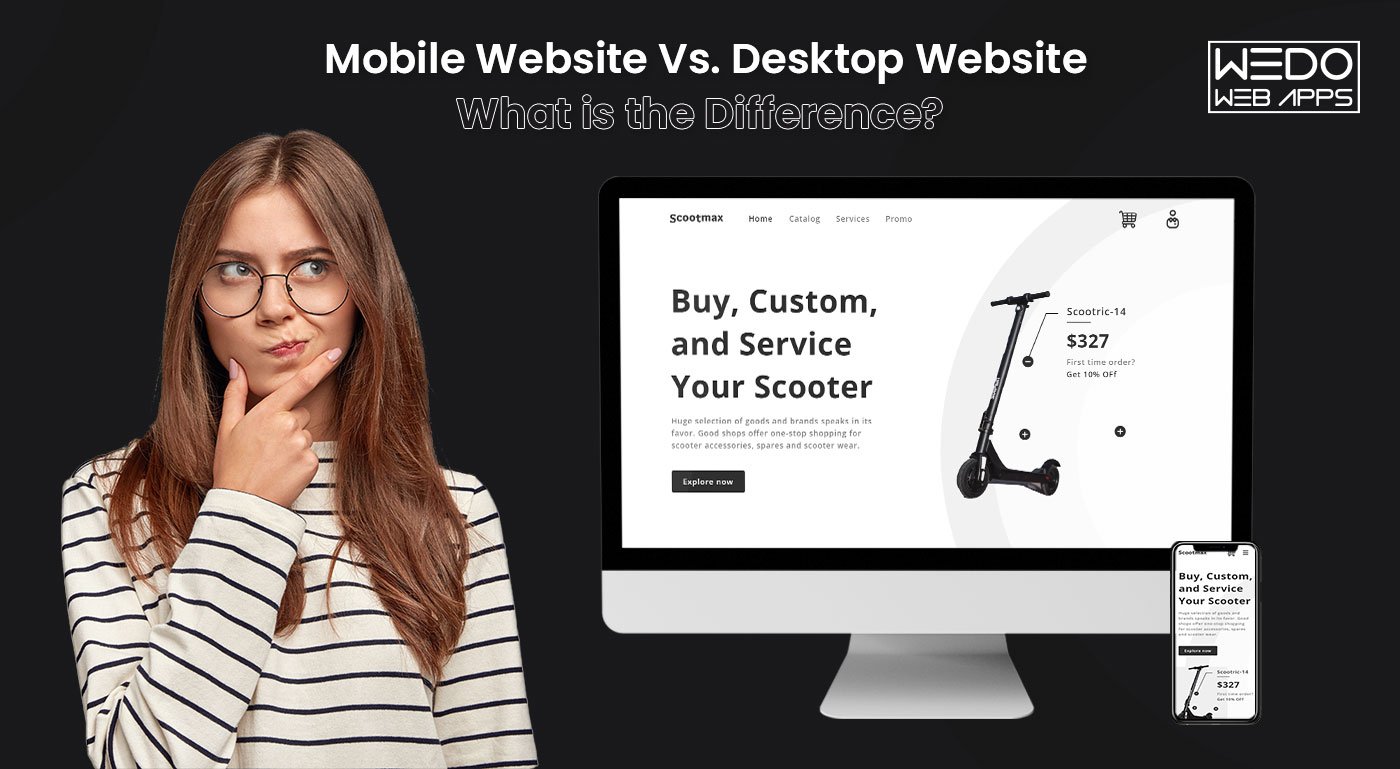
Mobile Website Vs. Desktop Website – What is the Difference?

Desktop vs Mobile: What Every Website Owner Should Know

From desktop websites to mobile websites to an expanding galaxy of various screens and devices, it has become a fact that accessing the world’s information on-demand is a part of our lives now. People expect connectivity from every corner of the world, and that too on the devices of their choice. Ultimately mobile-friendly websites, or we can say responsive websites, have become a new norm.

The time had already passed when you could earn good sales with just the desktop versions of websites. However, as mobile users are increasing in number, it is essential to design websites for mobile users and desktop browsing. This can be doing anything from designing your website in a way that it looks good on Android and iOS devices to responsive layouts, CSS media queries, and even developing a completely separate mobile web design. The ultimate agenda is to provide the website users with a tremendous user experience regardless of the device.

To make your website compatible with mobile devices, first, you need to understand how the desktop vs mobile versions differ in functionality and user behavior, and also how the mobile version differs from the site’s desktop version. The best way to know this difference is first to understand what a mobile website is and what it isn’t. Read further for the same.

What is a Mobile Website?

In contrast to the very small and tiny texts and heavy graphics and navigation experience of a desktop site on your smartphones and tablets, mobile sites are specially designed and scaled to function well on smartphone screens. Because smartphone users want essential decision-making information when they are looking for a service you offer, a mobile website is what can help you attract that customer.

Using fonts and graphics that are easier and larger to navigate and read in smaller screen sizes can help you entice your website visitors.

What a Mobile Website Isn’t?

Being a responsive web design company, the widespread misconception we hear about mobile websites is, “Mobile websites are just the smaller version of the regular desktop websites.” Now, take your mobile phones out and try to browse any website, even maybe your own. If you see a tiny version of your traditional website, if it requires you to use your fingers to expand and see the content on your website, you are merely viewing the desktop version of your website on your smartphone. This is absolutely not a mobile website.

In the following section, let’s talk about the critical differences between a traditional or desktop website and a mobile website.

Key Design Differences between Mobile and Desktop Websites

Let’s start with the fact that mobile browsing is absolutely different from desktop websites. Further in this post, we will see how user interactions on websites differ from interactions on mobile sites. These differences will be beneficial for you to design a better-optimized website.

Tappable vs. Clickable Interactions

Since most of the mobile devices today are touchscreens, it changes the way how users interact with the websites on different devices. Rather than using a cursor to click on something, users tap on their screens or use gestures to interact with the website.

You might not think of it as a huge deal, but it is one of the main things that need to be considered in mobile devices. Think of viewing desktop sites, how easy it is to click on a text line or an embedded link with a mouse. But to click a link with finer taps says a different story. This is known as a fat finger problem.

Resolving the fat finger problem just requires enlarging interface elements like call-to-actions, links, and navigation labels. Also, ensure giving enough space between them.

Dropdown Menus

One thing you need to consider for the quality of a mobile website is the number of clicks it requires for a user to complete a particular action. Fewer clicks obviously mean more usability. This brings us down to Dropdown Menus. Dropdown menus work well on desktops as the amount of user interaction or number of taps is not a big deal.

However, dropdowns for mobile users are a big problem. On mobile, dropdowns are often used where the simpler, more user-friendly controls would work better. For example, filling a form with a dropdown in every question becomes pretty irritating as the dropdown requires multiple taps, more interactions, and a longer time.

Navigation

Not only smaller than desktop, but mobile screens are also landscape-oriented, whereas mobile users view content in portrait mode. This affects a few design choices; the main one is navigation. Mobile phones are better suited to portrait navigation instead of landscape navigation.

Since mobile screens are viewed in the portrait mode, most suitable websites make use of vertical navigation options while desktop website tends to make use of horizontal navigation. You can further enhance the layout flow and user interaction with our guide, which is on improving website usability.

In this Navigation styles’ analysis, approximately 90% of the mobile sites use vertical navigation even though the desktop sites were likely to use horizontal navigation style.

Content Prioritization

The difference between mobile and desktop websites is more than just the screen size. However, screen size is still an essential element to consider while designing an optimized website for mobile phones. Since mobile phones have smaller screens, they provide less space for text, graphics, and other content.

So, to design a mobile website well, you need to prioritize some of the content, which means reducing word count, eliminating some graphics, or adjusting secondary information to some other pages. Desktop sites can afford to have a wide range of content, but it is not possible with mobile websites. The challenge here is to find a suitable line to cut between desktop and mobile websites.

The goal here is to satisfy mobile users without including any information that will have an impact on the website’s user experience – especially the elements that will affect the page load time on 3G or a slower network.

Situation-based Design

The mobility of mobile is yet another significant difference from the days of the desktop. When people used to browse websites through desktops, designers didn’t have to think much about how and where the users would interact with their website. Now, the majority of users access websites through their phones. Mobile devices are portable, users carry them everywhere, and they’re almost always connected to the internet.

It means while you design a mobile website, giving a thought to the current scenario is essential. Users’ locations vary quickly; similarly, their attentiveness and internet connectivity fluctuate. According to the Interaction Design Foundation, constantly changing context means the users will prefer short and simple interactions on mobile. However, it doesn’t mean that they will never have prolonged, complex interactions but will be rare.”

Integration with Phone Functions

Designers have to give up a lot when they’re developing a website for mobile. However, mobile devices have a lot of bonus features that can really enhance your website’s user experience. Integration of your website with various phone functions like direct calling and messaging, location, camera, and voice controls can offer faster interactions with your website.

It can also help users with more tailored functionalities to improve their experience in various ways that desktop websites cannot.

Now that we know the differences between a mobile and a desktop website let’s just move to the next section, i.e., the importance of mobile websites for your business. Here we go!

Work with a responsive web design service provider to seamlessly bridge the gap between mobile and desktop websites.

How is Mobile Site Important for Your Business?

You might have developed the world’s best marketing strategy, the most enticing website design, and the most robust audience that supports your brand but still not be able to make the desired sales from your business. That is because you don’t have a mobile website that is currently the most critical requirement of your business.

As we all know, most of the website traffic these days comes from mobile devices and not desktops. Therefore it is vital to develop a mobile website to increase conversions. Below are the reasons why your business needs a mobile website:

Increased Mobile Phone Users

In the early days, the need for a mobile website was not that prominent because smartphones were not that famous. Mobile devices were too small to browse any website efficiently, and people used desktops for browsing. However, as time passed, mobile websites became increasingly popular.

Research shows that approximately 95% of adults aged 18-49 own a smartphone and 15% of them solely rely on smartphones to browse the internet. As time goes on, this number is going to increase rapidly. These stats show that developing a mobile website that is compatible with both android and iOS is very important for your business to grow.

Enhanced Customer Experience

An easy-to-use, attractive website will help businesses retain their customers in the long run. This is the simplistic way to look at a mobile website’s importance, but it’s accurate anyhow. There is a lot more to cherish in a website design, but visitors will make their opinions look at the website’s design. Likewise, if a website is confusing, difficult to navigate, it will convince your visitor to go elsewhere.

Move Beyond Mobile-Friendly with Powerful App Development Learn more about our mobile app development services.

Mobile websites are developed especially to attract customers and to provide them with an enhanced user experience and that too on smaller screens. With mobile websites, your customers would not have the hassle of scrolling around to find the taskbars, buttons, and menu. Therefore, it is essential to have a website that is highly responsive and adjusts to any screen size.

Faster Download and Website Load Speed

In this digital era, website speed is paramount regardless of high graphics and the number of web pages. Moreover, with mobile phones whose processing speed keeps increasing, a mobile website is highly crucial for any business’s success.

If your website is only designed to function well on a desktop, it will take a longer time to load on a mobile device. This may cause website visitors to lose interest and navigate away to your competitors’ websites. Research shows that users are most likely to abandon the page if it takes more than 10 seconds to load.

A mobile website loads quickly on smartphones as it is coded that way. Therefore, if you have a business website, ensure to optimize it for mobile devices as well.

Improved Search Engine Ranking

What is the ultimate goal of developing a website? It is to make your website reach your target audience. Right? When people search for the product/service you offer, you obviously want your website to appear first on the search results. Being the first opportunity to entice your customers, you have a better chance to convert website clicks into long-term clients.

Earlier Google used to rank the websites based on the desktop version. However, as the mobile browsers kept increasing rapidly, the search engine too moved from desktop to mobile-friendly websites. Therefore, to rank on search engines and grow your business, a mobile-friendly website is a must.

Business Becoming More Competitive

Although mobile-friendly websites are a trend and necessity these days, a massive portion of businesses still have desktop-only websites. Studies show that only around 24% of 1 Million most popular businesses have a mobile website. And small business research observed that within the USA, Australia, Canada, and the UK, only around 30% of the small businesses have a mobile compatible website. Therefore, having a mobile website makes your business more competitive.

Ensure your website delivers a seamless experience across all devices! Our Ecommerce Development Services create responsive websites that convert on mobile and desktop.

Mobile Website – A Necessity or Not?

There still exist a lot of computers, laptops, and therefore, the need for a classic website design is not going anywhere soon – and even after so much hype of mobile websites, desktop websites are never going to vanish off completely. However, mobile devices are a preferred medium for website browsers, and therefore your mobile websites need to be ready for action.

Here, at WeDoWebApps LLC, we know exactly what a responsive website design is. This means we are experts at developing websites that can function well on any device it is being operated on. We stand ready to offer you the best responsive web design services to help you gain immense popularity and become the best in the industry.

Master Android App Development: Key Considerations Learn more about our mobile app development services.

Link Building Strategies makes Search Engine more powerful

SEO is Search Engine optimization. It’s nothing but a methodology of strategies, techniques, and tactics used to increase the number of followers to a website by getting a high ranking place in search engines. 

There are several methods in SEO

  • Link Building
  • Competitive Analysis
  • Title Tags
  • Traffic Monitoring
  • Social Media
  • Information Architecture
  • Keyword Research
  • Page content

Besides all these, Link building strategies is one most important section in SEO. Link building is a method of getting links from a different website to your own to improve search engine ranking.

In the present date, link building is the method of obtaining links from higher authority, quality, and relevant sites. So it helps to improve ranking in search engines.

The number of useful quality links from highly qualified websites is a significant factor in the google page ranking.

Compare React Native vs Angular and discover how link building strategies can make your search engine more powerful.

Useful quality links which are very effective doesn’t mean building unlimited relationships, but it means getting a link from genuine, highly authorized websites. So these are the importance of better link building strategies.

– A maximum viewer will be able to see your blog in the search result.

– High quality, genuine links means your website is considered as a precious resource. This thing can be quickly done by writing high-quality content.

– It also helps in getting indexed in the search result.

– It’s also considered one of the important methods in SEO.

– Helping you to get traffic from other websites links.

To get all kind of SEO related plans and pricing, please contact sales@WeDoWebApps.com.

Unlock the secrets to powerful link building strategies and get expert advice on choosing the right app development partner to elevate your project.

Developer for iOS

The iOS platform has been on the growing side for the last many years. The ubiquitous and versatile iPhone and iPad are the reason that gave many developers to bring out their ideas and put them in front of an audience. This audience, to be precise, is massive and a comparatively wealthy one. After some time, there was a real chance to make some money in the iOS Development Company sector, and developers have been taking up the task.

The contest between competitors brought out the need to have an online presence. Big iOS Development Company and organization started looking for iOS developers to bring their vision of an to life. So, Developers for iOS have a suitable chance of getting work and appreciation. This article delves into the skills and characteristics of an iOS Development Company and Developer for iOS App.

Developer for iOS App – Must have skills in an iOS Development Company.

There are many plus-points of being an iOS developer, and they can be sorted out. If someone is an aspiring iOS developer, they would be shot at getting a significant job as a developer. Now, getting the situation may not be as easy as it was back then, but it would have its perks.

The iOS Apps are growing in demand by each passing day. Apps are also a big part of digital marketing and online presence. They can be helpful in both of these tasks. Perhaps, this is the reason why organizations are looking to develop their apps. So, here are the skills that are required of a Developer for iOS App.

Design Guidelines

Though there are indeed not only a handful of skills that one requires being a developer. But there are quite a few that are necessary to accomplish. Appealingly designing an app is one of the essential things in the development process. There is a unique set of guidelines that an iOS developer must adhere to to make an intuitive app. They need to understand those design parameters to make the app more intuitive.

Swift – Programming Language

Apple has created a programming language specifically for the reason of developing iOS Apps. Swift is the number one constant in their equation of iOS development. All of the present and future projects are being done or are going to be done in Swift. So that means that a developer has to know this language perfectly. Keep in mind that it is neither a small nor a relaxed style, but there is no need to learn everything to be a junior developer. Just make sure to have a clear idea of the Options, the basic syntax, Classes, initialization, inheritance, Error Handling, Control flow, and Objective-C interoperability.

Spatial Reasoning

Another important thing that the iOS Development Company needs to keep in mind is the three-dimensional thinking. They also need to visualize the spatial associations of items as it is one of the most critical things. It is an utmost necessity for a developer, making sure that they have something in check. The bottom line is that when designing an application, one must be able to understand and predict how the users will react to them. For that, they need to understand the controls for inputs on various platforms and must have been using the devices that they are targeting. Understand the pros and cons of custom iOS development and how it relates to finding a developer for iOS.

Networking

Before going into this, try to imagine an app that can’t interact with the internet. Chances are there that it may not be possible in most of the cases. Either way, all the apps that users use to interact with the web in some or another method. It may not be in a significant way, but it has to be up to some extent.

That makes it inevitable for the developers to understand how to send and receive data to and from the internet. This is done through JSON, also known as JavaScript Object Notation. It is a pretty simple format and works in an even more straightforward way.

While partnering with a developer for iOS, make sure to leverage our iOS developer app to streamline your development process and boost productivity.

Benefits for Developer for iOS

Generally, when someone thinks of pursuing something, there are more significant motives that make them do what they do. In the case of an iOS Development Company, it can be a passion for app development, the advantages, or even deciding on a career path. Nevertheless, below is a list of some of the benefits that one gets when working as a Developer for iOS Apps in an iOS Development Company.

Payscale is more

As everybody with a smartphone in their hand knows, iOS caters to the premium customers a bit more. It may not have the market share of Android, but it does earn more from the app earnings. And a big chunk of that goes to the developers. So that makes for an excellent reason to go iOS.

Explore the benefits of choosing an iPhone application development company and how it compares to hiring a developer for iOS.

Trouble-free Testing

There are only a few iOS devices in circulation. In this way, it becomes easy to test the latest app because the testing is done on only a handful of tools.

Less work

There are only two screen sizes one must keep in mind while developing an iOS App. In the case of an iPad app, one gets an additional option as well. That translates to less work on the Developer’s part compared to the thousands of screens by different manufacturers in Android.

User experience

It all depends on how to users like the app and how it works on devices. The touch response of Hire Dedicated Swift Developers is unparalleled. So any app that one is developing for iOS is sure to have excellent responsiveness and quality. That explains the benefits of being a Developer for iOS or thinking of becoming one. In this article, we have given the paramount requirements of iOS developers and iOS Development Company. iOS is outshining its competitors. It has already made its mark in the world. We hope that you found this article to your satisfaction.

Collaborating with an iOS developer? Discover the full range of mobile applications at WedoWebApps to enhance your app development projects.