skip to content

Finding the Best Ecommerce Website Designing Company in the USA

ecommerce website designing company: In the ever-changing world of online commerce, your website is your virtual storefront. It’s the silent salesperson that guides customers towards conversion. And in the competitive US market, a well-designed and optimized ecommerce website isn’t just an option, it’s a necessity. But navigating the sea of talented ecommerce website design companies in the USA can feel overwhelming. Don’t worry. This comprehensive guide is your compass. It’s designed to give you the knowledge and insights you need. This will help you find the perfect partner for your digital journey.

Understanding Your Needs: The Ecommerce Puzzle

For businesses planning to migrate WooCommerce to Magento or any other technology, understanding the required functionalities and target audience is critical to ensure a smooth transition.Before embarking on your search, understanding your unique requirements is crucial. Ask yourself:

  • What type of products do you sell? Is it fashion, groceries, electronics, or something niche? Different industries have specific design considerations.
  • What is your target audience? Knowing their demographics, preferences, and online behavior helps tailor the user experience.
  • What functionalities are essential? Do you need shopping carts, wishlist options, personalized recommendations, or complex inventory management?
  • What’s your budget? Design agencies offer varying packages and pricing structures. Be realistic about your resources.
  • What is your desired timeline? Do you need a quick launch or a comprehensive, strategic approach?

The Ecommerce Design Landscape: A Spectrum of Expertise

Boutique agencies often specialize in tasks like Shopify to Magento 2 migration, making them ideal for businesses seeking platform-specific expertise. Now, let’s explore the diverse landscape of e-commerce design companies in the USA:

  • Full-Service Agencies: These powerhouses offer a broad range of services. They handle strategic planning, website design with best UX practices of eCommerce, development, marketing, and ongoing maintenance. Ideal for brands seeking a one-stop solution.
  • Boutique Agencies: Boutique agencies are smaller teams with specialized expertise. They focus on specific industries or platforms like Shopify or Magento. Perfect for businesses seeking personalized attention and niche understanding.
  • Freelancers: Skilled individuals offering competitive rates and flexibility. It is suitable for smaller projects or tight budgets. However, managing multiple freelancers can be time-consuming.

unlock your ecommerce potential

Beyond the Surface: Key Traits to Look For

If you’re using platforms like Magento, working with a dedicated Magento integration agency ensures seamless functionality and optimized workflows. Choosing the right partner goes beyond a fancy portfolio. Focus on these crucial qualities:

  • Experience: Prioritize agencies with proven success in creating high-performing eCommerce websites. Look for agencies that have succeeded in your industry.
  • Portfolio & Case Studies: Analyze their work, evaluating past projects for visual appeal, user-friendliness, and demonstrably successful outcomes.
  • Process & Methodology: Understand their workflow, communication style, and how they involve you in the decision-making process.
  • Technology Stack: Your technology stack should include platforms and tools relevant to your needs. Ensure the developers are proficient in your preferred CMS.
  • SEO & Marketing Expertise: An ecommerce website is not an island. Look for agencies that understand integrated marketing strategies and SEO best practices.
  • Client Testimonials & Reviews: Look for real-world feedback from past clients. This will give insights into the agency’s work ethic and effectiveness.

Work with a top responsive web design company to create an outstanding ecommerce website in the USA.

WEDOWEBAPPS: Your Guiding Light in the E-commerce Galaxy

At WEDOWEBAPPS, we believe that your eCommerce website deserves to be a masterpiece. It should be a strategic tool driving conversions and fostering brand loyalty. We are a full-service agency fueled by experience, passion, and commitment. We specialize in custom eCommerce development, ensuring your website is tailored to meet your unique business needs and drive maximum conversions.

Want a custom-crafted ecommerce website designed to boost sales? Look no further than our expert Ecommerce Development services!

Our team includes skilled designers, eCommerce developers, and marketing experts. They bring a wealth of knowledge and expertise to the table. We don’t just build websites, we build bridges between your brand and your customers. Here’s what sets us apart:

  • Industry-Specific Design: We tailor our approach to your specific industry. This ensures your website resonates with your target audience.
  • Data-Driven Optimization: We use data and analytics to improve your website’s performance. This also drives conversions.
  • Seamless Integration: We integrate your website with relevant marketing platforms and tools. It creates a streamlined and effective online presence.
  • Open Communication & Collaboration: We believe in transparent communication. We keep you informed at every step of the process.
  • Ongoing Support & Maintenance: We’re not just here for the launch. We offer ongoing support and maintenance to ensure your website remains competitive and secure.

take your ecommerce website to the next level

Ready to Ignite Your Ecommerce Journey?

Finding the perfect ecommerce website designing company in the USA is an investment in your brand’s future. Don’t settle for the generic, go for the exceptional. At WEDOWEBAPPS, we are confident in our ability to craft a website that drives sales. We also ensure that it reflects your brand’s unique identity and vision.

Contact us today for a free consultation. Let’s discuss how we can unlock your ecommerce potential. Remember, your dream website is just a conversation away. Looking for a wider range of website development services beyond e-commerce? WeDoWebApps excels at e-commerce solutions, but their expertise extends across website development. 

Shopify, Magento, or WooCommerce – Choose the Right Platform

Introduction

With digitalization, eCommerce website development seems to be the right choice if you are looking for long-term growth in your business. The idea of moving to the digital world sounds cool, but there is much more to it. Whether it is about products or services, startup or enterprise, an online store is something that pushes your business beyond boundaries. Setting up an online website with the best digital experiences is on the bucket list of every small to the enterprise-level business owner. However, making the right choice to set up an online store is the most crucial decision a business owner should take. Choosing an inappropriate website design platform may be an obstacle to your business growth. Choosing the right eCommerce platforms is crucial as It involves various factors like website loading time, features list, type of platform, plugins, and tools. There are different eCommerce platforms in the market, but among them, there are the top 3 competitors – Shopify, Magento, and WooCommerce. Therefore, you need to know which eCommerce best suits your business needs. Before diving into the eCommerce platforms, let’s talk about what eCommerce is, its characteristics, and why businesses need an eCommerce website. So Here we go.

What is an eCommerce Website?

An eCommerce or electronic commerce website allows you to buy or sell your products or services on the web. In other words, eCommerce websites are the online portals that facilitate you to buy or sell your offerings over the internet. 

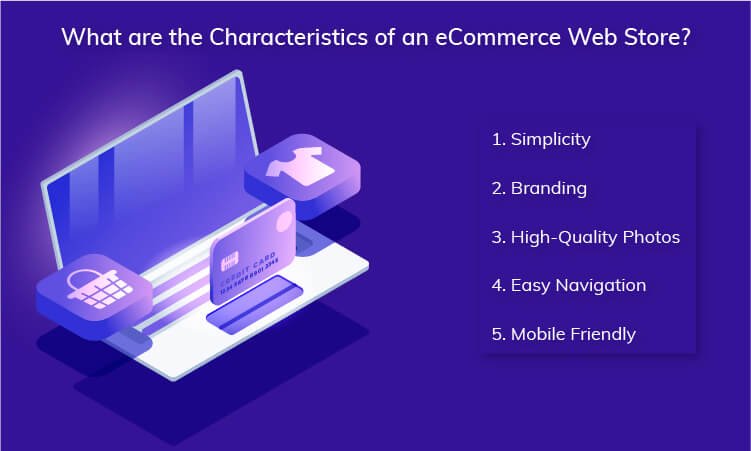
What are the Characteristics of an eCommerce Web Store?

Since there are many websites present on the World Wide Web these days, customers are loaded with the options for online shopping. So, to attract customers to your online store, you need to provide an excellent user experience to convince your customers to buy from you. In addition, you need to build trust in them that your products are worth buying. Characteristics of an eCommerce Web StoreTherefore, here we are with specific characteristics of an eCommerce store, including those which will make your website look appealing. 

1. Simplicity

The main focus of a website should be on the products rather than on extravagant design. An excessive website design for no legitimate reason can only do harm but no good to your business. It will distract the customers from the products on your site. Simplicity in design helps in enhancing the user experience. Therefore, designing a website that is simple and easy to use makes more sales.

2. Branding 

Most online shoppers prefer to buy products from the top brands in the market. Therefore, it is essential to establish a brand name not only in the online market but also in the offline market. In case you sell both online and offline, a website is just one part of the overall branding. It should operate well with other branding efforts in order to make your customers feel that the website is safe. If you are a startup, branding must be a long-term goal as you don’t have the advantage of trusted customers. 

3. High-Quality Photos and Images 

Selling online is way more different than selling offline. The customer cannot physically touch the product. It is a big thing to buy a product without touching it; therefore, you need to build trust for quality.Providing quality images and videos that exactly mirror the product can help overcome this challenge and help the visitors make their decision easily. The product photo is important as the customer will judge your product and your company just by seeing the product image. 

4. Easy Navigation

The very first requirement of buying or selling a product/service is that the customers should be able to find what they are looking for. Easy navigation is vital for any website, but it is especially crucial for online storefronts. Lost visitors will eventually result in decreased sales; therefore, every effort should be made to make the website clean and easy to navigate. Read also: How Shopify Web App Development can Increase your profit!

5. Mobile Friendly 

Nowadays, around 60% of the people prefer mobile phones for online shopping. However, suppose you have a website that works well on a PC or laptop but is not compatible with mobile devices. Now what? The mobile customers will go and look for other websites to buy what they want. Therefore, a website should be compatible with all types of screens, be it laptops, PCs, tablets, or mobile phones. This will ultimately help you gain more customers and increase sales which is the primary concern of an eCommerce website. 

Why do Businesses Need eCommerce Websites?

An eCommerce website has become the most vital part of your business plan in the rapidly growing global economy. The increased amount of online shoppers is the powerful catalyst for eCommerce development. If you are still confused about launching your online store, ask yourself why eCommerce is so much in trend around the world. Here, you will find various benefits of developing an online store.

1. eCommerce Helps in Cost Reduction

If you have an online store, it is not necessary to have all the products available to you in physical space. In fact, there are various companies that operate on the World Wide Web, where they show all their products through their eCommerce store. This implies saving money not only by renting or purchasing a premises, but also internet, electricity, etc. On the other hand, if you still want to have a physical store for your customers to come and visit, it should not necessarily be that large. In either case, you will be saving your money. 

2. eCommerce Platforms help Businesses Go Global

In connection to the above point, eCommerce platforms allow you to post your products for sale anywhere worldwide. Therefore, the customers will not need to travel to your place to see what you offer. If you have a physical store, you will be limited to your geographical area, whereas by having an online store, you will have the opportunity to grow your customer outreach.Furthermore, it will eliminate all your geographical and linguistic barriers. Your eCommerce store translated into different languages will allow the customers to buy from other areas of the world.

3. Increase in Sales

eCommerce is mainly focused on one thing that is increasing sales. At the end of the day, the primary purpose of your eCommerce store is to sell more, and therefore this is what it is aimed at. Having an eCommerce store will ultimately increase your business reach, improve your products thanks to the customer reviews, or be available all round the clock. 

4. Maximum Security of Transactions

Today, shopping over the internet has become more safer than a physical store. You can sit back at your home with nobody spying over the secret number of your online transactions. Of Course, the online storefronts will have SSL certificates. This certificate not only allows safe shopping but also keeps your data encrypted in a way that it is absolutely safe to enter passcodes and keys. It also protects even more confidential data, such as your credit card information. Security will continue to be the most significant concern in the near future, and eCommerce stores are absolutely safe to shop at. 

5. You can Easily Receive Feedbacks on the Products

You might have always wanted to know what your customers think of your product so that you can improve where you lack. One of the greatest advantages of having an eCommerce store is that you can ask your customers to leave genuine feedback on your website. Additionally, customer feedback will build trust in your current and upcoming customers. The more positive feedback you get, the more customers believe in your store, and ultimately more will be the purchase. eCommerce reviews are kind of a channel where the customers can see what they can expect from your website. So, this was all about eCommerce and its importance. Now let us come to our main focus point, i.e., Which platform is the best for eCommerce web design and developmentBefore getting into the detailed comparison, let’s look at the brief application of each platform. Shopify is a subscription-based eCommerce platform with more than 1000 apps to add various functionalities to your website. Magento is appropriate for enterprise-grade businesses and can host multiple websites with just one admin panel. It also includes various plugins and tools free and paid. Talking about WooCommerce, it is suitable for SMEs. It can create a web store from scratch by just using WordPress. To create an enticing eCommerce store, we would suggest you hire a website design company. A web design agency can ensure a website that includes everything you want in your store. Cannot decide between Magento, Shopify, and WooCommerce? You are not the only one; each and every business faces this situation while developing an eCommerce store. These three platforms are the most popular eCommerce platforms in the industry today. Let’s read further to clear your confusion and let you select the best. Read more: Grow your E-Commerce business with best Woocommerce Development Services

Shopify Overview

Founded in 2006, Tobias Lütke, Daniel Weinand, and Scott Lake launched Shopify after the attempt of opening Snowdevil. Snowdevil is a web store for snowboarding equipment. From just five people in a coffee shop, Shopify has grown to approximately 5000 people across the globe. Till 2009, Shopify powered more than 1 million stores in over 175 countries. With this rapid growth, Shopify became the most popular platform to start, run, and grow your business. It offers online businesses a wide range of services like payments, marketing, shipping, and customer engagement tools. These features simplify the process of running an online store for small businesses. Whether a jewelry designer, musician selling mixtapes, or a business looking to grow, with Shopify, you can sell anything you want. The sky’s the limit to what you can sell on this platform. In addition, Shopify offers numerous features that will improve your web store

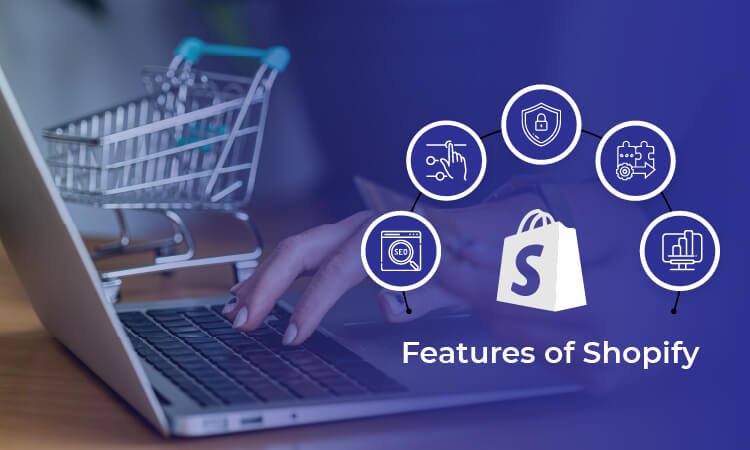
Features of Shopify

Features of Shopify

1. SEO

Search Engine Optimization is a fundamental requirement for all online business owners. This helps improve search engine ranking and visibility and thereby driving more traffic and customers to your website. Shopify comes with several SEO tools that help website owners appeal to search engines while they are busy working on other features of the website.

2. Securit

Shopify is capable of handling hacker protection, security compliances, and upgrades. This will allow you to focus on raising money and conversion rate. Also, you would be able to access dedicated support whenever you face any problem. The support team provides valuable assistance to the startup that wants a solution with no or fewer expenses. 

3. Analytical Tools

You can also keep track of the website’s progress with Shopify’s Analytical Tools. Through this feature, business owners can actually track how the visitors located them online and other helpful information that can help them enhance their marketing efforts. 

4. Hassle-free customization

Business owners with less or no technical knowledge can also use Shopify to develop a high-quality web store. This is all because of its easy customization features. It is extremely simple and convenient to set up an online web store with Shopify’s interface. It also includes guides and instructions to facilitate the development of a user-friendly website design. 

5. Integration

There are many business owners that rely on third-party software tools to ease their business processes. Shopify provides you the convenience of integrating useful tools like WooCommerce, MailChimp. This helps businesses streamline the entire work process, thereby eliminating the hassle of individually accessing the different programs. Since each and every website development platform has specific benefits and drawbacks, therefore, let’s discuss Shopify’s pros and cons to get a clear idea about whether to use Shopify or not. 

Strengths of Shopify

1. Built-in Tools

Shopify offers top-notch in-built tools for finding products to sell, creating your website, marketing your products, and many more. If you are a budding startup, you can keep your investment down by using Shopify’s free tools. With these extensive free tools, businesses can have a better Point of sale for a more profitable business. 

2. Easy to Configure and Setup 

Shopify offers the convenience of quickly opening a web store with no extra cost. Since all the features are conversion-optimized, the user interface is tidy, user-friendly, and easily understandable. Shopify offers a 14-day free trial in which you can learn the features. The trial period does not ask for any coding experience. On the Shopify website, you can find the documentation and the video tutorials for your reference. If that doesn’t work within your skill set, you can ask for help from responsive website development companies. 

3. Ease of Use

Shopify is an easy-to-use and robust website development platform. This enables you to create and launch your eCommerce website in a minimal time. If you are looking for a customized design, then the development can go for a few weeks. If you are a non-tech person, hire web design firms as per your needs. 

Drawback of Shopify

1. Not for Long Run

It is not easy to move your eCommerce store to a different platform. Because of this, choosing an eCommerce platform becomes tricky as you have to plan for the future. No doubt, you can use Shopify, but for a business that wishes to manage everything, it is better to move to a self-hosted platform. 

2. Shopify Pricing 

Shopify Storefront owners depend on the add-on features that advance Shopify plans and offers. The free version of Shopify only gives the basic features. So for advanced plans and built-in tools, you need to pay a higher cost. The pricing plan of Shopify or any other hosted platform will eventually become expensive. In general, Shopify is an effective eCommerce platform, but in the end, the decision falls as per the company’s needs. 

Magento Overview

Magento – An open-source eCommerce platform developed by Varien Inc., is now known as Magento Inc. It is a very useful platform for businesses looking to grow online. It is a scalable eCommerce platform and has many control options. This helps the developers build user-friendly and search engine-friendly websites. Magento was first launched on March 31, 2008, as an open-source eCommerce software. Till then, it has helped small business organizations build online businesses. It offers searching and sorting of products in several seamless ways. In addition, it is easily integrated with various third-party sites that are needed to run an online business effectively. Magento is one of the best eCommerce platforms in the web development industry. This is a PHP-based software that provides several features and an easy user interface. In addition, it offers almost all the facets required for an eCommerce solution to be successful. These facets include managing products, catalogs, and orders, along with marketing and promotion. 

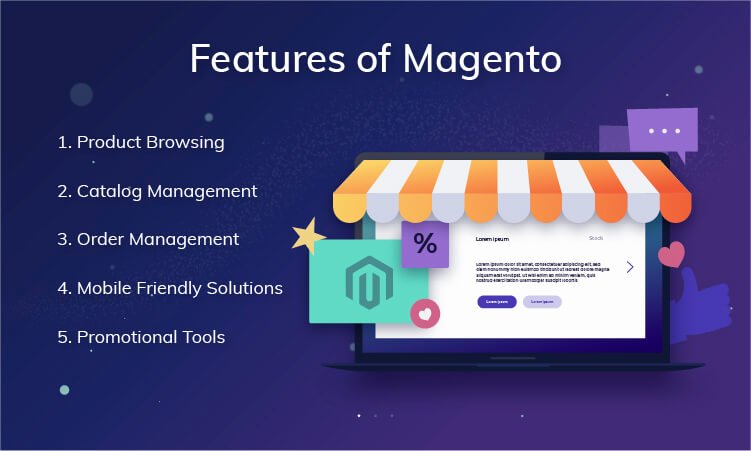
Features of Magento

Features of Magento

1. Product Browsing

Suppose you visit a website that is having a bad user experience, and you fail to find the product you wanted. Would you continue browsing on the same website? No, Right? Therefore, Magento provides functionalities that help you deliver an enhanced user experience to your customers. The functions include zoom-in and zoom-out on the image, multiple product images, wishlist addition, and many more.

2. Catalog Management 

No matter what you are selling, the catalog of your web store holds absolute importance. Magento is a comprehensive platform that helps you in various ways. For example, you can showcase your products virtually, edit and delete product reviews, inventory management, and many more. It also supports sharing the products on social media. Avail of web design services from us if you are looking for a professional Magento eCommerce website

3. Order Management

Magento also offers the feature of Order Management of your eCommerce website. This feature includes viewing, creating, and editing the products from the admin panel. Some of the advanced features include Multiple invoice printing, email notifications, call-center support, and RSS feed for new orders. Also, customization of the order status can be availed with Magento.

4. Mobile-Friendly Solutions

We all know that more than 60% of online shoppers prefer shopping from their mobile devices. And with Magento, you can attract this vast demographic of mobile users. Building mobile-friendly websites and applications with Magento is a seamless process. It offers mobile HTML5 for creating mobile-compatible eCommerce stores. 

5. Marketing and Promotional Tools

Magento also offers various promotional and marketing tools, which makes your advertising and marketing accessible. This Magento feature offers up-selling and cross-selling products, promotional pricing, free shipping, and monitoring coupon usage. Hence, Magento helps you to promote your products easily. Magento is one of the biggest eCommerce platforms. Just like Shopify and WooCommerce, Magento has hundreds of web stores worldwide. However, being the most responsive web design service, we have seen some of the strengths and failings of Magento. Here we go!

Advantages of Magento

1. Highest Flexibility 

Magento allows you to start selling your products or services with just a primary shop. However, when it grows, its design becomes quite challenging. For Magento, flexibility is crucial; hence its plans are designed to increase its progressions. Furthermore, due to its open-source nature, we could modify the source code as per our needs and desires. 

2. Large Community of Users 

Magento has a large community of users because it is the most used eCommerce website development platform worldwide. This community of users always ensures quick support. Moreover, they are motivated to develop numerous plugins and extensions. Therefore, if you have any issue related to Magento, you are more likely to get quick support as there is a massive community of Magento users.

3. Magento Unique features that other platforms lack

Magento has a variety of features helping you manage multiple stores, allow multiple locations, currencies, language, and pricing. Compare any other platform with Magento, and it will definitely stand out with its ample features. For example, with Magento, you can set up the product price according to a group of people. You can keep different prices for your staff, regular customers, and VIPs, respectively. Additionally, with the community version of Magento, you can enjoy various features that other eCommerce platforms lack. 

Disadvantages of Magento

1. It’s Expensive

Magento has many versions, the community version is free, and the enterprise version costs you more than approximately $15,000. Furthermore, the premier Magento version of which is targeted at large businesses, costs you more than approximately $22000 per annum. Add an extra third-party fee if you are unable to install the extension by yourself. Hence, Magento is way too expensive.

2. Time Consuming 

This eCommerce platform is time-consuming as it has a slow loading time. Therefore, it isn’t easy to customize your website in Magento as compared to other eCommerce platforms. In addition, it is not easy to migrate from another eCommerce platform to Magento as it imports data at a prolonged rate. Due to its flexible architecture, it becomes complex and time-consuming to set up a Magento store. This is one of the reasons behind the slow loading time of the Magento platform.

WooCommerce Overview

WooCommerce is a free plugin for WordPress and has been downloaded around 3.9 million times by January 2020 worldwide. WooCommerce operates approximately over 37% of the websites on the world wide web. It was primarily developed by the WordPress Theme Developer WooThemes.WooThemes further hired developers, namely Mike Jolley and James Koster at Jigowatt, to work on Jigoshop that ultimately became WooCommerce. When WooCommerce is integrated into a WordPress website, it adds basic functionalities to it such as product management and shopping cart.. WooCommerce can help you develop a basic online store that can sell a variety of products and services. You can sell physical goods, digital goods, ongoing membership, and affiliate transactions. WooCommerce can manage various essential features like inventory management, international customers, sales tax management, coupons, and shipping cost calculation. 

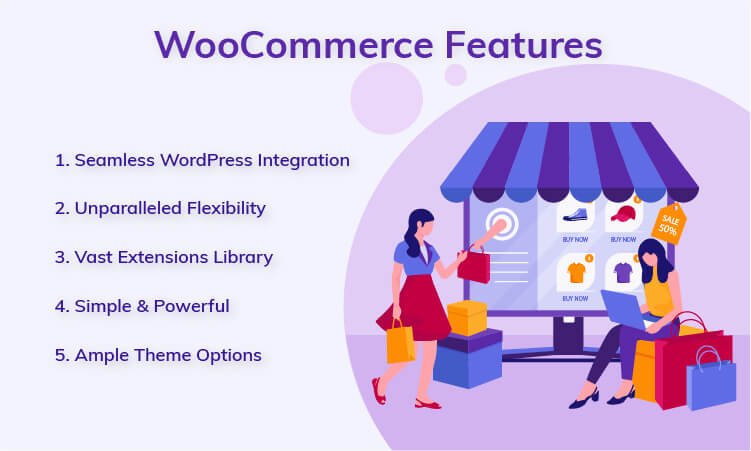
WooCommerce Features

WooCommerce Features

1. Seamless WordPress Integration

The significant advantage of choosing WooCommerce is that it is developed on the most popular CMS worldwide – WordPress. As a result, the concepts that work on WordPress also work the same on WooCommerce. Since using WordPress is so easy, the integration of WooCommerce with WordPress makes a website owner’s work much easier. 

2. Unparalleled Flexibility 

Whether you are selling physical products, virtual products, or even if you are working with external/affiliate products, WooCommerce is the right choice for you. You can easily customize WooCommerce to sell any kind of product/service. The best part of WooCommerce is that you don’t have to be technically strong to customize it. 

3. Vast Extensions Library

If you are planning to build an eCommerce store, you need a lot more than just a website and products. You need to set up shipping, payments, marketing, accounts, and a whole lot of things. WooCommerce comes with a massive variety of extensions that makes the website functionality much easier. WooCommerce extensions library comprises more than 400 extensions. 

4. Simple & Powerful

Even Though WooCommerce is a small platform, it does not only target developing small stores. With WooCommerce, you can even create professional storefronts. With the robust in-built tools, you can do a lot of things like managing orders, updating delivery status, and many more. In all, WooCommerce has everything that is needed in a professional web store. 

5. Ample Theme Options

Have you seen two Bath and Body Works stores? You haven’t, right? Similarly, there cannot be two stores that are exactly the same. To stand out from your peers, you need to develop a store that is unique and speaks your own story. WooCommerce is compatible with WordPress themes. Now that we know the features of WooCommerce let us now discuss the advantages and disadvantages of WooCommerce. Read further to learn more. 

Advantages of WooCommerce

1. Great Flexibility 

One of the major reasons for using WooCommerce is you can sell any kind of product regardless of your business niche. You can sell physical products, virtual products like downloadable novels, external products, and more. It also offers flexibility that allows businesses of all types and sizes to set up a store. You won’t have to worry about your business expanding past plugin capabilities. 

2. Maximum Security 

WooCommerce being an online platform, must have secure payment gateways in place. This should be done to ensure that your customer’s credentials are not compromised. WooCommerce comes with secure payment gateways like Stripe and PayPal. Because of the popularity of this platform, hackers constantly try to target it. WooCommerce developers keep updating the platform regularly in order to prevent it from cyber-attacks. However, the plugin does not come with a backup facility to restore the data in case the attack is successful. With WooCommerce, you can add a backup that will keep the customer data stored in an encrypted form. 

3. Infinite Customization Options

WooCommerce helps you develop a website that is specific to your business niche. It has limitless free plugins available on the WordPress Plugin Directory. If you want the paid versions, you can find them on WooCommerce.com and Codecanyon. Even though the free themes are limitless and impressive, if you don’t find a theme to suit your business, you can choose the one that is similar and customize it according to your business niche. One of the huge benefits of using WooCommerce is that you don’t need to be technically strong. WooCommerce Wizard allows you to create a site with no knowledge in HTML and CSS. 

Disadvantages of WooCommerce

1. It’s WordPress Specific

Even Though WooCommerce has many advantages, it is still a plugin. Therefore, you cannot use it in websites that are not hosted by WordPress. This thing makes it difficult for the businesses who want to use WooCommerce but have a website on some other platform. They will need to migrate their website to WordPress for WooCommerce.

2. Not a Cost-Effective Solution

While it is free to download and install WooCommerce, some extensions may require payment to make your website work at a suitable capacity. This is the most significant disadvantage of WooCommerce as it feels like there are hidden costs for business owners. Let’s say you want a payment gateway other than Paypal; for that, you will have to pay a bill. In addition, various extensions will require subscriptions that means you will have to deal with those every year. These subscriptions may cost you anywhere from $39 – $249, depending on how advanced you want your store to be. It looks like you’ve gained enough knowledge about all three platforms. Congratulations! You’ve cleared a critical step. But a lot of things might confuse you to choose a platform for your website development. The very first thing may be which eCommerce platform you should start your business with. This year everyone seemed to be tempted with Magento; earlier, it was WooCommerce and Shopify. The more you speak with the website design companies or the marketing companies, the more confused you will be. All three platforms have billion-dollar companies behind them, which will assure you of getting updated and enhanced with time. Since all the three are well supported and famous, all have an intense competition when it comes to choosing one. Shopify offers the easiest way to start your online business but compromising the flexibility, Magento provides enterprise-level flexibility but for the sake of ease of use. However, WooCommerce sits somewhere in the middle of both platforms, offering a significant amount of flexibility while staying easy to use. Confused about which platform you should go with? Let’s carry on with a detailed comparison between the three platforms to help you choose the most appropriate one for your website development. 

Magento vs. Shopify

Magento and Shopify both are eCommerce platforms, and both offer us exorbitant products. As such, both these platforms should be in close competition with each other, right?Absolutely Not.The reason it would be unfair to compare these two platforms is that both platforms serve different parts of the industry. Magento vs. Shopify would be like matching a fresher programmer with an experienced one – same platform, different experience. Nonetheless, both have their own value in the market.Shopify is preferred over Magento because it has more affordable pricing, comprehensive out-of-the-box functionalities, and numerous built-in themes. At the same time, there are many who choose Magento over Shopify because of its open-source nature, endless flexibility, outstanding features, and a massive dedicated community. Shopify is the perfect eCommerce solution for beginners or people with no prior coding experience. On the other hand, Magento is appropriate for experienced developers and businesses who have been in the eCommerce industry for a very long time. When you plan to build on Magento, it will require more human work, and assume that you have prior coding knowledge. 

Shopify vs. WooCommerce 

Shopify is superior to WooCommerce as it offers specific features at each subscription stage, out-of-the-box rich features, and requires no coding skills. Whereas you should consider WooCommerce over Shopify because it has powerful SEO functionality, ample plugins, add-ons to choose from, and most importantly, rich customization potential to meet your business needs. Both Shopify and WooCommerce are good eCommerce website development solutions. However, the choice comes down to individuals’ preference and their business requirements. If you want a user-friendly, plug ‘n’ play solution and less customization, Shopify would be the perfect fit for your web design. But if you are an experienced WordPress user looking for a flexible eCommerce platform, WooCommerce would be a great and lucrative option. It comes with varying costs approved by stand-alone applications as well as extensions.

Magento vs. WooCommerce

Just like we compared Magento and Shopify, the comparison between Magento and WooCommerce also falls under the same class. This makes the selection between the two relatively easy. Just choose one that suits your business requirements. Both the platforms require prior experience and knowledge, and it can be expensive to set up a web store with these two. As such, if you are comparing Magento and WooCommerce, it’s the debate about business needs, not the capabilities. Magento is suitable for large businesses looking for a better and more customized solution built from scratch. And also to the companies who are not afraid to invest their time, money, and efforts. WooCommerce will be best for small companies or budding startups looking for a cost-effective eCommerce web solution. While WooCommerce requires some pre-knowledge of WordPress, it is more suitable for beginners as compared to Magento. 

Shopify vs. WooCommerce vs. Magento

Now that we have seen the detailed description of each platform individually and have also compared them with each other, it is clear that all three have their target audience and strengths. Shopify is an eCommerce platform that is suitable for small businesses looking for an eCommerce solution without investing too much time, effort, and money.For businesses that are already running a WordPress website but are looking for a more flexible and enriched eCommerce functionality, WooCommerce is an excellent way to go.Magento is the best solution for medium and enterprise-level businesses who are looking for a comprehensive and tailored eCommerce solution absolutely from scratch. 

Final Words

Having analyzed WooCommerce, Shopify, and Magento, the biggest question that arises is – Which Platform to Choose? This is often the case in such questions, and the simple answer to these questions is – It Depends!There are a lot of factors that are to be considered while choosing an eCommerce platform for your website. For example, your technical skills, size of the store, features required, and also budget, all these factors help you decide which eCommerce platform is perfect for your online business. 

There are three scenarios where there is a clear answer to this question. 

  • You have fewer technical skills and want to quickly launch your store with minimum fuss, go with Shopify.
  • You have a great budget and want the most perfect solution to launch an enterprise eCommerce solution, go with Magento.
  • You are interested in learning new things for yourself and want a solution that will grow your business without restricting its potential, WooCommerce is for you. 

Now the decision is yours. You need to analyze your business requirements, budget, skills, and the necessary things before choosing any website design platform. If you lack the technical skills and want to hire a responsive website development company, WeDoWebApps LLC would be honored to help you with our outstanding eCommerce website development services. Get in touch to know more about eCommerce platforms and our services. So, WooCommerce, Magento, or Shopify. What are your thoughts?

Strategies to Improve Customer Experience in eCommerce Websites

Introduction, Why Customer Experience is the Real Growth Engine for eCommerce

A customer lands on your eCommerce website after clicking an ad. The page loads slowly. Navigation feels confusing. Product details are unclear. Checkout feels longer than it should.

Within seconds, they leave and complete their purchase somewhere else.

This scenario plays out every day across thousands of online stores.

In today’s competitive digital landscape, customer experience in eCommerce has become the primary differentiator between brands that grow and brands that struggle. Price and product features still matter, but the way customers experience your website, your checkout flow, and your support often matters more.

For startups, SMBs, and enterprises, the challenge is no longer just attracting visitors. The real challenge is optimizing the entire eCommerce customer journey so visitors become customers, and customers become repeat buyers.

When you focus on improving eCommerce customer experience strategically, you can:

  • Increase conversion rates
  • Reduce cart abandonment
  • Improve customer satisfaction
  • Build long-term brand loyalty

This blog explains how to improve eCommerce customer experience using proven, conversion-focused strategies that directly impact revenue. You will learn what the eCommerce customer experience really means, how the modern customer journey works, and what actions you can take to optimize customer experience across every touchpoint of your online store.

Expert insights into issues blocking eCommerce conversions

What is Customer Experience in eCommerce?

Customer Experience in eCommerce refers to the complete perception a customer forms based on every interaction they have with your online store, from the first visit to post-purchase support.

It is not limited to website design or usability.

eCommerce customer experience includes:

  • How easily users find products
  • How clearly the information is presented
  • How smooth the checkout process feels
  • How quickly issues are resolved
  • How personalized the shopping journey is

In simple terms, eCommerce customer experience is how your customers feel while buying from you.
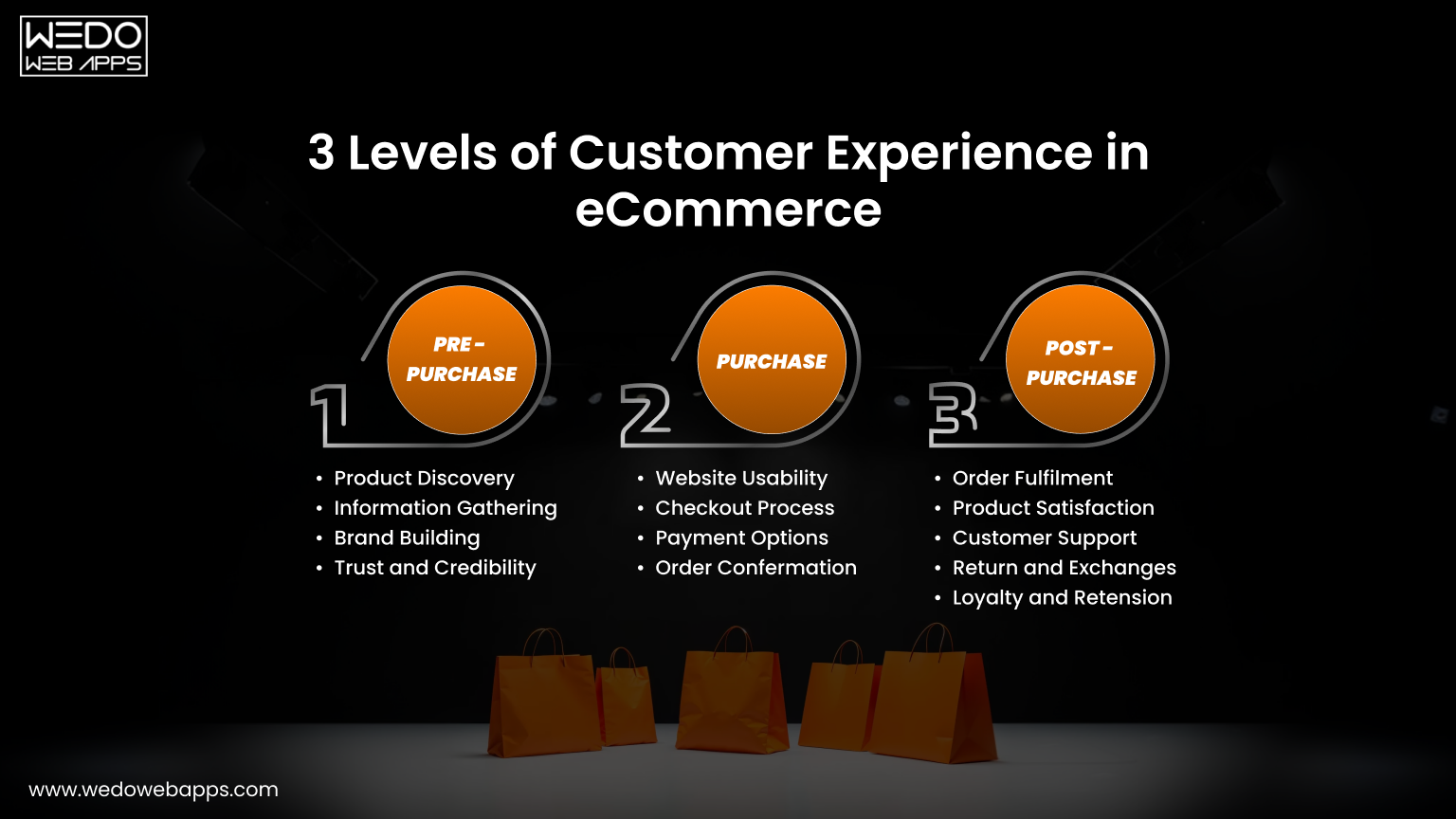
Understanding three levels of customer experience online

Customer Experience vs. User Experience (UX)

These two terms are often used interchangeably, but they are not the same.

User Experience (UX) focuses mainly on:

  • Interface design
  • Navigation
  • Page layouts
  • Visual hierarchy

Customer Experience (CX) is broader and includes:

  • UX
  • Content clarity
  • Product discovery
  • Checkout flow
  • Customer service
  • Post-purchase communication

UX is a component of CX. CX is the entire journey.

What Makes a Strong eCommerce Customer Experience?

A strong eCommerce customer experience is:

  • Fast
  • Intuitive
  • Personalized
  • Consistent
  • Trust-building

When these elements work together, customers:

  • Stay longer on your site
  • Add more products to the cart
  • Complete purchases
  • Return for future orders

This is why brands that invest in CX consistently outperform competitors on conversion rate and retention.

Why This Matters for Decision-Makers

For business owners and leaders, eCommerce customer experience is not a “design concern”. It is a growth strategy.

Optimizing customer experience helps you:

  • Improve customer experience on your eCommerce website
  • Increase conversion rates
  • Lower acquisition costs
  • Increase lifetime customer value

In short, a better experience equals better business outcomes.

Why eCommerce Customer Experience Directly Impacts Revenue

Every improvement you make to the eCommerce customer experience has a measurable impact on revenue. This is because experience influences how easily customers move from browsing to buying.

When your website feels intuitive, fast, and trustworthy, customers are far more likely to complete purchases.

When it feels slow, confusing, or unreliable, they leave.

Here is how customer experience in eCommerce directly affects your bottom line:

1. Better Experience Increases Conversion Rates

A smooth shopping experience removes friction from the buying process.

Examples of friction include:

  • Slow-loading pages
  • Confusing navigation
  • Unclear product information
  • Complicated checkout

Eliminating these obstacles makes it easier for customers to say “yes”, which naturally increases conversions.

If your goal is to improve customer experience on your ecommerce website, conversion optimization must be a top priority.

2. Positive Experiences Reduce Cart Abandonment

Cart abandonment often happens because something feels difficult or uncertain.

Common causes:

  • Unexpected costs
  • Forced account creation
  • Too many checkout steps
  • Limited payment options

Improving these areas creates a smoother path to purchase and recovers revenue that would otherwise be lost.

3. Strong CX Increases Repeat Purchases

Acquiring a new customer is expensive.

Delivering a positive experience encourages customers to return, which increases lifetime value and reduces dependency on paid acquisition.

Repeat customers also tend to:

  • Spend more per order
  • Purchase more frequently
  • Recommend your brand

4. Customer Experience Builds Brand Trust

Trust is essential in eCommerce.

When customers consistently have good experiences, they associate your brand with reliability. That trust lowers hesitation and shortens future buying cycles.

This trust factor plays a major role in optimising customer experience for long-term growth.

5. Poor CX Silently Destroys Revenue

The most dangerous part of a poor experience is that customers usually don’t complain.

They simply leave.

If your store isn’t converting well, the issue is often not your product. It’s the experience around it.

Key Takeaway: Improving ecommerce customer experience is not a cosmetic upgrade. It is a revenue strategy that directly influences conversions, retention, and profitability.

Understanding the Modern eCommerce Customer Journey
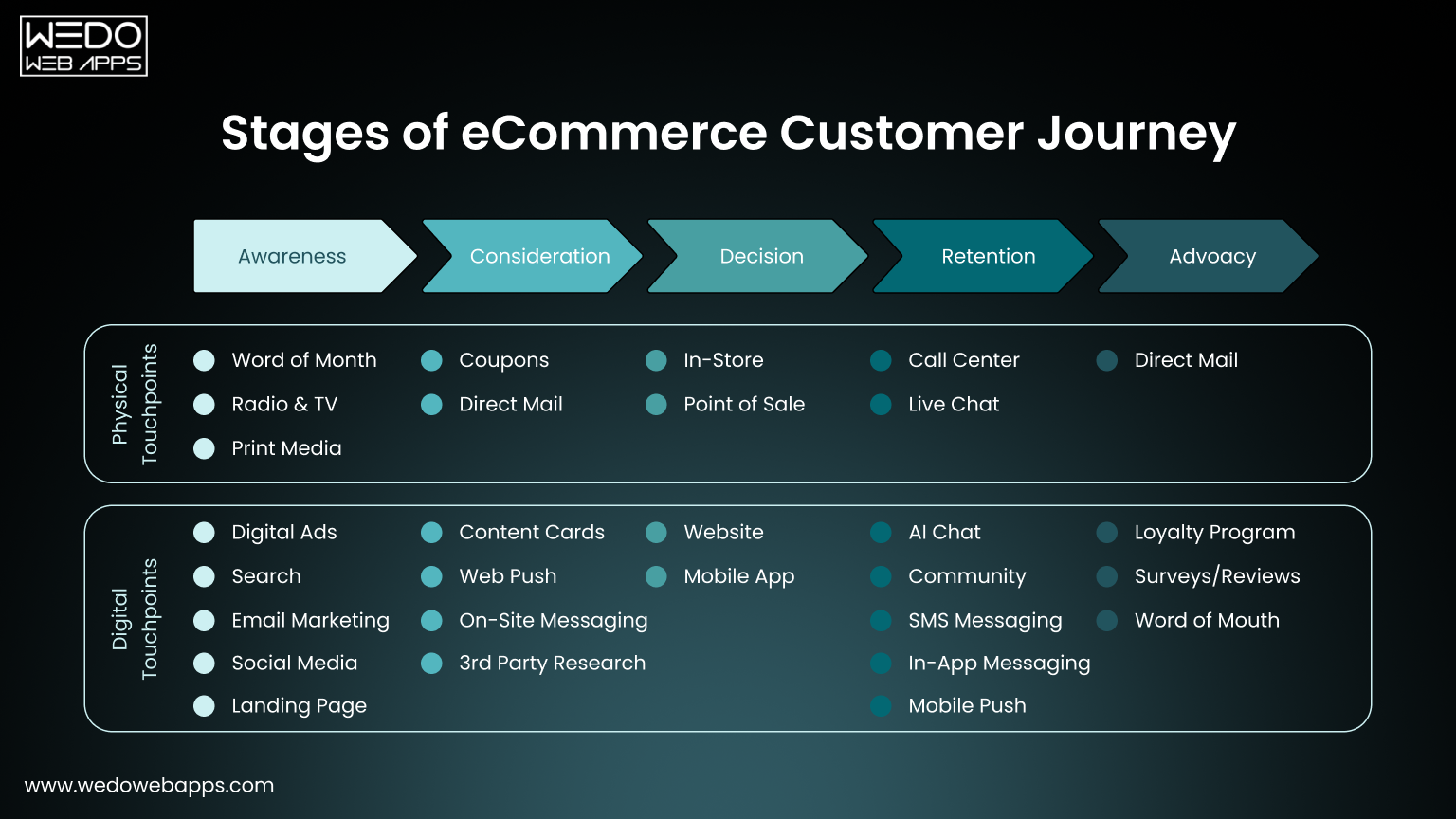
Key stages in the eCommerce customer journey

The eCommerce customer journey is the series of steps a customer goes through before, during, and after purchasing from your online store.

Understanding this journey is essential if you want to improve customer experience on your ecommerce website, because experience gaps usually appear at specific stages.

A modern eCommerce customer journey is no longer linear.

Customers may:

  • Discover your brand on social media
  • Visit your site from an ad
  • Leave without buying
  • Return through search
  • Compare competitors
  • Purchase later

Your goal is to deliver a consistent, friction-free experience at every touchpoint.

Stage 1: Awareness

This is when a potential customer first discovers your brand.

Common touchpoints:

  • Social media posts
  • Paid ads
  • Search engines
  • Influencer content

CX focus at this stage:

  • Fast-loading pages
  • Clear brand messaging
  • Strong first impression

If the first interaction feels slow or confusing, the journey ends immediately.

Stage 2: Consideration

Customers begin exploring products and evaluating options.

They look for:

  • Detailed product information
  • Images and videos
  • Reviews and ratings
  • Pricing clarity

CX focus:

  • Easy navigation
  • Search and filters
  • Well-structured product pages

This stage heavily influences whether customers trust your brand.

Stage 3: Purchase

This is the most critical stage of the journey.

Customers expect:

  • Simple checkout
  • Multiple payment options
  • Transparent pricing
  • Secure transactions

Even small obstacles here can destroy conversion rates.

Stage 4: Post-Purchase

The experience does not end after payment.

Post-purchase experience includes:

  • Order confirmation
  • Shipping updates
  • Easy returns
  • Customer support

Positive post-purchase experiences increase satisfaction and reduce refunds.

Stage 5: Loyalty and Advocacy

Happy customers become repeat buyers and promoters.

They:

  • Reorder
  • Leave reviews
  • Recommend your brand

This stage fuels sustainable growth.

Why This Matters

When you view ecommerce customer experience through the lens of the entire customer journey, it becomes clear where improvements are needed.

Optimizing only one stage is not enough.

To truly optimize customer experience, you must improve every stage of the journey.

3 Brands Crushing Customer Experience

Some eCommerce brands consistently outperform competitors, not because they sell radically different products, but because they deliver exceptional customer experiences at every stage of the journey.

Here are three well-known examples and what businesses can learn from them.

1. Amazon, Obsessive Focus on Convenience

Amazon’s success is built on removing friction from shopping.

What Amazon does exceptionally well:

  • Ultra-fast site performance
  • Powerful search and filtering
  • One-click purchasing
  • Transparent delivery timelines
  • Easy returns and refunds

Why it works: Customers never have to think about how to buy. They simply buy.

Key takeaway: If you want to improve customer experience on your ecommerce website, reduce friction everywhere, especially in search, product discovery, and checkout.

2. Apple, Experience-Led Product Presentation

Apple doesn’t just sell products. It sells clarity, simplicity, and confidence.

What Apple does well:

  • Clean, distraction-free design
  • Simple product comparisons
  • Strong visuals and videos
  • Clear benefits instead of technical jargon

Why it works: Customers understand exactly what they’re buying and why it’s right for them.

Key takeaway: High-quality product pages with clear messaging and visuals dramatically improve ecommerce customer experience and conversion rates.

3. Warby Parker, Seamless Omnichannel Experience

Warby Parker blends online and offline experiences effortlessly.

What they do well:

  • Virtual try-on tools
  • Home try-on programs
  • Consistent experience across website, mobile, and stores
  • Simple returns and exchanges

Why it works: Customers feel supported regardless of how they interact with the brand.

Key takeaway: Enabling omnichannel experiences helps optimise customer experience and builds trust.

What These Brands Have in Common

  • They remove friction
  • They prioritize clarity
  • They personalize experiences
  • They design for the customer, not the company

These principles apply to businesses of all sizes.

You don’t need Amazon-level budgets. You need customer-first design and strategic execution.

Proven Strategies to Improve eCommerce Customer Experience
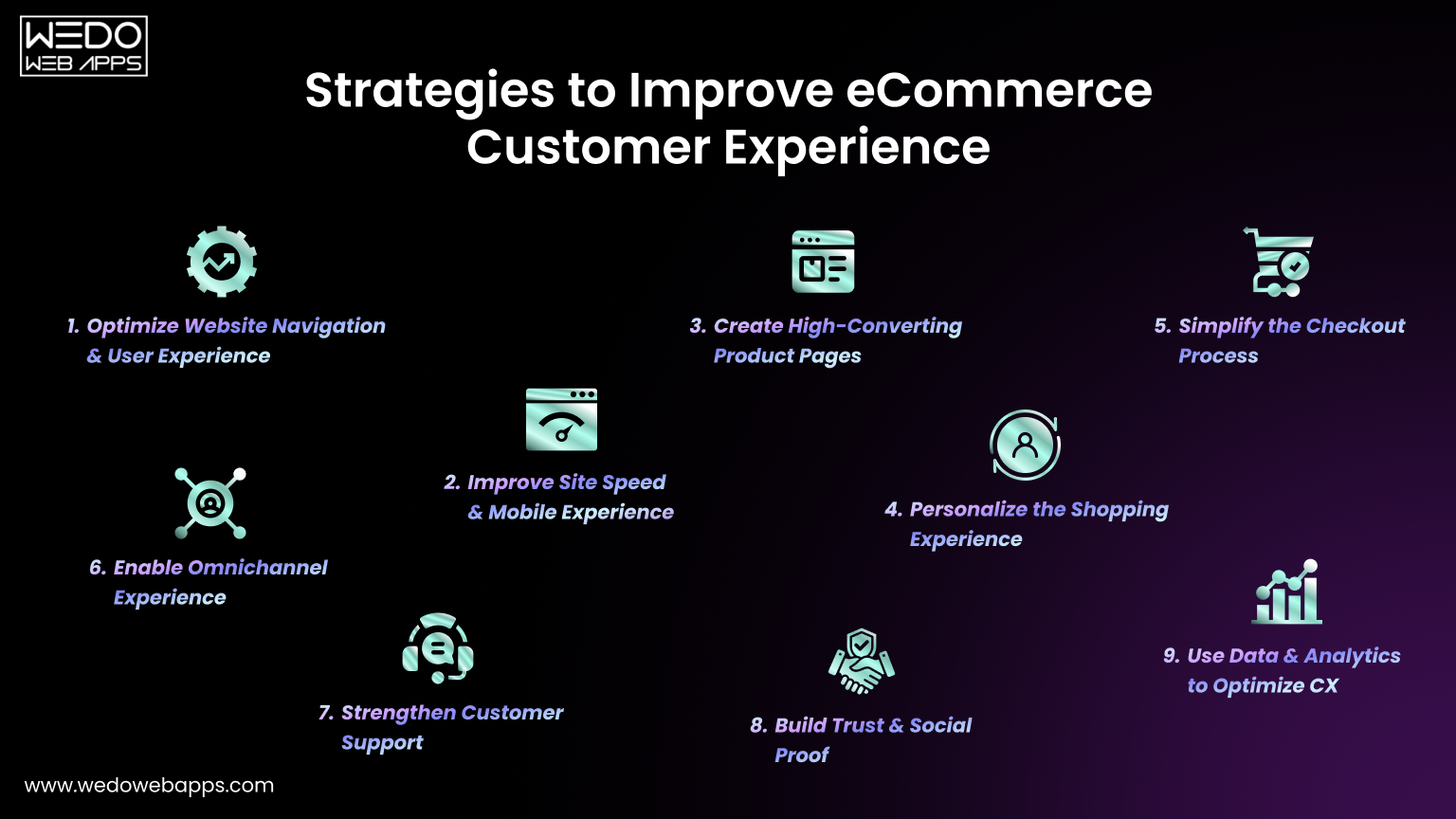
Strategies to boost customer experience in eCommerce

Improving ecommerce customer experience requires a combination of technology, design, data, and strategy. There is no single tactic that fixes everything. Successful brands continuously optimize multiple areas of their online store.

Below are proven strategies to help you improve customer experience on your ecommerce website and drive better business results.

1. Optimize Website Navigation and User Experience

Customers should find what they want within seconds.

Best practices:

  • Simple, logical menu structure
  • Clear product categories
  • Prominent search bar
  • Breadcrumb navigation

When navigation is intuitive, users explore more and bounce less.

2. Improve Site Speed and Mobile Experience

Most eCommerce traffic comes from mobile devices.

Focus on:

  • Fast page loading
  • Mobile-friendly layouts
  • Compressed images
  • Lightweight scripts

A slow site equals lost revenue.

3. Create High-Converting Product Pages

Product pages are conversion engines.

Essential elements:

  • High-quality images and videos
  • Clear product descriptions
  • Benefits-focused copy
  • Pricing transparency
  • Reviews and ratings

Strong product pages directly improve ecommerce customer experience and conversions.

4. Personalize the Shopping Experience

Personalization makes customers feel understood.

Examples:

  • Product recommendations
  • Recently viewed items
  • Personalized emails
  • Location-based offers

Personalization increases engagement and average order value.

5. Simplify the Checkout Process

Every extra step reduces conversions.

Best practices:

  • Guest checkout
  • Minimal form fields
  • Multiple payment options
  • Clear error messages

Simple checkout flows optimise customer experience and reduce abandonment.

6. Enable Omnichannel Experience

Customers interact across devices and platforms.

Ensure consistency across:

  • Website
  • Mobile
  • Social media
  • Email

Omnichannel experiences build trust and continuity.

7. Strengthen Customer Support

Fast, helpful support improves confidence.

Options include:

  • Live chat
  • Chatbots
  • Email support
  • Knowledge base

Good support is part of the ecommerce customer experience, not an afterthought.

8. Build Trust and Social Proof

Trust drives conversions.

Use:

  • Customer reviews
  • Testimonials
  • Security badges
  • Clear policies

Social proof reassures hesitant buyers.

9. Use Data and Analytics to Optimize CX

You can’t improve what you don’t measure.

Track:

  • Conversion rates
  • Bounce rates
  • Heatmaps
  • Funnel drop-offs

Use insights to continuously optimise customer experience.

Key Takeaway: Improving ecommerce customer experience is an ongoing process, not a one-time project.


Boost eCommerce growth by improving customer experience

Metrics to Measure eCommerce Customer Experience Success
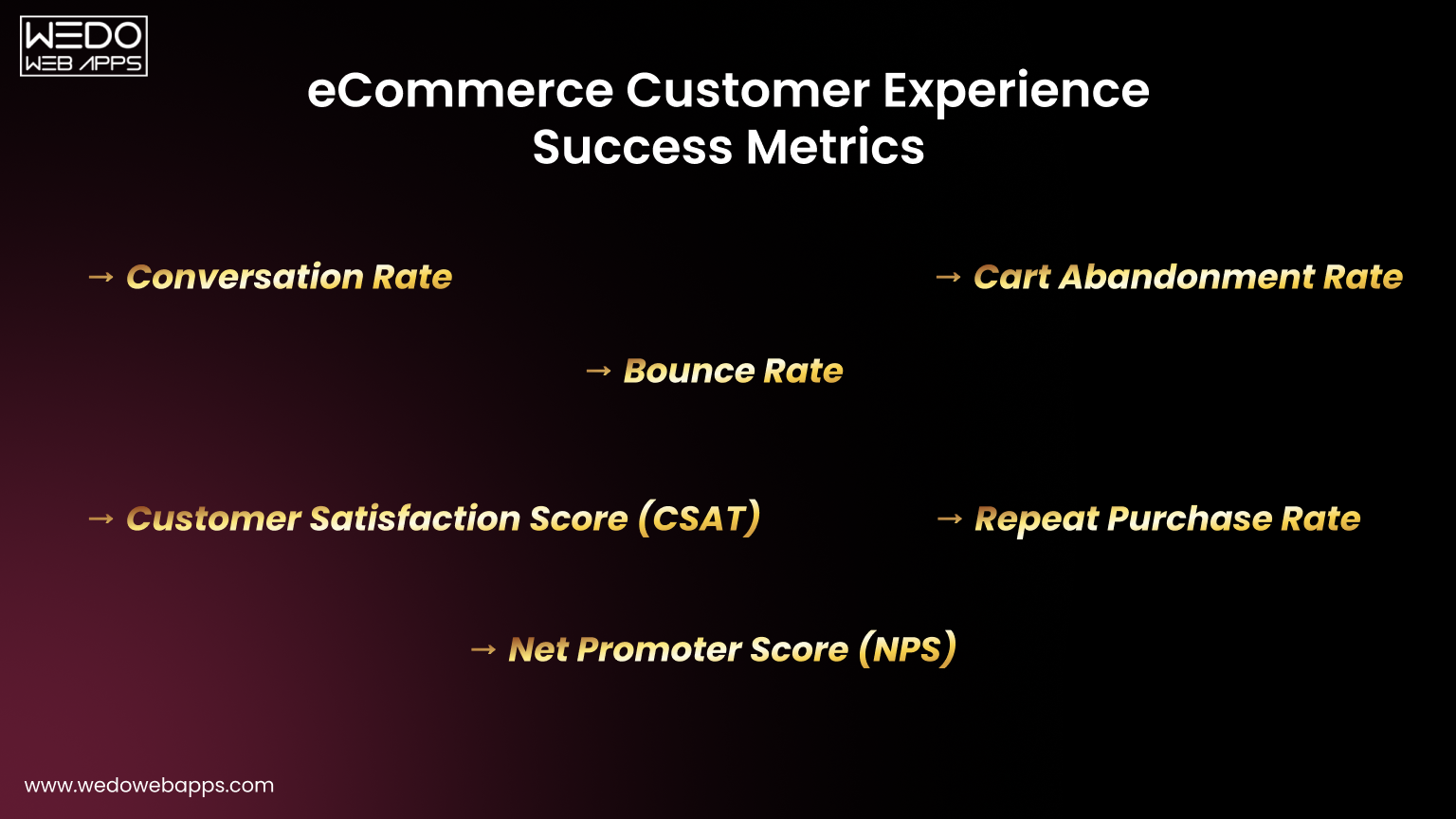
Key metrics for successful eCommerce customer experience

If you want to improve ecommerce customer experience, you must be able to measure it accurately. Without clear metrics, it’s impossible to know what’s working and what needs improvement.

Below are the most important metrics decision-makers should track.

Conversion Rate

Shows the percentage of visitors who complete a purchase.

Why it matters: A rising conversion rate indicates that your customer experience is becoming smoother and more persuasive.

Bounce Rate

Shows how many visitors leave after viewing only one page.

Why it matters: High bounce rates often signal slow loading, poor relevance, or confusing design.

Cart Abandonment Rate

Shows how many users add products to the cart but don’t purchase.

Why it matters: Helps identify checkout or trust issues.

Customer Satisfaction Score (CSAT)

Measures how satisfied customers are with their experience.

Why it matters: A direct indicator of customer happiness.

Net Promoter Score (NPS)

Measures how likely customers are to recommend your brand.

Why it matters: Strong signal of loyalty and advocacy.

Repeat Purchase Rate

Shows how many customers buy again.

Why it matters: Reflects long-term experience quality.

Pro Tip: Track these metrics monthly and correlate changes with UX, content, and checkout improvements.

Common Mistakes That Hurt eCommerce Customer Experience

Many eCommerce businesses focus heavily on driving traffic but fail to invest enough in experience optimization. As a result, they attract visitors but struggle to convert and retain them.

If you want to optimise customer experience and drive sustainable growth, avoid these common mistakes.

1. Designing for Aesthetics Instead of Usability

Visually impressive websites do not guarantee good experiences.

When design prioritizes style over function, users struggle to navigate, find products, or complete purchases.

What to focus on instead:

  • Clear layouts
  • Logical hierarchy
  • Easy navigation

Usability always beats visual complexity.

2. Overcomplicating Navigation and Site Structure

Complex menus and deep category structures confuse users.

Common symptoms:

  • Too many categories
  • Unclear labels
  • Hidden products

Simpler navigation improves discovery and reduces bounce rates.

3. Ignoring Mobile Optimization

Most shoppers browse and buy on mobile devices.

If your mobile site is slow, hard to tap, or visually broken, customers leave.

Mobile experience must be treated as primary, not secondary.

4. Hiding Important Purchase Information

Customers need clarity before buying.

Hiding or delaying information such as:

  • Shipping costs
  • Delivery timelines
  • Return policies
  • Warranty details

creates friction and abandonment.

5. Using Generic or Thin Product Descriptions

Short, vague descriptions fail to answer buyer questions.

Strong product pages explain:

  • What the product does
  • Who it’s for
  • Why it’s better
  • How it solves problems

Detailed content improves ecommerce customer experience and SEO.

6. Offering Too Many Checkout Steps

Long checkout flows frustrate users.

Each additional step reduces completion rates.

Simple, streamlined checkout improves conversions.

7. Not Showing Social Proof

Customers look for reassurance.

Without reviews, ratings, or testimonials, trust is weak.

Social proof strengthens confidence.

8. Treating Customer Support as an Afterthought

Slow or unavailable support damages trust.

Customers expect quick help when issues arise.

Support quality directly affects experience.

9. Failing to Use Data for CX Decisions

Many businesses rely on assumptions.

Without analytics, heatmaps, and feedback, improvements become guesswork.

Data-driven optimization leads to better outcomes.

Key Takeaway: Most ecommerce customer experience problems are preventable. They stem from overlooked fundamentals, not advanced technology.

Why Partnering with Experts Improves Customer Experience Faster

Improving ecommerce customer experience is not just about making design tweaks or adding plugins. It requires strategy, technical expertise, data analysis, and continuous optimization.

For many startups, SMBs, and enterprises, building and maintaining this capability in-house is challenging.

This is where partnering with experienced eCommerce and CX specialists creates a competitive advantage.

1. CX Strategy Aligned With Business Goals

Experts start with your business objectives.

They map:

  • Target customers
  • Customer journeys
  • Conversion funnels
  • Growth goals

This ensures every experience improvement supports revenue, not just aesthetics.

2. Access to Cross-Functional Expertise

Effective CX improvement requires:

  • UX and UI designers
  • Front-end developers
  • CRO specialists
  • Analytics experts

Hiring and managing all these roles internally is costly and time-consuming.

Partners provide immediate access to specialized skills.

3. Faster Implementation and Testing

Experienced teams already know:

  • What patterns work
  • What mistakes to avoid
  • How to test efficiently

This reduces trial-and-error and accelerates results.

4. Scalable Optimization Process

Experts build repeatable frameworks for:

  • Auditing experience
  • Prioritizing improvements
  • Testing changes
  • Measuring impact

This creates sustainable growth.

5. Technology and Tool Expertise

Specialists are familiar with:

  • eCommerce platforms
  • Analytics tools
  • Personalization engines
  • Automation solutions

This ensures correct implementation from day one.

Bottom Line: If ecommerce customer experience is a growth priority, treating it as a specialized discipline, not a side project, delivers faster and more predictable results.


Improve eCommerce shopping experience with expert help

Conclusion, Customer Experience Is the Foundation of eCommerce Growth

In today’s competitive market, customer experience in eCommerce is no longer optional. It is a critical growth driver.

Brands that win are not always the ones with the lowest prices or the largest catalogs. They are the ones that deliver fast, intuitive, personalized, and trustworthy experiences across the entire eCommerce customer journey.

By understanding how customers move through your store, identifying friction points, and applying proven strategies to optimise customer experience, you can:

  • Increase conversions
  • Reduce cart abandonment
  • Build customer loyalty
  • Drive sustainable revenue growth

Improving ecommerce customer experience is not a one-time project. It is an ongoing process that requires strategy, testing, and continuous optimization.

If your goal is to build an eCommerce business that scales, investing in customer experience is one of the highest-ROI decisions you can make.


Build a faster, smoother, high-converting eCommerce store