skip to content

React Native Developers Hiring Guide for 2024

We all know how hard it has become to find the perfect react native developer. While tech giants like Instagram and Airbnb have developed their mobile applications with the help of React Native, it is gained a lot of popularity in the past few years. Even it won’t be too wrong to consider, that for mobile app development, React Native is becoming the industry standard.

React Native: A Brief Introduction

If you want to hire react native app developers, you need to understand how react native can be deemed beneficial for your development. Back in January 2015, React Native as created by Facebook. The whole idea behind it was, they create a reliable framework based on JavaScript instead of using HTML. Further adding, with every single year, the community around React Native is gradually increasing, all thanks goes to the flexible and easy to use a framework.

Some of the salient features of using React Native includes:

  • React Native can be easily used to develop an app for both Android and iOS-based devices.
  • It provides excellent sustainability with cross-platform functionality.
  • React uses JavaScript as its core programming language.
  • The developers can avail the benefits of React, which is s JavaScript library to create user interfaces.
  • With an easy to navigate UI, React Native makes the entire user experience seamless.
  • React Native can make your apps lighter while proving faster performance.
  • It helps to use lesser resources as compared to that of any other native apps.
  • With the automated code update feature, you can always release faster app updates.
  • Any developer can tweak around with React Native and create a mobile app out of it.

Hard Skills Considered before Hiring React Native Developers

Down below are some of the mandatory hard skills that every React Native programmer should be aware of. Before you get started with your recruitment process, make sure that you understand the skills that are to be required for the programmer.

1) Good Stronghold on JavaScript

While being a React Native app development company, you need to opt for employees who have in-depth knowledge of JavaScript. The JavaScript can always help the developer to create better app logics, building components, and services.

2) Understanding ES6

While you are looking to hire for React Native developers, make sure that they have profound knowledge on what exactly is ES6. You can also test their skills on how they can convert ES6 code into an ES5 one. Further adding, you can also evaluate your programmer while asking the features of ES6 for JavaScript.

3) Knowing the Native iOS and Android Development Commands

Apart from being a React Native Developer, one needs to work on native tools to get the job done. Under such instances, it shall be far better if the individual is well versed with all the native Android and iOS developments.

4) Having Backend Skills

No matter how much a programmer is versed with the front-end skills, it shall be of no use if the entire backbone of the app is not strong enough. Due to these reasons, always look for the hunt of programmers who has the backend skills to get their program done.

5) Debugging

Resolving bugs is yet another reason, you should be vigilant enough to ask for React Native Programmers who are well equipped with their debugging skills.

Soft Skills Considered before Hiring React Native Developers

It is quite understandable if you want to hire a React Native developer, there are specific hard skills that the programmer needs to possess. But, apart from that, having a certain degree of soft power can help your company to continue with the development process seamlessly. Down below are some of the soft skills that every programmer should require:

1) Strong Communication Skill

Make sure to understand that by hiring a developer with strong communication skills, you can always add value to your company and the project they are directly involved. Communication skills are still required to convey the message better and making sure that everyone is on the same page.

2) Making the Code Clear to Understand

While someone might be a genius when it comes to writing code, but that the time of debugging, they can’t even understand their lines. This is certainly not how one should approach coding. That is precisely why you need to hire someone obvious and concise with the lines of code they write.

3) Adaptability    

Your React Native developer must know their way around, how to interact with different hardware and software. Being someone in the technological industry, it is widespread to expect, yet the majority of them always stick to their personal preferences. And if your developer doesn’t know how to use particular software, they should always be humble enough to learn about such.

4) Dedicated Work Approach

Dedication is yet another essential aspect when it comes to a React Native developer. Unless you have the eagerness to learn and grow yourself, you shall stay in the same positions for the years to come. It is only through the dedicated work approach that your developer can add value to themselves and your company.

5) Fostering Teamwork

While the majority of the developers prefer to work alone, there are certain instances where they will need to work as a team. During such cases, it is essential to understand that you need to hire someone who can foster such teamwork.

Follow our guide to hiring the best React Native developers and leverage our React Native development services for your next project.

Wrapping Up

In conclusion to the above-discussed article, our idea was to describe all the aspects one needs to look for to hire react developers. With each passing year, react native is becoming more of a go-to-framework for the majority of the development companies. To smoothen the development phase, React Native offers a variety of easy to access libraries and plugins. So, once you have gained a clear overview of what to look for such developers, you can quickly get the employees you require.

Determining the Life-cycle and Working on Android App Development

While developing an app for the Android platform, one needs to understand its various phases. We are going to explain the multiple stages here in our present comprehensive article on Determining the Lifecycle and Working on Android App Development. With the knowledge of all these phases, one will be able to develop a high-end app for their business.

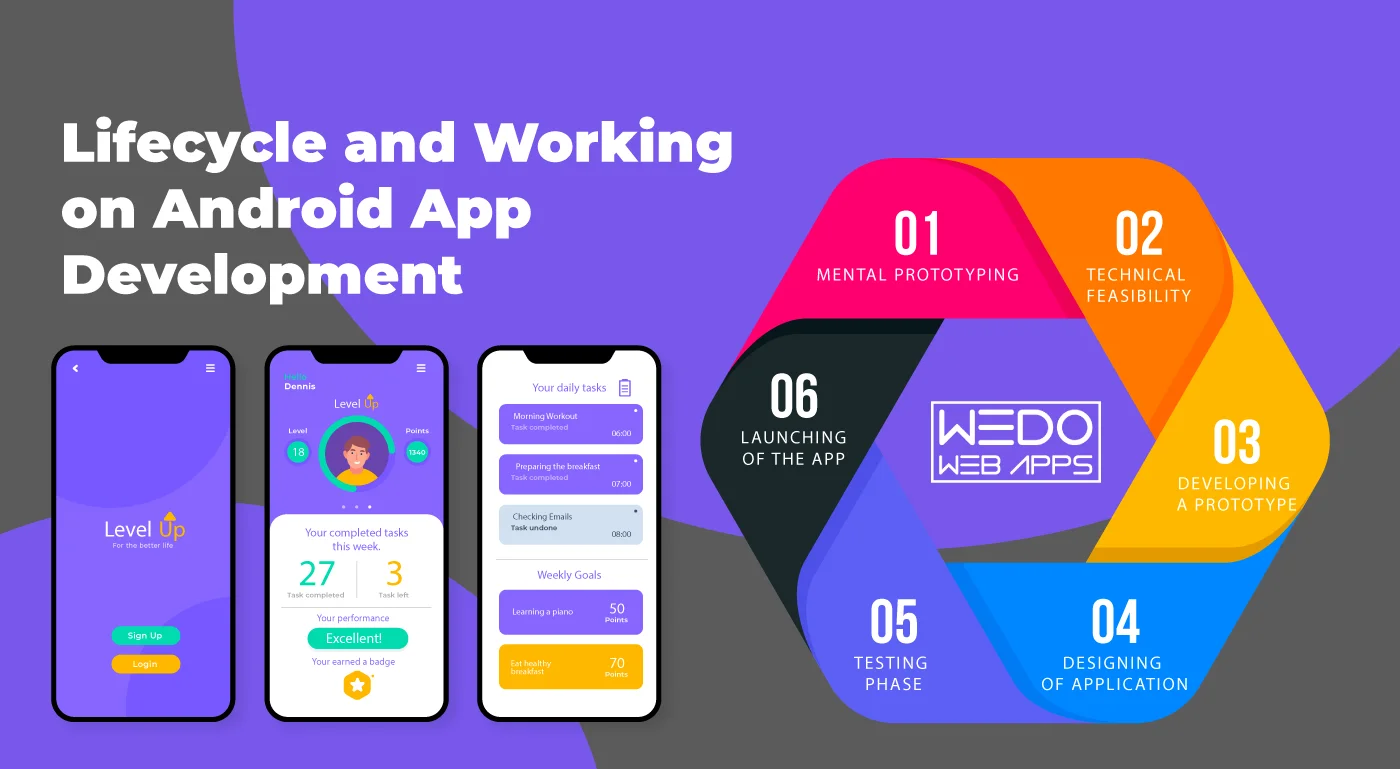
Lifecycle and Working on Android App Development – 8 Phases one shall know about

Here are the phases of the Android app development that occurs during its lifecycle and functioning. Kindly go through them and understand each of the steps in brief.

Preplanning and Research Before beginning with the development, it is necessary to carry out the planning. Furthermore, it is also required to do a brief research on the various topics and applications. Due to this, the developers must frame a proper plan to develop a highly versatile app.

  1. Mental Prototyping

Next, comes the phase of preparing a rough sketch of the app. Plotting the ideas on the paper, one must create a visual representation of the topics. This will make it easier for the developer to develop the applications. In this way, one can eliminate the specific issues that an app is facing while functioning.

  1. Assessment of Technical Feasibility

Technical Feasibility relates to the options for making the app technically stronger. In this phase, the app becomes capable of outsourcing the data from various public domains.

  1. Developing a Prototype

In this step, the developer creates the prototype of the application. The prototype gives a better idea to the developer about the creation of the app. In this phase, one has to use the rough wireframes and not the actual ones.

  1. Designing of Application

In this phase, the full-fledged designing, as well as the development of the application, is carried out. Deciding on the architecture of the apps, the developer has to make sure to fit the right thing at the right place.

  1. Utilization of Agile Methodologies

To progress effectively, it is utmost necessary to follow the recent trends. Using the Agile Methodology is perhaps one such better option for the same. With the help of this methodology, one will be easily able to make changes in the application and its features.

  1. Testing Phase

The testing of the application is very much essential. This phase makes it sure that there aren’t any issues in the functioning of the app. It also removes the different bugs from the system.

  1. Launching of the app

Once every check of the app is done, it is now time to launch the app. Google Play store provides the platform for the launching of the app.

Master the lifecycle of Android apps with our expert mobile app development services.

Summary

With this present compilation on, Determining the Lifecycle and Working on Android App Development, we have explained the various phases that occur during the development of an Android app. Getting familiar with all these phases, one will be able to develop a better application.

Hybrid Application vs Native Application Detailed Comparison Guide

Understanding Hybrid Application vs Native Application Before You Start Building

Developing a successful mobile app begins with a clear decision. The choice between the hybrid application and native application sets the standard for speed, usability, and overall experience. Many businesses compare native apps vs hybrid apps to understand which structure supports their goals, budgets, and long-term plans.

This comparison becomes even more important as users expect fast responses, stable performance, and smooth interaction from every mobile app. Each approach brings different strengths, like native apps, which offer direct access to device features. Hybrid apps allow a wider reach through a unified code base.

Understanding the difference between native application and hybrid application helps you to pick the better mobile app development method that aligns with your product priority. This guide will walk you through every part of the decision clearly and practically. It helps you choose the direction that fits your vision and supports growth without confusion.

What is a Native Application

A native application is built using platform-approved languages. iOS apps use Swift or Objective-C. Android apps use Kotlin or Java. This allows the app to communicate with device features while maintaining strong accuracy. It also helps to deliver a smooth interaction because the code runs inside the system environment.

The developer uses platform-approved languages, which help the app interact smoothly with the device tools.

How native apps are built:

  • iOS uses Swift or Objective-C.
  • Android uses Kotlin or Java.
  • The code runs within the system environment.
  • Interaction with the camera, GPS, sensors, and notification stays accurate.

Many teams compare the native apps vs hybrid apps at this early stage to decide which structure supports them with the performance and feature requirements. This also helps you understand the difference between native application and hybrid application before moving ahead.

When to Choose a Native Application

A native structure app works well when the project demands fast responses, advanced animations, or direct access to the hardware tools. You can pick the option when the product is required to meet the strict performance standards with the native mobile app development.

A native app setup fits the project that requires the application to perform strongly and needs advanced device controls.

Best suited for:

  • Apps with high animation or visual processing.
  • A product that must respond quickly.
  • Tools that rely on GPS, Bluetooth, a camera, or sensors.
  • Services that must work offline.
  • Projects that need a reliable and consistent user flow.

You can compare the mobile apps, hybrid vs native, to pick the one that is accurate and matters more to have effective development.

Benefits of Native Applications

Native applications often provide a more polished experience because the structure matches the operating system.

Key advantages:

  • Fast response due to direct system access.
  • Smooth interaction with stable performance.
  • Strong security as per the platform rules.
  • Better use of push notifications and device tools.
  • A familiar interface because it follows platform-specific design and guidelines.

These strengths often influence the decision during the app native vs hybrid evaluation when the team wants predictable performance.

Limitations of Native Applications

Native apps offer strong performance, but they also bring certain challenges, and here are the points that you can consider while choosing a native app.

Points to consider:

  • A separate version is needed for iOS and Android.
  • Required high development efforts.
  • Longer build and release cycles.
  • More detailed maintenance work.
  • Larger team involvement in some cases.

These factors shape early discussion around hybrid application vs native application, especially for businesses that are aiming for a quick multi-platform release.

Examples of Native Applications

There are several well-known apps that rely on native development due to their functional needs.

Common examples:

  • High-graphic mobile games.
  • A navigation tool that relies on real-time GPS.
  • Photo and video editing apps.
  • Banking apps require secure access.
  • Fitness tracking using motion and sensor data.

These examples help you illustrate that native vs hybrid mobile app comparison with real use cases.

Ready to plan your app with the right structure

What is a Hybrid Application

A hybrid app is an application created using a single code base that works on both iOS and Android. The core structure is built with web-based languages, then combined with native apps that allow the app to interact with device features. This setup will help you release the product across two different platforms without building a separate version. It also becomes a common choice during early evaluations of hybrid application vs native application when speed and accuracy are important factors.

How hybrid apps are built:

  • One code base for iOS and Android.
  • Developed with HTML, CSS, and JavaScript.
  • Runs inside the native shell that connects to the device’s tools.
  • Frameworks such as React Native, Iconic, and Flutter are widely used.

Businesses often compare hybrid application vs native application at this point to deduce if a fast multi-platform release will matter more than the deeper system integration.

When to Choose a Hybrid Application

Many businesses consider hybrid application development when they want a faster release across both platforms. The structure suits projects that depend on content delivery rather than on heavy system interaction. The team also prefers this method when the budget or timeline limit separates native builds. These points often guide early discussion around mobile app hybrid vs native to see which option matches product expectations.

Best suited for:

  • Apps with moderate speed and interaction needs.
  • Content-focused products, such as listings or media.
  • Early-stage ideas that need quick market entry.
  • Businesses that are targeting iOS and Android users together.
  • Teams with limited resources for dual development.

During planning, you can analyze mobile apps, hybrid vs native, to check if a unified code base can support timelines and given budgets.

Benefits of Hybrid Applications

Hybrid apps bring practical advantages for you if you need simplicity in development. Since the same code works for both platforms. The build process becomes quicker and easier to handle the application. The updates for the app take less time because changes apply across all devices. These strengths often influence the comparison between native apps vs hybrid apps for your project needs.

Key advantages:

  • Lower effort due to a single code base.
  • Faster development for both platforms.
  • Lower initial investment.
  • Uniform updates across the system.
  • Broad plugin support for device features.

These benefits will often help you highlight the comparison of native apps vs hybrid apps for the project that needs a quick release cycle.

Limitations of Hybrid Applications

Hybrid apps offer convenience, but they also come with performance and feature-related restrictions. Some apps may not achieve the same responsiveness as native builds. Access to advanced device tools often relies on plugins, which can limit customization. These factors shape the difference between native application and hybrid application for businesses planning for long-term growth.

Points to consider:

  • May not match native responsiveness for heavy tasks.
  • Limited access to deeper system functions.
  • UI may not fully match platform behavior.
  • Performance for graphics and complex animation may vary.
  • Dependence on third-party plugins for feature support.

These factors influence the difference between native application and hybrid application, helping businesses to understand where each method fits.

Examples of Hybrid Applications

A wide range of apps may choose hybrid development because they focus on content, reach, and simpler interactions. These apps do not rely on heavy functions and can deliver consistent results with the unified structure. This helps the product team understand the native vs hybrid mobile app with the help of relatable examples.

Common examples:

  • News and media apps.
  • Service booking platform.
  • eCommerce catalog browsing apps.
  • Corporate internal tools.
  • Social apps with moderate device interaction.

These examples help teams understand native vs hybrid mobile app decisions through practical scenarios.

Want to make the right choice for your mobile app

Difference Between Native Application and Hybrid Application
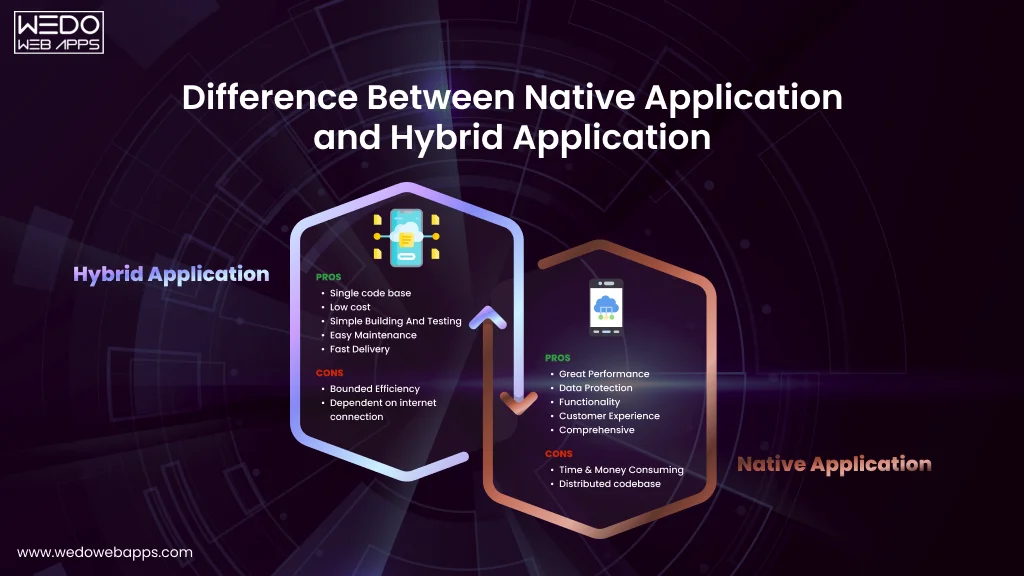
pros and cons of hybrid application and native application

Understanding the difference between native application and hybrid application becomes easier when you look at how each option shapes your overall experience. The points below help you evaluate hybrid application vs native application without reading the same information twice.


Comparison Areas Native Application Hybrid Application
Performance Native apps are rich in performance and are built using the design and development timeline. Uses a web-based layer that can give a direct impact on overall speed.
System Access Full access to GPS, camera, sensor, and notifications. Access through a plugin that can restrict deeper features.
Design Consistency Matches the platform design rules while maintaining strong accuracy. The interface may differ slightly across different devices.
Code Base Separate code for iOS and Android. One shared code for both platforms.
Development Timeline More time is required due to separate builds. Faster delivery because of one build server for all platforms.
Maintenance Updated inventory. One update applied everywhere.
Budget Requirements Usually higher due to parallel development. Lower because of the structure.
Best Fit High-performing apps, gaming, multimedia, and navigation. Content apps, eCommerce catalog, service platform, and MVPs.

Explanation of Each Comparison Point

Below is the simplified breakdown of the key areas shown in the table. This helps you understand the difference between native application and hybrid application with clear context.

1. Performance

Native apps perform well because they operate within the device’s system, which allows for a smooth transition and stable speed. This becomes an important decision around native apps vs hybrid apps, especially for products that require heavy visuals and real-time interaction.

A hybrid application runs through a shared base that works across multiple platforms. For the most general feature, the speed remains consistent. In many hybrid application vs native application comparisons, this becomes a strong advantage for the team to work quietly.

2.  User Interface Flow

Native apps follow Android and iOS design with device compatibility to make the interface look natural and consistent. Users recognize the gestures, layouts, and motion patterns instantly, which aligns well during the comparison in the app native vs hybrid evaluation.

Hybrid apps follow the platform design pattern, and some visual elements may require putting in some extra effort for adjustments. This can influence the early user perceptions of mobile app hybrid vs native.

3. Development Flexibility

Native development gives you deeper control over the visual elements and hardware connections. This helps in managing the demand of the project with refined elements, strong security measures, and specialized features.

A hybrid app supports one codebase platform, which reduces the development time and simplifies the expansion. You can consider this to have a strong influence when evaluating native apps vs hybrid apps in a project that needs faster and frequent modification.

4. Use of Device Features

Native apps interact directly with the device components like the camera, GPS, sensors, and processor modules. This reduced the chances of delays and helped to accelerate the results, especially in apps that rely on real-time data and complex processing.

Hybrid apps can access device hardware using the plugins. The experience depends on the quality of the plugin and community support. This model works well for standard features such as notification, camera access, and basic sensor functions.

5. Maintenance Outlook

Native applications require individual updates for Android and iOS. This allows precise control over improvements and optimisation. Businesses often choose this model to have detailed feature refinement on each platform.

Since hybrid apps share a unified codebase and are updated with a single cycle. This simplifies the long-term maintenance, which becomes a practical benefit when comparing the hybrid application vs native application for mobile to improve the team efficiency.

Native vs Hybrid App Summary with Practical Scenarios
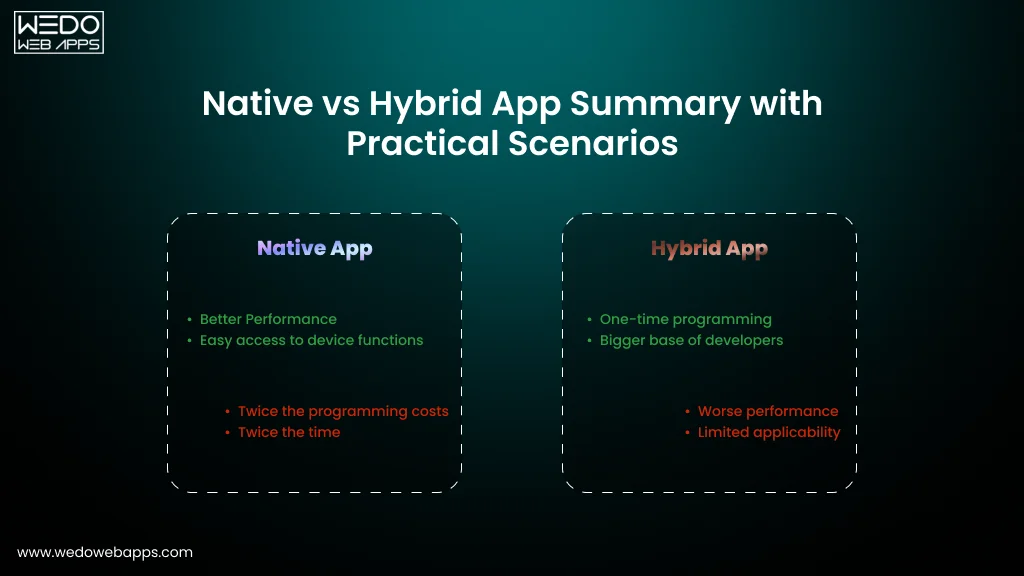
Native vs Hybrid App Summary with Practical Scenarios

Choosing between native and hybrid apps often depends on the purpose of your product, the expected experience, and how quickly the team wants to launch. With the help of this section, you will understand about the native apps vs hybrid apps, especially when comparing the real situation where each option performs differently. It also supports the search intent for app native vs hybrid and hybrid application vs native application through the practical examples.

Quick Summary Table

Scenario Native App Outcome Hybrid App Outcome
High-performance needs such as video editing or gaming. Smooth flow with fast response due to platform-specific build. Acceptable speed for simpler workloads, but may show minor delay in heavy tasks.
Early-stage startup aiming for faster release. Longer development time since separate builds are required. Quicker launch because the codebase is shared.
Apps with advanced device integration, such as sensors or camera-based tools. Direct access to hardware results in accurate output. Works with plugins that may require extra setup.
Long-term brand-centric products. Greater visual control and polished interactions. A common interface that fits both platforms with moderate adjustments.
Budget-sensitive projects. Higher investment due to two builds. Lower upfront cost because one codebase powers both apps.

How Native Works in Real Use Cases

A native structure fits well when the app must deliver high precision, strong interaction, and a polished interface. Brands that rely heavily on mobile experience prefer native because users require a smooth interface and fast responses. For instance, a fitness tracking product needs an app to monitor steps and heart rate benefits from direct access to device sensors.

This matches what users expect when they compare native apps vs hybrid apps, especially in performance-centric cases.

How Hybrid Fits Practical Situations

A hybrid build is suitable when your primary aim is faster availability without managing two separate versions. If you want to test the idea quickly or reach both Android and iOS at the same time, you can choose a hybrid app. For example, a service booking app or a news app with basic interactive pages works well in this structure. This aligns with the intent behind app native vs hybrid, particularly for teams with limited time or budgets.

Not sure which app approach fits your idea

How to Select the Right Approach for Your Mobile App
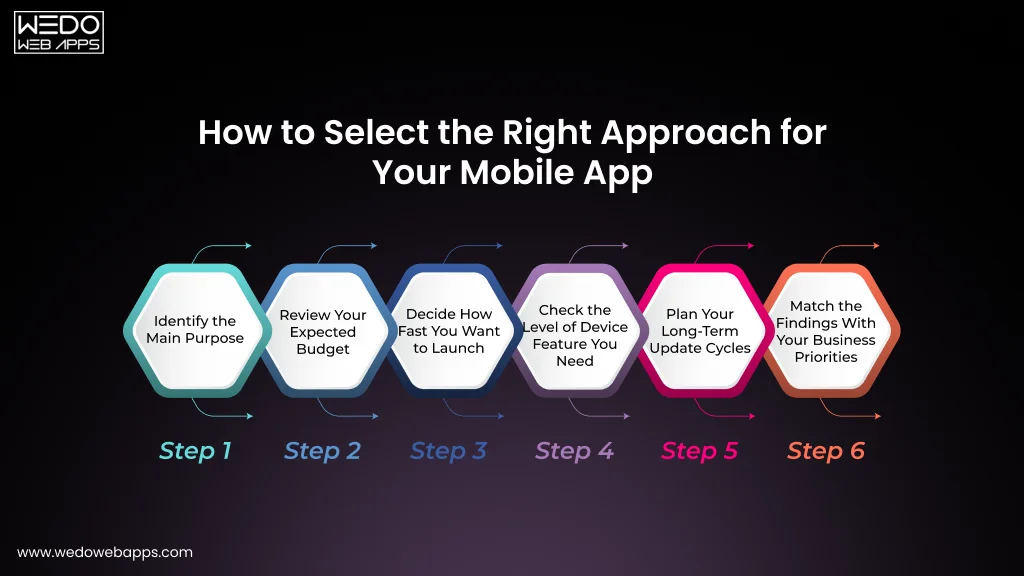
How to Select the Right Approach for Your Mobile App

When you compare hybrid application vs native application, the decision becomes easier if you follow the clear process, and that too in sequence. These steps guide you through every step so that you can choose the right structure with confidence.

Step 1: Identify the Main Purpose

Start by understanding the core goal of your application and the purpose that it will solve.

  • If the app must deliver high speed, smooth interaction, or advanced features, then a native app becomes a better option.
  • If your goal is quick availability across all platforms, then a hybrid app works well.

This step directly gives support to your search intent for native vs hybrid mobile apps.

Step 2: Review Your Expected Budget

Check how much you can invest in the development of your application and your long-term plans.

  • Native requires a separate build, which increases spending.
  • Hybrid support to share a codebase, which helps when the budget is controlled.

This gives you clarity while knowing about the difference between native application and hybrid application.

Step 3: Decide How Fast You Want to Launch

If your aim is to have the fastest development, then a hybrid offers the shortest development time. Native apps take longer to develop for different operating systems, but give better refinement. This helps you easily compare mobile apps hybrid vs native, based on the timelines.

Step 4: Check the Level of Device Feature You Need

Native apps provide direct access to device systems such as sensors, camera tools, and secure payment functions. Hybrid can use these features through plugins, which may require extra work. This supports knowing better for app native vs hybrid for your business.

Step 5: Plan Your Long-Term Update Cycles

Native is ideal when it comes to having frequent improvements, high-scale interactions, and large design updates. The hybrid works well if your app is more focused on the content update or routine adjustments.

Step 6: Match the Findings With Your Business Priorities

List your needs in simpler terms. Assess which structure aligns with your goals, budget, and timeline, along with the technical expectations. This structured approach gives a clear path for choosing between native apps vs hybrid apps.

Deciding What Works Best: Hybrid Application vs Native Application

Choosing the right approach between a native build and a hybrid build allows you to maintain the future of your mobile app. Each option supports a different version. Native fits are suitable where refined interaction, accuracy, and long-term experience are top priority. Hybrid support brands that want quicker availability and shared code structured without adjusting the budget.

Once you understand how both approaches work, it becomes simpler for you to decide which one matches your end goal. The comparison between hybrid application vs native application gives a strong base for shaping a product that feels right and fits your long-term plans.

If you want expert guidance on picking the right structure or planning your next mobile project, our team can help you move forward with a clear strategy. Reach out to the mobile app development company you have the product you need.

Make the right app choice with expert guidance

Is Android Application Development is an ideal option?

No doubt, mobile applications have changed the way businesses operate these days. Due to the evolving customer expectations and increasing demand for smartphones, businesses are forced to have a mobile app. Today, customers prefer to browse on their mobile devices to collect any information, and mobile apps are added advantage for those companies who are majorly into the eCommerce business.

Moreover, choosing the right platform to promote your mobile app in the market also plays a crucial role. As we know that Android and iOS are rivals, but Android is leading the smartphone sales, which is predicted to reach 81.1% by next year. Therefore, choosing Android for deploying your mobile app is an ideal choice.

Developing an Android app is not a cakewalk, so businesses prefer to hire an Android Application Development Company that can help them to accomplish the process with ease. The market for android application development companies is significant, and selecting a reliable partner can be a challenging task. But no need to worry! We’ll be sharing some tips to choose the right Android application company as well as the benefits that you can reap from these companies.

How to choose the right Android app development company for your business?

Do your homework-

Do thorough research around the globe as it will help you shortlist top companies, and you can consult with them. This will help you choose the right firm that suits your business requirements.

Know your Android app goals-

Make sure you’re clear about your goals and thoughts before discussing your mobile app. You should know what you want to include your Android app, how it should be designed, what features you require, etc.

Pick the right developer for your project-

Choose the developer who can go the extra mile and give you better suggestions as per the current trend in the market. These types of skilled developers maintain the uniqueness of the app and represent your brand efficiently.

Check the overall experience-

Go for the Android app development company that boasts unbeatable years of experience. Experience is the foremost thing that speaks about the brand’s challenges and solutions. The more the background, the more the challenges a company has faced and overcome it. Understand key necessities for Android app development and how they contribute to creating effective and successful applications.

Set a timeframe-

Companies provide an estimation of the development process, so make sure you decide a fixed time based on the estimate. Hence, you and the corresponding company is ready on the agreed timeframe.

Seamless communication-

Communication is key! Working collaboratively with the team of the development company will keep you up-to-date about the project. It also maintains transparency, which is the best thing for you as well as for the company as it establishes a trustable relationship between the two.

Consult with the company for increasing app profit-

Android app development companies are well-versed with the market trends, so you must consult with them concerning how you can make this app profitable to your business. Consultation with the experts and using your ideas can help you earn better ROI.

Choose quality over cost-

Countless service providers offer mobile app development services at a minimal cost, but it lacks quality. Make sure that you don’t compromise on quality just to save a few bucks because the competition is fierce.

Check technical proficiency-

The developer’s team of the company should be proficient in their technical skills because developing an app and developing a website are two different things. So ask about the technologies they will use to build your android app.

Establish long-term relationship-

It is better that you establish a long-term relationship because they will provide you with support services whenever required making things easier and seamless for you.

How choosing Android App development can reap your business more benefits?

Latest Android trend-

Android development companies have more profound insights into the industry-specific development trends as they implement it on different projects. The embracing of the latest trends is an integral part of the corporate culture, and companies cannot afford to lay back and continue with outdated methods. The most significant trend in the mobile app is the app design, which influences the interest and experience of visitors.For instance, visitors explore your website by navigating and searching for required information by scrolling down, and if things are not smooth, customers will click-off. Similarly, analytical tools and heat maps help Android app Development Company to determine which buttons and links have the highest engagement to enhance the customer experience with trendy updates.

Availability of Qualified Android developers-

You don’t have to be concerned about the android developers as these Android app development companies boast a large pool of qualified developers. They have highly experienced and qualified Android developers with vast industry experience in different domains. These companies not help you with Android developers, but also provide you with UI/UX specialist those are up-to-date with the latest trend in the Android market.

Helps with Strategic Development-

These development companies are the strategic associate that helps you through the entire mobile app development process, which begins from strategizing, gathering requirements from clients, and UI/UX designers to accomplish the project competently. The extended team of android development company not only assists you through the entire development process but also provides tactical consulting to help you achieve your business goals.

Efficient and reliable technical support-

One of the most significant advantages of employing an Android app development company is, they always have your back. They provide consistent technical support in case of bugs and issues in the app. This enables you to focus on what is essential for your business rather than technically resolving issues. Their team will update your app whenever a new version is introduced in the market, ensuring that you have a hassle-free time.

Increases business security-

Custom Android applications built by top companies always provide businesses with improved security. Every app is made for that business specifically. These companies develop apps to minimize the risk coupled with mobility by reducing the exposure of the application with enterprise mobility. These developing companies continually work in finding a balance between usability and mitigating risk. They make sure any vendor or user outside the company will have no clue about the app architecture and concept at any cost.As we know that mobile hacking apps are in trend, but they often attack the app with known vulnerabilities. Thus, business security is very high when you employ Android app development companies.

Customizable UI-

The UI of every mobile app can make or break the app market. Therefore, when you choose Android development companies, they focus on the design of mobile UI, making it customizable. You can review the UI of the app and suggest the changes accordingly to the company. Their team offers quick customization to ensure that you stay one step ahead in the market.

Care about your product-

Android development companies take care of your product and understand how important it is for you to have an innovative app. Thus, they make sure that you don’t regret choosing them over others by dedicatedly working on your requirements and asking for changes or feedback to provide you with the best Android apps that are rich in features.

Wrapping up

In a nutshell, there are over 75% Android users in the market, so developing an Android app can prove to be a beneficial option. However, choosing the right Android Application Development Company is a crucial aspect for deploying groundbreaking Android app in the Google Play Store and earning better ROI. I hope this article has given you the best insight to choose the appropriate android app development partner for your business.

Are you looking for a reliable and top-notch Android app development company?

If yes, ABC is your address! We offer scalable, rich-in-feature, and highly secured Android applications to businesses, regardless of their size or type. We have served a substantial client base over the years, with 98.99% accuracy with regards to project management. Drop us your business requirements, and our team will get back to you within 24 business hours. Contact us now to know more.

Helpful guidelines to simplify iOS app development process

Smartphones have taken over the traditional method of browsing through the desktop, easing communication. The revolutionary Internet and growing trend of mobile websites and applications have taken mobile popularity to the next level. People of every age are busy exploring different mobile apps either for entertainment or purchasing goods and services. Therefore, the app development industry is thriving! However, high-end mobile applications have become the most preferred choice among customers due to its impressive features and functionalities. And as we know, it is iOS that offer high-end apps to ease the life of customers, which has led even iOS app developers to showcase their creativity level in new horizons.

There are millions of apps available in the store, and every day, a new app is added. So in this ever-growing competition, developing a unique iOS app is quite challenging. Thus, employing an iOS Development Company is an ideal choice. These companies have a large pool of talents that enable them to deliver exceptional and innovative iOS applications. Not only an iOS development company but being an entrepreneur, you must also be well-versed with the guidelines that will help you boost the iOS app development process.

Moreover, an app programming guide helps iOS developers to keep factors like performance tips, app architecture, app lifecycle, app power consumption, etc., in every limelight.

Focus on the app success factors

From searching a critical app idea and turning it into a popular app becomes an essential task for the company offering the app development project. Comprehensive research and analysis that emphasize on vital aspects make it easier to find the advantages and disadvantages of the app development process. Therefore, it helps in concentrating more on the intricate issues and discovering an agile method that enables the app to emerge in the “Showcase” section of iTunes.

This section gives advantages to all thriving apps, including innovative ideas. Hence, the iOS app developer needs to think unconventionally to deliver vibrant and quality features and functionalities in the app to draw the attention of more users and intensify app download ratio by placing their app in the “Showcase” section.

Understand app approval process

Obtaining app approval from the store is tough, but if you understand well the rules and app review guidelines of iOS, before beginning your app, then things are quite more comfortable. After you accomplish the app development process, perform testing by adhering to the app store guidelines, before you deploy your app for approval.

Apple Store tests your app and provides approval only if they find your app informative. In case of bugs, they will send your app back with a reason for not approving. However, you have the flexibility to resend your app after resolving the issue bug for approval. It would help if you also had expertise about actions to take when your app gets refused.

Prioritize app promotion

iOS app development process entails various stages such as research & analysis, wireframe, conceptualization, design & architecture, integration of front-end and back-end coding, software architecture planning, testing, and launching. Well, still, your work is not accomplished; you are one step behind.

After that, the primary task in the app development process is running the promotion of your mobile app to boost the visibility of your app in the app store. Marketing your app using targeted keywords and using search engine optimization helps you to rank in SERPs of iTunes search results.

Continuous app development process

When it comes to setting the timeframe for the app development process, things become more difficult, especially in the case of developing high-end iOS applications. It requires researching excellent resources including iOS app development company or iOS developers, consult with them in detail concerning the app concept and project goals as well as the timeframe, promotion activities, launch period, and more.

Besides, publishing and promoting an app is not the end phase of your app development process, which has become a fact. The process never ends; you need to maintain, add new features, fix bugs, make implementation, and provide the latest updates to establish long-lasting relationships between your app and its users. Getting reviews/ responses/ feedback of your users about the app and integrating their demands in your next versions also becomes an essential part of the app development process that needs to be considered before stepping in the development process.

Read also: iOS App Development Tools and Remarkable Apple Store Apps

Don’t forget; free apps fuel the growth

Many businesses find it challenging when it comes to deploying free or paid apps in the App store. It is because earning profitable outcomes are based on numerous factors, which is the successful promotion of the app. Usually, people aim to choose the free app first if they find pleasing features in it.

Therefore, making your app habituated for people habituated is a crucial aspect. Then adding advanced features to the paid version, entice your customers to buy the app with a small amount. It comprehends to attract more users as compared to the paid app.

Right from creating app icon designs to screen designs and smooth coding, each stage is relatively essential when it comes to driving app success for the iOS app development process. Each step has its significance and needs proficiency to make an app appealing, attractive engaging, and user-friendly as well as flourishing.

In such scenarios, an expert iOS app development company can tremendously guide you in making your iOS app development process agile and easy which results in a successful iOS app that delivers profitable outcomes.

How to choose the right iOS development company for your business? 

There are certain factors, which need to be noted to choose the right iOS development company. Your choice is very critical for the growth of your business, so make a wise decision by keeping the following factors in mind:

  • Relevant experience

Developing an iPhone app is not a cakewalk. You can let anyone without start without any prior experience handover your project. A long year of experience in designing and developing an iOS application is highly essential for achieving your business goals efficiently. Never hand over the project to the company without revising its portfolio quality.

  • Artistic minds

Only innovative thinking will help your app reach your targeted audience quickly. As you already know, only a great featured iOS app outfits the plenty of other apps available in the App store can be successful. Check whether the company boasts a developer’s team that is proficient in their skills, dedicated and creative.

  • Cost-effectiveness

The top iPhone application development companies can offer you the best quote for Custom iPhone applications. These companies can deliver apps with exceptional quality at a reasonable price. Check out their previous apps. Do remember that your app quality is essential and never compromise the quality of the app for the price.

  • User-friendly app design

The ultimate aim or the success of an iOS app depends highly on its efficiency to reach the target audience at the right time. Your iPhone development company should be flexible in providing you with a range of innovative and user-friendly designs for your iPhone app.

  • Technical excellence

Only the technical expertise of the company will help you in developing a unique and interactive iOS app. The iOS developers and programmers of the app development company must be skilled and experienced. They should have an in-depth knowledge of OS framework, iPhone simulators, and Mac OS X framework, which will help you in developing a distinguishing iPhone app.

In conclusion

With the right guidelines concerning the app development process, iOS app developers can efficiently build a successful app. Right from understanding the app concept, app store approval process, designing & coding integration, app promotion activities, app testing, as well as finding an expert app development company; everything needs practical guidelines to convert your unique idea into a successful and profitable app. An expert iOS app development company can develop innovative apps using the best techniques for the mobile app development process to make it successful.

How to create a web application using react js?

With the advent of technologies, developing mobile-friendly web applications has become a common phenomenon. As we know, most of the people prefer mobile over desktop when it comes to exploring different companies. That’s the reason businesses seeking for a new web framework that can provide reliable and scalable web apps. This is where ReactJs come into play!

As per various research reports, it is estimated that there are 1,365+ developers and 94000+ websites that currently prefer ReactJs app development for their business. And this phenomenon is giving no sign of relaxing anytime soon!

If you’re planning to develop a website for your business or want to change the existing site, then look no further than ReactJs framework. It will not only help you enhance ROI but also attract more visitors.

So what exactly is ReactJs?

ReactJs is a toolkit for creating user interfaces introduced by Facebook in the year 2011. To merely put across, React is a solution that helps developers to resolve issues faced when building user interfaces. It enables developers to create intricate user interfaces that have components that will change regularly over time without writing tricky JavaScript codes every time.

React majorly focuses on the front-end framework, which is why it is quite different in terms of functionality. Precisely, it is a user-interface library! No doubt, the structure includes similar aspects of front-end, but its primary goal is to organize HTML elements into components.

Why startups, businesses, and enterprises moving towards ReactJs for app development?

Here’s a list of reasons explaining why businesses prefer ReactJS framework for developing web applications:

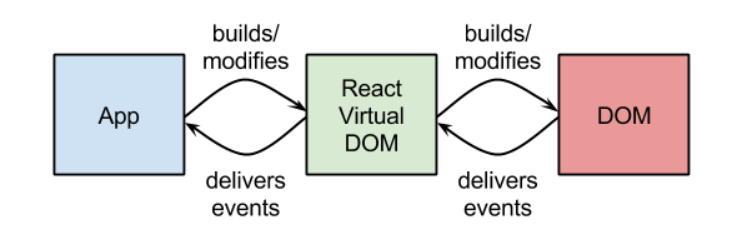
1. Virtual DOM

Using virtual DOM is the best thing in this modern world. It allows you to create an in-memory data structure cache memory and list down the resolutions differences. All thanks to this extension! After that, you can now update the presented browser DOM efficiently.

virtual dom

2. Interactive interfaces

ReactJs gives a chance to its users to manipulate the designing features, which is why key interfaces flow in a more relaxed and faster way. As per your preferences, principles, and tastes, you can develop an interface by hiring top ReactJS App Development Company for your next project. This mainly operates in the following two ways:

  • Loop – Developers can use loop orders to develop representation views in the React frame. However, a loop is offered in both Angular and React; it is much easier to use in the first.
  • Nest view- It allows the developers to control the nested elements within the ReactJS in a natural way.

3. Advanced performance

When you hire ReactJS developers, they reduce the problem of lagging behind other apps that are developed using the same platform. It has the power to automatically update on-page apps that often do not require reloads for redrawing UI. No matter whether your target audience uses a tablet, mobile, or smartphone, they simply won’t face any difficulty in loading a sizeable graphic web page.

4. Easy-to-use

The complexity level of using ReactJS development is one of the first things to mention. As compared to AngularJS, it is more straightforward. It was invented to streamline the process of development, programming, and administration of resources. But, you need to acquire knowledge of JSX and HTML that is a declarative and strict coding style.

5. Alternatives

ReactJS can be used like a rock, which is capable of killing any obstacle. It is an alternative to numerous other libraries, which you boast within the coding process of your web resource. For instance, jQuery, Backbone, and Angular are such additions to JavaScript. All the functions available in these libraries are now available within the ReactJs extension.

6. SEO friendly

The biggest problem with Javascript frameworks is that it does not fit well with search engines. As a result, this reduces the overall search engine ranking, which negatively impacts your web pages or developed apps. But ReactJS can help you get rid of this problem. It gives you a chance to run the application on a server, while the already tinted virtual DOM could signify and come back to the browser as a standard web page.

7. Flexible Development

When ReactJS was launched in the market, many businesses took it for granted. But many enjoyed the automatic upgrade in the maintenance and developmental process of ReactJS. It enables developers to overcome numerous limitations and prohibitions within a coding process while picking up the most seamless and comfortable ways to resolve specific problems and strategies to govern your front-end project.

8. Quick access to developers

As it is one of the most popular frameworks among the developer’s community, many newbie want to learn this programming language. Therefore, finding a ReactJS developer is quite easy; you can also opt for ReactJS application development companies.

Let’s get an idea about the top brands using React.js app development

You would be surprised to know how many companies in today’s competitive market use ReactJS for their business:

  • Netflix
  • Yahoo
  • Facebook
  • Whatsapp
  • Instagram
  • Atlassian
  • The New York Times
  • Khan Academy
  • Groupon

And the list goes on. But as you can see how many big giants are utilizing ReactJS for their business and thriving in the agile market. Due to obvious reasons and as we’ve mentioned, the ideas above for choosing ReactJS makes this framework the most preferred choice across the market.

Learn how our react native development services can assist you in creating a web application using React JS with our comprehensive guide.

Okay! So, how to build an app with ReactJS?

Step 1- Install the ReactJS project

In the visual display unit, type the following command:

  • npm install –g create-react-app
  • create-react-app we-react-app

After installing the project, start the application using the following command:

  • npm start

Step 2- Register a Service worker

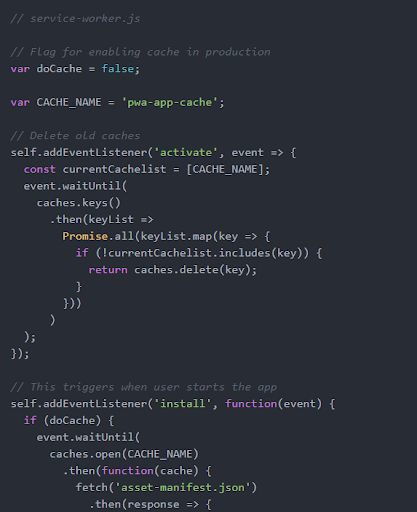
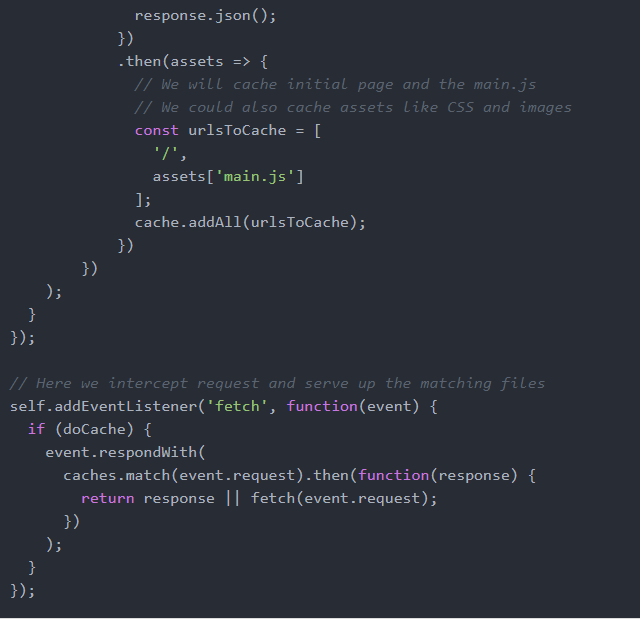
Services worker acts as alternative servers that take a seat between app and network. Utilizing service worker, you need to seize the network requests and serve the cached files. It lets your web page to function even if a system is offline. However, ReactJS is providing one registerWorker.js file inside the src folder. Initially, create a blank service-worker.js file inside the public folder. Add the following code to it:

Register a Service worker

Register a Service worker

Register a Service worker

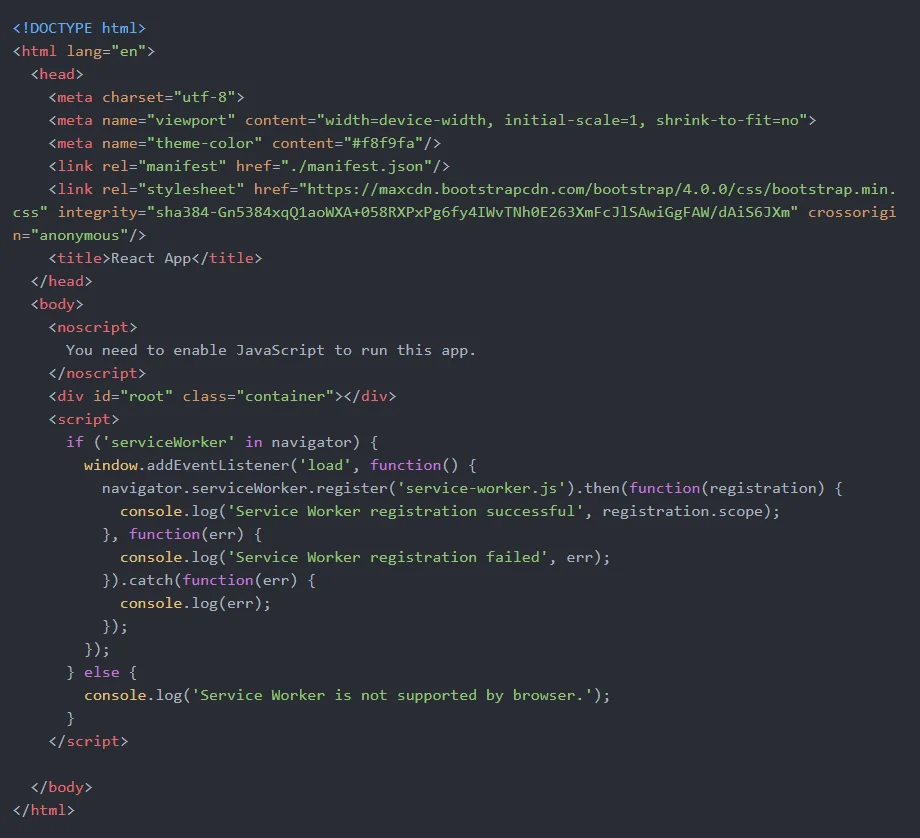
After that, add the following code inside index.html to check whether the browser supports the service-workers file or not.

Once you add code, see your browser’s console panel and find the message like “service worker registration successful.” This means your browser supporting the service worker.

Step 3- Tell the browser it’s a web application

Then, you need to add some code to inform the browser that this, not an ordinary web application; this is the web application. So add the following code inside <head> tag in the index.html file.

  • <meta name= “mobile-web-app-capable” content=”yes”>

The same goes for mobile devices and especially iOS devices.

  • <meta name= “apple-mobile-web-app-capable” content=”yes”>

Step 4: Create some bootstrap react components

To begin, add the bootstrap to the project. You need to use CDN. So add the link inside the index.html file. Besides that, create one component folder inside the src folder.

  • <link rel=”stylesheet” href=”https://maxcdn.bootstrapcdn.com/bootstrap/4.0.0/css/bootstrap.min.css” integrity=”sha384-Gn5384xqQ1aoWXA+058RXPxPg6fy4IWvTNh0E263XmFcJlSAwiGgFAW/dAiS6JXm” crossorigin=”anonymous”>

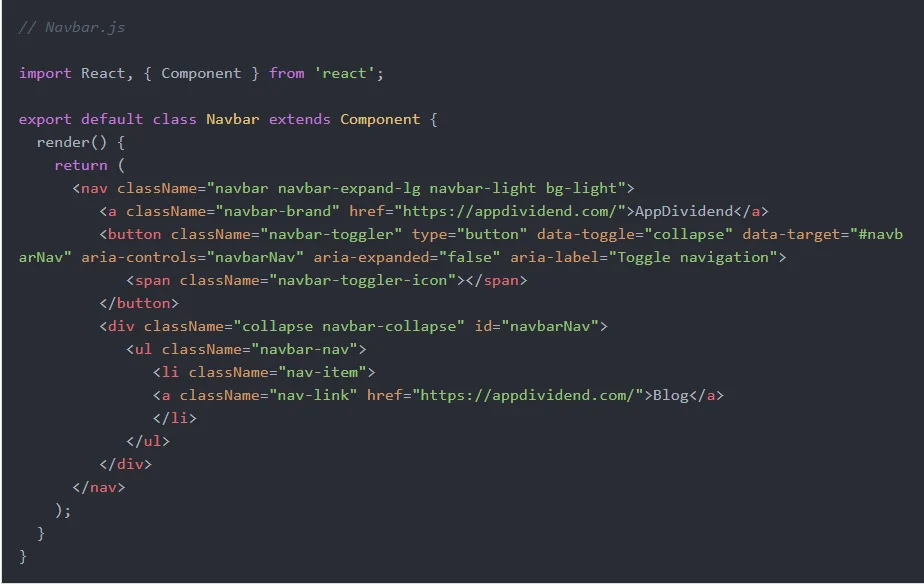
Now create one component called Navbar.js inside parts folder.

Create some bootstrap react components

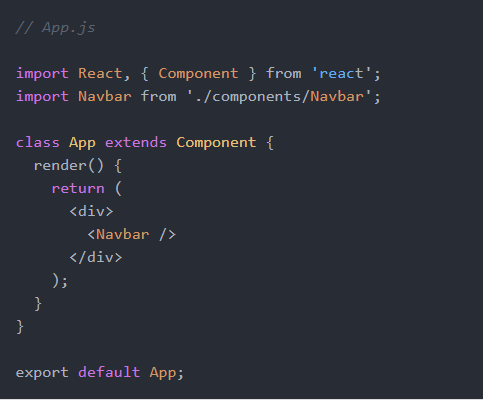
Now add the Navbar.js component inside the App.js file.

Create some bootstrap react components

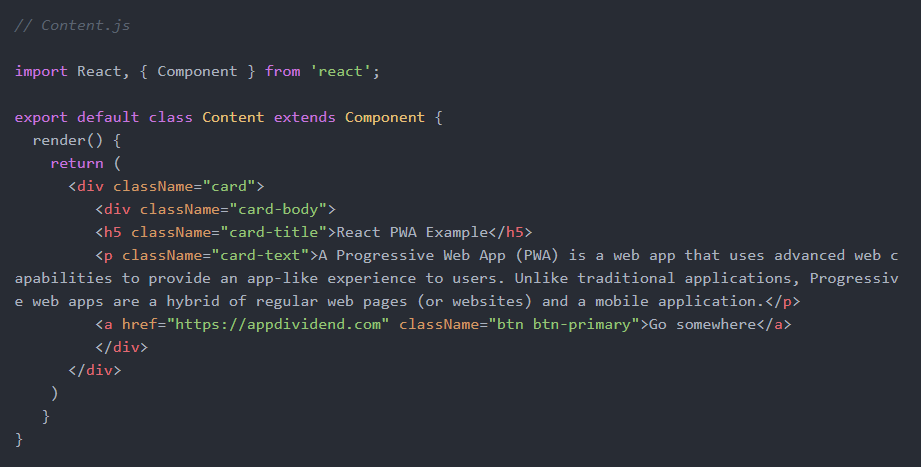
Now create a new component inside components folder called content.js.

Create some bootstrap react components

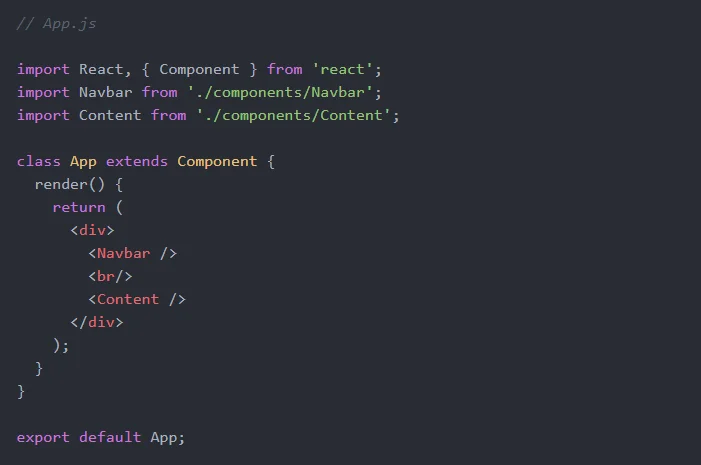
Now also add this component inside the App.js file.

Create some bootstrap react components

So finally, you will create an essential component powered by the web application.

Step 5: Add splash icons

You need to add a 512×512 image to show up the splash screen, and to achieve it update the manifest.json and add the image in the public folder.

Add splash icons

Step 6: Deploy the application in firebase

Throughout the process, we are only missing on HTTP and caching that will be fixed later once the project is deployed. Update the doCache flag to correct in a service-worker.js file. Next, create a new project based in the firebase-console with the name React web application app. Run the following commands in a project directory:

  • npm install –g firebase –tools
  • firebase login
  • firebase init

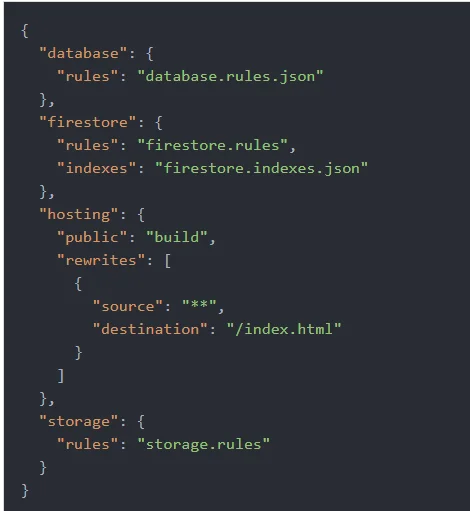
After the initialization of the firebase, your firebase.json file should look like this.

Deploy the application in firebase

Ensure your hosting object look as per the above image. Finally, build the production version of the application:

  • npm run build
  • Deploy the app in the firebase.
  • Firebase deploy
  • Then you can see the application live!

Conclusion

ReactJS is a revolutionary toolkit that enables giant companies to develop robust, scalable, and rich-in-feature web applications. It is allowing businesses to excel in the dynamic market with elegantly designed websites!

Thinking To Hiring The Reactjs App Development Company For Your Next Project?

No need to worry, we’ve got you covered! WeDoWebApps LLC is a leading organization that offers scalable, quick, and efficient ReactJS web application services to businesses worldwide. The company has served 1000+ clients across different countries, and there’s no sign of slowing down. With 10+ years of experience in the development sector, the company has built a fantastic portfolio in the market, which makes it a reliable choice in the agile market.

Do you have a query or requirement regarding the same? Get in touch with the team of experts today, and get a quick consultation. Shoot us your needs to hire react.js app developers at an affordable price model. Contact us now to know more.

Have a great React.js web application idea? WeDoWebApps offers professional web development services to bring your vision to life, leveraging advanced frameworks like React.js.

Things to Keep in Mind While Hiring React Native Developer

How to Hire React Native Developer? – Things you must check out

Here are some of the essential things one must check out while Hiring React Native Developer. With the broad knowledge of all these skills, it will become a simple task for any company or online business owner who is looking for a good developer.

Effective Communication Skills

The developer must be having practical communication skills. There are various occasions where he has to explain about the projects to the subordinates, superiors or peers. In such circumstances, the developer must not hesitate while explaining and must provide exact information to them. Due to this, he will be able to tell you about the project to everyone in a concise manner.

Experience

Having relevant experience in the field increases the versatility with which the developer creates applications. Thus, while looking to Hire React Native developer, he must make sure that the developer has a pleasant experience with the platform. This will make him deliver more qualitative work to the organization or the online business owner.

Quality of the Work

Instead of cost, the organization must enforce the quality of the work. The work quality of the developer must be well. With better quality work, it will become simple for users to understand the app. In this way, the app becomes easy to access, and one can easily avail of the function it provides.

To ensure a successful project, consider partnering with a trusted React Native app development company that can provide the expertise you need.

Timeframe

Finishing the project at the time is an essential requirement. This helps in the better planning of the various other schedules regarding the app. Hence, the developer must be capable of completing the project right at the designated time. This increases the trust of the organization, which in turn increases the credibility of his work. If you’re new to React Native, check out these beginner tips for React Native developers to get started on the right foot.

Understanding of the business

It is of utmost necessity for the React Native developer to have a proper understanding of the business. This will make him deliver the exact business solution as per the client’s requirement. He must be knowing the necessary business rules. Furthermore, better work experience with an organization of repute will be an added advantage.

With our present comprehensive article on Hire React Native Developer, we have given you a list of some of the essential checkouts one must make while hiring a developer for their project. Keeping all these points in mind, one will be able to make a perfect choice about a developer. We hope our compilation will be helpful to you to get a highly skilled developer for your project.

Finding the right React Native developer is crucial for your project’s success. For comprehensive support and expertise, consider our react native development services to ensure your application meets the highest standards.

Benefits of Availing the Services of React Native Development

Offering the users with a long list of versatilities, React Native is providing plenty of advantages. The recent post on React Native Development Company will explain to us the specific benefits of getting the services from these companies. Kindly go through these benefits to make a perfect decision regarding the project.

Benefits of availing the services of React Native Development Company

Before selecting the platform for development, one needs to know about the various other parameters. Below are the various merits of availing the services of React Native Development Company. Proper knowledge of these benefits will help the online business owner select a suitable platform for developing the project.

Rapid Development

Developing any project on the react-native platform involves a simple procedure. With these easy to use steps, creating an app using this platform will become much effortless. Moreover, the development time for developing these apps is much less. Therefore, creating apps in less time is possible with the help of this platform.

Open Source

Another benefit of developing the project with the help of this platform is that it is open-source. Due to this, it will be an easy task for the developers to get various templates, themes, and different other options much more comfortable. Furthermore, online business owners will also be having extensive options available to choose from. Hence, creating highly attractive applications that can quickly meet the online business owner’s requirements will be much simpler.

Reusability of code

One can easily use the codes of one project or platform on this platform. Therefore, it reduces the efforts the developers have to make while coding for the apps. This saves a lot of on development time and makes it extremely comfortable for them to work on the project. Providing similar results across all the platforms is also possible with this.

Native Performance

While developing the project on this platform, one can get native performance. It depicts that using the app as per the convenience of the users as well as accessing its various functions will be pretty much of a simple task.

To dive deeper into the advantages, explore our comprehensive React Native application development services and how they can enhance your project.

Developed by Facebook

Facebook has developed the react-native platform. It is a highly versatile platform with the help of which one can create Android as well as cross-platform applications. Besides that, with the increasing technology, it is also allowing us to create desktop applications. It is a simple task for the developers to develop high-quality applications with the help of this platform.

While developing a project on hire react native developers, the user will get a lot of benefits. In our present blog on React Native Development Company, we have explained the certain advantages one can gain while getting these services. Proper knowledge of all these points will surely encourage you to avail of these services for your project. Additionally, it will also provide a better understanding of the platform in brief.

Understanding the numerous advantages of React Native can significantly impact your development choices. Our react native development services are designed to help you fully leverage these benefits for your projects.

Explore Essential Tips for Hiring Expert Ionic Developers for Your Next App Development Project

Introduction

Ionic is one of the robust frameworks for developing apps, making it a top choice for businesses seeking efficient, high-quality mobile solutions. With the rise in demand for Ionic development services, it has become crucial for companies to understand the best practices for hiring Ionic developers. This comprehensive guide will delve into the essential tips and guidelines for selecting the best Ionic developers, ensuring you make informed decisions that align with your business goals.

Hiring Ionic developers requires a strategic approach to identify professionals who possess the necessary skills, experience, and work ethic to contribute positively to your projects. Given the increasing competition in the tech industry, knowing what to look for and how to evaluate potential candidates can make a significant difference. This blog post will provide actionable insights into the Ionic development hiring process, highlighting the key factors to consider and the best practices to follow.

Understanding Ionic and Its Importance

Before diving into the tips for hiring Ionic developers, it is essential to understand what Ionic is and why it is highly valued. Ionic is a powerful open-source framework used for developing cross-platform mobile applications. It allows developers to create high-performing apps with a single codebase that works seamlessly on iOS, Android, and the web. This efficiency makes it a cost-effective and time-saving solution for businesses.

Why do You Need an Ionic Framework Developer

Ionic Developers are the most invaluable assets in the app development industry as their skills can benefit your business in many ways. How?

Here are some key advantages you must know before you start selecting ionic developers:

1. Cost Reduction and Resource Efficiency

Expert Ionic Developers can significantly minimize resource wastage and lower the overall cost of application development. The Ionic Framework allows for the creation of cross-platform apps using a single codebase, streamlining the development process. Additionally, since Ionic is free and open-source, developers can leverage their expertise without incurring extra expenses.

2. Thorough Application Testing

An experienced Ionic developer can perform comprehensive testing of applications and services using the framework’s built-in commands. This enables them to quickly identify and resolve any bugs before the application reaches the deployment stage, ensuring a smoother launch.

3. Enhanced Brand Awareness and Growth

By utilizing Ionic’s community features, developers can help promote your brand while developing applications. This engagement not only raises awareness of your company but also supports its growth within the community.

4. Development of Dynamic Web Applications

The Ionic Framework supports a diverse range of web technologies and programming languages, empowering developers to create dynamic, high-quality cross-platform applications. They can also adapt and update these applications to meet industry standards, enhancing reliability and performance.
By leveraging these advantages, your organization can benefit from high-quality app development while maximizing efficiency and brand visibility.

Key Tips for Hiring Ionic Developers

1. Identify the Required Ionic Developer Skills

The first step in hiring Ionic developers is to clearly define the Roles and Skills of Ionic Developers you are looking for. An expert Ionic developer should have a strong grasp of HTML, CSS, and JavaScript. They should also be proficient in Angular, as Ionic heavily relies on this framework. Additionally, familiarity with mobile UI/UX principles and experience with tools like Cordova and Capacitor can be advantageous.

2. Evaluate Experience and Portfolio

When you are ready to hire Ionic developers, it’s crucial to assess their experience and portfolio. Look for developers who have a proven track record of building high-quality Ionic apps. Reviewing their previous projects can give you insights into their coding standards, creativity, and problem-solving abilities. Pay attention to the complexity of the apps they have developed and the feedback from their clients.

3. Check for Transparent Development Procedures

A transparent development process is vital for successful project execution. Ensure that the developers follow a clear and open workflow, keeping you informed about the progress at every stage. Regular updates, accessible communication channels, and a collaborative approach can help avoid misunderstandings and ensure the project stays on track.

4. Prioritize Communication Skills

Effective communication is essential when working with remote teams or individual developers. Your Ionic developers should be able to articulate their ideas, understand your requirements, and provide constructive feedback. Regular communication helps in addressing issues promptly and ensures that the development aligns with your vision.

5. Consider the Agile Methodology

Agile methodology is a preferred approach in software development due to its iterative nature and flexibility. Hiring Ionic developers who follow Agile practices can lead to faster delivery times and more adaptive processes. Agile allows for continuous feedback and improvements, ensuring that the final product meets your expectations.

6. Ensure Adherence to NDA and Source Code Authorization

Confidentiality and security are paramount in any development project. Ensure that the developers are willing to sign a Non-Disclosure Agreement (NDA) to protect your project’s details. Additionally, you should have complete control and ownership of the source code to make future modifications or updates without dependency.

7. Flexible Hiring Models

Depending on your project requirements and budget, consider developers who offer flexible hiring models. Whether you need full-time, part-time, or project-based developers, having the flexibility to choose can make the hiring process more convenient and cost-effective.

Guidelines for Selecting the Best Ionic Developers

If you want to know how to hire professional Ionic developers in the USA or globally, the below guidelines for hiring Ionic developers are for you.

1. Conduct Thorough Interviews

An in-depth interview process is crucial to gauge the technical and soft skills of potential developers. Prepare a set of technical questions that cover the core aspects of Ionic development, including frameworks, libraries, and best practices. Additionally, assess their problem-solving skills through coding challenges or real-world scenarios.

2. Look for Cultural Fit

While technical skills are essential, finding developers who align with your company’s culture and values can lead to a more harmonious working relationship. Consider their work ethics, collaboration style, and how well they can integrate with your existing team.

3. Verify References and Testimonials

Request references from previous clients or employers to validate the developers’ claims about their skills and experience. Testimonials and reviews can provide additional insights into their work quality, reliability, and professionalism.

4. Assess Problem-Solving Abilities

Ionic developers often face challenges that require innovative solutions. During the hiring process, assess their ability to troubleshoot and resolve issues efficiently. This can be done through technical tests or by discussing past projects where they had to overcome significant hurdles.

5. Technical Tests and Code Reviews

Practical assessments, such as coding tests or code reviews, are effective ways to evaluate a developer’s competence. These tests should focus on their understanding of Ionic, coding standards, and their ability to write clean, maintainable code.

6. Trial Periods

Consider implementing a trial period or a small initial project to evaluate the developers’ performance in a real-world setting. This allows you to assess their skills, communication, and work ethics before committing to a long-term engagement.

What to Consider When Hiring Ionic Developers

Hiring a skilled Ionic developer to develop your mobile application is very crucial for scaling your business. Therefore, consider the below Important factors in hiring Ionic developers:

1. Project Requirements

Clearly define your project requirements, including the scope, timeline, and budget. This helps in identifying developers who have the specific expertise needed for your project.

2. Technology Stack

Ensure that the developers are proficient in the entire technology stack required for your project. Besides Ionic, they should be familiar with related technologies like Angular, Cordova, and Capacitor.

3. Budget Constraints

Budget is a significant factor in the hiring process. While it is essential to find skilled developers, ensure that their rates align with your budget. Consider developers who offer competitive pricing without compromising on quality.

4. Availability and Time Zone

If you are hiring developers from different regions, consider their availability and time zone differences. Ensure that there are overlapping working hours to facilitate smooth communication and collaboration.

5. Long-Term Maintenance

Hiring Ionic developers is not just about the initial development; it also involves long-term maintenance and updates. Ensure that the developers are willing to provide ongoing support and maintenance services.

Conclusion

Hiring the best Ionic developers requires a strategic and informed approach. By focusing on the essential skills, evaluating experience, ensuring transparent development processes, and considering cultural fit, you can select developers who are well-suited for your projects. Adopting Agile methodology, ensuring NDA compliance, and offering flexible hiring models further enhance the hiring process. Follow these guidelines and Ionic developer tips to build a strong team of professional Ionic developers who can deliver high-quality, efficient mobile applications.


In summary, the process of hiring Ionic developers involves careful consideration of various factors, from technical skills and experience to communication and cultural fit. By adhering to these Ionic developer guidelines, you can ensure that you select the best candidates who can contribute significantly to your project’s success. Whether you are looking to Hire Ionic Developers USA or globally, these tips and best practices will help you navigate the hiring process with confidence and achieve your business objectives.