skip to content

AI Governance Explained: Building Responsible AI Compliance and Policy That Actually Work

Introduction

Organizations are under growing pressure to adopt AI, but many are doing so without a clear plan for managing the risks that come with it. As AI becomes part of customer service, operations, decision-making, and product development, businesses must answer important questions about accountability, data privacy, fairness, security, and regulatory obligations. Without a structured approach, AI can create uncertainty instead of delivering measurable business value.

This is exactly why terms like AI governance, responsible AI, AI compliance, and AI policy have become a priority for business leaders. While they are closely connected, each serves a distinct purpose. Treating them as the same can lead to gaps in oversight, inconsistent processes, and greater exposure to legal, operational, and reputational risks.

An effective AI governance strategy brings these elements together. It defines how AI systems are developed, deployed, monitored, and continuously improved. Responsible AI establishes the ethical principles behind AI adoption. AI compliance ensures alignment with applicable laws and industry regulations. An AI policy translates those principles into practical rules that teams can follow across the organization.

As an AI software development company, we help organizations build production-ready AI solutions with governance integrated from day one. This guide explains the differences between AI governance, responsible AI, AI compliance, and AI policy, why each matters, and how businesses can create a governance framework that supports innovation while maintaining trust, transparency, and compliance.

What Is AI Governance?

As your startup begins integrating AI into products, customer experiences, or internal operations, you’ll likely come across several terms that sound similar. AI governance, responsible AI, AI compliance, and AI policy are often used interchangeably, but they solve different business challenges. Understanding the distinction helps you make better decisions, avoid unnecessary risks, and build AI systems that can scale with confidence. Think of them as four connected layers that work together to keep your AI initiatives aligned with business goals, customer expectations, and regulatory requirements.

AI Governance: The Umbrella System of Oversight

AI governance is the overall system that guides how AI is planned, developed, deployed, monitored, and improved across your organization. It brings together people, processes, technology, and controls to ensure AI is used responsibly and consistently.

For a startup, this means creating clear ownership, defining approval processes, assessing risks before deployment, and monitoring AI performance after launch. Instead of reacting to problems later, AI governance helps you establish the right guardrails from the beginning, making future growth easier and more sustainable.

Responsible AI: The Principles and Values

While AI governance defines how AI is managed, responsible AI defines how AI should behave. It is built on ethical principles such as fairness, transparency, accountability, privacy, and human oversight.

If you’re developing an AI-powered application, responsible AI encourages you to reduce bias in training data, explain important AI decisions, protect user information, and ensure people can intervene when necessary. These principles build trust with customers and investors while supporting long-term product adoption.

AI Compliance: Meeting Legal and Regulatory Obligations

AI compliance focuses on meeting the legal and regulatory requirements that apply to your AI systems. Depending on where your startup operates, this may include privacy laws, industry regulations, or AI-specific legislation.

Compliance is not only about avoiding penalties. It also demonstrates that your AI products meet accepted standards for security, transparency, and responsible data handling. As regulations continue to evolve, building compliance into your development process becomes much easier than adding it after deployment.

AI Policy: The Internal Rules That Operationalize It All

An AI policy turns governance goals and ethical principles into practical rules that your teams follow every day. It explains how AI can be used, what data is allowed, who approves new AI tools, and how outputs should be reviewed before business decisions are made.

Even in an early-stage startup, a simple AI policy creates consistency across teams. As your business grows, it becomes the foundation for onboarding employees, reducing operational risks, and maintaining quality across AI initiatives.

How the Four Concepts Connect

Although each serves a different purpose, they work best as a single system. AI governance provides the overall direction. Responsible AI establishes the guiding principles. AI compliance ensures your AI activities meet external legal obligations. AI policy gives your team clear instructions for putting governance into practice.


ConceptPrimary PurposeFocus
AI GovernanceManages AI across its lifecycleOversight, accountability, risk management
Responsible AIDefines ethical expectationsFairness, transparency, privacy, human oversight
AI ComplianceMeets legal and regulatory requirementsLaws, standards, audits, documentation
AI PolicyGuides day-to-day AI usageInternal rules, employee responsibilities, acceptable use


When these four elements work together, your startup gains more than regulatory readiness. You create a strong foundation for building AI products that customers trust, investors value, and your team can confidently scale.
AI Governance and Compliance for Startups

Why AI Governance Matters Now

AI has moved beyond experimentation. Whether you are building your first AI product or expanding existing capabilities, every new model introduces decisions that can affect your customers, business operations, and regulatory responsibilities. For startups, moving fast is important, but scaling AI without AI governance often creates risks that are far more expensive than the technology itself.

The right governance framework allows you to innovate confidently while maintaining transparency, accountability, and compliance from day one.

Real-World Cost of Ungoverned AI

Recent events have shown that AI failures are rarely caused by technology alone. They often result from weak oversight, unclear ownership, poor data management, or missing governance controls.


ExampleBusiness ImpactGovernance Lesson
AI systems generating inaccurate or misleading contentLoss of customer trust and increased manual reviewsValidate output before production deployment
Employee use of public AI tools with confidential business dataSensitive information exposed outside the organizationCreate clear AI policy guidelines for acceptable AI usage
AI models producing biased hiring or lending recommendationsRegulatory scrutiny and reputational damageApply responsible AI principles throughout model development
AI applications failing new regulatory requirementsDelayed product launches and higher compliance costsBuild AI compliance into development instead of retrofitting later


The pattern is clear. Organizations that introduce governance early spend less time fixing problems and more time delivering business value.

Business Risks Without AI Governance

Ignoring AI governance can affect much more than your technology stack. It can influence customer confidence, investor decisions, and your ability to expand into regulated markets.


Risk AreaWhat It Means for Your Startup
Customer TrustUsers lose confidence when AI decisions appear inaccurate or difficult to explain.
ComplianceNew AI regulations may lead to penalties or operational restrictions.
SecurityWeak controls increase the likelihood of data leaks and unauthorized AI usage.
Brand ReputationOne public AI failure can damage credibility and slow customer acquisition.
Business OperationsPoor governance creates inconsistent AI practices across teams and products.


For startups, these challenges are easier and more affordable to prevent than to resolve after deployment.

Business Benefits of Strong AI Governance

Many founders see governance as a compliance exercise. In reality, it creates a stronger foundation for growth.

When AI governance becomes part of your product strategy, your team can develop, deploy, and scale AI with greater confidence.


BenefitBusiness Outcome
Faster AI AdoptionStandardized processes reduce delays and simplify decision-making.
Greater stakeholder trustCustomers, investors, and enterprise clients gain confidence in your AI practices.
Improved regulatory readinessCompliance becomes an ongoing process rather than a last-minute task.
Better operational consistencyTeams follow the same AI policy and governance standards across projects.
Long-term competitive advantageResponsible AI practices strengthen your brand and support sustainable growth.


As your AI initiatives expand, governance becomes an enabler rather than a barrier. Instead of slowing innovation, it gives your startup the confidence to build reliable AI solutions, enter regulated industries, and scale with fewer operational risks.

Our digital transformation services help startups integrate AI governance, responsible AI, and AI compliance into broader business transformation initiatives, ensuring AI supports your long-term growth instead of creating avoidable risks.

Core Principles of Responsible AI

Building an AI solution is only part of the journey. The real challenge is ensuring it behaves consistently, makes fair decisions, protects user data, and remains accountable as it evolves. This is where responsible AI becomes an essential part of your AI governance strategy.

For startups, adopting these principles early helps reduce future risks, strengthens customer confidence, and makes it easier to meet growing AI compliance requirements. Rather than treating ethics as a separate initiative, consider these principles as the standards that guide every stage of your AI lifecycle.

Fairness and Bias Mitigation

AI systems should deliver outcomes that are fair and unbiased for all users. Bias can enter through training data, model design, or deployment practices, leading to inaccurate or discriminatory results.

To reduce these risks, you should:

  • Use diverse and representative datasets.
  • Test models across different user groups.
  • Regularly monitor outputs for unintended bias.
  • Retrace and improve models when fairness issues appear.

Building fairness into development helps create products that users can trust.

Transparency and Explainability

People should understand when they are interacting with AI and how important decisions are made. While every technical detail does not need to be exposed, users deserve clear explanations for AI-generated outcomes that affect them.

Good transparency practices include:

  • Inform users when AI is being used.
  • Explain how AI supports business decisions.
  • Document model limitations and intended use.
  • Maintain clear records for audits and reviews.

Transparency supports both customer trust and stronger AI governance.

Accountability

Every AI system should have clear ownership. When responsibilities are undefined, it becomes difficult to resolve issues, manage risks, or demonstrate compliance.

Your startup should identify who is responsible for:

  • Approving AI models before deployment.
  • Monitoring AI performance.
  • Managing incidents and corrective actions.
  • Reviewing governance and policy updates.

Accountability ensures AI decisions remain aligned with business objectives.

Privacy and Data Protection

AI relies on data, making privacy one of the most important components of responsible AI. Customers expect their information to be collected, stored, and processed responsibly.

To strengthen privacy practices:

  • Collect only the data you need.
  • Protect sensitive information with appropriate security controls.
  • Follow applicable privacy regulations.
  • Define data retention and deletion policies.

Strong privacy practices also support long-term AI compliance.

Safety, Security, and Resilience

AI systems should remain reliable even when facing unexpected inputs or security threats. Weak security controls can expose sensitive data, disrupt operations, or create opportunities for malicious use.

Your governance framework should include:

  • Security testing before deployment.
  • Continuous monitoring for abnormal behavior.
  • Protection against prompt injection and adversarial attacks.
  • Regular updates to address emerging threats.

A secure AI environment reduces operational risks while improving system reliability.

Human Oversight

AI should support human decision-making, not replace it entirely. Certain business decisions require human judgment, especially when they involve legal, financial, or ethical considerations.

Human oversight can include:

  • Reviewing high-risk AI decisions.
  • Allowing users to challenge AI outcomes.
  • Defining escalation procedures for uncertain results.
  • Periodically evaluating model performance and business impact.

Keeping people involved where it matters most helps your startup balance automation with accountability. It also strengthens your overall AI governance framework as your AI capabilities continue to grow.

The AI Compliance Landscape: Global Regulations You Need to Know

As AI adoption accelerates, governments are introducing regulations that define how AI systems should be developed, deployed, and monitored. If your startup plans to serve customers across multiple regions, AI compliance should become part of your product strategy from the beginning rather than an afterthought.

The regulatory environment is still evolving, but one trend is clear. Organizations are expected to demonstrate transparency, manage AI risks, protect personal data, and maintain accountability throughout the AI lifecycle. Understanding the major frameworks can help you prepare for current obligations while building an AI governance framework that remains adaptable as new rules emerge.

European Union AI Act

The EU AI Act is the world’s first comprehensive AI regulation. It classifies AI systems based on their level of risk and applies stricter obligations to systems that could significantly affect people’s rights or safety.


Risk CategoryWhat It Means
Unacceptable RiskCertain AI applications are prohibited because they pose unacceptable risks.
High RiskAI systems must meet strict requirements for risk management, documentation, human oversight, and transparency.
Limited RiskUsers must be informed when interacting with AI in specific situations.
Minimal RiskMost everyday AI applications have limited regulatory obligations but should still follow good governance practices.


If your startup targets European customers, understanding these classifications early can reduce future compliance challenges.

United States: A Sector-Based Approach

Unlike the European Union, the United States does not have a single federal AI law. Instead, AI regulation combines state legislation, industry-specific requirements, and voluntary governance frameworks.

One of the most widely adopted resources is the NIST AI Risk Management Framework (AI RMF), which helps organizations identify, assess, manage, and monitor AI-related risks. Alongside this framework, industries such as healthcare, finance, and insurance often follow additional regulatory requirements based on the type of data they process.

For startups, adopting the NIST framework is often a practical way to establish stronger AI governance before mandatory regulations expand.

OECD AI Principles

The OECD AI Principles provide internationally recognized guidance for developing trustworthy AI. Although they are not legally binding, many governments and organizations use them as the foundation for national AI strategies.

The principles encourage organizations to:

  • Build AI that benefits people and society.
  • Respect human rights and democratic values.
  • Maintain transparency and accountability.
  • Protect privacy and security.
  • Continuously monitor AI systems throughout their lifecycle.

These recommendations align closely with responsible AI practices and can strengthen your governance framework.

China’s AI Regulations

China has introduced several AI-specific regulations covering recommendation algorithms, generative AI services, and deep synthesis technologies. These rules place significant emphasis on security, content management, transparency, and government oversight.

Organizations operating in or expanding into the Chinese market should carefully review local regulatory requirements before deploying AI-powered products.

India’s Digital Personal Data Protection Act

India’s Digital Personal Data Protection Act (DPDPA) focuses on how organizations collect, process, store, and protect personal data. While it is primarily a privacy law rather than an AI regulation, it has a direct impact on AI systems that rely on personal information.

For startups developing AI products in India, compliance includes:

  • Collecting personal data for lawful purposes.
  • Obtaining valid user consent where required.
  • Protecting sensitive information through appropriate safeguards.
  • Supporting user rights related to their personal data.

Strong data governance today will make future AI-specific compliance much easier.

Building an AI Compliance Roadmap Across Jurisdictions

Meeting AI compliance requirements becomes more manageable when governance is built into your development process rather than added after deployment.
A practical roadmap for startups includes:


StepRecommended Action
IdentifyDetermine which countries and regulations apply to your AI solution.
ClassifyAssess AI systems based on risk, data sensitivity, and intended use.
DocumentMaintain records of datasets, models, testing, and governance decisions.
ImplementEstablish an AI policy, security controls, and human oversight processes.
MonitorContinuously review regulations and update governance practices as requirements evolve.


No single regulation applies everywhere, but a strong AI governance framework allows your startup to adapt more efficiently as global AI laws continue to develop. By combining responsible AI, effective documentation, and ongoing compliance monitoring, you can enter new markets with greater confidence while reducing regulatory and operational risks.

How to Write an Effective AI Policy

Many startups begin using AI before defining how it should be used internally. Teams adopt AI tools for coding, content creation, customer support, or data analysis without consistent guidelines. While this may speed up experimentation, it can also introduce security risks, inconsistent practices, and compliance gaps. A well-written AI policy creates clear expectations for everyone in your organization and turns your AI governance strategy into everyday practice.

An effective policy should be practical, easy to understand, and flexible enough to evolve as your AI capabilities grow.

What Should an AI Policy Include?

An AI policy should provide clear guidance without becoming overly restrictive. It should explain what employees can do, what requires approval, and how AI systems should be managed throughout their lifecycle.


Policy AreaWhat to Include
Acceptable AI UsageDefine approved AI tools, business use cases, and restricted activities.
Data HandlingSpecify what data can be shared with AI systems and what must remain protected.
Model ValidationEstablish testing requirements before deploying AI models into production.
Human ReviewIdentify situations where AI-generated outputs require human review.
Security RequirementsDefine access controls, authentication, and monitoring practices.
Compliance ExpectationsAlign AI usage with legal, privacy, and industry-specific requirements.
Monitoring and ReportingExplain how AI performance, incidents, and policy violations should be reported.


Your policy should answer a simple question for every employee: What is the right way to use AI in our organization?

AI Policy vs. AI Framework vs. AI Governance

These terms are often confused, yet each serves a different purpose within an organization.


TermPurposeScope
AI GovernanceDirects how AI is managed across industries.Organization-wide oversight, accountability, and risk management.
AI PolicyDefines the rules employees and teams must follow.Daily operations and AI usage.
AI Governance FrameworkProvides the structure for implementing governance.Processes, roles, controls, and monitoring activities.


AI Policy Checklist: Where to Start

You do not need a lengthy document to create an effective AI policy. Even an early-stage startup can establish a strong foundation by covering the essentials.

  • Define the business objectives for using AI.
  • List approved AI tools and prohibited applications.
  • Create guidelines for handling confidential and customer data.
  • Establish testing and validation requirements before deployment.
  • Identify when human review is mandatory.
  • Assign ownership for policy management and approvals.
  • Document incident reporting and escalation procedures.
  • Review the policy regularly as AI technologies and regulations evolve.

A clear AI policy helps your startup scale AI responsibly. As your team grows and your products become more sophisticated, these guidelines reduce confusion, improve consistency, and support stronger AI compliance without slowing innovation. Most importantly, they ensure your AI governance strategy is reflected in everyday decisions rather than remaining a document that sits unused.

Building an AI Governance Framework: Step-by-Step

A successful AI governance framework is not built overnight. It develops through a series of practical steps that align your AI initiatives with business goals, regulatory requirements, and operational processes. For startups, starting early is an advantage. You can establish governance before AI systems become difficult to manage, helping your team scale confidently as your products and customer base grow.

The following framework provides a practical roadmap that you can adapt as your AI capabilities mature.

Step 1: Inventory and Classify Your AI Systems by Risk

Before creating policies or implementing controls, identify every AI system your organization uses or plans to develop. This includes customer-facing applications, internal automation tools, third-party AI services, and generative AI platforms.

Once identified, classify each system according to its potential business impact.


Risk LevelTypical AI ApplicationsGovernance Priority
Low RiskInternal productivity tools, document summarization.Basic monitoring and usage guidelines.
Medium RiskCustomer support chatbots, marketing automation.Regular testing, human review, documented processes.
High RiskHealthcare, finance, recruitment, legal decision support.Strict governance, continuous monitoring, compliance reviews.


Risk classification allows you to focus governance efforts where they matter most instead of applying identical controls to every AI system.

Step 2: Build an AI Governance Team

Governance should never depend on one department alone. As your startup grows, different teams contribute unique expertise that helps manage AI responsibly.

A practical governance team often includes:


RolePrimary Responsibility
LeadershipDefine AI strategy and business objectives
Product TeamEnsure AI supports customer and business needs
EngineeringDevelop, deploy, and maintain AI systems
Security & ComplianceAddress privacy, security, and regulatory requirements
Legal AdvisorsInterpret applicable laws and contractual obligations


For early-stage startups, one person may perform multiple responsibilities. The important part is ensuring every governance function has clear ownership.

Step 3: Create Policies and Ethical Guidelines

Once responsibilities are established, document how AI should be developed and used throughout your organization.

Your governance documentation should cover:

  • AI usage standards.
  • Data management practices.
  • Model testing requirements.
  • Human oversight procedures.
  • Incident reporting processes.
  • Security expectations.
  • Compliance responsibilities.

Clear documentation ensures every team follows the same standards while reducing operational inconsistencies.

Step 4: Implement Governance Tools and Automation

Manual governance becomes increasingly difficult as AI adoption expands. Introducing governance tools early allows your startup to monitor AI systems efficiently without slowing product development. For organizations managing models across production environments, MLOps consulting services can help establish automated workflows for model deployment, monitoring, lifecycle management, and governance.

Examples include:


Governance ActivitySupporting Technology
Model monitoringPerformance and drift detection platforms
Access managementIdentity and permission controls
Audit loggingAutomated activity tracking
Risk assessmentsAI governance and compliance platforms
DocumentationCentralized governance repositories


As part of our AI development services, we help startups integrate governance controls directly into the AI development lifecycle. This approach makes AI governance, AI compliance, and responsible AI part of the engineering process instead of treating them as separate activities after deployment.

Step 5: Monitor, Audit, and Continuously Improve

Governance does not end when an AI solution goes live. AI models evolve, regulations change, and business priorities shift over time. Continuous monitoring helps ensure your governance framework remains effective.

Establish regular reviews to evaluate:

  • AI model performance.
  • Bias and fairness metrics.
  • Security vulnerabilities.
  • Compliance with new regulations.
  • Customer feedback and reported issues.
  • Policy effectiveness.

Every review provides an opportunity to strengthen your governance framework and improve future AI deployments.

Many successful organizations treat governance as an ongoing improvement cycle rather than a one-time project. This mindset allows your startup to respond quickly to changing technologies while maintaining customer trust and regulatory readiness.

One example is a recent custom software project, where governance practices such as role-based access, AI output validation, and continuous monitoring were incorporated during development instead of after deployment. Building governance into the solution from the beginning reduced operational risks and created a stronger foundation for future AI expansion.
 

Turn AI Governance Into Scalable Solutions


Key Roles and Stakeholders in AI Governance

An effective AI governance framework depends on more than policies and technology. It requires clear ownership across your organization. When responsibilities are well defined, decisions become faster, risks are managed more effectively, and every team understands its role in developing and using AI responsibly.

For startups, this does not mean hiring an entirely new governance team. In many cases, the same people who build and manage your products can also take ownership of governance responsibilities. As your business grows, these roles can expand into dedicated functions.

Executive Sponsors

Every governance initiative needs leadership support. Depending on your organization’s size, this responsibility may belong to the CEO, CTO, Chief AI Officer, or another executive responsible for technology strategy.

Executive sponsors should:

  • Define the organization’s AI vision and governance objectives.
  • Approve governance policies and investment decisions.
  • Balance innovation with business and regulatory risks.
  • Promote a culture of responsible AI adoption.

Leadership involvement ensures AI governance becomes a business priority rather than only a technical initiative.

Legal and Compliance Teams

As AI regulations continue to evolve, legal and compliance professionals help ensure your AI initiatives align with applicable laws and contractual obligations.

Their responsibilities typically include:


ResponsibilityBusiness Value
Reviewing regulatory requirementsReduce legal and compliance risks
Supporting AI policy developmentCreates consistent governance
Assessing contractual obligationsProtects customer and partner interests
Monitoring regulatory updatesKeeps governance frameworks current


Even if your startup does not have an internal legal team, seeking legal guidance during major AI projects can prevent costly issues later.

Data Scientists and AI Engineers

Data scientists and engineers are responsible for translating governance principles into technical implementation. Their work directly influences the reliability, security, and performance of AI systems.

Key responsibilities include:

  • Selecting high-quality training data.
  • Testing models for bias and accuracy.
  • Implementing explainability and monitoring features.
  • Documenting model development and validation.
  • Maintaining AI systems after deployment.

Embedding responsible AI practices during development makes governance significantly more effective.

Risk and Audit Functions

Governance requires continuous oversight. Risk management and audit activities help identify weaknesses before they become business problems.

Typical responsibilities include:

  • Reviewing AI risks regularly.
  • Evaluating governance controls.
  • Monitoring policy compliance.
  • Supporting internal and external audits.
  • Recommending governance improvements.

For startups, these responsibilities are often shared between leadership, engineering, and compliance teams until dedicated governance resources become necessary.

Business Unit Owners and End Users

AI governance is not limited to technical teams. Product managers, operations teams, customer support professionals, and business users all influence how AI performs in real-world environments.

They contribute by:

  • Reporting inaccurate or unexpected AI outputs.
  • Identifying operational risks.
  • Providing customer feedback.
  • Following established AI policy guidelines.
  • Helping improve AI performance over time.

Their day-to-day experience provides valuable insights that technical teams may not immediately recognize.

Bringing Every Stakeholder Together

Strong AI governance works best when every stakeholder understands both their responsibilities and how their decisions affect the broader AI lifecycle.


StakeholderPrimary Focus
Executive LeadershipStrategy, investment, accountability
Legal & ComplianceRegulations, policies, legal obligations
Data Scientists & EngineersModel development, testing, monitoring
Risk & Audit TeamsRisk assessment, governance reviews
Business Teams & End UsersResponsible AI usage, feedback, continuous improvement


When governance becomes a shared responsibility instead of a single team’s task, your startup can introduce new AI capabilities with greater confidence, maintain stronger AI compliance, and build products that customers trust over the long term.

Governing AI in the Age of Generative and Agentic AI

Generative AI has changed how startups build products, automate workflows, and interact with customers. More recently, agentic AI has taken this a step further by enabling AI systems to plan tasks, make decisions, and execute actions with minimal human intervention. While these capabilities create new business opportunities, they also introduce risks that traditional AI governance frameworks were not originally designed to address.

If your startup is building AI assistants, integrating large language models, or working with an AI agent development company to deploy autonomous AI agents, your governance strategy must evolve alongside the technology. It is no longer enough to focus only on model accuracy. You also need controls that manage how AI accesses information, makes decisions, and interacts with business systems.

New Risks Introduced by Generative and Agentic AI

Unlike traditional AI models, generative and agentic AI systems produce dynamic outputs that can change with every interaction. This flexibility improves user experiences, but it also increases uncertainty.


RiskWhy It Matters
HallucinationsAI may generate incorrect information that appears accurate and reliable.
Prompt InjectionMalicious prompts can manipulate AI systems into ignoring intended instructions.
Data LeakageSensitive business or customer information may be exposed through AI interactions.
Intellectual Property RisksAI-generated content may unintentionally reproduce copyrighted material.
Autonomous Decision ErrorsAI agents may complete actions that conflict with business rules or user expectations.


Identifying these risks early allows your startup to build stronger governance controls before AI systems reach production.

Build Guardrails Before You Scale

Every AI application should operate within clearly defined boundaries. Governance guardrails reduce the likelihood of unexpected behavior while allowing AI to remain useful and productive.

Effective guardrails often include:

  • Restricting AI access to approved data sources.
  • Validating AI-generated responses before critical actions.
  • Applying content moderation and safety filters.
  • Using Retrieval Augmented Generation (RAG) to improve factual accuracy.
  • Logging AI interactions for monitoring and audits.

These controls improve reliability without limiting innovation.

As part of our AI integration services, we help startups connect AI models with enterprise systems while implementing governance controls such as secure data access, grounding techniques, and continuous monitoring. This ensures AI becomes a trusted part of your business rather than an unmanaged risk.

Governing Autonomous AI Agents

Agentic AI introduces a new governance challenge because these systems can perform multiple actions independently. Instead of responding to a single prompt, they may access applications, retrieve data, make decisions, and complete workflows.

To maintain control, every AI agent should operate within predefined boundaries.


Governance ControlPurpose
Role-Based PermissionsLimit what the AI agent can access or modify.
Execution BoundariesPrevent unauthorized or high-risk actions.
Human Approval CheckpointsRequire manual review for sensitive decisions.
Activity LoggingRecord every action performed by the AI agent.
Fallback MechanismsAllow humans to intervene when unexpected behavior occurs.


These controls help ensure autonomous AI remains aligned with business objectives.

Using AI to Govern AI

As AI ecosystems become more complex, organizations are increasingly using AI to strengthen governance itself. Intelligent monitoring tools can detect unusual model behavior, identify compliance risks, and alert teams before issues affect customers.

Examples include:


AI-Powered Governance CapabilityBusiness Benefit
Automated risk scoringPrioritize high-risk AI systems for review.
Continuous model monitoringDetects performance drift and unusual outputs.
Compliance monitoringIdentifies potential policy or regulatory violations.
AI output evaluationMeasures response quality and consistency.
Security analyticsDetects suspicious activity and potential attacks.


This does not replace human oversight. Instead, it gives your team better visibility into how AI systems perform at scale.

As generative and agentic AI continue to evolve, AI governance must become more proactive. Startups that establish strong guardrails, clear accountability, and continuous monitoring today will be better positioned to build reliable AI products, meet future AI compliance requirements, and earn long-term customer trust.
 

Build Trusted AI With AI Governance

Common AI Governance Challenges (and How to Solve Them)

Implementing AI governance is not simply about creating policies or selecting the right tools. As your startup grows, new AI models, changing regulations, and evolving customer expectations can make governance increasingly complex. The good news is that most challenges are predictable. With the right approach, you can address them before they slow innovation or expose your business to unnecessary risk.

Balancing Innovation with Regulation

Startups thrive on speed. Teams want to experiment, release new features, and respond quickly to market demands. However, moving too fast without governance can create compliance issues, security gaps, and inconsistent AI practices.

The goal is not to limit innovation. It is to create a framework where innovation happens responsibly.


ChallengePractical Solution
Rapid AI adoption across teamsEstablish clear governance processes before scaling AI initiatives.
Inconsistent AI development practicesStandardize documentation, testing, and approval workflows.
Delayed product releases due to complianceIntegrate AI compliance checks into the development lifecycle.


When governance becomes part of development rather than a final review, your team can move faster with greater confidence.

Lack of Global Standardization

AI regulations are developing at different speeds around the world. A startup serving customers in multiple countries may need to comply with several legal frameworks at the same time.

Instead of creating separate governance processes for every market, build a framework around widely accepted principles such as transparency, accountability, privacy, and risk management. This approach makes it easier to adapt as new regulations emerge.


Common ChallengeGovernance Approach
Different regional AI regulationsBuild governance around globally recognized best practices.
Expanding into new marketsReview local requirements before product launch.
Frequent regulatory updatesSchedule regular governance and policy reviews.


A flexible governance framework reduces future compliance efforts as your business grows internationally.

Resource and Skills Gaps

Many startups do not have dedicated AI governance specialists, compliance officers, or AI ethics teams. Governance responsibilities are often shared between founders, product managers, engineers, and security professionals.

Rather than waiting until your team grows, start with practical governance processes that fit your current stage.

You can strengthen your governance capabilities by:

  • Assigning clear ownership for AI decisions.
  • Training employees on your AI policy.
  • Documenting AI development and deployment processes.
  • Using governance tools to automate routine monitoring.
  • Working with experienced AI partners when specialized expertise is required.

If your team needs guidance, our AI consulting services help startups establish practical AI governance frameworks, identify compliance requirements, and implement responsible AI practices without adding unnecessary complexity.

Keeping Pace with Evolving Regulation

AI regulation continues to change as governments respond to new technologies and emerging risks. What meets compliance expectations today may require updates tomorrow.

Staying prepared requires governance that evolves alongside your business.


Best PracticeWhy It Matters
Review governance policies regularlyKeeps documentation aligned with new regulations.
Monitor regulatory developmentsIdentify changes before they affect your products.
Conduct periodic AI risk assessmentsDetects governance gaps as AI systems evolve.
Update employee trainingEnsures teams follow current governance practices.


Organizations that treat AI governance as an ongoing business function are better equipped to respond to regulatory changes without disrupting product development.

Every startup faces governance challenges as AI adoption grows. The difference lies in how early those challenges are addressed. By establishing clear processes, assigning ownership, and continuously improving your governance framework, you can reduce risk while creating a stronger foundation for responsible and scalable AI adoption.

AI Governance Best Practices Checklist

By now, you’ve seen that effective AI governance is not built around a single policy or regulation. It is the result of consistent processes, defined responsibilities, and continuous oversight. Whether you’re introducing your first AI feature or managing multiple AI products, following proven best practices can help you reduce risk while keeping innovation on track.

Use this checklist to evaluate whether your startup is building AI on a strong governance foundation.

  • Create a documented AI governance framework.
  • Develop a company-wide AI policy.
  • Classify AI systems based on risk.
  • Apply responsible AI principles throughout development.
  • Integrate AI compliance into development workflows.
  • Validate AI models before deployment.
  • Protect sensitive data with strong security controls.
  • Keep humans involved in high-impact decisions.
  • Continuously monitor AI performance after launch.
  • Maintain audit logs and governance documentation.
  • Review governance policies regularly.
  • Train teams on responsible AI practices.

A Quick Self-Assessment

If you answer “No” to several of the questions below, your governance framework may need further attention.

  • Do you know every AI system currently used across your organization?
  • Does your startup have a documented AI policy?
  • Are AI models reviewed before deployment?
  • Can you explain how your AI systems make important decisions?
  • Are governance responsibilities clearly assigned?
  • Is your business prepared for changing AI compliance requirements?
  • Do you regularly monitor AI performance after deployment?

The more “Yes” answers you have, the stronger your AI governance maturity is likely to be. If several areas still need improvement, now is the right time to strengthen your governance processes before your AI ecosystem becomes more complex. A solid governance foundation today will help your startup scale AI more confidently, maintain customer trust, and adapt to future regulations with fewer operational challenges.

The Future of AI Governance

AI governance will continue to evolve alongside AI itself. As models become more capable and autonomous, businesses will need equally adaptable governance frameworks. The focus is shifting from simply controlling AI risks to creating systems that can support continuous innovation while maintaining accountability, transparency, and compliance.

For startups, this presents both a challenge and an opportunity. Those that establish governance early will find it easier to adopt emerging AI technologies, expand into regulated industries, and build long-term trust with customers and investors.

What Will Shape the Next Generation of AI Governance?

Several trends are expected to influence how organizations govern AI over the coming years.


Emerging TrendWhat It Means for Your Business
Greater Regulatory AlignmentMore countries are expected to introduce AI laws that share common governance principles, making international compliance more structured.
AI-Powered GovernanceOrganizations will increasingly use AI to monitor models, identify risks, and automate compliance activities.
Stronger Oversight for Agentic AIAutonomous AI agents will require stricter controls around permissions, decision-making, and human intervention.
Industry-Specific Governance StandardsHealthcare, finance, education, and other sectors will continue developing specialized AI governance requirements.
Governance by DesignBusinesses will integrate governance into product development rather than adding controls after deployment.


Preparing Your Startup for What’s Next

The future of AI governance is not about predicting every regulation or technology shift. It is about building a flexible framework that can adapt as your business grows.

To stay prepared, your startup should:

  • Review governance processes regularly.
  • Update your AI policy as technologies and regulations evolve.
  • Monitor AI systems throughout their lifecycle.
  • Invest in employee awareness and governance training.
  • Treat responsible AI and AI compliance as ongoing business priorities.

Organizations that take this approach are better positioned to adopt new AI capabilities without disrupting operations or increasing unnecessary risk.

As AI becomes a core part of business strategy, governance will become a competitive differentiator rather than just a compliance requirement. Startups that combine innovation with clear oversight will be able to scale more confidently, respond faster to regulatory changes, and build AI solutions that customers, partners, and investors trust.

Conclusion

AI is creating new opportunities for startups to build smarter products, automate operations, and deliver better customer experiences. However, long-term success depends on more than adopting the latest AI technology. It also requires a clear strategy for managing how AI is developed, deployed, and monitored as your business grows.

A strong AI governance framework brings together responsible AI, AI compliance, and a well-defined AI policy to create a reliable foundation for innovation. Instead of treating governance as a regulatory obligation, successful startups use it to reduce risk, strengthen customer trust, improve operational consistency, and prepare for changing legal requirements.

Whether you’re launching your first AI-powered application or expanding AI across multiple business functions, building governance into your development process from the beginning will save time, reduce future challenges, and support sustainable growth. The earlier you establish the right framework, the easier it becomes to scale AI with confidence while maintaining transparency, accountability, and compliance.
 

Secure Scalable AI Solutions for Business

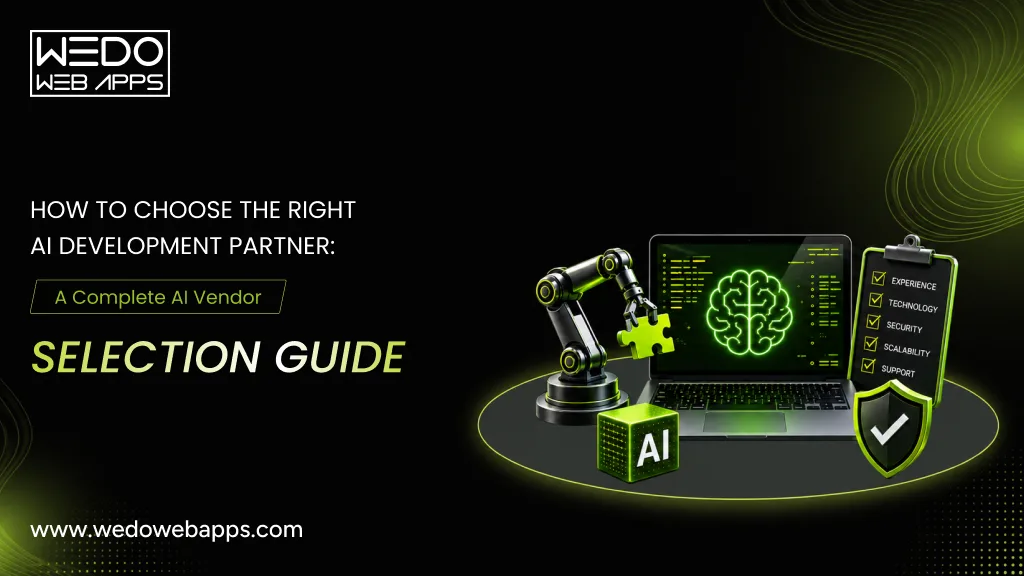
How to Choose the Right AI Development Partner: A Complete AI Vendor Selection Guide

Introduction

Finding an AI vendor is easy.

Finding one that can turn your investment into measurable business results is much harder.

Many businesses start their search with a list of promising vendors, polished presentations, and impressive technology claims. Yet, projects still miss deadlines, exceed budgets, struggle with adoption, or fail to deliver the expected ROI.

The problem is rarely the idea behind the project.

More often, it comes down to choosing the wrong AI software development company.

When evaluating a vendor, technical expertise is only one part of the equation. You also need a partner who understands your industry, aligns with your business objectives, manages data effectively, and can support your solution long after deployment.

That is where AI vendor selection becomes challenging.

The market is filled with AI software companies, consulting firms, and AI outsourcing providers that offer similar services on the surface. Without a structured evaluation process, it can be difficult to determine which partner is equipped to solve your specific business challenges.

Whether you are planning your first AI initiative or expanding existing capabilities, the decision you make today can influence project success, operational efficiency, customer experience, and long-term growth.

This guide will walk you through how to choose an AI development partner, what factors to evaluate during the AI vendor selection process, how to compare AI outsourcing with in-house development, and what separates leading AI software companies from the rest.

Why Choosing the Right AI Development Partner Matters

Selecting an AI development partner is not simply a technology decision. It is a business decision that can affect project timelines, operational efficiency, customer experience, and return on investment.

The difference between the right and wrong partner often becomes visible only after development begins. By then, switching vendors can be expensive and time-consuming.


AreaWorking With the Right AI PartnerWorking With the Wrong AI Partner
Project OutcomesSolutions align with business goals.Solutions solve technical problems but miss business objectives.
Delivery TimelineClear planning and predictable execution.Frequent delays and scope changes.
AI PerformanceModels are trained, tested, and optimized properly.Poor accuracy and unreliable results.
ScalabilitySystems support future growth.Rework is needed as requirements expand.
Long-Term SupportContinuous monitoring and improvement.Limited support after deployment.
ROIMeasurable business impact.Uncertain value from the investment.


The Business Impact of the Right AI Partner

A strong AI software company focuses on outcomes, not just deliverables.

For example, if your goal is to reduce customer support costs, the right partner will measure success through metrics such as resolution rates, response times, and operational savings. They will connect the AI solution to a business objective instead of simply deploying a chatbot and moving on.

This approach helps you gain value from AI faster while reducing the risk of wasted investment.

Risks of Selecting the Wrong AI Vendor

Many AI projects struggle because the vendor lacks experience with the client’s industry, data environment, or long-term goals.

Common consequences include:

  • Delayed project delivery
  • Budget overruns
  • Poor model performance
  • Data security concerns
  • Low user adoption
  • Expensive redevelopment efforts

These issues can impact more than a single project. They can reduce confidence in future AI initiatives across your organization.

What Sets Top AI Software Companies Apart

When evaluating AI vendor selection options, look beyond technical capabilities.

Leading providers typically share several characteristics:

  • They start with business objectives before discussing technology.
  • They have proven experience across multiple AI use cases.
  • They follow a structured development and deployment process.
  • They provide ongoing optimization and support.
  • They can demonstrate measurable results through case studies and client success stories.

The best partners act as advisors throughout the engagement. Their goal is not only to build an AI solution but also to help you create lasting business value from it.

If your organization is still defining its AI roadmap, working with experienced AI consulting services can help clarify opportunities, risks, and implementation priorities before development begins.


AI Strategy and Business Solutions Partner


Define Your AI Requirements Before Evaluating Vendors

Many businesses begin the AI vendor selection process by comparing providers, reviewing proposals, and scheduling discovery calls.

The challenge is that even the most experienced vendor cannot recommend the right solution if your objectives are unclear.

Before approaching an AI development partner, take time to define what you want to achieve, what resources you already have, and how success will be measured. This preparation can help you make faster decisions and avoid costly changes later in the project.

Identify the Problem You Want AI to Solve

Start with the business problem, not the technology.

Ask yourself:

  • Are you trying to automate repetitive tasks?
  • Do you want to improve customer support?
  • Are you looking to generate insights from large volumes of data?
  • Do you need more accurate forecasting or decision-making?

For example, a retailer struggling with customer retention may benefit from AI-driven recommendation systems, while a logistics company may focus on route optimization and demand forecasting.

The clearer the problem, the easier it becomes to identify a vendor with relevant experience.

Determine Your AI Project Scope and Goals

Once the problem is defined, establish what success looks like.

A project goal such as “implement AI” is too broad.

Instead, define measurable objectives such as:

  • Reduce support response times by 40%.
  • Automate 60% of repetitive manual tasks.
  • Improve forecasting accuracy by 25%.
  • Increase lead qualification efficiency.

Specific goals give both you and your vendor a clear target to work toward.

Assess Internal Resources and Technical Capabilities

Not every organization starts from the same position.

Consider the resources you already have:

  • Available data sources.
  • Internal development team.
  • Cloud infrastructure.
  • Subject matter experts.
  • Budget and timeline expectations.

Understanding your current capabilities helps determine whether you need a full-service AI software company, specialized expertise, or ongoing support from a dedicated team.

Establish Success Metrics and Expected ROI

One of the biggest mistakes organizations make is launching AI projects without defining how results will be measured.

Before engaging vendors, identify the metrics that matter most to your business.

These may include:

  • Revenue growth
  • Cost reduction
  • Process efficiency
  • Customer satisfaction
  • Employee productivity

A reliable vendor should be able to connect the proposed solution to these outcomes and explain how progress will be tracked over time.

If your AI initiative is part of a larger modernization effort, aligning it with broader digital transformation services can help ensure that the technology supports long-term business goals rather than solving a single short-term challenge.

Quick Readiness Check

Before contacting vendors, make sure you can answer these four questions:

  • What business problem are we solving?
  • What outcomes do we expect?
  • What resources do we already have?
  • How will we measure success?

If you can answer these confidently, you are in a much stronger position to evaluate potential AI partners and choose a solution that delivers measurable value.

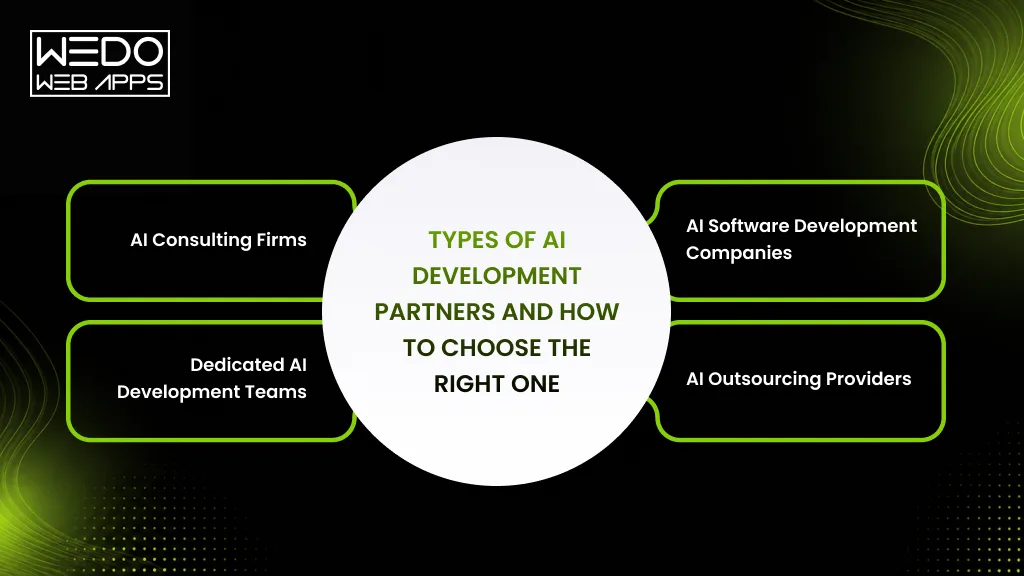
Types of AI Development Partners and How to Choose the Right One


Guide to AI Development Partner Types


Not all AI vendors offer the same level of involvement, expertise, or service scope.

Some focus on strategy. Others specialize in development and implementation. Some provide dedicated teams that work as an extension of your organization.

Understanding these differences can make the AI vendor selection process much easier and help you invest in the right type of partner from the start.

At a Glance: Which AI Partner Fits Your Needs?


Partner TypeBest ForTypical Engagement
AI Consulting FirmsBusinesses defining their AI strategy.Advisory, planning, and roadmap development.
AI Software Development CompaniesOrganizations ready to build AI solutions.End-to-end design, development, and deployment.
Dedicated AI Development TeamsCompanies needing long-term AI expertise.Team augmentation and ongoing development.
AI Outsourcing ProvidersBusinesses seeking cost-effective execution.Project-based or managed development services.


AI Consulting Firms

An AI consulting firm helps you determine where AI can create the most value within your business.

This option is often suitable when:

  • You are exploring AI opportunities for the first time.
  • Multiple use cases need evaluation.
  • Stakeholders require a clear implementation roadmap.
  • Technical and business teams need strategic alignment.

For example, a healthcare provider considering AI across diagnostics, patient support, and operations may benefit from consulting before committing to development.

AI Software Development Companies

An AI software company is responsible for designing, building, deploying, and supporting AI-powered applications and custom web development solutions.

This option works well when:

  • Your use case is already defined.
  • You need technical expertise across the entire development lifecycle.
  • Internal AI resources are limited.
  • Speed to market is a priority.

Many businesses choose this route because they gain access to data scientists, AI engineers, developers, and solution architects through a single engagement.

If your goal is to move from concept to implementation, partnering with a provider that offers comprehensive AI development services can help streamline delivery and reduce coordination challenges.

Dedicated AI Development Teams

A dedicated team functions as an extension of your in-house workforce.

This model is commonly chosen when:

  • AI development is an ongoing initiative.
  • Internal teams need additional expertise.
  • Product development requires long-term support.
  • Knowledge retention is important.

Instead of outsourcing a single project, you gain consistent access to specialists who become familiar with your systems, processes, and business goals.

AI Outsourcing Providers

AI outsourcing involves assigning part or all of your AI development activities to an external partner.

Organizations often select this approach when they need:

  • Faster project execution
  • Specialized expertise
  • Lower recruitment costs
  • Flexible resource allocation

For instance, a startup may outsource AI development to accelerate product launches without investing heavily in an internal AI department.

Which Option Is Best for Your Business?

The right choice depends on your current stage, internal capabilities, and long-term objectives.

Use this quick guide:

  • Need strategy and planning? -> AI consulting firm
  • Need a complete AI solution? -> AI software development company
  • Need ongoing expertise? -> Dedicated AI team
  • Need cost-effective execution? -> AI outsourcing provider

The most effective partnerships occur when the engagement model matches your business needs. Before comparing vendors, identify the type of support your organization requires. This simple step can significantly narrow your shortlist and improve your chances of finding the right AI development partner.

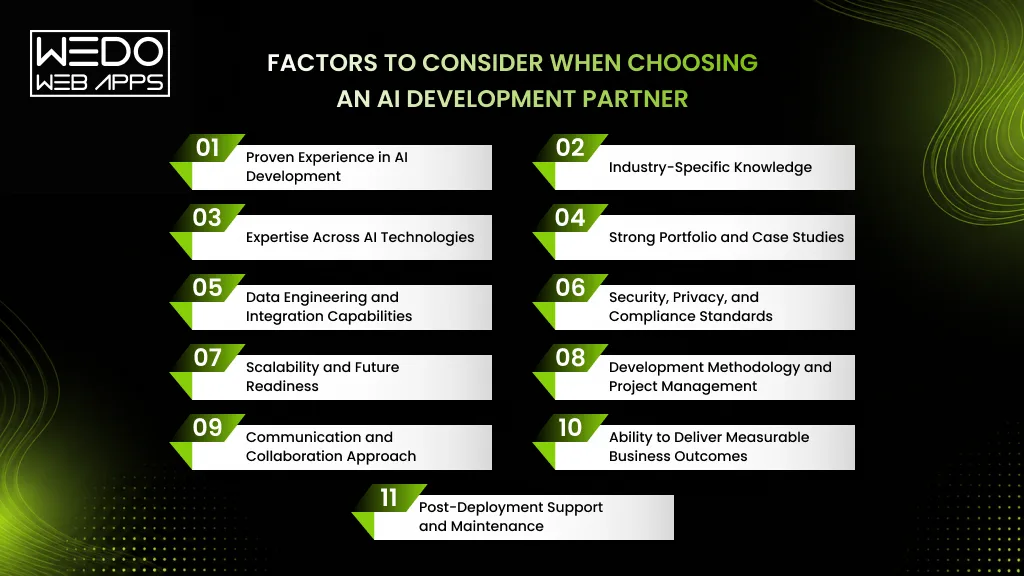
11 Key Factors to Consider When Choosing an AI Development Partner

Factors to Consider for AI Partner Selection


A polished website and a convincing sales pitch do not guarantee successful project delivery.

The real challenge is identifying whether a vendor has the expertise, processes, and business understanding needed to turn your AI initiative into measurable results.

Use the following factors as your evaluation framework when comparing potential partners.

1. Proven Experience in AI Development

Experience matters, but relevant experience matters more.

Ask vendors about projects similar to yours. A company that has built AI solutions for customer support may not be the best fit for predictive maintenance or computer vision applications.

Look for evidence of successful deployments, measurable outcomes, and long-term client relationships.

What to verify: Case studies, client references, and AI project success metrics.

2. Industry-Specific Knowledge

Every industry has unique challenges, regulations, and workflows.

A partner familiar with your sector can understand requirements faster and anticipate potential roadblocks.

For example, healthcare AI projects often involve strict compliance requirements, while retail AI solutions may focus heavily on personalization and customer behavior analysis.

What to verify: Industry case studies and domain expertise.

3. Expertise Across AI Technologies

Not every AI project requires the same technology stack.

A capable AI development partner should be able to recommend the most suitable approach instead of forcing a preferred technology into every project.

Evaluate expertise in:

What to verify: Technical certifications, project examples, and AI architecture capabilities.

4. Strong Portfolio and Case Studies

Case studies reveal how a vendor approaches challenges, implementations, and results.

Pay attention to outcomes rather than technical descriptions alone.

A strong portfolio should clearly explain:

  • The business challenge
  • The solution implementation
  • The measurable results achieved

Reviewing a relevant custom software project can provide valuable insight into a vendor’s problem-solving approach.

What to verify: Documented project outcomes and client testimonials.

5. Data Engineering and Integration Capabilities

AI systems depend on data quality.

Even the most advanced models can underperform if the underlying data is incomplete, inconsistent, or difficult to access.

Your vendor should understand data preparation, migration, governance, and integration requirements.

What to verify: Data pipeline experience and integration capabilities.

Also, evaluate their data analytics services capabilities to ensure they can turn business data into actionable insights.

6. Security, Privacy, and Compliance Standards

AI projects often process sensitive business and customer information.

A reliable vendor should have clear policies for data security, access control, encryption, and compliance.
This becomes especially important in regulated industries such as healthcare, finance, and insurance.

What to verify: Security certifications, compliance processes, and data handling practices.

7. Scalability and Future Readiness

Your AI solution should support future growth.

A system that works for 10,000 users today should not require a complete rebuild when usage doubles, or business requirements expand.

Evaluate whether the proposed architecture can adapt to new data sources, additional users, and future AI capabilities.

What to verify: Cloud architecture experience and scalability planning.

8. Development Methodology and Project Management

A structured delivery process often separates successful projects from unsuccessful ones.

Ask vendors how they manage planning, development, testing, deployment, and stakeholder communication.

A transparent process helps reduce uncertainty and improves accountability throughout the project lifecycle.

What to verify: Development frameworks, reporting processes, and delivery governance.

9. Communication and Collaboration Approach

Technical expertise alone is not enough.

You need a partner who communicates clearly, provides regular updates, and works collaboratively with your team.

Poor communication can create misunderstandings that lead to delays, budget overruns, and missed expectations.

What to verify: Communication channels, reporting frequency, and project management practices.

10. Ability to Deliver Measurable Business Outcomes

The best AI software companies focus on business value rather than technical outputs.

Instead of asking what technology will be used, ask what results will be achieved.

A strong vendor should be able to explain:

  • How success will be measured
  • Which KPIs will be tracked
  • Expected business impact
  • Long-term optimization plans

The goal is not simply to launch an AI solution. The goal is to create measurable improvements that justify the investment.

What to verify: ROI frameworks, KPI tracking, and business outcome reporting.

11. Post-Deployment Support and Maintenance

AI solutions require continuous monitoring, updates, and optimization.

Models can lose accuracy over time as business conditions, user behavior, and data patterns change.

A dependable partner should provide ongoing support after deployment to maintain performance and address emerging requirements.

What to verify: Support agreements, monitoring processes, and optimization services.

Quick Evaluation Checklist

Before making a final decision, ask yourself:

  • Does the vendor have relevant AI experience?
  • Have they delivered results in my industry?
  • Can they support future growth?
  • Do they understand both business and technical requirements?
  • Will they provide long-term support after launch?

If the answer to any of these questions is unclear, continue evaluating other vendors before making a commitment.


AI Vendor Evaluation Before Choosing


Questions to Ask Before Selecting an AI Vendor

Even after reviewing portfolios, case studies, and service offerings, you may still struggle to differentiate one vendor from another.

The right questions can reveal how a company approaches problem-solving, manages risk, and delivers results.

When conducting AI vendor selection, use the following questions to assess whether a potential partner is the right fit for your business.

Questions About Technical Expertise

Technical capability goes beyond knowing the latest AI tools and frameworks.

Ask questions such as:

  • Have you delivered a project similar to ours?
  • Which AI technologies would you recommend for our use case and why?
  • How do you handle data preparation and model training?
  • How do you evaluate model accuracy and performance?
  • Can you explain your approach to AI integration with existing systems?

What you’re looking for: Clear explanations, relevant examples, and recommendations tailored to your business rather than generic responses.

Questions About Project Delivery

A strong development process reduces surprises later in the project.

Consider asking:

  • What does your typical project lifecycle look like?
  • How do you manage scope changes?
  • What project management methodology do you follow?
  • How often will we receive progress updates?
  • Who will be our primary point of contact?

What you’re looking for: Transparency, accountability, and a structured delivery approach.

Questions About Data Security and Compliance

Data security should be addressed early in the conversation, especially if customer or operational data is involved.

Important questions include:

  • How do you protect sensitive business data?
  • What security practices do you follow?
  • How do you manage access controls?
  • Have you worked with compliance requirements relevant to our industry?
  • What happens to our data after project completion?

What you’re looking for: Clearly documented security processes and a strong understanding of compliance obligations.

Question About Long-Term Support

The relationship should not end once the solution is deployed.

Ask:

  • Do you offer ongoing support and maintenance?
  • How do you monitor AI model performance after launch?
  • What happens if business requirements change?
  • How frequently are models reviewed and updated?
  • What support response times can we expect?

What you’re looking for: A long-term partnership mindset rather than a project-only engagement.

Questions About Pricing and Engagement Models

Cost is important, but understanding how pricing works is equally important.

Ask questions such as:

  • What is included in the proposed cost?
  • Are there any ongoing licensing or infrastructure expenses?
  • How are change requests handled?
  • Do you offer fixed price, dedicated team, or time and materials models?
  • What factors could affect the final project cost?

What you’re looking for: Pricing transparency and a clear understanding of future costs.

Red Flags to Watch For

While evaluating vendors, pay attention to warning signs that may indicate future challenges:

  • Unrealistic promises about timelines or results.
  • Vague answers about security and compliance.
  • Limited evidence of previous AI projects.
  • No clear post-deployment support plan.
  • Difficulty explaining business outcomes.

A qualified AI development partner should be able to discuss both technical implementation and business impact with confidence.

By asking the right questions early, you can make a more informed AI vendor selection decision and reduce the risk of costly surprises later in the project.

AI Outsourcing vs In-House Development: Which Approach Is Right for You?

One of the biggest decisions businesses face is whether to build AI capabilities internally or work with an external partner.

The answer depends on factors such as budget, hiring capacity, project complexity, and long-term goals.

While some organizations prefer complete control through an internal team, others choose AI outsourcing to access specialized expertise and accelerate delivery.

AI Outsourcing vs In-House Development at a Glance


FactorAI OutsourcingIn-House Development
Time to startFasterSlower due to hiring and onboarding
Access to expertiseImmediate access to specialistsLimited to internal hiring capabilities
Upfront investmentLowerHigher recruitment and infrastructure
ScalabilityFlexible resource allocationDepends on hiring capacity
Knowledge retentionShared with external partnerRemains within the organization
Management overheadLowerHigher internal management effort


Benefit of AI Outsourcing

Many businesses choose AI outsourcing because it provides immediate access to experienced professionals without the time and expense of building a team from scratch.

Key advantages include:

Faster project execution

An established vendor already has data scientists, AI engineers, and solution architects in place.

Example: A startup developing an AI-powered SaaS product can begin development within weeks instead of spending months recruiting talent.

Access to specialized expertise

You gain access to professionals who have worked on multiple AI projects across industries.

Example: A retailer implementing demand forecasting can benefit from experts who have already solved similar challenges for other businesses.

Lower operational burden

The vendor handles recruitment, team management, and technical oversight.

Example: Your internal team can focus on business priorities while the external partner manages development activities.

Challenges of AI Outsourcing

Like any business decision, outsourcing also comes with considerations.


ChallengeHow to Reduce the Risk
Communication gapsEstablish regular reporting and meetings
Limited visibility into developmentDefine milestones and progress reviews
Dependence on external expertiseDocument processes and knowledge transfer plans
Quality concernsReview case studies, references, and pilot projects


Most of these challenges can be addressed by selecting the right AI development partner and establishing clear expectations from the start.

Benefit of Building an In-House AI Team

An internal team can be a strong option for organizations that view AI as a long-term strategic capability.

Benefits include:

Greater organizational knowledge

Internal teams understand company processes, customers, and business objectives.

More direct control

You have full oversight of priorities, workflows, and resource allocation.

Long-term capability building

AI knowledge remains within the organization and can support future initiatives.

However, building an internal team often requires significant investment in recruitment, training, and retention.

Cost and Resource Comparison

Before making a decision, consider the true cost beyond salaries alone.

An in-house AI team may require:

  • Recruitment expenses
  • Competitive salaries
  • Employee benefits
  • Training programs
  • Infrastructure and tooling
  • Ongoing retention efforts

By contrast, outsourcing converts many of these fixed costs into a more predictable project or service-based investment.

For businesses launching their first AI initiative, partnering with a provider offering AI development services is often the most cost-effective way to validate an idea before making larger investments.

When a Hybrid Approach Makes Sense

For many organizations, the best solution is not choosing one approach over the other.

A hybrid model combines internal business knowledge with external AI expertise.

For example:

  • Internal teams define objectives and priorities.
  • External specialists design and implement AI solutions.
  • Knowledge is gradually transferred to internal stakeholders.

This approach allows you to move quickly while still developing internal capabilities over time.

Choose AI outsourcing if speed, specialized expertise, and cost efficiency are your top priorities.

Choose an in-house team if AI is expected to become a core organizational capability and you have the resources to build and maintain it.

If you want the benefits of both, a hybrid model often provides the most balanced path forward.

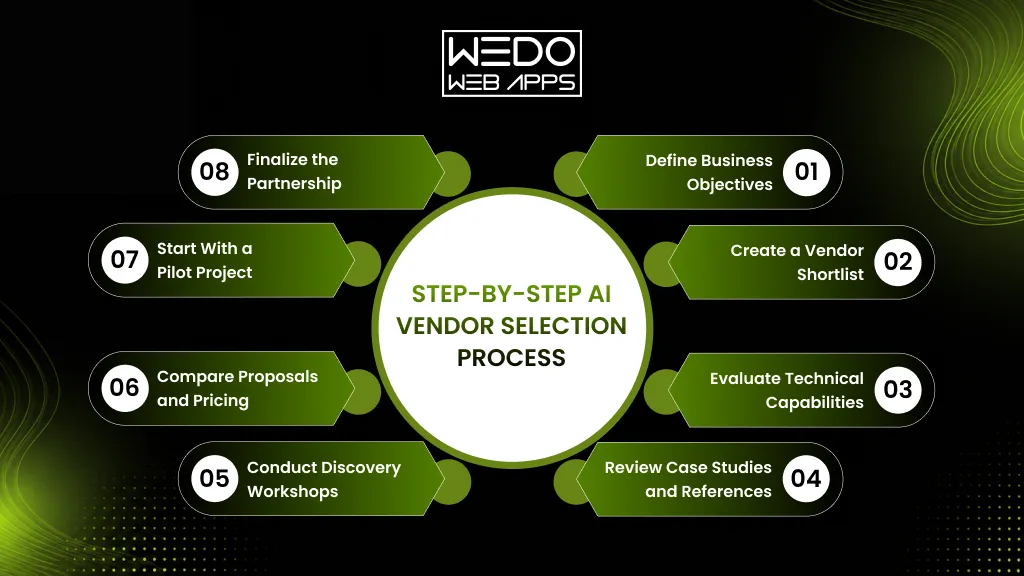
Step-by-Step AI Vendor Selection Process

AI Vendor Selection Process Guide


The best AI partnerships rarely happen by chance.

They result from a clear evaluation process that aligns business goals, technical requirements, and long-term expectations before a contract is signed.

Use the following framework to choose an AI development partner that can support both your immediate project needs and future growth plans.

Step 1: Define Business Objectives

Start by identifying the outcome you want to achieve.

Focus on business goals rather than technology requirements.

Ask questions such as:

  • What problem are we trying to solve?
  • Which processes need improvement?
  • What results would make this project successful?

A clear objective helps vendors recommend the most appropriate solution.

Step 2: Create a Vendor Shortlist

Once your requirements are defined, create a shortlist of potential partners.

Evaluate vendors based on:

  • Relevant AI experience
  • Industry expertise
  • Service offerings
  • Client reviews
  • Case studies

At this stage, aim for three to five strong candidates rather than evaluating dozens of providers.

Step 3: Evaluate Technical Capabilities

Review each vendor’s ability to handle your specific requirements.

Look beyond technology buzzwords and focus on practical experience.

Key areas to assess include:

  • AI technologies and frameworks
  • Data engineering capabilities
  • Integration expertise
  • Security practices
  • Scalability planning

The goal is to identify whether the vendor can deliver a solution that fits your business needs today and in the future.

Step 4: Review Case Studies and References

Past performance often provides the best indication of future performance.

When reviewing case studies, focus on:

  • The business challenge
  • The proposed solution
  • Implementation approach
  • Measurable outcomes

Whenever possible, request client references to gain additional insight into the vendor’s working style and reliability.

Step 5: Conduct Discovery Workshops

Before committing to a project, schedule discovery sessions with shortlisted vendors.

This stage helps you evaluate:

  • Problem-solving approach
  • Communication style
  • Technical understanding
  • Strategic thinking

Pay attention to the questions they ask.

A strong AI development partner will spend time understanding your business before proposing a solution.

Step 6: Compare Proposals and Pricing

Price should be evaluated alongside value.

Use the following criteria when comparing proposals:


Evaluating AreaWhat to Compare
ScopeDeliverables and responsibilities
TimelineProject milestones and deadlines
TeamExperience and expertise
SupportPost-deployment services
PricingTotal project cost and future expenses


The lowest proposal is not always the most cost-effective option.

Step 7: Start With a Pilot Project

A pilot project allows you to validate assumptions before committing to a larger investment.

Benefits of a pilot include:

  • Lower risk
  • Faster learning
  • Early performance validation
  • Better stakeholder confidence

Many successful AI initiatives begin with a limited-scope proof of concept before scaling further.

Step 8: Finalize the Partnership

Before signing an agreement, confirm:

  • Project scope
  • Success metrics
  • Ownership of data and intellectual property
  • Security requirements
  • Support and maintenance expectations
  • Communication processes

A well-defined agreement helps prevent misunderstandings and creates a stronger foundation for collaboration.

Quick Summary

The most successful AI vendor selection processes follow a simple pattern:

Define goals -> Shortlist vendors -> Evaluate capabilities -> Validate experience -> Run a pilot -> Finalize the partnership

By following these steps, you can reduce uncertainty, minimize project risk, and improve your chances of selecting an AI software company that aligns with your long-term business objectives.

How Leading AI Software Companies Approach AI Development

Not all AI projects follow the same path. However, successful implementations typically follow a structured process that reduces risks, improves collaboration, and increases the likelihood of achieving business objectives.

Understanding how leading AI software companies approach development can help you evaluate vendors more effectively and set realistic expectations for your project.

Discovery and Strategy Phase

Every successful AI project starts with understanding the business problem.

During this phase, the vendor works closely with stakeholders to identify challenges, objectives, data availability, and success criteria.

Typical activities include:

  • Business requirement analysis
  • Stakeholder workshops
  • Data assessment
  • Technical feasibility evaluation
  • Roadmap planning

A strong partner spends more time asking questions than recommending solutions at this stage.

If a vendor proposes a technology stack before understanding your business goals, it may be a warning sign.

Proof of Concept Development

Before committing to a large-scale implementation, many organizations validate ideas through a Proof of Concept (PoC).

The objective is to test whether the proposed solution can achieve the desired outcome using available data and resources.

A PoC helps answer questions such as:

  • Is the data sufficient?
  • Can the model achieve acceptable accuracy?
  • What business value can be expected?
  • What challenges may arise during implementation?

This stage helps reduce investment risks and builds confidence among stakeholders.

AI Model Training and Validation

Once feasibility is confirmed, development moves into model creation and optimization.

This phase typically includes:


ActivityPurpose
Data PreparationClean and structure data for training
Feature EngineeringImprove model performance using relevant variables
Model TrainingDevelop and train AI models
Testing and ValidationEvaluate accuracy, reliability, and consistency
Performance OptimizationRefine models based on results


The goal is not simply to build a model but to create one that performs reliably in real business environments.

Deployment and Integration

A model only delivers value when it becomes part of everyday business operations.

This phase focuses on deploying the solution and connecting it with existing systems.

Depending on the project, this may involve:

  • CRM integration
  • ERP integration
  • Customer support platforms
  • Internal business applications
  • Cloud infrastructure

This is where expertise in AI integration services becomes particularly valuable, as poor integration can limit adoption and reduce overall project impact.

Continuous Monitoring and Improvement

AI development does not end at deployment.

Business conditions change. Customer behavior evolves. New data becomes available.

As a result, AI models require ongoing monitoring and optimization.

Leading vendors typically provide:

  • Performance monitoring
  • Model retraining
  • Security updates
  • Accuracy improvements
  • Scalability enhancements

This ongoing support helps ensure that the solution continues delivering value long after implementation.

What This Means for Your Vendor Selection

When evaluating an AI development partner, look for evidence of a structured development lifecycle rather than isolated technical capabilities.

Vendors that follow a clear process are generally better equipped to manage risks, maintain quality standards, and deliver measurable business outcomes throughout the project lifecycle.


Right AI Development Partner Selection


Modern AI Trends to Consider Before Choosing a Partner

The AI market is evolving quickly.

A few years ago, many projects focused on predictive analytics and process automation. Today, organizations are exploring advanced use cases that involve Generative AI, AI agents, and multimodal systems.

This does not mean your project needs every new AI capability. However, your AI development partner should understand these technologies and know when they can create real business value.

Generative AI and Enterprise LLM Solutions

Generative AI has expanded the possibilities for customer support, content generation, knowledge management, and employee productivity.

Businesses are increasingly using Large Language Models (LLMs) to:

  • Build intelligent chatbots
  • Automate document processing
  • Create internal knowledge assistants
  • Improve employee self-service experiences

When evaluating vendors, ask whether they have experience building secure enterprise applications rather than simply integrating public AI tools.

The difference can significantly affect performance, security, and scalability.

AI Agents and Autonomous Workflows

AI agents can perform tasks, make decisions based on predefined rules, and interact with multiple systems with minimal human intervention.

Potential applications include:

  • Customer support automation
  • Lead qualification
  • Appointment scheduling
  • Internal workflow management

For example, an AI agent can receive a customer inquiry, retrieve relevant information, draft a response, and update internal systems automatically.

As adoption grows, organizations may benefit from working with vendors that understand how to design and govern agent-based workflows effectively. Businesses planning autonomous AI solutions can also explore agentic AI development services to build AI agents that can reason, act, and interact with business systems.

Retrieval Augmented Generation (RAG)

One of the biggest challenges with traditional AI models is that they may generate responses using outdated or incomplete information.

Retrieval Augmented Generation (RAG) addresses this issue by connecting AI systems to trusted data sources.

This approach is commonly used for:

  • Knowledge bases
  • Internal documentation
  • Customer support portals
  • Compliance resources

If your organization relies on large volumes of internal information, RAG capabilities can become an important evaluation criterion during AI vendor selection.

Multimodal AI Applications

Modern AI systems can process multiple forms of information, including text, images, audio, and video.

This creates opportunities across industries.

Examples include:


IndustryPotential Multimodal Use Case
HealthcareMedical image analysis with clinical documentation
RetailVisual product search and recommendations
ManufacturingImage-based quality inspection
InsuranceClaims processing using images and text
LogisticsDocument and shipment verification


While not every business requires multimodal AI today, understanding a vendor’s capabilities in this area can help future-proof your investment.

Responsible and Trustworthy AI Development

As AI adoption increases, so do concerns about privacy, security, bias, and transparency.

Organizations are paying closer attention to how AI systems are trained, deployed, and monitored.

A reliable AI software company should have clear practices around:

  • Data privacy
  • Security controls
  • Model monitoring
  • Bias mitigation
  • Regulatory compliance

These considerations are especially important in industries where AI-driven decisions can directly impact customers, employees, or business operations.

What This Means for Your Business

You do not need to select a vendor based on trend adoption alone.

Instead, focus on whether the vendor can evaluate emerging technologies objectively and recommend solutions that align with your goals.

The best partners understand when to use the latest AI capabilities and when a simpler approach can deliver better business results.

Real World Example: What an Effective AI Partnership Looks Like

The benefits of selecting the right AI development partner become easier to understand when viewed through a practical business scenario.

The following example illustrates how a structured partnership can help transform an AI initiative from an idea into measurable business value.

Business Challenge

Imagine a mid-sized eCommerce company struggling to manage a growing volume of customer inquiries.

Support agents spend hours answering repetitive questions about orders, returns, shipping updates, and product availability.

As the business grows, customer response times increase and operational costs continue to rise.

The company wants to improve customer service without significantly expanding its support team.

AI Solution Implemented

Instead of immediately deploying a chatbot, the chosen AI software company begins with a discovery phase.

The team evaluates:

  • Customer support workflows
  • Existing support data
  • Frequently asked questions
  • Integration requirements
  • Business objectives

Based on these findings, the company develops an AI-powered support assistant capable of:

  • Answering common customer questions
  • Retrieving order information
  • Providing shipping updates
  • Escalating complex issues to human agents

The solution is integrated with the existing customer support platform to ensure a seamless experience.

Results Achieved

The project delivers value beyond simple automation.

The business benefits from:

  • Faster response times
  • Reduced workload for support agents
  • Improved customer experience
  • Better scalability during peak demand periods
  • More time for employees to focus on high-value interactions

Most importantly, the solution addresses the original business challenge rather than introducing technology for the sake of innovation.

Lessons Learned

Several key lessons emerge from this example:

Start with the problem, not the technology

Successful AI initiatives focus on business objectives first.

Data quality matters

Well-organized and accessible data often plays a major role in project success.

Integration is as important as development

Even a highly accurate AI model can struggle to deliver value if it is disconnected from existing business processes.

Long-term support should be part of the plan

AI systems require monitoring, optimization, and updates to maintain performance over time.

The Bigger Takeaway

An effective partnership is not defined by the complexity of the technology being used.

It is defined by how well the solution aligns with business goals, integrates into existing workflows, and continues delivering value after deployment.

That is why choosing the right AI development partner often has a greater impact on project success than the technology itself.

AI Vendor Selection Checklist

By this stage, you should have a clear understanding of what to look for in an AI partner. Before making a final decision, use this checklist to evaluate and compare potential vendors side by side.

A strong AI vendor selection process should assess technical expertise, business alignment, security practices, and long-term support capabilities.

Technical Evaluation Checklist

Review whether the vendor can meet your technical requirements both today and in the future.

  • Proven experience delivering AI projects
  • Expertise in relevant AI technologies and frameworks
  • Strong data engineering capabilities
  • Experience integrating AI with existing systems
  • Scalable architecture and infrastructure planning
  • Clear development and testing processes
  • Ability to support future enhancements

Business Evaluation Checklist

Technical skills are important, but business understanding often determines whether a project delivers meaningful results.

  • Understanding of your industry and business model
  • Ability to align AI initiatives with business objectives
  • Clearly defined success metrics and KPIs
  • Relevant case studies and client references
  • Transparent project planning and delivery approach
  • Realistic timelines and expectations
  • Focus on measurable business outcomes

Security and Compliance Checklist

If your project involves sensitive business or customer information, security should be a priority from the start.

  • Data protection and privacy practices
  • Access control and authentication measures
  • Regulatory compliance experience
  • Secure development processes
  • Data ownership and governance policies
  • Risk management and monitoring procedures

Partnership and Support Checklist

An AI project does not end when the solution goes live.

Evaluate how the vendor will support your organization after deployment.

  • Dedicated communication channels
  • Ongoing monitoring and maintenance services
  • Model retraining and optimization support
  • Defined service level agreements (SLAs)
  • Knowledge transfer and documentation
  • Long-term scalability planning
  • Commitment to continuous improvement

Final Decision Questions

Before selecting an AI development partner, ask yourself:

  • Do they understand our business goals?
  • Can they demonstrate relevant experience?
  • Are their security and compliance practices sufficient?
  • Do they offer long-term support?
  • Can they clearly explain how success will be measured?

If you can confidently answer “yes” to each question, you are likely evaluating a vendor that can support both your immediate project needs and long-term growth objectives.

Conclusion

Choosing the right AI development partner is about more than technical expertise.

The vendor you select should understand your business objectives, recommend solutions that align with your goals, and support your organization beyond the initial deployment.

A structured AI vendor selection process can help you move past marketing claims and focus on the factors that truly influence project success. From evaluating technical capabilities and industry experience to assessing security practices and long-term support, each step plays a role in reducing risk and maximizing the value of your investment.

As AI adoption continues to grow, businesses that approach vendor selection strategically will be better positioned to implement solutions that improve efficiency, strengthen customer experiences, and create measurable business outcomes.

Before making a final decision, take the time to define your requirements, compare potential vendors carefully, and validate their ability to deliver results.

AI Software Company for Your Project

Legacy Software Modernization: Preparing Your Business for AI-Driven Digital Transformation

Introduction

The biggest obstacle to AI adoption is not choosing the right model; it is modernizing the systems that AI depends on. Many organizations are ready to invest in AI-powered automation, intelligent workflows, and predictive decision-making, yet they overlook the foundation required to make those initiatives successful. When critical business applications rely on aging architectures, fragmented data, and years of accumulated technical debt, AI becomes significantly harder to integrate, scale, and trust.

This shift has made legacy software modernization a boardroom conversation rather than just an IT responsibility. Modern enterprises are no longer modernizing applications simply because they are outdated; they are modernizing them to unlock AI capabilities, improve data accessibility, strengthen security, accelerate innovation, and support long-term digital transformation. In other words, modernization is no longer the end goal; it is the foundation that enables what’s next.

The challenge is that not every legacy system needs to be replaced, and not every modernization strategy delivers the same business outcomes. Some applications can be enhanced through APIs and cloud services, while others require refactoring, rearchitecting, or complete replacement. Choosing the right path depends on your existing technology landscape, business priorities, compliance requirements, and future AI ambitions.

This guide explains how to evaluate your legacy applications, identify the barriers preventing successful AI integration, compare modernization strategies, and build an AI-ready technology ecosystem that supports sustainable business growth. Whether you are planning your first modernization initiative or optimizing enterprise software for advanced AI use cases, you will gain a practical framework for making informed technology decisions with confidence.

Why Legacy Software Modernization is No Longer Optional

There was a time when organizations could delay software upgrades for years without affecting business growth. That reality has changed. Today, technologies like AI, cloud computing, automation, and real-time analytics evolve much faster than traditional enterprise systems. As a result, businesses that continue relying on outdated software often struggle to innovate, integrate new technologies, and respond quickly to changing customer and market demands.

Legacy modernization is no longer driven solely by aging infrastructure; it is driven by the need to remain competitive. Whether the goal is to improve operational efficiency, enhance customer experiences, or enable AI-powered decision-making, modern businesses require technology ecosystems that are secure, scalable, and capable of evolving with business needs.


What is a Legacy System?

A legacy system is any software application, platform, or technology environment that continues to support critical business operations but no longer aligns with current technical, security, or business requirements. These systems may still perform their intended functions, yet they often rely on outdated programming languages, aging infrastructure, limited integration capabilities, or unsupported software versions.

A legacy system isn’t necessarily “old.” It becomes a legacy system when it slows innovation, increases maintenance complexity, or prevents the business from adopting modern technologies like AI, cloud services, and automation.

Why Do Businesses Still Depend on Legacy Applications?

Despite their limitations, legacy applications continue to power many core business functions because replacing them is not always practical or cost-effective.

Common reasons organizations continue using legacy software include:

  • Years of business-critical data stored within existing systems.
  • High costs and risks associated with complete replacement.
  • Deep integration with internal processes and third-party applications.
  • Industry-specific customizations developed over many years.
  • Concerns about operational disruption during migration.

For many organizations, the challenge is not deciding whether to modernize; it is determining how to modernize without disrupting business continuity.

The Hidden Cost of Delaying Modernization

The financial impact of legacy systems extends far beyond maintenance expenses. As technology continues to evolve, delaying legacy software modernization increases both operational and strategic risks.

Organizations often experience:

  • Growing technical debt that slows software enhancements.
  • Higher infrastructure and maintenance costs.
  • Increased cybersecurity and compliance exposure.
  • Difficulty integrating AI, cloud platforms, and modern SaaS solutions.
  • Longer development cycles that delay innovation.
  • Reduced productivity caused by manual processes and disconnected systems.

Individually, these challenges may seem manageable. Together, they create a technology environment that limits business agility and makes future transformation initiatives significantly more complex and expensive.

Expert Insights: The cost of maintaining legacy software is not measured only by what businesses spend today; it is also measured by the opportunity they cannot pursue tomorrow. Every delayed modernization initiative can postpone AI adoption, automation, faster product delivery, abd data-driven innovation.

Legacy Modernization vs Software Replacement

One of the biggest misconceptions is that modernization always means replacing existing software. In reality, complete replacement is only one of several modernization approaches.

The right strategy depends on your business goals, application architecture, budget, and long-term technology roadmap.


Legacy ModernizationSoftware Replacement
Enhances or transforms existing applications.Replaces the entire application with a new solution.
Preserves valuable business logic where possible.Often requires rebuilding processes and workflows.
Typically reduces business disruption through phased implementation.May involve larger migration efforts and longer transition periods.
Supports gradual AI integration and cloud adoption.Suitable when existing systems are no longer maintainable or scalable.


For many organizations, the objective is not to start over; it is to maximize the value of existing investments while preparing the business for AI-driven innovation and long-term digital transformation.

Why Legacy Systems Struggle with AI Integration

Many organizations assume that adopting AI is as simple as connecting an AI model to their existing applications. In reality, AI is only as effective as the technology ecosystem supporting it. If enterprise systems cannot provide accurate, accessible, and real-time data, even the most advanced AI models will produce unreliable insights or require significant manual intervention.

This is why AI integration projects often uncover deeper technology challenges than expected. Legacy applications were typically designed to support specific business functions, not to exchange data seamlessly with cloud platforms, machine learning models, APIs, or modern enterprise applications. Before AI can deliver measurable business value, organizations must first address the limitations that prevent legacy systems from supporting intelligent technologies.

Technical Debt Limits Innovation

Technical debt is not just outdated code; it is the accumulation of short-term technology decisions that make future improvements slower, more expensive, and riskier.

Common signs of growing technical debt include:

  • Applications built on unsupported frameworks or programming languages.
  • Years of custom code with limited documentation.
  • Monolithic architectures that are difficult to modify.
  • Manual deployment and maintenance processes.
  • Increasing time and effort required for even minor software updates.

When AI initiatives depend on systems affected by significant technical debt, development teams often spend more time maintaining infrastructure than delivering new AI capabilities.

Expert Insight: Organizations rarely postpone AI projects because the models are not ready. More often, they postpone them because modern AI cannot efficiently operate on outdated software architectures.

Disconnected Data Silos Reduce AI Effectiveness

AI relies on data; not just large volumes of it, but data that is accurate, consistent, and connected across the business.

Legacy environments frequently store information in isolated systems, making it difficult for AI to build a complete understanding of customers, operations, or business performance.

Typical examples include:

  • Customer data stored separately from sales systems.
  • Inventory information isolated from procurement platforms.
  • Finance, HR, and operations using independent databases.
  • Inconsistent data formats across business applications.

Without a unified data foundation, AI models often produce incomplete, biased, or inconsistent outputs because they cannot access the full business context.

Poor API Support Restricts Integration

Modern AI platforms are designed to communicate through APIs, enabling applications to exchange data securely and in real time.

Many legacy systems were developed before API-first architecture became standard. Instead, they rely on:

  • Direct database connections.
  • Batch file transfers.
  • Proprietary interfaces.
  • Manual data exports.
  • Point-to-point integrations.

These approaches create bottlenecks that make AI integration slower, more complex, and harder to scale.

Modernization introduces API-driven connectivity, allowing AI services to interact with enterprise systems without extensive custom development.

Security and Compliance Challenges

AI systems often process sensitive business information, making security a critical requirement rather than an optional consideration.

Older applications may lack:

  • Modern identity and access management.
  • Encryption standards.
  • Multi-factor authentication.
  • Continuous security monitoring.
  • Support for evolving compliance requirements.

Introducing AI into an environment with outdated security controls increases organizational risk and can create compliance challenges, particularly in regulated industries such as healthcare, finance, and insurance.

Modernization provides an opportunity to strengthen cybersecurity while preparing systems for AI-enabled operations.

Scalability Limitations Slow AI Adoption

AI workloads are fundamentally different from traditional business applications. They require flexible computing resources, rapid data processing, and the ability to scale as usage grows.

Many legacy environments were designed for predictable, on-premises workloads rather than dynamic AI services.

As a result, organizations often experience:

  • Performance bottlenecks during high-demand periods.
  • Limited computing capacity for AI models.
  • Slow response times for intelligent applications.
  • High infrastructure costs when scaling existing systems.

Cloud-native modernization enables organizations to scale infrastructure based on demand, making AI deployments more reliable and cost-effective.

Why AI Requires Connected, High-Quality Data

One of the biggest misconceptions is that better AI models automatically produce better business outcomes.

In reality, AI quality depends on data quality.

Successful AI initiatives require:

  • Reliable and accurate enterprise data.
  • Consistent data formats across systems.
  • Real-time or near-real-time data access.
  • Clear governance and ownership.
  • Secure data sharing between applications.

Without these capabilities, AI models spend more time compensating for poor data than delivering meaningful intelligence.

Think of AI as a high-performance engine. Installing it in a vehicle with worn-out components won’t improve performance. Similarly, integrating AI into disconnected legacy systems cannot deliver its full potential without first modernizing the underlying technology foundation.

Key Takeaway

The biggest barrier to AI integration isn’t the AI technology itself; it’s the ability of existing enterprise systems to support it. Technical debt, fragmented data, outdated integration methods, security gaps, and limited scalability all reduce AI’s effectiveness. Addressing these challenges through legacy software modernization creates the reliable, connected, and scalable foundation needed for successful AI adoption and long-term digital transformation.

Building an AI-Ready Foundation Through Legacy Modernization

Modernizing legacy software isn’t about replacing old applications with newer ones; it’s about transforming the technology ecosystem that powers your business. AI doesn’t operate in isolation; it depends on applications, infrastructure, data, and integrations working together seamlessly. If even one layer becomes a bottleneck, the value of AI diminishes.

That’s why successful legacy software modernization focuses on more than code. It creates an environment where information flows securely, systems communicate efficiently, and new AI capabilities can be introduced without rebuilding the entire technology stack every few years.

Think of modernization as preparing every layer of your technology foundation—not just the software users interact with.

Application Modernization

Applications are often the first focus of modernization, but the objective extends beyond improving user interfaces or migrating to newer programming languages.

Modern application modernization aims to make software:

  • Easier to maintain and update.
  • Flexible enough to integrate with AI services.
  • Scalable to support growing business demands.
  • Compatible with cloud-native architectures.
  • Faster to deliver new features and enhancements.

Organizations may modernize applications by breaking large monolithic systems into modular services, refactoring outdated code, or introducing APIs that allow existing applications to communicate with AI platforms and custom web development services.

Why it matters for AI

Modern AI solutions rely on applications that can exchange information quickly and securely. Modular, API-enabled applications make it significantly easier to integrate capabilities such as intelligent search, document processing, predictive analytics, and AI agent development without redesigning the entire system.

Infrastructure Modernization

Even well-designed applications struggle if the infrastructure underneath them cannot support modern workloads.

Many legacy environments still depend on aging servers, fixed hardware capacity, and manually managed infrastructure. While these environments may support day-to-day operations, they often lack the flexibility required for AI-driven workloads.

Infrastructure modernization focuses on creating a platform that is:

  • Scalable as business demand grows.
  • Resilient against failures and downtime.
  • Easier to monitor and manage.
  • Optimized for cloud and hybrid environments.
  • Capable of supporting compute-intensive AI models.

Rather than treating infrastructure as a fixed asset, organizations increasingly view it as an adaptable platform that evolves alongside business needs.

Data Modernization

If applications are the engine of digital transformation, data is the fuel that powers AI.

Many organizations discover that their greatest modernization challenge isn’t software; it’s decades of fragmented, duplicated, and inconsistent business data.

Data modernization typically involves:

  • Consolidating information from multiple systems.
  • Improving data quality and consistency.
  • Establishing governance and ownership.
  • Enabling secure, real-time data access.
  • Creating scalable data pipelines for analytics and AI.

Without these improvements, AI models spend more time cleaning and interpreting data than generating meaningful business insights.

Businesses dealing with complex legacy data environments can also use data engineering services to build scalable pipelines, integrate disparate data sources, and prepare enterprise data for analytics and AI.

Expert Insight: Many AI projects don’t require more data—they require better-organized data. Modernization creates the structure AI needs to deliver accurate, trustworthy outcomes.

API-First Architecture

One of the defining characteristics of modern enterprise software is connectivity.

Instead of relying on custom integrations or manual data transfers, API-first architecture enables applications, cloud services, and AI platforms to communicate through standardized interfaces.

The benefits include:

  • Faster integration with AI services.
  • Easier connectivity between business applications.
  • Reduced dependence on custom point-to-point integrations.
  • Greater flexibility when adopting new technologies.
  • Simplified maintenance and future upgrades.

API-first design doesn’t just improve today’s integrations; it makes future innovation significantly easier.

Cloud-Native Transformation

Cloud migration and cloud-native transformation are often discussed together, but they aren’t the same. Businesses modernizing legacy infrastructure can use cloud computing solutions to improve scalability, flexibility, and infrastructure readiness for AI workloads.

Migrating applications to the cloud without redesigning them may reduce infrastructure management, but it doesn’t automatically improve flexibility, scalability, or AI readiness.

Cloud-native transformation focuses on building applications that fully leverage cloud capabilities such as:

  • Elastic scaling.
  • Containerization.
  • Microservices.
  • Automated deployments.
  • Continuous monitoring.
  • High availability.

These capabilities are especially valuable for AI applications, where workloads can fluctuate dramatically based on user demand and computational requirements.

Preparing Systems for AI

An AI-ready organization is built on more than modern applications or cloud infrastructure. It requires a technology ecosystem where applications, data, infrastructure, and integrations work together as a unified foundation.

Before implementing enterprise AI, organizations should evaluate whether their systems can:

  • Share data securely across applications.
  • Support API-based integrations.
  • Scale resources as AI workloads increase.
  • Meet security and regulatory requirements.
  • Continuously monitor system performance.
  • Adapt quickly to future technology changes.

When these capabilities are in place, AI becomes much easier to implement, expand, and optimize across the business.

Practical Example

Imagine a retail company running separate systems for inventory, sales, customer loyalty, and order management.

Without modernization:

  • Customer data is scattered across multiple databases.
  • Inventory updates occur in batches rather than real time.
  • AI cannot accurately forecast demand because it lacks complete information.
  • Personalization initiatives produce inconsistent recommendations.

After modernization:

  • APIs connect all business systems.
  • Customer and inventory data become unified.
  • Cloud infrastructure scales automatically during seasonal demand.
  • AI analyzes purchasing patterns in real time to improve forecasting, optimize inventory, and deliver personalized shopping experiences.

The AI model didn’t become smarter; the technology foundation became stronger.

Building an AI-Ready Enterprise Checklist

Before investing in enterprise AI, ask these questions:

  • Can your applications integrate through modern APIs?
  • Is your business data accurate, connected, and governed?
  • Can your infrastructure scale to support AI workloads?
  • Are security and compliance requirements built into your architecture?
  • Can new AI capabilities be deployed without disrupting core business operations?

If the answer to several of these questions is no, your organization will likely benefit from legacy software modernization before expanding AI initiatives.

Takeaway

AI success isn’t determined by the sophistication of the model alone; it’s determined by the strength of the technology foundation behind it. Legacy software modernization prepares applications, infrastructure, data, and integrations to work together, enabling organizations to adopt AI with greater confidence, scalability, and long-term business value. This foundation also makes it easier to evaluate the next critical decision: Which modernization strategy is the right fit for your business?

Choosing the Right Legacy Modernization Strategy

There is no universal approach to legacy modernization. The right strategy depends on factors such as your application’s business value, technical complexity, budget, compliance requirements, and long-term AI goals. An organization modernizing a customer-facing platform will have different priorities than one updating an internal ERP or finance system.

Rather than asking, “Which strategy is the most modern?”, ask, “Which strategy delivers the best balance between business continuity, investment, and AI readiness?”

The six modernization strategies below are commonly used to help organizations modernize legacy applications while minimizing disruption and maximizing long-term value.

Rehosting (Lift and Shift)

Rehosting moves an existing application from its current environment to a new infrastructure, typically the cloud, without making significant changes to the application’s code.

Best suited for:

  • Applications that are stable and business-critical.
  • Organizations looking for a quick cloud migration.
  • Businesses with limited modernization budgets.

Advantages

  • Faster migration.
  • Lower initial investment.
  • Minimal changes to existing applications.
  • Reduced infrastructure management.

Limitations

  • Doesn’t eliminate technical debt.
  • Limited improvement in AI readiness.
  • Existing architectural limitations remain.

Replatforming

Replatforming introduces targeted improvements while keeping the application’s core architecture intact. This may include upgrading databases, operating systems, middleware, or runtime environments to improve performance and compatibility.

Best suited for:

  • Applications that require better scalability.
  • Organizations preparing for cloud-native services.
  • Businesses seeking gradual modernization.

Advantages

  • Better performance and reliability.
  • Improved cloud compatibility.
  • Lower risk than full redevelopment.

Limitations

  • Core architectural constraints may still exist.
  • Some technical debt remains.

Refactoring

Refactoring restructures and improves the application’s internal code without changing its core functionality. The goal is to make the software easier to maintain, integrate, and evolve.

Best suited for:

  • Applications with valuable business logic.
  • Businesses planning long-term AI integration.
  • Organizations looking to reduce technical debt.

Advantages

  • Improved maintainability.
  • Easier API integration.
  • Better scalability.
  • Strong foundation for AI and automation.

Limitations

  • Higher development effort.
  • Longer implementation timeline.

Rearchitecting

Rearchitecting redesigns significant parts of an application to support modern architectures such as microservices, event-driven systems, or cloud-native platforms.

This approach is often chosen when existing software can no longer support future business requirements.

Best suited for:

  • Rapidly growing enterprises.
  • High-traffic customer applications.
  • Businesses adopting enterprise AI at scale.

Advantages

  • Exceptional scalability.
  • Greater flexibility.
  • Easier integration with modern technologies.
  • Long-term innovation platform.

Limitations

  • Significant investment.
  • Requires careful planning and governance.

Rebuilding

Rebuilding involves developing a completely new application while preserving the functionality and business objectives of the original system.

Best suited for:

  • Applications built on obsolete technologies.
  • Systems with excessive technical debt.
  • Businesses requiring major functional improvements.

Advantages

  • Modern technology stack.
  • Improved user experience.
  • Greater scalability and maintainability.

Limitations

  • Longer implementation cycles.
  • Higher development costs.
  • Careful migration planning required.

Replacing

Replacing means retiring an existing application and adopting a commercial or SaaS solution that better meets current business requirements.

Best suited for:

  • Commodity business processes.
  • Applications with minimal competitive differentiation.
  • Organizations seeking standardized functionality.

Advantages

  • Faster access to modern capabilities.
  • Lower maintenance responsibility.
  • Vendor-managed updates and security.

Limitations

  • Less customization.
  • Possible vendor lock-in.
  • Data migration and process changes may be required.

Legacy Modernization Strategy Comparison


StrategyInvestmentBusiness DisruptionTime to ImplementAI ReadinessBest For
RehostingLowLowShort⭐⭐Quick cloud migration
ReplatformingMediumLowShort to Medium⭐⭐⭐Improving performance and scalability
RefactoringMedium to HighMediumMedium⭐⭐⭐⭐Reducing technical debt while enabling AI
RearchitectingHighMedium to HighLong⭐⭐⭐⭐⭐Enterprise transformation and AI-driven innovation
RebuildingHighHighLong⭐⭐⭐⭐⭐Replacing outdated custom applications
ReplacingMedium to HighMediumMedium⭐⭐⭐⭐Standardizing non-core business functions


Expert Recommendation

Don’t choose a modernization strategy based solely on cost. Choose it based on business value and future AI requirements.

For example, rehosting may deliver quick infrastructure savings, but it won’t solve architectural limitations that restrict AI integration. If AI-powered automation, intelligent analytics, or personalized customer experiences are part of your long-term roadmap, strategies like refactoring or rearchitecting often provide stronger long-term returns despite requiring greater upfront investment.

How to Choose the Right Strategy

Before committing to a modernization initiative, evaluate each application against these questions:

  • How critical is this application to daily business operations?
  • Does it support processes that differentiate your business?
  • Can it integrate with modern APIs and AI platforms?
  • Is the current architecture scalable and secure?
  • Will modernization deliver greater long-term value than replacement?
  • How quickly do you need measurable business outcomes?

The answers will often point toward the most practical modernization strategy; not just from a technology perspective, but from a business and investment standpoint.

Section Takeaway

The best legacy modernization strategy isn’t the one with the newest technology; it’s the one that aligns with your business objectives, minimizes unnecessary disruption, and prepares your organization for future AI integration. Evaluating applications individually and balancing short-term priorities with long-term innovation creates a modernization roadmap that supports sustainable digital transformation rather than one-time technology upgrades.


Modernize Legacy Software for AI

Step-by-Step Legacy Modernization Roadmap for AI Integration


AI Implementation in Legacy Systems


Successful legacy software modernization isn’t a one-time migration project; it’s a strategic transformation program. Organizations that achieve the best results don’t start by rewriting code or moving everything to the cloud. They begin by understanding how technology supports business operations, identifying modernization priorities, and creating a roadmap that balances innovation with business continuity.

The following roadmap provides a practical framework for modernizing legacy applications while building a technology ecosystem that’s ready for AI integration and long-term digital transformation.

Step 1: Assess Existing Applications

Every modernization initiative starts with understanding the current application landscape.

Rather than assuming every legacy system needs modernization, evaluate each application based on:

  • Business criticality.
  • Technical health.
  • Maintenance costs.
  • Security posture.
  • Integration capabilities.
  • User adoption and performance.

This assessment helps identify which applications should be modernized, replaced, retained, or retired.

Best Practice:

Create an application inventory before making modernization decisions. Many organizations discover duplicate systems, underutilized applications, or unnecessary maintenance costs during this phase.

Step 2: Audit Enterprise Data Readiness

AI is only as effective as the data it can access.

Before introducing AI capabilities, organizations should evaluate whether their data is accurate, consistent, secure, and accessible across business functions.

Focus on questions such as:

  • Is customer, operational, and financial data stored in separate silos?
  • Are data formats standardized?
  • Can applications exchange information in real time?
  • Are governance and compliance policies in place?
  • Is data quality sufficient for AI-driven insights?

Resolving these issues early prevents costly delays during AI implementation.

Step 3: Define Business Priorities and Modernization Goals

Technology should support business outcomes, not the other way around.

Before selecting modernization strategies, define what success looks like.

Examples include:

  • Reducing operational costs.
  • Accelerating product delivery.
  • Improving customer experiences.
  • Enabling AI-powered automation.
  • Increasing application scalability.
  • Strengthening cybersecurity and compliance.
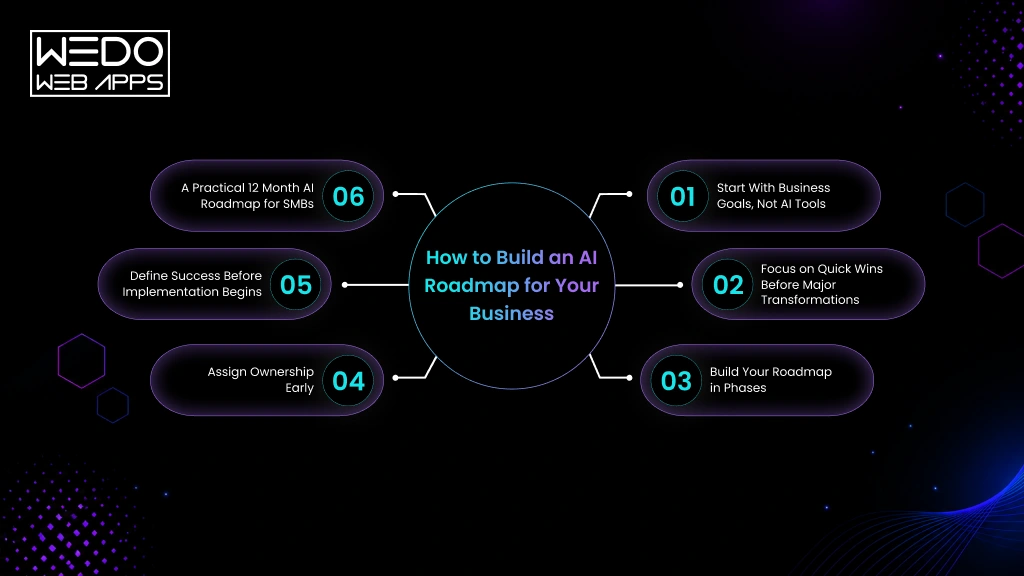
Clear objectives help organizations prioritize investments and measure modernization success.

Step 4: Modernize Applications and Architecture

Once priorities are established, begin modernizing the applications that deliver the greatest business value.

Depending on your strategy, this may involve:

  • Refactoring legacy code.
  • Introducing microservices.
  • Building APIs.
  • Replatforming applications.
  • Rebuilding selected systems.
  • Retiring obsolete software.

The goal isn’t to modernize everything simultaneously; it’s to modernize the systems that create the highest business impact.

Step 5: Modernize Data and Integration Layers

Many modernization projects focus on applications while overlooking the systems that connect them.

This stage strengthens the foundation that enables enterprise-wide AI.

Key activities include:

  • Consolidating business data.
  • Building API-driven integrations.
  • Eliminating redundant data sources.
  • Establishing governance policies.
  • Implementing secure data pipelines.

By improving how information moves across the organization, businesses create a reliable environment for AI, analytics, and automation.

Step 6: Enable Cloud Infrastructure and AI Services

With applications and data prepared, organizations can begin introducing cloud capabilities and AI solutions with significantly lower implementation risk. A DevOps Consulting company can also help automate deployment pipelines, improve infrastructure reliability, and establish practices that support continuous delivery during modernization.

This may include:

  • Cloud-native infrastructure.
  • AI-powered document processing.
  • Intelligent chatbots and virtual assistants.
  • Predictive analytics.
  • Workflow automation.
  • Recommendation engines.

Rather than treating AI as a separate initiative, integrate it gradually into high-value business processes where it can deliver measurable outcomes.

Step 7: Continuously Optimize and Scale

Modernization doesn’t end after deployment.

As business needs evolve, applications, infrastructure, and AI capabilities should continue evolving alongside them.

Organizations should establish processes to:

  • Monitor application performance.
  • Measure business outcomes.
  • Strengthen security continuously.
  • Optimize cloud resources.
  • Improve AI model performance.
  • Expand modernization initiatives incrementally.

Continuous optimization ensures technology remains aligned with changing business priorities rather than becoming tomorrow’s legacy system.

Legacy Modernization Roadmap at a Glance


PhasePrimary ObjectiveExpected Business Outcome
Assess ApplicationsUnderstand the current technology landscapeBetter modernization decisions
Audit Data ReadinessPrepare reliable, connected dataStronger AI performance
Define Business GoalsAlign technology with business prioritiesHigher ROI and measurable outcomes
Modernize ApplicationsImprove flexibility and maintainabilityFaster innovation and easier integration
Modernize Data & IntegrationsEnable connected systemsImproved AI readiness and collaboration
Enable Cloud & AIIntroduce scalable technologiesIncreased efficiency and automation
Optimize ContinuouslyImprove performance over timeSustainable digital transformation


Expert Tip

Resist the urge to modernize every application at once. A phased approach focused on high-impact systems reduces implementation risk, minimizes business disruption, and allows teams to demonstrate measurable value before expanding modernization efforts across the enterprise.

Common Mistakes to Avoid During Modernization

Even well-planned projects can lose momentum when organizations:

  • Treat modernization as an infrastructure project instead of a business initiative.
  • Underestimate the importance of data quality.
  • Attempt to modernize every application simultaneously.
  • Choose technology before defining business objectives.
  • Ignore employee adoption and change management.
  • Delay cybersecurity improvements until after implementation.

Avoiding these pitfalls helps organizations achieve faster results while reducing cost, complexity, and operational risk.

Section Takeaway

A successful legacy software modernization initiative follows a structured roadmap that balances business priorities with technical transformation. By assessing existing applications, preparing enterprise data, modernizing incrementally, and integrating AI strategically, organizations create a scalable technology foundation that supports continuous innovation rather than one-time change.

How AI Accelerates Legacy Modernization

AI is often viewed as the end goal of modernization, but it has also become one of the most effective tools for accelerating modernization projects. From analyzing legacy code to generating documentation and automating software testing, AI helps development teams reduce manual effort, identify modernization opportunities faster, and improve overall project efficiency.

That doesn’t mean AI replaces software engineers or solution architects. Instead, it acts as an intelligent assistant that supports repetitive, time-consuming tasks while allowing experts to focus on architectural decisions, business logic, security, and implementation strategy.

When used strategically, AI shortens modernization timelines without compromising software quality.

AI-Assisted Code Analysis

One of the biggest challenges in legacy modernization is understanding applications that have evolved over many years.

Some systems contain:

  • Limited or outdated documentation.
  • Complex business rules.
  • Thousands of interconnected files.
  • Custom integrations developed by multiple teams.
  • Code written in legacy programming languages.

AI-powered code analysis tools can examine application structures, identify dependencies, detect obsolete components, and surface potential risks much faster than manual code reviews.

This allows development teams to spend less time understanding existing systems and more time planning modernization efforts.

Business Value

  • Faster application assessment.
  • Reduced project discovery time.
  • Better visibility into technical debt.
  • Improved modernization planning.

Automated Documentation Generation

Many legacy applications operate with incomplete, outdated, or missing technical documentation.

This creates challenges when:

  • New developers join the project.
  • Applications require modernization.
  • Compliance audits are conducted.
  • Business processes need to be understood.

Generative AI can analyze source code and automatically generate:

  • Technical documentation.
  • API documentation.
  • System summaries.
  • Workflow explanations.
  • Dependency maps.

Although this documentation should always be reviewed by experienced engineers, it significantly reduces the time required to understand complex applications.

Intelligent Code Refactoring

Modernizing legacy software often involves restructuring code without changing business functionality.

AI-assisted development tools can:

  • Recommend cleaner code structures.
  • Detect duplicated logic.
  • Suggest modern coding patterns.
  • Highlight performance bottlenecks.
  • Identify security vulnerabilities.

These recommendations help developers modernize applications more efficiently while maintaining software quality.

It’s important to note that AI provides recommendations, not production-ready solutions. Human expertise remains essential for validating architectural decisions and ensuring business requirements are preserved.

AI-Powered Testing

Software testing is one of the most resource-intensive stages of any modernization project.

AI can improve this process by helping teams:

  • Generate test cases automatically.
  • Identify regression risks.
  • Prioritize critical test scenarios.
  • Detect application anomalies.
  • Analyze test results more efficiently.

This enables faster release cycles while reducing the likelihood of introducing defects during modernization.

For organizations modernizing large enterprise applications, AI-assisted testing can significantly improve both speed and confidence.

Migration Planning with AI

Planning a modernization initiative requires analyzing applications, dependencies, business priorities, infrastructure, and potential risks.

AI can support planning by:

  • Identifying application dependencies.
  • Recommending modernization candidates.
  • Estimating migration complexity.
  • Detecting redundant components.
  • Highlighting integration challenges.

These insights help organizations build more informed modernization roadmaps and allocate resources more effectively.

However, modernization strategy should always align with business objectives rather than AI-generated recommendations alone.

Predictive Monitoring After Modernization

The value of AI continues even after modernization is complete.

AI-powered monitoring solutions can:

  • Detect abnormal application behavior.
  • Predict infrastructure failures.
  • Identify performance bottlenecks.
  • Monitor cloud resource utilization.
  • Recommend optimization opportunities.

Instead of reacting to problems after they occur, organizations can proactively maintain application performance and reliability.

This supports continuous improvement while ensuring the technology environment remains ready for future business growth.

Expert Tip

Use AI to accelerate engineering tasks, not to replace engineering judgment.

AI is highly effective for code analysis, documentation, testing, and identifying modernization opportunities. However, decisions involving application architecture, security, compliance, business processes, and long-term technology strategy should always be guided by experienced software architects and domain experts.

Where AI Delivers the Greatest Value During Modernization


Modernization ActivityHow AI HelpsHuman Expertise Required
Code assessmentIdentifies dependencies, technical debt, and obsolete componentsValidate findings and prioritize modernization
DocumentationGenerates technical documentation and system summariesReview accuracy and add business context
Code refactoringSuggests cleaner, modern coding patternsPreserve business logic and architectural integrity
Software testingCreates test cases and detects regression risksDefine testing strategy and approve releases
Migration planningAnalyzes applications and recommends modernization pathsAlign decisions with business goals and compliance
Performance monitoringPredicts issues and recommends optimizationsImplement improvements and oversee operations


Section Takeaway

AI is no longer just the outcome of legacy software modernization; it has become a powerful accelerator for the modernization journey itself. By supporting code analysis, documentation, testing, migration planning, and ongoing monitoring, AI enables development teams to modernize more efficiently while reducing project risk. Combined with experienced engineering leadership, AI helps organizations deliver modernization initiatives faster, with greater confidence, and with a stronger foundation for long-term digital transformation.

Common Risks and Best Practices

Even with a well-defined roadmap, legacy software modernization isn’t without challenges. Modernization projects involve critical business applications, enterprise data, multiple stakeholders, and evolving technology requirements. Without proper planning, organizations can experience delays, budget overruns, operational disruption, or modernization efforts that fail to deliver the expected business value.

The good news is that most modernization challenges are predictable and, more importantly, preventable. Understanding the risks early allows organizations to build mitigation strategies into their modernization plans instead of reacting after problems arise.

Risk-to-Solution Framework


Common RiskWhy It HappensBest Practice
Poor data migrationInconsistent, duplicate, or incomplete data creates migration errors and unreliable AI outcomes.Audit, cleanse, and validate data before migration begins.
Business disruption and downtimeReplacing critical systems all at once interrupts day-to-day operations.Use phased modernization with staged deployments and rollback plans.
Security and compliance gapsLegacy systems often lack modern security controls and regulatory alignment.Build security and compliance requirements into every modernization phase.
Budget overrunsProject scope expands without clear priorities or measurable milestones.Define realistic objectives, prioritize high-value applications, and modernize incrementally.
Integration complexityLegacy applications weren’t designed to communicate with modern platforms or AI services.Adopt API-first architecture and standardized integration frameworks.
Employee resistance to changeTeams struggle to adapt to new tools, workflows, and business processes.Invest in communication, training, and change management from the beginning.


Don’t Modernize Everything at Once

One of the most common mistakes organizations make is treating modernization as a single, large-scale project.

Attempting to modernize every application simultaneously often leads to:

  • Competing business priorities.
  • Resource constraints.
  • Longer delivery timelines.
  • Increased operational risk.
  • Difficulty measuring success.

Instead, prioritize applications based on business impact, technical complexity, and AI readiness. Delivering incremental improvements allows teams to demonstrate value early, reduce risk, and refine their modernization approach before expanding it across the organization.

Best Practice:

Think in terms of a modernization portfolio rather than a single modernization project. Each application may require a different strategy, timeline, and level of investment.

Treat Data as a Business Asset, Not a Technical Task

Organizations often focus heavily on application modernization while underestimating the importance of data.

However, fragmented or poor-quality data affects:

  • AI model accuracy.
  • Business reporting.
  • Customer experiences.
  • Operational efficiency.
  • Regulatory compliance.
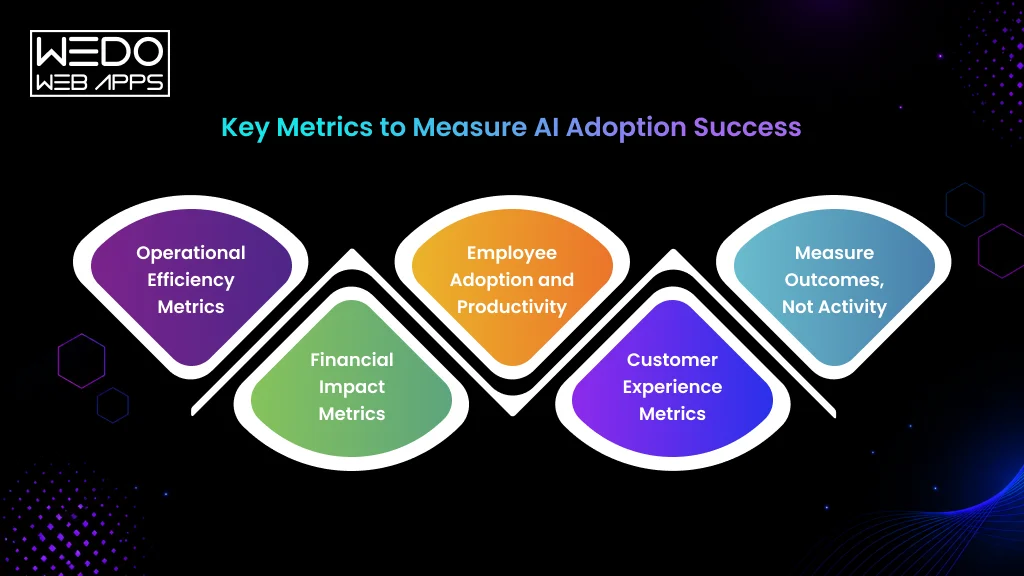
Successful modernization initiatives establish clear data governance policies, define ownership, and improve data quality before introducing AI-driven capabilities.

Remember: modern applications cannot compensate for poor data.

Align Technology Decisions with Business Goals

A modernization initiative should never be driven solely by technology trends.

Before selecting tools, cloud platforms, or AI solutions, organizations should clearly define the business outcomes they want to achieve.

These might include:

  • Reducing operational costs.
  • Improving customer satisfaction.
  • Accelerating product releases.
  • Strengthening cybersecurity.
  • Increasing operational efficiency.
  • Enabling AI-powered business processes.

When modernization decisions are tied to measurable business objectives, it’s much easier to evaluate ROI and prioritize investments.

Build Security into Every Phase

Security shouldn’t be treated as the final step before deployment.

Every modernization activity, from application assessment to cloud migration and AI integration, should include security reviews, access controls, compliance validation, and continuous monitoring.

This proactive approach helps organizations:

  • Reduce cyber risk.
  • Meet regulatory requirements.
  • Protect sensitive business data.
  • Build trust with customers and stakeholders.

Security becomes significantly more effective when it’s integrated into the modernization lifecycle rather than added afterward.

Invest in People Alongside Technology

Technology alone doesn’t determine modernization success.

Employees must understand:

  • Why modernization is happening.
  • How new systems improve daily work.
  • What changes to expect.
  • Where to access training and support.

Organizations that actively involve business users, IT teams, and leadership throughout the modernization journey generally experience higher adoption rates and smoother transitions.

After all, even the most advanced technology delivers limited value if people don’t use it effectively.

Expert Insight

Most modernization failures aren’t caused by technology; they’re caused by planning, governance, and change management. Organizations that combine a clear business strategy with phased implementation, strong stakeholder alignment, and experienced technical leadership consistently achieve better long-term outcomes than those focused solely on replacing legacy systems.

Modernization Success Checklist

  • Before launching your modernization initiative, ask yourself:
  • Have we prioritized applications based on business value?
  • Is our enterprise data accurate and ready for AI?
  • Have we selected the right modernization strategy for each application?
  • Are security and compliance integrated into the project plan?
  • Do we have a phased rollout strategy to minimize business disruption?
  • Have we prepared employees for organizational change?
  • Are we measuring success using business outcomes, not just technical milestones?

If you can confidently answer “yes” to these questions, your modernization initiative is far more likely to deliver lasting business value.

Section Takeaway

Every legacy modernization project involves risk, but those risks don’t have to become roadblocks. By approaching modernization as a business transformation initiative, prioritizing data readiness, embedding security from the start, and modernizing incrementally, organizations can reduce uncertainty while building a stronger foundation for AI integration and sustainable digital transformation.

Business Outcomes Beyond Technology

The success of legacy software modernization shouldn’t be measured by how many applications were migrated or how much legacy code was replaced. The real measure of success is the business value it creates. When modernization is aligned with organizational goals, it becomes a catalyst for innovation, operational excellence, and sustainable growth; not just a technology upgrade.

By building an AI-ready technology foundation, organizations can improve efficiency, respond faster to market changes, and create new opportunities that weren’t possible with disconnected, aging systems.

Operational Benefits

Modernized systems simplify day-to-day operations by reducing complexity and enabling teams to work more efficiently.

Organizations commonly experience:

  • Reduced technical debt, making applications easier to maintain and enhance.
  • Faster software releases through modern development and deployment practices.
  • Lower maintenance and infrastructure costs by retiring outdated technologies.
  • Improved system reliability, reducing downtime and business interruptions.
  • Greater operational efficiency by automating repetitive processes and minimizing manual work.

These improvements allow IT teams to shift their focus from maintaining legacy infrastructure to delivering new digital capabilities that support business growth.

Customer Benefits

Customers may never know your systems have been modernized, but they’ll notice the difference in the experience you deliver.

Modernization helps organizations:

  • Provide faster and more responsive digital experiences.
  • Deliver personalized interactions powered by AI and connected customer data.
  • Improve service availability through more resilient applications.
  • Launch new products and features more quickly.
  • Respond to customer needs with greater speed and accuracy.

In competitive markets, these improvements can strengthen customer satisfaction, increase retention, and create meaningful differentiation.

Strategic Benefits

The most significant value of legacy modernization often emerges over time.

Instead of simply solving today’s technical challenges, modernization prepares organizations for tomorrow’s opportunities.

Strategic outcomes include:

  • Business agility, allowing teams to adapt quickly to changing market conditions.
  • Scalable technology foundations that support future growth without repeated infrastructure overhauls.
  • Faster AI adoption, enabling organizations to integrate intelligent capabilities as business needs evolve.
  • Better decision-making through connected, high-quality enterprise data.
  • Improved resilience, helping organizations respond more effectively to disruption and change.

These long-term capabilities position modernization as a strategic investment rather than a one-time project.

Legacy Modernization Business Impact

The table below summarizes how modernization translates into measurable business outcomes.


Modernization ImprovementBusiness OutcomeLong-Term Value
Reduced technical debtFaster development cyclesContinuous innovation
API-first architectureEasier AI and system integrationGreater technology flexibility
Modernized data ecosystemBetter analytics and AI accuracySmarter business decisions
Cloud-native infrastructureImproved scalability and reliabilityLower operating costs
Automated workflowsIncreased productivityHigher operational efficiency
Stronger security controlsReduced business riskGreater customer and stakeholder trust


From Cost Center to Growth Enabler

For many years, legacy modernization was viewed primarily as a cost-saving initiative.

Today, that perspective has changed.

Organizations increasingly invest in modernization to:

  • Launch AI-powered products and services.
  • Accelerate digital innovation.
  • Expand into new markets more quickly.
  • Improve collaboration across departments.
  • Create technology ecosystems that evolve alongside business strategy.

Rather than asking, “How much will modernization cost?”, leading organizations ask, “What opportunities are we missing if we don’t modernize?”

That shift in thinking is what separates organizations that react to change from those that lead it.

Executive Insight

Legacy software modernization isn’t just about reducing operational costs; it’s about increasing an organization’s capacity to innovate. Businesses with modern, connected technology foundations are better positioned to adopt AI, respond to customer expectations, and capitalize on new market opportunities without being constrained by outdated systems.

Real-World Business Scenario

Consider a manufacturing company operating with separate systems for production, inventory, procurement, and customer orders.

Before modernization:

  • Production planning relied on delayed reports.
  • Inventory decisions were largely reactive.
  • Customer updates required manual coordination across departments.
  • AI forecasting initiatives struggled due to fragmented data.

After modernization:

  • Operational data became available in real time through connected systems.
  • AI helped forecast demand and optimize inventory levels.
  • Teams collaborated using a unified technology platform.
  • Leadership gained faster insights for strategic decision-making.

The result wasn’t just better software; it was a business that could operate faster, make smarter decisions, and respond more effectively to market demand.

Section Takeaway

The greatest return on legacy software modernization isn’t measured by technical improvements alone. It’s reflected in faster innovation, stronger customer experiences, greater operational efficiency, and a technology foundation that supports continuous AI integration and digital transformation. When modernization is aligned with business strategy, it becomes a long-term investment in organizational growth rather than a short-term IT initiative.

Why Partner with an Experienced AI Software Development Company

Legacy software modernization is rarely just a technology upgrade. It often involves modernizing business-critical applications, integrating multiple enterprise systems, migrating sensitive data, strengthening security, and preparing the organization for future AI initiatives—all while keeping day-to-day operations running.

While internal development teams understand the business, they may not always have the specialized expertise or bandwidth required to execute large-scale modernization programs. Partnering with an experienced AI software development company brings proven methodologies, technical expertise, and strategic guidance that reduce implementation risk and accelerate business outcomes.

The right partner doesn’t simply modernize software; they help build a technology foundation that supports long-term innovation.

Strategic Modernization Expertise

Every legacy environment is different.

Some applications require minor improvements, while others need complete architectural redesigns. Choosing the wrong modernization strategy can increase costs, delay projects, and create new technical debt.

An experienced modernization partner helps organizations:

  • Assess the current technology landscape.
  • Prioritize applications based on business value.
  • Recommend the most suitable modernization strategy.
  • Develop phased implementation roadmaps.
  • Minimize disruption throughout the transformation journey.

This strategic planning ensures modernization investments deliver measurable business value rather than short-term technical improvements.

AI Integration Capabilities

Modernization and AI are no longer separate initiatives.

Organizations increasingly modernize software with future AI adoption in mind, making it essential to work with teams that understand both application modernization and AI integration services.

An experienced AI partner can help:

  • Identify high-impact AI opportunities.
  • Prepare enterprise data for AI.
  • Design API-first architectures.
  • Integrate AI into existing business workflows.
  • Implement scalable AI solutions aligned with business goals.

By considering AI requirements during modernization, businesses avoid costly redesigns later.

Cloud and Digital Transformation Experience

Modernization often extends beyond applications.

It may also involve cloud migration, infrastructure optimization, cybersecurity improvements, workflow automation, and enterprise-wide transformation initiatives.

A partner with expertise in digital transformation services can help organizations create a connected technology ecosystem instead of managing isolated modernization projects.

This broader perspective enables:

  • Better integration between business systems.
  • Improved scalability.
  • Greater operational resilience.
  • Faster adoption of emerging technologies.

End-to-End Software Engineering

Legacy modernization is a continuous journey rather than a one-time implementation.

From discovery and planning to development, testing, deployment, and ongoing optimization, organizations benefit from working with teams capable of supporting every stage of the software lifecycle.

Comprehensive engineering capabilities typically include:

  • Legacy application assessment.
  • Custom software development.
  • Cloud-native application development.
  • API development and integration.
  • AI solution implementation.
  • Performance optimization.
  • Ongoing maintenance and support.

Having a single technology partner throughout the lifecycle improves consistency, collaboration, and long-term maintainability.

A Business-First Approach to Modernization

Technology decisions should always support business outcomes.

The most successful modernization initiatives begin by understanding questions such as:

  • What business challenges need to be solved?
  • Which applications create the greatest value?
  • Where can AI improve productivity or customer experiences?
  • How can modernization reduce operational risk?
  • What roadmap best supports future business growth?

A business-first approach ensures modernization investments remain aligned with organizational priorities instead of becoming isolated IT projects.

Partner Evaluation Checklist

Before choosing a modernization partner, consider these questions:

  • Do they have experience modernizing enterprise applications?
  • Can they support both modernization and AI integration?
  • Do they recommend strategies based on business goals rather than technology trends?
  • Can they provide end-to-end software engineering capabilities?
  • Do they have relevant case studies demonstrating measurable business outcomes?
  • Will they continue supporting optimization after deployment?

The answers to these questions often reveal whether a partner can deliver lasting business value, not just complete a migration project.

Why Organizations Choose WEDOWEBAPPS

At WEDOWEBAPPS, we combine software engineering expertise with AI-driven innovation to help businesses modernize legacy applications without losing the value built into existing systems. Our approach focuses on creating scalable, secure, and future-ready technology ecosystems that enable organizations to adopt AI with confidence.

Whether you’re modernizing a single application or transforming an enterprise technology landscape, our team helps you:

  • Assess and prioritize legacy systems.
  • Define a modernization roadmap aligned with business goals.
  • Build scalable cloud-native applications.
  • Implement secure AI integration services.
  • Accelerate digital transformation through custom software solutions.
  • Continuously optimize applications as business needs evolve.

Rather than treating modernization as a standalone project, we help organizations create technology foundations that continue delivering value long after implementation.

Key Takeaway

Legacy software modernization isn’t about replacing every legacy application; it’s about creating a technology foundation that enables continuous innovation. Organizations that modernize strategically can reduce technical debt, improve data accessibility, strengthen security, accelerate AI integration, and build the agility needed for long-term digital transformation.

Before starting any modernization initiative, remember these five principles:

  • Modernize with a business objective, not just a technology objective. Every decision should support measurable business outcomes such as operational efficiency, customer experience, or AI adoption.
  • Prioritize high-value applications first. Focus on systems that create the greatest business impact instead of attempting to modernize everything at once.
  • Treat data as a strategic asset. High-quality, connected, and governed data is essential for successful AI initiatives.
  • Choose the right modernization strategy for each application. Rehosting, refactoring, rearchitecting, rebuilding, and replacing all serve different business needs.
  • View modernization as an ongoing capability rather than a one-time project. Technology, customer expectations, and AI capabilities will continue to evolve, and your systems should be able to evolve with them.

Legacy Modernization at a Glance


Focus AreaKey QuestionDesired Outcome
Business StrategyWhy are we modernizing?Clear business goals and measurable ROI
ApplicationsWhich systems create the most value?Prioritized modernization roadmap
DataIs our data AI-ready?Reliable, connected, and governed data
TechnologyWhich modernization strategy fits best?Scalable and future-ready architecture
AI ReadinessCan our systems support intelligent capabilities?Faster AI adoption and innovation
Continuous ImprovementHow will we evolve after modernization?Sustainable digital transformation


Organizations that gain the greatest value from legacy software modernization don’t chase the latest technology trends; they build adaptable technology ecosystems that can support whatever comes next. AI may be today’s priority, but the real competitive advantage lies in having systems that can continuously integrate emerging technologies, respond to changing business needs, and scale without requiring another complete transformation.

Conclusion

Legacy software modernization is no longer just about upgrading outdated systems; it’s about creating a technology foundation that enables successful AI integration and long-term digital transformation. Organizations that modernize strategically can reduce technical debt, improve business agility, and unlock new opportunities for innovation without disrupting critical operations.

The question isn’t whether your legacy systems need to evolve; it’s whether they’re ready to support your next phase of growth. With the right modernization strategy, businesses can build scalable, AI-ready systems that deliver value today while preparing for tomorrow.


AI-Ready Legacy Software Modernization

13 AI Implementation Mistakes That Cause Project Failure

Introduction

AI can accelerate growth, improve efficiency, and can also allow you to create new opportunities, but only when implemented with a clear purpose. Still, there are many organizations that invest heavily in artificial intelligence and still struggle to achieve meaningful results.

The reason is often not the technology itself. Most setbacks stem from preventable AI implementation mistakes that occur before and during execution. Unclear objectives, poor planning, unrealistic expectations, and weak adoption strategies can quickly turn a promising initiative into an expensive lesson.

Many cases of AI project failure can be traced back to overlooked AI planning mistakes rather than technical limitations during software development. Organizations that rush into AI without a well-defined AI strategy often find it difficult to scale initiatives, measure ROI, or gain stakeholder buy-in.

In this guide, we will examine the most common AI implementation mistakes businesses make and the practical steps to avoid them.

Why AI Projects Fail More Often Than Expected

Organizations are investing in AI at an unprecedented rate, yet many initiatives fail to deliver the expected business impact. The challenge is rarely the technology itself. More often, the problem lies in how AI is planned, implemented, and managed.

Many businesses approach AI with ambitious goals but without the foundation needed to achieve them. This disconnect often creates a gap between expectations and actual outcomes.

Quick Answer: Why Do AI Projects Fail?

Most cases of AI project failure occur because organizations lack clear business objectives, reliable data, stakeholder alignment, and a well-defined AI strategy. Combined with poor execution and common AI planning mistakes, these issues prevent AI initiatives from generating measurable business value.

The Gap Between AI Ambitions and Business Outcomes

Many companies adopt AI because they want to improve efficiency, reduce costs, or gain a competitive advantage. However, success becomes difficult when AI initiatives are driven by trends rather than business needs.


AI GoalBusiness Challenge
Implement AI toolsNo clear problem to solve
Automate processesUndefined success metrics
Deploy AI quicklyLimited organizational readiness


When business outcomes are unclear, measuring success becomes equally difficult.

Common Patterns Behind AI Project Failure

Several AI implementation mistakes appear repeatedly across successful projects:

  • Starting without defined objectives.
  • Using poor quality or fragmented data.
  • Expecting immediate ROI.
  • Ignoring employee adoption and training.
  • Scaling before validating results.

The Role of Strategy, Planning, and Execution

Successful AI initiatives are built on more than technology. They require a strong AI strategy, careful planning, and disciplined execution.

The most successful organizations typically:

  • Align AI initiatives with business goals.
  • Assess data readiness early.
  • Establish measurable KPIs.
  • Create a roadmap before development begins.

Without these fundamentals, even promising AI projects can struggle to deliver meaningful results.

The 13 Most Common AI Implementation Mistakes

Many organizations assume that selecting the right AI tool is the most important factor in project success. In reality, most AI implementation mistakes occur before weak adoption strategies; these mistakes can significantly increase the risk of AI project failure.

Let’s start with one of the most common and costly mistakes businesses make:

Mistake 1: Launching AI Without Clear Business Objectives

One of the fastest ways to derail an AI initiative is to start with the technology instead of the business problem. Organizations often decide to “implement AI” without clearly defining the challenges needed to be solved.

When objectives are vague, teams struggle to prioritize use cases, allocate resources, and demonstrate ROI. As a result, projects may generate interesting outputs but fail to create meaningful business value.

What This Looks Like in Practice


ApproachLikely Outcome
“We need an AI solution”Unclear direction and success criteria
“Let’s add AI to our processes.”Difficulty proving value
“We want to reduce customer support resolution time by 30%.”Measurable business outcome
“Let’s automate invoice processing to reduce manual effort”Clear implementation roadmap


The difference is simple: successful AI initiatives start with a business objective, not a technology objective.

Why This Mistake Happens

Some of the most common reasons include:

  • Pressure to keep up with competitors.
  • Executive enthusiasm without a defined use case.
  • Lack of alignment between business and technical teams.
  • Absence of measurable success metrics.
  • Focusing on AI capabilities rather than business outcomes.

These are often early AI planning mistakes that create challenges throughout the implementation lifecycle.

How to Avoid It

Before investing in any AI solution, answer these questions:

  • What specific business problem are we solving?
  • What KPI will define success?
  • How will this initiative impact revenue, cost, productivity, or customer experience?
  • What is the expected timeline for measurable results?

A strong AI strategy connects every AI initiative to a business goal. When objectives are clear from the start, organizations can prioritize the right use cases, measure outcomes effectively, and significantly reduce the likelihood of project failure.

Mistake 2: Treating AI as a Technology Project Instead of a Business Initiative

Many organizations view AI as an IT or engineering project. As a result, decisions are often driven by technical capabilities rather than business priorities. While technology is an important component, AI initiatives deliver value only when they support a specific business objective.

This mindset is one of the most common AI implementation mistakes because it creates a disconnect between development efforts and organizational goals. Teams may successfully deploy an AI solution, yet struggle to demonstrate its impact on efficiency, revenue, customer experience, or operational performance.

Technology First vs Business First


Technology First ApproachBusiness First Approach
Focuses on AI features and modelsFocuses on business outcomes
Success measured by deploymentSuccess measured by business impact
Limited stakeholder involvementCross-functional collaboration
Difficult to justify ROIClear value proposition and KPIs


When AI is treated solely as a technology initiative, adoption often becomes an afterthought. Employees may not understand how to use the solution, leadership may question its value, and projects can lose momentum despite being technically successful.

Warning Signs of This Mistake

  • Business teams are rarely involved in planning discussions.
  • Success is defined by launching the solution rather than achieving results.
  • AI use cases are selected based on trends rather than business needs.
  • Teams cannot clearly explain the expected business impact.

These issues frequently contribute to AI project failure, especially when organizations attempt to scale AI across multiple departments.

How to Avoid It

A successful AI strategy starts by identifying business goals before evaluating tools or technologies.

Consider the following questions:

  • Which business challenge are we trying to solve?
  • Who will benefit from the solution?
  • How will success be measured?
  • What operational or financial impact do we expect?

Organizations that align AI initiatives with business objectives are far more likely to achieve measurable outcomes and avoid costly AI planning mistakes later in the project lifecycle.

Mistake 3: Choosing AI Use Cases With Low Business Impact

Not every business problem requires AI, and not every AI use case delivers meaningful value. One of the most overlooked AI implementation mistakes is investing time and resources into projects that generate limited business impact.

In many cases, organizations select use cases based on what’s technically possible rather than what’s strategically valuable. While these projects may demonstrate AI capabilities, they often struggle to justify investment or gain long-term support from stakeholders.

High Impact vs Low Impact AI Use Cases


Low Impact Use CasesHigh Impact Use Cases
Minor workflow enhancementsRevenue growth opportunities
Features with limited adoptionCustomer expectation improvements
Nice-to-have automationCost reduction initiatives
Experimental projects without KPIsSolutions tied to measurable business outcomes


A use case may be technically impressive, but if it doesn’t solve a meaningful business challenge, its value will be difficult to prove.

Signs You’re Pursuing the Wrong Use Case

  • The business impact cannot be clearly quantified.
  • Success metrics are undefined.
  • Stakeholders struggle to explain the expected ROI.
  • The problem could be solved without AI.
  • Adoption is expected to be low from the start.

These warning signs often lead to AI project failure because teams invest resources without creating measurable outcomes.

How to Avoid It

Before approving an AI initiative, evaluate each use case against three key criteria:

  • Business Value: Will it increase revenue, reduce costs, improve efficiency, or strengthen customer experience?
  • Feasibility: Do you have the data, resources, and expertise required?
  • Scalability: Can the solution create value beyond a single team or department?

A well-defined AI strategy prioritizes use cases that align with business goals rather than trends. This approach helps organizations avoid common AI planning mistakes and focus on initiatives that can deliver measurable results.

Mistake 4: Skipping the AI Planning and Discovery Phase

Many organizations are eager to move from idea to implementation as quickly as possible. However, rushing into development without proper planning is one of the most costly AI implementation mistakes businesses can make.

The planning and discovery phase helps organizations validate use cases, assess data readiness, identify potential risks, and define success metrics before significant resources are committed. When this step is skipped, teams often encounter unexpected challenges that delay progress and increase costs.

What Happens When Planning Is Overlooked?


Without PlanningWith Proper Discovery
Unclear project scopeClearly defined objectives
Data issues discovered lateData readiness assessed early
Misaligned stakeholder expectationsShared understanding of goals
Higher risk of delays and reworkSmoother implementation process


Many cases of AI project failure can be traced back to decisions made before development even begins. A lack of preparation often leads to unrealistic timelines, budget overruns, and solutions that fail to address the intended business problem.

Common AI Planning Mistakes

  • Starting development without defining KPIs.
  • Failing to evaluate data quality and availability.
  • Overlooking compliance and governance requirements.
  • Not identifying key stakeholders early.
  • Underestimating implementation costs and timelines.

How to Avoid It

Before launching an AI initiative, create a discovery roadmap that covers:

  • Business objectives and expected outcomes.
  • Data availability and quality assessment.
  • Technical and operational requirements.
  • Risk, compliance, and governance considerations.
  • Success metrics and measurement plans.

A strong AI strategy begins long before implementation. Organizations that invest time in planning and discovery are better positioned to avoid costly setbacks and achieve sustainable business results.

Mistake 5: Understanding Data Quality Requirements

AI systems are only as reliable as the data they learn from. Even the most advanced models can produce inaccurate, biased, or inconsistent results when trained on poor quality data. This is why data-related issues remain one of the leading causes of AI project failure.

Many organizations assume they have enough data to support an AI initiative, only to discover that the data is incomplete, outdated, duplicated, or spread across multiple systems. These challenges can significantly affect model performance and business outcomes.

Common Data Quality Issues


Data ChallengePotential Impact
Missing dataIncomplete insights and predictions
Inaccurate recordsUnreliable outputs
Duplicate entriesDistorted results
Inconsistent formatsIntegrations and processing challenges
Siloed data sourcesLimited visibility across operations


Without addressing these issues, businesses risk making decisions based on flawed information.

Warning Signs of Poor Data Readiness

  • Data is stored across disconnected systems.
  • Teams frequently question data accuracy.
  • There are no established data governance processes.
  • Significant manual cleaning is required before analysis.
  • Different departments report conflicting figures.

These problems often originate from overlooked AI planning mistakes and become more expensive to fix as the project progresses.

How to Avoid It

Before implementation begins, assess the quality, accessibility, and relevance of your data.

Focus on:

  • Establishing data governance standards.
  • Identifying and resolving data inconsistencies.
  • Centralizing critical data sources where possible.
  • Defining data ownership and accountability.
  • Conducting a data readiness assessment before development.

A successful AI strategy treats data as a business asset rather than a technical requirement. Organizations that prioritize data quality early are far more likely to avoid costly AI implementation mistakes and achieve reliable results from their AI initiatives.

Mistake 6: Expecting Immediate ROI From AI Investments

AI has the potential to deliver significant business value, but expecting instant results is one of the most common AI implementation mistakes organizations make. Unlike traditional software deployments, AI initiatives often require time for data preparation, model training, testing, optimization, and user adoption.

When expectations are unrealistic, stakeholders may become frustrated if results do not appear within the first few weeks or months. This can lead to reduced support, budget cuts, or premature project termination.

The Reality of AI ROI


Unrealistic ExpectationRealistic Expectation
Immediate business impactGradual improvement over time
Instant cost savingsValue increases as models mature
Perfect results from day oneContinuous optimization is required
Company-wide transformationSuccess starts with focused use cases


The most successful organizations view AI as a long-term investment rather than a quick fix.

Why Unrealistic Expectations Create Problems

  • Projects are evaluated before they have time to mature.
  • Teams focus on short-term wins instead of sustainable outcomes.
  • Stakeholder confidence declines when expectations are not met.
  • Resources may be redirected before value is fully realized.

These factors frequently contribute to AI project failure, even when the underlying solution has strong potential.

How to Avoid It

Set realistic expectations from the beginning by defining both short-term and long-term goals.

Consider tracking:

  • Operational efficiency improvements.
  • Time savings from automation.
  • Customer experience metrics.
  • Cost reductions over time.
  • Revenue growth opportunities.

A well-planned AI strategy includes clear milestones, realistic timelines, and measurable KPIs. This helps organizations avoid common AI planning mistakes and evaluate progress based on business outcomes rather than unrealistic expectations.

Mistake 7: Ignoring Change Management and Employee Adoption

An AI solution can be technically successful and still fail to deliver business value if employees do not use it. This is why overlooking change management is one of the most expensive AI implementation mistakes organizations make.

Many businesses focus heavily on development and deployment but spend little time preparing employees for new workflows, responsibilities, or tools. As a result, resistance increases, adoption remains low, and the expected benefits never fully materialize.

Why Employees Resist AI Initiatives

Common concerns include:

  • Fear of job displacement.
  • Lack of understanding about how AI works.
  • Uncertainty about new processes and responsibilities.
  • Limited training and support.
  • Concerns about the accuracy of AI-generated outputs.

When these concerns are not addressed, adoption becomes a significant barrier to success.

The Impact of Poor Adoption


ChallengeBusiness Impact
Low user engagementReduced return on investment
Resistance to new workflowsSlower implementation progress
Lack of trust in AI outputsInconsistent usage across teams
Inadequate trainingLower productivity gains


These issues often contribute to AI project failure, even when the technology performs as expected.

How to Avoid It

Organizations can improve adoption by:

  • Involving employees early in the process.
  • Clearly communicating the purpose and benefits of AI.
  • Providing role-specific training and support.
  • Gathering feedback throughout implementation.
  • Demonstrating how AI supports employees rather than replacing them.

A successful AI strategy focuses on people as much as technology. Businesses that prioritize change management are more likely to avoid costly AI planning mistakes and achieve lasting value from their AI investments.

Mistake 8: Building AI Without Governance and Compliance Controls

Many organizations focus on what AI can do but spend far less time considering how it should be managed. This oversight is one of the most serious AI implementation mistakes, especially as regulations and data privacy requirements continue to evolve.

Without proper governance, AI systems can create risks related to data security, compliance, transparency, and accountability. What starts as a promising initiative can quickly become a legal, operational, or reputational challenge.

Why AI Governance Matters

AI governance establishes the policies, processes, and responsibilities needed to ensure AI systems are used responsibly and consistently.

Key areas include:

  • Data privacy and protection.
  • Regulatory compliance.
  • Model transparency.
  • Risk management.
  • Accountability and oversight.

When these areas are ignored, organizations expose themselves to unnecessary risks that can undermine the success of the entire initiative.

Common Governance Gaps


Governance IssuePotential Impact
No data usage policiesPrivacy and compliance concerns
Limited model oversightUnreliable or biased outputs
Unclear ownershipLack of accountability
Inadequate risk assessmentIncreased operational risk
Poor documentationDifficulty meeting compliance requirements


These gaps often remain unnoticed until they create significant business problems.

How to Avoid It

Before deploying AI solutions, organizations should establish a governance framework that includes:

  • Clear policies for data collection and usage.
  • Defined roles and responsibilities.
  • Regular model monitoring and audits.
  • Risk assessment procedures.
  • Compliance reviews for applicable regulations.

A strong AI strategy balances innovation with accountability. By building governance into the foundation of an AI initiative, organizations can reduce risk, strengthen trust, and avoid many of the factors that contribute to AI project failure.

Mistake 9: Selecting the Wrong AI Models or Tools

With hundreds of AI platforms, models, and frameworks available today, it is easy to assume that choosing the most advanced solution will produce the best results. In reality, selecting technology that does not align with business requirements is one of the most common AI implementation mistakes organizations make.

Common Tool Selection Mistakes

  • Choosing tools based on popularity rather than business needs.
  • Prioritizing features over practical requirements.
  • Ignoring integration capabilities.
  • Overlooking scalability and maintenance costs.
  • Selecting models that require data the organization doesn’t have.

These decisions can create technical challenges that slow implementation and reduce ROI.

Choosing the Right Fit


ConsiderationKey Question
Business GoalsDoes the tool support the intended outcome?
Data RequirementsDo we have the data needed to make it effective?
IntegrationWill it work with existing systems and workflows?
ScalabilityCan it support future growth and expansion?
CostDoes the expected value justify the investment?


The best solution is not always the most powerful one. It is the one that solves the business problem efficiently and sustainably.

How to Avoid It

Before selecting an AI platform or model:

  • Define business and technical requirements.
  • Evaluate multiple solutions against the same criteria.
  • Conduct pilot testing before full deployment.
  • Assess integration and long-term maintenance needs.
  • Consider both current and future business requirements.

Thorough testing is also essential before deployment, and quality assurance services can help validate functionality, performance, security, and reliability across AI-powered applications.

A well-defined AI strategy helps organizations evaluate technology through a business lens rather than chasing trends. This approach reduces unnecessary complexity and lowers the risk of AI project failure caused by poor technology decisions.

Mistake 10: Failing to Integrate AI into Existing Workflows

An AI solution cannot deliver value if it operates separately from the processes employees use every day. Yet many organizations treat deployment as the finish line, only to discover that their new AI system is disconnected from existing workflows, tools, and decision-making processes.

Businesses looking to automate complex workflows can also explore agentic AI development services to build AI agents that can make decisions, execute tasks, and interact with existing business systems.

This is one of the most overlooked AI implementation mistakes because the technology may work exactly as intended, but employees are forced to switch between systems, manually transfer data, or bypass the solution altogether.

Signs of Poor AI Integration

  • Employees continue using manual processes.
  • AI outputs require significant manual intervention.
  • Teams switch between multiple platforms to complete a task.
  • Adoption remains low despite successful deployment.
  • Business processes remain largely unchanged after implementation.

When AI is not embedded into day-to-day operations, its impact is often limited.

Workflow Integration Matters More Than Deployment


Poor IntegrationEffective Integration
AI operates as a separate toolAI becomes part of existing workflows
Additional manual steps are requiredProcesses become faster and simpler
Low employee engagementHigher adoption and usage
Limited business impactMeasurable operational improvements


The goal should not be to add another tool to an employee’s workload. The goal should be to make it easier, faster, or more accurate.

How to Avoid It

To maximize value from AI initiatives:

  • Map existing workflows before implementation.
  • Identify where AI can create the greatest impact.
  • Minimize process disruptions where possible.
  • Integrate AI outputs into systems employees already use.
  • Collect user feedback and refine workflows after deployment.

A successful AI strategy focuses on business processes, not just technology. Organizations that prioritize workflow integration are far more likely to avoid AI project failure and realize the full value of their AI investments.

Mistake 11: Neglecting Monitoring and Performance Measurement

Many organizations stop evaluating their AI initiatives once the solution is deployed. However, AI is not a “set it and forget it” technology. Models can lose accuracy, business requirements can change, and data quality can decline over time.

For organizations managing machine learning models in production, MLOps consulting services can help establish automated pipelines, model monitoring, lifecycle management, and continuous performance optimization.

Failing to monitor performance is one of the most costly AI implementation mistakes because issues often go unnoticed until they begin affecting business outcomes.

Why Continuous Monitoring Matters

Without ongoing measurement, organizations cannot determine whether an AI solution is delivering the expected value or identify opportunities for improvement.

Key areas to track include:

  • Model accuracy and reliability.
  • Business KPIs and ROI.
  • User adoption rates.
  • System performance and uptime.
  • Data quality trends.

Regular monitoring helps teams detect problems early and make informed adjustments.

What Happens Without Performance Tracking?


No MonitoringContinuous Monitoring
Declining model accuracy goes unnoticedIssues are identified and addressed early
Difficult proving ROIClear visibility into business impact
Reduced stakeholder confidenceData-driven decision making
Missed optimization opportunitiesOngoing performance improvements


Even high-performing AI solutions require periodic evaluation to remain effective.

How to Avoid It

Create a performance management framework before deployment.

This should include:

  • Clearly defined KPIs.
  • Regular performance reviews.
  • Automated monitoring where possible.
  • Feedback mechanisms for end users.
  • A process for retraining and improving models.

A strong AI strategy does not end at implementation. Organizations that continuously measure and optimize their AI initiatives are better positioned to avoid AI project failure and sustain long-term business value.

Mistake 12: Scaling AI Before Proving Value

One successful pilot does not automatically mean an AI solution is ready for organization-wide deployment. Yet many businesses rush to expand AI initiatives before validating their impact, making this one of the most common AI implementation mistakes.

Scaling too early can amplify existing issues. If the solution has data quality challenges, adoption barriers, or unclear ROI, those problems become more difficult and expensive to resolve at a larger scale.

Why Premature Scaling Is Risky

Before expanding an AI initiative, organizations should have clear evidence that it delivers measurable business value.

Consider the difference:


Scaling Too EarlyScaling at the Right Time
Limited proof of ROIDemonstrated business impact
Unresolved technical issuesStable and reliable performance
Low user retentionStrong engagement and feedback
Increased costs and complexityControlled and sustainable growth


The objective is not to scale quickly. The objective is to scale successfully.

Signs You’re Not Ready to Scale

  • Success metrics have not been achieved consistently.
  • User adoption remains low.
  • Performance varies across different scenarios.
  • Business value cannot be clearly measured.
  • Teams are still addressing operational challenges.

These warning signs often indicate that further refinement is needed before broader deployment.

How to Avoid It

Before scaling an AI initiative:

  • Validate results through a pilot program.
  • Measure ROI against predefined KPIs.
  • Gather feedback from users and stakeholders.
  • Resolve technical and operational issues.
  • Develop a phased rollout plan.

A well-executed AI strategy treats scaling as a milestone, not a starting point. Organizations that prove value first are far more likely to avoid AI project failure and achieve sustainable growth from their AI investments.

Mistake 13: Choosing the Wrong AI Development Partner

Even with a strong use case and a clear roadmap, the success of an AI initiative can depend heavily on the expertise of the team building it. Choosing a partner based solely on cost, promises, or technical jargon is one of the most expensive AI implementation mistakes organizations make.

An inexperienced partner may deliver a functional solution, but struggle with business alignment, scalability, integration, governance, or long-term support. These gaps can delay outcomes and increase the risk of AI project failure.

What to Look for in an AI Partner

The right partner should bring more than technical capabilities. They should understand your business goals and provide guidance throughout the implementation journey.


Evaluation AreaWhat to Assess
Industry ExperienceHave they solved similar business challenges?
Technical ExpertiseDo they have experience with relevant AI technologies?
Strategic GuidanceCan they help define use cases and success metrics?
Integration CapabilitiesCan they work with your existing systems?
Post-Deployment SupportDo they offer optimization and ongoing support?


A strong partner acts as an advisor, not just a service provider.

Red Flags to Watch For

  • Promising unrealistic timelines or ROI.
  • Focusing only on technology without discussing business outcomes.
  • Limited experience with similar projects.
  • Lack of a clear implementation methodology.
  • No plan for governance, monitoring, or long-term support.

These issues often surface later in the project when they are more difficult and costly to address.

How to Avoid It

Before selecting an AI partner:

  • Review relevant case studies and client success stories.
  • Assess both technical and business expertise.
  • Ask about implementation processes and governance practices.
  • Evaluate communication and collaboration capabilities.
  • Clarify expectations around support, maintenance, and scalability.

A successful AI strategy requires the right combination of technology, planning, and expertise. Partnering with an experienced AI development team can help organizations avoid common AI planning mistakes, reduce implementation risks, and accelerate the path to measurable business outcomes.

AI Planning Mistakes That Occur Before Development Begins

AI Project Planning Mistakes

Many organizations assume that AI projects fail during development or deployment. In reality, some of the most damaging AI planning mistakes happen long before a solution is built. Decisions made during the planning phase influence everything from project scope and budget to adoption and ROI.

When organizations skip critical planning activities, they often spend months addressing issues that could have been identified in the early stages. This not only increases costs but also raises the likelihood of AI project failure.

The table below highlights some of the most common planning mistakes and their potential impact:


AI Planning MistakePotential Consequence
Lack of stakeholder alignmentConflicting priorities and delayed decisions
Undefined success metricsDifficulty measuring ROI and business impact
Poor data readiness assessmentUnexpected implementation challenges
No implementation roadmapScope creep and project delays
Underestimating total costsBudget overruns and resource constraints


Lack of Stakeholder Alignment

AI initiatives often involve multiple teams, including leadership, operations, IT, data, compliance, and end users. When these stakeholders are not aligned on goals, priorities, and expectations, projects can lose momentum before they even begin.

Common signs of misalignment:

  • Different teams have different definitions of success.
  • Decision-making becomes slow and inconsistent.
  • Business and technical teams operate in silos.

Undefined Success Metrics

One of the most common AI implementation mistakes is launching a project without knowing how success will be measured.

Before development starts, organizations should establish clear KPIs such as:

  • Cost reduction targets.
  • Productivity improvements.
  • Customer satisfaction metrics.
  • Revenue growth opportunities.

Without measurable outcomes, proving the value of an AI initiative becomes difficult.

Incomplete Data Readiness Assessment

Many businesses overestimate the quality and availability of their data. Discovering data issues after development begins can lead to delays, rework, and additional costs.

Before moving forward, evaluate:

  • Data quality and accuracy.
  • Data accessibility.
  • Data governance practices.
  • Availability of historical data.

No Implementation Roadmap

A roadmap provides structure and direction throughout the project lifecycle. Without one, teams often struggle with changing priorities, unrealistic timelines, and unclear responsibilities.

A basic roadmap should outline:

  1. Business objectives.
  2. Project milestones.
  3. Resource requirements.
  4. Success metrics.
  5. Deployment and scaling plans.

Budgeting Only for Development

Many organizations allocate budgets for building AI solutions but overlook expenses related to integration, training, governance, maintenance, and optimization.

To create a sustainable AI strategy, budgeting should account for the full lifecycle of the initiative rather than just the development phase.

The stronger the planning process, the lower the risk of costly mistakes later. Organizations that address these foundational gaps early are far more likely to achieve successful AI outcomes.

Warning Signs Your AI Project Is at Risk of Failure

Reasons Behind AI Project Failure

Not every AI initiative fails suddenly. In most cases, warning signs appear weeks or even months before major issues become visible. The challenge is that many organizations overlook these signals until they begin affecting timelines, budgets, or business outcomes.

Recognizing these early indicators can help teams address problems before they turn into costly AI implementation mistakes.

Objectives Continue to Change

Project goals should evolve only when business requirements change. If objectives are constantly shifting, teams may struggle to prioritize tasks, measure success, or maintain momentum.

Potential impact:

  • Scope creep.
  • Delayed timelines.
  • Misaligned stakeholder expectations.

Teams Lack Ownership

Successful AI initiatives require clear accountability. When no individual or team is responsible for driving outcomes, decision-making slows and progress becomes inconsistent.

Common signs include:

  • Unclear roles and responsibilities.
  • Delayed approvals.
  • Frequent project bottlenecks.

AI Outputs Are Not Trusted

Even highly accurate AI systems can fail if employees do not trust the results. Low confidence often leads users to ignore recommendations or return to manual processes.


Warning SignBusiness Impact
Employees double-check every outputReduced productivity gains
Teams avoid using AI recommendationsLow adoption rates
Frequent complaints about reliabilityLimited business value


This issue is often linked to poor change management and communication.

Adoption Rates Remain Low

One of the clearest indicators of potential AI project failure is low user engagement after deployment.

If employees are not actively using the solution, investigate whether the problem is related to:

  • Training gaps.
  • Workflow integration issues.
  • Lack of perceived value.
  • User experience challenges.

Costs Rise Without Measurable Results

AI projects require investment, but costs should be accompanied by visible progress and measurable outcomes.

If expenses continue to increase while KPIs remain unchanged, it may indicate:

  • Poor project planning.
  • Misaligned use cases.
  • Technology selection issues.
  • Gaps in the overall AI strategy.

A Practical AI Strategy Framework to Reduce Failure Risk

AI Strategy for Project Success


Avoiding AI implementation mistakes is not just about fixing problems as they arise. It requires a structured approach that aligns business goals, data, people, and technology from the start. Organizations that consistently achieve positive outcomes follow a clear AI strategy rather than pursuing isolated AI initiatives.

The framework below can help reduce the risk of AI project failure and create a stronger foundation for long-term success.

Step 1: Define Business Outcomes First

Before discussing tools, models, or platforms, define the business outcome you want to achieve.

Ask questions such as:

  • What problem are we solving?
  • How will success be measured?
  • What business value do we expect?

Clear objectives help prevent many common AI planning mistakes later in the project.

Step 2: Assess Organizational Readiness

Not every organization is ready to implement AI at scale.

Evaluate:

  • Data quality and availability.
  • Technical infrastructure.
  • Internal expertise.
  • Leadership support.
  • Employee readiness.

Identifying gaps early reduces implementation risks and unexpected delays.

Step 3: Prioritize High-Impact Use Cases

Rather than launching multiple AI initiatives at once, focus on use cases that offer measurable business value.

Prioritization criteria:

  • Business impact.
  • Feasibility.
  • Scalability.
  • Resource requirements.

This approach helps organizations generate quick wins while minimizing risk.

Step 4: Establish Governance and Accountability

Strong governance ensures AI systems remain secure, compliant, and aligned with organizational objectives.

Key focus areas include:

  • Data governance.
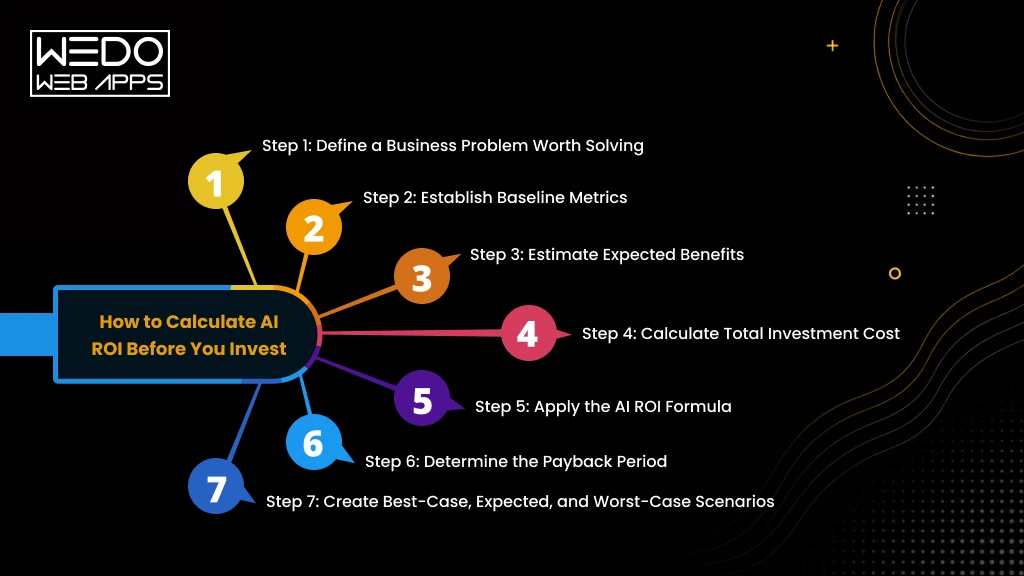
  • Compliance requirements.
  • Risk management.
  • Performance monitoring.
  • Stakeholder accountability.

Step 5: Launch a Pilot Before Scaling

Pilot projects provide an opportunity to validate assumptions, test performance, and gather user feedback before broader deployment.

A pilot should answer three critical questions:

  • Does the solution work?
  • Do users adopt it?
  • Does it deliver measurable business value?

Step 6: Measure, Improve, and Scale

AI initiatives should evolve based on data, feedback, and performance insights.

Track metrics such as:

  • ROI.
  • Productivity gains.
  • Cost savings.
  • User adoption.
  • Customer impact.

Once value has been demonstrated consistently, organizations can scale with greater confidence and a lower risk of AI project failure.

By following this framework, businesses can move beyond experimentation and build an AI strategy that supports sustainable growth, operational efficiency, and measurable outcomes.

AI Roadmap and Strategy Guide

Real Examples of AI Project Failure and the Lessons Learned

Many organizations learn valuable lessons from failed AI initiatives, but those lessons often come at a high cost. Examining real-world scenarios helps illustrate how common AI implementation mistakes can affect business outcomes and what organizations can do differently.

Example 1: Poor Data Led to Inaccurate Predictions

A retail company invested in an AI-driven demand forecasting solution to improve inventory planning. However, the model was trained on incomplete and inconsistent historical data.

What went wrong?

  • Data quality issues were identified too late.
  • Historical records contained inaccuracies.
  • No comprehensive data readiness assessment was conducted.

Lesson learned: Even advanced AI models cannot compensate for poor quality data. Data preparation should be a priority before development begins.

Example 2: Strong Technology, Weak Adoption

A financial services organization deployed an AI-powered recommendation system to support internal decision-making. While the technology performed well during testing, employees rarely used it after launch.


ChallengeOutcome
Limited employee trainingLow adoption rates
Lack of trust in AI outputsContinued reliance on manual processes
Poor workflow integrationMinimal business impact


Lesson learned: Technology alone does not drive success. Employee adoption and change management play a critical role in achieving measurable value.

Example 3: Scaling Too Quickly

A company achieved positive results from a small AI pilot and immediately expanded the solution across multiple departments. As usage increased, data inconsistencies, integration issues, and performance challenges began to emerge.

What went wrong?

  • The pilot did not fully validate scalability.
  • Operational challenges were not resolved before expansion.
  • Governance processes were still evolving.

Lesson learned: One of the most common AI planning mistakes is assuming a successful pilot guarantees enterprise-wide success. Scaling should happen only after performance, adoption, and ROI have been validated.

Key Takeaways From These Examples


Across industries, the causes of AI project failure are often surprisingly similar:

  • Poor data quality.
  • Weak stakeholder alignment.
  • Low employee adoption.
  • Inadequate planning.
  • Premature scaling.

Organizations that address these challenges early and build a clear AI strategy are far more likely to achieve sustainable results from their AI investments.

AI Implementation Readiness Checklist

Before investing in AI, organizations should evaluate whether they have the foundation needed for success. Many AI implementation mistakes occur because businesses focus on the technology while overlooking AI readiness factors such as data quality, governance, stakeholder alignment, and success measurement.

Use the checklist below to assess your organization’s preparedness before launching an AI initiative.

Strategic Readiness


QuestionStatus
Have you identified a clear business problem to solve?Yes/No
Are AI objectives aligned with business goals?Yes/No
Have success metrics and KPIs been defined?Yes/No
Is there executive sponsorship for the initiative?Yes/No


Data and Technology Readiness


QuestionStatus
Is the required data available and accessible?Yes/No
Is the data accurate, complete, and up to date?Yes/No
Can your existing infrastructure support AI adoption?Yes/No
Have integration requirements been evaluated?Yes/No


Organizational Readiness


QuestionStatus
Are stakeholders aligned on project goals?Yes/No
Have ownership and responsibilities been defined?Yes/No
Is there a plan for employee training and adoption?Yes/No
Have potential risks and resistance factors been identified?Yes/No


Governance and Risk Readiness


QuestionStatus
Are data governance policies in place?Yes/No
Have compliance requirements been reviewed?Yes/No
Is there a framework for monitoring AI performance?Yes/No
Have accountability and oversight roles been assigned?Yes/No


How To Interpret Your Results


Readiness ScoreAssessment
13-16 Yes AnswersStrong foundation for AI implementation
9-12 Yes AnswersModerate readiness with some gaps to address
5-8 Yes AnswersSignificant preparation required before implementation
0-4 Yes AnswersHigh risk of AI project failure without further planning


Organizations that complete this assessment before starting an initiative are better positioned to avoid common AI planning mistakes, allocate resources effectively, and build an AI strategy that delivers measurable business outcomes.

How AI Consulting Partners Help Prevent Implementation Mistakes

Building and scaling AI initiatives requires more than technical expertise. Organizations must align business objectives, data, processes, governance, and adoption strategies to achieve meaningful results. This is where the right consulting partner can make a significant difference.
Experienced AI consultants help organizations identify and address potential risks before they become costly AI implementation mistakes. They bring proven frameworks, industry knowledge, and practical experience that can accelerate outcomes while reducing uncertainty.

Where AI Consulting Partners Add Value


AreaHow Consultants Help
StrategyDefine goals, use cases, and success metrics
PlanningCreate implementation roadmaps and timelines
Data ReadinessAssess data quality and infrastructure requirements
GovernanceEstablish compliance and risk management frameworks
AdoptionSupport training, communication, and change management
OptimizationMonitor performance and identify improvement opportunities


Common Challenges They Have Solved

Many businesses seek external expertise when they encounter challenges such as:

  • Unclear AI priorities.
  • Limited in-house expertise.
  • Difficulty identifying high-value use cases.
  • Concerns around compliance and governance.
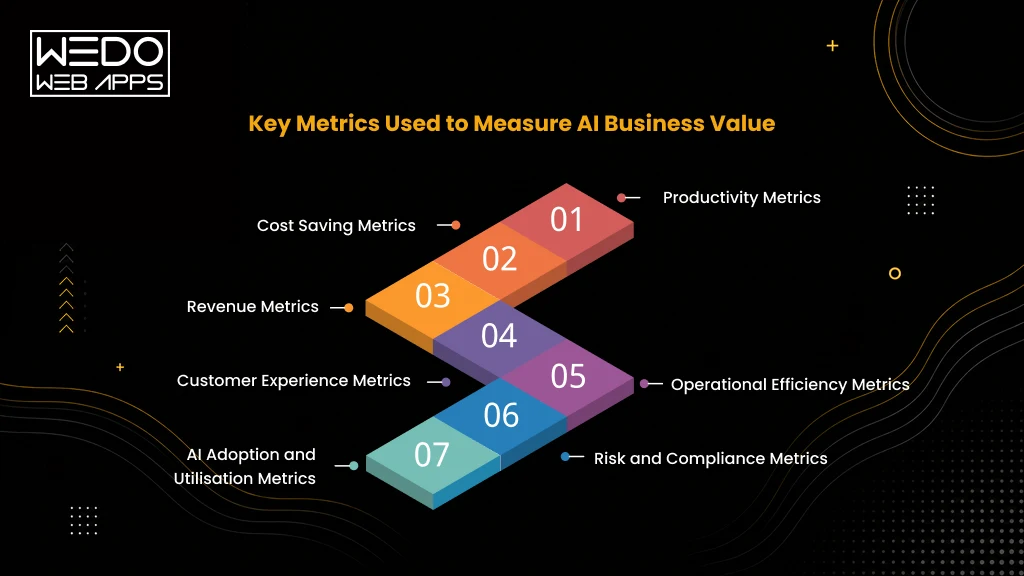
  • Low adoption or uncertain ROI.

Addressing these issues early can significantly reduce the likelihood of AI project failure.

Questions to Ask Before Choosing an AI Partner

Not all consulting firms offer the same level of expertise. Before selecting a partner, consider the following:
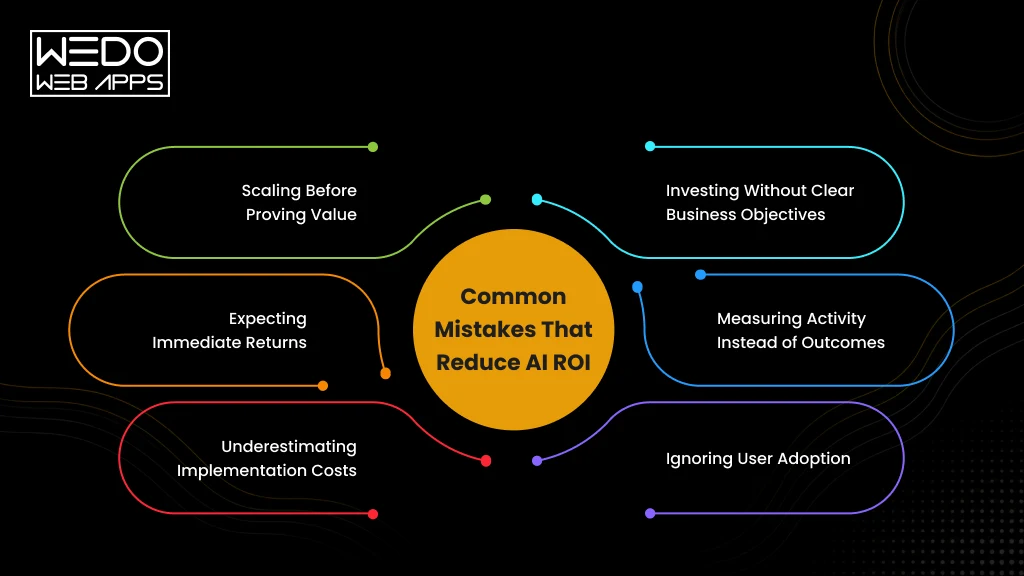
  • Do they have experience with similar projects or industries?
  • Can they demonstrate measurable business outcomes?
  • Do they provide strategic guidance in addition to technical support?
  • How do they approach governance, security, and compliance?
  • What support do they offer after deployment?

The Value of Expert Guidance

A strong AI strategy is built on informed decisions, realistic expectations, and a clear roadmap. The right consulting partner can help organizations avoid common AI planning mistakes, accelerate implementation, and maximize the value of their AI investments.

Rather than reacting to problems after they occur, businesses can benefit from expert guidance that helps them plan, execute, and scale AI initiatives with greater confidence.

Conclusion

AI has the potential to transform operations, improve decision-making, and create measurable business value. However, success is rarely determined by technology alone. As we’ve seen throughout this guide, many cases of AI project failure stem from avoidable decisions related to planning, execution, governance, and adoption.

From unclear objectives and poor data quality to weak change management and premature scaling, these AI implementation mistakes can significantly impact outcomes and ROI. The good news is that most of these challenges can be prevented with the right preparation and a structured approach, along with the help of an experienced AI app development company.

Organizations that invest time in avoiding common AI planning mistakes are better equipped to identify high-value use cases, align stakeholders, manage risks, and measure success effectively. More importantly, they are able to build an AI strategy that supports long-term business goals rather than short-term experimentation.

As AI adoption continues to grow, the organizations that succeed will not necessarily be the first to implement AI. They will be the ones that approach it with clear objectives, strong foundations, and a commitment to continuous improvement.

AI Strategy and Implementation

AI Adoption Framework for Small and Medium Businesses

Introduction

AI is quickly moving from a competitive advantage to a business necessity. What was once accessible only to large enterprises is now an advantage to businesses of all sizes through AI-powered tools, automation platforms, and intelligent analytics solutions. Yet, while interest in AI continues to grow, many small and medium businesses still struggle to answer a fundamental question:

Where should we start?

The challenge is not a lack of technology. It is the lack of a clear strategy for adoption and scaling it effectively. Without a structured AI adoption framework, businesses often invest in tools before identifying their objectives, resulting in disconnected initiatives and limited business impact.

Successful business AI adoption starts with understanding where AI can create value, which processes should be prioritized, and how implementation aligns with broader business goals. This requires careful AI planning, realistic expectations, and a clear path from experimentation to measurable outcomes.

A well-defined AI roadmap helps organizations navigate this process by outlining priorities, resources, timelines, and success metrics with the software development approach. Combined with a practical approach to AI implementation, it enables businesses to reduce risk, improve operational efficiency, and create a stronger foundation for long-term growth.

In this guide, we will walk through a step-by-step framework that helps small and medium businesses assess their readiness, identify high-impact opportunities, develop an actionable roadmap, and implement AI initiatives that deliver real business value.

What Is an AI Adoption Framework?

AI Adoption Framework Process

An AI adoption framework is a structured approach that helps businesses plan, deploy, manage, and scale artificial intelligence initiatives in alignment with their goals. Rather than implementing AI tools without a clear direction, businesses use a framework to identify opportunities, allocate resources, minimise risks, and measure outcomes.

For small and medium businesses, an AI adoption framework acts as a blueprint that connects AI planning, AI implementation, and long-term business objectives. It ensures that AI investments support operational improvements, customer experiences, and revenue growth instead of becoming isolated technology projects.

Why Businesses Need an AI Adoption Framework

Many organisations recognise the potential of AI but struggle to move from experimentation to measurable business results. A structured framework provides clarity on where to begin, what to prioritise, and how to scale initiatives effectively.

Key benefits include:

  • Aligning AI initiatives with business goals.
  • Prioritising high-value use cases.
  • Reducing implementation risks and unnecessary spending.
  • Creating a structured AI roadmap for growth.
  • Establishing governance and accountability.
  • Measuring the success of business AI adoption initiatives.

AI Adoption Framework vs AI Strategy vs AI Roadmap

Although these terms are often used interchangeably, they serve different purposes within an organisation’s AI journey.


ComponentPurposeKey Focus
AI Adoption FrameworkProvides the overall structure for adopting AI across the business.Governance, planning, implementation, and scaling.
AI StrategyDefines why the business is investing in AI.Business objectives, expected outcomes, and priorities.
AI RoadmapOutlines how AI initiatives will be executed over time.Milestones, timelines, resources, and deliverables.


Think of it this way:

  • The AI strategy defines the destination.
  • The AI roadmap outlines the route.
  • The AI adoption framework provides the system that keeps the entire journey organised and measurable.

Core Components of an AI Adoption Framework

A successful framework typically includes the following elements:


ComponentsPurpose
Business ObjectiveDefine what the organization aims to achieve with AI
Data ReadinessAssess data quality, accessibility, and governance
Technology InfrastructureEvaluate existing systems and AI capabilities
Workforce ReadinessIdentify training and skill requirements
AI GovernanceEstablish policies, compliance, and risk controls
Performance MeasurementTrack outcomes and return on investment


When these components work together, businesses can build a sustainable approach to AI planning, create a realistic AI roadmap, and execute AI implementation projects with greater confidence and control.

Why Many Small and Medium Businesses Delay AI Adoption

Business AI Adoption Guide

Small and medium businesses rarely reject AI because they do not see its potential. More often, they delay adoption because they are unsure where to start, what to prioritise, or how to justify the investment.

While AI tools have become more accessible, many businesses still face practical barriers that slow decision-making and implementation. Understanding these challenges is the first step toward building a successful AI adoption framework.

Limited Budget & Resource Concerns

For most SMBs, every technology investment competes with other business priorities.

Imagine having to choose between:

  • Hiring an additional employee
  • Upgrading business software
  • Expanding marketing efforts
  • Investing in AI initiatives

Without a clear business case, AI moves to the bottom of the list.

The good news is that modern business AI adoption does not always require large budgets or dedicated AI teams. Many businesses begin with affordable AI tools that automate repetitive tasks, improve customer service, or support internal operations before expanding their efforts.

What often changes leadership’s perspective?

When AI is positioned as a solution to a specific business problem rather than a technology investment.

Lack of Knowledge & Expertise

One of the most common reasons businesses postpone AI planning is uncertainty. Business leaders frequently ask:

  • Do we need an AI specialist?
  • Which processes should we automate first?
  • How do we know if AI will actually deliver value?
  • What tools are worth investing in?

These questions create a decision bottleneck. Teams spend months researching AI opportunities but never move toward implementation because there is no clear framework for evaluating options.

In many cases, the challenge is not learning everything about AI. It is understanding where AI fits within existing business processes.

Uncertainty About Business Value

Several enterprises know what AI can do. But only fewer understand what AI should do for their business. Consider the following difference to have a clear idea:


AI ActivityBusiness Outcome
Automating customer supportFaster response times and lower support costs
AI-powered forecastingBetter inventory planning
Marketing automationHigher campaign efficiency
Document processingReduced administrative workload


Here, the focus should never be on adopting AI for the sake of adoption. The focus should be on answering one question:

Which business problem will AI solve first?

Businesses that can answer this question usually build a stronger AI roadmap than those chasing multiple opportunities simultaneously.

Data & Technology Challenges

AI is compared to a high-performance engine. But even the most advanced engine cannot perform well if the fuel is poor. The same principle applies to data. Several SMBs discover that their information is:

  • Stored across multiple systems
  • Inconsistent or incomplete
  • Difficult to access
  • Lacking clear ownership

As a result, businesses may rush into AI implementation only to realise they need to address data quality issues first. Before evaluating AI tools, businesses should assess whether their existing data can support reliable outcomes. A simple readiness check can help:

  • Customer data is organized
  • Business records are up to date
  • Systems can share information
  • Teams know where critical data resides

The more boxes checked, the smoother the implementation journey tends to be.

Security & Compliance Concerns

For many business leaders and founders, the concern is not whether AI works. It is whether it can be used safely. Questions around data privacy, customer information, and regulatory compliance slow adoption decisions, particularly in industries that manage sensitive information.


ConcernWhy it Matters
Data privacyProtects customer and business information
Access controlLimits unauthorised use of AI systems
Regulatory complianceReduces legal and operational risks
AI accuracyPrevents decisions based on incorrect outputs


Addressing these issues early strengthens trust and creates a more sustainable foundation of business AI adoption.

Resistance to Change Across Teams

Technology adoption is rarely a technology problem. It is often a people problem. Employees may worry that AI will change their responsibilities, replace tasks they currently perform, or introduce unfamiliar workflows.

When these concerns are not addressed, even well-planned initiatives can struggle to gain traction. Businesses that achieve successful adoption typically focus on three areas:

  • Explaining why AI is being introduced.
  • Demonstrating how it supports employees.
  • Providing practical training and guidance.

When teams understand the purpose behind AI initiatives, adoption becomes significantly easier and more effective.

The AI Adoption Framework for SMBs

SMB AI Adoption Framework Guide

Many businesses make the mistake of treating AI adoption as a technology project. In reality, successful business AI adoption is a business transformation initiative supported by technology.

The organisations that see the greatest results are not necessarily the ones using the most advanced AI tools. They are the ones that follow a clear process for evaluating opportunities, implementing solutions, and measuring outcomes.

The framework below provides a practical approach that small and medium businesses can follow to move from AI exploration to measurable business impact. Let’s break down each stage.

1. Assess Business Readiness

Before evaluating AI tools, businesses need to evaluate AI readiness. Many AI projects fail because organisations jump directly into implementation without understanding whether their processes, data, and teams are ready to support AI.

Think of this stage as a pre-flight check. The goal is to identify gaps before investing time and resources. A data analytics company can help assess data readiness and identify gaps that may affect AI implementation.

Ask the following questions to yourself:

  • Do we have clear business challenges that need solving?
  • Is our data organised and accessible?
  • Are our current systems capable of supporting AI tools?
  • Do employees understand how AI could support their work?
  • Is leadership aligned on the expected outcomes?

If the answer is “no” to several of these questions, focus on improving readiness before moving forward. AI does not fix broken processes. It amplifies what already exists.

2. Identify High Impact AI Opportunities

Once readiness is established, the next challenge is deciding where AI can create the greatest value. One of the biggest mistakes businesses make is trying to implement AI everywhere at once. Instead, focus on areas where repetitive tasks, high volumes of data, or manual processes are slowing productivity. Businesses exploring autonomous workflows can also consider agentic AI development services to build AI systems that plan, decide, and execute tasks across business processes.

Natural language processing can also support AI adoption by helping businesses automate tasks involving text, documents, customer queries, and other language-based workflows.

Business FunctionAI Opportunity
Customer SupportAI chatbots and automated ticket routing
MarketingContent generation and campaign optimization
SalesLead scoring and sales forecasting
OperationsWorkflow automation and reporting
FinanceInvoice processing and expense categorisation
HRCandidate screening and employee onboarding support

A core component of any AI adoption plan is business process automation, which helps businesses eliminate manual steps and streamline repetitive workflows before layering AI on top.

The objective isn’t to find the most advanced use case. The objective is to find the use case that solves a real business problem.

3. Prioritize AI Use Cases

After identifying opportunities, businesses often face a new problem: too many options. Not every idea deserves immediate investment. A simple prioritisation exercise can help determine which initiatives should move forward first. What you need to do is to use the impact vs effort approach as follows.

  • High Impact, Low Effort = Implement first
  • High Impact, High Effort = Plan for future phases
  • Low Impact, Low Effort = Consider if resources allow
  • Low Impact, High Effort = Avoid or postpone

For example:

Automating customer enquiries may deliver quick results with minimal disruption. Building a custom AI forecasting platform may require significantly more time, data, and investment.

Not every process needs an AI solution. When prioritizing use cases, SMBs can separate tasks that require prediction or decision making from repetitive, rule-based processes that can be handled through RPA solutions.

This stage is a critical part of effective AI planning because it prevents businesses from spreading resources too thin.

4. Create an AI Roadmap

Once priorities are clear, businesses need a plan. An AI roadmap transforms ideas into actionable milestones by defining what will be implemented, when it will happen, and how success will be measured. A simple roadmap often works better than an overly detailed one.


TimelineFocus
1-3 MonthsAssess readiness and select use cases
4-6 MonthsLaunch pilot projects
7-9 MonthsEvaluate results and optimize processes
10-12 MonthsExpand successful initiatives


A roadmap should answer these questions:

  • What are we implementing?
  • Who is responsible?
  • How will we measure success?

Without these answers, even promising AI initiatives can lose momentum.

5. Implement AI Solutions

This is where strategy becomes action. However, successful AI implementation is rarely about deploying software and hoping for the best. The right approach depends on the business problem, data availability, and desired outcome. For businesses that need predictive models, intelligent automation, or data-driven decision-making, machine learning development services can support the development and deployment of customized ML solutions. The most successful organisations follow a phased approach:

Pilot -> Learn -> Improve -> Scale

For advanced adoption, AI Agent Development Company enables autonomous systems that act on your behalf across tools and workflows.

Here is a practical implementation checklist you can consider:

  • Select the appropriate AI solution.
  • Prepare and validate data.
  • Define success metrics.
  • Train employees.
  • Monitor adoption and performance.
  • Gather feedback from users.
  • Refine workflows as needed.

Businesses that begin with small pilot projects often identify challenges early, reducing risks before expanding adoption.

6. Scale & Optimize AI Adoption

The final step is where long-term value is created. Many businesses successfully launch AI projects but never move beyond the pilot stage. As a result, they achieve isolated improvements without creating broader organizational impact. To scale successfully, focus on three areas:

1. Expand Proven Use Cases

If an AI solution delivers measurable results in one department, evaluate where similar opportunities exist elsewhere.

2. Standardise Best Practices

Document successful workflows, governance policies, and implementation processes so future projects can build on previous successes.

3. Continuously Measure Results

You need to track metrics that include:

  • Productivity improvements
  • Cost savings
  • Customer satisfaction
  • Employee adoption rates
  • Revenue impact

The most effective AI adoption framework is not a one-time initiative. It is an ongoing process of evaluation, improvement, and expansion.

AI Adoption Framework Consultation

How to Build an AI Roadmap for Your Business

AI Implementation Roadmap

Many AI initiatives fail long before the implementation stage. Not because the technology falls short, but because businesses lack a clear plan for turning ideas into action. An AI roadmap bridges the gap between ambition and execution. It helps organisations define priorities, allocate resources, establish timelines, and track progress.

More importantly, it ensures that AI initiatives remain tied to business objectives rather than becoming standalone technology projects. For small and medium businesses, a roadmap does not need to be overly complex. It needs to be practical, realistic, and focused on outcomes.

Step 1. Start With Business Goals, Not AI Tools

One of the most common mistakes businesses make is evaluating AI tools before identifying the problems they want to solve. Imagine two companies:

  • Company A invests in an AI platform because competitors are using it.
  • Company B identifies that customer enquiries are overwhelming its support team and explores AI solutions to reduce response times.

Which company is more likely to see measurable results?

The second company has a clear business objective. The technology simply becomes a means to achieve it. Before creating an AI roadmap, ask:

  • What business challenge are we trying to solve?
  • What outcome would define success?
  • How will this initiative support our growth strategy?

When business goals lead the conversation, AI investments become far easier to justify and measure.

Step 2. Focus on Quick Wins Before Major Transformations

Many businesses become excited about AI’s potential and immediately pursue large-scale projects. While ambitious initiatives may have long-term value, they often require significant investment, change management, and technical expertise. A more effective approach is to build momentum through early wins.

For example, an SMB might start by:

  • Automating repetitive customer support requests.
  • Generating routine reports using AI tools.
  • Improving marketing campaign analysis.
  • Streamlining internal knowledge sharing.

These projects typically require less effort, produce visible results faster, and help teams gain confidence in AI. Think of your first AI project as a proof point rather than a transformation programme.

Step 3. Build Your Roadmap in Phases

A successful AI roadmap should feel achievable. Breaking adoption into phases allows businesses to learn, adjust, and expand without creating unnecessary disruption.


PhasesPrimary Objective
FoundationAssess readiness, identify opportunities, and define priorities
PilotLaunch targeted AI initiatives and evaluate outcomes
ExpansionExtend successful use cases to additional teams or processes
OptimizationRefine performance and scale adoption across the business


Rather than asking, “How can we transform the entire business with AI?”, ask: “What is the next logical step in our AI journey?” This mindset often leads to more sustainable growth and better outcomes.

Step 4. Assign Ownership Early

Even the most promising roadmap can stall when nobody is accountable for moving it forward. AI initiatives often involve multiple departments, including operations, IT, marketing, customer service, and leadership teams. Without clear ownership, priorities can shift, and projects lose momentum. A simple approach is to define:

  • Who approves AI investments.
  • Who manages implementation.
  • Who monitors performance.
  • Who reports on business outcomes.

When responsibilities are clearly assigned, decision-making becomes faster, and progress becomes easier to track.

Step 5. Define Success Before Implementation Begins

Many businesses measure AI success after deployment. The strongest organisations define success before implementation starts. Consider the difference between these two goals:

Avoid “Improve customer service with AI” and not “Reduce average customer response times by 30% within six months”. The second objective creates a measurable target that can guide decision-making throughout the project. Depending on the initiative, success metrics may include:

  • Productivity improvements
  • Cost reductions
  • Customer satisfaction scores
  • Revenue growth
  • Employee adoption rates
  • Process completion times

These metrics become an important part of both AI planning and long-term business AI adoption.

Step 6. A Practical 12 Month AI Roadmap for SMBs

While every organisation’s journey will be different, most successful AI initiatives follow a similar progression. During the first few months, businesses focus on readiness assessments, identifying opportunities, and selecting high-value use cases. Once priorities are established, pilot projects are launched to validate assumptions and measure results.

As confidence grows, organisations begin expanding successful initiatives into additional workflows or departments. By the end of the first year, the focus shifts from experimentation to optimisation, ensuring that AI delivers consistent value across the business.

The goal is not to implement as much AI as possible within twelve months. The goal is to create a repeatable process for successful AI implementation that can support future growth.

AI Implementation Best Practices for SMBs

AI Implementation Guide for SMBs

A successful AI implementation is rarely determined by the technology itself. More often, success depends on how well businesses prepare, execute, and manage adoption across teams. While every organisation’s journey is different, the following practices can help SMBs reduce risks and achieve stronger outcomes.

Start Small & Scale Gradually

One of the biggest mistakes businesses make is trying to transform multiple processes simultaneously. This often creates unnecessary complexity and makes it difficult to measure results.

Instead, start with a single use case that can deliver visible business value within a reasonable timeframe. Once the initiative proves successful, it becomes much easier to expand AI into other areas of the organization.

Focus on Solving Business Problems

AI should always have a purpose beyond technology adoption. Before implementing any solution, ensure it addresses a challenge such as:

  • Reducing repetitive manual work
  • Improving customer response times
  • Increasing operational efficiency
  • Supporting better decision-making

When AI initiatives are tied to measurable business objectives, it becomes easier to demonstrate ROI and gain stakeholder support.

Use Existing AI Tools Before Building Custom Solutions

Many SMBs assume they need custom AI applications to see meaningful results. In reality, existing AI-powered platforms can often solve common business challenges without the cost and complexity of custom development. As AI requirements become more specialised, businesses may consider generative AI development services to build customised applications, assistants, or AI-powered workflows around their specific needs.

For example:

Businesses can use AI for content creation, customer support automation, reporting, and workflow management using tools that are already available in the market.

For most SMBs, the fastest path to value is adoption before customisation.

Involve Employees Early

Technology adoption becomes significantly easier when employees understand the purpose behind the change.

Rather than introducing AI after decisions have been made, involve key teams early in the process. Their feedback can help identify potential challenges, improve workflows, and increase adoption rates once implementation begins.

Maintain High-Quality Data

AI is only as effective as the data it receives. Poor quality data can lead to inaccurate outputs, unreliable insights, and reduced trust in AI systems. Before implementation, businesses should review whether their data is:

  • Accurate
  • Consistent
  • Accessible
  • Up to date

A strong data foundation often leads to smoother business AI adoption and better long-term results.

Define Success Before Deployment

Many organisations launch AI initiatives and only later decide how success will be measured. A more effective approach is to establish clear metrics from the beginning. Depending on the use case, these may include:


ObjectiveExample Metric
Improve efficiencyHours saved per week
Reduce costsLower operational expenses
Improve customer serviceFaster response times
Increase productivityTasks completed per employee


These benchmarks help businesses evaluate whether their AI implementation is delivering the expected outcomes.

Continuously Monitor and Improve

AI adoption is not a one-time project. Business needs, customer expectations, and technology capabilities will continue to evolve. Regular reviews can help identify:

  • New optimisation opportunities
  • Areas with low adoption
  • Performance gaps
  • Additional use cases worth exploring

MLOps Consulting Services can help businesses continuously monitor AI models, manage deployment pipelines, and maintain reliable performance as solutions scale.

Businesses that treat AI as an ongoing capability rather than a one-time deployment are often better positioned for long-term success.

Essential AI Governance Considerations for SMBs

AI Governance Framework for SMBs

As AI becomes more integrated into daily operations, governance becomes just as important as implementation. Without clear guidelines, businesses risk exposing sensitive data, generating unreliable outputs, or creating compliance issues that can affect customer trust.

The good news is that governance does not have to be complicated. For most SMBs, it starts with a few practical safeguards that support responsible and sustainable business AI adoption.

Data Privacy and Security

Many AI tools require access to business information, customer records, internal documents, or operational data. Before granting access, businesses should establish clear rules around how information is shared and stored. A simple governance checklist includes:

  • Reviewing what data AI tools can access
  • Removing sensitive information when possible
  • Using secure and approved AI platforms
  • Regularly updating access permissions
  • Training employees on safe AI usage

Think of AI as a new employee joining your organisation. You wouldn’t give unrestricted access to every system on day one, and the same principle should apply to AI tools.

Responsible AI Usage

AI can generate content, recommendations, and insights quickly, but speed should not replace accountability.


Responsible UseRisky Use
Reviewing AI-generated reports before sharing themPublishing AI-generated information without verification
Using AI to assist decision-makingAllowing AI to make critical decisions without oversight
Fact-checking AI outputsAssuming every output is accurate


The goal is not to eliminate human involvement. It is to ensure that employees understand where AI can assist and where human judgement remains essential.

Access Control and Permissions

Not every employee needs access to every AI tool. As adoption grows, businesses should define:

  • Who can use specific AI platforms?
  • What information can be shared with those tools?
  • Which departments require approval before implementation?
  • Who is responsible for monitoring usage?

Clear access controls reduce unnecessary risks while making AI implementation easier to manage.

Compliance Requirements

Regulations surrounding AI continue to evolve. While the specific requirements depend on your industry and location, businesses should ensure that AI initiatives align with existing legal, privacy, and data protection obligations. Before expanding AI usage, consider the following questions:

  • Is customer data being collected, stored, and processed securely?
  • Are employees aware of how sensitive information should be handled when using AI tools?
  • Can AI-generated outputs and decisions be reviewed if necessary?
  • Are there industry-specific regulations that may affect how AI is used?

Businesses operating in sectors such as healthcare, finance, legal services, and insurance should pay particular attention to compliance requirements, as these industries often have stricter standards for handling data and maintaining records.

Rather than treating compliance as a final checkpoint, it should be incorporated into AI planning from the beginning. This approach helps reduce risk and supports more sustainable business AI adoption as AI initiatives grow across the organisation.

Managing AI Risks

No technology is completely risk-free, and AI is no exception. The key is to identify potential risks early and establish practical safeguards. Some of the most common risks include:

  • Inaccurate outputs
  • Biased recommendations
  • Data exposure
  • Overreliance on automation
  • Lack of accountability

A useful rule for SMBs is simple:

“The greater the impact of an AI-generated output, the greater the level of human review it should receive.”

This approach allows businesses to benefit from automation while maintaining control over important decisions.

Key Metrics to Measure AI Adoption Success

Business AI Adoption Metrics

Implementing AI is only part of the journey. To understand whether your efforts are delivering value, you need a way to measure results consistently and support from an AI consulting company. Without clear metrics, businesses often struggle to determine whether their AI implementation is improving operations or simply adding another layer of technology.

The most effective approach is to track metrics that align with the goals established during AI planning and outlined in your AI roadmap.

Operational Efficiency Metrics

For many SMBs, the first benefits of AI appear in day-to-day operations. Tasks that previously required significant manual effort can often be completed faster and with fewer resources. Common metrics include:

  • Hours saved through automation
  • Reduction in manual tasks
  • Faster process completion times
  • Decrease in operational bottlenecks

For example:

If an AI-powered support tool reduces average response times from four hours to one hour, the impact can be measured immediately.

Financial Impact Metrics

Every business investment should contribute to measurable value, and AI is no exception. Consider tracking:

  • Cost savings from automation
  • Reduction in outsourcing expenses
  • Increased revenue from AI-assisted initiatives
  • Return on investment (ROI)

The goal is not just to prove that AI works. The goal is to demonstrate that it contributes to business performance.

Employee Adoption and Productivity

Even the most capable AI solution cannot create value if employees are not using it effectively. Signs of successful adoption include:

  • Regular usage across teams
  • Reduced time spent on repetitive work
  • Increased employee productivity
  • Positive employee feedback

Strong adoption rates often indicate that AI has been integrated successfully into existing workflows.

Customer Experience Metrics

For businesses using AI in customer-facing processes, customer experience should remain a key measurement area. Some useful indicators include:


MetricWhat it Helps Measure
Customer Satisfaction (CSAT)Overall service quality
Response TimeSpeed of customer support
Resolution TimeEfficiency in solving issues
Customer RetentionLong-term customer loyalty


Improvements in these areas often signal that AI is helping create better customer experiences rather than simply increasing automation.

Measure Outcomes, Not Activity

One of the most common mistakes businesses make is focusing on usage rather than results. While adoption metrics can indicate whether employees are using AI tools, they do not necessarily show whether those tools are creating meaningful business value.


Focus on Activity MetricsFocus on Business Impact Metrics
Number of AI tools implementedTime saved via automation
Number of employees with AI accessProductivity improvements
Number of AI projects launchedCost reductions achieved
Number of AI-generated outputsRevenue growth supported by AI
Number of AI platforms loginsImprovements in customer satisfaction


Ultimately, the success of an AI adoption framework should be measured by business outcomes rather than implementation activity. The metrics that matter most are the ones that demonstrate efficiency gains, financial impact, and long-term value for the organisation.

AI Strategy Consultation Guide

AI Adoption Framework Checklist for SMBs

A successful AI adoption framework is built on careful preparation, clear priorities, and continuous measurement. Use the following checklists to assess your readiness and ensure your AI initiatives stay aligned with business objectives.

Readiness Assessment Checklist

Before investing in AI tools or projects, evaluate whether your business has the necessary foundation in place.

  • Clear business goals have been identified.
  • Leadership supports AI adoption initiatives.
  • Key stakeholders understand the expected outcomes.
  • Existing processes have been reviewed for improvement opportunities.
  • Business data is accurate and up to date.
  • Critical information is accessible across teams.
  • Data governance policies are in place.
  • Sensitive data has been identified and protected.
  • Existing systems can support AI integrations.
  • Required software and infrastructure are available.
  • Security measures have been reviewed.
  • Current technology limitations have been documented.

AI Planning Checklist

Effective AI planning helps ensure resources are directed toward initiatives with the highest potential impact.

  • Business challenges suitable for AI have been identified.
  • Potential AI use cases have been documented.
  • Expected benefits and outcomes have been defined.
  • Costs and resource requirements have been estimated.
  • Risks and implementation challenges have been assessed.
  • Stakeholder expectations have been aligned.
  • Success metrics have been established.

AI Roadmap Checklist

A well-structured AI roadmap provides direction and helps keep initiatives on track.

  • Short-term and long-term AI objectives have been defined.
  • High priority use cases have been selected.
  • Implementation timelines have been established.
  • Project milestones have been documented.
  • Ownership and responsibilities have been assigned.
  • Required budget and resources have been allocated.
  • Governance and compliance considerations have been included.

AI Implementation Checklist

Successful AI implementation requires more than selecting the right technology. It also depends on preparation, adoption, and ongoing optimisation.

  • Appropriate AI tools have been selected.
  • Data sources have been validated and prepared.
  • Pilot projects have been launched before scaling.
  • Employees have received training and guidance.
  • Workflows have been updated to support AI adoption.
  • Human review processes have been established where necessary.
  • Performance is being monitored regularly.
  • Feedback is being collected from users and stakeholders.

Performance Measurement Checklist

Measuring results helps determine whether your business AI adoption efforts are delivering value.

  • Productivity improvements are being tracked.
  • Time savings are being measured.
  • Operational costs are being monitored.
  • Customer satisfaction metrics are being reviewed.
  • Employee adoption rates are being assessed.
  • Revenue impact is being evaluated where applicable.
  • AI initiatives are being reviewed against original objectives.
  • Opportunities for optimisation and scaling have been identified.

Final Check

If you can confidently tick most of the items above, your business is in a strong position to move forward with AI planning, execute your AI roadmap, and achieve successful AI implementation. More importantly, these checklists can help ensure that your business AI adoption efforts remain focused on measurable outcomes rather than technology adoption alone.

Conclusion

AI offers significant opportunities for small and medium businesses, but achieving meaningful results requires more than simply adopting new tools. Success comes from taking a structured approach that aligns AI initiatives with business goals, operational needs, and long-term growth plans.

A well-defined AI adoption framework provides that structure. It helps businesses assess their readiness, identify high-value opportunities, prioritise investments, and execute AI implementation initiatives with greater confidence. Combined with effective AI planning, a realistic AI roadmap, and clear performance measurement, organisations can reduce risk while maximising the value of their AI investments.

The most successful examples of business AI adoption are not necessarily the ones using the most advanced technologies. They are the organisations that start with clear objectives, focus on solving real business challenges, and continuously refine their approach based on measurable outcomes.

Whether you are exploring AI for the first time or looking to scale existing initiatives, or needing support for AI development, following a structured framework can help transform AI from an emerging technology into a practical driver of efficiency, innovation, and sustainable business growth.

AI Roadmap for Business Growth

Continue using AI Cursor?Keep it onTurn Off

AI ROI Explained: How to Measure Business Value Before Investing

Introduction

If nearly every business is investing in AI, why are so few seeing meaningful financial returns?

That question sits at the centre of every AI strategy discussion today. While AI promises faster operations, lower costs, improved decision-making, and new revenue opportunities, business leaders are under increasing pressure to prove the AI ROI before committing significant budgets.

The challenge is that adopting AI and generating measurable business value are not the same thing. According to McKinsey’s State of AI survey, 88% of organizations report using AI in at least one business function, yet only 39% report measurable EBIT impact at the enterprise level. This gap highlights a critical reality: successful AI initiatives are driven by business outcomes, not technology adoption alone.

At the same time, the potential upside remains significant. McKinsey estimates that generative AI could contribute between $2.6 trillion and $4.4 trillion in annual economic value across industries, with much of that value coming from customer operations, marketing, sales, software development, and research functions.

For executives, the real question is no longer whether AI has potential. It is whether a specific AI investment can generate measurable returns for their organization. That requires a clear understanding of expected costs, value drivers, implementation risks, and the timeframe needed to achieve results.

This guide explains how to evaluate AI business value, calculate return on AI, build a strong AI cost justification framework, and determine whether an AI initiative is likely to deliver a positive outcome before any investment is made. Whether you are assessing a software development company or planning a large-scale transaction programme, having a structured ROI model can help turn AI from a promising idea into a financially sound business decision.

What Is AI ROI?

AI ROI for Business Growth Guide

AI ROI (Return on Investment) measures the financial and operational value generated by an AI initiative compared to its total cost. Businesses calculate AI ROI by comparing benefits such as cost savings, productivity improvements, revenue growth, and customer experience gains against implementation, training, maintenance, and operational expenses.

In simple terms, AI ROI helps organisations determine whether an AI investment is delivering measurable business outcomes. A positive ROI indicates that the value generated exceeds the total investment, while a negative ROI suggests that costs outweigh the benefits.

For example, if an AI-powered customer support solution reduces operational costs, shortens response times, and improves customer satisfaction, the combined value of those improvements can be compared against the total cost of implementation to determine the overall return on AI.


AI ROI Formula

Businesses typically use the following calculations to evaluate AI business value and investment performance:


MetricFormula
AI ROI (%)((Total Benefits – Total Costs) ÷ Total Cost) × 100
Payback PeriodTotal Investment ÷ Monthly Benefit
Net Business ValueTotal Benefits – Total Cost


Understanding These Metrics

  • AI ROI (%) shows the percentage return generated from the investment.
  • Payback Period indicates how long it takes for the investment to recover its initial cost.
  • Net Business Value measures the actual financial gain after all costs have been deducted.

For decision makers, these metrics provide a structured way to assess whether an AI initiative aligns with business objectives and delivers sufficient value to justify the investment.

Quick Takeaway: A successful AI project is not measured by the technology deployed. It is measured by the business value created, the cost reduced, the revenue generated, and the speed at which the investment pays for itself.

What Is AI ROI and Why Does It Matter?

Every business investment comes with one fundamental question: Will the value generated outweigh the cost? When it comes to artificial intelligence, answering that question is often more complex than it is for traditional technology investments.

Unlike conventional software, AI can influence multiple areas of a business at the same time. It can reduce manual work, improve customer experiences, support faster decision-making, and create new revenue opportunities. As a result, measuring AI ROI requires looking beyond direct financial gains and evaluating the broader business impact.

For business leaders, understanding the return on AI is not simply about proving whether a project was successful. It is about determining where to invest, how much to invest, and which initiatives are most likely to deliver measurable outcomes.

Defining AI ROI in Business Terms

At its core, AI ROI measures the value an AI initiative generates compared to the total resources invested in implementing and maintaining it.

The value created by AI can come from several sources, including:

  • Reduced operational costs through automation.
  • Increased employee productivity and output.
  • Faster business processes and workflows.
  • Higher revenue from improved accuracy.
  • Lower error rates and improved accuracy.
  • Better business decisions supported by data insights.

For example, if a customer service team uses AI to automate routine enquiries and reduces support costs by £150,000 annually while spending £50,000 on implementation and maintenance, the initiative generates a positive return.

The key point is that AI business value is not limited to cost savings. Many organizations realise value through improved efficiency, stronger customer relationships, and increased scalability.

AI ROI vs AI Business Value vs Return on AI

These terms are often used interchangeably, but they serve different purposes when evaluating an AI investment.


TermMeaningPrimary Focus
AI ROIMeasures financial return relative to investment cost.Financial performance
AI Business ValueMeasures the broader impact AI creates across the organization.Strategic outcomes
Return on AIOverall gains generated from AI initiatives over time.Financial and operational benefits


A useful way to think about it is:

  • AI ROI tells you whether the investment paid off financially.
  • AI business value explains how AI consulting is important to business goals.
  • Return on AI captures the total outcome generated from the investment.

Organizations that focus only on ROI may overlook long-term benefits such as improved customer retention, faster innovation cycles, or stronger competitive positioning.

Why AI Investments Face Greater Scrutiny Than Traditional Software Investments

Many software purchases have predictable costs and expected outcomes. AI projects are different because results often depend on several variables, including:

  • Data quality and availability.
  • Employee adoption rates.
  • Process maturity.
  • Integration with existing systems.
  • Ongoing model optimization.

This uncertainty makes AI cost justification a critical step before approval.

Business leaders and finance teams typically want answers to questions such as:

  • What problem will AI solve?
  • How much value can it generate?
  • When will the investment break even?
  • What risks could affect the expected outcome?
  • How will success be measured?

Without clear answers, even promising AI initiatives can struggle to secure budget approval.

The Risks of Measuring AI Success Incorrectly

One of the most common reasons organizations fail to demonstrate AI ROI is that they measure activity instead of outcomes.

For instance, businesses often track:

  • Number of AI tools deployed.
  • Number of employees using AI.
  • Volume of AI-generated outputs.

While these metrics indicate adoption, they do not necessarily reflect business impact.

More meaningful indicators include:

  • Revenue growth attributed to AI-assisted processes.
  • Cost reductions achieved through automation.
  • Hours saved across departments.
  • Improvements in customer satisfaction scores.
  • Reduction in processing time or operational errors.

When measurement is aligned with business objectives, organisations can build stronger cases for future AI investments and make more informed decisions about scaling successful initiatives.

In the next section, we will examine the specific ways organizations generate measurable AI business value and the value drivers that contribute most to long-term returns.

How Businesses Create Value from AI Investments

How AI Creates Business Value

The success of an AI investment is ultimately determined by the value it creates for the business. While many organizations initially focus on automation and cost savings, the true impact of AI often extends much further. From increasing workforce productivity to unlocking new opportunities, AI can influence multiple areas of business performance simultaneously.

This is why organizations that consistently achieve strong AI ROI focus on business outcomes rather than technology adoption alone. They begin by identifying where AI can solve measurable problems and then track the value generated over time.

Cost Reduction Through Automation

One of the most immediate ways businesses realise return on AI is by automating repetitive, time-consuming tasks.

AI can handle activities such as:

  • Data entry and document processing.
  • Customer support enquiries.
  • Invoice and payment processing.
  • Scheduling and workflow management.
  • Report generation and data analysis.

As manual effort decreases, organizations can reduce operational costs while allowing employees to focus on higher-value work.

Example: An accounts payable team that automates invoice processing can significantly reduce processing time, minimise human errors, and lower administrative costs.

Employee Productivity and Time Savings

Productivity improvements are often among the largest contributors to AI business value.

Instead of replacing employees, many AI solutions help teams complete tasks faster and more efficiently.

Common productivity gains include:

  • Faster content creation and research.
  • Reduced time spent searching for information.
  • Improved knowledge management.
  • Quicker analysis of large datasets.
  • Accelerated software development and testing.

Even modest time savings across a large workforce can translate into substantial financial value over the course of a year.

Business Perspective: Saving just one hour per employee per week can create thousands of productive hours annually across a medium-sized organization.

Revenue Growth and New Opportunities

While cost savings are easier to measure, revenue generation often produces the most significant long-term AI ROI.

AI supports growth by helping organizations:

  • Improve lead qualification and conversion rates.
  • Deliver personalized customer experiences.
  • Identify cross-sell and upsell opportunities.
  • Optimise pricing strategies.
  • Launch products and services more efficiently.

For sales and marketing teams, AI can provide insights that help prioritize high-value opportunities and improve customer engagement throughout the buying journey.

Improved Customer Experience and Retention

Customer expectations continue to rise, and AI is increasingly being used to meet those expectations at scale.

Businesses can improve customer experiences through:

  • AI-powered chatbots and virtual assistants.
  • Personalized recommendations.
  • Faster response times.
  • Predictive customer support.
  • Proactive issue resolution.

The result is often higher customer satisfaction, improved retention rates, and stronger customer lifetime value.

Although these benefits may not always appear immediately in financial reports, they contribute significantly to overall AI business value.

Better Decision-Making Through Data Insights

Modern organizations generate vast amounts of data every day. AI helps transform that data into actionable insights that support faster and more informed decision-making. For businesses that need predictive models and data-driven solutions, machine learning development can help turn historical and real-time data into actionable predictions and automated decision support.

AI-driven analytics can help leaders:

  • Identify emerging trends.
  • Forecast demand more accurately.
  • Detect operational inefficiencies.
  • Assess risks before they escalate.
  • Allocate resources more effectively.

When decision-makers have access to timely and relevant insights, organizations can respond more quickly to market changes and business challenges.

Risk Reduction and Compliance Benefits

Risk mitigation is often overlooked when calculating return on AI, yet it can represent a substantial source of value.

AI can support compliance and risk management by:

  • Detecting fraud and unusual activity.
  • Monitoring regulatory requirements.
  • Identifying security vulnerabilities.
  • Improving audit processes.
  • Reducing human errors in critical workflows.

In industries where compliance failures can lead to significant penalties or reputational damage, these benefits can provide a compelling case for AI cost justification.

Businesses generate AI ROI through a combination of cost savings, productivity improvements, revenue growth, customer experience enhancements, and better decision-making. The strongest results typically come from initiatives that address multiple value drivers rather than focusing on a single outcome.

Before estimating returns, however, organizations must understand the full cost of implementation. In the next section, we will examine the complete cost structure behind an AI investment, including both visible and hidden expenses that influence ROI calculations.

The Complete Cost of an AI Investment

Factors Impacting AI Investment

Many organizations overestimate the benefits of AI while underestimating the total cost required to achieve those benefits. This is one of the primary reasons why projected AI ROI and actual results often differ.

A successful AI investment involves far more than purchasing a software licence or subscribing to an AI platform. Costs can accumulate across implementation, integration, training, governance, and ongoing optimization. Without accounting for these expenses, businesses risk creating unrealistic ROI projections and weak AI cost justification models.

Before calculating the expected return on AI, decision-makers should understand every cost component involved in the initiative.

Software and Licensing Costs

For most businesses, software licensing is the most visible AI expense.

Depending on the solution, costs may include:

  • Subscription fees for AI platforms.
  • Usage-based pricing models.
  • Enterprise licensing agreements.
  • API access charges.
  • Additional costs for premium features.

The pricing structure can vary significantly based on usage volume, number of users, and the complexity of AI workloads.

Consideration: A low initial subscription cost may become substantially higher as AI adoption expands across departments.

AI Development and Integration Expenses

Implementing AI often requires connecting it with existing business systems and workflows. Businesses evaluating AI development services should also account for the costs of custom solution development, system integration, data preparation, and ongoing optimisation.

Common integration costs include:

  • CRM integration
  • ERP integration
  • Workflow automation setup
  • Data migration and preparation
  • Custom AI model development
  • Internal and external development resources

For organisations with complex technology environments, integration expenses can represent a significant portion of the total investment.

Example: An AI solution that operates independently may deliver limited value if it cannot access the business data needed to support decisions and automation.

Infrastructure and Cloud Costs

Many AI solutions depend on cloud infrastructure and computing resources to operate effectively.

Potential infrastructure costs include:

  • Cloud storage
  • Data processing resources
  • AI model hosting
  • Computing power for training and inference
  • Data security and backup systems.

As AI usage grows, these costs can increase alongside transaction volumes and processing requirements.

Businesses evaluating large-scale AI deployments should factor infrastructure growth into long-term ROI calculations rather than focusing solely on initial implementation expenses.

Employee Training and Change Management

Technology alone rarely determines AI success. Employee adoption often has a greater impact on realised AI business value.

Training-related expenses may include:

  • User onboarding programmes
  • AI literacy workshops
  • Process redesign initiatives
  • Documentation and support resources
  • Change management activities

Many organisations overlook these costs during planning, only to encounter low adoption rates after implementation.

Why it matters: Even the most advanced AI solution will struggle to generate value if employees do not understand how or when to use it.

Ongoing Monitoring, Maintenance, and Governance

AI is not a one-time deployment. To maintain performance and compliance, organizations must continuously monitor and improve their systems.

Ongoing costs may include:

  • Performance monitoring
  • Model updates and retraining
  • Security management
  • Compliance reviews
  • Governance frameworks
  • Vendor support and maintenance

These expenses are often recurring and should be included when projecting long-term return on AI.

Hidden Costs That Affect AI ROI

Some of the most significant AI expenses are not immediately visible during the planning phase.

Common hidden costs include:

  • Data cleansing and preparation.
  • Process redesign efforts.
  • Temporary productivity declines during adoption.
  • Internal stakeholder alignment.
  • Project management resources.
  • Legal and compliance reviews.
  • Additional cybersecurity requirements.

These costs may not appear on vendor invoices, but they can have a substantial impact on the overall profitability of an AI initiative.

AI Investment Cost Breakdown

The table below provides a simplified view of direct and indirect costs that should be included when evaluating an AI investment.


Cost CategoryTypical Examples
Software CostsLicenses, subscriptions, API usage
Implementation CostsDevelopment, integrations, configuration
Infrastructure CostsCloud services, storage, computing resources
People CostsTraining, onboarding, risk management
Governance CostsSecurity, compliance, risk management
Hidden CostsData preparation, process redesign, adoption challenges


Accurately calculated AI ROI starts with understanding the full cost of ownership. Businesses that consider only software expenses often overestimate potential returns and underestimate the resources required for success. By accounting for direct, indirect, and hidden costs from the beginning, organisations can build a stronger AI cost justification framework and make more informed investment decisions.

The next step is to combine these costs with expected benefits and calculate the potential return before implementation. In the following section, we will walk through a practical framework for estimating AI ROI before you invest.

How to Calculate AI ROI Before You Invest


How to Calculate AI ROI Guide

One of the biggest mistakes organisations make is waiting until after implementation to measure AI ROI. By that point, budgets have been approved, resources have been allocated, and expectations have already been set.

A more effective approach is to estimate the potential return on AI before investing. This allows decision-makers to compare opportunities, prioritise high-impact use cases, and build a stronger business core for stakeholders.

While no forecast can guarantee results, a structured ROI framework can provide a realistic view of the value an AI initiative is expected to generate.

Step 1: Define a Business Problem Worth Solving

The starting point for any AI initiative should be a clearly defined business challenge.

Instead of asking:

  • “How can we use AI?”

Ask:

  • “What business problem are we trying to solve?”
  • “What outcome are we trying to improve?”
  • “How will success be measured?”

The strongest AI investments are tied to specific objectives such as:

  • Reducing customer support costs.
  • Increasing sales conversion rates.
  • Accelerating operational processes.
  • Reducing compliance risks.

Without a measurable objective, calculating ROI becomes largely speculative.

Step 2: Establish Baseline Metrics

Before estimating future improvements, businesses need to understand their current performance.

Common baseline metrics include:

  • Average process completion time.
  • Cost per transaction.
  • Customer acquisition cost.
  • Customer satisfaction scores.
  • Employee productivity levels.
  • Error and rework rates.

These benchmarks create a reference point that allows organisations to quantify the value generated by AI.

Example: If customer support agents currently handle 100 tickets per day and AI is expected to increase productivity to 130 tickets per day, the improvement can be measured against a known baseline.

Step 3: Estimate Expected Benefits

Once baseline metrics are established, businesses can estimate the value AI is expected to create.

Potential benefits often fall into several categories:

Financial Benefits

  • Reduced labour costs.
  • Lower operational expenses.
  • Increased revenue.
  • Reduced customer churn.

Productivity Benefits

  • Time saved across workflows.
  • Faster decision-making.
  • Improved employee output.

Strategic Benefits

  • Better customer experiences.
  • Increased scalability.
  • Faster innovation cycles.
  • Improved competitive positioning.

For ROI calculations, businesses should prioritise benefits that can be measured and assigned a financial value.

Step 4: Calculate Total Investment Cost

The next step is determining the full cost of the initiative.

This should include:

  • Software and licensing fees.
  • Integration and implementation costs.
  • Training expenses.
  • Infrastructure costs.
  • Ongoing maintenance.
  • Governance and compliance expenses.

A complete cost assessment helps prevent unrealistic ROI projections and strengthens AI cost justification efforts.

Step 5: Apply the AI ROI Formula

Once benefits and costs have been estimated, the organization can calculate projected AI ROI.

The standard formula is:

AI ROI (%) = ((Total Benefits – Total Costs) ÷ Total Costs) × 100

For example:


ItemValue
Total Annual Benefits£300,000
Total Annual Costs£100,000
Net Gain£200,000
AI ROI200%


In this scenario, every £2 in additional value.

This calculation provides a clear financial view of whether the initiative is likely to deliver a positive return.

Step 6: Determine the Payback Period

ROI alone does not tell the full story. Businesses also need to understand how quickly the investment will recover its cost.

The payback period is calculated as:

Payback Period = Total Investment ÷ Monthly Benefit

For example:


ItemValue
Total Investment£120,000
Monthly Benefit£15,000
Payback Period8 months


Many organizations prefer projects with short payback periods because they reduce financial risk and demonstrate value sooner.

Step 7: Create Best-Case, Expected, and Worst-Case Scenarios

AI outcomes rarely match projections exactly. Adoption rates, data quality, and operational challenges can all affect results.

To improve forecasting accuracy, businesses should evaluate multiple scenarios:


ScenarioExpected Outcome
Best CaseBenefits exceed projections, and adoption is high.
Expected CaseResults align with forecasted assumptions.
Worst CaseAdoption is slower, and benefits take longer to materialise.


Scenario planning helps leadership teams make more informed decisions and prepare for potential risks before approving an AI investment.

A Practical AI ROI Assessment Checklist

Before moving forward with an AI initiative, ask the following questions:

  • Is there a clearly defined business problem?
  • Have baseline performance metrics been established?
  • Can expected benefits be quantified?
  • Have all implementation and operational costs been included?
  • Is the projected ROI positive?
  • Is the payback period acceptable?
  • Have potential risks and adoption challenges been considered?

If the answer to most of these questions is yes, the organisation is in a much stronger position to evaluate the true AI business value of the investment.

Calculating AI ROI before implementation helps organisations move beyond assumptions and evaluate opportunities based on measurable outcomes. By defining objectives, establishing baselines, estimating benefits, accounting for total costs, and analysing multiple scenarios, decision-makers can build a more accurate view of the potential return on AI and reduce the risk of investing in initiatives that fail to deliver value.

The next section provides a practical AI ROI calculator framework that business leaders can use to estimate returns and present investment proposals to stakeholders with greater confidence.

AI ROI Assistance for Business

AI ROI Calculator Framework for Decision Makers

Calculating AI ROI becomes much easier when decision-makers follow a structured framework rather than relying on assumptions. A well-designed ROI model helps organizations estimate potential returns, compare investment opportunities, and build confidence among stakeholders before committing resources.

The goal is not to predict the future with perfect accuracy. Instead, it is to create a realistic financial model that connects expected business outcomes with the total cost of the initiative.

Whether you’re evaluating a chatbot, AI-powered analytics platform, workflow automation solution, or generative AI tool, the same framework can be applied to assess potential AI business value.

Inputs Required for ROI Estimation

Every ROI model starts with two core inputs:

  • Total investment costs.
  • Expected business benefits.

Before building your calculations, gather the following data:

Cost Inputs

  • AI software or platform fees.
  • Implementation and integration costs.
  • Infrastructure and cloud expenses.
  • Employee training costs.
  • Ongoing maintenance and support costs.
  • Governance and compliance expenses.

Benefit Inputs

  • Hours saved through automation.
  • Productivity improvements.
  • Labour cost reductions.
  • Increased sales or revenue.
  • Reduced operational errors.
  • Customer retention improvements.
  • Reduced compliance risks.

The more accurate these inputs are, the more reliable the projected return on AI will be.

Sample AI ROI Calculation Example

Consider a company implementing an AI-powered customer support solution.

Annual Costs


Cost CategoryAnnual Cost
AI Platform Subscription£30,000
Integration and Setup£20,000
Employee Training£10,000
Ongoing Maintenance£15,000
Total Investment£75,000


Annual Benefits


Benefit CategoryAnnual Value
Reduced Support Labour Costs£80,000
Productivity Gains£40,000
Reduced Escalation Costs£20,000
Improved Customer Retention£35,000
Total Benefits£175,000


ROI Calculations


MetricValue
Total Benefits£175,000
Total Costs£75,000
Net Gain£100,000
AI ROI133%


In this example, the organization generates £1.33 in value for every £1 invested after recovering its original costs.

AI ROI Template Table

Business leaders can use the following template when evaluating any AI investment.


CategoryEstimated Value
Software Costs£
Integration Costs£
Training Costs£
Infrastructure Costs£
Ongoing Support Costs£
Total Investment£
Cost Savings Generated£
Productivity Gains£
Revenue Growth£
Risk Reduction Value£
Total Benefits£
Net Business Value£
AI ROI (%)%


This framework creates a consistent method for evaluating different AI initiatives across departments and business functions.

How Leadership Teams Use ROI Models for Budget Approval

Executives rarely approve investments based solely on technical capabilities. They want evidence that the initiative supports business objectives and delivers measurable outcomes.

When presenting an AI business case, leadership teams typically focus on:

  • Expected financial return.
  • Time required to recover the investment.
  • Strategic alignment with business goals.
  • Risks and mitigation plans.
  • Resource requirements.
  • Long-term scalability.

A strong ROI model helps answer these questions and provides a clear rationale for investment decisions.

To strengthen AI cost justification, include:

  • Baseline performance metrics.
  • Financial projections.
  • Assumptions used in calculations.
  • Best-case and worst-case scenarios.
  • Expected payback period.

This approach demonstrates that the proposal is grounded in measurable business outcomes rather than technology trends.

What Decision Makers Should Look For?

Not every AI project needs to generate a triple-digit ROI to be valuable.

In many cases, successful initiatives share the following characteristics:

  • A clear business objective.
  • Measurable performance improvements.
  • Realistic implementation costs.
  • Strong employee adoption potential.
  • A reasonable payback period.
  • Scalability across the organisation.

Projects that meet these criteria are often better candidates for investment than initiatives built around technology experimentation alone.

An effective AI ROI framework transforms AI from a technology discussion into a business decision. By documenting costs, quantifying expected benefits, and calculating projected returns, organisations can evaluate opportunities more objectively and build stronger investment cases. The most successful businesses use ROI models not only to justify spending but also to prioritise the initiatives most likely to generate meaningful AI business value.

In the next section, we’ll examine the key metrics organisations use to measure AI performance and track the actual value generated after implementation.

Key Metrics Used to Measure AI Business Value

AI Value Measurement Metrics

Implementing AI is only the first step. To determine whether an initiative is delivering meaningful results, organisations need to track the right performance indicators over time.

One of the most common reasons businesses struggle to demonstrate AI ROI is that they focus on adoption metrics rather than business outcomes. While it is useful to know how many employees use an AI tool, leadership teams are ultimately interested in how that usage translates into measurable value.

The most effective measurement frameworks combine financial, operational, customer, and strategic metrics to provide a complete view of AI business value.

Productivity Metrics

Productivity improvements are often among the earliest indicators of a successful AI investment.

These metrics help organisations understand whether AI is enabling employees to work more efficiently.

Common productivity metrics include:

  • Time saved per task.
  • Average task completion time.
  • Output per employee.
  • Number of tasks automated.
  • Reduction in manual effort.
  • Increase in employee capacity.

Example: If an AI-powered reporting tool reduces report creation time from four hours to one hour, the organisation gains three hours of productive capacity for every report generated.

Questions to Ask

  • Are employees completing tasks faster?
  • Has AI reduced repetitive work?
  • Are teams able to handle higher workloads without increasing headcount?

Cost Saving Metrics

Cost reduction remains one of the most direct ways to measure return on AI.

These metrics help quantify financial benefits generated through automation and operational improvements.

Key cost-related metrics include:

  • Labour cost savings.
  • Reduction in outsourcing expenses.
  • Lower operational costs.
  • Reduced support costs.
  • Reduced processing costs.
  • Decrease in error-related expenses.

For many organisations, cost savings provide the strongest foundation for AI cost justification because they can be directly linked to financial performance.

Questions to Ask

  • Which costs have been reduced since implementation?
  • Are operational expenses declining?
  • How much value is being generated through automation?

Revenue Metrics

Some AI initiatives are designed primarily to support growth rather than reduce costs.

In these cases, revenue-focused metrics become essential.

Common revenue metrics include:

  • Revenue growth.
  • Conversion rate improvements.
  • Average deal size.
  • Customer lifetime value.
  • Upsell and cross-sell revenue.
  • Lead-to-customer conversion rates.

Example: An AI-powered recommendation engine that increases online sales by 10% can generate significant business value even if operational costs remain unchanged.

Questions to Ask

  • Has AI contributed to higher sales performance?
  • Are customers spending more?
  • Is customer acquisition becoming more efficient?

Customer Experience Metrics

Customer experience improvements can have a substantial impact on long-term business performance.

Although these benefits may be harder to quantify initially, they often influence retention, loyalty, and revenue growth.

Important customer metrics include:

  • Customer satisfaction (CSAT).
  • Net Promoter Score (NPS).
  • Customer retention rate.
  • Customer churn rate.
  • Average response time.
  • First-contact resolution rate.

Organisations that improve customer experiences often see indirect gains that strengthen overall AI ROI over time.

Questions to Ask

  • Are customers receiving faster service?
  • Has satisfaction improved?
  • Are retention rates increasing?

Operational Efficiency Metrics

AI is frequently used to optimize business processes and eliminate inefficiencies.

Operational metrics help measure the impact of these improvements.

Common efficiency metrics include:

  • Process cycle time.
  • Workflow completion rates.
  • Resource utilisation.
  • Error rates.
  • Downtime reduction.
  • Throughput increases.

These indicators are particularly important in operations, finance, supply chain, and customer support functions.

Questions to Ask

  • Are workflows moving faster?
  • Have bottlenecks been reduced?
  • Is process accuracy improving?

Risk and Compliance Metrics

Risk reduction is often overlooked when evaluating AI business value, yet it can provide substantial financial and strategic benefits.

Relevant metrics include:

  • Fraud detection rates.
  • Compliance violation reductions.
  • Security incident reduction.
  • Audit efficiency improvements.
  • Risk exposure reduction.
  • Regulatory reporting accuracy.

For highly regulated industries, avoiding a single compliance issue can justify a significant AI investment.

Questions to Ask

  • Has AI reduced operational risk?
  • Are compliance processes more efficient?
  • Have costly errors decreased?

AI Adoption and Utilisation Metrics

Business outcomes matter most, but adoption metrics help explain why certain results are being achieved.

If employees are not using AI tools effectively, ROI will likely fall short of expectations.

Useful adoption metrics include:

  • Active users.
  • Frequency of use.
  • Departmental adoption rates.
  • Feature utilisation.
  • User satisfaction.
  • Training completion rates.

These metrics should be used alongside business outcomes rather than as standalone indicators of success.

Questions to Ask

  • Are employees actively using the solution?
  • Which teams generate the most value from AI?
  • Are adoption levels increasing over time?

Building a Balanced AI Measurement Framework

The most successful organisations avoid relying on a single KPI.

Instead, they create a balanced scorecard that combines multiple categories of metrics.


Metric CategoryPrimary Purpose
Productivity MetricMeasure efficiency gains
Cost-Saving MetricMeasure direct financial impact
Revenue MetricMeasure growth contribution
Customer MetricMeasure customer experience improvements
Operational MetricMeasure process optimisation
Risk MetricsMeasure risk reduction and compliance improvements
Adoption MetricsMeasure usage and engagement


Tracking a mix of these indicators provides a more accurate picture of return on AI and prevents businesses from overlooking important sources of value.

There is no single metric that defines AI ROI. The most effective measurement strategies combine productivity, cost savings, revenue growth, customer experience, operational efficiency, risk reduction, and adoption metrics. By tracking a balanced set of KPIs, organisations can gain a clearer understanding of the true AI business value generated by their investments and make better decisions about future AI initiatives.

The next step is understanding why many AI projects fail to achieve expected returns. In the following section, we’ll examine the most common mistakes that reduce AI ROI and how organisations can avoid them.

AI Cost Justification: Building a Strong Business Case

A successful AI investment is not approved because of its technical capabilities. It is approved because it can deliver measurable business outcomes.

To secure stakeholder buy-in, organisations need to show how AI will solve a specific business challenge and generate value that exceeds the cost of implementation. This is the foundation of effective AI cost justification.

Businesses that need help evaluating AI opportunities, defining suitable use cases, and building an investment roadmap can also use AI consulting services to align technology decisions with measurable business outcomes.

Questions Executives Ask Before Approving AI Budgets

Before investing in AI, leadership teams typically want answers to questions such as:

  • What problem are we solving?
  • What business value will AI create?
  • What is the projected AI ROI?
  • How long is the payback period?
  • What risks could affect results?

Clear answers help build confidence in the investment decision.

How to Connect AI Outcomes to Business Goals

The strongest business cases link AI initiatives directly to organisational objectives.


Business GoalPotential AI Outcomes
Reduce CostsProcess automation
Increase RevenueBetter lead conversion
Improve ProductivityFaster task completion
Improve Customer ExperiencePersonalised support
Reduce RiskAutomated monitoring


This approach shifts the discussion from technology adoption to business impact.

Quantifying Soft Benefits and Intangible Value

Not all business value comes from direct cost savings.

Businesses should also consider:

  • Improved customer satisfaction.
  • Better employee experiences.
  • Faster decision-making.
  • Increased scalability.
  • Stronger competitive positioning.

While these benefits can be harder to measure, they often contribute significantly to long-term return on AI.

Creating an Executive Summary for Stakeholders

A strong AI business case should clearly communicate:

  • The business problem.
  • The proposed AI solution.
  • Expected benefits.
  • Total investment required.
  • Projected ROI and payback period.
  • Key risks and mitigation plans.

Effective AI cost justification focuses on outcomes rather than technology. When organisations connect AI initiatives to measurable business goals and clearly demonstrate expected value, they are far more likely to secure approval and achieve positive AI ROI.

AI Business Case Strategy Consulting

Common Mistakes That Reduce AI ROI

Avoid Common AI ROI Mistakes

Even well-planned AI initiatives can fail to deliver the expected AI ROI if organisations overlook key factors during implementation and measurement. In many cases, the issue is not the technology itself but how it is deployed, managed, and evaluated.

Understanding these common mistakes can help businesses maximize AI business value and improve the chances of achieving a positive return on AI.

Investing Without Clear Business Objectives

Many organisations adopt AI because it is gaining attention in the market rather than because it solves a specific business problem.

Before investing, define:

  • The problem being addressed.
  • The desired outcome.
  • The metrics that will measure success.

Without clear objectives, demonstrating ROI becomes difficult.

Measuring Activity Instead of Outcomes

Tracking usage alone does not prove business value.

For example, metrics such as:

  • Number of AI users.
  • Number of prompts generated.
  • Number of automated tasks.

are useful, but they do not show whether AI is improving business performance.

Focus on outcomes such as cost savings, productivity gains, revenue growth, and customer satisfaction.

Ignoring User Adoption

AI delivers value only when employees use it effectively.

Low adoption often results from:

  • Insufficient training.
  • Poor workflow integration.
  • Lack of stakeholder buy-in.

Organisations that invest in change management and employee enablement typically achieve stronger AI ROI.

Underestimating Implementation Costs

Many businesses focus on software costs while overlooking expenses such as:

  • Integration.
  • Training.
  • Data preparation.
  • Ongoing maintenance.

Failing to account for these costs can lead to unrealistic ROI expectations and weak AI cost justification.

Expecting Immediate Returns

Unlike traditional software purchases, AI often requires time to generate meaningful results.

Businesses may need to:

  • Refine workflows.
  • Improve data quality.
  • Increase user adoption.
  • Optimise AI models.

Measuring performance too early can create a misleading picture of success.

Scaling Before Proving Value

A common mistake is expanding AI initiatives across the organisation before validating results.

A better approach is to:

  1. Start with a pilot project.
  2. Measure outcomes.
  3. Refine the implementation.
  4. Scale successful use cases.

This reduces risk and helps ensure that future investments are supported by proven results.

Most AI failures are not caused by the technology itself. They result from unclear objectives, poor measurement, low adoption, underestimated costs, unrealistic expectations, and premature scaling. Avoiding these mistakes can significantly improve AI ROI and help organisations realise greater AI business value from their investments.

AI ROI Benchmarks Across Common Business Functions

The expected AI ROI varies depending on where AI is implemented and the business problem it is designed to solve. While every organisation has different goals, certain functions consistently deliver measurable value due to their reliance on repetitive tasks, data analysis, and customer interactions.

Rather than comparing your results against a universal benchmark, focus on identifying the areas where AI can create the greatest impact within your organisation.

Customer Support and Service

Customer support is often one of the fastest areas to realise return on AI.

Common value drivers include:

  • Reduced response times.
  • Lower support costs.
  • Increased ticket resolution rates.
  • Improved customer satisfaction.

AI chatbots, virtual assistants, and automated ticket routing can help teams manage higher volumes without increasing headcount.

Sales and Lead Qualification

Sales teams use AI to prioritise opportunities and improve conversion rates.

Potential benefits include:

  • Faster lead qualification.
  • Improved sales productivity.
  • Higher conversion rates.
  • More accurate sales forecasting.

When implemented effectively, AI can help sales teams spend more time engaging high-value prospects and less time on administrative tasks.

Marketing and Content Operations

Marketing departments often use AI to improve efficiency and campaign performance.

Typical outcomes include:

  • Faster content production.
  • Better audience targeting.
  • Improved campaign optimization.
  • Reduced manual workload.

The value generated often comes from a combination of productivity gains and increased marketing effectiveness.

Finance and Accounting

AI can streamline financial processes that require significant manual effort.

Common applications include:

  • Invoice processing.
  • Expense management.
  • Financial forecasting.
  • Fraud detection.

These use cases often contribute to AI business value through improved accuracy, reduced processing time, and lower operational costs.

Human Resources

HR teams increasingly use AI to automate administrative tasks and improve hiring processes.

Potential benefits include:

  • Faster candidate screening.
  • Reduced recruitment costs.
  • Improved employee onboarding.
  • Better workforce planning.

These efficiencies allow HR professionals to focus more on strategic initiatives and employee engagement.

IT and Internal Operations

IT departments frequently achieve strong ROI through automation and proactive monitoring.

Key value drivers include:

  • Reduced system downtime.
  • Faster issue resolution.
  • Automated service management.
  • Improved resource utilisation.

AI can help internal teams operate more efficiently while supporting business continuity.

There is no single benchmark that defines successful AI ROI. The most valuable AI initiatives are those that address high-impact business challenges and produce measurable improvements in cost, productivity, revenue, customer experience, or operational efficiency. By focusing on the functions where AI can deliver the greatest business value, organisations can prioritise investments with the strongest potential returns.

When Is AI Not a Good Investment?

AI can deliver significant business value, but it is not the right solution for every challenge. In some situations, the costs, complexity, or implementation effort may outweigh the potential benefits.

Recognising these scenarios early can prevent unnecessary spending and improve AI cost justification efforts.

Processes That Are Already Highly Efficient

If a process is already performing well with minimal manual effort, introducing AI may produce only marginal improvements.

Before investing, ask:

  • Is there a measurable problem to solve?
  • Will AI create meaningful business value?
  • Can the expected gains justify the investment?

Sometimes process optimisation alone can deliver better results at a lower cost.

Lack of Reliable Data

AI systems depend on quality data to generate accurate outputs and insights.

Common challenges include:

  • Incomplete datasets.
  • Inconsistent data formats.
  • Poor data governance.
  • Limited historical information.

Without reliable data, achieving a positive AI ROI becomes much more difficult.

Undefined Success Metrics

Businesses often struggle to measure results when objectives are unclear.

Before launching an AI initiative, define:

  • The desired outcome.
  • Key performance indicators (KPIs).
  • Expected financial or operational benefits.

If success cannot be measured, the return on AI cannot be evaluated accurately.

Small Problems With Minimal Business Impact

Not every challenge requires an AI solution.

If the problem affects only a small portion of the business or generates limited costs, the investment may not produce sufficient returns.

Focus AI efforts on areas where improvements can create measurable organisational value.

Limited Internal Adoption Readiness

Even the most advanced AI solution will fail to generate value if employees do not use it.

Warning signs include:

  • Lack of leadership support.
  • Resistance to change.
  • Limited training resources.
  • Unclear ownership of AI initiatives.

Organisations should address these challenges before making significant investments.

A successful AI investment starts with selecting the right use case. Businesses are less likely to achieve positive AI ROI when data quality is poor, objectives are unclear, adoption readiness is low, or the problem being solved has limited business impact. Evaluating these factors early helps organisations invest in AI where it can create the greatest AI business value.

Final Thoughts: Focus on Business Value Before Technology

The success of an AI investment is not determined by how advanced the technology is. It is determined by the business outcomes it delivers.

Before investing in AI, organisations should focus on identifying the problem they want to solve, the value they expect to create, and the metrics they will use to measure success. This approach helps build stronger AI cost justification, reduces implementation risk, and improves the likelihood of achieving a positive AI ROI.

Whether the goal is to reduce costs, improve productivity, increase revenue, or enhance customer experiences, the most successful AI initiatives are those that are tied to clear business objectives and have better digital transformation.

As AI adoption continues to grow, organisations that prioritise AI business value over technology trends will be better positioned to make informed investment decisions, maximise their return on AI, and create sustainable long-term growth.

Turn AI Potential into Results

10 Signs Your Business Needs AI Automation (With Real AI Automation Examples)

Introduction

Does your team spend more time managing work than actually getting work done?

Are employees constantly handling the same repetitive tasks, chasing approvals, updating spreadsheets, or switching between multiple tools just to complete a single process? While these inefficiencies may seem manageable at first, they can quickly slow operations, reduce productivity, and limit your ability to scale. If this sounds familiar, your business may already be showing clear signs that it’s time to rethink how work gets done.

The good news is that you don’t need to automate everything overnight. By identifying the right processes and implementing AI strategically, businesses can streamline daily operations, reduce manual effort, and make faster, data-driven decisions. Today’s AI automation examples go far beyond simple task automation, helping organizations improve business automation, simplify workflow automation, eliminate repetitive work, and unlock higher levels of AI productivity without disrupting existing systems.

In this guide, you will discover 10 signs your business needs AI automation, understand why these challenges occur, and explore practical AI automation examples that can help your organization operate more efficiently, improve employee productivity, and create a stronger foundation for long-term growth.

10 Signs Your Business Needs AI Automation

Many businesses show early warning signs that manual processes are holding them back. If you’re experiencing any of the following, it’s time to explore AI automation examples that improve business automation and streamline workflow automation.

  1. Manual work keeps increasing as your business grows.
  2. Employees spend too much time on repetitive tasks.
  3. Customer responses are slower than expected.
  4. Reports take too long to prepare and analyze.
  5. Decision-making is delayed due to disconnected data.
  6. Teams constantly switch between multiple business applications.
  7. Human errors are becoming more frequent.
  8. Scaling requires hiring more people instead of improving efficiency.
  9. Employees spend more time on administrative work than strategic initiatives.
  10. Competitors are delivering faster, more efficient customer experiences through AI.

What is AI Automation?

AI automation is the use of artificial intelligence (AI) to automate business processes that typically require human decision-making, pattern recognition, or data analysis. Unlike traditional automation, which follows predefined rules, AI can analyze information, learn from historical data, and make intelligent decisions with minimal human intervention. This enables businesses to automate not only routine tasks but also more complex workflows that evolve over time.

For example, traditional automation might automatically send an invoice after an order is placed. AI automation, on the other hand, can extract information from invoices, detect errors, prioritize urgent payments, and update financial systems without manual input. These practical AI automation examples demonstrate how businesses can improve efficiency while reducing repetitive work.

AI Automation vs. Traditional Automation


Traditional AutomationAI Automation
Follows predefined rules and conditionsLearns from data and adapts over time
Best for repetitive, rule-based tasksHandles dynamic tasks that require analysis and decision-making
Requires manual updates when processes changeContinuously improves with new data and insights
Limited to structured workflowsCan process structured and unstructured data, including emails, documents, and customer interactions


Businesses across industries are increasingly using AI to automate repetitive processes such as customer support, document processing, lead qualification, reporting, inventory management, and employee onboarding. These AI automation examples help organizations improve business automation, streamline workflow automation, and enhance AI productivity by allowing employees to focus on strategic initiatives instead of repetitive tasks.

The key advantage of AI automation is not replacing tasks; it is enabling them to work smarter. By reducing manual effort, minimizing errors, and accelerating everyday operations, businesses can improve productivity, deliver better customer experiences, and scale more efficiently.

Why Businesses Wait Too Long to Automate

Many businesses recognize that their operations could be more efficient, but they often postpone automation until manual processes begin affecting customer satisfaction, employee productivity, or business growth. The challenge is not always a lack of awareness; it’s the belief that existing workflows are “good enough” or that AI automation is only suitable for large enterprises.

In reality, delaying business automation can lead to growing operational costs, slower decision-making, and increased pressure on employees. As businesses expand, so does the number of repetitive tasks, approvals, reports, and customer interactions that require attention. What once seemed manageable can quickly become a barrier to productivity and scalability.

Here are some of the most common reasons businesses wait too long to adopt AI automation:

  • They believe AI is only for large enterprises. Modern AI solutions are scalable, making them accessible for startups, small businesses, and growing organizations alike.
  • They rely on manual processes that seem to work. While spreadsheets, emails, and manual approvals may get the job done, they often consume valuable time and increase the risk of errors as workloads grow.
  • They assume AI implementation is expensive or complex. Many businesses can begin with a single workflow automation project that delivers measurable results before expanding automation across other departments.
  • They don’t know where to start. Without a clear understanding of which processes create the biggest bottlenecks, businesses often delay action instead of identifying quick wins that can improve quickly.

The reality is that AI automation does not require transforming your entire business overnight. The most successful organizations start by automating one high-impact process, measure the results, and expand from there. Whether it is reducing manual reporting, accelerating customer responses, or simplifying internal approvals, small improvements can lead to significant gains in AI productivity and long-term business performance.

The next step is identifying whether your business is already showing the signs that automation is no longer optional. If any of the following challenges sound familiar, it is time to explore practical AI automation examples that can help your business work faster, smarter, and more efficiently.

10 Signs Your Business AI Automation

Not every business needs to automate every process. However, when routine work starts consuming valuable time, creating bottlenecks, or affecting customer experience, it is a strong indicator that your existing processes are no longer keeping pace with your growth.

If several of the following signs sound familiar, your business can likely benefit from AI automation to improve efficiency, eliminate repetitive tasks, and build smarter workflow automation processes.

1. Manual Work Keeps Increasing as Your Business Grows

As your business grows, so does the number of daily operational tasks. If your team is spending more time on administrative work than strategic initiatives, it is a clear sign that manual processes are no longer sustainable.

Common Signs

  • Customer data is entered manually into multiple systems.
  • Employees rely heavily on spreadsheets for daily operations.
  • Invoice processing requires manual intervention.
  • Approvals happen through lengthy email chains.
  • Teams spend hours updating records instead of serving customers.

Why this becomes a problem

Manual processes may work for a small team, but they quickly become bottlenecks as your business expands. More customers, transactions, and requests mean more opportunities for delays, inconsistencies, and human errors. Instead of supporting growth, these repetitive processes begin slowing it down.

AI Automation Example

An AI-powered workflow can automatically extract customer information from forms or emails, validate the data, and update your CRM or ERP without manual entry. This is one of the most practical AI automation examples for improving business automation while reducing repetitive tasks.

If your team processes large volumes of emails, forms, or documents manually, Natural Language Processing Services can automate extraction and classification.

How AI Helps

  • Eliminates manual data entry.
  • Automates approvals and document processing.
  • Reduces human errors.
  • Keeps business systems synchronized.
  • Improves overall AI productivity through intelligent workflow automation.

2. Your Team Spends Too Much Time on Repetitive Tasks

Not every task requires human creativity. If employees are repeatedly performing the same actions every day, it is a strong indication that those processes are ready for AI automation.

Common Signs

  • Copying data between different applications.
  • Sending the same emails repeatedly.
  • Scheduling meetings manually.
  • Updating CRM records after every interaction.
  • Processing routine requests one at a time.

Why this becomes a problem

Every hour spent on repetitive tasks is an hour not spent on innovation, customer relationships, or business growth. Over time, these manual activities reduce employee engagement, increase operational costs, and limit your team’s ability to focus on high-value work.

AI Automation Example

An AI assistant can automatically categorize emails, schedule meetings based on calendar availability, update CRM records after customer interactions, and generate follow-up emails without manual effort. These are practical AI automation examples that significantly improve daily efficiency.

How AI Helps

  • Automates routine administrative work.
  • Reduces manual effort across departments.
  • Improves employee productivity.
  • Standardizes recurring processes.
  • Enhances AI productivity while supporting smarter business automation.

3. Customer Response is Slower Than Expected

Today’s customers expect quick answers, whether they are requesting a quote, asking a question, or submitting a support ticket. Delayed responses can lead to lost opportunities and reduced customer satisfaction.

Common Signs

  • Sales inquiries wait hours or days for a response.
  • Customer support queues continue growing.
  • Follow-up emails are often forgotten.
  • Teams struggle to respond outside business hours.
  • Leads lose interest before receiving a reply.

Why this becomes a problem

Slow response times affect both customer experience and revenue. Prospective customers often move to competitors that respond faster, while existing customers may become frustrated by delayed support.

AI Automation Example

AI-powered chatbots and virtual assistants can instantly answer common questions, qualify leads, route support tickets, and provide 24/7 assistance. These AI automation examples help businesses improve responsiveness without increasing headcount.

How AI Helps

  • Provides instant customer support.
  • Automates lead qualification.
  • Routes inquiries to the right teams.
  • Sends personalized follow-ups automatically.
  • Improves customer satisfaction through intelligent workflow automation.

AI Automation for Business Growth

4. Reports Take Too Long to Prepare

Business decisions rely on accurate data, but manually collecting and organizing information from multiple systems can delay reporting and reduce its value.

Common Signs

  • Teams manually gather data from different platforms.
  • Reports are created in spreadsheets every week.
  • KPIs are outdated before they are reviewed.
  • Managers spend hours formatting reports.
  • Decision-makers wait days for business insights.

Why this becomes a problem

When reporting is slow, decisions become reactive instead of proactive. Delayed insights make it harder to identify opportunities, respond to market changes, and address operational issues before they grow.

AI Automation Example

AI can automatically collect data from multiple business systems, generate dashboards, highlight trends, and deliver scheduled reports to stakeholders without manual intervention. This is one of the most valuable AI automation examples for improving operational visibility.

How AI Helps

  • Generates reports automatically.
  • Delivers real-time dashboards.
  • Identifies trends and anomalies.
  • Reduces reporting errors.
  • Improves decision-making through better business automation.

5. Decision-Making is Delayed Due to Disconnected Data

Many businesses store information across multiple tools, making it difficult to get a complete picture of operations. When teams rely on outdated or incomplete information, decisions become slower and less effective.

Common Signs

  • Customer information is spread across multiple systems.
  • Teams rely on different versions of the same data.
  • Managers wait for manual updates before making decisions.
  • Departments operate in silos.
  • Business insights are difficult to access quickly.

Why this becomes a problem

Disconnected systems create delays, duplicate work, and inconsistent reporting. Without reliable, real-time data, leaders often make decisions based on incomplete information rather than accurate business insights.

AI Automation Example

AI-powered platforms can integrate data from CRM, ERP, accounting, marketing, and customer support systems into a single dashboard. They can also identify trends, predict outcomes, and notify decision-makers when immediate action is needed.

How AI Helps

  • Connects multiple business systems.
  • Provides real-time business insights.
  • Reduces manual data consolidation.
  • Supports faster, data-driven decisions.
  • Strengthens workflow automation while improving overall AI productivity.

6. Employees Constantly Switch Between Multiple Business Applications

Modern businesses use dozens of tools to manage operations. However, when employees constantly switch between applications to complete a single task, productivity suffers and valuable time is lost.

Common Signs

  • Customer information is copied between different platforms.
  • Employees juggle multiple browser tabs throughout the day.
  • Teams manually transfer files between systems.
  • Notifications and updates are scattered across different tools.
  • Work slows down because information is not connected.

Why this becomes a problem

Application switching interrupts focus, increases the risk of mistakes, and creates unnecessary delays. Instead of completing meaningful work, employees spend time searching for information and moving data between disconnected systems.

AI Automation Example

AI can connect your CRM, ERP, communication tools, accounting software, and project management platform to automate data synchronization and trigger actions across systems. This is one of the most effective AI automation examples for improving workflow automation without replacing your existing software.

How AI Helps

  • Connects business applications automatically.
  • Eliminates manual data transfers.
  • Reduces context switching.
  • Keeps information synchronized across departments.
  • Improves operational efficiency through intelligent business automation.

7. Human Errors are Becoming More Frequent

Even the most experienced employees make mistakes when handling repetitive manual processes. As workloads increase, so does the likelihood of data entry errors, missed approvals, duplicate records, and inaccurate reports.

Common Signs

  • Duplicate customer records appear frequently.
  • Incorrect invoices or orders are processed.
  • Important approvals are overlooked.
  • Reports contain inconsistent information.
  • Manual data entry leads to costly mistakes.

Why this becomes a problem

Small errors often lead to larger operational time costs. Incorrect data affects reporting, customer experience, compliance, and financial accuracy. Fixing these mistakes also consumes additional time and resources.

AI Automation Example

  • AI-powered document processing can automatically validate invoices, detect duplicate records, verify information, and flag inconsistencies before they impact business operations. These AI automation examples reduce manual intervention while improving data accuracy.

How AI Helps

  • Reduces manual data entry errors.
  • Validates information automatically.
  • Detects inconsistencies in real time.
  • Improves reporting accuracy.
  • Creates more reliable workflow automation processes.

Talk to AI Automation Experts

8. Business Growth Means Hiring More People Instead of Improving Efficiency

Growth should increase revenue, not administrative overhead. If every increase in workload requires hiring additional employees, your processes may not be scalable.

Common Signs

  • Operational costs rise with every new customer.
  • Teams struggle to keep up during busy periods.
  • Administrative roles continue increasing.
  • Hiring becomes the only solution to higher demand.
  • Employees are overwhelmed by routine work.

Why this becomes a problem

While hiring is essential for growth, relying solely on additional staff to manage repetitive processes increases costs and limits profitability. Businesses that improve efficiency can often scale faster without proportionally increasing operational expenses.

AI Automation Example

AI can automatically process invoices, assign customer inquiries, qualify leads, generate reports, and route requests to the right teams, allowing businesses to handle higher workloads with greater efficiency.

How AI Helps

  • Supports business growth without excessive hiring.
  • Automates high-volume operational tasks.
  • Reduces administrative workload.
  • Improves resource utilization.
  • Enhances overall AI productivity.

9. Employees Spend More Time on Administrative Work Than Strategic Work

Your employees bring valuable expertise to the business. If they’re spending most of their day updating spreadsheets, preparing reports, or managing repetitive workflows, they’re unable to focus on innovation, customer relationships, and business growth.

Common signs

  • Managers spend hours creating reports.
  • Sales teams manually update CRM records.
  • HR handles repetitive onboarding tasks.
  • Marketing teams manually schedule campaigns.
  • Skilled employees spend more time on administration than decision-making.

Why this becomes a problem

Administrative work reduces employee satisfaction and limits business innovation. When highly skilled professionals spend most of their time on routine activities, businesses lose opportunities to improve products, strengthen customer relationships, and drive growth.

AI Automation Example

AI can summarize meetings, generate reports, draft emails, automate employee onboarding, and organize project updates automatically. These AI automation examples allow employees to spend more time solving problems instead of managing processes.

How AI Helps

  • Automates repetitive administrative work.
  • Increases employee productivity.
  • Supports better collaboration.
  • Allows teams to focus on strategic initiatives.
  • Improves long-term AI productivity across the organization.

10. Your Competitors Are Delivering Faster Customer Experiences

Businesses across industries are adopting AI to improve speed, efficiency, and customer satisfaction. If your competitors are responding faster, delivering services more efficiently, or offering personalized experiences at scale, automation may already be giving them a competitive advantage.

Common signs

  • Competitors respond to inquiries within minutes.
  • Customers expect faster service than you can provide.
  • Competitors launch products or services more quickly.
  • Manual processes delay customer onboarding.
  • Customer expectations continue increasing.

Why this becomes a problem

Customer expectations continue to evolve. Businesses that rely heavily on manual processes often struggle to keep pace with competitors that use AI to streamline operations and deliver faster, more consistent experiences.

AI Automation Example

Businesses use AI to provide instant customer support, automate follow-ups, personalize recommendations, accelerate onboarding, and proactively resolve customer issues. These AI automation examples help organizations improve efficiency while delivering a superior customer experience.

How AI Helps

  • Accelerates customer interactions.
  • Improves service consistency.
  • Automates follow-ups and communication.
  • Enables faster business operations.
  • Creates a competitive advantage through intelligent business automation and workflow automation.

Key Takeaway

If your business is experiencing several of these signs, it’s likely that manual processes are limiting growth more than you realize. The good news is that you don’t need to automate everything at once. Start by identifying the workflows that consume the most time, create the most errors, or slow down decision-making. From there, implementing the right AI solution can deliver measurable improvements in efficiency, productivity, and customer experience.

AI Automation Examples for Different Business Functions

AI automation is not limited to one department. Whether you are in sales, finance, HR, or customer support, there are countless opportunities to automate repetitive processes and improve efficiency.

The table below highlights practical AI automation examples across different business functions, the manual tasks they replace, and the benefits they deliver.


Business FunctionManual ProcessAI Automation ExampleBusiness Benefit
SalesQualifying leads and assigning them to sales repsAI scores leads, routes them to the right representative, and schedules follow-ups automaticallyFaster lead response and improved conversion rates
Customer SupportResponding to common customer queriesAI chatbots answer FAQs, create tickets, and escalate complex issuesFaster support and higher customer satisfaction
MarketingSending campaigns and segmenting audiences manuallyAI personalizes campaigns, segments customers, and optimizes email timingBetter engagement and improved campaign performance
FinanceProcessing invoices and verifying paymentsAI extracts invoice data, validates records, and flags anomaliesReduced errors and faster financial operations
Human ResourcesScreening resumes and onboarding employeesAI shortlists candidates, schedules interviews, and automates onboarding workflowsFaster hiring and improved employee experience
OperationsManaging approvals and tracking internal processesAI automates approvals, assigns tasks, and monitors workflow progressIncreased operational efficiency and better workflow visibility
Inventory & Supply ChainMonitoring stock levels manuallyAI predicts demand, identifies low inventory, and automates replenishment alertsBetter inventory planning and reduced stock shortages
Executive ManagementPreparing reports for decision-makingAI generates real-time dashboards, summarizes business performance, and identifies trendsFaster, data-driven business decisions


Key Insight: The best AI automation examples don’t replace your workforce; they eliminate repetitive work so employees can focus on strategic, customer-facing, and revenue-generating activities.

How AI Helps Businesses Automate Workflows

Recognizing the signs is only the first step. The real value comes from understanding how AI transforms everyday business operations into faster, smarter, and more efficient workflows.

Instead of simply replacing manual tasks, AI connects people, processes, and systems to create intelligent workflow automation that improves productivity across the organization.

Reduce Repetitive Tasks

Routine activities like data entry, invoice processing, appointment scheduling, report generation, and email responses consume valuable employee time. AI automates these repetitive tasks, allowing teams to focus on work that requires creativity, collaboration, and critical thinking.

Business Impact

  • Less manual work.
  • Fewer repetitive administrative tasks.
  • More time for strategic initiatives.
  • Improved employee satisfaction.

Improve Workflow Automation

Many businesses rely on disconnected systems that require employees to move information between applications manually. AI eliminates these bottlenecks by creating connected workflows that trigger actions automatically, and AI agent development services can help businesses build intelligent systems that execute these workflows with greater autonomy.

Business Impact

  • Faster approvals.
  • Better collaboration between teams.
  • Reduced operational delays.
  • Consistent business processes.

Increase AI Productivity

AI doesn’t just help employees work faster; it helps them work smarter. By analyzing large volumes of information, prioritizing tasks, and generating actionable insights, AI improves decision-making across the organization.

Business Impact

  • Higher employee productivity.
  • Better resource allocation.
  • Faster execution.
  • Reduced operational costs.

Improve Decision-Making

Business leaders need access to accurate information at the right time. AI continuously analyzes operational data, identifies trends, and highlights opportunities before they become problems.

Business Impact

  • Real-time visibility.
  • Data-driven decisions.
  • Predictive business insights.
  • Reduced reporting delays.

Deliver Better Customer Experiences

Customers expect quick responses, personalized interactions, and consistent service. AI enables businesses to meet these expectations by automating communication while maintaining quality.

Business Impact

  • Faster customer responses.
  • Personalized interactions.
  • Higher customer satisfaction.
  • Stronger customer retention.

Explore AI Development Services

How to Identify the Best Business Process to Automate First

Not every process needs AI automation from day one. The most successful businesses start with one workflow that consumes significant time, creates frequent bottlenecks, or directly impacts customers. Starting small allows you to measure results, refine your approach, and confidently expand business automation across other areas.

Step 1: Identify Repetitive Tasks

Look for activities your team performs every day with little variation. These are often the easiest and most valuable processes to automate.

Examples include

  • Data entry
  • Invoice processing
  • Appointment scheduling
  • Email follow-ups
  • Lead assignment
  • Report generation

Tip: If a task follows the same steps every time, it’s likely a strong candidate for AI automation.

Step 2: Measure How Much Time the Process Takes

Before automating a workflow, understand its impact on your business.

Ask questions like:

  • How many hours are spent on this task every week?
  • How many employees are involved?
  • How often do delays occur?
  • Does the process slow down customers or other teams?

The more time-consuming the process, the greater the potential return from workflow automation.

Step 3: Look for Bottlenecks and Human Errors

Some processes don’t take long but frequently cause delays because they depend on manual approvals or repetitive handoffs.

Common bottlenecks

  • Waiting for approvals
  • Manual document verification
  • Duplicate data entry
  • Switching between multiple applications
  • Miscommunication between departments

These challenges often make excellent AI automation examples because AI can remove unnecessary manual intervention while improving accuracy.

Step 4: Prioritize High-Impact Workflows

Rather than trying to automate everything, focus on workflows that deliver the greatest business value.


High PriorityLower Priority
Customer supportOne-time internal tasks
Sales lead managementInfrequent manual activities
Invoice processingRare administrative requests
Employee onboardingProcesses with minimal business impact
Reporting and analyticsWorkflows already operating efficiently


Prioritizing high-impact workflows helps businesses achieve faster results while building confidence in future AI initiatives.

Step 5: Start Small and Scale Gradually

AI automation doesn’t have to be an organization-wide transformation. Many successful businesses begin with a single workflow, measure the results, and expand automation as they see measurable improvements. To sustain AI automation in production, businesses need MLOps consulting to manage pipelines, monitoring, and ongoing model improvements.

By taking an incremental approach, you can:

  • Reduce implementation risks.
  • Improve employee adoption.
  • Measure ROI more effectively.
  • Continuously optimize workflows.
  • Scale automation based on business needs.

Key Takeaway

The best AI initiatives don’t begin with technology; they begin with a business problem. By identifying repetitive tasks, evaluating operational bottlenecks, and prioritizing high-impact workflows, you can implement AI where it delivers the greatest value. Starting with one well-defined process creates a strong foundation for long-term business automation, improved AI productivity, and scalable growth.

Conclusion

The signs are often easier to spot than businesses realize. If your team spends too much time on repetitive tasks, struggles with manual processes, or faces delays in reporting and decision-making, it’s time to rethink how work gets done.

The best approach to business automation isn’t to automate everything at once. Start with one high-impact workflow, measure the results, and scale your automation efforts as your business grows. Small, strategic improvements can significantly boost efficiency, reduce errors, and improve AI productivity.

The AI automation examples in this guide show how businesses can streamline everyday operations through intelligent workflow automation. By taking the first step today, you can free your team from routine work, make faster decisions, and create a more agile, scalable business for the future.

Ready to turn manual processes into intelligent workflows? Explore our AI Workflow Automation and AI Development solutions to discover where AI can deliver the greatest impact for your business.

AI Process Automation Experts

Build vs Buy AI: How to Choose the Right AI Strategy for Your Business

Introduction

Every business these days wants to integrate AI into its business strategy to improve efficiency, automate workflows, and gain a competitive advantage. But once the decision to adopt AI is made, a much bigger question follows: Should you build custom AI software tailored to your business or buy an AI software that is ready to use? The answer is not always simple, and making the wrong choice can lead to unnecessary costs, longer implementation timelines, or technology that fails to support your long-term goals.

The build vs buy AI decision is about more than technology; it is about choosing an AI implementation strategy that aligns with your budget, business objectives, available resources, and future growth.

In this guide, we will compare both approaches, explore their costs, advantages, and limitations, and help you determine which option is the right fit for your business.

What Does Build vs Buy AI Mean?

The build vs buy AI decision for a business is to choose between developing custom AI software tailored to their business needs or purchasing an existing AI solution from a third-party provider. While both approaches help businesses adopt artificial intelligence, they differ significantly in terms of customization, implementation time, ownership, scalability, and long-term costs.

When you build AI, your development team or technology partner designs and develops an AI solution specifically for your business processes. This approach gives you complete control over features, integration data, and future enhancements.

When you buy AI software, you implement a ready-made platform that already includes AI capabilities such as automation, predictive analytics, chatbots, document processing, or customer support. These solutions can be deployed much faster but typically offer limited customization compared to custom-built AI applications.

Why Are Businesses Facing This Decision Today?

The rapid growth of generative AI and enterprise AI platforms has made AI more accessible than ever. Businesses can now choose from hundreds of ready-to-use AI tools or invest in building AI solutions that solve unique operational challenges.
However, selecting the right AI implementation strategy is no longer just a technical decision. Organizations must evaluate factors such as:

  • Business goals and competitive advantage
  • Budget and expected ROI
  • Implementation timeline
  • Data privacy and regulatory compliance
  • Integration with existing software
  • Long-term scalability and maintenance

Understanding these factors helps businesses determine whether building or buying AI will deliver the greatest value.

Examples of Build vs Buy AI


Business NeedBuild AIBuy AI
Customer SupportDevelop an AI assistant trained on proprietary products and internal knowledgeUse platforms like Intercom AI or Zendesk AI
Sales ForecastingCreate predictive models using your historical sales dataUse AI features in Salesforce or HubSpot
Document ProcessingBuild an AI solution for industry-specific document workflowsPurchase an AI-powered OCR or document automation platform
HR RecruitmentDevelop AI that matches candidates based on custom hiring criteriaUse AI-enabled recruitment software


Build vs Buy AI at a Glance

The choice between building custom AI software and buying AI software depends on factors such as your business objectives, available budget, implementation timeline, customization requirements, and long-term growth plans. The table below provides a quick comparison to help you understand which approach best aligns with your organization’s needs.


FactorBuild AIBuy AI
Implementation TimelineLonger development cycle with planning, design, development, and testingFaster deployment with minimal setup
Upfront CostHigher initial investmentLower upfront investment with subscription or licensing fees
CustomizationFully tailored to your business processes and workflowsLimited to the features offered by the vendor
Data OwnershipComplete control over your data, models, and intellectual propertyData policies depend on the software provider
IntegrationSeamlessly integrates with your existing systems and workflowsIntegration options vary by platform
ScalabilityEasily evolves as your business and AI requirements growScaling depends on vendor capabilities and pricing plans
MaintenanceManaged by your internal team or development partnerHandled primarily by the software vendor
Competitive AdvantageEnables unique AI capabilities that differentiate your businessUses standardized features available to many businesses
Best ForBusinesses with unique requirements, proprietary data, or long-term AI strategiesBusinesses seeking rapid deployment and proven AI functionality


Key Takeaway

There is no one-size-fits-all answer to the build vs buy AI debate. If your organization requires unique AI capabilities, deep integrations, and complete ownership, custom AI software is often the better long-term investment. However, if speed, affordability, and ease of implementation are your priorities, buying AI software can help you achieve results much faster.

Expert Help Choosing Your AI Strategy

Advantages of Building Custom AI Software

Building custom AI software gives businesses the flexibility to create AI solutions that align with their unique goals, workflows, and long-term growth strategy. Although it requires a higher upfront investment and longer development timeline, a custom-built solution can deliver greater business value, stronger competitive differentiation, and better control over future innovation.

Complete Customization

Unlike off-the-shelf platforms, custom AI software is designed around your specific business requirements. Whether you need intelligent workflow automation, Agentic AI Development, industry-specific AI models, or personalized customer experiences, every feature is built to support your operational needs instead of forcing your processes to fit existing software.

Full Ownership and Data Control

When you build AI, your organization owns the application, its architecture, and the underlying business logic. This provides greater control over sensitive business data, deep learning models, model training, security policies, and future enhancements, making it a preferred option for organizations with strict compliance or privacy requirements.

Seamless Integration with Existing Systems

Custom AI solutions can be integrated directly with your existing software ecosystem, including CRM platforms, ERP systems, internal databases, and business applications. This enables smoother workflows, improves data consistency, and reduces manual intervention across departments.

Better Scalability for Future Growth

As your business evolves, so do your AI requirements. Custom AI software allows you to add new features, support increasing workloads, and adapt to changing business processes without being limited by a vendor’s product roadmap or licensing model.

Stronger Competitive Advantage

Generic AI software often provides the same capabilities to every customer. Building your own AI solution allows you to develop proprietary features, automate unique business processes, and create customer experiences that competitors cannot easily update.

Greater Long-Term Return on Investment 

Although the initial development cost is higher, custom AI software can deliver better long-term value by eliminating recurring licensing fees, reducing dependency on third-party vendors, and continuously adapting to changing business needs. For organizations that view AI as a strategic asset rather than a short-term tool, this often results in a stronger return on investment over time.

When Building AI Makes Sense

Building AI is typically the right choice if your business:

  • Has unique workflows that standard AI software cannot support.
  • Relies on proprietary data to create business value.
  • Requires advanced integrations with existing systems.
  • Operates in highly regulated industries with strict security or compliance requirements.
  • Views AI as a long-term competitive differentiator rather than a standalone productivity tool.

Advantages of Buying AI Software

Buying AI software allows businesses to adopt artificial intelligence without the time, cost, and complexity of building a solution from scratch. For organizations that need proven AI capabilities quickly, off-the-shelf platforms offer a practical way to improve productivity, automate routine tasks, and accelerate digital transformation.

Faster Implementation

Ready-made AI solutions can often be deployed within days or weeks instead of months. This allows businesses to start automating processes, improving customer experiences, or gaining data-driven insights much sooner than a custom development project.

Lower Upfront Cost

Building custom AI software requires significant investment in planning, development, testing, and infrastructure. In contrast, most AI platforms are available through subscription or licensing models, making them a more affordable option for businesses with limited budgets or short-term AI initiatives.

Access to Proven AI Capabilities

Established AI software providers continuously enhance their products with new features, security updates, and performance improvements. Businesses can benefit from mature, well-tested AI capabilities without investing in ongoing research and development.

Reduced Technical Complexity

Buying AI software eliminates many of the technical challenges associated with AI development, including model training, infrastructure management, and ongoing maintenance. This allows internal teams to focus on using AI effectively rather than building and supporting it.

Ongoing Vendor Support

Most AI software vendors provide implementation assistance, technical support, documentation, regular updates, and security patches. This reduces operational overhead and helps businesses maintain reliable AI performance over time.

Easier Adoption Across Teams

Many commercial AI platforms are designed with intuitive interfaces and built-in integrations, making it easier for employees to adopt the technology with minimal training. Faster user adoption can help businesses realize value from their AI investment more quickly.

When Buying AI Software Makes Sense

Buying AI Software is often the better option if your business:

  • Needs AI capabilities within a short implementation timeline.
  • Wants to minimize upfront development costs.
  • Requires AI for common business functions such as customer support, sales, marketing, or HR.
  • Has limited in-house AI expertise or development resources.
  • Prefers vendor-managed maintenance, updates, and security.

Build vs Buy AI Cost Comparison

Cost is often the biggest factor when deciding whether to build custom AI software or buy AI software, but focusing only on the upfront investment can be misleading. Businesses should evaluate the total cost of ownership (TCO), which includes implementation, infrastructure, maintenance, upgrades, licensing, and long-term scalability.

While buying AI software generally requires a lower initial investment, recurring subscription fees and limited customization can increase costs over time. On the other hand, building custom AI software involves higher development costs but offers greater flexibility and long-term value for businesses with evolving AI needs.


Cost FactorBuild AIBuy AI
Initial InvestmentHigh due to development, testing, and deploymentLow to moderate through subscriptions or licensing
Implementation CostIncludes planning, development, integrations, and customizationUsually limited to setup, configuration, and onboarding
InfrastructureManaged by the business or cloud providerTypically included or managed by the vendor
MaintenanceOngoing updates, monitoring, and enhancementsIncluded in the vendor’s subscription or support plan
Customization CostHigh initially but tailored to business needsLimited customization; advanced features may cost extra
Scalability CostAdditional investment as new features are developedHigher subscription tiers or usage-based pricing may apply
Long-Term CostHigher upfront but potentially lower over timeLower upfront but recurring fees can accumulate


Which Option Delivers Best ROI?

The answer depends on how your business plans to use AI.
If AI supports a core product, differentiates your services, or automates business-critical operations, investing in custom AI software can generate stronger long-term returns through greater efficiency, flexibility, and ownership.

If your objective is to improve existing processes using proven AI capabilities and achieve results quickly, buying AI software often yields a faster return on investment and lower financial risk.

Decision Tip: Evaluate AI costs over a three- to five-year period rather than comparing only the initial investment. This provides a clearer picture of the true financial impact of each approach.

Estimate the Cost of Your AI Project

Hidden Costs Businesses Often Overlook

Whether you decide to build custom AI software or buy AI software, the total investment extends beyond development costs or subscription fees. Many businesses underestimate ongoing expenses that emerge after implementation, leading to budget overruns and lower-than-expected returns.

Understanding these hidden costs helps you choose an AI implementation strategy that aligns with your long-term business objectives rather than just your initial budget.

Integration with Existing Systems

AI solutions rarely operate in isolation. AI integration services can connect them with your CRM, ERP, databases, payment systems, or other business applications, but may require additional development, testing, and ongoing maintenance, especially if you are working with legacy systems.

Data Preparation and Management

AI systems rely on accurate, high-quality data to deliver reliable results. Cleaning, organizing, labeling, and maintaining data often requires considerable time and resources, regardless of whether you build or buy an AI solution.

Employee Training and Change Management

Successfully adopting AI involves more than deploying new technology. Employees need training to use AI effectively, while organizations must adapt workflows and processes to maximize adoption and productivity.

Ongoing Maintenance and Performance Optimization

Custom AI software requires continuous monitoring, model improvements, security updates, and feature enhancements, often supported by MLOps Consulting to maintain model performance. Even purchased AI platforms may require configuration updates, workflow optimization, and periodic adjustments as business requirements evolve.

Vendor Lock-In

Businesses that rely heavily on a single AI software provider may face challenges when switching platforms in the future. Limited portability, proprietary technologies, and changing pricing structures can increase long-term costs and reduce flexibility.

Security and Compliance

Organizations operating in industries such as healthcare, finance, or legal services often need additional investments in data protection, access controls, compliance audits, and regulatory requirements. These costs should be considered from the beginning rather than after implementation.

How to Avoid Unexpected AI Costs

Before choosing to build or buy AI, businesses should:

  • Define clear business objectives and success metrics.
  • Evaluate the total cost of ownership instead of upfront pricing alone.
  • Assess integration requirements with existing systems.
  • Plan for ongoing maintenance, updates, and user training.
  • Consider future scalability and potential vendor dependency.

Expert Insight: The most successful AI projects are planned around long-term business value, not just implementation costs. Evaluating operational, technical, and organizational expenses early helps businesses avoid costly surprises later.

Which Businesses Should Build AI?

While off-the-shelf AI solutions work well for many organizations, they may not address every business requirement. Companies with unique workflows, proprietary data, or industry-specific challenges often benefit more from custom AI software that is designed around their long-term goals.

Here are the types of businesses where building AI typically delivers the greatest value.

Startups Building AI-Driven Products

If AI is a core feature of your product or service rather than an add-on, building a custom solution provides greater flexibility and differentiation. It allows startups to create unique user experiences, protect intellectual property, and scale their AI capabilities as the business grows.

Small and Medium-Sized Businesses with Unique Workflows

SMBs often rely on specialized processes that generic AI tools cannot fully support. A custom AI solution can automate repetitive tasks, improve operational efficiency, and integrate seamlessly with existing business systems.

Enterprises with Complex Operations

Large organizations typically manage multiple departments, legacy systems, and large volumes of data. Building AI enables deeper integrations, stronger governance, enhanced security, and the flexibility to support enterprise-scale operations.

Healthcare Organizations

Healthcare providers often require AI solutions that meet strict privacy, compliance, and security standards. Custom Healthcare AI software can support applications such as medical document processing, clinical decision support, patient engagement, and workflow automation while addressing regulatory requirements.

Financial Services

Banks, insurance companies, and fintech businesses handle sensitive financial data and complex regulatory obligations. Custom fintech AI software enables advanced fraud detection, risk assessment, customer insights, and intelligent automation tailored to business-specific policies.

Manufacturing and Supply Chain Businesses

Manufacturers can leverage custom AI to improve demand forecasting, predictive maintenance, quality control, inventory management, and production planning. Tailored solutions integrate more effectively with existing operational systems and deliver insights specific to manufacturing processes.

SaaS Companies

For SaaS businesses, AI can become a key product differentiator. Building custom AI allows companies to introduce intelligent features, personalize user experiences, automate workflows, and continuously innovate without depending on third-party software limitations.

Key Takeaway

Building AI is generally the right choice when artificial intelligence plays a strategic role in your business, your processes require extensive customization, or your competitive advantage depends on capabilities that standard AI software cannot provide.

Build vs Buy AI Decision Framework

Choosing between building custom AI software and buying AI software isn’t about finding a universally better option; it’s about selecting the approach that best supports your business strategy. Use the framework below to evaluate which solution aligns with your organization’s priorities.


QuestionIf Your Answer Is YesRecommended Approach
Is AI a core part of your product or competitive advantage?You need AI capabilities that competitors can’t easily replicate.Build AI
Do you have unique workflows that standard AI tools cannot support?Your business requires extensive customization.Build AI
Do you need complete ownership of your AI models, data, and intellectual property?Data privacy and control are business priorities.Build AI
Do you need an AI solution within weeks rather than months?Speed is more important than customization.Buy AI
Is your budget limited for the initial implementation?You prefer predictable subscription-based costs.Buy AI
Will your AI requirements continue to evolve over time?You expect frequent enhancements and new capabilities.Build AI
Are your AI needs focused on common business functions like customer support, marketing, or HR?Standard AI features meet your requirements.Buy AI


Questions to Ask Before Making a Decision

Before investing in AI, AI consulting can help you answer questions such as:

  • What business problem are we trying to solve with AI?
  • Will AI become a long-term competitive advantage or simply improve existing operations?
  • Do we require industry-specific features or will standard functionality be sufficient?
  • How important are data ownership, security, and regulatory compliance?
  • What is our realistic budget and expected return on investment?
  • Can our existing systems integrate with the chosen AI solution?
  • How quickly do we need to implement AI?

Final Decision Guide

Choose custom AI software if your organization values customization, scalability, data ownership, and long-term innovation. While the initial investment is higher, it provides greater flexibility and a stronger competitive advantage as your business grows.

Choose AI software if your priority is rapid deployment, lower upfront costs, and access to proven AI capabilities. This approach is well suited for businesses looking to improve existing processes without the complexity of custom development.

Decision Tip: If you’re unsure which approach is right, begin by defining your business objectives before evaluating technology. The most successful AI projects start with solving a business problem, not simply adopting AI because it’s available.

Expert AI Strategy for Your Business

Why a Hybrid AI Strategy Is Becoming the Preferred Choice

For many businesses, the decision is no longer simply build vs buy AI. Instead, organizations are combining both approaches to create a hybrid AI strategy that balances speed, flexibility, and long-term innovation.

Rather than building every AI capability from scratch or relying entirely on off-the-shelf software, businesses purchase proven AI technologies for common use cases while developing custom AI software for the processes that create the greatest competitive value.

What Does a Hybrid AI Strategy Look Like?

A hybrid approach typically involves buying standard AI capabilities and building custom solutions around them.


Buy AI Software ForBuild Custom AI Software For
AI chatbots and virtual assistantsIndustry-specific AI workflows
Document processing and OCRCustomer-facing AI products
Speech-to-text and translationBusiness-specific automation
Email and marketing automationProprietary recommendation engines
Meeting summaries and productivity toolsInternal decision-support systems


Why Businesses Are Choosing a Hybrid Approach?

A hybrid strategy offers several advantages over relying entirely on one approach.

  • Faster time to value by implementing proven AI tools where customization isn’t required.
  • Lower development costs by avoiding the need to build common AI capabilities from scratch.
  • Greater flexibility by creating custom AI for processes that are unique to your business.
  • Reduced risk through a phased AI implementation strategy instead of a large, all-at-once investment.
  • Better scalability as businesses can expand custom AI capabilities while continuing to leverage commercial AI platforms.

Is a Hybrid AI Strategy Right for Your Business?

A hybrid approach is often the best choice if your organization:

  • Wants to implement AI quickly while planning for long-term innovation.
  • Has a mix of standard business processes and highly specialized workflows.
  • Needs to balance development costs with customization.
  • Plans to scale AI adoption gradually across multiple departments.
  • Wants to minimize vendor dependency without building every AI capability internally.

Key Takeaway

Building and buying AI don’t have to be competing strategies. For many organizations, the most effective AI implementation strategy is to combine the strengths of both. By purchasing proven AI solutions for common business functions and developing custom AI where it creates real business value, companies can accelerate adoption while maintaining the flexibility to innovate and grow.

Common Mistakes When Choosing Between Build and Buy AI

Choosing the right AI solution requires more than comparing features or pricing. Many businesses rush into AI adoption without fully evaluating their long-term objectives, resulting in higher costs, poor adoption, or solutions that fail to deliver meaningful business value.

Here are some of the most common mistakes to avoid when deciding whether to build or buy AI.

Prioritizing Cost Over Business Value

Choosing the least expensive option may reduce upfront spending, but it doesn’t always deliver the best long-term return. Evaluate how the AI solution will improve productivity, customer experience, and operational efficiency instead of focusing solely on its initial cost.

Ignoring Long-Term Scalability

Your AI requirements will likely evolve as your business grows. Selecting a solution that cannot support future users, workflows, or integrations may lead to expensive upgrades or a complete replacement later.

Underestimating Integration Requirements

Even the most advanced AI solution can create challenges if it doesn’t integrate smoothly with your existing CRM, ERP, databases, or internal applications. Assess compatibility early to avoid delays and additional implementation costs.

Overlooking Data Security and Compliance

Businesses handling sensitive customer or business data must consider security, privacy, and regulatory compliance before implementing AI. Ignoring these requirements can expose organizations to operational and legal risks.

Expecting AI to Solve Every Business Problem

AI is most effective when applied to clearly defined business challenges. Implementing AI without specific objectives or measurable success metrics often leads to disappointing outcomes and poor return on investment.

Choosing Technology Before Defining Business Goals

Many organizations evaluate AI platforms before identifying the problem they want to solve. A successful AI implementation strategy starts with business objectives, followed by selecting the technology that best supports those goals.

Key Takeaway

The most successful AI projects begin with a clear understanding of business priorities, not just technology preferences. By evaluating long-term value, scalability, integration, security, and strategic objectives, businesses can make more informed decisions and maximize the return on their AI investment.

Conclusion

The build vs buy AI decision is not about choosing the most advanced technology; it’s about selecting the solution that creates the greatest long-term value for your business. While buying AI software offers faster deployment and lower upfront costs, custom AI software provides greater flexibility, deeper integration, complete ownership, and a stronger competitive advantage for businesses with unique requirements.

The right choice depends on your business objectives, budget, implementation timeline, existing technology ecosystem, and future growth plans. For many organizations, a hybrid AI approach that combines off-the-shelf AI tools with custom-built solutions can deliver the ideal balance of speed, innovation, and scalability.

If you’re still evaluating the best AI implementation strategy, working with an experienced AI consulting partner can help you avoid costly mistakes and maximize your return on investment.

Custom AI Solutions for Businesses

How to Assess Business AI Readiness Before Investing in AI?

Introduction

Every business wants to invest in AI, but not every business is ready for it.

As organizations race to automate processes, improve customer experiences, and gain a competitive edge, many jump into AI initiatives without evaluating whether they have the right data, infrastructure, processes, or an expert team in place. The result? Expensive projects, slow adoption, and AI solutions that fail to deliver meaningful business value.

An AI readiness assessment helps you answer one critical question before making that investment: Is your business truly prepared for AI? By evaluating your organization’s technology, data, people, and operational readiness, you can identify potential gaps, reduce implementation risks, and build a roadmap for successful AI adoption.

Whether you are just beginning your AI journey or planning to scale existing initiatives, this guide will help you assess your business AI readiness, understand your AI adoption readiness, and use a practical AI readiness checklist to determine your next steps with confidence.

What is AI Readiness?

AI readiness is the process of evaluating whether a business has the strategy, data, technology, processes, and workforce needed to successfully adopt and scale artificial intelligence solutions. An AI readiness assessment helps organizations identify strengths, uncover gaps, and determine what improvements are required before investing in AI initiatives.

Being AI-ready does not mean your business already uses artificial intelligence. Instead, it means you have the right foundation to implement AI effectively and achieve measurable business outcomes. This includes having high-quality data, modern technology infrastructure, clearly defined business objectives, skilled teams, and governance practices that support responsible AI adoption.

Think of an AI readiness assessment as a health check for your organization. Rather than rushing into AI implementation, it evaluates whether your current capabilities can support AI-driven transformation and highlights the areas that need attention first.


Key Components of Business AI Readiness

A comprehensive business AI readiness assessment typically focuses on five essential areas:

  • Business Strategy: Clear goals and measurable use cases for AI implementation.
  • Data Readiness: Reliable, accessible, and well-governed data to train and support AI systems.
  • Technology Infrastructure: Modern software, cloud platforms, APIs, and scalable systems that can integrate AI solutions.
  • People and Skills: Leadership support, employee readiness, and access to AI expertise.
  • Governance and Security: Policies for data privacy, compliance, risk management, and responsible AI use.

When these components work together, businesses are better positioned to accelerate AI adoption, reduce implementation risks, and maximize the return on their AI investments.

Why AI Readiness Matters Before Investing in AI

Artificial intelligence has the potential to improve efficiency, automate repetitive tasks, enhance customer experiences, and uncover valuable business insights. However, these benefits are only achievable when your organization has the right foundation in place. Investing in AI without evaluating your readiness can lead to implementation challenges, increased costs, and solutions that fail to deliver measurable results.

An AI readiness assessment helps businesses reduce uncertainty by identifying technical, operational, and organizational gaps before development begins. Instead of relying on assumptions, decision-makers gain a clear understanding of whether their current infrastructure, data, processes, and workforce are prepared to support AI initiatives.

Key Benefits of Assessing AI Readiness

Business AI readiness advantages

  • Reduce implementation risks by identifying potential challenges before deployment.
  • Improve return on investment (ROI) by focusing on AI projects that align with business goals.
  • Accelerate AI adoption with a clear roadmap for implementation.
  • Optimize existing technology by understanding whether current systems can support AI solutions.
  • Strengthen data quality to improve the accuracy and reliability of AI-driven outcomes.
  • Increase employee adoption through better planning, training, and change management.
  • Support long-term scalability by building a strong foundation for future AI initiatives.

Businesses that evaluate their AI readiness before implementation are better equipped to prioritize the right use cases, allocate resources effectively, and achieve sustainable agentic AI development adoption rather than short-term experimentation.

AI Readiness Is More Than Technology

Many organizations assume AI readiness is simply about having the latest tools or cloud infrastructure. In reality, successful AI adoption readiness depends on aligning technology with business strategy, high-quality data, skilled teams, and well-defined processes.

For example, even the most advanced AI solution can struggle to deliver value if the underlying data is incomplete, business objectives are unclear, or employees aren’t prepared to integrate AI into their daily workflows. A comprehensive AI maturity assessment helps uncover these gaps early, allowing businesses to address them before investing in development.

Business AI readiness consultation

The Five Pillars of Business AI Readiness

Core AI Readiness Components

A successful AI readiness assessment goes beyond evaluating technology. It examines the core capabilities that determine whether your organization can effectively adopt, implement, and scale AI. These five pillars provide a practical framework for measuring business AI readiness and identifying areas that need improvement before investing in AI solutions.

1. Business Strategy and Goals

Every successful AI initiative starts with a clear business objective. Rather than adopting AI because it’s trending, organizations should identify specific challenges AI can solve, such as improving customer service, automating repetitive tasks, optimizing operations, or generating actionable insights.

Ask yourself:

  • Have we identified measurable business goals for AI?
  • Do we know which processes will benefit the most?
  • Have we defined how success will be measured?

Without a clear strategy, even technically successful AI projects may fail to deliver meaningful business value.

2. Data Readiness

AI systems rely on data to learn, analyze, and generate accurate outcomes, making machine learning development highly dependent on reliable data. Poor-quality, outdated, or fragmented data can significantly reduce the effectiveness of AI solutions.

Evaluate whether your business has:

  • Accurate and reliable data
  • Centralized and accessible data sources
  • Consistent data governance practices
  • Processes for maintaining data quality

Strong data readiness creates the foundation for reliable AI performance and better decision-making.

3. Technology and Infrastructure

Your existing technology should be capable of supporting AI integration without introducing unnecessary complexity. Modern cloud platforms, scalable applications, APIs, and secure infrastructure make AI implementation more efficient.

Consider whether your organization has:

  • Scalable cloud or non-premises infrastructure
  • Systems that support API integrations
  • Modern business applications
  • Security measures to protect AI workloads

The stronger your technology foundation, the smoother your AI implementation will be.

4. People and Organizational Readiness

Technology alone does not drive successful AI adoption; people do. Employees and leadership must understand how AI supports business objectives and be prepared to adapt to new ways of working.

Assess your organization’s readiness by asking:

  • Does leadership actively support AI initiatives?
  • Do employees understand the benefits of AI?
  • Are training and upskilling programs available?
  • Is there access to AI expertise when needed?

Organizations that invest in people are more likely to achieve long-term AI adoption and maximize the value of their AI investments.

5. Governance, Security, and Compliance

As AI becomes more integrated into business operations, responsible governance becomes increasingly important. Businesses should establish policies that ensure AI systems are secure, compliant, transparent, and aligned with organizational standards.

A strong governance framework should include:

  • Data privacy and security controls
  • Regulatory and compliance requirements
  • Ethical AI guidelines
  • Risk management and monitoring processes

Effective governance helps businesses build trust while reducing operational and compliance risks associated with AI adoption.

AI Readiness Consulting Services

Signs Your Business is Ready for AI?

Not every organization starts its AI journey from the same point. Some businesses already have the right infrastructure and processes in place, while others may need to address a few gaps before implementing AI solutions. Recognizing these indicators can help you evaluate your AI adoption readiness and determine whether it’s the right time to move forward.

The following signs suggest your business has a strong foundation for successful AI adoption:


SignWhy It Matters
You have clearly defined business goals.AI delivers the best results when aligned with measurable business objectives rather than broad experimentation.
Your business collects high-quality, organized data.Reliable data improves the accuracy, performance, and efficiency of AI models.
Repetitive or time-consuming processes exist.Tasks that follow consistent workflows are ideal for AI-powered automation.
Your technology infrastructure supports integration.Modern applications, cloud platforms, and APIs simplify AI implementation and scalability.
Leadership is committed to AI adoption.Executive support drives investment, organizational alignment, and long-term success.
Employees are open to adopting new technologies.A collaborative workforce accelerates AI adoption and reduces resistance to change.
You understand the problems AI should solve.Identifying practical use cases helps prioritize investments and maximize business value.
Data security and governance policies are established.Strong governance reduces risks while ensuring responsible and compliant AI implementation.


You Don’t Need to Check Every Box

Very few businesses are perfectly prepared for AI from day one, and that is completely normal. The purpose of an AI assessment readiness is not to achieve one perfect score, but to identify your strengths, uncover improvement areas, and build a practical roadmap for successful implementation.

If your organization meets most of the indicators above, you are likely well-positioned to begin exploring AI initiatives. If not, the next step is understanding the common readiness gaps that can slow or prevent successful AI adoption.

Common AI Readiness Gaps That Delay Successful Adoption

Even businesses with ambitious AI goals can face challenges during implementation if foundational gaps aren’t addressed early. An AI readiness assessment helps identify these obstacles before they become costly setbacks, allowing organizations to create a realistic roadmap for AI adoption.

Here are some of the most common AI readiness gaps businesses should address before investing in AI solutions.

1. Poor Data Quality

AI systems depend on accurate, consistent, and accessible data. If your business data is incomplete, duplicated, outdated, or spread across multiple systems, AI models may generate unreliable insights and reduce overall performance.

How to address it: Audit your data sources, improve data quality, and establish clear data governance practices.

2. Unclear Business Objectives

Many organizations adopt AI because competitors are doing it rather than because they have clearly defined business goals. Without measurable objectives, it is difficult to evaluate success or prioritize the right AI initiatives.

How to address it: Identify specific business challenges where AI can deliver measurable value, such as customer support, demand forecasting, or workflow automation.

3. Legacy Technology Infrastructure

Older software systems and disconnected applications often make AI integration more complex, increasing implementation time and costs.

How to address it: Modernize critical systems, improve API connectivity, and ensure your technology stack can support AI-powered applications.

4. Limited AI Skills and Internal Expertise

Successful AI adoption requires collaboration between business leaders, technical teams, and end users. A lack of AI knowledge can slow implementation and reduce employee confidence.

How to address it: Invest in AI training, encourage cross-functional collaboration, or work with experienced AI consultants and development partners.

5. Weak Governance and Security Practices

AI solutions often process sensitive business and customer data. Without clear governance policies, businesses may face compliance risks, security vulnerabilities, and ethical concerns.

How to address it: Establish policies for data privacy, security, regulatory compliance, and responsible AI usage before deployment.

6. Resistance to Organizational Change

Introducing AI often changes how teams work. If employees don’t understand the purpose or benefits of AI, resistance to change can reduce adoption and limit the success of AI initiatives.

How to address it: Communicate the value of AI early, involve key stakeholders throughout the process, and provide ongoing training and support.

7. Turning Readiness Gaps Into Opportunities

Identifying these gaps is not a sign that your business is not ready for AI; it is an opportunity to prepare more effectively. The goal of an AI maturity assessment is to uncover these challenges early so you can prioritize improvements, reduce implementation risks, and build a stronger foundation for long-term AI success.

AI Readiness Checklist for Businesses

If you are wondering whether your organization is ready to adopt AI, use this practical AI readiness checklist as a starting point. While every business has unique goals and challenges, checking these essential areas can help you evaluate your current readiness and identify where improvements may be needed before investing in AI.

Business Strategy

Before implementing AI, make sure your organization has a clear direction.

  • Define the business problems AI will solve.
  • Set measurable goals and success metrics.
  • Prioritize AI use cases based on business impact.
  • Align AI initiatives with your long-term strategy.

Data Readiness

Reliable data is the foundation of every successful AI solution.

  • Ensure your data is accurate, complete, and up to date.
  • Centralize business data for easier access.
  • Establish data governance and ownership.
  • Protect sensitive information with strong security practices.

Technology Infrastructure

Your existing technology should support seamless AI integration.

  • Review whether current systems can integrate with AI tools.
  • Evaluate cloud, on-premises, or hybrid infrastructure.
  • Confirm APIs and software integrations are available.
  • Plan for future scalability as AI adoption grows.

People and Skills

AI success depends on people as much as technology.

  • Gain leadership support for AI initiatives.
  • Assess employee readiness and training needs.
  • Encourage collaboration between business and technical teams.
  • Identify internal skill gaps or external expertise requirements.

Governance and Risk Management

Responsible AI adoption requires clear governance.

  • Define data privacy and compliance requirements.
  • Establish ethical AI policies and approval processes.
  • Monitor AI performance and potential risks.
  • Create a plan for ongoing review and improvement.

How to Interpret Your Results

There is no such thing as a perfect score. The purpose of this AI readiness checklist is to understand where your business stands today and identify the areas that need attention before moving forward.

  • Most boxes checked: Your business has a strong foundation for AI adoption and can begin evaluating implementation opportunities.
  • Some boxes checked: You are on the right path, but addressing a few readiness gaps will improve your chances of success.
  • Few boxes checked: Focus on strengthening your strategy, data, technology, and governance before investing in AI solutions.

Completing this checklist is an important first step, but it provides only a high-level view of your organization’s preparedness. A more detailed AI maturity assessment can help you measure your current capabilities, benchmark your progress, and create a structured roadmap for long-term AI adoption.

Expert assessing business AI readiness

AI Maturity Assessment Framework

An AI maturity assessment helps businesses understand how prepared they are to adopt, implement, and scale AI across the organization. Unlike a simple checklist, a maturity assessment measures your current capabilities and provides a roadmap for continuous improvement.

Most organizations fall into one of the following four AI maturity levels. 


Maturity LevelCharacteristicsRecommended Next Step
Level 1 – ExploringAI discussions have started, but there is no formal strategy or implementation plan.Define business objectives and identify high-value AI use cases.
Level 2 – Building FoundationsData, infrastructure, and internal processes are improving, and pilot AI projects are being considered.Strengthen data quality, modernize systems, and prepare teams for AI adoption.
Level 3 – AI ReadyThe business has a clear AI strategy, reliable data, modern technology, and leadership support.Launch AI project with measurable KPIs and monitor business outcomes.
Level 4 – AI DrivenAI is integrated into multiple business functions and continuously optimized for growth and innovation.Scale successful AI initiatives and continuously improve governance and performance.

Where Does Your Business Stand?

Ask yourself these questions:

  • Have we identified clear business goals for AI?
  • Is our data accurate, organized, and accessible?
  • Can our existing technology support AI integration?
  • Do our employees have the skills and support needed to adopt AI?
  • Have we established governance, security, and compliance policies for AI?

If you answered “Yes” to most of these questions, your business is likely progressing toward a high level of AI adoption readiness. If several answers are “No”, do not view it as a setback; it simply highlights the areas that should be addressed before implementing AI solutions.

Why AI Maturity Matters?

AI readiness is not a one-time milestone. As your business grows, your data evolves, and new AI technologies emerge, your level of readiness will change. Regularly reviewing your AI maturity helps ensure your organization continues to adopt AI strategically, manage risks effectively, and maximize long-term business value.

How to Successfully Prepare Your Business for AI

AI Business Preparation Steps

Completing an AI readiness assessment is only the beginning. The real value comes from turning your findings into a practical action plan. Whether your business is just starting its AI journey or preparing to scale existing initiatives, these steps can help you move forward with confidence.

Step 1: Define Clear Business Objectives

Identify the specific business challenges you want AI to solve. Focus on measurable outcomes, such as improving operational efficiency, enhancing customer experiences, reducing costs, or increasing productivity.

Step 2: Strengthen Your Data Foundation

Review the quality, accessibility, and governance of your business data. Clean, organized, and secure data is essential for building reliable AI solutions and generating meaningful insights.

Step 3: Modernize Your Technology Stack

Evaluate whether your current applications, infrastructure, and integrations can support AI implementation. Upgrading legacy systems where necessary will make AI adoption smoother and more scalable.

Step 4: Prepare Your Teams for AI Adoption

Successful AI implementation requires more than technology. Educate stakeholders, train employees, and encourage collaboration between business and technical teams to improve adoption and long-term success.

Step 5: Start Small and Scale Strategically

Instead of launching multiple AI initiatives at once, begin with a high-impact pilot project, such as Generative AI Development. Measure results, refine your approach, and expand AI adoption based on proven outcomes and business value.

When to Seek Expert Guidance

If your assessment reveals significant gaps in data, infrastructure, or strategy, working with an experienced AI consulting and AI-powered software development company can help you avoid costly mistakes. The right partner can evaluate your readiness, prioritize high-impact AI opportunities, and create a roadmap that aligns with your business goals and long-term digital transformation strategy.

AI Readiness Assessment vs. AI Consulting

While the terms AI readiness assessment and AI Consulting are often used together, they serve different purposes. An AI readiness assessment helps you understand whether your AI business is prepared to adopt AI, whereas AI consulting focuses on creating and executing a strategy to implement AI solutions successfully.

Think of an AI readiness assessment as the starting point, and AI consulting as the next step that helps turn your assessment into measurable business outcomes.


AI Readiness AssessmentAI Consulting
Evaluates your organization’s preparedness for AI adoption.Develops a customized AI strategy aligned with business goals.
Identifies gaps in data, technology, processes, and workforce readiness.Recommends the right AI solutions, technologies, and implementation approach.
Helps prioritize AI opportunities and investment decisions.Guides AI development, integration, deployment, and optimization.
Provides a roadmap for becoming AI-ready.Supports end-to-end AI implementation and long-term digital transformation.


Which One Does Your Business Need?

If you are still exploring AI or unsure whether your organization has the right foundation, start with an AI readiness assessment. It helps you understand your current capabilities, identify improvement areas, and reduce implementation risks.

If you have already assessed your readiness and are ready to move forward, AI consulting can help you define your AI roadmap, select the right technologies, and successfully implement AI solutions that deliver measurable business value.

What Happens After an AI Readiness Assessment

Completing an AI Readiness Assessment is an important milestone, but it is only the beginning of your AI journey. The insights from your assessment should helo you prioritize initiatives, address readiness gaps, and create a structured plan for implementing AI solutions that align with your business goals.

Here is what businesses should do next:

1. Prioritize Business Opportunities

Start by identifying the areas where AI can deliver the greatest impact. Focus on business challenges that are repetitive, data-driven, and capable of producing measurable improvements in efficiency, customer experience, or decision-making.

2. Select High-Impact AI Use Cases

Not every process needs AI. Evaluate potential use cases based on business value, implementation complexity, and expected return on investment. Beginning with a focused, high-impact project often leads to faster results and valuable organizational learning.

3. Build an Implementation Roadmap

Create a phased roadmap that outlines project objectives, timelines, resource requirements, success metrics, and governance practices. A structured implementation plan helps keep AI initiatives aligned with long-term business goals while minimizing risks.

4. Launch a Pilot Project

Before scaling AI across the organization, validate your approach with a pilot implementation. A controlled pilot allows you to measure performance, gather user feedback, identify improvement opportunities, and refine your strategy before making larger investments.

5. Scale and Continuously Improve

Once your pilot delivers measurable results, expand AI adoption across relevant business functions. Continuously monitor performance, optimize AI models, strengthen governance practices, and adapt your strategy as business needs evolve.

Turning Readiness Into Real Business Value

An AI Readiness assessment provides the direction, but successful implementation require the right expertise, technology, and execution strategy. Partnering with an experienced AI Development Service provider can help you transform your roadmap into scalable AI solutions that deliver measurable business outcomes while supporting your broader digital transformation goals.

Scalable AI solutions for business

Conclusion

Artificial Intelligence can transform the way businesses operate, but successful AI adoption starts long before implementation. Assessing your organization’s strategy, data, technology, people, and governance helps you understand whether you are truly prepared to invest in AI and where improvements are needed.

An AI readiness assessment is not about finding a perfect score; it is about making informed decisions that reduce risks, maximixe ROI, and create a clear path toward successful AI adoption. Whether you are exploring AI for the first time or planning to expand existing initiatives, taking the time to evaluate your readiness can save valuable time, resources, and effort in the long run.

If you are ready to move beyond assessment and turn your AI vision into reality, partnering with an experienced AI-powered software development company can make all the difference. From AI consulting and implementation planning to custom AI development services, the right technology partner can help you build secure, scalable, and business-focused AI solutions that support your long-term digital transformation goals.

AI experts helping businesses scale